
Two figures are said to be congruent if they have the same
- shape
- size
- shape and size
- area
Answer
Congruence implies that one figure can be placed exactly over the other. To achieve this, both the shape (angles and proportions) and the size (actual measurements) must be identical.
Hence, Option 3 is the correct option.
The symbol for congruency is
- =
- ≡
- ≈
- ≅
Answer
= → means equal in value or area.
≡ → denotes identity or equivalence.
≈ → means approximately equal.
≅ → is the specific mathematical symbol for congruence.
Hence, Option 4 is the correct option.
Two line segments are congruent only if
- they have at least one end point common
- they are equal in length
- they are equal in length and parallel to each other
- they have coincident end points
Answer
For 1D objects like line segments, the only "size" they have is length. If two segments have the same length, they are congruent, regardless of where they are positioned or if they are parallel.
Hence, Option 2 is the correct option.
Two angles are congruent if they have
- a common vertex
- a common arm
- the same measure
- equal lengths of their arms
Answer
Two angles are congruent if they have the same degree measure. The length of the arms does not matter because arms are rays that extend infinitely.
Hence, Option 3 is the correct option.
Two circles are said to be congruent only if
- they have the same centre
- they have the same radius
- they have the same centre and same radius
- they have the same radius and lie on different planes
Answer
Since all circles have the same shape, the only factor that determines their size is the radius.
If two circles have equal radii, they are congruent. They do not need to share the same center (that would make them concentric, not just congruent).
Hence, Option 2 is the correct option.
Which of the following is not a condition for triangles to be congruent?
- SSS
- SAS
- ASA
- AAA
Answer
SSS, SAS, and ASA are valid congruence criteria.
AAA (Angle-Angle-Angle) only proves that triangles are the same shape (similar), but not necessarily the same size. A small equilateral triangle and a giant equilateral triangle have the same angles but are not congruent.
Hence, Option 4 is the correct option.
If △ABC ≅ △DEF, then
- AB = DF
- BC = EF
- AC = DE
- All of these
Answer
In a congruence statement, the order of letters matters.
AB corresponds to DE
BC corresponds to EF
AC corresponds to DF
Therefore, only BC = EF is necessarily true based on the corresponding parts of congruent triangles (CPCT).
Hence, Option 2 is the correct option.
Two triangles are congruent. Between them, which of the following can be different?
- area
- perimeter
- shape
- orientation
Answer
Congruent triangles must have the same area, perimeter, and shape. However, one triangle can be rotated, flipped, or moved to a different position (orientation) and still remain congruent to the original.
Hence, Option 4 is the correct option.
Fill in the blanks :
(i) Two triangles having corresponding angles equal are always ............... .
(ii) Two squares are congruent if they have ............... .
(iii) If two triangles are similar, then they have corresponding ............... equal.
(iv) If two triangles are congruent, then they have corresponding ............... equal.
(v) Two congruent triangles are always ............... .
Answer
(i) Two triangles having corresponding angles equal are always similar.
(ii) Two squares are congruent if they have the same side length.
(iii) If two triangles are similar, then they have corresponding angles equal.
(iv) If two triangles are congruent, then they have corresponding sides and angles equal.
(v) Two congruent triangles are always similar.
Explanation
(i) Two triangles have the same shape, but they might be different sizes unless a corresponding side is also equal.
(ii) All squares have 90° angles, so the only factor that determines congruence is the length of the side.
(iii) The corresponding sides of two similar triangles are proportional, but not necessarily equal.
(iv) If two triangles are congruent, then they have corresponding sides and angles equal. This is often referred to as CPCT — Corresponding Parts of Congruent Triangles.
(v) Congruence is a special case of similarity where the ratio of corresponding sides is 1:1.
Write true (T) or false (F) :
(i) All squares are congruent.
(ii) All concentric circles are congruent.
(iii) If two squares have equal areas, they are congruent.
(iv) If two figures have equal areas, they are congruent.
(v) If two equilateral triangles are equal in area, they are congruent.
(vi) If the hypotenuse and an acute angle of a right triangle are equal to the hypotenuse and the corresponding acute angle of another right triangle, then the triangles are congruent.
Answer
(i) False
Reason — While all squares have the same shape (all angles are 90°), they can be different sizes. One square might have a side of 2 cm and another 5 cm; these are similar but not congruent.
(ii) False
Reason — Concentric circles share the same center but must have different radii to be distinct. Since their radii are different, their sizes are different, making them non-congruent.
(iii) True
Reason — The area of a square is side2. If the areas are equal, the side lengths must also be equal (). Since they have the same side lengths and same shape, they are congruent.
(iv) False
Reason — Figures can have the same area but completely different shapes. For example, a rectangle with sides 4 cm and 9 cm has an area of 36 cm2, and a square with side 6 cm also has an area of 36 cm2, but they are not congruent.
(v) True
Reason — For an equilateral triangle, the area is fixed by the side length (). If the areas are equal, the sides must be equal. Since all equilateral triangles have 60° angles, equal sides guarantee congruence by SSS or SAS.
(vi) True
Reason — If one acute angle is equal, and we know the right angle (90°) is equal, then the third angle must also be equal. Since the hypotenuse (a side) is also equal, the triangles are identical in shape and size. This is the ASA (Angle-Side-Angle) criterion.
Assertion: In △ABC, AB = 3.5 cm, AC = 5 cm, BC = 6 cm and in △PQR, PR = 3.5 cm, PQ = 5 cm and RQ = 6 cm. Then △ACB ≅ △PQR.
Reason: Two triangles are congruent if the three sides of one are equal to the three sides of the other.
- Both Assertion (A) and Reason (R) are true and Reason (R) is the correct explanation of Assertion (A).
- Both Assertion (A) and Reason (R) are true but Reason (R) is not the correct explanation of Assertion (A).
- Assertion (A) is true but Reason (R) is false.
- Assertion (A) is false but Reason (R) is true.
Answer
Both Assertion (A) and Reason (R) are true and Reason (R) is the correct explanation of Assertion (A).
Explanation
The sides of both triangles are equal (3.5 cm, 5 cm, 6 cm), so triangles are congruent by SSS.
So, Assertion is true.
The statement in reason is the formal definition of the SSS (Side-Side-Side) congruence criterion.
So, Reason is true and it correctly explains the assertion.
Hence, option 1 is the correct option.
Assertion: Two squares having same perimeter are congruent.
Reason: Any two squares are always similar.
- Both Assertion (A) and Reason (R) are true and Reason (R) is the correct explanation of Assertion (A).
- Both Assertion (A) and Reason (R) are true but Reason (R) is not the correct explanation of Assertion (A).
- Assertion (A) is true but Reason (R) is false.
- Assertion (A) is false but Reason (R) is true.
Answer
Both Assertion (A) and Reason (R) are true but Reason (R) is not the correct explanation of Assertion (A).
Explanation
Perimeter of a square = 4 × side. If the perimeters are equal, the sides are equal. Since the sides are equal and all angles are 90°, the squares are congruent.
So, Assertion is true.
Every square has the same internal angles 90° and proportional sides, so all squares are indeed similar.
So, Reason is true.
The reason the squares are congruent is because their side lengths are equal. The similarity rule in Reason only explains why they have the same shape, not why they are the same size.
Hence, option 2 is the correct option.
Consider the statements:
Statement 1: All equilateral triangles are congruent.
Statement 2: All right triangles are congruent.
Which of these is/are true?
- Statement I
- Statement II
- Both the statements
- Neither of the statements
Answer
Statement 1 — All equilateral triangles have three equal sides and all angles equal to 60°, so they have the same shape. However, they can have different side lengths.
For example, an equilateral triangle of side 2 cm and another of side 5 cm have the same shape but different sizes. So they are similar but not necessarily congruent.
So, Statement 1 is false.
Statement 2 — All right triangles have one angle equal to 90°, but the lengths of the other two sides can vary. For example, a right triangle with legs 3 cm and 4 cm is not the same size as a right triangle with legs 5 cm and 12 cm.
So, Statement 2 is false.
Hence, Option 4 is the correct option.
Consider the four triangles given below:
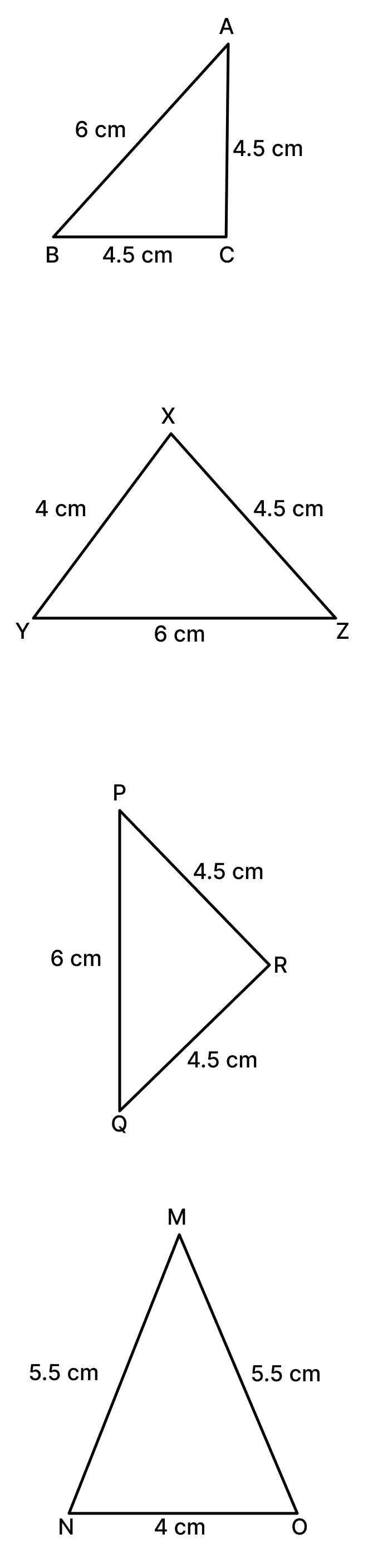
Which triangles are congruent?
- △ABC ≅ △XYZ
- △MNO ≅ △ABC
- △XYZ ≅ △MNO
- △ABC ≅ △PQR
Answer
The sides of the four triangles are:
△ABC : AB = 6 cm, BC = 4.5 cm, AC = 4.5 cm
△XYZ : XY = 4 cm, YZ = 6 cm, XZ = 4.5 cm
△PQR : PQ = 6 cm, QR = 4.5 cm, PR = 4.5 cm
△MNO : MN = 5.5 cm, NO = 4 cm, MO = 5.5 cm
Since the sides of △ABC and △PQR are the same, let's compare △ABC and △PQR :
AB = PQ = 6 cm [Side]
BC = QR = 4.5 cm [Side]
AC = PR = 4.5 cm [Side]
Since all three pairs of corresponding sides are equal, the triangles are congruent by the SSS condition of congruence.
∴ △ABC ≅ △PQR
The remaining pairs of triangles do not have all three sides equal, so they are not congruent.
Hence, Option 4 is the correct option.
Consider the triangle.
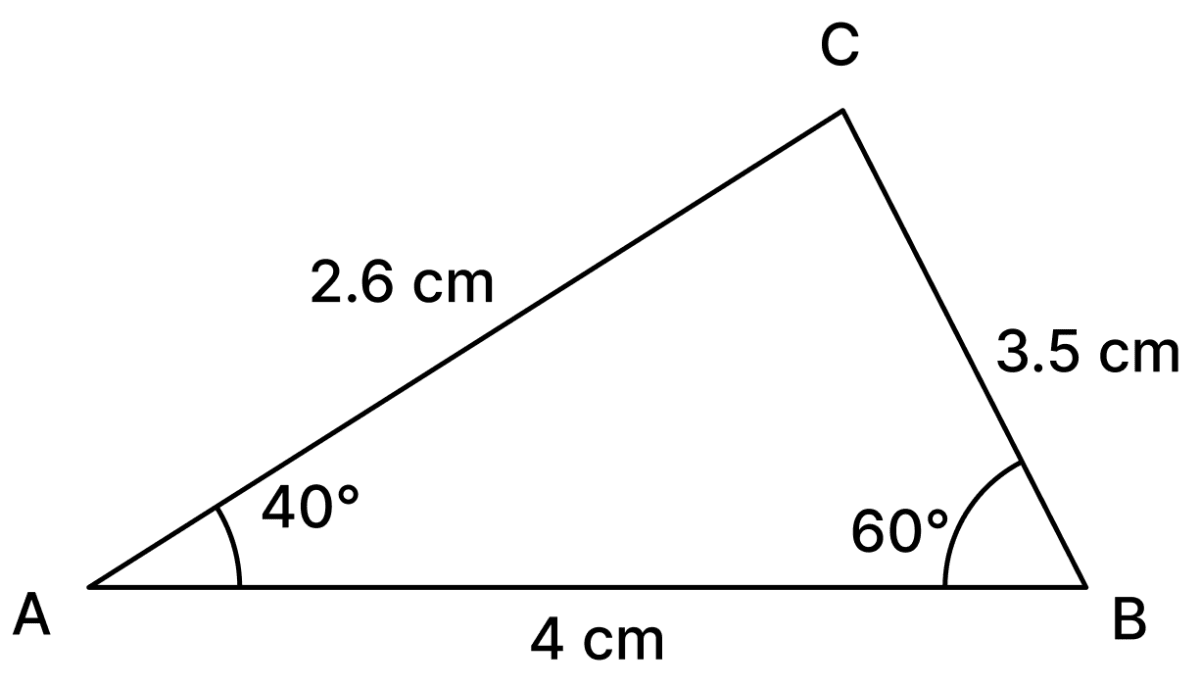
Which among the following is congruent to △ABC?
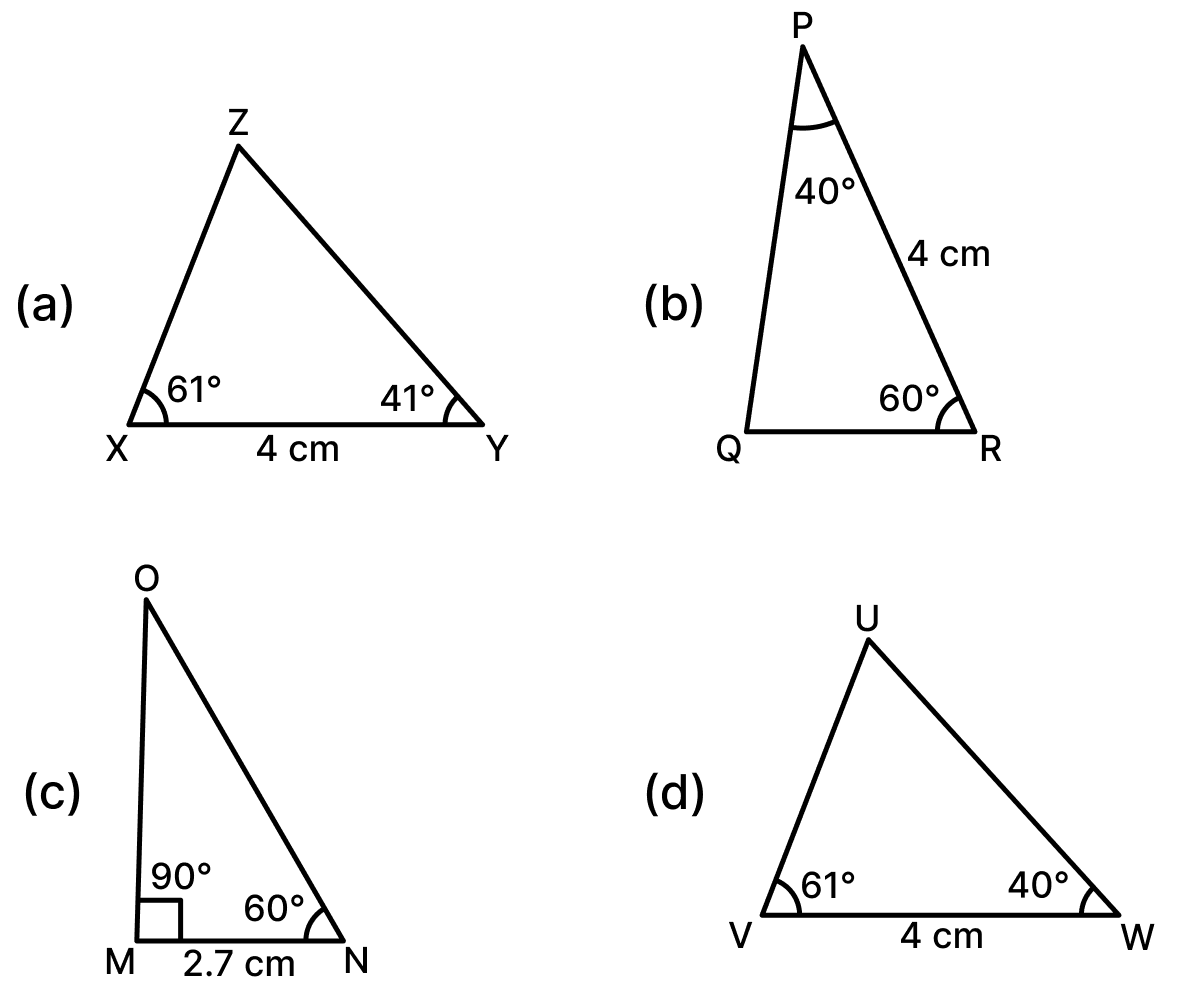
Answer
In △ABC :
∠A = 40°, ∠B = 60° and AB = 4 cm.
The side AB = 4 cm lies between the two given angles ∠A and ∠B.
Checking each option :
Option 1 (△XYZ) : ∠X = 61°, ∠Y = 41° and XY = 4 cm. The angles do not match those of △ABC, so it is not congruent to △ABC.
Option 2 (△PQR) : ∠P = 40°, ∠R = 60° and PR = 4 cm. The side PR = 4 cm lies between the two given angles ∠P and ∠R.
Comparing △ABC and △PRQ :
∠A = ∠P = 40° [Angle]
AB = PR = 4 cm [Side]
∠B = ∠R = 60° [Angle]
Since two angles and the included side are equal, the triangles are congruent by the ASA condition of congruence.
∴ △ABC ≅ △PRQ
Option 3 (△MNO) : ∠M = 90°, ∠N = 60° and MN = 2.7 cm. The angles and the side length do not match those of △ABC, so it is not congruent to △ABC.
Option 4 (△UVW) : ∠V = 61°, ∠W = 40° and VW = 4 cm. The angles do not match those of △ABC, so it is not congruent to △ABC.
Hence, Option 2 is the correct option.
ABCD and EFGH are squares:
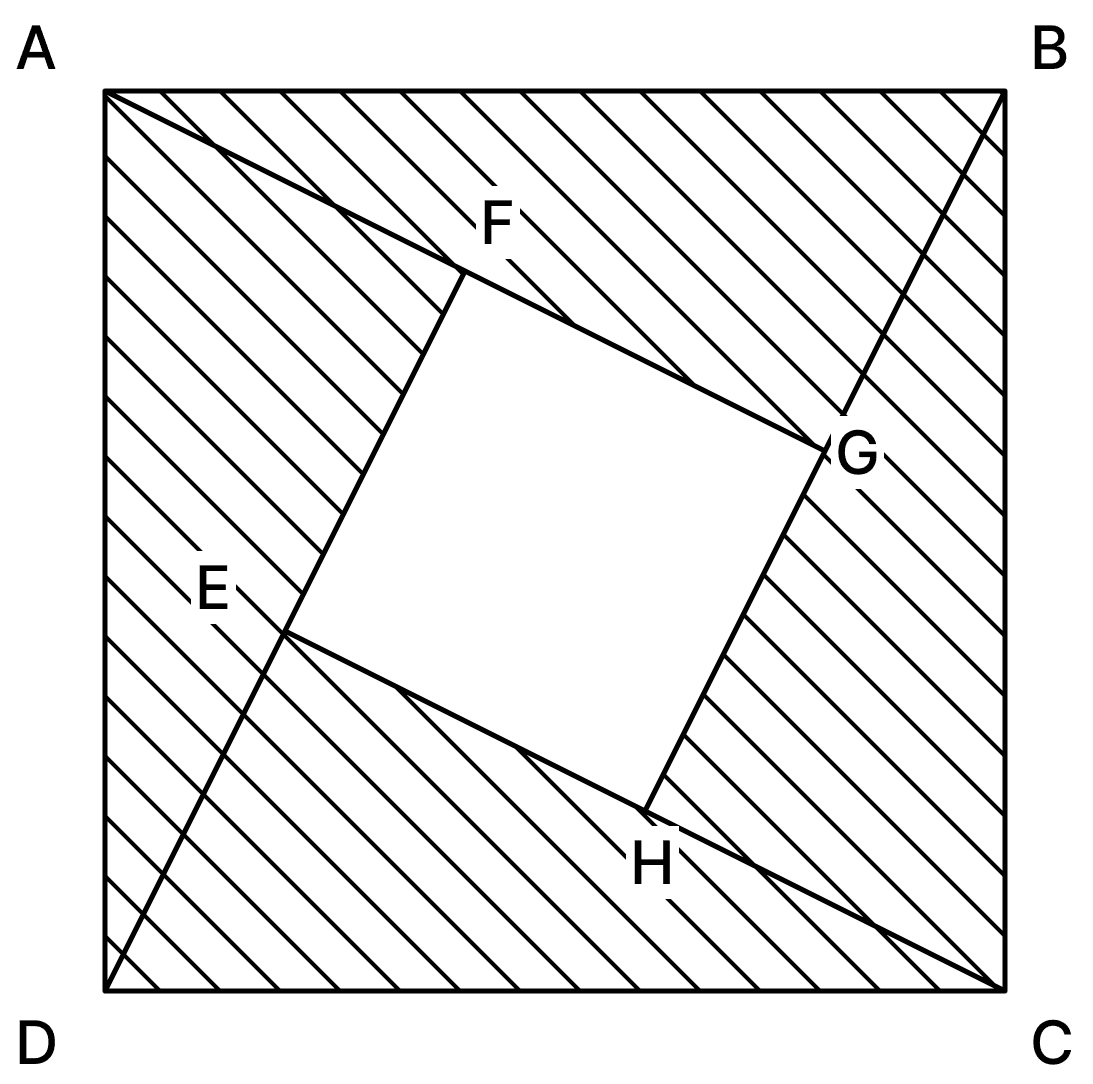
Which of the following is not true?
- △AGB ≅ △BHC
- △BHC ≅ △CED
- △CED ≅ △DFA
- △DFA ≅ △DEF
Answer
From the figure:
- A, F and G are collinear.
- B, G and H are collinear.
- C, H and E are collinear.
- D, E and F are collinear.
Since EFGH is a square, its adjacent sides are perpendicular. Therefore,
∠AGB = ∠BHC = ∠CED = ∠DFA = 90°
Also, since ABCD is a square,
AB = BC = CD = DA
Consider △AGB and △BHC:
∠AGB = ∠BHC = 90°
AB = BC
Also, ∠GAB = ∠HBC
because AG ⊥ BH and AB ⊥ BC.
∴ △AGB ≅ △BHC
by the AAS condition of congruence.
Similarly,
△BHC ≅ △CED
and
△CED ≅ △DFA.
Thus, options 1, 2 and 3 are true.
However, D, E and F are collinear. Hence, they do not form a triangle, so △DEF cannot be congruent to △DFA.
Hence, Option 4 is the correct option.