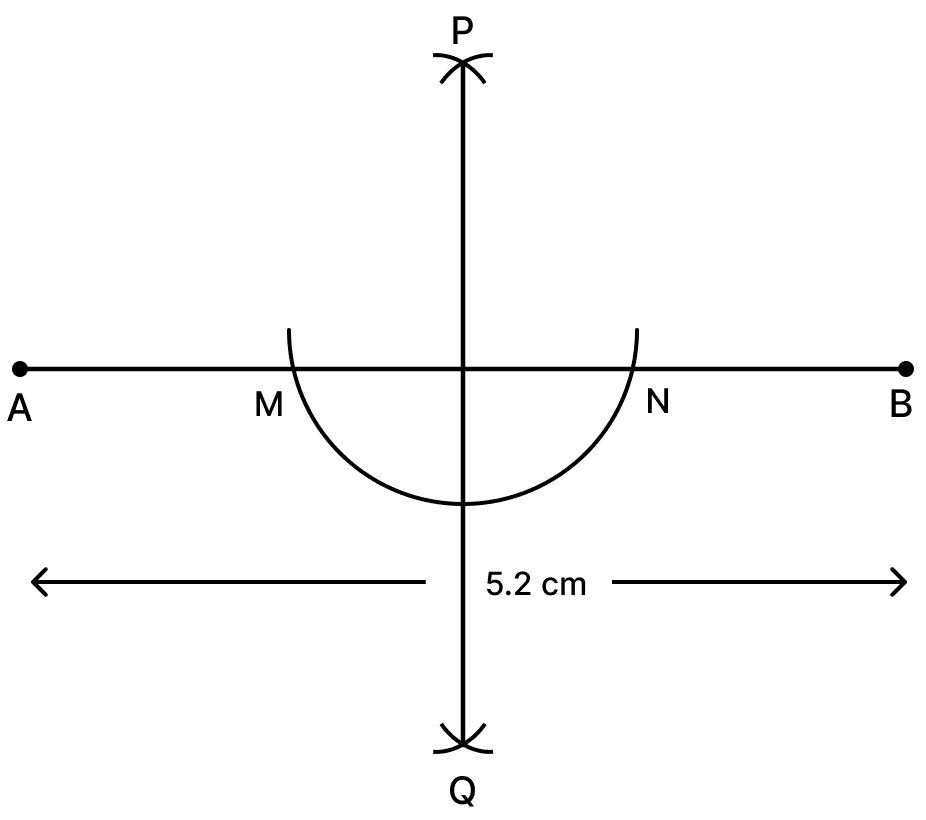
Draw a line segment AB = 5.2 cm. Draw a perpendicular to it from a point P outside line AB by using :
(i) ruler and compasses
(ii) ruler and set square
Answer
(i) ruler and compasses
Steps of construction:
- Draw a line segment AB = 5.2 cm using a ruler.
- Mark a point P outside the line AB.
- With P as centre and any convenient radius, draw an arc cutting AB at two points M and N.
- With M as centre and radius more than half of MN, draw an arc below AB.
- With N as centre and the same radius, draw another arc cutting the previous arc at Q.
- Join P and Q.
PQ ⟂ AB, so PQ is the required perpendicular.
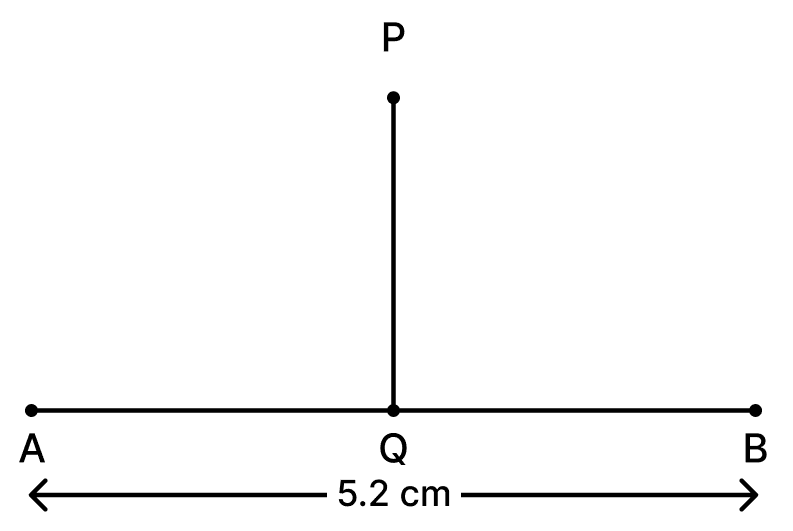
(ii) ruler and set square
Steps of construction:
- Draw a line segment AB = 5.2 cm.
- Mark a point P outside AB.
- Place a ruler along line AB.
- Place a set square such that one of its edges lies along AB.
- Slide the set square along the ruler until its perpendicular edge passes through point P.
- Draw a line PQ along that edge meeting AB at Q.
PQ ⟂ AB, hence required perpendicular is obtained
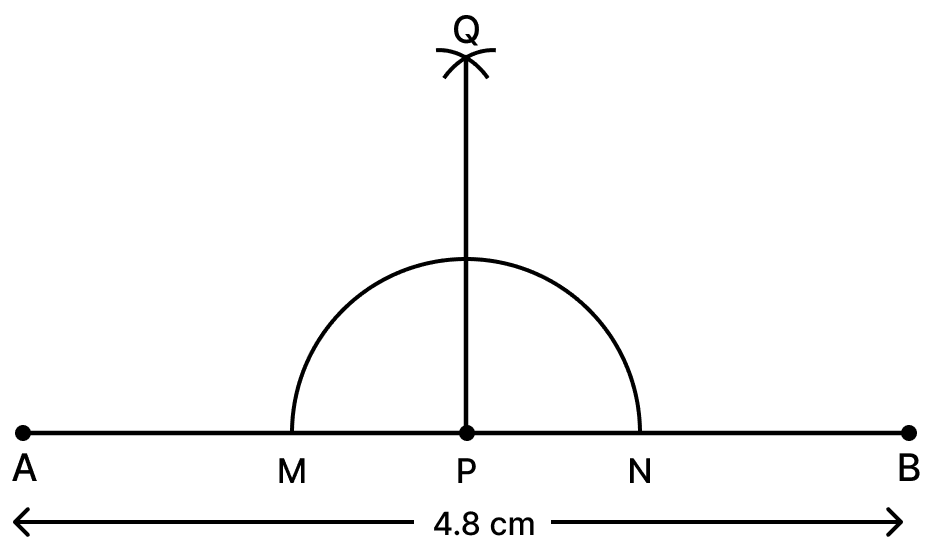
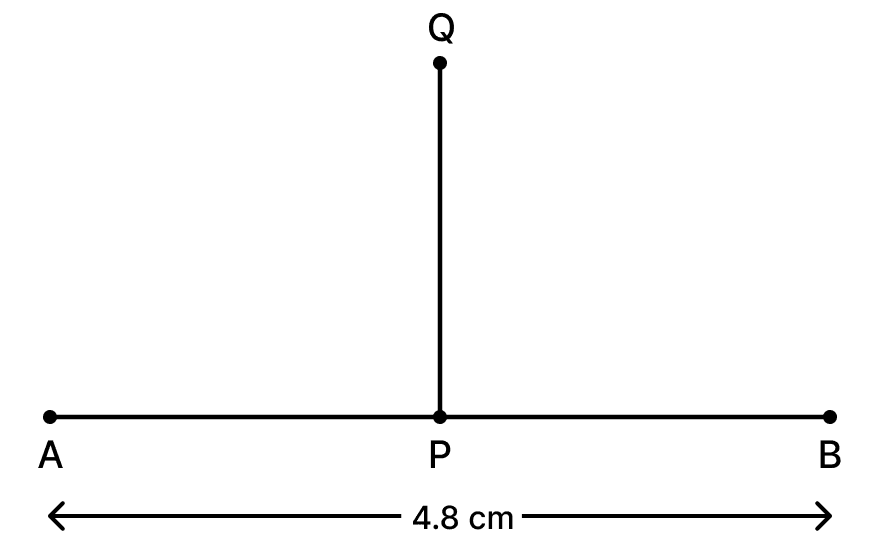
Draw a line segment AB = 4.8 cm. Take a point P on it such that BP = 2.3 cm. Draw a perpendicular to AB at point P using:
(i) ruler and compasses
(ii) ruler and set square
Answer
(i) ruler and compasses
Steps of construction:
- Draw a line segment AB = 4.8 cm using a ruler.
- Mark point P on AB such that BP = 2.3 cm.
- With P as centre and a convenient radius, draw an arc cutting AB at two points M and N.
- With M as centre and radius more than half of MN, draw an arc above AB.
- With N as centre and the same radius, draw another arc cutting the previous arc at Q.
- Join P and Q.
PQ ⟂ AB, so PQ is the required perpendicular at point P.
(ii) ruler and set square
Steps of construction:
- Draw a line segment AB = 4.8 cm.
- Mark point P such that BP = 2.3 cm.
- Place a ruler along line AB.
- Place a set square so that one of its edges coincides with AB.
- Adjust the set square so that its perpendicular edge passes through P.
- Draw a line PQ along that edge.
PQ ⟂ AB, hence required perpendicular is obtained.
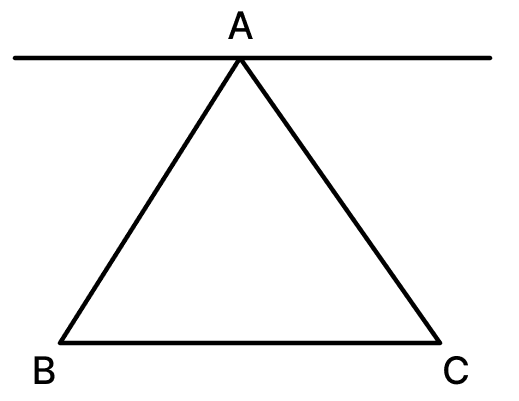
Draw any triangle ABC. Through A, draw a line parallel to BC using :
(i) ruler and compasses
(ii) ruler and set square
Answer
Steps of construction:
(i) ruler and compasses
Steps of construction:
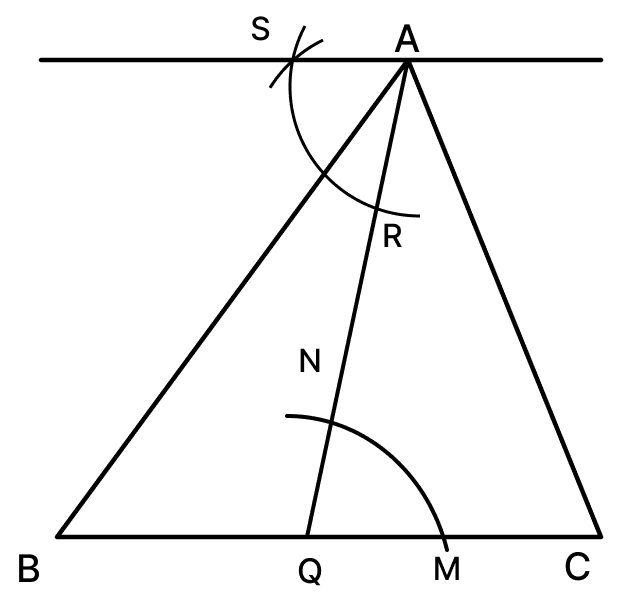
- Draw any triangle ABC.
- Take any point Q on BC. Join A and Q.
- With Q as centre and any convenient radius draw an arc cutting BC at M and AQ at N.
- With the same radius and A as centre, draw an arc cutting AQ at R.
- Take radius = MN and with R as centre, draw an arc cutting the existing arc at S. Join A and S.
(ii) ruler and set square
- Draw any triangle ABC.
- Place a set square such that one of its shorter edges lies along line BC.
- Place a ruler vertically such that one of its edges just lies along and touches the standing edge of the set square.
- Hold the ruler firmly and slide the set square along it until its horizontal edge just passes through point A.
- Draw the line through A along the edge of the set square.
Construct a △ABC such that :
(i) AB = 5 cm, BC = 4.6 cm and AC = 4.3 cm
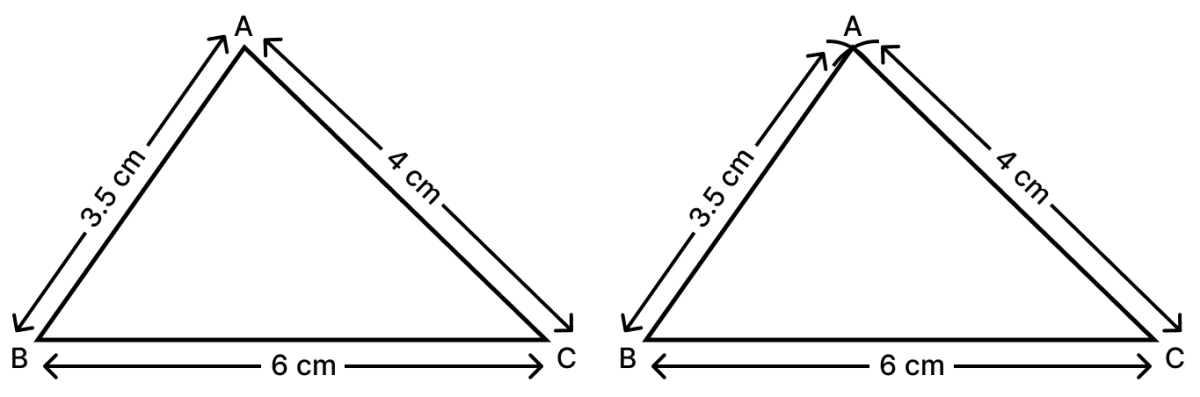
(ii) BC = 6 cm, CA = 4 cm and AB = 3.5 cm
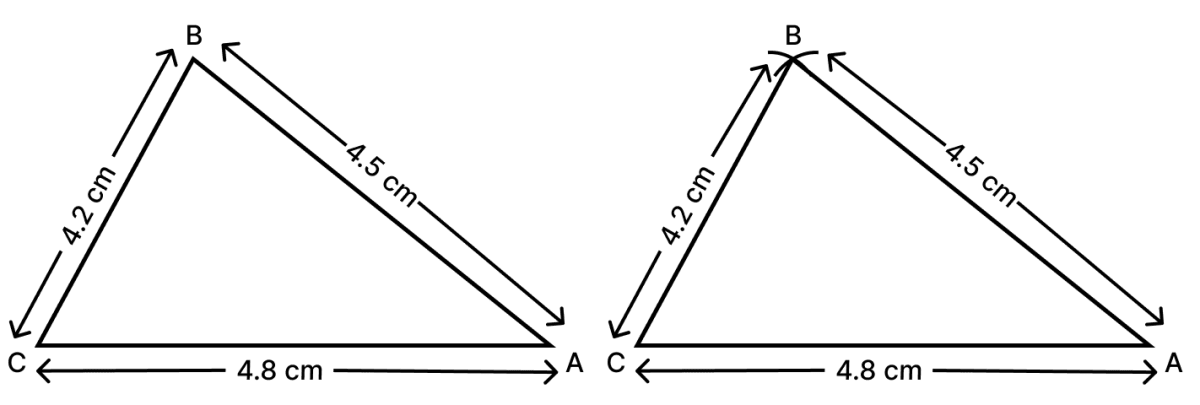
(iii) CA = 4.8 cm, CB = 4.2 cm and AB = 4.5 cm
Answer
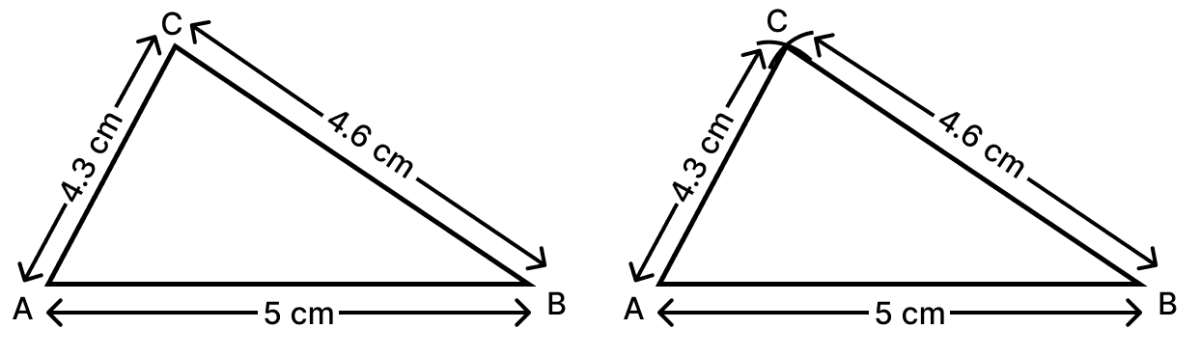
(i) AB = 5 cm, BC = 4.6 cm and AC = 4.3 cm
Steps of construction:
- Draw AB = 5 cm.
- With A as centre and radius 4.3 cm (AC), draw an arc.
- With B as centre and radius 4.6 cm (BC), draw another arc cutting the first arc at C.
- Join AC and BC.
Then, △ABC is the required triangle.
(ii) BC = 6 cm, CA = 4 cm and AB = 3.5 cm
Steps of construction:
- Draw BC = 6 cm.
- With B as centre and radius 3.5 cm (AB), draw an arc.
- With C as centre and radius 4 cm (CA), draw another arc cutting the first arc at A.
- Join AB and AC.
Then, △ABC is the required triangle.
(iii) CA = 4.8 cm, CB = 4.2 cm and AB = 4.5 cm
Steps of construction:
- Draw CA = 4.8 cm.
- With C as centre and radius 4.2 cm (CB), draw an arc.
- With A as centre and radius 4.5 cm (AB), draw another arc cutting the first arc at B.
- Join AB and BC.
Then, △ABC is the required triangle.
Construct a △ABC such that :
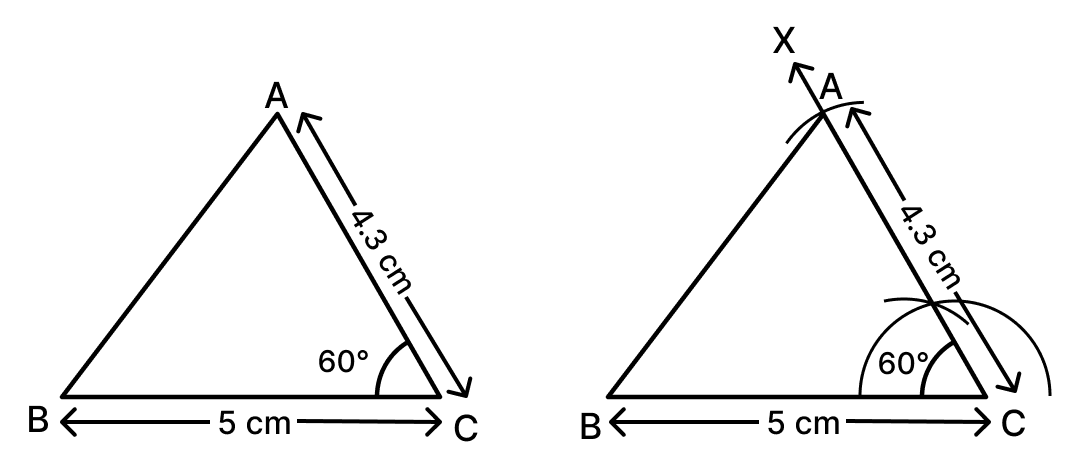
(i) BC = 5 cm, ∠BCA = 60° and CA = 4.3 cm.
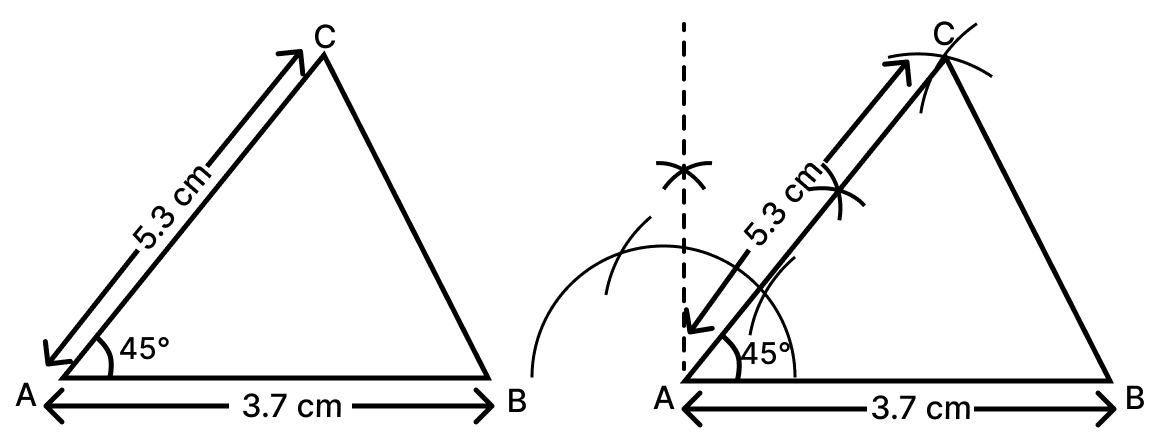
(ii) AB = 3.7 cm, ∠A = 45° and AC = 5.3 cm.
Answer
(i) BC = 5 cm, ∠BCA = 60° and CA = 4.3 cm.
Steps of Construction:
- Draw BC = 5 cm.
- At point C, construct an angle of 60°.
- With C as centre and radius 4.3 cm, draw an arc cutting the ray CX at A.
- Join A to B.
Then, △ABC is the required triangle.
(ii) AB = 3.7 cm, ∠A = 45° and AC = 5.3 cm.
Steps of Construction:
- Draw AB = 3.7 cm.
- At point A, construct an angle of 45°.
- With A as centre and radius 5.3 cm, draw an arc cutting the ray AX at C.
- Join B to C.
Then, △ABC is the required triangle.
Construct a △XYZ such that :
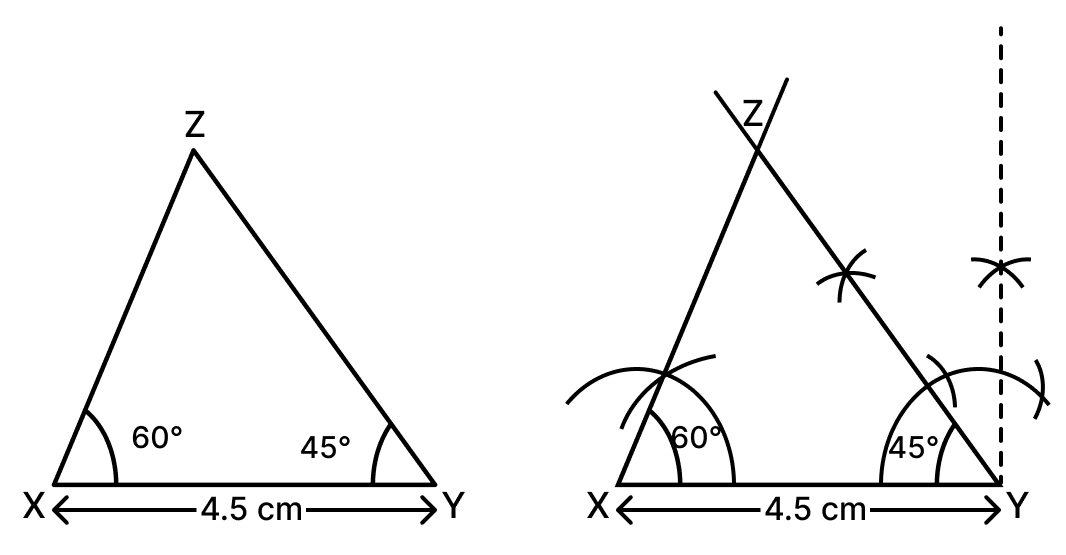
(i) XY = 4.5 cm, ∠X = 60° and ∠Y = 45°.
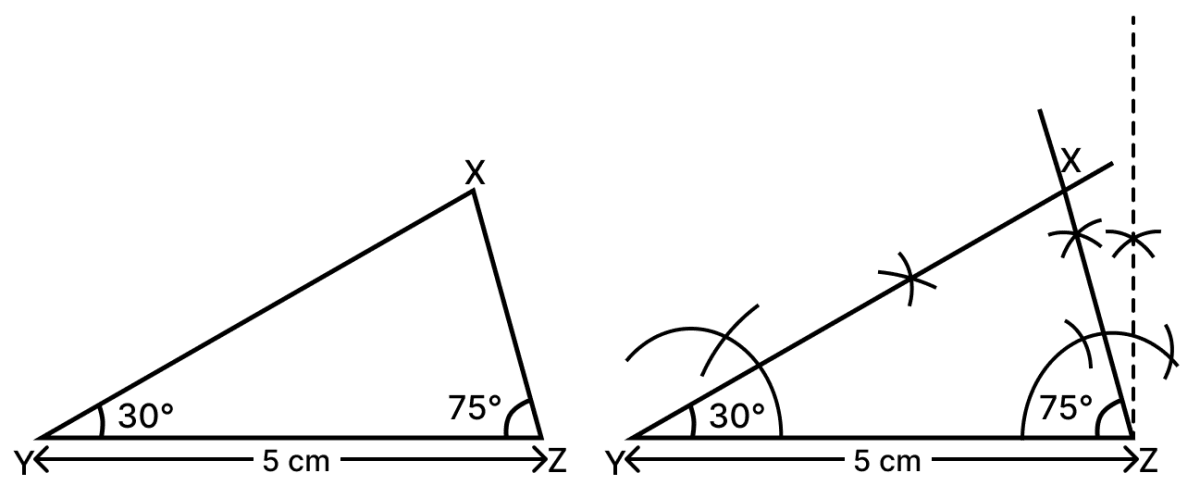
(ii) YZ = 5 cm, ∠ZYX = 30° and ∠YZX = 75°.
Answer
(i) XY = 4.5 cm, ∠X = 60° and ∠Y = 45°.
Steps of Construction:
- Draw a line segment XY = 4.5 cm.
- At point X, construct an angle of 60°.
- At point Y, construct an angle of 45°.
- Let the two rays intersect at point Z.
- Join ZX and ZY.
Then, △XYZ is the required triangle.
(ii) YZ = 5 cm, ∠ZYX = 30° and ∠YZX = 75°.
Steps of Construction:
- Draw a line segment YZ = 5 cm.
- At point Y, construct an angle of 30°.
- At point Z, construct an angle of 75°.
- Let the two rays intersect at point X.
- Join XY and XZ.
Then, △XYZ is the required triangle.
Construct an isosceles △ABC such that :
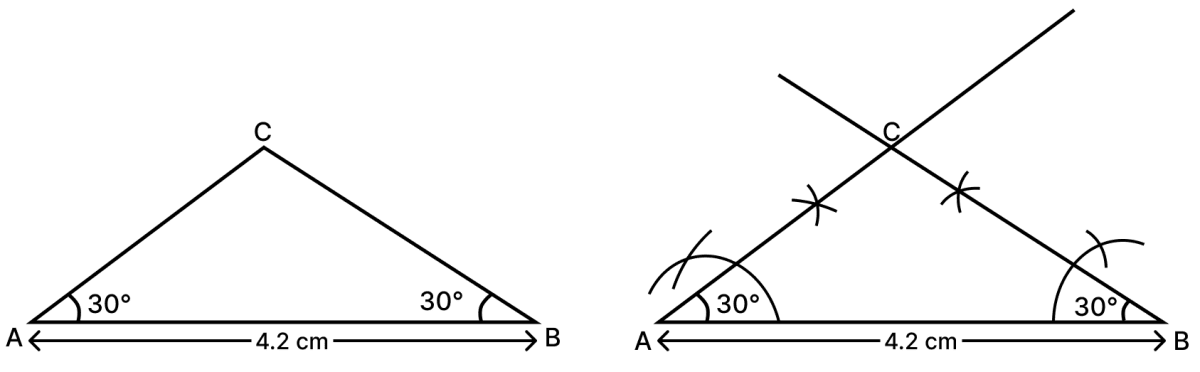
(i) base AB = 4.2 cm, base angle = 30°.
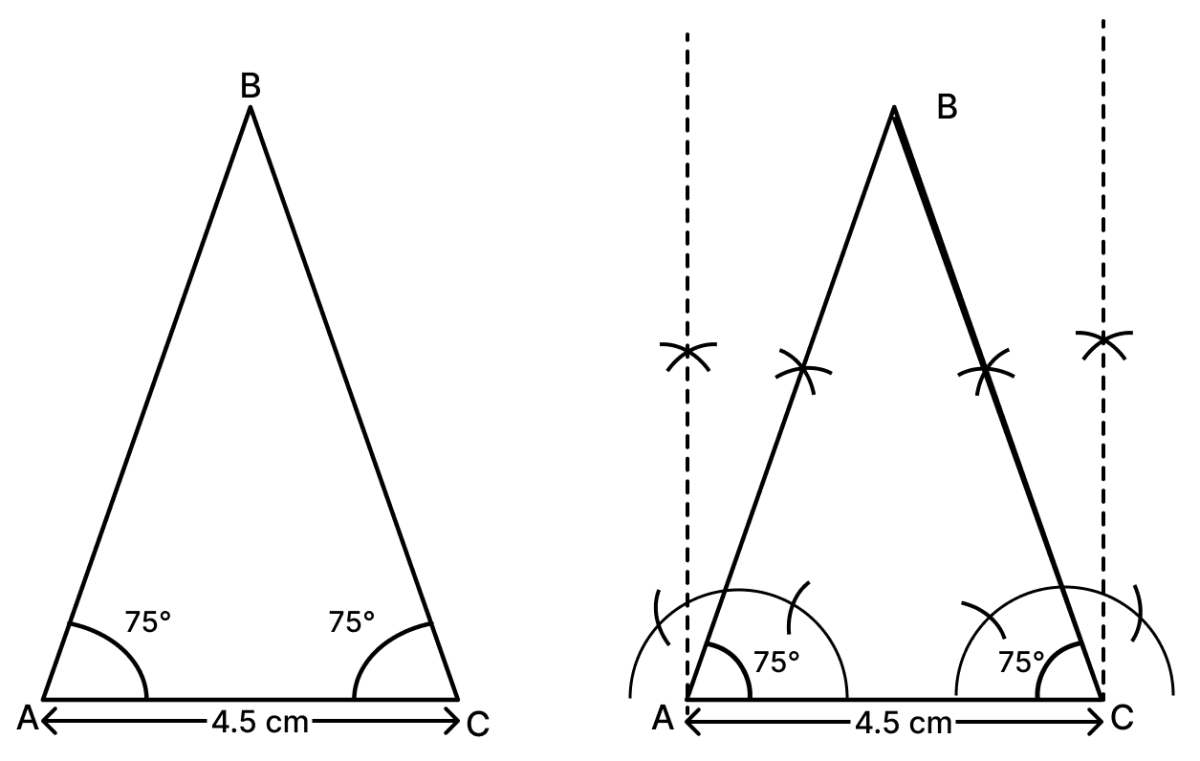
(ii) base AC = 4.5 cm, base angle = 75°.
Answer
(i) base AB = 4.2 cm, base angle = 30°.
Steps of Construction:
- Draw a line segment AB = 4.2 cm.
- At point A, construct an angle of 30°.
- At point B, construct an angle of 30°.
- Let the two rays intersect at point C.
- Join AC and BC.
Then, △ABC is the required isosceles triangle.
(ii) base AC = 4.5 cm, base angle = 75°.
Steps of Construction:
- Draw a line segment AC = 4.5 cm.
- At point A, construct an angle of 75°.
- At point C, construct an angle of 75°.
- Let the two rays intersect at point B.
- Join AB and BC.
Then, △ABC is the required isosceles triangle.
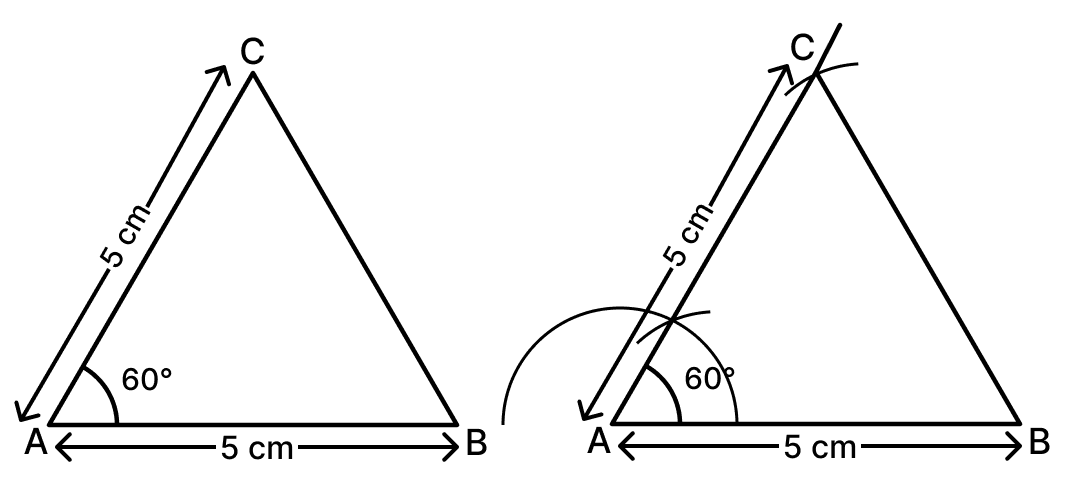
Construct an isosceles △ABC such that AB = AC = 5 cm and ∠A = 60°.
Answer
Steps of Construction:
- Draw a line segment AB = 5 cm.
- At point A, construct an angle of 60°.
- On this ray, mark point C such that AC = 5 cm.
- Join BC.
Then, △ABC is the required isosceles triangle.
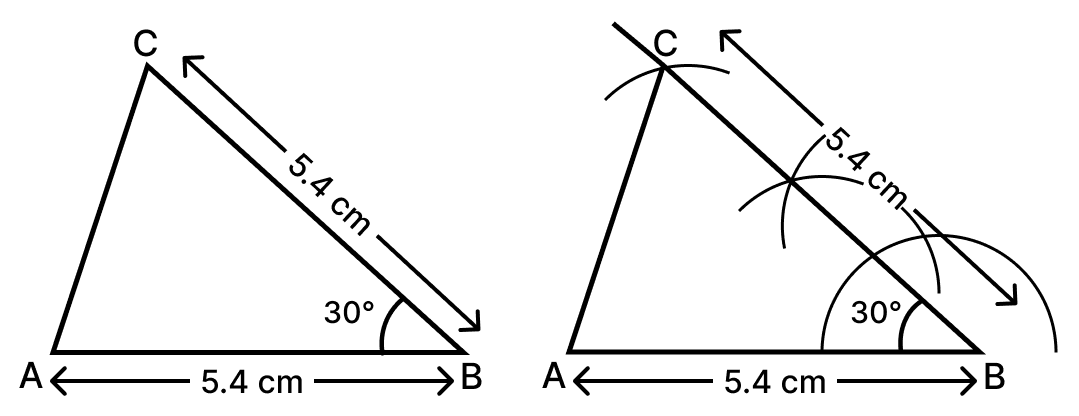
Construct an isosceles △ABC such that AB = BC = 5.4 cm and ∠B = 30°.
Answer
Steps of Construction:
- Draw a line segment AB = 5.4 cm.
- At point B, construct an angle of 30°.
- On this ray, mark point C such that BC = 5.4 cm.
- Join AC.
Then, △ABC is the required isosceles triangle.
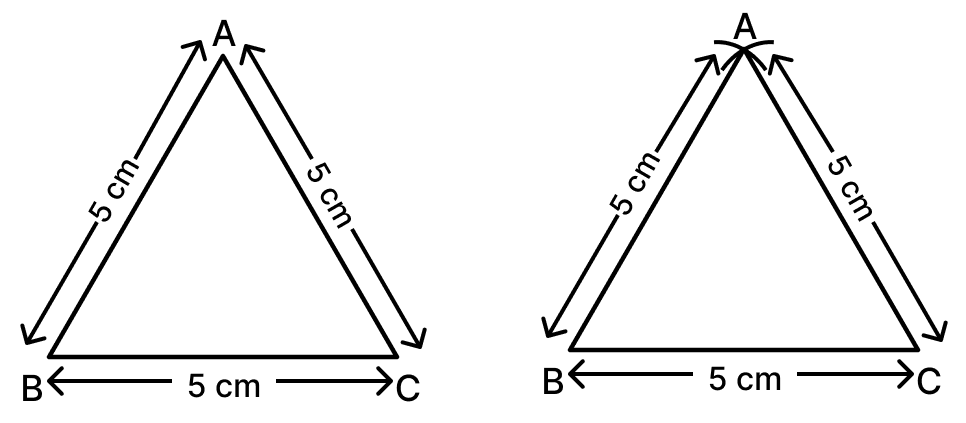
Construct an equilateral △ABC in which BC = 5 cm.
Answer
Steps of Construction:
- Draw a line segment BC = 5 cm.
- With B as centre and radius 5 cm, draw an arc.
- With C as centre and radius 5 cm, draw another arc cutting the first arc at A.
- Join AB and AC.
Then, △ABC is the required equilateral triangle.
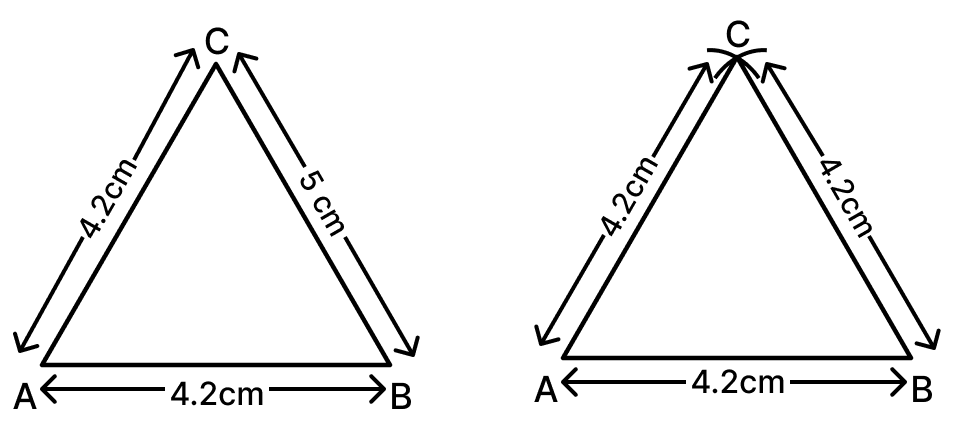
Construct an equilateral △ABC such that AB = 4.2 cm.
Answer
Steps of Construction:
- Draw a line segment AB = 4.2 cm.
- With A as centre and radius 4.2 cm, draw an arc.
- With B as centre and radius 4.2 cm, draw another arc cutting the first arc at C.
- Join AC and BC.
Then, △ABC is the required equilateral triangle.
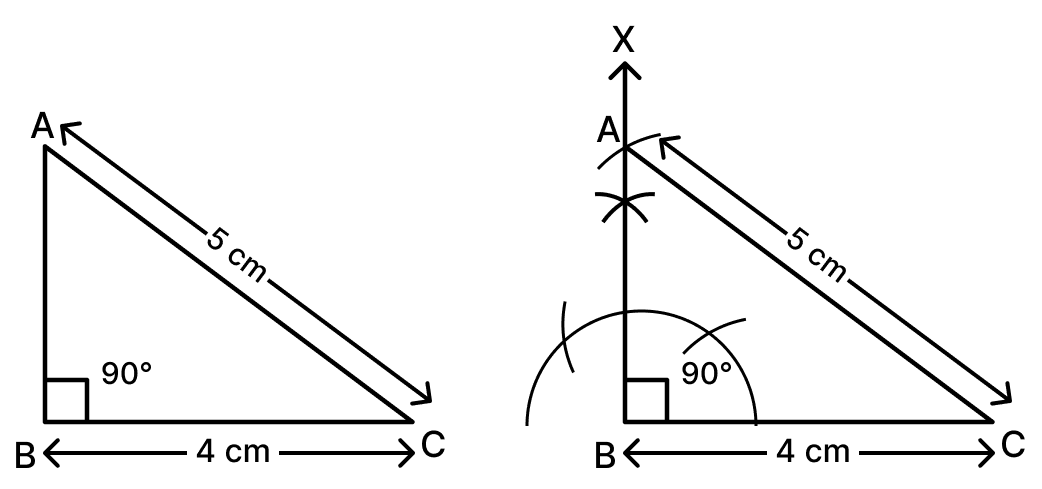
Construct a right angled △ABC in which ∠B = 90°, BC = 4 cm and hypotenuse CA = 5 cm.
Answer
Steps of Construction:
- Draw a line segment BC = 4 cm.
- At point B, construct ∠CBX = 90°.
- With C as centre and radius 5 cm, draw an arc cutting the perpendicular at A.
- Join AC.
Then, △ABC is the required triangle.
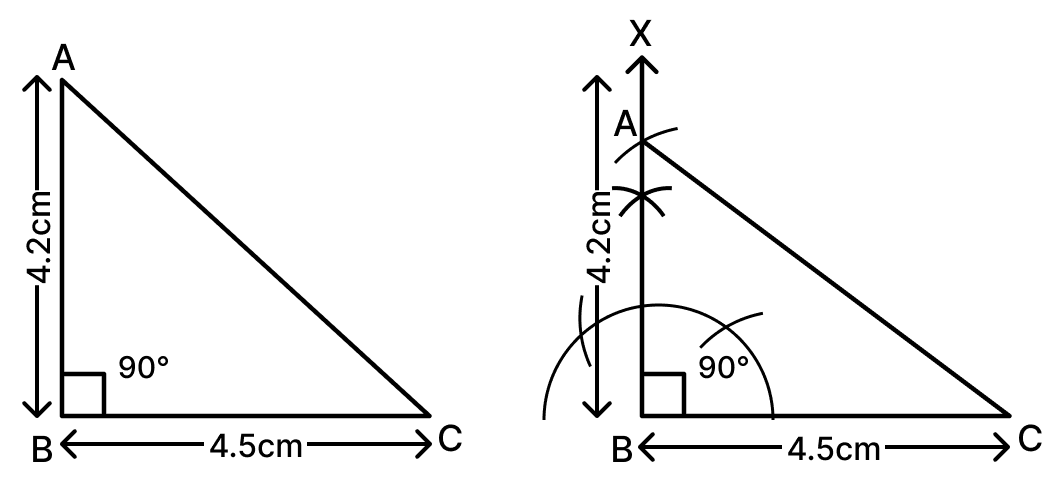
Construct a right angled △ABC in which AB = 4.2 cm, BC = 4.5 cm and ∠B = 90°.
Answer
Steps of Construction:
- Draw a line segment BC = 4.5 cm.
- At point B, construct ∠CBX = 90°.
- On the perpendicular line, mark point A such that AB = 4.2 cm.
- Join AC.
Then, △ABC is the required triangle.