
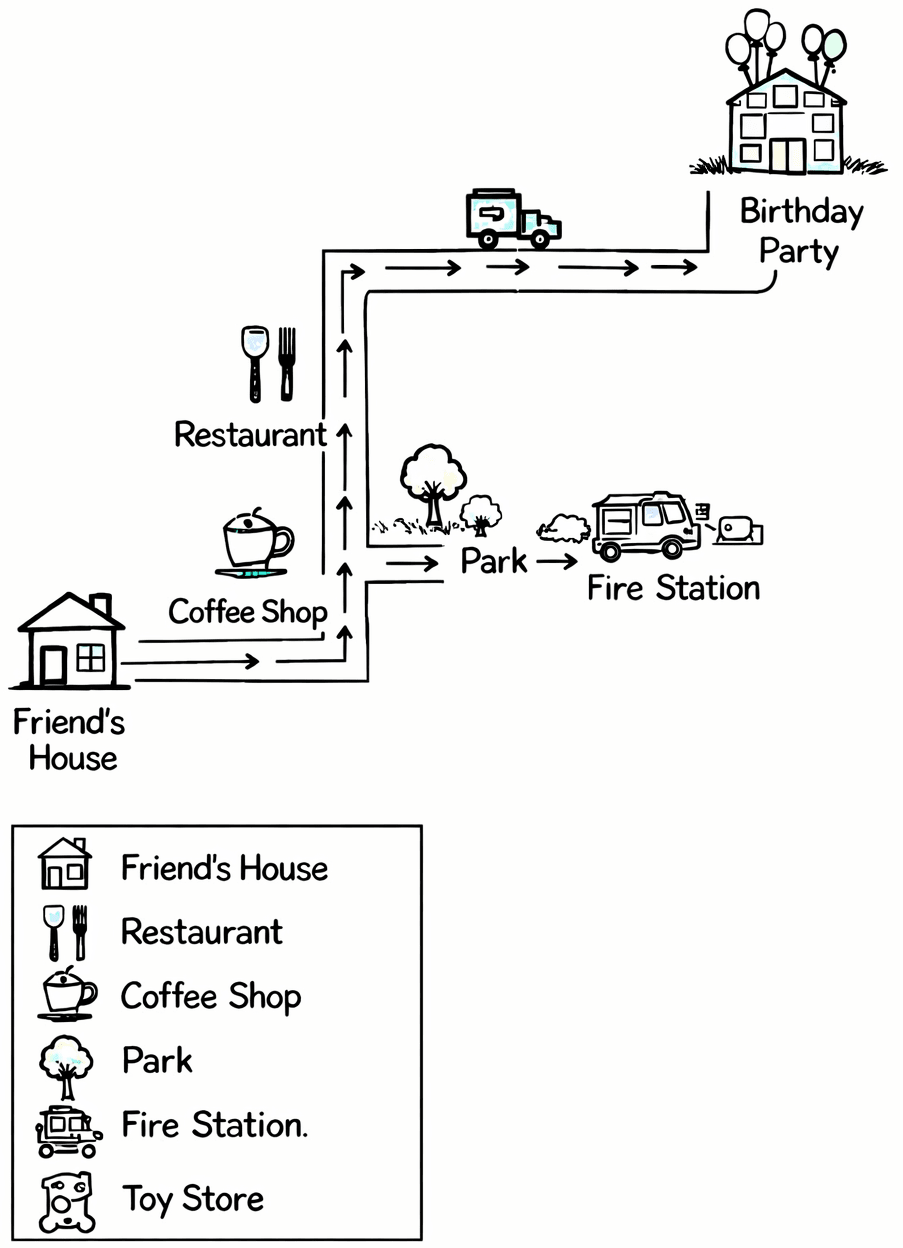
Draw a map to guide your friend telling him the way from his home to the venue of your birthday party. Use suitable symbols.
Answer
The map showing the way my friend's home to the venue of my birthday party is shown below:
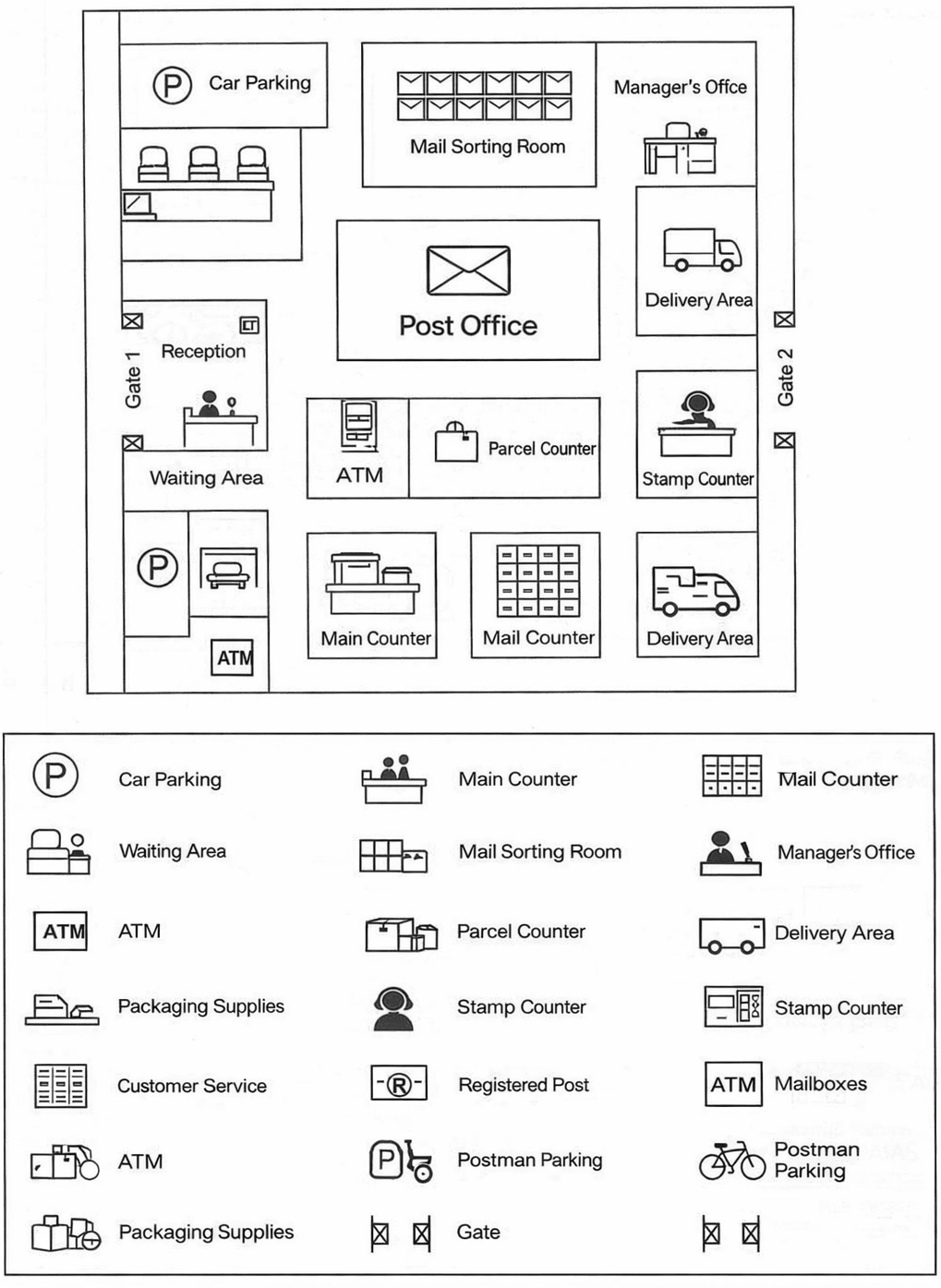
Draw a map of the post office near your house.
Answer
Map of the post office is shown below:
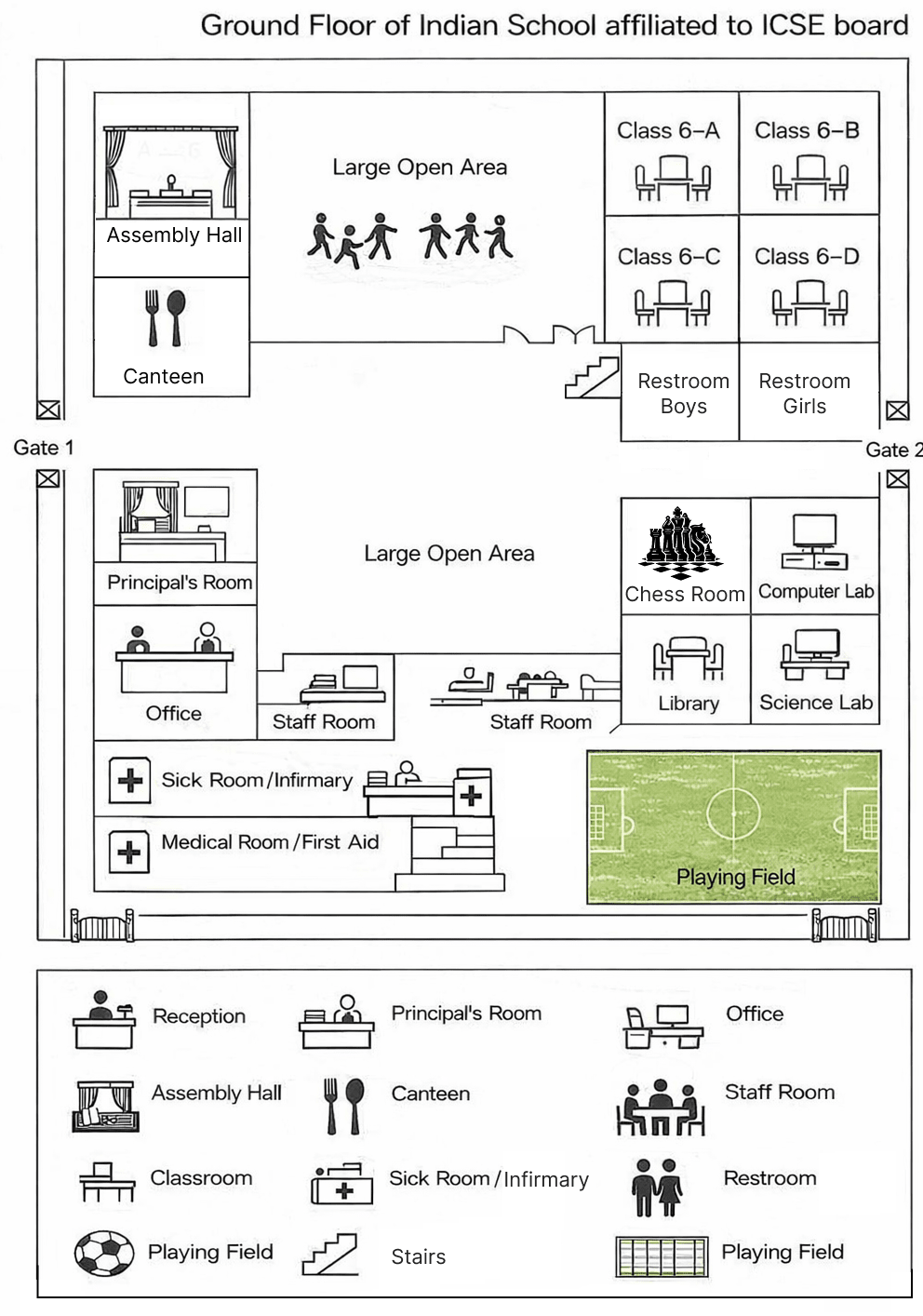
Draw a map of the ground floor of your school.
Answer
Map of the ground floor of my school is shown below:
Assertion: A rectangular pyramid has 5 rectangular faces.
Reason: A pyramid is named according to its polygonal base.
- Both Assertion (A) and Reason (R) are true and Reason (R) is the correct explanation of Assertion (A).
- Both Assertion (A) and Reason (R) are true and Reason (R) is not the correct explanation of Assertion (A).
- Assertion (A) is true but Reason (R) is false.
- Assertion (A) is false but Reason (R) is true.
Answer
Assertion (A) is false but Reason (R) is true.
Explanation
A rectangular pyramid has only one rectangular face, which is its base. The other 4 faces are triangular and meet at a common vertex (the apex). Thus, it has 5 faces in all, but they are not all rectangular.
So, Assertion (A) is false.
A pyramid is named according to the shape of its base, such as triangular pyramid, rectangular pyramid, or pentagonal pyramid.
So, Reason (R) is true.
Hence, option 4 is the correct option.
Assertion: A cone is not a polyhedron.
Reason: A solid shape made up of polygonal regions, which are its faces, is called a polyhedron.
- Both Assertion (A) and Reason (R) are true and Reason (R) is the correct explanation of Assertion (A).
- Both Assertion (A) and Reason (R) are true and Reason (R) is not the correct explanation of Assertion (A).
- Assertion (A) is true but Reason (R) is false.
- Assertion (A) is false but Reason (R) is true.
Answer
Both Assertion (A) and Reason (R) are true and Reason (R) is the correct explanation of Assertion (A).
Explanation
A cone is not a polyhedron because it has a curved surface.
So, Assertion (A) is true.
The definition of a polyhedron is a solid bounded by flat polygonal faces (like squares, triangles, or rectangles).
So, Reason (R) is true.
Hence, option 1 is the correct option.
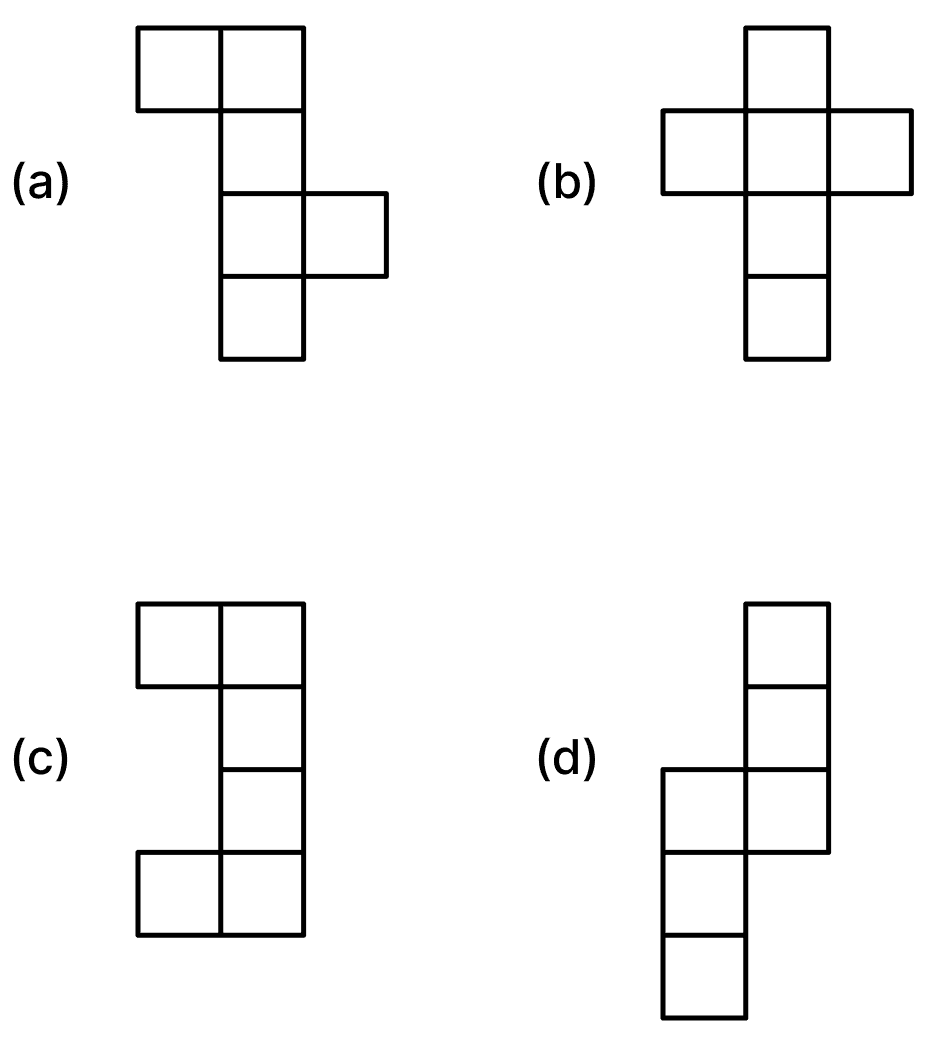
Which of the following nets cannot make a cube?
Answer
To check which net cannot make a cube, imagine folding the squares along the edges.
- A valid cube net must fold into 6 different faces without overlapping.
Let's analyze each option:
Option A: This is a classic "1-3-1-1" style net. The faces fold perfectly around the central 3-square column, with the top-left and middle-right squares folding up to form the top and bottom lids.
Option B: This is the standard, most recognizable "Latin Cross" net (a 1-4-1 configuration). The central column of 4 forms the four sides, and the two wings fold up to form the remaining two opposite faces.
Option C: Both horizontal extensions are on the same side (the left) of the central vertical line. When folded, these squares will overlap each other, leaving the right side of the cube completely wide open.
Option D: This is a "3-3" zig-zag style net (often referred to as a step net). When folded, the faces shift perfectly into position without overlapping to form a complete cube.
(a), (b), and (d) all have balanced faces on opposite sides that fold cleanly without overlapping to cover all 6 sides of a cube.
Therefore, (c) cannot make a cube.
Hence, option 3 is the correct option.
The net of a die is shown.
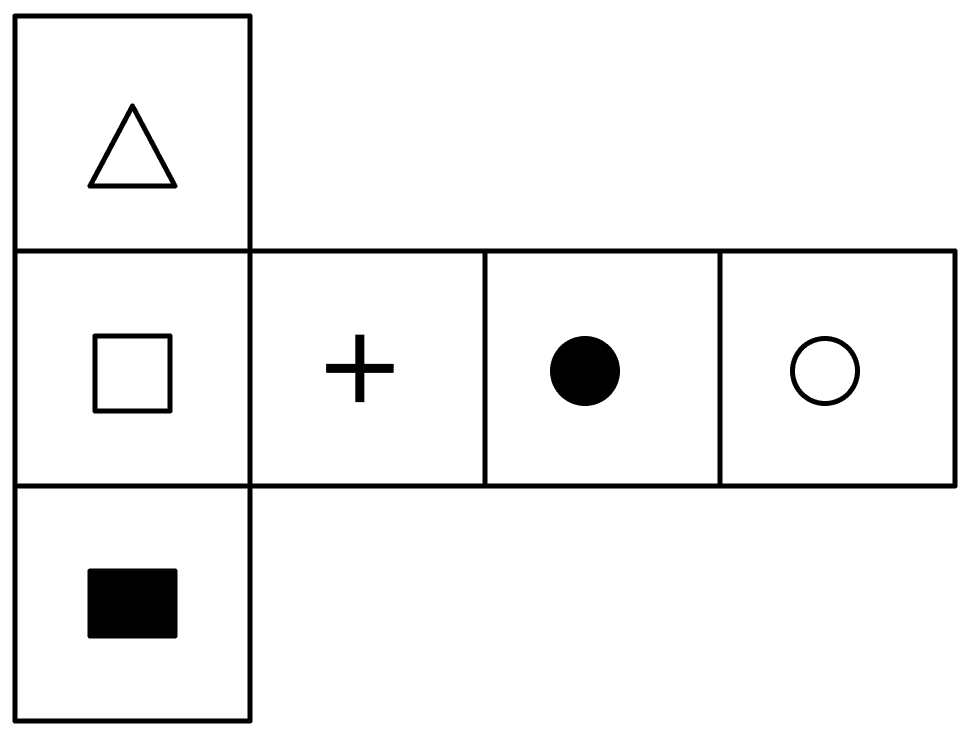
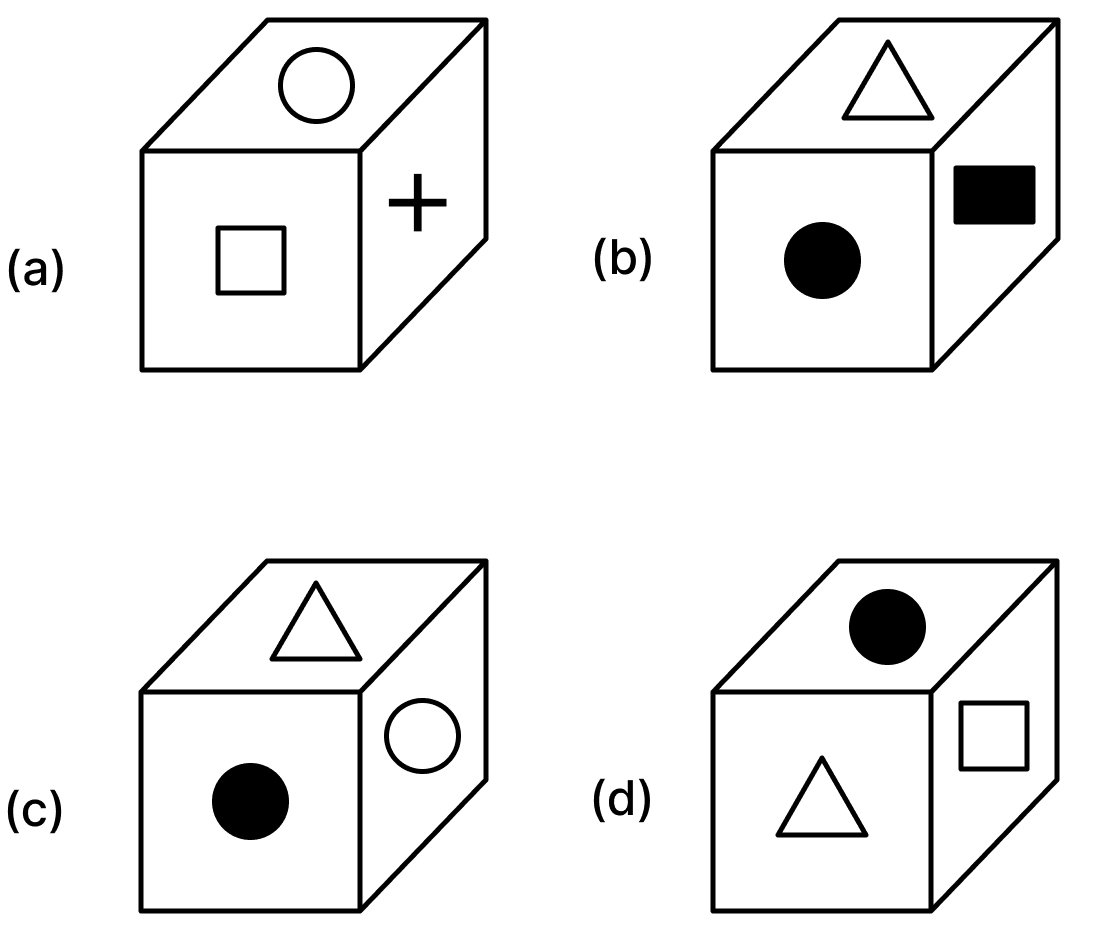
Which of the following dice can be formed using the given net?
Answer
From the given net, the pairs of opposite faces of the die are :
- □ lies opposite •
- △ lies opposite ▬
Now, examining each option :
Option 1 : ○ is shown on the top and + is shown on a visible side. Since ○ and + lie on opposite faces, they cannot both be visible at the same time. So, option 1 is incorrect.
Option 2 : △ is shown on the top and ▬ is shown on a visible side. Since △ and ▬ lie on opposite faces, they cannot both be visible at the same time. So, option 2 is incorrect.
Option 4 : • is shown on the top and □ is shown on a visible side. Since • and □ lie on opposite faces, they cannot both be visible at the same time. So, option 4 is incorrect.
Option 3 : △ is shown on the top, • on the front, and ○ on the right side. None of these are pairs of opposite faces, and this arrangement is consistent with the way the given net folds into a cube.
Hence, option 3 is the correct option.
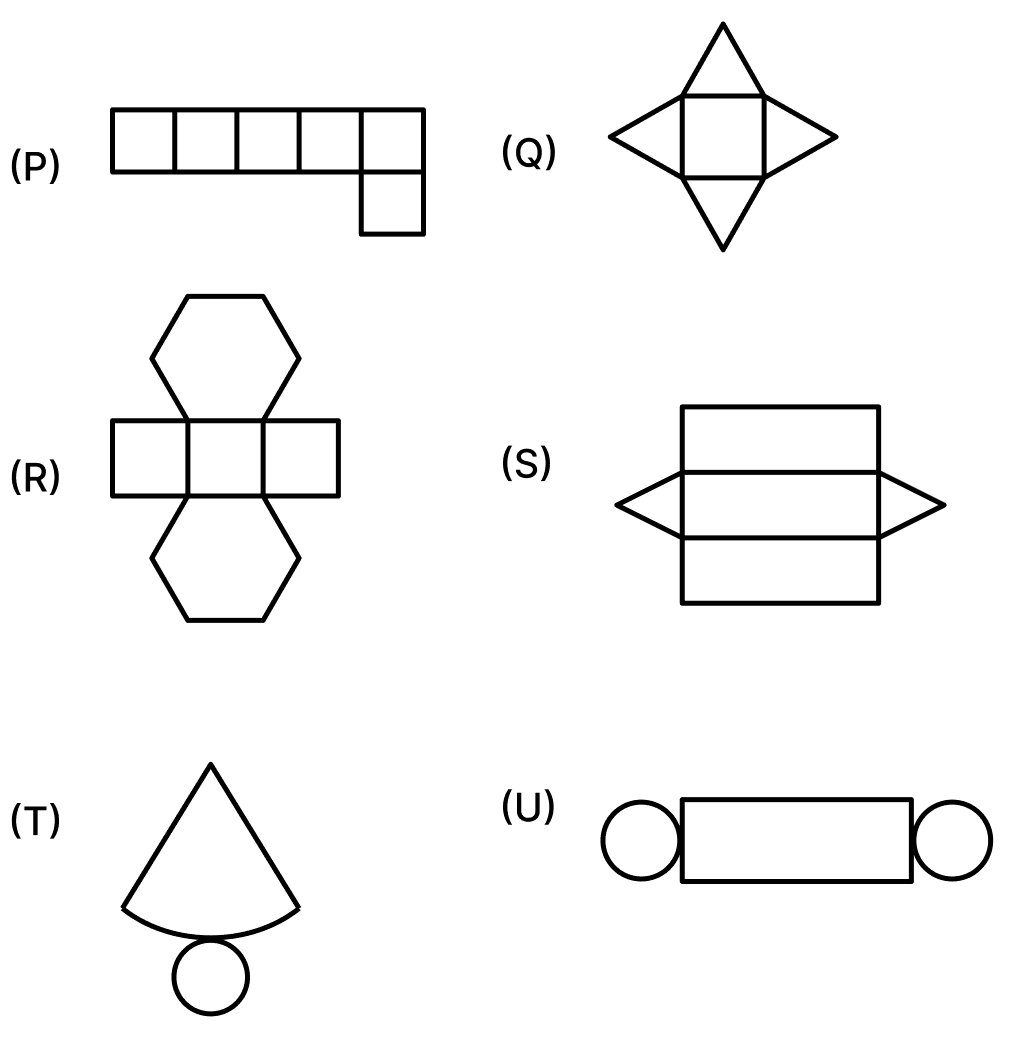
Which of the following is the net of a solid?
- (Q) and (S) only
- (P), (Q) and (T) only
- (Q), (S), (T) and (U) only
- All of these
Answer
Let us examine each figure one by one.
- (P): This figure has 6 squares, but 5 of them are in one straight row. When folded, some faces overlap, so it cannot form a solid cube. Hence, (P) is not a net of a solid.
- (Q): This figure has 1 square and 4 triangles attached to it. When folded, the square becomes the base and the triangles form the side faces. So, it forms a square pyramid. Hence, (Q) is a net of a solid.
- (R): This figure has 2 hexagons and only 3 rectangles. To form a hexagonal prism, we need 2 hexagons and 6 rectangles. So, (R) is not a net of a solid.
- (S): This figure has 3 rectangles and 2 triangles. These fold to form a triangular prism. Hence, (S) is a net of a solid.
- (T): This figure has a sector of a circle and a circle. These fold to form a cone. Hence, (T) is a net of a solid.
- (U): This figure has 1 rectangle and 2 circles. These fold to form a cylinder. Hence, (U) is a net of a solid.
Therefore, only (Q), (S), (T) and (U) are nets of solids.
Hence, option 3 is the correct option.
Himani gives toy erasers as return gifts for her birthday. One of the erasers is shown below.
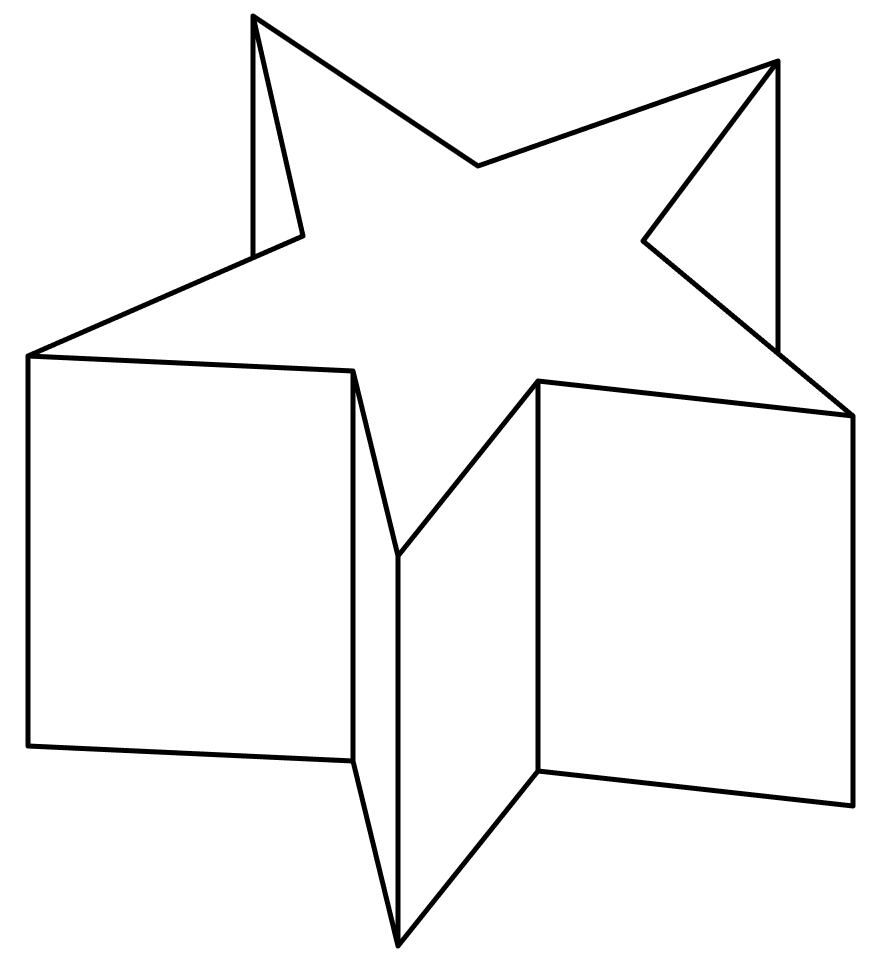
How many edges are there?
- 17
- 25
- 30
- 35
Answer
The eraser is shaped like a 3D 5-pointed star prism (a star shape with thickness).
A 5-pointed star has 10 vertices along its outline — 5 outer points (the tips of the star) and 5 inner points (where adjacent star arms meet). So, each star-shaped face has 10 edges.
The 3D star prism has :
- 10 edges along the outline of the front star-shaped face
- 10 edges along the outline of the back star-shaped face
- 10 edges connecting the corresponding vertices of the front face to the back face
Total number of edges = 10 + 10 + 10 = 30.
Hence, option 3 is the correct option.