
Which of the following fractions can be expressed as a mixed fraction?
Answer
A fraction can be expressed as a mixed fraction only if it is an improper fraction (numerator > denominator).
Hence, option 3 is the correct option.
Which of the following is an improper fraction?
Answer
An improper fraction has numerator greater than denominator.
Hence, option 2 is the correct option.
Three-fourths of 3 is
- a unit fraction
- a proper fraction
- an improper fraction
- not a fraction
Answer
Given:
Three-fourths of 3
= of 3
= 3 =
where numerator > denominator, therefore it is an improper fraction.
Hence, option 3 is the correct option.
If the cost of a pen is ₹, then, the cost of 60 pens will be
- ₹960
- ₹480
- ₹500
- ₹1000
Answer
Given:
Cost of 1 pen = ₹
Number of pens = 60
Cost of 60 pens = ?
Cost of 60 pens = (Cost of 1 pen) x (Number of pens)
Substituting the values in above, we get:
Cost of 60 pens = ₹ x 60
= ₹ x 60 = ₹ = ₹1000
Hence, option 4 is the correct option.
If a sheet of paper having an area of cm2 is cut into 13 strips of equal area, then the area of each strip will be
cm2
cm2
cm2
cm2
Answer
Given:
Area of sheet = cm2
Number of strips = 13
Area of each strip = ?
Area of each strip = (Area of sheet) ÷ (Number of strips)
Substituting the values in above, we get:
Area of each strip = cm2 ÷ 13
Hence, option 2 is the correct option.
Fill in the blanks :
(i) If is a fraction, then a and b are ............... .
(ii) In an improper fraction, the numerator is ............... the denominator.
(iii) The product of two improper fractions is a/an ............... fraction.
(iv) ÷ equal to the product of and ............... .
(v) The product of two proper fractions is ............... than each of the given fractions.
(vi) The reciprocal of a proper fraction is a/an ............... fraction.
(vii) The fraction whose reciprocal is equal to the fraction itself is ............... .
Answer
(i) If is a fraction, then a and b are natural numbers.
(ii) In an improper fraction, the numerator is greater than or equal to the denominator.
(iii) The product of two improper fractions is a/an improper fraction.
(iv) ÷ equal to the product of and the reciprocal of .
(v) The product of two proper fractions is smaller than each of the given fractions.
(vi) The reciprocal of a proper fraction is a/an improper fraction.
(vii) The fraction whose reciprocal is equal to the fraction itself is 1 .
Write true (T) or false (F):
(i) In an improper fraction, the numerator is always greater than the denominator.
(ii) The product of two proper fractions can be an improper fraction.
(iii) Any improper fraction is always greater than any proper fraction.
(iv) Every unit fraction is equal to 1.
(v) The reciprocal of a proper fraction is an improper fraction.
(vi) The product of two proper fractions is always greater than each of the two proper fractions.
(vii) There exists a fraction whose multiplicative inverse is equal to the fraction itself.
(viii) The product of a proper fraction and and an improper fraction is always less than the improper fraction.
Answer
(i) False
Reason — In an improper fraction, the numerator may be equal to or greater than the denominator.
(ii) False
Reason — A proper fraction is less than 1. The product of two numbers less than 1 is always less than 1. Hence, it remains a proper fraction.
(iii) True
Reason — An improper fraction is greater than or equal to 1. A proper fraction is always less than 1. Therefore, any improper fraction is greater than any proper fraction.
(iv) False
Reason — A unit fraction is any fraction with a numerator of 1, such as . Only the fraction is equal to 1.
(v) True
Reason — In a proper fraction, the denominator is larger than the numerator. When you take the reciprocal, the larger number becomes the numerator, making it an improper fraction.
(vi) False
Reason — The product of two proper fractions is always less than each of them.
(vii) True
Reason — The number 1 can be written as the fraction . Its multiplicative inverse (reciprocal) is also , which is equal to the original fraction. (Similarly, or also shares this property).
(viii) True
Reason — A proper fraction is less than 1. When a number is multiplied by a fraction less than 1, the product becomes smaller than the original number.
When Prabhu Dayal died, he left all his money for his grand-children, 3 of whom were boys and 5 were girls. In his will he insisted that each grand-child must get equal share of the total amount of ₹56,00,000.
(1) What was the share of each child ?
₹8,00,000
₹11,20,000
₹6,40,000
₹7,00,000
(2) What fraction of the money did the girls receive ?
(3) How much did the boys receive in total ?
₹21,00,000
₹24,00,000
₹35,00,000
₹40,00,000
(4) If one of the girls did not take her share and the money is divided among the remaining grand-children, the fraction of the money received by the boys is :
Answer
(1) Given:
Total Money = ₹56,00,000
Total Grand-children = 3 Boys + 5 Girls = 8 children
Each child receives equal share.
∴ Share of each child = Total Money ÷ Total Grand-children
Substituting the values in above, we get:
Share of each child = ₹56,00,000 ÷ 8
= ₹ = ₹7,00,000
Hence, option 4 is the correct option.
(2) Given:
Number of girls = 5
Total children = 8
Fraction of money received by girls = Number of girls ÷ Total children
Substituting the values in above, we get:
Fraction of money received by girls = 5 ÷ 8
=
Hence, option 3 is the correct option.
(3) Number of boys = 3
Given,
Amount received by each boy = ₹7,00,000 [From step 1]
Total amount received by boys = (Number of boys) x (Amount received by each boy)
Substituting the values in above, we get:
Total amount received by boys = 3 x ₹7,00,000
= ₹21,00,000
Hence, option 1 is the correct option.
(4) Given:
If one girl did not take her share,
Remaining children = 7 (3 boys + 4 girls)
Now total money is divided among 7 children equally.
Fraction received by boys = Number of boys ÷ Total children
Substituting the values in above, we get:
Fraction received by boys = 3 ÷ 7 =
Hence, option 4 is the correct option.
Amar is an electrician. He bought bundles of an electric cable where each bundle had m of cable.
(1) Find the total length of the cable purchased by Amar.
- 1427 m
- 1521 m
- 1605 m
- 1717 m
(2) If the cost of cable is ₹ per metre, find the amount paid by Amar.
- ₹8830
- ₹9520
- ₹10140
- ₹11280
(3) Amar used bundles of cable for electric connections in the top floor of the building. What length of cable was used for the top floor ?
- 476 m
- 507 m
- 625 m
- 712 m
(4) Amar cut a length of m from a bundle and divided the remaining cable of this bundle into pieces of 21 m, length each. How many pieces of 21 m did he get from this bundle ?
- 9
- 10
- 11
- 12
Answer
(1) Given:
Total bundles =
Length per bundle = m
Total length of the cable purchased = (Total bundles) x (Length per bundle)
Substituting the values in above, we get:
Total length of the cable purchased = x m
= x m
= x m
= 1521 m
Hence, option 2 is the correct option.
(2) The cost of cable per meter = ₹
Given
Total length of the cable = 1521 m [From previous step]
The amount paid by Amar = (Cost of cable per meter) x (Total length of the cable)
Substituting the values in above, we get:
The amount paid by Amar = ₹ x 1521 m
= ₹20 x 507
= ₹10140
Hence, option 3 is the correct option.
(3) Given:
Bundles of cable used for the top floor =
Length per bundle = m
Length of cable used for the top floor = (Bundles of cable used for the top floor) x (Length per bundle)
Substituting the values in above, we get:
Length of cable used for the top floor = x m = 507 m
Hence, option 2 is the correct option.
(4) Given:
Length of one bundle = m
Cut length = m = m
Remaining length = (Length of one bundle - Cut length)
Substituting the values in above, we get:
Remaining length = m
= m = m = 189 m
Number of pieces of 21 m length = Remaining length ÷ 21
Substituting the values in above, we get:
Number of pieces of 21 m length = 189 m ÷ 21 =
= 9
Hence, option 1 is the correct option.
Assertion: Reciprocal of an improper fraction is a proper fraction.
Reason: Reciprocal is also known as multiplicative inverse.
- Both Assertion (A) and Reason (R) are true and Reason (R) is the correct explanation of Assertion (A).
- Both Assertion (A) and Reason (R) are true but Reason (R) is not the correct explanation of Assertion (A).
- Assertion (A) is true but Reason (R) is false.
- Assertion (A) is false but Reason (R) is true.
Answer
Both Assertion (A) and Reason (R) are true but Reason (R) is not the correct explanation of Assertion (A).
Explanation
An improper fraction is a fraction where the numerator is greater than or equal to the denominator (e.g., ).
Its reciprocal is obtained by interchanging numerator and denominator:
Since is less than 1, it is a proper fraction.
So, the Assertion is true.
The Reason is also true because reciprocal is indeed called the multiplicative inverse.
However, the reason does not explain why the reciprocal of an improper fraction becomes a proper fraction. It only defines what a reciprocal is.
Hence, option 2 is the correct option.
Assertion: The product of two proper fractions is less than each of the fractions.
Reason: For any two fractions and , we have, .
- Both Assertion (A) and Reason (R) are true and Reason (R) is the correct explanation of Assertion (A).
- Both Assertion (A) and Reason (R) are true but Reason (R) is not the correct explanation of Assertion (A).
- Assertion (A) is true but Reason (R) is false.
- Assertion (A) is false but Reason (R) is true.
Answer
Assertion (A) is true but Reason (R) is false.
Explanation
A proper fraction is less than 1.
When we multiply two numbers less than 1, the result becomes even smaller.
Example:
is smaller than both and
So, the Assertion is true.
The given formula in the Reason is incorrect.
Correct multiplication rule is:
But the reason states the denominator remains b, which is wrong.
So, the Reason is false.
Hence, option 3 is the correct option.
Find the product of P and Q, if the sum of numbers in each row and in each column is same.
| P | ||
| Q |
Answer
Given:
The sum of numbers in each row and each column is the same.
First, we find the common sum by adding the numbers in the first row.
Sum of first row =
So, the common sum of each row and each column =
Finding P (in the second column):
Sum of second column = + P + =
Finding Q (in the third row):
Sum of third row = + + Q =
Finding the product P × Q:
Hence, option 2 is the correct option.
The value of
Answer
We have:
Simplifying each bracket:
Hence, option 3 is the correct option.
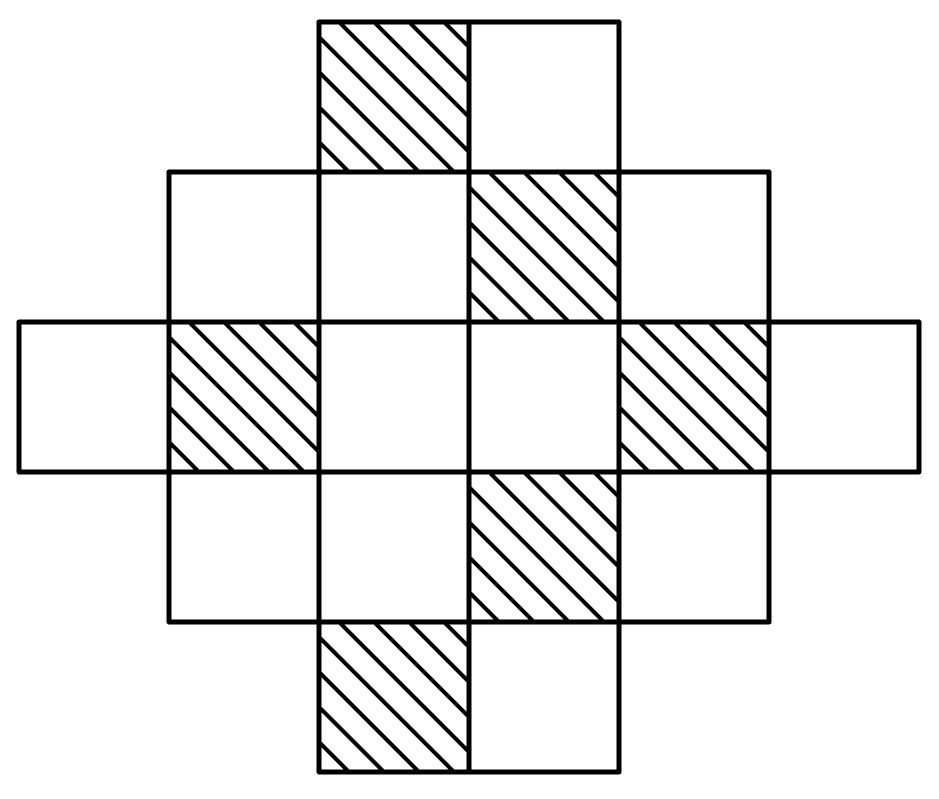
How many more unit squares in the figure must be shaded so that the fraction of shaded squares is ?
- 1
- 3
- 6
- 8
Answer
From the figure:
Total number of unit squares = 18
Number of squares already shaded = 6
Required fraction of shaded squares =
Number of squares that must be shaded = × 18 = 14
Number of more squares to be shaded = (Required shaded squares) − (Already shaded squares)
Substituting the values, we get:
Number of more squares to be shaded = 14 − 6 = 8
Hence, option 4 is the correct option.
In a flower garden, are red roses, are pink roses and the rest are blue roses. What fraction of the roses are blue?
Answer
Given:
Fraction of red roses =
Fraction of pink roses =
Total fraction of all roses = 1
Fraction of blue roses = 1 − (Fraction of red roses + Fraction of pink roses)
Substituting the values, we get:
Hence, option 3 is the correct option.
The following are the results from the class election.
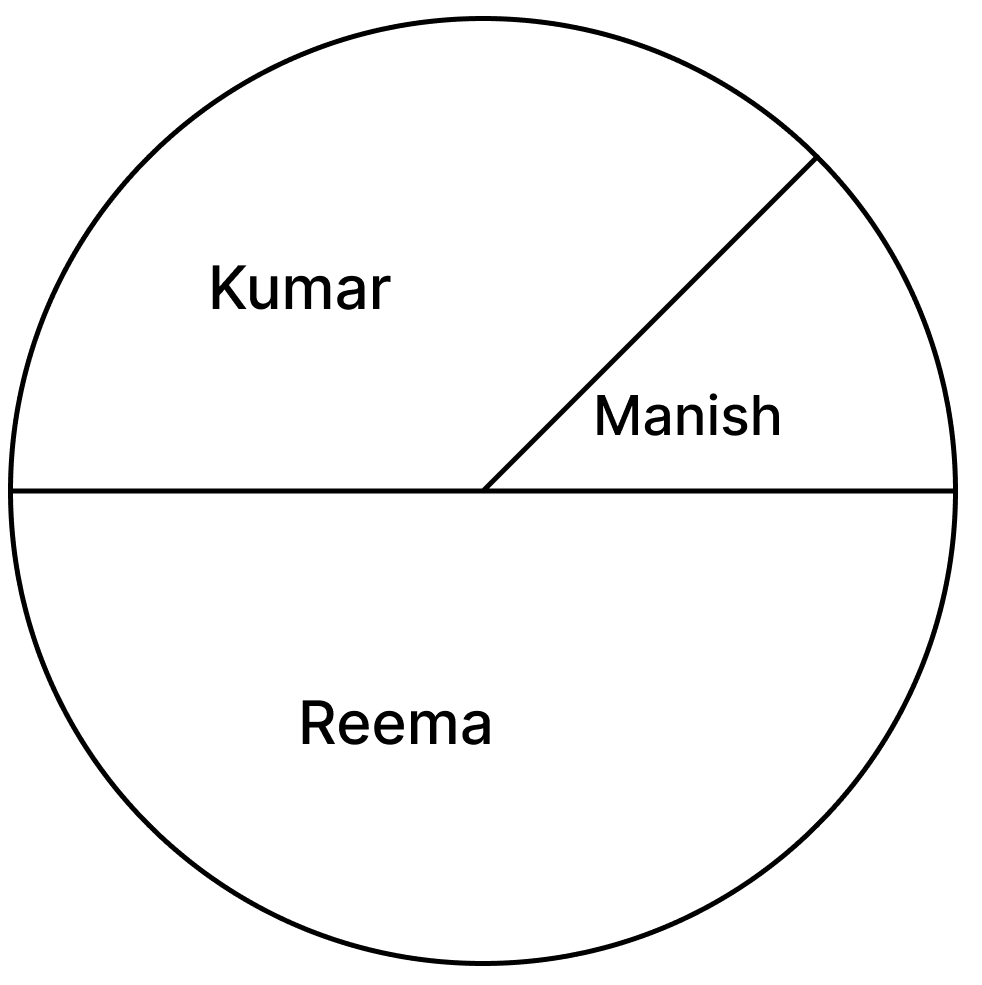
If 150 students voted, about how many votes did Kumar receive?
- 25
- 38
- 50
- 75
Answer
From the pie chart:
Reema occupies about half of the circle, i.e., of the total votes.
The remaining half is divided between Kumar and Manish, with Kumar's share being much larger than Manish's share.
Kumar's share is approximately of the total votes.
Total votes = 150
Number of votes received by Kumar = × 150
Hence, option 3 is the correct option.
Anushka studied these pictures of fractions.
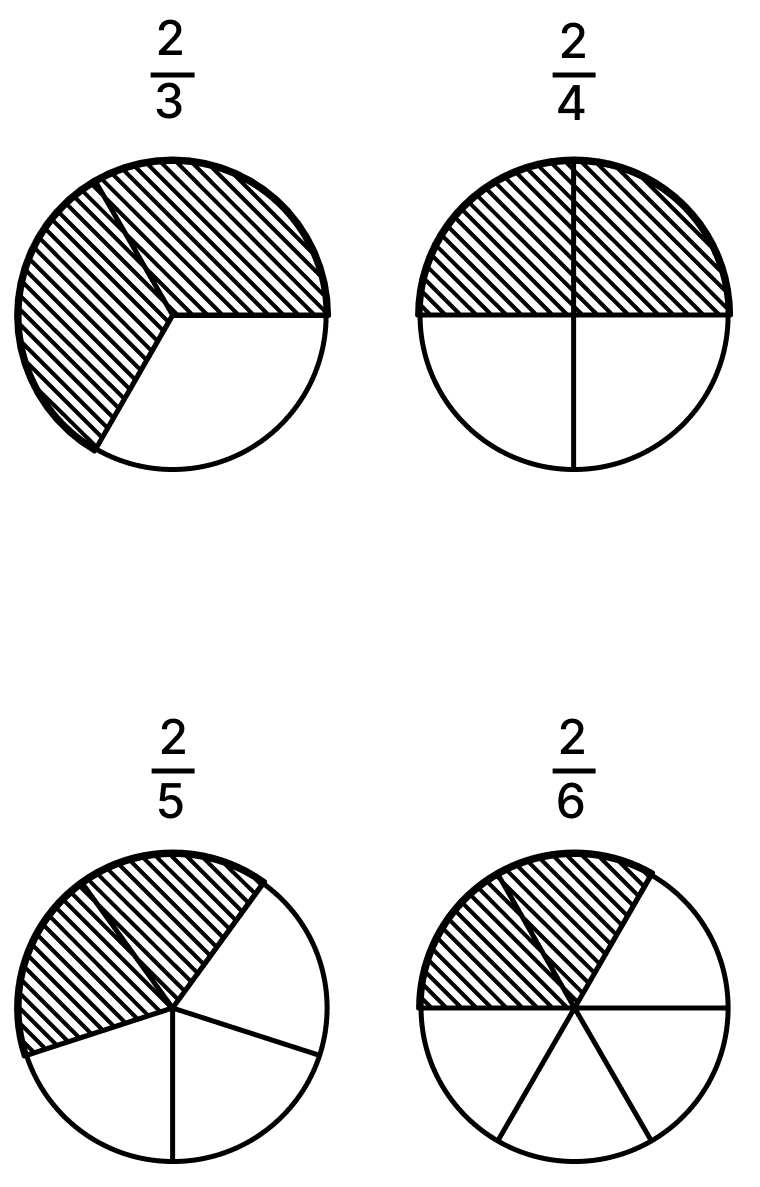
What pattern might she correctly notice in the fractions?
- Increasing the denominator increases the value of the fraction.
- If the denominator stays the same and the numerator increases, the fraction remains the same.
- Increasing the denominator by 2 cuts the size of the fraction in half.
- If the numerator stays the same and the denominator increases, the fraction decreases.
Answer
From the figure, the fractions shown are:
Observation:
The numerator remains the same (2) in all the fractions, while the denominator keeps increasing (3, 4, 5, 6).
As the denominator increases, the whole is divided into more parts, so each part becomes smaller. Hence, the value of the fraction decreases.
This is shown by the shaded regions in the circles, which keep getting smaller as we move from to .
Hence, option 4 is the correct option.
How many pieces of equal size can be cut from a rope of 30 m long, each measuring m?
- 10
- 6
- 4
- 8
Answer
Given:
Total length of rope = 30 m
Length of each piece = m = m
Number of pieces = (Total length of rope) ÷ (Length of each piece)
Substituting the values, we get:
Number of pieces = 30 ÷
Hence, option 4 is the correct option.
The value of is:
Answer
We have:
We simplify from the innermost fraction outwards.
Step 1: Simplify
Step 2: Simplify
Step 3: Simplify
Step 4: Simplify
Step 5: Simplify
Hence, option 4 is the correct option.
Which of the following represents the shaded parts?

Answer
From the figure:
First triangle:
The triangle is divided into 4 equal smaller triangles. Out of these, only 1 (the central inverted) triangle is shaded.
So, fraction of shaded portion =
Second triangle:
The triangle is divided into 4 equal smaller triangles. Out of these, 3 triangles (the corners) are shaded.
So, fraction of shaded portion =
Total shaded fraction =
Hence, option 4 is the correct option.
What is the least fraction that must be added to to make the result a natural number?
Answer
We have:
To make the result a natural number, we must add the least fraction that takes to the next natural number.
The next natural number greater than is 2.
Required least fraction = 2 −
Hence, option 2 is the correct option.
I read of a book on one day and of the remaining next day. If 100 pages of the book were still left unread, how many pages did the book contain?
- 450
- 360
- 345
- 280
Answer
Given:
Let the total number of pages in the book = x
Day 1:
Pages read on day 1 = of x =
Remaining pages after day 1 = x − = =
Day 2:
Pages read on day 2 = of remaining =
Pages remaining after day 2 =
According to the question, pages still left unread = 100
Hence, option 1 is the correct option.
A drum of petrol is full. When 30 litres of oil are drawn from it, it is full. The capacity of the drum is:
- 200 l
- 180 l
- 170 l
- 150 l
Answer
Given:
Let the capacity of the drum = x litres
Initial petrol in drum = of x = litres
Petrol drawn out = 30 litres
Final petrol in drum = of x = litres
According to the question:
Initial petrol − Petrol drawn out = Final petrol
Substituting the values, we get:
So, the capacity of the drum = 180 litres
Hence, option 2 is the correct option.