
Two lines AB and CD are cut by a transversal EF, as shown in the figure. Identify the given pair of angles as adjacent angles, vertically opposite angles, alternate angles, corresponding angles or co-interior angles.
(i) ∠6 and ∠7
(ii) ∠3 and ∠4
(iii) ∠4 and ∠8
(iv) ∠1 and ∠5
(v) ∠3 and ∠5
(vi) ∠2 and ∠4
(vii) ∠4 and ∠5
(viii) ∠2 and ∠7
(ix) ∠3 and ∠6
(x) ∠4 and ∠6
(xi) ∠2 and ∠6
(xii) ∠1 and ∠4
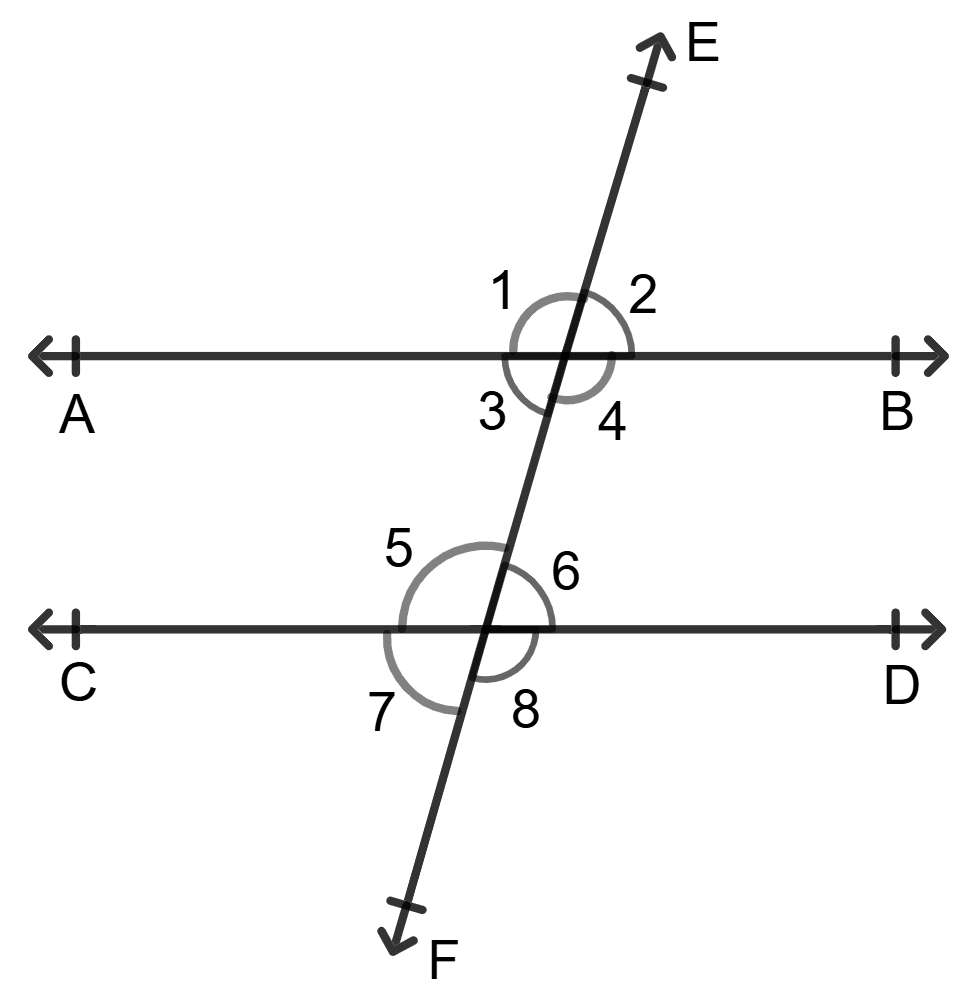
Answer
(i) ∠6 and ∠7
These angles are opposite each other at the same intersection point formed by two intersecting lines CD and EF.
∴ These are vertically opposite angles.
(ii) ∠3 and ∠4
These angles share a common vertex and a common arm on line AB, and lie next to each other without overlapping.
∴ These are adjacent angles.
(iii) ∠4 and ∠8
These angles are in the same relative position (bottom-right) at each intersection.
∴ These are corresponding angles.
(iv) ∠1 and ∠5
These angles are in the "top-left" position at each intersection.
∴ These are corresponding angles.
(v) ∠3 and ∠5
These angles lie inside the two parallel lines and are on the same side of the transversal.
∴ These are co-interior angles.
(vi) ∠2 and ∠4
These angles share a common vertex and a common arm and lie next to each other without overlapping.
∴ These are adjacent angles.
(vii) ∠4 and ∠5
These angles lie between the two parallel lines but on opposite sides of the transversal.
∴ These are interior alternate angles.
(viii) ∠2 and ∠7
These angles lie outside the two parallel lines and on opposite sides of the transversal.
∴ These are exterior alternate angles.
(ix) ∠3 and ∠6
These angles lie between the two parallel lines but on opposite sides of the transversal.
∴ These are interior alternate angles.
(x) ∠4 and ∠6
These angles lie inside the two parallel lines and on the same side of the transversal.
∴ These are co-interior angles.
(xi) ∠2 and ∠6
These angles are in the same relative position (top-right) at different intersections.
∴ These are corresponding angles.
(xii) ∠1 and ∠4
These angles are opposite each other at the same intersection point formed by two intersecting lines AB and EF.
∴ These are vertically opposite angles.
In the given figure, AB || CD and EF is a transversal. If ∠8 = 110°, find each one of the unknown angles, marked in the figure. Give reasons.
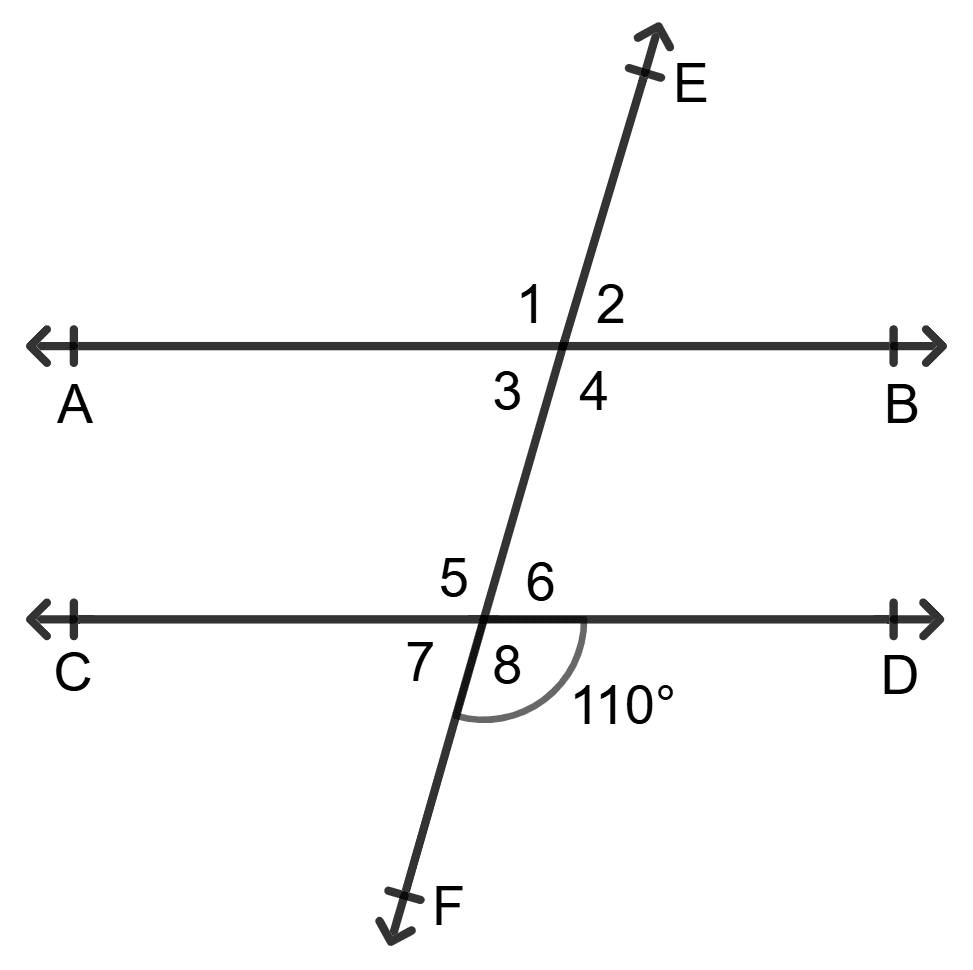
Answer
Given:
AB || CD
EF is a transversal
∠8 = 110°
Let's find angles at the bottom intersection (Point on CD):
∠5 = ∠8 [Vertically opposite angles]
∴ ∠5 = 110°
Since CD is a straight line, the angles ∠7 and ∠8 form a linear pair and must sum to 180°.
∴ ∠7 + ∠8 = 180°
⇒ ∠7 + 110° = 180° [Substituting the value of ∠8]
⇒ ∠7 = 180° - 110°
⇒ ∠7 = 70°
∠6 = ∠7 [Vertically opposite angles]
∴ ∠6 = 70°
Let's find angles at the top intersection (Point on AB):
∠4 = ∠8 [Corresponding angles]
∴ ∠4 = 110°
∠1 = ∠4 [Vertically opposite angles]
∴ ∠1 = 110°
Since AB is a straight line, the angles ∠1 and ∠2 form a linear pair and must sum to 180°.
∴ ∠1 + ∠2 = 180°
⇒ 110° + ∠2 = 180° [Substituting the value of ∠1]
⇒ ∠2 = 180° - 110°
⇒ ∠2 = 70°
∠3 = ∠2 [Vertically opposite angles]
∴ ∠3 = 70°
∠5 = 110°, ∠6 = 70°, ∠7 = 70°, ∠1 = 110°, ∠2 = 70°, ∠3 = 70°, ∠4 = 110°
In each of the following figures, AB || CD and EF is a transversal. Find each one of the unknown angles x, y, z in each case.
(i)
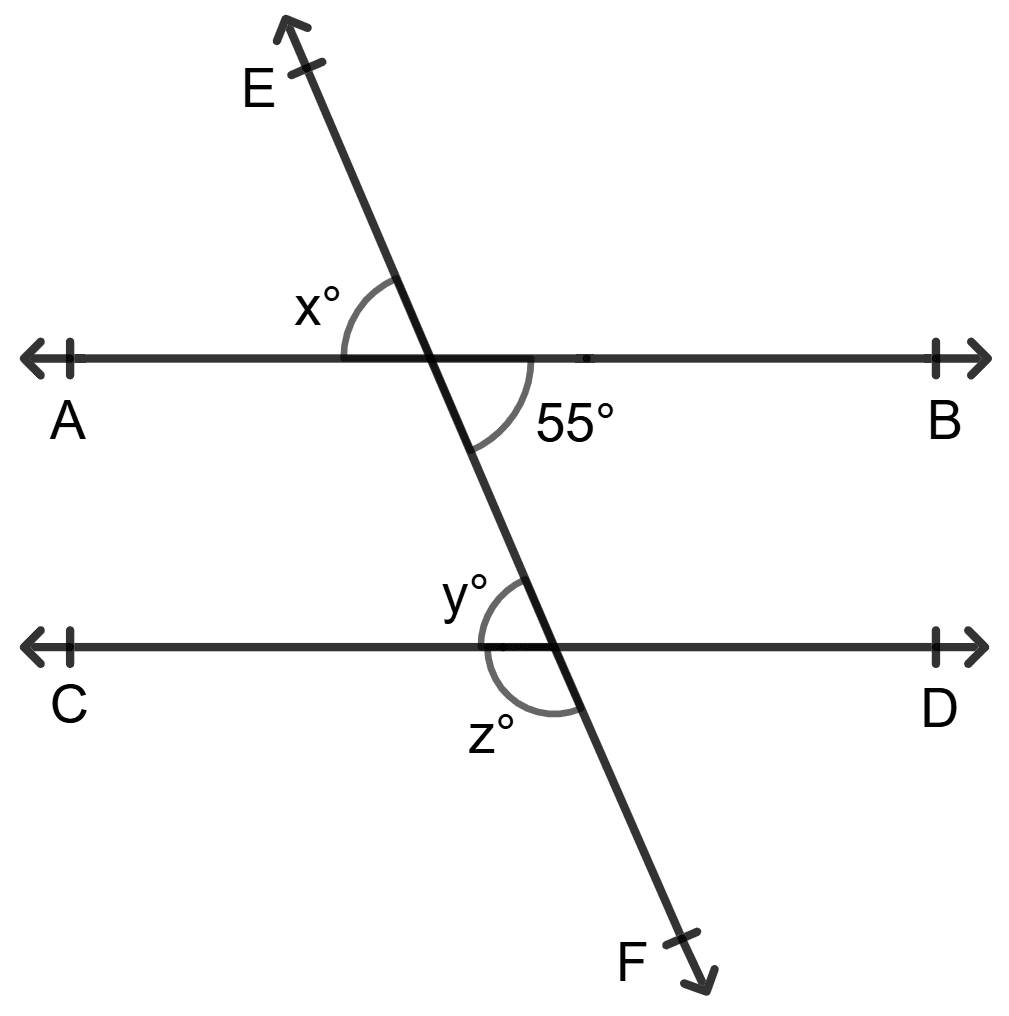
(ii)
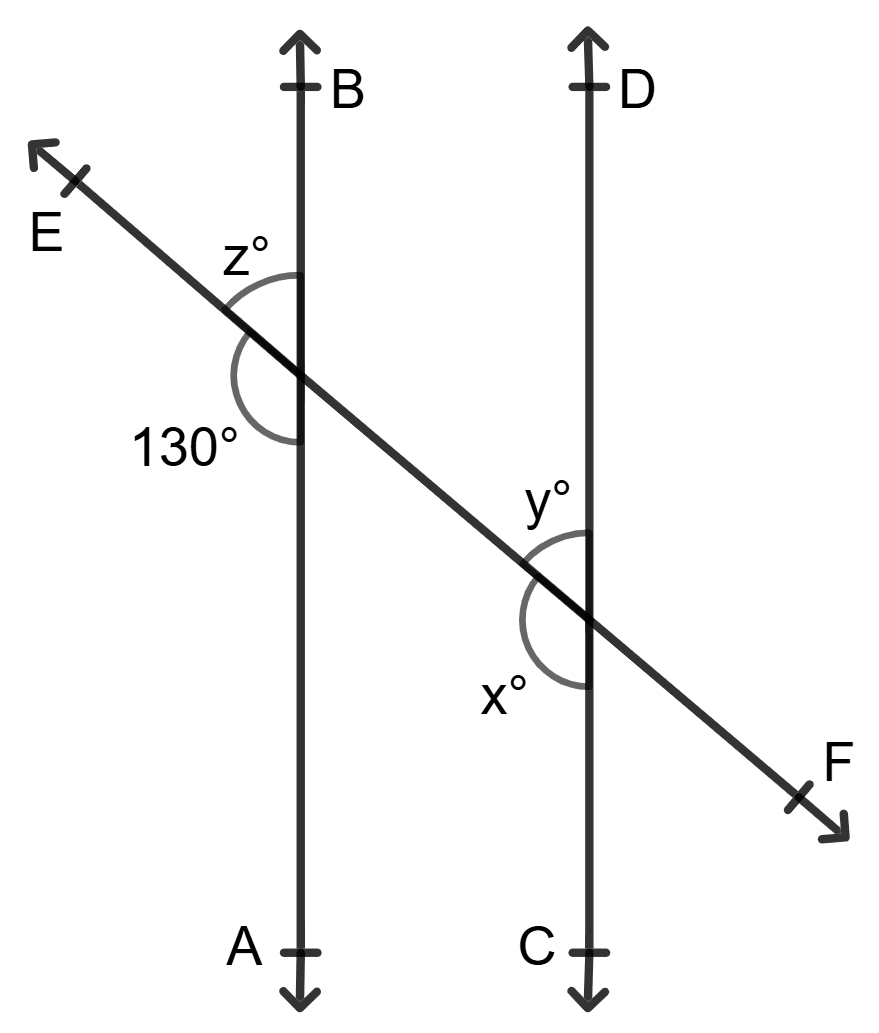
(iii)
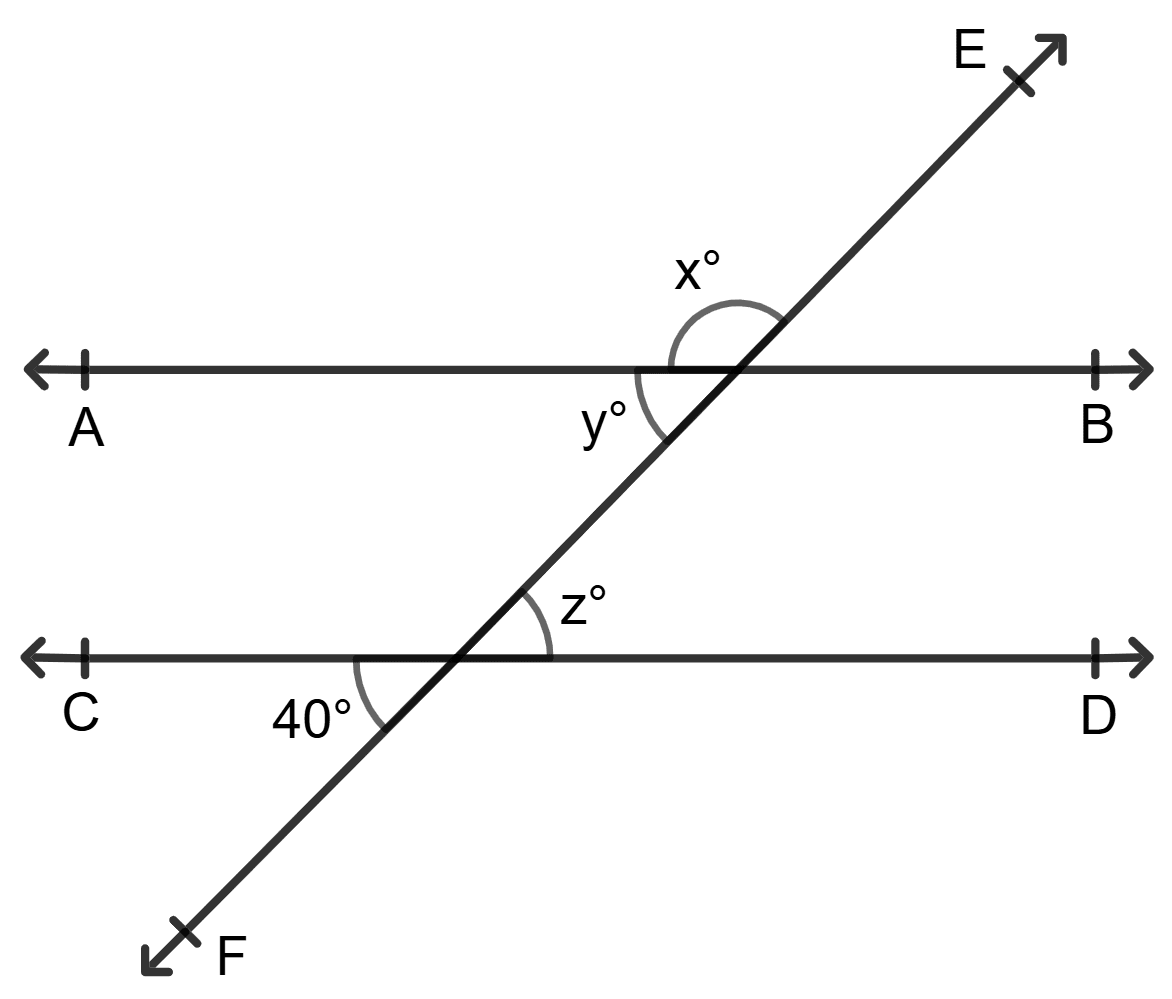
Answer
Given:
AB || CD
EF is a transversal
(i)
x° = 55° [Vertically opposite angles are equal]
y° and 55° angle are alternate interior angles i.e., these angles are on opposite sides of the transversal between the parallel lines. So, they are equal.
∴ y° = 55°
Since y° and z° form a linear pair on line CD they must sum to 180°.
∴ y° + z° = 180°
⇒ 55° + z° = 180° [Substituting the value of y]
⇒ z° = 180° - 55°
⇒ z° = 125°
x° = 55°, y° = 55°, z° = 125°
(ii)
x° and 130° are corresponding angles i.e., these angles are in the same relative position at each intersection. So, they are equal.
∴ x° = 130°
Since x° and y° form a linear pair on line CD they must sum to 180°.
∴ x° + y° = 180°
⇒ 130° + y° = 180° [Substituting the value of x]
⇒ y° = 180° - 130°
⇒ y° = 50°
z° = y° [Corresponding angles]
∴ z° = 50°
x° = 130°, y° = 50°, z° = 50°
(iii)
From the figure,
z° = 40° [Vertically opposite angles]
z° = y° [Interior alternate angles]
∴ y° = 40°
Since x° and y° form a linear pair on line AB they must sum to 180°.
∴ x° + y° = 180°
⇒ x° + 40° = 180° [Substituting the value of y]
⇒ x° = 180° - 40°
⇒ x° = 140°
x° = 140°, y° = 40°, z° = 40°
In each of the following figures, AB || CD and EF is a transversal. Find the value of x in each case.
(i)
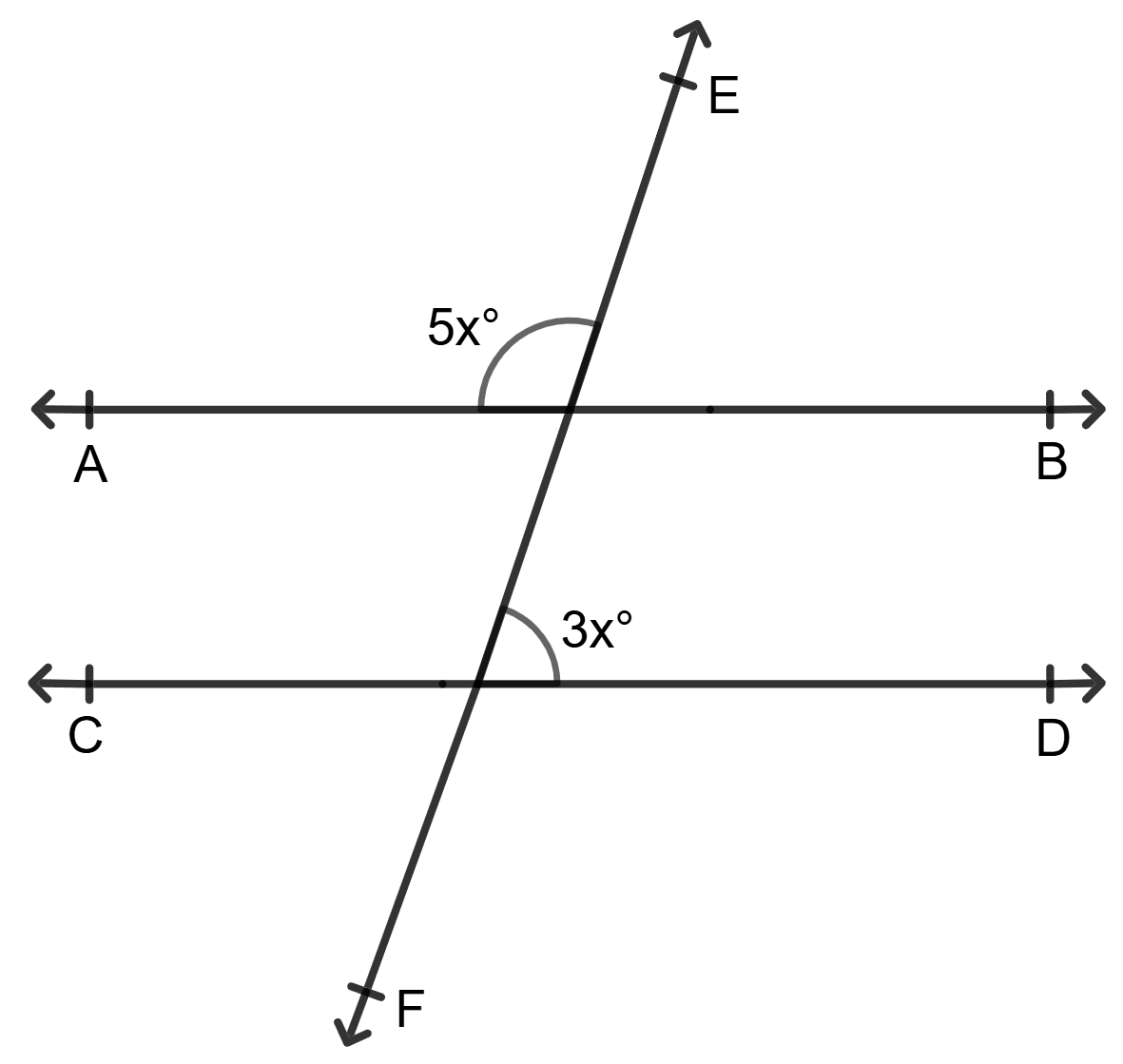
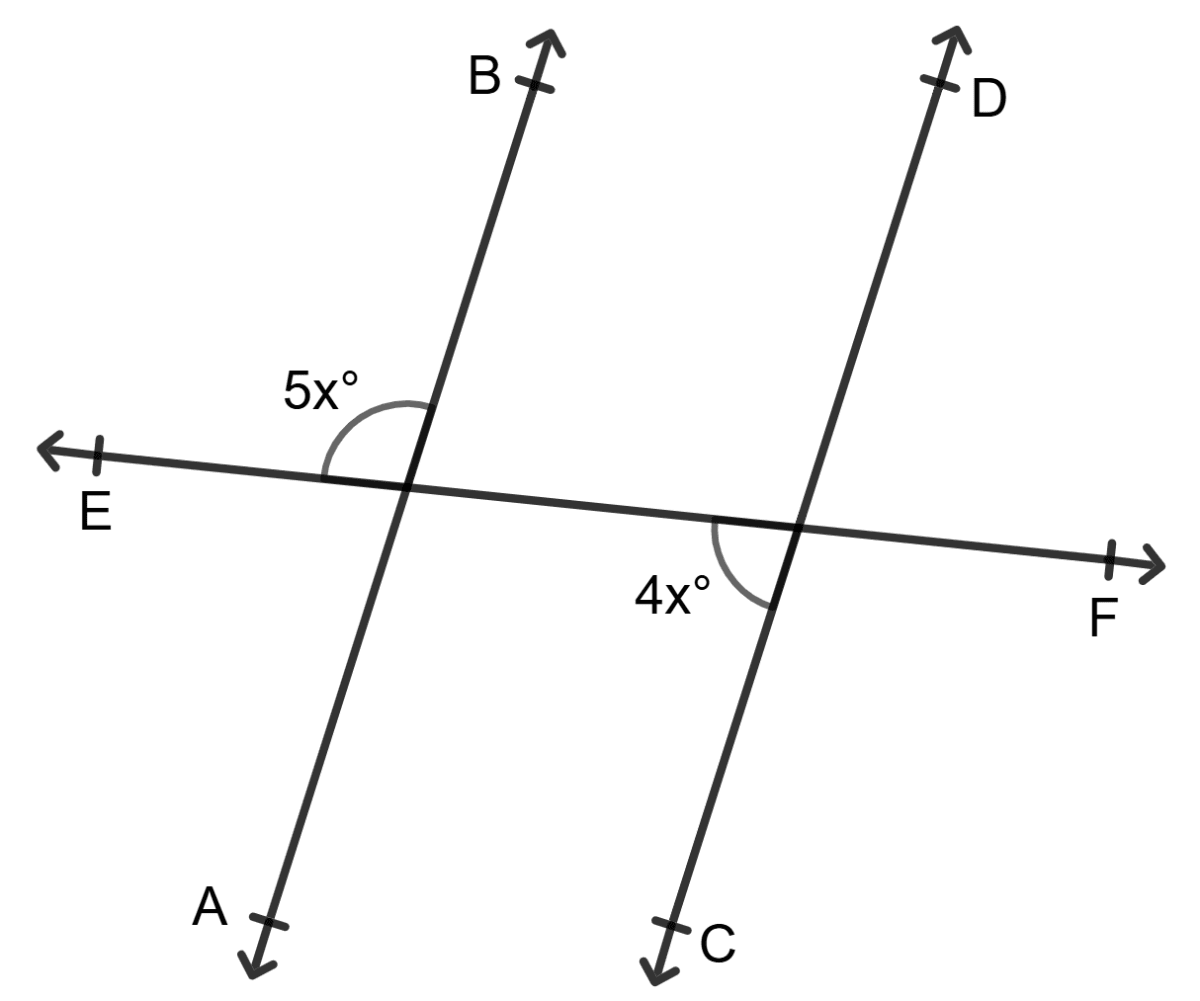
(ii)
(iii)
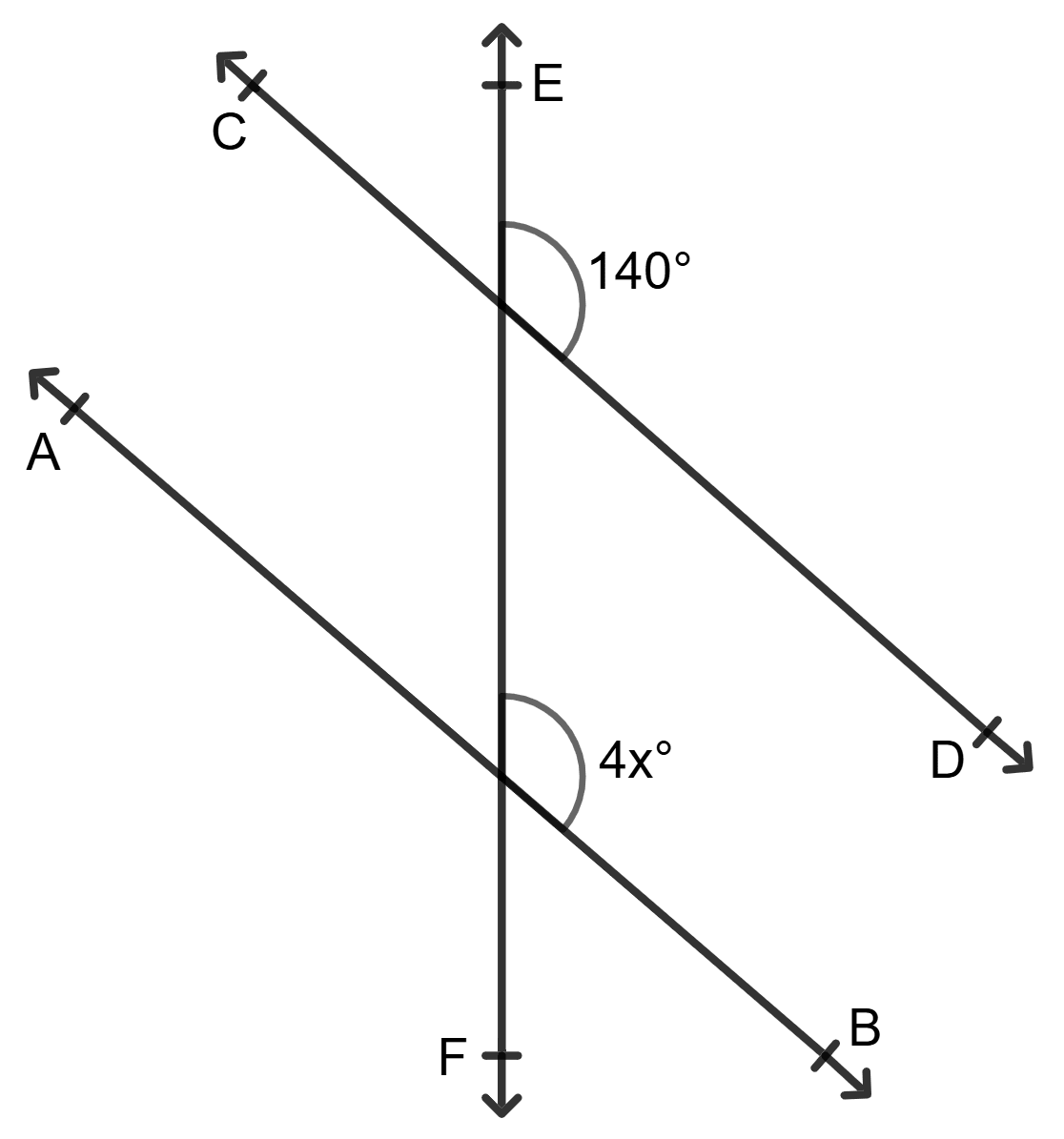
Answer
(i)
From the figure,
The opposite angle of 5x° will be equal to 5x°. Because, they are vertically opposite angles.
Now, 5x° and 3x° are co-interior angles i.e., they lie inside the parallel lines on the same side of the transversal.
Co-interior angles are supplementary:
∴ 5x° + 3x° = 180°
⇒ 8x° = 180°
⇒ x° =
x° = 22.5°
(ii)
From the figure,
The opposite angle of 5x° will be equal to 5x°. Because, they are vertically opposite angles.
5x° and 4x° are co-interior angles i.e., they lie inside the parallel lines on the same side of the transversal.
Co-interior angles are supplementary:
∴ 5x° + 4x° = 180°
⇒ 9x° = 180°
⇒ x° =
x° = 20°
(iii)
From the figure,
140° and 4x° are corresponding angles i.e., they are in the same relative position at each intersection. Therefore, they are equal.
4x° = 140°
⇒ x° =
x° = 35°
In the given figure, AB || CD. If ∠BAC = (3x + 15)° and ∠ACD = (2x + 45)°, find the value of x.
Also, find the measures of ∠BAC and ∠ACD.
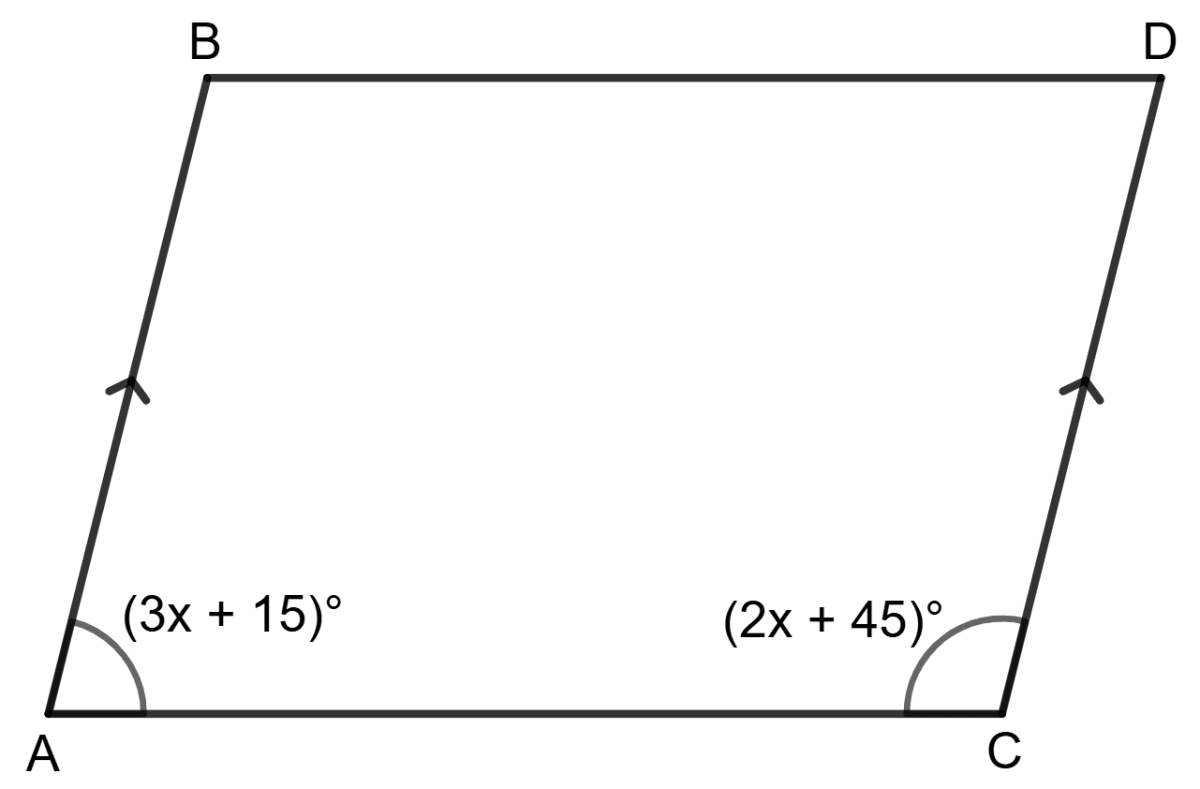
Answer
Given:
AB || CD
∠BAC = (3x + 15)°
∠ACD = (2x + 45)°
∠BAC and ∠ACD lie inside the parallel lines on the same side of transversal AC. So, they are co-interior angles.
Co-interior angles are supplementary:
∴ (3x + 15)° + (2x + 45)° = 180°
⇒ 3x° + 2x° + 15° + 45° = 180°
⇒ 5x° + 60° = 180°
⇒ 5x° = 180° - 60°
⇒ 5x° = 120°
⇒ x° =
⇒ x° = 24°
Let's find each angle by substituting the value of x:
∠BAC = (3x + 15)° = (3(24) + 15)° = (72 + 15)° = 87°
∠ACD = (2x + 45)° = (2(24) + 45)° = (48 + 45)° = 93°
x° = 24°, ∠BAC = 87° and ∠ACD = 93°
In the given figure, AB || CD. Find the value of x.
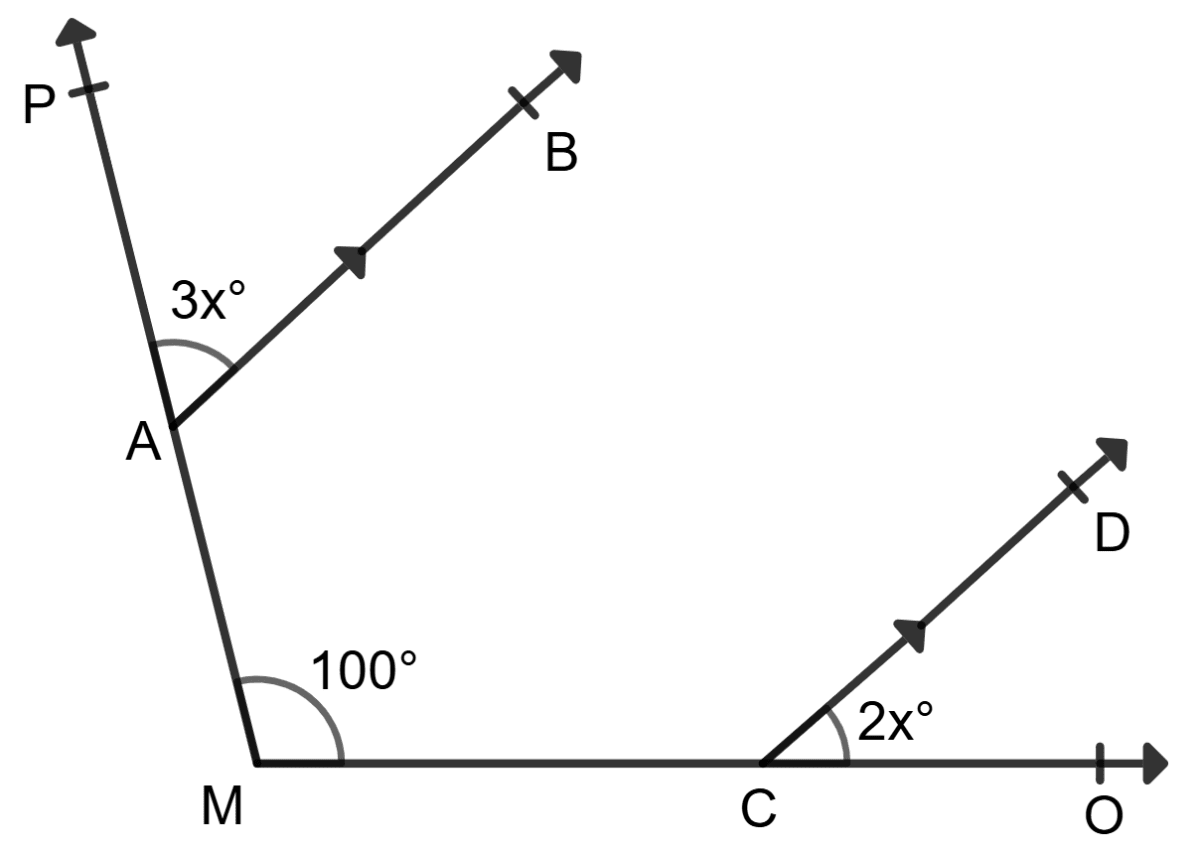
Answer
Draw a line EF through point M such that EF is parallel to both AB and CD.
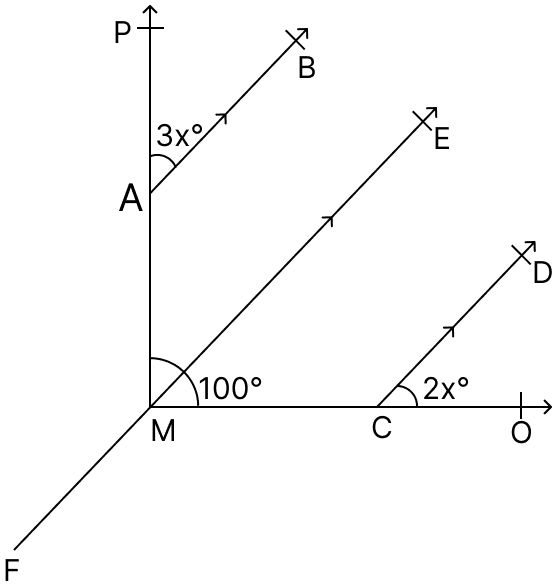
From the figure,
∠PAB = 3x°, ∠OCD = 2x° and ∠PMO = 100°
For AB || ME:
∠AME = ∠PAB [Corresponding angles]
∴ ∠AME = 3x° [Substituting the value of ∠PAB]
For CD || ME:
∠CME = ∠OCD [Corresponding angles]
∴ ∠CME = 2x° [Substituting the value of ∠OCD]
As the line ME splits the 100° angle at point M into two parts:
∴ ∠AME + ∠CME = 100°
⇒ 3x° + 2x° = 100°
⇒ 5x° = 100°
⇒ x° =
x° = 20°
In the given figure, AB || DC and BC || AD. Find the values of x, y and z.
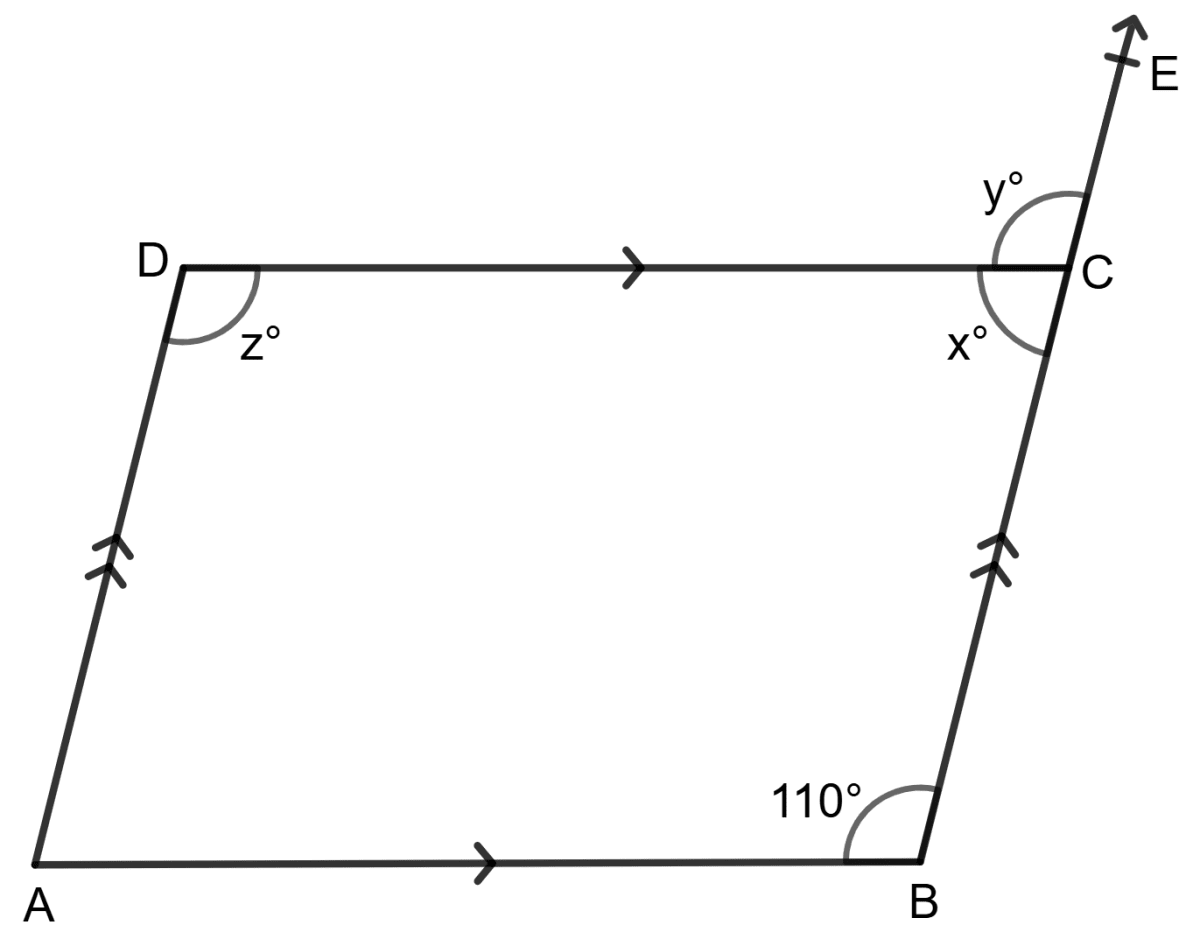
Answer
From the figure,
∠ABC = 110°, ∠BCD = x°, ∠ADC = z°, ∠DCE = y°
Since AB || CD and BC || AD, the figure ABCD is a parallelogram.
Consider parallel lines AB and CD with BC acting as a transversal.
Angles ∠ABC and ∠BCD are co-interior angles.
Co-interior angles are supplementary:
∴ ∠ABC + ∠BCD = 180°
⇒ 110° + x° = 180° [Substituting the values of ∠ABC and ∠BCD]
⇒ x° = 180° - 110°
⇒ x° = 70°
Angles ∠BCD (x°) and ∠DCE (y°) form a linear pair. So, they must sum to 180°.
∴ ∠BCD + ∠DCE = 180°
⇒ 70° + y° = 180° [Substituting the values of ∠BCD and ∠DCE]
⇒ y° = 180° - 70°
⇒ y° = 110°
In a parallelogram, opposite angles are equal.
Angle z° is opposite to ∠ABC
∴ z° = ∠ABC
z° = 110° [Substituting the values of ∠ABC]
x° = 70°, y° = 110° and z° = 110°
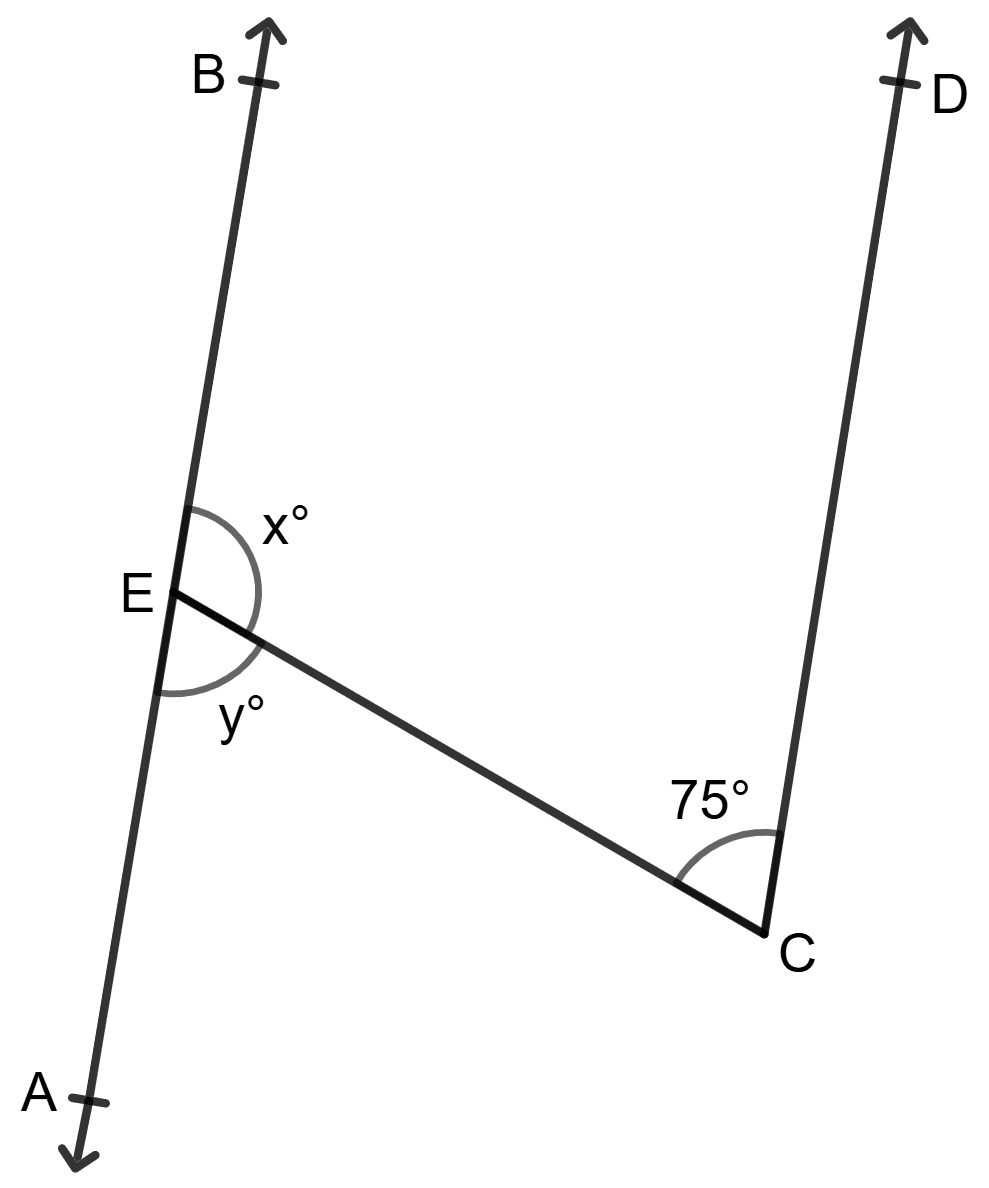
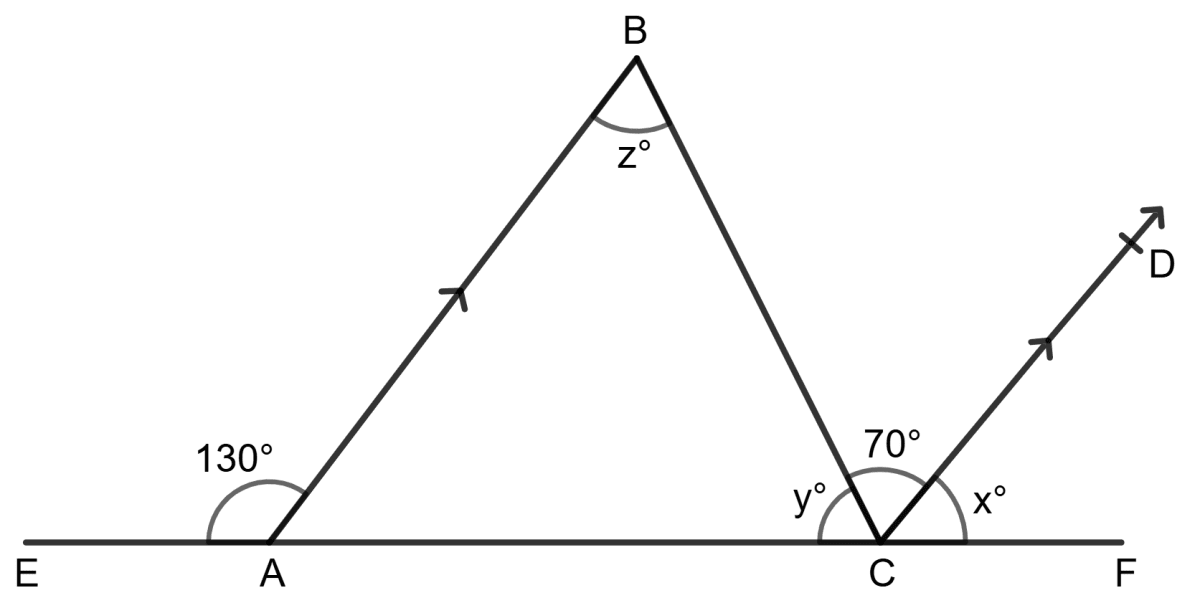
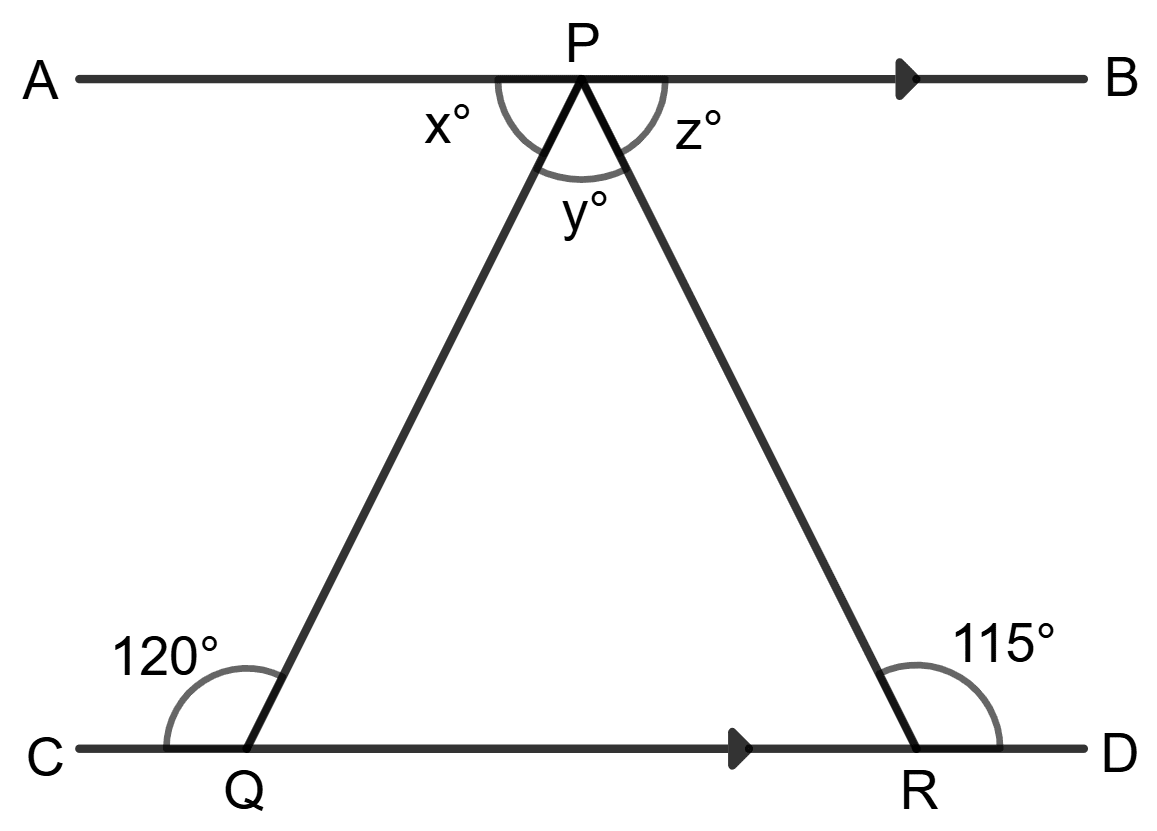
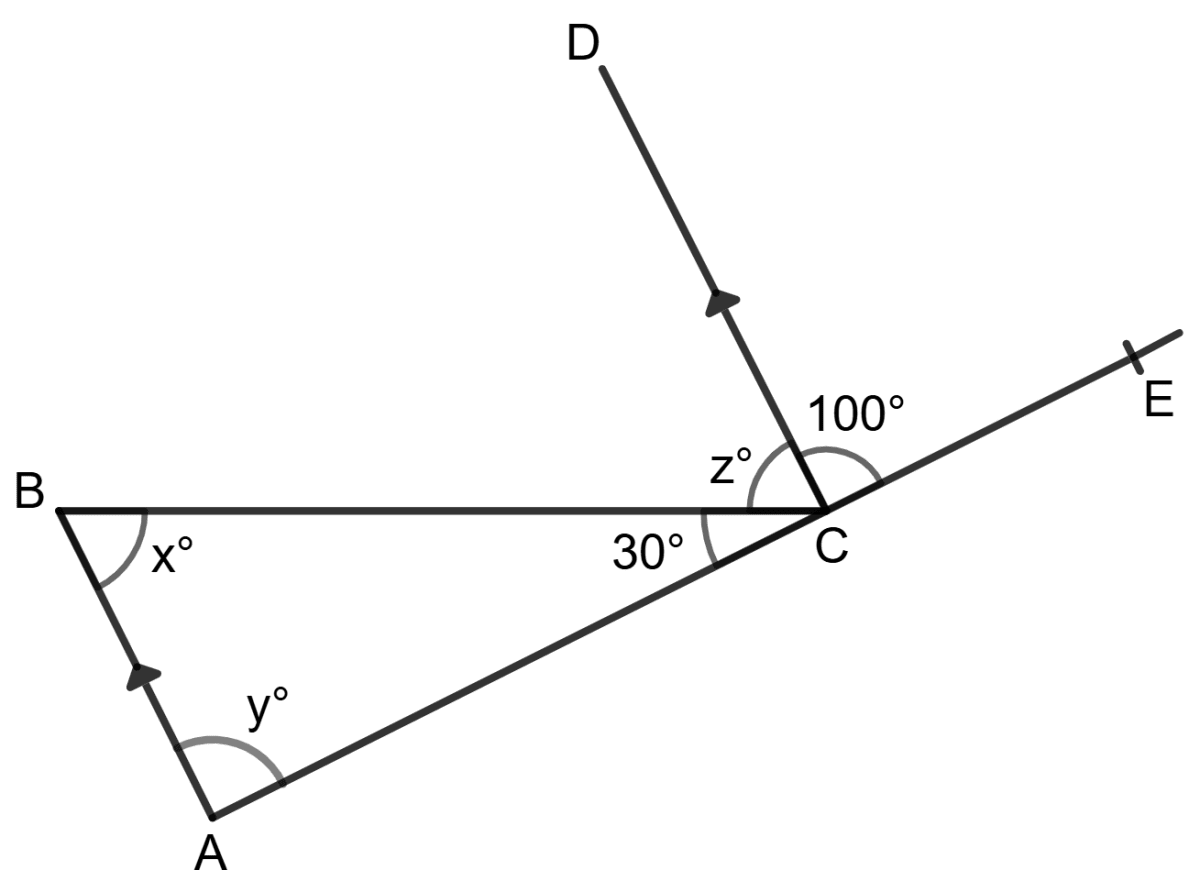
In each of the figures given below, AB || CD. Find the unknown angles, giving reasons.
(i)
(ii)
(iii)
(iv)
(v)
(vi)
(vii)
(viii)
Answer
(i)
Given:
AB || CD
∠ECD = 75°
∠AEC = ∠ECD [Alternate angles]
⇒ y° = ∠ECD
⇒ y° = 75° [Substituting the value of ∠ECD]
Since, AB is a straight line:
∠BEC + ∠AEC = 180° [Linear pair]
⇒ x° + y° = 180°
⇒ x° + 75° = 180° [Substituting the value of y]
⇒ x° = 180° - 75°
⇒ x° = 105°
x° = 105° and y° = 75°
(ii)
Given:
AB || CD
∠EAB = 130°
∠BCD = 70°
Since, EF is a straight line:
∠EAB + ∠BAC = 180° [Linear pair]
⇒ 130° + ∠BAC = 180° [Substituting the value of ∠EAB]
⇒ ∠BAC = 180° - 130°
⇒ ∠BAC = 50°
∠DCF = ∠BAC [Corresponding angles]
⇒ x° = ∠BAC
⇒ x° = 50° [Substituting the value of ∠BAC]
Since EF is a straight line:
∠BCA + ∠BCF = 180° [Linear pair]
⇒ y° + (x° + 70°) = 180°
⇒ y° + 50° + 70° = 180° [Substituting the value of x]
⇒ y° + 120° = 180°
⇒ y° = 180° - 120°
⇒ y° = 60°
In △ABC, we know that the sum of interior angles is 180°.
∴ ∠BAC + ∠ABC + ∠BCA = 180°
⇒ 50° + z° + y° = 180°
⇒ 50° + z° + 60° = 180° [Substituting the value of y]
⇒ z° + 110° = 180°
⇒ z° = 180° - 110°
⇒ z° = 70°
x° = 50°, y° = 60° and z° = 70°
(iii)
Given:
∠CQP = 120°
∠DRP = 115°
Since, CD is a straight line:
∠CQP + ∠PQR = 180° [Linear pair]
⇒ 120° + ∠PQR = 180° [Substituting the value of ∠CQP]
⇒ ∠PQR = 180° - 120°
⇒ ∠PQR = 60°
AB || CD and PQ is a transversal:
∠APQ = ∠PQR [Alternate angles]
⇒ x° = ∠PQR
⇒ x° = 60° [Substituting the value of ∠PQR]
Since, CD is a straight line:
∠PRD + ∠PRQ = 180° [Linear pair]
⇒ 115° + ∠PRQ = 180° [Substituting the value of ∠PRD]
⇒ ∠PRQ = 180° - 115°
⇒ ∠PRQ = 65°
AB || CD and PR is a transversal:
∠BPR = ∠PRQ [Alternate angles]
⇒ z° = ∠PRQ
⇒ z° = 65° [Substituting the value of ∠PRQ]
In △PQR, we know that the sum of interior angles is 180°.
∴ ∠PQR + ∠QPR + ∠PRQ = 180°
⇒ 60° + y° + 65° = 180°
⇒ y° + 125° = 180°
⇒ y° = 180° - 125°
⇒ y° = 55°
x° = 60°, y° = 55° and z° = 65°
(iv)
Given:
∠DCE = 100°
∠BCA = 30°
Since, AE is a straight line:
∠BCA + ∠BCD + ∠DCE = 180°
⇒ 30° + z° + 100° = 180°
⇒ z° + 130° = 180°
⇒ z° = 180° - 130°
⇒ z° = 50°
AB || CD and BC is a transversal:
∠ABC = ∠BCD [Alternate angles]
⇒ x° = z°
⇒ x° = 50°
In △ABC, we know that the sum of interior angles is 180°.
∴ ∠ABC + ∠BAC + ∠BCA = 180°
⇒ x° + y° + 30° = 180°
⇒ 50° + y° + 30° = 180°
⇒ y° + 80° = 180°
⇒ y° = 180° - 80°
⇒ y° = 100°
x° = 50°, y° = 100° and z° = 50°
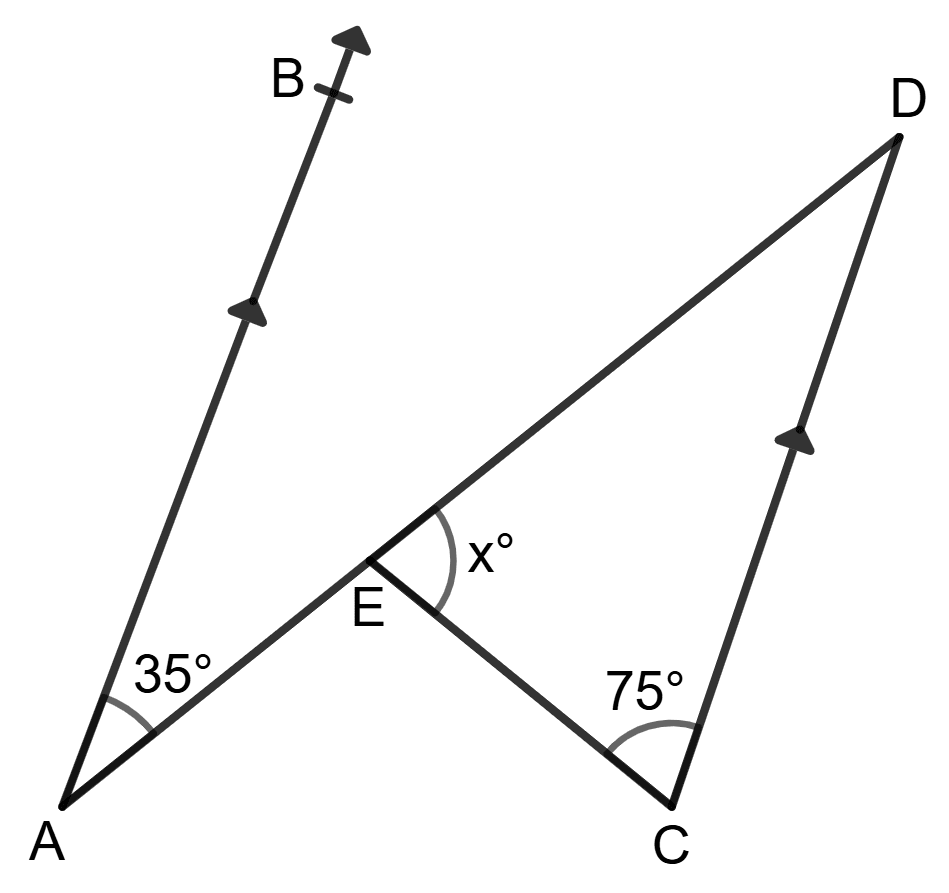
(v)
From figure,
∠BAD = 35°
∠ECD = 75°
AB || CD and AD is a transversal:
∠ADC = ∠BAD [Alternate angles]
∠ADC = 35°
∴ ∠CDE = 35° [Both are same angles i.e., ∠D]
In △CDE, we know that the sum of interior angles is 180°.
∴ ∠ECD + ∠CDE + ∠DEC = 180°
⇒ 75° + 35° + x° = 180°
⇒ x° + 110° = 180°
⇒ x° = 180° - 110°
x° = 70°
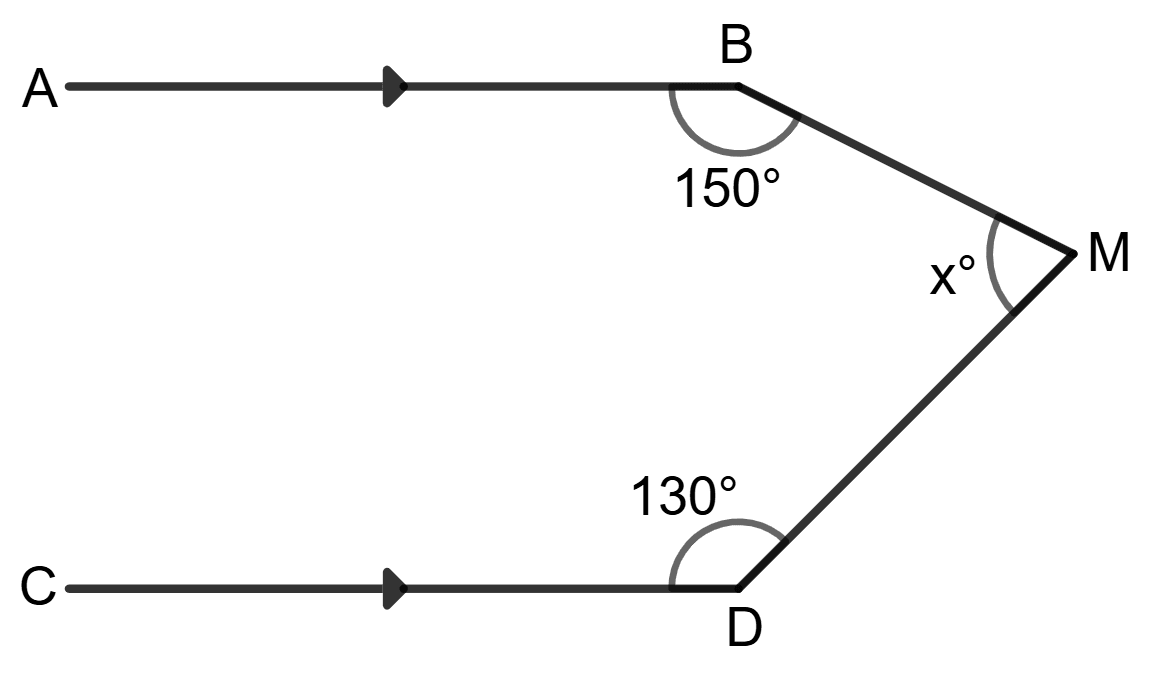
(vi)
Through M, draw a line EMF such that EF || AB || CD.
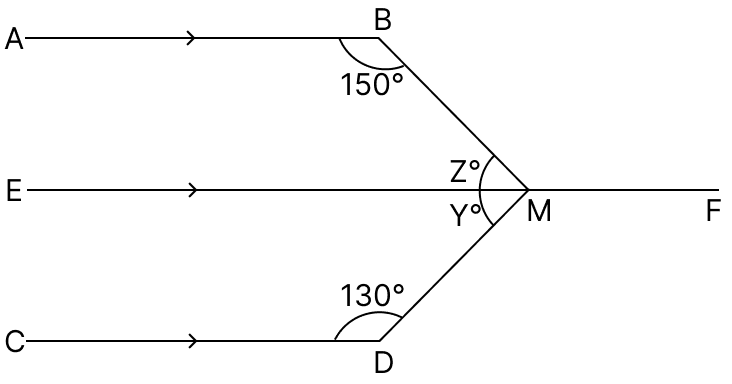
This line splits the angle x into two parts:
Let ∠EMB = z° and ∠EMD = y°
Now, EF || CD and MD is a transversal.
∴ The sum of co-interior angles is 180°.
∴ ∠CDM + ∠DME = 180°
⇒ 130° + y° = 180°
⇒ y° = 180° - 130°
⇒ y° = 50°
Again, Now, EF || AB and MB is a transversal.
∴ The sum of co-interior angles is 180°.
∴ ∠ABM + ∠BME = 180°
⇒ 150° + z° = 180°
⇒ z° = 180° - 150°
⇒ z° = 30°
x° = y° + z°
⇒ x° = 50° + 30°
x° = 80°
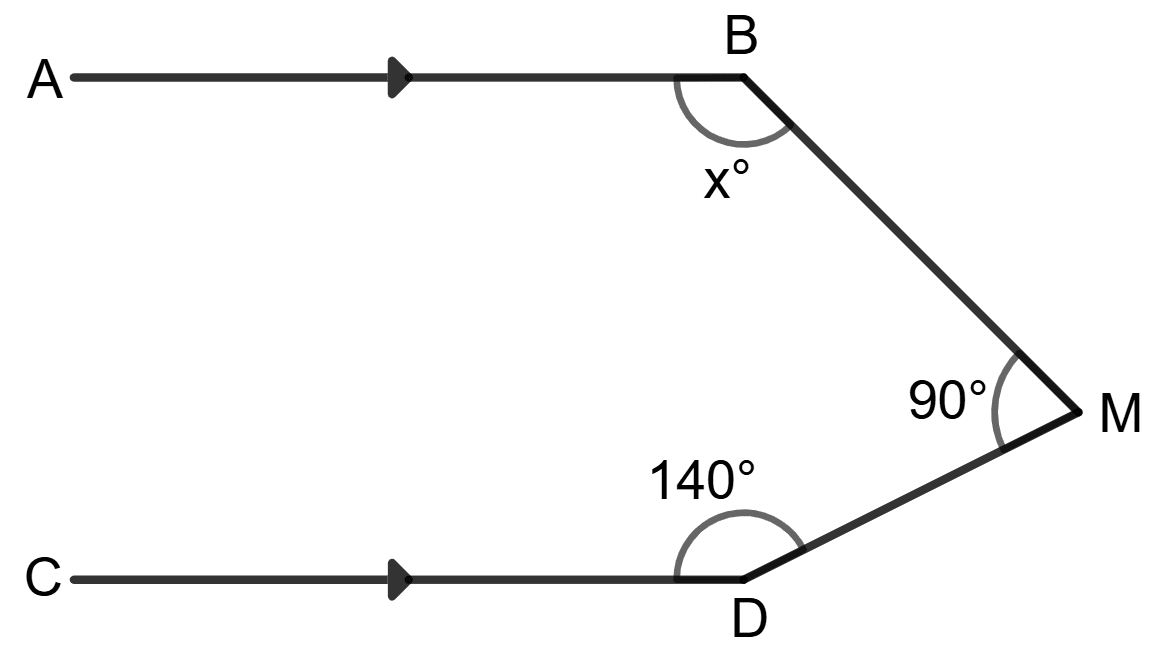
(vii)
Through M, draw a line EMF such that EF || AB || CD.
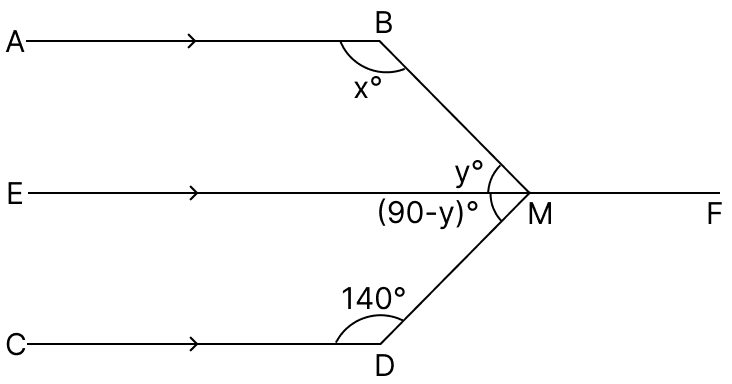
This line splits the angle at M into two parts:
Let ∠EMB = y° and ∠EMD = (90 - y)°
Now, EF || CD and MD is a transversal.
∴ The sum of co-interior angles is 180°.
∴ ∠CDM + ∠DME = 180°
⇒ 140° + (90 - y)° = 180°
⇒ 140° + 90° - y° = 180°
⇒ 230° - y° = 180°
⇒ y° = 230° - 180°
⇒ y° = 50°
Again, EF || AB and MB is a transversal.
∴ The sum of co-interior angles is 180°.
∴ ∠ABM + ∠BME = 180°
⇒ x° + y° = 180°
⇒ x° + 50° = 180°
⇒ x° = 180° - 50°
x° = 130°
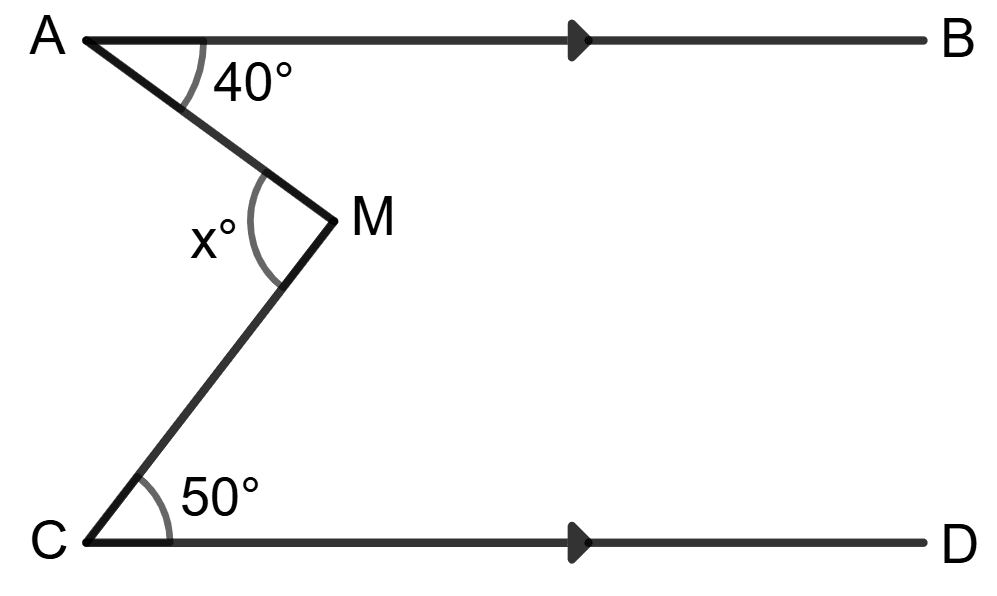
(viii)
Through M, draw a line EMF such that EF || AB || CD.
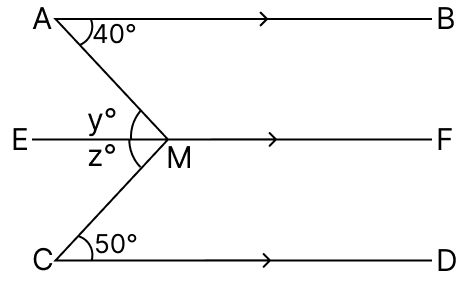
This line splits the angle at M into two parts:
Let ∠AME = y° and ∠CME = z°
Now, EF || AB and AM is a transversal.
∠AME = ∠BAM [Alternate angles]
∴ y° = 40°
Again, EF || CD and CM is a transversal.
∠CME = ∠MCD [Alternate angles]
∴ z° = 50°
x° = y° + z°
⇒ x° = 40° + 50°
x° = 90°
In each of the following figures AB || CD. Find the unknown angles, giving reasons.
(i)
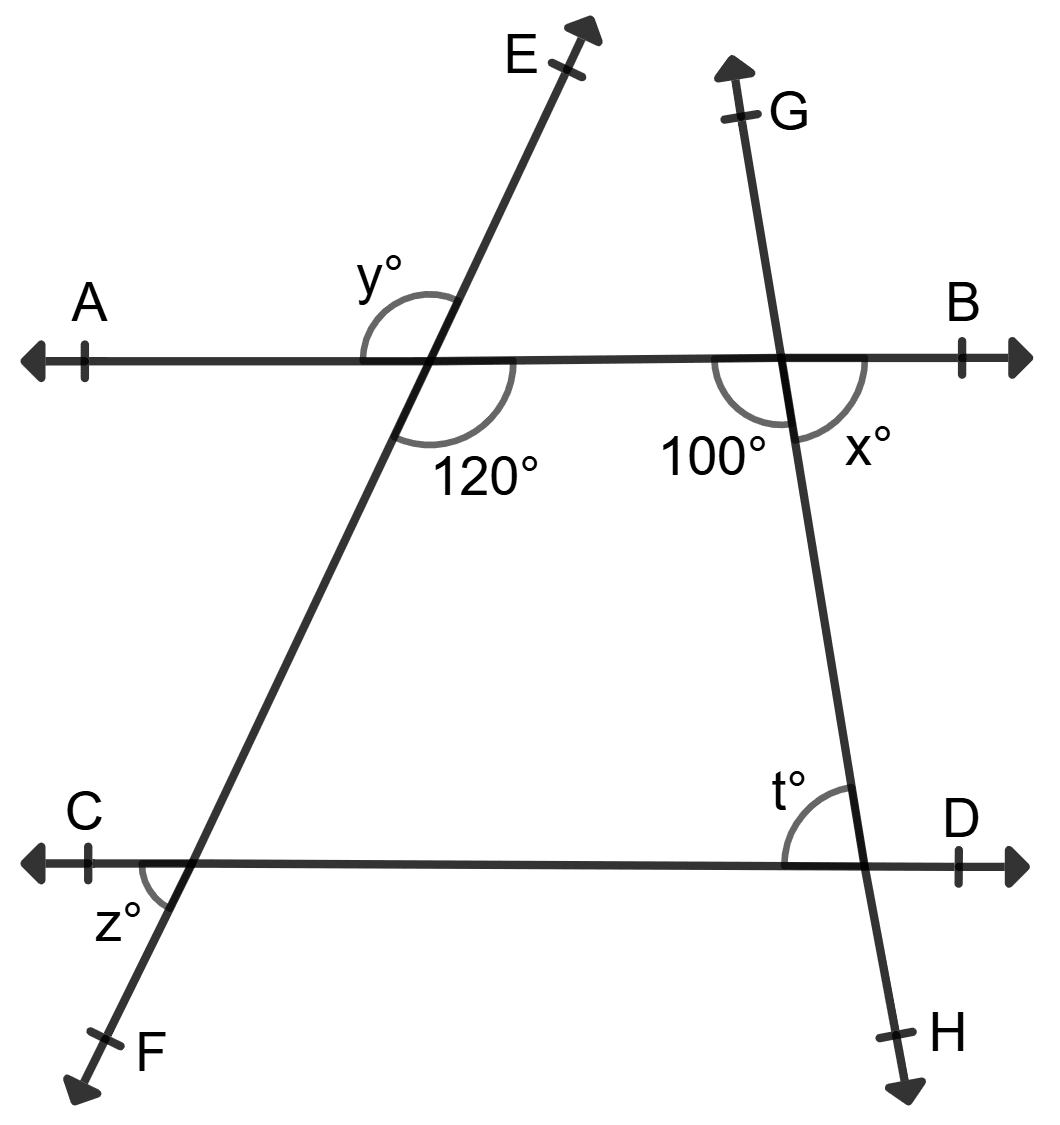
(ii)
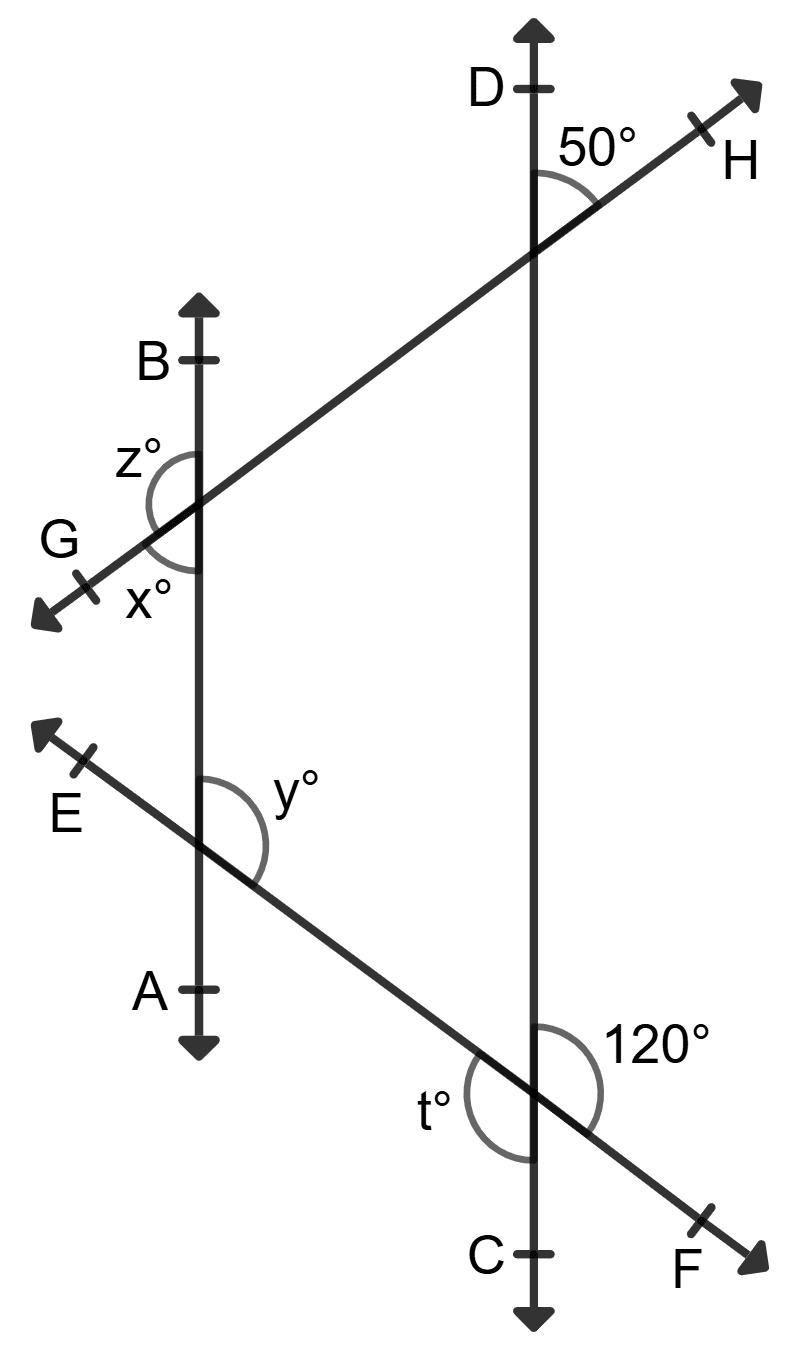
Answer
(i)
Given:
AB || CD
Since, AB is a straight line:
x° + 100° = 180° [Linear pair]
⇒ x° = 180° - 100°
⇒ x° = 80°
y° = 120° [Vertically opposite angles]
AB || CD and GH is a transversal:
t° = x° [Alternate angles]
∴ t° = 80°
Let the angle opposite to z° be p°.
In quadrilateral ABCD, sum of interior angles is 360°.
∴ 120° + 100° + 80° + p° = 360°
⇒ 300° + p° = 360°
⇒ p° = 360° - 300°
⇒ p° = 60°
z° = p° [Alternate angles]
∴ z° = 60°
x° = 80°, y° = 120°, z° = 60° and t° = 80°
(ii)
Given:
AB || CD
t° = 120° [Vertically opposite angles]
AB || CD and EF is a transversal:
y° = t° [Alternate angles]
∴ y° = 120°
x° = 50° [Exterior alternate angles]
Since, AB is a straight line:
x° + z° = 180° [Linear pair]
⇒ 50° + z° = 180°
⇒ z° = 180° - 50°
⇒ z° = 130°
x° = 50°, y° = 120°, z° = 130° and t° = 120°
In the given figure l || m and p || q. Find the angles x, y, z.
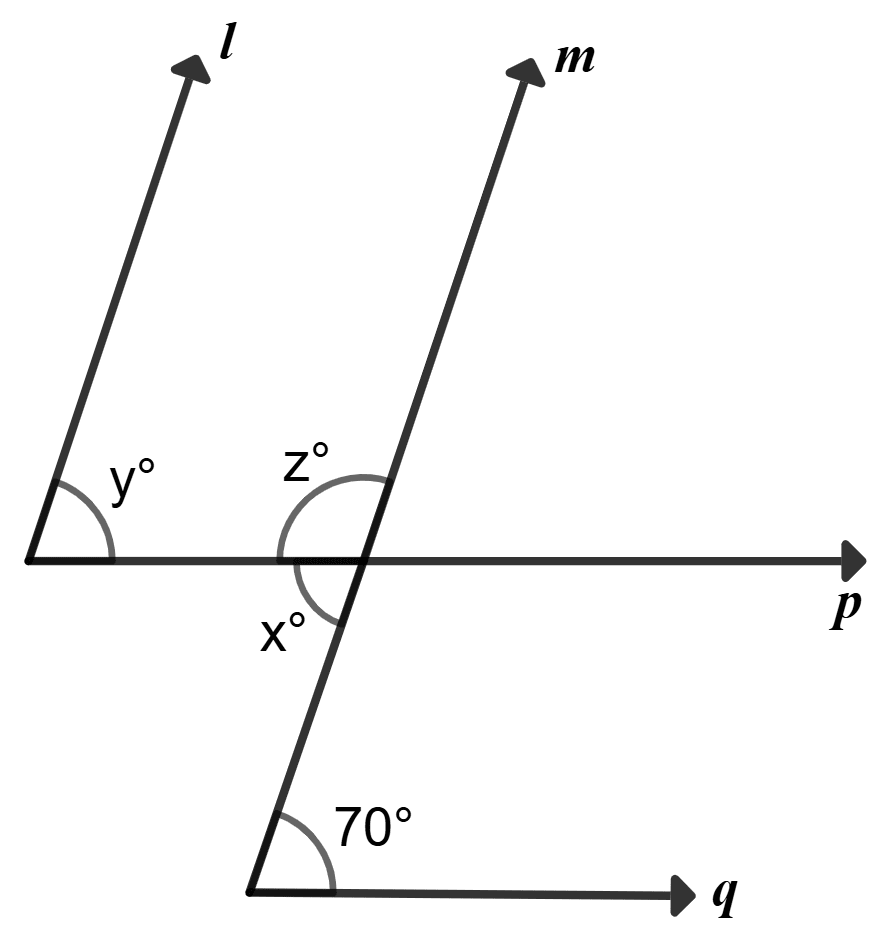
Answer
Consider p || q and m is a transversal:
x° = 70° [Alternate angles]
Since, m is a straight line:
x° + z° = 180° [Linear pair]
⇒ 70° + z° = 180°
⇒ z° = 180° - 70°
⇒ z° = 110°
Now, consider l || m and p is a transversal:
y° = x° [Alternate angles]
∴ y° = 70°
x° = 70°, y° = 70° and z° = 110°
In the given figure, AB || CD || EF. Find x, y and z.
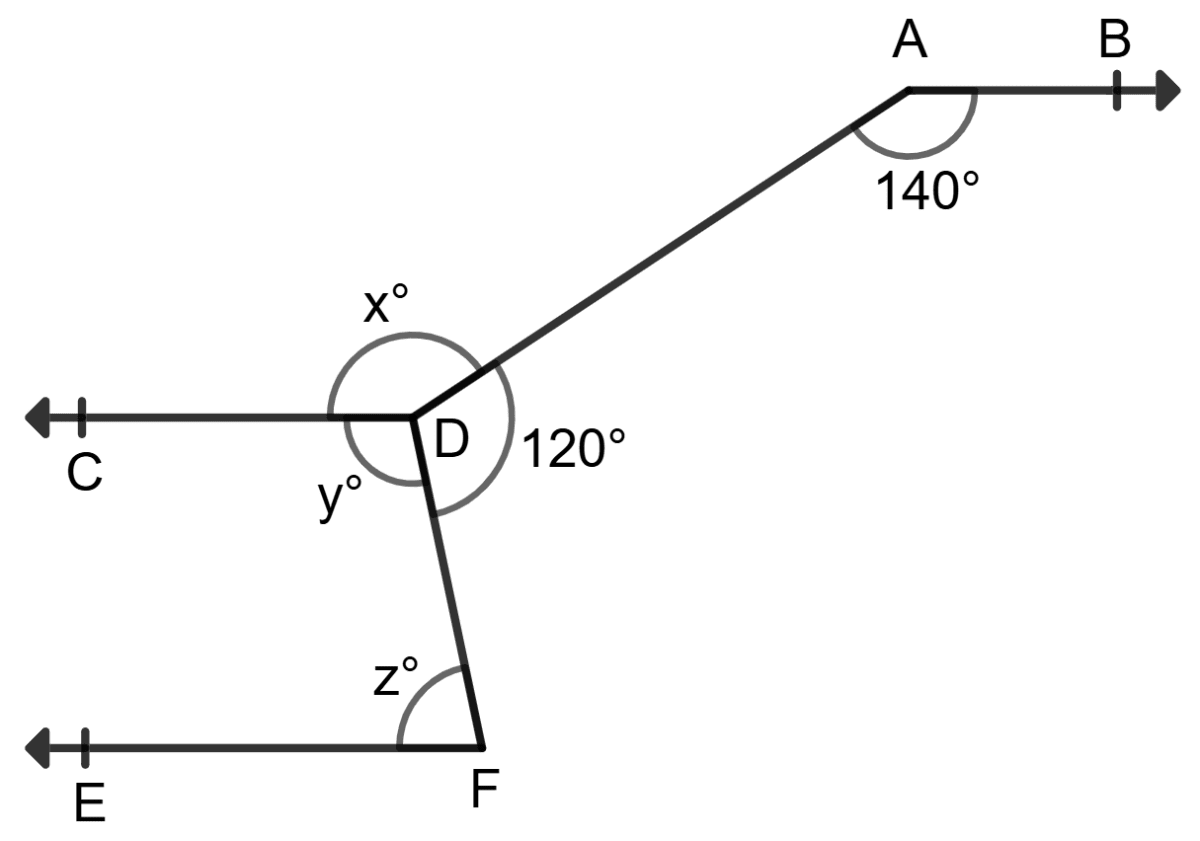
Answer
Consider AB || CD and AD is a transversal:
x° = 140° [Alternate angles]
Since, x°, y° and 120° meet at same point D and form a complete angle:
x° + y° + 120° = 360°
⇒ 140° + y° + 120° = 360° [Substituting the value of x]
⇒ 260° + y° = 360°
⇒ y° = 360° - 260°
⇒ y° = 100°
y° and z° are co-interior angles.
Co-interior angles are supplementary:
∴ y° + z° = 180°
⇒ 100° + z° = 180° [Substituting the value of y]
⇒ z° = 180° - 100°
⇒ z° = 80°
x° = 140°, y° = 100° and z° = 80°
In the given figure, AB || CD || EF and AD || BE. Find x, y and z.
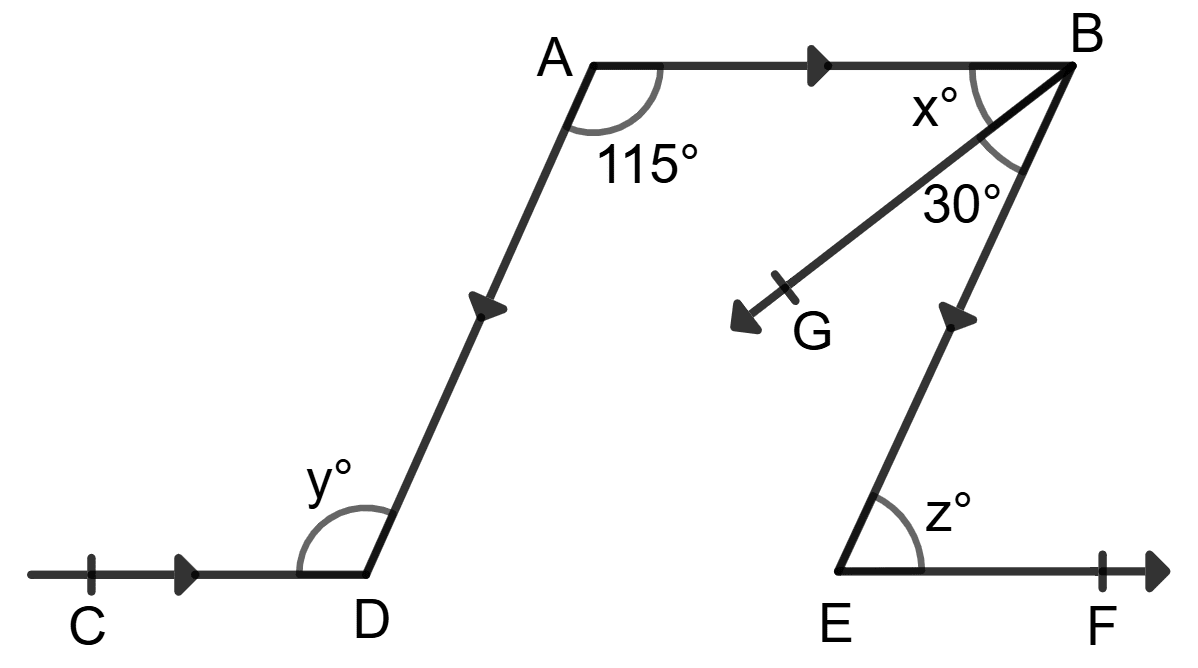
Answer
Consider AB || CD and AD is a transversal:
y° = 115° [Alternate angles]
∠BAD and ∠ABE are co-interior angles.
Since, line GB intersects at point B, therefore ∠ABE = (x° + 30°)
Co-interior angles are supplementary:
∴ ∠BAD + ∠ABE = 180°
⇒ 115° + x° + 30° = 180° [Substituting the value of ∠ABE]
⇒ x° + 145° = 180°
⇒ x° = 180° - 145°
⇒ x° = 35°
Now, consider AB || EF and BE is a transversal:
∠BEF = ∠ABE [Alternate angles]
⇒ ∠BEF = x° + 30° [Substituting the value of ∠ABE]
⇒ ∠BEF = 35° + 30° [Substituting the value of x]
⇒ ∠BEF = 65°
∴ z° = 65°
x° = 35°, y° = 115° and z° = 65°
In the given figure, l || m || n and p || q || r. Find the angles x, y, z and t.
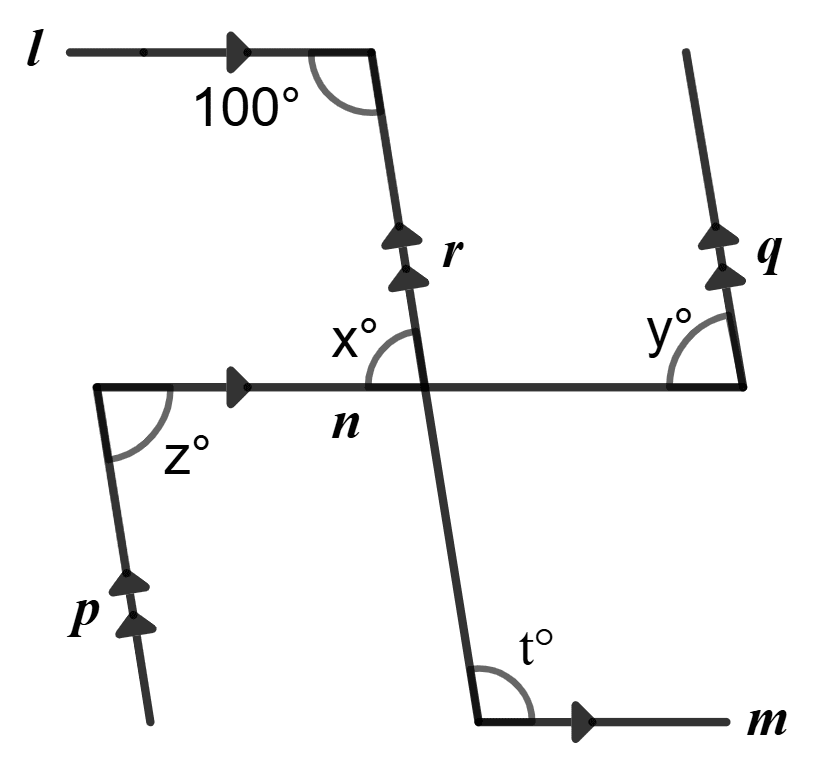
Answer
Consider, l || n:
x° and 100° are co-interior angles.
Co-interior angles are supplementary:
∴ x° + 100° = 180°
⇒ x° = 180° - 100°
⇒ x° = 80°
y° = x° [Corresponding angles]
∴ y° = 80°
Consider p || r and n is a transversal:
z° = x° [Alternate angles]
∴ z° = 80°
Now, consider l || m and r is a transversal:
t° = 100° [Alternate angles]
x° = 80°, y° = 80°, z° = 80° and t° = 100°
In the given figure, l || m and p || q. Find the angles x, y, z and t.
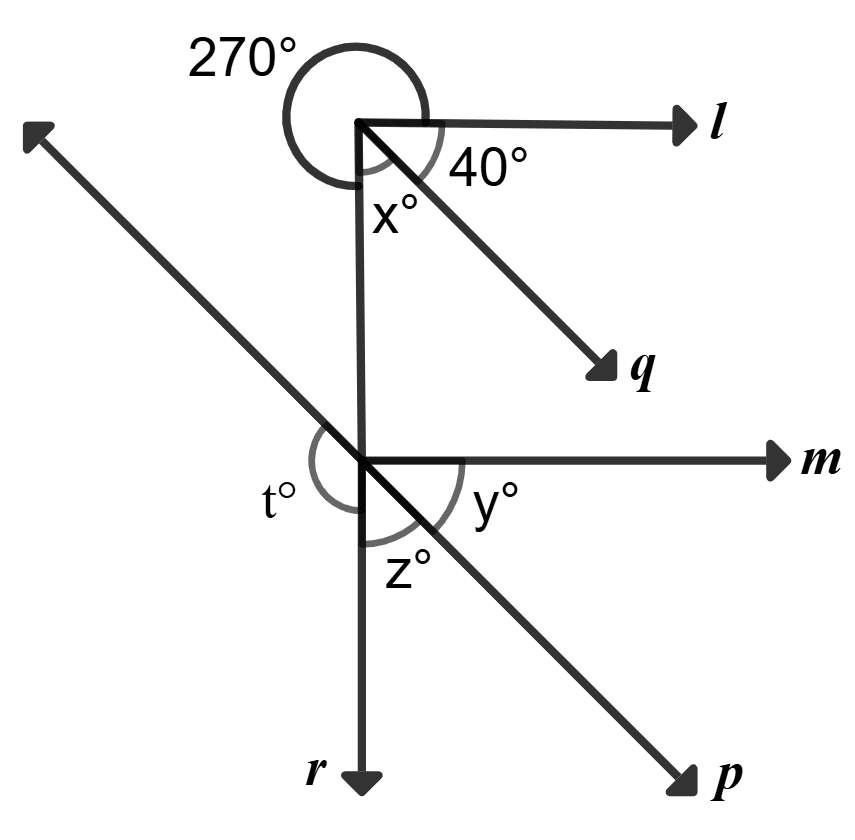
Answer
The angles at the top intersection point (where lines l, q and the vertical line meet) must sum to 360° because they form a complete circle.
270° + 40° + x° = 360°
⇒ 310° + x° = 360°
⇒ x° = 360° - 310°
⇒ x° = 50°
Consider p || q:
z° = x° [Corresponding angles]
∴ z° = 50°
Similarly,
y° = 40° [Corresponding angles]
Since, p is a straight line:
z° + t° = 180° [Linear pair]
⇒ 50° + t° = 180° [Substituting the value of z]
⇒ t° = 180° - 50°
⇒ t° = 130°
x° = 50°, y° = 40°, z° = 50° and t° = 130°
In the given figure, AB || CD. Find the angles x, y and z.
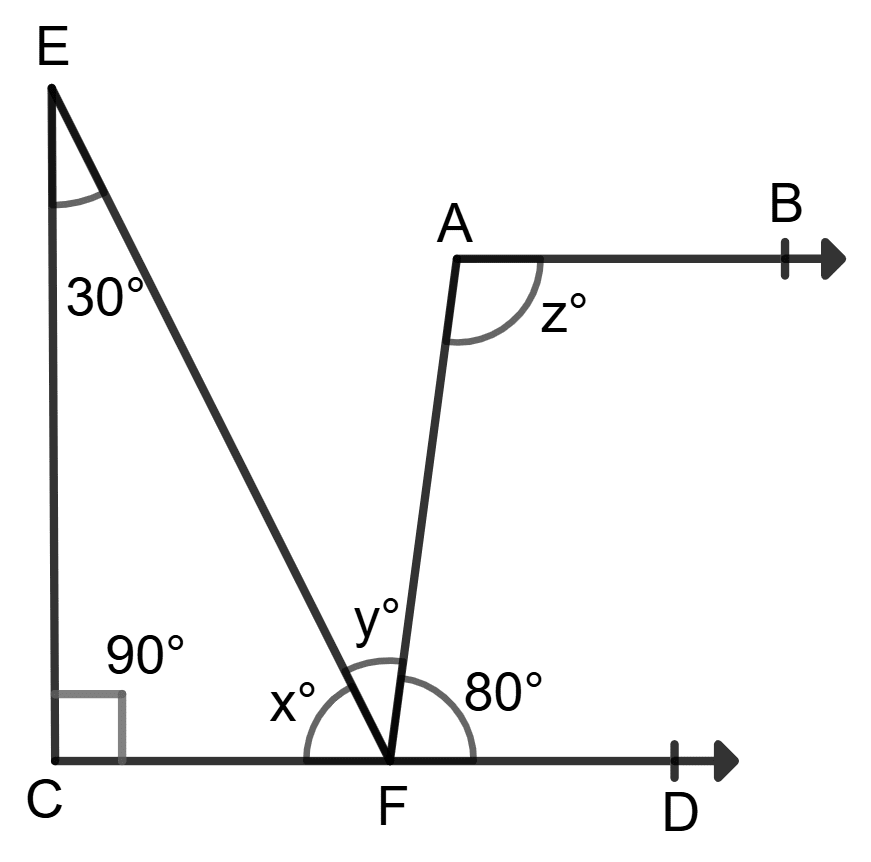
Answer
From figure,
∠ECF = 90°, ∠CEF = 30°, ∠AFD = 80°
In △ECF, the sum of interior angles is 180°.
∴ ∠ECF + ∠CEF + ∠EFC = 180°
⇒ 90° + 30° + x° = 180°
⇒ 120° + x° = 180°
⇒ x° = 180° - 120°
⇒ x° = 60°
Consider, AB || CD:
z° and 80° are co-interior angles.
Co-interior angles are supplementary:
∴ z° + 80° = 180°
⇒ z° = 180° - 80°
⇒ z° = 100°
Since CD is a straight line, the sum of all angles on one side of a straight line at a point is 180°.
∴ x° + y° + 80° = 180°
⇒ 60° + y° + 80° = 180°
⇒ y° + 140° = 180°
⇒ y° = 180° - 140°
⇒ y° = 40°
x° = 60°, y° = 40° and z° = 100°
In the given figure, l || m and p || q. Find the angles x, y and z.
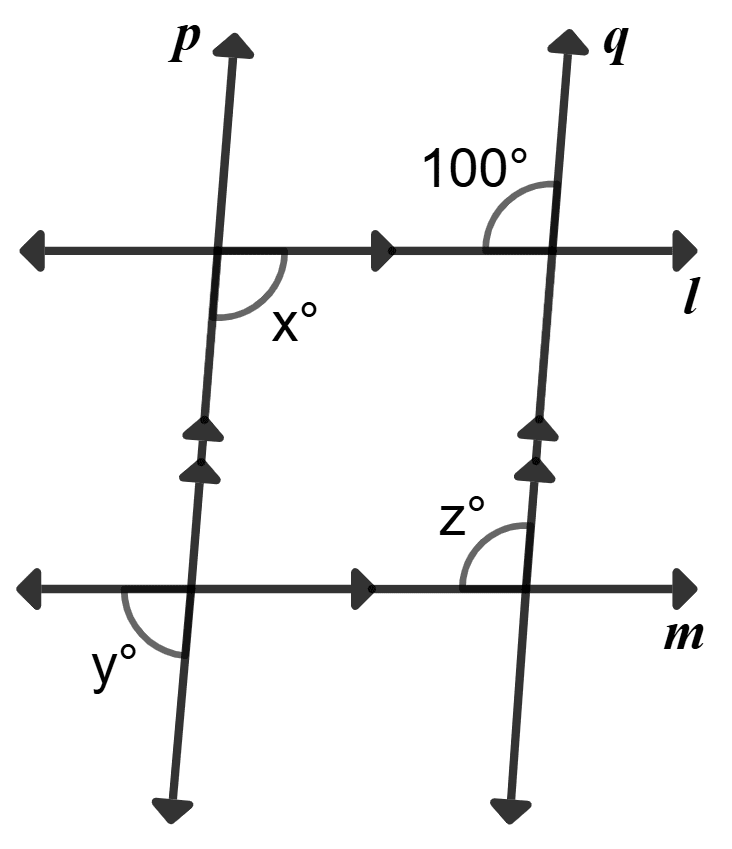
Answer
Consider p || q and l is a transversal:
x° = 100° [Alternate angles]
Consider l || m:
z° = 100° [Corresponding angles]
Let the angle vertically opposite to y° be t°.
Now, t° and z° are co-interior:
∴ t° + z° = 180°
⇒ t° + 100° = 180°
⇒ t° = 180° - 100°
⇒ t° = 80°
y° = t° [Vertically opposite angles]
∴ y° = 80°
x° = 100°, y° = 80° and z° = 100°
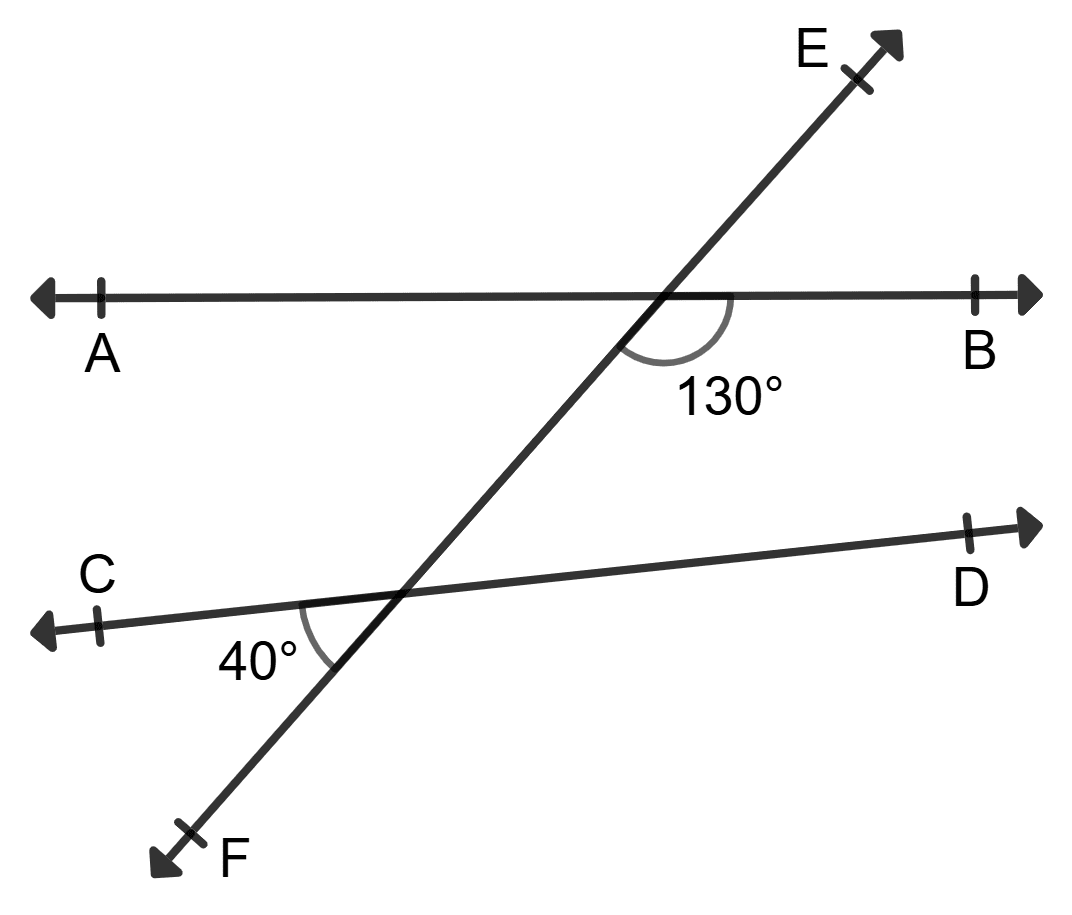
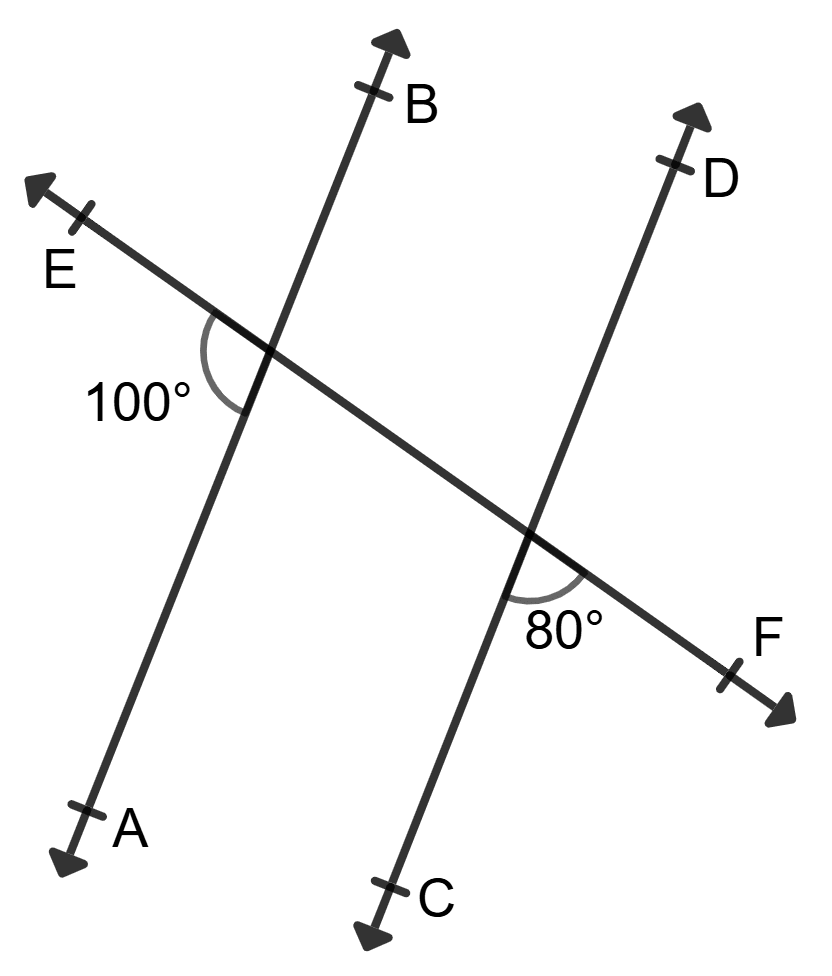
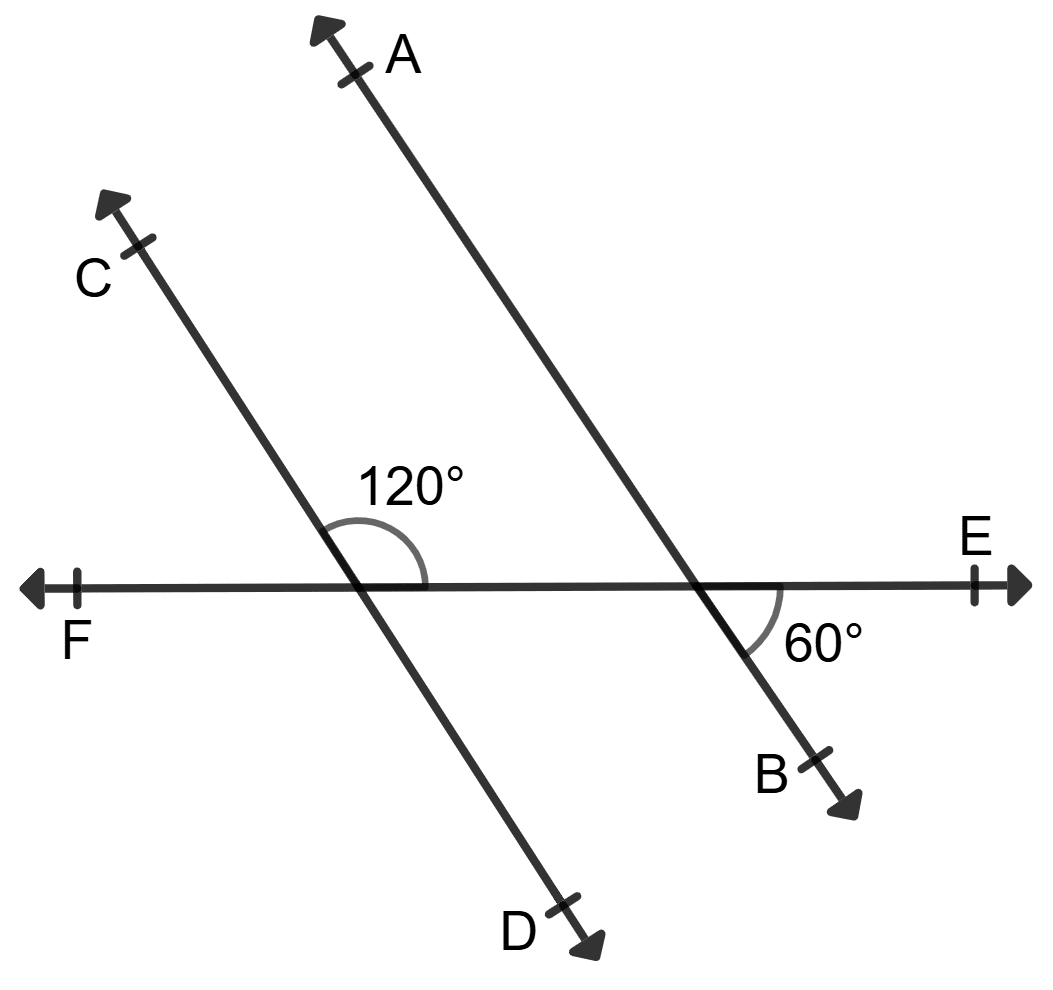
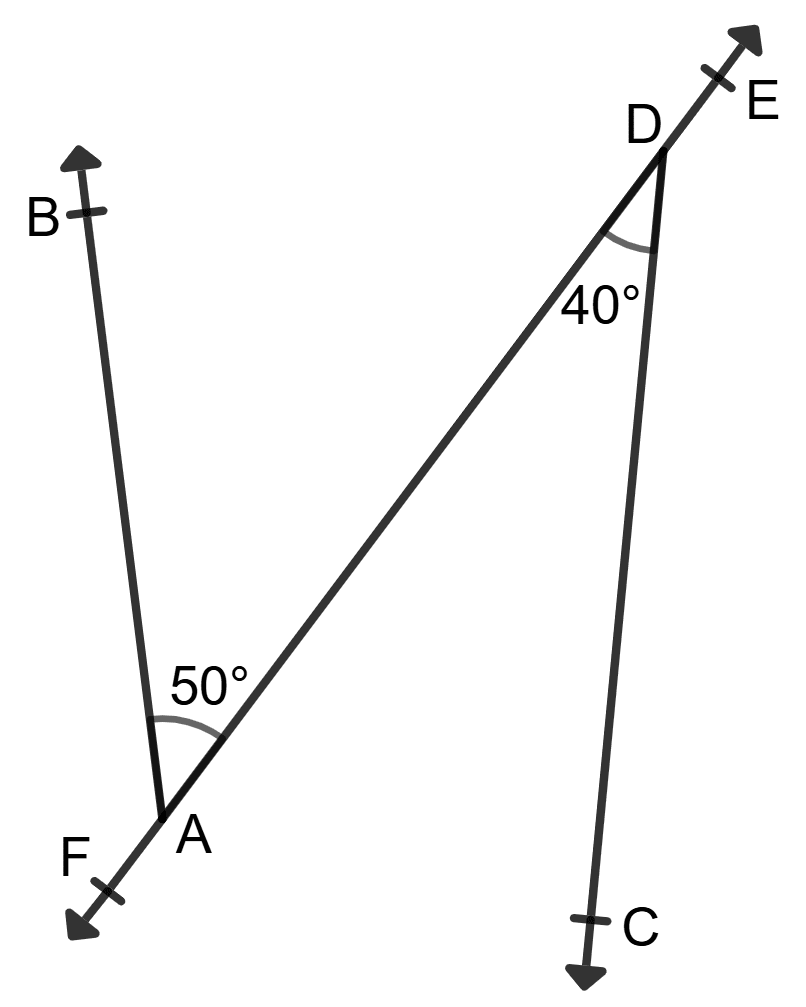
In each of the following figures, two lines AB and CD are cut by a transversal EF. In each case, find whether AB || CD or not. Give reasons in support of your answer.
(i)
(ii)
(iii)
(iv)
(v)
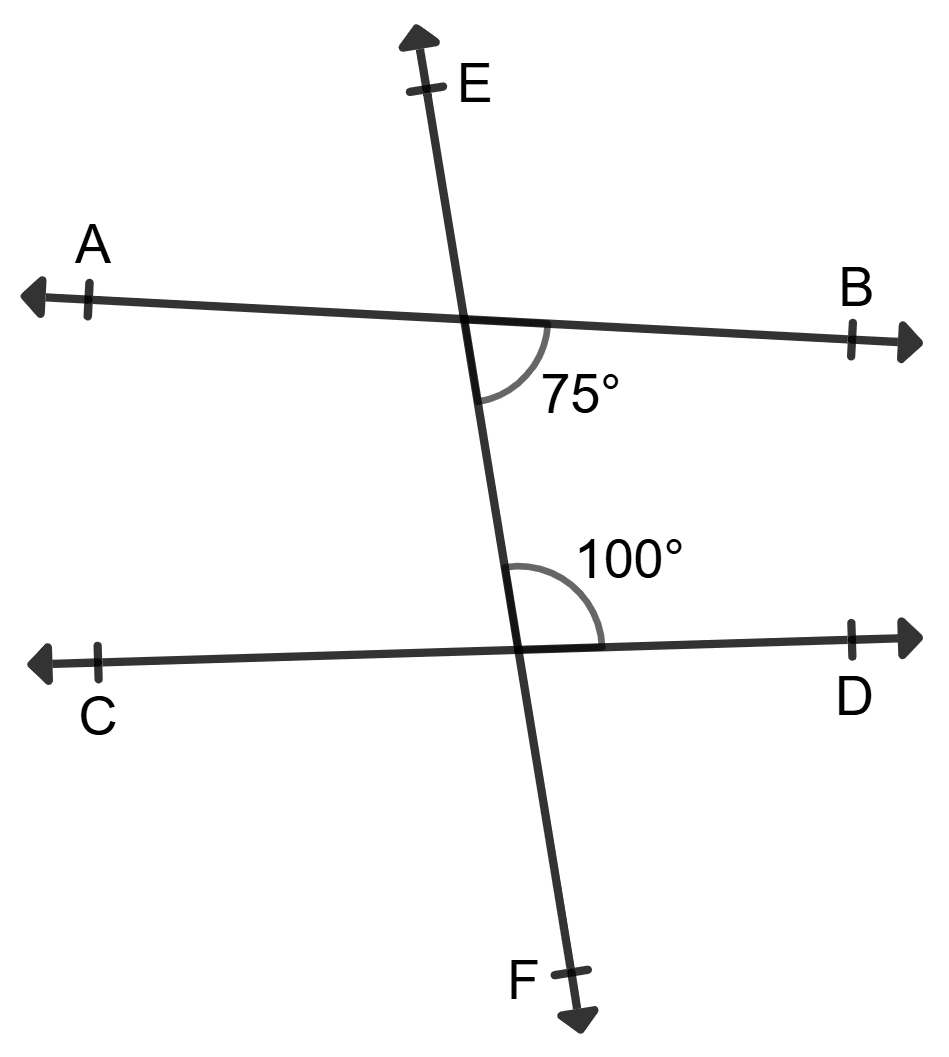
Answer
(i)
In the given figure,
The angle vertically opposite to 40° is 40°.
Now, consider the pair of co-interior angles: 130° and 40°.
Sum = 130° + 40° = 170°
Since the sum of co-interior angles is not 180°.
AB and CD are not parallel.
(ii)
At the first intersection, the interior angle adjacent to 100° is 180° - 100° = 80° (Linear pair).
This 80° angle and the given 80° angle at the second intersection are corresponding angles.
Since 80° = 80°, the corresponding angles are equal.
AB and CD are parallel.
(iii)
The sum of angle adjacent to 120° and 120° is 180° because they form linear pair.
So,
Adjacent angle = 180° - 120° = 60°
This 60° angle and the given 60° angle are exterior alternate angles.
Since 60° = 60°, the external alternate angles are equal.
AB and CD are parallel.
(iv)
From the figure we have,
AD is a transversal
∠BAD = 50° and ∠ADC = 40°
These form a pair of interior alternate angles.
But 50° ≠ 40°
Since alternate angles are not equal,
AB and CD are not parallel.
(v)
The angles 75° and 100° are a pair of co-interior angles.
Co-interior angles are supplementary.
Sum = 75° + 100° = 175°
Since the sum of co-interior angles is not 180°,
AB and CD are not parallel.