
The sum of all the angles at a point is
- 0°
- 90°
- 180°
- 360°
Answer
Angles around a single point form a complete rotation, which is always 360°.
Hence, option 4 is the correct option.
The sum of a linear pair of angles is
- 0°
- 90°
- 180°
- 360°
Answer
A linear pair of angles sits on a straight line and the measure of a straight angle is 180°.
Hence, option 3 is the correct option.
Vertically opposite angles
- are complementary
- are supplementary
- are equal
- form a linear pair
Answer
When two lines intersect, the angles opposite each other at the vertex are always equal.
Hence, option 3 is the correct option.
When two parallel lines are cut by a transversal, then the co-interior angles are
- equal
- supplementary
- complementary
- always unequal
Answer
Co-interior angles are supplementary i.e., angles on the same side of the transversal, inside the parallel lines always add up to 180°.
Hence, option 2 is the correct option.
A pair of complementary angles is
- 42° 16', 47° 34'
- 34° 10', 55° 50'
- 53° 27', 29° 33'
- 19° 26', 70° 36'
Answer
Evaluating all options:
Sum of minutes: 16' + 34' = 50'
Sum of degrees: 42° + 47° = 89°
Total: 89° 50'
Sum of minutes: 10' + 50' = 60' = 1°
Sum of degrees: 34° + 55° = 89°
Total: 89° + 1° = 90°
Sum of minutes: 27' + 33' = 60' = 1°
Sum of degrees: 53° + 29° = 82°
Total: 82° + 1° = 83°
Sum of minutes: 26' + 36' = 62' = 1° 2'
Sum of degrees: 19° + 70° = 89°
Total: 89° + 1° 2' = 90° 2'
Among all these, second option gave the result 90°.
Hence, option 2 is the correct option.
The measures of two complementary angles are in the ratio 1 : 5. What is the measure of the smaller angle?
- 15°
- 20°
- 25°
- 30°
Answer
Let the angles be x and 5x
The question states that the angles are complementary:
∴ x + 5x = 90°
⇒ 6x = 90°
⇒ x =
⇒ x = 15°
Hence, option 1 is the correct option.
The measures of two supplementary angles are in the ratio 4 : 11. What is the measure of the greater angle?
- 106°
- 121°
- 132°
- 154°
Answer
Let the angles be 4x and 11x.
The question states that the angles are supplementary:
∴ 4x + 11x = 180°
⇒ 15x = 180°
⇒ x =
⇒ x = 12°
Greater angle = 11x = (11 x 12°) = 132°
Hence, option 3 is the correct option.
An angle is 80° less than three times its supplement. The angle is
- 75°
- 85°
- 105°
- 115°
Answer
Let the supplement be s.
The angle is (3s - 80°)
Since they are supplementary:
(3s - 80°) + s = 180°
⇒ 4s - 80° = 180°
⇒ 4s = 180° + 80°
⇒ 4s = 260°
⇒ s =
⇒ s = 65°
The angle = 180° - 65° = 115°
Hence, option 4 is the correct option.
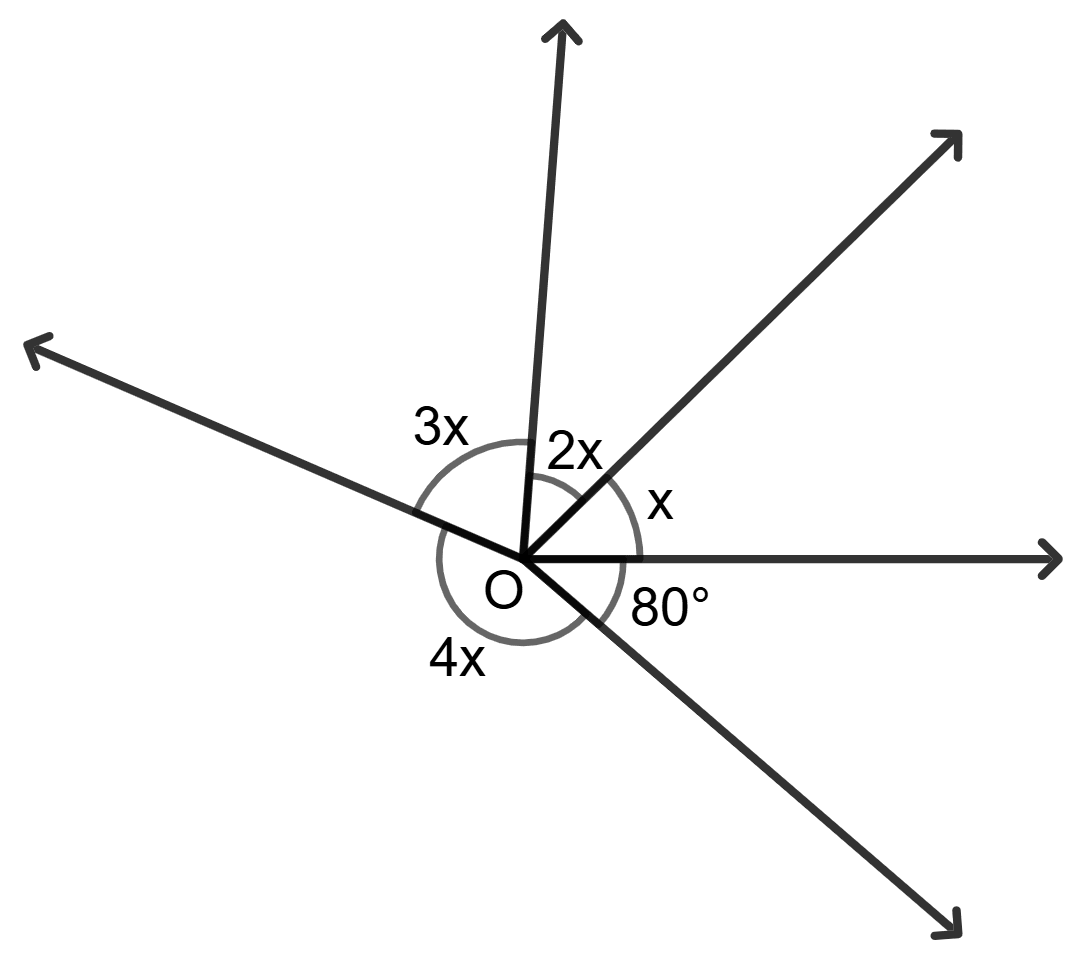
The value of x in the given figure is
- 24°
- 28°
- 36°
- 42°
Answer
Angles meeting at a single point, always sum to 360°, as they complete one full rotation.
3x + 2x + x + 80° + 4x = 360°
⇒ 10x + 80° = 360°
⇒ 10x = 360° - 80°
⇒ 10x = 280°
⇒ x =
⇒ x = 28°
Hence, option 2 is the correct option.
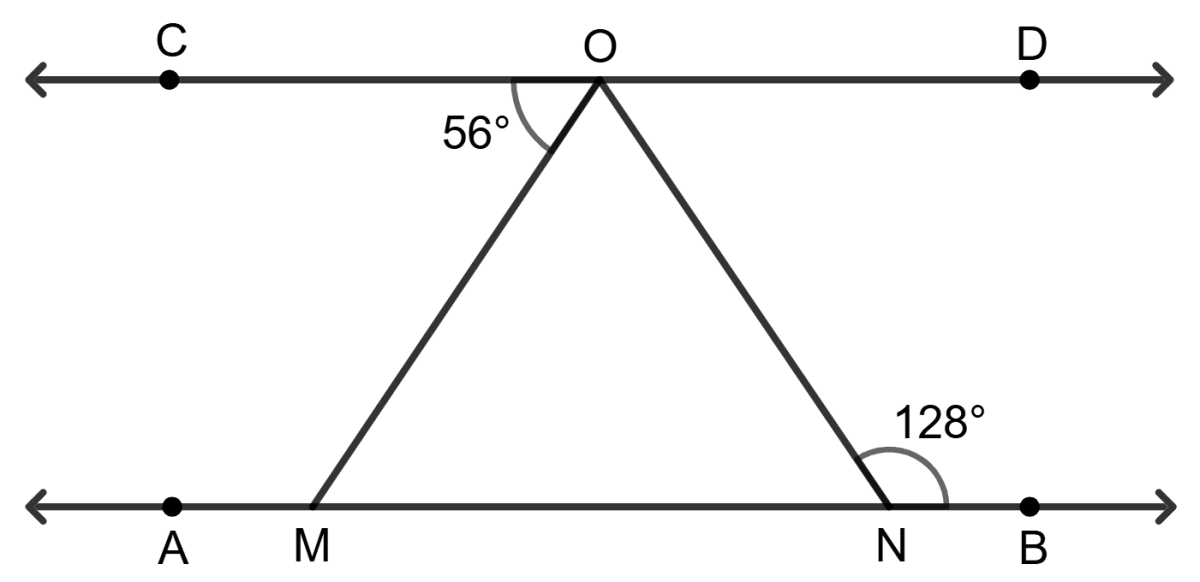
In the given figure, AB || CD. If ∠BNO = 128° and ∠COM = 56°, then ∠MON is
- 52°
- 64°
- 72°
- 84°
Answer
Given:
AB || CD.
∠BNO = 128° and ∠COM = 56°
Consider AB || CD and OM is a transversal:
∠NOC = ∠BNO [Alternate angles]
∴ ∠NOC = 128°
Now,
∠NOC = ∠COM + ∠MON
⇒ 128° = 56° + ∠MON
⇒ ∠MON = 128° - 56°
⇒ ∠MON = 72°
Hence, option 3 is the correct option.
Fill in the blanks :
(i) An angle whose measure is more than 180° but less than 360° is called a ............... .
(ii) A straight line that intersects two or more lines in a plane is called a ............... .
(iii) A pair of adjacent angles is said to be a ............... if these angles have one arm common and other arms as opposite rays.
(iv) Two intersecting lines make ............... pairs of vertically opposite angles.
(v) Two lines are said to be ............... to each other if they intersect at right angles.
Answer
(i) An angle whose measure is more than 180° but less than 360° is called a reflex angle.
(ii) A straight line that intersects two or more lines in a plane is called a transversal.
(iii) A pair of adjacent angles is said to be a linear pair if these angles have one arm common and other arms as opposite rays.
(iv) Two intersecting lines make two pairs of vertically opposite angles.
(v) Two lines are said to be perpendicular to each other if they intersect at right angles.
Write true (T) or false (F) :
(i) An angle whose measure is 90° is called a straight angle.
(ii) The sum of the angles of a linear pair is 180°.
(iii) When two straight lines cut each other, the sum of any two adjacent angles formed is 180°.
(iv) A line which intersects two other lines at their point of intersection is called a transversal.
(v) When two parallel lines are cut by a transversal, then the exterior opposite angles are supplementary.
Answer
(i) False
Reason — An angle of 90° is called a right angle. A straight angle measures exactly 180°.
(ii) True
Reason — By definition, a linear pair consists of adjacent angles formed by intersecting lines, which together form a straight line.
(iii) True
Reason — Any two adjacent angles formed by the intersection of two straight lines form a linear pair, making them supplementary.
(iv) False
Reason — A transversal is a line that intersects two or more lines at distinct (different) points. If it passes through their point of intersection, the lines are simply concurrent.
(v) False
Reason — When parallel lines are cut by a transversal, exterior alternate angles are equal, not supplementary. However, co-exterior angles (exterior angles on the same side of the transversal) are supplementary.
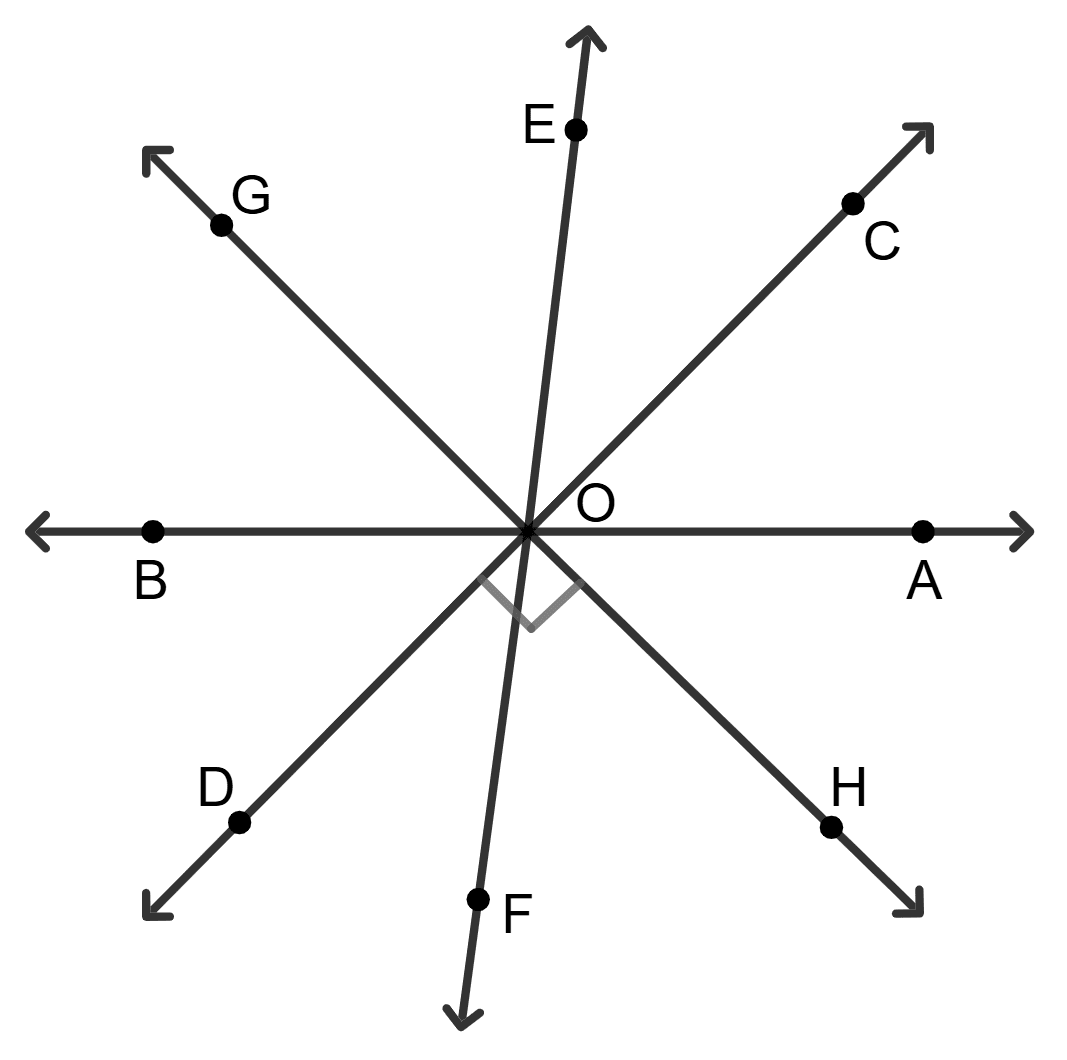
Mohit has a complex collection of lines drawn in a plane. He studies the angles formed due to the intersection of these lines. It is known that ∠DOH = 90°.
(1) Which of the following is a pair of vertically opposite angles ?
- ∠AOC, ∠BOG
- ∠BOG, ∠BOD
- ∠COE, ∠FOH
- ∠EOG, ∠FOH
(2) Which of the following is a pair of perpendicular lines ?
- AB, CD
- CD, GH
- AB, EF
- EF, GH
(3) Which of the following is a pair of complementary angles ?
- ∠AOC, ∠COE
- ∠COE, ∠EOG
- ∠EOG, ∠FOH
- ∠COG, ∠DOH
(4) Which of the following is a pair of supplementary angles ?
- ∠COE, ∠DOF
- ∠BOF, ∠AOH
- ∠AOE, ∠BOE
- ∠AOD, ∠BOG
Answer
(1)
Vertically opposite angles are formed when two straight lines intersect. In the diagram, line EF and line GH intersect at point O. This intersection creates the pair ∠EOG and ∠FOH, which are opposite each other.
Hence, option 4 is the correct option.
(2)
The problem states that ∠DOH = 90°. Perpendicular lines are lines that intersect at a right angle (90°). Since the angle between line CD and line GH is 90°, these two lines are perpendicular.
Hence, option 2 is the correct option.
(3)
Complementary angles are two angles whose sum is 90°.
Since ∠DOH = 90° and CD and GH are straight lines, the angle ∠COG which is vertically opposite to ∠DOH is also 90°.
∠COG is made up of two angles ∠COE and ∠EOG which are complementary angles.
Hence, option 2 is the correct option.
(4)
Supplementary angles are two angles that sum to 180°. These usually form a linear pair on a straight line. Angles ∠AOE and ∠BOE sit on the straight line AB. Therefore, their sum must be 180°.
Hence, option 3 is the correct option.
Assertion: Two angles making a linear pair are always supplementary.
Reason: A pair of adjacent angles is said to be a linear pair, if these angles have one arm common and other arms as opposite rays.
- Both Assertion (A) and Reason (R) are true and Reason (R) is the correct explanation of Assertion (A).
- Both Assertion (A) and Reason (R) are true and Reason (R) is not the correct explanation of Assertion (A).
- Assertion (A) is true but Reason (R) is false.
- Assertion (A) is false but Reason (R) is true.
Answer
Both Assertion (A) and Reason (R) are true and Reason (R) is the correct explanation of Assertion (A).
Explanation
The assertion states that a linear pair of angles is always supplementary. This is mathematically true. In geometry, supplementary angles are two angles that sum up to exactly 180°.
The reason provides the geometric definition of a linear pair:
They must be adjacent (share a common vertex and a common arm).
Their non-common arms must be opposite rays, which means they form a single straight line.
Since the definition in the Reason is exactly why the Assertion is true, the Reason is the correct explanation for the Assertion.
Hence, option 1 is the correct option.
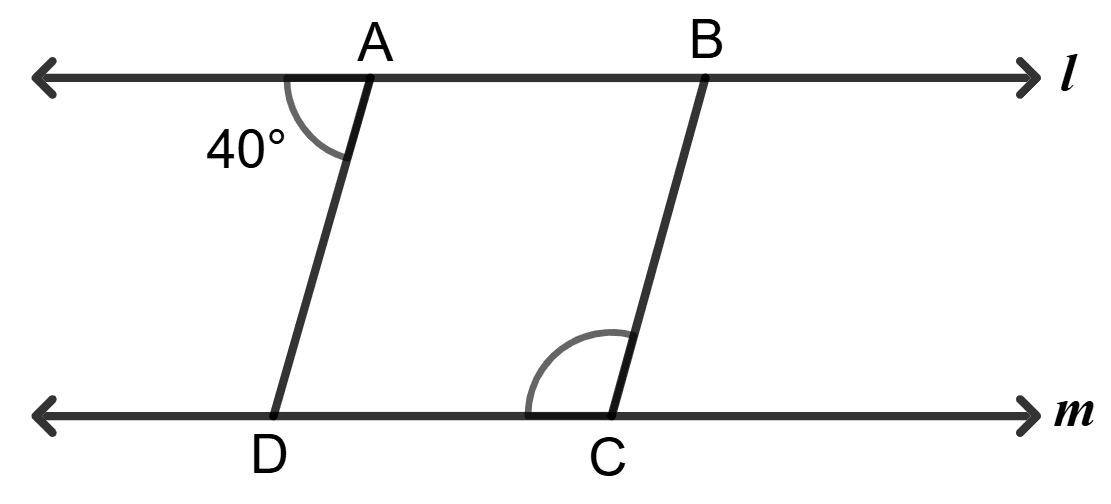
Assertion: In the figure l || m, AD || BC and ∠A = 40°. The measure of ∠BCD is 140°.
Reason: If two parallel lines are cut by a transversal, then the pair of corresponding angles are equal and the co-interior angles are supplementary.
- Both Assertion (A) and Reason (R) are true and Reason (R) is the correct explanation of Assertion (A).
- Both Assertion (A) and Reason (R) are true and Reason (R) is not the correct explanation of Assertion (A).
- Assertion (A) is true but Reason (R) is false.
- Assertion (A) is false but Reason (R) is true.
Answer
Both Assertion (A) and Reason (R) are true and Reason (R) is the correct explanation of Assertion (A).
Explanation
From the figure,
Consider, l || m and AD is the transversal:
∠ADC = ∠A [alternate interior angles]
∴ ∠ADC = 40°
Now, consider AD || BC and m is a transversal:
∠ADC + ∠BCD = 180° [Co-interior angles]
⇒ 40° + ∠BCD = 180°
⇒ ∠BCD = 180° - 40°
⇒ ∠BCD = 140°
The Assertion is true.
The reason states that if two parallel lines are cut by a transversal:
Corresponding angles are equal.
Co-interior angles are supplementary (180°).
These are fundamental properties of parallel lines.
The Reason is true and it is the correct explanation for how we calculated the value in the Assertion.
Hence, option 1 is the correct option.
Assertion: The sum of two vertically opposite angles is 162°, then each of the angles is 81°.
Reason: Vertically opposite angles are supplementary.
- Both Assertion (A) and Reason (R) are true and Reason (R) is the correct explanation of Assertion (A).
- Both Assertion (A) and Reason (R) are true and Reason (R) is not the correct explanation of Assertion (A).
- Assertion (A) is true but Reason (R) is false.
- Assertion (A) is false but Reason (R) is true.
Answer
Assertion (A) is true but Reason (R) is false.
Explanation
The assertion states that if the sum of two vertically opposite angles is 162°, then each angle is 81°.
When two lines intersect, the vertically opposite angles formed are always equal.
Calculation:
Let each angle be x.
x + x = 162°
2x = 162°
x =
x = 81°
The Assertion is true.
The reason states that "Vertically opposite angles are supplementary."
Vertically opposite angles are equal, but they are only supplementary if the intersecting lines are perpendicular (forming four 90° angles). In a general case, vertically opposite angles are not supplementary.
The Reason is false.
Hence, option 3 is the correct option.
Which of the following statements is true?
- A pair of complementary angles can have two right angles.
- A pair of complementary angles can have two obtuse angles.
- A pair of complementary angles can have two acute angles.
- A pair of complementary angles can have one acute and one obtuse angle.
Answer
Two angles are said to be complementary if their sum is 90°.
Option 1: Two right angles sum to 90° + 90° = 180°, not 90°. So this is not possible.
Option 2: Each obtuse angle is greater than 90°, so the sum of two obtuse angles is greater than 180°, which cannot equal 90°.
Option 3: Each acute angle is less than 90°. The sum of two acute angles can be 90°. For example, 30° + 60° = 90°. So a pair of complementary angles can have two acute angles.
Option 4: An obtuse angle is itself greater than 90°, so the sum of an acute angle and an obtuse angle is greater than 90°, which cannot equal 90°.
Hence, option 3 is the correct option.
Which of the following shows ∠P and ∠Q as alternate interior angles?
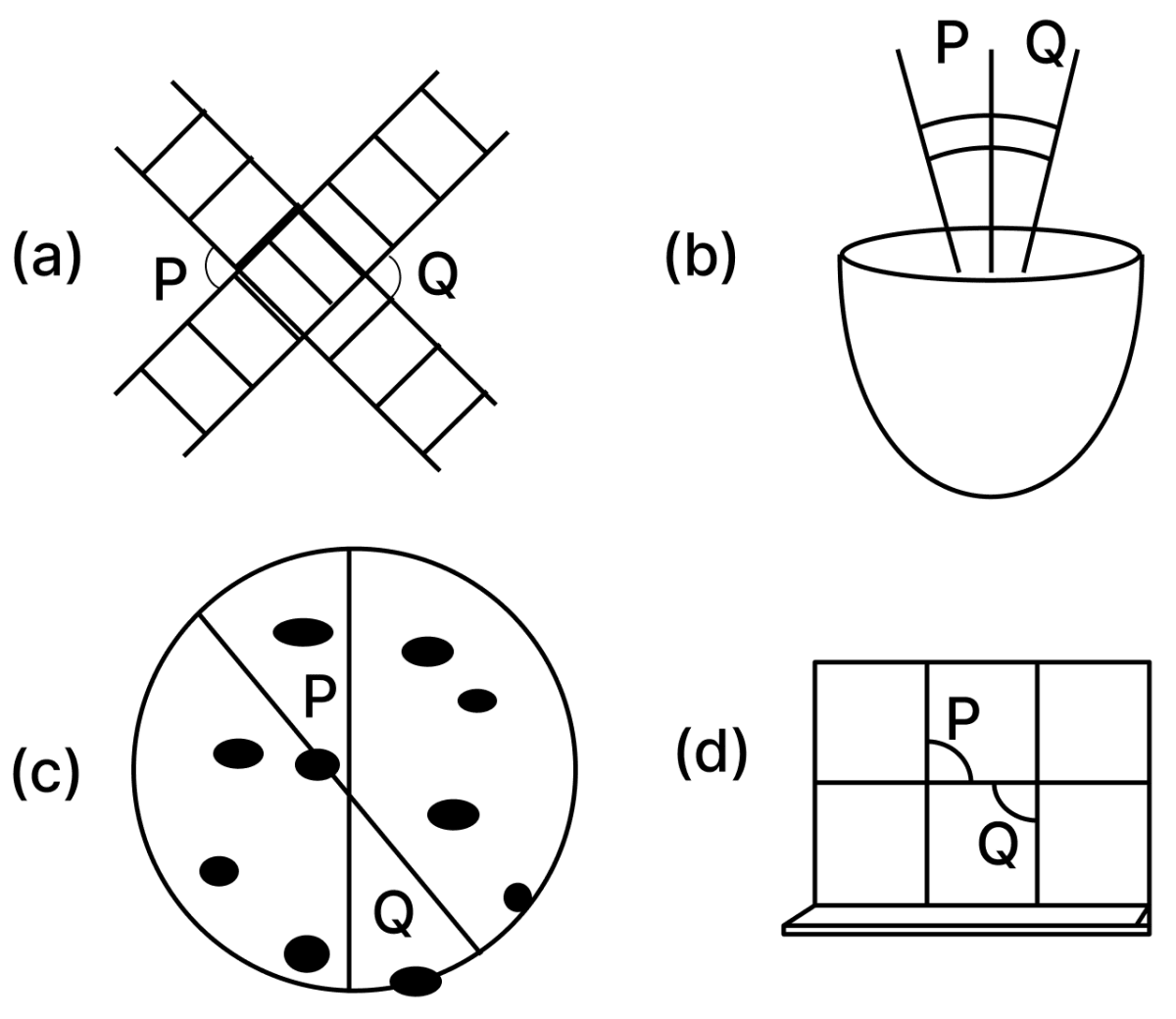
Answer
Alternate interior angles are formed when a transversal crosses two lines. These angles lie:
(i) between the two lines (interior region), and
(ii) on opposite sides of the transversal.
When the two lines are parallel, alternate interior angles form the characteristic "Z-shape" (or its mirror image).
Option 1: ∠P and ∠Q are vertically opposite angles at separate intersections where the tracks cross.
Option 2: These are adjacent angles sharing a common arm and vertex.
Option 3: ∠P and ∠Q are vertically opposite angles formed by the intersection of two straight lines at the center of the pizza.
Option 4: The two vertical bars are parallel and the horizontal bar is a transversal. ∠P and ∠Q lie between the parallel lines and on opposite sides of the transversal.
Hence, option 4 is the correct option.
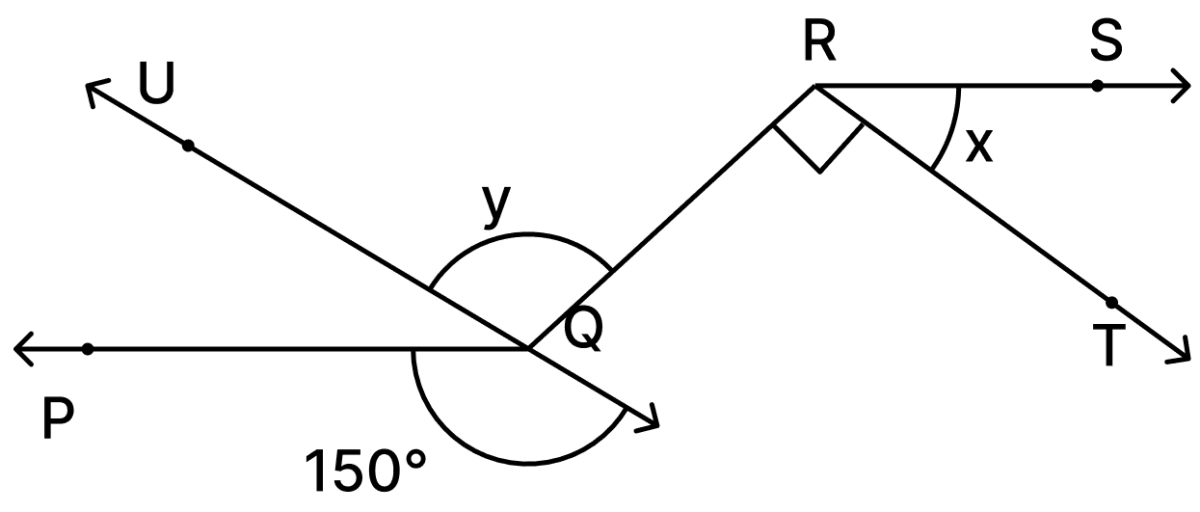
If RS ∥ PQ and RT ∥ UQ, then the value of 8x − 2y is:
- 60°
- 30°
- 150°
- 100°
Answer
From the figure,
∠TRQ = 90° [Given]
Since RT ∥ UQ,
y = ∠TRQ [Alternate angles]
∴ y = 90°
At Q, the given 150° angle and ∠PQU form a linear pair.
∠PQU + 150° = 180°
∠PQU = 30°
Since RS ∥ PQ and RT ∥ UQ, the angle between RS and RT equals the angle between QP and QU.
∴ x = 30°
Hence,
Substituting the values of x and y into the expression:
8x − 2y = 8(30°) - 2(90°)
= 240° - 180°
= 60°
Hence, option 1 is the correct option.
Three lines l, m, n intersect each other at point P, as shown in the figure.
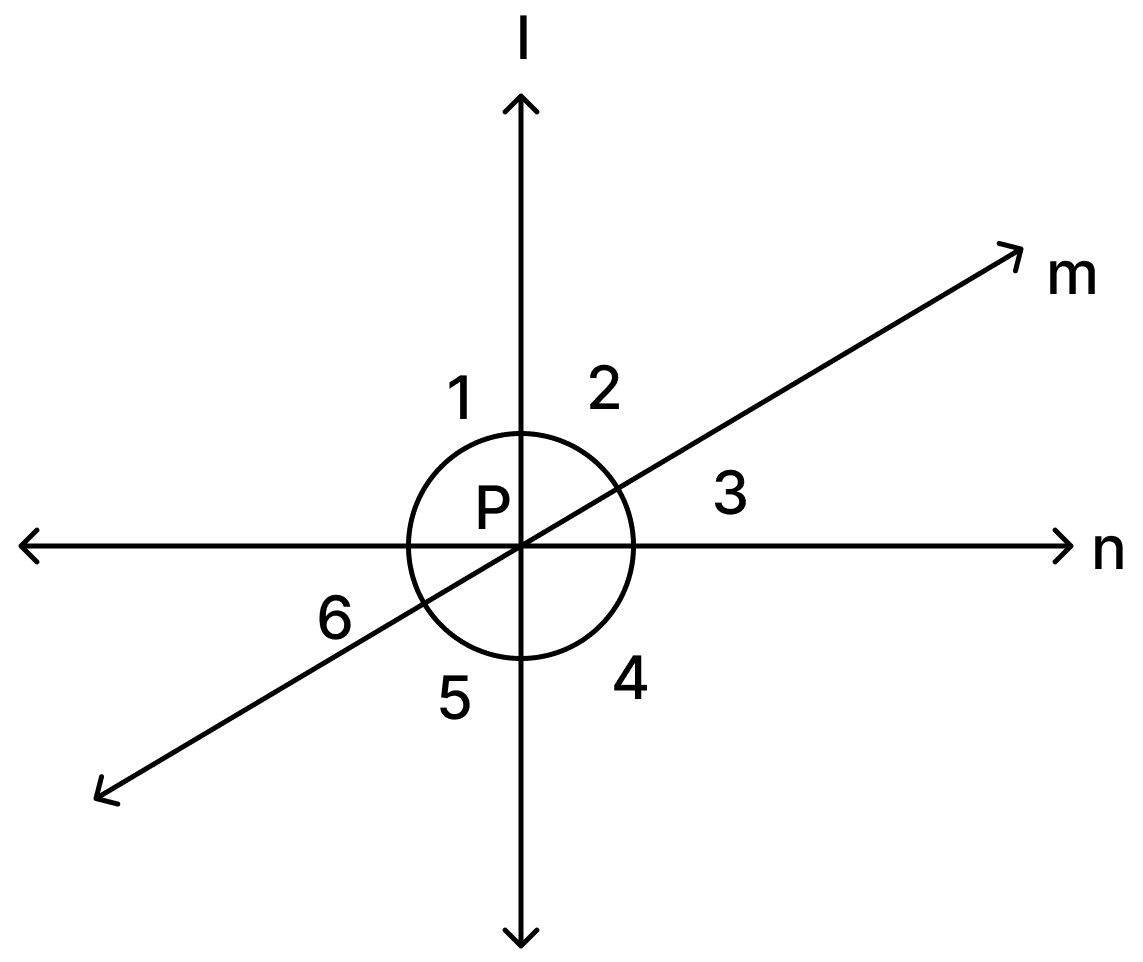
Line l is perpendicular to line n. The measure of ∠2 is 65°. What is the sum of the measure of ∠3 and ∠4?
- 110°
- 115°
- 120°
- 210°
Answer
When three lines intersect at a single point P, they form 6 angles. The three angles on one side of any line sum to 180° (angles on a straight line).
Since line l is perpendicular to line n, the angle between l and n is 90°.
From the figure, ∠2 and ∠3 together form the right angle between l and n.
∠2 + ∠3 = 90°
65° + ∠3 = 90°
∠3 = 90° - 65°
∠3 = 25°
∠4 is the angle between the downward vertical line and the right horizontal line.
Since l ⊥ n,
∠4 = 90°
Therefore:
∠3 + ∠4 = 25° + 90° = 115°
Hence, option 2 is the correct option.
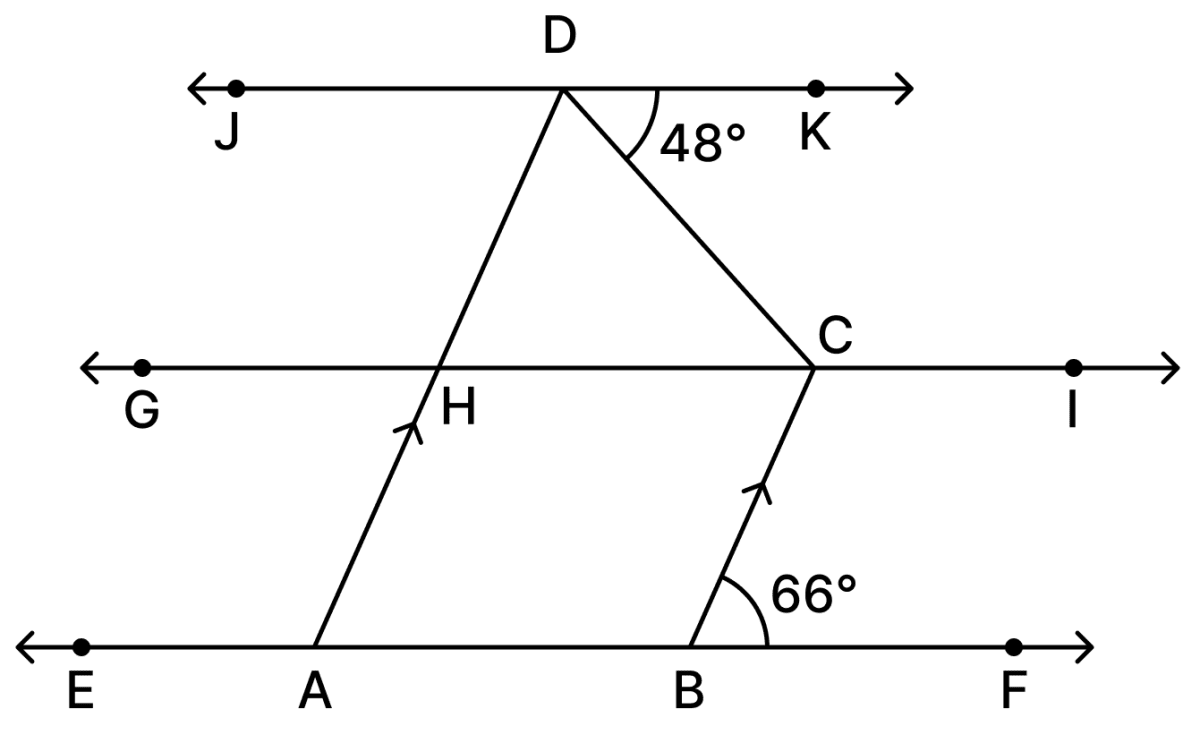
In the given figure (not drawn to scale), AD is parallel to BC, JDK, GHCI, EABF are straight and parallel lines, then ∠BCI + ∠HAB is equal to:
- 150°
- 160°
- 180°
- 180°
Answer
From the figure,
∠CBF = 66°
Since AD ∥ BC and line EABF cuts these two parallel lines,
∠HAB = ∠CBF = 66° [Corresponding angles]
Also EABF ∥ GHCI, and BC is a transversal.
Therefore, ∠CBF and ∠BCI are co-interior angles.
∠CBF + ∠BCI = 180°
66° + ∠BCI = 180°
∠BCI = 114°
Hence,
∠BCI + ∠HAB = 114° + 66° = 180°
Hence, option 3 is the correct option.
Consider the figure shown alongside.
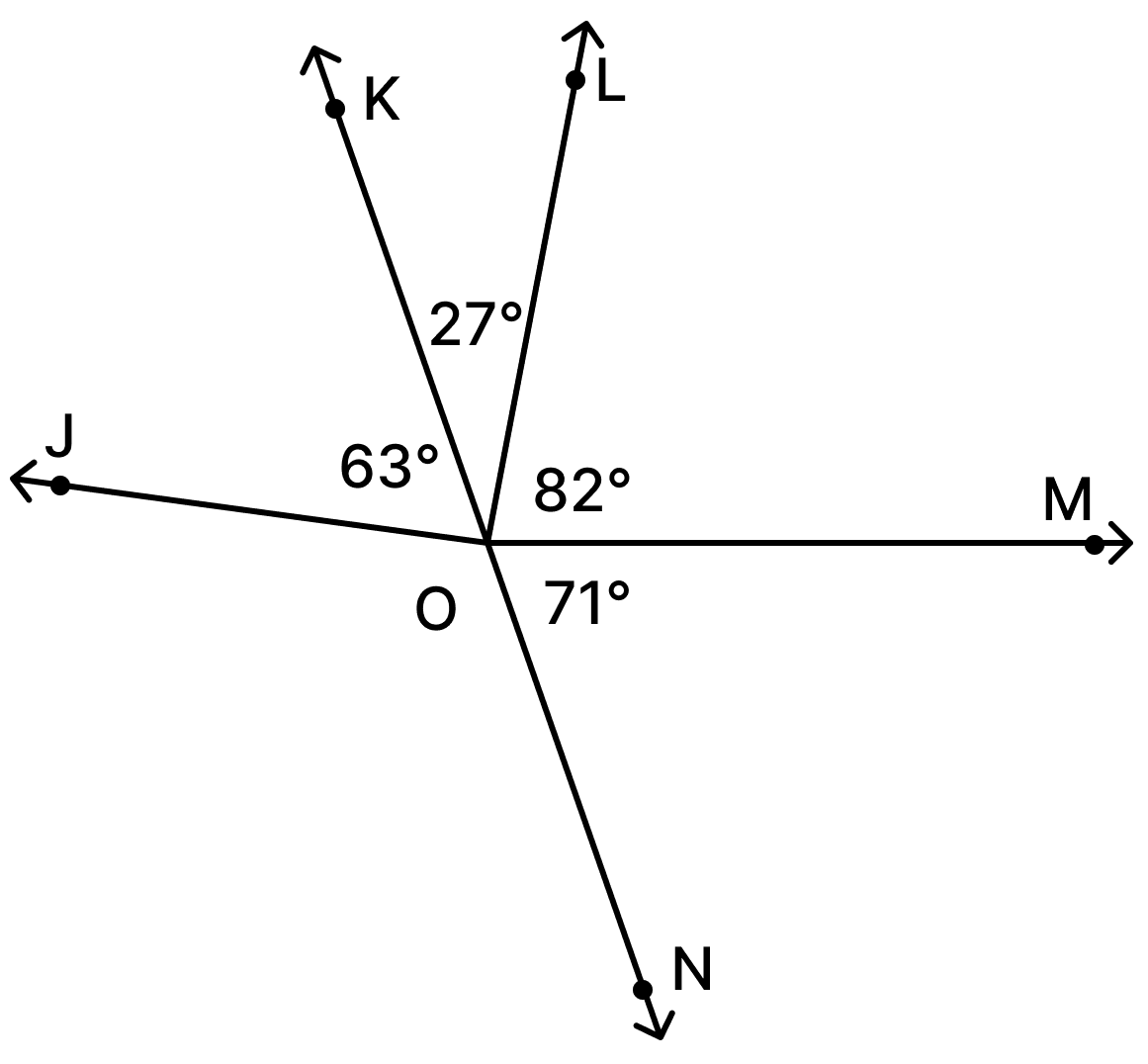
Which of these is a linear pair?
- ∠JOK and ∠KOL
- ∠JOL and ∠LOM
- ∠LOM and ∠MON
- ∠KOM and ∠MON
Answer
Two angles form a linear pair if:
(i) they are adjacent (share a common arm and a common vertex), and
(ii) the non-common arms form a straight line (i.e., are opposite rays).
The sum of the angles in a linear pair is always 180°.
Option 1: ∠JOK and ∠KOL share arm OK. The non-common arms OJ and OL do not form a straight line.
Option 2: ∠JOL and ∠LOM share arm OL. The non-common arms OJ and OM do not form a straight line.
Option 3: ∠LOM and ∠MON share arm OM. The non-common arms OL and ON are not opposite rays, so the two angles do not form a linear pair.
Option 4: ∠KOM and ∠MON share arm OM. The non-common arms OK and ON form a straight line (since K, O, N are collinear in the figure).
Hence, option 4 is the correct option.
Select the correct option.
- If two lines are parallel, then pair of interior angles on the same side of transversal are always complementary.
- If an angle is 60° more than three times of its supplement, then the smaller angle is of measure 60°.
- Two angles can be supplementary, if both of them are acute.
- The measure of complement of 41° is 49°.
Answer
Option 1: If two parallel lines are cut by a transversal, the pair of interior angles on the same side of the transversal (co-interior angles) are supplementary (sum = 180°), not complementary. So this is false.
Option 2: Let the angle be x°. Its supplement is (180 − x)°.
According to the given condition:
x = 3(180 − x) + 60
x = 540 − 3x + 60
x = 600 − 3x
4x = 600
x = 150°
The supplement is 180° − 150° = 30°. So the smaller angle is 30°, not 60°. This is false.
Option 3: An acute angle is less than 90°. The sum of two acute angles is less than 90° + 90° = 180°. So two acute angles can never be supplementary. This is false.
Option 4: The complement of an angle x is (90° − x).
Complement of 41° = 90° − 41° = 49°. This is true.
Hence, option 4 is the correct option.
In the figure shown, line t cuts lines l and m. A student makes two statements about the lines l and m.
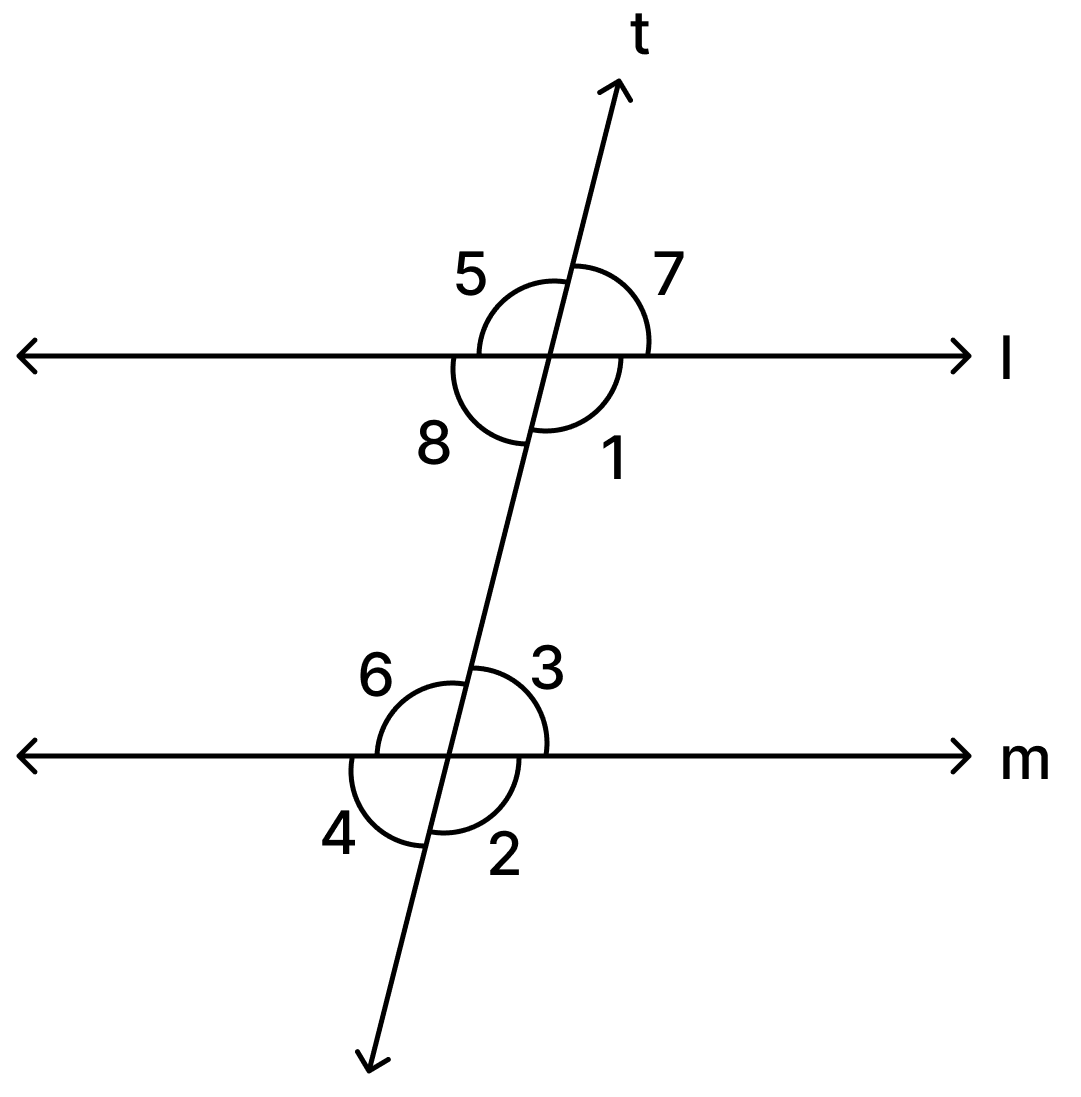
Statement I: If ∠5 and ∠6 are equal, lines l and m will always be parallel.
Statement II: If ∠4 and ∠8 are equal, lines l and m will always be parallel.
Which of these statement(s) is/are true?
- Only statement I
- Only statement II
- Both statement I and II
- Neither statement I nor statement II
Answer
Statement I: From the figure, ∠5 and ∠6 are corresponding angles.
If corresponding angles are equal, then the two lines are parallel.
So, Statement I is true.
Statement II: From the figure, ∠4 and ∠8 are corresponding angles.
If corresponding angles are equal, then the two lines are parallel.
So, Statement II is true.
Both statement I and II are true.
Hence, option 3 is the correct option.