
Read the given paragraph and answer the questions that follow.
Kanika and her brother Sujit were helping their father paint the walls of their house. Their father measured the area of each wall using the formula 'length × height' to know how much paint was needed. Kanika was amazed to learn that area is measured in square units like square metres (m2). Later, they went to the kitchen where their mother was pouring milk into a measuring jug. Sujit noticed the numbers on the jug and learnt that this was used to measure the volume of liquids. Their mother told them that volume is the space an object or liquid occupies and it is measured in litres or cubic centimetres (cm3).
- How did Kanika and her father calculate how much paint was needed for the wall?
- What does volume measure and in which units is it usually expressed?
- Why is a stone denser than a sponge of the same size?
- Explain what density means in simple terms.
Answer
- Kanika and her father calculated the area of each wall by multiplying its length by its height. This helped them know how much paint was needed.
- Volume measures the amount of space occupied by an object or a liquid. It is usually expressed in litres (L), millilitres (mL) or cubic centimetres (cm3).
- A stone is denser than a sponge of the same size because it has more mass packed in the same volume.
- Density means mass per unit volume of a substance. It tells us how closely the particles of a substance are packed.
Circle the word that does not belong to other words given alongside it.
- Mass, Volume, Speed, Temperature
- Length, Width, Height, Kilogram
- Density, Volume, Weight, Area
- Litre, Millilitre, Gram, Cubic centimetre
- Speed, Distance, Time, Density
Answer
- Speed
Reason — Mass, volume and temperature are all properties of Physical Quantities and Measurement, whereas speed describes how fast a body moves. - Kilogram
Reason — Length, width and height are dimensions, whereas kilogram is the SI unit of mass. - Weight
Reason — Density, volume and area describe how much space a body occupies or how its matter is packed, whereas weight is the force with which the earth pulls a body. - Gram
Reason — Litre, millilitre and cubic centimetre are all units of volume, whereas gram is a unit of mass. - Density
Reason — Speed, distance and time are related to the motion of a body (speed = distance ÷ time), whereas density is mass per unit volume and is not related to motion.
Match the columns.
| Column A | Column B |
|---|---|
| 1. Volume | (a) Mass ÷ Volume |
| 2. Density | (b) Space occupied by a substance |
| 3. Speed | (c) Used to measure volume |
| 4. Measuring cylinder | (d) km/h or m/s |
| 5. Speed = Distance ÷ Time | (e) Formula to calculate speed |
Answer
| Column A | Column B |
|---|---|
| 1. Volume | (b) Space occupied by a substance |
| 2. Density | (a) Mass ÷ Volume |
| 3. Speed | (d) km/h or m/s |
| 4. Measuring cylinder | (c) Used to measure volume |
| 5. Speed = Distance ÷ Time | (e) Formula to calculate speed |
Answer in one or a few word(s).
- The surface enclosed within the boundary of a two-dimensional figure
- The amount of space occupied by a three-dimensional body
- Mass per unit volume of a substance
- The distance travelled by a moving body in unit time
Answer
- Area
- Volume
- Density
- Speed
Write the correct word(s) in the given blanks.
- A ............... is used to find the area of irregular surfaces approximately.
- The mass (m) of a regular solid can be determined using a/an ............... .
- If the position of the body changes with time with respect to its surroundings, it is said to be in ............... .
- The volume of ............... solids can be measured quite accurately by water displacement method.
- ............... are used to obtain more accuracy in measurement of volume of liquids.
Answer
- A graph paper is used to find the area of irregular surfaces approximately.
- The mass (m) of a regular solid can be determined using a beam balance or an electronic balance.
- If the position of the body changes with time with respect to its surroundings, it is said to be in motion.
- The volume of irregular solids can be measured quite accurately by water displacement method.
- Measuring cylinders are used to obtain more accuracy in measurement of volume of liquids.
Write True or False for the following statements.
- One cubic metre is the volume of a cube of side 1 metre long.
- Density is the amount of space an object occupies.
- A larger object always has more density than a smaller one.
- Speed = Mass ÷ Volume is the formula to calculate speed.
Answer
- True
- False
Corrected Statement — Density is the mass per unit volume of a substance. - False
Corrected Statement — Density depends on the material of an object, not on its size, so a larger object does not always have more density than a smaller one. - False
Corrected Statement — Speed = Distance ÷ Time is the formula to calculate speed.
Find errors in the given sentences and correct them.
- A litre of honey and a litre of water have the same density.
- Measuring cylinders or cans are usually used to measure volume of liquids and can be easily seen with a milkman or at a shop selling kerosene.
- One cubic centimetre is the volume of a cube of side 1 metre long.
- Speed and density are measured using the same units.
Answer
- A litre of honey and a litre of water have the same volume but different densities.
- Measuring beakers or cans are usually used to measure volume of liquids and can be easily seen with a milkman or at a shop selling kerosene.
- One cubic centimetre is the volume of a cube of side 1 centimetre long.
- Speed and density are measured using different units. (Speed is measured in m/s or km/h, while density is measured in kg/m3 or g/cm3.)
Give reason — Objects of the same volume can be made of different materials and have different weights.
Answer
Objects of the same volume can have different weights because different materials have different densities. A material with more mass packed in the same volume is denser and therefore heavier.
Give reason — Speed is a measure of how quickly something moves.
Answer
Speed is a measure of how quickly something moves because it tells us the distance travelled by a moving body in unit time. A body that covers more distance in the same time has greater speed.
Give reason — Measuring cylinders are better than beakers for measuring volume.
Answer
Measuring cylinders are better than beakers because they are narrow and have fine graduation marks on their walls. This allows us to read the level of the liquid against the marks more clearly and obtain more accurate measurements than with a wider beaker.
Give reason — Two objects can have the same mass but different volumes.
Answer
Two objects can have the same mass but different volumes because they are made of different materials having different densities. A denser material packs the same mass into a smaller volume, so for the same mass the less dense object occupies a larger volume.
Give reason — Objects with more density feel heavier even if they are small.
Answer
Objects with more density feel heavier even if they are small because density is mass per unit volume. A denser object has more mass packed into a small volume, so even a small object made of a dense material has a large mass and feels heavy.
Define area.
Answer
The area of an object is the space occupied by a two-dimensional figure on a plane.
How can we determine the density of an irregular solid?
Answer
To determine the density of an irregular solid like a stone, we need to measure its mass and its volume.
- The mass (m) of the irregular solid is found using a beam balance or an electronic balance.
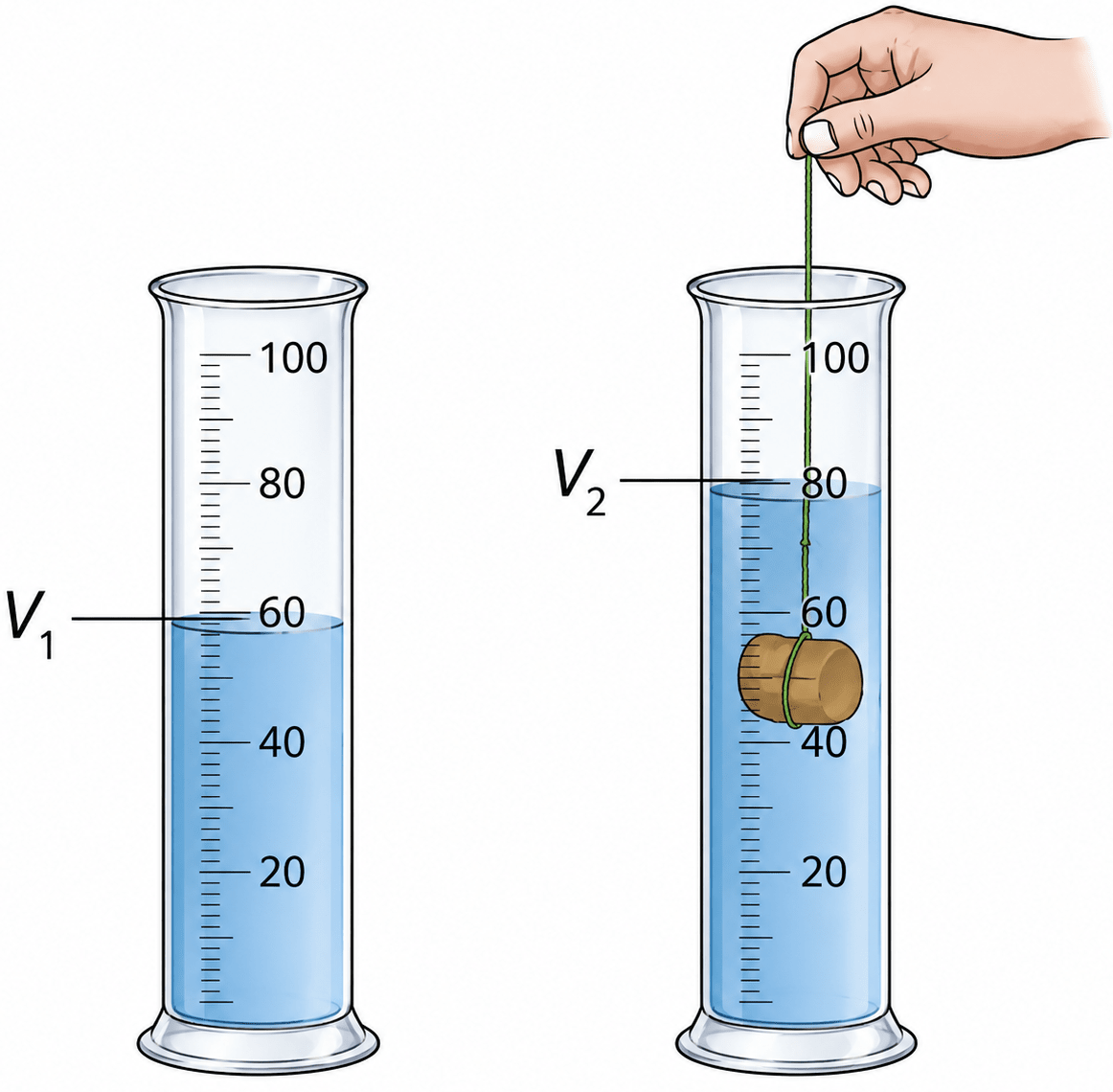
- The volume of the irregular solid is found by the water displacement method. The solid is tied with a thread and completely immersed in water in a measuring cylinder. The rise in water level, that is the difference between the final reading (V2) and the initial reading (V1), gives the volume of the solid.
The density is then calculated using the formula:
Why does on immersing any object in water, the level of water rise?
Answer
When an object is completely immersed in water, it pushes aside (displaces) an amount of water equal to its own volume. Since this displaced water has nowhere else to go, the level of water in the container rises.
What is speed, and how can we calculate it for a moving object?
Answer
Speed is the distance travelled by a moving body in unit time. It tells us how fast or slow a body moves. It is calculated using the formula:
Why do we use different units like liters, millilitres and cubic centimetres to measure volume?
Answer
We use different units to measure volume because the amount of space occupied by objects and liquids varies greatly. Small volumes are conveniently measured in millilitres (mL) or cubic centimetres (cm3), while larger volumes are measured in litres (L). Choosing a suitable unit makes the measurement easy to express and understand, where 1 L = 1000 mL = 1000 cm3.
Define volume. Explain how we can measure the volume of an irregular object.
Answer
Volume is the amount of space occupied by a three-dimensional body.
To measure the volume of an irregular object such as a pebble, we use the water displacement method.
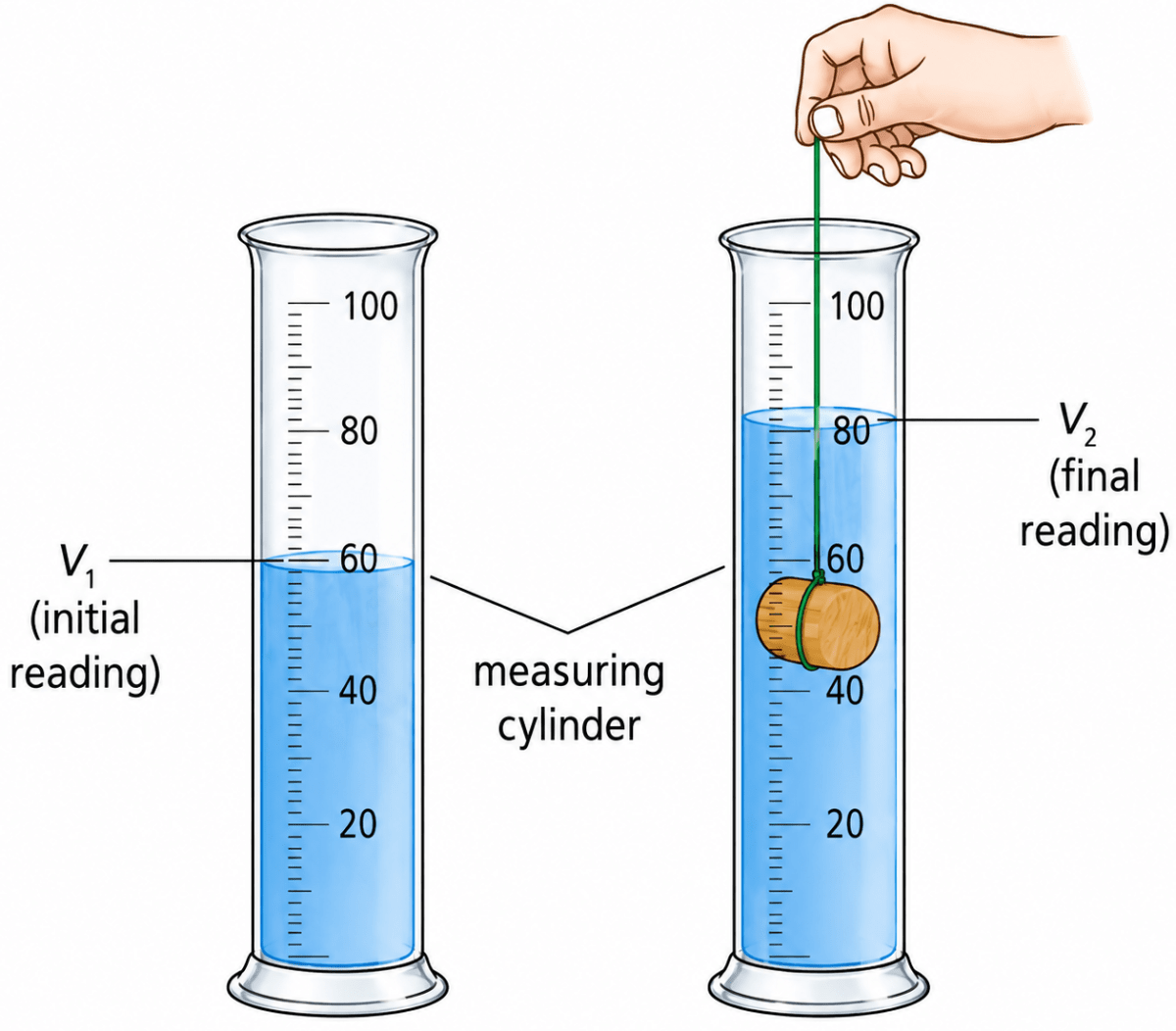
- Take a measuring cylinder and fill it partly with water.
- Note the initial water level. Let it be V1.
- Tie the irregular object with a thread and immerse it completely in water.
- The water level rises. Note the final water level. Let it be V2.
- The volume of the object is equal to the volume of water displaced.
Volume of the object = final reading - initial reading = V2 - V1
Thus, the volume of an irregular object can be measured using the water displacement method.
What procedure do we need to follow for determining the density of a liquid?
Answer
To determine the density of a liquid, say milk, we follow these steps:
- Take an empty dry beaker and measure its mass using a beam balance or an electronic balance. Let the mass of the beaker be m1 gram.
- Take a measuring cylinder and measure a fixed volume of milk, say V = 100 mL = 100 cm3.
- Pour this milk into the same beaker.
- Measure the mass of the beaker with milk using the same balance. Let this mass be m2 gram.
- Mass of milk = m2 - m1.
- Density of milk is calculated using the formula:
Therefore,
What type of instruments are commonly used for measuring volume of liquids?
Answer
Two instruments are commonly used for measuring the volume of liquids:
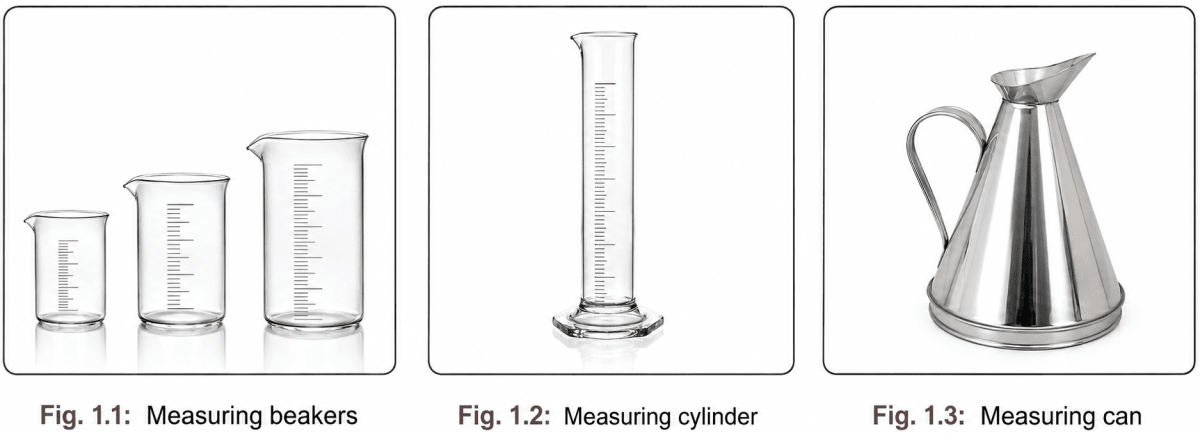
- Measuring beakers (or cans) — These are used to measure the volume of liquids and can be easily seen with a milkman or at a shop selling kerosene. They are available in different capacities such as 50 mL, 100 mL, 200 mL, 250 mL, 500 mL, 1 L, 2 L and 5 L, which are marked on them.
- Measuring cylinders — These are used to obtain more accuracy in measuring the volume of liquids. They are available in sizes such as 10 mL, 50 mL, 100 mL and 200 mL. They have graduations on their walls and are made of glass or plastic so that the level of the liquid can be seen against the marks.
Explain the concept of speed. How is it calculated, and what are the units used?
Answer
The speed of a moving body gives an idea of how fast or slow the body moves. A body that covers more distance in the same time moves faster and has a greater speed. Thus, speed is defined as the distance travelled by a moving body in unit time.
It is calculated using the formula:
The SI unit of speed is metre per second (m/s or m s-1). Other commonly used units of speed are centimetre per second (cm/s), kilometre per hour (km/h) and kilometre per minute (km/min).
How do we measure the area of regular and irregular shapes? Explain with formulas.
Answer
Regular shapes — The area of regular surfaces is measured by using fixed formulae, provided we know their dimensions:
| Regular Surface | Formula for Area |
|---|---|
| Square | Side × Side |
| Rectangle | Length × Breadth |
| Triangle | |
| Circle | π × (Radius)2 |
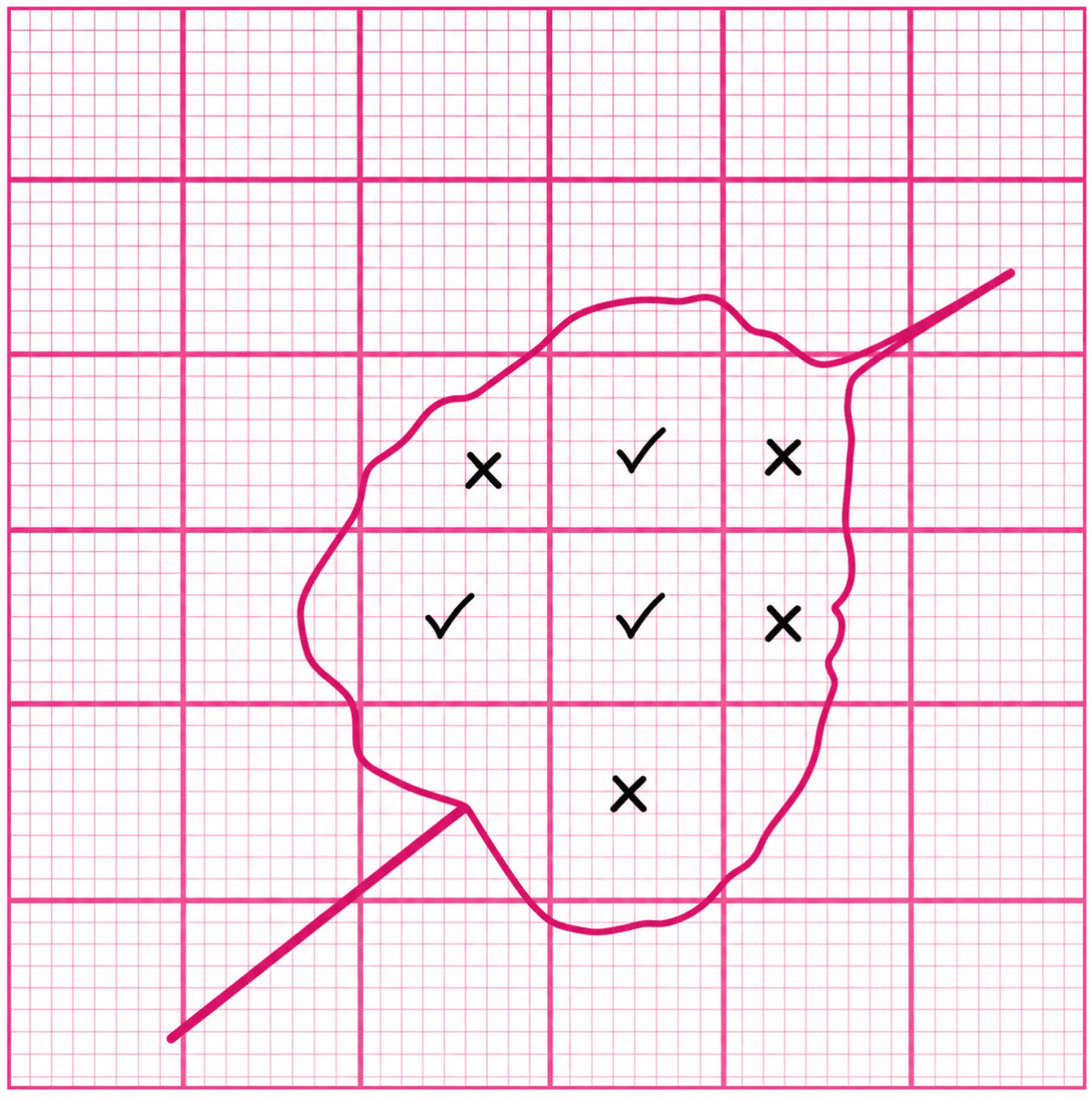
Irregular shapes — As irregular shapes have no fixed formula, their area is found approximately using a graph paper. The object is placed on the graph paper (whose squares are each of side 1 cm) and its outline is marked. The complete squares and the squares that are more than half-covered are counted, while the squares less than half-covered are ignored. The total number of counted squares multiplied by the area of one square gives the approximate area of the shape.
Read the given case study and answer the questions that follow.
Teena is helping her mother design a small kitchen garden in their backyard. First, they measure the area of the rectangular plot using a tape. The plot is 6 metres long and 4 metres wide. To calculate the space available, Teena multiplies the length and width, getting 24 square metres. This helps them plan how many plants can be grown.
Later, Teena fills a watering can with water to help her plants grow. The can holds 10 liters of water, which is a measure of volume. She wonders how the can's volume would change if it were taller but narrower. Her father explains that volume depends on the shape and size of the container.
In the evening, Teena does an experiment with two objects: a rubber ball and a metal ball of the same size. When she holds them, she notices the metal ball is heavier. Her science teacher had taught that this is because of density, the metal ball has more mass in the same volume.
- How did Teena calculate the area of the rectangular plot? What unit did she use?
- What does volume measure, and how was Teena able to understand it using the watering can?
- Why did the metal ball feel heavier than the rubber ball even though both had the same size?
- Explain how Teena calculated her speed while cycling. Write the formula she used and how she applied it.
Answer
Teena calculated the area of the rectangular plot by multiplying its length by its width.
Area = length × width = 6 m × 4 m = 24 m2.
She used the unit square metre (m2).Volume measures the amount of space occupied by an object or a liquid. Teena understood it using the watering can because the can held 10 litres of water, and litre is a unit used to measure the volume of liquids. The amount of water the can could hold (its capacity) showed her how much space was inside it, that is its volume.
The metal ball felt heavier than the rubber ball even though both were the same size because the metal ball has a higher density. Both balls had the same volume, but the metal ball had more mass packed into that same volume. Since density is mass per unit volume, the metal (denser material) made the ball heavier.
Teena would calculate her speed by measuring the distance she covered while cycling and the time she took to cover it. She would use the formula:
Read the given information carefully and answer the questions that follow.
Density testing is a way to measure how tightly packed the molecules of a substance are. In other words, it’s a measurement of how much “stuff” is in a given amount of space. The standard unit of measurement for density is grams per cubic centimetre (g/cm3), but it can also be expressed as kilograms per cubic metre (kg/m3). Density testing is used in a variety of fields, including chemistry, physics, engineering, and geology. For example, density testing can be used to determine the purity of a chemical substance, the strength of a building material, or the composition of a rock sample. It’s a pretty handy tool!
The symbol most often used for density is ρ, although the Latin letter D can also be used. Mathematically, density is defined as mass per unit volume, where ρ is the density, m is the mass, and V is the volume.
Density measurement can be a tricky business! Here are some of the main issues that can arise:
Precision: Getting an accurate density measurement can be difficult, especially if the sample size is small or if there are variations within the sample. Extremely small or large samples might not provide representative results for the entire substance.
Temperature and Pressure: Density measurements can be affected by temperature and pressure changes, so it’s important to control for these variables as much as possible. As the temperature or pressure of a substance changes, its density can change as well. Therefore, density measurements should ideally be conducted under specific temperature and pressure conditions to be meaningful and comparable.
Environmental Factors: Environmental factors, such as air currents or vibrations, can affect sensitive measurements in laboratory settings.
Contamination: Any foreign material in the sample can skew the density measurement, so it’s important to ensure that the sample is clean and free of contaminants.
Homogeneity of Substance: Density can vary within a substance, especially in heterogeneous materials or substances with impurities. Ensuring that the sample is homogeneous is crucial for accurate density measurements.
Buoyancy: When measuring the density of an object in a fluid, the buoyant force can affect the measurement. This is typically corrected for in laboratory settings, but it’s a consideration, especially in large-scale or field measurements.
Accuracy of the Instrument: The accuracy of the instruments used to measure mass and volume can affect the precision of density measurements. Slight errors in either mass or volume measurements can lead to significant discrepancies in calculated density. Instruments used for measuring density need to be calibrated regularly to ensure their accuracy. Failure to calibrate equipment can lead to inaccurate measurements.
Human Error: Human error, such as misreading instruments or incorrectly recording measurements, can introduce inaccuracies in density measurements.
In summary, although density is simple in concept, the real-world problem of getting good measurements is complicated by the nature of the sample to be tested. It’s important to use a clean sample, control for temperature and pressure, and account for any variations within the sample. Despite the challenges, density measurement is a valuable tool for understanding the composition and properties of a wide range of substances!
Source: https://www.cscscientific.com/csc-scientific-blog/the-main-issues-with-measuring-density
- Write the formula to calculate density.
- The density of an irregular solid is determined by which method?
- A block of mass 150 kg has volume 4 m3. Calculate its density in kg/m3.
- What are the main issues that can arise during the measurement of density?
Answer
1. The formula to calculate density is:
2. The density of an irregular solid is determined by using the water displacement method to find its volume (and a beam or electronic balance to find its mass).
3. Given,
Mass of block = 150 kg
Volume of block = 4 m3
Therefore, the density of the block is 37.5 kg/m3.
4. The main issues that can arise during measurement of density are errors in precision, changes in temperature and pressure, environmental factors such as air currents or vibrations, contamination of the sample, non-uniformity of the substance, buoyancy, inaccuracy of instruments and human error while reading or recording measurements.
A wooden cube and a metal cube have the same volume but different masses. What can you infer about their densities?
Answer
Since the wooden cube and the metal cube have the same volume but different masses, we can infer that they have different densities. As the metal cube is heavier, it has more mass in the same volume and is therefore denser than the wooden cube. This shows that density depends on the material an object is made of.
Two bottles look the same in size, but one feels heavier than the other. What can you conclude about their densities, and how does this relate to the material inside them?
Answer
The two bottles look the same in size, which means they have the same volume. Since one bottle feels heavier than the other, it must contain more mass in the same volume. Therefore, the heavier bottle has a higher density. The heavier bottle contains a denser material, while the lighter bottle contains a less dense material.
A rectangular plot is 8 m long and 5 m wide. Calculate its area and suggest how many 1 m2 plant beds can be made in it.
Answer
Area of rectangle = length × breadth
= 8 m × 5 m
= 40 m2
Each plant bed has an area of 1 m2.
Therefore, the area of the rectangular plot is 40 m2 and 40 plant beds of 1 m2 each can be made in it.
A car travels 60 km in 1.5 hours. Calculate its speed.
Answer
Given,
Distance travelled = 60 km
Time taken = 1.5 h
Therefore, the speed of the car is 40 km/h.
Design a simple experiment using water and two containers to compare their volume. How would you record your findings?
Answer
Aim: To compare the volume (capacity) of two different containers using water.
Materials required: Two containers of different shapes, water and a measuring cylinder (or a measuring beaker).
Procedure:
- Take the first container and fill it completely with water.
- Pour all this water carefully into the measuring cylinder and note the reading. This reading gives the volume of the first container.
- Empty the measuring cylinder. Now fill the second container completely with water.
- Pour this water into the measuring cylinder and note the reading. This gives the volume of the second container.
- Compare the two readings. The container that holds more water has the greater volume.
Recording the findings: The findings can be recorded in a table like the one below.
| Container | Volume of water (mL) |
|---|---|
| Container 1 | ........... |
| Container 2 | ........... |
The container with the larger reading in the table has the greater volume.
Create a method to compare the density of three objects at home using water displacement and a weighing scale.
Answer
Aim: To compare the densities of three objects using water displacement and a weighing scale.
Materials required: Three small objects (that sink in water), a weighing scale, a measuring cylinder, water and a piece of thread.
Procedure:
- Take the first object and measure its mass (m) using the weighing scale.
- Fill the measuring cylinder partly with water and note the initial level V1.
- Tie the object with a thread and immerse it completely in water. Note the final level V2. The volume of the object = V2 - V1.
- Calculate its density using the formula:
- Repeat the same steps for the second and third objects.
- Compare the three densities. The object with the highest density has the most mass packed in the same volume.
Recording the findings: The findings can be recorded in a table like the one below.
| Object | Mass (g) | Volume = V2 - V1 (cm3) | Density (g/cm3) |
|---|---|---|---|
| Object 1 | ........... | ........... | ........... |
| Object 2 | ........... | ........... | ........... |
| Object 3 | ........... | ........... | ........... |
Maanvi was helping her uncle paint a room. To find out how much paint was needed, she first measured the area of the four walls. She calculated the area using the formula 'length × height' for each wall. Then, she thought about how the size of the paint bucket was related to volume. She wondered if the area was large, would one big bucket be enough? When Maanvi poured the paint into two different containers of the same size, she noticed one felt heavier. She remembered her teacher saying that this difference could be due to density, even though the volume was the same. Maanvi also recalled how quickly the painter moved while painting and realised that he worked at a certain speed.
- What made Maanvi think that one bucket might not be enough for all four walls?
- How did Maanvi connect the size of the bucket to the concept of volume?
- Why did the same-sized containers with different weights make her think of density?
- What did Maanvi observe about the painter's work that helped her think about speed?
- How did Maanvi use what she learnt in school to solve a real-life problem?
Answer
Maanvi thought one bucket might not be enough because the total area of all four walls was large. A larger area needs more paint to cover it, so she realised one bucket might fall short.
Maanvi connected the size of the bucket to volume because the bucket's size decided how much paint it could hold. The amount of space inside the bucket (its capacity) is its volume, which is measured in litres.
The same-sized containers had the same volume, but one felt heavier than the other. This made Maanvi think of density, because density is mass per unit volume. The heavier container had more mass in the same volume, so it had a higher density.
Maanvi observed how quickly the painter moved while painting. Since speed is the distance covered in unit time, watching how fast the painter worked made her think about the concept of speed.
Maanvi used what she had learnt in school about area, volume, density and speed to understand and solve a real-life painting problem. She used area to find out how much paint was needed, volume to understand the bucket's capacity, density to explain the difference in weight of the containers, and speed to describe how fast the painter worked.
Gagan wanted to know if the size of a container affects how much water it holds. He collected different shaped bottles — tall, short and wide. He measured how much water each could store. Then he noted the volume in millilitres. Then he placed small cubes inside a box to find the volume the box could hold, using the formula (length × breadth × height). He took two blocks of the same size but made of different materials. One was made of foam and the other of metal. He weighed them and noticed the metal one was heavier. This made him wonder about their densities. Finally, Gagan saw his dog run across the garden and timed how fast it ran. He measured the garden's length and compared how quickly his dog covered the space.
- What method did Gagan use to measure the volume of bottles and boxes?
- Why did he choose to compare foam and metal blocks of the same size?
- What observation led him to investigate density?
- How did Gagan try to understand speed using his dog?
- What does Gagan's activity show about the importance of investigation in learning science?
Answer
To measure the volume of the bottles, Gagan filled each bottle with water and measured how much water it could store, noting the volume in millilitres. For the box, he used the formula volume = length × breadth × height.
He chose blocks of the same size (same volume) but of different materials so that he could compare their masses fairly. By keeping the volume the same, any difference in weight would be due only to the material, which would help him understand density.
When Gagan weighed the foam block and the metal block of the same size, he noticed that the metal block was heavier. This observation led him to investigate density, because the same volume held more mass in the metal block.
Gagan tried to understand speed by watching his dog run across the garden. He measured the length of the garden (the distance) and timed how quickly the dog covered that distance. Using speed = distance ÷ time, he could find how fast the dog ran.
Gagan's activity shows that investigation helps us learn science by doing. By collecting materials, measuring, observing and comparing, he understood the ideas of volume, density and speed in a practical way rather than only reading about them. This makes the concepts clearer and easier to remember.
Gunjan decided to do a few experiments at home. First, she measured the area of her study table using a notebook and counted how many notebooks could fit on it. She then filled a measuring cup with water and poured it into containers of different shapes to understand how volume changes with shape. Next, she took a plastic ball and a metal ball of the same size and dropped them in water. Both sank, but the metal one felt heavier. She checked their mass and calculated density using a formula: mass ÷ volume. Finally, she marked two points on the floor and timed how fast her toy car moved from one point to the other. She did this three times and averaged the values to find the speed.
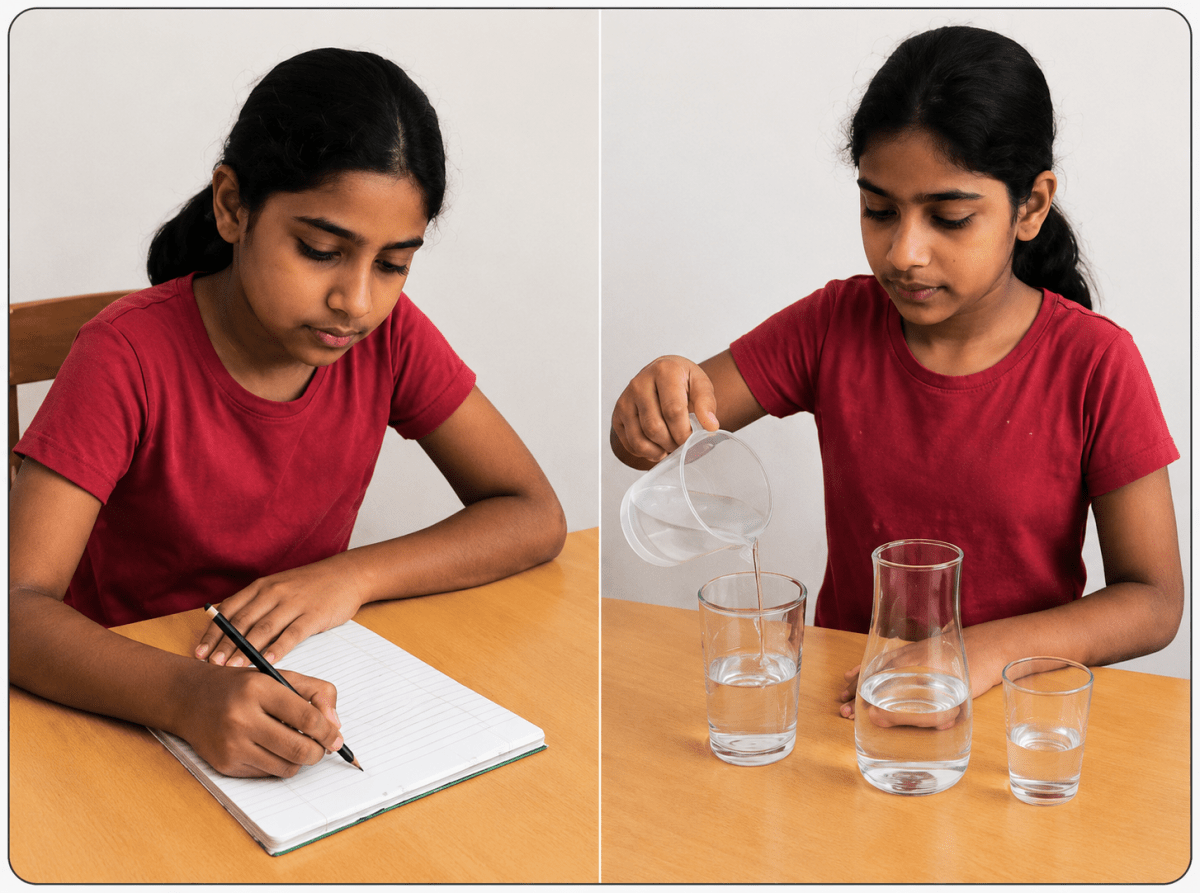
- How did Gunjan estimate the area of her study table in her experiment?
- What did pouring water into different containers teach her about volume?
- How did she compare the density of two balls?
- Why did she repeat the toy car speed test three times?
- What does this tell us about why repetition is important in experiments?
Answer
Gunjan estimated the area of her study table by placing a notebook on it repeatedly and counting how many notebooks could fit on the surface. The total number of notebooks needed to cover the table gave an estimate of its area.
Pouring the same amount of water into containers of different shapes taught her that the volume (amount of water) stays the same even when the shape of the container changes. It showed her that volume depends on the amount of space occupied, not on the shape of the container.
Gunjan compared the density of the two balls by taking a plastic ball and a metal ball of the same size (same volume). She measured the mass of each ball and calculated the density using the formula density = mass ÷ volume. As the metal ball had more mass for the same volume, it had a higher density.
She repeated the toy car speed test three times and averaged the values to get a more reliable and accurate result, because a single reading might contain a small error.
This tells us that repetition is important in experiments because it reduces the effect of small errors and gives more accurate and dependable results. Taking the average of several readings gives a value closer to the true one.
Shyam was asked to plan a science project. He decided to combine everything he had learnt. He first measured the area of a cardboard sheet to design a model house. Then, he used small blocks to build the house and calculated the volume of the structure. To make his model light but strong, Shyam selected materials by checking their density. He avoided materials that were too heavy for the same volume. Lastly, he built a small wind-powered car and tested how far it could go in 10 seconds to estimate its speed. Shyam combined all his knowledge to build something meaningful.
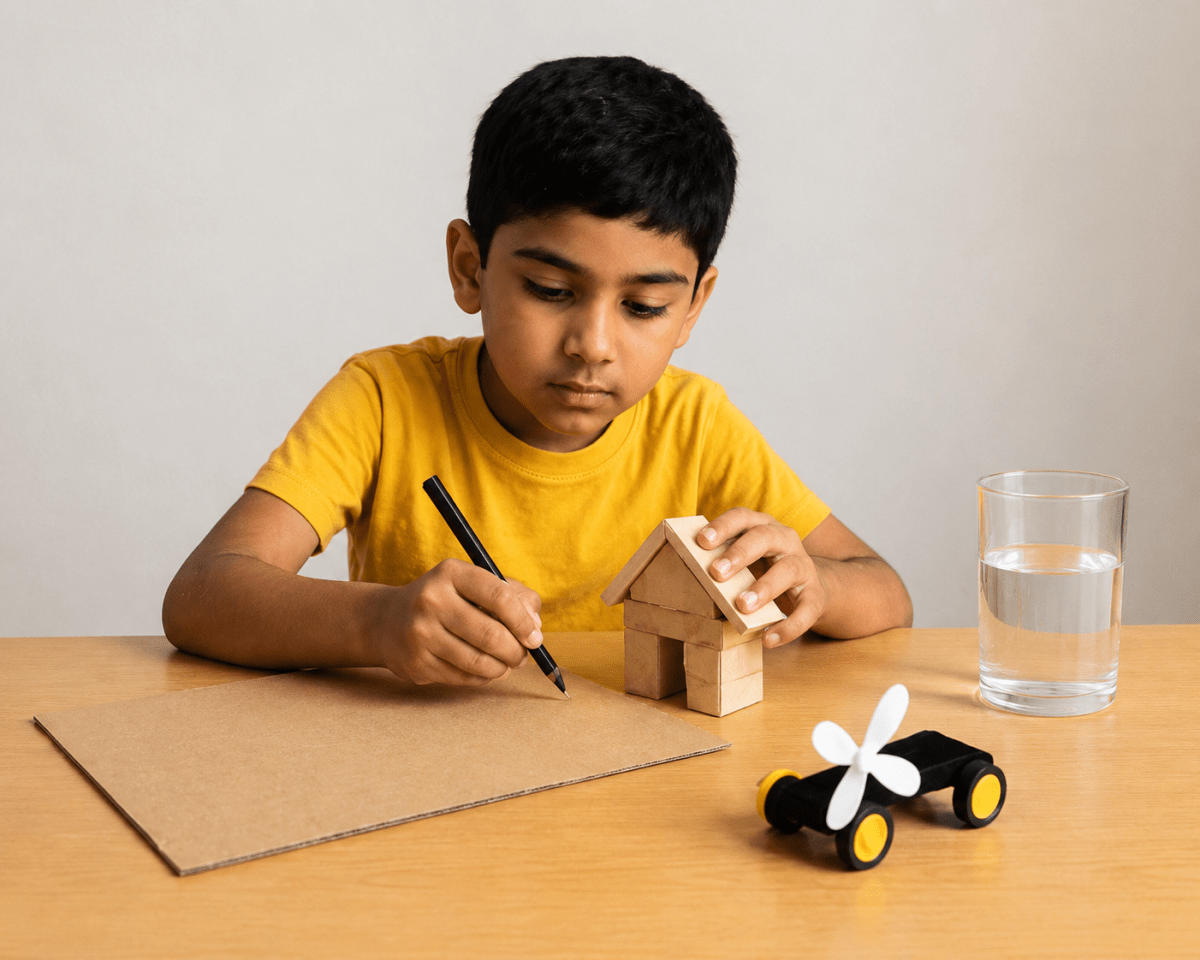
- How did Shyam use the concept of area in building his model house?
- Why was measuring volume important while using building blocks?
- How did checking the density of materials help Shyam choose the right ones?
- In what way did Shyam measure the speed of the wind-powered car?
- How did Shyam combine knowledge of area, volume, density, and speed in one project?
Answer
Shyam used the concept of area by measuring the area of the cardboard sheet. This helped him know how much surface he had to work with so that he could plan and design the model house properly.
Measuring volume was important while using building blocks because it told Shyam how much space the structure occupied. By calculating the volume (length × breadth × height), he could plan the size of the house and how many blocks were needed.
Checking the density of the materials helped Shyam choose materials that were light but strong. By avoiding materials that were too heavy for the same volume (that is, materials of high density), he could keep his model light while still being sturdy.
Shyam measured the speed of the wind-powered car by testing how far it could travel in 10 seconds. Using speed = distance ÷ time, he could estimate the speed of the car from the distance it covered in that time.
Shyam combined his knowledge of all four concepts in one project: he used area to plan the cardboard design of the house, volume to build the structure with blocks, density to choose light but strong materials, and speed to test his wind-powered car. By bringing these ideas together, he built a meaningful and complete science project.
Fill in the blanks.
- The ............... of an object is defined as the space it occupies.
- The SI unit of mass is ............... .
- The instrument used to measure the volume of a liquid is called a ............... .
- The formula to calculate the area of a rectangle is ............... .
- Matter is anything that has ............... and occupies ............... .
Answer
- The volume of an object is defined as the space it occupies.
- The SI unit of mass is kilogram (kg).
- The instrument used to measure the volume of a liquid is called a measuring cylinder.
- The formula to calculate the area of a rectangle is length × breadth.
- Matter is anything that has mass and occupies space.
Write True or False.
- The density of water is 1 g/cm3.
- The area of irregular shapes can be measured using graph paper.
- A beam balance is used to measure volume.
- The unit of area in the SI system is square metre (m2).
- Liquids have a definite shape and volume.
Answer
- True
- True
- False
Corrected Statement — A beam balance is used to measure mass. - True
- False
Corrected Statement — Liquids have a definite volume but not a definite shape.
Match the columns.
| Column A | Column B |
|---|---|
| 1. Measuring cylinder | (a) Graph paper |
| 2. SI unit of length | (b) Volume of liquids |
| 3. Area of circle | (c) Metre (m) |
| 4. Measuring area of irregular objects | (d) Mass per unit volume |
| 5. Density | (e) πr2 |
Answer
| Column A | Column B |
|---|---|
| 1. Measuring cylinder | (b) Volume of liquids |
| 2. SI unit of length | (c) Metre (m) |
| 3. Area of circle | (e) πr2 |
| 4. Measuring area of irregular objects | (a) Graph paper |
| 5. Density | (d) Mass per unit volume |
What is a physical quantity?
Answer
A physical quantity is a quantity that can be measured and expressed by a number and a unit.
Mention two fundamental quantities.
Answer
Two fundamental quantities are length and mass.
Define speed and give its common units with the relation between km/h and m/s.
Answer
Speed is the distance travelled by a moving body in unit time. Its common units are metre per second (m/s) and kilometre per hour (km/h).
The relation between km/h and m/s is:
Conversely, 1 m/s = 3.6 km/h.
What is the SI unit of temperature?
Answer
The SI unit of temperature is the kelvin (K).
Define density.
Answer
Density is the mass per unit volume of a substance. It is given by the formula , where m is the mass and V is the volume.
Define area. How is the area of a rectangle calculated?
Answer
Area is the surface enclosed within the boundary of a two-dimensional figure. It is the space occupied by a two-dimensional figure on a plane. The SI unit of area is square metre (m2).
The area of a rectangle is calculated by finding the product of its length and breadth:
For example, if a rectangle is 6 m long and 4 m wide, its area = 6 m × 4 m = 24 m2.
Describe the method to determine the volume of an irregular solid.
Answer
The volume of an irregular solid can be determined by the water displacement method.
- Take a measuring cylinder and fill it partly with water.
- Note the initial level of water. Let it be V1.
- Tie the irregular solid with a thread and immerse it completely in water.
- The level of water rises. Note the final level of water. Let it be V2.
- The rise in water level gives the volume of the irregular solid.
Volume of irregular solid = V2 - V1
Thus, the volume of an irregular solid is equal to the volume of water displaced by it.
Explain the importance of SI units in measurement.
Answer
SI units are important for the following reasons:
- The International System (SI units) was adopted by the General Conference on Weights and Measures in 1960 to bring uniformity in measurement.
- As everyone uses the same units, SI units avoid confusion that could arise from different systems of measurement.
- SI units are accepted worldwide, so measurements made in one place can be easily understood and compared in another.
- They are the most widely used system of units, which makes the exchange of scientific information easy and accurate.
A car covers 200 km in 5 hours. Find its speed in km/h and m/s, showing the conversion steps.
Answer
(a) Speed in km/h:
Distance covered = 200 km
Time taken = 5 h
(b) Speed in m/s:
First convert the distance and time into SI units.
Distance = 200 × 1000 = 200000 m
Time = 5 × 60 = 300 minutes = 300 × 60 = 18000 s
Therefore, the speed of the car is 40 km/h or 11.11 m/s.
State the relationship between mass, volume and density, and write the formula for density.
Answer
The density of a substance is its mass per unit volume. This means density depends on how much mass is packed in a given volume. For the same volume, a greater mass means a greater density.
The formula for density is:
where ρ is the density, m is the mass and V is the volume of the substance.