
Read the given paragraph and answer the questions that follow.
Aman woke up early to visit the science park with his cousin, Suman. As he sat in the car, he noticed that the buildings and trees seemed to move backwards, even though he was sitting still in the car. Suman explained that he was in motion with respect to the ground, but at rest with respect to the car.
At the park, they observed a large rotating globe, which Suman identified as an example of circular motion. A nearby pendulum clock moved back and forth, showing periodic motion, while a person jogging on a straight track showed rectilinear motion.
Later, Aman participated in a science experiment. He used a toy car and stopwatch to measure how far it travelled every 5 seconds. On a smooth surface, it moved the same distance each time, showing uniform motion. On a rough patch, the distance varied, which was non-uniform motion.
As they climbed a small hill in the park, Suman mentioned feeling lighter. Their guide explained that it was because weight depends on gravity, which slightly decreases at higher altitudes, although mass remains constant.
When returning home, Aman checked the total distance they travelled was 30 km, but their displacement—from starting point to ending point—was zero, because they came back to the same place.
- Why did Aman feel the trees were moving backwards while he was sitting inside the car?
- Identify the three types of motion Aman and Suman observed at the science park.
- What difference did Aman notice between the toy car's movement on a smooth surface and a rough surface? What types of motion do these represent?
- Why did Suman feel lighter while climbing the hill, even though her mass didn't change?
- How was the distance travelled by Aman and Suman different from their displacement when they returned home?
Answer
- Aman felt the trees were moving backwards because he was in motion along with the moving car. With respect to the moving car, the trees outside kept changing their position, so they appeared to move backwards. Rest and motion are relative terms, and the trees appeared to move only because of Aman's point of observation.
- The three types of motion they observed at the science park were circular motion (the rotating globe), periodic motion (the pendulum clock moving back and forth) and rectilinear motion (the person jogging on a straight track).
- On the smooth surface, the toy car covered the same distance in each equal interval of time, which is uniform motion. On the rough patch, the distance varied in equal intervals of time, which is non-uniform motion.
- Suman felt lighter while climbing the hill because weight depends on the gravitational pull, which decreases slightly at higher altitudes. Her mass remained constant, but as the gravity reduced, her weight became less, making her feel lighter.
- The distance they travelled was 30 km, which is the total length of the actual path covered. Their displacement was zero because they returned to the same starting point, and displacement is the shortest distance between the initial and final positions.
Circle the word that does not belong to other words given alongside it.
- Circular motion, Periodic motion, Random motion, Stationary object
- Weight, Kilogram, Mass, Constant
- Running, Rotating, Swinging, Sitting
- Direction, Displacement, Distance, Time
- Mass, Volume, Weight, Gravity
Answer
- Stationary object
Reason — Circular, periodic and random are all types of motion, whereas a stationary object is at rest. - Weight
Reason — Mass is measured in kilograms and remains constant, whereas weight depends on gravitational pull and may change from place to place. - Sitting
Reason — Running, rotating and swinging are all forms of motion, whereas sitting represents a state of rest. - Time
Reason — Direction, displacement and distance are related to position and movement, whereas time is a separate physical quantity. - Gravity
Reason — Mass, volume and weight are physical quantities of a body, whereas gravity is the force of attraction of the earth.
Match the columns.
| Column A | Column B |
|---|---|
| 1. Rest | (a) Force acting due to gravity |
| 2. Circular motion | (b) Object not changing position |
| 3. Displacement | (c) Shortest distance between two points |
| 4. Uniform motion | (d) Same distance in same time |
| 5. Weight | (e) Moving around a fixed point |
Answer
| Column A | Column B |
|---|---|
| 1. Rest | (b) Object not changing position |
| 2. Circular motion | (e) Moving around a fixed point |
| 3. Displacement | (c) Shortest distance between two points |
| 4. Uniform motion | (d) Same distance in same time |
| 5. Weight | (a) Force acting due to gravity |
Answer in one or a few word(s).
- The change in position of an object with respect to its surroundings and time
- When a moving body covers equal distances in equal intervals of time
- The ratio of the total distance covered by the objects to the total time taken during the journey
- The quantity of matter contained in an object
- The force with which the earth attracts a body towards its centre
Answer
- Motion
- Uniform motion
- Average speed
- Mass
- Weight
Write the correct word(s) in the given blanks.
- When you see outside, the trees will appear to be moving backwards. But to a person standing on the roadside, they will appear ............... .
- An object is said to be in ............... motion if it moves along a curved or circular path.
- The position of the pendulum at rest is its ............... position.
- When a motion is ..............., the entire body of the object moves to and fro from the mean position.
- ............... is the total length of the actual path covered by an object irrespective of its direction.
Answer
- When you see outside, the trees will appear to be moving backwards. But to a person standing on the roadside, they will appear stationary (at rest).
- An object is said to be in curvilinear motion if it moves along a curved or circular path.
- The position of the pendulum at rest is its mean position.
- When a motion is oscillatory, the entire body of the object moves to and fro from the mean position.
- Distance is the total length of the actual path covered by an object irrespective of its direction.
Write True or False for the following statements.
- Displacement is the longest possible distance covered by an object from its initial position to its final position in a particular direction.
- A body is said to exhibit uniform motion if it covers unequal distances in equal intervals of time.
- Average speed is the ratio of the total distance travelled by the object to the total time taken during the journey.
- In a spring balance, the object whose weight is to be measured, is suspended from the hook at its one end and the other end is fixed.
- The less is the mass, the greater is the attraction between the body and the earth.
Answer
- False
Corrected Statement — Displacement is the shortest possible distance covered by an object from its initial position to its final position in a particular direction. - False
Corrected Statement — A body is said to exhibit uniform motion if it covers equal distances in equal intervals of time. - True
- True
- False
Corrected Statement — The more is the mass, the greater is the attraction between the body and the earth.
Find errors in the given sentences and correct them.
- If a body exhibits both rotatory as well as translatory motion, its motion is called random motion.
- The earth keeps on rotating on its axis as well as revolves around the sun in a straight path in an indefinite time interval.
- The vehicles move in a circular motion and their wheels rotate in a linear motion.
- Some examples of oscillatory motion are the movement of a fan, motion of swings like merry-go-round and giant wheel.
- An object is said to be in rectilinear motion if it moves along a curved or circular path.
Answer
- If a body exhibits both rotatory as well as translatory motion, its motion is called rolling motion.
- The earth keeps on rotating on its axis as well as revolves around the sun in a curved (elliptical) path in a fixed time interval.
- The vehicles move in a linear motion and their wheels rotate in a circular motion.
- Some examples of rotatory motion are the movement of a fan, motion of swings like merry-go-round and giant wheel.
- An object is said to be in curvilinear motion if it moves along a curved or circular path.
Give reason — We see trees move backwards when we sit in a moving car.
Answer
We see the trees move backwards when we sit in a moving car because we are in motion along with the car. With respect to the moving car, the position of the trees keeps changing, so they appear to move backwards. This happens because rest and motion are relative terms and depend on the point of observation.
Give reason — Rest and motion are relative terms.
Answer
Rest and motion are relative terms because an object may appear to be in motion with respect to one object and at rest with respect to another. Whether a body is at rest or in motion depends on the point of observation and its surroundings. For example, a passenger sitting in a moving car is at rest with respect to a fellow passenger but in motion with respect to a person standing on the road.
Give reason — A child on a swing is in periodic motion.
Answer
A child on a swing is in periodic motion because the swing moves to and fro about its mean position and repeats its motion after a fixed interval of time. Since the movement gets repeated regularly, it is an example of periodic motion.
Give reason — Displacement can be zero even when distance is not.
Answer
Displacement can be zero even when distance is not, because displacement is the shortest distance between the initial and final positions, whereas distance is the total length of the path covered. When an object returns to its starting point, its initial and final positions are the same, so its displacement is zero, but the distance it actually covered is not zero.
Give reason — Uniform motion means constant speed.
Answer
Uniform motion means constant speed because in uniform motion a body covers equal distances in equal intervals of time. As the distance covered in each equal interval of time is the same, the speed of the body does not change and remains constant throughout.
When is an object said to be in a state of rest?
Answer
An object is said to be in a state of rest if it does not change its position with respect to its surroundings with time. For example, trees, houses and buildings are at rest.
How is rectilinear motion different from curvilinear motion?
Answer
Rectilinear motion is the motion of a body moving along a straight line, such as a car moving on a straight road. Curvilinear motion is the motion of a body moving along a curved or circular path, such as a train moving along a curved track.
What is oscillatory motion?
Answer
Oscillatory motion is the back and forth (to and fro) movement of a body about its mean position. For example, the motion of a pendulum and the motion of a swing are oscillatory motions.
When is a body said to exhibit uniform motion?
Answer
A body is said to exhibit uniform motion when it covers equal distances in equal intervals of time. In uniform motion, the body moves with a constant speed.
Give some examples for non-periodic motion.
Answer
Some examples of non-periodic motion are the beating of the heart, the movement of the body while dancing, the movement of hands while writing and a car moving on a busy road.
Explain how rest and motion are relative terms.
Answer
Rest and motion are relative terms because whether a body is at rest or in motion depends on the point of observation and its surroundings. The same object may appear to be in motion with respect to one observer and at rest with respect to another.
For example, imagine you are sitting near the window of a moving car. The trees outside will appear to be moving backwards. But to a person standing on the roadside, the trees will appear stationary. The person sitting next to you in the car is at rest with respect to you, but both of you will appear to be in motion to the person standing outside.
This shows that an object may appear in motion with respect to some objects and at rest with respect to others. Hence, rest and motion are relative terms.
Differentiate between periodic motion and non-periodic motion.
Answer
| Periodic Motion | Non-periodic Motion |
|---|---|
| The motion which gets repeated after a fixed interval of time. | The motion which does not repeat itself after regular intervals of time. |
| The motion follows a regular pattern. | The motion does not follow a regular pattern. |
| Examples: motion of the earth around the sun, movement of the hands of a clock. | Examples: beating of the heart, movement of hands while writing. |
What is multiple motion? Explain it with the help of examples.
Answer
When a body exhibits more than one type of motion at the same time, such a motion is called multiple motion.
Some examples of multiple motion are:
- Motion of the earth: The earth rotates on its axis and at the same time revolves around the sun in a curved (elliptical) path.
- Drawing water from a well: The bucket shows linear motion while the pulley on which the rope runs exhibits circular motion.
- Vehicle moving on a straight road: The wheels of a vehicle rotate in a circular motion while the vehicle itself moves in a linear motion.
- Motion of a drill: While making a hole in wood, a drill rotates (rotatory motion) and at the same time gets pushed forwards into the wood (translatory motion).
Differentiate between mass and weight.
Answer
| Mass | Weight |
|---|---|
| The mass of a body is the quantity of matter contained in it. | The weight of a body is the force with which the earth attracts it towards its centre. |
| The SI unit of mass is kilogram (kg). | The SI unit of weight is newton (N). |
| It is a constant quantity and does not change with the position of the body. | Its value changes from place to place as it depends on gravity. |
| It is measured with a beam balance. | It is measured with a spring balance. |
| The mass of a body can never be zero. | The weight of a body can be zero if there is no gravity at that place. |
How is uniform motion different from non-uniform motion? Explain it with graphical representation.
Answer
| Uniform Motion | Non-uniform Motion |
|---|---|
| When a moving body covers equal distances in equal intervals of time. | When a moving body covers unequal distances in equal intervals of time. |
| The speed of the body remains constant. | The speed of the body keeps on changing. |
| Example: a car covering 20 km every 30 minutes. | Example: a car covering 10 m, 15 m and 20 m in successive equal intervals. |
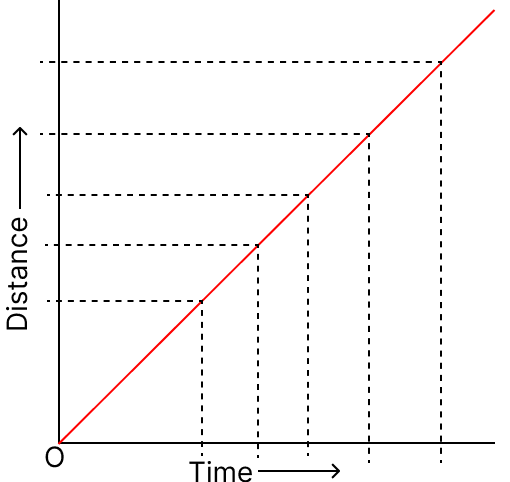
In a distance-time graph, uniform motion is represented by a straight line, because the body covers equal distances in equal intervals of time.
Read the given case study and answer the questions that follow.
Pakhi and her family were travelling to a hill station. As the train started moving, Pakhi noticed that trees and electric poles outside the window seemed to move backwards. She asked her mother, who explained that the trees were not moving it only seemed that way because they were moving in the train. This made Pakhi wonder about how motion is observed.
When the train stopped at a station, Pakhi saw a man walking straight on the platform. Her brother pointed out that the man was showing rectilinear motion. Pakhi then noticed the ceiling fan above her in the train rotating and realised it was an example of circular motion. The rhythmic movement of the toy hanging on the train wall reminded her of periodic motion.
On reaching the hill station, the family took a cable car to reach the top. It moved at a steady speed, covering equal distances in equal intervals of time, showing uniform motion. Later, on a hilly path, the car moved slowly uphill and quickly downhill, an example of non-uniform motion.
- Why did Pakhi feel that trees were moving backwards when the train started?
- Identify and explain two different types of motion Pakhi observed during her journey.
- What is the difference between distance and displacement?
- Why did Pakhi experience uniform motion in the cable car but non-uniform motion in the car on the hill road?
Answer
Pakhi felt that the trees were moving backwards because she was in motion along with the moving train. With respect to the moving train, the trees kept changing their position, so they appeared to move backwards. This happens because rest and motion are relative terms.
Two types of motion Pakhi observed were:
- Rectilinear motion: The man walking straight on the platform moved along a straight line.
- Periodic motion: The hanging toy repeated its rhythmic motion after regular intervals of time.
Distance is the total length of the actual path covered by an object irrespective of its direction, whereas displacement is the shortest distance between the initial and final positions in a particular direction. Distance is a scalar quantity, while displacement is a vector quantity.
Pakhi experienced uniform motion in the cable car because it moved at a steady speed, covering equal distances in equal intervals of time. In the car on the hill road, the speed kept changing as it moved slowly uphill and quickly downhill, covering unequal distances in equal intervals of time, which is non-uniform motion.
Read the given information carefully and answer the questions that follow.
Types of motion
Rectilinear motion: When an object moves in a straight line, the motion is known as rectilinear motion. All points on the object move in straight lines along parallel paths. Example: A ball dropped from a height, a car racing on a straight track.
Translatory motion: When all points on the body of the object move the same distance in the same interval of time, the object is said to be moving in translatory motion. Rectilinear motion is translatory motion. Another type of translatory motion is curvilinear motion. Example: A car moving on a road, a ball sliding on a path or a ball rolling on an inclined plane.
Imp concept: Rolling is translatory as well as rotatory motion. Sliding is only translatory motion.
Random motion: When the direction of motion of the object is not fixed and keeps on changing, the motion is known as random motion.
Curvilinear motion: When a body moves along a circular path, it is said to be moving in curvilinear motion. Example: a stone thrown high at an angle to the ground, the path of a javelin.
Circular motion: When a body moves in a circular path, it is known as circular motion. At any point in time during the motion, the distance between the body and the center of the path remains same. Example: revolution of the earth, car moving along a round-about.
Rotatory motion: The motion of an object along its axis such that all points on the object move in a circular path with the centres on the axis. Example: rotation of the earth, a fidget spinner, a rotating fan or a spinning top.
Periodic motion: The motion which is repeated after a fixed interval of time is known as periodic motion. Example: Rotation and revolution of the earth, rotation of clock hands, pendulum of a clock.
Oscillatory motion: It is also known as vibratory motion. In this motion, object moves to and fro about a mean position. Example: movement of the bob of a pendulum, strings of a guitar, rocking chair.
Source: https://www.olympiadgenius.com/study-material/grade-6-Science-Types-of-motion/?_id=861
Now answer the following questions.
- Name the different types of motion.
- Differentiate between oscillatory and vibratory motion.
- How is rolling motion translatory as well as rotatory motion?
- Observe the types of motion around yourself and name them with examples.
Answer
The different types of motion are translatory motion (rectilinear and curvilinear), rotatory motion, circular motion, oscillatory motion, vibratory motion, periodic motion, non-periodic motion, multiple motion, rolling motion and random motion.
The difference between oscillatory and vibratory motion is:
| Oscillatory Motion | Vibratory Motion |
|---|---|
| The entire body moves to and fro about its mean position. | Only a part of the body moves to and fro about its mean position. |
| Example: motion of a pendulum, motion of a swing. | Example: vibration of guitar strings, surface of a drum or tabla. |
Rolling motion is both translatory and rotatory because when a body rolls, it rotates about its own axis (rotatory motion) and at the same time moves forward from one place to another (translatory motion). For example, when a ball rolls on the ground, it spins as well as moves ahead.
Some types of motion observed around us are:
- Rectilinear motion: a car moving on a straight road.
- Circular motion: a child sitting on a merry-go-round.
- Rotatory motion: the blades of a ceiling fan.
- Oscillatory motion: a swing moving to and fro.
- Periodic motion: the hands of a clock.
A bus moves along a straight road for 3 km, then turns right and moves another 4 km. Analyse the path and determine the following.
(a) The total distance covered (b) The displacement of the bus
Answer
(a) Total distance covered = 3 km + 4 km = 7 km
(b) The bus first moves 3 km, then turns right and moves 4 km. The two paths are at right angles, so the displacement is the shortest straight-line distance from the starting point to the final point. Using the Pythagoras' theorem:
Therefore, the total distance covered is 7 km and the displacement of the bus is 5 km.
A person standing on a moving escalator says she/he is at rest. Another person at the bottom of the escalator says she/he is in motion.
Analyse the scenario and explain how both can be correct using the concept of reference points.
Answer
Both persons can be correct because rest and motion are relative terms and depend on the reference point (point of observation).
The person standing on the moving escalator is at rest with respect to the escalator, because his position does not change with respect to the escalator. So, he says he is at rest.
The person at the bottom of the escalator sees that the position of the standing person keeps changing with respect to the ground. So, with respect to the ground, the person on the escalator is in motion.
Since both are observing from different reference points, both statements are correct.
A train covers 60 km in 1 hour and another 30 km in the next 30 minutes. Calculate the average speed of the train. Is the motion uniform or non-uniform?
Answer
Given,
First part: distance = 60 km, time = 1 h
Second part: distance = 30 km, time = 30 min = h
Total distance travelled = 60 km + 30 km = 90 km
Total time taken = 1 h + h = h = 1.5 h
In the first part, the train covers 60 km in 1 hour (60 km/h), and in the second part it covers 30 km in 30 minutes (60 km/h). Since the train covers equal distances in equal intervals of time, the motion is uniform.
Therefore, the average speed of the train is 60 km/h and the motion is uniform.
A 10 kg object is placed on Earth and the moon. Find the weight of the object on both planets, given gravity on Earth = 9.8 m/s2 and on moon = 1.6 m/s2.
Answer
Given,
Mass of the object, m = 10 kg
Gravity on Earth, g = 9.8 m/s2
Gravity on Moon, g = 1.6 m/s2
We know that, Weight, W = m × g
Weight on Earth = 10 kg × 9.8 m/s2 = 98 N
Weight on Moon = 10 kg × 1.6 m/s2 = 16 N
Therefore, the weight of the object is 98 N on Earth and 16 N on the Moon. The mass remains the same (10 kg) at both places, but the weight changes because gravity is different.
Work in groups and design an experiment using a toy car to show the difference between uniform and non-uniform motion. Include materials needed, procedure and how to measure the motion.
Answer
Aim: To show the difference between uniform and non-uniform motion using a toy car.
Materials required: A toy car, a ruler or measuring tape, a stopwatch, a smooth surface and a rough surface (such as a carpet).
Procedure:
- Mark a starting point and several equal distances (for example, every 1 metre) on a smooth, flat surface.
- Place the toy car at the starting point and give it a gentle push. Using the stopwatch, note the time taken by the car to cover each equal distance.
- If the car covers equal distances in equal intervals of time, it is in uniform motion.
- Now repeat the same activity on a rough surface (carpet).
- Note the time taken by the car to cover each equal distance.
- If the car covers unequal distances in equal intervals of time, it is in non-uniform motion.
Measuring the motion: Use the ruler to measure the distance and the stopwatch to measure the time. Record the readings in a table and compare the distances covered in equal time intervals to decide whether the motion is uniform or non-uniform.
Create a real-life situation where a person experiences all three types of motion — rectilinear, circular and periodic within a single day. Describe the scenario and label the type of motion for each activity.
Answer
Scenario: Riya's day at school.
- In the morning, Riya walks straight along the road to reach her school bus stop. — Rectilinear motion (motion along a straight line).
- At school, she enjoys a ride on the merry-go-round in the playground, moving around a fixed point. — Circular motion (motion around a fixed point in a circular path).
- In the evening, she swings on the swing in the park, moving to and fro and repeating the motion after a fixed interval of time. — Periodic motion (motion repeated after a fixed interval of time).
In this way, Riya experiences rectilinear, circular and periodic motion in a single day.
Palak was sitting still under a tree reading a book, while her younger brother Puneet was flying a kite, running back and forth across the field. Though both were in the same park, only Puneet was in motion. But when a train passed nearby, both Palak and Puneet appeared to move when seen from the train. This made Palak wonder, are we always in motion in some way?

- What made Palak think she was moving even though she was sitting still?
- Is it possible for a person to be at rest and in motion at the same time? Why or why not?
- How does the observer's position change how we define rest and motion?
- Why does Palak appear to move from the point of view of someone on the train?
- Think of another example in daily life where something appears to be in motion only because of the observer's position.
Answer
Palak thought she was moving because when the train passed by, she appeared to change her position with respect to the moving train. To an observer in the train, her position kept changing, so she seemed to be in motion.
Yes, it is possible for a person to be at rest and in motion at the same time. This is because rest and motion are relative terms. A person can be at rest with respect to one object and in motion with respect to another at the same time. For example, Palak was at rest with respect to the ground but in motion with respect to the moving train.
The observer's position decides the reference point from which motion is observed. With respect to one reference point, an object may appear at rest, while with respect to another it may appear in motion. So, whether a body is at rest or in motion depends on the position of the observer.
Palak appears to move from the point of view of someone on the train because her position keeps changing with respect to the moving train. As the train moves, the distance between Palak and the train keeps changing, so she seems to be in motion.
Another example: When we sit in a moving bus, the trees, poles and buildings outside appear to move backwards, even though they are actually at rest. They appear to move only because of the observer's position in the moving bus.
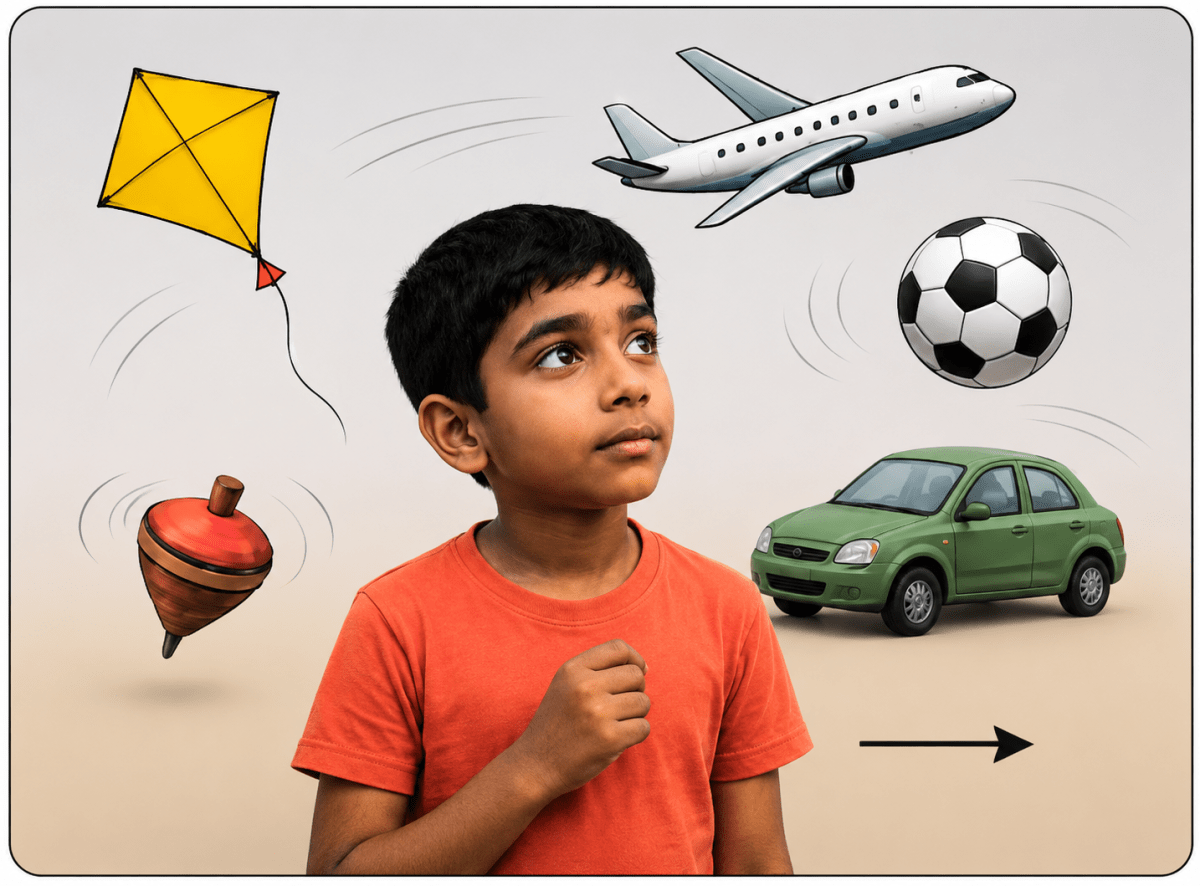
Rahul was observing different objects around him. He noticed the hands of the clock moving in circles, the school bell vibrating when it rang, and his school bus moving in a straight line on the road. He recorded these in his notebook and later discussed with his teacher to find out the types of motion. She explained that these were circular, periodic and rectilinear motion.
- How can you test or identify if an object is showing circular or rectilinear motion?
- Can an object show more than one type of motion at once? Investigate and give an example.
- How can you identify circular motion in your surroundings? List two examples.
- Can an object show periodic and circular motion together? Give an example.
- What motion do you notice in the pendulum of a wall clock? Can you measure it?
Answer
We can identify the type of motion by observing the path of the object. If the object moves along a straight line, it is showing rectilinear motion. If it moves around a fixed point along a circular path, keeping a constant distance from the centre, it is showing circular motion.
Yes, an object can show more than one type of motion at once; this is called multiple motion. For example, a moving vehicle shows linear motion while its wheels rotate in circular motion at the same time.
Circular motion can be identified when an object moves around a fixed point in a circular path, keeping a constant distance from the centre. Two examples are the motion of the moon around the earth and a child sitting on a merry-go-round.
Yes, an object can show periodic and circular motion together. For example, the motion of the earth around the sun is circular as well as periodic, because it moves in a nearly circular path and repeats its motion after a fixed interval of time (one year).
The pendulum of a wall clock shows oscillatory (periodic) motion, as it moves to and fro about its mean position and repeats its motion after a fixed interval. Yes, it can be measured by finding its time period, that is the time taken to complete one oscillation, using a stopwatch.
Preeti turned her room into a motion lab. She carried out the following controlled experiments.
- She rolled a toy car on a smooth floor and measured the time it took to cover each metre. She repeated the same on a carpet and noted the time difference.
- She hung a key on a string and pushed it gently to see if it came back at regular intervals.
- She marked a zigzag path with tape and walked through it, then measured both the path she walked and the shortest line from start to end.
- She weighed a brick using a spring balance and a kitchen scale to compare mass and weight.

- Why did Preeti use two types of surfaces for rolling the toy car?
- What did she want to check by swinging the key on a string?
- How did she demonstrate the difference between distance and displacement?
- Why did she use two tools to weigh the brick?
- Why is it important to change only one thing at a time in an experiment?
Answer
Preeti used two types of surfaces (smooth floor and carpet) to compare how the surface affects the motion of the toy car. On the smooth surface the car covered equal distances in equal time (uniform motion), while on the rough carpet the distances varied (non-uniform motion). This helped her study the difference between uniform and non-uniform motion.
By swinging the key on a string, Preeti wanted to check whether it came back to the same position at regular intervals of time. This was to demonstrate oscillatory (periodic) motion, like that of a simple pendulum.
Preeti marked a zigzag path and walked through it. The total length of the zigzag path she walked was the distance, and the shortest straight line from the start to the end point was the displacement. By comparing the two, she showed the difference between distance and displacement.
Preeti used two tools because mass and weight are measured by different instruments. The kitchen scale (beam balance type) measures the mass of the brick, while the spring balance measures its weight (the force with which the earth attracts it). This helped her compare mass and weight.
It is important to change only one thing at a time in an experiment so that we can clearly understand the effect of that single change. If many things are changed at once, we cannot tell which change caused the result, and the experiment would not give reliable conclusions.
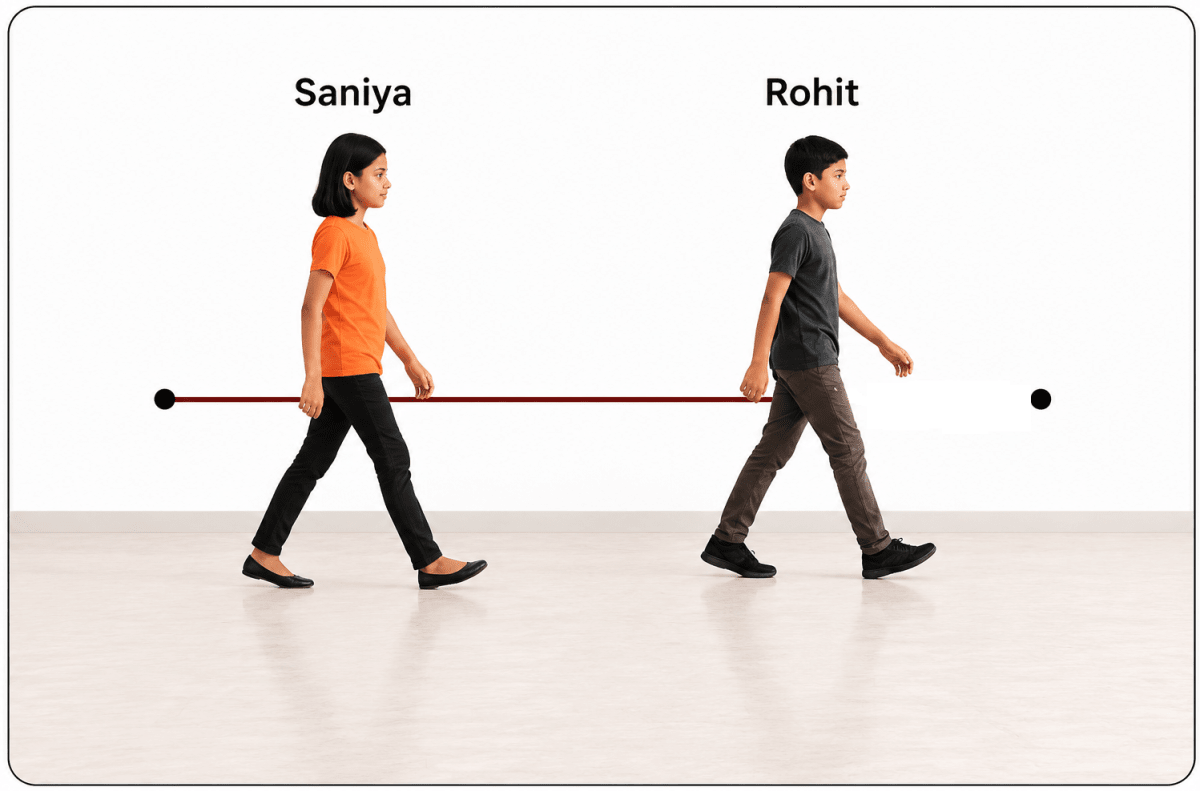
Saniya and Rohit started at the same point. Saniya walked straight for 100 metres and stopped. Rohit took a winding path and also ended up 100 metres from the start. Though both are at the same final point, Saniya walked less and Rohit more. Their displacements were equal, but their distances were different.
- How can the same displacement result from different distances?
- Can two people have the same distance but different displacements? How?
- If they both end at the same point, why is only the distance different?
- Create a new example where two people have different displacements but cover the same distance?
- Why is direction important?
Answer
The same displacement can result from different distances because displacement depends only on the shortest distance between the starting and ending points, not on the path taken. Saniya walked straight while Rohit took a winding path, so they covered different distances, but since both ended at the same point 100 m from the start, their displacement was the same.
Yes, two people can have the same distance but different displacements. For example, if one person walks 100 m in a straight line and another walks 100 m along a curved path, both cover the same distance, but the straight walker has a larger displacement than the one who curved back towards the start.
If they both end at the same point, their displacement is the same because displacement depends only on the initial and final positions. Only the distance is different because distance depends on the actual path covered, and Rohit's winding path was longer than Saniya's straight path.
New example: Aarav walks 4 m east, then 3 m north (distance = 7 m, displacement = 5 m). Ishaan walks 7 m straight in one direction (distance = 7 m, displacement = 7 m). Both cover the same distance of 7 m but have different displacements.
Direction is important because displacement is a vector quantity, which has both magnitude and direction. The direction tells us which way the object has moved from its starting point. Without direction, we cannot correctly describe the displacement of a body.
Fill in the blanks.
- An object is said to be in ............... if its position changes with respect to its surroundings and time.
- The shortest possible distance between the initial and final points is called ............... .
- The motion of a pendulum is an example of ............... motion.
- When a body covers equal distances in equal intervals of time, it is said to be in ............... motion.
- The laws of motion were discovered by ............... .
Answer
- An object is said to be in motion if its position changes with respect to its surroundings and time.
- The shortest possible distance between the initial and final points is called displacement.
- The motion of a pendulum is an example of oscillatory (periodic) motion.
- When a body covers equal distances in equal intervals of time, it is said to be in uniform motion.
- The laws of motion were discovered by Isaac Newton.
Write True or False.
- A body at rest never changes its position with respect to its surroundings.
- The distance covered can be equal to or greater than the displacement.
- Circular motion is a type of translatory motion.
- In vibratory motion the whole object moves to and fro.
- Average speed is calculated by dividing total distance travelled by total time taken.
Answer
- True
- True
- False
Corrected Statement — Circular motion is a special type of curvilinear motion. - False
Corrected Statement — In vibratory motion, only a part of the object moves to and fro. - True
Match the columns.
| Column A | Column B |
|---|---|
| 1. Movement of clock's second hand | (a) Path followed is not fixed |
| 2. Distance | (b) Circular motion |
| 3. Rolling ball | (c) Total path length |
| 4. Curvilinear motion | (d) Linear + Rotatory motion |
| 5. Non-periodic motion | (e) Motion along a curved path |
Answer
| Column A | Column B |
|---|---|
| 1. Movement of clock's second hand | (b) Circular motion |
| 2. Distance | (c) Total path length |
| 3. Rolling ball | (d) Linear + Rotatory motion |
| 4. Curvilinear motion | (e) Motion along a curved path |
| 5. Non-periodic motion | (a) Path followed is not fixed |
What is weight?
Answer
The weight of a body is the force with which the earth attracts the body towards its centre. Its SI unit is newton (N). Its value changes from place to place as it depends on gravity.
Give two examples of rectilinear motion.
Answer
Two examples of rectilinear motion are an automobile moving on a straight road and an apple falling from a tree.
State the difference between uniform and non-uniform motion.
Answer
In uniform motion, a body covers equal distances in equal intervals of time and moves with a constant speed. In non-uniform motion, a body covers unequal distances in equal intervals of time and its speed keeps on changing.
Define periodic motion with example.
Answer
Periodic motion is the motion of a body which gets repeated after a regular interval of time. For example, the motion of the earth around the sun and the movement of the hands of a clock are periodic motions.
Write the formula for speed.
Answer
The SI unit of speed is metre per second (m/s).
Explain how rest and motion are relative terms, with a suitable example.
Answer
Rest and motion are relative terms because whether a body is at rest or in motion depends on the point of observation and the surroundings. The same object can appear to be at rest with respect to one observer and in motion with respect to another.
For example, when you are sitting in a moving car, the person sitting next to you appears to be at rest with respect to you. But to a person standing on the roadside, both of you appear to be in motion. Similarly, the trees outside appear to move backwards to you, but they are at rest to the person standing on the road.
This shows that an object may be at rest with respect to some objects and in motion with respect to others. Hence, rest and motion are relative terms.
Differentiate between distance and displacement.
Answer
| Distance | Displacement |
|---|---|
| It is the total length of the actual path covered by an object irrespective of its direction. | It is the shortest distance between the initial and final positions in a particular direction. |
| It is a scalar quantity (has only magnitude). | It is a vector quantity (has both magnitude and direction). |
| It is denoted by 'd'. | It is denoted by 's'. |
| Its value can never be zero for a moving body. | Its value can be zero if the body returns to its starting point. |
The SI unit of both distance and displacement is metre (m).
Explain with examples how a body can have more than one type of motion at the same time.
Answer
When a body exhibits more than one type of motion at the same time, it is said to have multiple motion. Many objects show two types of motion together.
Some examples are:
- Motion of the earth: The earth rotates on its axis and at the same time revolves around the sun in a curved path.
- Vehicle moving on a straight road: The wheels of a vehicle rotate in a circular motion while the vehicle moves forward in a linear motion.
- Drawing water from a well: The bucket moves up and down in linear motion while the pulley rotates in circular motion.
- Motion of a drill: While making a hole, the drill rotates (rotatory motion) and at the same time moves forward into the wood (translatory motion).
Thus, a body can have more than one type of motion at the same time.
What is average speed? How is it calculated?
Answer
When an object is in non-uniform motion, its speed keeps on changing. In such cases, we calculate the average speed of the object. Average speed is the ratio of the total distance travelled by the object to the total time taken during the journey.
It is calculated using the formula:
For example, if a car travels a total distance of 75 km in 2 hours, then its average speed = = 37.5 km/h. The SI unit of average speed is metre per second (m/s).
Discuss the differences between translatory, rotatory and oscillatory motion with one example each.
Answer
| Translatory Motion | Rotatory Motion | Oscillatory Motion |
|---|---|---|
| Every point on the object moves through the same distance in the same interval of time. | The body spins about a fixed axis, and different parts move through different distances. | The body moves to and fro about its mean position. |
| The body moves from one place to another along a straight or curved path. | The body does not change its place but rotates about an axis. | The body repeats its to and fro movement. |
| Example: a car moving on a straight road. | Example: the blades of a ceiling fan. | Example: the motion of a pendulum. |