
Read the given paragraph and answer the questions that follow.
Sumit, a curious Class 7 student, was excited about the upcoming science fair. He wanted to make a model that explained how energy works in daily life. After reading his textbook, he decided to create a working model of a windmill connected to a light bulb. Sumit explained to the visitors that when the wind blows, it turns the blades of the windmill. This is kinetic energy of moving air. As the blades spin, they rotate a small dynamo, converting kinetic energy into electrical energy, which lights up the bulb. The bulb then converts electrical energy into light and heat energy. Everyone was amazed by the way one form of energy changed into another. Sumit also made a colourful chart showing that energy cannot be created or destroyed, it can only be transformed from one form to another. This idea is called the law of conservation of energy. His model helped everyone understand that even when energy changes form, the total energy remains the same. Sumit's project was praised by both teachers and parents.
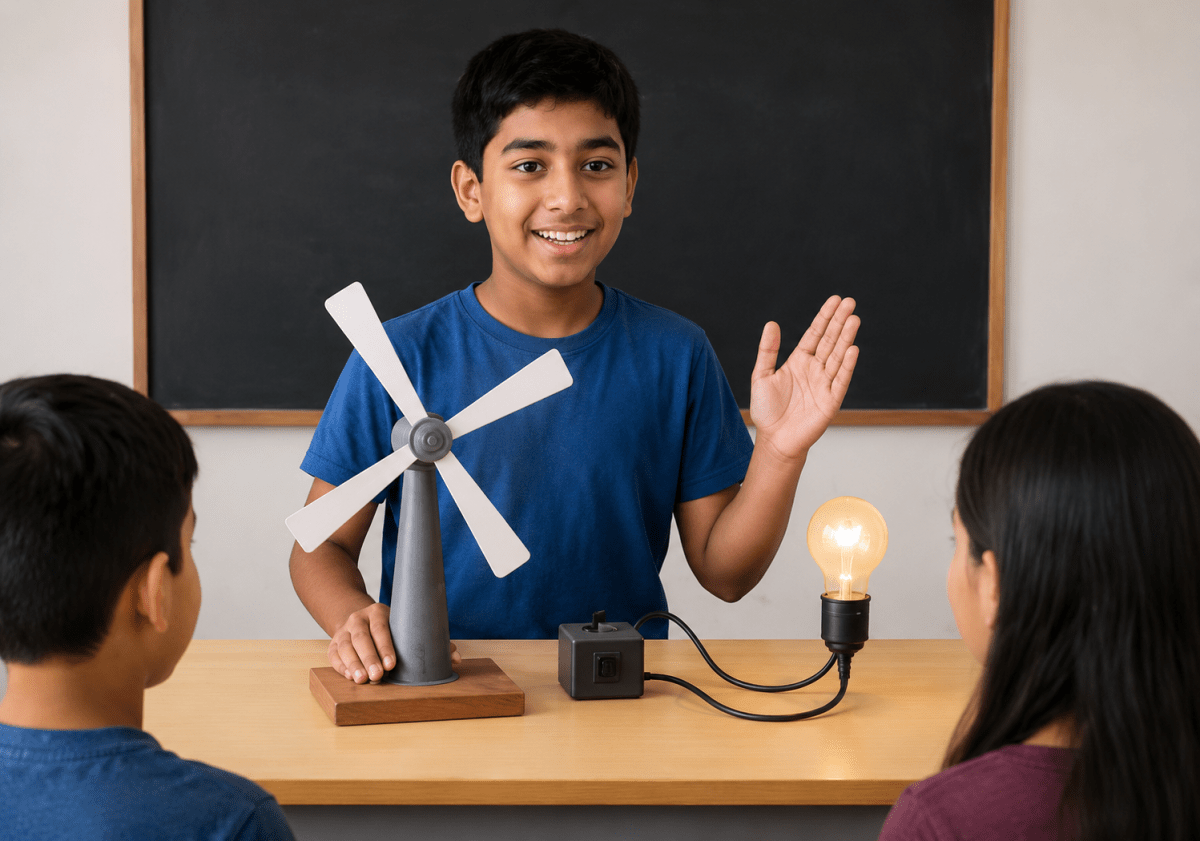
- What type of energy does the wind carry in Sumit's model?
- Which energy transformation lights up the bulb in the windmill?
- What is meant by the conservation of energy?
- What two forms of energy are produced by the bulb?
- Why do you think Sumit's project was appreciated by everyone?
Answer
- The wind carries kinetic energy in Sumit's model, as it is the energy of moving air.
- The bulb is lit up when the kinetic energy of the spinning blades is converted into electrical energy by the dynamo. This electrical energy then lights up the bulb.
- Conservation of energy means that energy can neither be created nor destroyed. It can only be transformed from one form to another, and the total energy of the system always remains the same.
- The bulb produces light energy and heat energy from electrical energy.
- Sumit's project was appreciated by everyone because it clearly showed how one form of energy changes into another in daily life and explained the law of conservation of energy in a simple, working model that everyone could easily understand.
Circle the word that does not belong to other words given alongside it.
- Potential energy, Chemical energy, Magnetic energy, Gravity
- Battery, Bulb, Generator, Solar panel
- Energy cannot be created, Energy can be transformed, Energy is destroyed, Energy is conserved
- Kinetic energy, Heat, Movement, Solar energy
- Light energy, Sound energy, Heat energy, Coal
Answer
- Gravity
Reason — Potential energy, chemical energy and magnetic energy are all forms of energy, whereas gravity is a force. - Bulb
Reason — Battery, generator and solar panel are sources that supply energy, whereas a bulb is a device that uses energy. - Energy is destroyed.
Reason — The other statements are true according to the law of conservation of energy, whereas energy can never be destroyed. - Movement
Reason — Kinetic energy, heat energy and solar energy are forms of energy, whereas movement is not a form of energy. - Coal
Reason — Light energy, sound energy and heat energy are forms of energy, whereas coal is a fuel (a source of energy).
Match the columns.
| Column A | Column B |
|---|---|
| 1. Solar panel | (a) Chemical energy to mechanical energy |
| 2. Electric fan | (b) Source of heat and light energy |
| 3. Battery in a toy car | (c) Electrical energy to kinetic energy |
| 4. Burning of wood | (d) Mechanical energy to electrical energy |
| 5. Windmill connected to generator | (e) Converts light energy to electrical energy |
Answer
| Column A | Column B |
|---|---|
| 1. Solar panel | (e) Converts light energy to electrical energy |
| 2. Electric fan | (c) Electrical energy to kinetic energy |
| 3. Battery in a toy car | (a) Chemical energy to mechanical energy |
| 4. Burning of wood | (b) Source of heat and light energy |
| 5. Windmill connected to generator | (d) Mechanical energy to electrical energy |
Answer in one or a few word(s).
- The energy possessed by a body due to its position or motion
- A form of energy produced by vibrating bodies
- The energy that is stored in molecular bonds
- The energy produced by the flow of electric charge (electrons) through a conductor
- The process of changing one form of energy to another
Answer
- Mechanical energy
- Sound energy
- Chemical energy
- Electrical energy
- Energy transformation
Write the correct word(s) in the given blanks.
- ............... are the tiny particles that make up every object in the universe.
- ............... energy refers to the energy that is stored in molecular bonds, the forces that hold molecules together.
- When electrical energy is made available for use through the wires or cables, we call it ............... .
- The law of conservation of energy states that ............... can neither be created nor be destroyed.
- ............... is defined as the displacement caused in a body in the direction of the force applied.
Answer
- Atoms are the tiny particles that make up every object in the universe.
- Chemical energy refers to the energy that is stored in molecular bonds, the forces that hold molecules together.
- When electrical energy is made available for use through the wires or cables, we call it electricity.
- The law of conservation of energy states that energy can neither be created nor be destroyed.
- Work is defined as the displacement caused in a body in the direction of the force applied.
Write True or False for the following statements.
- The energy possessed by a body by virtue of its motion is called kinetic energy.
- Light energy is a form of energy which is responsible for the sensation of hotness or coldness.
- When electrical energy is made available for use through the wires or cables, we call it chemical energy.
- The light energy of the sun is utilised by plants during the process of photosynthesis and converted into heat energy.
- Work is done by a force when it displaces a body along its direction.
Answer
- True
- False
Corrected Statement — Heat energy is a form of energy which is responsible for the sensation of hotness or coldness. - False
Corrected Statement — When electrical energy is made available for use through the wires or cables, we call it electricity. - False
Corrected Statement — The light energy of the sun is utilised by plants during the process of photosynthesis and converted into chemical energy. - True
Find errors in the given sentences and correct them.
- When the pendulum is at rest, its position is known as extreme position.
- The potential energy of the moving water is used to move the blades of a turbine.
- In a solar cell, the electrical energy gets converted to chemical energy.
- The potential energy of a body is not directly proportional to its mass.
- The process of changing one form of energy to another is known as conservation of energy.
Answer
- When the pendulum is at rest, its position is known as mean position.
- The kinetic energy of the moving water is used to move the blades of a turbine.
- In a solar cell, the light energy gets converted to electrical energy.
- The potential energy of a body is directly proportional to its mass.
- The process of changing one form of energy to another is known as energy transformation.
Give reason — When the roller coaster car is at the top of the coaster, it has the maximum potential energy.
Answer
When the roller coaster car is at the top of the coaster, it is at the maximum height above the ground. Since the potential energy of a body increases with its height, the car has the maximum potential energy at the top and zero kinetic energy.
Give reason — Energy cannot be created nor destroyed.
Answer
Energy cannot be created nor destroyed because of the law of conservation of energy. Energy can only be converted from one form to another, and the total energy of a system always remains the same.
Give reason — A solar panel does not work well on cloudy days.
Answer
A solar panel works by converting light energy from the sun into electrical energy. On cloudy days, the sunlight reaching the panel is reduced, so less light energy is available for conversion. Therefore, the solar panel does not work well on cloudy days.
Give reason — We feel warm when we sit near a fire.
Answer
We feel warm when we sit near a fire because the burning of fuel releases heat energy. This heat energy reaches our body and gives us the sensation of warmth.
Give reason — A moving car is said to have kinetic energy.
Answer
A moving car is said to have kinetic energy because kinetic energy is the energy possessed by a body by virtue of its motion. Since the car is in motion, it possesses kinetic energy and is capable of doing work.
Define energy.
Answer
Energy is defined as the ability of a body to do work. Its SI unit is joule (J).
What does law of conservation of energy state?
Answer
The law of conservation of energy states that energy can neither be created nor be destroyed. It can only be converted from one form to another, and the total energy of a system always remains conserved.
Give two examples of energy transformation.
Answer
- In an electric bulb, electrical energy gets converted into light and heat energy.
- In a microphone, sound energy is converted into electrical energy.
What does a simple pendulum consist of?
Answer
A simple pendulum consists of a small and heavy mass called the bob, which is tied to a thread from a rigid support.
Why is huge amount of water stored in the dams built at a height?
Answer
A huge amount of water is stored in dams built at a height because water at such a height possesses potential energy. When this water is released, its potential energy gets converted into kinetic energy, which is used to turn the blades of a turbine to produce electricity.
What is mechanical energy? Explain the types of mechanical energy with examples.
Answer
Mechanical energy is the energy possessed by a body due to its position or motion. In other words, it is the energy possessed by a body when it is in motion or when it is lifted to a height with respect to the earth's surface.
Mechanical energy is divided into two types:
Kinetic energy: It is the energy possessed by a body by virtue of its motion. Every moving body possesses kinetic energy.
Examples: a moving ball, flowing water, a flying bird and a moving car.Potential energy: It is the energy possessed by a body by virtue of its position or change in shape.
Examples: water stored in a dam at a height, a stretched rubber band and a stone kept on a hill.
Describe the different types of stored energies.
Answer
The different types of stored energies are:
Muscular energy: It is the energy stored in the muscles of our body. We get this energy from the food we eat, which releases chemical energy that gets stored in our muscles. This energy is used to perform various activities.
Chemical energy: It is the energy stored in molecular bonds, the forces that hold atoms together. This energy is released when chemical substances undergo a change, such as the burning of coal and other fossil fuels. A battery also stores chemical energy.
Magnetic energy: It is the energy stored in a magnet due to which it exerts force on iron objects and other magnets. It is used in magnetic separation of iron, lifting heavy iron objects and in medical tests like Magnetic Resonance Imaging (MRI).
Nuclear energy: It is the energy stored in the nucleus of an atom. When the nucleus of an atom splits or two nuclei combine together, a large amount of energy is released in the form of heat. This energy can be used to generate electricity.
How Light Energy is different from Heat energy?
Answer
| Light Energy | Heat Energy |
|---|---|
| Light energy is a form of energy which makes things visible to us. | Heat energy is a form of energy which is responsible for the sensation of hotness or coldness. |
| The main source of light energy is the sun. Candle, bulb and tube light are other sources. | We get heat energy mainly from the sun and by burning fuels like wood, coal and petrol. |
| It is utilised by green plants to prepare food through photosynthesis. | It is useful in activities like cooking, generating electricity and running steam engines. |
Explain the law of conservation of energy with the help of examples.
Answer
The law of conservation of energy states that energy can neither be created nor be destroyed. It can only be converted from one form to another, and the total energy of a system always remains the same.
This means that if some energy gets transformed into different forms of energy, the total sum of all the energies remains the same as before. For instance, if 100 J of electrical energy is used to run a mixer, 70 J may be used to do work while the remaining 30 J gets converted into sound energy and heat energy. Here, the energy has not been destroyed but has taken other non-useful forms.
Some examples that explain the law of conservation of energy are:
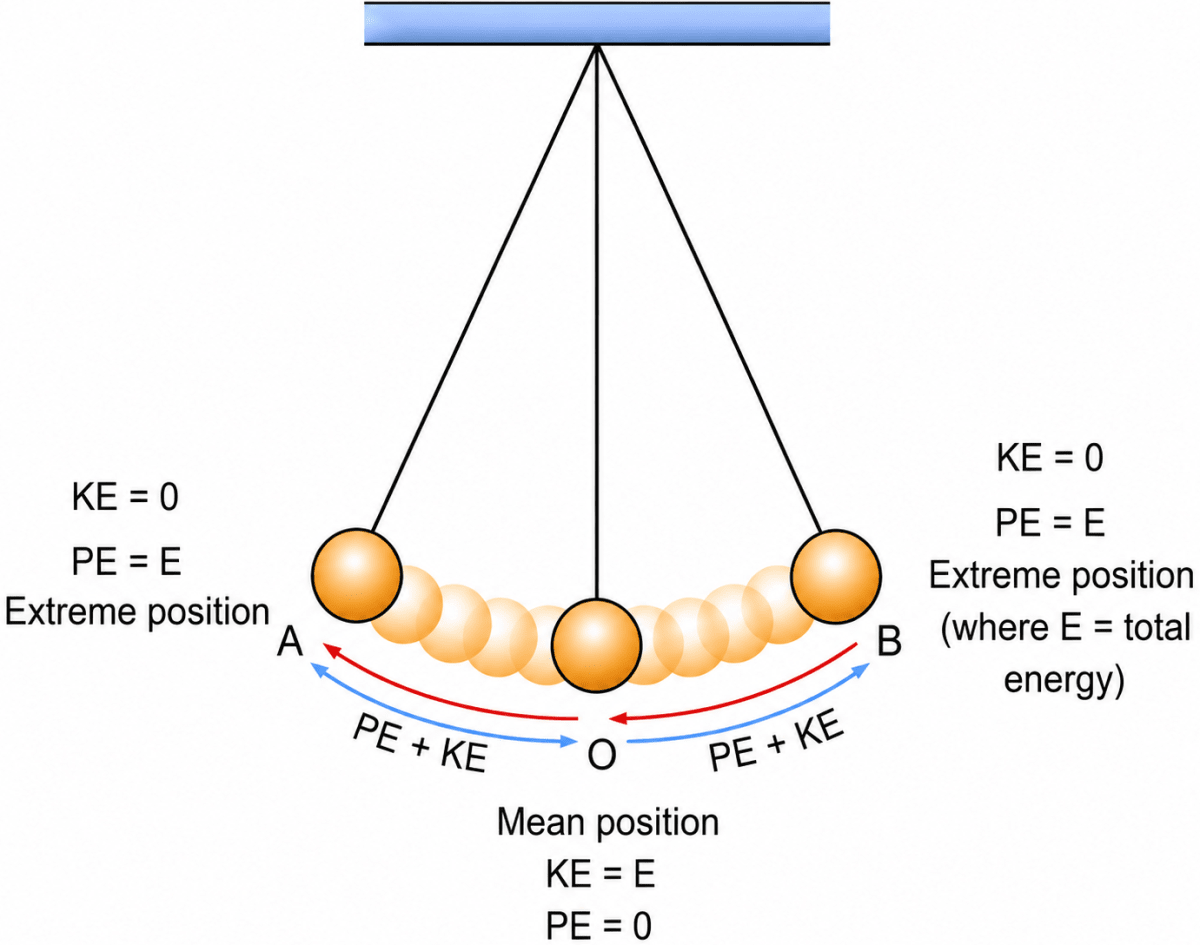
- Motion of a simple pendulum: As the bob of the pendulum swings, its energy keeps changing between kinetic energy and potential energy. At the extreme positions it has only potential energy, and at the mean position it has only kinetic energy. However, at any instant the total mechanical energy remains conserved.
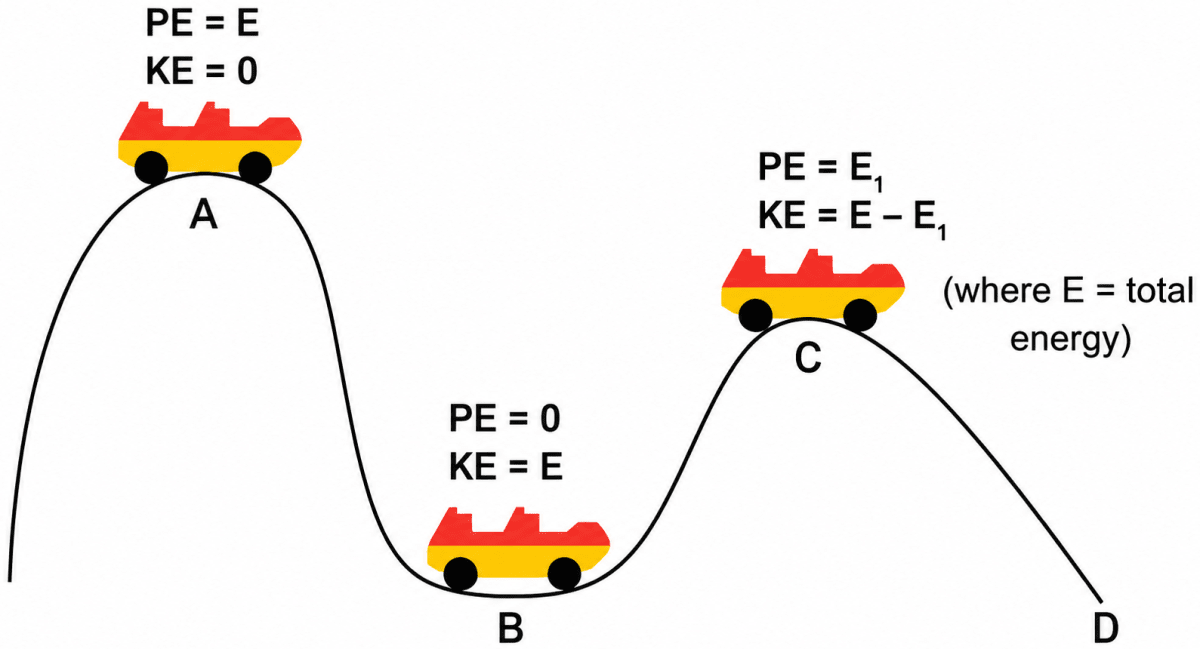
- Roller coaster: At the top of the coaster the car has maximum potential energy and zero kinetic energy. At the bottom-most point its potential energy becomes zero and kinetic energy becomes maximum. Throughout the path, the total mechanical energy remains conserved.
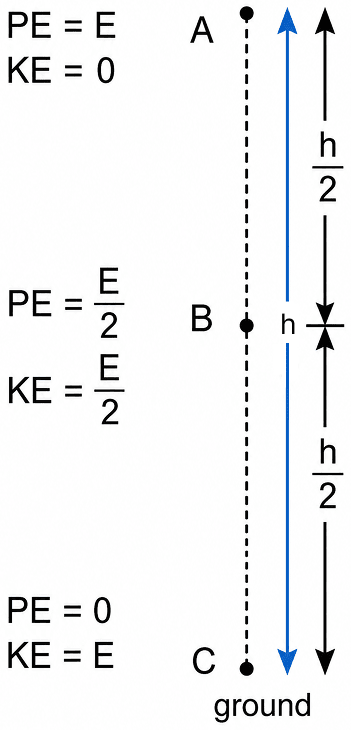
- Vertically falling ball: When a ball is held at a height it has maximum potential energy. As it falls, its potential energy changes into kinetic energy. Just before striking the ground, its potential energy is zero and kinetic energy is maximum. At every point, the total energy remains the same.
Describe the different types of stored energies.
Answer
The different types of stored energies are:
Muscular energy: It is the energy stored in the muscles of our body. We get this energy from the food we eat, which releases chemical energy that gets stored in our muscles. This energy is used to perform various activities.
Chemical energy: It is the energy stored in molecular bonds, the forces that hold atoms together. This energy is released when chemical substances undergo a change, such as the burning of coal and other fossil fuels. A battery also stores chemical energy.
Magnetic energy: It is the energy stored in a magnet due to which it exerts force on iron objects and other magnets. It is used in magnetic separation of iron, lifting heavy iron objects and in medical tests like Magnetic Resonance Imaging (MRI).
Nuclear energy: It is the energy stored in the nucleus of an atom. When the nucleus of an atom splits or two nuclei combine together, a large amount of energy is released in the form of heat. This energy can be used to generate electricity.
Read the given case study and answer the questions that follow.
Teena and her friends went to an eco-park on a school trip. As they walked around, they observed various ways in which energy was used and transformed. They saw a windmill spinning slowly in the breeze, a solar streetlight charging during the day and a small fountain running with the help of a motor. They sat on benches made of recycled material.
- How does the windmill in the park show energy transformation?
- How is solar energy used in the park?
- Why do you think the eco-park is designed in this way?
Answer
The windmill shows energy transformation because the kinetic energy of the moving air (wind) turns its blades. This kinetic energy is converted into mechanical energy, which can be used to produce electrical energy with the help of a generator.
Solar energy is used in the park to power the solar streetlights. The solar panel converts light energy from the sun into electrical energy during the day. This electrical energy is stored and later used to light up the streetlights.
The eco-park is designed in this way to use renewable sources of energy like wind and solar energy, and to make use of recycled materials. This helps save conventional energy, reduces pollution and protects the environment.
Read the given information carefully and answer the questions that follow.
Energy cannot be created nor destroyed, meaning that the total amount of energy in the universe has always been and will always be constant. However, this does not mean that energy is immutable; it can change form and even transfer between objects.
A common example of energy transfer that we see in everyday life is the transfer of kinetic energy – the energy associated with motion – from one moving object to a stationary object via work. In physics, work is a measure of energy transfer and refers to the force applied by an object over a distance. When a golf club is swung and hits a stationary golf ball, some of the club's kinetic energy transfers to the ball as the club does "work" on the ball. In an energy transfer such as this one, energy moves from one object to another, but stays in the same form.
Thermal energy has to do with the internal energy of a system due to its temperature.
Source: https://education.nationalgeographic.org/resource/energy-transfers-and-transformations/
- "Energy cannot be created or destroyed."? Briefly explain this statement in your own words.
- Give two examples of energy transfer.
- What are the different types of energies.
Answer
This statement means that the total amount of energy in the universe always stays the same. Energy can never be made from nothing or completely destroyed. It can only change from one form to another or move from one object to another.
Two examples of energy transfer are:
- When a golf club hits a stationary golf ball, some of the kinetic energy of the club is transferred to the ball.
- When a moving cricket ball hits the stumps, its kinetic energy is transferred to the stumps, making them fall.
The different types of energies are mechanical energy (kinetic and potential energy), heat energy, light energy, sound energy, electrical energy, muscular energy, chemical energy, magnetic energy and nuclear energy.
A fan and a television both use electrical energy. Compare how energy is used in both devices. What kind of energy transformation takes place in each?
Answer
Both a fan and a television use electrical energy, but they transform it into different forms.
In a fan, electrical energy is converted into mechanical energy (kinetic energy) which rotates the blades and produces a flow of air.
In a television, electrical energy is converted into light energy (the picture on the screen) and sound energy (from the speakers).
Thus, while a fan mainly produces mechanical energy, a television mainly produces light and sound energy.
A student wants to lift water using a hand pump. The pump is hard to operate. Suggest an energy source that can make this task easier and explain the transformation that would occur.
Answer
The task can be made easier by using electrical energy to run an electric water pump (motor) instead of operating the hand pump by hand.
In an electric water pump, electrical energy is converted into mechanical energy. This mechanical energy is used to do the work of lifting the water. This removes the effort of using muscular energy and makes the task much easier.
Design a simple energy-saving system for a classroom using any two renewable energy sources. What sources will you use and how will the energy be transformed and used?
Answer
To design an energy-saving system for a classroom, two renewable energy sources can be used: solar energy and wind energy.
Solar energy: Solar panels can be fixed on the roof of the classroom. These panels convert light energy from the sun into electrical energy during the day. This electrical energy can be stored in a battery (as chemical energy) and used to run the lights and other devices in the classroom.
Wind energy: A small windmill can be set up near the classroom. The kinetic energy of the moving air turns the blades of the windmill, which is converted into mechanical energy and then into electrical energy with the help of a generator. This electrical energy can be used to run fans in the classroom.
In this way, both solar and wind energy can be used to save electricity and reduce the use of conventional energy sources.
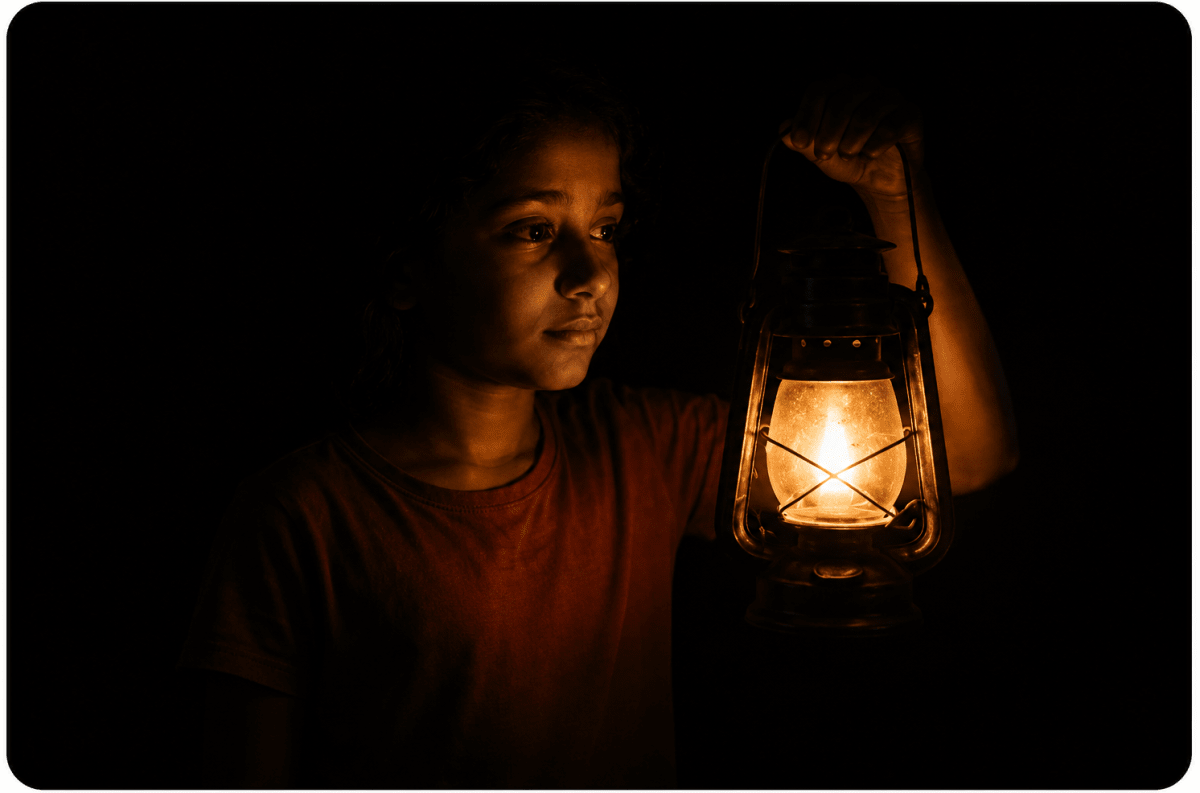
Seema visited her grandmother in the village. At night, when the power went out, Grandma lit an old kerosene lantern. Seema watched the yellow flame and felt the warmth. She thought about how the chemical energy in kerosene was turning into light and heat. "Isn't it amazing how something invisible like energy can become something we see and feel?" she wondered. Grandma smiled and said, "Everything around us works because of energy, it just changes forms."
- What energy transformation happened when the kerosene lantern was lit?
- Why did Seema find energy transformations amazing?
- Can energy be seen directly? Explain your answer.
- What are other examples where chemical energy is changed into light or heat?
- Why is it important to think about how we use energy?
Answer
When the kerosene lantern was lit, the chemical energy stored in the kerosene was converted into light energy and heat energy.
Seema found energy transformations amazing because something invisible like energy could change into forms that we can actually see (light) and feel (heat). It showed her how energy keeps changing its form all around us.
Energy cannot be seen directly. We can only observe its effects, such as the light we see and the heat we feel. Energy itself is invisible, but its transformations make their presence known through these effects.
Other examples where chemical energy is changed into light or heat are:
- Burning of a candle, which gives light and heat.
- Burning of wood and coal, which gives heat and light.
- Bursting of a cracker, where chemical energy changes into heat, light and sound energy.
It is important to think about how we use energy so that we do not waste it. Using energy carefully helps us save resources, reduce pollution and protect the environment for the future.
On Sunday, Preetam took a walk in the park with his science notebook. He observed the tall streetlights powered by solar panels. He saw children playing with toy cars that had tiny batteries inside. He even noticed a person jogging, sweating from the effort. Preetam made notes: "Sunlight to electricity (solar panels), chemical to movement (batteries), food to energy (human body)." He smiled, knowing he could now spot energy transformations everywhere.

- What three energy transformations did Preetam notice during his walk?
- What was the source of energy for the streetlights?
- What did the toy car's battery store and release?
- How does the human body get energy?
- Name one more example of energy transformation you can find in your surroundings.
Answer
The three energy transformations Preetam noticed were:
- Sunlight to electricity in the solar streetlights (light energy to electrical energy).
- Chemical energy to movement in the toy cars (chemical energy to kinetic energy).
- Food to energy in the human body (chemical energy to muscular energy).
The source of energy for the streetlights was the sun. The solar panels converted the light energy of the sun into electrical energy.
The toy car's battery stored chemical energy and released it as electrical energy, which was then converted into kinetic energy to move the car.
The human body gets energy from the food we eat. The food is broken down to release chemical energy, which is stored in our muscles as muscular energy and used to perform activities.
One more example of energy transformation is an electric fan, in which electrical energy is converted into mechanical energy.
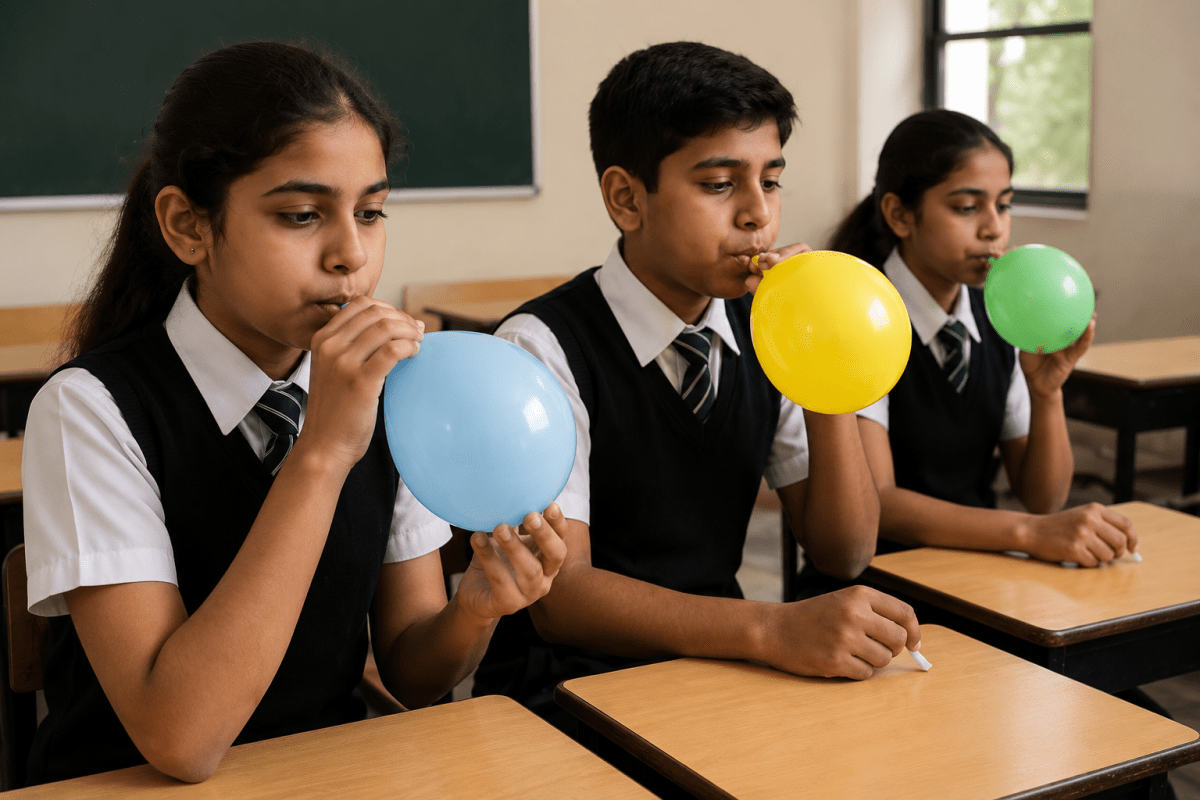
In the class, the teacher gave each group a balloon, a straw, string and tape. Babita's group taped the balloon to the straw and threaded the string through it. When they blew the balloon and let go, it zoomed forwards. "What just happened?" asked Babita. The teacher explained, "The air inside had potential energy. When released, it became kinetic energy, making the balloon move!" The students clapped, amazed to see energy in action.
- What did the balloon contain before it was released?
- What type of energy made the balloon move?
- How was energy stored and then used in this experiment?
- Why was this a good way to understand energy transformation?
Answer
Before it was released, the balloon contained compressed air, which had potential energy.
Kinetic energy made the balloon move. The potential energy of the air changed into kinetic energy when the balloon was released.
In this experiment, energy was stored as potential energy in the compressed air inside the blown-up balloon. When the balloon was released, this stored potential energy was converted into kinetic energy, which made the balloon zoom forwards.
This was a good way to understand energy transformation because the students could actually see the stored potential energy changing into kinetic energy as the balloon moved. It made an invisible idea easy to observe and understand through a simple activity.
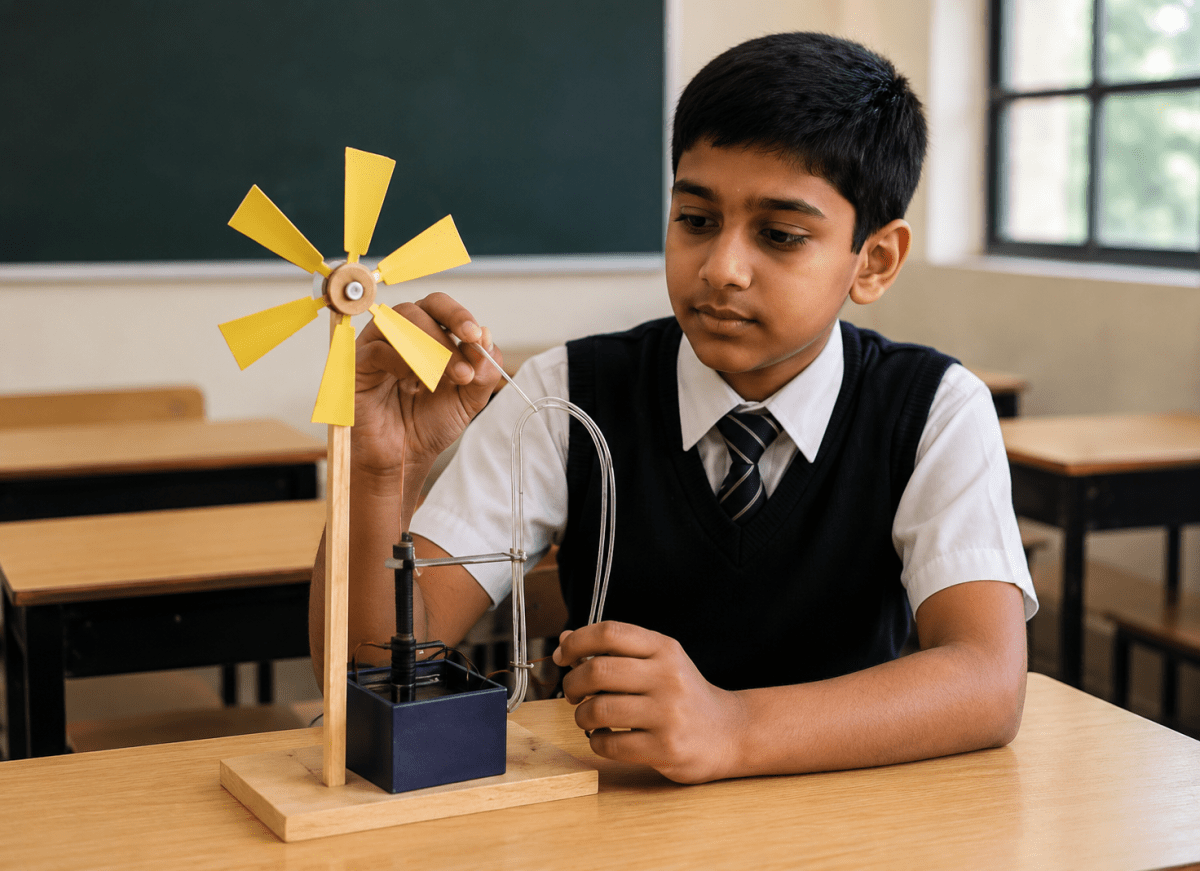
Kartik loved making new things. After learning about energy transformations, he designed a model of a wind-powered water pump. He imagined wind turning a fan, which would rotate a wheel connected to a pump. This would help lift water in fields without electricity. "Wind energy to mechanical energy to work!" he explained proudly. His teacher praised him for using science to solve a real problem.
- What kind of machine did Kartik imagine?
- Which energy transformations would happen in Kartik's model?
- Why was Kartik's idea useful for farmers?
- How can thinking about energy help solve real-life problems?
Answer
Kartik imagined a wind-powered water pump in which the wind would turn a fan that rotates a wheel connected to a pump to lift water.
In Kartik's model, the kinetic energy of the wind (wind energy) would be converted into mechanical energy of the rotating fan and wheel. This mechanical energy would then be used to do the work of lifting water.
Kartik's idea was useful for farmers because it could lift water in fields without using electricity. This would help farmers irrigate their fields using a free and renewable source of energy, the wind.
Thinking about energy helps us solve real-life problems because it allows us to use available energy sources wisely and design useful machines. By understanding how energy changes form, we can create devices that make work easier and save conventional energy.
Fill in the blanks.
- The capacity to do work is termed as ............... .
- ............... energy is stored in food and fuels.
- Mechanical energy exists in two forms: ............... energy and ............... energy.
- The energy possessed by water at the top of a dam is ............... energy.
- When energy is changed from one form to another, the process is known as ............... of energy.
Answer
- The capacity to do work is termed as energy.
- Chemical energy is stored in food and fuels.
- Mechanical energy exists in two forms: kinetic energy and potential energy.
- The energy possessed by water at the top of a dam is potential energy.
- When energy is changed from one form to another, the process is known as transformation of energy.
Write True or False.
- Heat energy is a form of mechanical energy.
- A stretched rubber band possesses potential energy.
- Electrical energy can be converted into mechanical energy.
- The unit of energy is newton.
- There is always some loss of energy during transformation from one form to another.
Answer
- False
Corrected Statement — Heat energy is a separate form of energy and not a form of mechanical energy. - True
- True
- False
Corrected Statement — The unit of energy is joule. - False
Corrected Statement — During an energy transformation, no total energy is lost. However, some useful energy may be converted into less useful forms such as heat and sound energy.
Match the columns.
| Column A | Column B |
|---|---|
| 1. Running water | (a) Atom bomb |
| 2. Burning | (b) Joule |
| 3. Sound energy | (c) Kinetic energy |
| 4. Nuclear energy | (d) Heat energy |
| 5. Energy | (e) Vibration |
Answer
| Column A | Column B |
|---|---|
| 1. Running water | (c) Kinetic energy |
| 2. Burning | (d) Heat energy |
| 3. Sound energy | (e) Vibration |
| 4. Nuclear energy | (a) Atom bomb |
| 5. Energy | (b) Joule |
Write the law of conservation of energy.
Answer
The law of conservation of energy states that energy can neither be created nor be destroyed. It can only be converted from one form to another, and the total energy of a system always remains conserved.
Name two forms of mechanical energy.
Answer
The two forms of mechanical energy are kinetic energy and potential energy.
Define one joule.
Answer
One joule is the amount of energy needed to exert a force of 1 newton through a distance of 1 metre.
That is, 1 J = 1 N × 1 m.
What is potential energy?
Answer
Potential energy is the energy possessed by a body by virtue of its position or change in shape. For example, water stored in a dam at a height and a stretched rubber band possess potential energy.
How does an electric bulb demonstrate energy transformation?
Answer
An electric bulb demonstrates energy transformation because when it is switched on, the electrical energy supplied to it gets converted into light energy and heat energy.
Discuss at least three different forms of energy found in your home and how they are used.
Answer
Three different forms of energy found in our home are:
Electrical energy: It is supplied to our home through wires and cables. It is used to run appliances like bulbs, fans, televisions and washing machines.
Chemical energy: It is stored in food and in fuels like LPG (cooking gas). The chemical energy in food is converted into muscular energy, while the chemical energy in cooking gas is converted into heat energy for cooking.
Heat energy: It is obtained by burning fuels like cooking gas. It is used for activities like cooking food and heating water.
Describe the factors on which kinetic energy depends.
Answer
The kinetic energy of a body depends on the following two factors:
The speed of the body: A fast-moving object has more kinetic energy, as kinetic energy is directly proportional to the square of the speed of the body.
The mass of the body: The kinetic energy of a body is directly proportional to its mass. The heavier an object, the more is its kinetic energy.
Illustrate with a diagram the various forms of energy conversion in a hydroelectric power plant.
Answer
In a hydroelectric power plant, a huge amount of water is stored in a dam built at a height. The various forms of energy conversion that take place are:
- Water stored at a height possesses potential energy.
- When the water is released, its potential energy is converted into kinetic energy as it flows down.
- The kinetic energy of the moving water turns the blades of a turbine, converting it into mechanical energy.
- The turbine is connected to a generator, which converts the mechanical energy into electrical energy.
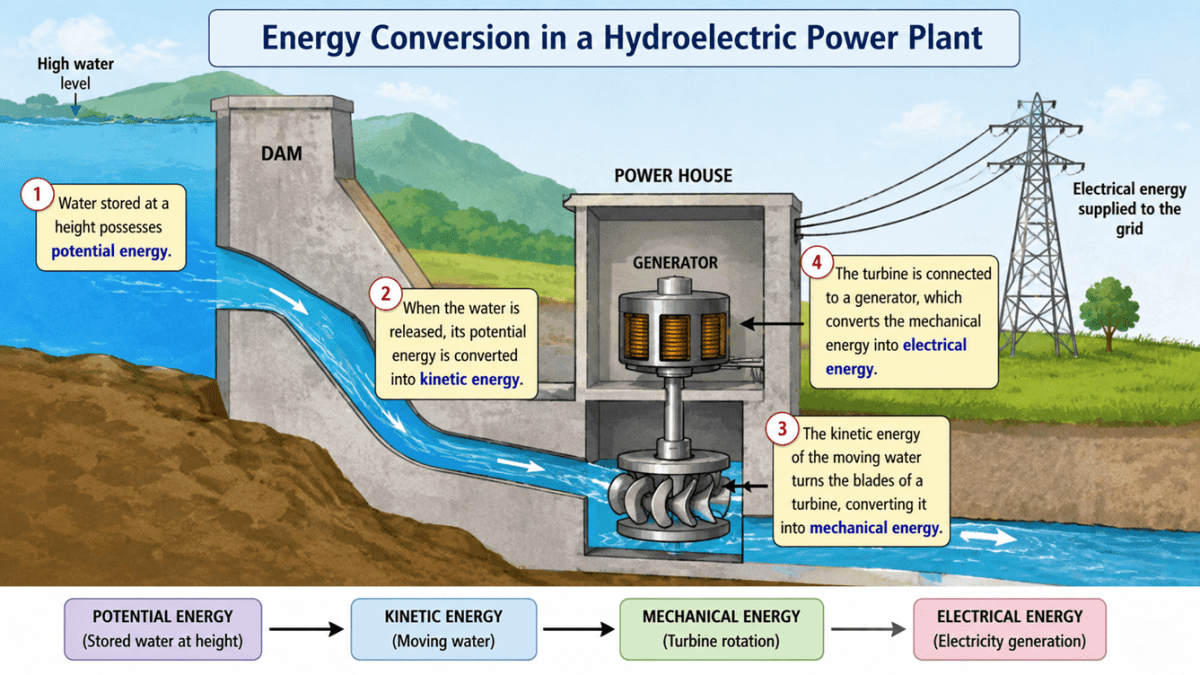
Thus, in a hydroelectric power plant, potential energy → kinetic energy → mechanical energy → electrical energy.
How does the law of conservation of energy apply to a swinging pendulum?
Answer
A swinging pendulum is a good example of the law of conservation of energy.
When the bob is at the extreme positions (A or B), it is at its highest point. Here it has only potential energy and zero kinetic energy. As the bob moves towards the mean position (O), its potential energy starts converting into kinetic energy. At the mean position, its potential energy becomes zero and it has only kinetic energy.
In this way, as the pendulum oscillates, its energy keeps changing between potential energy and kinetic energy. However, at any instant, the total mechanical energy (the sum of potential and kinetic energy) remains conserved. This shows that energy is only transformed and not destroyed.
Compare and contrast heat energy and mechanical energy with examples.
Answer
| Heat Energy | Mechanical Energy |
|---|---|
| Heat energy is a form of energy which is responsible for the sensation of hotness or coldness. | Mechanical energy is the energy possessed by a body due to its position or motion. |
| It is obtained mainly from the sun and by burning fuels. | It is possessed by a body that is moving or is placed at a height. |
| Example: the heat we get from a fire or from the sun. | Example: a moving car (kinetic energy) and water stored in a dam (potential energy). |