
Have you ever wondered what you might see if the invisible world around you became visible?
Answer
If the invisible world became visible, we would be able to see a huge variety of tiny living beings all around us. We would notice microorganisms like bacteria, protozoa, some fungi and algae present in water, soil, air, on the surfaces of objects, on our food, and even inside our own body. We would also see the basic building blocks of life — the cells — that make up every plant and animal around us.
How do you think your observation of this hidden world might change the way you think about size, complexity, or even what counts as ‘living’?
Answer
Observing this hidden world would show us that living organisms can be extremely small and yet carry out all the processes needed for life. Many microorganisms are unicellular, which means that a single cell performs all their life processes. Others are made up of many cells. Thus, size alone does not decide whether something is living.
Have you thought how these tiny living beings interact with each other?
Answer
These tiny living beings interact with one another and with their surroundings in many ways. Some microorganisms, like bacteria and fungi, break down dead plants and animals and recycle nutrients into the soil. Some bacteria live inside the roots of legumes and provide them with nitrogen. Others, such as the bacteria in our gut, help in digestion. In this way, microorganisms are closely connected with plants, animals, and the environment.
Various parts of a cell are given below. Write them in the appropriate places in the following diagram.
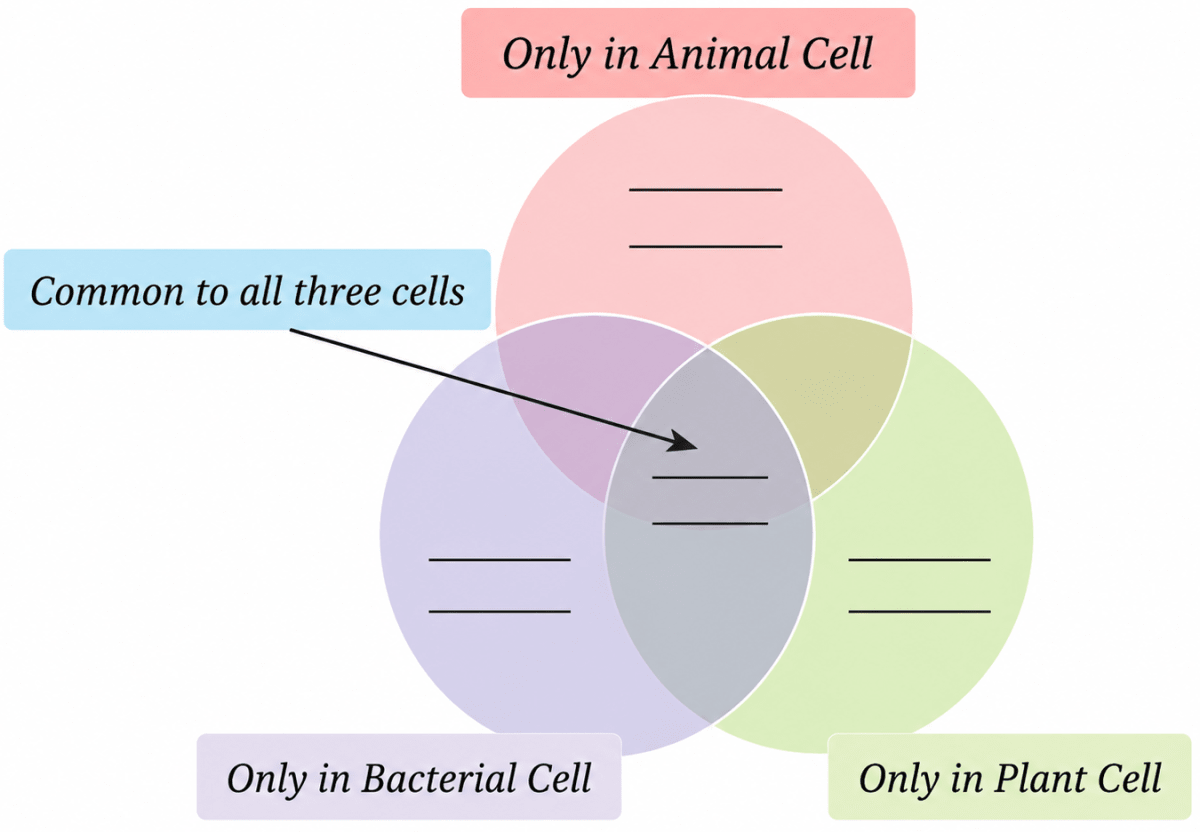
- Nucleus
- Cytoplasm
- Chloroplast
- Cell wall
- Cell membrane
- Nucleoid
Answer
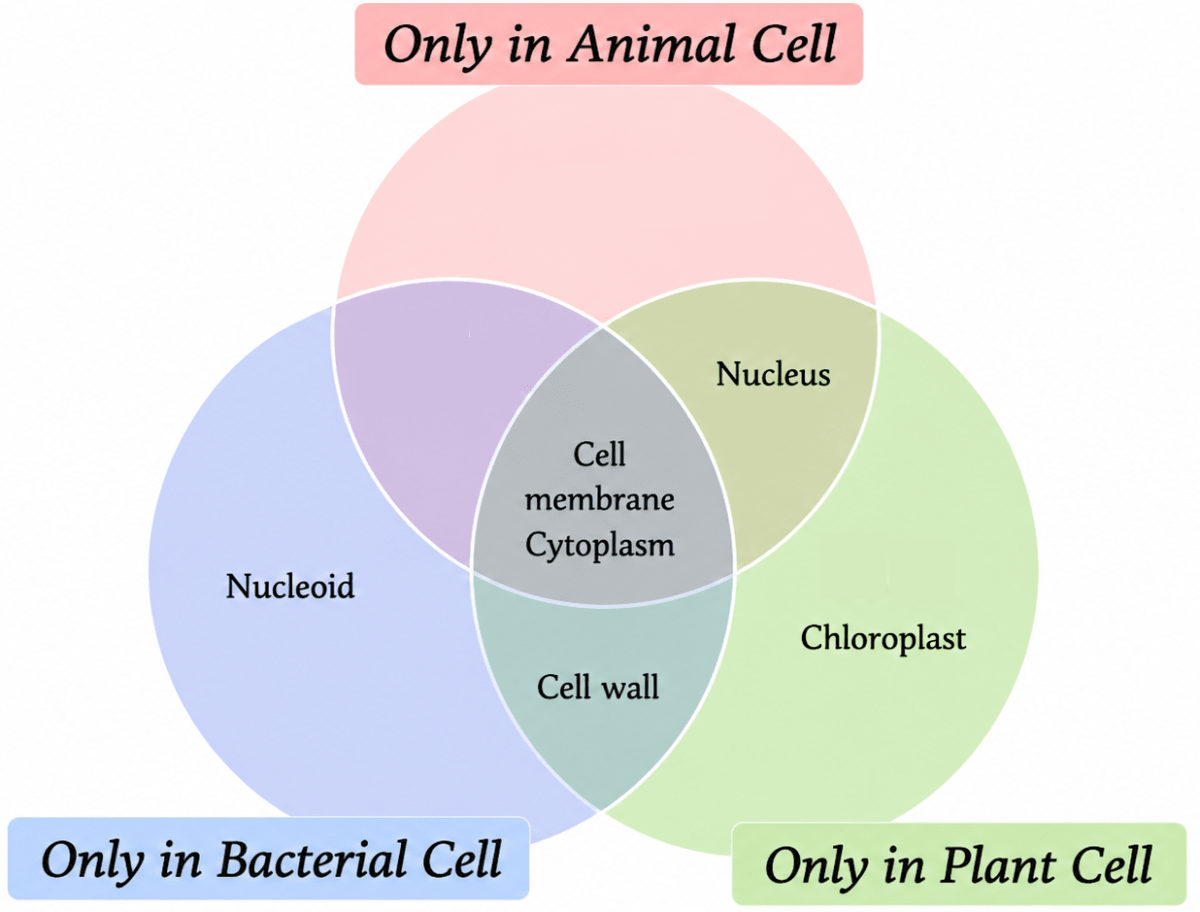
The completed diagram is shown below:
Aanandi took two test tubes and marked them A and B. She put two spoonfuls of sugar solution in each of the test tubes. In test tube B, she added a spoonful of yeast. Then she attached two incompletely inflated balloons to the mouth of each test tube. She kept the set-up in a warm place, away from sunlight.
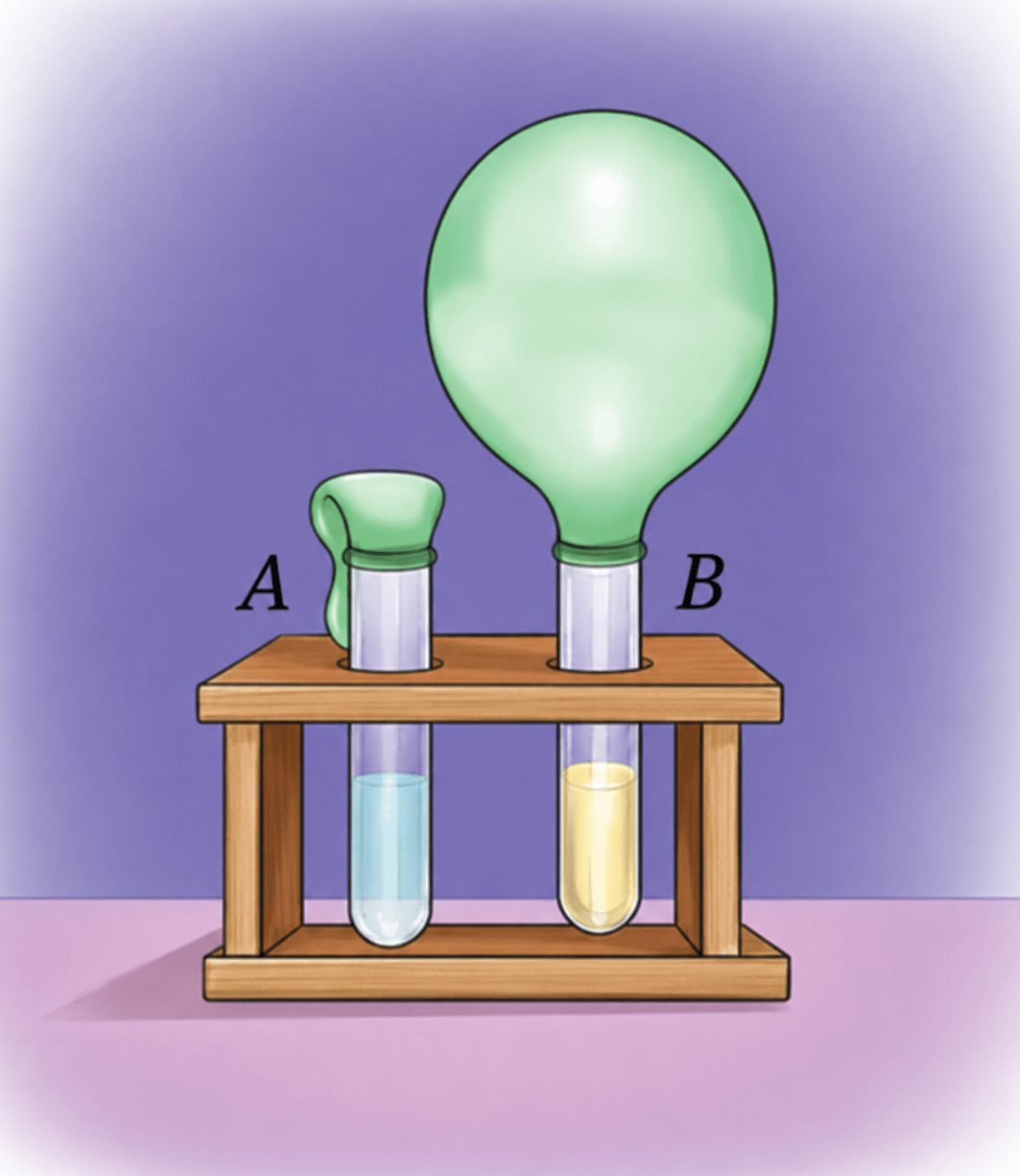
(i) What do you predict will happen after 3–4 hours? She observed that the balloon attached to test tube B was inflated. What can be a possible explanation for this?
- Water evaporated in test tube B and filled the balloon with the water vapour.
- The warm atmosphere expanded the air inside the test tube B, which inflated the balloon.
- Yeast produced a gas inside the test tube B which inflated the balloon.
- Sugar reacted with warm air, which produced gas, eventually inflating the balloon.
(ii) She took another test tube, 1/4 filled with lime water. She removed the balloon from test tube B in such a manner that the gas inside the balloon did not escape. She attached the balloon to the test tube with lime water and shook it well. What do you think she wants to find out?
Answer
(i) Yeast produced a gas inside the test tube B which inflated the balloon.
Reason — The yeast added to the sugar solution in test tube B grows and respires. During this process, it breaks down the sugar and releases carbon dioxide gas. This gas fills the balloon and inflates it. No yeast was added in test tube A, so no gas was produced and its balloon did not inflate.
(ii) Aanandi wants to identify the gas produced by yeast. When the gas collected in the balloon comes in contact with lime water, the lime water turns milky. This confirms that the gas released by yeast is carbon dioxide.
A farmer was planting wheat crops in his field. He added nitrogen-rich fertiliser to the soil to get a good yield of crops. In the neighbouring field, another farmer was growing bean crops, but she preferred not to add nitrogen fertiliser to get healthy crops. Can you think of the reasons?
Answer
Beans are legumes. The roots of legumes have swollen regions called root nodules which contain Rhizobium bacteria. These bacteria trap nitrogen from the air and make it useful for the plants. This naturally increases the nitrogen content of the soil, so the bean plants grow healthy without adding any nitrogen fertiliser.
Wheat is not a legume and does not have such nitrogen-fixing bacteria in its roots. Therefore, the farmer growing wheat had to add nitrogen-rich fertiliser to the soil to get a good yield.
Snehal dug two pits, A and B, in her garden. In pit A, she put fruit and vegetable peels and mixed it with dried leaves. In pit B, she dumped the same kind of waste without mixing it with dried leaves. She covered both the pits with soil and observed after 3 weeks. What is she trying to test?
Answer
Snehal is trying to test whether mixing dried leaves with fruit and vegetable waste affects the rate or extent of decomposition and manure formation. By comparing the contents of pits A and B after three weeks, she can observe whether the presence of dried leaves makes any difference to the decomposition of the waste by microorganisms.
Identify the following microorganisms:
- I live in every kind of environment, and inside your gut.
- I make bread and cakes soft and fluffy.
- I live in the roots of pulse crops and provide nutrients for their growth.
Answer
- Bacteria — They are found in every kind of environment and many bacteria live inside our gut, where they help in digestion.
- Yeast — It produces carbon dioxide during respiration, which makes bread and cakes soft and fluffy.
- Rhizobium — It lives in the root nodules of pulse (legume) crops and fixes nitrogen, providing nutrients for their growth.
Design an experiment to test that microorganisms need optimal temperature, air, and moisture for their growth.
Answer
The growth of bread mould can be used to test the conditions needed by microorganisms.
Take four identical slices of bread and place them in four clean, transparent containers labelled A, B, C, and D.
- Container A: Moisten the bread slightly and keep it in a warm place with access to air.
- Container B: Moisten the bread slightly and keep it in a refrigerator.
- Container C: Keep a dry slice of bread in a warm place with access to air.
- Container D: Moisten the bread slightly, place it in a small airtight container with as little air as possible, and keep it in a warm place.
Observe all four containers for three to four days without opening them.
The maximum visible mould growth is expected in container A because it has suitable warmth, moisture, and air. Little or no visible growth is expected in the other containers because one of these conditions is limited. This shows that bread mould grows best under suitable temperature, moisture, and air conditions.
Take 2 slices of bread. Place one slice in a plate near the sink. Place the other slice in the refrigerator. Compare after three days. Note your observations. Give reasons for your observations.
Answer
Observation: After three days, the slice of bread kept near the sink develops a powdery or cotton-like growth (mould) on it, while the slice kept in the refrigerator remains almost fresh without any such growth.
Reason — The warm and moist surroundings near the sink provide favourable conditions for the growth of mould. The low temperature inside the refrigerator slows the growth and multiplication of microorganisms. Therefore, the bread kept in the refrigerator spoils more slowly.
A student observes that when curd is left out for a day, it becomes more sour. What can be two possible explanations for this observation?
Answer
Two possible explanations are:
- Curd contains bacteria such as Lactobacillus. When the curd is left out, these bacteria keep multiplying and ferment the milk sugar to produce more lactic acid, which makes the curd more sour.
- The curd was left out in a warm place. Lactobacillus bacteria grow well in warm conditions, so they multiply rapidly and produce more lactic acid, increasing the sourness of the curd.
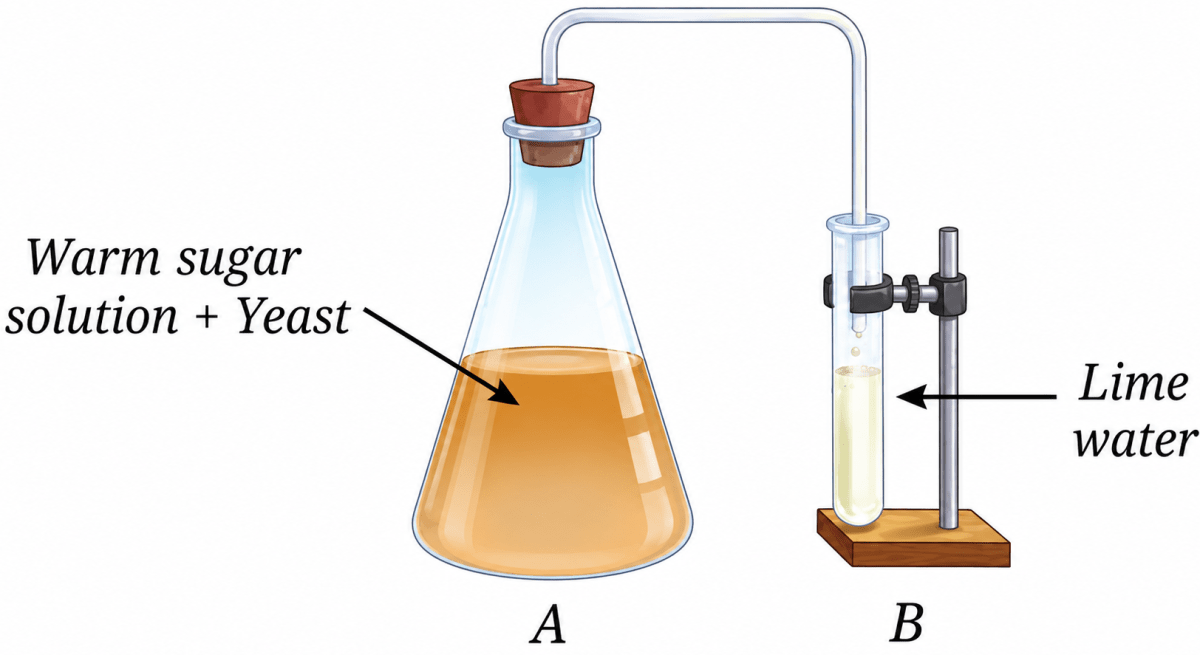
Observe the set-up given in the below figure and answer the following questions.
- What happens to the sugar solution in flask A?
- What do you observe in test tube B after four hours? Why do you think this happened?
- What would happen if yeast was not added in flask A?
Answer
- In flask A, the yeast present in the warm sugar solution grows and respires. It breaks down the sugar and produces carbon dioxide gas along with a small amount of alcohol. Bubbles of gas are formed in the solution.
- After four hours, the lime water in test tube B turns milky. This happens because the carbon dioxide gas produced by the yeast in flask A passes through the tube into the lime water. Carbon dioxide turns lime water milky, which confirms that the gas released by the yeast is carbon dioxide.
- If yeast was not added in flask A, no gas would be produced because there would be no microorganism to break down the sugar. As a result, no carbon dioxide would pass into test tube B, and the lime water would not turn milky.