
How does your body respond to an infection such as common cold?
Answer
When a pathogen like the common cold virus enters our body, our immune system responds to fight against it. The natural ability of our body to fight diseases is known as immunity, and this work is carried out by a special system called the immune system. As a result, we may show symptoms like nasal congestion and discharge, sore throat, fever, cough, and body ache while the body works to recover.
We rarely see cases of smallpox or polio these days, but diseases like diabetes and heart problems are more common. Why?
Answer
Diseases like smallpox and polio are communicable diseases that have been controlled through vaccination. In fact, smallpox has been completely eradicated worldwide through mass vaccination, and polio is prevented using vaccines.
On the other hand, diseases like diabetes and heart problems are non-communicable diseases linked to lifestyle, diet, and environmental factors. They have become more common because people are eating more processed food, getting less exercise and living longer lives.
Could climate change lead to new types of diseases?
Answer
Yes, climate change could lead to the spread of diseases. Changes in temperature, rainfall, and environment can increase the breeding of vectors like mosquitoes, which spread diseases such as malaria and dengue. For example, the arrival of the monsoon leads to an increase in malaria and dengue cases. Changing conditions may also affect the spread of pathogens and create favourable conditions for diseases to appear in new areas.
How do emotions like stress or worry affect us and make us sick?
Answer
Health is not only about the body; our feelings and relationships matter too. Even if we eat well and live in a clean place, we may not feel good if we are lonely or upset. Emotions like stress or worry can affect our mental well-being and lead to problems such as headaches, loss of sleep, weight loss, and difficulty in making friends. Since health means complete physical, mental, and social well-being, negative emotions can harm our overall health and make us feel unwell.
Why do some groups of people get affected more than others during disease outbreaks?
Answer
Some groups of people get affected more than others because of differences in their living conditions, immunity, and surroundings. People living in dirty, polluted, and unhygienic areas fall sick more often. Those with weaker immune systems are also less able to fight diseases. Factors like unsafe drinking water, poor sanitation, and lack of vaccination can make certain groups more likely to get infected during disease outbreaks.
Group the diseases shown in the images as communicable or non-communicable.
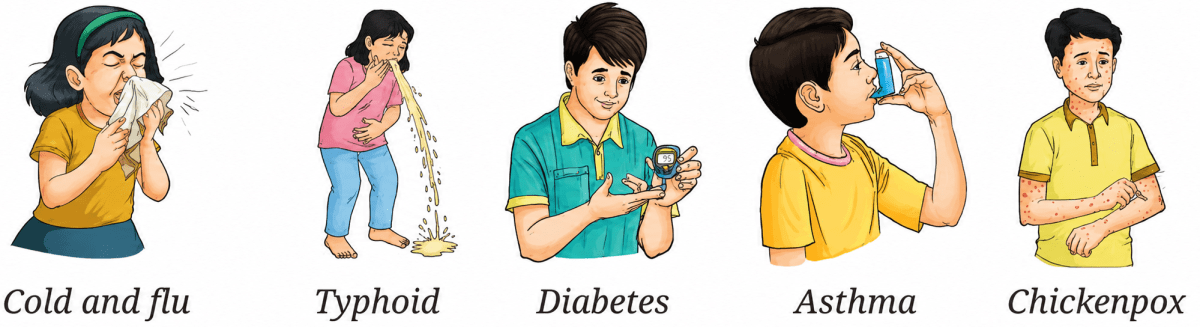
Answer
| Communicable diseases | Non-communicable diseases |
|---|---|
| Cold and flu | Diabetes |
| Typhoid | Asthma |
| Chickenpox |
Diseases can be broadly grouped into communicable and non-communicable diseases. From the options given below, identify the non-communicable diseases.
(i) Typhoid (ii) Asthma (iii) Diabetes (iv) Measles
- (i) and (ii)
- (ii) and (iii)
- (i) and (iv)
- (ii) and (iv)
Answer
(ii) and (iii)
Reason — Asthma and diabetes are non-communicable diseases as they are not caused by pathogens and do not spread from one person to another. They are linked to lifestyle, diet, and/or environment.
Typhoid and measles are communicable diseases caused by pathogens and can spread from one person to another.
There is a flu outbreak in your school. Several classmates are absent, while some are still coming to school coughing and sneezing.
- What immediate actions should the school take to prevent further spread?
- If your classmate, who shares the bench with you, starts showing symptoms of the flu, how can you respond in a considerate way without being rude or hurtful?
- How can you protect yourself and others from getting infected in this situation?
Answer
(i) The school should advise sick students to stay at home and rest until they recover. It should ask students to cover their mouth and nose while coughing or sneezing, wear masks, wash their hands frequently, and avoid sharing personal items. Keeping the classrooms and surroundings clean also helps.
(ii) I can politely suggest to my classmate that they should rest at home until they feel better, and offer to help them with the missed lessons. I can also gently advise them to cover their mouth and nose while coughing or sneezing so that others stay safe.
(iii) I can protect myself and others by washing my hands frequently, wearing a mask, covering my mouth and nose while coughing or sneezing, avoiding the sharing of personal items, and maintaining good hygiene. I should also maintain a reasonable distance from an infected person without behaving rudely or making the person feel excluded.
Your family is planning to travel to another city where malaria is prevalent.
- What precautions should you take before, during, and after the trip?
- How can you explain the importance of mosquito nets or repellents to your sibling?
- What could happen if travellers ignore health advisories in such areas?
Answer
(i) Before the trip — Find out about the disease, follow any health advisories, and carry mosquito repellents, nets, and long-sleeved clothes.
During the trip — Use mosquito nets and repellents, wear long-sleeved clothes, and avoid areas with still or stagnant water where mosquitoes breed.
After the trip — Watch for symptoms like high fever, chills, and sweating, and consult a doctor immediately if they appear.
(ii) I can explain to my sibling that malaria spreads through the bite of mosquitoes. Using mosquito nets and repellents stops mosquitoes from biting us, which protects us from getting infected. This is a simple but important way to stay safe.
(iii) If travellers ignore health advisories, they may get bitten by infected mosquitoes and catch malaria. This can lead to high fever, profuse sweating, and periodic chills and may lead to serious illness.
Your uncle has started smoking just to fit in with his friends, even though it is well known that smoking can seriously harm health and even cause death.
- What would you say to him to make him stop, without being rude?
- What would you do if your friend offers you a cigarette at a party?
- How can schools help prevent students from indulging in such harmful habits?
Answer
(i) I would gently tell my uncle that smoking is a harmful habit that can seriously damage health and even cause death. I would explain that we should say 'NO' to harmful substances like tobacco, and that there is no need to take up such a habit just to fit in with friends.
(ii) I would politely refuse the cigarette and say 'NO'. I would explain that smoking is harmful to health and that I do not wish to start such a habit.
(iii) Schools can help by creating awareness about the harmful effects of tobacco, alcohol, and addictive drugs. They can organise health campaigns, encourage students to adopt a healthy lifestyle, and teach them to say 'NO' to harmful substances.
Saniya claims to her friend Vinita that "Antibiotics can cure any infection, so we don't need to worry about diseases." What question(s) can Vinita ask her to help Saniya understand that her statement is incorrect?
Answer
Vinita can ask Saniya the following questions:
- Do antibiotics work against diseases caused by viruses, such as the common cold and flu?
- Do antibiotics work against diseases caused by protozoa, like malaria?
- What happens if antibiotics are used unnecessarily or incorrectly?
These questions help Saniya understand that antibiotics work only against bacterial infections and do not work against viruses or protozoa. Also, the indiscriminate use of antibiotics leads to antibiotic resistance, which makes infections harder to treat. So, her statement is incorrect.
The following table contains information about the number of dengue cases reported in a hospital over a period of one year:
| S. No. | Month | No. of dengue cases |
|---|---|---|
| 1 | January | 10 |
| 2 | February | 12 |
| 3 | March | 15 |
| 4 | April | 18 |
| 5 | May | 22 |
| 6 | June | 40 |
| 7 | July | 65 |
| 8 | August | 65 |
| 9 | September | 65 |
| 10 | October | 30 |
| 11 | November | 30 |
| 12 | December | 20 |
Make a bar graph of the number of cases on the Y-axis and the month on the X-axis. Critically analyse your findings and answer the following:
- In which three months were the dengue cases highest?
- In which month(s) were the cases lowest?
- What natural or environmental factors during the peak months might contribute to the increase in dengue cases?
- Suggest a few preventive steps that the community or government can take before the peak season to reduce the spread of dengue.
Answer
The bar graph is shown below:
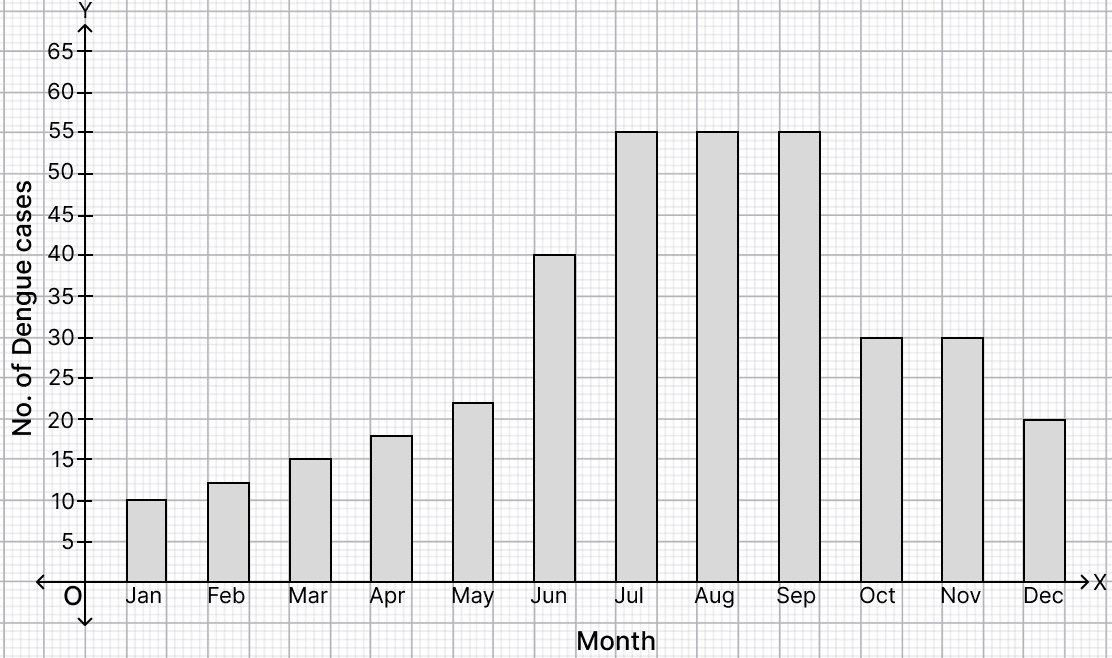
(i) The dengue cases were highest in the months of July, August, and September, with 65 cases each.
(ii) The cases were lowest in the month of January, with 10 cases.
(iii) The peak months (July, August, and September) fall during the monsoon season. Rainfall leads to collection of stagnant water in many places, which provides breeding grounds for mosquitoes. Since the arrival of the monsoon leads to an increase in mosquito breeding, the number of dengue cases also rises during these months.
(iv) Some preventive steps are:
- Avoiding the collection of stagnant water in coolers, pots, buckets, and other containers.
- Carrying out anti-mosquito drives and spraying approved insecticides to control mosquito breeding.
- Using mosquito nets and repellents and wearing long-sleeved clothes.
- Keeping the surroundings clean and creating awareness in the community.
Imagine you are in charge of a school health campaign. What key messages would you use to reduce communicable and non-communicable diseases?
Answer
The key messages for the school health campaign would be:
To reduce communicable diseases:
- Wash your hands frequently with soap and water.
- Cover your mouth and nose while coughing or sneezing, and wear a mask in crowded places.
- Do not share personal items like towels and handkerchiefs.
- Keep yourself, your home, food, and water clean.
- Get vaccinated and stay at home and rest when unwell.
To reduce non-communicable diseases:
- Eat a balanced diet with plenty of fruits, vegetables, and whole grains, and avoid processed, fatty, or sugary food.
- Stay physically active and exercise regularly.
- Get enough sleep and manage stress through yoga and meditation.
- Say 'NO' to harmful substances like tobacco, alcohol, and addictive drugs.
It is recommended that we should not take an antibiotic for a viral infection like a cold, a cough, or flu. Can you provide the possible reason for this recommendation?
Answer
Antibiotics work only against bacterial infections because they act on parts of bacterial cells. They do not work against viruses. Therefore, antibiotics cannot cure viral illnesses such as the common cold or influenza. A cough can have different causes, so antibiotics should be taken only when prescribed by a doctor. Unnecessary use of antibiotics can lead to antibiotic resistance, making bacterial infections harder to treat in the future.
Which disease(s) among the following may spread if drinking water gets contaminated by the excreta from an infected person?
Hepatitis A, Tuberculosis, Poliomyelitis, Cholera, Chickenpox.
Answer
The diseases that may spread through drinking water contaminated by the excreta of an infected person are Hepatitis A, Poliomyelitis, and Cholera.
Reason — These diseases spread through contaminated water and food. Tuberculosis and chickenpox spread through the air and not through contaminated drinking water.
When our body encounters a pathogen for the first time, the immune response is generally low but on exposure to the same pathogen again, the immune response by the body is much more compared to the first exposure. Why is it so?
Answer
When our body encounters a pathogen for the first time, the immune system takes time to recognise it and fight against it, so the immune response is low. During this process, the immune system learns to recognise the pathogen. When the body is exposed to the same pathogen again, the immune system already recognises it and attacks it quickly and strongly. This is the basis of acquired immunity, which is also the way vaccines protect us by training the immune system in advance.