
If we don’t have an electric lamp while making an electric circuit with an electric cell, is there any other way through which we can find out if current is flowing in the circuit?
Answer
Yes, we can use a magnetic compass to find out whether current is flowing in the circuit. When current flows through a wire, it produces a magnetic field around it. If a magnetic compass is placed near or below the wire, its needle gets deflected. This deflection indicates that electric current is flowing through the circuit.
Is it possible to make temporary magnets? How can these be made?
Answer
Yes, it is possible to make temporary magnets. A temporary magnet can be made by tightly winding an insulated wire in the form of a coil around an iron nail (core) and passing electric current through it. Such a current carrying coil is called an electromagnet. It behaves like a magnet only as long as the current flows, and loses its magnetic effect when the current is stopped.
We can generate heat by burning fossil fuels and wood; but how is heat generated in various electrical appliances?
Answer
Heat is generated in electrical appliances due to the heating effect of electric current. When electric current flows through a conductor, it faces resistance to its flow. This resistance causes some of the electrical energy to be converted into heat energy, and the conductor gets heated. Appliances like heaters and irons contain a rod or coil of wire, called a heating element, that produces heat in this way.
How do we know if a cell or a battery is dead? Can all cells and batteries be recharged?
Answer
A cell or battery is said to be dead when the chemicals inside it get used up, so it can no longer supply electricity. We come to know it is dead when the device connected to it stops working.
No, all cells and batteries cannot be recharged. Single-use cells like dry cells have to be disposed of once used up. However, rechargeable batteries can be recharged and reused multiple times.
Fill in the blanks:
(i) The solution used in a Voltaic cell is called ............... .
(ii) A current carrying coil behaves like a ............... .
Answer
(i) The solution used in a Voltaic cell is called electrolyte.
(ii) A current carrying coil behaves like a magnet.
Choose the correct option:
(i) Dry cells are less portable compared to Voltaic cells. (True/False)
(ii) A coil becomes an electromagnet only when electric current flows through it. (True/False)
(iii) An electromagnet, using a single cell, attracts more iron paper clips than the same electromagnet with a battery of 2 cells. (True/False)
Answer
(i) False
Reason — A Voltaic cell uses a liquid electrolyte, whereas a dry cell uses a moist paste as electrolyte. Hence, dry cells are more portable and convenient than Voltaic cells.
(ii) True
Reason — A coil behaves like a magnet only when electric current flows through it. When the current stops, it loses its magnetic effect.
(iii) False
Reason — A battery of 2 cells gives a larger current than a single cell. This creates a stronger magnetic field, so the electromagnet with 2 cells attracts more iron paper clips than the one with a single cell.
An electric current flows through a nichrome wire for a short time.
(i) The wire becomes warm.
(ii) A magnetic compass placed below the wire is deflected.
Choose the correct option:
- Only (i) is correct
- Only (ii) is correct
- Both (i) and (ii) are correct
- Both (i) and (ii) are not correct
Answer
Both (i) and (ii) are correct
Reason — When current flows through the nichrome wire, it gets warm due to the heating effect of electric current. At the same time, the current produces a magnetic field around the wire, which deflects the magnetic compass placed below it. Hence, both effects occur together.
Match the items in Column A with those in Column B.
| Column A | Column B |
|---|---|
| (i) Voltaic cell | (a) Best suited for electric heater |
| (ii) Electric iron | (b) Works on magnetic effect of electric current |
| (iii) Nichrome wire | (c) Works on heating effect of electric current |
| (iv) Electromagnet | (d) Generates electricity by chemical reactions |
Answer
| Column A | Column B |
|---|---|
| (i) Voltaic cell | (d) Generates electricity by chemical reactions |
| (ii) Electric iron | (c) Works on heating effect of electric current |
| (iii) Nichrome wire | (a) Best suited for electric heater |
| (iv) Electromagnet | (b) Works on magnetic effect of electric current |
Nichrome wire is commonly used in electrical heating devices because it
- is a good conductor of electricity.
- generates more heat for a given current.
- is cheaper than copper.
- is an insulator of electricity.
Answer
generates more heat for a given current.
Reason — Nichrome wire offers higher resistance compared to a copper wire of the same size and length. Due to this higher resistance, more electrical energy is converted into heat, so it generates more heat for a given current.
Electric heating devices (like an electric heater or a stove) are often considered more convenient than traditional heating methods (like burning firewood or charcoal). Give reason(s) to support this statement considering societal impact.
Answer
Electric heating devices are considered more convenient because:
- They do not produce smoke, soot, or harmful gases, so they keep the surroundings clean and do not cause indoor air pollution that can harm our health.
- They can be switched ON and OFF easily and the heat can be controlled, which saves time and effort.
- They do not require collecting, storing, or burning firewood or charcoal, which reduces the cutting of trees and helps protect the environment.
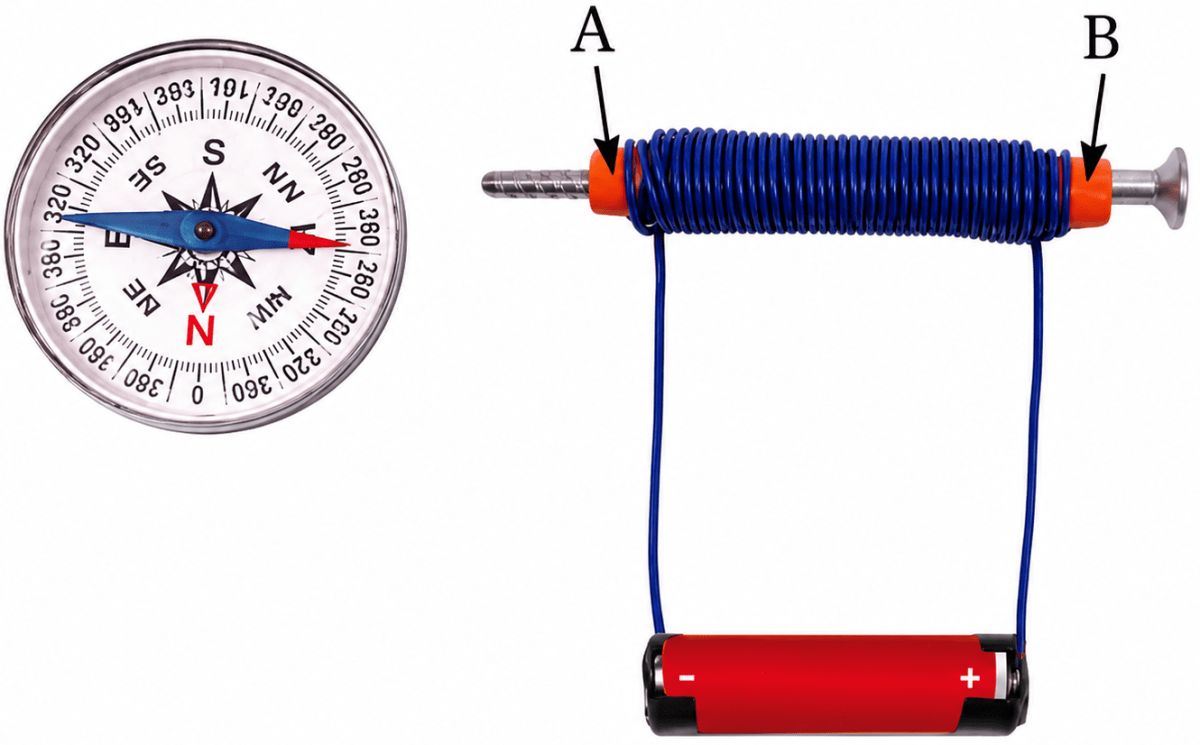
Look at Fig. 4.4a. If the compass placed near the coil deflects: (i) Draw an arrow on the diagram to show the path of the electric current. (ii) Explain why the compass needle moves when current flows. (iii) Predict what would happen to the deflection if you reverse the battery terminals.
Answer
(i) The arrow showing the path of the electric current is drawn from the positive terminal of the cell through the coil and back to the negative terminal.
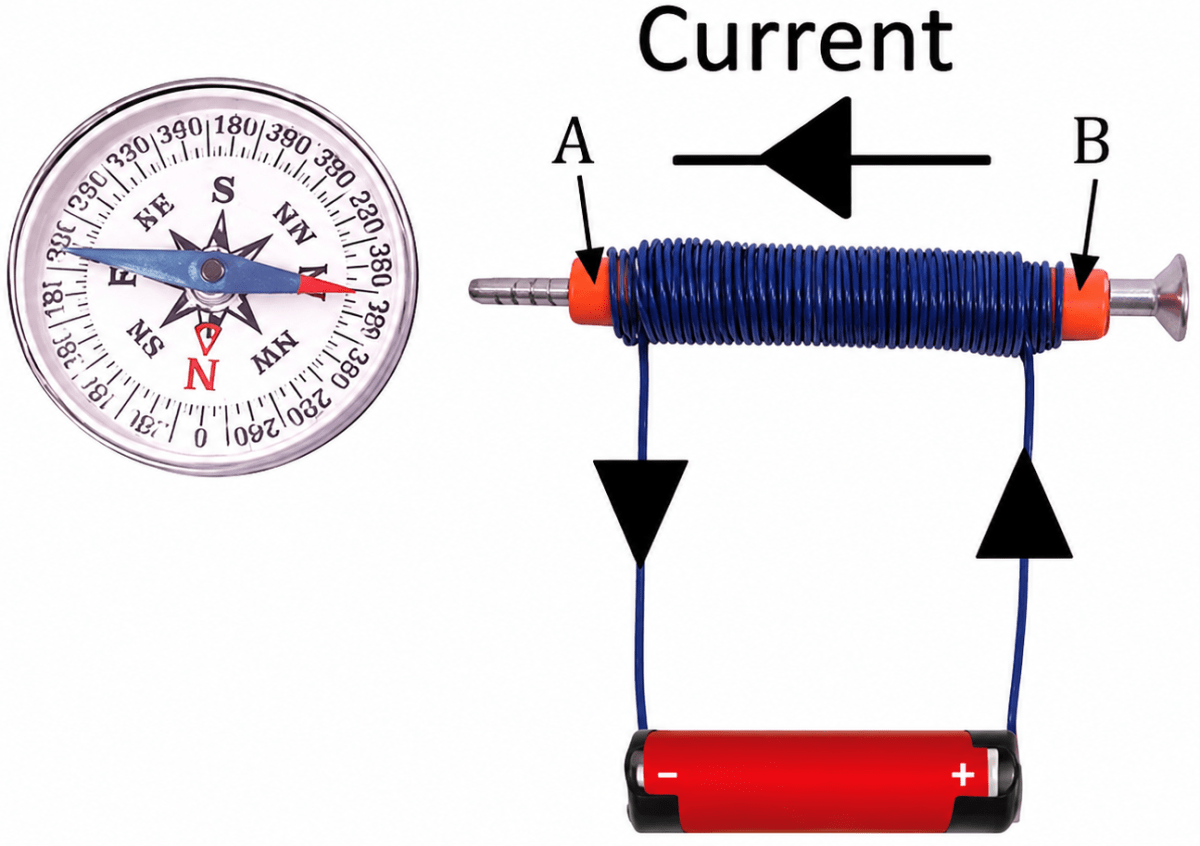
(ii) The compass needle moves because the current flowing through the coil produces a magnetic field around it. The coil behaves like a magnet, and this magnetic effect of the electric current deflects the magnetic compass needle.
(iii) If the battery terminals are reversed, the direction of the current reverses. This reverses the polarity (poles) of the electromagnet. As a result, the compass needle deflects in the opposite direction.
Suppose Sumana forgets to move the switch of her lifting electromagnet model to OFF position (in introduction story). After some time, the iron nail no longer picks up the iron paper clips, but the wire wrapped around the iron nail is still warm. Why did the lifting electromagnet stop lifting the clips? Give possible reasons.
Answer
The lifting electromagnet stopped lifting the clips because of the following possible reasons:
- Since the switch was left ON for a long time, the cell got weak as its chemicals were used up. The current reduced greatly, so the magnetic field became too weak to lift the iron paper clips.
- The small current that still flows through the coil keeps producing some heat due to the heating effect of electric current, which is why the wire is still warm, even though the magnetic effect is now too weak to attract the clips.
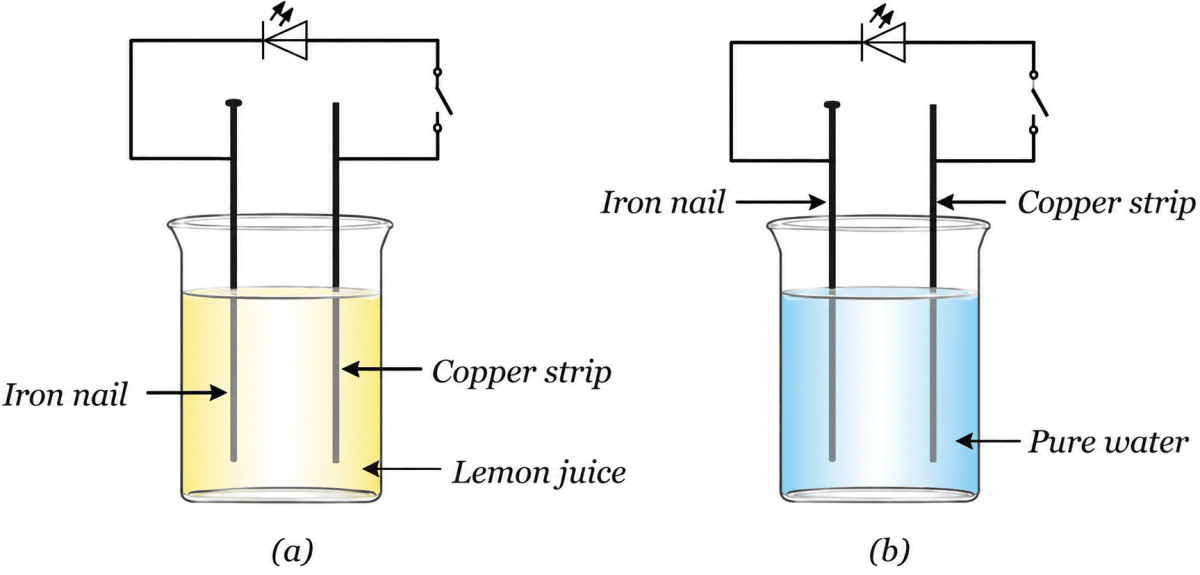
In Fig. 4.12, in which case the LED will glow when the switch is closed?
Answer
The LED will glow in case (a), where the beaker contains lemon juice.
Reason — Lemon juice acts as an electrolyte and conducts electricity, so it forms a Voltaic cell with the copper strip and iron nail, allowing current to flow and making the LED glow. Pure water in case (b) is not an electrolyte and does not conduct electricity, so the LED does not glow.
Neha keeps the coil exactly the same as in Activity 4.4 but slides the iron nail out, leaving only the coiled wire. Will the coil still deflect the compass? If yes, will the deflection be more or less than before?
Answer
Yes, the coil will still deflect the compass needle, because a current carrying coil itself produces a magnetic field and behaves like a magnet.
However, the deflection will be less than before. This is because the iron nail (core) makes the electromagnet stronger. Without the iron core, the magnetic field of the coil becomes weaker, so the deflection of the compass needle is less.
We have four coils, of similar shape and size, made up from iron, copper, aluminium, and nichrome as shown in the Fig. 4.13.
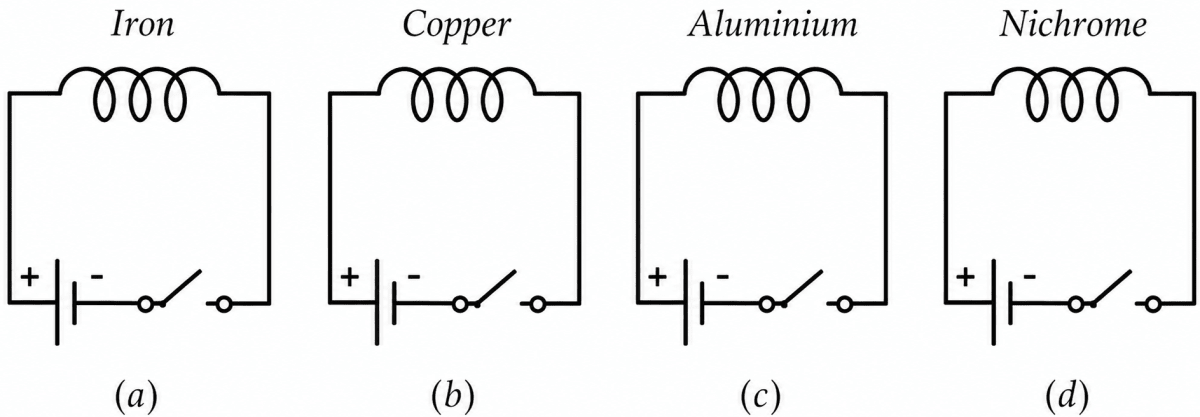
When current is passed through the coils, compass needles placed near the coils will show deflection.
- Only in circuit (a)
- Only in circuits (a) and (b)
- Only in circuits (a), (b), and (c)
- In all four circuits
Answer
In all four circuits
Reason — Iron, copper, aluminium, and nichrome are all conductors. When current flows through any current carrying conductor, it produces a magnetic field around it. Therefore, the compass needle will show deflection in all four circuits.