
Why does it feel harder to pedal a bicycle when going uphill than on flat ground?
Answer
While going uphill, the gravitational force of the Earth acts vertically downward on the bicycle and the rider. A part of this force acts down the slope and opposes the upward motion. To move up the slope, we have to apply extra muscular force through pedalling. On flat ground, there is no such opposing pull along the path, so pedalling feels easier.
Why is it easier to slip on a wet surface?
Answer
The force of friction between our feet and the ground stops us from slipping. A wet surface reduces the friction between our feet and the ground. Due to this reduced friction, our feet cannot grip the surface properly, and hence we slip easily.
Why do we feel ‘light’ or like we are ‘floating’ just after our swing reaches its highest point and begins to come down?
Answer
As the swing reaches its highest point and begins to come down, we start moving downwards under the influence of the gravitational force of the Earth. Since we move down along with this downward pull, the seat presses against us much less than usual. Due to this reduced push from the seat, we feel ‘light’ or as if we are ‘floating’.
Match items in Column A with the items in Column B.
| Column A (Type of force) | Column B (Example) |
|---|---|
| (i) Muscular force | (a) A cricket ball stopping on its own just before touching the boundary line |
| (ii) Magnetic force | (b) A child lifting a school bag |
| (iii) Frictional force | (c) A fruit falling from a tree |
| (iv) Gravitational force | (d) Balloon rubbed on woollen cloth attracting hair strands |
| (v) Electrostatic force | (e) A compass needle pointing North |
Answer
| Column A (Type of force) | Column B (Example) |
|---|---|
| (i) Muscular force | (b) A child lifting a school bag |
| (ii) Magnetic force | (e) A compass needle pointing North |
| (iii) Frictional force | (a) A cricket ball stopping on its own just before touching the boundary line |
| (iv) Gravitational force | (c) A fruit falling from a tree |
| (v) Electrostatic force | (d) Balloon rubbed on woollen cloth attracting hair strands |
State whether the following statements are True or False.
(i) A force is always required to change the speed of motion of an object.
(ii) Due to friction, the speed of the ball rolling on a flat ground increases.
(iii) There is no force between two charged objects placed at a small distance apart.
Answer
(i) True — A force is essential to change the speed of an object, whether to increase it or decrease it.
(ii) False — Friction always acts opposite to the direction of motion. So it decreases the speed of the ball, and does not increase it.
(iii) False — Charged objects exert an electrostatic force on each other even when they are not in contact, as it is a non-contact force.
Two balloons rubbed with a woollen cloth are brought near each other. What would happen and why?
Answer
The two balloons move away from each other, that is, they repel each other.
Reason — When both balloons are rubbed with the same woollen cloth, they acquire the same (like) kind of charge. Since similar (like) charges repel each other, the two balloons push away from each other.
When you drop a coin in a glass of water, it sinks, but when you place a bigger wooden block in water, it floats. Explain.
Answer
When an object is placed in water, the gravitational force of the Earth (its weight) acts on it downwards, while the buoyant force (upthrust) of water acts on it upwards.
In the case of the coin, the gravitational force on it is more than the buoyant force applied by the water. Hence, the coin sinks. In the case of the wooden block, the buoyant force is equal to its weight. Hence, the wooden block floats, even though it is bigger.
If a ball is thrown upwards, it slows down, stops momentarily, and then falls back to the ground. Name the forces acting on the ball and specify their directions.
(i) During its upward motion
(ii) During its downward motion
(iii) At its topmost position
Answer
(i) During its upward motion — Two forces act downwards: the gravitational force (acting downwards) and the frictional force of air (acting downwards, opposite to the upward motion). Both slow the ball down.
(ii) During its downward motion — The gravitational force acts downwards, while the frictional force of air acts upwards (opposite to the downward motion).
(iii) At its topmost position — The ball is momentarily at rest. At that instant, the frictional force of air is negligible/zero, and the gravitational force acts on it in the downward direction.
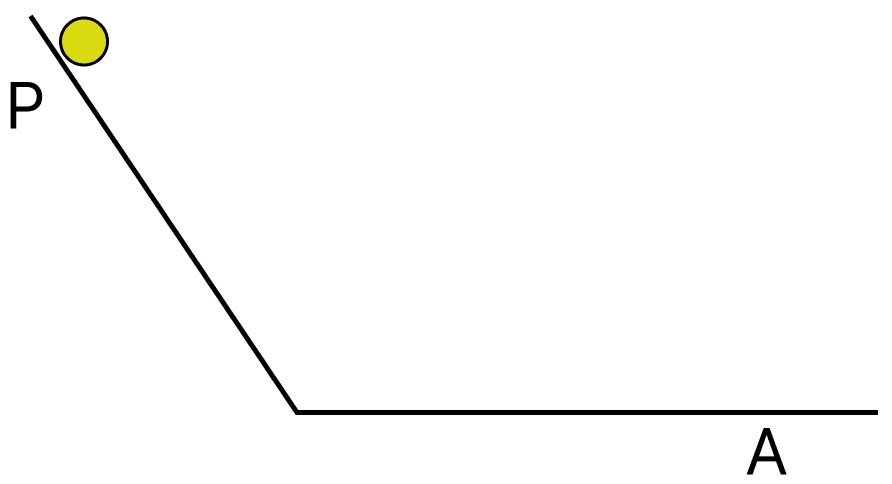
A ball is released from the point P and moves along an inclined plane and then along a horizontal surface as shown in the Fig. 5.16. It comes to stop at the point A on the horizontal surface. Think of a way so that when the ball is released from the same point P, it stops (i) before the point A (ii) after crossing the point A.
Answer
The ball comes to a stop because of the force of friction acting on it, which depends on the nature of the surface in contact.
(i) To stop before the point A — Make the horizontal surface rougher (for example, by spreading sand or cloth on it). A rougher surface increases the force of friction, so the ball stops sooner, before reaching A.
(ii) To stop after crossing the point A — Make the horizontal surface smoother (for example, a polished or glass surface). A smoother surface reduces the force of friction, so the ball travels a longer distance and stops after crossing A.
Why do we sometimes slip on smooth surfaces like ice or polished floors? Explain.
Answer
Smooth surfaces like ice or polished floors have very little friction. Friction is needed for our feet to grip the surface while walking. On such smooth surfaces, the force of friction between our feet and the surface is very small, so our feet are unable to grip properly. As a result, we slip.
Is any force being applied to an object in a non-uniform motion?
Answer
Yes, a force is being applied to the object. In non-uniform motion, the speed or the direction of motion of the object keeps changing. Since a force is essential to bring about a change in the speed or the direction of motion, an unbalanced force must be acting on the object.
The weight of an object on the Moon becomes one-sixth of its weight on the Earth. What causes this change? Does the mass of the object also become one-sixth of its mass on the Earth?
Answer
The weight of an object is the gravitational force with which a planet (or the Moon) pulls it towards itself. The gravitational pull of the Moon is one-sixth of that of the Earth. This is what causes the weight of the object to become one-sixth on the Moon.
No, the mass of the object does not become one-sixth. Mass is the amount of matter in an object, and its value remains the same at every place. So the mass stays unchanged, while only the weight changes.
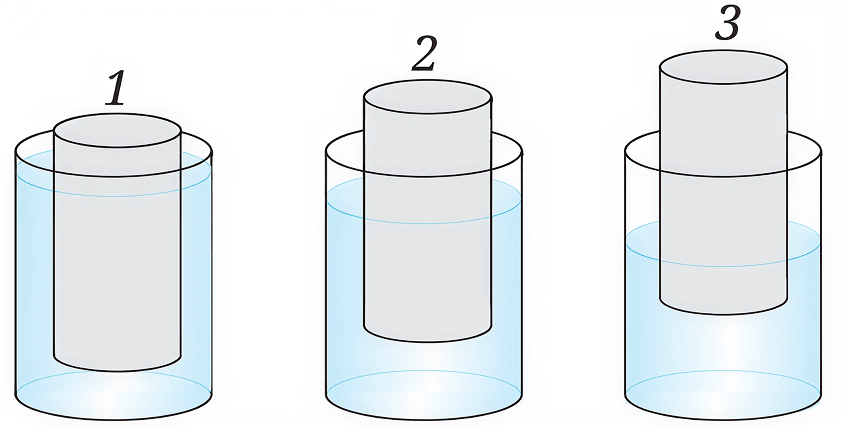
Three objects 1, 2, and 3 of the same size and shape but made of different materials are placed in the water. They dip to different depths as shown in Fig. 5.17. If the weights of the three objects 1, 2, and 3 are w1, w2, and w3, respectively, then
w1 = w2 = w3
w1 > w2 > w3
w2 > w3 > w1
w3 > w1 > w2
Answer
w1 > w2 > w3
Reason — The objects are of the same size and shape and are floating at different depths. A floating object displaces enough water so that the buoyant force balances its weight. The object that dips deeper displaces more water and therefore has a greater weight. As shown in the figure, object 1 dips the most and object 3 dips the least. Hence, w1 > w2 > w3.