
Why are winds stronger on some days than on others?
Answer
Winds are caused by differences in air pressure, as air moves from a region of higher pressure to a region of lower pressure. The greater the difference in air pressure between two regions, the higher is the speed of the air flowing between them. So, on days when the pressure difference is large, the winds blow stronger, while on days when the pressure difference is small, the winds are calmer.
Why are water tanks usually placed at a height?
Answer
The pressure exerted by a liquid in a vessel depends on the height of its column. The greater the height of the water column, the greater is the pressure at the bottom. Water tanks are placed at a height so that the pressure of water in the taps is increased, which results in a good, strong stream of water from the taps.
Can air pressure really crush us?
Answer
No, air pressure does not crush us under normal conditions.
The air around us exerts pressure on our body from all directions. However, the air and fluids inside our body exert an equal pressure outward. These two pressures balance each other.
Therefore, we do not feel the atmospheric pressure and are not crushed by it.
What causes storms and cyclones? If the Earth stopped rotating, would cyclones still form?
Answer
When land or ocean water gets heated, the warm and moist air rises, creating a low pressure area. Cooler air from the surrounding high pressure regions rushes in to take its place, setting up wind circulation. The rising air cools, its moisture condenses to form clouds, and strong winds accompanied by rain form a storm. Over warm ocean waters, the heat released during condensation warms the air further, creating an even lower pressure. More air rushes in, and the Earth’s rotation makes the moving air spin, forming a cyclone.
If the Earth stopped rotating, the moving air would not be set into a spin. Since the spinning of winds around the low pressure centre is essential for a cyclone, cyclones would not form in their usual spinning form.
Choose the correct statement.
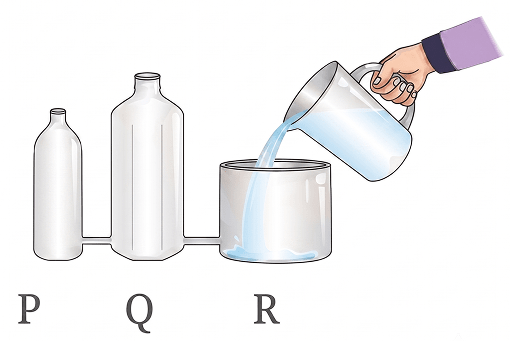
Look at the Fig. 6.21 carefully. Vessel R is filled with water. When pouring of water is stopped, the level of water will be ............... .
- the highest in vessel P
- the highest in vessel Q
- the highest in vessel R
- equal in all three vessels
Answer
equal in all three vessels
Reason — The three vessels are joined together. The pressure exerted by a liquid depends only on the height of its column, not on the shape or size of the vessel. So the water settles at the same level in all three vessels.
Choose the correct statement.
A rubber sucker (M) is pressed on a flat smooth surface and an identical sucker (N) is pressed on a rough surface.
- Both M and N will stick to their surfaces.
- Both M and N will not stick to their surfaces.
- M will stick but N will not stick.
- M will not stick but N will stick.
Answer
M will stick but N will not stick.
Reason — When a sucker is pressed, most of the air between its cup and the surface is pushed out, reducing the pressure inside it. The higher atmospheric pressure outside then holds it in place. On a smooth surface, the air stays pushed out, so sucker M sticks. On a rough surface, air leaks in through the gaps, so the pressure inside is not reduced and sucker N does not stick.
Choose the correct statement.
A water tank is placed on the roof of a building at a height ‘H’. To get water with more pressure on the ground floor, one has to ............... .
- increase the height ‘H’ at which the tank is placed.
- decrease the height ‘H’ at which the tank is placed.
- replace the tank with another tank of the same height that can hold more water.
- replace the tank with another tank of the same height that can hold less water.
Answer
increase the height ‘H’ at which the tank is placed.
Reason — The pressure exerted by a liquid depends on the height of its column. Increasing the height ‘H’ increases the height of the water column, and hence the water reaches the ground floor with greater pressure.
Choose the correct statement.
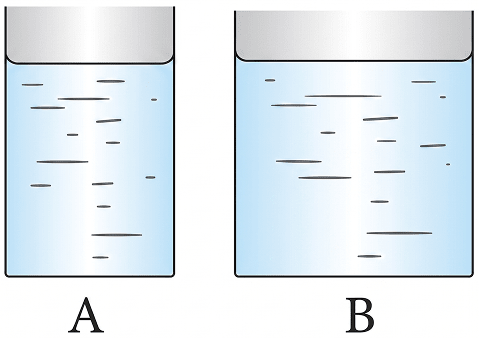
Two vessels, A and B contain water up to the same level as shown in Fig. 6.22. PA and PB are the pressures at the bottom of the vessels. FA and FB are the forces exerted by the water at the bottom of the vessels A and B.
- PA = PB, FA = FB
- PA = PB, FA < FB
- PA < PB, FA = FB
- PA > PB, FA > FB
Answer
PA = PB, FA < FB
Reason — Liquid pressure depends only on the height of the water column, which is the same in both vessels, so PA = PB. Since force is pressure multiplied by area, and vessel B has a larger base area than vessel A, the force at the bottom of B is greater. Hence FA < FB.
State whether the following statements are True [T] or False [F].
(i) Air flows from a region of higher pressure to a region of lower pressure.
(ii) Liquids exert pressure only at the bottom of a container.
(iii) Weather is stormy at the eye of a cyclone.
(iv) During a thunderstorm, it is safer to be in a car.
Answer
(i) True
(ii) False
Corrected Statement — Liquids exert pressure not only at the bottom but also on the sides of a container. In fact, liquids exert pressure in all directions.
(iii) False
Corrected Statement — The eye of a cyclone is the region of lowest pressure at its centre, where the wind is calm. The strong winds and heavy rainfall occur in the region surrounding the eye.
(iv) True
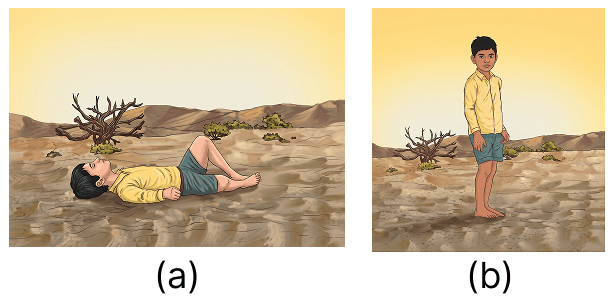
Fig. 6.23 a shows a boy lying horizontally, and Fig. 6.23 b shows the boy standing vertically on a loose sand bed. In which case does the boy sink more in sand? Give reasons.
Answer
The boy sinks more in the sand when he is standing vertically (Fig. 6.23 b).
Reason — Pressure is the force acting per unit area. When the boy stands, his weight acts on the small area of his feet, so the pressure on the sand is high and he sinks more. When he lies down, his weight is spread over the large area of his body, so the pressure on the sand is low and he sinks less.
An elephant stands on four feet. If the area covered by one foot is 0.25 m2, calculate the pressure exerted by the elephant on the ground if its weight is 20000 N.
Answer
Total area covered by four feet = 4 × 0.25 m2 = 1 m2
Weight (force) of the elephant = 20000 N
Pressure = = 20000 N/m2
So, the pressure exerted by the elephant on the ground is 20000 N/m2 (20000 Pa).
There are two boats, A and B. Boat A has a base area of 7 m2, and 5 persons are seated in it. Boat B has a base area of 3.5 m2, and 3 persons are seated in it. If each person has a weight of 700 N, find out which boat will experience more pressure on its base and by how much?
Answer
For boat A:
Total weight (force) = 5 × 700 N = 3500 N
Pressure on base of A = = 500 N/m2
For boat B:
Total weight (force) = 3 × 700 N = 2100 N
Pressure on base of B = = 600 N/m2
Boat B experiences more pressure on its base.
Difference in pressure = 600 N/m2 − 500 N/m2 = 100 N/m2
So, boat B experiences more pressure than boat A by 100 N/m2 (100 Pa).
Would lightning occur if air and clouds were good conductors of electricity? Give reasons for your answer.
Answer
No, lightning would not occur if air and clouds were good conductors of electricity.
Reason — Lightning happens because air normally acts as an electrical insulator and does not allow opposite charges to meet. The charges keep building up in the clouds until the buildup becomes very large, and then the insulating property of air breaks down, causing a sudden flow of charges seen as lightning. If air and clouds were good conductors, the charges would flow away continuously and would never build up to a large amount. So no sudden discharge, and hence no lightning, would take place.
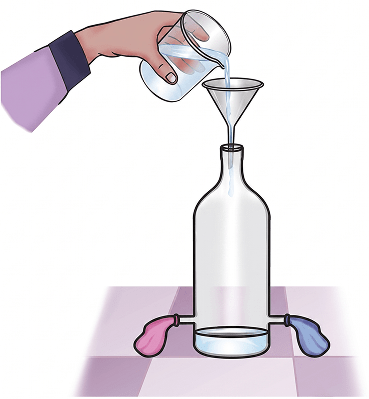
What will happen to the two identical balloons A and B as shown in Fig. 6.24 when water is filled into the bottle up to a certain height? Will both the balloons bulge? If yes, will they bulge equally? Explain your answer.
Answer
Yes, both the balloons A and B will bulge, provided the water level is above the openings connected to both balloons.
This happens because the water column exerts pressure on the balloons. Since liquids exert pressure in all directions, the water pushes against both balloons and makes them bulge. As both balloons are placed at the same height, the height of the water column above each of them is the same. Therefore, the pressure on both balloons is equal, and they bulge equally.
Explain how a storm becomes a cyclone.
Answer
A storm can develop into a cyclone over warm ocean waters in the following way:
- As the ocean water gets heated, the warm and moist air above it rises, and the water vapour in it condenses to form raindrops.
- During this condensation, heat is released back into the atmosphere. This further warms the rising air, making it rise even higher and creating an even lower pressure region.
- Air from the surrounding regions rushes in to fill this low pressure area and also begins to rise.
- The Earth’s rotation causes the moving air to spin around the low pressure centre.
- This cycle keeps repeating, forming a very low pressure area with high-speed winds revolving around it. This spinning system of clouds, winds, and rain is called a cyclone.
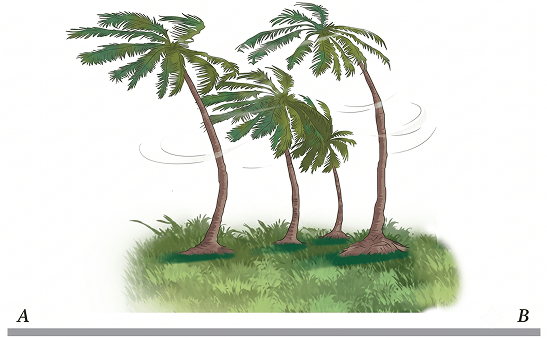
Fig. 6.25 shows trees along the sea coast in a summer afternoon. Identify which side is land— A or B. Explain your answer.
Answer
Side A is the land, and side B is the sea.
Reason — During a summer afternoon, the land gets heated faster than the sea. The warm air over the land rises, creating a low pressure area, and cooler air from over the sea (a high pressure region) blows towards the land. This is the sea breeze. Trees bend in the direction in which the wind blows. As the trees are bent towards side A, the wind is blowing from B to A. Since the breeze blows from the sea towards the land in the afternoon, side B is the sea and side A is the land.
Describe an activity to show that air flows from a region of high pressure to a region of low pressure.
Answer
Activity (Activity 6.5):
- Take two similar balloons made of thin rubber and a drinking straw.
- Insert one end of the straw into one (uninflated) balloon and secure it with a rubber band or thread.
- Inflate the second balloon and hold its mouth with your fingers so that the air does not escape.
- Insert the free end of the straw into the neck of the inflated balloon and secure it tightly, making sure no air leaks out. Now one end of the straw is inside the inflated balloon and the other end is inside the uninflated balloon.
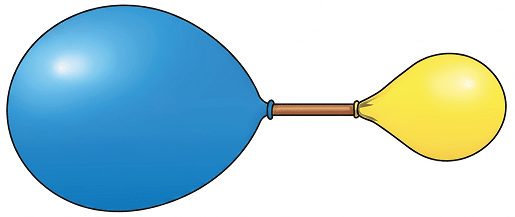
Observation: Some air moves from the inflated balloon into the uninflated balloon. The inflated balloon becomes smaller while the uninflated one bulges, until both balloons attain almost the same size and the air flow stops.
Conclusion: The air pressure in the inflated balloon is higher than in the uninflated balloon, so air flows from the inflated balloon to the uninflated balloon. The flow continues until the pressure in both balloons becomes equal. This shows that air flows from a region of high pressure to a region of low pressure.
What is a thunderstorm? Explain the process of its formation.
Answer
A storm accompanied by lightning and thunder is called a thunderstorm.
Process of formation:
- When the land gets heated, the warm and moist air rises, creating a low pressure area. Cooler air from surrounding high pressure regions rushes in, setting up a continuous wind circulation.
- As the rising air cools, the moisture in it condenses to form water droplets, creating clouds. These droplets merge and fall as rain, hail, or snow. Strong winds with rain form a storm.
- When the warm air rises to great heights, the low temperature there turns water droplets into ice particles.
- Strong winds moving upwards and downwards cause rubbing between water droplets and ice particles, which develops static electric charges in the clouds.
- When the charge buildup becomes very large, the insulating property of air breaks down, and a sudden flow of charges produces lightning. Lightning heats up the air, which expands and produces a loud sound called thunder.
A storm with this lightning and thunder is a thunderstorm.
Explain the process that causes lightning.
Answer
- Inside a cloud, strong winds blow upwards and downwards, causing rubbing between water droplets and ice particles. This rubbing develops static electric charges in the cloud.
- The lighter, positively charged ice particles move to the upper part of the cloud, while the heavier, negatively charged water droplets settle in the lower part. This causes a separation of charges within the cloud.
- When the negatively charged lower part of the cloud comes close to the ground, it makes the ground and nearby objects, such as trees and buildings, positively charged.
- Normally, air acts as an insulator and does not allow these opposite charges to meet. But when the buildup of charges becomes very large, the insulating property of air breaks down.
- A sudden flow of charges then takes place, producing a bright flash of light called lightning. Lightning may occur within a cloud, between two clouds, or between a cloud and the ground.
Explain why holes are made in banners and hoardings.
Answer
Banners and hoardings have a large surface area. When high-speed winds blow against them, the wind exerts a large force on this big area. If the banner were a single solid sheet, this force could tear it or knock it down.
Holes are made in banners and hoardings so that some of the wind can pass through them. This reduces the pressure difference and the force exerted by strong winds on the large surface area of the banner or hoarding. As a result, the banner or hoarding is less likely to get torn or blown away and remains stable even during strong winds.