
Why is it possible to pile up stones or sand, but not a liquid like water?
Answer
Stones and sand are solids. In solids, the particles are tightly packed and the interparticle attractions are very strong, holding the particles in fixed positions. This gives solids a definite shape and volume, so they can be piled up. Water is a liquid in which the particles are free to move and the interparticle attractions are weaker. Hence, water has no fixed shape, flows and takes the shape of its container, and cannot be piled up.
Why does water take the shape of folded hands but lose that shape when released?
Answer
Water is a liquid, and the particles of a liquid are free to move within a limited space. Because of this, a liquid has no fixed shape and takes the shape of the container holding it. When water is held in folded hands, the hands act as a container, so the water takes the shape of the cupped hands. When the hands are released, there is no container to hold the water in place, so it flows away and loses that shape.
We cannot see air, so how does it add weight to an inflated balloon?
Answer
Air is matter and is made up of a very large number of tiny constituent particles. Although these particles are too small to be seen, each particle has mass. When a balloon is inflated, a large number of air particles are pushed into it. The combined mass of all these particles adds weight to the inflated balloon, even though the air itself cannot be seen.
Is the air we breathe today the same that existed thousands of years ago?
Answer
Matter is made up of constituent particles that are neither created nor destroyed. The particles of air are in constant motion and keep moving, mixing and spreading from one place to another. Through natural processes such as breathing, burning and the activities of plants, the same air particles keep getting used and recycled again and again. So, in terms of its constituent particles, much of the air around us is made up of the same particles that have existed and been recycled over thousands of years.
Choose the correct option.
The primary difference between solids and liquids is that the constituent particles are:
- closely packed in solids, while they are stationary in liquids.
- far apart in solids and have fixed position in liquids.
- always moving in solids and have fixed position in liquids.
- closely packed in solids and move past each other in liquids
Answer
closely packed in solids and move past each other in liquids.
Reason — In solids, the particles are closely packed and held in fixed positions by very strong interparticle attractions, so they can only vibrate about their positions and cannot move past each other. In liquids, the interparticle attractions are slightly weaker, so the particles remain close together but are free to move and slip past one another. This is why a solid has a definite shape while a liquid flows and takes the shape of its container.
Options 1, 2, and 3 are incorrect because the particles in solids are not stationary (they vibrate), they are not far apart, and they are not always moving from place to place.
Which of the following statements are true? Correct the false statements.
- Melting ice into water is an example of the transformation of a solid into a liquid.
- Melting process involves a decrease in interparticle attractions during the transformation.
- Solids have a fixed shape and a fixed volume.
- The interparticle interactions in solids are very strong, and the interparticle spaces are very small.
- When we heat camphor in one corner of a room, the fragrance reaches all corners of the room.
- On heating, we are adding energy to the camphor, and the energy is released as a smell.
Answer
- True.
- True.
- True.
- True.
- True.
- False.
Corrected statement — On heating, energy is added to camphor. This makes camphor particles move faster and escape into the air as vapour. The smell is due to these camphor vapour particles spreading and reaching our nose, not because energy is released as a smell.
Choose the correct answer with justification. If we could remove all the constituent particles from a chair, what would happen?
- Nothing will change.
- The chair will weigh less due to lost particles.
- Nothing of the chair will remain.
Answer
Nothing of the chair will remain.
Reason — All matter is made up of constituent particles, and a chair too is made up of a very large number of such particles. If all these particles are removed, no matter would be left behind. Hence, nothing of the chair would remain.
Why do gases mix easily, while solids do not?
Answer
In gases, the interparticle attractions are negligible and the interparticle spaces are very large, so the particles move freely in all directions. This allows the particles of different gases to spread and mix easily. In solids, the particles are closely packed and held in fixed positions by very strong interparticle attractions, so they cannot move from one place to another. Therefore, solids do not mix or diffuse on their own like gases do.
When spilled on the table, milk in a glass tumbler, flows and spreads out, but the glass tumbler stays in the same shape. Justify this statement.
Answer
Milk is a liquid. Its particles are free to move and have weaker interparticle attractions, so milk has no fixed shape. When spilled, it flows and spreads out, taking the shape of the surface on which it falls. The glass tumbler is a solid in which the particles are closely packed and held in fixed positions by strong interparticle attractions. So the tumbler has a definite shape and does not change its shape.
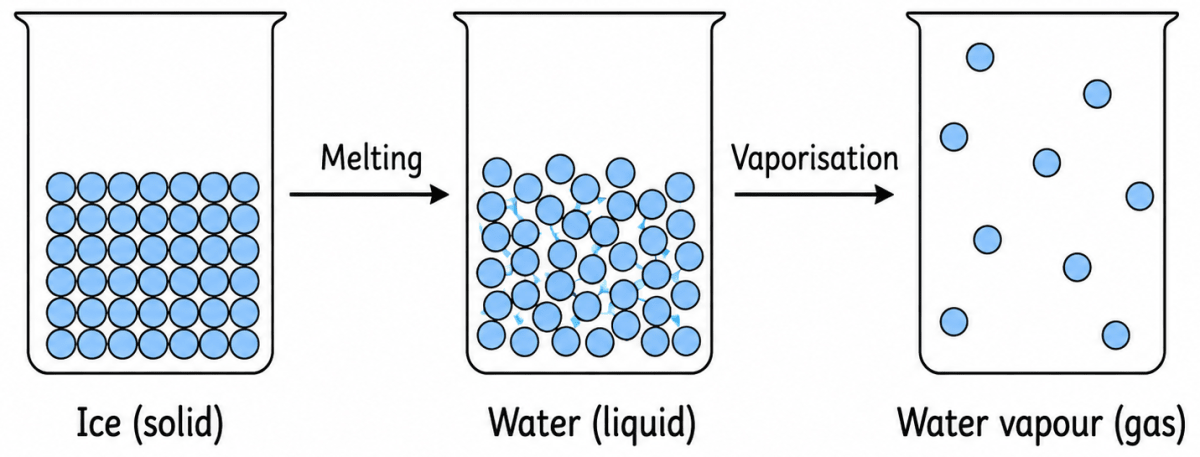
Represent diagrammatically the changes in the arrangement of particles as ice melts and transforms into water vapour.
Answer
As ice (solid) is heated, it melts into water (liquid), and on further heating the water changes into water vapour (gas). In ice, the particles are closely packed with minimum interparticle spacing. In water, the particles are a little more loosely packed with slightly larger spaces. In water vapour, the particles are far apart and move freely, with maximum interparticle spacing.
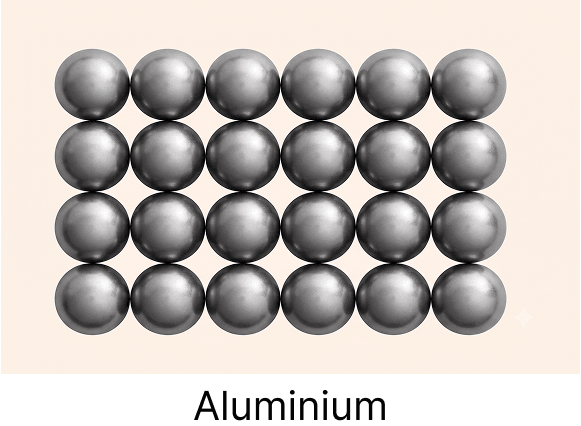
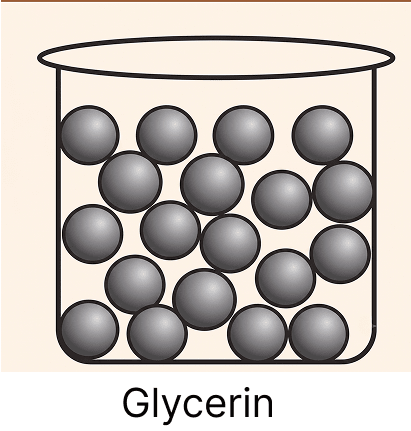
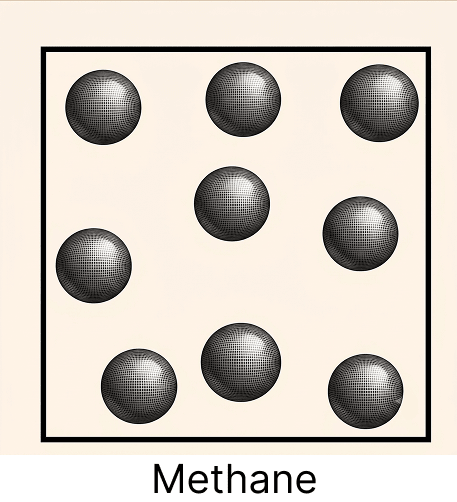
Draw a picture representing particles present in the following:
- Aluminium foil
- Glycerin
- Methane gas
Answer
Aluminium foil is a solid, so its particles are closely packed with minimum interparticle spacing. Glycerin is a liquid, so its particles are a little more loosely packed with slightly larger spaces between them. Methane is a gas, so its particles are far apart and free to move, with maximum interparticle spacing.
Observe Fig. 7.16a which shows the image of a candle that was just extinguished after burning for some time. Identify the different states of wax in the figure and match them with Fig. 7.16b showing the arrangement of particles.
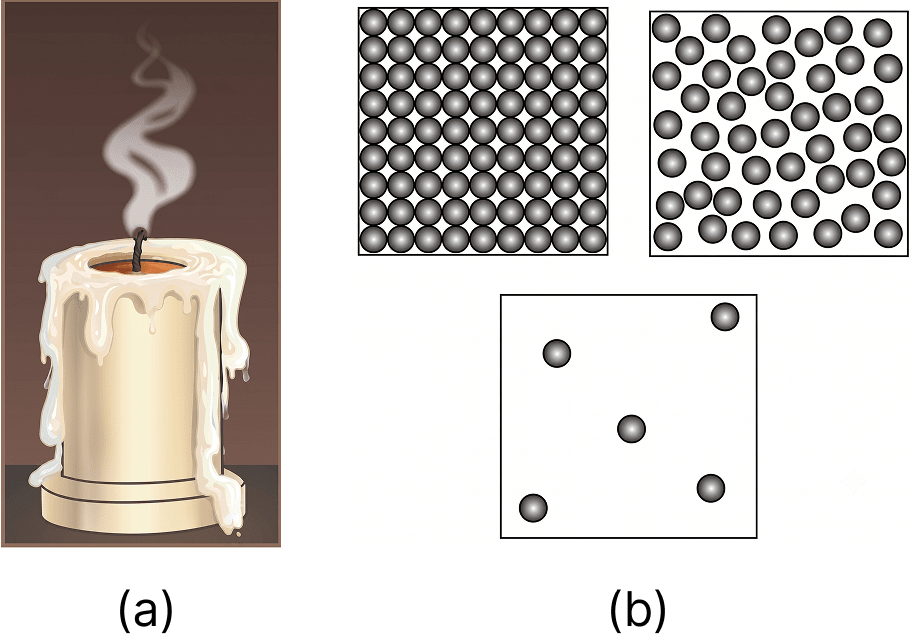
Answer
When a candle burns, the wax is present in all three states of matter:
- Solid wax — the hard body of the candle, where the particles are very closely packed.
- Liquid (molten) wax — the melted wax around the wick, where the particles are a little more loosely packed.
- Gaseous wax (wax vapour) — the vapour near the wick, where the particles are far apart and move freely.
These can be matched with the arrangement of particles in Fig. 7.16b as: solid wax with the closely packed particles, liquid wax with the slightly loosely packed particles, and gaseous wax with the widely spaced, free particles.
Why does the water in the ocean taste salty, even though the salt is not visible? Explain.
Answer
When salt dissolves in ocean water, it breaks up into its constituent particles, which are extremely small and cannot be seen even with an ordinary microscope. These tiny salt particles occupy the interparticle spaces between the water particles and spread uniformly throughout the water. So the salt is no longer visible, but its presence can be sensed by taste, which is why ocean water tastes salty.
Grains of rice and rice flour take the shape of the container when placed in different jars. Are they solids or liquids? Explain.
Answer
Grains of rice and rice flour are solids. They appear to take the shape of the container only because the grains are very small and can rearrange and pour easily. However, each individual grain of rice or particle of flour keeps its own definite shape and volume and does not change. In a liquid, the particles themselves are free to move and flow, but here only the collection of grains shifts, while each grain remains a solid with a fixed shape and volume. Hence, they are solids.