
Which of the entities in the picture below consist of matter, and which of them do not?

Answer
All the things in the picture that have mass and take up space are made of matter. These include the students, the staircase, the ball, the water bottle, the books, the bag, the trees, and the air around them.
The things in the picture that are not matter are light (sunlight), heat, and the sounds or thoughts of the students, as these do not have mass and do not take up space.
How can elements be combined to form a compound?
Answer
Elements combine to form a compound when their atoms join together chemically in a fixed ratio. During this combination, the elements react with each other and form a completely new substance whose properties are different from those of the combining elements.
For example, the elements hydrogen and oxygen combine chemically in a fixed ratio of 2:1 to form the compound water.
How could the discovery of a compound that absorbs carbon dioxide from the air contribute to solving environmental challenges?
Answer
A compound that absorbs carbon dioxide from the air would help in reducing the amount of carbon dioxide present in the atmosphere. Since excess carbon dioxide contributes to the warming of the Earth, removing some of it from air could help in controlling environmental problems such as climate change.
Consider the following reaction where two substances, A and B, combine to form a product C:
A + B → C
Assume that A and B cannot be broken down into simpler substances by chemical reactions. Based on this information, which of the following statements is correct?
- A, B, and C are all compounds and only C has a fixed composition.
- C is a compound, and A and B have a fixed composition.
- A and B are compounds, and C has a fixed composition.
- A and B are elements, C is a compound, and has a fixed composition.
Answer
The correct statement is:
A and B are elements, C is a compound, and has a fixed composition.
Reason — Since A and B cannot be broken down into simpler substances, they are elements. When they combine chemically to form a new substance C, it is a compound, and a compound always has a fixed composition.
Assertion: Air is a mixture.
Reason: A mixture is formed when two or more substances are mixed, without undergoing any chemical change.
- Both Assertion and Reason are true and Reason is the correct explanation for Assertion.
- Both Assertion and Reason are true, but Reason is not the correct explanation for Assertion.
- Assertion is true, but Reason is false.
- Assertion is false, but Reason is true.
Answer
Both Assertion and Reason are true and Reason is the correct explanation for Assertion.
A is true as air is a uniform mixture of gases such as nitrogen, oxygen, argon, carbon dioxide, and water vapour. These gases are simply mixed together without any chemical change, and each retains its own properties. Hence, the Reason correctly explains why air is a mixture.
Therefore, Both Assertion and Reason are true and Reason is the correct explanation for Assertion.
Water, a compound, has different properties compared to those of the elements oxygen and hydrogen from which it is formed. Justify this statement.
Answer
Water is a compound formed when the elements hydrogen and oxygen combine chemically in a fixed ratio of 2:1. The properties of a compound are different from those of the elements that form it.
Hydrogen is a fuel that burns easily, and oxygen supports combustion. However, water, which is formed from these two elements, is used to extinguish fire. This shows that water has properties completely different from those of hydrogen and oxygen. Hence, the statement is justified.
In which of the following cases are all the examples correctly matched? Give reasons in support of your answers.
- Elements — water, nitrogen, iron, air.
- Uniform mixtures — minerals, seawater, bronze, air.
- Pure substances — carbon dioxide, iron, oxygen, sugar.
- Non-uniform mixtures — air, sand, brass, muddy water.
Answer
The correctly matched case is:
Pure substances — carbon dioxide, iron, oxygen, sugar.
Reason — Carbon dioxide and sugar are compounds, while iron and oxygen are elements. Since both elements and compounds are pure substances, all the examples in this case are correctly matched.
The other cases are incorrect because:
Case 1 — Water is a compound and air is a mixture, so they are not elements.
Case 2 — Minerals are not uniform mixtures. Minerals have a fixed chemical composition and are mostly compounds, though some may be pure elements. Hence, all the examples are not uniform mixtures.
Case 4 — Air and brass are uniform mixtures, so they are not examples of non-uniform mixtures.
Iron reacts with moist air to form iron oxide, and magnesium burns in oxygen to form magnesium oxide. Classify all the substances involved in the above reactions as elements, compounds or mixtures, with justification.
Answer
The substances involved in the two reactions are classified as follows:
| Substance | Classification | Justification |
|---|---|---|
| Iron | Element | Made up of only one kind of atoms and cannot be broken down into simpler substances. |
| Moist air | Mixture | Air is a mixture of gases along with water vapour. |
| Iron oxide (rust) | Compound | Formed by the chemical combination of iron and oxygen. |
| Magnesium | Element | Made up of only one kind of atoms and cannot be broken down into simpler substances. |
| Oxygen | Element | Made up of only one kind of atoms and cannot be broken down into simpler substances. |
| Magnesium oxide | Compound | Formed by the chemical combination of magnesium and oxygen. |
Classify the following as elements, compounds, or mixtures in Table 8.3.
Carbon dioxide, sand, seawater, magnesium oxide, muddy water, aluminium, gold, oxygen, rust, iron sulfide, glucose, air, water, fruit juice, nitrogen, sodium chloride, sulfur, hydrogen, baking soda.
Table 8.3
| Elements | Compounds | Mixtures |
|---|---|---|
Identify pure substances amongst these and list them below.
Answer
The completed table 8.3 is given below:
| Elements | Compounds | Mixtures |
|---|---|---|
| Aluminium | Carbon dioxide | Sand |
| Gold | Magnesium oxide | Seawater |
| Oxygen | Rust | Muddy water |
| Nitrogen | Iron sulfide | Air |
| Sulfur | Glucose | Fruit juice |
| Hydrogen | Water | |
| Sodium chloride | ||
| Baking soda |
Pure substances are:
| Pure substances |
|---|
| Aluminium |
| Gold |
| Oxygen |
| Nitrogen |
| Sulfur |
| Hydrogen |
| Carbon dioxide |
| Magnesium oxide |
| Rust |
| Iron sulfide |
| Glucose |
| Water |
| Sodium chloride |
| Baking soda |
What new substance is formed when a mixture of iron filings and sulfur powder is heated, and how is it different from the original mixture? Also, write the word equation for the reaction.
Answer
When a mixture of iron filings and sulfur powder is heated, a new substance called iron sulfide is formed.
It is different from the original mixture in the following ways:
- The mixture of iron and sulfur is non-uniform, and its components iron and sulfur can be seen separately. Iron sulfide is uniform with the same colour and texture throughout.
- In the mixture, iron can be separated using a magnet, but iron sulfide is not attracted by a magnet.
- The mixture retains the properties of iron and sulfur, while iron sulfide is a compound with completely new properties.
The word equation for the reaction is:
Iron + Sulfur ⟶ Iron sulfide
Is it possible for a substance to be classified as both an element and a compound? Explain why or why not.
Answer
No, a substance cannot be classified as both an element and a compound.
An element is made up of only one kind of atoms and cannot be broken down into simpler substances. A compound is made up of two or more different elements combined chemically in a fixed ratio and can be broken down into simpler substances by chemical means. Since these two definitions are opposite in nature, a substance can be either an element or a compound, but not both at the same time.
How would our daily lives be changed if water were not a compound but a mixture of hydrogen and oxygen?
Answer
If water were a mixture of hydrogen and oxygen instead of a compound, it would not have its own special properties. Hydrogen is a fuel that burns easily and oxygen supports combustion. So such a mixture would be highly flammable and dangerous, and it could catch fire easily.
This water would no longer be able to put out fire, and we could not safely drink it or use it for daily activities like cooking, cleaning, and bathing. Hence, our daily lives would be greatly affected.
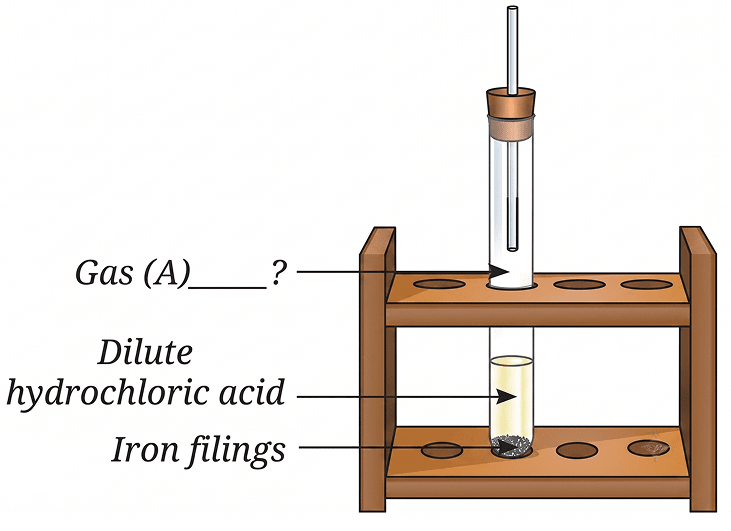
Analyse Fig. 8.24. Identify Gas A. Also, write the word equation of the chemical reaction.
Answer
In Fig. 8.24, iron filings react with dilute hydrochloric acid. Therefore, Gas A is hydrogen.
When iron reacts with dilute hydrochloric acid, it forms iron chloride and releases hydrogen gas, which is colourless, odourless, and burns with a 'pop' sound.
The word equation for the reaction is:
Iron + Dilute Hydrochloric acid ⟶ Iron chloride + Hydrogen gas
Write the names of any two compounds made only from non-metals, and also mention two uses of each of them.
Answer
Two compounds made only from non-metals are:
1. Water (H2O) — made of the non-metals hydrogen and oxygen.
- Used for drinking and daily activities like cooking and cleaning.
- Used to extinguish ordinary fires.
2. Carbon dioxide (CO2) — made of the non-metals carbon and oxygen.
- Used by green plants to prepare their food during photosynthesis.
- Used in fire extinguishers to put out fires.
How can gold be classified as both a mineral and a metal?
Answer
Gold is a metal because it is an element that has the properties of metals, such as lustre and being a good conductor.
Gold is also a mineral because it is a natural solid substance found in the Earth. Some minerals, called native minerals, are pure elements and not compounds. Gold is one such native mineral, which exists in nature as a pure element. Hence, gold can be classified as both a mineral and a metal.