
How might the loss of forest cover and changes in rainfall patterns lead to elephants to enter human farms and villages?
Answer
Forests are the natural home of elephants, providing them with food and water. Changes in rainfall and temperature affect the growth of vegetation, while cutting down trees for roads and buildings causes forests to dry up and shrink. Because of this loss of habitat, food becomes scarce and waterholes dry up. As a result, elephants wander into nearby farms and villages in search of food like bananas and sugarcane, which sometimes leads to crop damage and harm to people and animals.
Imagine you are a tree in a dense forest. What kind of relationships would you have with water, sunlight, other animals, and other components of the forest?
Answer
As a tree, I would depend on and interact with both abiotic and biotic components of the forest:
- Water — I would absorb water from the soil for growth and to make food.
- Sunlight — I would use sunlight along with carbon dioxide and water to prepare my own food by photosynthesis.
- Other animals — I would provide food, shelter, and oxygen to animals, and they would help me in pollination and seed dispersal.
- Other components — I would take nutrients from the soil, release oxygen into the air, hold the soil with my roots to prevent erosion, and retain soil moisture.
Do you think the Earth can thrive without humans? Can humans survive without the Earth?
Answer
Yes, the Earth can thrive without humans. Plants, animals, and microorganisms would continue to interact with each other and with the abiotic components, keeping ecosystems in balance.
However, humans cannot survive without the Earth. We depend completely on the Earth's ecosystems for clean air, water, food, medicines, and other resources needed for our well-being and survival.
If two kinds of birds compete for the same fruit, how might their way of living change over time?
Answer
When two kinds of birds compete for the same fruit, both struggle to get enough food. This competition helps control their population size. Over time, to reduce competition, the birds may change their way of living — for example, by feeding at different times, eating other kinds of food, or moving to different areas. In this way, they adjust so that both can survive in the ecosystem.
Can human actions cause natural disasters?
Answer
Yes, human actions can trigger some disasters or increase the damage caused by natural events. Activities such as cutting down forests, polluting water and air, destroying mangroves, and overusing natural resources disturb the natural balance of ecosystems. For example, cutting down mangrove forests removes a natural barrier against strong winds, waves, floods, and tsunamis. This makes nearby coastal areas more vulnerable to severe damage.
Refer to the given diagram (Fig. 12.19) and select the wrong statement.
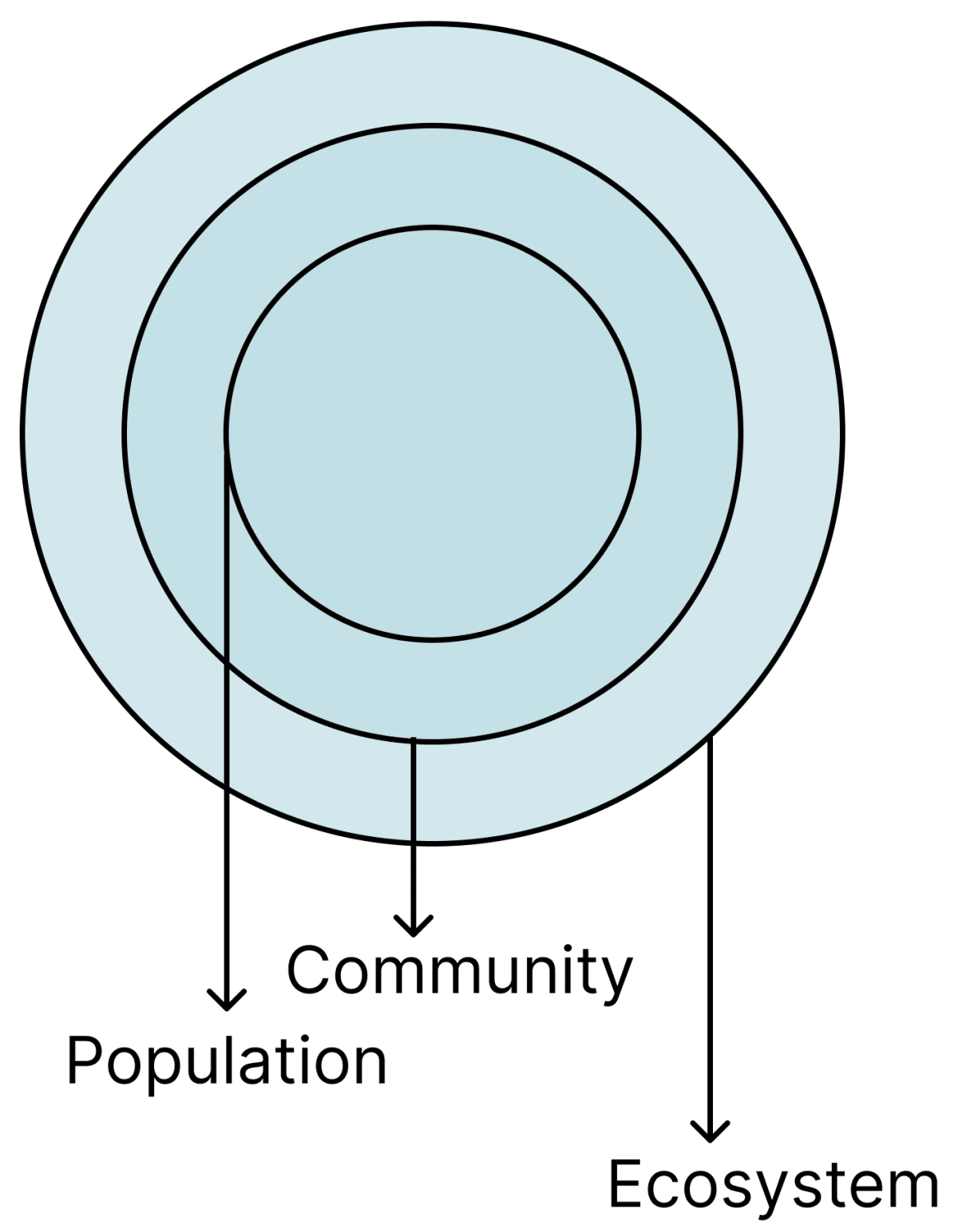
- A community is larger than a population.
- A community is smaller than an ecosystem.
- An ecosystem is part of a community.
Answer
The wrong statement is An ecosystem is part of a community.
Reason — An ecosystem is the largest unit, which includes the community along with the abiotic components. So, a community is part of an ecosystem, not the other way around. A population is the smallest unit, a community is made up of different populations, and an ecosystem includes the community and its surroundings. Hence, statement 3 is incorrect.
A population is part of a community. If all decomposers suddenly disappear from a forest ecosystem, what changes do you think would occur? Explain why decomposers are essential.
Answer
If all decomposers disappear from a forest ecosystem:
- Dead plants, dead animals, and waste matter would keep piling up and would not break down.
- The nutrients locked in this dead matter would not be returned to the soil.
- The soil would become poor in nutrients, so plants would not grow well.
- This would affect the whole food chain, disturbing the balance of the ecosystem.
Decomposers are essential because they break down complex substances in dead plants and animals into simpler ones and recycle important nutrients back into the soil. This keeps the soil fertile and ensures that nothing is wasted in nature.
Selvam from Cuddalore district, Tamil Nadu, shared that his village was less affected by the 2004 Tsunami compared to nearby villages due to the presence of mangrove forests. This surprised Sarita, Shabnam, and Shijo. They wondered if mangroves were protecting the village. Can you help them understand this?
Answer
Yes, the mangrove forests protected Selvam's village. Mangroves grow along coastal areas and act as a natural barrier between the sea and the land. They protect the coast by slowing down strong winds and waves during storms and floods. During the 2004 Tsunami, the thick mangrove forests reduced the force of the giant waves before they reached the village. This is why Selvam's village was less affected compared to nearby villages that did not have mangroves to protect them.
Look at this food chain:
Grass → Grasshopper → Frog → Snake
If frogs disappear from this ecosystem, what will happen to the population of grasshoppers and snakes? Why?
Answer
In this food chain, frogs eat grasshoppers and are themselves eaten by snakes. If frogs disappear:
- Grasshoppers — Their population would increase, because there would be no frogs left to eat them.
- Snakes — Their population would decrease, because snakes would lose their main source of food.
This shows how the removal of one organism disturbs the balance of the whole food chain.
In a school garden, students noticed fewer butterflies the previous season. What could be the possible reasons? What steps can students take to have more butterflies on campus?
Answer
Possible reasons for fewer butterflies:
- Fewer flowering plants that provide nectar.
- Use of pesticides or chemicals that harm butterflies.
- Loss of suitable plants on which butterflies lay eggs.
- Pollution or changes in the surrounding environment.
Steps students can take:
- Grow more flowering plants that provide nectar.
- Avoid using harmful pesticides and chemicals.
- Plant the kinds of plants on which butterflies lay their eggs.
- Keep the garden clean and provide water sources.
Why is it not possible to have an ecosystem with only producers and no consumers or decomposers?
Answer
An ecosystem cannot survive with only producers because all components are interdependent. Without consumers, there would be no organisms to feed on plants and help in processes like pollination and seed dispersal. Without decomposers, dead plants would pile up and their nutrients would not return to the soil, making it infertile. This would stop new plants from growing. Hence, producers, consumers, and decomposers are all needed to keep an ecosystem balanced and working.
Observe two different places near your home or school (e.g., a park and a roadside). List the living and non-living components you see. How are the two ecosystems different?
Answer
| Place | Living components | Non-living components |
|---|---|---|
| Park | grass, trees, flowers, birds, insects, squirrels | soil, water, sunlight, air |
| Roadside | a few small plants, weeds, ants, birds | soil, dust, sunlight, air |
The two ecosystems are different because a park has more variety of plants and animals and a healthier environment, while a roadside has fewer living organisms and is more affected by pollution, dust, and human activity.
‘Human-made ecosystems like agricultural fields are necessary, but they must be made sustainable.’ Comment on the statement.
Answer
Human-made ecosystems like agricultural fields are necessary because farming provides food and livelihood and helps a growing population become food secure. However, farming becomes unsustainable when synthetic fertilisers and pesticides are overused, groundwater is extracted excessively, and the same crop is grown repeatedly as monoculture. These practices can reduce soil fertility, harm useful soil organisms, reduce biodiversity, affect pollinators, and increase pest problems.
Therefore, agricultural fields must be made sustainable by using practices such as composting, organic manure, natural pest control, crop rotation, mixed cropping, water conservation, and reduced use of synthetic chemicals.
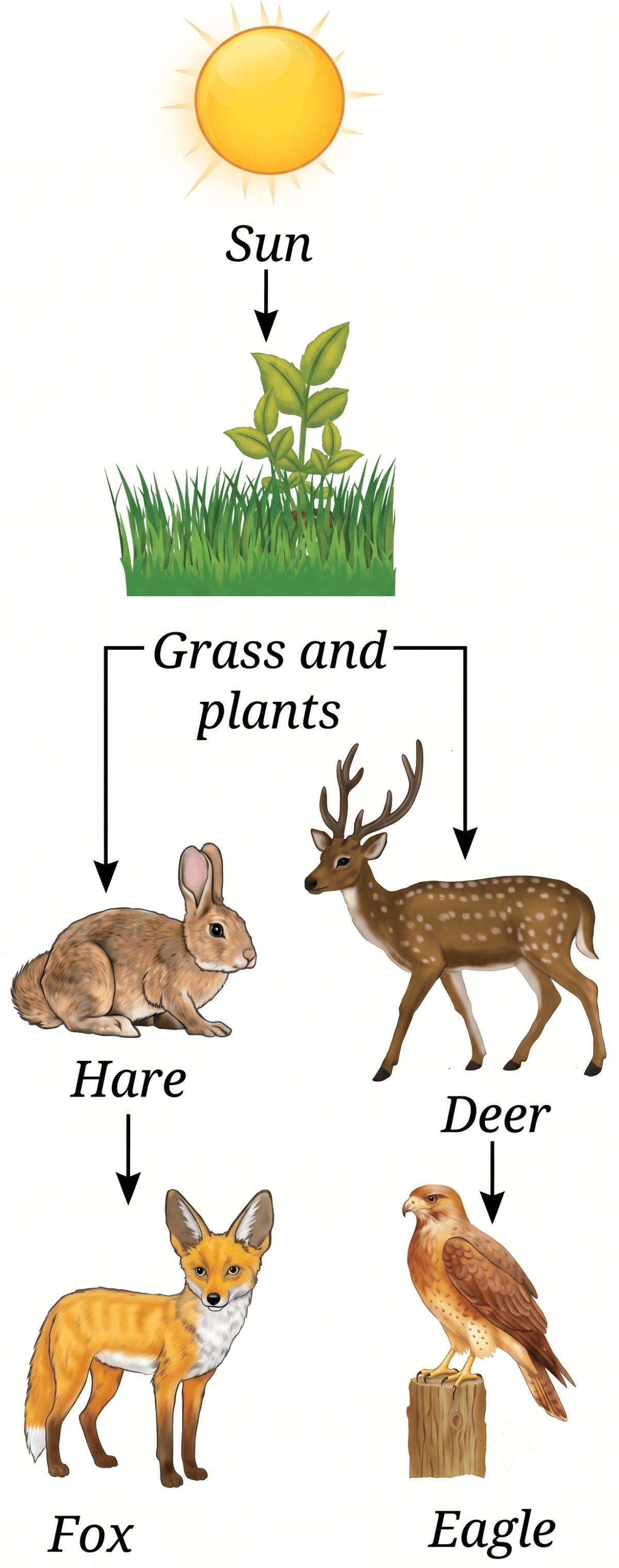
If the Indian hare population (Fig. 12.20) drops because of a disease, how would it affect the number of other organisms?
Answer
The hare is an important link in the food web, eaten by animals such as the fox and the eagle.
If the hare population drops :
- Animals that feed on the hare, like the fox and eagle, would have less food, so their numbers may decrease. They may then depend more on other animals.
- The grass and plants eaten by the hare may grow more, as fewer hares would be feeding on them.
This shows that a change in one organism affects many other organisms connected to it through the food web.