
Have you ever seen the Moon during the day? Why do you think it is sometimes visible when the Sun is up?
Answer
Yes, the Moon can sometimes be seen during the day. This happens because the Moon does not always rise at sunset and set at sunrise. The Moon rises about 50 minutes later each day, so on some days it rises in the afternoon. At such times, the Moon is above the horizon while the Sun is still up, and so it becomes visible in the daytime sky. Since the Moon shines by reflecting sunlight, its lit portion can be seen even when the Sun is out.
Imagine you lived on the Moon instead of Earth. What would you mean by a day, a month or a year?
Answer
On Earth, a day, a month, and a year are based on natural periodic events — the rotation of the Earth, the cycle of the Moon's phases, and the Earth's revolution around the Sun. If we lived on the Moon, these units would be measured by the Moon's own cycles. A day would be based on the time the Moon takes to rotate once about its axis, which is about 29.5 Earth days, so a single day on the Moon would be very long. A month and a year would be based on the time the Moon takes to revolve around the Earth and the time the Earth–Moon system takes to go around the Sun. So the meaning of these time units would be very different from what we experience on Earth.
What would happen if Earth had two moons instead of one? How would that change the night sky?
Answer
If the Earth had two moons, the night sky would look very different. We would see two moons, each going through its own set of phases, possibly at different times. On some nights we might see two bright moons together, while on other nights one might be a crescent and the other a full Moon. The combined moonlight would make some nights much brighter than they are now. Keeping time using the Moon would also become more complicated, as there would be two separate phase cycles to follow instead of one.
If we didn't have clocks or calendars, how else could we measure time?
Answer
Even without clocks or calendars, we can measure time using the natural periodic events in the sky. The rising and setting of the Sun marks a day. The changing phases of the Moon, which repeat in about 29.5 days, can be used to count a month. The cycle of seasons, caused by the Earth's revolution around the Sun, marks a year. The length of shadows cast by the Sun during the day can also be used to tell the time of day. These natural cycles were used by people in ancient times to keep track of time before clocks and calendars were invented.
State whether the following statements are True or False.
i. We can only see that part of the Moon which reflects sunlight towards us.
ii. The shadow of Earth blocks sunlight from reaching the Moon causing phases.
iii. Calendars are based on various astronomical cycles which repeat in a predictable manner.
iv. The Moon can only be seen at night.
Answer
i. True
ii. False
Corrected Statement — The phases of the Moon are not caused by Earth's shadow. They happen because of the change in the relative positions of the Sun, Moon, and Earth, so we see different amounts of the Moon's illuminated portion. The Earth's shadow falling on the Moon causes a lunar eclipse, not phases.
iii. True
iv. False
Corrected Statement — The Moon can sometimes be seen during the day as well, because it rises about 50 minutes later each day and is not always opposite the Sun.
Amol was born on 6th of May on a full Moon day. Does his birthday fall on the full Moon day every year? Explain your answer.
Answer
No, Amol's birthday will not fall on a full Moon day every year. His birthday on 6th May follows the Gregorian calendar, which is a solar calendar based on the cycle of seasons. The full Moon depends on the cycle of the Moon's phases, which follows the lunar calendar. A lunar year is about 354 days, which is around 11 days shorter than the solar year of about 365 days. Because of this difference, the full Moon does not fall on the same date of the Gregorian calendar every year. So 6th May will be a full Moon day only occasionally, not every year.
Name two things that are incorrect in Fig. 11.10.

Answer
Two incorrect things are:
(i) The picture shows clouds near the Moon. This is incorrect because clouds are present in the Earth's atmosphere and do not exist in space around the Moon.
(ii) Stars are shown on the dark part of the Moon. This is incorrect because the dark part is still the surface of the Moon; it is only non-illuminated. Stars cannot be seen through the Moon.
Look at the pictures of the Moon in Fig. 11.11, and answer the following questions.
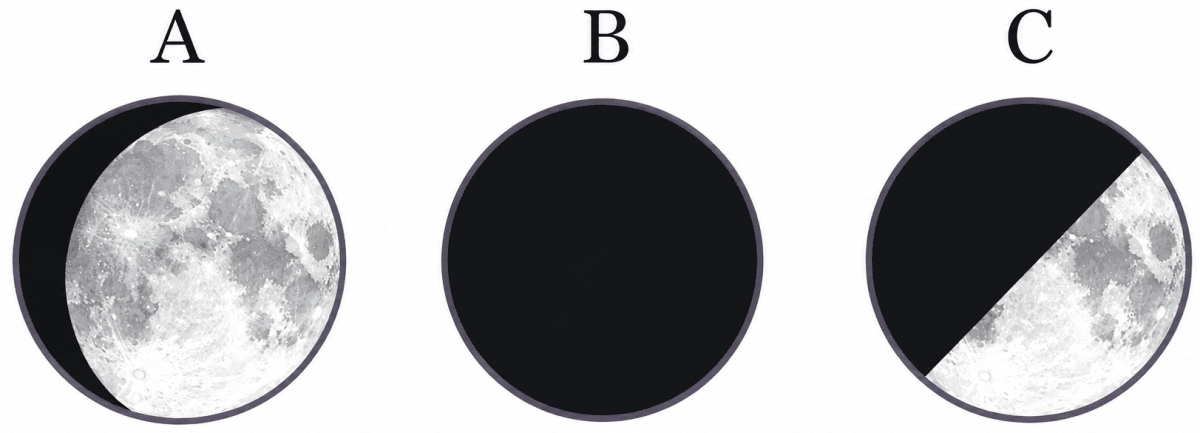
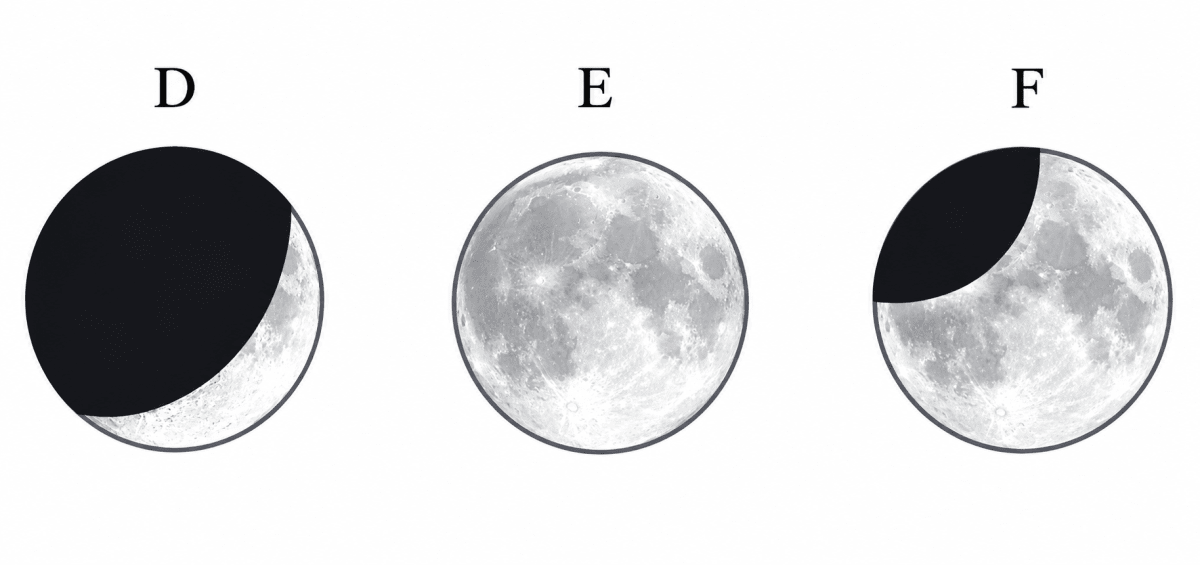
(i) Write the correct panel number corresponding to the phases of the Moon shown in the pictures above.
| Picture label (e.g. A, B, C, etc.) | Phase of Moon |
|---|---|
| Three days after New Moon | |
| Full Moon | |
| Three days after Full Moon | |
| A week after Full Moon | |
| Day of New Moon |
(ii) List the picture labels of the phases of the Moon that are never seen from Earth. Hint: You can use your observations from Activity 11.1 or Fig. 11.2 as reference.
Answer
(i)
- Three days after New Moon — Picture D
Explanation: Three days after the New Moon, a thin crescent of the Moon becomes visible. Picture D shows only a small illuminated portion of the Moon, which matches the appearance of the Moon a few days after the New Moon.
- Full Moon — Picture E
Explanation: During the Full Moon phase, the entire face of the Moon visible from Earth is illuminated. Picture E shows the complete bright circular disc of the Moon, so it represents the Full Moon.
- Three days after Full Moon — Picture A
Explanation: A few days after the Full Moon, the Moon starts waning and a small dark portion appears on one side. Picture A shows most of the Moon illuminated with only a small dark region, indicating the phase three days after the Full Moon.
- A week after Full Moon — Picture C
Explanation: About one week after the Full Moon, the Moon appears as a half-moon. Picture C shows approximately half of the Moon illuminated, which corresponds to this phase.
- Day of New Moon — Picture B
Explanation: On the day of the New Moon, the side of the Moon facing Earth is not illuminated by the Sun. Therefore, the Moon appears completely dark. Picture B represents the New Moon phase.
| Picture label (e.g. A, B, C, etc.) | Phase of Moon |
|---|---|
| D | Three days after New Moon |
| E | Full Moon |
| A | Three days after Full Moon |
| C | A week after Full Moon |
| B | Day of New Moon |
(ii) Phases that are never seen from Earth are Picture B and Picture F.
Explanation:
Picture B represents the New Moon. On the New Moon day, only the non-illuminated side of the Moon faces the Earth, so the Moon is not visible from Earth.
Picture F does not represent a regular phase of the Moon. In normal phases, the boundary between the illuminated and non-illuminated portions is a curved line across the Moon's disc. Picture F shows an irregular dark patch-like region, so it is not a phase normally seen from Earth.
Malini saw the Moon overhead in the sky at sunset.
i. Draw the phase of the Moon that Malini saw.
ii. Is the Moon in the waxing or the waning phase?
Answer
i. Malini saw a half Moon, with half of the visible disc bright and the other half dark. When the Moon is overhead at sunset, it is in the waxing half-Moon phase.

ii. The Moon was in the waxing phase. A waxing Moon is easiest to spot at sunset, and its bright portion keeps increasing day by day towards the full Moon.
Ravi said, "I saw a crescent Moon, and it was rising in the East, when the Sun was setting." Kaushalya said, "Once I saw the gibbous Moon during the afternoon in the East." Who out of the two is telling the truth?
Answer
Kaushalya is telling the truth.
When the Sun is setting in the West, a Moon rising in the East is nearly opposite the Sun. A Moon opposite the Sun appears as a full Moon, not a crescent. A crescent Moon appears close to the Sun in the sky, so it cannot be rising in the East while the Sun sets in the West. Therefore, Ravi cannot be correct.
A gibbous Moon appears farther from the Sun than a crescent but is not opposite it, so it can be seen in the eastern sky during the afternoon while the Sun is still up. Hence, Kaushalya's observation is possible and she is telling the truth.
Scientific studies show that the Moon is getting farther away from the Earth and slower in its revolution. Will luni-solar calendars need an intercalary month more often or less often?
Answer
The luni-solar calendars will need an intercalary month less often.
An intercalary month (Adhika Maasa) is added because the 12 lunar months (about 354 days) fall short of the solar year (about 365 days) by nearly 11 days. As the Moon moves farther away and becomes slower in its revolution, each lunar month becomes longer. This makes the lunar year longer too, so the gap between the lunar year and the solar year becomes smaller. With a smaller difference to make up, the extra month needs to be added less often.
A total of 37 full Moons happen during 3 years in a solar calendar. Show that at least two of the 37 full moons must happen during the same month of the solar calendar.
Answer
In a solar calendar, there are 12 months in a year. Over 3 years, the total number of months is:
12 x 3 = 36 months
There are 37 full Moons to be spread across these 36 months. If each of the 36 months had only one full Moon, that would account for only 36 full Moons. But there are 37 full Moons, which is one more than the number of months.
So, when 37 full Moons are placed in 36 months, at least one month must contain more than one full Moon. This shows that at least two of the 37 full Moons must happen during the same month of the solar calendar.
On a particular night, Vaishali saw the Moon in the sky from sunset to sunrise. What phase of the Moon would she have noticed?
Answer
Vaishali would have noticed a full Moon.
On a full Moon day, the Moon is nearly opposite the Sun in the sky. So when the Sun sets in the West, the full Moon rises in the East, and it stays in the sky the whole night, setting in the West around sunrise. Since Vaishali could see the Moon all night from sunset to sunrise, the Moon must have been in its full Moon phase.
If we stopped having leap years, in approximately how many years would the Indian Independence Day happen in winter?
Answer
A leap year adds one extra day every 4 years to make up for the extra quarter day the Earth takes to revolve around the Sun. If we stopped having leap years, the calendar would slip by about day each year compared to the seasons.
Indian Independence Day (15th August) falls during the rainy/summer period. For it to shift into winter, the date needs to move by about half a year, that is, about 6 months or roughly 180 days.
Number of years for the calendar to slip by 180 days:
years
So, if we stopped having leap years, Indian Independence Day would happen in winter in approximately 720 years.
Note: The exact value depends on how many days of shift one counts as "winter" (about 6 months). Using roughly 180 days of shift gives an approximate answer of around 720 years.
What is the purpose of launching artificial satellites?
Answer
Artificial satellites are human-made objects launched from the Earth that orbit around it. They are launched for many useful purposes, such as:
- Communication — helping in telephone, television, and internet services.
- Navigation — helping to find locations and directions.
- Weather monitoring — observing and predicting weather.
- Disaster management — giving early warning and information during natural disasters.
- Scientific research — studying the Earth, stars, and other celestial objects.
For example, ISRO's Cartosat satellites capture high-quality images of the Earth to improve maps and plan cities, while AstroSat makes scientific observations of stars and other celestial objects.
On which periodic phenomenon are the following measures of time based: (i) day (ii) month (iii) year?
Answer
- Day — It is based on the rotation of the Earth about its own axis. One mean solar day is the average time the Sun takes to return to its highest position in the sky, which is about 24 hours.
- Month — It is based on the cycle of the phases of the Moon as it revolves around the Earth. The Moon takes about 29.5 days to complete one cycle of phases.
- Year — It is based on the revolution of the Earth around the Sun. The Earth takes nearly 365 and a quarter days to complete one revolution, during which one cycle of seasons occurs.