
What is India's parliamentary system, and how is it structured?
Answer
India follows a parliamentary system where people elect representatives, and the majority party or coalition in the Lok Sabha forms the government, led by the Prime Minister and collectively responsible to the Lok Sabha.
The Indian Parliament has a bicameral structure and consists of:
- The President of India
- Lok Sabha (House of the People) — whose members are directly elected by the people.
- Rajya Sabha (Council of States) — whose members are elected indirectly.
What are the key functions of the Parliament?
Answer
The Constitution lays down the key functions of the Parliament. They can be broadly classified under the following heads:
- Constitutional functions: Parliament upholds the core values of the Constitution by enabling parliamentary democracy through universal adult suffrage, maintaining separation of powers, ensuring federalism, and upholding Fundamental Rights and Directive Principles of State Policy. It also performs functions such as the election of the President and Vice-President and amendment of the Constitution.
- Lawmaking: One of the primary responsibilities of Parliament is to make laws. A proposed law is introduced as a bill, which goes through a detailed process of discussion, consideration and approval before becoming an Act.
- Executive accountability: Parliament holds the Executive accountable through mechanisms such as Question Hour and Parliamentary committees, where ministers are required to explain and justify government policies, actions and decisions.
- Financial accountability: Parliament approves and monitors government expenditure through the annual budget and examines the allocation of funds to different ministries.
Thus, Parliament performs constitutional and lawmaking functions and also ensures the accountability of the Executive and government expenditure.
What are the roles of the legislature and the executive in India's Parliamentary democracy?
Answer
In India's Parliamentary democracy, the Legislature and the Executive have distinct but closely linked roles.
- Role of the Legislature
- The Parliament of India is the supreme legislative body of the country and consists of the President, Lok Sabha and Rajya Sabha.
- Its main role is to make laws and oversee the work of the Executive.
- It keeps a check on the Executive by asking questions and seeking explanations.
- It approves and sanctions government expenditure.
- It works through various Parliamentary committees to examine government policies and actions.
- It holds the Executive accountable through mechanisms such as Question Hour.
- Role of the Executive
- The Executive consists of the President, Vice-President and the Council of Ministers headed by the Prime Minister.
- Its main role is to implement and enforce the laws made by the Legislature.
- It takes decisions regarding the day-to-day functioning of the government.
- Most bills discussed in Parliament are initiated by the government.
- It provides information and explanations to the Legislature about its decisions and actions.
- It prepares and implements the budget approved by Parliament.
- The Council of Ministers is collectively responsible to the Lok Sabha.
How are the legislature and the executive organised at the union and state levels?
Answer
At the Union level, the Legislature is the Parliament, consisting of the President, Lok Sabha and Rajya Sabha. The President is the nominal head of the Executive, while the Prime Minister is the de facto executive authority and heads the Council of Ministers, which is collectively responsible to the Lok Sabha.
At the State level, the Legislature consists of the Vidhan Sabha and, in some states, the Vidhan Parishad. The Governor is the nominal head of the State Executive, while the Chief Minister is the de facto executive authority and heads the Council of Ministers, which is collectively responsible to the Vidhan Sabha.
Draw a small chart to show the process of how RTE became an act. What do you think the process would be if RTE had been tabled in the Lok Sabha?
Answer
The Right to Education (RTE) Act became law through a step-by-step process in Parliament. Below is a chart showing how it became an Act.
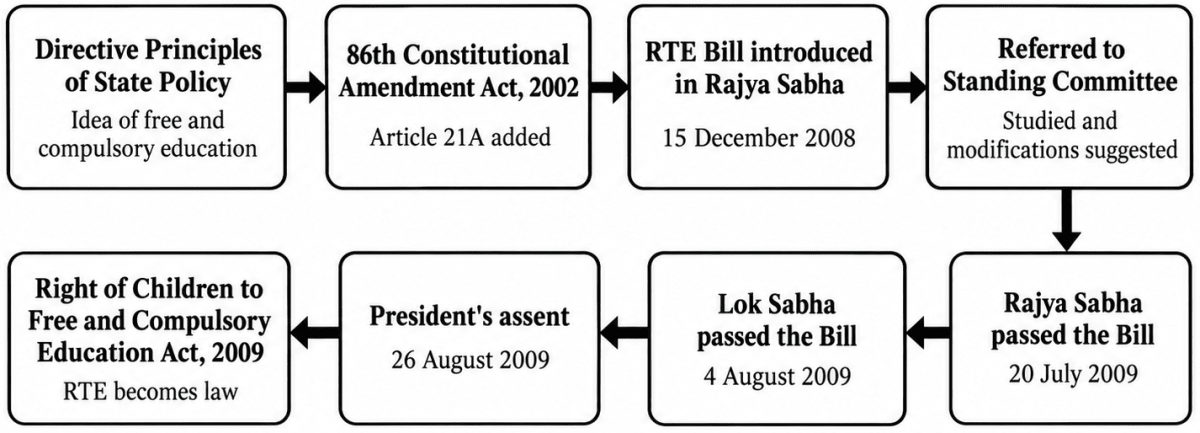
If the RTE Bill had first been tabled in the Lok Sabha, the process would have remained largely the same. It would first have been discussed and passed by the Lok Sabha and then sent to the Rajya Sabha for a similar process. After approval by both Houses, it would have been sent to the President for assent and then notified in the Gazette.
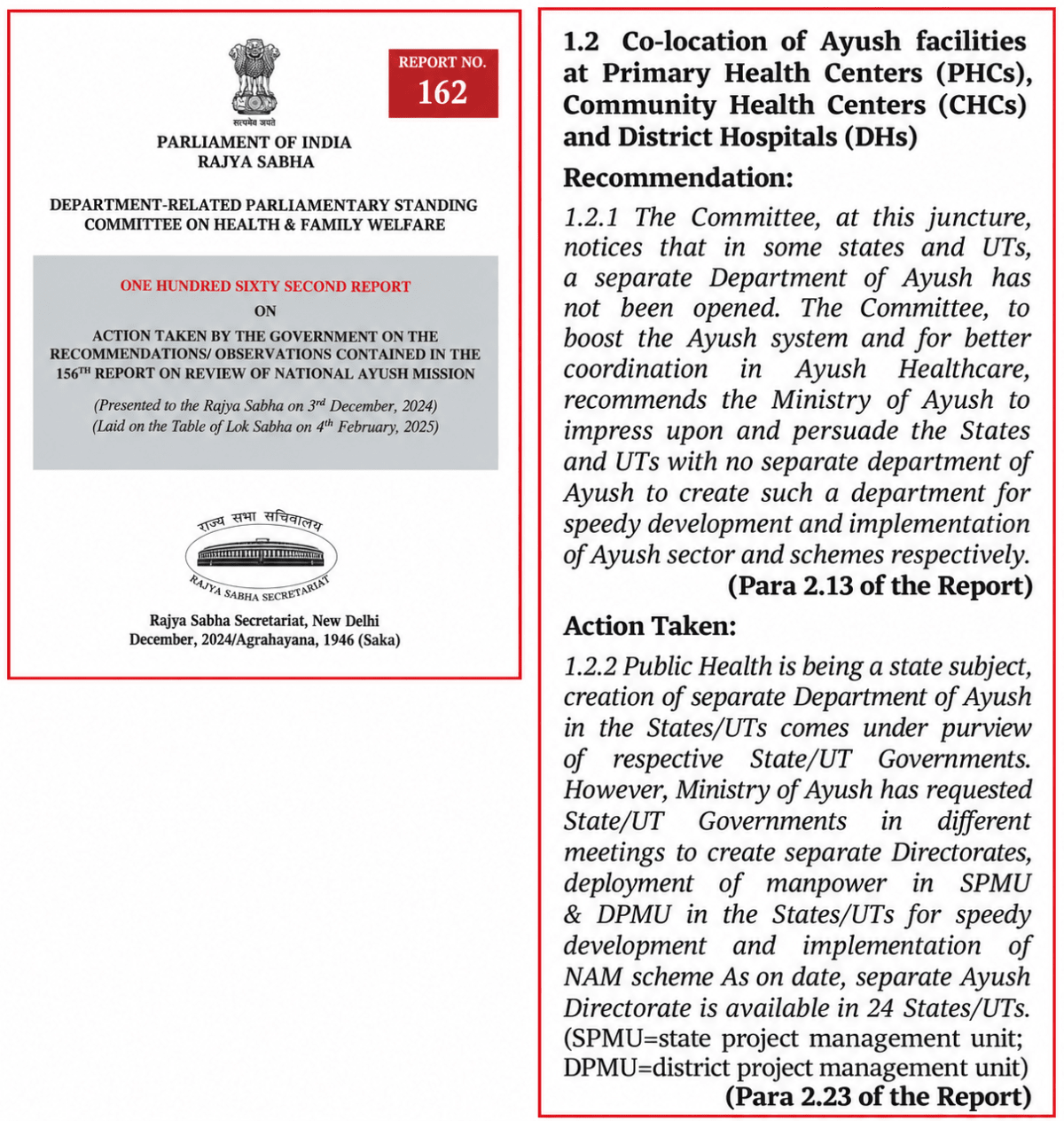
Given here is an extract from the report of meetings between the Standing Committee on Health and Family Welfare and the officers from the Ministry of Health and Family Welfare. Observe the screenshots below and discuss the following in small groups — Who is reporting to whom? What is the subject that has been reviewed? Identify the Committee's recommendation. What is the government's reply?
Answer
Who is reporting to whom — The Parliamentary Standing Committee on Health and Family Welfare reports to Parliament. The Ministry of Health and Family Welfare officials report to the Committee on government action taken on its earlier recommendations
Subject reviewed — The report examines government action on recommendations from the 156th Report on the National AYUSH Mission, focusing on co-locating AYUSH facilities at Primary Health Centers (PHCs), Community Health Centers (CHCs) and District Hospitals (DHs).
The Committee's recommendation — The Committee asked the Ministry of Ayush to persuade States and Union Territories without a separate Department of Ayush to establish one so that AYUSH programmes could be better coordinated and implemented.
The government's reply — Since public health is a State subject, creating a separate AYUSH Department falls within the responsibility of State/UT governments. The Ministry of Ayush reported that it had urged them to create AYUSH Directorates and deploy personnel in State Project Management Units (SPMUs) and District Project Management Units (DPMUs) for the National AYUSH Mission. According to the printed report, 24 States/UTs had separate AYUSH Directorates at that time.
Why do you think that Parliament keeps an eye on government expenditure? (Hint: Whose money does the government spend?)
Answer
Parliament keeps an eye on government expenditure because the government spends public money, which is collected from the people. Therefore, it is important to ensure that this money is used properly and for public welfare.
Parliament exercises financial accountability by approving and monitoring government expenditure through the annual budget and by examining how funds are distributed among different ministries. The government must also provide Parliament with timely and accurate information about its spending.
If the Executive is part of the Legislature, how do we say that there is separation of power? (Hint: revisit the section on legislature above)
Answer
Although the Council of Ministers is chosen from among the Members of Parliament, the Legislature and the Executive perform different functions.
- The Legislature makes laws, approves government expenditure, and keeps a check on the Executive through Question Hour and Parliamentary committees.
- The Executive implements and enforces laws and runs the day-to-day administration of the government.
- The Executive is collectively responsible to the Lok Sabha and must explain and justify its decisions and actions.
- The Judiciary independently checks whether laws and executive actions follow the Constitution.
Thus, separation of powers is maintained through the distinct functions and checks and balances among the Legislature, Executive, and Judiciary.
What might happen if one of the organs — Legislature, Executive, Judiciary — had all the power? How could it affect the rights of people? Discuss with your classmates how each organ checks the others. For example, how does the Legislature question the actions of the Executive? How does the Judiciary make sure that laws and government actions respect the Constitution? Do you think there might be ways in which the actions of the Judiciary itself are reviewed?
Answer
If one organ of government holds all the power, it may misuse its authority, threaten citizens’ rights and freedoms, and weaken democracy due to the lack of checks and balances.
The three organs check one another in the following ways:
- Legislature checks the Executive: Parliament questions ministers through Question Hour, parliamentary committees and discussions. It also examines government expenditure and demands explanations for government decisions.
- Judiciary checks the Legislature and Executive: The Judiciary acts as the custodian of the Constitution. It can examine whether laws passed by the Legislature and actions taken by the Executive follow the Constitution and protect Fundamental Rights.
- Review of the Judiciary: Judicial decisions can also be reconsidered through the system of appeals and review within the courts. Thus, no organ should become more powerful than the others.
Can you find examples where the Judiciary has asked lawmakers to review a law? Can you find any instances when the implementation of a law has been questioned by the Judiciary?
Answer
Yes. The Judiciary can examine laws and ask lawmakers or public authorities to respond when a law or its application conflicts with the Constitution.
- Review of a law — Shreya Singhal v. Union of India (2015): The Supreme Court examined Section 66A of the Information Technology Act, 2000 and struck it down because it violated freedom of speech and expression. This is an example of judicial review of legislation; the Court invalidated the provision rather than merely recommending that Parliament reconsider it.
- Questioning the implementation of a law — M.C. Mehta v. Union of India (1988): In a case concerning pollution of the River Ganga near Kanpur, the Supreme Court examined failures to prevent pollution and issued directions to authorities to enforce environmental safeguards.
These examples show that the Judiciary can examine both the constitutionality of laws and how authorities implement them.
Study the data given in the following table. What conclusions can you draw about the functioning of Parliament over time? Compile data for more recent years.
| Period of Lok Sabha | Number of sessions | Number of sittings |
|---|---|---|
| 1st Lok Sabha (1952–1957) | 14 | 677 |
| 2nd Lok Sabha (1957–1962) | 16 | 567 |
| 10th Lok Sabha (1991–1996) | 16 | 423 |
| 13th Lok Sabha (1999–2004) | 14 | 356 |
Answer
The following conclusions can be drawn from the table:
- In the four Lok Sabhas shown in the textbook table, the number of sessions was between 14 and 16.
- The number of sittings, however, has fallen sharply — from 677 in the 1st Lok Sabha to 356 in the 13th Lok Sabha, which is nearly half.
- On average, each session had fewer sittings in the later Lok Sabhas shown than in the early Lok Sabhas.
- With fewer sittings, there is less time for debates and discussions on proposed laws, for questioning the Executive, and for examining government expenditure. This can affect the quality of laws and the careful scrutiny that Parliament is expected to carry out.
Parliamentary records and data compiled by PRS Legislative Research provide the following comparison for more recent completed Lok Sabhas:
| Period of Lok Sabha | Number of sittings |
|---|---|
| 14th Lok Sabha (2004–2009) | 332 |
| 15th Lok Sabha (2009–2014) | 357 |
| 16th Lok Sabha (2014–2019) | 331 |
| 17th Lok Sabha (2019–2024) | 274 |
Although the total rose from the 14th to the 15th Lok Sabha, the broad long-term trend is downward. The 17th Lok Sabha held 274 sittings across 15 sessions, the fewest of any Lok Sabha that completed a full five-year term.
Read the following statement of the former chairman of the Rajya Sabha, M. Venkaiah Naidu given in 2021:
"...the productivity of Rajya Sabha during 2004-14 has been about 78% and it declined to about 65% since then. Of the 11 sessions [that he presided over], four of them clocked low productivity of 6.80%, 27.30%, 28.90% and 29.55%; during the year 2018, the Rajya Sabha recorded the lowest ever productivity of 35.75% under the impact of disruptions."
What conclusions can you draw from this statement? What implications does this have for the role that the Rajya Sabha is expected to play?
Answer
The following conclusions can be drawn from the statement:
- The productivity of the Rajya Sabha declined from about 78% during 2004–14 to about 65% afterwards.
- Some sessions recorded very low productivity because of frequent disruptions.
- Low productivity means that much of the time scheduled for discussion, debate and other Parliamentary work was lost.
- Such disruptions can reduce the time available for examining bills and discussing important issues.
Implications for the role of the Rajya Sabha: The Rajya Sabha represents states and ensures careful scrutiny of laws. Low productivity and disruptions weaken its ability to examine bills, discuss governance, protect state interests and hold the Executive accountable. Regular, productive functioning is essential for effective democracy.
Part V of the Indian Constitution begins with Chapter I — The Executive. It looks at the roles and responsibilities of the President, Vice President, and Council of Ministers, among others. It is in Chapter II that the role and functions of Parliament are listed. Why might this be so?
Answer
Part V first explains the Union Executive because it is closely connected with the functioning of Parliament. The President is the Head of State and nominal head of the Executive, and is also a part of Parliament. The President appoints the Prime Minister and other ministers, summons Parliament, and gives assent to bills.
The Prime Minister and Council of Ministers also play an important role in running the government and are collectively responsible to the Lok Sabha. Therefore, the Constitution first explains the Executive and then describes the role and functions of Parliament, showing how closely the two are linked in India’s Parliamentary system.
Atal Bihari Vajpayee, a former Prime Minister of India, said during a speech in the Lok Sabha, "Sarkaarein aayengi, jaayengi. Paartiyaan banengi, bigadengi. Lekin yeh desh rehna chaahiye, is desh ka loktantra amar rehna chaahiye." (Governments will come and go, parties will rise and fall. But the nation must endure, and its democracy must live on.)
What message do you think this gives about the role of Parliament and leaders in a democracy? Why is it important to protect democratic values even when political power changes?
Answer
The statement conveys that governments, political parties and leaders may change, but the nation and its democracy must remain strong. Parliament represents the voice of the people and must continue to make laws, hold the Executive accountable and uphold the Constitution, irrespective of which party is in power.
Protecting democratic values is important because principles such as universal adult suffrage, separation of powers, federalism and Fundamental Rights safeguard the rights of citizens and prevent any one organ from becoming too powerful. Respect for these values and institutions helps maintain people’s trust and strengthens democracy even when political power changes.
What makes the Indian Parliament the "voice of the people"? How does it ensure that different opinions are heard?
Answer
The Indian Parliament is called the “voice of the people” because it represents citizens, makes laws and holds the government accountable. The Lok Sabha is directly elected by the people, while the Rajya Sabha represents the states, ensuring representation from across India.
Parliament ensures that different opinions are heard in the following ways:
- MPs from different states and political parties take part in debates and discussions.
- The Speaker of the Lok Sabha and the Chairperson of the Rajya Sabha ensure orderly discussion and allow members to express their views.
- During Question Hour, MPs can question ministers about government policies and actions.
- Parliamentary committees include members from different political parties and examine government policies and decisions.
- Bills are discussed clause by clause, and proposed amendments are put to vote.
- Translation and interpretation services in several Indian languages make Parliamentary discussions more accessible.
Why do you think the Constitution made the Executive responsible to the Legislature?
Answer
The Constitution made the Executive responsible to the Legislature to ensure that the government remains accountable to the elected representatives of the people.
- The Prime Minister and the Council of Ministers run the government, but they are collectively responsible to the Lok Sabha.
- Parliament can question the Executive through Question Hour and Parliamentary committees.
- Ministers must explain and justify their policies, decisions and actions before Parliament.
- Parliament also approves and monitors government expenditure, ensuring proper use of public money.
- This system prevents arbitrary use of power and ensures that the Executive continues to function with the confidence of the Lok Sabha.
Why do you think we have chosen the system of bicameral legislature at the Union level?
Answer
India has chosen a bicameral legislature at the Union level because a single directly elected House was considered inadequate to meet the needs of a large and diverse country.
- The Lok Sabha represents the people of India through direct elections.
- The Rajya Sabha, or Council of States, represents the states and reflects the spirit of federalism.
- The two Houses help maintain a balance between national unity and regional interests.
- A bill is generally considered by both Houses, which allows laws to be discussed and examined carefully before they are passed.
Try to track the journey of a recent bill passed by the Parliament. Identify in which House it was introduced. Were there any major debates or disagreements? How long did it take for the bill to become a law? Use newspaper archives, government websites, and Lok Sabha debates, or ask your teacher for help.
Answer
A recent example is the Waqf (Amendment) Bill, 2024, which was introduced in the Lok Sabha on 8 August 2024 and referred to a Joint Parliamentary Committee for detailed examination. The Bill led to significant debates and disagreements over issues such as the composition of Waqf Boards, waqf-by-user properties and the role of government authorities in managing waqf properties. After consideration, it was passed by the Lok Sabha on 3 April 2025 and by the Rajya Sabha on 4 April 2025. The President gave assent on 5 April 2025, after which it became the Waqf (Amendment) Act, 2025. Thus, the Bill took about eight months from its introduction to becoming a law.
The Women's Reservation Bill, 2023, was passed with wide support. Why might it have taken over 25 years for this bill to be passed, despite being discussed for so long?
Answer
The Constitution lays down a detailed lawmaking process, requiring a bill to pass through several stages before becoming an Act. Constitutional Amendment Bills require a special majority in both Houses, which can cause further delays. The following reasons may explain the long delay:
- Lack of agreement among members: Although the idea of reserving seats for women had wide support in principle, there were long-standing disagreements among members and parties over the details of the bill, such as whether there should be separate reservation for women of particular communities within the quota.
- The requirement of passage by both Houses: A bill must be passed by both the Lok Sabha and the Rajya Sabha before it can be sent for the President's assent. A bill that is passed by one House but not by the other cannot become an act.
- Lapsing of bills: When a Lok Sabha is dissolved at the end of its term, bills pending before it lapse, and the process has to begin again with a fresh bill in the new Lok Sabha.
- Limited time for discussion: Parliament meets for a limited number of sittings, and sessions are often cut short by disruptions. As a result, some bills take years to be discussed and passed.
The bill could finally be passed in 2023 because a broad agreement was reached among the members across parties, which shows that in a democracy, an important law requires patience, debate and consensus.
Sometimes the Parliament is disrupted and does not function for the number of days it is supposed to. What impact do you think this has on the quality of laws and the trust people place in their representatives?
Answer
Parliament is meant to be a place for thoughtful debates and discussions, where laws are made in the interest of the people. Frequent disruptions can affect its functioning in the following ways:
Impact on the quality of laws:
- Bills may get less time for proper discussion and examination.
- Important matters of governance may not be debated adequately.
- Question Hour and other proceedings may be disrupted, reducing the accountability of the Executive.
- Some bills may be delayed for years or passed without sufficient discussion.
Impact on the trust of the people:
- People may feel that their representatives are not performing their duties effectively.
- Absenteeism, non-cooperative conduct and repeated disruptions can reduce the quality of Parliamentary debate.
- This may weaken people’s confidence in their representatives and in the legislature.
What is the role that the Judiciary plays in Indian democracy? What could happen if we didn't have an independent judiciary?
Answer
The Judiciary is the branch of government that is responsible for interpreting and applying the laws of the land, including in specific cases of disputes. It functions through a system of courts and plays a pivotal role in maintaining the democratic nature of society and governance.
Its role in Indian democracy includes the following:
- It acts as the custodian of the Constitution, ensuring that all branches of the government operate within the principles and parameters enshrined in the Constitution.
- It keeps a check on the effective functioning of society and the institutions of the government by interpreting laws, resolving disputes, and safeguarding fundamental rights.
- It checks that the laws passed by Parliament have not violated the Constitutional framework.
- If a violation of the Constitution occurs when the laws are implemented by the Executive, the Judiciary has the power to step in.
Without an independent judiciary, Fundamental Rights could be threatened, disputes might not be resolved fairly, and laws or government actions could go unchecked, weakening checks and balances and democracy.