
What are the factors of production?
Answer
The factors of production are the resources or inputs used to produce goods and services. They are mainly of four types:
- Land – includes land and natural resources such as water, forests, soil, minerals and sunlight.
- Labour – the physical and mental effort used in production.
- Capital – money and human-made resources such as machinery, tools, buildings and equipment used for production.
- Entrepreneurship – the ability to organise the other factors of production, take risks and make important business decisions.
Technology acts as an important facilitator that helps improve production and productivity.
How are these factors interconnected?
Answer
The factors of production are combined to produce goods and services. They are interconnected in the following ways:
- The proportion of each factor used depends on the product. For example, agriculture, construction and handicrafts rely more on labour and are labour-intensive, while semiconductor chips and satellites need more capital and specialised machinery and are capital-intensive.
- If some factors are missing or misused, production can become inefficient or can even be halted.
- Increased use of machines in agriculture lowers the dependence on labour, and 3-D printing can help produce handloom products on a large scale.
- Inputs are available at different places. Enterprises procure them from these locations and combine them. However, a disruption in the supply chain, as during the COVID-19 pandemic, can halt production.
Thus, all the factors of production are interdependent and must work together efficiently to produce goods and services.
What is the role of human capital in production, and what are its facilitators?
Answer
Human capital refers to the specialised knowledge, skills, abilities and expertise of people that improve the quality and efficiency of their labour. It plays an important role in production by helping people perform their work better, become more productive and create economic value.
The main facilitators of human capital are:
- Education and training – develop knowledge, practical skills and expertise required for different occupations.
- Healthcare – good health enables people to learn better and work efficiently, both physically and mentally.
- Technology – helps people gain knowledge, develop skills and improve productivity.
- Social and cultural influences – values such as hard work, punctuality, continuous improvement and attention to quality help strengthen human capital.
In the Chapters of the theme Tapestry of the Past, you have seen examples of the art and architecture in India across several centuries. What do you think are the factors that enabled their creators to achieve such high levels of excellence? Discuss in groups and share in class.
Answer
The creators of India’s art and architecture achieved high levels of excellence because of their skill, knowledge, training and dedication. Their knowledge was passed from one generation to another and improved through regular practice. They combined kalā (art) with vidyā (knowledge) and often treated work as worship. Texts such as the śhilpa śhāstras also gave detailed guidelines on design, measurements and proportions. These factors helped them produce works of outstanding craftsmanship.
Many of the traditional techniques of production have either disappeared or are on a decline. For example, the stitching of ships saw a severe decline after the arrival of Europeans in the Indian Ocean in the 16th century. This technique is now used for making small fishing boats.
Why do you think the use of indigenous techniques has declined? Discuss in the class.
Answer
The use of indigenous techniques has declined due to the following reasons:
- New technology – newer techniques and machines replaced older methods because they helped produce more goods in less time and at a lower cost.
- Foreign competition – after the arrival of Europeans, their ships and methods of production competed with Indian techniques such as stitched shipbuilding.
- Mass production – factory-made goods produced on a large scale became cheaper than handmade products, reducing the demand for traditional goods.
- Loss of knowledge – traditional knowledge was passed from one generation to another. When younger generations took up other occupations, this knowledge and skill were gradually lost.
- Lack of demand and support – with fewer buyers and little financial support, many artisans could not continue their traditional work.
Find out some techniques and products from your region that showcase human effort and skill. Explain briefly using drawings and text in the class.
Answer
One example of a product that showcases human effort and skill is bamboo and cane products, such as those made in Arunachal Pradesh.
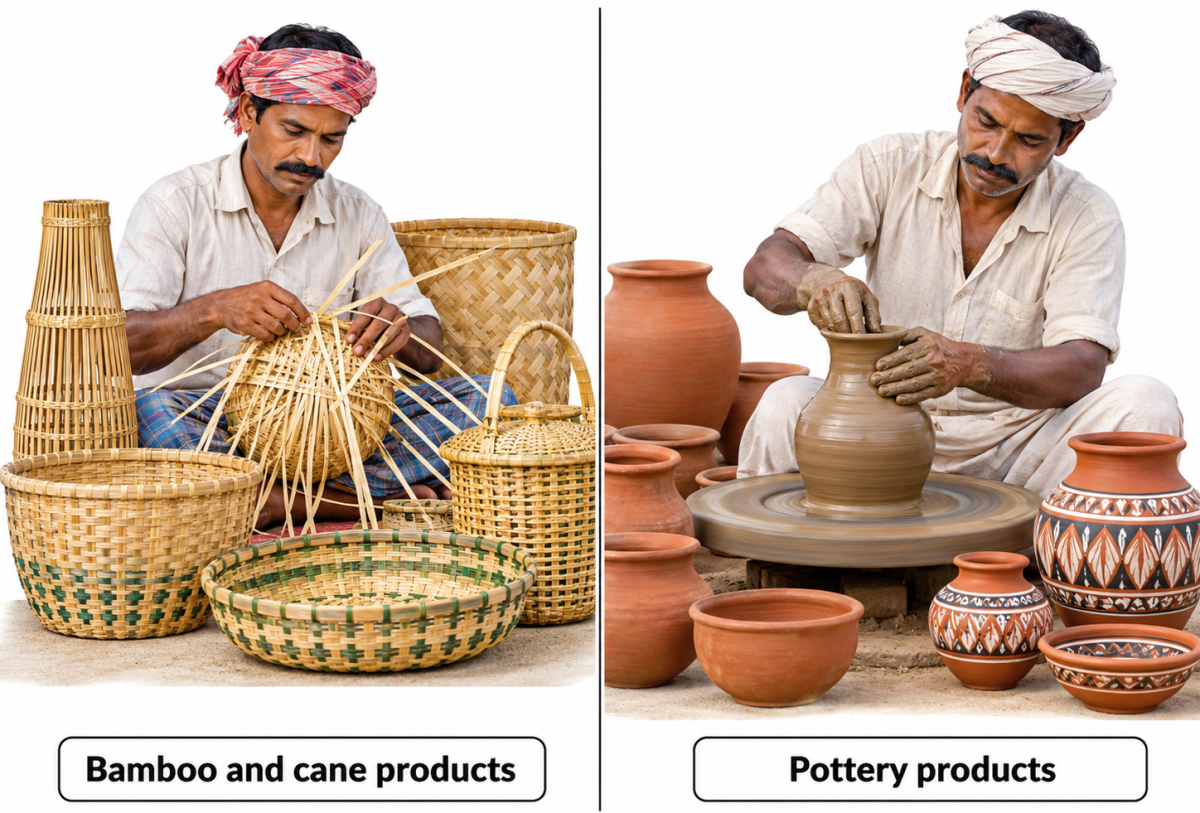
Artisans cut and split bamboo and cane into thin strips, soften and shape them, and then weave them by hand into baskets, boxes, containers and other useful items. The work requires patience, careful handwork and a good sense of design. The skill is usually learnt through years of practice and is passed on from one generation to the next.
Another example is pottery, such as the pottery products of Delhi. Potters shape clay on a wheel, dry and bake the pots, and then paint them with colourful designs by hand. Each piece reflects the skill, creativity and effort of the potter.
Identify a factory in your region. Find out how much capital may have been invested in the construction of the factory (you may provide an estimate). What kinds of equipment does the factory use to create its finished products?
Answer
Let us take the example of a fruit processing factory that makes fruit juices and jams.
The capital invested in such a factory may be around ₹10 crore (estimate). This includes money spent on buying or leasing the land, constructing the factory building, buying machinery, setting up storage and purchasing vehicles.
The equipment used by the factory to create its finished products includes:
- Conveyor belts to move fruits from one stage to another.
- Washing and sorting machines to clean the fruits and separate them by size and quality.
- Peeling, cutting and crushing machines to extract pulp and juice.
- Boilers and mixing tanks to cook, heat and mix the products.
- Bottling, sealing and packaging machines to pack the finished products.
- Cold storage units to keep raw fruits and finished products fresh.
- Delivery vehicles to transport the products to shops and markets.
Can you think of some technological advancements that have impacted the lives of people and communities around you? Talk to elders at home and in the neighbourhood about it.
Answer
Some technological advancements that have impacted the lives of people and communities around us are:
- Digital payments – payments can now be made at the click of a button through UPI (Unified Payments Interface), instead of carrying cash everywhere.
- Email and mobile phones – earlier, people sent letters by post, which took many days. Now, people communicate quickly and at a lower cost through email and mobile phones.
- Weather updates – farmers can get advance weather updates and plan their farming activities better.
- GPS – Global Positioning Systems help find the shortest routes for travelling and transporting goods.
- Online learning – platforms such as SWAYAM allow students to learn at their own pace, from anywhere, free of cost.
- Modern farming and healthcare – drones spray fertilisers to improve crop health, and robots assist doctors in surgical processes.
How do infrastructure and healthcare systems like hospitals, primary healthcare centres, doctors, pharmacies, diagnostic labs, etc., contribute to developing human capital?
Answer
Infrastructure and healthcare systems such as hospitals, primary healthcare centres, doctors, pharmacies and diagnostic labs help in developing human capital by keeping people healthy and fit. Good health improves cognitive development, helps children attend school regularly and enables workers to perform efficiently. Healthy workers can be more productive, creative and are less likely to remain absent due to illness. Thus, healthcare strengthens the quality and productivity of human capital.
Harsh, a student at government school in Grade 8, had to drop out of school two years back as his father lost his job. How do you think the loss of schooling years will affect Shivay when he grows up?
Answer
The loss of schooling years will affect Harsh in the following ways when he grows up:
- He will miss out on the knowledge and basic skills that education provides, which prepare a person to solve real-world problems.
- Without proper education and training, his human capital will remain weak, and he may not be able to do skilled work efficiently.
- He may get fewer job opportunities and may have to take up low-paying work, which will affect his income and standard of living.
- He may find it difficult to learn new skills or use new technology at work, which will lower his productivity.
What problems could businesses face when they do not find workers with the required skills?
Answer
Businesses could face the following problems when they do not find workers with the required skills:
- Production may become slow and inefficient, and work may get delayed.
- The quality of goods and services may be poor, leading to a loss of customers.
- Businesses may have to spend extra money and time on training workers.
- They may have to offer higher salaries to attract skilled workers, which increases costs.
- Machines and advanced technology may not be used properly without skilled workers.
- Businesses may not be able to grow, expand or compete with other businesses.
Are some jobs more important than others? What would happen if nobody cleaned the streets, collected the trash, farmers stopped cultivating the crops, doctors were not available to treat patients, and so on?
Answer
No, all jobs are important. Every worker contributes differently through their work and helps create goods and services for society’s needs.
If nobody cleaned the streets or collected the trash, garbage would pile up, causing pollution and the spread of diseases. If farmers stopped cultivating crops, there would be a shortage of food. If doctors were not available, sick people would not get treatment and many lives would be at risk. Unhealthy people would also not be able to attend school or go to work.
Thus, all jobs depend on one another, and society can function smoothly only when everyone performs their work well.
What could be the lessons for young entrepreneurs that you can gather from the above case?
Answer
The lessons for young entrepreneurs from the life of J.R.D. Tata are:
- Have a vision and dream big – he played a big role in building modern India.
- Take risks and innovate – he started India’s first airline, Tata Airlines, in 1932.
- Keep growing – under his leadership, the Tata Group expanded into areas like steel, cars, power and chemicals.
- Serve society – businesses should not only make money but also help society.
- Care for workers – provide good working conditions for employees.
- Work hard and stay honest – hard work and honesty lead to lasting success and respect.
Does the existing knowledge of the entrepreneur help in finding solutions to the problem at hand? Or do they need to seek other sources?
Answer
The existing knowledge of the entrepreneur does help in finding solutions, as their experience, skills and understanding of the business help them identify problems and make key decisions.
However, existing knowledge is not always enough. New problems often need new ideas and specialised knowledge. So, entrepreneurs also need to seek other sources, such as experts, engineers and research and development (R&D) teams, experienced people in the field, and online courses and portals. They also need to keep learning about new technology and the needs of customers.
Thus, entrepreneurs find the best solutions by combining their own knowledge with knowledge gained from other sources.
Is profit the only motivation for an entrepreneur? Why or why not?
Answer
No, profit is not the only motivation for an entrepreneur. Profit is important for running and expanding a business, but entrepreneurs are also motivated by other factors:
- They want to solve a problem with an innovative solution.
- They derive a deep sense of satisfaction from seeing their dreams become a reality.
- They want to serve people and contribute to the welfare of society.
- They create job opportunities and support the livelihoods of others.
For example, J.R.D. Tata believed that businesses should not only make money but also help society.
What are the other personality traits required to be a successful entrepreneur?
Answer
The personality traits required to be a successful entrepreneur are:
- Vision – the ability to identify a problem and imagine a solution.
- Risk-taking – willingness to invest money and time in a new idea.
- Determination – being resolute and not giving up in the face of difficulties.
- Creativity and innovation – the ability to come up with new ideas, products and services.
- Decision-making – the ability to make key decisions regarding the operation of the business.
- Leadership and organising skills – the ability to combine various factors of production and guide workers.
- Hard work and honesty – working sincerely and dealing fairly with workers and customers.
- Care for others – concern for workers and the welfare of society.
How are local communities and biodiversity affected by such activities? Do you also know some places around you that have seen water and land degradation over time? Discuss in class.
Answer
Activities such as the waste from leather factories and improper disposal of old smartphones affect local communities and biodiversity in the following ways:
- Rivers and groundwater get polluted, and people do not get clean water for drinking and daily use.
- Harmful substances like lead and mercury leak into the ground and water and can harm people’s health.
- Polluted soil becomes less fertile, which affects farming and the livelihoods of farmers.
- Fish and other aquatic animals die in polluted rivers, affecting fishing communities.
- Plants and animals lose their natural habitats, leading to a loss of biodiversity.
Yes, many places around us have seen water and land degradation over time. For example, a lake or river near a town may become polluted when sewage and waste from factories are released into it. Its water may turn dirty and smelly, fish may die and people living nearby may no longer be able to use the water. Similarly, open land where garbage is dumped becomes degraded over time.
How are the factors of production different from each other? What are the difficulties you faced in classifying the factors of production in the exercise given in-text?
Answer
The factors of production are different from each other in the following ways:
- Land includes geographical land and natural resources such as soil, water, forests, minerals and sunlight.
- Labour refers to the physical and mental effort used in production.
- Capital includes money and human-made resources such as machinery, tools, equipment and buildings used for production.
- Entrepreneurship involves organising the other factors of production, taking risks and making important business decisions. Technology acts as a facilitator of production.
The main difficulty in classifying the factors of production is that they are closely interconnected. Some inputs may seem to belong to more than one category. For example, a worker’s effort is labour, while the worker’s specialised knowledge and skills form human capital. Similarly, a shop or building may be linked with land as well as capital.
How does human capital differ from physical capital?
Answer
Human capital differs from physical capital in the following ways:
| Aspect | Human Capital | Physical Capital |
|---|---|---|
| Meaning | Refers to the specialised knowledge, skills, abilities and expertise of people. | Refers to human-made resources such as machinery, tools, equipment, vehicles, computers and buildings used in production. |
| Form | Exists within people and cannot be separated from them. | Consists of durable assets that can be seen, bought, sold or rented. |
| Development | Developed through education, training, healthcare, technology and social and cultural influences. | Obtained by investing money in buying or building assets. |
| Role in production | Improves the quality and efficiency of labour. | Provides the tools, machines and equipment used for production. |
How do you think technology is changing the way people develop their skills and knowledge?
Answer
Technology is changing the way people develop their skills and knowledge in the following ways:
- Online courses – government platforms like SWAYAM offer free online courses in subjects like robotics, aquaculture and textile printing.
- Learning at one’s own pace – students can learn from anywhere and at their own pace, even while pursuing other jobs or courses.
- Removing geographical barriers – people living in remote areas can access quality knowledge and skill development without travelling far.
- Finding jobs – online portals like the National Career Service help people find job opportunities across various sectors, from plumbing to accounting.
- Need for new skills – as new technology comes into use at work, people learn new skills to use it and keep improving their knowledge.
A skill is something you learn and practice to get better. It helps you do things well, like playing a sport, creative writing, solving math problems, cooking, or even communicating well with people. If you could learn one skill today, what would it be and why?
Answer
If I could learn one skill today, I would choose effective communication. It would help me express my ideas clearly, listen to others carefully and work well with people. Good communication is useful in studies, future jobs and everyday life. By practising this skill regularly, I could become more confident and improve my ability to interact with others.
Do you think entrepreneurship is the 'driving force' of production? Why or why not?
Answer
Yes, entrepreneurship can be called the ‘driving force’ of production because:
- The entrepreneur identifies a problem and comes up with an innovative solution.
- The entrepreneur takes risks by investing money and time.
- The entrepreneur gathers and combines the other factors of production — land, labour and capital. Without the entrepreneur, these factors would remain unused.
- The entrepreneur makes key decisions regarding the operation and functioning of the business.
- The entrepreneur brings new products and services to the market and creates job opportunities.
However, entrepreneurship alone cannot produce goods and services. It depends on land, labour, capital and technology, as all the factors complement each other. Thus, entrepreneurship drives production, but it works together with the other factors.
Can technology replace other factors like labour? Is this good or bad? Support your answer with the help of an example.
Answer
Technology can replace labour to some extent, but not completely. For example, increased use of machines such as tractors and harvesters in agriculture lowers the dependence on labour, and drones can spray fertilisers over large fields in a short time. However, human effort is still needed at every stage of production to design, supervise and improve products and processes. Even robots used in surgery only assist doctors; they do not replace them.
This change has both good and bad effects:
- Good effects – technology enables enterprises to produce more goods with the same or fewer inputs. It saves time and effort, lowers costs, improves quality and makes work easier.
- Bad effects – workers who are replaced by machines may lose their jobs, especially if they do not have the skills to use new technology. Some traditional techniques and skills may also decline.
How do education and skill training affect human capital? Can they be substitute for each other, or do they complement each other?
Answer
Education and skill training help develop human capital. Education provides knowledge and problem-solving abilities, while skill training develops practical skills through hands-on experience. Together, they improve productivity, efficiency and career opportunities, helping develop human capital.
Education and skill training mainly complement each other. For example, a civil engineering student needs theoretical knowledge along with practical training to help design and build safe, durable, cost-effective and eco-friendly roads and bridges. Combining knowledge with hands-on skills prepares people to work more effectively.
Imagine you want to start a business that produces steel water bottles. What kind of inputs are needed? How would you obtain them? Suppose one of the factors is missing; what happens to your business operations?
Answer
The inputs needed to start a business that produces steel water bottles, and the ways to obtain them, are as follows:
- Land – a plot of land for the factory, and natural resources like water. I would either purchase the land or pay rent to use it.
- Raw materials – steel sheets, lids, rubber rings and packaging material. I would buy them from suppliers.
- Labour – workers for cutting, shaping, polishing and packing the bottles, along with skilled engineers and supervisors. I would hire them and train them.
- Capital – money, a factory building and machines for cutting, shaping, welding, polishing and printing, along with vehicles for transport. I would use my personal savings and take help from family and friends, and take a loan from a bank to meet any shortfall.
- Entrepreneurship – as the entrepreneur, I would organise all the inputs, take risks and make the key decisions.
- Technology – modern machines and methods to produce good-quality bottles quickly and at a lower cost.
If any factor of production is missing, production may slow down or stop. For example, a shortage of steel sheets can halt production, unskilled workers may reduce quality, and insufficient capital can prevent buying machines or paying workers. Thus, all factors are essential for smooth production.
Think like an economist. Let's explore what happens when things change. If you were Ratna, what would you do in the following situations? Discuss with your classmates.
I. Suppose the rent for your space suddenly doubles.
- Will you raise the price of the food served to cover the costs?
- Will you look for a cheaper location?
- How does this affect your business?
II. Imagine one of your helpers quits suddenly.
- Can the remaining workers manage the same amount of work?
- Will you need to offer a higher salary to attract a new worker?
III. You receive a small loan to invest in better technology for your restaurant.
- Will this increase the production or improve quality?
- Will it help you reach more customers?
IV. Suppose another restaurant opens in the neighbourhood.
- How will you attract and keep your customers?
- Will you improve your service, reduce prices, or offer something new?
V. What government laws or rules should be amended to improve the ease of doing business?
Answer
I. If the rent suddenly doubles, my cost of using land will increase. I would first try to reduce other costs, such as wastage of ingredients and electricity. I may raise the prices of food slightly, but not too much, as customers may stop coming. I would not shift to a cheaper location easily, because Pause Point is popular among highway travellers and a new location may not attract the same customers. Higher rent will reduce my profits and may make it harder to expand the business.
II. If one of my helpers quits suddenly, the remaining workers may manage the work for a short time, but they will be overburdened. This may lead to slower service and lower food quality. I would need to hire a new worker quickly. If skilled workers are hard to find, I may have to offer a higher salary to attract one, which will increase my costs. I could also train an existing worker to take up the extra work.
III. If I receive a small loan to invest in better technology, such as modern kitchen equipment and a digital payment system, food can be cooked faster and in larger quantities with better quality. This will increase production and improve quality. Using technology such as online food ordering and social media, I can also reach more customers. However, I will have to repay the loan along with interest.
IV. If another restaurant opens in the neighbourhood, I will face competition. To attract and keep my customers, I will maintain the taste and quality of my food and provide fast and friendly service. I may improve my service, offer discounts to regular customers and add new dishes to the menu. I would avoid reducing prices too much, as it may lead to losses.
V. To improve the ease of doing business, the government can make the following changes:
- Simplify the process of registering a business and getting licences.
- Provide a single-window system so that all approvals can be obtained at one place.
- Make loans available to small businesses easily and at lower interest rates.
- Reduce paperwork and make rules simple and easy to follow.
- Support skill training so that businesses can find skilled workers.