
How do we categorise natural resources?
Answer
Natural resources can be categorised mainly in two ways:
- Based on their uses:
- Resources essential for life — air, water and soil.
- Resources for materials — wood, marble, metals, gold, etc.
- Resources for energy — coal, water, petroleum, natural gas, sunlight, wind, etc.
- Based on their ability to regenerate:
- Renewable resources — resources that are restored and regenerated naturally, such as sunlight, wind, river water, soil and timber from forests.
- Non-renewable resources — resources that are created over long periods and cannot be replenished at the rate at which we use them, such as coal, petroleum, iron, copper and gold.
What is the connection between the distribution of natural resources and different aspects of life?
Answer
As natural resources are unevenly scattered across the globe, their locations shape human society in several key ways:
- Settlements & Jobs: Industries set up where resources exist, creating job opportunities and causing towns to grow with improved modern amenities.
- Trade & Industry: Resource-rich locations drive regional and global trade. When paired with human expertise, unique goods like Wootz steel are created—a process that historically helped build major empires in India.
- Displacement & Social Conflict: Development in resource-rich areas can force local communities out of their homes or threaten culturally sacred sites, leading to social friction.
- Cross-Border Tensions: Ecosystems cross political borders, often leading to disputes over shared assets. Examples include river water sharing (like the Kaveri River dispute among Indian states) and historical or modern wars over resource control.
- The "Paradox of Plenty": Having abundant resources does not automatically bring wealth. Regions that lack processing facilities or value-adding industries often experience slower economic growth, a situation known as the "natural resource curse".
What are the implications of unsustainable use / over exploitation of natural resources?
Answer
The implications of unsustainable use or over exploitation of natural resources are:
- Renewable resources stop being renewable — the natural rhythm of restoration and regeneration is disturbed. If we harvest timber faster than the forest can grow trees, we will eventually deplete the forest.
- Rising temperatures — fossil fuel-driven industrialisation and the cutting down of forests for agriculture and other purposes have led to rising temperatures. On account of this, the glaciers in some places in the Himalayas are melting faster than precipitation can replace them, which has implications on water security for the populations living in the plains dependent on the 'water tower'.
- Loss of species — commercialisation of fishing has resulted in over-fishing. The population of tuna, an important type of fish that keeps the ocean ecosystem in balance, is on a decline.
- Pollution — wastes from industries are frequently discharged into rivers and other water bodies without proper treatment. These wastes often cannot decay to become the food of some lifeform, and the river becomes poisonous and cannot support life.
- Depletion of groundwater — in most states the rate of extraction of groundwater is greater than the rate at which the water table is replenished. This leads to a higher cost of extraction and eventually to its unavailability.
- Soil degradation — the improper use of chemical fertilisers and pesticides has led to soil degradation and crop failure.
- Pollution, biodiversity loss and climate change — the irresponsible treatment of natural resources has led to these, and they have been taking place at an increased pace in recent years.
- Exhaustion of non-renewable resources — non-renewable resources cannot be replenished at the rate at which they are used. It has been estimated that the coal reserves in India may last another 50 years.
Identify human actions in your surroundings that result in Nature losing her ability to restore and regenerate. What types of interventions can be undertaken to restore Nature's cycle?
Answer
Human actions in our surroundings that result in Nature losing her ability to restore and regenerate are:
- Clearing of forests for housing, agriculture and other purposes.
- Discharge of industrial waste into rivers and other water bodies without proper treatment.
- Extraction of groundwater at a rate greater than the rate at which the water table is replenished.
- Improper use of chemical fertilisers and pesticides, which degrades the soil.
- Commercialised and excessive fishing, which does not allow fish populations to be maintained.
- Excessive use of fossil fuels, which adds to pollution and rising temperatures.
- Polluting processes of production, such as cement manufacture, which release fine dust and cause soil and water pollution.
The interventions that can be undertaken to restore Nature's cycle are:
- Afforestation with suitable native trees to restore ecosystems.
- Treating waste before releasing it into water bodies.
- Rainwater harvesting and water reuse to conserve groundwater.
- Using compost, cow dung and other natural fertilisers, natural pest repellents, mulching and multi-cropping in place of chemical inputs.
- Regulating fishing, especially during breeding seasons.
- Shifting to renewable sources of energy such as solar, wind and flowing water.
- Using alternative building materials such as stone, mud, plant-based materials and materials recycled from waste plastic.
- Reusing and recycling materials to reduce pressure on natural resources.
Take up a small research study to assess the types of renewable resources in your region; you may discuss with your teacher the geographical area of your study and sources to access information that you may need. What has been the change in their status over time? Make a small report that identifies the reasons for the change and what may be done.
Answer
Sample report — Sikkim:
In Sikkim, renewable resources such as soil and biodiversity had been affected by the use of expensive chemical fertilisers and pesticides. Farms like Pema's family farm faced declining yields and mounting debts on account of these chemical inputs.
The status of these resources changed after the state government announced a policy to promote organic farming. Initially the yields dropped as the soil was recovering from years of chemical use, but after about five years the farms were thriving. In 2016, Sikkim became a 100 per cent organic state with all of its farmland certified organic. Local biodiversity flourished, with beneficial insects and birds returning; tourism increased as visitors came to see the organic farming model, and farmers' incomes grew by 20 per cent on average.
The reasons for the earlier decline were the heavy use of chemical fertilisers and pesticides, which degraded the soil and harmed biodiversity. The change for the better came from the switch to compost, natural pest repellents prepared using neem and garlic, and the growing of multiple crops across the year.
What may be done is to continue these practices so that soil fertility and biodiversity are protected and Nature's process of restoration and regeneration is not disturbed.
What are the non-renewable resources that you use daily, directly or indirectly? What are the possible renewable substitutes? What are some of the steps we can take to transition to renewables?
Answer
Non-renewable resources used daily include petroleum for transport, coal and natural gas for energy, and metals and minerals used in vehicles, buildings, utensils and electrical equipment.
Renewable alternatives include solar, wind and hydropower for energy. For metals and minerals, reuse and recycling can reduce the need for fresh extraction.
The steps we can take to transition to renewables are:
- Switch to renewable sources of energy for as many purposes as we can, such as solar, wind and hydropower.
- Reduce the unnecessary use of coal, petroleum and natural gas.
- Conserve electricity and avoid the wastage of energy.
- Use public transport, cycling or walking to reduce the consumption of fuel.
- Reuse and recycle materials so that fewer metals and minerals need to be extracted.
- Use the non-renewable resources we have judiciously, so that they last long enough for humanity to find more sustainable alternatives.
(i) Select any two natural resources. Gather information about their availability across different parts of India. Mark them on a map. What do you observe about their distribution? What are the types of economic activities connected with them?
(ii) Discuss the implications of extracting the natural resources in those parts for current and future generations. Suggest ways in which we can use Nature's gifts in responsible ways.
Answer
(i) The two natural resources selected are coal and iron ore.
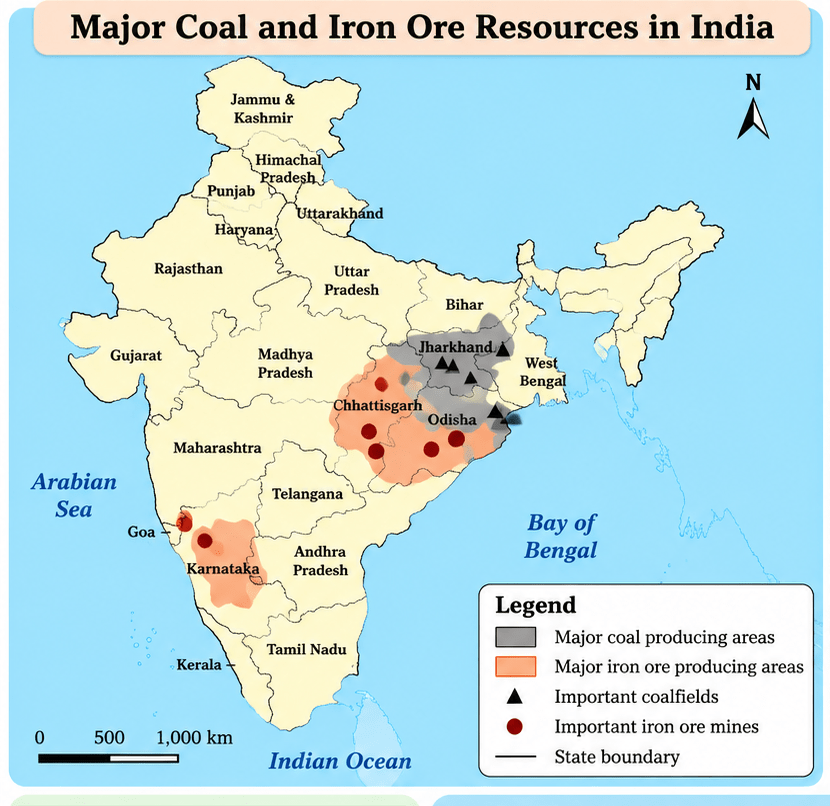
- Coal is found mainly in Jharkhand, Odisha, Chhattisgarh and West Bengal, with important coalfields such as Jharia, Raniganj, Bokaro, Talcher, Korba and Singareni. It supports mining, thermal power generation and industries.
- Iron ore is found mainly in Odisha, Jharkhand, Chhattisgarh, Karnataka and Goa. It supports mining and the iron and steel industry.
Observation: These resources are unevenly distributed and are concentrated in particular regions. Mining and related industries provide employment and support the growth of towns and industries.
(ii) Extraction of these resources provides energy, raw materials, employment and economic development. However, excessive mining can cause land degradation, pollution, deforestation, loss of biodiversity and displacement of people. Since coal and iron ore are non-renewable, excessive use reduces the resources available for future generations.
Nature's gifts can be used in responsible ways by:
- Using non-renewable resources judiciously.
- Increasing the use of renewable sources of energy.
- Reusing and recycling materials.
- Controlling pollution and treating industrial waste.
- Restoring mined land through reforestation and other conservation measures.
- Protecting forests, water and biodiversity while carrying out development activities.
Find out about such a conflict in the international context. Discuss your findings in the class.
Answer
One example of an international conflict over a natural resource is the sharing and use of the waters of the Brahmaputra River.
The river rises in Tibet, where it is called the Yarlung Tsangpo, flows through India as the Brahmaputra and then enters Bangladesh. Since the river flows across national boundaries, its water is shared by people in different countries.
Upstream activities such as irrigation, hydropower projects and water storage can affect the flow of water downstream. This can create concerns among countries that depend on the river for agriculture, fishing, transport and other needs.
Such issues can be addressed through negotiations, sharing of information and agreements between the countries. However, reaching agreements over shared natural resources can be difficult because each country has its own needs and interests.
What do you think are the different inputs required to enable the use of the natural resources available in different geographical areas?
Answer
The different inputs required to enable the use of the natural resources available in different geographical areas are:
- Technology — an entity can be called a resource only if it is technologically accessible. For example, petroleum lying deep under the ocean can be used only if we have the technology to access it.
- Economic feasibility — the exploitation of the resource must be economically feasible, that is, the cost of extraction must not be too high.
- Cultural acceptability — the exploitation of the resource must be culturally acceptable; cutting trees in sacred groves, for instance, is not.
- Human knowledge and skills — combined with the natural resource, knowledge and skills can create unique products of higher value, like the Wootz steel of the past.
- Industries — economies need industries that convert the resources into products of higher value; without them, having plenty of resources does not automatically make a country rich.
- Good governance and strategic planning — these determine whether natural resources become lasting benefits or temporary windfalls, and they are also needed to balance resource extraction with sustainability.
Take a pause. Look at yourself and the things around you. What is the origin of each of them? At some point they all lead to Nature; even the plastic button on your shirt.
Answer
Everything around us can be traced back to Nature at some point. The food we eat comes from plants and animals, while crops grow in soil; the water we drink comes from rivers, ponds and rain; the air we breathe comes from the atmosphere. Our clothes are made from cotton or other fibres, our furniture and paper come from the wood of trees, our utensils and vehicles come from metal ores, our houses are built of stone, mud, sand and cement taken from the Earth, and the electricity we use is generated from coal, water, sunlight or wind. Even the plastic button on a shirt is made from materials obtained from petroleum, which formed in the Earth over millions of years. Thus the origin of each of these things leads back to natural resources — materials and substances that occur in Nature and are valuable to humans.
What might be the different criteria we can use to categorise natural resources?
Answer
The different criteria we can use to categorise natural resources are:
- The uses we put them to — this gives us resources essential for life such as air, water and soil; resources for materials such as wood, marble and metals; and resources for energy such as coal, petroleum, natural gas, sunlight and wind.
- Whether they can be replenished or not — this gives us renewable resources, which are restored and regenerated naturally, and non-renewable resources, which are created over long periods and cannot be replenished at the rate at which we use them.
- Whether they are living or non-living — this gives us resources such as forests, fish and other living things on the one hand, and minerals, metals and water on the other.
What can make what is today a renewable resource non-renewable tomorrow? Describe some actions that can prevent this from happening.
Answer
A renewable resource can become depleted when we use it faster than Nature can restore or regenerate it. For example, excessive cutting of trees can reduce forests, over-extraction of groundwater can lower the water table, and overfishing can reduce fish populations.
Some actions that can prevent this are:
- Use renewable resources at a rate that allows Nature to restore and regenerate them.
- Plant native trees to restore forests and ecosystems.
- Harvest rainwater, conserve water and reuse water wherever possible.
- Use compost, natural pest-control methods and other sustainable farming practices to protect soil.
- Regulate fishing, especially during breeding seasons.
- Treat waste before releasing it into rivers and other water bodies.
- Reduce the use of fossil fuels and increase the use of renewable energy to reduce environmental damage.
Name five ecosystem functions that serve humans.
Answer
Five ecosystem functions that serve humans are:
- Trees naturally produce the oxygen that we breathe.
- A forest naturally filters water, giving us clean water.
- A forest prevents soil erosion, which protects our farmland.
- A forest provides habitat for animals, which supports biodiversity.
- Insects and other creatures living in the forest pollinate our crops.
What are renewable resources? How are they different from non-renewable ones? What can people do to ensure that renewable resources continue to be available for our use and that of future generations? Give two examples.
Answer
Renewable resources are resources that can be naturally replenished or regenerated over time, provided they are used sustainably. Examples include sunlight, wind, water and forests.
They differ from non-renewable resources in the following ways:
- Renewable resources can be replenished naturally, while non-renewable resources take a very long time to form.
- Renewable resources can remain available if they are used at a rate at which Nature can regenerate them, while non-renewable resources cannot be replenished at the rate at which they are used.
- Examples of renewable resources are water, forests and sunlight, while coal, petroleum and minerals are non-renewable resources.
To ensure that renewable resources remain available for future generations, people should use them sustainably, conserve them and protect the natural processes that regenerate them.
Two examples:
- Timber — we can take timber from the forest, in limited quantities, for a long time if we allow the forest to regenerate.
- River water — river water remains renewable as long as glaciers and forests exist and the rivers are fed regularly by rain and melting glaciers.
Identify cultural practices in your home and neighbourhood that point to mindfulness in the use of natural resources.
Answer
Cultural practices in our homes and neighbourhoods that show mindful use of natural resources include:
- Worshipping and caring for plants and trees, such as performing tulasi puja.
- Offering arghyam to Surya as a mark of respect and gratitude towards Nature.
- Avoiding the wasteful use of water and following traditional practices such as rainwater harvesting and the rejuvenation of ponds and tanks.
- Repurposing, reusing and recycling household articles instead of discarding them.
- Using cow dung, compost and other natural fertilisers in gardens or fields instead of relying only on chemical fertilisers.
- Protecting trees and sacred groves and avoiding unnecessary cutting of trees.
What are some considerations to keep in mind in the production of goods for our current use?
Answer
Some important considerations in the production of goods are:
- Minimise pollution – Production processes should cause as little air, water and soil pollution as possible.
- Treat waste properly – Industrial waste should be treated before it is released into the environment.
- Use sustainable materials – Renewable, recycled and locally available materials should be preferred where possible.
- Use resources wisely – Renewable resources should be used at a rate that allows them to regenerate, while non-renewable resources should be used carefully.
- Use suitable technology – Traditional knowledge can be combined with modern technology to develop sustainable methods of production.
- Reduce waste and reuse materials – Products and materials should be reused, repaired and recycled wherever possible.
- Consider people and future generations – Production should provide local employment, meet present needs and conserve resources for future generations.