
How did foreign invasions and the rise of new dynasties reshape India's political boundaries during this period?
Answer
Foreign invasions and the rise of new dynasties repeatedly reshaped India's political boundaries in the following ways:
- Invasions by Turkic, Afghan and later Mughal forces from beyond the Hindu Kush led to the establishment of new political powers in different parts of India.
- The Delhi Sultanate, formed after the defeat of Prithviraj Chauhan in 1192, expanded its control over large parts of northern and central India under the Mamluks, Khiljis, Tughlaqs, Sayyids and Lodis.
- Under Muhammad bin Tughlaq, most of the Subcontinent came under one ruler for the first time since the Mauryan Empire, but this dominance was short-lived.
- Several regional powers such as the Eastern Gangas, Hoysalas and the Rajputs of Mewar resisted the expansion of the Delhi Sultanate.
- As the Delhi Sultanate weakened, new powers such as the Vijayanagara Empire, the Bahmani Sultanate and later the Deccan Sultanates emerged. Timur's attack on Delhi further weakened the Sultanate, and its territory shrank considerably under the Lodis.
- In 1526, Babur defeated Ibrahim Lodi in the First Battle of Panipat and established the Mughal Empire.
- Under rulers such as Akbar and Aurangzeb, the Mughal Empire expanded over large parts of the Subcontinent, reaching its greatest extent under Aurangzeb.
- At the same time, the Rajputs, Ahoms, Sikhs, peasant communities and tribal groups continued to resist Mughal expansion, and new regional powers such as the Sikh Empire rose as the Mughal Empire declined.
- Thus, continuous invasions, warfare, resistance, alliances and the rise and fall of dynasties repeatedly reshaped India's political map.
How did Indian society respond to invasions? How did India's economy adapt during times of political instability?
Answer
Response of Indian society to invasions:
- Many kingdoms offered stiff resistance — the Eastern Gangas under Narasimhadeva I, the Hoysalas, the Musunuri Nayakas, Rana Kumbha of Mewar, Maharana Pratap, the Ahoms and the Sikhs.
- Peasant communities, such as the Jat peasantry, rebelled against harsh exploitation.
- Tribal groups such as the Bhils, Gonds, Santhals and Kochs fought back against attempts to annex their territory or impose taxes on them. Rani Durgavati of the Garha kingdom fought bravely against Akbar's forces.
- Some groups used guerrilla warfare and their knowledge of the terrain, as Maharana Pratap and the Ahoms did.
- Rajput women committed jauhar to avoid being captured and enslaved.
- Communities strove to maintain or revive their traditions, rebuilt towns, cities and temples, and blended indigenous and foreign elements to create new cultural expressions and a shared heritage.
- By and large, people of different faiths and communities lived peacefully side by side, economically dependent on each other.
Adaptation of India's economy:
- Agriculture remained the mainstay of the economy. The expansion of irrigation systems increased agricultural productivity and allowed multiple food and non-food crops to be grown.
- Artisanal industries such as textiles, weapons, utensils, ornaments and jewellery continued to thrive, and ship-building developed considerably.
- Indian goods were exported through ports such as Calicut, Mangalore, Surat, Masulipatnam and Hooghly, and India imported much less than it exported.
- Decentralised economic and social systems, such as śhreṇis (guilds), jātis and systems for credit, kept economic activity going.
- The hundi system enabled merchants to transfer funds across political boundaries without physically carrying currency, making them less vulnerable to plunder.
- Trader communities such as the Marwaris developed parallel systems of credit and trust that worked independently of official structures and across different political regimes.
- Temples acted as centres of economic activity by providing credit to merchants, funding trade and developing community infrastructure.
- Thus, despite political instability, the Subcontinent remained one of the wealthiest regions in the world.
What impact did this period have on the lives of the people?
Answer
This period had a deep impact on the lives of the people, both negative and positive:
- Military campaigns raided villages and cities, plundered wealth and destroyed temples and seats of learning.
- Large numbers of people were killed or enslaved during invasions and conquests, such as Timur's attack on Delhi and Akbar's conquest of Chittorgarh.
- Taxes such as the jizya and the pilgrimage tax placed an economic burden on non-Muslims and caused public humiliation.
- Peasants bore the heaviest burden of land revenue, which was usually one-fifth of the produce but was raised by some sultans to as high as one-half.
- Poorly executed schemes, such as Muhammad bin Tughlaq's shifting of the capital and his token currency, caused great loss of life and economic decline.
- The peasantry suffered severe famines, and by the late 1600s, many peasants lost their land and became bonded labourers.
- Craftspeople and labourers often faced harsh economic conditions, as wealth was concentrated in the hands of rulers, courtiers, high officials and merchants. Frequent warfare also caused forced displacement of people.
- On the positive side, roads, bridges, canals, irrigation works and new cities were built, and agriculture and trade expanded.
- Art, architecture, literature, music and painting flourished, and people of different faiths largely lived peacefully side by side, creating a shared heritage.
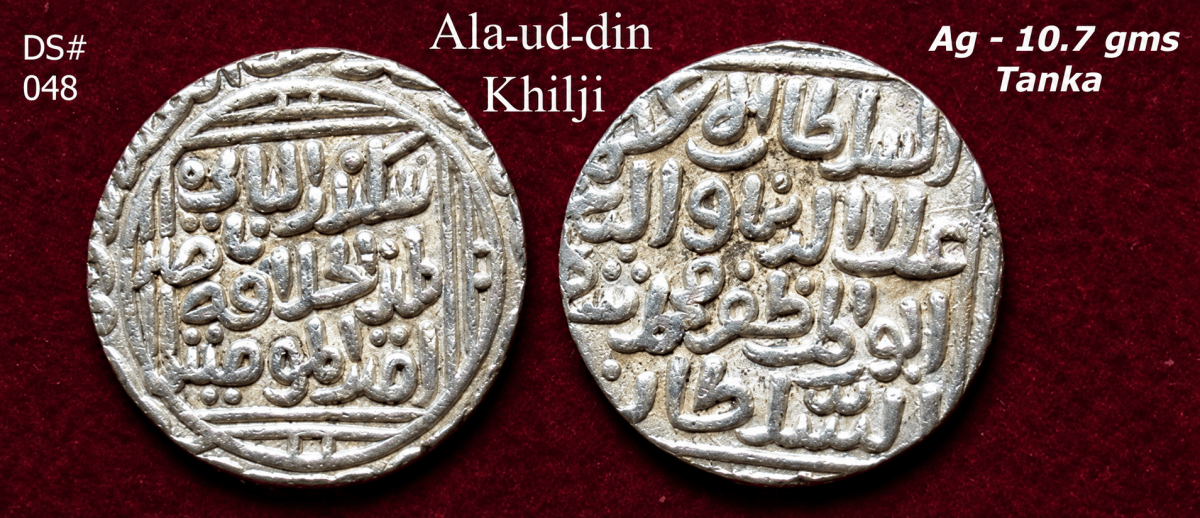
Looking at Fig. 2.6, why do you think Ala-ud-din Khilji called himself 'the second Alexander'?
Answer
Alexander was a famous conqueror who ruled a vast empire. Ala-ud-din Khilji called himself ‘the second Alexander’ (Sikander Sani) to present himself as a great conqueror like Alexander. His military campaigns expanded the Delhi Sultanate over large parts of northern and central India and into the south. The title on his coins helped project his power and ambition.
What kind of resources do you think were needed to maintain an army and wage war in those days? Discuss in groups the various types of expenditure involved, from weapons or food for soldiers to animals used in warfare, road construction, etc.
Answer
Maintaining an army and waging war required large amounts of money and resources. The main expenses included:
- Food and wages for soldiers and other military personnel.
- Weapons and equipment, such as swords, spears, bows, arrows and shields.
- Horses, elephants and camels, along with their food and care.
- Transport and supplies for moving soldiers, weapons and provisions.
- Roads and bridges to help armies move from one place to another.
- Forts and military camps for defence, shelter and storage.
- Clothing and other necessities for soldiers.
Rulers therefore needed large revenues from land revenue, taxes and other sources to maintain their armies and conduct military campaigns.
Why do you think such locations were chosen for many of the medieval forts? Discuss pros and cons. (Hint: think of issues of strategy, security, vulnerability, etc.)
Answer
Many medieval forts, such as Kumbhalgarh Fort, were built on hilltops surrounded by forests and steep slopes because such locations gave natural protection against enemies.
Pros:
- The height of the hill allowed defenders to watch the surrounding area and spot approaching enemies from far away.
- Steep slopes made it very difficult for enemy soldiers, horses, elephants and heavy weapons to reach the fort walls.
- Dense forests acted as a natural barrier and provided cover for surprise attacks on invaders.
- Defenders fighting from higher ground had an advantage over attackers below.
- Such forts could guard important routes and passes and served as strongholds and symbols of the ruler's power.
Cons:
- Building massive walls and structures on hilltops was difficult, slow and very expensive.
- Supplying food, water and other goods to the fort was difficult, especially during a long siege.
- If an enemy surrounded the fort for a long time, the defenders could run out of supplies, as happened at Chittorgarh, which Akbar besieged for more than five months.
- Forts in remote locations were isolated, which made communication with other parts of the kingdom and the movement of the army slow.
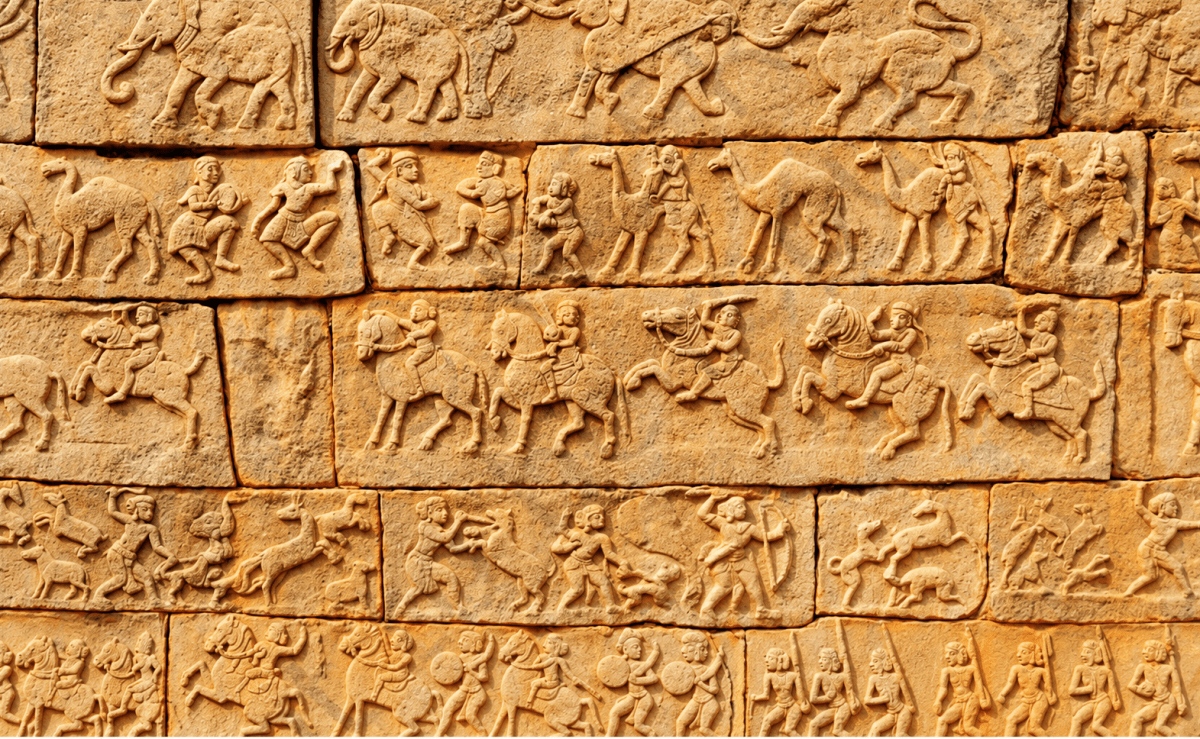
In Fig. 2.14, what elements do you observe? What do they tell you about life then? (Hint: observe the weapons, the animals, the activities.)
Answer
Elements observed in the panel:
- Animals such as horses, elephants and camels, many of them with riders.
- Soldiers and horsemen carrying weapons such as swords, spears, shields and bows.
- Scenes of fighting, hunting, and men attacking or taming animals.
- Rows of people who appear to be walking in a procession or dancing.
What they tell us about life then:
- Warfare was an important part of life, and armies depended heavily on horses and elephants, which explains why horses bought from Portuguese traders were so valued in Vijayanagara.
- Camels and horses show that animals were used for transport and trade over long distances.
- Hunting was a common activity, especially among kings and nobles.
- Processions, dances and festivals were part of social and religious life.
- The detailed carvings show that sculptors were highly skilled and that rulers patronised art and temple building.
Compare the maps in Figs. 2.3, 2.12 and 2.16. What differences do you notice? What is the 'reshaping' that has occurred?
Fig 2.3
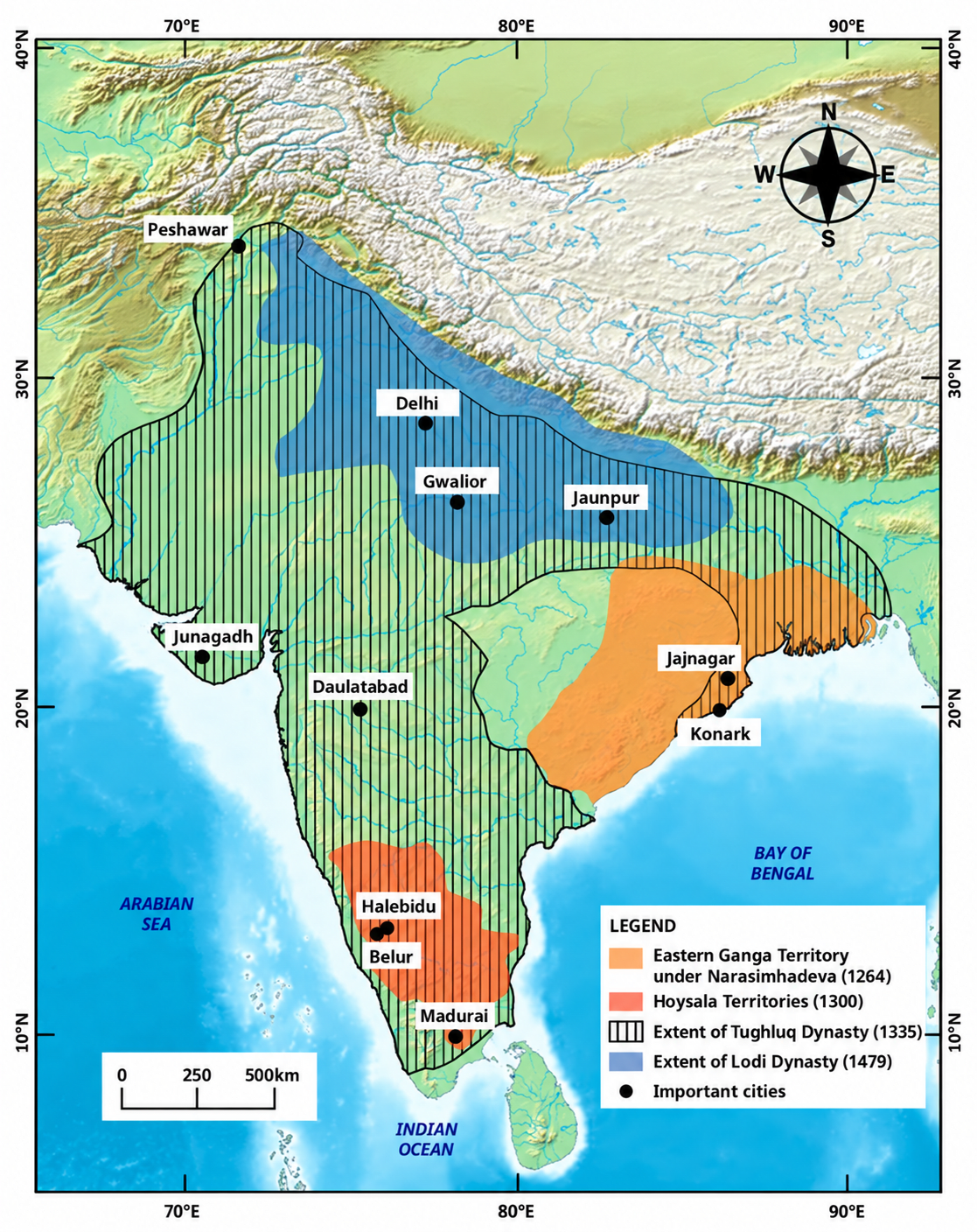
Fig 2.12
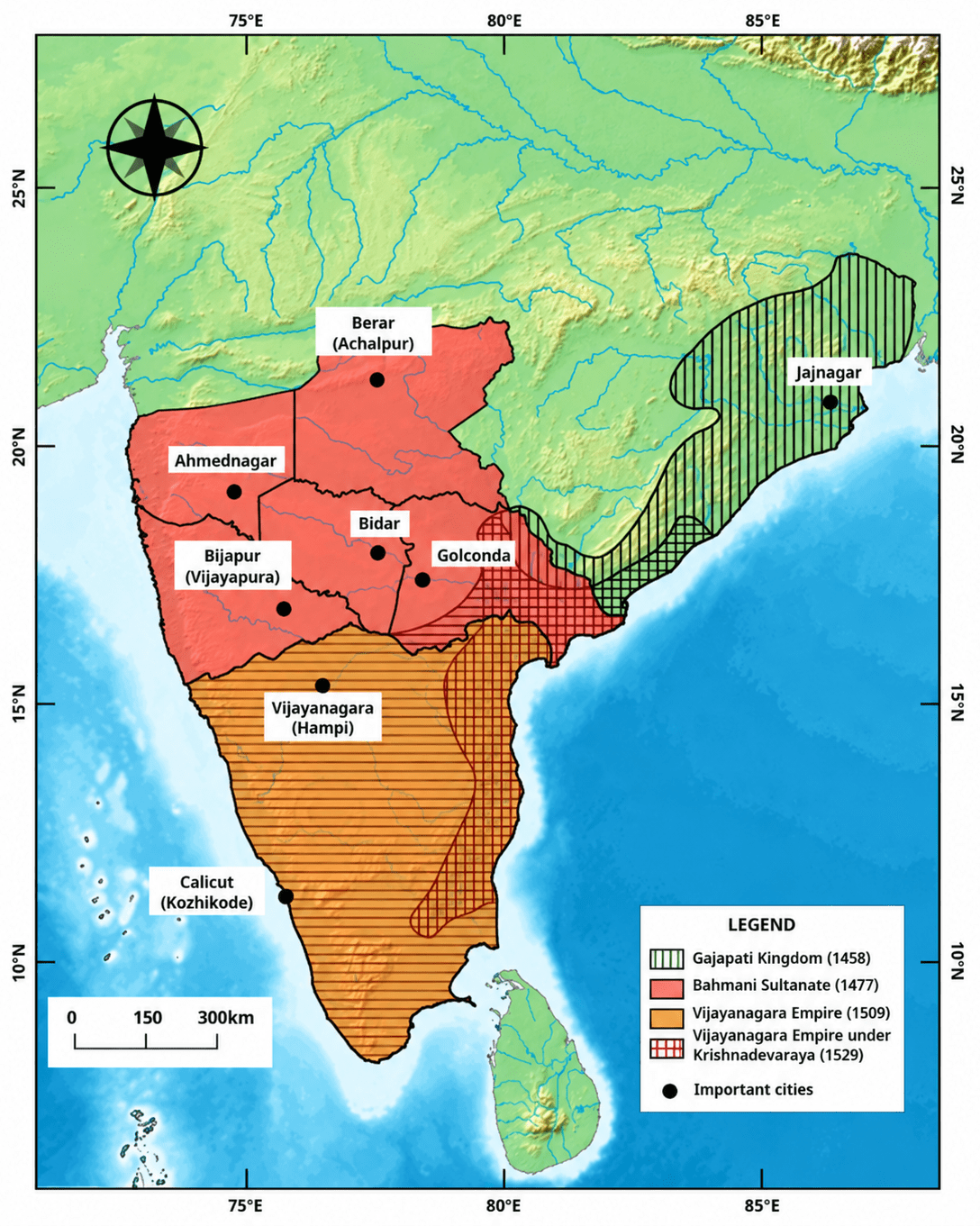
Fig 2.16
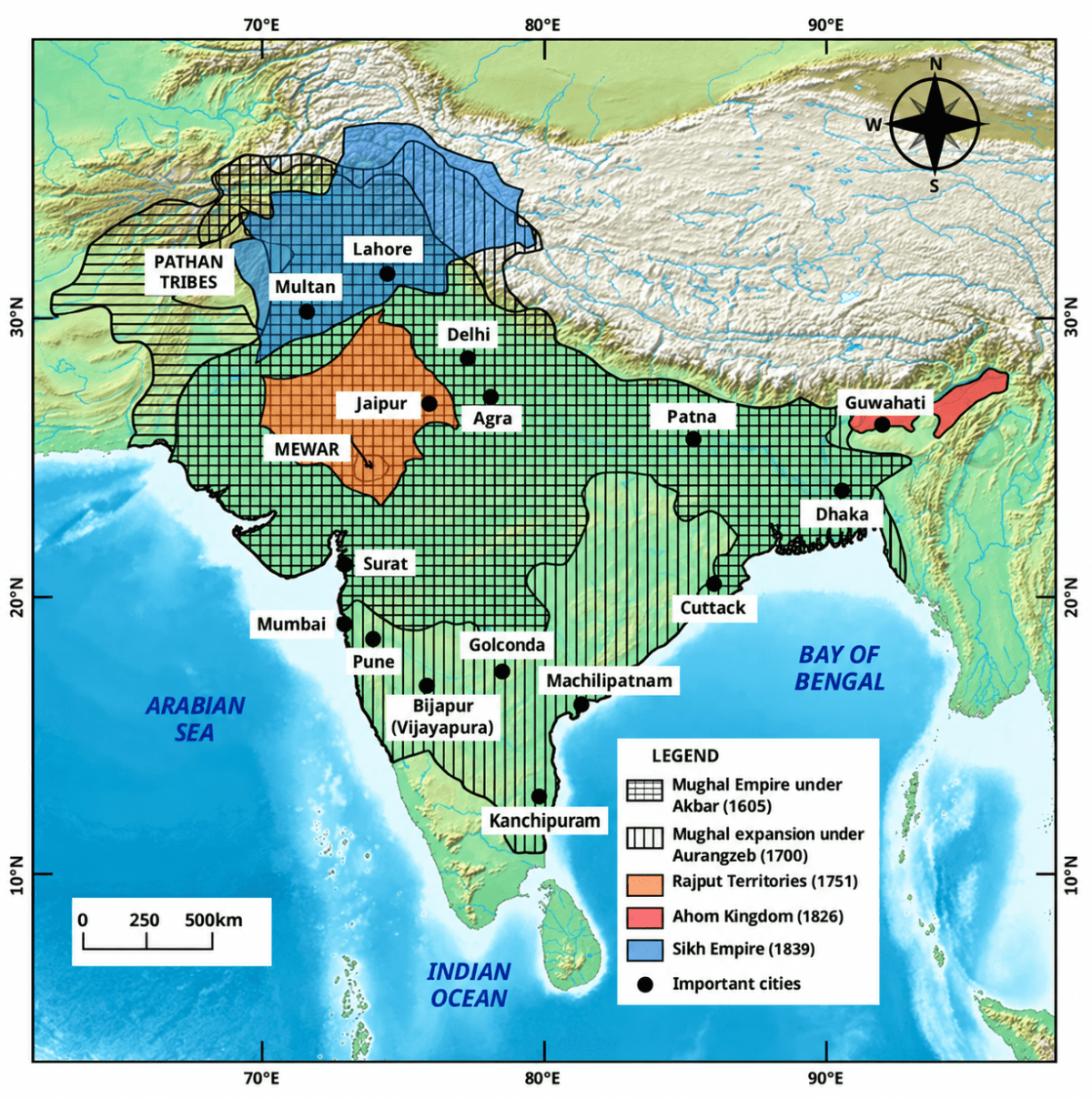
Answer
Differences noticed in the maps:
- Fig. 2.3 shows that under the Tughlaqs (1335), the Delhi Sultanate covered most of the Subcontinent, but by the time of the Lodis (1479), it had shrunk to a smaller region in the north around Delhi, Gwalior and Jaunpur. The Eastern Gangas and the Hoysalas held territories in the east and south.
- Fig. 2.12 shows that the Deccan and the south were divided among new powers — the Bahmani Sultanate (1477), the Vijayanagara Empire (1509), which expanded further under Krishnadevaraya (1529), and the Gajapati Kingdom (1458) on the east coast.
- Fig. 2.16 shows the Mughal Empire under Akbar (1605) covering most of north and central India and its expansion under Aurangzeb (1700) deep into the south. It also shows the later rise of regional powers — the Rajput territories (1751), the Ahom Kingdom (1826) and the Sikh Empire (1839).
The 'reshaping' that occurred:
- Political power shifted from the Delhi Sultanate to new regional kingdoms in the Deccan and the south, and then to the Mughal Empire.
- The boundaries of empires expanded and shrank repeatedly — the Delhi Sultanate grew and then shrank, while the Mughal Empire grew to its greatest extent and later declined.
- As the Mughal Empire weakened, regional powers such as the Rajputs, Ahoms and Sikhs rose again, showing that India's political map kept changing throughout this period.
In his last letters to two of his sons, Aurangzeb wrote, "I came alone and am going away alone. I know not who I am and what I have been doing. … I have not done well for the country and the people, and of the future there is no hope. I was helpless [in life] and I am departing helpless." What do these words tell us about Aurangzeb? How do you feel about them?
Answer
What the words tell us about Aurangzeb:
- He felt lonely and helpless towards the end of his life.
- He expressed regret about his actions and felt that he had not done enough for the country and its people.
- He seemed to question the meaning and purpose of his life and achievements.
- His words show that, despite ruling a vast empire, he felt uncertain and dissatisfied at the end of his life.
- They suggest that power and conquest did not bring him peace or happiness.
How I feel about them:
These words make me feel that power and success alone cannot guarantee happiness or satisfaction. They also show how a person may reflect on their actions and achievements at the end of life.
Discuss in class how the paik system affected the daily lives of the people in the Ahom kingdom, both in terms of challenges and benefits, and helped the king manage both the army and the economy.
Answer
Under the paik system, every able-bodied man had to provide service to the state through labour or military duty in exchange for land rights.
Benefits for the people:
- People received land rights, which gave them a means of livelihood through agriculture.
- They benefited from public infrastructure, such as roads and embankments, built through the system.
- Every man took part in protecting the kingdom, which gave the people security and a sense of shared responsibility.
Challenges for the people:
- Service to the state was compulsory, so people had to spend time away from their own fields and families.
- Hard physical labour and military duty could be tiring and dangerous, especially during wars.
- Work on their own land could suffer while they were serving the state.
How it helped the king:
- The king could maintain a large fighting force without the cost of a permanent army.
- Labour was available for building public infrastructure without much expense.
- By granting land in return for service, the king promoted agriculture and kept the economy productive.
How did the Ahoms use the rivers, hills and forests of Assam to their advantage? Can you think of ways in which the geography helped them build defences and fight wars?
Answer
The Ahoms used their knowledge of the terrain of Assam — dense forests, hills and rivers — to defend their kingdom in the following ways:
- Rivers: The Brahmaputra River acted as a natural barrier and a battlefield. The Ahoms were expert boatmen and fought on the river, as in the Battle of Saraighat (1671), where Lachit Borphukan and his 10,000 men defeated a Mughal force of 30,000 soldiers.
- Hills: The hills gave the Ahoms high ground for defence, lookout points to watch enemy movements, and places to retreat to safely.
- Forests: Dense forests helped the Ahoms hide, carry out surprise attacks and ambushes, and use persistent guerrilla tactics against the larger Mughal armies.
- Defences: The Ahom soldiers were skilled in rowing boats, shooting arrows, digging trenches and using guns and cannons, which helped them build strong defences suited to the land.
- The difficult terrain slowed down large invading armies, which were unfamiliar with the region. Thus, even though the Mughals had more men and a larger fleet of river boats, the Ahoms were able to preserve their independence.
During the time of the Tughlaqs, the Musunuri Nayakas, Telugu chieftains, rallied over 75 more chieftains of the region, formed a confederacy that defeated smaller provinces, formed a confederacy that defeated the Delhi Sultanate forces, and expelled Muhammad bin Tughlaq's army from Warangal (present-day Telangana) around 1330–1336. Do you think it would have been an easy task to bring together 75 leaders in those days?
Answer
No, it would not have been easy to bring together more than 75 chieftains. They belonged to different regions and had their own interests, rivalries and priorities. The Musunuri Nayakas had to build trust, unite them around the common goal of resisting the Delhi Sultanate and coordinate their forces. Their success shows the importance of leadership, cooperation and unity.
Have you noticed the term pati in titles like 'Gajapati'? Pati means 'lord' or 'master' and was commonly used by many ruling dynasties of this period to signify power and stature. The Vijayanagara kings were called 'Narapati', the Bahmani Sultanate rulers 'Ashwapati', and the Maratha rulers 'Chhatrapati' — each title reflecting different aspects of kingship and power. Can you guess what these three terms might mean?
Answer
- Narapati: Nara means 'man', so Narapati means 'lord of men'. It shows the king as the ruler of the people and of a large body of soldiers.
- Ashwapati: Ashwa means 'horse', so Ashwapati means 'lord of horses'. It reflects the strength of the Bahmani rulers' cavalry.
- Chhatrapati: Chhatra means 'umbrella' or 'parasol', so Chhatrapati means 'lord of the royal umbrella'. The royal umbrella was a symbol of sovereignty, so the title signifies a supreme, independent ruler.
Similarly, 'Gajapati' means 'lord of elephants', reflecting the strength of the Gajapati rulers' elephant forces.
What strikes you in Babur's impressions of India? Discuss in groups.
Answer
The following points strike us in Babur's impressions of India:
- His views were mixed. He was nostalgic about Central Asia and found India to be a 'country of few charms'.
- At the same time, he openly acknowledged India's great wealth, noting that it was a large country with masses of gold and silver.
- He admired the fine and healthy air during the rainy season.
- He was impressed by the countless artisans and workmen of every sort in India.
- Despite not liking India very much, he decided to stay and build his empire here, mainly because of its wealth.
- His memoirs show him as cultured and curious, with a keen interest in architecture, poetry, birds and fruit trees, yet he was also a brutal conqueror. This shows how India's riches attracted foreign invaders.
Why do you think Akbar employed different strategies to expand his empire, while the earlier rulers of Delhi relied mostly on military might?
Answer
Akbar employed different strategies because military might alone could win territories but could not keep a large and diverse empire stable. The rule of the earlier sultans, based mostly on force, had led to political instability, frequent rebellions and short reigns. Akbar realised that he needed the support of the Rajputs, regional leaders and his mostly non-Muslim subjects to stabilise his empire. He therefore entered into marriage alliances, welcomed Rajput and regional leaders into his court, appointed Hindu officials to high positions, abolished the jizya and promoted sulh-i-kul, or peace with all. His growing knowledge and interfaith dialogues also changed his views, as he came to feel that it was wrong to force others to convert. At the same time, Akbar did not give up military conquest altogether, but combined it with diplomacy and good administration.
We saw above that Delhi sultans' average reign lasted about nine years. This figure becomes 27 years in the case of Mughal emperors up to Aurangzeb; and 16 years if we consider all Mughal rulers, up to the end of the empire in the 19th century. What do you make of these numbers of years of reign?
Answer
These numbers tell us about the stability of each period:
- Delhi sultans (about 9 years): The short average reign shows that the Sultanate was politically unstable. Successions were often violent, and almost two sultans out of three seized power by eliminating their predecessors. Power also passed through five different dynasties.
- Mughal emperors up to Aurangzeb (27 years): The much longer average reign shows that the early Mughal period was more stable. Rulers such as Akbar (almost 50 years) and Aurangzeb (almost 49 years) ruled for long periods, which allowed them to build a strong administration and expand the empire.
- All Mughal rulers (16 years): The fall in the average shows that after Aurangzeb's death in 1707, the empire declined rapidly, with weaker rulers and more frequent changes on the throne.
Thus, longer reigns generally meant greater political stability, continuity in administration, and more time for the growth of art, architecture and culture, while shorter reigns reflected instability and conflict.
(i) Why do you think Guru Tegh Bahadur endured torture rather than convert? Why did he think his sacrifice would make a difference?
(ii) What values did the Sikh Gurus and the Khalsa embody?
(iii) How are they relevant in today's world?
Answer
(i) Guru Tegh Bahadur refused to give up his beliefs because he stood for freedom of religion, courage and resistance to oppression. By accepting martyrdom rather than abandoning his faith, he defended the right of people to follow their beliefs. His sacrifice could inspire others to stand up for justice and religious freedom.
(ii) The Sikh Gurus and the Khalsa embodied values such as equality, compassion, truthfulness, humility, courage and justice. They also emphasised standing against oppression and protecting those facing injustice.
(iii) These values remain relevant today. They encourage us to respect different beliefs, treat people equally, help those in need, oppose injustice and protect the dignity and rights of others.
Compare the political strategies of the Delhi Sultanate and the Mughals. What similarities and differences existed between them?
Answer
Similarities:
- Both were founded by rulers of foreign origin — the Delhi Sultanate by Turkic–Afghan dynasties and the Mughal Empire by Babur, a Turkic–Mongol ruler.
- In both, the ruler held supreme authority and was assisted by ministers in charge of different departments.
- Both relied on military conquest to expand their territories and maintained large armies.
- Both depended mainly on land revenue from the peasantry to maintain their administration and military.
- Both assigned land or territories to nobles in return for service — the iqta system under the Sultanate and jagirs under the Mughals.
- Both saw violent struggles for the throne, and some rulers of both imposed the jizya on non-Muslims.
Differences:
- The Delhi sultans relied mostly on military might and plunder, while Akbar also used diplomacy, marriage alliances and cooperation with Rajput and regional leaders.
- Under the Sultanate, taxes were collected through the iqta system, while Akbar introduced the mansabdari system, under which officers maintained a fixed number of troops and animals according to their rank, with regular inspections.
- Akbar organised a more systematic administration with ministers such as the Diwan, Mir Bakhshi, Khan-i-Saman and Sadr, and divided the empire into twelve subahs.
- Todar Mal introduced an efficient revenue system based on detailed surveys of land, crop yields and prices.
- Akbar abolished the jizya and promoted sulh-i-kul, while many sultans followed discriminatory policies (though Aurangzeb later reimposed the jizya).
- The Mughal Empire was more stable, especially up to Aurangzeb, with an average reign of 27 years compared to about nine years for the Delhi sultans.
Why did kingdoms like the Vijayanagara Empire and the Ahom Kingdom manage to resist conquest for a longer time compared to others? What geographical, military, and social factors contributed to their success?
Answer
The Vijayanagara Empire and the Ahom Kingdom resisted conquest for a longer time because of the following factors:
Geographical factors:
- The Vijayanagara Empire was located far to the south of Delhi, which made it difficult for northern powers to control it.
- The Ahom Kingdom in the Brahmaputra Valley was protected by dense forests, hills and rivers, which made it very difficult for invading armies to advance.
Military factors:
- The Vijayanagara rulers, especially Krishnadevaraya, built a strong army, won many wars against their neighbours and secured the empire's dominance over the Deccan. They valued horses bought from Portuguese traders for their army.
- The Ahoms used persistent guerrilla tactics, fought skilfully on rivers using boats, and were expert in shooting arrows, digging trenches and using guns and cannons.
- The paik system allowed the Ahom rulers to maintain a large fighting force without a permanent army, and able commanders such as Lachit Borphukan defeated much larger Mughal forces.
Social factors:
- The Vijayanagara Empire was prosperous, with a flourishing capital, active trade, and rulers who patronised poets, scholars and temples, which gave the kingdom strength and unity.
- The Ahoms assimilated the local culture, promoted agriculture and encouraged diverse faiths, which won the support of the people.
- Under the paik system, every able-bodied man served the state in return for land rights, so the people had a stake in defending the kingdom.
Imagine you are a scholar in the court of Akbar or Krishnadevaraya. Write a letter to a friend describing the politics, trade, culture, and society you are witnessing.
Answer
Dear Friend,
I am writing to you from the court of Emperor Akbar. Politically, the Mughal Empire is expanding through wars, diplomacy and alliances with Rajput rulers. Akbar also follows sulh-i-kul, or peace with all, and includes people from different communities in administration.
Trade is active, with agriculture, textiles and long-distance commerce supporting the economy. The hundi system helps merchants transfer money safely.
The court is a major centre of culture and learning. Sanskrit works such as the Mahābhārata and Rāmāyaṇa are being translated into Persian, while painting, music and architecture are flourishing. Society is diverse, though peasants often face a heavy tax burden.
Yours sincerely,
(Scholar's name)
How come Akbar, a ruthless conqueror in his young days, grew tolerant and benevolent after some years? What could have led to such a change?
Answer
Akbar, who ordered the massacre of some 30,000 civilians at Chittorgarh at the age of 25, gradually became tolerant because of the following reasons:
- Growth in knowledge: Although illiterate, Akbar became keen to explore Persian and Indian texts and classical Indian thought, which broadened his outlook.
- Interfaith dialogues: He invited scholars of different faiths, including Jesuits, to his court and held discussions with them, which helped him understand and respect other religions.
- Change in personal beliefs: Akbar himself admitted that as he grew in knowledge, he was overwhelmed with shame for persecuting people, and felt it was wrong to force others to convert since forced converts could not be expected to be sincere.
- Political need: He realised that a large and diverse empire could not be held together by force alone. To stabilise it, he needed the support of Rajput rulers and his non-Muslim subjects.
- Experience of war: The heavy losses and determined resistance he faced, such as at Chittorgarh, may have shown him the limits of military might.
As a result, he entered into marriage alliances, welcomed Rajput and regional leaders into his court, abolished the jizya and promoted sulh-i-kul. However, he did not give up conquest altogether, as the final years of his reign involved fresh military campaigns.
What might have happened if the Vijayanagara Empire had won the Battle of Talikota? Imagine and describe how it could have changed the political and cultural history of south India.
Answer
If the Vijayanagara Empire had won the Battle of Talikota in 1565, the history of south India might have been very different:
Political changes:
- The magnificent city of Vijayanagara would not have been sacked and left in ruins, and its civilian population would have been spared.
- The empire would not have broken up into smaller regions ruled by Nayakas, and it might have continued as a strong, united power for a much longer time.
- The Deccan Sultanates, having lost the battle, would have been weakened, and Vijayanagara might have extended its dominance over the Deccan.
- A stronger Vijayanagara Empire might have affected the expansion of other powers into south India in later years.
Cultural changes:
- Temples, palaces and other buildings at Vijayanagara might have been better preserved and more buildings might have been constructed.
- Literature, music, sculpture and architecture could have continued to receive royal patronage.
- The city might have remained an important centre of trade and cultural exchange.
- The influence of Vijayanagara's artistic and architectural traditions might have remained stronger for a longer period.
Thus, a victory at Talikota could have preserved a major centre of political power and culture in south India for many more years.
Many values promoted by early Sikhism, including equality, seva, and justice, remain relevant today. Select one of these values and discuss how it remains relevant in contemporary society.
Answer
Equality
Guru Nanak taught that all human beings are equal and should be treated with respect, regardless of their birth, religion or social status. This value of equality remains highly relevant today.
People may still face discrimination based on caste, religion, gender, wealth or language. Equality teaches us to respect everyone, oppose discrimination and provide equal opportunities. It is also a fundamental principle of the Indian Constitution, which guarantees equality before the law. By practising equality at home, in school and in society, we can help create a fairer and more harmonious society.
Imagine you are a trader in a port city (Surat, Calicut or Hooghly). Describe the scenes you see as regards goods, people you trade with, movement of ships, etc.
Answer
I am a trader in the busy port city of Surat. The harbour is always active with ships arriving from distant lands and others being loaded with Indian goods for export. The markets are filled with cotton textiles, silk, dyes, spices, sugar, timber, jewellery, utensils and weapons. Ships from abroad bring horses, metals, silk and luxury goods.
I trade with merchants from Arabia, Persia and Central Asia, as well as Indian trading communities such as the Marwaris. We often use hundis to transfer money safely over long distances. The port remains crowded with merchants, sailors, porters and shipbuilders, making it an important centre of trade and commerce.