
What is universal adult franchise?
Answer
Universal adult franchise means that every adult citizen has the right to vote, and every vote has equal value. In India, every citizen aged 18 years and above can vote, irrespective of caste, creed, race, religion, gender, education or income.
What is an electoral system?
Answer
An electoral system is the set of rules, institutions and procedures through which people elect their representatives. It determines how votes are cast and counted and how representatives are elected. In India, the electoral system is organised to enable citizens to participate in elections freely and fairly.
How does India's electoral system work?
Answer
India’s electoral system is based on universal adult franchise. Citizens directly elect representatives to the Lok Sabha and State Legislative Assemblies from their constituencies. India follows the First-Past-the-Post system, where the candidate with the highest number of votes wins. The Election Commission of India conducts and supervises elections to ensure they are free and fair.
India changed the minimum age for voting from 21 to 18 in 1988. Discuss whether this was a good move.
Answer
Yes, lowering the voting age from 21 to 18 was a good move.
- It gave young Indians a direct voice in choosing their representatives.
- Young people are affected by decisions on education, jobs and their future, so they should have a say.
- It made Indian democracy more inclusive by expanding adult voting rights.
- It encouraged young people to develop the habit of responsible voting.
- It allowed the ideas and concerns of youth to influence democratic decisions.
In 1947, our literacy rate was about 14 per cent, only about 8 per cent among women. Some argued that the right to vote should be given only to literate people. Discuss in your group why the Constitution makers may have decided on universal franchise from the time of Independence itself.
Answer
The Constitution makers adopted universal adult franchise because they believed that every adult citizen should have an equal role in a democracy.
- Democracy is based on equality, so the right to vote should not depend on literacy.
- If voting had been limited to literate people, a large majority of Indians would have been excluded.
- Women would have been especially disadvantaged, as female literacy was very low at that time.
- Universal franchise ensured that every adult citizen had an equal voice in choosing representatives.
- It also allowed all sections of society to participate in shaping the future of the country.
Discuss in groups — What role do such measures play in a democracy? Do you know of anyone who benefited from these improved accessibility measures? How might they increase voter participation in your neighbourhood? How can technology assist? If you have access to the internet, visit the ECI website and identify the various interventions that the ECI has taken to facilitate voting by people with disabilities.
Answer
Accessibility measures help make elections more inclusive by reducing barriers that may prevent eligible citizens from voting.
- Facilities such as wheelchairs, ramps and assistance at polling stations help voters with mobility difficulties.
- Braille-enabled voter material helps voters with visual disabilities participate more independently.
- App-based requests for assistance can help voters arrange facilities such as wheelchairs and ramps.
- Postal and home-voting facilities for specified categories can help eligible voters who may find it difficult to reach polling stations.
- Such measures can increase participation by making voting easier, safer and more accessible.
The example of a person who has benefited from these measures will vary according to the student’s family or neighbourhood.
About 34 per cent of eligible voters did not exercise their right to vote in the 2024 elections. Why do you think this is so? What are some challenges people face in exercising their rights? Design and conduct a short survey among adults in your family and neighbourhood to answer these questions. Analyse the data and write a report with suggestions on how it may be possible to ensure everyone votes.
Answer
Eligible voters may sometimes be unable or unwilling to vote because of practical difficulties, lack of awareness or voter apathy.
Some possible challenges are:
- Some people may show little interest in elections or feel that their vote will not make a difference.
- Voters may be away from the constituency where they are registered on polling day.
- People living in remote or difficult geographical areas may face problems reaching polling stations.
- Elderly persons and persons with disabilities may face mobility or accessibility difficulties.
- Long queues, lack of time or other personal commitments may discourage some voters.
Suggestions:
- Conduct voter-awareness campaigns.
- Make voter information and registration procedures easy to access.
- Improve accessibility at polling stations.
- Use suitable technology to provide information and assistance to voters.
The survey findings and final report should be based on the actual responses collected by the student.
What are the most important aspects of the election process in this caselet?
Answer
The caselet shows several important features of a fair and transparent election process:
- Clear rules were explained to voters.
- Candidates were allowed to campaign and share their ideas.
- Voting was conducted through a secret ballot.
- Equal access was provided, including a Braille ballot paper.
- Votes were counted transparently in the presence of a witness.
- The candidate with the highest valid votes was declared elected.
Why was it important to have a secret ballot?
Answer
A secret ballot was important because it allowed every student to vote privately and freely without pressure or fear. It protected the voter’s choice and helped make the election fair and impartial.
What considerations might the students have had while exercising their choice?
Answer
The students may have considered the following points while choosing their representative:
- The ideas and promises made by each candidate.
- How useful each proposal would be for the whole class.
- Which candidate could best represent the students’ interests.
- The candidate’s sense of responsibility and commitment.
- The candidate’s ability to carry out the promises made during the campaign.
Do you think the students have any responsibility after Gurmat was elected as the class rep? If yes, what are they?
Answer
Yes, the students continue to have responsibilities even after Gurmat is elected as the Class Representative.
- They should cooperate with and support her in carrying out class activities.
- They should participate actively in initiatives such as peer coaching and mutual support.
- They should share their concerns and suggestions with the Class Representative.
- They should also ensure that she fulfils the commitments made during the election.
What was the role that Ms. Usha played? Why was it important?
Answer
Ms. Usha acted as the Election Officer. She explained the rules, organised the voting process, arranged the secret ballot, ensured accessibility, secured the ballot box and supervised the counting. Her role was important because it helped ensure that the election was fair, transparent and orderly.
Why was it important for Ms. Usha to organise a braille ballot paper for Neha?
Answer
It was important for Ms. Usha to organise a braille ballot paper so that Neha could cast her vote independently and participate equally in the election. This ensured that the election process was inclusive and accessible to every student.
What would happen if many students in the class chose not to mark a preference?
Answer
If many students did not mark a preference, their ballots would be declared invalid and the election would be decided by fewer valid votes. As a result, the winner might not truly reflect the choice of the whole class. Therefore, every voter should mark a preference; if they do not support any candidate, they may choose NOTA instead.
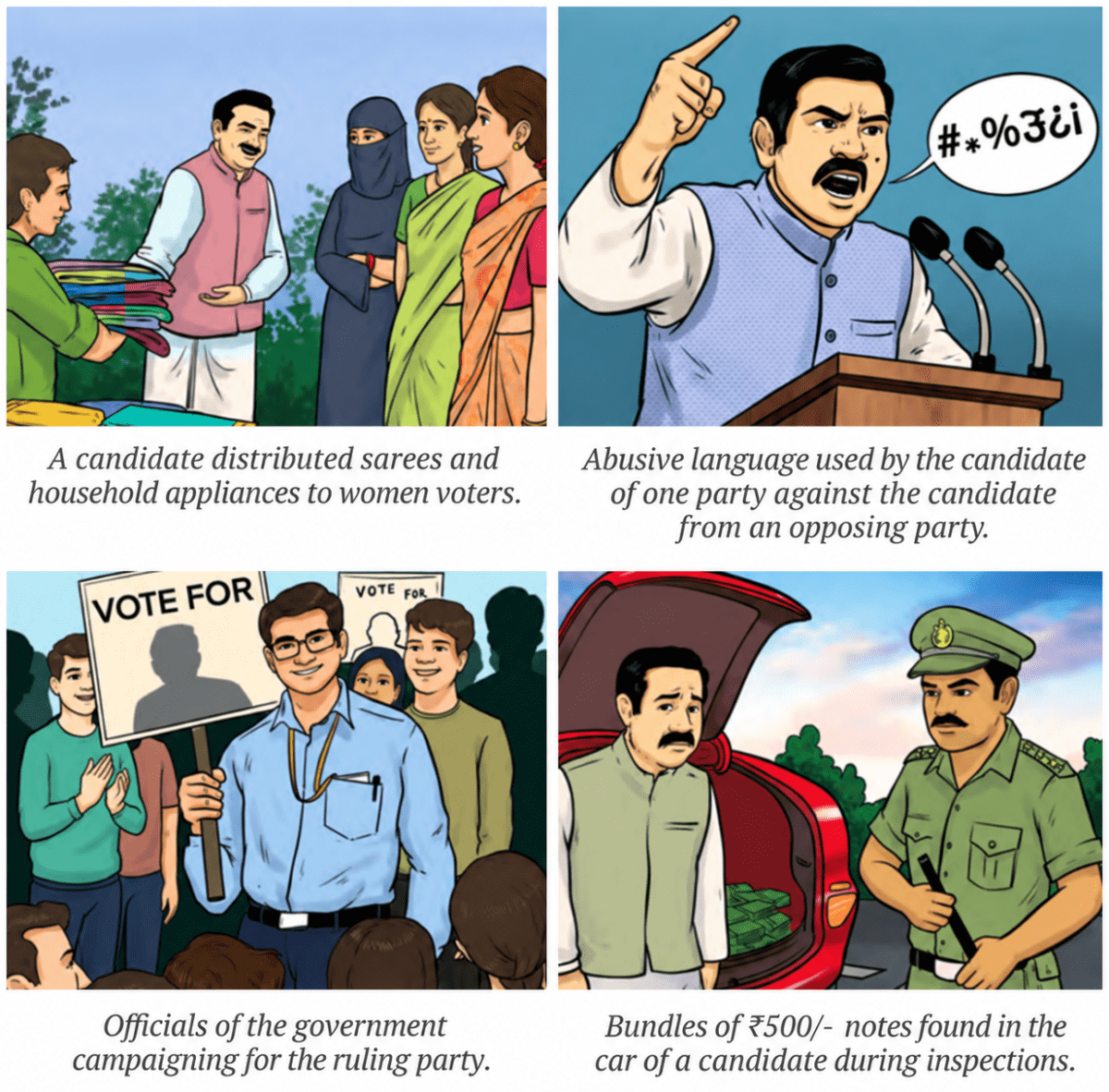
Here are a few types of complaints that the ECI handles. Why do you think these might be violations of the code of conduct?
Answer
These acts violate the Model Code of Conduct (MCC), which aims to ensure free and fair elections.
- Distributing sarees and household items to voters can be an attempt to influence them through gifts.
- Using abusive language against opponents violates the MCC’s expectation of responsible and respectful campaigning.
- Government officials must not use government resources or their official position to favour a political party.
- Large amounts of cash found during election inspections may indicate an attempt to influence voters and require investigation.
Such practices can give unfair advantages, disturb peaceful elections and affect voters’ free choice.
Why do you think the above group of people is not involved in electing the President of India? Why are the common people not involved in the election of the president?
Answer
The above group is not involved because the Electoral College includes only the elected members specified for the presidential election, while nominated members and members of Legislative Councils are excluded. Common people do not elect the President directly; instead, the President is elected indirectly by elected MPs and MLAs. This allows the President to represent the will of the people through their representatives and gives both the Centre and the States a role in the election.
Why is universal adult franchise important for a healthy democracy?
Answer
Universal adult franchise is important for a healthy democracy because it ensures that every adult citizen has an equal voice in choosing representatives.
- It promotes equality by giving every eligible citizen one vote of equal value.
- It allows people from all sections of society to participate in governance.
- It makes elected representatives answerable to the people.
- It gives citizens the power to participate in deciding the country’s future.
- It encourages civic participation and democratic responsibility.
What is the meaning of 'secret ballot'? Why is this important in a democracy?
Answer
‘Secret ballot’ means that a voter’s choice is kept private — no one knows who voted for whom.
It is important in a democracy for the following reasons:
- It allows every voter to vote freely according to their own judgement.
- It protects voters from fear, pressure or threats from candidates, parties or other people.
- It prevents voters from being bribed or influenced, since no one can check how they voted.
- It ensures that the result is a true and honest reflection of the will of the people.
- It treats every voter equally, as each vote is cast privately and counted equally.
Give examples of direct and indirect elections.
Answer
In a direct election, people themselves vote for their representatives. In an indirect election, the elected representatives of the people vote to choose someone.
Examples of direct elections:
- Election of members to the Lok Sabha.
- Election of members to the state and union territory legislative assemblies.
- Elections to gram panchayats and urban local bodies.
Examples of indirect elections:
- Election of members to the Rajya Sabha, who are elected by the elected members of the state legislative assemblies.
- Election of the President of India, who is elected by an Electoral College of MPs and MLAs.
- Election of the Vice President of India, who is elected by the members of both Houses of Parliament.
How is the election of members to the Lok Sabha different from that to the Rajya Sabha?
Answer
The election of members to the Lok Sabha is different from that to the Rajya Sabha in the following ways:
- Members of the Lok Sabha are elected directly by the people, while members of the Rajya Sabha are elected indirectly.
- Lok Sabha members are elected by the voters of 543 constituencies, whereas 233 of the 245 members of the Rajya Sabha are elected by the elected members of the state legislative assemblies and 12 are nominated by the President of India.
- Lok Sabha uses the First-Past-the-Post system, while Rajya Sabha elections use proportional representation by Single Transferable Vote.
- Lok Sabha can be dissolved and normally has a five-year term. Rajya Sabha is a permanent House; members serve six-year terms, with one-third retiring every two years.
- Rajya Sabha seats are allocated among states mainly according to their population, so larger states have more seats.
What, in your view, are the advantages of the EVM over paper ballots?
Answer
In my view, the EVM has several advantages over paper ballots.
- Voting is simple because the voter selects a candidate by pressing the corresponding button.
- Electronic recording can reduce errors caused by incorrectly or unclearly marked paper ballots.
- Counting can be completed without manually sorting and counting large numbers of paper ballots.
- The VVPAT produces a paper record that allows the voter to verify that the vote has been recorded for the chosen candidate and provides a record for verification where required.
- The NOTA option is available on the machine for voters who do not wish to support any listed candidate.
- EVMs reduce the need to print and handle large quantities of paper ballots.
The EVM and VVPAT system has worked so well that countries like Namibia and Bhutan have used it with support from the ECI, and others have received training from India to adopt it.
Voter turnout has been declining in some urban areas of India. What could be the reasons for this trend, and what steps can be taken to encourage more people to vote?
Answer
Voter turnout may be lower in some urban areas because of:
- Voter apathy or the belief that one vote does not matter.
- Busy work schedules and personal commitments.
- Migrants being registered in their hometown instead of their current city.
- Using polling holidays for travel or leisure.
- Missing names on voter lists or lack of voting-related information.
- Distrust of candidates or political parties.
Steps that can be taken to encourage more people to vote:
- Conducting voter-awareness campaigns through the Election Commission, schools and media.
- Making voter registration and transfer easier.
- Providing more accessible polling stations and reducing waiting times.
- Continuing facilities for elderly and disabled voters.
- Encouraging citizens to see voting as an important democratic responsibility.
Why do you think a proportion of seats in the Lok Sabha is reserved for scheduled castes and scheduled tribes? Write a short note.
Answer
Of the 543 Lok Sabha constituencies, 84 are reserved for persons from the scheduled castes and 47 are reserved for scheduled tribes.
Seats are reserved for Scheduled Castes (SCs) and Scheduled Tribes (STs) to ensure their fair representation in the Lok Sabha.
These communities have historically faced discrimination and social disadvantage. Without reservation, their representation in the legislature could be inadequate. Reserved seats ensure that their concerns are represented in law-making and that they can participate equally in shaping the country’s future.
Thus, reservation supports the constitutional principles of equality and inclusive democracy.
Social media is changing the way we experience elections — from catchy campaign reels and live speeches to political debates on Instagram and Twitter. But is this strengthening democracy or confusing it? Discuss in pairs: What are the benefits, what are the challenges, and what might the future of elections be in a digital age?
Answer
Social media has become an important part of the way elections are experienced today, and it brings both benefits and challenges.
Benefits:
- Information about candidates, parties and policies reaches many people quickly.
- Voters can watch speeches, debates and campaign messages and interact with candidates.
- It can increase young people’s participation and spread voter-awareness campaigns.
Challenges:
- Fake news and rumours can spread rapidly and mislead voters.
- Abusive content and personal attacks can affect healthy political debate.
- Online campaigns can be difficult to monitor and regulate.
- Algorithms may show people mainly the views they already agree with.
The future of elections in a digital age:
- Campaigning is likely to move further online, with more reels, live events and direct messaging.
- Rules for digital campaigning and for checking false information will have to become stronger.
- Media literacy will be as important as literacy itself, so that voters can tell reliable information from false claims.
- Technology can also be used positively, to make voter registration, awareness and accessibility easier.
Social media can strengthen democracy if it is used to inform voters, but it can confuse them if it is used to mislead. An aware and vigilant voter, who asks the right questions and verifies what they see before casting a responsible vote, remains the strongest safeguard of a democratic system.