
Who were the Marathas? How did they manage to become the largest pan-Indian power before the British took over?
Answer
The Marathas were people of the Deccan plateau, mainly present-day Maharashtra, and were associated with the Marathi language. Under Chhatrapati Shivaji Maharaj, they came together around the ideal of Swarājya and built a strong state with the help of guerrilla warfare, forts, efficient administration and a powerful navy. After Shivaji, rulers and leaders such as Sambhaji, Rajaram, Tarabai and the Peshwas continued the expansion. By the 18th century, Maratha power had spread across large parts of India, including Delhi, making them the largest pan-Indian power before the British.
What were some features of their governance?
Answer
The Marathas built a well-organised state with separate arrangements for civil, military and judicial matters.
- Civilian administration — Chhatrapati Shivaji established a relatively centralised administration. He abolished hereditary posts and land assignments and paid government officials from the state treasury. Officials were also transferred regularly. He gave pensions to the widows of soldiers who died in battle and offered military posts to their sons.
- Council of eight ministers — Shivaji was assisted by the aṣhṭa pradhāna maṇḍala, or council of eight ministers. It included the Pradhān, Amātya, Sachiv, Mantrī, Sumant, Senāpatī, Nyāyādhīsh and Paṇḍitrāo.
- Revenue — The Marathas collected chauth and sardeshmukhi from provinces that were not directly under their rule. In return, they protected these provinces and did not interfere in their internal administration.
- Military administration — The armed forces consisted of infantry, cavalry and navy. The cavalry included bārgīrs, whose horses and equipment were provided by the state, and shiledārs, who provided their own horses and equipment. Forts were also an important part of Maratha power.
- Judicial system — The Marathas had an efficient judicial system. The panchāyat was the main body that delivered justice, and an appeal could be made to a Maratha chief. The kotwāl or police maintained law and order in important towns.
- Trade and communication — Trade was encouraged. Roads were maintained, ferries were used for river transport and bridges were built over rivers and small streams.
What impact did the Maratha Empire leave in Indian history?
Answer
The Maratha Empire had an important political, military and cultural impact on Indian history.
- The Marathas challenged Mughal dominance and established the largest Indian empire before the British takeover.
- They developed an efficient system of administration.
- Their navy resisted European naval power for some time despite having less advanced technology.
- They contributed to cultural revival and development in language, literature, music, dance and the arts.
- They revived local Hindu traditions while respecting other religions.
- The ideal of Swarājya created confidence in self-rule and later contributed to ideas that supported India’s freedom movement.
Have you ever heard the term 'bhakti'? What does it mean to you? Choose a bhakti saint from any part of India and learn about their life, their teachings, and the message they shared. You can also find one of their poems or bhajans and share it with your classmates.
Answer
‘Bhakti’ means devotion to the divine or to a particular deity. It emphasises sincere devotion rather than only external rituals.
I have chosen Sant Tukaram of Maharashtra.
- Sant Tukaram was a well-known Bhakti saint of Maharashtra.
- He followed the path of bhakti, or sincere devotion to the divine.
- He composed devotional songs and poetry in the language of the common people, making spiritual ideas easier to understand.
- His teachings emphasised devotion, simplicity and spiritual upliftment rather than mere external rituals.
- Along with saints such as Dnyaneshwar, Namdev and Ramdas, he helped strengthen the cultural and spiritual foundation of Maharashtra.
- His devotional compositions are still remembered and sung today.
Try to find out more about guerrilla warfare. Which other countries in the world adopted this method? What geographical advantages did they utilise for this? Discuss your findings in groups.
Answer
Guerrilla warfare is a method in which small groups use speed, surprise and knowledge of the terrain to attack larger armies. Chhatrapati Shivaji used the hills, forests and forts of the Deccan effectively for this purpose. Similar methods were used in Spain, Vietnam and Yugoslavia, where fighters took advantage of mountains, forests, difficult routes and local knowledge to hide, move quickly and launch surprise attacks.
Pick an event from Chhatrapati Shivaji’s life and, with your classmates, stage it as a play.
Answer
I would stage Chhatrapati Shivaji’s escape from Agra as a short play.
- Scene 1 — At the Mughal court: Shivaji visits Aurangzeb’s court at Agra, feels insulted and leaves the court angrily.
- Scene 2 — House arrest: Aurangzeb places Shivaji under house arrest. Shivaji begins sending baskets of fruits and sweets as gifts to holy men and Mughal generals.
- Scene 3 — The plan: When the guards stop checking the baskets carefully, Shivaji and his son Sambhaji hide inside them.
- Scene 4 — The escape: They are carried out safely and escape from Agra.
The play would highlight Shivaji’s courage, presence of mind and ability to use clever strategies in difficult situations.
Have you heard of the dance form 'Bharatnatyam'? Did you know that this dance form has a deep connection with the Marathas? Can you find out what this connection was?
Answer
Yes, Bharatanatyam has a deep connection with the Marathas of Thanjavur. After Ekoji established Maratha rule there, the rulers became important patrons of art and culture. Under Serfoji II, talented musicians were encouraged, and the early stages of Bharatanatyam developed along with modern Carnatic music.
If you could time-travel and meet Chhatrapati Shivaji, what three questions would you ask him and why?
Answer
If I could time-travel and meet Chhatrapati Shivaji Maharaj, I would ask him:
- What inspired you to establish Swarājya? — to understand his vision of self-rule and good governance.
- How did you successfully use guerrilla warfare against larger armies? — to learn about his military strategy and use of the Deccan terrain.
- Why did you consider a strong navy and forts essential for your kingdom? — to understand how he planned to protect his territory and coastal regions.
Chhatrapati Shivaji issued strict instructions to his officials not to mistreat the subjects or to forcefully grab even a blade of grass from them. In one of the letters issued to his officials, Chhatrapati Shivaji says:
"Wood from big trees like teak is required for the Navy. If needed, secure permission for cutting the trees from the forest and then proceed. Other trees like the mango and jackfruit are also useful, but do not touch them. Because such trees take many years to mature, and the people look after them like their children. If you cut them, will their sorrow ever end? If you accomplish something by oppressing others, it perishes soon, along with the oppressor. There is harm in the absence of such trees as well. Therefore, do not use force in any circumstances."
Based on Chhatrapati Shivaji's letter, what can you tell about his values as a ruler?
Answer
The letter shows that Chhatrapati Shivaji was a just, compassionate and responsible ruler. He instructed officials not to oppress people and to take permission before cutting trees needed for the Navy. His concern for mango and jackfruit trees shows respect for both the people and natural resources. He believed that rule should be based on justice, restraint and the welfare of subjects, not on force.
Analyse how geography (particularly mountains and coastlines) guided Maratha military strategy and state formation.
Answer
Geography shaped Maratha military strategy and state formation in a decisive way.
- The hills, forests and mountains of the Deccan were ideal for guerrilla warfare based on speed, surprise and knowledge of the terrain.
- Forts such as Pratapgad and Raigad helped the Marathas control important routes, protect their armies and resist larger enemy forces.
- The western coastline encouraged Chhatrapati Shivaji to build a strong navy to protect coastal areas and secure their resources.
- Coastal forts such as Sindhudurg strengthened Maratha control over the sea and protected maritime trade.
- Leaders like Kanhoji Angre used coastal geography and naval tactics to challenge European fleets.
- The southern expansion during the dakṣhiṇa-digvijaya gave the Marathas greater strategic depth against Mughal attacks.
Imagine you are creating a short biography of a Maratha leader for younger students. Choose one personality (Kanhoji Angre, Bajirao I, Mahadji Shinde, Ahilyabai Holkar or Tarabai) and write 3–4 paragraphs highlighting what makes them inspirational. Include at least one challenge they overcame.
Answer
Ahilyabai Holkar
Ahilyabai Holkar belonged to the Holkar dynasty, one of the chief families that helped in the Maratha expansion in north India. During the 18th century, the Holkars ruled a large kingdom in central India around present-day Indore.
After losing her husband and son, Ahilyabai continued to govern the state. She ruled for about thirty years and cared for the common people. She built and restored hundreds of temples, ghats, wells and roads across India, from Kedarnath in the north to Rameswaram in the south. She also rebuilt the Kashi Vishwanath temple in Varanasi and the Somnath temple in Gujarat.
Ahilyabai also promoted the Maheshwar weaving industry in Madhya Pradesh and helped revive traditional handloom crafts. Her administration and concern for the people made her an important Maratha ruler.
If you could visit one Maratha fort today (such as Raigad, Sindhudurg, Gingee, or Pratapgad), which would you choose and why? Research its history, architecture, and strategic importance. Present your findings as a digital presentation or a poster in class.
Answer
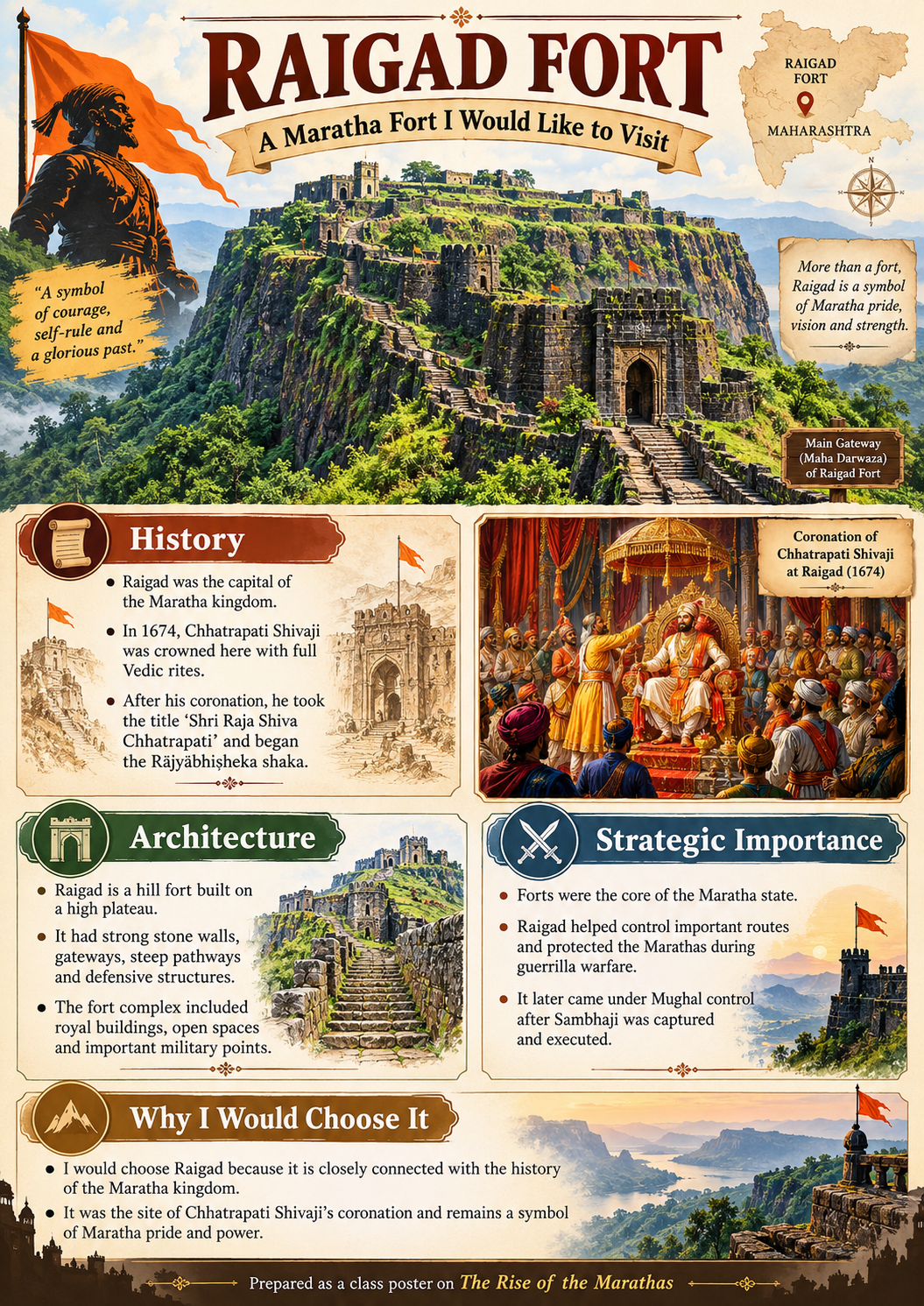
I would choose Raigad Fort in Maharashtra.
Raigad was the capital of the Maratha kingdom. In 1674, Chhatrapati Shivaji was crowned there with full Vedic rites and took the title ‘Shri Raja Shiva Chhatrapati’. He also began the Rājyābhiṣheka shaka.
The fort was important because forts were the core of the Maratha state. They helped the Marathas control important routes and shelter their armies during guerrilla warfare. Raigad was also captured by Aurangzeb after Sambhaji was captured and executed.
I would choose Raigad because of its importance in the history of the Maratha kingdom and the coronation of Chhatrapati Shivaji.
The chapter states, "The British took India from the Marathas more than from the Mughals or any other power." What do you think this means? What evidence from the chapter supports this idea?
Answer
The statement means that when the British expanded their rule in India, the Marathas were their main Indian rivals, while Mughal power had already weakened.
The chapter supports this by showing that:
- The Marathas controlled large parts of central and northern India and had even reached Lahore, Attock and Peshawar.
- After the defeat at Panipat in 1761, they recovered quickly and recaptured Delhi under Mahadji Shinde in 1771.
- Delhi remained under Maratha control until the British captured it about three decades later.
- The British and Marathas fought three Anglo-Maratha Wars between 1775 and 1818.
- Maratha power ended in 1818 because of internal disunity and the superior organisation and technology of the British.
Compare how Chhatrapati Shivaji and later Marathas treated religious places and people of different faiths. What evidence from the chapter shows their approach to religious diversity?
Answer
Both Chhatrapati Shivaji and the later Marathas promoted their own cultural and religious traditions while respecting people of different faiths.
- Chhatrapati Shivaji was a devout Hindu, but he respected other religions and did not allow religious places to be harmed.
- During the sack of Surat, he avoided attacking religious places and even spared the house of Mohandas Parekh, a charitable man.
- He also rebuilt temples and encouraged Sanskrit, Marathi literature and religious institutions.
- The later Marathas continued to support Hindu cultural revival, such as the revival of Lord Jagannath worship at Puri and the restoration of temples by Ahilyabai Holkar.
- In Thanjavur, Maratha rulers encouraged a syncretic and multilingual culture in which Tamil, Telugu and Marathi traditions interacted freely.
The chapter describes how forts were 'the core of the state' for Marathas. Why were they so important? How did they help the Marathas survive against larger enemies?
Answer
Forts were the core of the Maratha state because they provided defence, control and shelter against stronger enemies.
- Forts helped the Marathas control important routes and strategic locations.
- They provided safe shelter to the army during guerrilla warfare and enemy attacks.
- Chhatrapati Shivaji captured and strengthened many forts from the beginning of his rule.
- Mountain forts such as Raigad protected the interior, while coastal forts such as Sindhudurg guarded the western coast.
- Even after losing battles or important centres, the Marathas could continue resistance from other forts, as Rajaram did from Gingee.
- Their network of forts enabled them to withstand the long Mughal attacks under Aurangzeb.
You have been appointed as the chief designer for Maratha coins. Design a coin that represents Maratha achievements and values. Explain the symbols you chose.
Answer
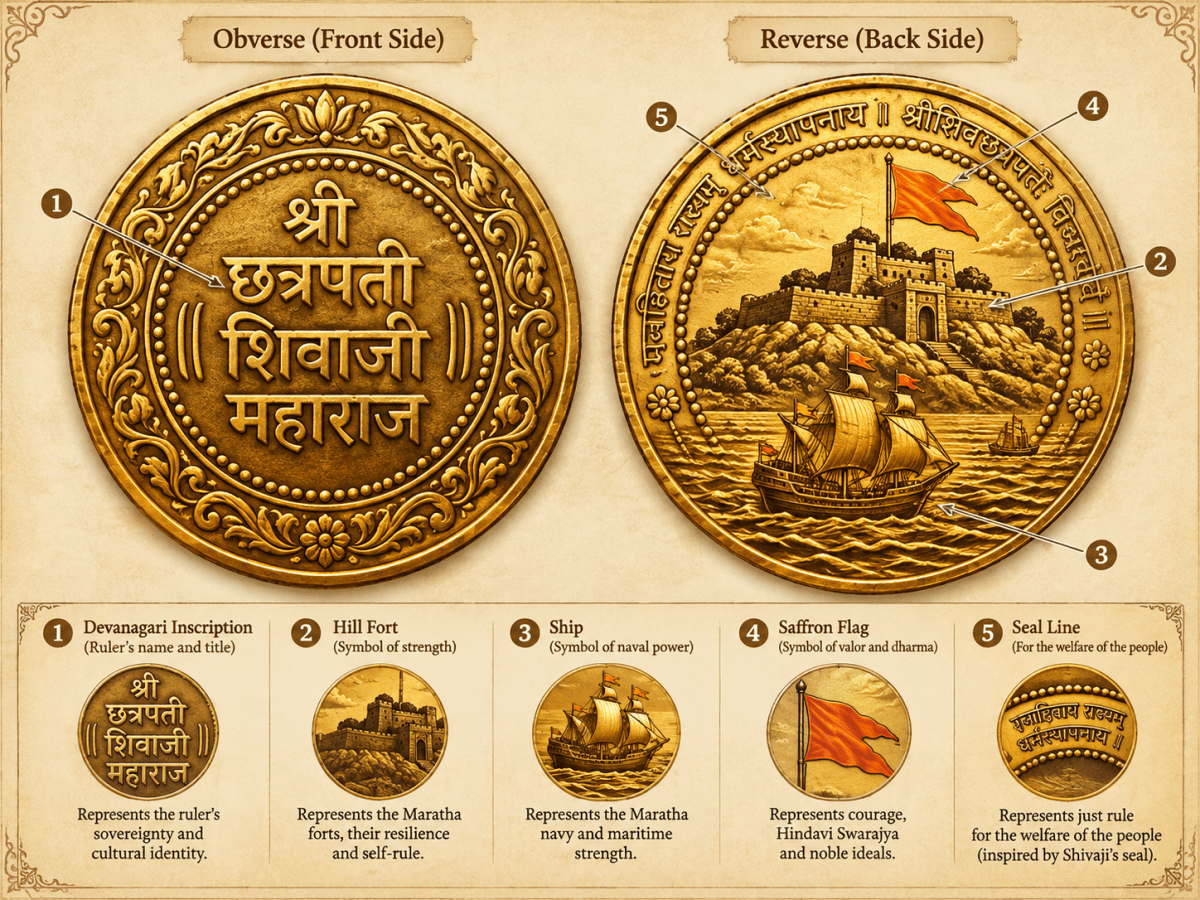
As the chief designer, I would mint a gold coin carrying inscriptions in the Devanagari script on both sides.
On one side, I would place the ruler's name and title in Devanagari, within a circle of dots. On the other side, I would show a hill fort with a saffron flag flying over it, and a ship sailing below it, with a line from Chhatrapati Shivaji's seal running around the edge.
- The name and title in Devanagari — Chhatrapati Shivaji minted gold and copper coins in his own name to signify his sovereignty, and his use of the Devanagari script was an assertion of cultural identity, a notable departure from the prevalent Persian seals.
- The hill fort — forts were the core of the state; the kingdom itself was created from forts, and they helped the Marathas survive decades of onslaught.
- The ship — it stands for the Maratha Navy, a revolutionary creation of Chhatrapati Shivaji that protected the west coast and challenged European naval supremacy.
- The saffron flag — Chhatrapati Shivaji's saffron-coloured flag was adopted by all Marathas.
- The line from the seal — his seal declared that his authority reigns for the welfare of the people, which was the guiding value of Maratha rule.
After this introduction to the Maratha period, what do you think was their most important contribution to Indian history? Write a paragraph supporting your opinion with examples from the chapter. Then share and discuss your ideas with classmates.
Answer
In my opinion, the most important contribution of the Marathas was the ideal of Swarājya, or self-rule. Chhatrapati Shivaji showed that Indians could establish, defend and administer their own kingdom through efficient administration, forts, a strong navy and respect for the welfare of the people. His successors expanded Maratha power across large parts of India and challenged Mughal and later British dominance. The ideal of Swarājya also created cultural confidence and inspired later generations to believe in self-government, contributing to the early growth of India’s freedom movement.