
What is the concept of justice?
Answer
Justice means ensuring that every person is treated fairly, equally and with dignity according to the law. It protects people’s rights and helps in resolving disputes in a fair manner. The two important aspects of justice are substantive justice, which focuses on whether the final decision is fair, just and reasonable, and procedural justice, which ensures that every person gets a full opportunity to be heard before a decision is taken.
Why is it important for a just and harmonious Society?
Answer
Justice is important for a just and harmonious society because it helps maintain peace, equality and dignity. It ensures that disputes are resolved fairly through dialogue, mediation or courts of law, protects people’s rights, and ensures that laws and government actions remain within the framework of the Constitution. In this way, justice promotes fairness and harmony in society.
What is the structure and role of the judiciary in India?
Answer
The judiciary in India has a unified hierarchical structure consisting of the Supreme Court at the apex, High Courts at the State level, and Subordinate Courts at the district level.
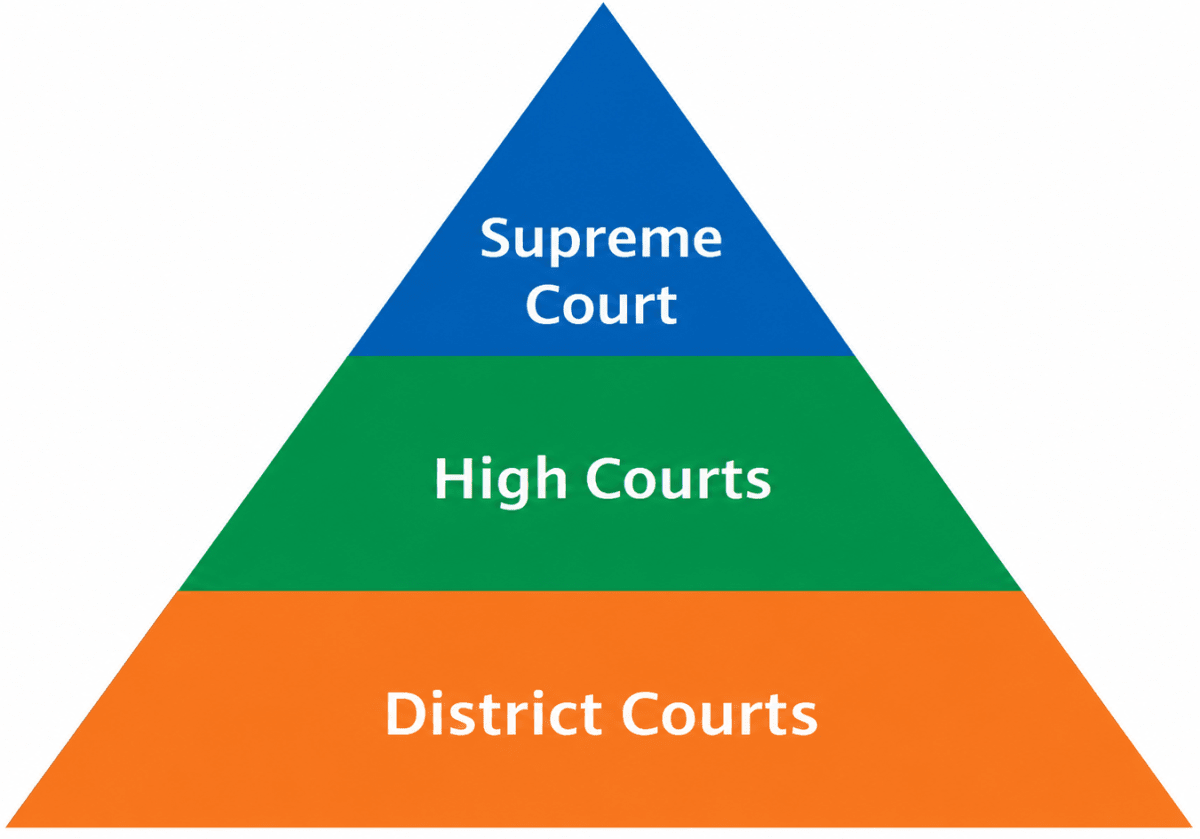
Its main role is to ensure that justice is delivered fairly, protect the Fundamental Rights of citizens, interpret the Constitution, settle disputes, and ensure that the laws made by the legislature and the actions of the executive remain within the framework of the Constitution.
What are the alternative modes of dispute resolution?
Answer
The alternative modes of dispute resolution help in settling disputes outside the regular courts and reduce the burden on the judiciary. These are:
- Arbitration, where the parties refer their dispute to an independent arbitrator or panel of arbitrators, whose decision is final and legally binding.
- Mediation/Conciliation, where a neutral mediator helps the parties arrive at a mutual settlement but cannot impose a decision on them.
- Negotiation, where the parties discuss the dispute directly with each other to reach a settlement.
- Lok Adalats, which are people’s courts where disputes, including cases pending in courts, are settled amicably.
- Gram Nyayalayas, which are mobile, village-level courts that decide disputes through a simplified procedure without technicalities.
Think of a time when you felt that someone had not been fair to you. How did you feel? What did you think needed to be done to make the situation right? Who could have made things right? What would you do in such a situation? Share in small groups.
Answer
Once, I felt that a classmate was given credit for work that I had also done. I felt hurt and thought that the situation was unfair. To make it right, both sides needed to be heard fairly before any decision was taken. The teacher could have listened to us and helped resolve the matter. In such a situation, I would calmly explain my point of view and try to solve the issue through dialogue and fair discussion rather than arguing.
Several High Courts mentioned in the table have more than one bench. Explore which High Courts have more than one bench with the help of your teachers.
| S. No. | High Court | States / Union Territories Covered |
|---|---|---|
| 1 | Allahabad High Court | Uttar Pradesh |
| 2 | Andhra Pradesh High Court | Andhra Pradesh |
| 3 | Bombay High Court | Maharashtra, Goa, Union Territory of Dadra & Nagar Haveli and Daman & Diu |
| 4 | Calcutta High Court | West Bengal and Union Territory of Andaman & Nicobar Islands |
| 5 | Chhattisgarh High Court | Chhattisgarh |
| 6 | Delhi High Court | Delhi |
| 7 | Gauhati High Court | Assam, Nagaland, Mizoram and Arunachal Pradesh |
| 8 | Gujarat High Court | Gujarat |
| 9 | Himachal Pradesh High Court | Himachal Pradesh |
| 10 | Jammu & Kashmir and Ladakh High Court | Union Territory of Jammu & Kashmir and Union Territory of Ladakh |
| 11 | Jharkhand High Court | Jharkhand |
| 12 | Karnataka High Court | Karnataka |
| 13 | Kerala High Court | Kerala and Union Territory of Lakshadweep |
| 14 | Madras High Court | Tamil Nadu and Union Territory of Puducherry |
| 15 | Madhya Pradesh High Court | Madhya Pradesh |
| 16 | Manipur High Court | Manipur |
| 17 | Meghalaya High Court | Meghalaya |
| 18 | Orissa High Court | Odisha |
| 19 | Patna High Court | Bihar |
| 20 | Punjab & Haryana High Court | Punjab, Haryana and Union Territory of Chandigarh |
| 21 | Rajasthan High Court | Rajasthan |
| 22 | Sikkim High Court | Sikkim |
| 23 | Telangana High Court | Telangana |
| 24 | Tripura High Court | Tripura |
| 25 | Uttarakhand High Court | Uttarakhand |
Answer
The High Courts that have more than one bench are:
- Allahabad High Court, with a bench at Lucknow.
- Bombay High Court, with benches at Nagpur, Aurangabad (Chhatrapati Sambhajinagar), Panaji (Goa) and Kolhapur.
- Calcutta High Court, with benches at Port Blair and Jalpaiguri.
- Gauhati High Court, with benches at Kohima, Aizawl and Itanagar.
- Jammu & Kashmir and Ladakh High Court, which sits at Srinagar and Jammu.
- Karnataka High Court, with benches at Dharwad and Kalaburagi.
- Madras High Court, with a bench at Madurai.
- Madhya Pradesh High Court, with benches at Indore and Gwalior.
- Rajasthan High Court, with its principal seat at Jodhpur and a bench at Jaipur.
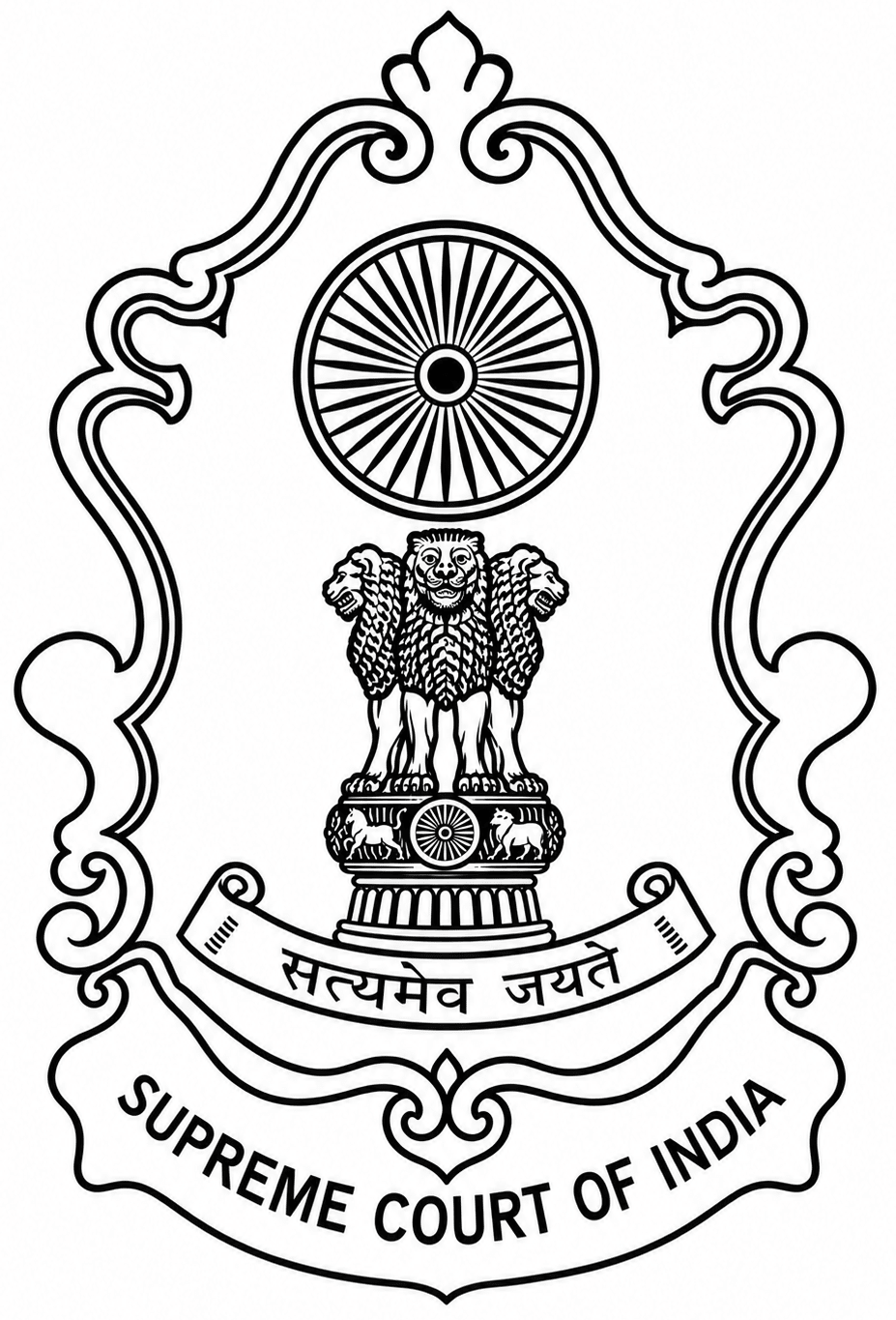
This is the logo of the Supreme Court of India. What are the elements familiar to you? Notice the Sanskrit motto, 'yato dharmastato jayah' — 'Where there is dharma, there is victory.'
Answer
The familiar elements in the logo of the Supreme Court of India are the National Emblem of India (the Lion Capital of Ashoka), the Dharma Chakra (wheel) at the top, and the Sanskrit motto ‘yato dharmastato jayah’, which means ‘Where there is dharma, there is victory.’ The motto conveys that justice and righteousness always win, which reflects the role of the Supreme Court in upholding justice.
Write a model letter to the High Court or Supreme Court about a current social issue you have observed to bring it to the notice of the judiciary.
Answer
To
The Hon’ble Chief Justice
High Court of ...............
Subject: Request for action against pollution of a local river
Respected Sir/Madam,
I wish to bring to your notice the pollution of a river in our locality. I have observed waste and dirty water entering the river from nearby drains and factories. The river water has developed a bad smell, and the pollution may harm people who depend on it as well as plants and animals.
I request the Hon’ble High Court to take notice of this issue and consider directing the concerned authorities to investigate the pollution, prevent untreated waste from entering the river and take steps to clean it.
Yours faithfully,
Name: ...............
Place: ...............
Date: ...............
Imagine that you are part of the legislature or executive. Given the large number of cases in the judicial system, what are some innovative solutions that you can devise to address the issue?
Answer
Some innovative solutions to reduce the large number of pending cases in the judicial system are:
- Promote alternative dispute resolution methods such as mediation, arbitration and Lok Adalats so that suitable disputes are settled outside regular courts.
- Expand Gram Nyayalayas to provide quick and simple justice at the village level.
- Increase the use of digital technology through e-Filing, hybrid hearings and online access to case information.
- Strengthen specialised tribunals so that specific disputes can be resolved efficiently without adding to the burden of regular courts.
- Provide more courtrooms, trained support staff and better facilities so that cases can be managed without unnecessary delays.
Create a moot court and enact the following cases. What are the considerations that the judge might need to take into account to arrive at a just outcome?
(i) Anita and Sameer worked in a factory that produced different types of screws. They had both completed an Industrial Training Institute diploma and joined the factory together. One day, Anita discovered that she was getting paid less than Sameer for the same job. After many appeals to her boss and no change in her salary, she decided to go to court.
Enact this scene from the litigants' perspective, showcasing their respective points of view. What might be the outcome of the case?
(ii) The people of a village living next to a river used its water for drinking and irrigation purposes. Gradually, they began to notice that the clear water was turning a brownish colour and had begun to smell too. Many people were falling sick. They figured that this was due to the effluents that were being discharged by a factory upstream.
What are the steps that the residents of the village could take to ensure that the water is clean again?
Answer
(i) A sample moot-court enactment:
Anita: "Sameer and I have the same qualifications, joined together and do the same work. Yet I receive a lower salary. I request equal pay and the amount I should have received earlier."
Factory representative: "We believe there are reasons for the difference in pay. We would like to present the work records and salary details to explain our decision."
Judge: "Both sides must be heard. I will examine the appointment letters, the nature of their work, salary records and any evidence of different responsibilities or performance."
Possible outcome: If the evidence shows that Anita receives less pay than Sameer solely because she is a woman, despite performing the same or similar work, the court may direct the factory to remove the unfair difference and pay any wages lawfully due to her. The judge must give both sides a fair hearing before making a decision.
(ii) Steps the villagers could take:
- Collect evidence of the pollution, such as photographs, water-test reports and information about people falling ill.
- Complain to the local authorities and the State Pollution Control Board, and request an investigation and safe drinking water.
- Ask the factory to stop releasing untreated effluents into the river and to treat its waste properly.
- If the problem is not resolved, approach the National Green Tribunal or seek appropriate legal action, such as a Public Interest Litigation before the High Court or Supreme Court.
Considerations for the judge: The judge would consider the villagers’ health, their need for clean water, the test reports and other evidence, and the factory’s explanation. If the factory is found responsible, the court or tribunal may order it to stop the pollution, treat its waste, help restore the river and pay compensation where appropriate.
Many eminent individuals from across India have served as Supreme Court or High Court judges. Write an essay about one such individual from your state or district, talking about their contributions as a judge of the Supreme Court or High Court.
Answer
Sample essay — Justice M. N. Venkatachaliah (Karnataka)
Justice M. N. Venkatachaliah is an eminent Indian judge associated with Karnataka. He became a judge of the Karnataka High Court in 1975 and a judge of the Supreme Court of India in 1987. In 1993, he became the Chief Justice of India.
As a judge, Justice Venkatachaliah worked to uphold the Constitution and ensure fairness in the judicial system. In an important case concerning arrests, he emphasised that the police must have proper reasons for arresting a person and that a person who is arrested must be able to inform someone and consult a lawyer. This helped protect the rights and liberty of citizens.
After retiring, he continued to serve society as Chairman of the National Human Rights Commission. His career inspires us to value justice, fairness and respect for people's rights.