
There are 100 lockers and 100 people numbered 1 to 100. Person 1 opens every locker. Person 2 toggles every 2nd locker (closes it if open, opens it if closed). Person 3 toggles every 3rd locker (3rd, 6th, 9th, … and so on). Person 4 toggles every 4th locker (4th, 8th, 12th, … and so on). This continues until all 100 get their turn. In the end, only some lockers remain open, and the open lockers reveal the code.
(i) Before the process begins, Khoisnam realises that he already knows which lockers will be open at the end. How did he figure out the answer?
(ii) Does every number have an even number of factors?
(iii) Can you use this insight to find more numbers with an odd number of factors?
(iv) Write the locker numbers that remain open.
(v) Khoisnam immediately collects word clues from these 10 lockers and reads, "The passcode consists of the first five locker numbers that were touched exactly twice." Which are these five lockers?
Answer
(i) Each locker is toggled once by every person whose number is a factor of the locker number. So the number of times a locker is toggled is the same as the number of factors of the locker number.
A locker stays open only if it is toggled an odd number of times.
Factors usually occur in pairs (partner factors), so most numbers have an even number of factors. The only exception is a perfect square, whose square root pairs with itself. For example, 36 = 6 × 6, so 6 is counted only once. Hence perfect squares have an odd number of factors.
Therefore, the lockers that remain open are exactly the perfect square numbers. Khoisnam realised this even before the process began.
The open lockers are the perfect squares from 1 to 100.
(ii) No. Most numbers have an even number of factors because factors occur in partner pairs.
For example, the factors of 6 are 1, 2, 3 and 6, forming the pairs 1 × 6 and 2 × 3 (4 factors).
But a perfect square has one factor that pairs with itself, so it has an odd number of factors. For example, the factors of 9 are 1, 3 and 9, since 9 = 1 × 9 = 3 × 3 (3 factors).
No, only perfect squares have an odd number of factors; all other numbers have an even number of factors.
(iii) Yes. A number has an odd number of factors only when it is a perfect square, because its square root is a factor that pairs with itself.
1 × 1, 2 × 2, 3 × 3, 4 × 4, …
All perfect squares — 1, 4, 9, 16, 25, 36, 49, 64, 81, 100, … — have an odd number of factors.
(iv) The open lockers are the perfect squares from 1 to 100.
12 = 1, 22 = 4, 32 = 9, 42 = 16, 52 = 25,
62 = 36, 72 = 49, 82 = 64, 92 = 81, 102 = 100
The open lockers are 1, 4, 9, 16, 25, 36, 49, 64, 81 and 100.
(v) A locker is touched exactly twice when its number has exactly two factors. A number with exactly two factors (1 and the number itself) is a prime number.
The first five prime numbers are 2, 3, 5, 7 and 11.
The passcode is 2-3-5-7-11.
Find the squares of the first 30 natural numbers and fill in the table below. What patterns do you notice?
| 12 = 1 | 112 = 121 | 212 = 441 |
| 22 = 4 | 122 = ___ | 222 = ___ |
| 32 = 9 | 132 = ___ | 232 = ___ |
| 42 = 16 | 142 = ___ | 242 = ___ |
| 52 = 25 | 152 = ___ | 252 = ___ |
| 62 = ___ | 162 = ___ | 262 = ___ |
| 72 = ___ | 172 = ___ | 272 = ___ |
| 82 = ___ | 182 = ___ | 282 = ___ |
| 92 = ___ | 192 = ___ | 292 = ___ |
| 102 = ___ | 202 = ___ | 302 = ___ |
Answer
| 12 = 1 | 112 = 121 | 212 = 441 |
| 22 = 4 | 122 = 144 | 222 = 484 |
| 32 = 9 | 132 = 169 | 232 = 529 |
| 42 = 16 | 142 = 196 | 242 = 576 |
| 52 = 25 | 152 = 225 | 252 = 625 |
| 62 = 36 | 162 = 256 | 262 = 676 |
| 72 = 49 | 172 = 289 | 272 = 729 |
| 82 = 64 | 182 = 324 | 282 = 784 |
| 92 = 81 | 192 = 361 | 292 = 841 |
| 102 = 100 | 202 = 400 | 302 = 900 |
Some patterns we notice are:
The squares end only with the digits 0, 1, 4, 5, 6 or 9. None of them end with 2, 3, 7 or 8.
The difference between two consecutive squares is the sequence of odd numbers (3, 5, 7, 9, …).
The square of an even number is even, and the square of an odd number is odd.
A square ending in a single 0 never occurs — squares end with an even number of zeros.
Write 5 numbers such that you can determine by looking at their units digit that they are not squares.
Answer
A number ending in 2, 3, 7 or 8 can never be a perfect square. So any such numbers will do.
For example: 22, 53, 78, 97 and 1028 are not squares (they end in 2, 3, 8, 7 and 8 respectively).
Which of the following numbers have the digit 6 in the units place?
(i) 382
(ii) 342
(iii) 462
(iv) 562
(v) 742
(vi) 822
Answer
The units digit of a square depends only on the units digit of the number.
(i) 382
382 → units digit 8, and 82 = 64
It ends in 4.
(ii) 342
342 → units digit 4, and 42 = 16
It ends in 6.
(iii) 462
462 → units digit 6, and 62 = 36
It ends in 6.
(iv) 562
562 → units digit 6, and 62 = 36
It ends in 6.
(v) 742
742 → units digit 4, and 42 = 16
It ends in 6.
(vi) 822
822 → units digit 2, and 22 = 4 → ends in 4.
It ends in 4.
Find more such patterns by observing the numbers and their squares from the table you filled earlier.
| 12 = 1 | 112 = 121 | 212 = 441 |
| 22 = 4 | 122 = 144 | 222 = 484 |
| 32 = 9 | 132 = 169 | 232 = 529 |
| 42 = 16 | 142 = 196 | 242 = 576 |
| 52 = 25 | 152 = 225 | 252 = 625 |
| 62 = 36 | 162 = 256 | 262 = 676 |
| 72 = 49 | 172 = 289 | 272 = 729 |
| 82 = 64 | 182 = 324 | 282 = 784 |
| 92 = 81 | 192 = 361 | 292 = 841 |
| 102 = 100 | 202 = 400 | 302 = 900 |
Answer
Looking at the units digit of a number and that of its square, we get the following patterns:
A number ending in 1 or 9 has a square ending in 1.
A number ending in 2 or 8 has a square ending in 4.
A number ending in 3 or 7 has a square ending in 9.
A number ending in 4 or 6 has a square ending in 6.
A number ending in 5 has a square ending in 5 (in fact, in 25).
A number ending in 0 has a square ending in 0.
The units digit of a number completely decides the units digit of its square, as listed above.
If a number contains 3 zeros at the end, how many zeros will its square have at the end?
Answer
A number with exactly 3 zeros at the end can be written as:
N × 1000 = N × 103, where N is not divisible by 10.
The square of a number:
(N × 103)2
= N2 × 106
So its square has 6 zeros at the end.
The square will have 6 zeros at the end.
What do you notice about the number of zeros at the end of a number and the number of zeros at the end of its square? Will this always happen? Can we say that squares can only have an even number of zeros at the end?
Answer
If a number has n zeros at the end, it can be written as (a part not ending in zero) × 10n. On squaring, the factor 10n becomes 102n, giving 2n zeros at the end.
Since the number of zeros, 2n, is always a multiple of 2, it is always even. This will always happen.
Yes, a square always has an even number of zeros at the end — twice the number of zeros in the original number.
What can you say about the parity of a number and its square?
Answer
The square of an even number is even (even × even = even), and the square of an odd number is odd (odd × odd = odd).
A number and its square always have the same parity.
Using the pattern of consecutive odd numbers, find 362, given that 352 = 1225.
Answer
Since every square is the sum of consecutive odd numbers starting from 1, the value 1225 is the sum of the first 35 odd numbers.
To get 362, we add the 36th odd number to 1225.
The 36th odd number is 2 × 36 - 1 = 71.
362 = 352 + 71
= 1225 + 71
= 1296
362 = 1296
How do we find the 36th odd number?
Answer
The odd numbers are 1, 3, 5, 7, … .
The nth odd number is 2n - 1.
For the 36th odd number, put n = 36.
2 × 36 - 1
= 72 - 1
= 71
The 36th odd number is 71.
What is the nth odd number?
Answer
The 1st odd number is 1, the 2nd is 3, the 3rd is 5, and so on.
Each is 1 less than twice its position.
The nth odd number is 2n - 1.
Find how many numbers lie between two consecutive perfect squares. Do you notice a pattern?
Answer
Between n2 and (n + 1)2, the count of numbers is:
(n + 1)2 - n2 - 1
= n2 + 2n + 1 - n2 - 1
= 2n
So between 1 and 4 there are 2 numbers, between 4 and 9 there are 4, between 9 and 16 there are 6, and so on.
There are 2n numbers between n2 and (n + 1)2.
How many square numbers are there between 1 and 100? How many are between 101 and 200? Using the table of squares you filled earlier (In-Text 2: Q1), enter the values below, tabulating the number of squares in each block of 100. What is the largest square less than 1000?
| Block | Number of squares |
|---|---|
| 1 – 100 | ___ |
| 101 – 200 | ___ |
| 201 – 300 | ___ |
| 301 – 400 | ___ |
| 401 – 500 | ___ |
| 501 – 600 | ___ |
| 601 – 700 | ___ |
| 701 – 800 | ___ |
| 801 – 900 | ___ |
| 901 – 1000 | ___ |
Answer
Counting the squares from the table in each block of 100:
| Block | Number of squares |
|---|---|
| 1 – 100 | 10 |
| 101 – 200 | 4 |
| 201 – 300 | 3 |
| 301 – 400 | 3 |
| 401 – 500 | 2 |
| 501 – 600 | 2 |
| 601 – 700 | 2 |
| 701 – 800 | 2 |
| 801 – 900 | 2 |
| 901 – 1000 | 1 |
The largest square less than 1000 is 312 = 961, since 322 = 1024 exceeds 1000.
There are 10 squares between 1 and 100 and 4 between 101 and 200; the largest square less than 1000 is 961.
Can you see any relation between triangular numbers and square numbers? Extend the pattern shown and draw the next term.
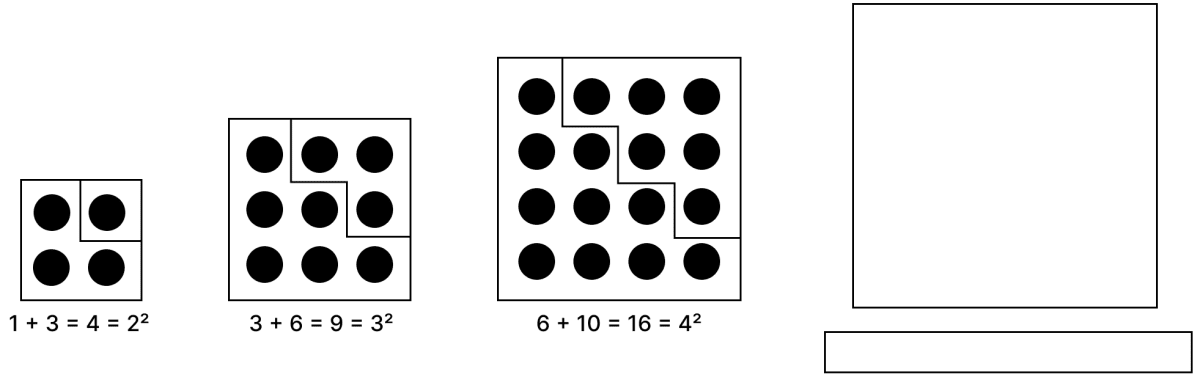
Answer
The sum of two consecutive triangular numbers is a perfect square.
1 + 3 = 4 = 22
3 + 6 = 9 = 32
6 + 10 = 16 = 42
Extending the pattern, the next two consecutive triangular numbers are 10 and 15:
10 + 15 = 25 = 52
The next figure is a 5 × 5 square formed by fitting together the dot patterns of the triangular numbers 10 and 15.
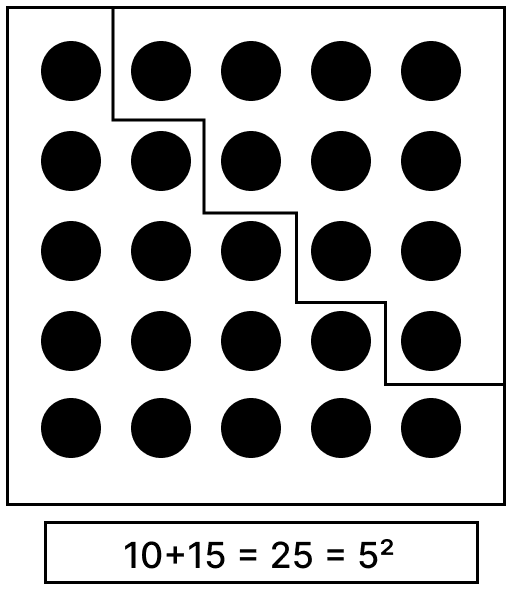
Two consecutive triangular numbers always add up to a perfect square; the next term is 10 + 15 = 25 = 52.
The area of a square is 49 sq. cm. What is the length of its side?
Answer
Given:
Area of a square = 49 sq. cm
Let a be the side of the square.
The area of a square = a2.
49 = a2
⇒ a =
⇒ a =
⇒ a = 7
The length of its side is 7 cm.
What is the square root of 64?
Answer
8 × 8 = 64 and (−8) × (−8) = 64.
Therefore, the integer square roots of 64 are +8 and −8. The symbol denotes the positive or principal square root.
Given a number, such as 576 or 327, how do we find out if it is a perfect square? If it is a perfect square, how can we find its square root?
Answer
Write the prime factorisation of the number. If the prime factors can be split into two equal groups, the number is a perfect square, and the product of the factors in one group is its square root.
For 327:
327 = 3 × 10⁹
The factors cannot be paired, so 327 is not a perfect square. (It also ends in 7, which already rules it out.)
For 576:
576 = (2 × 2) × (2 × 2) × (2 × 2) × (3 × 3)
= (2 × 2 × 2 × 3) × (2 × 2 × 2 × 3)
⇒ = 2 × 2 × 2 × 3 = 24
327 is not a perfect square; 576 is a perfect square with .
Is 324 a perfect square?
Answer
324 = (2 × 2) × (3 × 3) × (3 × 3)
⇒ = 2 × 3 × 3
⇒ = 18
The factors pair up completely, so 324 is a perfect square.
Yes, 324 is a perfect square and .
Is 156 a perfect square?
Answer
156 = 2 × 2 × 3 × 13
The factors 3 and 13 cannot be paired.
No, 156 is not a perfect square.
Find whether 1156 and 2800 are perfect squares using prime factorisation.
Answer
For 1156:
1156 = (2 × 2) × (17 × 17)
⇒ = 2 × 17
⇒ = 34
The factors pair up completely, so 1156 is a perfect square.
For 2800:
2800 = (2 × 2) × (2 × 2) × (5 × 5) × 7
The factor 7 is left without a pair.
1156 is a perfect square (), but 2800 is not a perfect square.
Which of the following numbers are not perfect squares?
(i) 2032
(ii) 2048
(iii) 1027
(iv) 1089
Answer
A perfect square can only end in 0, 1, 4, 5, 6 or 9.
(i) 2032
2032 ends in 2
It is not a perfect square.
(ii) 2048
2048 ends in 8
It is not a perfect square.
(iii) 1027
1027 ends in 7
It is not a perfect square.
(iv) 1089
1089 ends in 9, and 1089 = 33 × 33 = 332
It is a perfect square.
Which one among 642, 1082, 2922, 362 has last digit 4?
Answer
The last digit of a square depends only on the last digit of the number.
642 → 42 = 16 → ends in 6.
1082 → 82 = 64 → ends in 4.
2922 → 22 = 4 → ends in 4.
362 → 62 = 36 → ends in 6.
1082 and 2922 have last digit 4.
Given 1252 = 15625, what is the value of 1262?
(i) 15625 + 126
(ii) 15625 + 262
(iii) 15625 + 253
(iv) 15625 + 251
(v) 15625 + 512
Answer
To go from one square to the next, we add the corresponding odd number:
Here, we add the 126th odd number.
1262 = 1252 + (2 × 126 - 1)
= 15625 + 251
= 15876
Hence, option (iv) 15625 + 251 is correct.
Find the length of the side of a square whose area is 441 m2.
Answer
Given:
Area of a square = 441 m2
Let the side of square be a.
The area of a square = a2
441 m2 = a2
⇒ a = m
⇒ a = m
⇒ a = 3 × 7 m
⇒ a = 21 m
The length of the side of the square is 21 m.
Find the smallest square number that is divisible by each of the following numbers: 4, 9, and 10.
Answer
The number must be a multiple of 4, 9 and 10, so first find their LCM.
4 = 2 × 2
9 = 3 × 3
10 = 2 × 5
LCM = 2 × 2 × 3 × 3 × 5 = 180
In 180 = (2 × 2) × (3 × 3) × 5, the factor 5 is unpaired.
To make it a perfect square, multiply by 5.
180 × 5 = 900 = (2 × 2) × (3 × 3) × (5 × 5) = 302
The smallest square number divisible by 4, 9 and 10 is 900.
Find the smallest number by which 9408 must be multiplied so that the product is a perfect square. Find the square root of the product.
Answer
Prime factorisation of 9408:
9408 = (2 × 2) × (2 × 2) × (2 × 2) × (7 × 7) × 3
The factor 3 is left without a pair. So we multiply by 3.
9408 × 3 = 28224
28224 = (2 × 2) × (2 × 2) × (2 × 2) × (3 × 3) × (7 × 7)
⇒ = 2 × 2 × 2 × 3 × 7 = 168
9408 must be multiplied by 3; the product is 28224 and .
How many numbers lie between the squares of the following numbers?
(i) 16 and 17
(ii) 99 and 100
Answer
(i) 16 and 17
Between n2 and (n + 1)2 there are 2n numbers.
Between 162 and 172:
Here n = 16
2n = 2 × 16 = 32
There are 32 numbers between 162 and 172.
(ii) 99 and 100
Between n2 and (n + 1)2 there are 2n numbers.
Between 992 and 1002:
Here n = 99
2n = 2 × 99 = 198
There are 198 numbers between 992 and 1002.
In the following pattern, fill in the missing numbers.
12 + 22 + 22 = 32
22 + 32 + 62 = 72
32 + 42 + 122 = 132
42 + 52 + 202 = ( __ )2
92 + 102 + ( __ )2 = ( __ )2
Answer
In each row the pattern is n2 + (n + 1)2 + [n(n + 1)]2 = [n(n + 1) + 1]2.
For 4 and 5:
42 + (4 + 1)2 + [4(4 + 1)]2 = [4(4 + 1) + 1]2
= 42 + 52 + [4(5)]2 = [4(5) + 1]2
= 42 + 52 + 202 = [20 + 1]2
= 42 + 52 + 202 = 212
For 9 and 10:
92 + (9 + 1)2 + [9(9 + 1)]2 = [9(9 + 1) + 1]2
= 92 + 102 + [9(10)]2 = [9(10) + 1]2
= 92 + 102 + 902 = [90 + 1]2
= 92 + 102 + 902 = 912
∴ 42 + 52 + 202 = (21)2
92 + 102 + (90)2 = (91)2
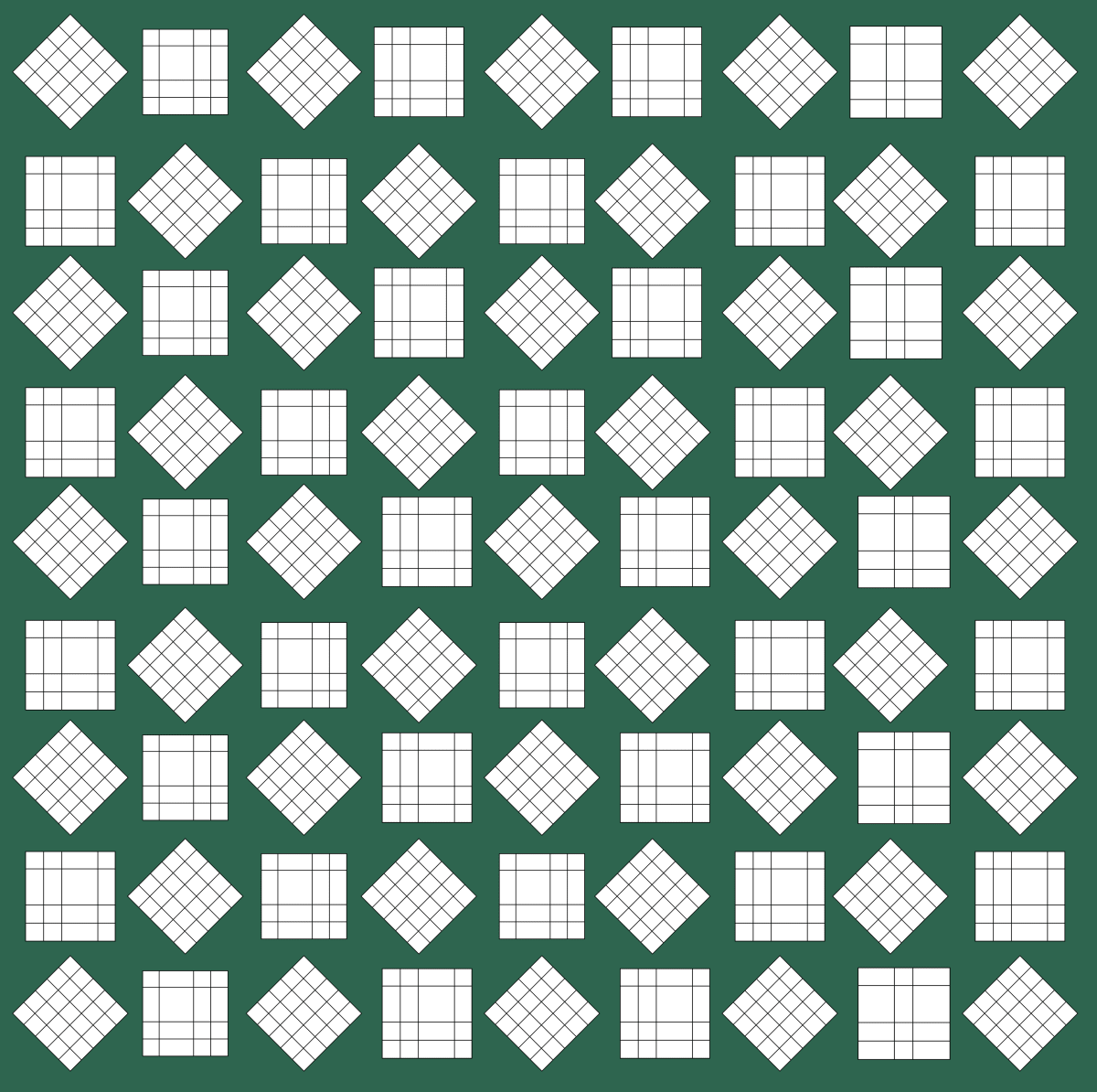
How many tiny squares are there in the following picture? Write the prime factorisation of the number of tiny squares.
Answer
The diamond-shaped figures each contain 5 × 5 = 25 tiny squares.
The arrangement consists of 9 rows of diamond-shaped figures. Each odd-numbered row (1st, 3rd, 5th, 7th, and 9th) contains 5 figures, while each even-numbered row (2nd, 4th, 6th, and 8th) contains 4 figures.
Then
The arrangement has
= 5 × 5 + 4 × 4
= 25 + 16
= 41 diamond figures
So, total number of tiny squares:
= 41 × 25
= 1025
Now, prime factorisation of 1025:
1025 = 5 × 5 × 41
There are 1025 tiny squares and .
How many cubes of side 1 cm will make a cube of side 3 cm?
Answer
A cube of side 3 cm has 3 layers, each layer being a square of unit cubes.
3 × 3 × 3 = 27
27 cubes of side 1 cm are needed.
Is 9 a cube?
Answer
2 × 2 × 2 = 8 and 3 × 3 × 3 = 27
Since 9 lies between 8 and 27, it cannot be written as a number multiplied by itself three times.
No, 9 is not a perfect cube.
Can you estimate the number of unit cubes in a cube with an edge length of 4 units?
Answer
Each layer is a 4 × 4 square of unit cubes (16 cubes), and there are 4 such layers.
4 × 4 × 4 = 64
There are 64 unit cubes.
Complete the table below.
| 13 = 1 | 113 = 1331 |
| 23 = 8 | 123 = ___ |
| 33 = 27 | 133 = 2197 |
| 43 = 64 | 143 = 2744 |
| 53 = 125 | 153 = ___ |
| 63 = ___ | 163 = ___ |
| 73 = ___ | 173 = 4913 |
| 83 = ___ | 183 = 5832 |
| 93 = ___ | 193 = 6859 |
| 103 = ___ | 203 = ___ |
Answer
63 = 6 × 6 × 6 = 216
73 = 7 × 7 × 7 = 343
83 = 8 × 8 × 8 = 512
93 = 9 × 9 × 9 = 729
103 = 10 × 10 × 10 = 1000
123 = 12 × 12 × 12 = 1728
153 = 15 × 15 × 15 = 3375
163 = 16 × 16 × 16 = 4096
203 = 20 × 20 × 20 = 8000
The complete table is:
| 13 = 1 | 113 = 1331 |
| 23 = 8 | 123 = 1728 |
| 33 = 27 | 133 = 2197 |
| 43 = 64 | 143 = 2744 |
| 53 = 125 | 153 = 3375 |
| 63 = 216 | 163 = 4096 |
| 73 = 343 | 173 = 4913 |
| 83 = 512 | 183 = 5832 |
| 93 = 729 | 193 = 6859 |
| 103 = 1000 | 203 = 8000 |
What patterns do you notice in the table above?
Answer
The cube of an even number is even, and the cube of an odd number is odd.
Unlike squares, the cubes end with every digit from 0 to 9.
The units digit of a cube is fixed by the units digit of the number: the cubes of numbers ending in 0, 1, 4, 5, 6 and 9 end in the same digit, while 2 ↔ 8, 3 ↔ 7 swap (for example, 23 ends in 8 and 83 ends in 2).
Cubes preserve parity and can end with any digit from 0 to 9.
We know that 0, 1, 4, 5, 6, 9 are the only last digits possible for squares. What are the possible last digits of cubes?
Answer
Looking at the units digits of the cubes:
03 = 0 → units digit 0
13 = 1 → units digit 1
23 = 8 → units digit 8
33 = 27 → units digit 7
43 = 64 → units digit 4
53 = 125 → units digit 5
63 = 216 → units digit 6
73 = 343 → units digit 3
83 = 512 → units digit 2
93 = 729 → units digit 9
Thus, every digit from 0 to 9 occurs as the units digit of a cube.
A cube can end with any of the digits 0, 1, 2, 3, 4, 5, 6, 7, 8 or 9.
Similar to squares, can you find the number of cubes with 1 digit, 2 digits, and 3 digits? What do you observe?
Answer
1-digit cubes: 13 = 1 and 23 = 8 → 2 cubes.
2-digit cubes: 33 = 27 and 43 = 64 → 2 cubes.
3-digit cubes: 53 = 125, 63 = 216, 73 = 343, 83 = 512 and 93 = 729 → 5 cubes.
We observe that cubes are far fewer than squares in each range, because cubes grow much more quickly than squares.
There are 2 one-digit, 2 two-digit and 5 three-digit cubes.
Can a cube end with exactly two zeroes (00)? Explain.
Answer
If a number has k zeros at the end, it can be written as (a part not ending in zero) × 10k. On cubing, 10k becomes 103k, so the cube ends with 3k zeros.
The number of zeros at the end of a cube is always a multiple of 3 (0, 3, 6, …). Since 2 is not a multiple of 3, a cube can never end with exactly two zeros.
No, a cube cannot end with exactly two zeros; the number of trailing zeros of a cube is always a multiple of 3.
The next two taxicab numbers after 1729 are 4104 and 13832. Find the two ways in which each of these can be expressed as the sum of two positive cubes.
Answer
For 4104:
4104 = 23 + 163 = 8 + 4096
4104 = 93 + 153 = 729 + 3375
For 13832:
13832 = 23 + 243 = 8 + 13824
13832 = 183 + 203 = 5832 + 8000
Consecutive odd numbers have a role to play with cubes too. Look at the following pattern:
1 = 1 = 13
3 + 5 = 8 = 23
7 + 9 + 11 = 27 = 33
13 + 15 + 17 + 19 = 64 = 43
21 + 23 + 25 + 27 + 29 = 125 = 53
31 + 33 + 35 + 37 + 39 + 41 = 216 = 63
Later in the series of consecutive odd numbers, we get: 91 + 93 + 95 + 97 + 99 + 101 + 103 + 105 + 107 + 109. Can you tell what this sum is without doing the calculation?
Answer
A block of consecutive odd numbers adds up to a cube. The nth block (which produces n3) contains n odd numbers and starts at n(n - 1) + 1.
For n = 10, the block starts at 10 × 9 + 1 = 91 and has 10 terms — exactly the numbers 91, 93, …, 109. Hence their sum is 103.
91 + 93 + ... + 109 = 103 = 1000
The sum is 103 = 1000.
Let us check if 3375 is a perfect cube.
Answer
3375 = 3 × 3 × 3 × 5 × 5 × 5
= (3 × 5) × (3 × 5) × (3 × 5)
= (3 × 5)3 = 153
The factors split into three identical groups.
Yes, 3375 is a perfect cube and .
Is 500 a perfect cube?
Answer
500 = 2 × 2 × 5 × 5 × 5
The two 2's cannot form a triplet, so the factors cannot be split into three identical groups.
No, 500 is not a perfect cube.
Find the cube roots of these numbers:
(i)
(ii)
(iii)
Answer
(i)
64 = (2 × 2) × (2 × 2) × (2 × 2) = (2 × 2)3
⇒ = 2 × 2 = 4
(ii)
512 = (2 × 2 × 2) × (2 × 2 × 2) × (2 × 2 × 2) = (2 × 2 × 2)3
⇒ = 2 × 2 × 2 = 8
(iii)
729 = (3 × 3) × (3 × 3) × (3 × 3) = (3 × 3)3
⇒ = 3 × 3 = 9
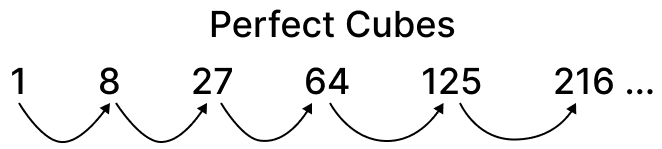
Compute successive differences over levels for perfect cubes until all the differences at a level are the same. What do you notice?
Answer
Starting from the perfect cubes and taking differences level by level:
Perfect cubes: 1, 8, 27, 64, 125, 216, …
Level 1:
8 - 1 = 7,
27 - 8 = 19,
64 - 27 = 37,
125 - 64 = 61,
216 - 125 = 91, …
⇒ 7, 19, 37, 61, 91, …
Level 2:
19 - 7 = 12,
37 - 19 = 18,
61 - 37 = 24,
91 - 61 = 30, …
⇒ 12, 18, 24, 30, …
Level 3:
18 - 12 = 6,
24 - 18 = 6,
30 - 24 = 6, …
⇒ 6, 6, 6, …
After three levels the differences become constant and equal to 6. (For squares this happened after two levels, with the constant value 2.)
After three levels, all the differences for perfect cubes are equal to 6.
Find the cube roots of 27000 and 10648.
Answer
For 27000:
27000 = (2 × 3 × 5) × (2 × 3 × 5) × (2 × 3 × 5)
= (2 × 3 × 5)3 = 303
⇒ = 30
For 10648:
10648 = (2 × 11) × (2 × 11) × (2 × 11)
= (2 × 11)3 = 223
⇒ = 22
and .
What number will you multiply by 1323 to make it a cube number?
Answer
1323 = 3 × 3 × 3 × 7 × 7 = 33 × 72
The triplet of 3's is complete, but the 7's form only a pair. We need one more 7 to make a triplet, so multiply by 7.
1323 × 7 = 9261 = 33 × 73 = 213
Multiply by 7; the product 9261 = 213 is a cube.
State true or false. Explain your reasoning.
(i) The cube of any odd number is even.
(ii) There is no perfect cube that ends with 8.
(iii) The cube of a 2-digit number may be a 3-digit number.
(iv) The cube of a 2-digit number may have seven or more digits.
(v) Cube numbers have an odd number of factors.
Answer
(i) False.
Reason —
The cube of an odd number is odd, since odd × odd × odd = odd.
For example, 33 = 27.
(ii) False.
Reason —
Some perfect cubes do end with 8.
For example, 23 = 8 and 123 = 1728 both end with 8.
(iii) False.
Reason —
The smallest 2-digit number is 10, and 103 = 1000 already has 4 digits, so the cube of a 2-digit number always has 4 or more digits.
(iv) False.
Reason —
The largest 2-digit number is 99, and 993 = 970299 has only 6 digits, so the cube of a 2-digit number can have at most 6 digits.
(v) False.
Reason —
A perfect cube does not necessarily have an odd number of factors. For example, 23 = 8 has the four factors 1, 2, 4 and 8. A perfect cube has an odd number of factors only when it is also a perfect square.
You are told that 1331 is a perfect cube. Can you guess without factorisation what its cube root is? Similarly, guess the cube roots of 4913, 12167, and 32768.
Answer
We use two ideas: the units digit of the cube fixes the units digit of the cube root, and the part of the number before the last three digits fixes the tens digit.
For 1331: last digit 1 gives units digit 1; the part 1 lies between 13 and 23, so the tens digit is 1.
.
For 4913: last digit 3 comes from 73 = 343, so units digit 7; the part 4 lies between 13 = 1 and 23 = 8, so tens digit 1.
.
For 12167: last digit 7 comes from 33 = 27, so units digit 3; the part 12 lies between 23 = 8 and 33 = 27, so tens digit 2.
.
For 32768: last digit 8 comes from 23 = 8, so units digit 2; the part 32 lies between 33 = 27 and 43 = 64, so tens digit 3.
.
and .
Which of the following is the greatest? Explain your reasoning.
(i) 673 − 663
(ii) 433 − 423
(iii) 672 − 662
(iv) 432 − 422
Answer
The difference between two consecutive cubes is (n + 1)3 − n3 = 3n(n + 1) + 1.
The difference between n2 and (n + 1)2 is 2n + 1
(i) 673 - 663 = 3 × 66 × (66 + 1) + 1
= 198 × 67 + 1
= 13266 + 1
= 13267
(ii) 433 - 423 = 3 × 42 × (42 + 1) + 1
= 126 × 43 + 1
= 5418 + 1
= 5419
(iii) 672 - 662 = 2 × 66 + 1
= 132 + 1
= 133
(iv) 432 - 422 = 2 × 42 + 1
= 84 + 1
= 85
The differences of cubes are far larger than the differences of squares, and 67 is larger than 43, so (i) is the greatest.
673 - 663 = 13267 is the greatest.
Look at the following numbers: 3 6 10 15 1 They are arranged such that each pair of adjacent numbers adds up to a square
3 + 6 = 9, 6 + 10 = 16, 10 + 15 = 25, 15 + 1 = 16
Try arranging the numbers 1 to 17 (without repetition) in a row so that the sum of every adjacent pair of numbers is a square. Can you arrange them in more than one way? If not, can you explain why?

Answer
The only squares that two numbers from 1 to 17 can add up to are 4, 9, 16 and 25. Listing the possible neighbours, the numbers 16 and 17 each have only one possible partner: 16 + 9 = 25 and 17 + 8 = 25. So 16 and 17 must sit at the two ends of the row.
Starting from 16, each next number is then forced (the only alternative at one step leads to a dead end), giving the arrangement:
16, 9, 7, 2, 14, 11, 5, 4, 12, 13, 3, 6, 10, 15, 1, 8, 17
Checking a few sums: 16 + 9 = 25, 9 + 7 = 16, 7 + 2 = 9, …, 1 + 8 = 9, 8 + 17 = 25 — every adjacent pair is a square.

Because 16 and 17 are forced to the ends and every step in between is forced, the arrangement is essentially unique — the only other arrangement is the same row read backwards.
The arrangement is 16, 9, 7, 2, 14, 11, 5, 4, 12, 13, 3, 6, 10, 15, 1, 8, 17, and it cannot be done in an essentially different way (only its reverse).
Can you do the same with the numbers from 1 to 32 (without repetition), arranging all the numbers in a circle?
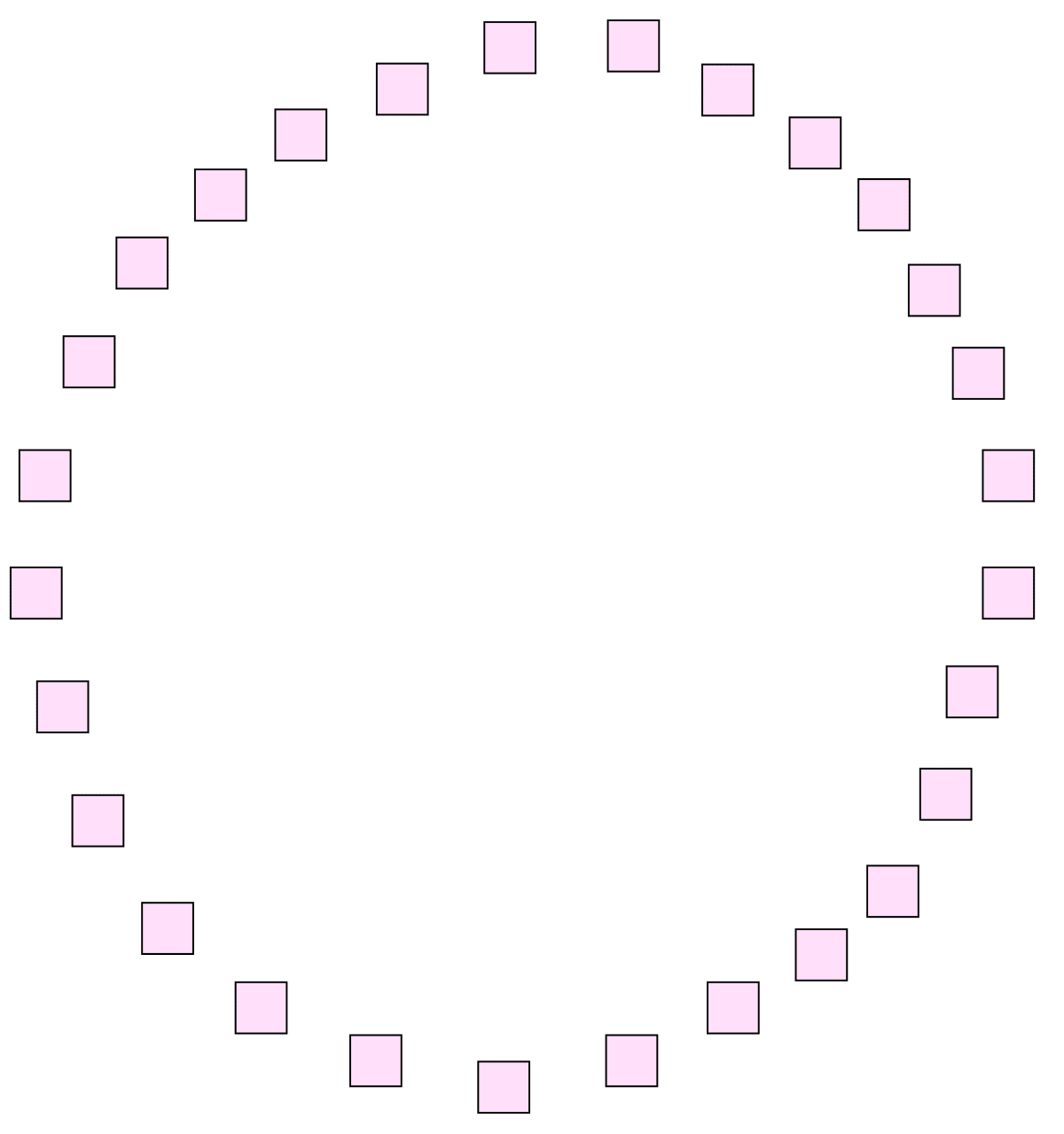
Answer
Yes. Here the sums of adjacent numbers can be 4, 9, 16, 25, 36 or 49. One valid circular arrangement (read around the circle and back to the start) is:
1, 8, 28, 21, 4, 32, 17, 19, 30, 6, 3, 13, 12, 24, 25, 11, 5, 31, 18, 7, 29, 20, 16, 9, 27, 22, 14, 2, 23, 26, 10, 15
and then 15 joins back to 1 (15 + 1 = 16). Every adjacent pair, including the last-to-first pair, adds up to a perfect square.
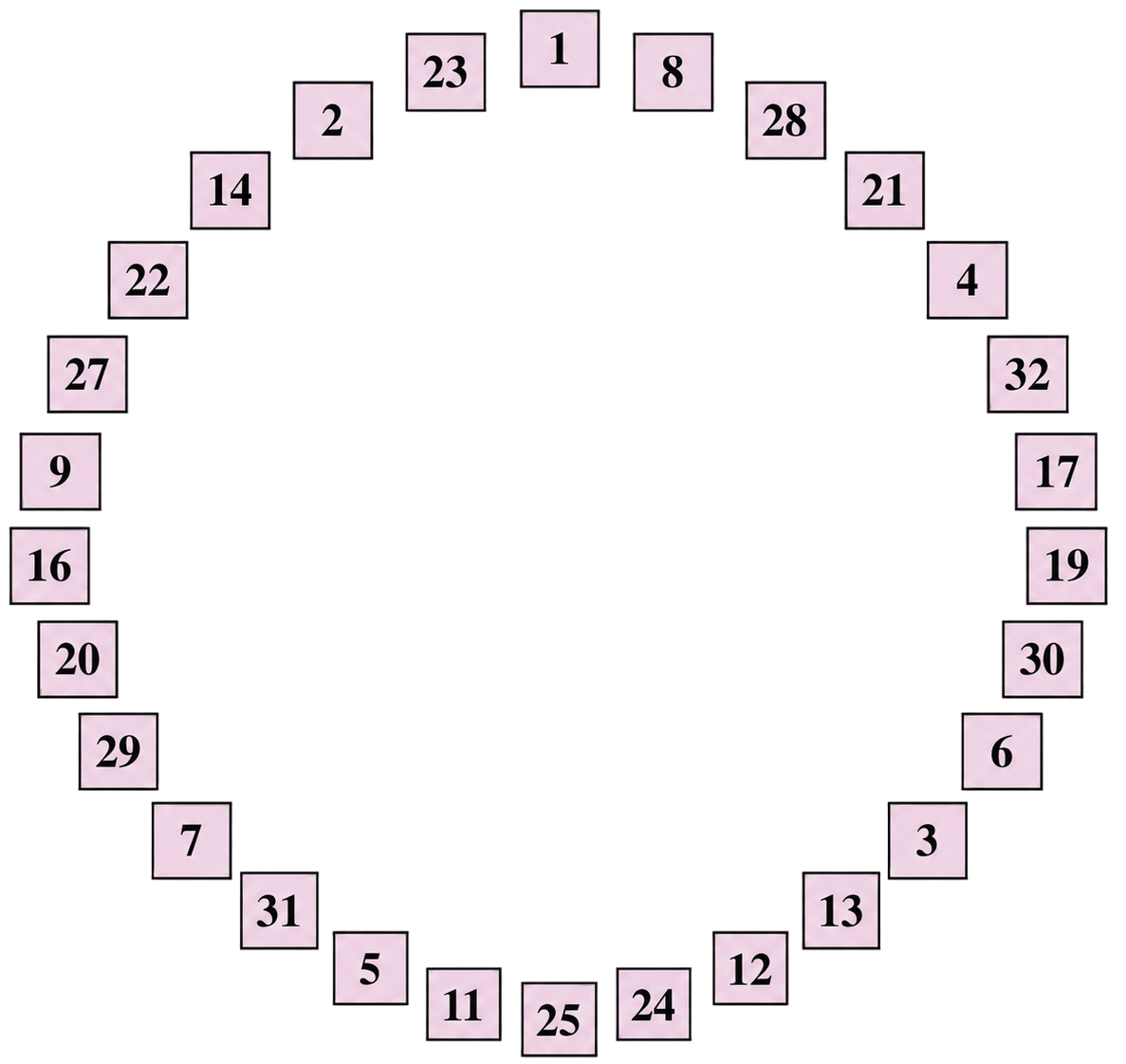
Yes; one such circle is 1, 8, 28, 21, 4, 32, 17, 19, 30, 6, 3, 13, 12, 24, 25, 11, 5, 31, 18, 7, 29, 20, 16, 9, 27, 22, 14, 2, 23, 26, 10, 15 (back to 1).