
Say you can fold a sheet of paper as many times as you wish. What would its thickness be after 30 folds? Make a guess.
Answer
This is a guessing question, so any reasonable guess is fine. After making a guess, let us check the actual value.
The thickness doubles after every fold. If the initial thickness of the sheet is 0.001 cm, then the thickness after 30 folds is:
Thickness after 30 folds = 0.001 × 230 cm
We know that 230 = 1,07,37,41,824.
Thickness = 0.001 × 1,07,37,41,824 cm
= 10,73,741.824 cm
= 10,737.41824 m
≈ 10.7 km
Hence, after 30 folds the thickness would be about 10.7 km, which is the typical height at which planes fly.
Now, what do you think the thickness would be after 30 folds? 45 folds? Make a guess.
Answer
This is again a guessing question, so any reasonable guess is acceptable. Let us check the actual values.
The thickness doubles after every fold, and the initial thickness is 0.001 cm.
After 30 folds:
Thickness = 0.001 × 230 cm
= 0.001 × 1,07,37,41,824 cm
= 10,73,741.824 cm
≈ 10.7 km
After 45 folds:
Thickness = 0.001 × 245 cm
= 0.001 × 35,18,43,72,08,832 cm
= 3,51,84,37,208.832 cm
≈ 3,51,844 km
Hence, after 30 folds the thickness is about 10.7 km, and after 45 folds it is about 3,51,844 km, which is almost the distance from the Earth to the Moon (about 3,84,400 km).
Fill the table below.
| Fold | Thickness | Fold | Thickness | Fold | Thickness |
|---|---|---|---|---|---|
| 18 | ≈ 262 cm | 21 | 24 | ||
| 19 | ≈ 524 cm | 22 | 25 | ||
| 20 | ≈ 10.4 m | 23 | 26 |
| Fold | Thickness | Fold | Thickness |
|---|---|---|---|
| 27 | ≈ 1.3 km | 29 | |
| 28 | 30 |
| Fold | Thickness | Fold | Thickness | Fold | Thickness |
|---|---|---|---|---|---|
| 31 | 36 | 41 | |||
| 32 | 37 | 42 | |||
| 33 | 38 | 43 | |||
| 34 | 39 | 44 | |||
| 35 | 40 | 45 |
Answer
The thickness doubles after every fold. Since the initial thickness of the sheet is 0.001 cm, the thickness after any fold can be found using:
Thickness after n folds = 0.001 × 2n cm
For example, for the 21st fold:
Thickness = 0.001 × 221 cm
= 0.001 × 20,97,152 cm
= 2097.152 cm
= 20.97 m
≈ 21 m
Computing each entry in the same way, the completed tables are as follows.
| Fold | Thickness | Fold | Thickness | Fold | Thickness |
|---|---|---|---|---|---|
| 18 | ≈ 262 cm | 21 | ≈ 21 m | 24 | ≈ 168 m |
| 19 | ≈ 524 cm | 22 | ≈ 42 m | 25 | ≈ 336 m |
| 20 | ≈ 10.4 m | 23 | ≈ 84 m | 26 | ≈ 671 m |
| Fold | Thickness | Fold | Thickness |
|---|---|---|---|
| 27 | ≈ 1.3 km | 29 | ≈ 5.4 km |
| 28 | ≈ 2.7 km | 30 | ≈ 10.7 km |
| Fold | Thickness | Fold | Thickness | Fold | Thickness |
|---|---|---|---|---|---|
| 31 | ≈ 21.5 km | 36 | ≈ 687 km | 41 | ≈ 21,990 km |
| 32 | ≈ 43 km | 37 | ≈ 1,374 km | 42 | ≈ 43,980 km |
| 33 | ≈ 86 km | 38 | ≈ 2,749 km | 43 | ≈ 87,961 km |
| 34 | ≈ 172 km | 39 | ≈ 5,498 km | 44 | ≈ 1,75,922 km |
| 35 | ≈ 344 km | 40 | ≈ 10,995 km | 45 | ≈ 3,51,844 km |
Hence, the tables are completed as shown above, with the thickness doubling after each fold.
Which expression describes the thickness of a sheet of paper after it is folded 10 times? The initial thickness is represented by the letter-number v.
(i) 10v
(ii) 10 + v
(iii) 2 × 10 × v
(iv) 210
(v) 210v
(vi) 102v
Answer
The thickness of the paper doubles after every fold, and the initial thickness is v.
After 1 fold, thickness = v × 2
After 2 folds, thickness = v × 2 × 2 = v × 22
After 3 folds, thickness = v × 2 × 2 × 2 = v × 23
Continuing this pattern, after 10 folds the thickness becomes:
Thickness = v × 2 × 2 × ... × 2 (2 multiplied 10 times) = v × 210 = 210v
So, the expression that describes the thickness after 10 folds is 210v.
Hence, option (v) 210v is the correct option.
Express the number 32400 as a product of its prime factors and represent the prime factors in their exponential form.
Answer
We find the prime factors of 32400 by repeated division:
32400 = 2 × 16200
16200 = 2 × 8100
8100 = 2 × 4050
4050 = 2 × 2025
2025 = 5 × 405
405 = 5 × 81
81 = 3 × 27
27 = 3 × 9
9 = 3 × 3
So, writing 32400 as a product of its prime factors:
32400 = 2 × 2 × 2 × 2 × 5 × 5 × 3 × 3 × 3 × 3
Grouping the same prime factors together and writing them in exponential form:
32400 = 24 × 52 × 34
Hence, 32400 = 24 × 52 × 34.
What is (-1)5? Is it positive or negative? What about (-1)56?
Answer
Finding (-1)5:
(-1)5 = (-1) × (-1) × (-1) × (-1) × (-1) = -1
Since the power 5 is an odd number, the result is negative. [A negative number raised to an odd power is negative]
Finding (-1)56:
(-1)56 means (-1) multiplied by itself 56 times.
Since the power 56 is an even number, the result is positive, and it equals +1. [A negative number raised to an even power is positive]
So, (-1)56 = 1.
Hence, (-1)5 = -1 (negative) and (-1)56 = 1 (positive).
Is (-2)4 = 16? Verify.
Answer
We need to check whether (-2)4 is equal to 16.
(-2)4 means (-2) multiplied by itself 4 times:
(-2)4 = (-2) × (-2) × (-2) × (-2)
= [(-2) × (-2)] × [(-2) × (-2)]
= 4 × 4
= 16
Since the power 4 is an even number, the negative signs cancel out in pairs and the result is positive. [A negative number raised to an even power is positive]
So, (-2)4 = 16, which is the same as the given value.
Hence, it is verified that (-2)4 = 16.
What is 02, 05? What is 0n?
Answer
Finding 02:
02 = 0 × 0 = 0
Finding 05:
05 = 0 × 0 × 0 × 0 × 0 = 0
Finding 0n:
0n means 0 multiplied by itself n times. Since multiplying 0 by itself any number of times always gives 0, we get:
0n = 0 × 0 × ... × 0 (0 multiplied n times) = 0, where n is a counting number (n ≥ 1).
Hence, 02 = 0, 05 = 0, and in general 0n = 0 for every counting number n.
Express the following in exponential form:
(i) 6 × 6 × 6 × 6
(ii) y × y
(iii) b × b × b × b
(iv) 5 × 5 × 7 × 7 × 7
(v) 2 × 2 × a × a
(vi) a × a × a × c × c × c × c × d
Answer
(i) 6 × 6 × 6 × 6
The number 6 is being multiplied by itself 4 times.
6 × 6 × 6 × 6 = 64
Hence, the answer is 64.
(ii) y × y
The letter-number y is being multiplied by itself 2 times.
y × y = y2
Hence, the answer is y2.
(iii) b × b × b × b
The letter-number b is being multiplied by itself 4 times.
b × b × b × b = b4
Hence, the answer is b4.
(iv) 5 × 5 × 7 × 7 × 7
Here, 5 is multiplied by itself 2 times and 7 is multiplied by itself 3 times.
5 × 5 × 7 × 7 × 7 = 52 × 73
Hence, the answer is 52 × 73.
(v) 2 × 2 × a × a
Here, 2 is multiplied by itself 2 times and a is multiplied by itself 2 times.
2 × 2 × a × a = 22 × a2
Hence, the answer is 22 × a2.
(vi) a × a × a × c × c × c × c × d
Here, a is multiplied 3 times, c is multiplied 4 times and d appears 1 time.
a × a × a × c × c × c × c × d = a3 × c4 × d
Hence, the answer is a3 × c4 × d.
Express each of the following as a product of powers of their prime factors in exponential form:
(i) 648
(ii) 405
(iii) 540
(iv) 3600
Answer
(i) 648
We find the prime factors of 648 by repeated division:
648 ÷ 2 = 324
324 ÷ 2 = 162
162 ÷ 2 = 81
81 ÷ 3 = 27
27 ÷ 3 = 9
9 ÷ 3 = 3
3 ÷ 3 = 1
So, 648 = 2 × 2 × 2 × 3 × 3 × 3 × 3
Grouping the like prime factors:
648 = 23 × 34
Hence, the answer is 23 × 34.
(ii) 405
We find the prime factors of 405 by repeated division:
405 ÷ 3 = 135
135 ÷ 3 = 45
45 ÷ 3 = 15
15 ÷ 3 = 5
5 ÷ 5 = 1
So, 405 = 3 × 3 × 3 × 3 × 5
Grouping the like prime factors:
405 = 34 × 5
Hence, the answer is 34 × 5.
(iii) 540
We find the prime factors of 540 by repeated division:
540 ÷ 2 = 270
270 ÷ 2 = 135
135 ÷ 3 = 45
45 ÷ 3 = 15
15 ÷ 3 = 5
5 ÷ 5 = 1
So, 540 = 2 × 2 × 3 × 3 × 3 × 5
Grouping the like prime factors:
540 = 22 × 33 × 5
Hence, the answer is 22 × 33 × 5.
(iv) 3600
We find the prime factors of 3600 by repeated division:
3600 ÷ 2 = 1800
1800 ÷ 2 = 900
900 ÷ 2 = 450
450 ÷ 2 = 225
225 ÷ 3 = 75
75 ÷ 3 = 25
25 ÷ 5 = 5
5 ÷ 5 = 1
So, 3600 = 2 × 2 × 2 × 2 × 3 × 3 × 5 × 5
Grouping the like prime factors:
3600 = 24 × 32 × 52
Hence, the answer is 24 × 32 × 52.
Write the numerical value of each of the following:
(i) 2 × 10³
(ii) 72 × 23
(iii) 3 × 44
(iv) (-3)2 × (-5)2
(v) 32 × 104
(vi) (-2)5 × (-10)6
Answer
(i) 2 × 10³
103 = 10 × 10 × 10 = 1000
2 × 103 = 2 × 1000 = 2000
Hence, the answer is 2000.
(ii) 72 × 23
72 = 7 × 7 = 49
23 = 2 × 2 × 2 = 8
72 × 23 = 49 × 8 = 392
Hence, the answer is 392.
(iii) 3 × 44
44 = 4 × 4 × 4 × 4 = 256
3 × 44 = 3 × 256 = 768
Hence, the answer is 768.
(iv) (-3)2 × (-5)2
(-3)2 = (-3) × (-3) = 9 [A negative number raised to an even power is positive]
(-5)2 = (-5) × (-5) = 25
(-3)2 × (-5)2 = 9 × 25 = 225
Hence, the answer is 225.
(v) 32 × 104
32 = 3 × 3 = 9
104 = 10 × 10 × 10 × 10 = 10000
32 × 104 = 9 × 10000 = 90000
Hence, the answer is 90000.
(vi) (-2)5 × (-10)6
(-2)5 = (-2) × (-2) × (-2) × (-2) × (-2) = -32 [A negative number raised to an odd power is negative]
(-10)6 = (-10) × (-10) × (-10) × (-10) × (-10) × (-10) = 1000000 [A negative number raised to an even power is positive]
(-2)5 × (-10)6 = (-32) × 1000000 = -32000000
Hence, the answer is -3,20,00,000.
Three daughters with curious eyes,
Each got three baskets—a kingly prize.
Each basket had three silver keys,
Each opens three big rooms with ease.
Each room had tables—one, two, three,
With three bright necklaces on each, you see.
Each necklace had three diamonds so fine…
Can you count these stones that shine?
Hint: Find out the number of baskets and rooms.
(i) How many rooms were there altogether?
(ii) How many diamonds were there in total? Can we find out by just one multiplication using the products above?
Answer
(i) The given information can be visualised as a tree, where the king has 3 daughters, each daughter has 3 baskets, each basket has 3 keys, and each key opens 3 rooms.
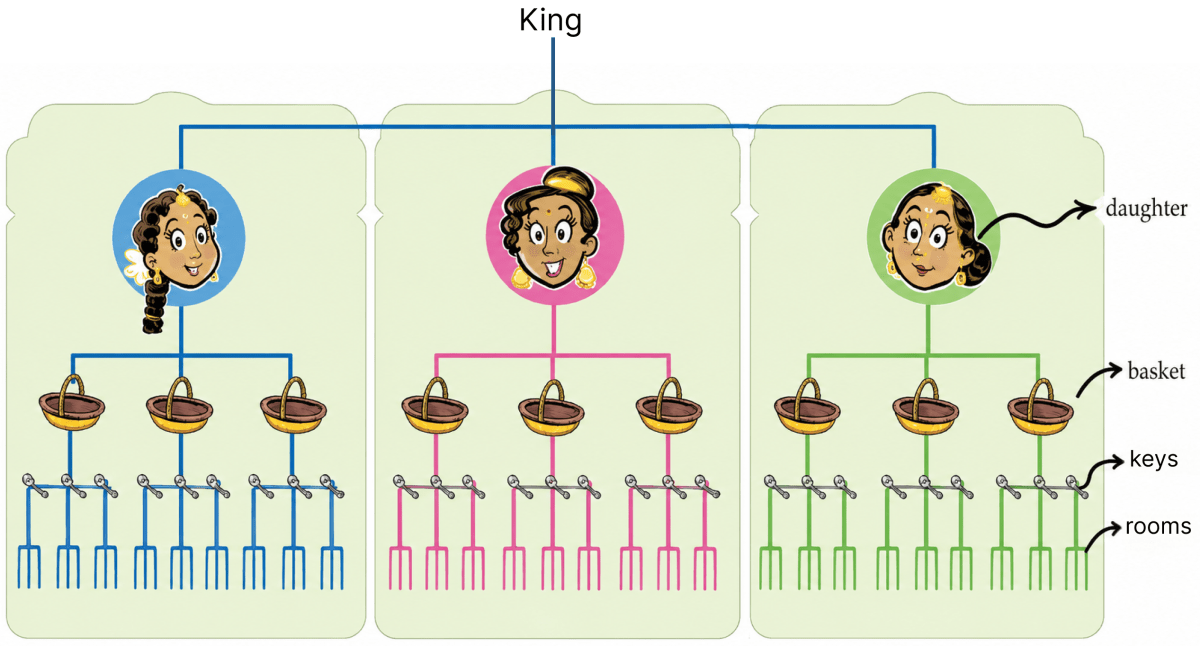
Counting step by step, multiplying by 3 at each level:
Number of daughters = 3
Number of baskets = 3 × 3 = 9 = 32
Number of keys = 9 × 3 = 27 = 33
Number of rooms = 27 × 3 = 81 = 34
Hence, there were 9 (= 32) baskets and 81 (= 34) rooms altogether.
(ii) How many diamonds were there in total? Can we find out by just one multiplication using the products above?
Continuing the chain beyond the rooms:
Number of tables = 81 × 3 = 243 = 35
Number of necklaces = 243 × 3 = 729 = 36
Number of diamonds = 729 × 3 = 2187 = 37
So, the number of diamonds is 3 × 3 × 3 × 3 × 3 × 3 × 3 = 37.
Yes, we can find it by just one multiplication using the products found above. Since the number of rooms is 34 (= 81), we multiply it by 33 (= 27):
37 = 34 × 33 = 81 × 27 = 2187
Hence, there were 2187 (= 37) diamonds in total.
37 can also be written as 32 × 35. Can you reason out why?
Answer
37 means 3 is multiplied by itself 7 times:
37 = 3 × 3 × 3 × 3 × 3 × 3 × 3
We can split these seven 3's into a group of two and a group of five:
37 = (3 × 3) × (3 × 3 × 3 × 3 × 3) = 32 × 35
This is because, by the law of exponents, when we multiply powers of the same base we add the exponents:
32 × 35 = 32 + 5 = 37 [∵ na × nb = na + b]
Hence, 37 can be written as 32 × 35 because the exponents 2 and 5 add up to 7.
Write the product p4 × p6 in exponential form.
Answer
p4 × p6 means p multiplied 4 times, multiplied by p multiplied 6 times:
p4 × p6 = (p × p × p × p) × (p × p × p × p × p × p) = p10
Using the law of exponents, we add the exponents: 4 + 6 = 10.
p4 × p6 = p4 + 6 = p10 [∵ na × nb = na + b]
Hence, the answer is p10.
Use this observation (na × nb = na + b) to compute the following:
(i) 29
(ii) 57
(iii) 46
Answer
(i) 29
We split the exponent 9 as 4 + 5:
29 = 24 + 5 = 24 × 25 [∵ na × nb = na + b]
24 = 16 and 25 = 32
29 = 16 × 32 = 512
Hence, the answer is 512.
(ii) 57
We split the exponent 7 as 3 + 4:
57 = 53 + 4 = 53 × 54 [∵ na × nb = na + b]
53 = 125 and 54 = 625
57 = 125 × 625 = 78125
Hence, the answer is 78125.
(iii) 46
We split the exponent 6 as 3 + 3:
46 = 43 + 3 = 43 × 43 [∵ na × nb = na + b]
43 = 64
46 = 64 × 64 = 4096
Hence, the answer is 4096.
Is 210 also equal to (25)2? Write it as a product.
Answer
210 means 2 is multiplied by itself 10 times. We can group these ten 2's into two groups of five:
210 = (2 × 2 × 2 × 2 × 2) × (2 × 2 × 2 × 2 × 2)
= 25 × 25
= (25)2
We can also verify this using the power of a power rule:
(25)2 = 25 × 2 = 210 [∵ (na)b = na × b]
Hence, yes, 210 = (25)2, written as the product 25 × 25.
Write the following expressions as a power of a power in at least two different ways:
(i) 86
(ii) 715
(iii) 914
(iv) 58
Answer
To write a number as a power of a power, we use the rule (na)b = na × b. We split the exponent into two factors whose product gives the original exponent.
(i) 86
The exponent 6 can be written as 2 × 3 or 3 × 2.
86 = 82 × 3 = (82)3
86 = 83 × 2 = (83)2
Hence, 86 = (82)3 = (83)2.
(ii) 715
To write a number as a power of a power, we use the rule (na)b = na × b. We split the exponent into two factors whose product gives the original exponent.
The exponent 15 can be written as 3 × 5 or 5 × 3.
715 = 73 × 5 = (73)5
715 = 75 × 3 = (75)3
Hence, 715 = (73)5 = (75)3.
(iii) 914
To write a number as a power of a power, we use the rule (na)b = na × b. We split the exponent into two factors whose product gives the original exponent.
The exponent 14 can be written as 2 × 7 or 7 × 2.
914 = 92 × 7 = (92)7
914 = 97 × 2 = (97)2
Hence, 914 = (92)7 = (97)2.
(iv) 58
To write a number as a power of a power, we use the rule (na)b = na × b. We split the exponent into two factors whose product gives the original exponent.
The exponent 8 can be written as 2 × 4 or 4 × 2.
58 = 52 × 4 = (52)4
58 = 54 × 2 = (54)2
Hence, 58 = (52)4 = (54)2.
In the middle of a beautiful, magical pond lies a bright pink lotus. The number of lotuses doubles every day in this pond. After 30 days, the pond is completely covered with lotuses. On which day was the pond half full?
Answer
The number of lotuses doubles every day, so the area covered by the lotuses also doubles every day.
This means the pond on any given day has twice the lotuses it had on the previous day.
Looking at it the other way, the pond had half as many lotuses on the previous day as it had on the given day.
Since the pond is completely covered (full) on the 30th day, on the previous day (the 29th day) it must have had half the lotuses, i.e. it was half full.
∴ The pond was half full on the 29th day.
Hence, the pond was half full on the 29th day.
If the pond is completely covered by lotuses on the 30th day, how much of it is covered by lotuses on the 29th day?
Answer
The number of lotuses doubles every day.
So, number of lotuses on the 30th day = 2 × (number of lotuses on the 29th day).
This means the lotuses on the 29th day = half of the lotuses on the 30th day.
Since the pond is completely covered on the 30th day, on the 29th day it is half covered.
Hence, half of the pond is covered by lotuses on the 29th day.
Write the number of lotuses (in exponential form) when the pond was —
(i) fully covered (ii) half covered
Answer
The pond starts with 1 lotus and the number of lotuses doubles every day.
So the number of lotuses each day is:
Start: 1 = 20
After 1 day: 2 = 21
After 2 days: 2 × 2 = 22
⋮
After 30 days: 2 multiplied by itself 30 times = 230
(i) fully covered
The pond is fully covered on the 30th day.
So, the number of lotuses when fully covered = 230.
Hence, the answer is 230.
(ii) half covered
The pond is half covered on the 29th day.
So, the number of lotuses when half covered = 229.
This can be verified, as 229 × 2 = 230 (fully covered).
Hence, the answer is 229.
There is another pond in which the number of lotuses triples every day. When both the ponds had no flowers, Damayanti placed a lotus in the doubling pond. After 4 days, she took all the lotuses from there and put them in the tripling pond.
(i) How many lotuses will be in the tripling pond after 4 more days?
(ii) What if Damayanti had changed the order in which she placed the flowers in the lakes? How many lotuses would be there?
(iii) Can this product be expressed as an exponent mn, where m and n are some counting numbers?
(iv) Use this observation to compute the value of 25 × 55.
Answer
(i)
Damayanti placed 1 lotus in the doubling pond, where the number doubles every day.
After the first 4 days, the number of lotuses = 1 × 2 × 2 × 2 × 2 = 24.
These 24 lotuses are then placed in the tripling pond, where the number triples every day.
After the next 4 days, the number of lotuses = 24 × 3 × 3 × 3 × 3 = 24 × 34.
Hence, there will be 24 × 34 lotuses in the tripling pond after 4 more days.
(ii)
If Damayanti changed the order — first placing 1 lotus in the tripling pond for 4 days, and then moving them to the doubling pond for 4 days — the count would be:
1 × 34 × 24 = (3 × 3 × 3 × 3) × (2 × 2 × 2 × 2).
Since the order of multiplication does not change the product, the number of lotuses is the same as before.
Hence, the number of lotuses would be the same, i.e. 34 × 24.
(iii)
By regrouping the numbers, we have:
1 × 34 × 24
= (3 × 3 × 3 × 3) × (2 × 2 × 2 × 2)
= (3 × 2) × (3 × 2) × (3 × 2) × (3 × 2) [Regrouping]
= (3 × 2)4
= 64
Yes, the product can be expressed as an exponent.
In general form, ma × na = (mn)a, where a is a counting number.
Hence, the product can be expressed as 64.
(iv)
Using the observation ma × na = (mn)a:
25 × 55
= (2 × 5)5 [Since the exponents are the same]
= 105
= 1,00,000
Hence, 25 × 55 = 105 = 1,00,000.
Simplify and write it in exponential form.
Answer
We know that
Hence, the answer is 24 = 16.
Estu has 4 dresses and 3 caps. How many different ways can Estu combine the dresses and caps?
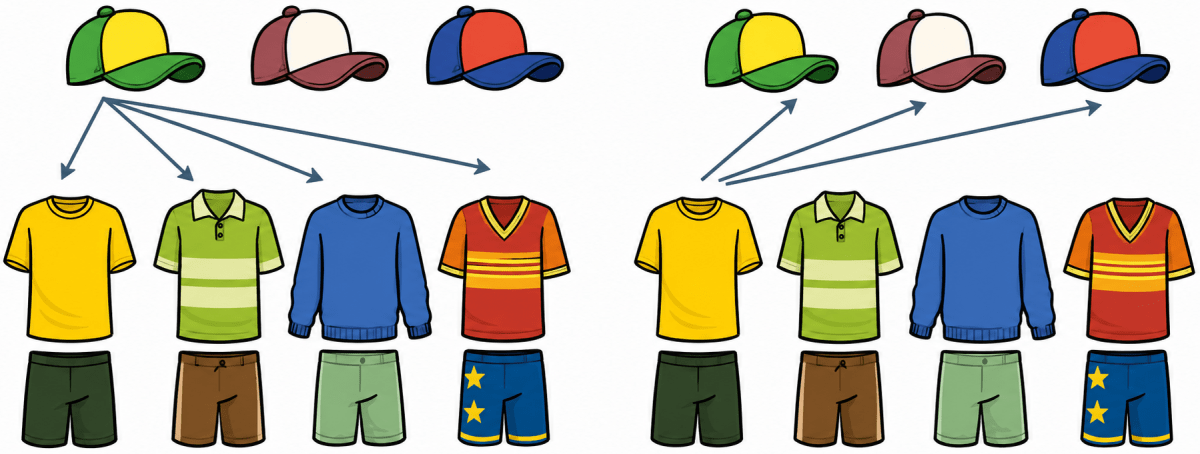
Answer
For each cap, Estu can choose any one of the 4 dresses.
Since there are 3 caps, the total number of combinations = 4 + 4 + 4 = 4 × 3 = 12.
We can also look at it the other way — for each dress, Estu can choose any one of the 3 caps, so for 4 dresses, the total = 3 + 3 + 3 + 3 = 3 × 4 = 12.
Hence, Estu can combine the dresses and caps in 12 different ways.
Roxie has 7 dresses, 2 hats, and 3 pairs of shoes. How many different ways can Roxie dress up?
Answer
To dress up, Roxie chooses one item of each type:
- any 1 of the 7 dresses,
- any 1 of the 2 hats,
- any 1 of the 3 pairs of shoes.
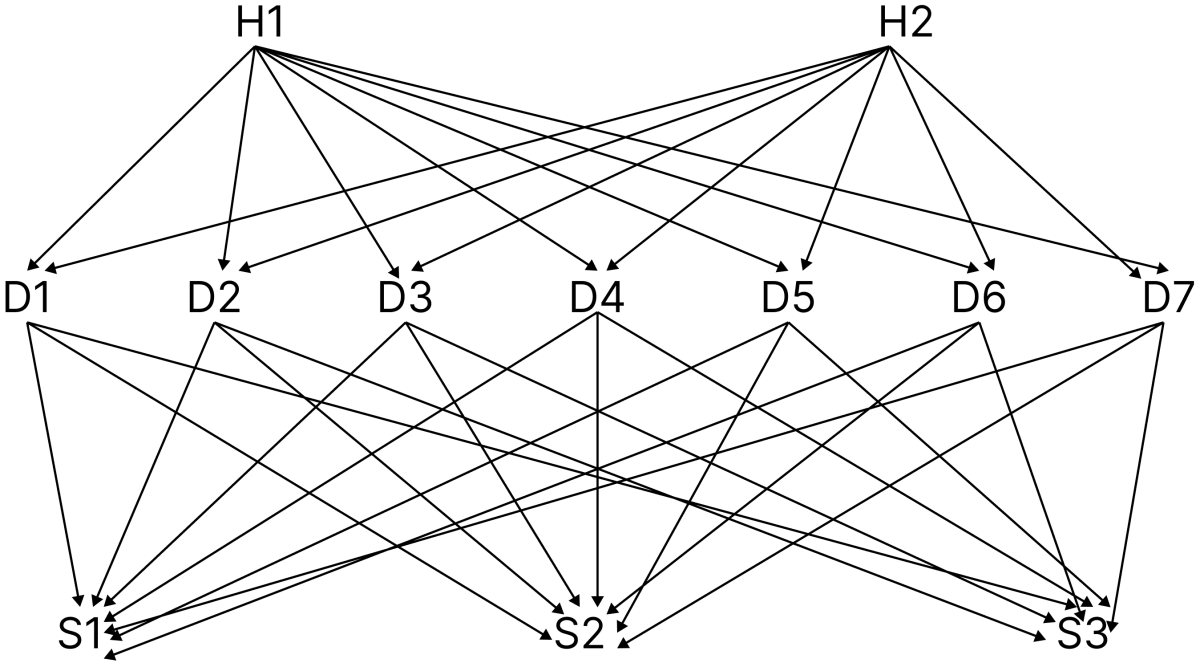
By the multiplication principle, the total number of ways = (choices of dresses) × (choices of hats) × (choices of shoes).
Total number of ways = 7 × 2 × 3.
7 × 2 × 3
= 14 × 3
= 42
Hence, Roxie can dress up in 42 different ways.
Estu and Roxie came across a safe containing old stamps and coins that their great-grandfather had collected. It was secured with a 5-digit password. Since nobody knew the password, they had no option except to try every password until it opened. They were unlucky and the lock only opened with the last password, after they had tried all possible combinations.
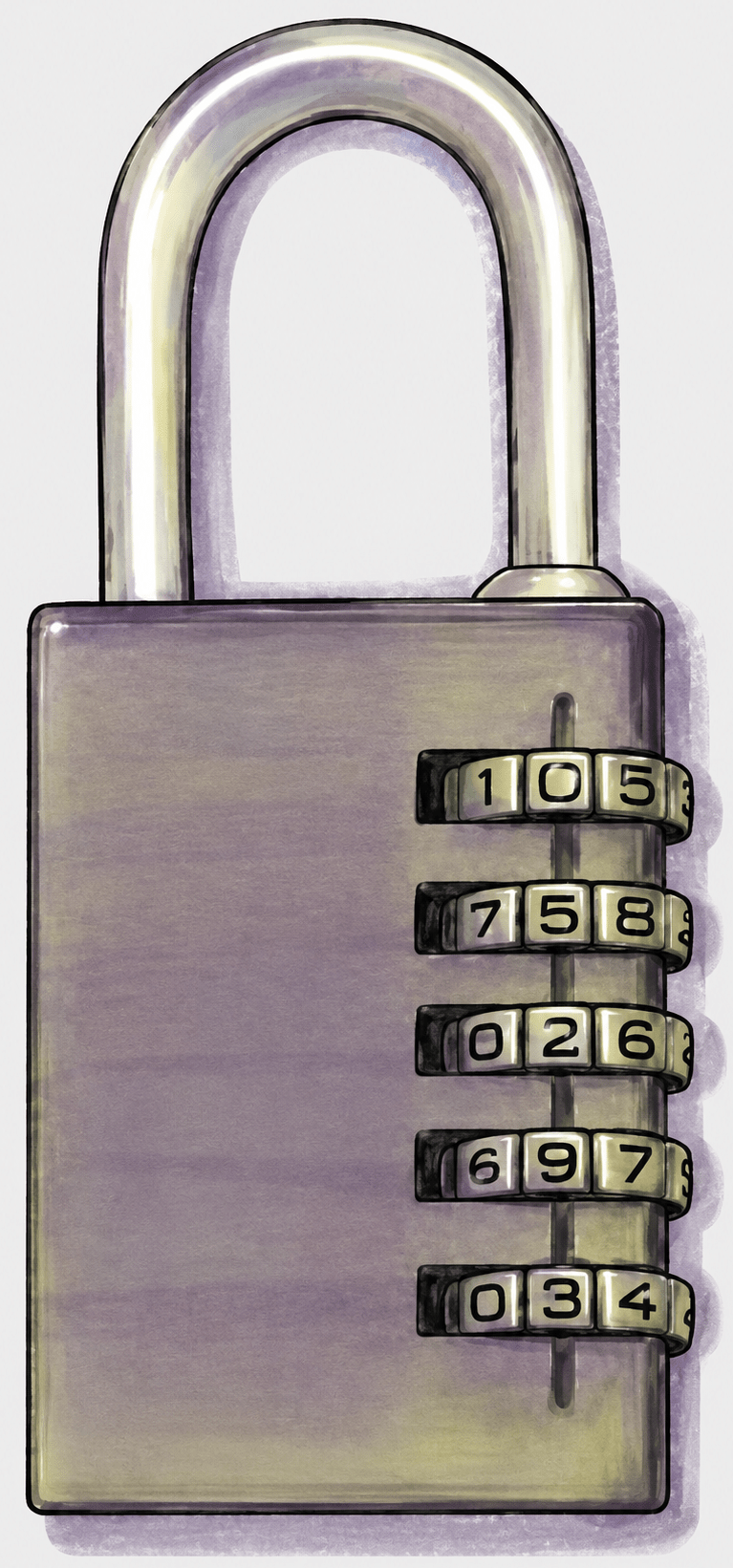
(i) How many passwords did they end up checking?
(ii) How many 5-digit passwords are possible?
Answer
For a digit lock, each slot (digit) can be any of the digits 0, 1, 2, 3, 4, 5, 6, 7, 8, 9 — that is, 10 choices per slot.
For a 5-digit lock, by the multiplication principle, the total number of possible passwords is:
10 × 10 × 10 × 10 × 10
= 105
= 1,00,000
(i)
The lock opened only with the last password, after they had tried all possible combinations. So they checked every possible password.
∴ Number of passwords checked = total number of possible passwords = 1,00,000.
Hence, they ended up checking 1,00,000 (105) passwords.
(ii)
Each of the 5 slots has 10 choices, so the number of 5-digit passwords = 105 = 1,00,000.
Hence, 1,00,000 (105) 5-digit passwords are possible.
Estu says, "Next time, I will buy a lock that has 6 slots with the letters A to Z. I feel it is safer." How many passwords are possible with such a lock?
Answer
The letters A to Z give 26 choices for each slot.
The lock has 6 slots, and each slot can be filled by any one of the 26 letters.
By the multiplication principle, the total number of passwords is:
26 × 26 × 26 × 26 × 26 × 26
= 266
Computing the value:
262 = 676
263 = 262 × 26 = 676 × 26 = 17,576
266 = (263)2 = 17,576 × 17,576 = 30,89,15,776
This number (about 30 crore) is far larger than the 1,00,000 passwords possible with a 5-digit number lock, so Estu is right that the new lock is much safer.
Hence, 266 = 30,89,15,776 passwords are possible.
Think about how many combinations are possible in different contexts. Some examples are—
(i) Pincodes of places in India—The Pincode of Vidisha in Madhya Pradesh is 464001. The Pincode of Zemabawk in Mizoram is 796017.
(ii) Mobile numbers.
(iii) Vehicle registration numbers.
Try to find out how these numbers or codes are allotted/generated.
Answer
In each of these examples, the code is built from a fixed number of positions, and each position has a fixed set of choices. The number of possible codes is found by multiplying the number of choices at each position.
(i) Pincodes of places in India
A PIN (Postal Index Number) code in India is a 6-digit number, introduced in 1972. The digits are not random — they are allotted in a structured way:
- The first digit indicates the postal region/zone (there are 8 geographical zones with first digit 1–8, plus zone 9 reserved for the Army Postal Service).
- The first two digits together indicate the sub-region (a state or a part of a state).
- The first three digits together indicate the sorting district.
- The last three digits identify the specific post office within that sorting district.
For example, in 464001 (Vidisha), '4' is the region, '46' the sub-region, '464' the sorting district, and '001' the post office.
If every one of the 6 positions could be any digit 0–9, the count of 6-digit codes would be 106 = 10,00,000. (In practice, fewer are used because the first digit cannot be 0 and some combinations are reserved.)
(ii) Mobile numbers
An Indian mobile number is 10 digits long. The first digit is restricted to 6, 7, 8, or 9 (so the first position has 4 choices), and the leading digits also identify the telecom operator and circle. Each of the remaining 9 digits can be any of 0–9 (10 choices each).
Number of possible 10-digit mobile numbers with this rule = 4 × 109 = 4,00,00,00,000 (4 arab / 4 billion).
(iii) Vehicle registration numbers
In India, a vehicle registration number usually has the form State code – RTO code – Series – Number, for example KA 01 AB 1234.
- The first two letters are the State/Union Territory code (e.g. KA for Karnataka, MH for Maharashtra).
- The next two digits are the code of the Regional Transport Office (RTO) that registered the vehicle.
- One or two letters form the series.
- The last (usually four) digits are the unique number, allotted in sequence from 0001 to 9999 within a series.
When one series is fully used (for example 0001–9999 of series 'AB'), the next series ('AC', 'AD', …) is started.
Hence, each of these codes is generated by combining a fixed number of positions (digits and/or letters), and the number of possibilities at each position is multiplied together to get the total count of codes.
What is 2100 ÷ 225 in powers of 2?
Answer
We have:
2100 ÷ 225
= 2100 - 25 [By division rule na ÷ nb = na-b]
= 275
Hence, 2100 ÷ 225 = 275.
Why can't n be 0?
Answer
The generalised form na ÷ nb = na-b involves dividing by nb.
If n = 0, then nb = 0b = 0, and division by zero is not defined.
So the expression na ÷ nb would have no meaning when n = 0.
For the same reason, the forms n0 = 1 and n-a = also require a non-zero base, since they too would involve dividing by zero.
Hence, n cannot be 0.
We had required a and b to be counting numbers. Can a and b be any integers? Will the generalised forms still hold true?
Answer
Yes, a and b can be any integers (with n ≠ 0), and the generalised forms still hold true.
Let us verify each form with examples involving negative integers.
Product rule: na × nb = na+b
By the rule, 2-4 × 27 = 2-4+7 = 23. Both give the same result.
Power of a power: (na)b = na × b
By the rule, (2-2)3 = 2(-2) × 3 = 2-6. Both give the same result.
Division rule: na ÷ nb = na-b
By the rule, 23 ÷ 25 = 23-5 = 2-2. Both give the same result.
Hence, yes, the generalised forms hold true for any integers a and b, where n ≠ 0.
Write equivalent forms of the following.
(i) 2-4
(ii) 10-5
(iii) (-7)-2
(iv) (-5)-3
(v) 10-100
Answer
Using the rule n-a = :
(i) 2-4 =
(ii) 10-5 =
(iii) (-7)-2 =
(iv) (-5)-3 =
(v) 10-100 =
Simplify and write the answers in exponential form.
(i) 2-4 × 27
(ii) 32 × 3-5 × 36
(iii) p3 × p-10
(iv) 24 × (-4)-2
(v) 8p × 8q
Answer
(i) 2-4 × 27
= 2-4 + 7 [By the product rule]
= 23
Hence, the answer is 23.
(ii) 32 × 3-5 × 36
= 32 + (-5) + 6 [By the product rule]
= 33
Hence, the answer is 33.
(iii) p3 × p-10
= p3 + (-10) [By the product rule]
= p-7
Hence, the answer is p-7.
(iv)
Hence, the answer is 20 = 1.
(v) 8p × 8q
Answer
We have:
8p × 8q
= 8p+q [By product rule]
Hence, the answer is 8p+q.
Can we say that 16384 (47) is 16 (42) times larger than 1,024 (45)?
Answer
To check this, we find how many times larger 47 is than 45 by dividing.
47 ÷ 45
= 47 - 5 [By division rule]
= 42
= 16
So, 16,384 = 1,024 × 16.
Hence, yes, 16384 (47) is 16 (42) times larger than 1,024 (45).
How many times larger than 4-2 is 42?
Answer
To find how many times larger 42 is than 4-2, we divide.
42 ÷ 4-2
= 42 - (-2) [By division rule]
= 42 + 2
= 44
= 256
Hence, 42 is 44 (256) times larger than 4-2.
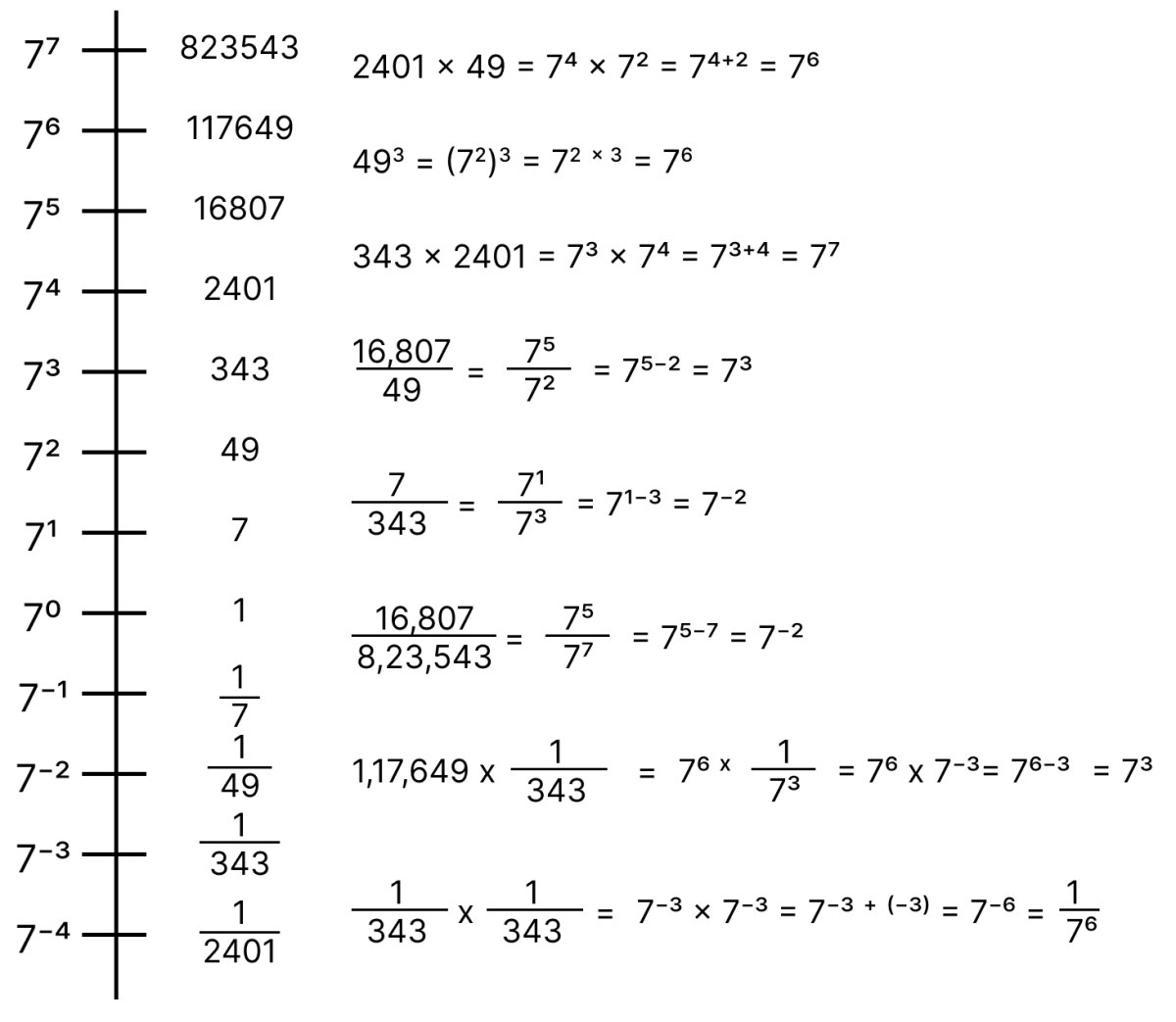
Use the power line for 7 to answer the following questions.
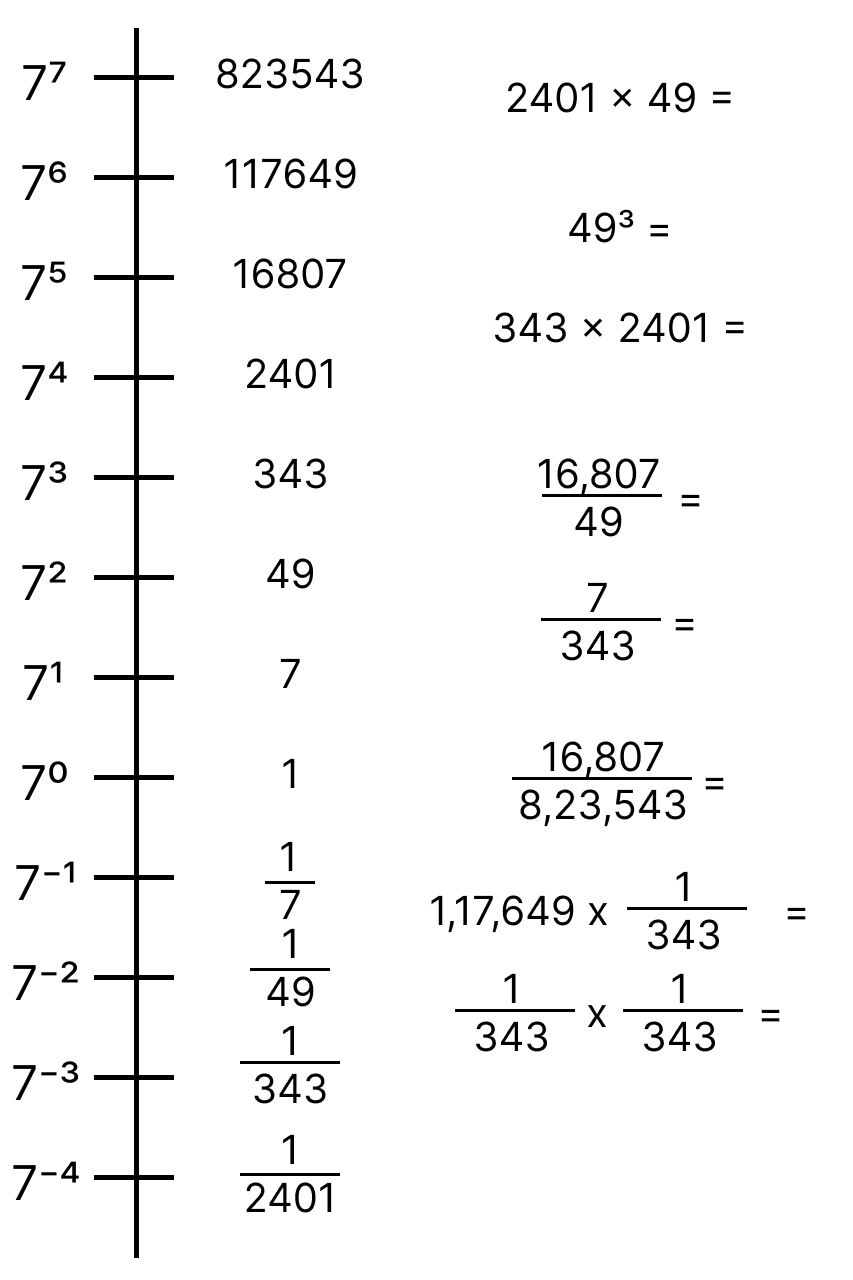
Answer
Using the power line for 7, here are the answers below.
Write these numbers using powers of 10:
(i) 172
(ii) 5642
(iii) 6374.
Answer
(i) 172
172 = (1 × 100) + (7 × 10) + (2 × 1)
Writing it using powers of 10,
172 = (1 × 10²) + (7 × 101) + (2 × 100).
Hence, 172 = (1 × 10²) + (7 × 101) + (2 × 100).
(ii) 5642
5642 = (5 × 1000) + (6 × 100) + (4 × 10) + (2 × 1)
Writing it using powers of 10,
5642 = (5 × 10³) + (6 × 10²) + (4 × 101) + (2 × 100).
Hence, 5642 = (5 × 10³) + (6 × 10²) + (4 × 101) + (2 × 100).
(iii) 6374
6374 = (6 × 1000) + (3 × 100) + (7 × 10) + (4 × 1)
Writing it using powers of 10,
6374 = (6 × 10³) + (3 × 10²) + (7 × 101) + (4 × 100).
Hence, 6374 = (6 × 10³) + (3 × 10²) + (7 × 101) + (4 × 100).
How can we write 561.903 using powers of 10?
Answer
The digits to the left of the decimal point use the place values 100, 10 and 1, while the digits to the right use the place values , and .
Writing it using powers of 10,
561.903 = (5 × 10²) + (6 × 101) + (1 × 100) + (9 × 10⁻¹) + (0 × 10–2) + (3 × 10⁻³).
Hence, 561.903 = (5 × 10²) + (6 × 101) + (1 × 100) + (9 × 10⁻¹) + (0 × 10–2) + (3 × 10⁻³).
Write the following large-number facts in scientific form:
(i) The Sun is located 30,00,00,00,00,00,00,00,00,000 m from the centre of our Milky Way galaxy.
(ii) The number of stars in our galaxy is 1,00,00,00,00,000.
(iii) The mass of the Earth is 59,76,00,00,00,00,00,00,00,00,00,000 kg.
Answer
In scientific form, a number is written as x × 10y, where 1 ≤ x < 10 and y are integers.
(i)
The number 30,00,00,00,00,00,00,00,00,000 is the digit 3 followed by 20 zeroes.
So, 30,00,00,00,00,00,00,00,00,000 = 3 × 10²⁰.
Hence, the distance of the Sun is 3 × 10²⁰ m.
(ii)
The number 1,00,00,00,00,000 is the digit 1 followed by 11 zeroes.
So, 1,00,00,00,00,000 = 1 × 1011 = 1011.
Hence, the number of stars in our galaxy is 1011.
(iii)
The number 59,76,00,00,00,00,00,00,00,00,00,000 is 5976 followed by 21 zeroes.
Placing the decimal point after the first digit,
59,76,00,00,00,00,00,00,00,00,00,000 = 5.976 × 1024.
Hence, the mass of the Earth is 5.976 × 1024 kg.
The distance between the Sun and Saturn is 1.4335 × 10¹² m. The distance between Saturn and Uranus is 1.439 × 10¹² m. The distance between the Sun and the Earth is 1.496 × 10¹¹ m. Can you say which of the three distances is the smallest?
Answer
In scientific form, the exponent of 10 tells us how big the number is. So we first compare the exponents.
Sun–Saturn distance = 1.4335 × 10¹² m (exponent 12)
Saturn–Uranus distance = 1.439 × 10¹² m (exponent 12)
Sun–Earth distance = 1.496 × 10¹¹ m (exponent 11)
The Sun–Earth distance has the smallest exponent (11), while the other two distances have a larger exponent (12). Since 1011 < 1012, the Sun–Earth distance is the smallest.
We can also see this by writing it with the same exponent:
1.496 × 1011 = 0.1496 × 10¹², which is much smaller than 1.4335 × 10¹² and 1.439 × 10¹².
Hence, the distance between the Sun and the Earth (1.496 × 10¹¹ m) is the smallest.
The number line below shows the distance between the Sun and Saturn (1.4335 × 10¹² m). On the number line below, mark the relative position of the Earth. The distance between the Sun and the Earth is 1.496 × 10¹¹ m.

Answer
The full length of the number line (from the Sun to Saturn) represents 1.4335 × 10¹² m.
The Earth lies at 1.496 × 10¹¹ m from the Sun. To find its position, we compare this distance with the full length:
So the Earth lies at about (one-tenth) of the way from the Sun towards Saturn — that is, quite close to the Sun.

Hence, the Earth is marked at about one-tenth of the distance from the Sun to Saturn, very close to the Sun.
Express the following numbers in standard form.
(i) 59,853
(ii) 65,950
(iii) 34,30,000
(iv) 70,04,00,00,000
Answer
In standard form, a number is written as x × 10y, where 1 ≤ x < 10 and y is an integer.
(i) 59,853
We place the decimal point after the first digit and count the number of places it moves (4 places).
59,853 = 5.9853 × 10⁴.
Hence, 59,853 = 5.9853 × 10⁴.
(ii) 65,950
Placing the decimal point after the first digit (4 places),
65,950 = 6.595 × 10⁴.
Hence, 65,950 = 6.595 × 10⁴.
(iii) 34,30,000
Placing the decimal point after the first digit (6 places),
34,30,000 = 3.43 × 10⁶.
Hence, 34,30,000 = 3.43 × 10⁶.
(iv) 70,04,00,00,000
Placing the decimal point after the first digit (10 places),
70,04,00,00,000 = 7.004 × 10¹⁰.
Hence, 70,04,00,00,000 = 7.004 × 10¹⁰.
Nanjundappa wants to donate jaggery equal to Roxie’s weight and wheat equal to Estu’s weight. He is wondering how much it would cost. What would be the worth (in rupees) of the donated jaggery? What would be the worth (in rupees) of the donated wheat?
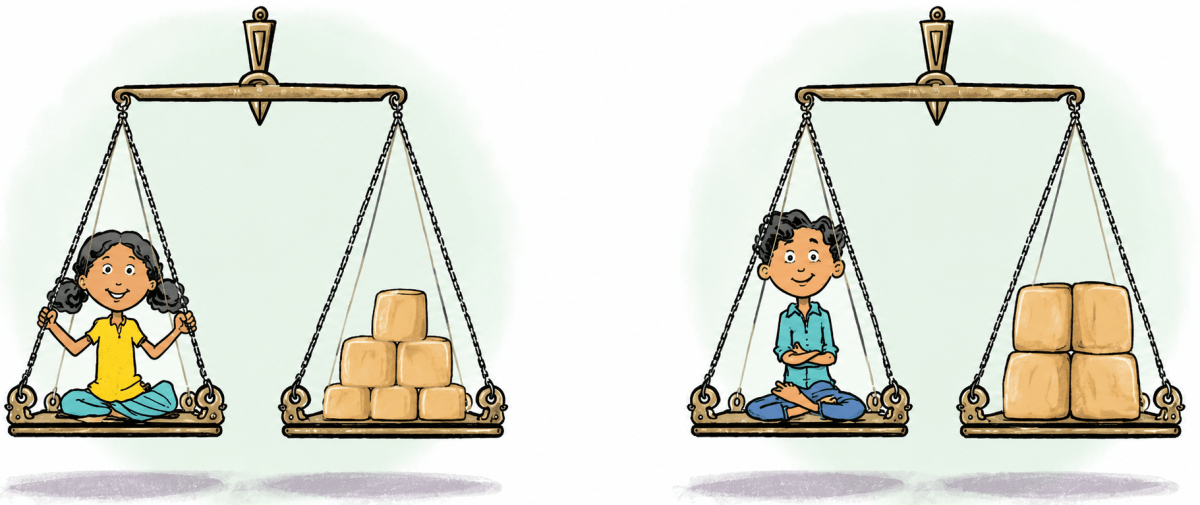
Answer
To find the worth, we first describe the relationships among the quantities involved.
The worth of the jaggery depends on how much Roxie weighs and on the price of jaggery per kilogram. Similarly, the worth of the wheat depends on how much Estu weighs and on the price of wheat per kilogram. So,
Worth of jaggery (in ₹) = Roxie’s weight (in kg) × cost of 1 kg jaggery (in ₹).
Worth of wheat (in ₹) = Estu’s weight (in kg) × cost of 1 kg wheat (in ₹).
Hence, the worth of jaggery = Roxie’s weight × cost of 1 kg jaggery, and the worth of wheat = Estu’s weight × cost of 1 kg wheat.
Make necessary and reasonable assumptions for the unknowns and find the answers. Remember, Roxie is 13 years old and Estu is 11 years old.
Answer
Here the unknowns are the weights of Roxie and Estu and the cost of 1 kg of jaggery and wheat. We make reasonable assumptions for these.
For jaggery:
Assume Roxie’s weight = 45 kg and the cost of 1 kg jaggery = ₹70.
Worth of jaggery = 45 × 70 = ₹3,150.
For wheat:
Assume Estu’s weight = 50 kg and the cost of 1 kg wheat = ₹50.
Worth of wheat = 50 × 50 = ₹2,500.
(These are only reasonable assumptions — the answers will change if different weights or prices are assumed.)
Hence, the donated jaggery is worth about ₹3,150 and the donated wheat is worth about ₹2,500.
Roxie wonders, "Instead of jaggery, if we use 1-rupee coins, how many coins are needed to equal my weight?" How can we find out?
Answer
The total weight of all the coins should equal Roxie’s weight. If we know the weight of one coin, then the number of coins is the total weight divided by the weight of one coin. So we describe the relationship as:
To use this, we need to know the weight of a single 1-rupee coin (which we can find out by measuring or by assuming a reasonable value).
Hence, the number of coins = (Roxie’s weight) ÷ (weight of one 1-rupee coin).
Would the number of coins be in hundreds, thousands, lakhs, crores, or even more? Make an instinctive guess.
Answer
A 1-rupee coin is very light, so a large number of coins is needed to make up a person’s weight. An instinctive guess is that the number of coins would be in the thousands (perhaps tens of thousands), not in lakhs or crores.
Hence, an instinctive guess is that the number of coins would be in the (tens of) thousands.
Find the answer by making necessary and reasonable assumptions and approximations for the unknowns. Remember, we are not looking for an exact answer but a reasonably close estimate.
Answer
We use the relationship found earlier and assume reasonable values for the unknowns.
Assume Roxie’s weight = 45 kg = 45,000 g.
Assume the weight of one 1-rupee coin ≈ 4 g.
So about 11,000 coins, which is of the order of 1.1 × 10⁴, i.e. in the ten-thousands. This is reasonably close to our earlier guess.
Hence, about 11,000 (≈ 1.1 × 10⁴) one-rupee coins would equal Roxie’s weight.
Estu asks, "What if we use 5-rupee coins or 10-rupee notes instead? How much money could it be?" Make an instinctive guess first. Then find out (make necessary and reasonable assumptions about the unknown details and find the answers).
Answer
Instinctive guess: A few tens of thousands of rupees for the 5-rupee coins, and a few lakhs of rupees for the 10-rupee notes (since notes are much lighter than coins).
We again take Roxie’s weight = 45 kg = 45,000 g.
Using 5-rupee coins:
Assume the weight of one 5-rupee coin ≈ 6 g.
Money = 7500 × 5 = ₹37,500.
Using 10-rupee notes:
Assume the weight of one currency note ≈ 1 g.
Money = 45,000 × 10 = ₹4,50,000.
Hence, using 5-rupee coins the money is about ₹37,500, and using 10-rupee notes it is about ₹4,50,000 (close to our guess).
Estu says, "When I become an adult, I would like to donate notebooks worth my weight every year". Roxie says, "When I grow up, I would like to do annadāna (offering grains or meals) worth my weight every year". How many people might benefit from each of these offerings in a year? Again, guess first before finding out.
Answer
Instinctive guess: A few tens of students could benefit from the notebooks, and a few hundred people from the annadāna.
Since they are talking about doing this as adults, assume each of them weighs about 60 kg = 60,000 g.
Notebooks (Estu):
Assume one notebook weighs ≈ 200 g.
If each student receives a set of about 6 notebooks for the year,
Annadāna (Roxie):
Assume one meal needs ≈ 150 g of grain (rice).
So about 400 people could be served one meal each.
Hence, the notebooks could benefit about 50 students and the annadāna could benefit about 400 people in a year (the numbers depend on the assumptions made).
Roxie and Estu overheard someone saying—"We did pādayātra for about 400 km to reach this place! We arrived early this morning." How long ago would they have started their journey?
Answer
We first describe the relationship: the time taken depends on the distance and on how much is walked each day.
Assume a comfortable walking speed ≈ 5 km/h.
Assume that they walk about 8 hours each day (resting at night).
Distance covered in one day = 5 × 8 = 40 km.
Hence, they would have started their journey about 10 days ago.
How many times can a person circumnavigate (go around the world) the Earth in their lifetime if they walk non-stop? Consider the distance around the Earth as 40,000 km.
Answer
The number of times around the Earth = total distance walked in a lifetime ÷ distance around the Earth.
We make the following reasonable assumptions:
Lifespan ≈ 70 years.
Walking speed ≈ 5 km/h.
Walking non-stop means 24 hours a day.
Total number of hours in a lifetime = 70 × 365 × 24 = 6,13,200 hours.
Total distance walked = 5 × 6,13,200 = 30,66,000 km (≈ 3 × 10⁶ km).
Hence, a person could go around the Earth about 76 times in their lifetime if they walked non-stop (with these assumptions).
Roxie tells Estu about a science-fiction novel she is reading where they build a ladder to reach the moon, "... I wonder if we actually had a ladder like that, how many steps would it have?". What do you think? Make an instinctive guess first.
Answer
This is an instinctive-guess question, so begin with a quick guess of your own. To check the guess, we model the situation.
To count the steps, we need the gap between two consecutive steps and the distance to the Moon. Let us make these reasonable assumptions:
Gap between consecutive steps = 20 cm
Distance from the Earth to the Moon = 3,84,400 km
Number of steps = Distance to the Moon ÷ Gap between two steps.
First, let us express the distance in centimetres.
3,84,400 km = 3,84,400 × 1000 m = 3,84,400 × 1000 × 100 cm
= 3,84,400 × 105 cm
= 3.844 × 1010 cm
Now,
Number of steps = 3.844 × 10¹⁰ ÷ 20
= 3.844 × 10¹⁰ ÷ (2 × 101)
= 1.922 × 109
= 1,92,20,00,000
Hence, the ladder would have about 1,92,20,00,000 steps (192 crore 20 lakh steps), i.e. ≈ 1.922 × 10⁹ steps.
Would the number of steps be in thousands, lakhs, crores, or even more?
Answer
From Question 1, the number of steps ≈ 1,92,20,00,000.
Reading this number, 1,92,20,00,000 = 192 crore 20 lakh.
So the number of steps is in crores — in fact, it is about 192 crore (close to 2 arab), which is of the order of 109.
Hence, the number of steps is in crores (about 192 crore steps).
Can you come up with some examples of linear growth and of exponential growth?
Answer
In linear growth the quantity increases by adding a fixed amount at each step (it is additive). In exponential growth the quantity increases by multiplying by a fixed factor at each step (it is multiplicative).
Some examples of linear growth:
Climbing a ladder where every step adds the same height (say 20 cm).
Saving a fixed amount of money every month.
Distance covered by a vehicle moving at a constant speed (equal distance every hour).
Filling a tank at a constant rate (the same volume of water added every minute).
Some examples of exponential growth:
The thickness of a sheet of paper doubling with every fold.
The number of lotuses doubling (or tripling) every day in a pond.
Bacteria that split into two after every fixed interval of time.
Money grown through compound interest.
A forwarded message where each person forwards it to a fixed number of new people.
Hence, linear growth is additive (a fixed amount is added each time), while exponential growth is multiplicative (the quantity is multiplied by a fixed factor each time).
The estimated global population of starlings is around 1.3 arab/1.3 billion (...............). The global human population as of 2025 is 8.2 arab/8.2 billion (8.2 × 10⁹).
Answer
1 billion = 109, so
1.3 billion = 1.3 × 109 = 1,30,00,00,000.
(Also, 1 arab = 109, so 1.3 arab = 1.3 × 109 = 1,30,00,00,000.)
The estimated global population of starlings is around 1.3 arab/1.3 billion (1.3 × 10⁹).
With a global human population of about 8 × 10⁹ and about 4 × 10⁵ African elephants, can we say that there are nearly 20,000 people for every African elephant?
Answer
Number of people for every African elephant
= Human population ÷ Number of African elephants
= (8 × 10⁹) ÷ (4 × 10⁵)
= (8 ÷ 4) × 109 − 5 [Using the division rule]
= 2 × 104
= 20,000
Hence, yes, there are nearly 20,000 people for every African elephant.
The estimated mosquito population worldwide (2023) is 11 neel/110 trillion (...............). A derived estimate of the population of the Antarctic krill stands at 50 neel/500 trillion (5 × 10¹⁴).
Answer
1 trillion = 1012, so
110 trillion = 110 × 1012 = 1.1 × 102 × 1012 = 1.1 × 10¹⁴.
(Also, 1 neel = 1013, so 11 neel = 11 × 1013 = 1.1 × 10¹⁴.)
The estimated mosquito population worldwide (2023) is 11 neel/110 trillion (1.1 × 10¹⁴).
Calculate and write the answer using scientific notation:
(i) How many ants are there for every human in the world?
(ii) If a flock of starlings contains 10,000 birds, how many flocks could there be in the world?
(iii) If each tree had about 104 leaves, find the total number of leaves on all the trees in the world.
(iv) If you stacked sheets of paper on top of each other, how many would you need to reach the Moon?
Answer
We use the following estimates from the chapter:
Number of ants ≈ 2 × 10¹⁶, human population ≈ 8 × 10⁹, number of starlings ≈ 1.3 × 10⁹, number of birds in one flock = 104 and number of trees ≈ 3 × 10¹².
(i)
Number of ants for every human
= Number of ants ÷ Human population
= (2 × 10¹⁶) ÷ (8 × 10⁹)
= (2 ÷ 8) × 1016 − 9
= 0.25 × 107
= 2.5 × 10⁶
Hence, there are about 2.5 × 10⁶ (25 lakh) ants for every human.
(ii)
Number of flocks
= Number of starlings ÷ Birds in one flock
= (1.3 × 10⁹) ÷ 104
= 1.3 × 10⁹ − 4
= 1.3 × 10⁵
Hence, there could be about 1.3 × 10⁵ (1,30,000) flocks in the world.
(iii)
Total number of leaves
= Number of trees × Leaves on one tree
= (3 × 1012) × 104
= 3 × 10¹² + 4
= 3 × 10¹⁶
Hence, there are about 3 × 10¹⁶ leaves on all the trees in the world.
(iv)
The thickness of one sheet of paper is 0.001 cm = 10−3 cm, and the distance to the Moon is 3,84,400 km = 3.844 × 1010 cm (as found earlier).
Number of sheets
= Distance to the Moon ÷ Thickness of one sheet
= (3.844 × 10¹⁰) ÷ 10−3
= 3.844 × 10¹⁰ − (−3)
= 3.844 × 10¹³
Hence, you would need about 3.8 × 10¹³ sheets of paper to reach the Moon.
“How old are you?” asked Estu.
“I completed 13 years a few weeks ago!” said Roxie.
“How old are you?” asked Estu again.
“I’m 4840 days old today!” said Roxie.
“How old are you?” asked Estu again
(i) "I'm ............... hours old!" said Roxie. Make an estimate before finding this number.
(ii) Estu: "I am 4070 days old today. Can you find out my date of birth?"
Answer
(i) Roxie said that she is 4840 days old.
A quick estimate: 13 years ≈ 13 × 365 ≈ 4745 days ≈ 4745 × 24 ≈ 1,13,880 hours, so the answer should be a little more than one lakh hours.
Now, since 1 day = 24 hours,
Age in hours = 4840 × 24
= 1,16,160 hours
"I'm 1,16,160 hours old said Roxie.
(ii) Assuming today's date is 23 May 2026, we calculate Estu's date of birth as follows:
To find the date of birth, we count back 4070 days from today's date.
First, convert 4070 days into years and days.
11 ordinary years = 11 × 365 = 4015 days.
In any 11-year span there are about 3 leap years, which add 3 extra days: 4015 + 3 = 4018 days.
Remaining days = 4070 − 4018 = 52 days ≈ 1 month 22 days.
So 4070 days = 11 years 52 days, which is approximately 11 years, 1 month, and 22 days.
Hence, if today is 23 May 2026, counting back 4070 days gives Estu's date of birth as 1 April 2015.
If you have lived for a million seconds, how old would you be?
Answer
One million seconds = 106 seconds.
We know 1 day = 24 × 60 × 60 = 86,400 seconds.
Age in days = 106 ÷ 86,400 ≈ 12 days.
Hence, if you have lived for a million seconds you would be only about 12 days old — not even two weeks!
"I am 69,70,710 … old". What could this number mean? Find out!
Answer
Roxie has been describing her age in smaller and smaller units: first 13 years, then 4840 days, then in hours; the number 69,70,710 is the next step — her age in minutes.
Let us check using Roxie's age of 4840 days.
Age in hours = 4840 × 24 = 1,16,160 hours.
Age in minutes = 1,16,160 × 60 = 69,69,600 minutes.
This is very close to 69,70,710 (the small difference is because the count is taken a little later in the day). Converting back, 69,70,710 ÷ (24 × 60) = 69,70,710 ÷ 1440 ≈ 4841 days ≈ 13 years.
Hence, the number 69,70,710 is Roxie's age expressed in minutes.
105 seconds ≈ 1.16 days and 106 seconds ≈ 11.57 days. Think of some events or phenomena whose time is of the order of (i) 105 seconds and (ii) 106 seconds. Write them in scientific notation.
Answer
(i) Events of the order of 105 seconds (about a day):
- One full day–night cycle, i.e. one rotation of the Earth: 86,400 seconds ≈ 8.64 × 10⁴ seconds.
- A two-day weekend: about 1.7 × 10⁵ seconds.
- A one-and-a-half-day train journey across the country: about 1.3 × 10⁵ seconds.
(ii) Events of the order of 106 seconds (about a fortnight):
- A two-week vacation (about 12 days): about 1 × 10⁶ seconds.
- The time a small wound takes to heal (about 10 days): about 8.6 × 10⁵ seconds.
- The length of a long fair or festival (about 11–12 days): about 1 × 10⁶ seconds.
Hence, events lasting about a day are of the order of 105 seconds, and events lasting about a fortnight are of the order of 106 seconds.
A fossil of Kelenken Guillermoi, a type of terror bird, is dated to 15 million years ago (≈ ............... seconds).
Answer
15 million years = 15 × 106 years = 1.5 × 10⁷ years.
We know 1 year ≈ 3.15 × 10⁷ seconds (since 365 × 24 × 60 × 60 ≈ 3.15 × 10⁷).
Time in seconds = (1.5 × 107) × (3.15 × 107)
= (1.5 × 3.15) × 107 + 7
= 4.725 × 10¹⁴
A fossil of Kelenken Guillermoi, a type of terror bird, is dated to 15 million years ago ≈ 4.7 × 10¹⁴ seconds.
Plants on land started 47 crore/470 million years ago (≈ ............... seconds).
Answer
470 million years = 470 × 106 years = 4.7 × 10⁸ years.
Using 1 year ≈ 3.15 × 10⁷ seconds,
Time in seconds = (4.7 × 108) × (3.15 × 107)
= (4.7 × 3.15) × 108 + 7
= 14.805 × 1015
= 1.48 × 10¹⁶
Plants on land started 47 crore/470 million years ago ≈ 1.5 × 10¹⁶ seconds.
Calculate and write the answer using scientific notation:
(i) If one star is counted every second, how long would it take to count all the stars in the universe? Answer in terms of the number of seconds using scientific notation.
(ii) If one could drink a glass of water (200 ml) every 10 seconds, how long would it take to finish the entire volume of water on Earth?
Answer
(i)
The estimated number of stars in the observable universe is 2 × 10²³.
Counting one star every second,
Time taken = 2 × 1023 × 1 second = 2 × 10²³ seconds.
Hence, it would take about 2 × 10²³ seconds to count all the stars.
(ii)
There are an estimated 2 × 1025 drops of water on Earth, with 16 drops in 1 ml.
Total volume of water = (2 × 1025) ÷ 16
= 0.125 × 1025
= 1.25 × 1024 ml.
A glass holds 200 ml, so
Number of glasses = (1.25 × 1024) ÷ 200
= (1.25 × 1024) ÷ (2 × 10²)
= 0.625 × 1022
= 6.25 × 10²¹ glasses.
Since one glass is finished every 10 seconds,
Time taken = 6.25 × 1021 × 10 = 6.25 × 10²² seconds.
Hence, it would take about 6.25 × 10²² seconds to finish all the water on Earth.
Observe the names million (106), billion (109), trillion (1012), quadrillion (1015), quintillion (1018), sextillion (1021), septillion (1024), octillion (1027), nonillion (1030), decillion (1033). What does the first part of each name denote?
Answer
Look at the first part (the prefix) of each name. These prefixes are the Latin words for counting numbers — bi denotes 2 (billion), tri denotes 3 (trillion), quad denotes 4 (quadrillion), quint denotes 5 (quintillion), sext denotes 6 (sextillion), sept denotes 7 (septillion), oct denotes 8 (octillion), non denotes 9 (nonillion), and dec denotes 10 (decillion). The name million corresponds to the number 1.
So the first part of each name denotes a counting number n. This number fixes the power of 10: if the first part denotes n, then the name stands for 103(n + 1) (which is the same as 1000n + 1).
Checking the pattern:
For billion, n = 2, so 103(2 + 1) = 109.
For trillion, n = 3, so 103(3 + 1) = 1012.
For decillion, n = 10, so 103(10 + 1) = 1033.
Hence, the first part of each name denotes a counting number (bi = 2, tri = 3, …, dec = 10), and it tells us the power of ten through the rule 103(n + 1).
Find out the units digit in the value of 2224 ÷ 432? [Hint: 4 = 22]
Answer
We have:
2224 ÷ 432
= 2224 ÷ (22)32 [Since 4 = 22]
= 2224 ÷ 264 [Using (na)b = na × b]
= 2224 - 64 [By division rule na ÷ nb = na - b]
= 2160
Now, the units digits of the powers of 2 repeat in a cycle of four — 2, 4, 8, 6:
21 = 2, 22 = 4, 23 = 8, 24 = 16, 25 = 32, …
The units digit depends on where the exponent falls in this cycle. Since 160 is exactly divisible by 4 (160 = 4 × 40), the exponent corresponds to the 4th position in the cycle, whose units digit is 6.
Hence, the units digit of 2224 ÷ 432 is 6.
There are 5 bottles in a container. Every day, a new container is brought in. How many bottles would be there after 40 days?
Answer
Bottles brought in per day: 5 bottles (1 container).
Total number of days: 40 days
Number of bottles = Number of days × 5
After 40 days:
40 × 5 = 200 = 2 × 10²
Hence, there will be 200 (2 × 10²) bottles after 40 days.
Write the given number as the product of two or more powers in three different ways. The powers can be any integers.
(i) 643
(ii) 1928
(iii) 32-5
Answer
(i) 643
Since 64 = 26, we have 643 = (26)3 = 218.
This can be written as a product of powers in three different ways:
643 = 218 = 210 × 28
643 = 49 = 45 × 44 [Since 49 = (22)9 = 218]
643 = 86 = 88 × 8-2 [Since 86 = (23)6 = 218]
Hence, three possible forms are 210 × 28, 45 × 44 and 88 × 8-2.
(ii) 1928
Since 192 = 26 × 3, we have 1928 = (26 × 3)8 = 248 × 38.
This can be written as a product of powers in three different ways:
1928 = 248 × 38
1928 = 424 × 38 [Since 424 = (22)24 = 248]
1928 = 648 × 38 [Since 648 = (26)8 = 248]
Hence, three possible forms are 248 × 38, 424 × 38 and 648 × 38.
(iii) 32-5
Since 32 = 25, we have 32-5 = (25)-5 = 2-25.
This can be written as a product of powers in three different ways:
32-5 = 2-25 = 2-15 × 2-10
32-5 = 2-25 = 2-30 × 25
32-5 = 2-25 = 4-10 × 2-5 [Since 4-10 = (22)-10 = 2-20]
Hence, three possible forms are 2-15 × 2-10, 2-30 × 25 and 4-10 × 2-5.
Examine each statement below and find out if it is 'Always True', 'Only Sometimes True', or 'Never True'. Explain your reasoning.
(i) Cube numbers are also square numbers.
(ii) Fourth powers are also square numbers.
(iii) The fifth power of a number is divisible by the cube of that number.
(iv) The product of two cube numbers is a cube number.
(v) q46 is both a 4th power and a 6th power (q is a prime number).
Answer
(i) Only Sometimes True.
Reason — A cube number is of the form n3. It is also a perfect square only when n itself is a perfect square.
For example, 43 = 64 = 82 is both a cube and a square, and 13 = 1 = 12.
But 23 = 8 and 33 = 27 are not perfect squares.
Since it holds for some cube numbers but not for all, the statement is Only Sometimes True.
(ii) Always True.
Reason — A fourth power is of the form n4, and n4 = (n2)2, which is the square of n2.
So every fourth power is a perfect square.
(iii) Always True.
Reason — For n ≠ 0, n5 = n3 × n2. Therefore, n5 ÷ n3 = n2, which is an integer. The restriction n ≠ 0 is necessary because division by 0 is undefined.
(iv) Always True.
Reason — If a3 and b3 are two cube numbers, then a3 × b3 = (a × b)3 = (ab)3, using ma × na = (mn)a.
Since (ab)3 is a cube number, the product of two cube numbers is always a cube number.
(v) Never True.
Reason — Since q is a prime number, q46 is a perfect 4th power only if 46 is divisible by 4, and a perfect 6th power only if 46 is divisible by 6.
But 46 ÷ 4 = 11.5 and 46 ÷ 6 ≈ 7.67, neither of which is a whole number. So q46 is neither a 4th power nor a 6th power. Hence the statement is Never True.
Simplify and write these in the exponential form.
(i) 10-2 × 10⁻⁵
(ii) 57 ÷ 54
(iii) 9-7 ÷ 94
(iv) (13-2)-3
(v) m5n12(mn)9
Answer
(i) 10-2 × 10-5
= 10-2 + (-5) [By product rule na × nb = na + b]
= 10-7
=
Hence, the answer is 10-7 or .
(ii) 57 ÷ 54
= 57 - 4 [By division rule na ÷ nb = na - b]
= 53
Hence, the answer is 53.
(iii) 9-7 ÷ 94
= 9-7 - 4 [By division rule]
= 9-11
=
Hence, the answer is 9-11 or .
(iv) (13-2)-3
= 13(-2) × (-3) [By power of a power rule (na)b = na × b]
= 136
Hence, the answer is 136.
(v) m5n12(mn)9
= m5n12 × m9n9
And
m5 × m9 = m5 + 9 = m14
n12 × n9 = n12 + 9 = n21
∴ m5n12(mn)9 = m14n21
Hence, the answer is m14n21.
If 122 = 144 what is
(i) (1.2)2
(ii) (0.12)2
(iii) (0.012)2
(iv) 1202
Answer
(i) (1.2)2
Hence, (1.2)2 = 1.44.
(ii) (0.12)2
Hence, (0.12)2 = 0.0144.
(iii) (0.012)2
Hence, (0.012)2 = 0.000144.
(iv) 1202
= (12 × 10)2
= 122 × 102
= 144 × 100
= 14400
Hence, 1202 = 14400.
Circle the numbers that are the same—
24 × 36, 64 × 32, 610, 182 × 62, 624
Answer
Let us express each number using its prime factors (2 and 3).
24 × 36 = 24 × 36
64 × 32 = (2 × 3)4 × 32 = 24 × 34 × 32 = 24 × 36
610 = (2 × 3)10 = 210 × 310
182 × 62 = (2 × 32)2 × (2 × 3)2 = (22 × 34) × (22 × 32) = 24 × 36
624 = (2 × 3)24 = 224 × 324
The numbers 24 × 36, 64 × 32 and 182 × 62 all simplify to 24 × 36, while 610 and 624 are different from these and from each other.
Hence, the numbers that are the same are 24 × 36, 64 × 32 and 182 × 62, each equal to 24 × 36 = 11664.
Identify the greater number in each of the following—
(i) 43 or 34
(ii) 28 or 82
(iii) 1002 or 2100
Answer
(i) 43 or 34
43 = 4 × 4 × 4 = 64
34 = 3 × 3 × 3 × 3 = 81
Since 81 > 64, 34 is greater than 43.
(ii) 28 or 82
28 = 256
82 = 64
Since 256 > 64, 28 is greater than 82.
(iii) 1002 or 2100
1002 = (102)2 = 104 = 10,000.
For 2100 = (210)10 = 102410.
Since 1024 > 1000 = 103, we get 102410 > (103)10 = 1030.
So 2100 is greater than 1030, which is far larger than 1002 = 104.
Hence, 2100 is greater than 1002.
A dairy plans to produce 8.5 billion packets of milk in a year. They want a unique ID (identifier) code for each packet. If they choose to use the digits 0–9, how many digits should the code consist of?
Answer
The dairy needs a unique code for each packet, so the number of possible codes must be at least equal to the number of packets.
Number of packets = 8.5 billion = 8.5 × 109 = 8,50,00,00,000.
If a code has d digits and each digit can be any of 0–9, then the number of possible codes is 10d (10 choices for each of the d places).
With a 9-digit code: 109 = 1,00,00,00,000 = 1 billion codes. Since 1 billion is less than 8.5 billion, 9 digits are not enough.
With a 10-digit code: 1010 = 10,00,00,00,000 = 10 billion codes. Since 10 billion is more than 8.5 billion, 10 digits are sufficient.
Hence, the code should consist of 10 digits.
64 is a square number (82) and a cube number (43). Are there other numbers that are both squares and cubes? Is there a way to describe such numbers in general?
Answer
Yes, there are many other numbers that are both squares and cubes.
Let us look closely at 64. We know that 64 = 26.
Using the law (na)b = na × b, we can group the six 2's in two different ways:
26 = (23)2 = 82 [a square number]
26 = (22)3 = 43 [a cube number]
So 64 is both a square and a cube because the power of 2 here is 6, and 6 can be split as 3 × 2 (giving a square) as well as 2 × 3 (giving a cube).
This will happen for any number of the form n6, since
n6 = (n3)2 [making it a square]
n6 = (n2)3 [making it a cube]
A few such numbers are:
16 = 1 = 12 = 13
26 = 64 = 82 = 43
36 = 729 = 272 = 93
46 = 4096 = 642 = 163
Hence, every number of the form n6 (where n is a counting number) is both a square number and a cube number.
A digital locker has an alphanumeric (it can have both digits and letters) passcode of length 5. Some example codes are G89P0, 38098, BRJKW, and 003AZ. How many such codes are possible?
Answer
Each character of the passcode can be either a digit or a letter.
Number of digits (0 to 9) = 10
Number of letters (A to Z) = 26
So, the number of choices for each position = 10 + 26 = 36.
The passcode has 5 positions, and each position can be filled in 36 ways, independent of the others. Just like the lock example in the chapter, we multiply the choices for each position:
36 × 36 × 36 × 36 × 36
= 365
= 6,04,66,176
Hence, 365 = 6,04,66,176 such codes are possible (about 6 crore codes).
The worldwide population of sheep (2024) is about 109, and that of goats is also about the same. What is the total population of sheep and goats?
(i) 209
(ii) 1011
(iii) 1010
(iv) 1018
(v) 2 × 10⁹
(vi) 109 + 109
Answer
Population of sheep ≈ 109
Population of goats ≈ 109
Total population = Population of sheep + Population of goats
109 + 109
= 1 × 10⁹ + 1 × 109
= (1 + 1) x 109 [Taking 109 common]
= 2 × 10⁹
Note that while adding two equal powers, only the count in front (the coefficient) is added; the power of 10 stays the same. So 109 + 109 = 2 × 10⁹, and not 1018 (which is the product 109 × 109) or 209.
Checking the options, both (v) 2 × 10⁹ and (vi) 109 + 109 give the same value.
Hence, the total population of sheep and goats is 109 + 109 = 2 × 10⁹, i.e. options (v) and (vi).
Calculate and write the answer in scientific notation:
(i) If each person in the world had 30 pieces of clothing, find the total number of pieces of clothing.
(ii) There are about 100 million bee colonies in the world. Find the number of honeybees if each colony has about 50,000 bees.
(iii) The human body has about 38 trillion bacterial cells. Find the bacterial population residing in all humans in the world
(iv) Total time spent eating in a lifetime in seconds.
Answer
(For these estimates, we take the world's human population to be about 8.2 × 10⁹.)
(i) If each person in the world had 30 pieces of clothing, find the total number of pieces of clothing.
Total pieces = Number of people × Pieces per person
= 30 × (8.2 × 109)
= (3 × 101) × (8.2 × 109)
= (3 × 8.2) × 101 + 9 [Regrouping]
= 24.6 × 1010
= 2.46 × 10¹¹
Hence, the total number of pieces of clothing is approximately 2.46 × 10¹¹.
(ii) There are about 100 million bee colonies in the world. Find the number of honeybees if each colony has about 50,000 bees.
Number of colonies = 100 million = 108
Bees per colony = 50,000 = 5 × 10⁴
Total number of honeybees:
108 × (5 × 104)
= 5 × (108 × 104)
= 5 × 10⁸ + 4 [By product rule]
= 5 × 10¹²
Hence, the number of honeybees ≈ 5 × 10¹².
(iii) The human body has about 38 trillion bacterial cells. Find the bacterial population residing in all humans in the world
Bacterial cells in one body = 38 trillion = 38 × 1012 = 3.8 × 10¹³
World population ≈ 8.2 × 10⁹
Total bacterial population:
(3.8 × 1013) × (8.2 × 109)
= (3.8 × 8.2) × 1013 + 9 [Regrouping]
= 31.16 × 1022
= 3.116 × 10²³
Hence, the bacterial population residing in all humans is approximately 3.116 × 10²³.
(iv) Total time spent eating in a lifetime in seconds
This depends on a few reasonable assumptions:
Lifespan ≈ 70 years.
Time spent eating each day ≈ 1 hour = 3600 seconds = 3.6 × 10³ seconds.
Number of days in the lifetime = 70 × 365 ≈ 25,550 days
Total time spent eating:
25550 × 3600
= 91980000
= 9.198 × 10⁷ seconds
Hence, the total time spent eating in a lifetime ≈ 9.198 × 10⁷ seconds (of the order of 108 seconds). The answer may vary depending on the assumptions made.
What was the date 1 arab/1 billion seconds ago?
Answer
1 arab = 1 billion = 109.
First, let us convert 109 seconds into years.
Number of seconds in 1 year = 365 × 24 × 60 × 60
365 × 24 × 60 × 60
= 3,15,36,000
= 3.1536 × 10⁷ seconds
Now, dividing the total seconds by the number of seconds in a year:
So 1 billion seconds is about 31.7 years, i.e. roughly 31 years and 8 months.
Counting back about 31 years and 8 months from today (23 May 2026), we reach a date in September 1994 (about 14 September 1994).
Hence, 1 billion seconds ago was about 31.7 years ago — roughly mid-September 1994. (Since this depends on the exact day on which you calculate, slightly different dates are acceptable.)
Find a partner to play this game with. In 10 seconds, the person who writes a number or an expression, using only the digits 0-9 and arithmetic operations, that gives a number that is the larger between the two wins the round. In Round 1, Roxie wrote 10000000000000 and Estu wrote 999999 × 999999. Between these two, Roxie's number is greater. Can you see why?
Answer
Roxie's number is 10000000000000, which is 1 followed by 13 zeros:
10000000000000 = 1013.
Estu's number is 999999 × 999999 = 9999992.
Now, 999999 is just less than 10,00,000 = 106. So
9999992
< (106)2
= 1012 [Using (na)b = na × b]
Therefore, Estu's number is less than 1012, while Roxie's number is 1013.
Since 1013 > 1012, Roxie's number is greater.
Hence, Roxie's number (1013) is greater, because Estu's number 999999 × 999999 is less than (106)2 = 1012.
In Round 2, Roxie wrote 101000 + 101000 + 101000 + 101000 and Estu wrote (101000000) × 9000. Can you say which is greater?
Answer
Roxie's number:
101000 + 101000 + 101000 + 101000
= 4 × 101000
Estu's number:
(101000000) × 9000
= 9 × 103 × 101000000
= 9 × 101000003 [By product rule]
Comparing the two, Roxie's number is about 101000 in size, while Estu's number is about 101000003 in size.
Since the power of 10 in Estu's number (1000003) is far larger than that in Roxie's number (1000), Estu's number is enormously greater.
Hence, Estu's number (101000000) × 9000 = 9 × 101000003 is greater.
Below are some conditions that you may consider for different rounds.
(i) Exponents are not allowed. Only addition is allowed.
(ii) Exponents are not allowed. Only addition and multiplication are allowed.
(iii) Exponents are allowed. Only addition is allowed.
(iv) Exponents are allowed. Any arithmetic operation is allowed.
You can create your own conditions and/or involve more people to play together.
Answer
In each round, the aim is to write the largest possible number in just 10 seconds. The trick is to use the operation that grows numbers the fastest. Let us look at each condition.
(i) Exponents are not allowed. Only addition is allowed.
Addition increases a number very slowly. The largest number we can make is limited only by how many digits we can physically write in 10 seconds. Adding small numbers cannot beat simply writing one long number. So the best strategy is to write the longest possible string of 9's, such as 999999... (as many 9's as you can write).
(ii) Exponents are not allowed. Only addition and multiplication are allowed.
Multiplying two numbers gives a result whose number of digits is roughly the sum of the digits of the two numbers. For example, 99999 × 99999 is about 1010, which has about the same number of digits as the directly written number 9999999999. So multiplication does not really beat writing one long number either. (This is the same idea as Round 1, where Roxie's 1013 beat Estu's 999999 × 999999.) Once again, writing the longest string of 9's is the best strategy.
(iii) Exponents are allowed. Only addition is allowed.
Now things change completely. Exponents grow numbers extremely fast. For example, 99 = 387420489, and a "power tower" like 999 is already astronomically large. Addition adds almost nothing in comparison. So the best strategy is to build the tallest power tower of 9's you can, such as 999.
(iv) Exponents are allowed. Any arithmetic operation is allowed.
The conclusion is the same as in (iii): power towers beat everything. The largest number comes from writing the tallest tower of 9's possible in 10 seconds, for example . Multiplication and addition add almost nothing compared to adding one more level to the exponent tower.
Key idea: Without exponents, the size of your number is limited by how many digits you can physically write. With exponents (especially power towers), you can write unimaginably large numbers using very few symbols.