
Imagine that we are living in the Stone Age, say, around ten thousand years ago. Suppose we have a herd of cows. Here are some natural questions that we might ask about our herd —
(i) How do we ensure that all cows have returned safely after grazing?
(ii) Do we have fewer cows than our neighbour?
(iii) If there are fewer, how many more cows would we need so that we have the same number of cows as our neighbour?
Answer
(i) We can keep one stick or pebble for each cow before the cows leave for grazing. When the cows return, we match each cow with one stick. If every stick matches one cow, then all cows have returned safely.
(ii) We can compare our collection of sticks with our neighbour’s collection by placing them side by side. If our sticks finish earlier, then we have fewer cows than our neighbour.
(iii) After matching the sticks one by one, the extra sticks left with the neighbour show how many more cows we need to have the same number of cows.
How will you use such sticks to answer the other two questions (Q1 (ii) and Q1 (iii))?
Answer
For Q1 (ii) (Comparing herds): Gather your collection of sticks and your neighbour's collection. Line them up and match them one-to-one. If your neighbour has extra unmatched sticks left over, your herd is smaller.
For Q1 (iii) (Finding the deficit): The exact number of unmatched sticks remaining in your neighbour's pile tells you the exact deficit of cows you need to make up.
How many numbers can you represent in this way using the sounds of the letters of your language?
Answer
The number of numbers that can be represented depends on the number of letters or sounds in the language. For example, if a language has 26 letters like English, then only 26 numbers can be directly represented using single letters.
Hence, the count of numbers we can represent equals the number of letters in the language; for English it is 26.
Do you see a way of extending this method to represent bigger numbers as well? How?
Answer
Yes. We can extend the method by combining symbols or letters together. For example, after using single letters, we can use pairs such as “aa”, “ab”, “ac”, and so on. This allows us to represent much larger numbers.
Suppose you are using the number system that uses sticks to represent numbers, as in Method 1. Without using either the number names or the numerals of the Hindu number system, give a method for adding, subtracting, multiplying and dividing two numbers or two collections of sticks.
Answer
Suppose we have two groups of sticks.
Count the sticks in each of the groups.
To add, put all sticks at one place and count altogether.
To subtract, take out sticks from the given collection of sticks and count the remaining sticks.
To multiply two numbers, groups of equal numbers of sticks may be counted.
For division, from the given number of sticks, the sticks in required number may be grouped. See the number of such groups formed and the number of ungrouped sticks.
Hence, addition is combining the collections, subtraction is removing a one-to-one matched part, multiplication is repeated grouping (an array), and division is repeated removal of equal groups while keeping a tally.
One way of extending the number system in Method 2 is by using strings with more than one letter — for example, we could use 'aa' for 27. How can you extend this system to represent all the numbers? There are many ways of doing it!
Answer
After using the single letters a, b, c, …, z, continue systematically with all two-letter strings:
aa, ab, ac, …, az, ba, bb, …, zz.
After all two-letter strings have been used, continue with three-letter strings:
aaa, aab, aac, ....
The length of the string can be increased whenever all strings of the current length have been used. Since strings of any length can be formed, the system can be continued without end.
Hence, arranging all letter strings in a fixed order gives an unending number system.
Try making your own number system.
Answer
One possible additive number system is:
● = 1
▲ = 5
■ = 25
★ = 125
To represent a number, use as many symbols of the greatest possible value as needed, followed by symbols of smaller values. No symbol should occur five or more times because five copies of one symbol can be replaced by one symbol of the next value.
For example,
17 = ▲ ▲ ▲ ● ●
because 17 = 5 + 5 + 5 + 1 + 1.
Hence, this is a consistent number system based on the landmark numbers 1, 5, 25, 125, … .
A group of indigenous people in Australia called the Gumulgal had the following words for their numbers.
- urapon
- ukasar
- ukasar-urapon
- ukasar-ukasar
- ukasar-ukasar-urapon
- ukasar-ukasar-ukasar
Can you see how their number names are formed?
Answer
Yes. The Gumulgal count in twos. They have basic names only for 1 and 2:
1 = urapon, 2 = ukasar.
The names of the next numbers are built by joining these two names:
3 = ukasar-urapon, which is 2 + 1,
4 = ukasar-ukasar, which is 2 + 2.
So the name for 3 is made from the names of 2 and 1, and the name for 4 is made from two copies of the name for 2.
Hence, the Gumulgal number names are formed by counting in twos and joining the names for 2 and 1.
Quickly count the number of objects in each of the following boxes:
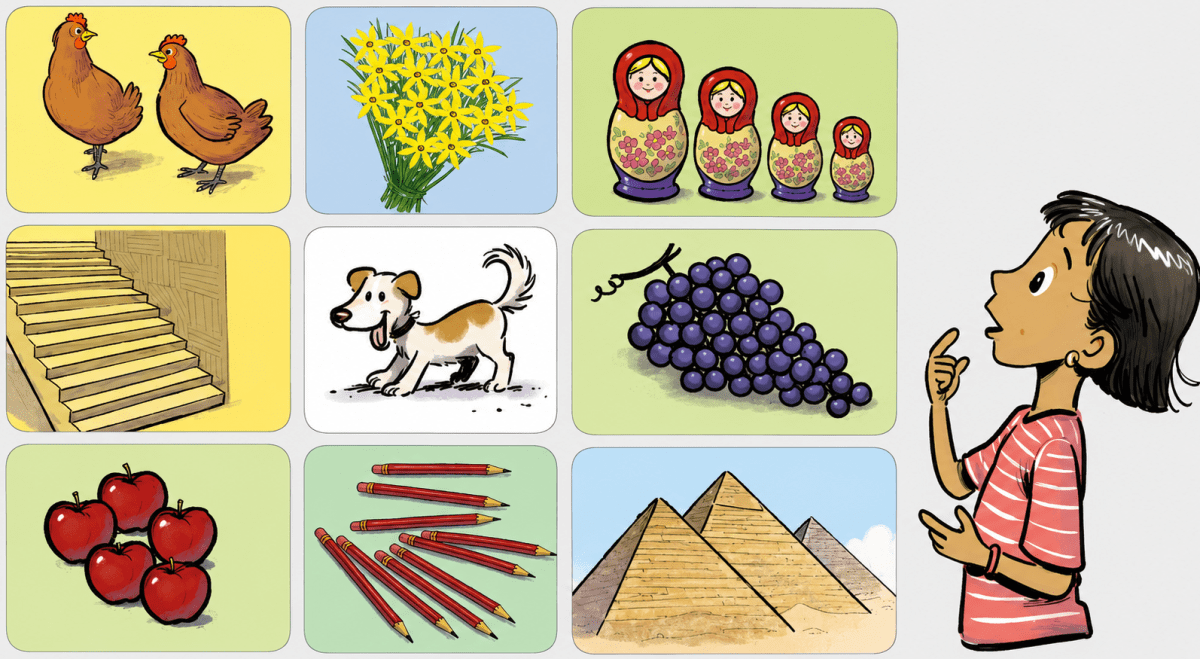
Answer
We can tell the number of objects in a box at a single glance only when the box has very few objects. As soon as a box has about five or more objects, we are forced to count them one by one.
Looking at the boxes, our eye instantly takes in the small collections — 1 dog, 2 hens, 3 pyramids, 4 nesting dolls and 5 apples — without any counting. The boxes with a spray of flowers, stairs, a bunch of grapes and a group of pencils have too many objects to take in at a glance, so we must count them one by one.
This shows that the human eye can usually grasp a quantity directly only up to about 4 objects; beyond that, we start counting. This very limit of perception is what could have prompted early people using tally marks to replace each group of about five marks with a single new symbol.
Hence, we can recognise the number of objects at a single glance only for small collections — roughly up to 4 objects — while for larger groups (5 or more) we are forced to count them one by one.
What could be the difficulties with using a number system that counts only in groups of a single particular size? How would you represent a number like 1345 in a system that counts only by 5s?
Answer
When a number system uses only one group size say 5, it has a symbol for a single unit and a symbol for one group of 5, but nothing for a larger collection. So a big number can only be shown by repeating the group-symbol again and again. This makes the representation long and clumsy for large numbers: writing and reading a long string of identical symbols is slow and error-prone, and (because of the same limit of perception seen in the previous activity) we cannot even tell two long strings apart at a glance. In short, the method is more efficient than plain tally marks, but it still becomes cumbersome as numbers grow, because there is no shorter symbol for a "group of groups".
To represent 1345 by 5s, we group it into as many 5s as possible:
1345 ÷ 5 = 269, with remainder 0.
So 1345 is exactly 269 groups of five, with no single units left over. If we use a dot • for 1 and a special mark — for one group of 5 (so that • • • • • becomes —), then 1345 has to be written as the group-mark repeated 269 times. Even though we counted in fives, we still need 269 copies of the "5" symbol, which is exactly why this system is awkward for large numbers — and why people later introduced further landmark numbers (5, 10, 50, 100, …), as in the Roman system.
Hence, counting by a single group size is still cumbersome for large numbers, since the one group-symbol must be repeated many times; for example, 1345 = 269 groups of 5 (with no leftover units), needing the "5" symbol written 269 times.
Represent the following numbers in the Roman system.
(i) 1222
(ii) 2999
(iii) 302
(iv) 715
Answer
To write a number in the Roman system, we express it as a sum of landmark numbers (1, 5, 10, 50, 100, 500, 1000), taking as many of the largest as possible, then as many of the next, and so on, and then write the matching symbols.
(i) 1222
1222 = 1000 + 100 + 100 + 10 + 10 + 1 + 1
= M + C + C + X + X + I + I
So, 1222 = MCCXXII.
(ii) 2999
2999 = 1000 + 1000 + 500 + 100 + 100 + 100 + 100 + 50 + 10 + 10 + 10 + 10 + 5 + 1 + 1 + 1 + 1
= MM + D + CCCC + L + XXXX + V + IIII
This gives MMDCCCCLXXXXVIIII.
Using the short (subtractive) forms 900 = CM, 90 = XC and 9 = IX, the same number is more commonly written as MMCMXCIX.
So, 2999 = MMDCCCCLXXXXVIIII, which is usually written in the shorter form MMCMXCIX.
(iii) 302
302 = 100 + 100 + 100 + 1 + 1 = CCC + II
So, 302 = CCCII.
(iv) 715
715 = 500 + 100 + 100 + 10 + 5 = D + CC + X + V
So, 715 = DCCXV.
Add the following numbers without converting them to Hindu numerals: LXXXVII + LXXVIII
Answer
We write down all the symbols of both numbers together and then group them, starting from the largest landmark number, using the carrying rules: 5 Is make a V, 2 Vs make an X, 5 Xs make an L, 2 Ls make a C, 5 Cs make a D, and 2 Ds make an M.
LXXXVII = L + X + X + X + V + I + I
LXXVIII = L + X + X + V + I + I + I
Now we collect the like symbols and carry where needed:
The Ls: L + L = two Ls = C.
The Xs: XXX + XX = five Xs = L.
The Vs: V + V = two Vs = X.
The Is: II + III = five Is = V.
So the total is C + L + X + V = CLXV.
Hence, LXXXVII + LXXVIII = CLXV.
How will you multiply two numbers given in Roman numerals, without converting them to Hindu numerals? Try to find the product of the following pairs of landmark numbers: V × L, L × D, V × D, VII × IX.
Answer
Roman-numeral multiplication can be carried out by repeated addition and regrouping the symbols according to the Roman rules.
V × L = CCL
L × D = MMMMMMMMMMMMMMMMMMMMMMMMM
(that is, M written 25 times)
V × D = MMD
VII × IX = LXIII
Hence, V × L = CCL, L × D = M written 25 times, V × D = MMD and VII × IX = LXIII.
Multiply CCXXXI and MDCCCLII.
Answer
For compactness, let an overline over a Roman numeral mean that its value is multiplied by 1000.
Break CCXXXI into CC + XXX + I and multiply MDCCCLII by each part:
MDCCCLII × I = MDCCCLII
MDCCCLII × XXX = DLX
MDCCCLII × CC = CD
Adding the three partial products and regrouping the Roman symbols,
CD + DLX + MDCCCLII = DCCCXII.
As a check,
231 × 1852 = 427812.
Hence, CCXXXI × MDCCCLII = DCCCXII.
A group of indigenous people in a Pacific island use different sequences of number names to count different objects. Why do you think they do this?
Answer
Their counting words may have developed in connection with the objects being counted. Different objects may have been grouped, exchanged or used in different ways; for example, some may have been counted in pairs and others in larger bundles. Therefore, separate counting sequences became convenient for different classes of objects.
Hence, they use different number-name sequences because their counting is linked to the type of object and the way in which it is grouped or used.
Consider the extension of the Gumulgal number system beyond 6 in the same way of counting by 2s. Come up with ways of performing the different arithmetic operations (+, –, ×, ÷) for numbers occurring in this system, without using Hindu numerals. Use this to evaluate the following:
(i) (ukasar-ukasar-ukasar-ukasar-urapon) + (ukasar-ukasar-ukasar-urapon)
(ii) (ukasar-ukasar-ukasar-ukasar-urapon) – (ukasar-ukasar-ukasar)
(iii) (ukasar-ukasar-ukasar-ukasar-urapon) × (ukasar-ukasar)
(iv) (ukasar-ukasar-ukasar-ukasar-ukasar-ukasar-ukasar-ukasar) ÷ (ukasar-ukasar)
Answer
Use the following rules:
Addition: Combine the two strings. Replace every pair of urapon by one ukasar.
Subtraction: Cancel matching symbols. When necessary, replace one ukasar by two urapon before cancelling.
Multiplication: Use repeated addition. Each ukasar in the multiplier requires two copies of the multiplicand, while an urapon requires one copy.
Division: Separate the dividend into equal groups matching the divisor. Express the number of complete groups in the Gumulgal system.
(i) Combining the two strings gives seven ukasar and two urapon. The two urapon form one more ukasar.
Answer:
ukasar-ukasar-ukasar-ukasar-ukasar-ukasar-ukasar-ukasar
(ii) Cancelling three ukasar from the larger string leaves:
Answer:
ukasar-urapon
(iii) The multiplier ukasar-ukasar requires four copies of the multiplicand. After combining the copies and replacing pairs of urapon, the result is:
Answer:
ukasar written eighteen times
(iv) Eight ukasar can be separated into four equal groups of ukasar-ukasar. The number of groups is:
Answer:
ukasar-ukasar
Hence, the answers are (i) eight ukasar, (ii) ukasar-urapon, (iii) eighteen ukasar and (iv) ukasar-ukasar.
Identify the features of the Hindu number system that make it efficient when compared to the Roman number system.
Answer
The Hindu number system is more efficient because:
- it is a place value system;
- it uses only ten digits, 0 to 9;
- the value of a digit depends on its position;
- zero acts as a placeholder and is also treated as a number;
- numbers of any size can be represented without inventing new symbols; and
- arithmetic operations can be performed systematically.
The Roman system has no place value and no symbol for zero, so writing large numbers and performing calculations are more difficult.
Hence, place value, the use of zero and a fixed set of ten digits make the Hindu number system much more efficient than the Roman system.
Using the ideas discussed in this section, try refining the number system you might have made earlier.
Answer
The earlier shape-based system can be refined into a base-5 place value system by using five digit-symbols:
○ = 0, ● = 1, ▲ = 2, ■ = 3 and ◆ = 4.
The positions from right to left represent 1, 5, 25, 125, and so on. A symbol's value therefore depends on both the symbol and its position. The symbol ○ acts as a placeholder when a particular power of 5 is absent.
Hence, introducing a base, place value and a symbol for zero makes the number system compact, unambiguous and suitable for calculation.
Represent the following numbers in the Egyptian system: 10458, 1023, 2660, 784, 1111, 70707.
Answer
10458 = 10,000 + 400 + 50 + 8
= 1 × 10⁴ + 4 × 10² + 5 × 10 + 8 × 1
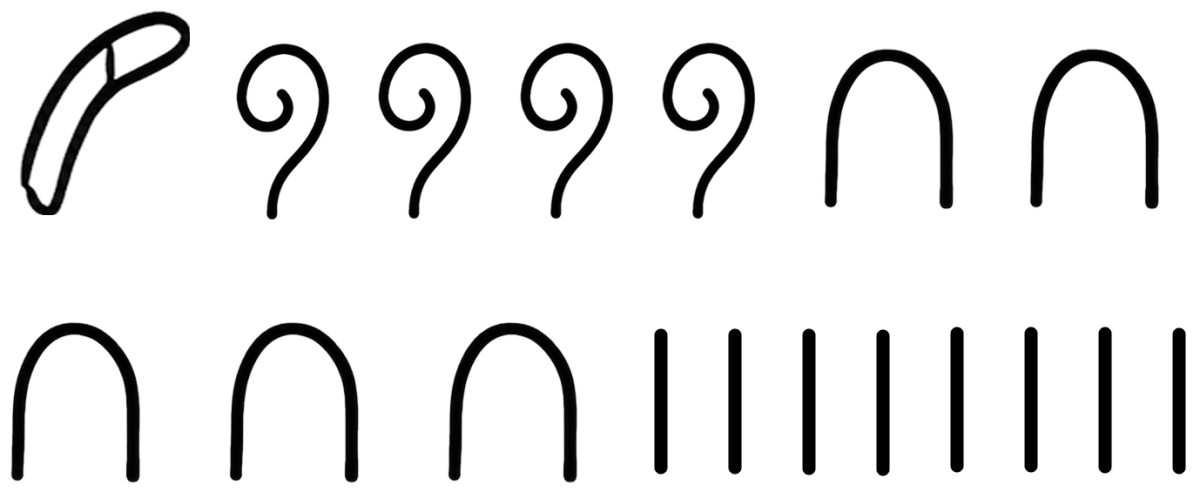
1023 = 1000 + 20 + 3
= 1 × 10³ + 2 × 10 + 3
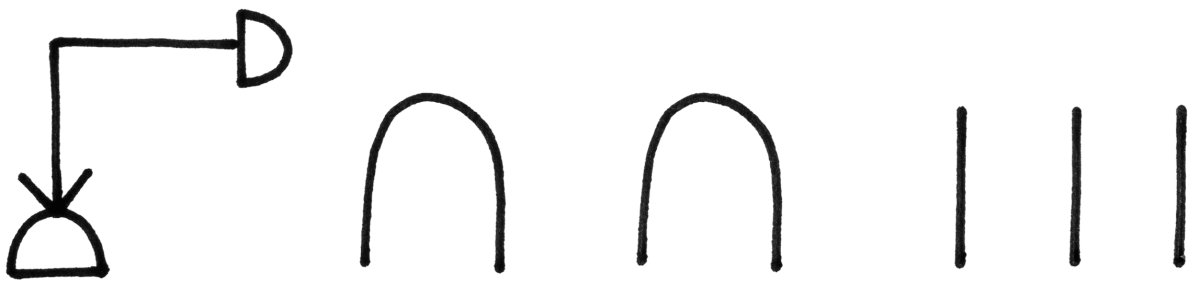
2660 = 2000 + 600 + 60
= 2 × 10³ + 6 × 10² + 6 × 10
784 = 700 + 80 + 4
= 7 × 10² + 8 × 10 + 4
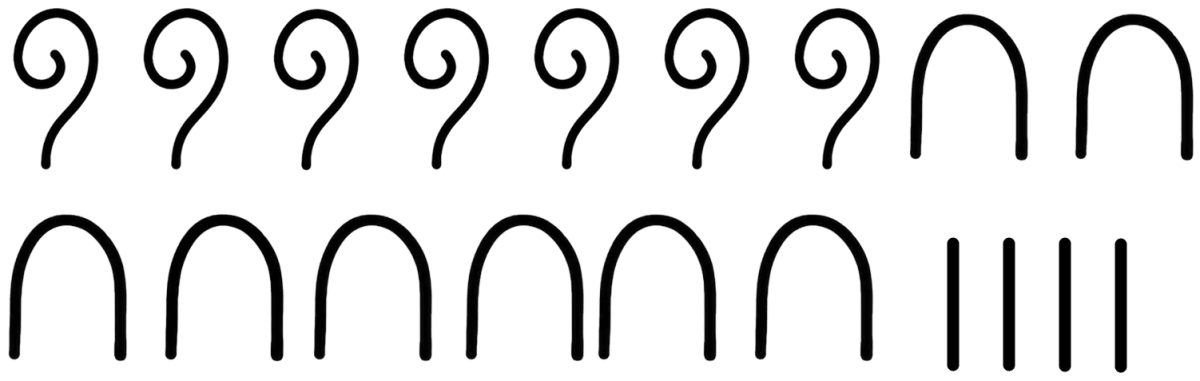
1111 = 1000 + 100 + 10 + 1
= 1 × 10³ + 1 × 10² + 1 × 10 + 1
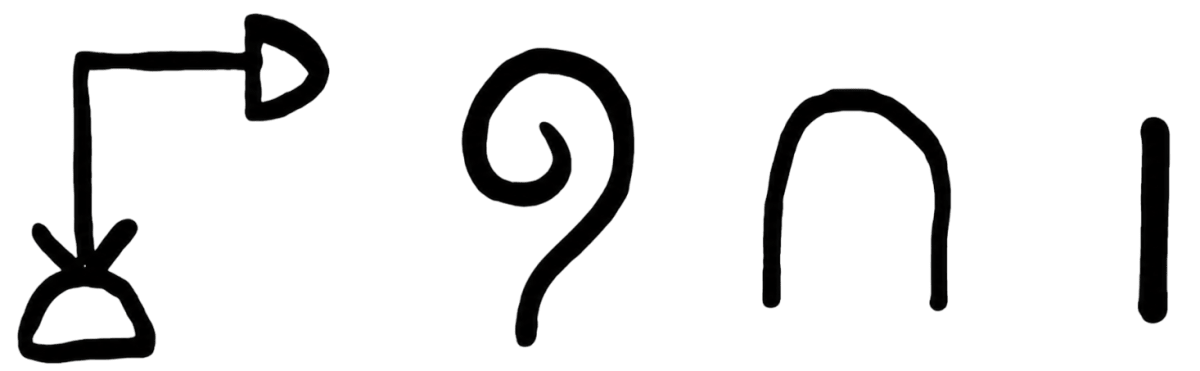
70707 = 70000 + 700 + 7
= 7 × 10⁴ + 7 × 10² + 7
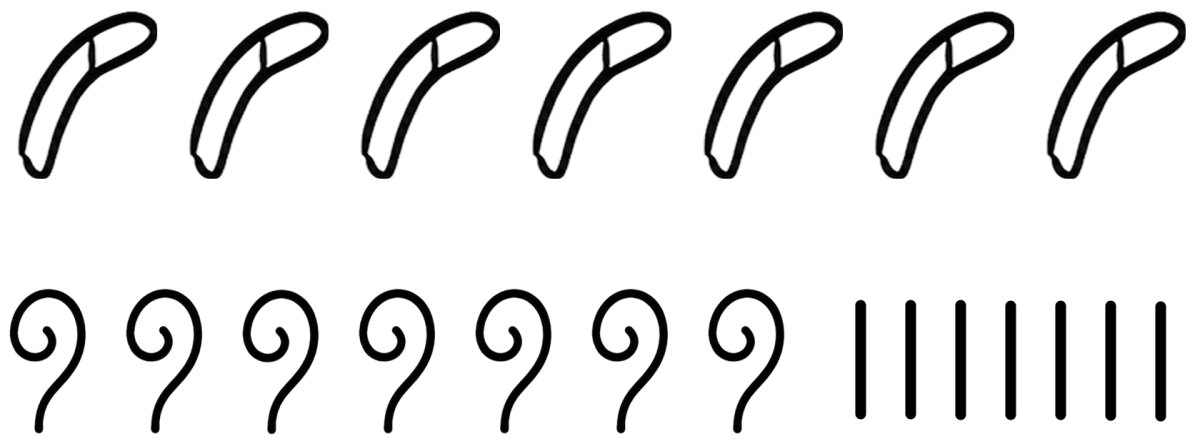
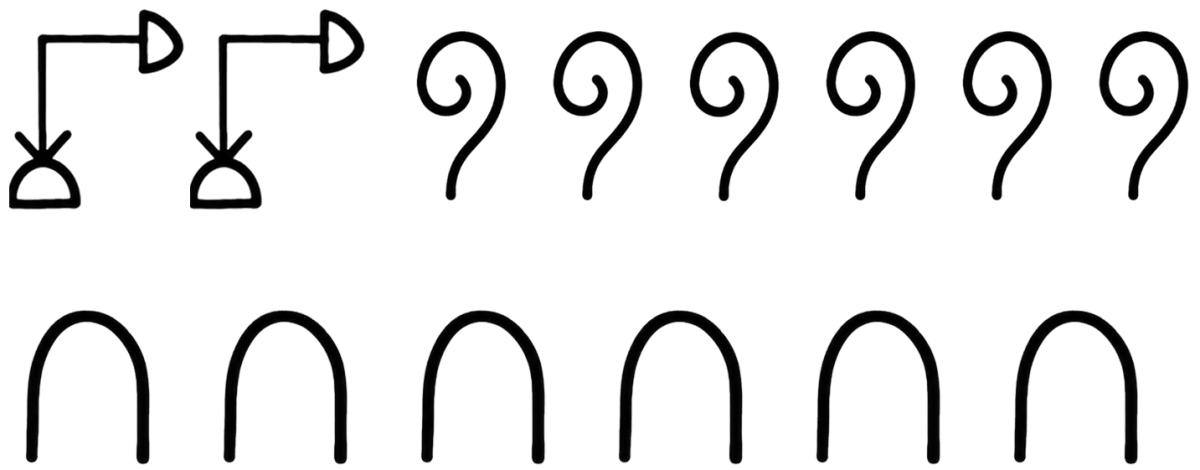
What numbers do these numerals stand for?
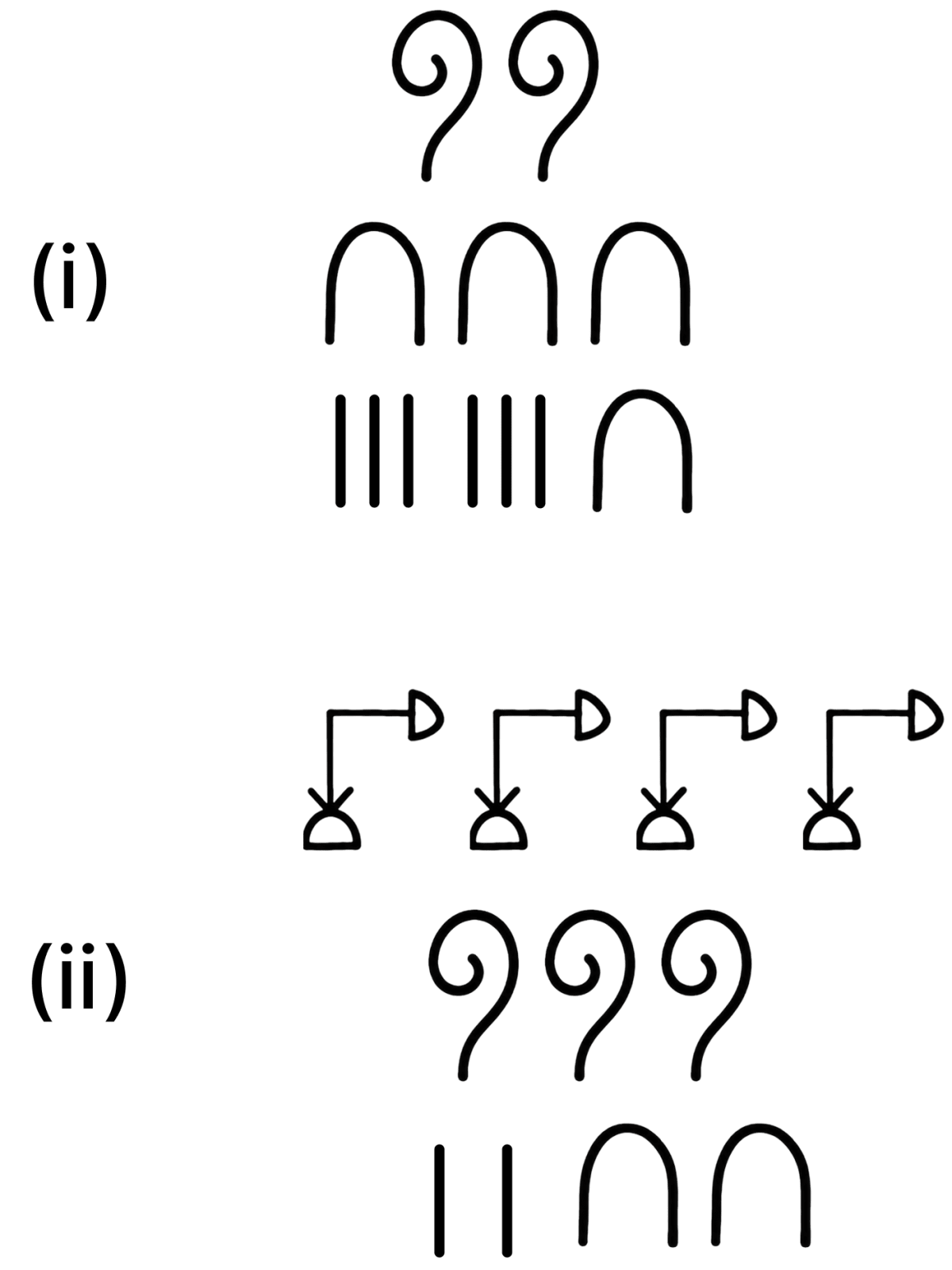
Answer
(i)

Count the symbols:
2 spirals = 2 × 100 = 200
7 heel-bone symbols = 7 × 10 = 70
6 strokes = 6 × 1 = 6
∴ 200 + 70 + 6 = 276
(ii)
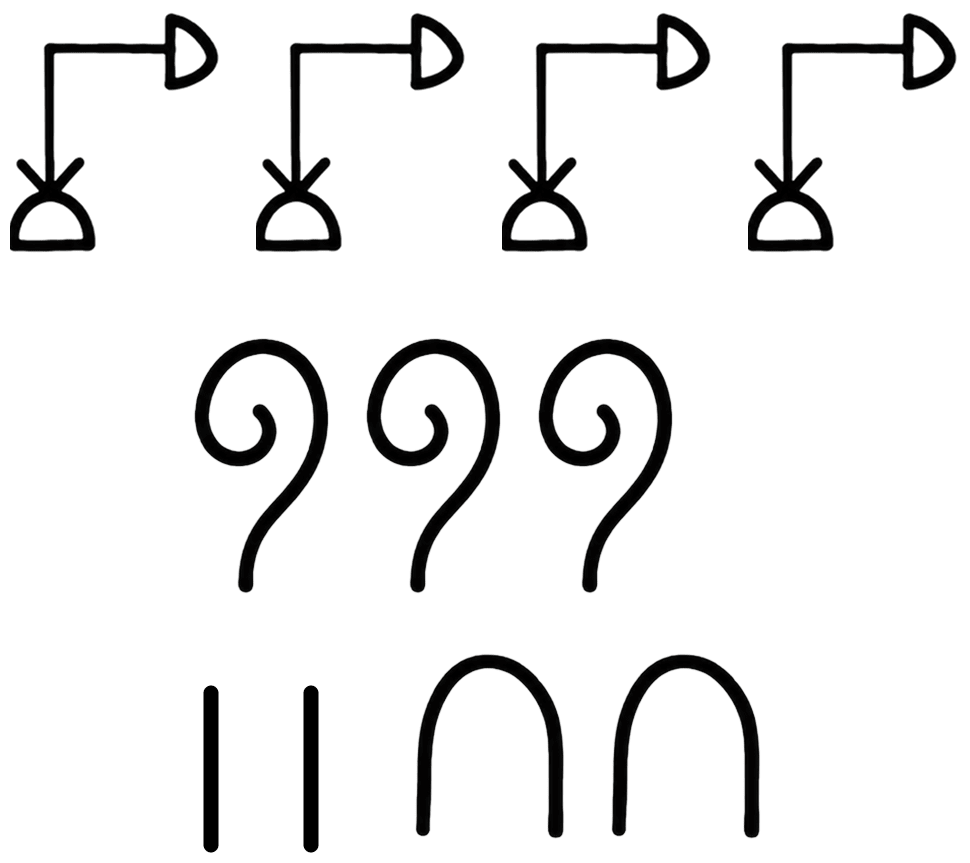
Count the symbols:
4 lotus symbols = 4 × 1000 = 4000
3 spirals = 3 × 100 = 300
2 heel-bone symbols = 20
2 strokes = 2
∴ 4000 + 300 + 20 + 2 = 4322
Instead of grouping together 10 collections of size equal to the previous landmark number (as in the case of the Egyptian system), can we get a number system by grouping together 5 collections of size equal to the previous landmark number? Can this 5 be replaced by any positive integer?
Answer
Yes, we can. Let 1 be the first landmark number. Grouping together 5 collections of the previous landmark number each time gives:
second landmark number = 5, third landmark number = 5 × 5 = 25, fourth landmark number = 5 × 25 = 125, and so on.
Each landmark number is 5 times the previous one, so they are all powers of 5: 50 = 1, 51 = 5, 52 = 25, 53 = 125, … This is a base-5 system.
And yes, the 5 can be replaced by any positive integer n (with n greater than 1). Grouping n collections of the previous landmark number each time gives the landmark numbers 1, n, n2, n3, …, which is a base-n system. (If n were 1, every landmark number would stay equal to 1, so we need n greater than 1 to get a useful system.)
Hence, grouping in 5s gives a base-5 system, and replacing 5 by any positive integer n (n greater than 1) gives a base-n system whose landmark numbers are the powers of n.
Express the number 143 in base-5 system.
Answer
The landmark numbers are 1, 5, 25 and 125.
143 = 125 + 5 + 5 + 5 + 1 + 1 + 1
Therefore, the representation contains:
- one circle for 125,
- no hexagon for 25,
- three squares for 5, and
- three triangles for 1.

Hence, 143 is represented by one circle, three squares and three triangles.
Write the following numbers in the above base-5 system using the symbols in Table 2:
(i) 15
(ii) 50
(iii) 137
(iv) 293
(v) 651
Answer
We repeatedly group each number into the landmark numbers (powers of 5), starting from the largest landmark number that fits.
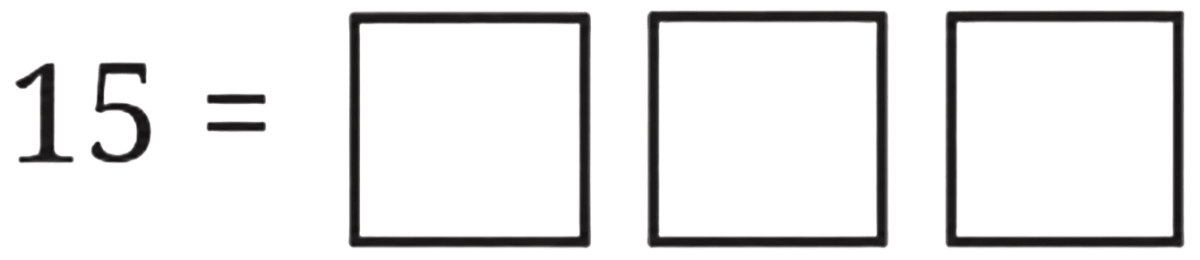
(i) 15:
15 = 3 × 5
This is three squares.
(ii) 50:
50 = 2 × 25
This is two hexagons.

(iii) 137:
137 = 125 + 5 + 5 + 1 + 1
= 1 × 125 + 0 × 25 + 2 × 5 + 2 × 1
This is one circle, two squares and two triangles.

(iv) 293:
293 = 250 + 25 + 15 + 3
= 2 × 125 + 1 × 25 + 3 × 5 + 3 × 1
This is two circles, one hexagon, three squares and three triangles.

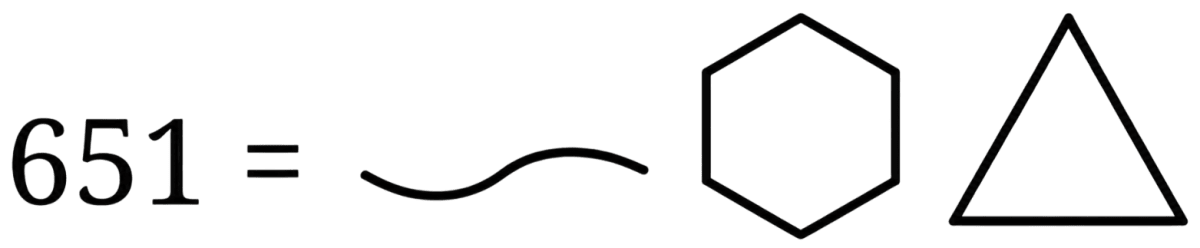
(v) 651:
651 = 625 + 25 + 1
= 1 × 625 + 0 × 125 + 1 × 25 + 0 × 5 + 1 × 1
This is one wavy line, one hexagon and one triangle.
Is there a number that cannot be represented in our base-5 system above? Why or why not?
Answer
Yes. Zero cannot be represented because no symbol has been assigned to it in this system.
Every positive integer can be represented because the landmark numbers 1, 5, 25, 125, 625, … continue without limit. While representing a positive integer, each landmark symbol is needed at most four times, since five copies of one symbol can be replaced by one symbol of the next landmark number.
Hence, zero cannot be represented in the given system, but every positive integer can be represented.
Compute the landmark numbers of a base-7 system. In general, what are the landmark numbers of a base-n system?
Answer
In a base-7 system, the first landmark number is 1 and every next landmark number is 7 times the previous one. So they are the powers of 7:
70 = 1, 71 = 7, 72 = 49, 73 = 343, 74 = 2401, 75 = 16807, …
In general, the landmark numbers of a base-n system are the powers of n, starting from n0 = 1:
n0 = 1, n1 = n, n2, n3, …
Hence, the landmark numbers of a base-7 system are 1, 7, 49, 343, 2401, … and, in general, the landmark numbers of a base-n system are 1, n, n2, n3, …
Add the following Egyptian numerals:

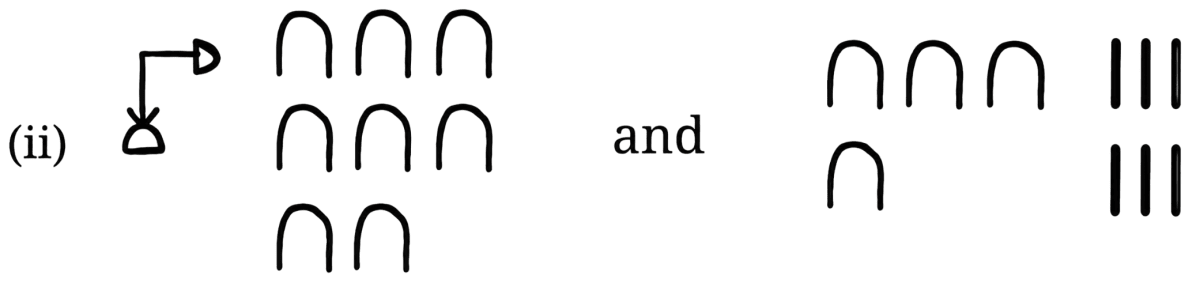
Answer
(i)
Let us find the total number of 1000, 100 and 1 and group them starting from the largest possible landmark number. It has a total of —
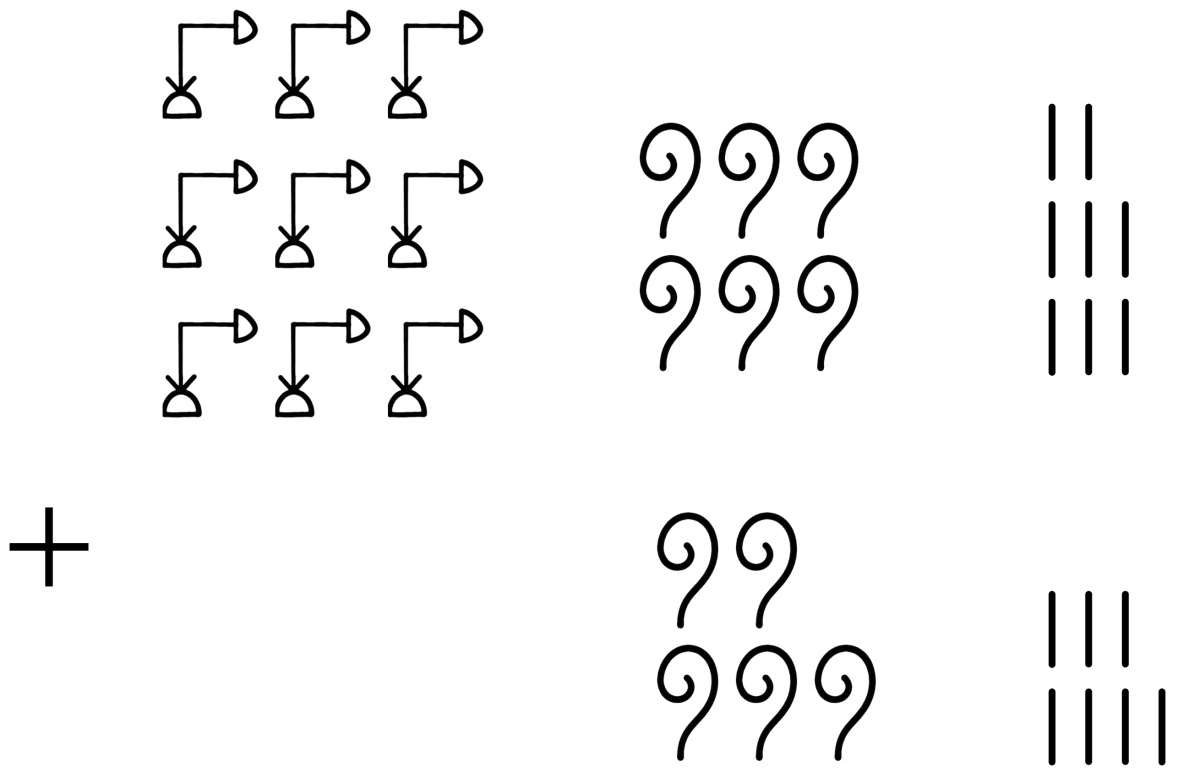
9 symbols of 1000s, 11 symbols of 100s and 15 symbols of 1s
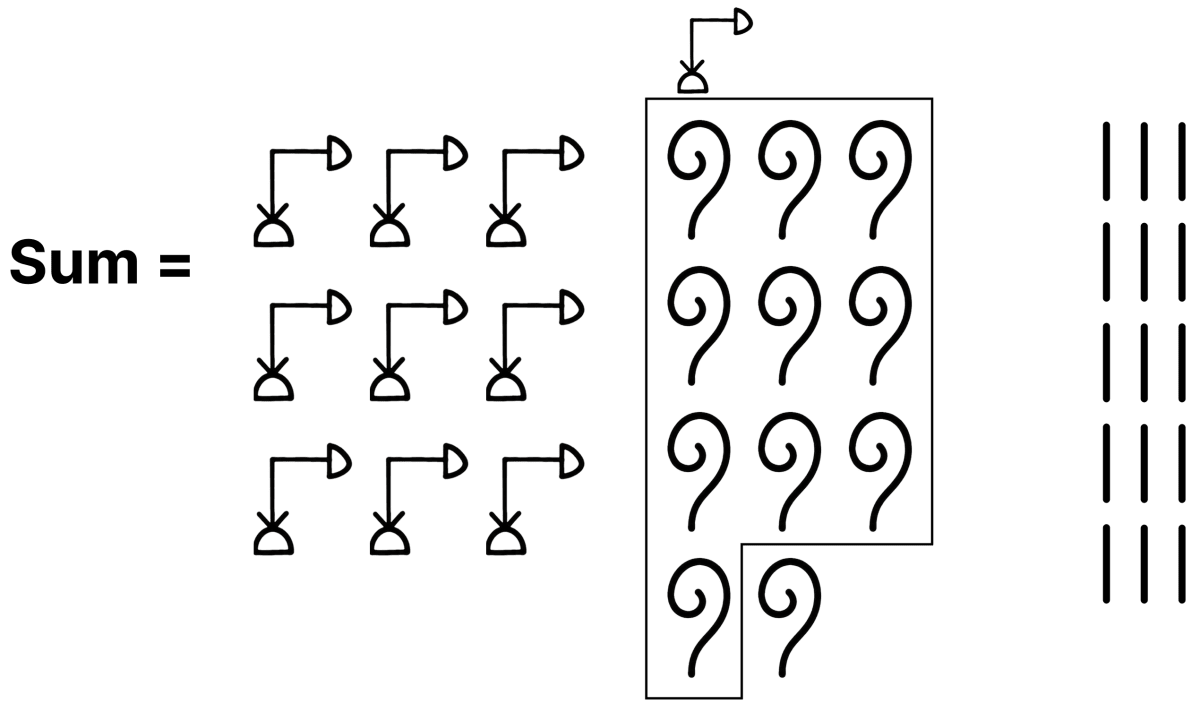
Since 10 symbols of 100s give the next landmark number i.e., 1000s, the sum can be regrouped as —
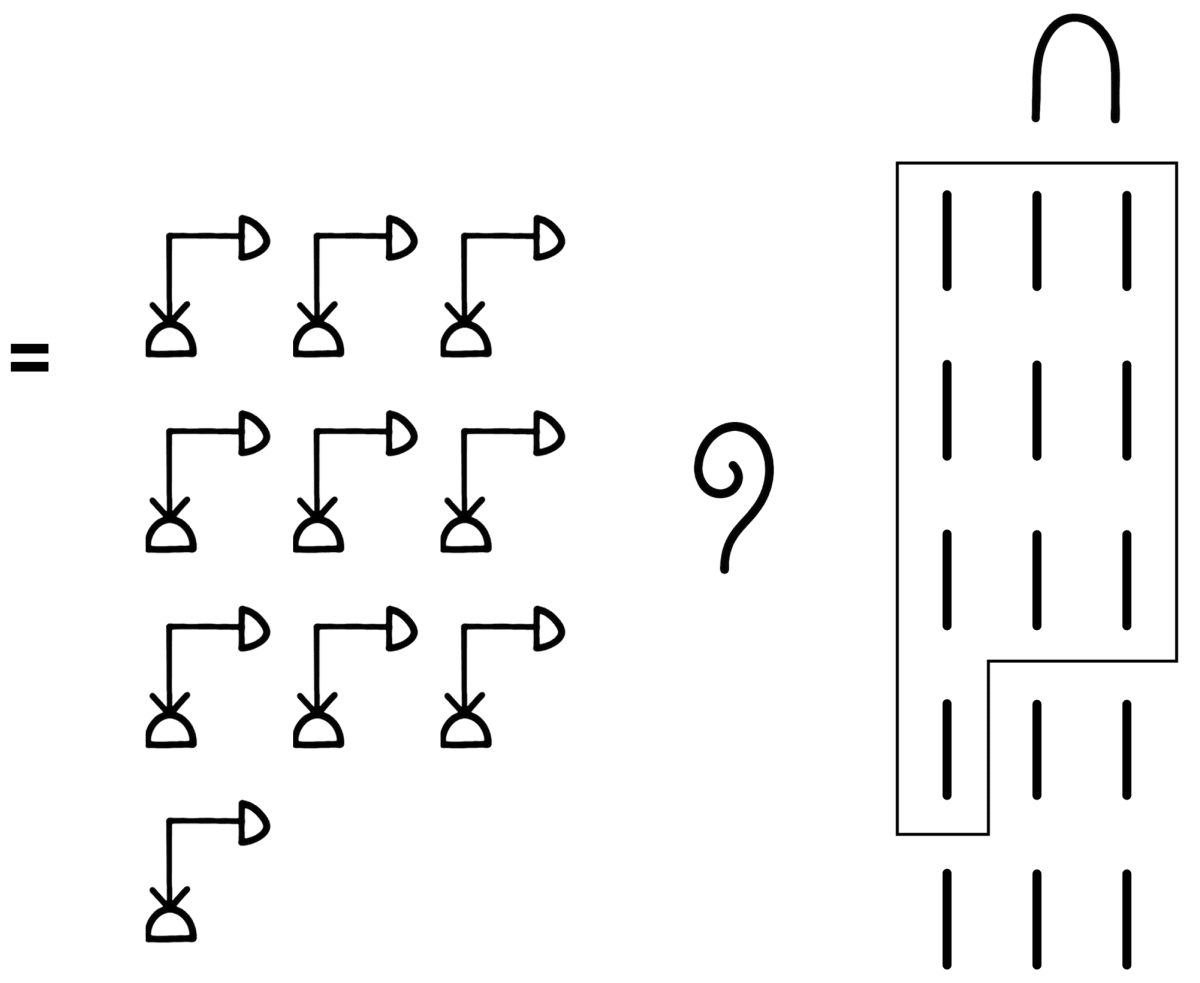
Since 10 symbols of 1s give the next landmark number i.e., 10s, the sum can be regrouped as —
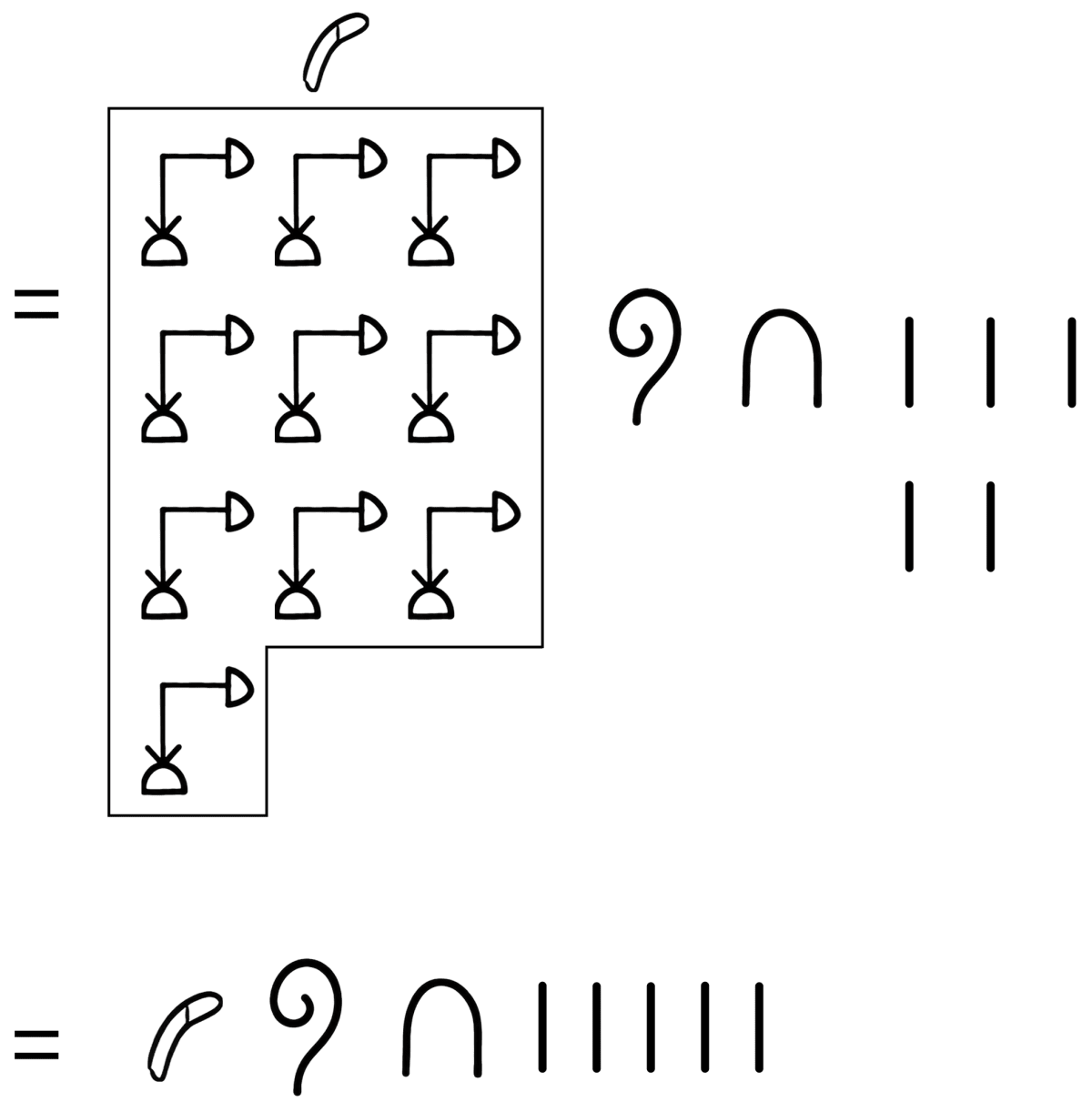
Since 10 symbols of 1000s give the next landmark number i.e., 10000s, the sum can be regrouped as —
(ii)
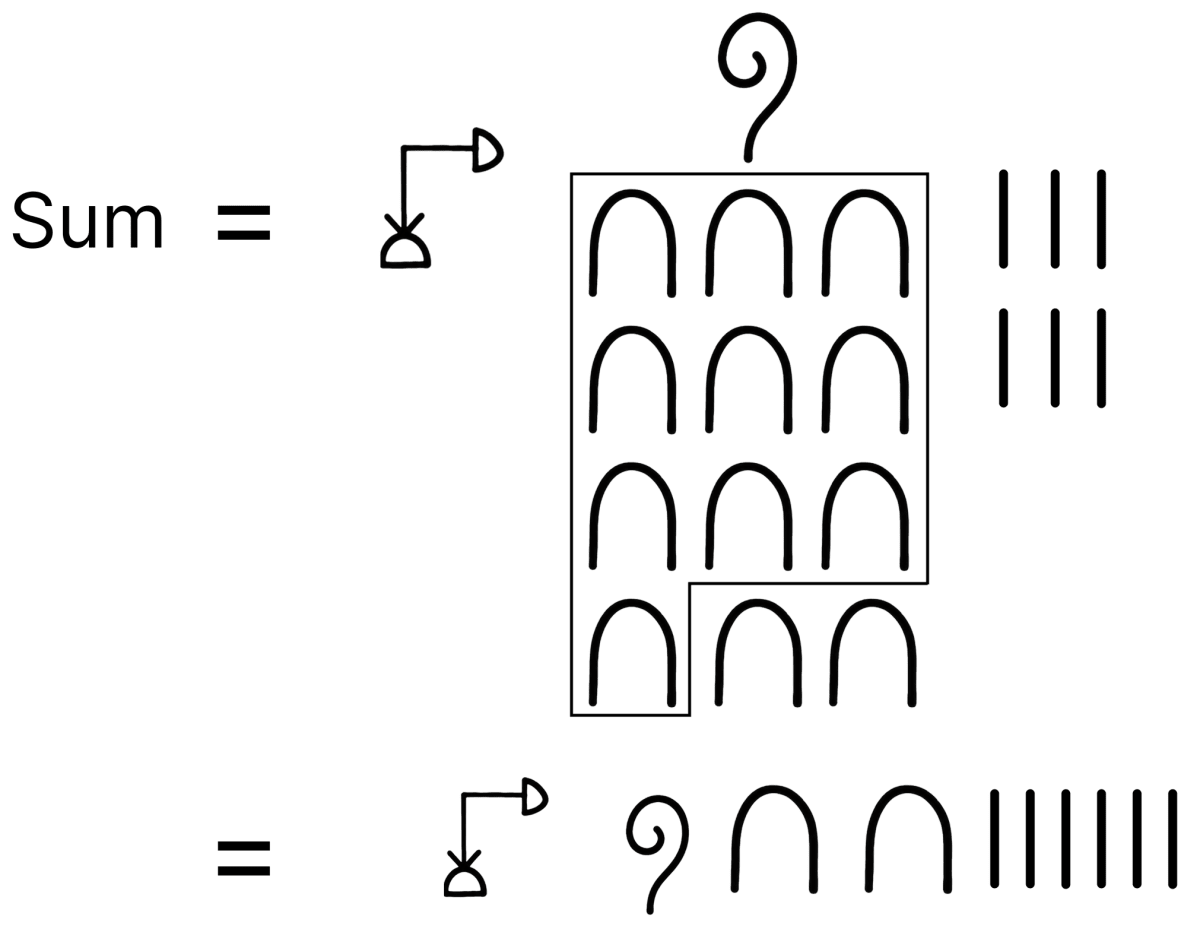
Let us find the total number of 1000, 10 and 1 and group them starting from the largest possible landmark number. It has a total of —
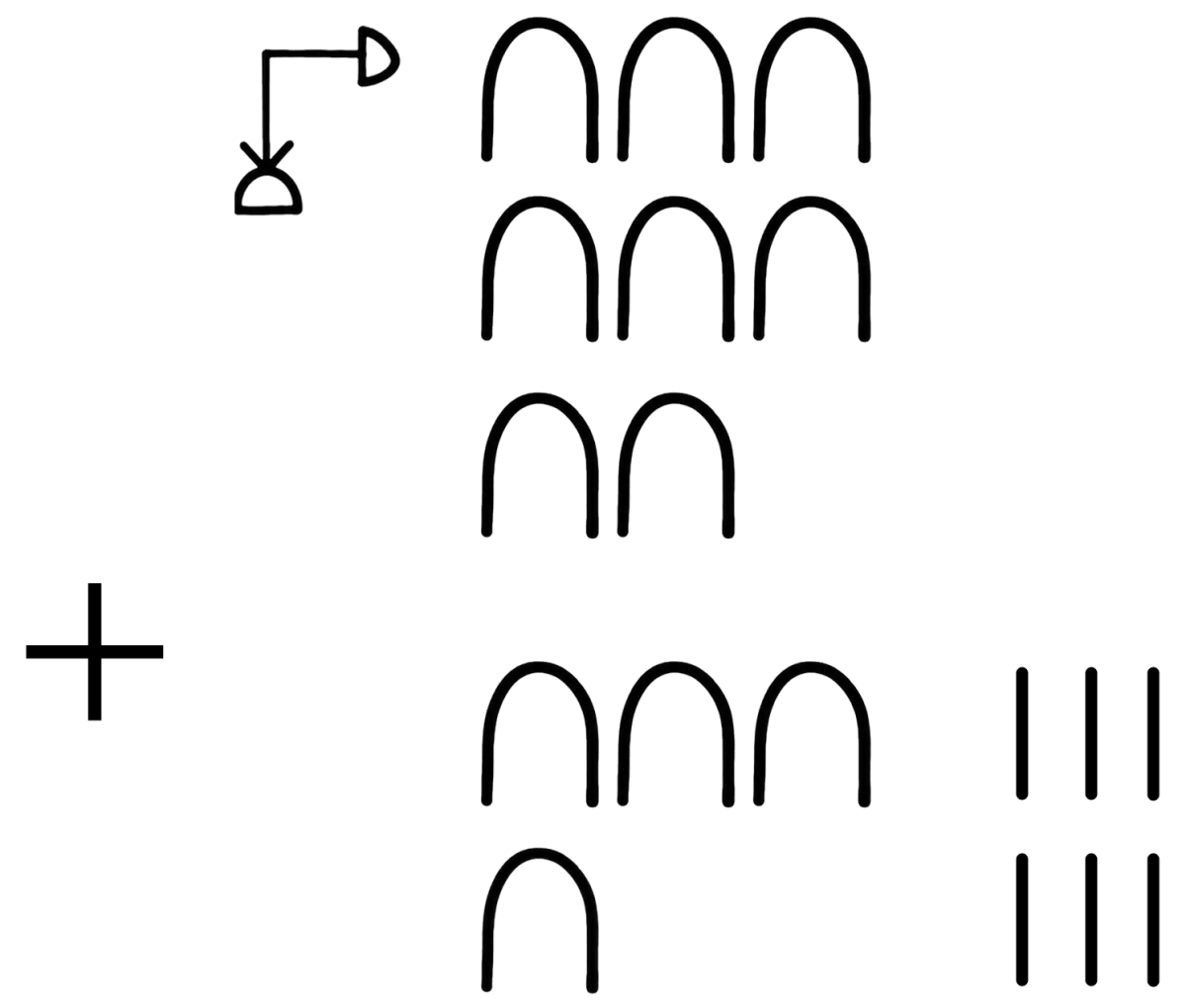
1 symbol of 1000s, 12 symbols of 10s and 6 symbols of 1s
Since 10 symbols of 10s give the next landmark number i.e., 100s, the sum can be regrouped as —
Add the following numerals that are in the base-5 system that we created:
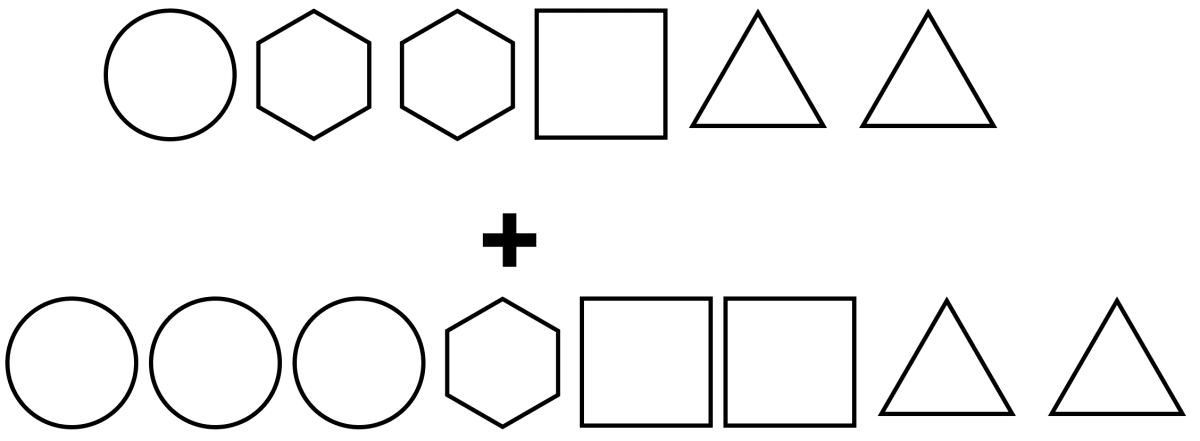
Remember that in this system, 5 times a landmark number gives the next one!
Answer
Reading the two given base-5 numerals:
First numeral = ○⬡⬡□△△ = 1 × 125 + 2 × 25 + 1 × 5 + 2 × 1 = 125 + 50 + 5 + 2 = 182.
Second numeral = ○○○⬡□□△△ = 3 × 125 + 1 × 25 + 2 × 5 + 2 × 1 = 375 + 25 + 10 + 2 = 412.
Now we collect all the symbols together (here 5 of one landmark number make the next one):
triangles (1): 2 + 2 = 4,
squares (5): 1 + 2 = 3,
hexagons (25): 2 + 1 = 3,
circles (125): 1 + 3 = 4.
Each count is less than 5, so no regrouping is needed.
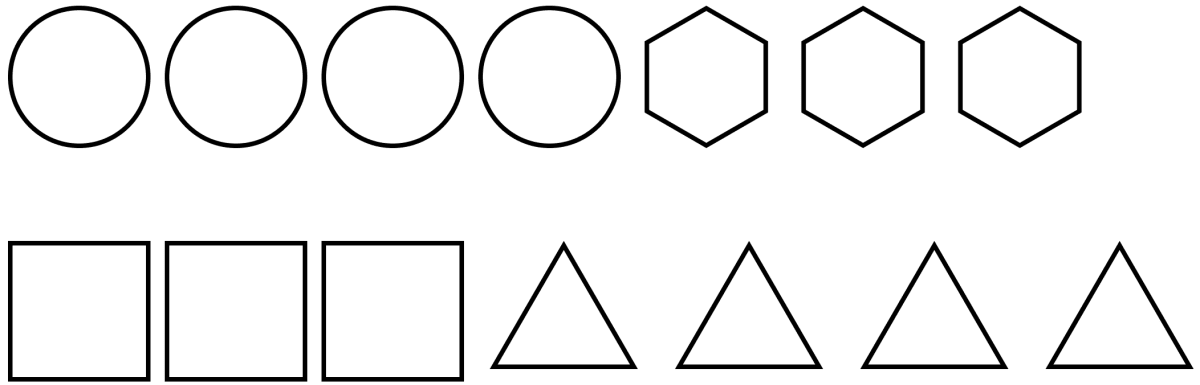
So the sum = 182 + 412 = 594
= 4 circles + 3 hexagons + 3 squares + 4 triangles.
○○○○⬡⬡⬡□□□△△△△
How to multiply two numbers in Egyptian numerals?
Answer
To multiply two numbers, we write each number as a sum of its landmark numbers and then use the distributive property: we multiply every landmark number of the first number by every landmark number of the second number, and add up all these partial products.
The reason this is easy is that the product of any two landmark numbers is again a landmark number, because the landmark numbers are powers of 10:
10a × 10b = 10a + b.
So every partial product is itself a landmark number, and these can be collected and regrouped just like in addition.
Hence, to multiply, we express each number as a sum of landmark numbers, multiply the landmark numbers pairwise (each product is again a landmark number), and add the results.
What is any landmark number multiplied by ⋂ (that is, 10)? Find the following products —
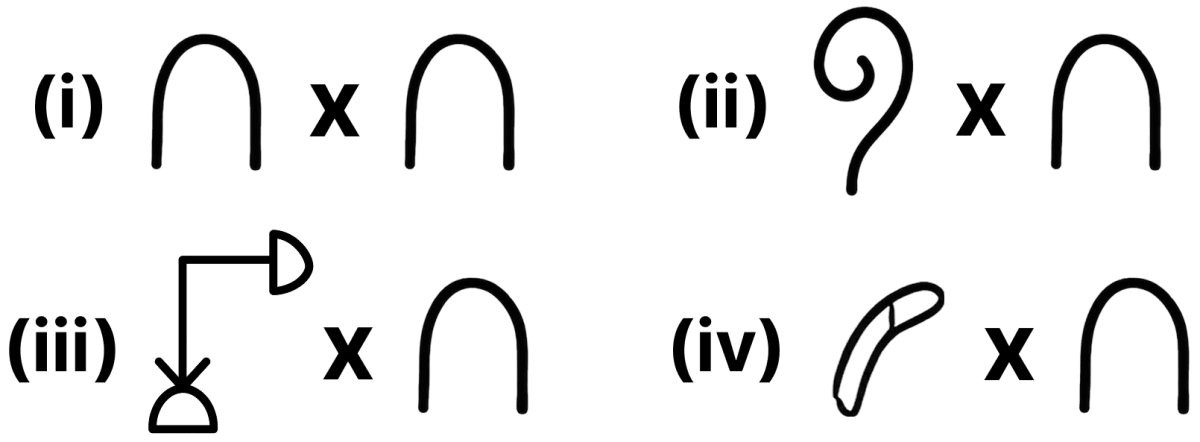
Answer
Each landmark number is a power of 10, so multiplying it by 10 increases the power by 1 and gives the next landmark number. In general, 10k × 10 = 10k + 1.
In general,
10k × 10 = 10k + 1.
(i)

= 10 × 10
= 100
= 102

(ii)

= 100 × 10
= 1000
= 103
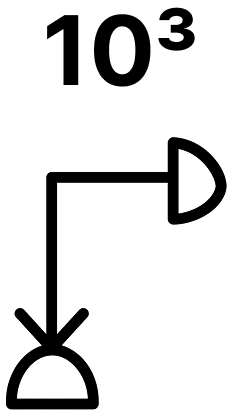
(iii)
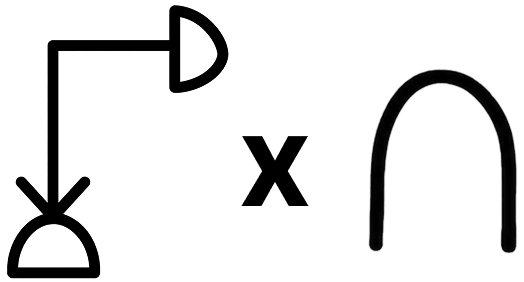
= 1000 × 10
= 10,000
= 104

(iv)

= 10,000 × 10
= 100,000
= 105

Hence, multiplying any landmark number by 10 simply gives the next landmark number.
What is any landmark number multiplied by 102? Find the following products:
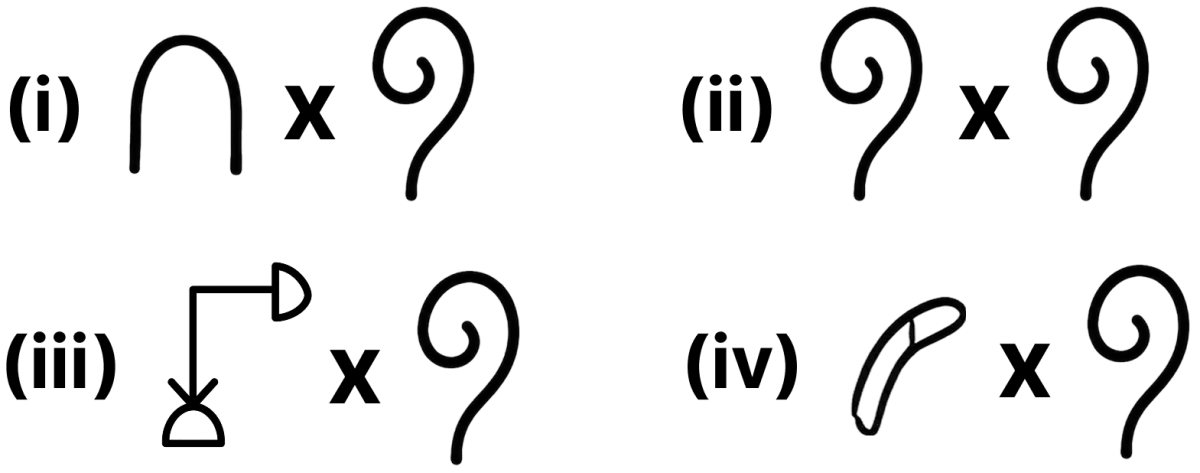
Answer
Multiplying a landmark number (a power of 10) by 100 = 102 increases its power by 2, so the result is the landmark number two places higher. In general,
10k × 102 = 10k + 2.
(i)

= 10 × 100
= 1000
= 103
(ii)
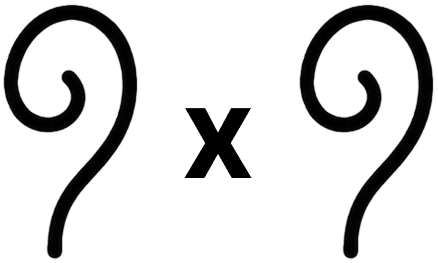
= 100 × 100
= 10,000
= 104
(iii)
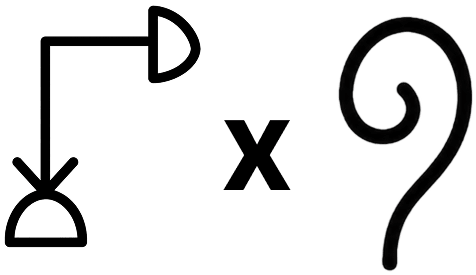
= 1000 × 100
= 100,000
= 105
(iv)

= 10,000 × 100
= 1000000
= 106

Hence, multiplying any landmark number by 102 gives the landmark number two places higher.
Find the following products:
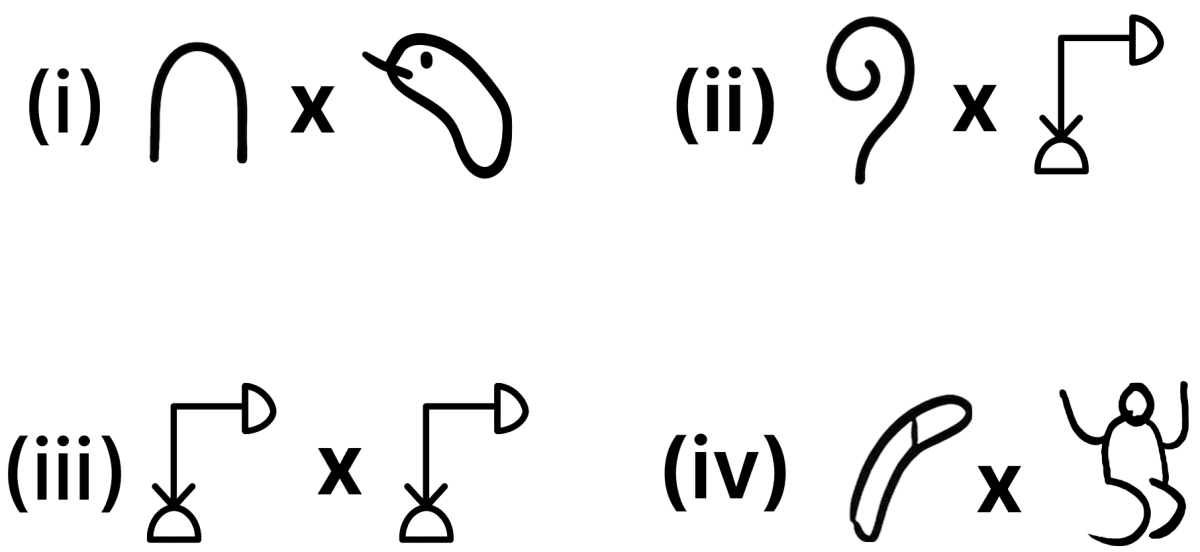
Answer
Each Egyptian landmark number is a power of 10, so the product of two of them is found simply by adding the powers (the powers of 10 add up).
(i)

= 10 × 105
= 106
(ii)
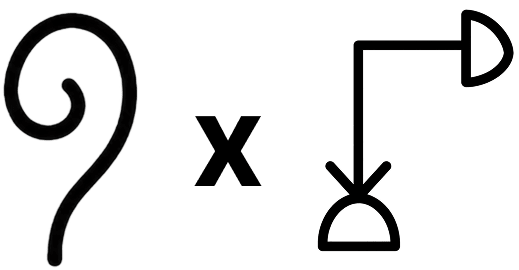
= 102 × 103
= 105
(iii)

= 103 × 103
= 106
(iv)

= 104 × 106
= 1010
Hence, the product of any two landmark numbers is again a landmark number, because each is a power of 10 and multiplying them just adds the powers. (In (iv), 1010 is a landmark number higher than any for which the Egyptian system has a symbol.)
Does this property hold true in the base-5 system that we created? Does this hold for any number system with a base?
Answer
Yes. In the base-5 system the landmark numbers are the powers of 5 (1, 5, 25, 125, ...). The product of any two of them is
5a × 5b = 5a + b,
which is again a power of 5, and so is again a landmark number.
The same reasoning works for any base-n system, where the landmark numbers are the powers of n. Their product is
na × nb = na+b,
which is again a power of n, hence again a landmark number.
Hence, the property holds in the base-5 system and, in fact, in every number system with a base, since multiplying two powers of the base gives another power of the base.
What can we conclude about the product of a number and ⋂ (10), in the Egyptian system?
Answer
By the distributive law, multiplying a number by ⋂ (10) multiplies each landmark number in its representation by 10, and multiplying any power of 10 by 10 gives the next higher power of 10.
So, multiplying a number by ⋂ simply replaces every symbol in the numeral by the symbol for the next higher landmark number — each symbol is shifted up by one level.
Hence, the product of a number and ⋂ (10) is obtained by promoting every symbol in its representation to the symbol for the next higher power of 10.
Now find the following products —
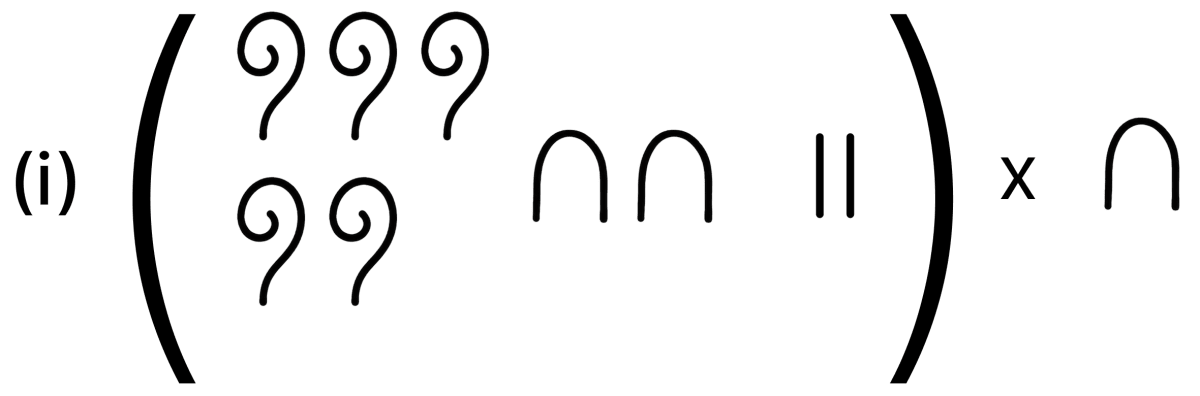
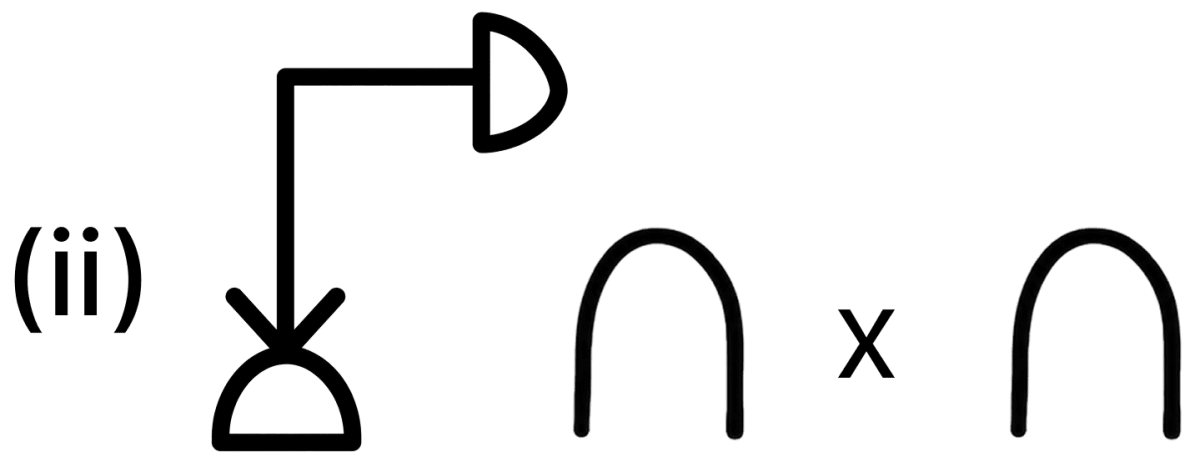
Answer
We multiply each number by ⋂ (10) by promoting every symbol to the next higher landmark number.
= (500 + 20 + 2) × 10
= 522 × 10
= 5220

= (1000 + 10) × 10
= 1010 × 10
= 10100

What would be a simple rule to multiply a number with ⋂?
Answer
To multiply a number by ⋂ (10), replace every symbol in its representation by the symbol for the next higher landmark number (the next power of 10).
That is, each 1 (|) becomes a 10 (⋂), each 10 (⋂) becomes the 102-symbol, each 102-symbol becomes the 103-symbol, and so on — every symbol is shifted up by one level.
Hence, the simple rule is: multiplying by ⋂ promotes each symbol of the numeral to the symbol for the next higher power of 10.
To get an idea of how the abacus was used for calculations, consider a simple addition problem: 2907 + 43. The two numbers are taken on either side of the vertical partition.
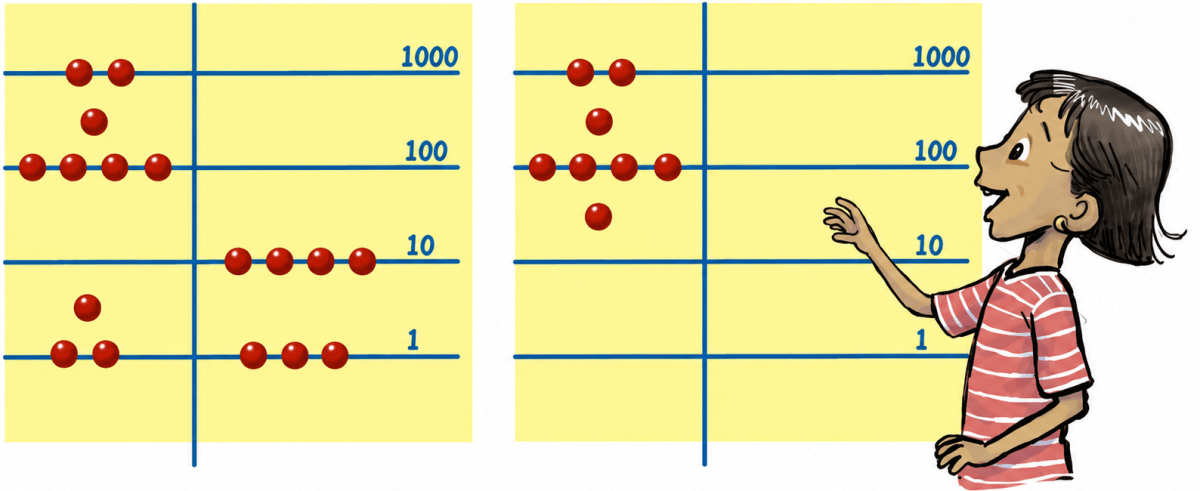
(i) How would you use this to find the sum?
(ii) What is to be done if the total in a line exceeded 10?
Answer
On the abacus, the lines (from bottom to top) stand for 1, 10, 100 and 1000, and a counter placed above a line counts as 5 of that line's value.
First place the two numbers on the two sides of the vertical partition:
2907 is grouped as 2907 = 2000 + 900 + 0 + 7, so on its side we put 2 counters on the 1000-line; 9 hundreds on the 100-line as 1 counter above the line (5) and 4 counters on the line (4); nothing on the 10-line; and 7 ones on the 1-line as 1 counter above the line (5) and 2 counters on the line (2).
43 is grouped as 43 = 40 + 3, so on its side we put 4 counters on the 10-line and 3 counters on the 1-line.
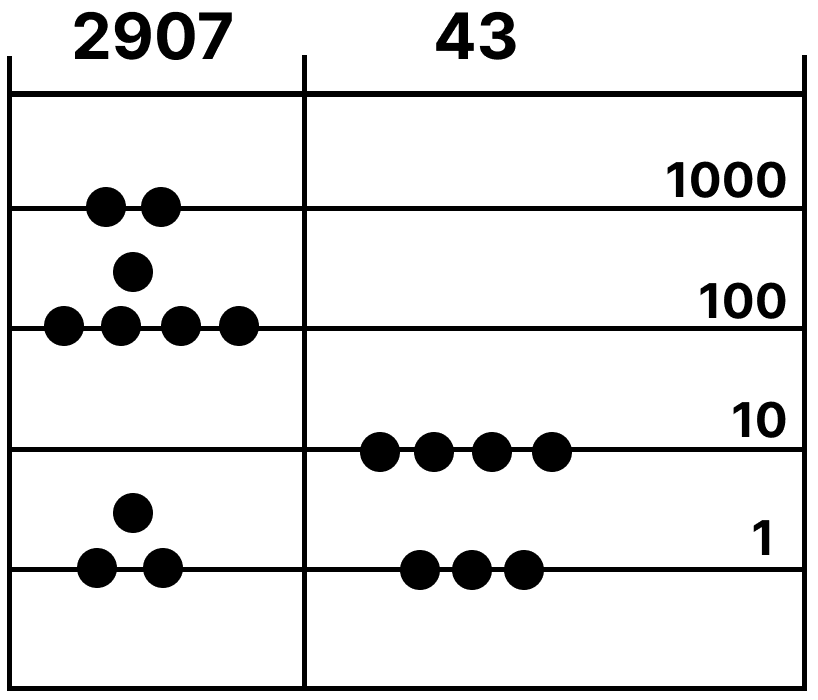
(i) To find the sum, bring the counters of both sides on each line together. On the 1-line the 7 ones and the 3 ones make 10 ones.
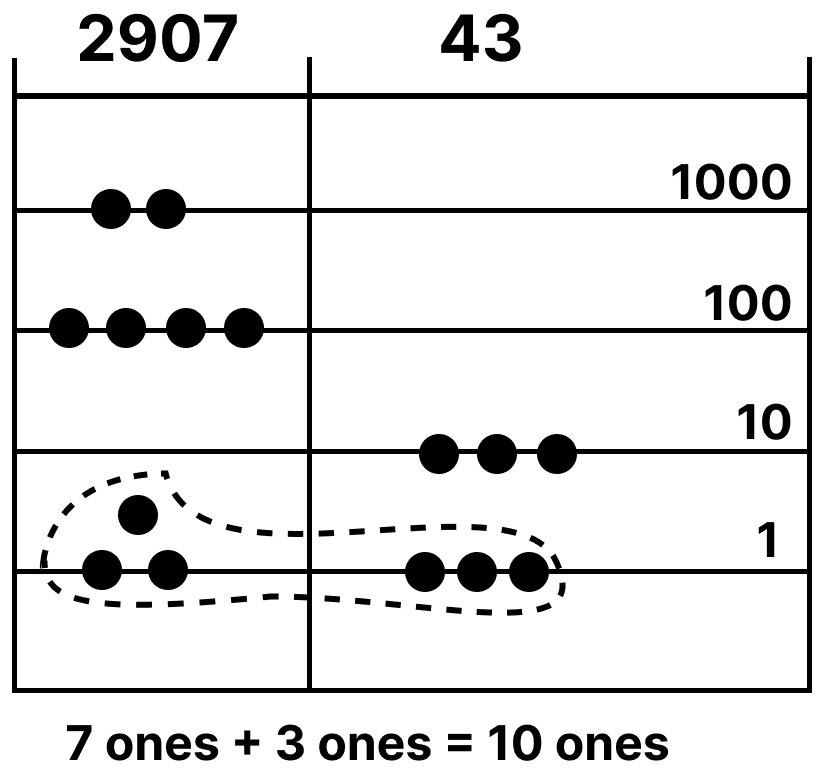
(ii) If the counters on a line have a total value of 10 or more, the combination representing 10 units of that line is removed and replaced by one counter on the next higher line. This is the carrying step.
So the 10 ones are replaced by 1 counter on the 10-line. The 10-line then has the 4 tens (from 43) together with this 1 carried ten, making 5 tens, shown as a single counter above the 10-line. The 1-line becomes empty (0).
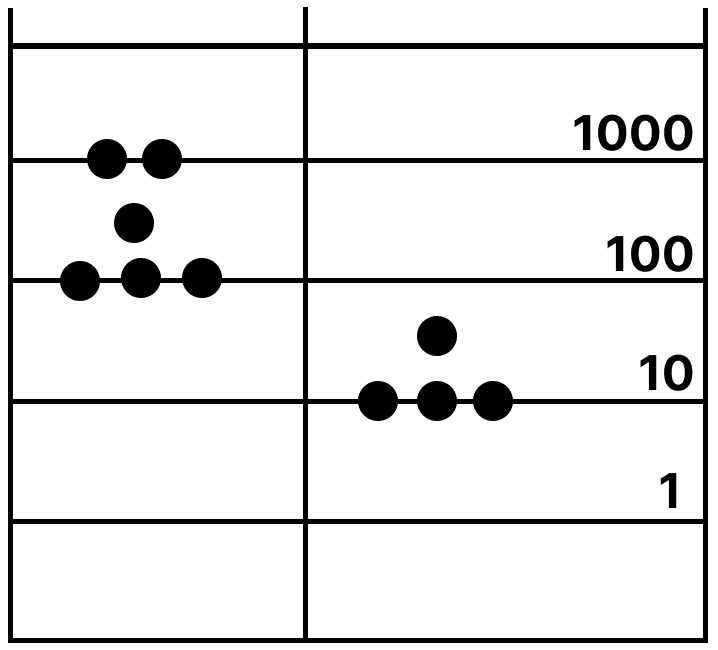
The final reading is 2 (thousands) + 9 (hundreds) + 5 (tens) + 0 (ones)
= 2000 + 900 + 50 = 2950.
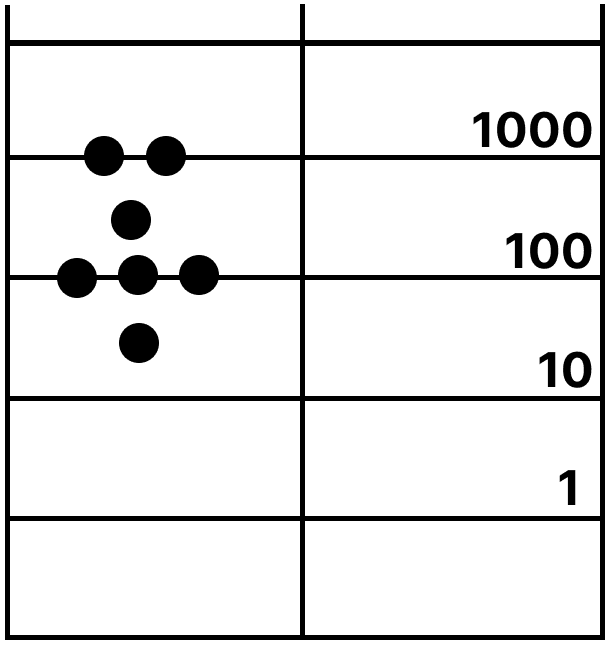
Hence, 2907 + 43 = 2950, and whenever the total on a line reaches 10, those 10 counters are grouped into a single counter on the next higher line (a carry).
Can there be a number whose representation in Egyptian numerals has one of the symbols occurring 10 or more times? Why not?
Answer
No. If a symbol occurs 10 times, those 10 copies can be replaced by one symbol of the next landmark number. For example, ten 10-symbols make one 100-symbol, and ten 100-symbols make one 1000-symbol.
Therefore, in a correctly regrouped Egyptian numeral, each symbol can occur at most 9 times.
Hence, no symbol occurs 10 or more times because every group of 10 is replaced by one symbol of the next landmark number.
Create your own number system of base 4, and represent numbers from 1 to 16.
Answer
Let the landmark symbols be:
∟ = 40 = 1
△ = 41 = 4
□ = 42 = 16
Then:
1 = ∟
2 = ∟ ∟
3 = ∟ ∟ ∟
4 = △
5 = △ ∟
6 = △ ∟ ∟
7 = △ ∟ ∟ ∟
8 = △ △
9 = △ △ ∟
10 = △ △ ∟ ∟
11 = △ △ ∟ ∟ ∟
12 = △ △ △
13 = △ △ △ ∟
14 = △ △ △ ∟ ∟
15 = △ △ △ ∟ ∟ ∟
16 = □
Hence, the landmark numbers are 1, 4, 16, …, and four copies of any symbol are replaced by one symbol of the next landmark number.
Give a simple rule to multiply a given number by 5 in the base-5 system that we created.
Answer
Multiplying by 5 changes every landmark number into the next landmark number:
1 × 5 = 5,
5 × 5 = 25,
25 × 5 = 125, and so on.
Therefore, replace every symbol in the numeral by the symbol for the next higher landmark number.
Hence, to multiply a numeral by 5, promote each symbol to the next landmark symbol.
Can we represent 640 more compactly?
Answer
Yes. The number is 640 = (10) × 60 + 40.
Instead of writing the 60-symbol ten times (the Egyptian idea), we write the coefficient 10 just once — as a single symbol for 10 — next to a single 60-symbol, and we write 40 next to it.
So 640 is represented compactly as "ten 60s and one 40": the symbol for 10 placed with the 60-symbol, followed by 40.

Hence, by writing how many times each landmark number occurs (the coefficient) instead of repeating the landmark symbol, the number 640 can be written far more compactly as ten 60s and one 40.
Represent the following numbers in the Mesopotamian system —
(i) 63
(ii) 132
(iii) 200
(iv) 60
(v) 3605
Answer
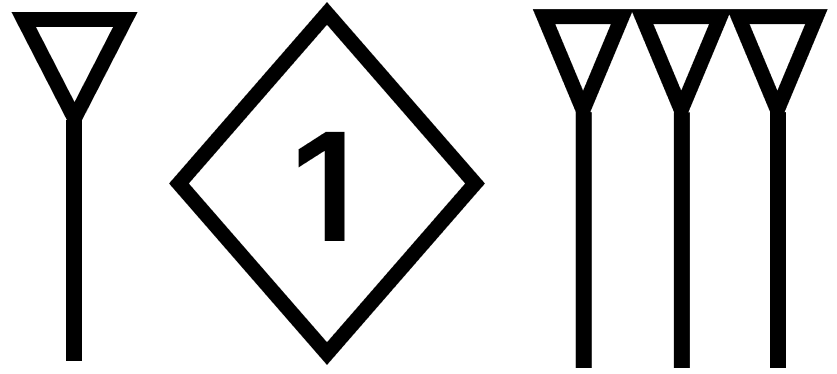
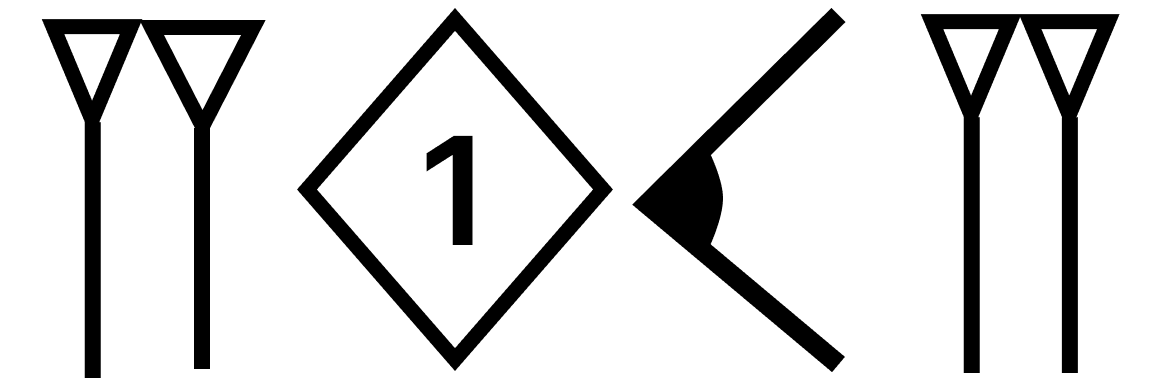
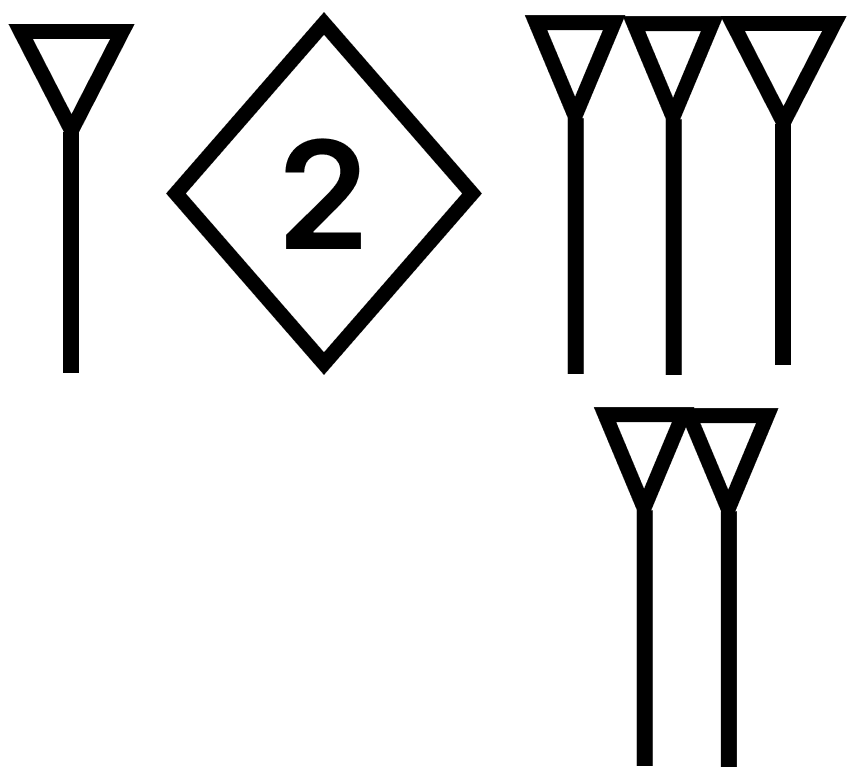
In the Mesopotamian system, each number is grouped into powers of 60 (1, 60, 3600, ...). The number of times each power occurs (a value from 0 to 59) is written using the symbol for 1 (a single wedge) and the symbol for 10 (a corner wedge), and the positions, from right to left, stand for the 1s, the 60s, the 3600s, and so on.
(i) 63
63 = 1 × 60 + 3
(ii) 132
132 = 2 × 60 + 12
(iii) 200
200 = 3 × 60 + 20

(iv) 60
60 = 1 × 60

(v) 3605
3605 = 1 × 3600 + 0 × 60 + 5
Look at the representation of 60. What will be the representation for 3,600?
Answer
In the compact Mesopotamian place value system, the same wedge symbol is used in different positions.
A single wedge can represent 1, 60 or 3600 depending on its position. Since the Mesopotamians did not regularly use a placeholder at the end of a numeral, 3600 could also be written as a single wedge, just like 1 and 60.
This makes the numeral ambiguous because its value cannot be determined without additional context.
Hence, 3600 has the same single-wedge representation as 1 and 60, which reveals a limitation of the Mesopotamian system.
Represent the following numbers using the Mayan system:
(i) 77
(ii) 100
(iii) 361
(iv) 721
Answer
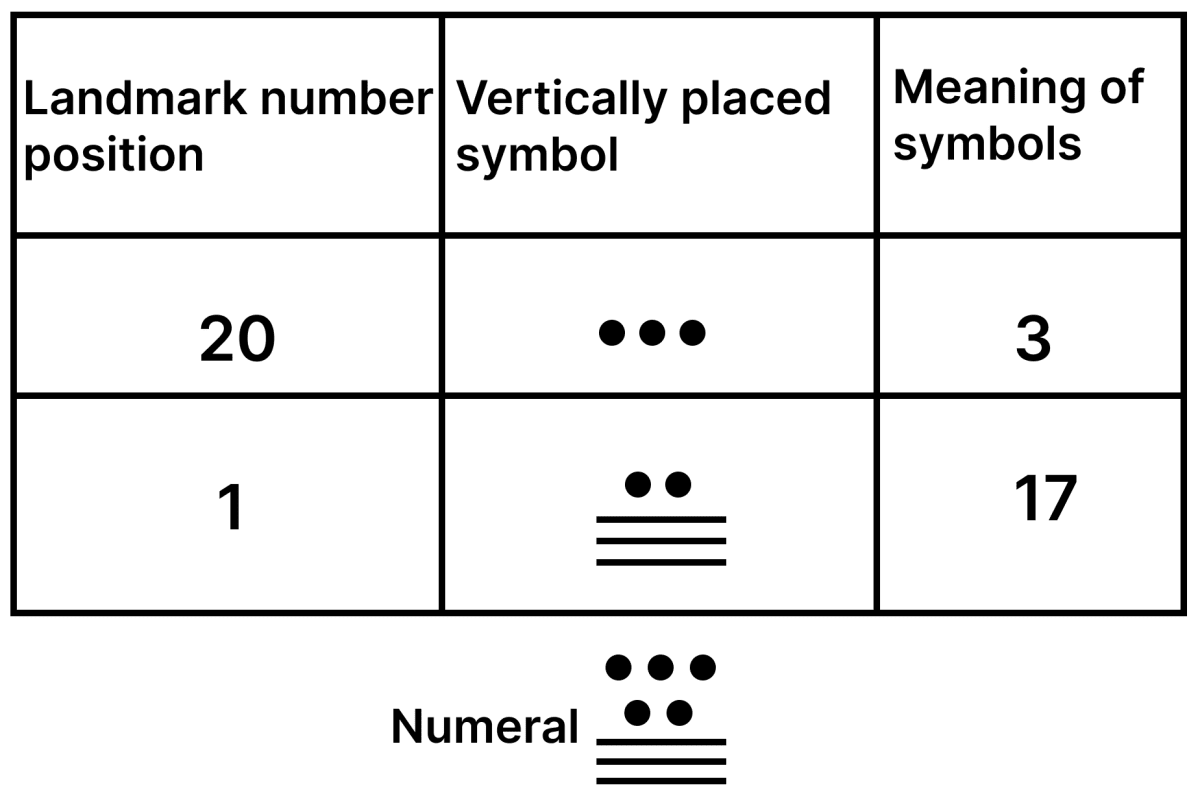
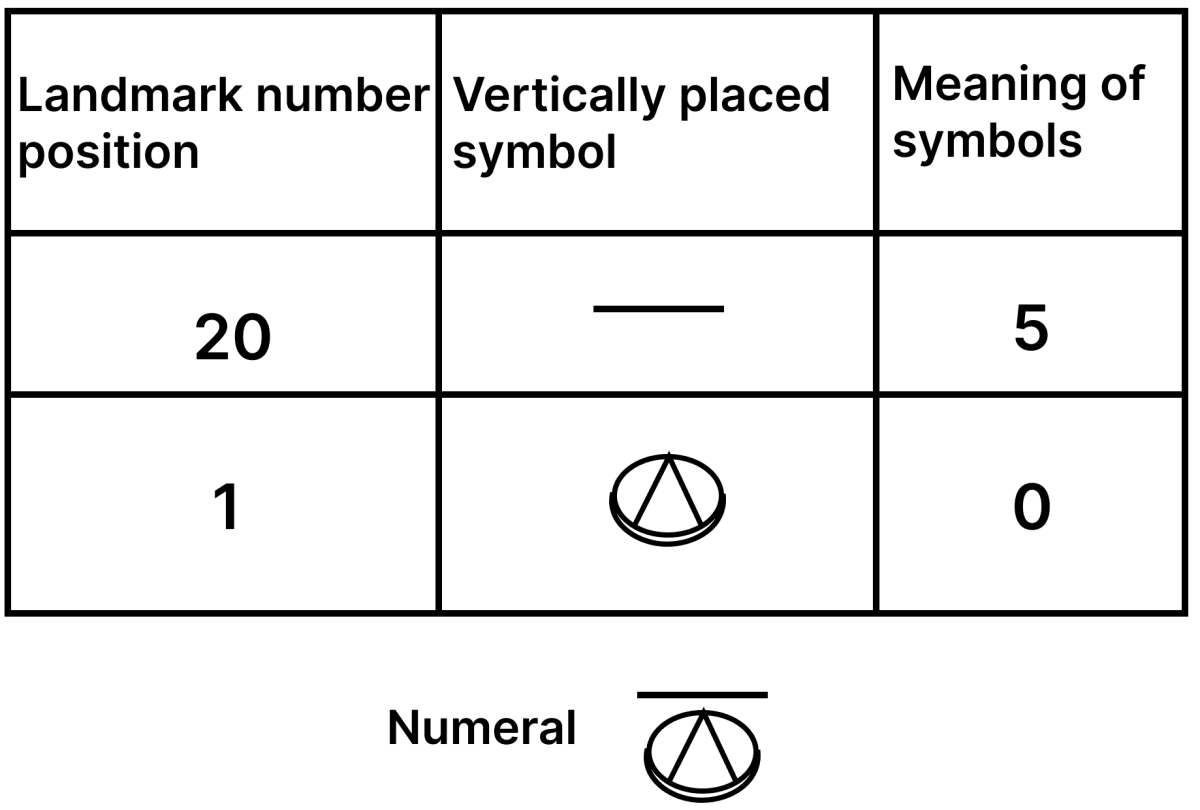
In the Mayan system, the landmark numbers (from the bottom position upwards) are 1, 20, 20×18 = 360, 202×18 = 7200, and so on. Within each position a value from 0 to 19 is shown using a shell for 0, a dot for 1, and a bar for 5, with the symbols stacked one above the other (bars at the bottom, dots above). The lowermost set of symbols counts the 1s, the set above counts the 20s, the next set above counts the 360s, and so on.
(i) 77
Splitting 77 into the landmark numbers:
77 = 3 × 20 + 17 × 1
So we need 3 in the 20s position and 17 in the 1s position.
(ii) 100
Splitting 100 into the landmark numbers:
100 = 5 × 20 + 0 × 1
So we need 5 in the 20s position and 0 in the 1s position.
(iii) 361
Splitting 361 into the landmark numbers:
361 = 1 × 360 + 0 × 20 + 1 × 1
So we need 1 in the 360s position, 0 in the 20s position, and 1 in the 1s position.
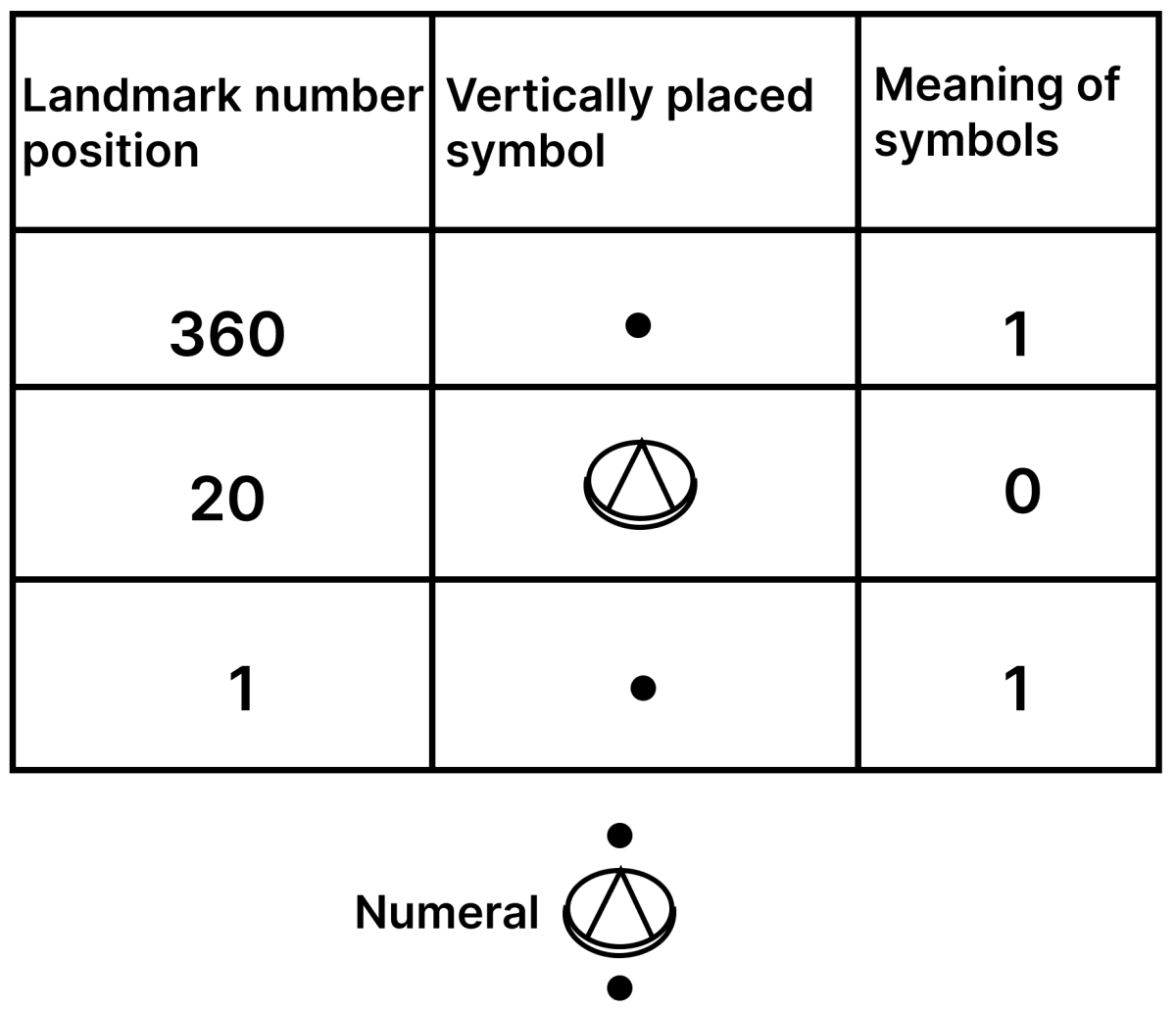
(iv) 721
Splitting 721 into the landmark numbers:
721 = 2 × 360 + 0 × 20 + 1 × 1
So we need 2 in the 360s position, 0 in the 20s position, and 1 in the 1s position.
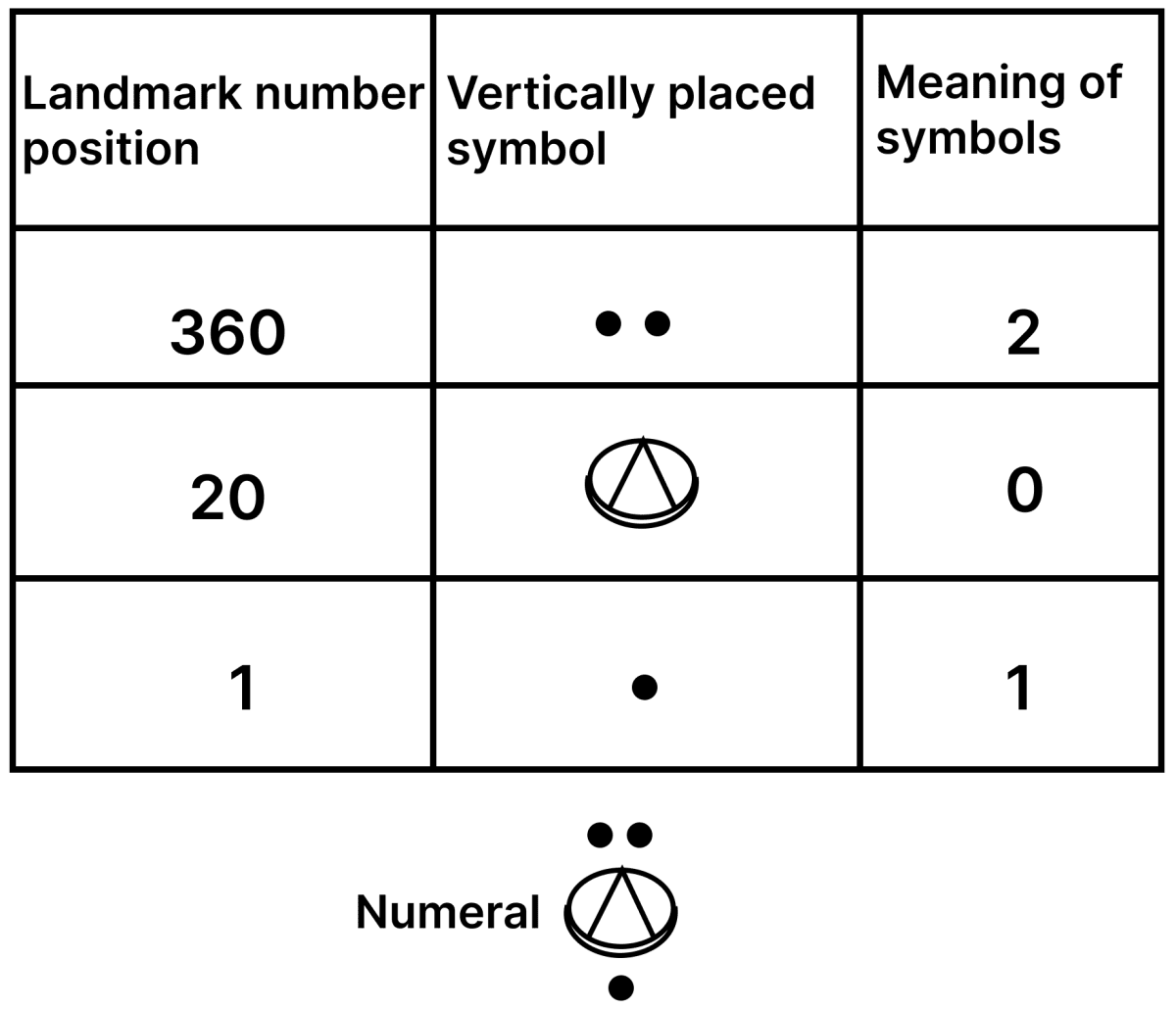
Hence, in the Mayan system 77 is written as (3)(17), 100 as (5)(0), 361 as (1)(0)(1) and 721 as (2)(0)(1), where each position is filled with the matching dots, bars and shell stacked vertically.
Where does the Hindu/Indian number system figure in the evolution of ideas of number representation?
(i) What are its landmark numbers?
(ii) And does it use a place value system?
Answer
The Hindu number system comes at the end of the evolution of ideas about representing numbers. It brings together all the important ideas that developed one after another:
- Counting in groups of a single number (as the Gumulgal did).
- Grouping using landmark numbers (as in the Roman system with I, V, X, L, C, M).
- Choosing the powers of a single number as the landmark numbers — the idea of a base.
- Using the position of a symbol to denote the landmark number — the idea of a place value system.
- The idea of 0, both as a positional digit (placeholder) and as a number in its own right.
(i) The Hindu number system is a base-10 (decimal) system, so its landmark numbers are the powers of 10: 1, 10, 102 (100), 103 (1000), 104 (10,000), and so on. Each landmark number is 10 times the previous one.
(ii) Yes, it is a place value system. The position of each digit decides the landmark number (power of 10) it stands for. Its special feature is that it has a symbol for 0 (used in India at least as early as 200 BCE) which is treated on par with the other digits. Because of 0 and the use of a single digit in each position, every number can be written unambiguously using just ten symbols (0–9), and computation becomes efficient.
Hence, the Hindu number system is the final stage in the evolution of number representation; it is a base-10 place value system whose landmark numbers are the powers of 10, and its use of 0 as both a digit and a number is its key breakthrough.
Why do you think the Chinese alternated between the Zong and Heng symbols? If only the Zong symbols were to be used, how would 41 be represented? Could this numeral be interpreted in any other way if there is no significant space between two successive positions?
Answer
The Chinese used a blank space to show a skipped place value, but a blank space is hard to judge. By alternating between the Zong (vertical) symbols and the Heng (horizontal) symbols, two neighbouring positions always look different. This makes it easy to see where one place value ends and the next begins, so the digits do not run into one another and the number can be read without confusion.
If only the Zong symbols were used, then 41 = 4 tens + 1 unit would be written using the Zong symbol for 4 followed by the Zong symbol for 1, that is, four vertical strokes followed by one vertical stroke:
41 → |||| |
Yes, without a significant space between the two positions this numeral can be read in more than one way. The five vertical strokes ||||| could be understood as:
- the single digit 5 (since 5 in the Zong system is five vertical strokes), or
- 1 ten and 4 units, that is, 14, or
- 4 tens and 1 unit, that is, 41.
Hence, the Chinese alternated the Zong and Heng symbols to keep successive positions distinct; with only Zong symbols and no clear space, 41 looks like |||||, which could equally be read as 5, 14 or 41.
Form a base-2 place value system using 'ukasar' and 'urapon' as the digits. Compare this system with that of the Gumulgal's.
Answer
A base-2 place value system needs exactly two digits, 0 and 1. Let us take urapon for the digit 0 and ukasar for the digit 1. The place values (from the right) are the powers of 2: 1, 2, 22 = 4, 23 = 8, and so on. The value of a numeral is found by multiplying each digit by the place value of its position and adding.
Some numbers in this system are:
| Number | Base-2 | Name (urapon = 0, ukasar = 1) |
|---|---|---|
| 1 | 1 | ukasar |
| 2 | 10 | ukasar-urapon |
| 3 | 11 | ukasar-ukasar |
| 4 | 100 | ukasar-urapon-urapon |
| 5 | 101 | ukasar-urapon-ukasar |
| 6 | 110 | ukasar-ukasar-urapon |
| 7 | 111 | ukasar-ukasar-ukasar |
| 8 | 1000 | ukasar-urapon-urapon-urapon |
Comparison with the Gumulgal's system:
| Number | Base-2 system (ur = 0, uk = 1) | Gumulgal System |
|---|---|---|
| 1 | (1) × 2⁰ = uk | ur |
| 2 | (1) × 2¹ + (0) × 2⁰ = uk ur | uk |
| 3 | (1) × 2¹ + (1) × 2⁰ = uk uk | uk-ur |
| 4 | (1) × 2² + (0) × 2¹ + (0) × 2⁰ = uk ur ur | uk-uk |
| 5 | (1) × 2² + (0) × 2¹ + (1) × 2⁰ = uk ur uk | uk-uk-ur |
| 6 | (1) × 2² + (1) × 2¹ + (0) × 2⁰ = uk uk ur | uk-uk-uk |
| 7 | (1) × 2² + (1) × 2¹ + (1) × 2⁰ = uk uk uk | uk-uk-uk-ur |
| 8 | (1) × 2³ + (0) × 2² + (0) × 2¹ + (0) × 2⁰ = uk ur ur ur | uk-uk-uk-uk |
In Base-2 system, and the Gumulgal system there are only two landmark numbers.
Hence, the Gumulgal's system is additive and limited, while the base-2 system built from the same two words is positional, uses a zero, and can represent all numbers.
Where in your daily lives, and in which professions, do the Hindu numerals, and 0, play an important role? How might our lives have been different if our number system and 0 hadn't been invented or conceived of?
Answer
The Hindu numerals and 0 are used almost everywhere in daily life: reading clocks and calendars, dates, prices and money (and giving change), phone numbers, house and vehicle numbers, page numbers, bus and train numbers, measuring length, weight and temperature, shopping bills, bank balances, and marks or scores in exams and games.
They are essential in many professions:
- Accountants and bankers, for keeping accounts, balances and interest.
- Shopkeepers and traders, for billing and working out profit and loss.
- Engineers and architects, for measurements, designs and calculations.
- Scientists, for measurements and for handling very large and very small numbers.
- Computer programmers, since computers work using just the digits 0 and 1.
- Doctors, for medicine dosages and readings.
- Astronomers, for working with extremely large numbers.
If the Hindu number system and 0 had not been invented, we would have to manage with clumsy systems such as tally marks or Roman numerals. Writing large numbers would be long and awkward, and there would be ambiguity (like the blank spaces in the Mesopotamian system). Arithmetic would be slow and full of errors, and powerful subjects like algebra and analysis, which grew out of treating 0 as a number, would not have developed. Modern science, accounting, surveying and especially computers and digital technology (which depend on 0 and 1) might not exist at all.
Hence, the Hindu numerals and 0 are central to everyday life and to almost every profession, and without them writing numbers, doing calculations, and developing modern science and technology would have been extremely difficult.
The ancient Indians likely used base 10 for the Hindu number system because humans have 10 fingers, and so we can use our fingers to count. But what if we had only 8 fingers? How would we be writing numbers then? What would the Hindu numerals look like if we were using base 8 instead? Base 5? Try writing the base-10 Hindu numeral 25 as base-8 and base-5 Hindu numerals, respectively. Can you write it in base-2?
Answer
If we had only 8 fingers, we would most likely have used base 8. The landmark numbers would then be the powers of 8 (1, 8, 82, …), and we would need only 8 digits: 0, 1, 2, 3, 4, 5, 6, 7 — the digits 8 and 9 would not exist. In the same way, base 5 would use only 5 digits: 0, 1, 2, 3, 4, and base 2 would use only 2 digits: 0 and 1.
Writing 25 in base 8
Repeatedly divide by 8:
25 ÷ 8 = 3 remainder 1
3 ÷ 8 = 0 remainder 3
Reading the remainders from the last to the first gives 31. So,
25 = 3 × 81 + 1 × 80 = (31)8
Writing 25 in base 5
Repeatedly divide by 5:
25 ÷ 5 = 5 remainder 0
5 ÷ 5 = 1 remainder 0
1 ÷ 5 = 0 remainder 1
Reading the remainders from the last to the first gives 100. So,
25 = 1 × 52 + 0 × 51 + 0 × 50 = (100)5
Writing 25 in base 2
Yes, 25 can be written in base 2. Repeatedly divide by 2:
25 ÷ 2 = 12 remainder 1
12 ÷ 2 = 6 remainder 0
6 ÷ 2 = 3 remainder 0
3 ÷ 2 = 1 remainder 1
1 ÷ 2 = 0 remainder 1
Reading the remainders from the last to the first gives 11001. So,
25 = 1 × 24 + 1 × 23 + 0 × 22 + 0 × 21 + 1 × 20 = (11001)2
Hence, with base 8 we would use the digits 0–7, with base 5 the digits 0–4, and with base 2 the digits 0 and 1; the number 25 is written as (31)8, (100)5 and (11001)2.