
Observe the following figures
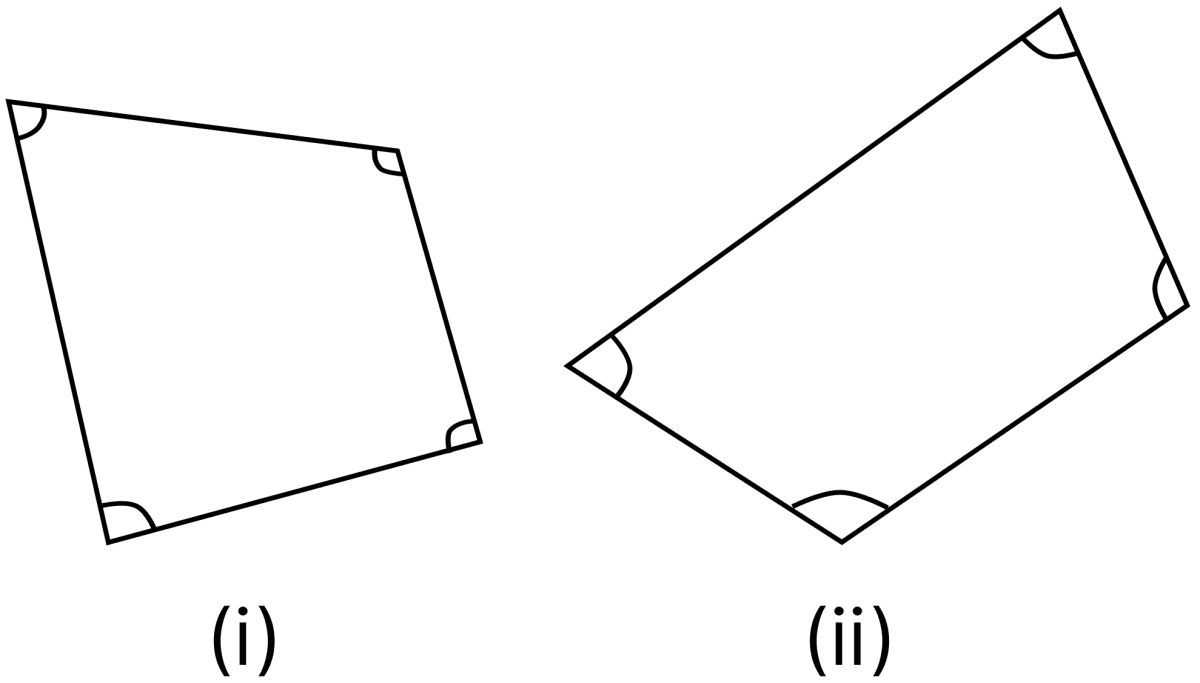
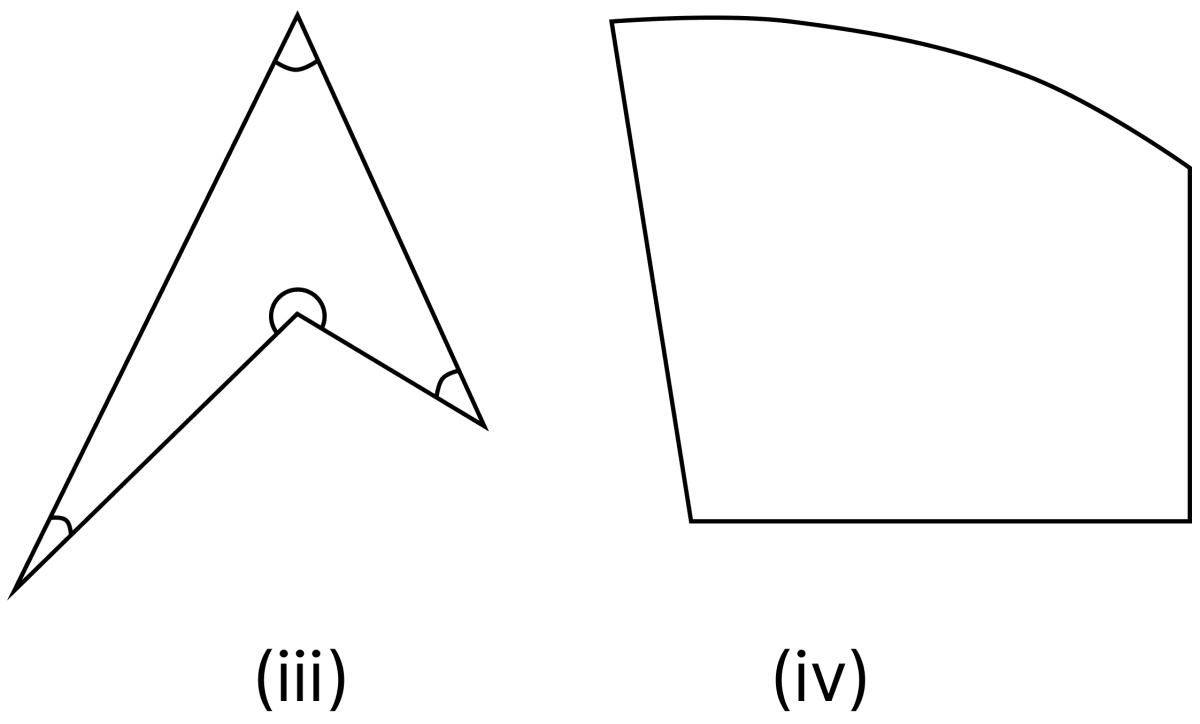
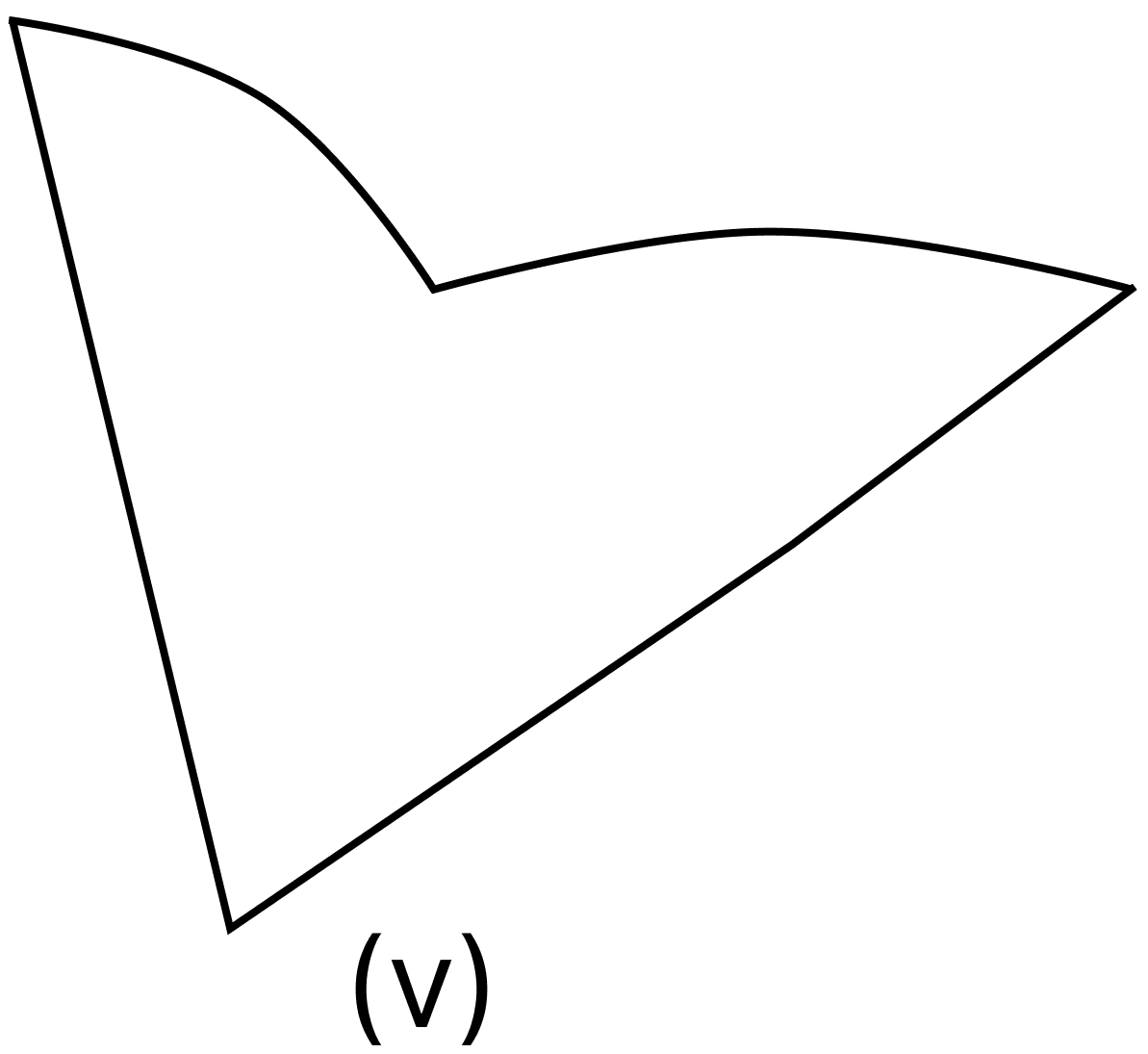
Figs. (i), (ii), and (iii) are quadrilaterals, and the others are not. Why?
Answer
Figures (i), (ii), and (iii) are quadrilaterals because each figure is a closed shape made up of four straight line segments.
Figures (iv) and (v) are not quadrilaterals because they are not formed entirely using four straight line segments.
Are there other ways to define a rectangle?
Answer
Yes. Apart from defining a rectangle as a quadrilateral in which all the angles are right angles and the opposite sides are of equal length, a rectangle can also be defined as a quadrilateral whose diagonals are equal and bisect each other.
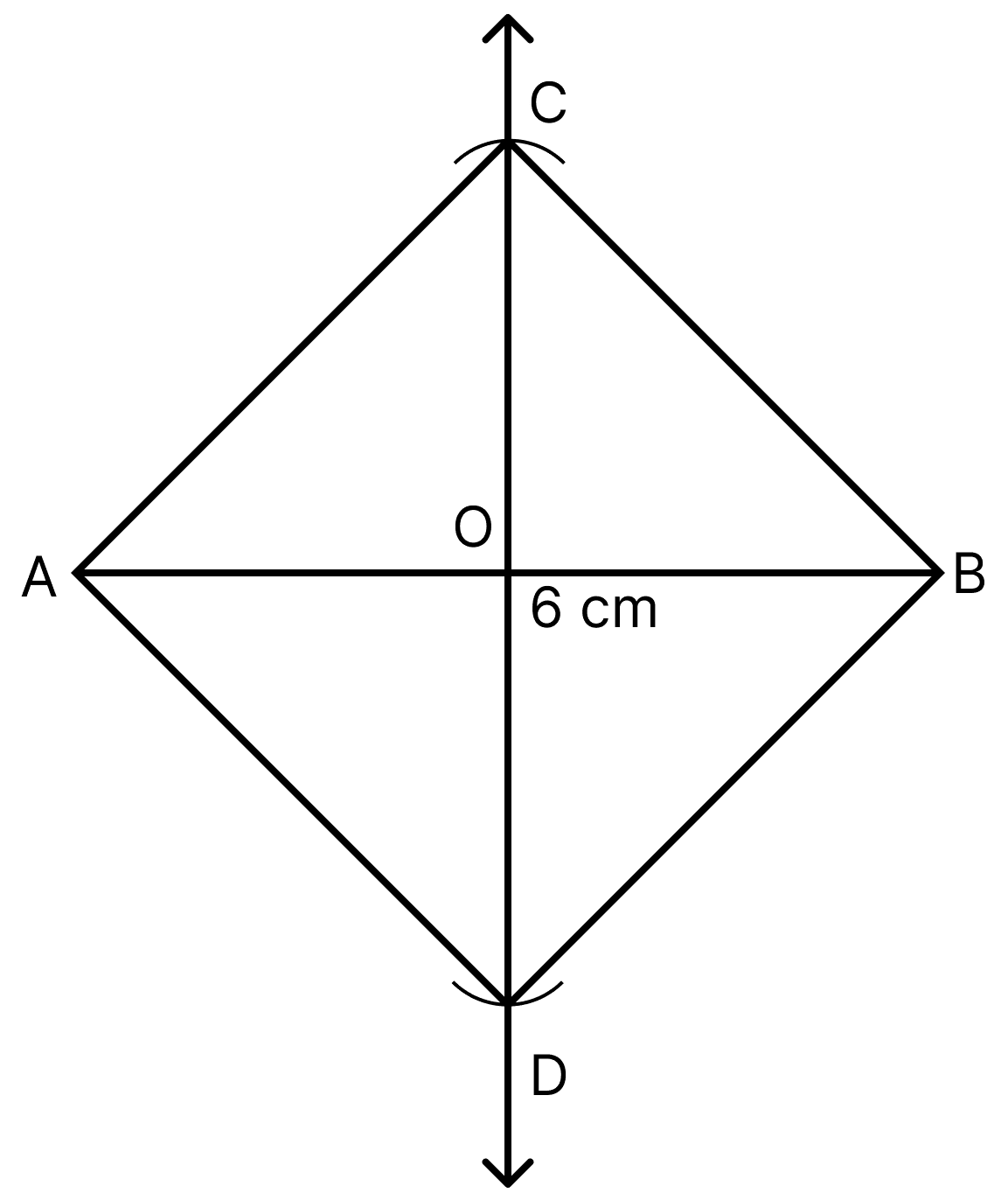
A carpenter needs to put together two thin strips of wood, as shown in Fig. 1, so that when a thread is passed through their endpoints, it forms a rectangle. She already has one 8 cm long strip.
(i) What is the length of the other diagonal?
(ii) What is the point of intersection of the two diagonals?
(iii) What should the angle be between the diagonals?
Answer
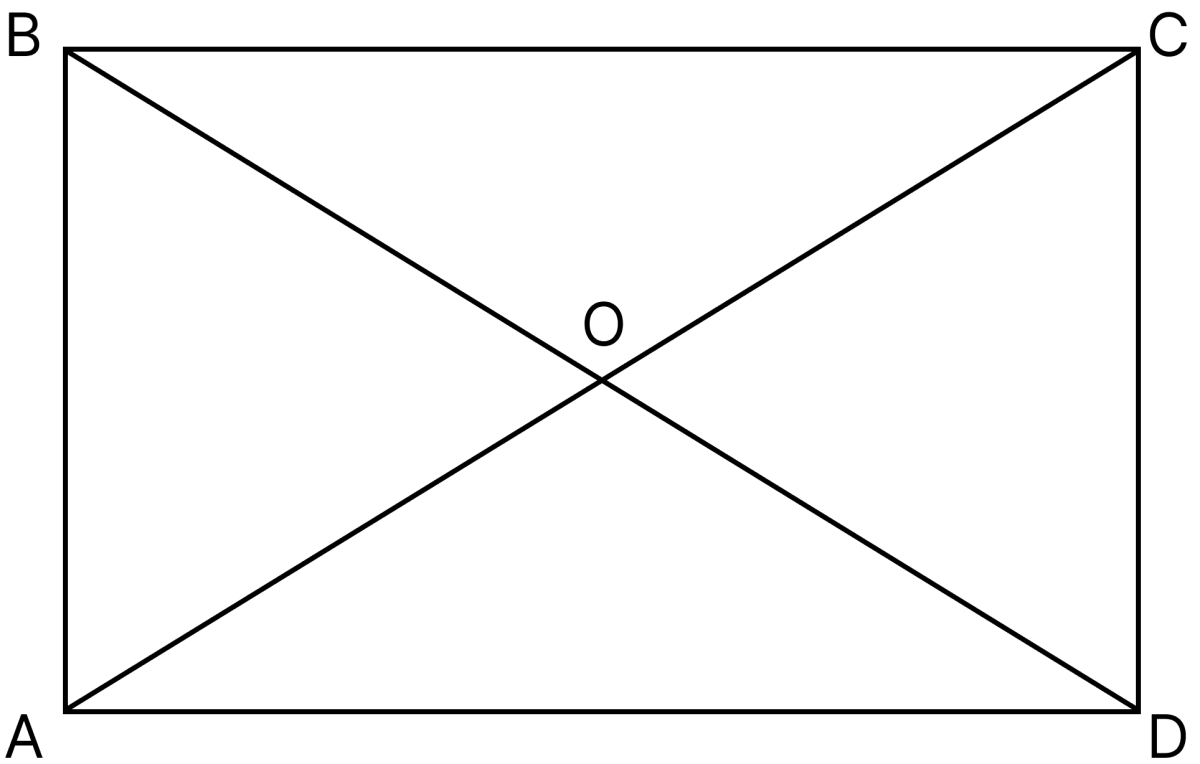
The two strips of wood act as the two diagonals of the rectangle, and the thread passing through their endpoints forms the sides of the rectangle.
(i) The other diagonal must also be 8 cm long, because the diagonals of a rectangle are equal in length.
(ii) The two strips must be joined at their midpoints, because the diagonals of a rectangle bisect each other. So their point of intersection is the midpoint of each diagonal.
(iii) The diagonals may be joined at any non-zero angle less than 180°. As long as the diagonals are equal and bisect each other, the quadrilateral formed by their endpoints will be a rectangle.
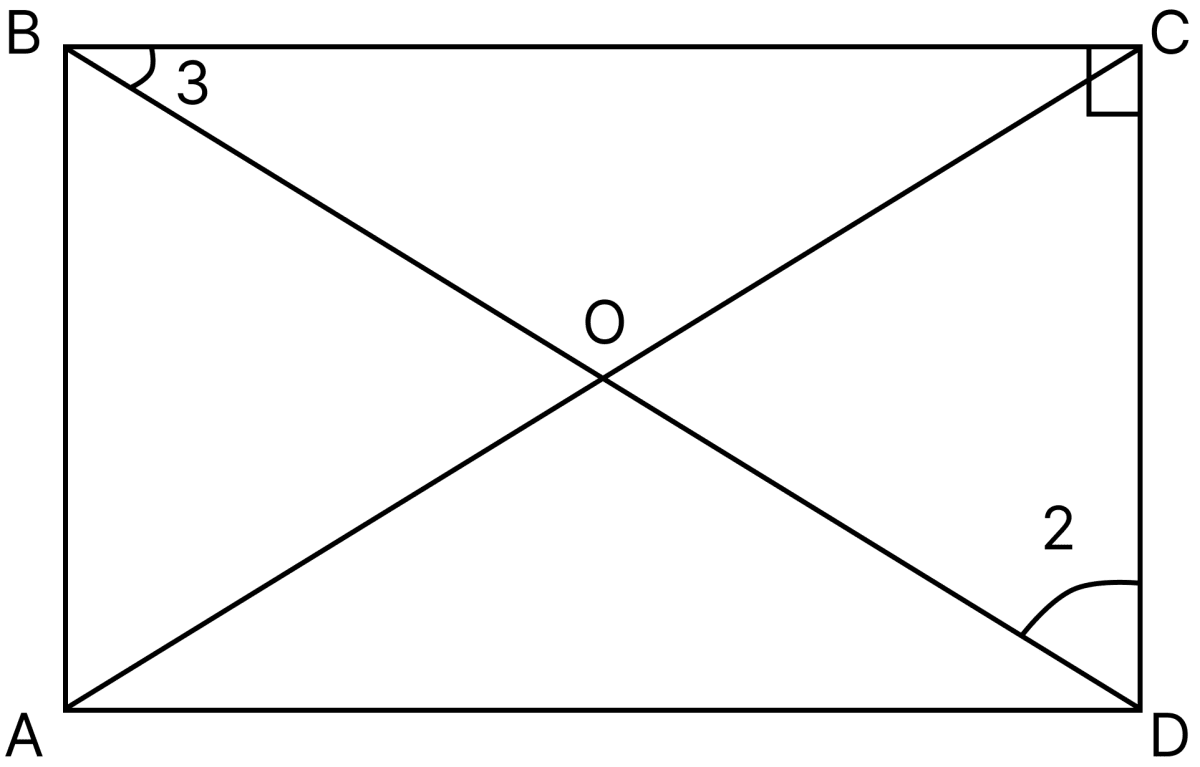
Can the following equalities be used to establish that △AOD ≅ △COB?
AO = CO (proved above)
∠AOB = ∠COD (vertically opposite angles)
AD = CB
Answer
No, these equalities cannot be used to establish that △AOD ≅ △COB.
Of the three statements given, two are pairs of equal sides and one is a pair of equal angles:
AO = CO and AD = CB are two pairs of corresponding sides.
∠AOB = ∠COD is a pair of equal angles.
For two triangles to be congruent by the SAS condition, the equal angle must be the angle included between the two equal sides.
In △AOD, the sides AO and AD meet at the vertex A, so the angle included between them is ∠OAD.
In △COB, the sides CO and CB meet at the vertex C, so the included angle is ∠OCB.
But the angle given here is ∠AOB (= ∠COD), which is at the vertex O. This is not the angle between AO and AD.
In fact, ∠AOB is not an angle of △AOD at all, because it is formed using OB, which is not a side of △AOD. So the given angle is a non-included angle.
Using two sides and a non-included angle (the SSA arrangement) does not guarantee congruence. Hence, these three equalities cannot be used to prove △AOD ≅ △COB.
To prove the congruence correctly, we use the fact that the diagonals bisect each other (so OD = OB as well), together with the included angle:
In △AOD and △COB,
AO = CO [O is the midpoint of AC]
∠AOD = ∠COB [Vertically opposite angles]
OD = OB [O is the midpoint of BD]
So, △AOD ≅ △COB by the SAS congruence condition.
Thus, the congruence is true, but it must be established using the included angle ∠AOD = ∠COB, not the non-included angle ∠AOB = ∠COD.
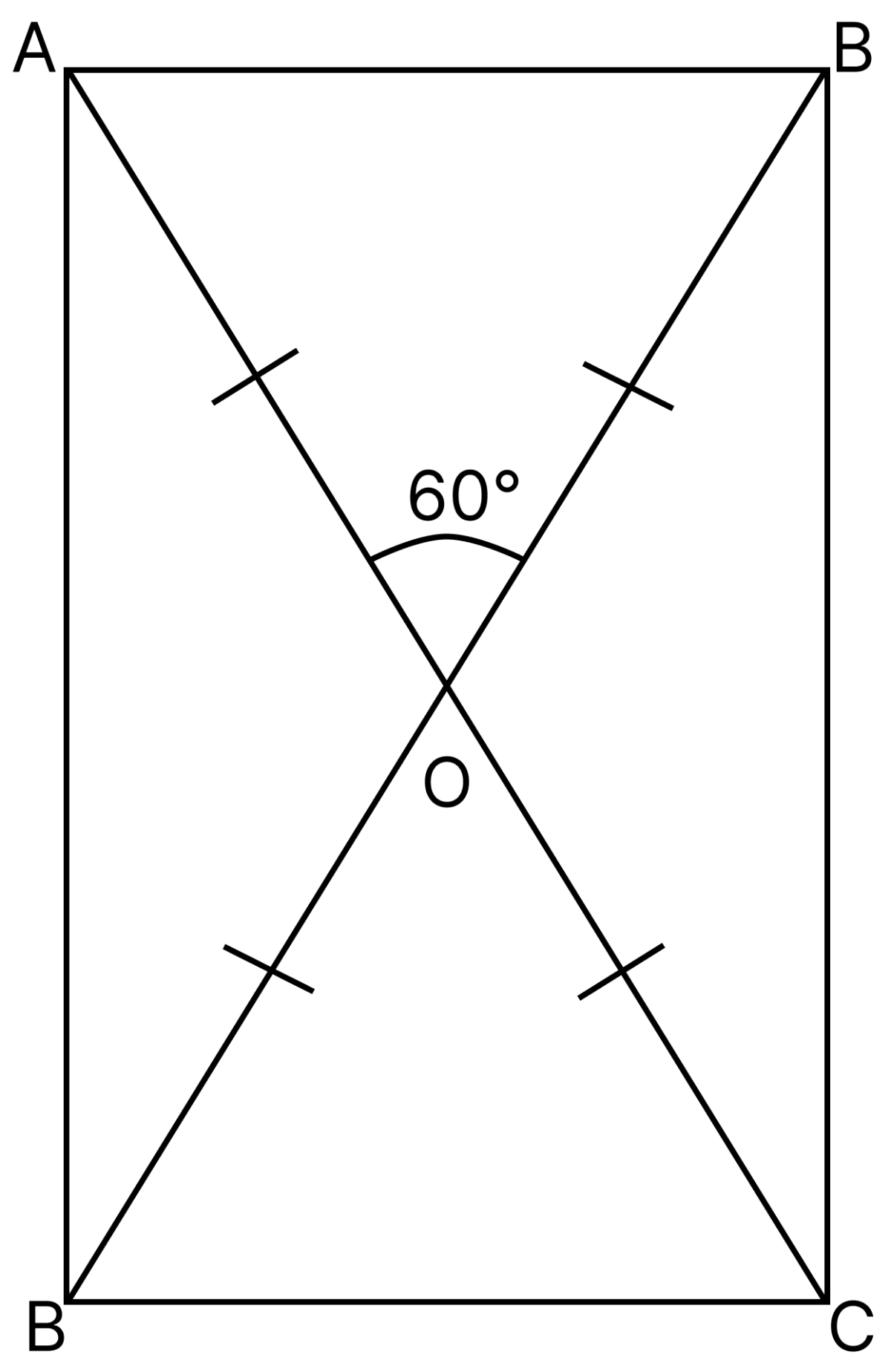
Can you find all the remaining angles?
Answer
In the above figure, the two diagonals are equal in length and bisect each other at O, and the angle between them is ∠AOB = 60°.
Since the diagonals are equal and bisect each other, all four half-diagonals are equal:
OA = OB = OC = OD
So each of the four triangles formed around O is isosceles, and we can use this to find every angle.
First, the angles at O:
∠AOB = 60° [Given]
∠AOB + ∠BOC = 180° [AOC is a straight line]
60° + ∠BOC = 180°
∠BOC = 120°
By vertically opposite angles, ∠COD = 60° and ∠AOD = 120°.
Now the base angles of each isosceles triangle:
In △AOB (OA = OB):
∠OAB = ∠OBA
∠AOB + ∠OAB + ∠OBA = 180° [Angle sum property]
60° + 2∠OAB = 180°
2∠OAB = 120°
∠OAB =
∠OAB = 60°
⇒ ∠OBA = 60°
In △BOC (OB = OC):
∠OBC = ∠OCB
∠BOC + ∠OBC + ∠OCB = 180°
120° + 2∠OBC = 180°
2∠OBC = 60°
∠OBC =
∠OBC = 30°
⇒ ∠OCB = 30°
In △COD (OC = OD):
∠OCD = ∠ODC
∠COD + ∠OCD + ∠ODC = 180°
60° + 2∠OCD = 180°
2∠OCD = 120°
∠OCD =
∠OCD = 60°
⇒ ∠ODC = 60°
In △AOD (OA = OD):
∠OAD = ∠ODA
∠AOD + ∠OAD + ∠ODA = 180°
120° + 2∠OAD = 180°
2∠OAD = 60°
∠OAD =
∠OAD = 30°
⇒ ∠ODA = 30°
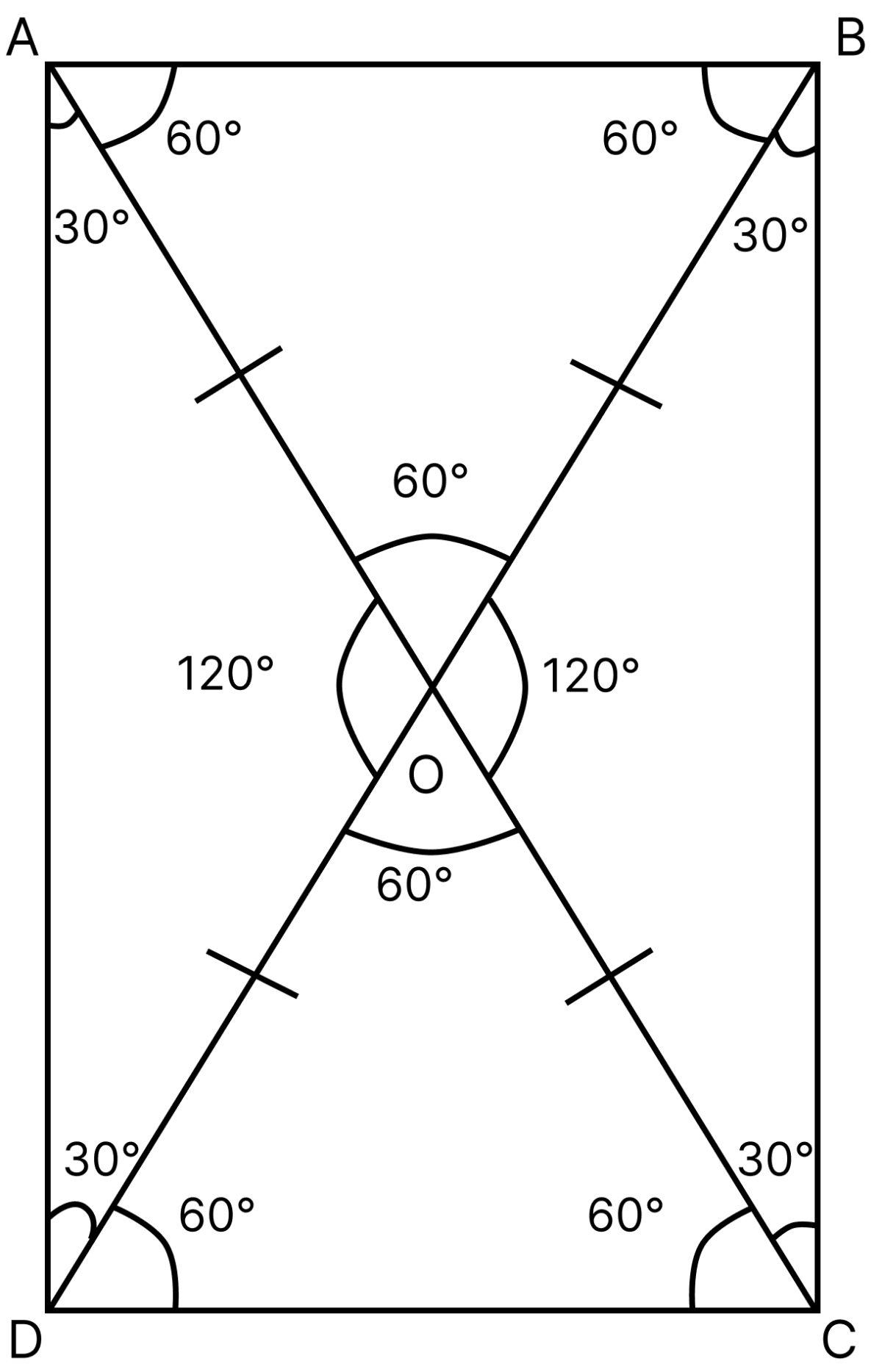
So, all the angles are:
At the centre O: ∠AOB = ∠COD = 60° and ∠BOC = ∠AOD = 120°
At A: ∠OAB = 60° and ∠OAD = 30°
At B: ∠OBA = 60° and ∠OBC = 30°
At C: ∠OCB = 30° and ∠OCD = 60°
At D: ∠ODC = 60° and ∠ODA = 30°
(Each corner correctly adds up to 90°.)
(i) Can we now identify what type of quadrilateral ABCD is?
(ii) Notice that its angles all add up to 90° (30° + 60°). What can we say about its sides?
Answer
(i) Yes, we can identify. ABCD is a rectangle.
(ii) The two angles meeting at each corner add up to 90°:
At A: 60° + 30° = 90°
At B: 60° + 30° = 90°
At C: 30° + 60° = 90°
At D: 60° + 30° = 90°
So all four angles of ABCD are 90°.
About its sides:
The diagonals are equal and bisect each other, so OA = OC and OB = OD. Using these together with the vertically opposite angles at O, the four triangles are congruent in pairs.
In △AOB and △COD:
OA = OC [O is the midpoint of AC]
∠AOB = ∠COD [Vertically opposite angles]
OB = OD [O is the midpoint of BD]
So, △AOB ≅ △COD by the SAS congruence condition, and hence AB = CD.
In △AOD and △COB:
OA = OC [O is the midpoint of AC]
∠AOD = ∠COB [Vertically opposite angles]
OD = OB [O is the midpoint of BD]
So, △AOD ≅ △COB by the SAS congruence condition, and hence AD = CB.
Therefore, the opposite sides of ABCD are equal: AB = CD and AD = BC.
Since all the angles of ABCD are 90° and its opposite sides are equal, ABCD is a rectangle.
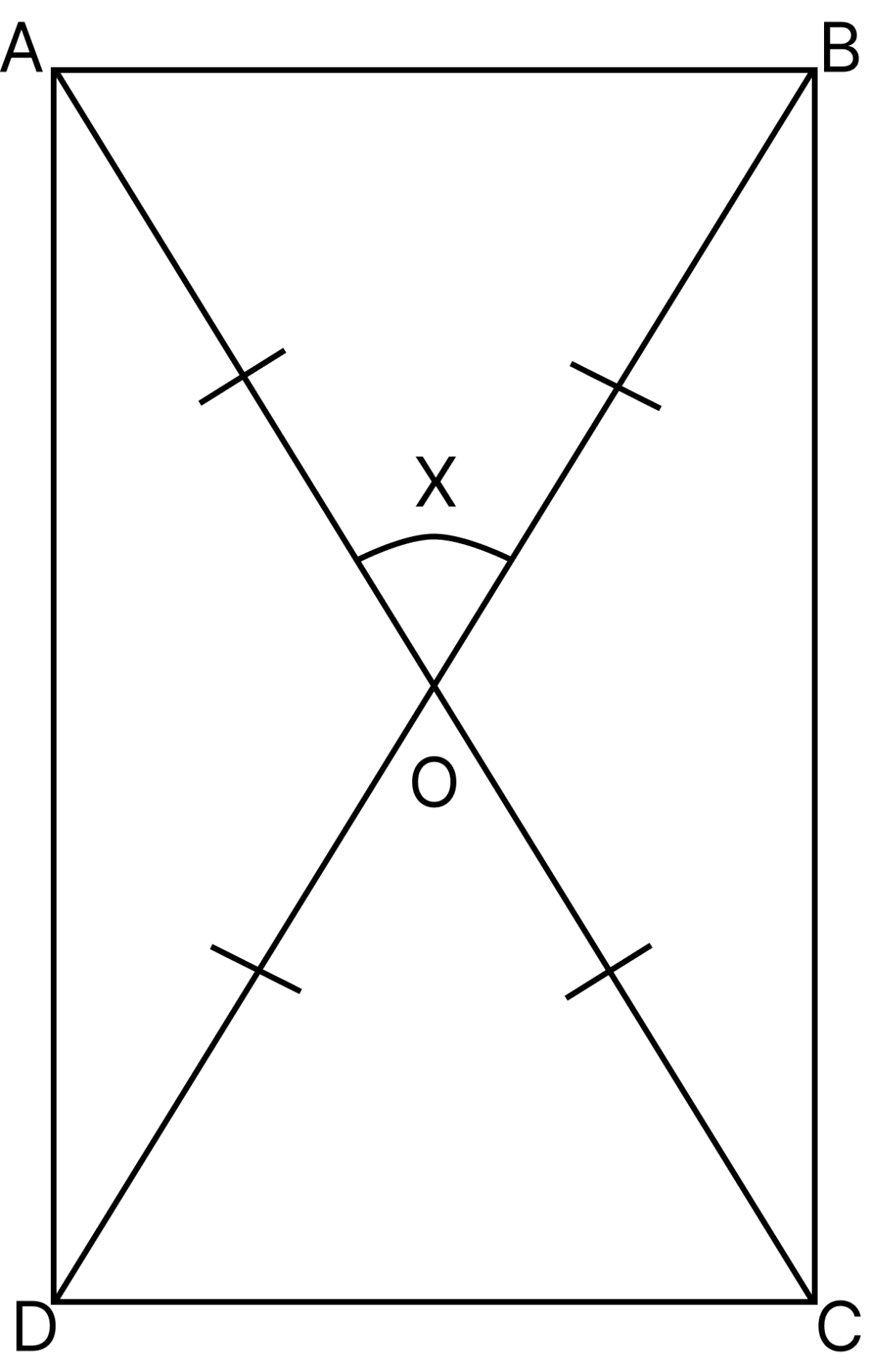
Will ABCD remain a rectangle if the angles between the diagonals are changed? Can we generalise this?
Answer
Yes, ABCD remains a rectangle whatever the angle between the diagonals may be.
To check this in general, take one of the angles between the diagonals as x, where 0° < x < 180°, that is, ∠AOB = x.
The diagonals are still equal and bisect each other, so OA = OB = OC = OD.
The four angles at O can now be found using linear pairs and vertically opposite angles:
∠AOB = x [Taken as x]
∠AOB + ∠BOC = 180° [AOC is a straight line]
x + ∠BOC = 180°
∠BOC = 180° − x
By vertically opposite angles, ∠COD = x and ∠AOD = 180° − x.
So the four angles between the diagonals are x, x, 180° − x, and 180° − x.
As worked out in Question 4, the two angles meeting at every corner add up to exactly 90°, no matter what value x takes.
So all four angles of ABCD are always 90°, and, as shown in Question 4, its opposite sides are equal.
Hence, for any angle x between the diagonals, ABCD is a rectangle. Generalising: if the diagonals of a quadrilateral are equal and bisect each other, then the quadrilateral is always a rectangle, whatever the angle between the diagonals.
What is the value of a (in degrees) in terms of x?
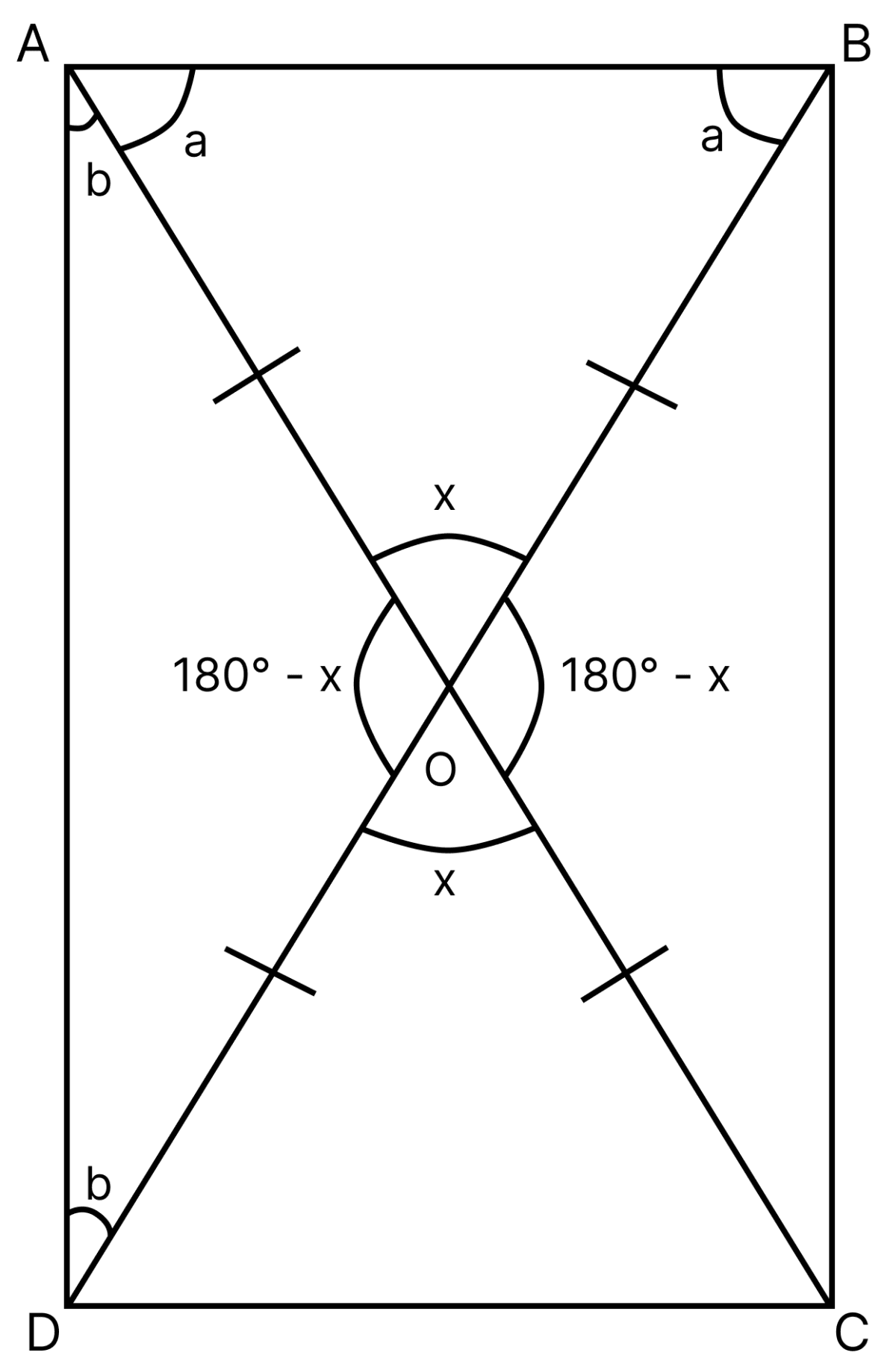
Answer
In △AOB, OA = OB, so it is isosceles and its base angles are equal, each equal to a. Its apex angle is ∠AOB = x.
By the angle sum property of a triangle:
a + a + x = 180° [Sum of the interior angles of a triangle]
2a = 180° − x
a =
a =
Similarly, in △AOD, OA = OD, so it is isosceles with base angles b each, and its apex angle is ∠AOD = 180° − x:
b + b + (180° − x) = 180°
2b = 180° − (180° − x)
2b = 180° − 180° + x
2b = x
b =
At each corner of ABCD, the two base angles meeting there are a and b, so each corner angle is:
a + b =
= 90°
Thus, All four angles of ABCD are 90° for every value of x.
In the earlier definition, we stated that a rectangle has:
(a) opposite sides of equal length, and
(b) all angles equal to 90°.
(i) Would we be wrong if we just define a rectangle as a quadrilateral in which all the angles are 90°?
(ii) If you think that this definition is incomplete, try constructing a quadrilateral in which the angles are all 90° but the opposite sides are not equal. Are you able to construct such a quadrilateral?
Answer
(i) No, we would not be wrong. Defining a rectangle simply as "a quadrilateral in which all the angles are 90°" is a complete and correct definition.
This is because the condition "opposite sides are equal" follows automatically once all four angles are 90°. We can prove this.
Consider a quadrilateral ABCD in which all four angles measure 90°. Join the diagonal BD and compare △BAD and △DCB.
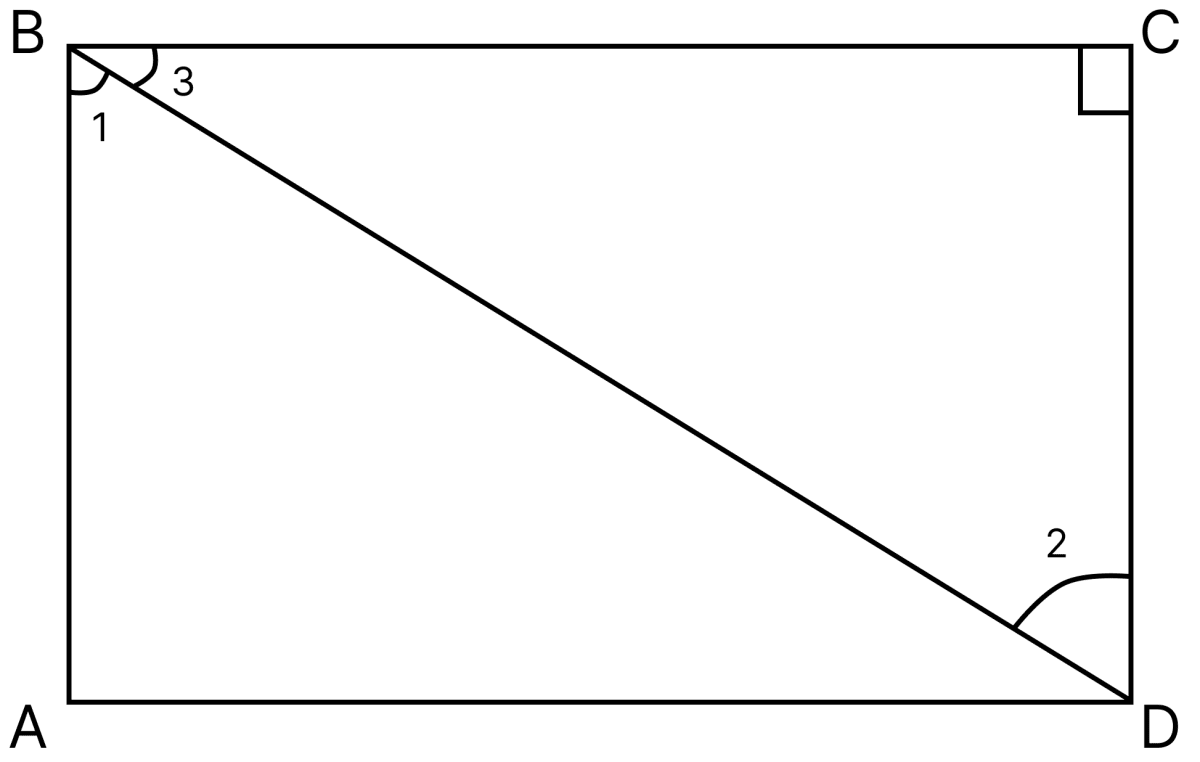
Two equalities can be seen at once:
∠BAD = ∠DCB = 90° (given)
BD = DB (common side).
We only need to compare ∠1 and ∠2, where ∠1 = ∠ABD and ∠2 = ∠BDC. Let ∠3 = ∠DBC.
Since ∠B = ∠ABC = 90°, and BD divides it into ∠1 and ∠3:
∠3 + ∠1 = 90°
In △BCD, since ∠C = ∠BCD = 90°:
∠3 + ∠2 + 90° = 180° [Angle sum property]
∠3 + ∠2 = 180° - 90°
∠3 + ∠2 = 90°
Comparing the two results, ∠3 + ∠1 = ∠3 + ∠2, so:
∠1 = ∠2
Now, in △BAD and △DCB:
∠BAD = ∠DCB = 90° [Given]
∠1 = ∠2 [Proved above]
BD = DB [Common side]
So, △BAD ≅ △DCB by the AAS congruence condition.
Therefore, AD = CB and BA = DC, since they are corresponding sides of congruent triangles.
This shows that the opposite sides come out equal on their own. Hence, a quadrilateral with all angles 90° is necessarily a rectangle, and the definition "all angles equal to 90°" is enough by itself.
(ii) No, such a quadrilateral cannot be constructed.
We have just proved that if all four angles of a quadrilateral are 90°, then its opposite sides are forced to be equal (AD = CB and AB = DC). So it is impossible to draw a quadrilateral whose angles are all 90° but whose opposite sides are unequal.
Hence, "all angles equal to 90°" alone correctly defines a rectangle, and a quadrilateral with all right angles but unequal opposite sides does not exist.
Is it wrong to write △BAD ≅ △CDB? Why?
Answer
Yes, it is wrong.
The correct congruence is △BAD ≅ △DCB, which matches the vertices as:
B ↔ D,
A ↔ C
D ↔ B
Under this matching, the equal parts correspond correctly:
∠BAD ↔ ∠DCB (both 90°)
∠ABD ↔ ∠CDB (that is, ∠1 = ∠2)
side BD ↔ side DB.
If we instead write △BAD ≅ △CDB, the vertices are matched as:
B ↔ C
A ↔ D
D ↔ B
This pairing is incorrect, because it would match the right angle ∠BAD (at A) with ∠CDB (at D, which is not a right angle), and it would pair the side AD with the diagonal DB. These parts are not equal, so this correspondence does not hold.
So it is wrong to write △BAD ≅ △CDB, because the order of the letters states an incorrect correspondence of vertices. The correct statement is △BAD ≅ △DCB.
In the quadrilaterals below, are there any non-rectangles?
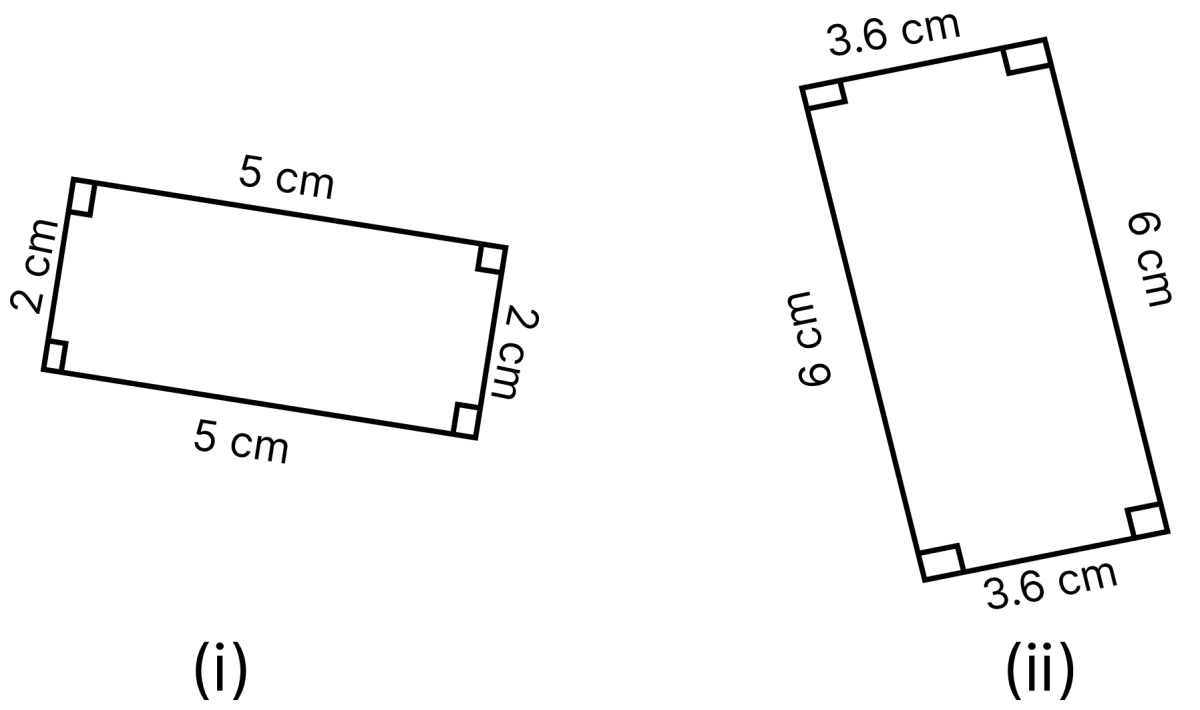
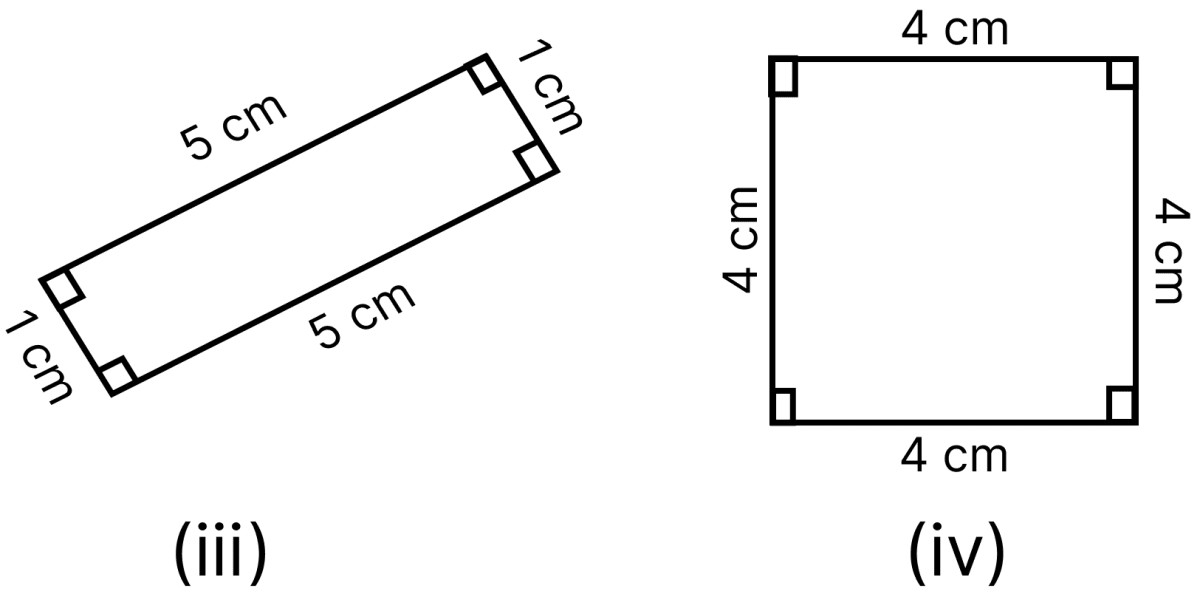
Answer
The four quadrilaterals shown have these measurements and all their angles equal to 90°:
(i) sides 5 cm and 2 cm,
(ii) sides 3.6 cm and 6 cm,
(iii) sides 5 cm and 1 cm,
(iv) all sides 4 cm.
No, there are no non-rectangles among them.
A quadrilateral in which all the angles are 90° is a rectangle. Since each of (i), (ii), (iii), and (iv) has every angle equal to 90°, all four of them are rectangles.
Figure (iv) is also a rectangle, but it is a special one in which all four sides are equal (4 cm each). Such a rectangle is called a square.
So all four quadrilaterals are rectangles; none of them is a non-rectangle. Figure (iv) is a special rectangle — a square.
While solving the Carpenter’s Problem for the case of a rectangle, we have seen that to get a quadrilateral with all angles 90° (and opposite sides of equal length), the diagonals have to be drawn such that:
(i) they are of equal lengths, and
(ii) they bisect each other.
(a) What more needs to be done to get equal side lengths as well?
(b) Can this be achieved by properly choosing the angle between the diagonals? See if you can reason and/or experiment to figure this out!
Answer
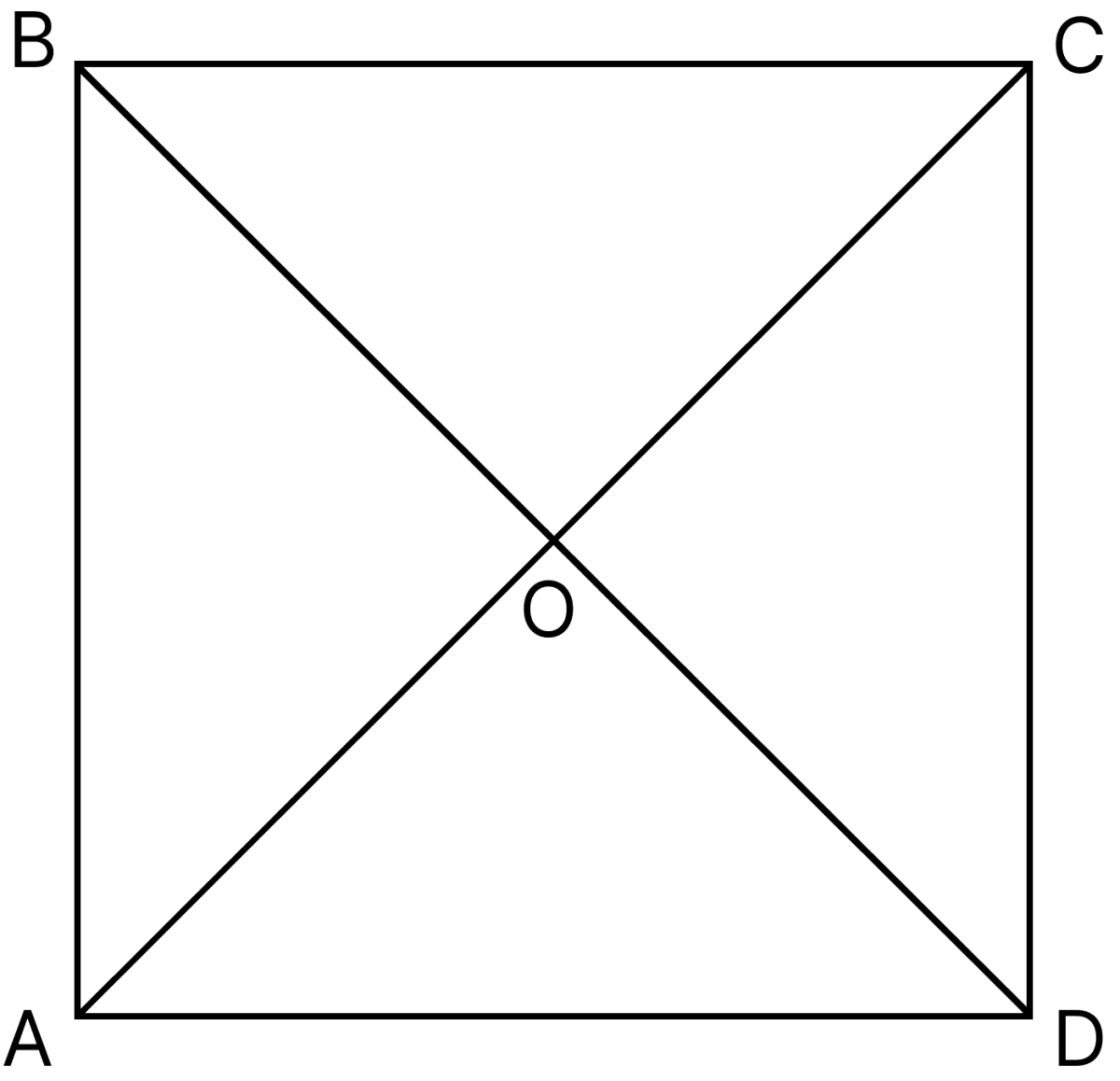
We already know that two equal diagonals which bisect each other give a quadrilateral with all angles 90° (a rectangle), and that the four half-diagonals are then all equal:
OA = OB = OC = OD
(a) To make the sides equal as well, draw these diagonals so that the angle between them is 90°. Then each of the four triangles formed around the point of intersection O — △OAB, △OBC, △OCD, and △ODA — has two equal sides (the half-diagonals) with the included angle 90° between them.
By the SAS congruence condition, all four triangles are congruent, so their third sides are equal:
AB = BC = CD = DA
When all four sides are equal and all four angles are 90°, the quadrilateral is a square.
(b) Yes, this can be achieved by properly choosing the angle between the diagonals. The diagonals must bisect each other at right angles (90°).
So, besides the diagonals being equal and bisecting each other, they must also meet at an angle of 90°. This makes all the sides equal, and the quadrilateral formed is a square.
To find the angle formed by the diagonals, what are the two triangles we should consider for congruence?
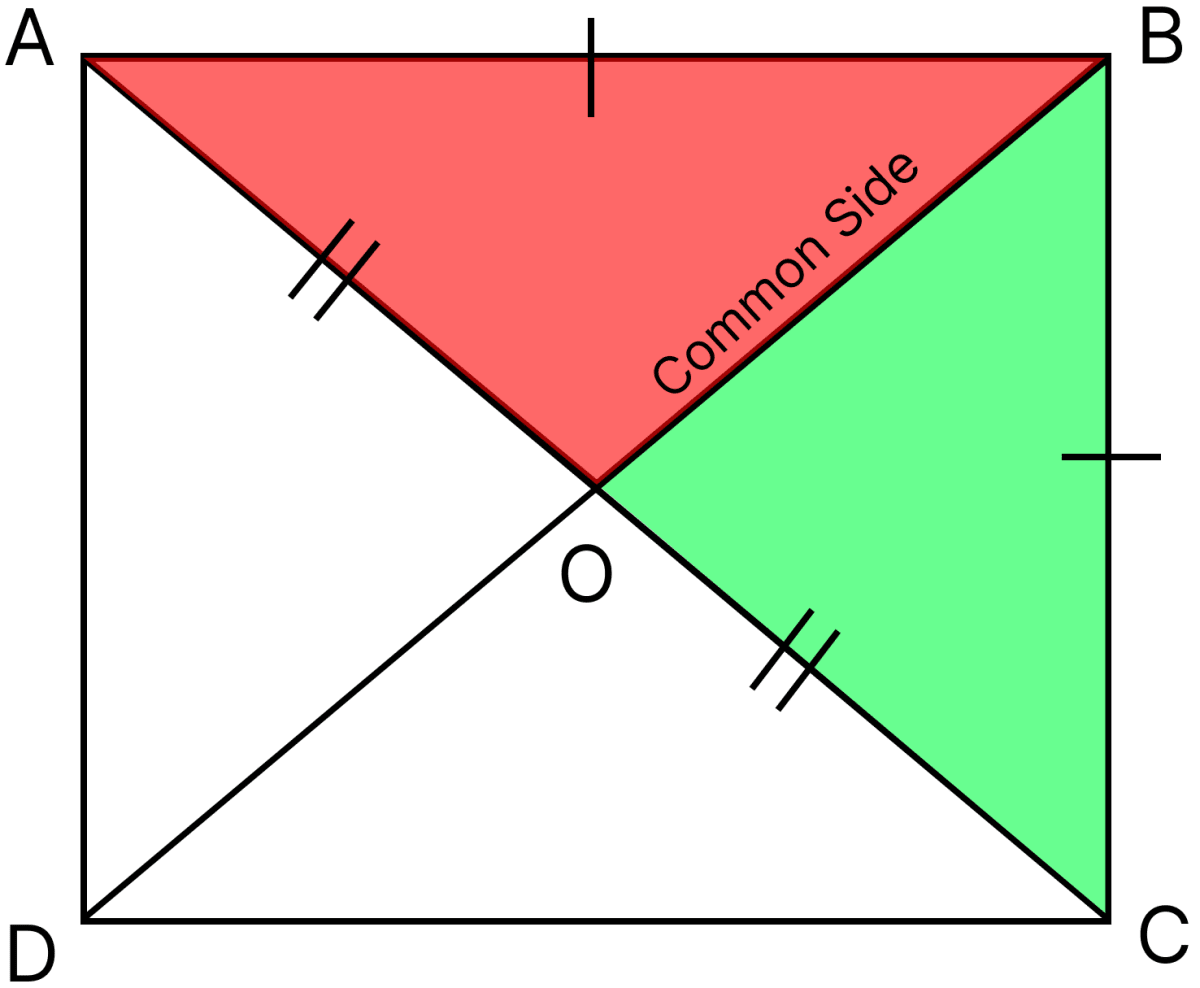
Answer
In the square ABCD, let the diagonals AC and BD meet at O.
To find the angle formed by the diagonals, we consider the two triangles △BOA and △BOC.
These two triangles are congruent by the SSS condition:
BA = BC [All the sides of a square are equal]
OA = OC [The diagonals bisect each other, so O is the midpoint of AC]
BO = BO [Common side]
So, by the SSS congruence condition, △BOA ≅ △BOC.
Can the fact that the two triangles are congruent be used to find the angles ∠BOA and ∠BOC formed by the diagonals?
Answer
Yes.
Since △BOA ≅ △BOC, their corresponding angles are equal:
∠BOA = ∠BOC [Corresponding parts of congruent triangles]
Also, A, O, and C lie on the straight line AC, so ∠BOA and ∠BOC form a linear pair:
∠BOA + ∠BOC = 180°
∠BOA + ∠BOA = 180° [∠BOA = ∠BOC]
2∠BOA = 180°
∠BOA =
∠BOA = 90°
⇒ ∠BOC = 90°
So ∠BOA = ∠BOC = 90°. Hence, the diagonals of a square bisect each other at right angles.
Using the property that the diagonals of a square are equal and perpendicular bisectors of each other, construct a square with diagonal length 8 cm.
Answer
We use the fact that the diagonals of a square are equal, bisect each other, and meet at right angles.
Step 1: Draw the line segment BD = 8 cm. This is one diagonal of the square.
Step 2: Construct the midpoint O of BD, so that:
BO = OD = 4 cm
Step 3: Place a protractor (or set square) at point O and draw a line perpendicular to BD, making an angle of 90° with BD.
Step 4: On this perpendicular line, mark points A and C on opposite sides of O such that:
AO = OC = 4 cm
Thus, AC = 8 cm, AC ⟂ BD, and the two diagonals bisect each other at O.
Step 5: Join AB, BC, CD, and DA.
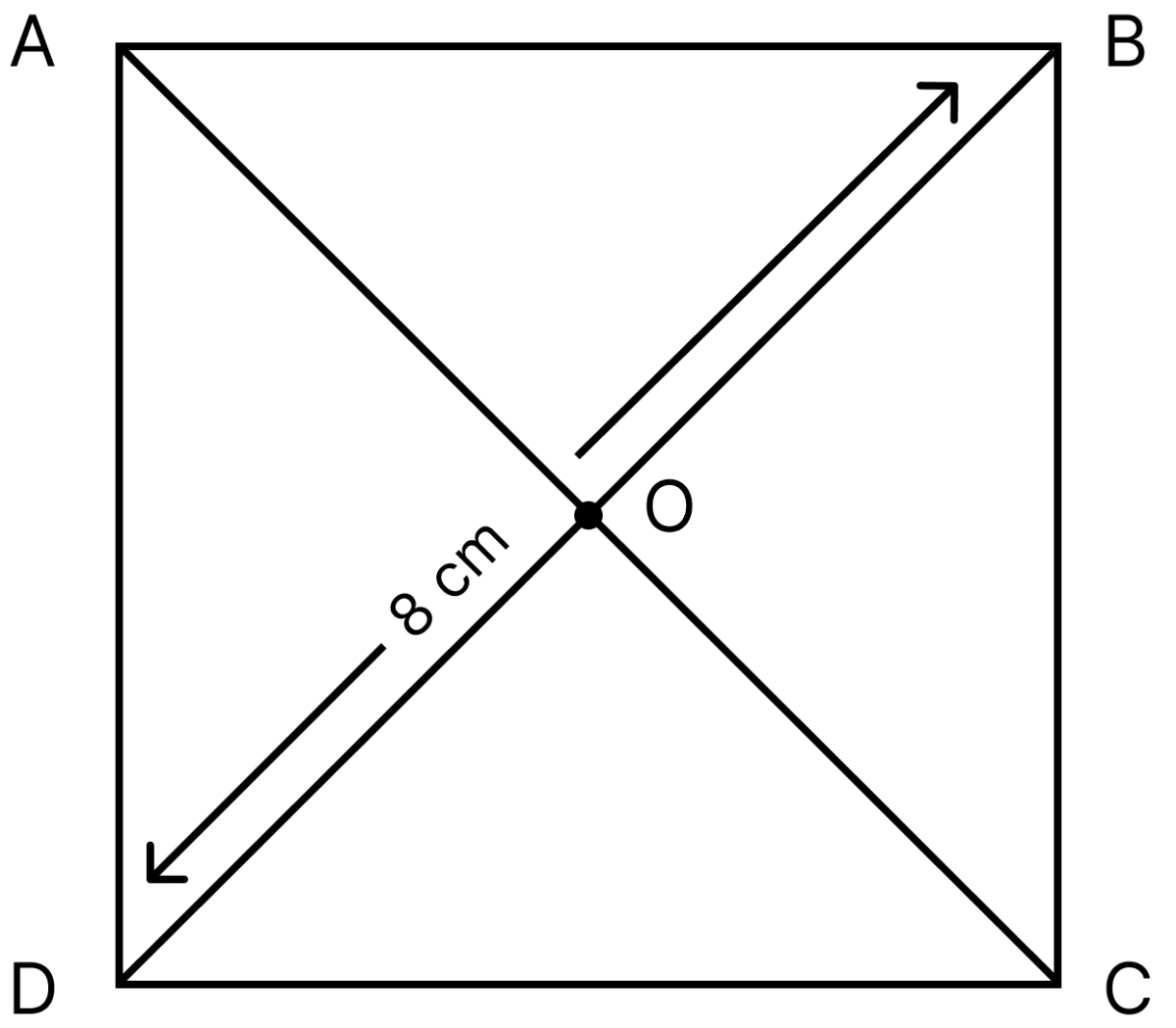
Since the diagonals AC and BD are equal, bisect each other, and meet at right angles, ABCD is the required square with diagonal 8 cm.
Hence, ABCD is the required square.
Since a square is a special type of rectangle, all the properties of a rectangle hold true for a square.
Verify if this is true by going through geometric reasoning in Deduction 1 and Deduction 2, and see if they apply to a square as well.
Answer
Yes, both Deduction 1 and Deduction 2 apply to a square.
A square is a special type of rectangle, in which all the angles are 90° and the opposite sides are equal (in fact, all four sides are equal). So a square satisfies every condition that was used in Deduction 1 and Deduction 2. Let us check.
Deduction 1 — The diagonals of a square are equal.
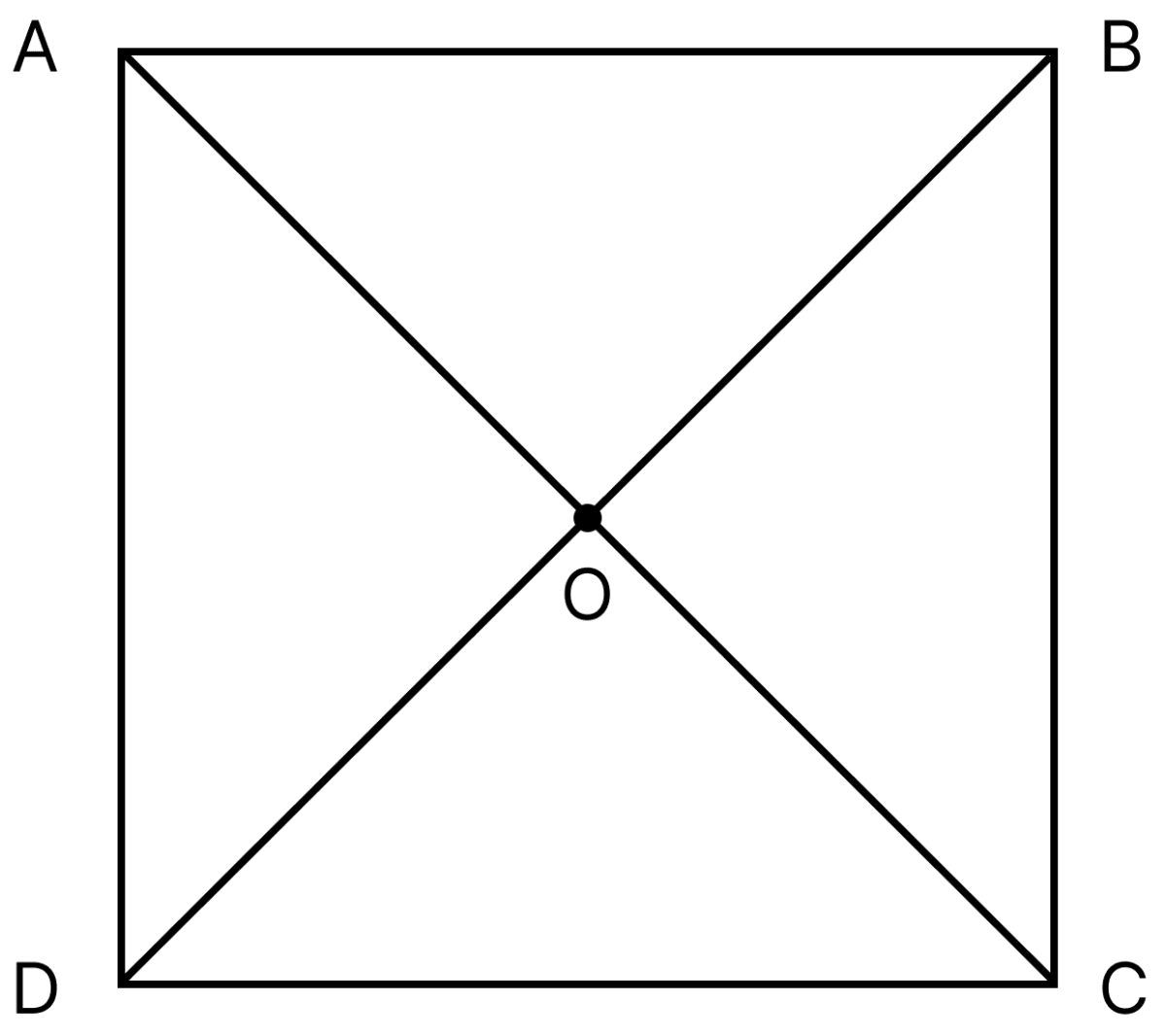
In square ABCD, consider △ADC and △DAB.
Since ABCD is a square, we have
AB = CD [Opposite sides of a square are equal]
∠BAD = ∠CDA = 90° [All the angles of a square are 90°]
AD is common to both triangles.
So, △ADC ≅ △DAB by the SAS congruence condition.
Therefore, AC = BD, since they are corresponding parts of congruent triangles.
This shows that the diagonals of a square are equal in length — exactly as in Deduction 1 for a rectangle.
Deduction 2 — The diagonals of a square bisect each other.
Let the diagonals AC and BD of square ABCD meet at O. Consider △AOB and △COD.
∠AOB = ∠COD [Vertically opposite angles]
Let ∠1 = ∠OBA, ∠2 = ∠ODC, and ∠3 = ∠DBC.
Since ∠ABC = 90°,
∠3 + ∠1 = 90°
In △BCD, since ∠BCD = 90°,
∠3 + ∠2 + 90° = 180° [Angle sum property]
∠3 + ∠2 = 180° - 90°
∠3 + ∠2 = 90°
So, ∠1 = ∠2 (= 90° − ∠3).
Also, AB = CD [Opposite sides of a square are equal]
Thus, by the AAS condition for congruence, △AOB ≅ △COD.
Hence OA = OC and OB = OD, since they are corresponding parts of congruent triangles. So, O is the midpoint of AC and BD.
This shows that the diagonals of a square bisect each other — exactly as in Deduction 2 for a rectangle.
Therefore, both deductions hold for a square: the diagonals of a square are equal and they bisect each other.
What are the measures of ∠1, ∠2, ∠3, and ∠4?
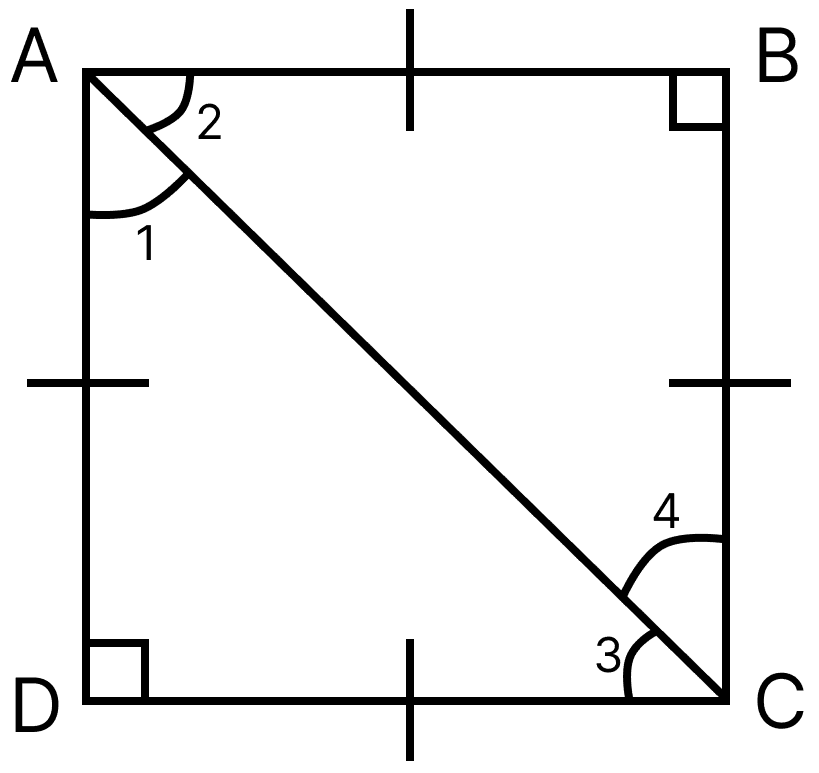
Answer
In the square ABCD, the diagonal AC divides ∠A into ∠1 and ∠2, and ∠C into ∠3 and ∠4.
In △ADC, we have:
∠1 + ∠3 + ∠ADC = 180° [Angle sum property]
∠1 + ∠3 + 90° = 180° [∠ADC = 90°]
∠1 + ∠3 = 90°
Since AD = DC (all the sides of a square are equal), △ADC is isosceles, so:
∠1 = ∠3
∠1 + ∠1 = 90°
2∠1 = 90°
∠1 =
∠1 = 45°
⇒ ∠1 = ∠3 = 45°
Similarly, in △ABC, we have:
∠2 + ∠4 + ∠ABC = 180° [Angle sum property]
∠2 + ∠4 + 90° = 180° [∠ABC = 90°]
∠2 + ∠4 = 90°
Since AB = BC (all the sides of a square are equal), △ABC is isosceles, so:
∠2 = ∠4
∠2 + ∠2 = 90°
2∠2 = 90°
∠2 =
∠2 = 45°
⇒ ∠2 = ∠4 = 45°
So, ∠1 = ∠2 = ∠3 = ∠4 = 45°. Each diagonal of a square divides the right angle at a vertex into two equal halves of 45° each.
Find all the other angles inside the following rectangles.
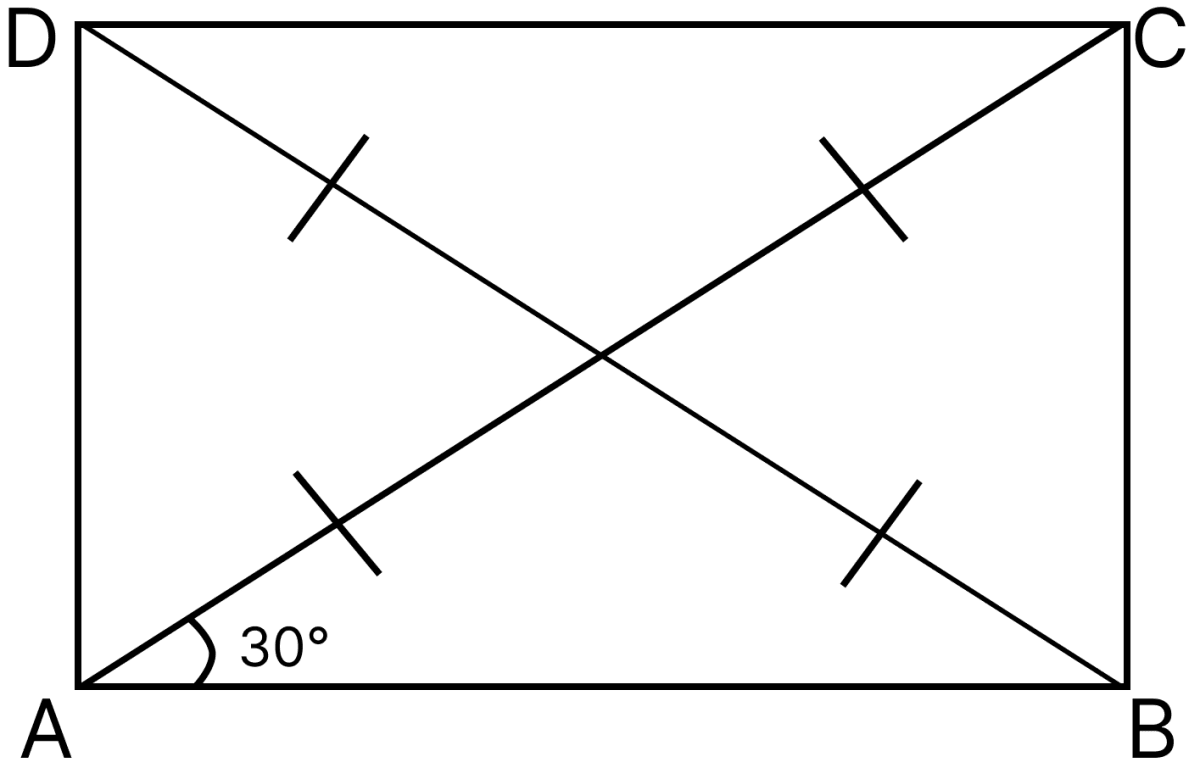
Answer
In a rectangle, the diagonals are equal in length and bisect each other. So, if the diagonals meet at O, then the four half-diagonals are all equal. This makes each of the four triangles formed around O an isosceles triangle, and we can use this to find every angle.
In rectangle ABCD, the diagonals AC and BD meet at O, and ∠CAB = 30°.
Since OA = OB, △OAB is isosceles, so:
∠OBA = ∠OAB = 30°
∠OBA + ∠OAB + ∠AOB = 180° [Angle sum property]
30° + 30° + ∠AOB = 180°
60° + ∠AOB = 180°
∠AOB = 180° - 60°
∠AOB = 120°
∠AOB + ∠BOC = 180° [AOC is a straight line]
120° + ∠BOC = 180°
∠BOC = 180° - 120°
∠BOC = 60°.
In △BOC:
Since OB = OC, △BOC is isosceles, so:
∠OCB = ∠OBC
∠BOC + ∠OBC + ∠OCB = 180°
60° + ∠OBC + ∠OBC = 180°
60° + 2∠OBC = 180°
2∠OBC = 180° - 60°
2∠OBC = 120°
∠OBC =
∠OBC = 60°
⇒ ∠OCB = 60°
By vertically opposite angles, ∠COD = 120° and ∠AOD = 60°.
Using the isosceles triangles around O:
In △COD:
Since OC = OD, △COD is isosceles, so:
∠OCD = ∠ODC
∠COD + ∠OCD + ∠ODC = 180°
120° + ∠OCD + ∠OCD = 180°
120° + 2∠OCD = 180°
2∠OCD = 180° - 120°
2∠OCD = 60°
∠OCD =
∠OCD = 30°
⇒ ∠ODC = 30°
In △AOD,
Since OA = OD, △AOD is isosceles, so:
∠OAD = ∠ODA
∠AOD + ∠OAD + ∠ODA = 180°
60° + ∠OAD + ∠OAD = 180°
60° + 2∠OAD = 180°
2∠OAD = 180° - 60°
2∠OAD = 120°
∠OAD =
∠OAD = 60°
⇒ ∠ODA = 60°
At the centre O: ∠AOB = ∠COD = 120° and ∠BOC = ∠AOD = 60°
At A: ∠CAB = 30° and ∠CAD = 60°
At B: ∠DBA = 30° and ∠DBC = 60°
At C: ∠ACB = 60° and ∠ACD = 30°
At D: ∠BDA = 60° and ∠BDC = 30°
(Each corner correctly adds up to 90°.)
Find all the other angles inside the following rectangles.
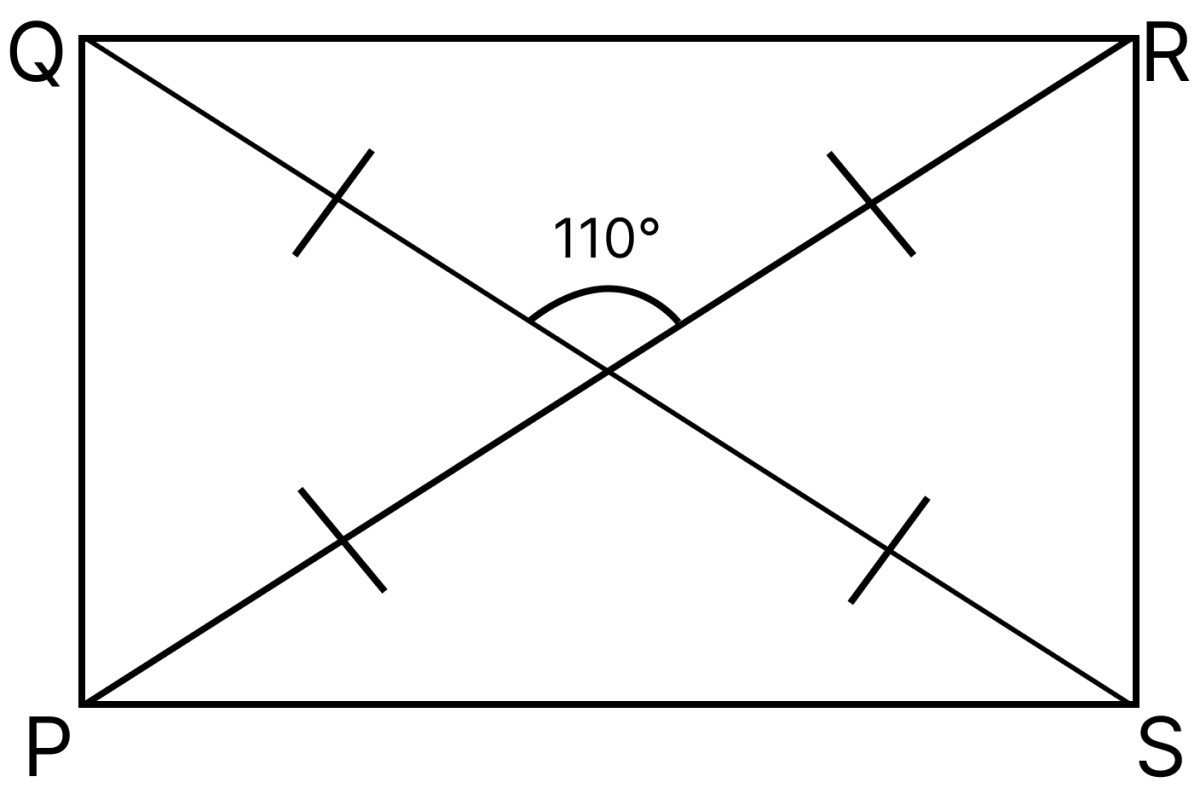
Answer
In a rectangle, the diagonals are equal in length and bisect each other. So, if the diagonals meet at O, then the four half-diagonals are all equal. This makes each of the four triangles formed around O an isosceles triangle, and we can use this to find every angle.
In rectangle PQRS, the diagonals PR and QS meet at O, and the angle between the diagonals ∠QOR = 110°.
As ROP is a straight line,
∠QOR + ∠QOP = 180°
110° + ∠QOP = 180°
∠QOP = 180° - 110°
∠QOP = 70°
By vertically opposite angles, ∠POS = 110° and ∠ROS = 70°.
Since all four half-diagonals are equal, each triangle around O is isosceles:
In △QOR (OQ = OR):
∠OQR = ∠ORQ
∠QOR + ∠OQR + ∠ORQ = 180°
∠QOR + ∠OQR + ∠OQR = 180°
∠QOR + 2∠OQR = 180°
110° + 2∠OQR = 180°
2∠OQR = 180° - 110°
2∠OQR = 70°
∠OQR =
∠OQR = 35°
⇒ ∠ORQ = 35°
In △QOP (OQ = OP):
∠OQP = ∠OPQ
∠QOP + ∠OQP + ∠OPQ = 180°
∠QOP + ∠OQP + ∠OQP = 180°
70° + 2∠OQP = 180°
2∠OQP = 180° - 70°
2∠OQP = 110°
∠OQP =
∠OQP = 55°
⇒ ∠OPQ = 55°
In △ROS (OR = OS):
∠ORS = ∠OSR
∠ROS + ∠ORS + ∠OSR = 180°
∠ROS + ∠ORS + ∠ORS = 180°
70° + 2∠ORS = 180°
2∠ORS = 180° - 70°
2∠ORS = 110°
∠ORS =
∠ORS = 55°
⇒ ∠OSR = 55°
In △POS (OP = OS):
∠OPS = ∠OSP
∠POS + ∠OPS + ∠OSP = 180°
∠POS + ∠OPS + ∠OPS = 180°
∠POS + 2∠OPS = 180°
110° + 2∠OPS = 180°
2∠OPS = 180° - 110°
2∠OPS = 70°
∠OPS =
∠OPS = 35°
⇒ ∠OSP = 35°
So, all the angles are:
At the centre O: ∠QOR = ∠POS = 110° and ∠QOP = ∠ROS = 70°
At Q: ∠SQR = 35° and ∠SQP = 55°
At R: ∠PRQ = 35° and ∠PRS = 55°
At P: ∠RPQ = 55° and ∠RPS = 35°
At S: ∠QSR = 55° and ∠QSP = 35°
(Each corner correctly adds up to 90°.)
Draw a quadrilateral whose diagonals have equal lengths of 8 cm that bisect each other, and intersect at an angle of
(i) 30°
(ii) 40°
(iii) 90°
(iv) 140°
Answer
(i) 30°
Steps of construction:
Draw a line segment AB = 8 cm.
Take midpoint O on AB.
Draw an angle 30° at O on OB.
Through O, draw a line l along the angle.
From O, mark points C and D on line l such that:
OC = OD = 4 cm
- Join AD, DB, BC, and CA.
For an angle of 30° between the diagonals, the quadrilateral formed is a rectangle.
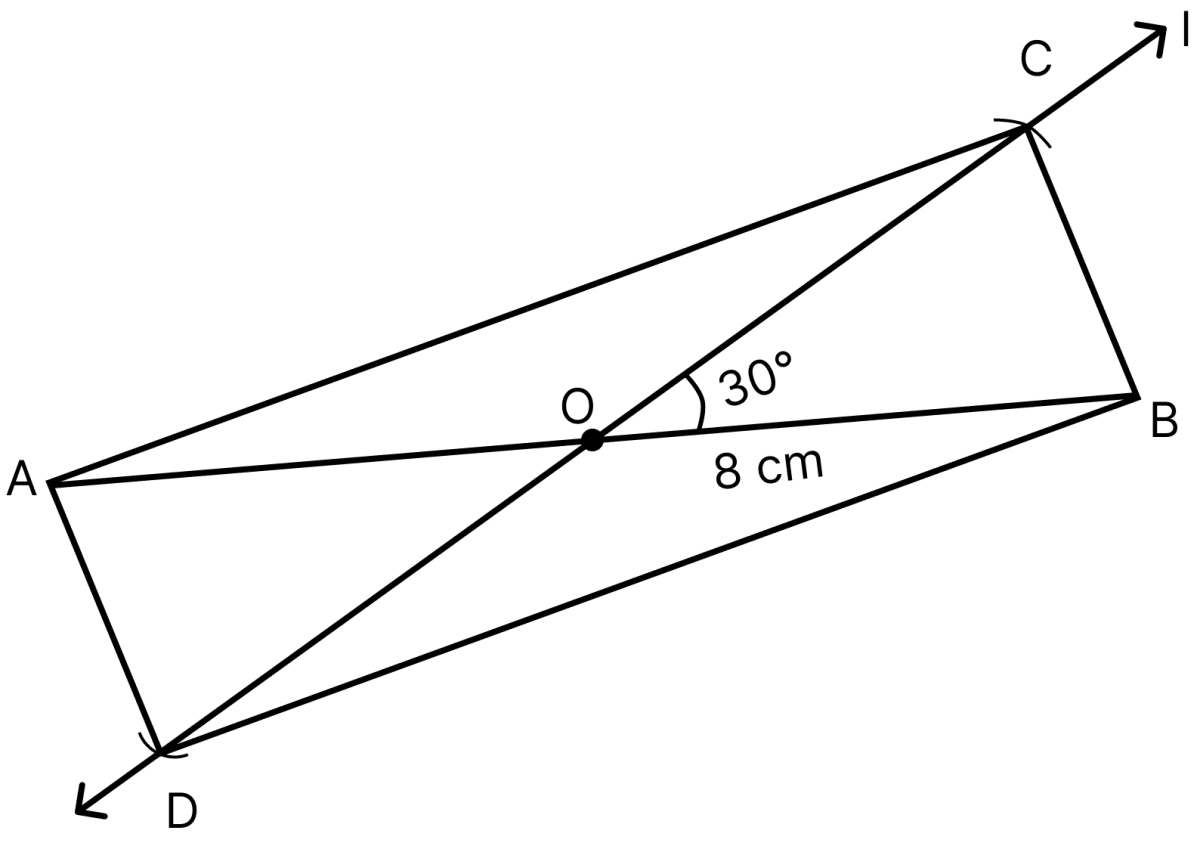
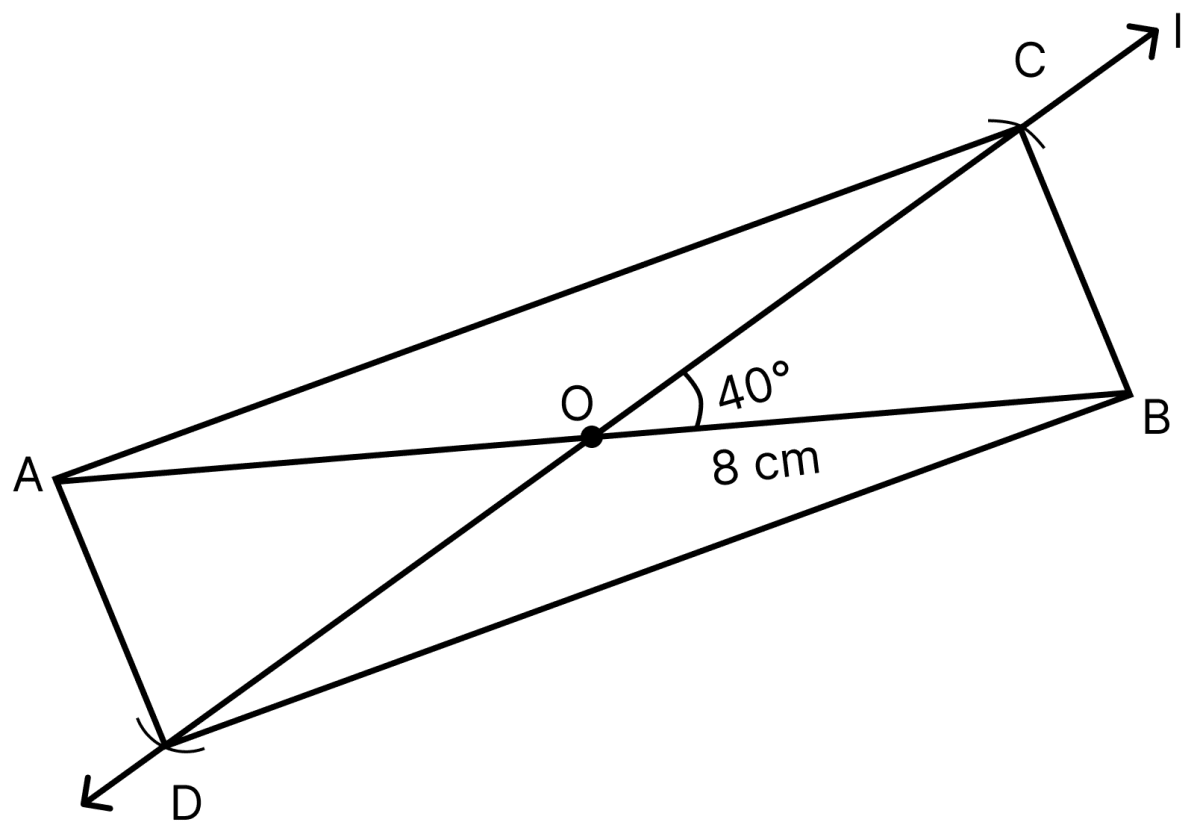
(ii) 40°
Steps of construction:
Draw a line segment AB = 8 cm.
Take midpoint O on AB.
Draw an angle 40° at O on OB.
Through O, draw a line l along the angle.
From O, mark points C and D on line l such that:
OC = OD = 4 cm
- Join AD, DB, BC, and CA.
For an angle of 40° between the diagonals, the quadrilateral formed is a rectangle.
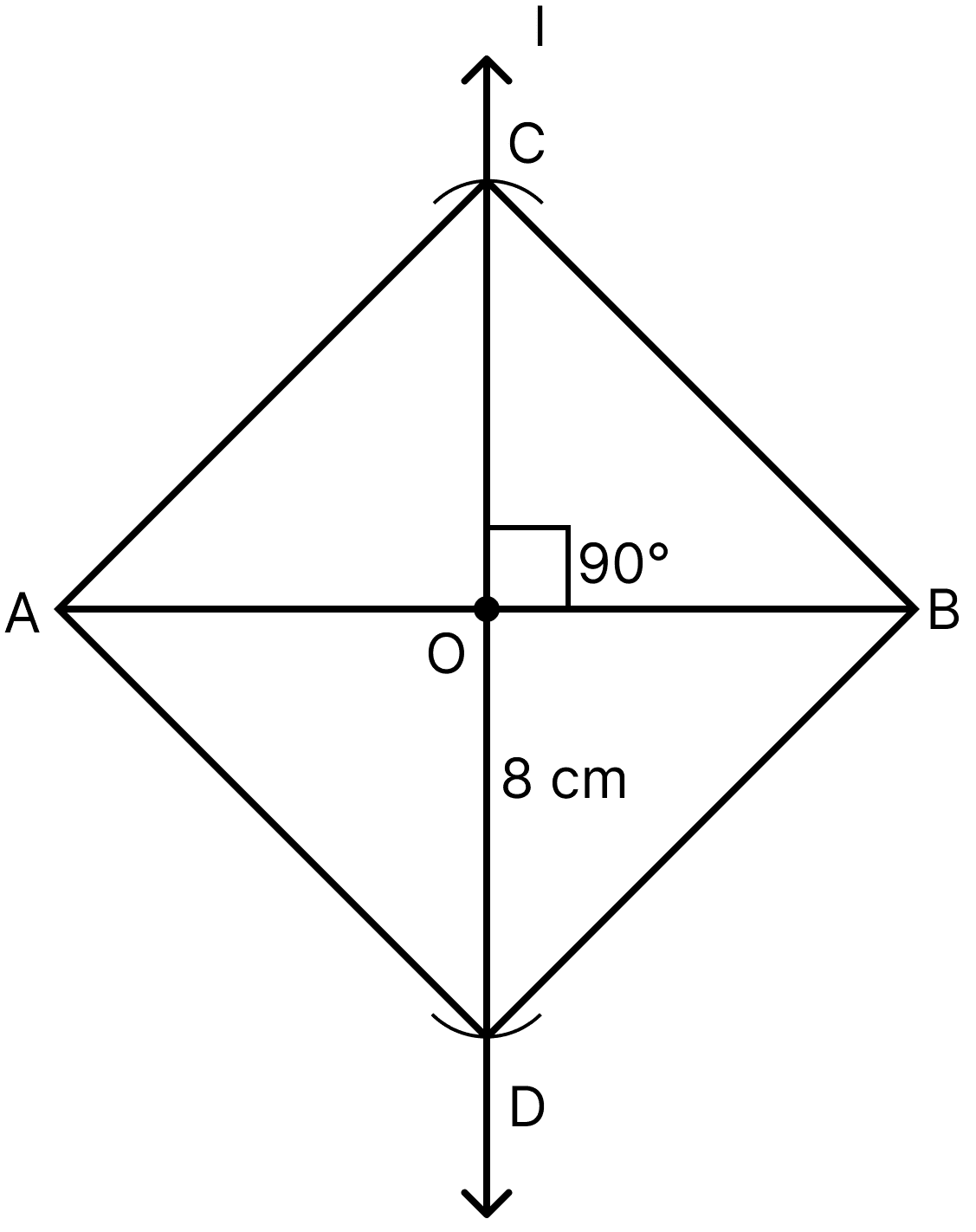
(iii) 90°
Steps of construction:
Draw a line segment AB = 8 cm.
Take midpoint O on AB.
Draw an angle 90° at O on OB.
Through O, draw a line l along the angle.
From O, mark points C and D on line l such that:
OC = OD = 4 cm
- Join AD, DB, BC, and CA.
For an angle of 90° between the diagonals, the quadrilateral formed is a square (a special rectangle whose diagonals meet at right angles).
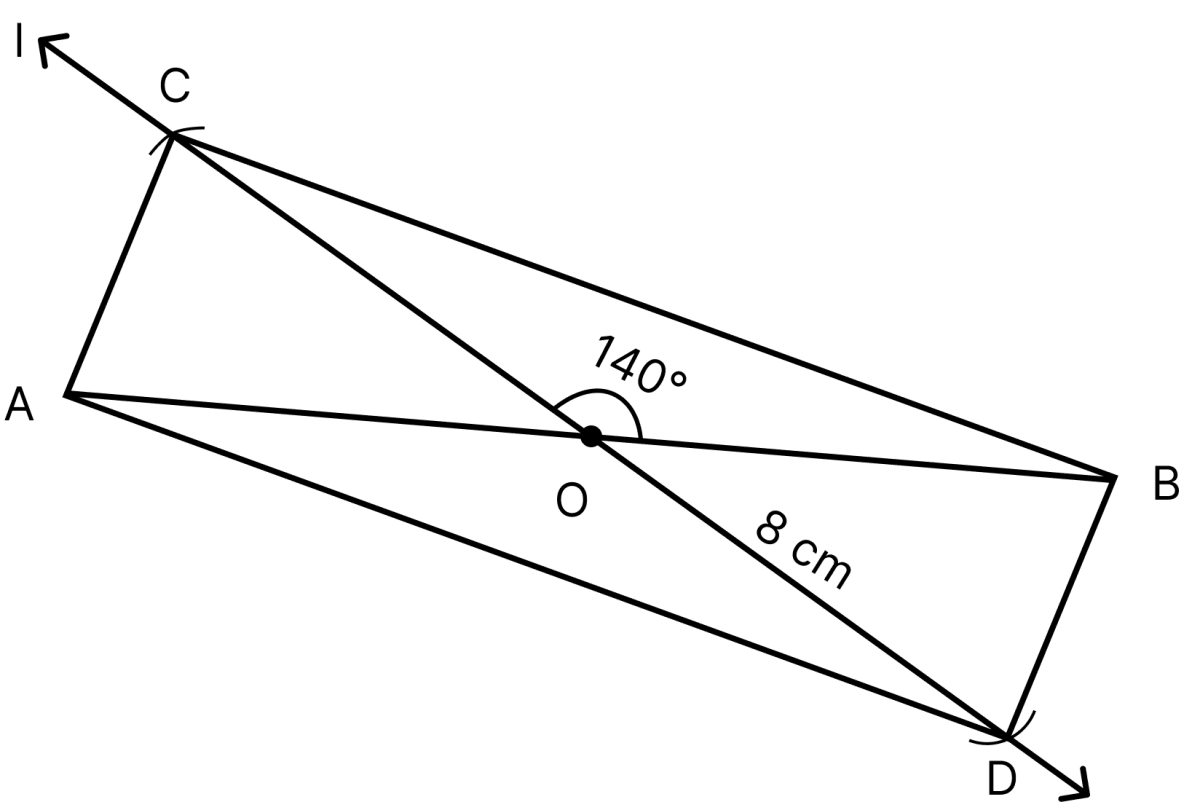
(iv) 140°
Steps of construction:
Draw a line segment AB = 8 cm.
Take midpoint O on AB.
Draw an angle 140° at O on OB.
Through O, draw a line l along the angle.
From O, mark points C and D on line l such that:
OC = OD = 4 cm
- Join AD, DB, BC, and CA.
For an angle of 140° between the diagonals, the quadrilateral formed is a rectangle.
Consider a circle with centre O. Line segments PL and AM are two perpendicular diameters of the circle. What is the figure APML? Reason and/or experiment to figure this out.
Answer
The figure APML is a square.
The points A, P, M, and L all lie on the circle, and the diagonals of the quadrilateral APML are AM and PL, which are the two diameters of the circle.
We are given that:
PL and AM are diameters, so they are equal in length (each equal to the diameter of the circle).
Both diameters pass through the centre O, and the centre is the midpoint of every diameter, so the diagonals bisect each other at O.
The diameters PL and AM are perpendicular, so the diagonals meet at 90°.
A quadrilateral whose diagonals are equal, bisect each other, and meet at right angles is a square.
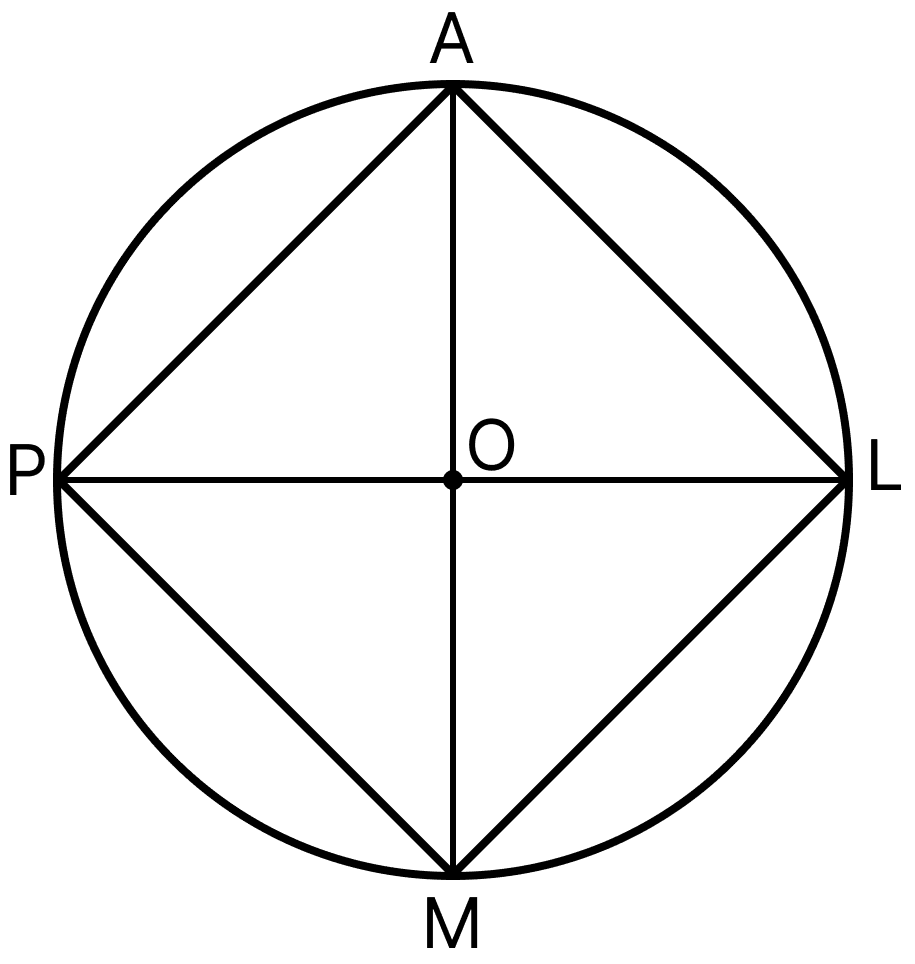
Hence, APML is a square.
We have seen how to get 90° using paper folding. Now, suppose we do not have any paper but two sticks of equal length, and a thread. How do we make an exact 90° using these?
Answer
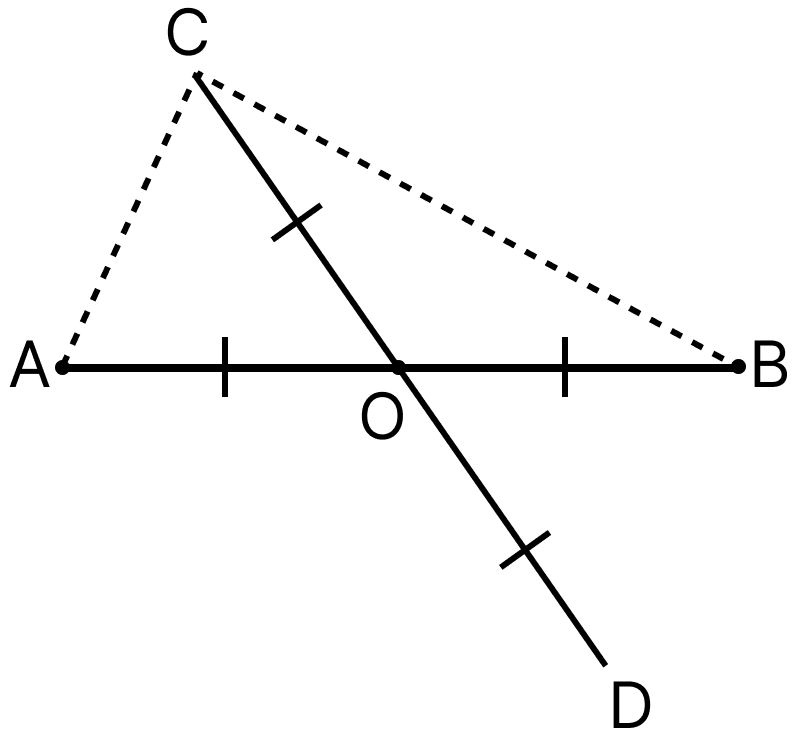
Let AB and CD be the equal sticks. Put them together as shown in the figure such that their midpoints coincide at O.
Now fix one end of the thread at A, pass it through C, and extend it to B, as shown in the figure.
ACBD is a rectangle since their diagonals are equal and bisect each other.
Hence ∠C = 90°.
We saw that one of the properties of a rectangle is that its opposite sides are parallel. Can this be chosen as a definition of a rectangle? In other words, is every quadrilateral that has opposite sides parallel and equal, a rectangle?
Answer
No, this cannot be chosen as a definition of a rectangle.
Having opposite sides parallel and equal is not enough to make a quadrilateral a rectangle. A parallelogram also has its opposite sides parallel and equal, but its angles need not be 90°.
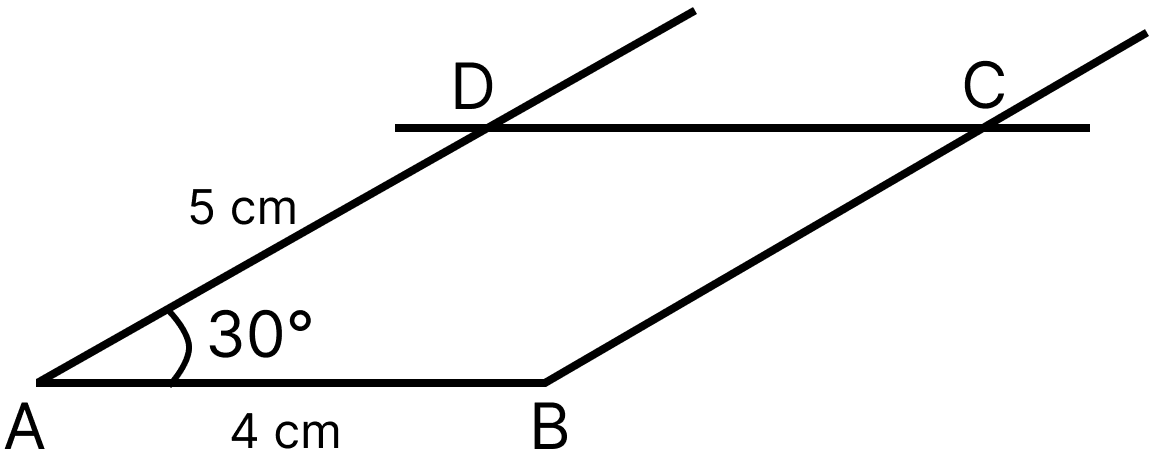
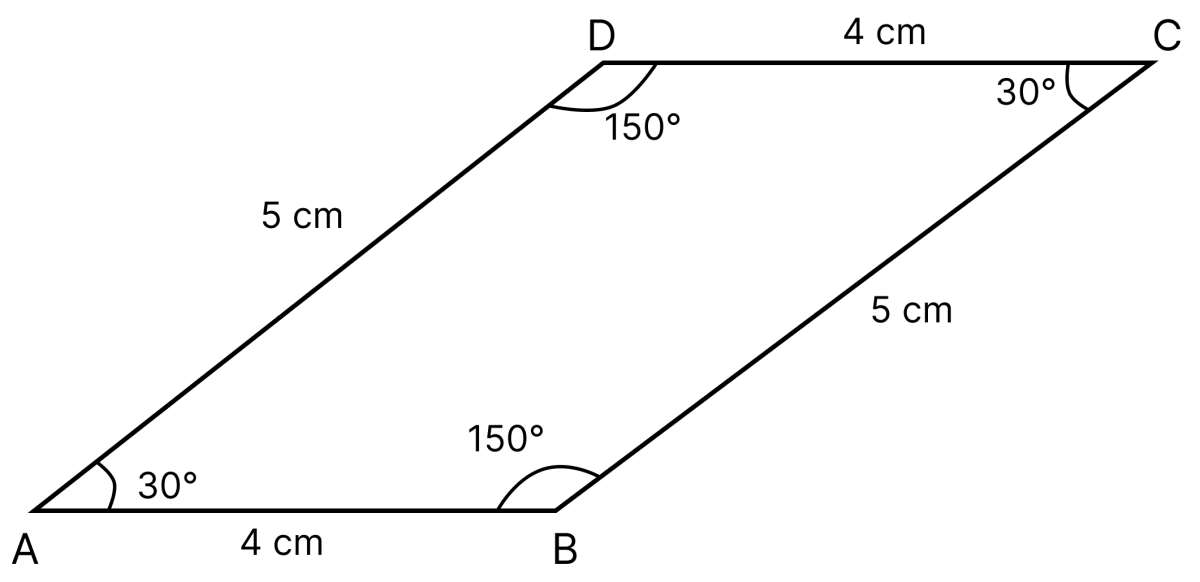
For example, a parallelogram with adjacent sides of 4 cm and 5 cm and an angle of 30° between them has parallel and equal opposite sides, yet it is not a rectangle.
So, a quadrilateral with opposite sides parallel and equal is a rectangle only when all its angles are also 90°. Therefore, "opposite sides parallel and equal" alone cannot define a rectangle.
Are there quadrilaterals that have parallel opposite sides that are not rectangles?
Answer
Yes.
A non-rectangular parallelogram has both pairs of opposite sides parallel, but its angles are not all 90°. For example, a parallelogram with angles 30° and 150° has parallel opposite sides but is not a rectangle.
Similarly, a non-square rhombus has both pairs of opposite sides parallel but need not be a rectangle.
Hence, quadrilaterals with parallel opposite sides need not be rectangles.
(i) What are the remaining angles of the parallelogram?
(ii) What are the lengths of the remaining sides?
(iii) See if you can reason out and/or experiment to figure these out.
Answer
In parallelogram ABCD, the adjacent sides are AB = 4 cm and AD = 5 cm, and the angle between them is ∠A = 30°.
(i) The remaining angles:
Since AB || DC and AD is a transversal:
∠A + ∠D = 180° [Co-interior angles]
30° + ∠D = 180°
∠D = 180° − 30°
∠D = 150°
Since AD || BC and AB is a transversal:
∠A + ∠B = 180° [Co-interior angles]
30° + ∠B = 180°
∠B = 180° − 30°
∠B = 150°
The opposite angles of a parallelogram are equal, so:
∠C = ∠A = 30°
So, the remaining angles are ∠B = 150°, ∠C = 30°, and ∠D = 150°.
(ii) The remaining sides:
The opposite sides of a parallelogram are equal in length, so:
CD = AB = 4 cm
BC = AD = 5 cm
So, the remaining sides are CD = 4 cm and BC = 5 cm.
(iii) The angles were found using the property that the co-interior angles on a transversal of two parallel lines add up to 180°, together with the fact that the opposite angles of a parallelogram are equal.
The sides were found using the property that the opposite sides of a parallelogram are equal.
Is it wrong to write △ABD ≅ △CBD? Why?
Answer
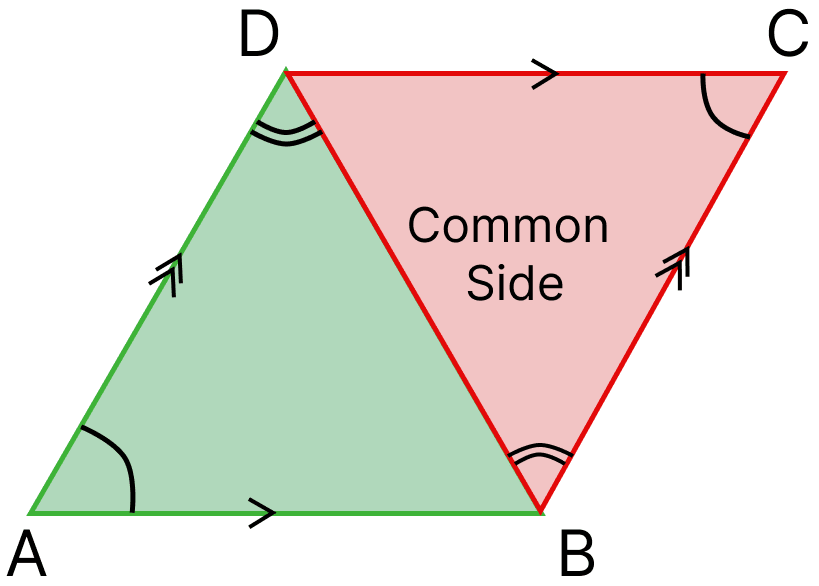
Yes, it is wrong to write △ABD ≅ △CBD.
In a congruence statement, the vertices must be written in the order in which they correspond (that is, in the order of the equal parts).
Here the correct congruence is △ABD ≅ △CDB, in which the vertices correspond as:
A ↔ C
B ↔ D
D ↔ B.
This gives the matching equal parts:
AB = CD
AD = CB
BD = DB [and the corresponding angles are equal]
If we write △ABD ≅ △CBD, the correspondence becomes
A ↔ C
B ↔ B
D ↔ D.
This would mean:
AB = CB and AD = CD
But in this parallelogram,
AB = 4 cm
CB = 5 cm
AD = 5 cm
CD = 4 cm
So these sides are not equal, and this correspondence does not match the actual equal parts.
Hence, it is wrong to write △ABD ≅ △CBD. The correct way to write it is △ABD ≅ △CDB.
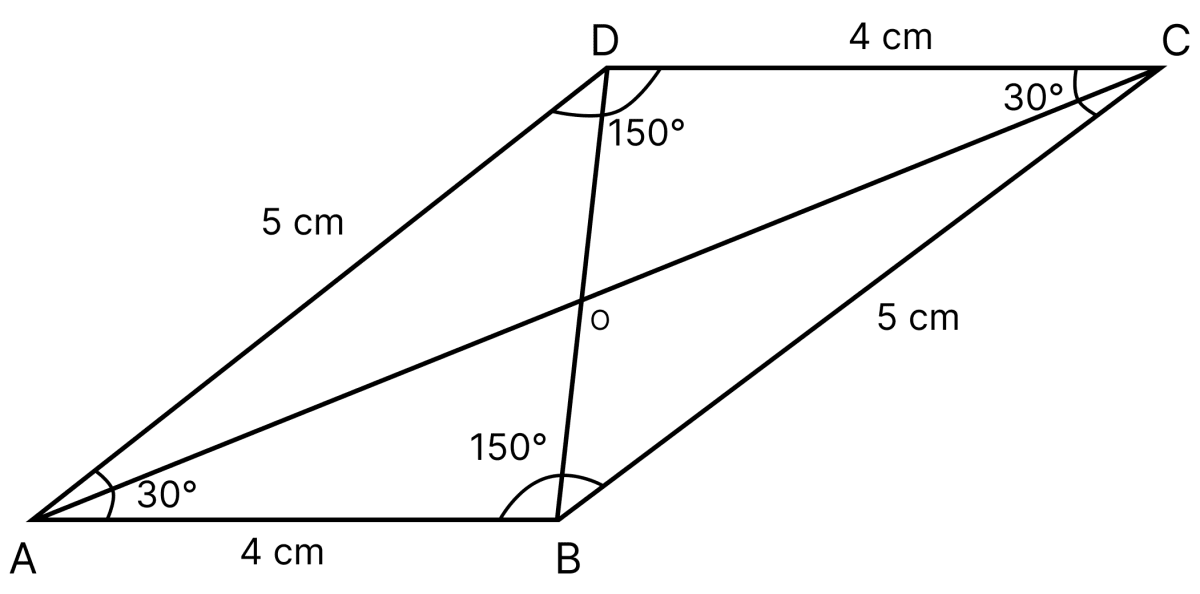
(i) Are the diagonals of a parallelogram always equal? Check with the parallelogram that you have constructed.
(ii) Do the diagonals bisect each other (that is, do they intersect at their midpoints)? Reason and/or experiment to figure this out.
Answer
(i) No, the diagonals of a parallelogram are not always equal.
The diagonals of a parallelogram already bisect each other. If, in addition, the two diagonals were also equal, then (as we saw in the Carpenter's Problem) the quadrilateral would have to be a rectangle, with all its angles equal to 90°.
In the parallelogram we constructed, the angles are 30° and 150°, which are not 90°. So it is not a rectangle, and therefore its two diagonals are not equal. On measuring the diagonals AC and BD of the constructed parallelogram, we find that they are of different lengths.
So, the diagonals of a parallelogram need not be equal; they are equal only when the parallelogram is a rectangle.
(ii) Yes, the diagonals of a parallelogram bisect each other.
Let the diagonals AC and BD of parallelogram ABCD meet at O. Consider △OAB and △OCD.
AB = CD [Opposite sides of a parallelogram are equal]
Since AB || CD and AC is a transversal:
∠OAB = ∠OCD [Alternate angles]
Since AB || CD and BD is a transversal:
∠OBA = ∠ODC [Alternate angles]
So, by the ASA condition for congruence, △OAB ≅ △OCD.
Therefore, OA = OC and OB = OD, since they are corresponding parts of congruent triangles.
So, O is the midpoint of both diagonals AC and BD.
Hence, the diagonals of a parallelogram bisect each other.
Is it wrong to write △AOE ≅ △SOY? Why?
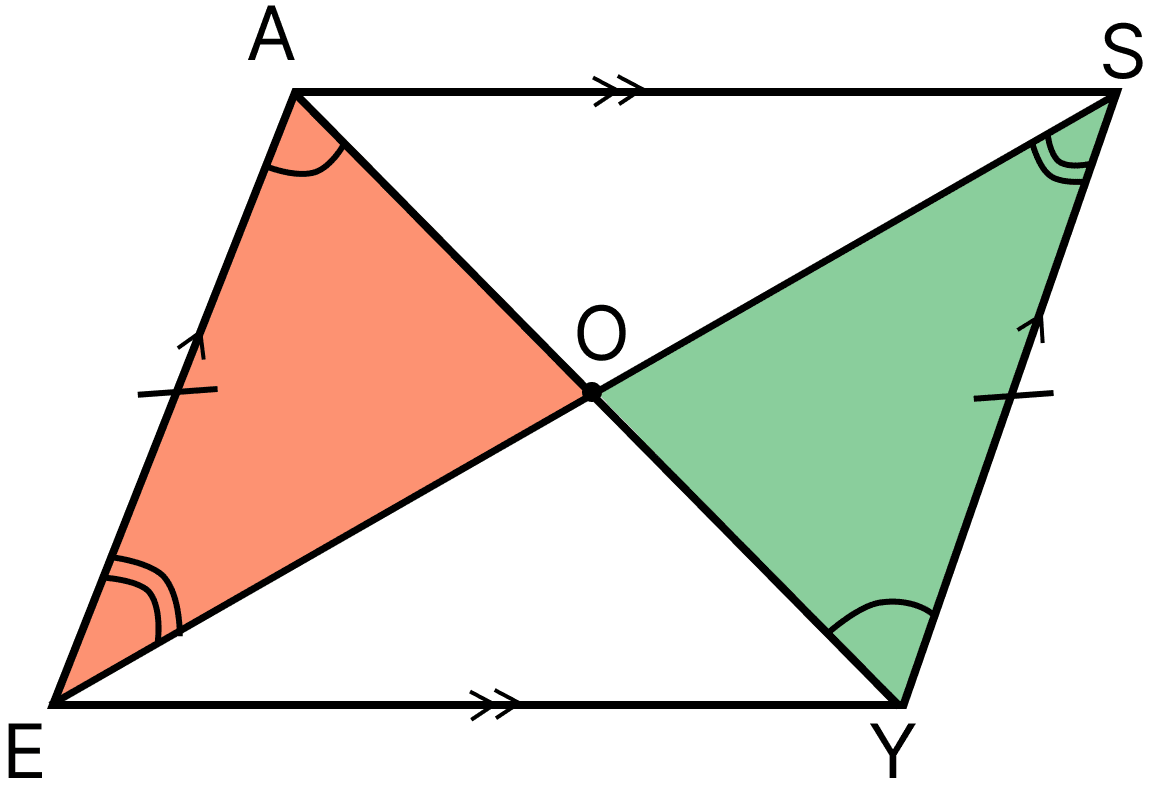
Answer
Yes, it is wrong to write △AOE ≅ △SOY.
In parallelogram EASY, the diagonals AY and ES meet at O.
The correct congruence is △AOE ≅ △YOS, in which the vertices correspond as:
A ↔ Y
O ↔ O
E ↔ S.
This gives the matching equal parts:
OA = OY
OE = OS
AE = YS [and the corresponding angles are equal]
If we write △AOE ≅ △SOY, the correspondence becomes:
A ↔ S
O ↔ O
E ↔ Y
This would mean:
OA = OS and OE = OY
But OA and OS are halves of two different diagonals (OA is half of AY, while OS is half of ES).
Since the diagonals of a parallelogram are not equal,
⇒ OA ≠ OS (and OE ≠ OY).
So this correspondence does not match the actual equal parts.
Hence, it is wrong to write △AOE ≅ △SOY. The correct way to write it is △AOE ≅ △YOS.
Do the diagonals of a parallelogram intersect at a particular angle?
Answer
No, the diagonals of a parallelogram do not intersect at any particular (fixed) angle.
The diagonals of a parallelogram always bisect each other, but the angle at which they cross is not fixed — it depends on the shape of the parallelogram and need not be 90°.
For example, in the parallelogram we constructed (with angles 30° and 150°), the diagonals meet at an angle other than a right angle.
The diagonals meet at right angles only in special parallelograms, such as a rhombus or a square.
So, in general, there is no particular angle at which the diagonals of a parallelogram intersect.
Are squares the only quadrilaterals that have equal sidelengths?
Answer
No, squares are not the only quadrilaterals that have equal side lengths.
A quadrilateral in which all four sides are of the same length is called a rhombus. In a rhombus, all the sides are equal, but the angles need not be 90°.
For example, we can construct a quadrilateral with all four sides equal in which one of the angles is 50° (in fact, any angle less than 180° can be taken). Such a figure has equal side lengths, but it is not a square, because a square must also have all its angles equal to 90°.
A square is simply a special rhombus in which all the angles are also 90°. So, every square is a rhombus, but every rhombus need not be a square.
Hence, squares are not the only quadrilaterals with equal side lengths; rhombuses also have all their sides equal.
What are the other angles of the rhombus ABCD that we have constructed?
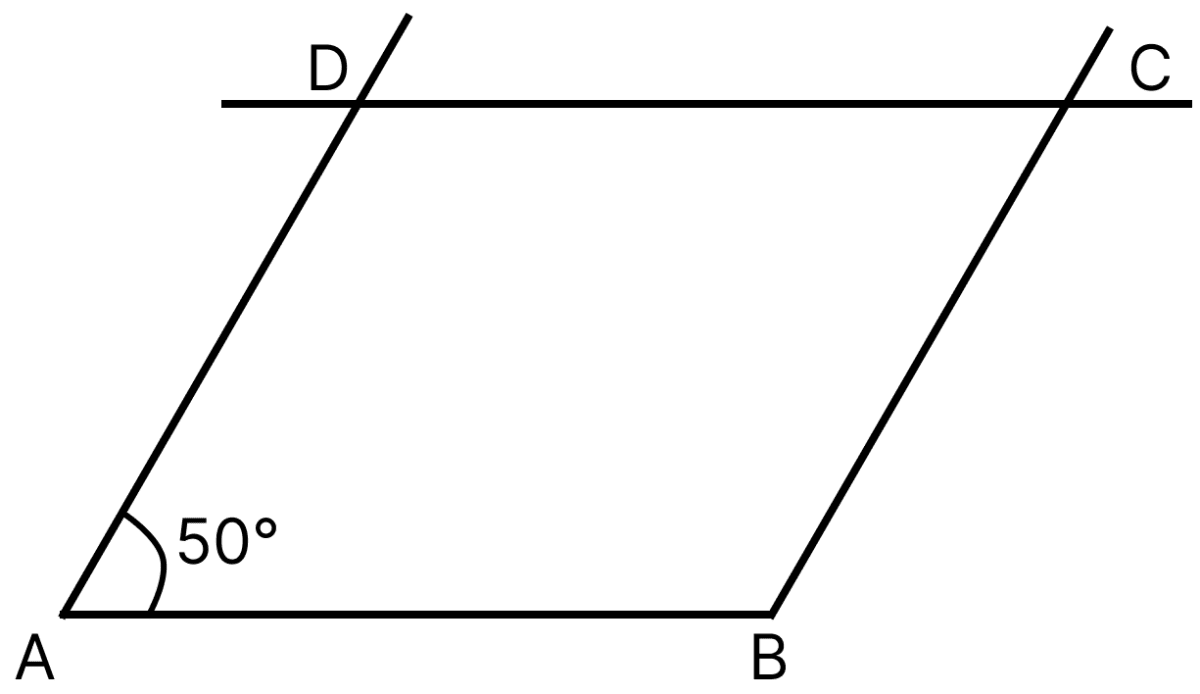
Reason and/or experiment to figure this out.
Answer
In rhombus ABCD, all four sides are equal, that is, AB = BC = CD = DA. The rhombus was constructed with ∠DAB = ∠A = 50°.
Draw the diagonal DB. A diagonal divides the rhombus into two isosceles triangles, and (as proved in Deduction 9) the four angles that a diagonal makes with the sides of a rhombus are all equal. Let each of these equal angles be a.
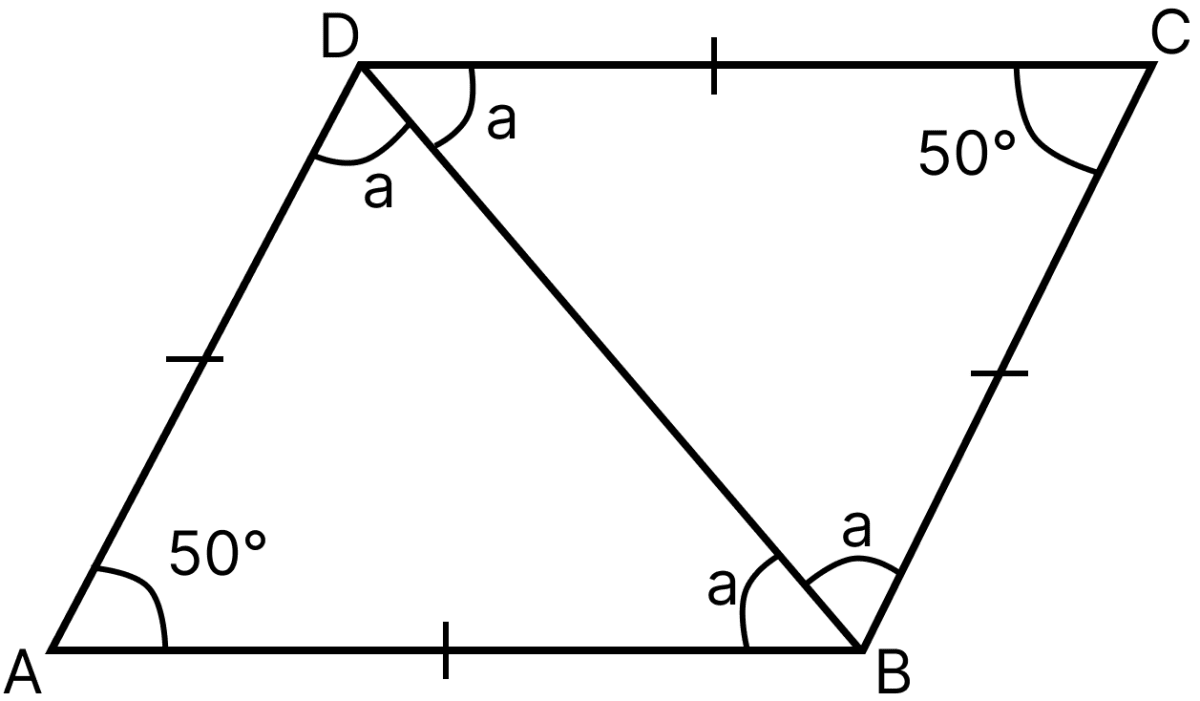
In △ADB:
Since AD = AB, △ADB is isosceles, so:
∠ADB = ∠ABD = a
∠ADB + ∠ABD + ∠DAB = 180° [Angle sum property]
a + a + 50° = 180°
2a + 50° = 180°
2a = 180° - 50°
2a = 130°
a =
a = 65°
So, each of the four equal angles formed by the diagonal is 65°, that is:
∠ADB = ∠ABD = ∠CDB = ∠CBD = 65°
Therefore, the full angles at B and D are:
∠B = ∠ABD + ∠CBD
∠B = 65° + 65°
∠B = 130°
∠D = ∠ADB + ∠CDB
∠D = 65° + 65°
∠D = 130°
In △CDB:
Since CD = CB, △CDB is isosceles, so:
∠BCD + ∠CDB + ∠CBD = 180° [Angle sum property]
∠BCD + 65° + 65° = 180°
∠BCD + 130°= 180°
∠BCD = 180° - 130°
∠BCD = 50°
So, ∠C = 50°.
Thus, the angles of rhombus ABCD are:
∠A = 50°, ∠B = 130°, ∠C = 50°, and ∠D = 130°.
Hence, the other angles of the rhombus ABCD are ∠B = 130°, ∠C = 50°, and ∠D = 130°. So, in a rhombus the opposite angles are equal to each other.
It can be seen that △GAE ≅ △MAE. How?
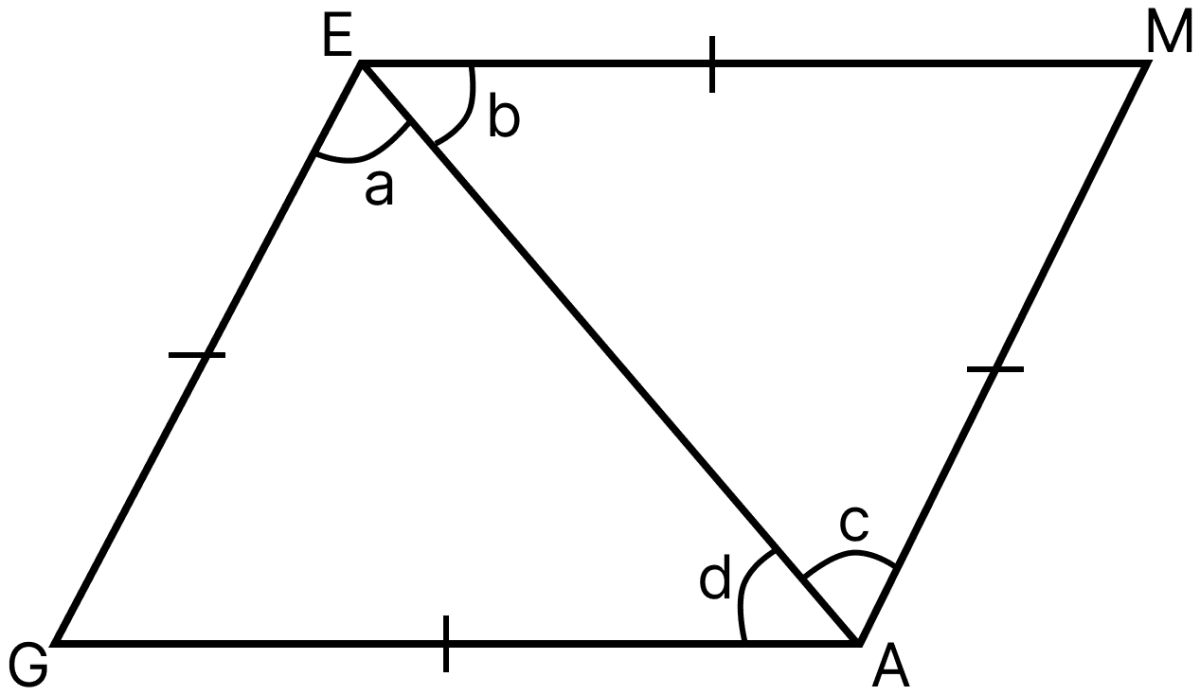
Answer
Consider the rhombus GAME. Since all the sides of a rhombus are equal, we have:
GA = AM = ME = EG
In △GAE and △MAE:
GA = MA [Sides of the rhombus]
GE = ME [Sides of the rhombus]
AE = AE [Common side]
So, by the SSS congruence condition, △GAE ≅ △MAE.
Hence, △GAE ≅ △MAE by the SSS congruence condition.
Are the diagonals of a rhombus equal?
Answer
No, the diagonals of a rhombus are not equal in general.
In a rhombus, the diagonals bisect each other at right angles, but they need not be of the same length. If we construct a rhombus whose angles are not 90° and then measure its two diagonals, we find that they have different lengths.
The diagonals of a rhombus are equal only in the special case when the rhombus is a square, that is, when all its angles are 90°.
Hence, the diagonals of a rhombus are not equal, except when the rhombus is a square.
Do the diagonals of a rhombus intersect at any particular angle?
Reason out and/or experiment to figure this out!
Answer
Yes. The diagonals of a rhombus always intersect each other at right angles (90°).
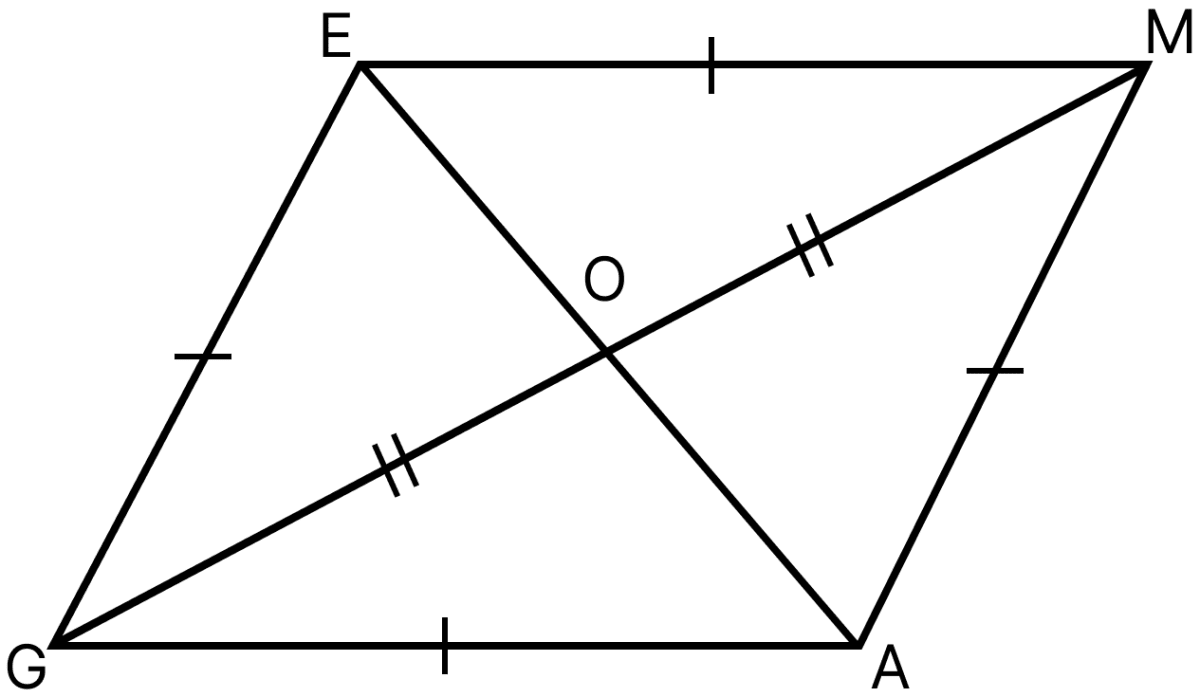
This can be reasoned out using congruence. Consider the rhombus GAME, whose diagonals GM and EA meet at O.
In △GEO and △MEO:
GE = ME [Sides of the rhombus]
GO = MO [The diagonals of a rhombus bisect each other, so O is the midpoint of GM]
EO = EO [Common side]
So, by the SSS congruence condition, △GEO ≅ △MEO.
Therefore, ∠GOE = ∠MOE, since they are corresponding parts of congruent triangles.
Since GOM is a straight line:
∠GOE + ∠MOE = 180°
∠GOE + ∠GOE = 180°
2∠GOE = 180°
∠GOE =
∠GOE = 90°
So, ∠GOE = ∠MOE = 90°.
Hence, the diagonals of a rhombus intersect each other at an angle of 90°.
In the rhombus GAME, we have △GEO ≅ △MEO . Why?
Answer
In the rhombus GAME, the diagonals GM and EA meet at O.
In △GEO and △MEO:
GE = ME [Sides of the rhombus, since all the sides of a rhombus are equal]
GO = MO [The diagonals of a rhombus bisect each other, so O is the midpoint of GM]
EO = EO [Common side]
So, by the SSS congruence condition, △GEO ≅ △MEO.
Hence, △GEO ≅ △MEO by the SSS congruence condition.
Find the remaining angles in the following quadrilaterals.
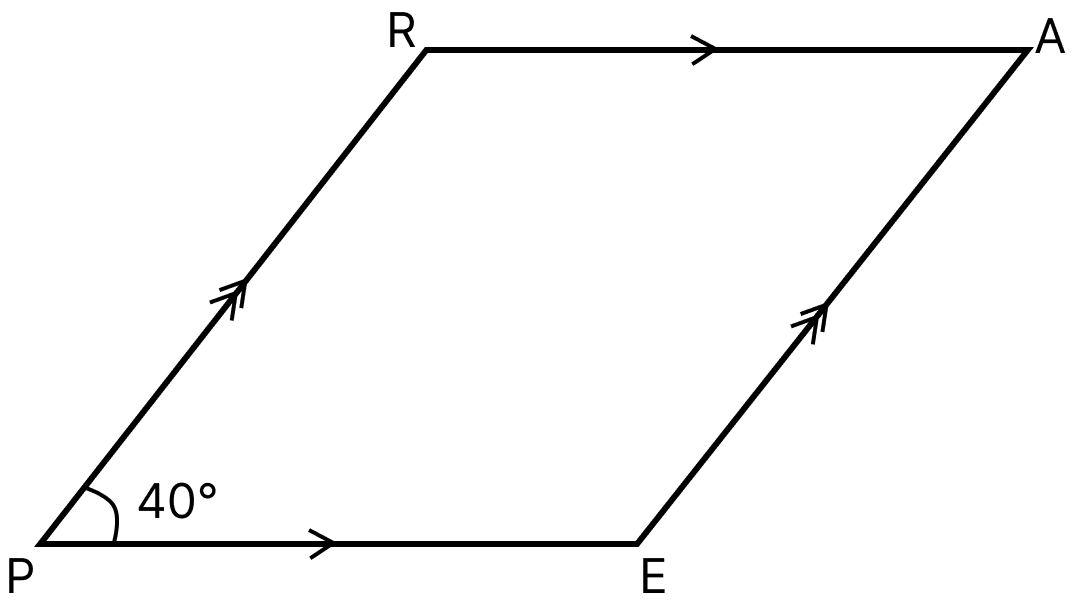
Answer
PRAE is a parallelogram, since RA || PE and PR || EA.
∠P = 40° [Given]
In a parallelogram, the opposite angles are equal.
∴ ∠A = ∠P = 40°
In a parallelogram, the adjacent angles add up to 180°.
∠R + ∠P = 180°
∠R + 40° = 180°
⇒ ∠R = 180° − 40°
⇒ ∠R = 140°
∴ ∠R = ∠E = 140° and ∠A = ∠P = 40°.
Find the remaining angles in the following quadrilaterals.
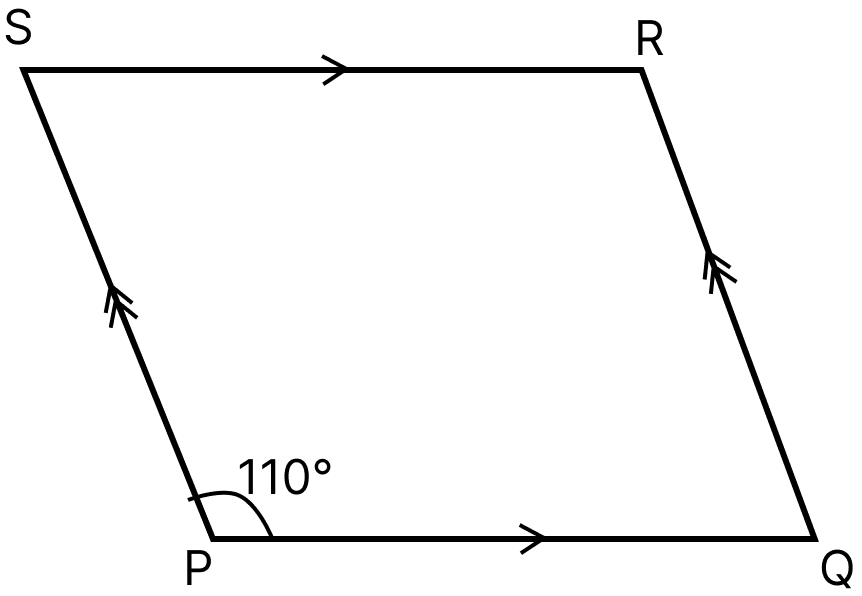
Answer
SRQP is a parallelogram, since SR || PQ and SP || RQ.
∠P = 110° [Given]
Opposite angles of a parallelogram are equal.
∴ ∠R = ∠P = 110°
Adjacent angles of a parallelogram add up to 180°.
∠S + ∠P = 180°
∠S + 110° = 180°
⇒ ∠S = 180° − 110°
⇒ ∠S = 70°
∴ ∠S = ∠Q = 70° and ∠R = 110°.
Find the remaining angles in the following quadrilaterals.
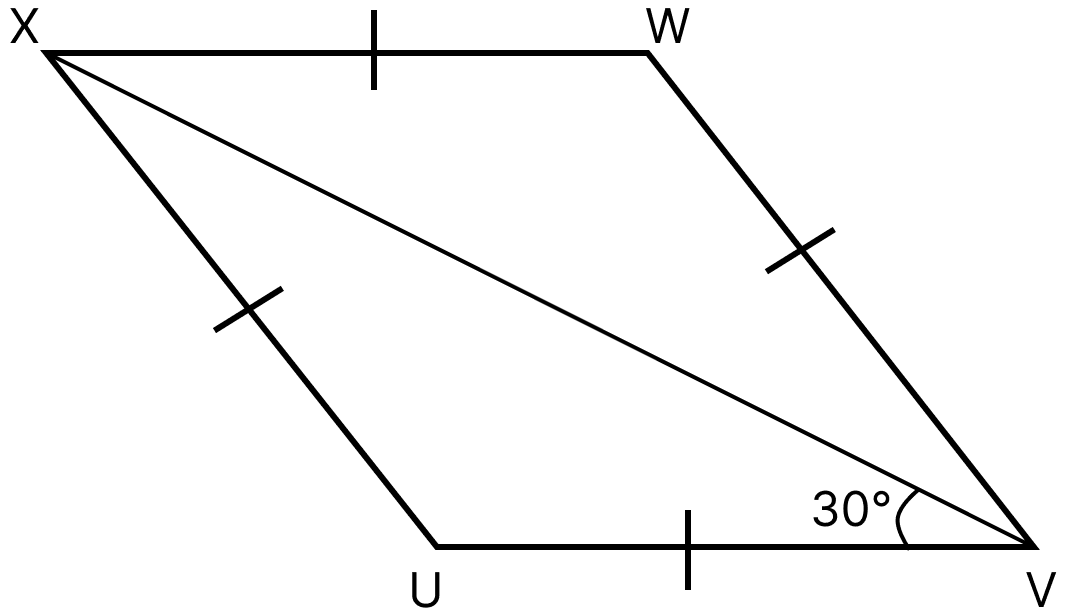
Answer
XWVU is a rhombus, since all its sides are equal. XV is a diagonal.
∠XVU = 30° [Given]
The diagonals of a rhombus bisect its angles.
∴ ∠XVW = ∠XVU = 30°
⇒ ∠UVW = ∠XVU + ∠XVW
⇒ ∠UVW = 30° + 30°
⇒ ∠UVW = 60°
Opposite angles of a rhombus are equal.
∴ ∠UXW = ∠UVW = 60°
Since the diagonal XV also bisects ∠X, ∠UXV = ∠WXV = 30°.
Adjacent angles of a rhombus add up to 180°.
∠U + ∠UVW = 180°
∠U = 180° − ∠UVW
∠U = 180° − 60°
∠U = 120°
⇒ ∠W = 120°
∴ ∠U = ∠W = 120°, ∠UXV = ∠WXV = 30°, ∠XVW = ∠XVU = 30°.
Find the remaining angles in the following quadrilaterals.
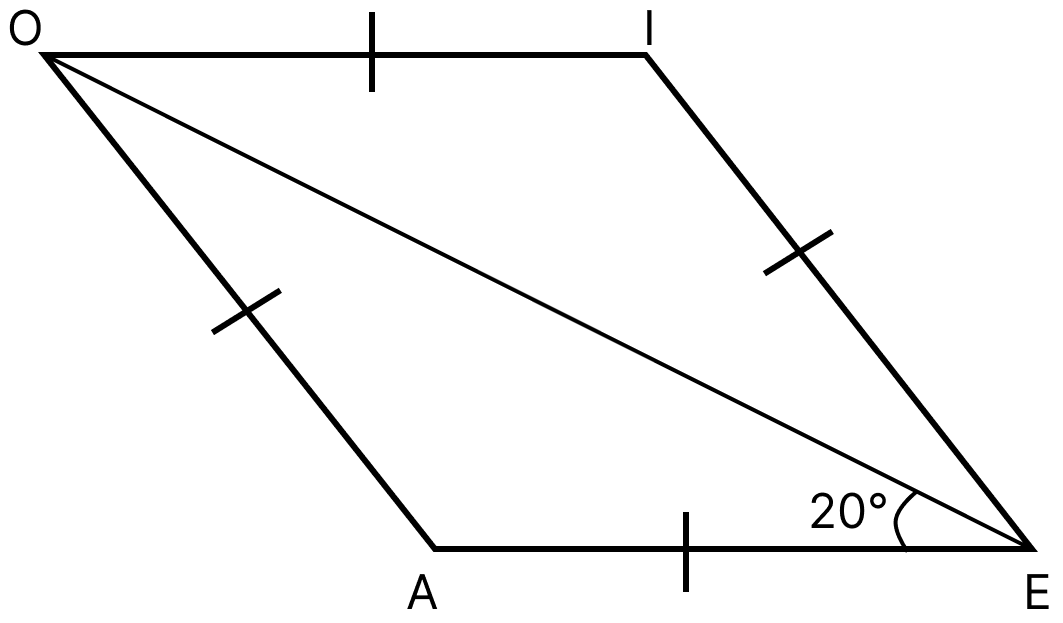
Answer
OIEA is a rhombus, since all its sides are equal. OE is a diagonal.
∠OEI = 20° [Given]
The diagonals of a rhombus bisect its angles, so OE bisects ∠E and ∠O.
∴ ∠OEA = ∠OEI = 20°
⇒ ∠AEI = ∠OEA + ∠OEI
⇒ ∠AEI = 20° + 20°
⇒ ∠AEI = 40°
Opposite angles of a rhombus are equal.
∴ ∠O = ∠E = 40°
since OE bisects ∠O, ∠AOE = ∠EOI = 20°.
Adjacent angles of a rhombus add up to 180°.
∠A + ∠AEI = 180°
∠A + 40° = 180°
∠A = 180° − 40°
∠A = 140°
⇒ ∠I = 140°
∴ ∠A = ∠I = 140°, ∠AOE = ∠EOI = 20°, ∠OEA = ∠OEI = 20°.
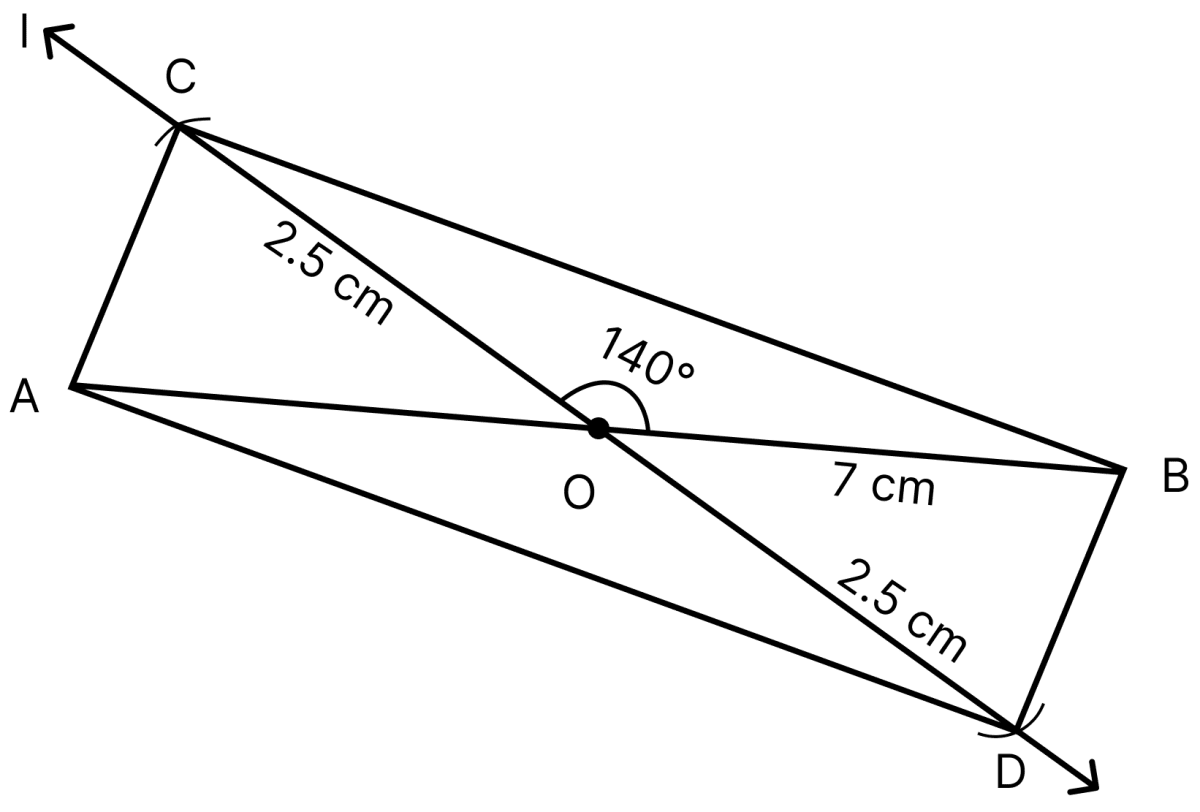
Using the diagonal properties, construct a parallelogram whose diagonals are of lengths 7 cm and 5 cm, and intersect at an angle of 140°.
Answer
The diagonals of a parallelogram bisect each other. So each diagonal is divided into two equal halves at the point of intersection.
Half of the second diagonal = cm = 2.5 cm
Steps of construction:
Draw a line segment AB = 7 cm. This is the first diagonal.
Mark the midpoint O of AB.
At O, draw a line l making an angle of 140° with OB.
With O as centre and radius 2.5 cm, draw two arcs cutting line l at C and D on either side of AB, so that OC = OD = 2.5 cm.
Join AC, AD, BC and BD.
Then, ACBD is the required parallelogram. Its diagonals AB = 7 cm and CD = 5 cm bisect each other at O at an angle of 140°.
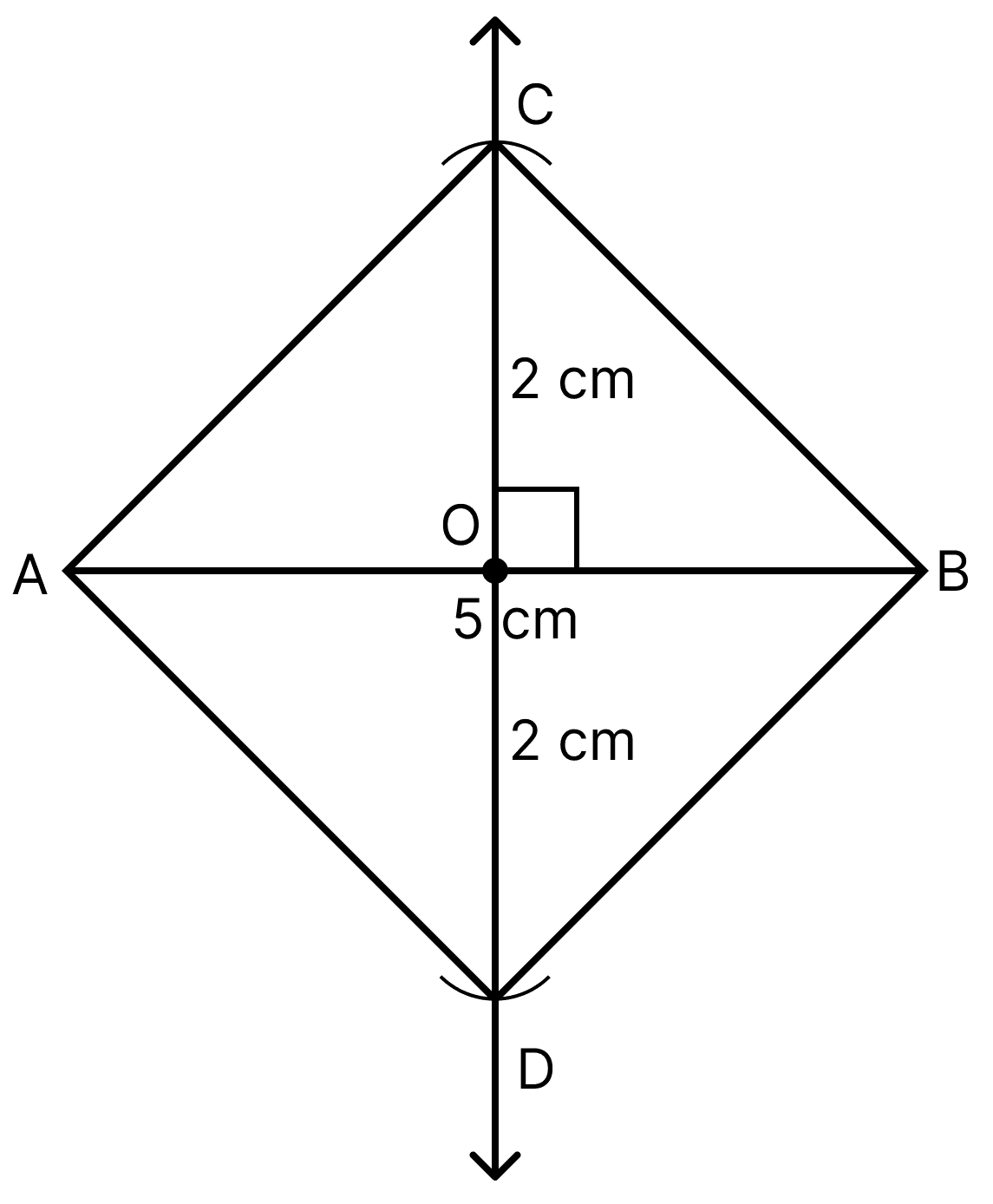
Using the diagonal properties, construct a rhombus whose diagonals are of lengths 4 cm and 5 cm.
Answer
The diagonals of a rhombus bisect each other at right angles (90°). So each diagonal is divided into two equal halves at the point of intersection, and the two diagonals are perpendicular.
Half of the second diagonal = cm = 2 cm
Steps of construction:
Draw a line segment AB = 5 cm. This is the first diagonal.
Mark the midpoint O of AB.
At O, draw a line perpendicular to AB (an angle of 90° at O).
With O as centre and radius 2 cm, draw two arcs cutting the perpendicular at C and D on either side of AB, so that OC = OD = 2 cm.
Join AC, AD, BC and BD.
Then, ACBD is the required rhombus. Its diagonals AB = 5 cm and CD = 4 cm bisect each other at right angles.
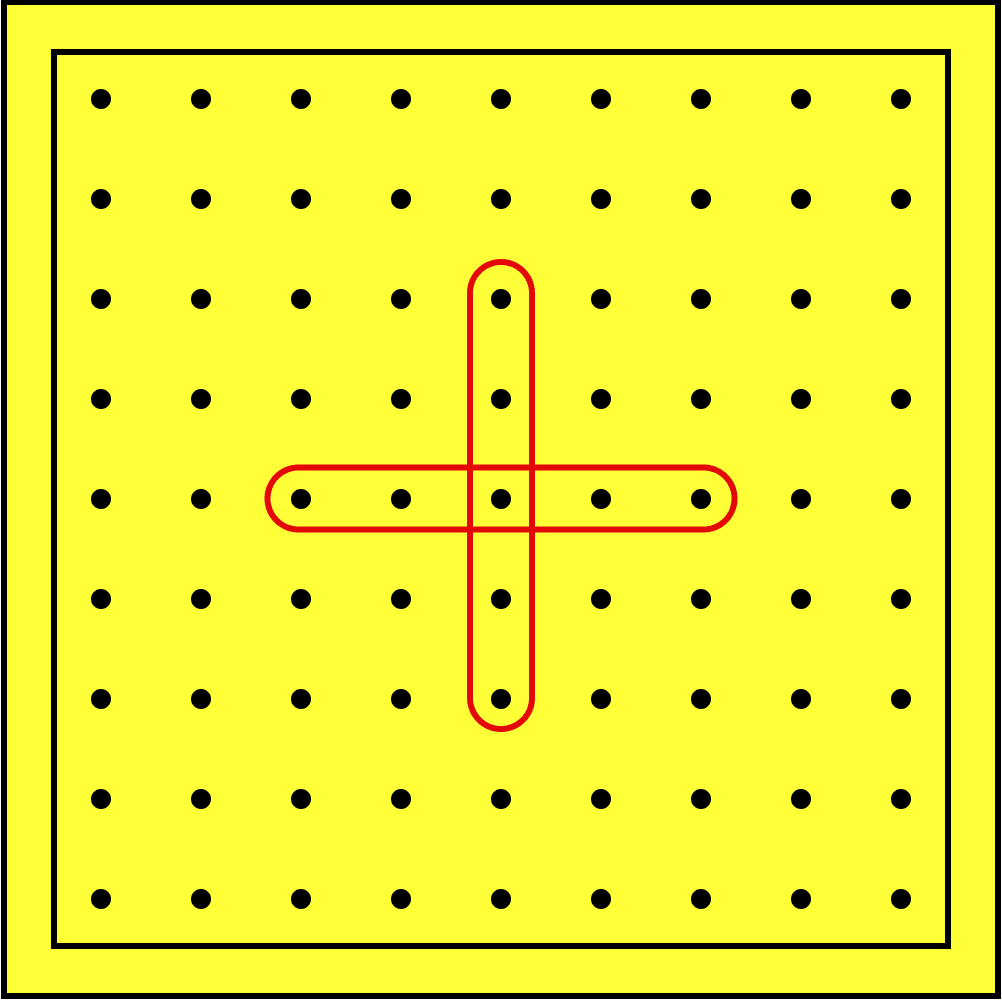
Place two rubber bands perpendicular to each other, forming diagonals of equal length. Join the ends.
(i) What is the quadrilateral that you get? Justify your answer.
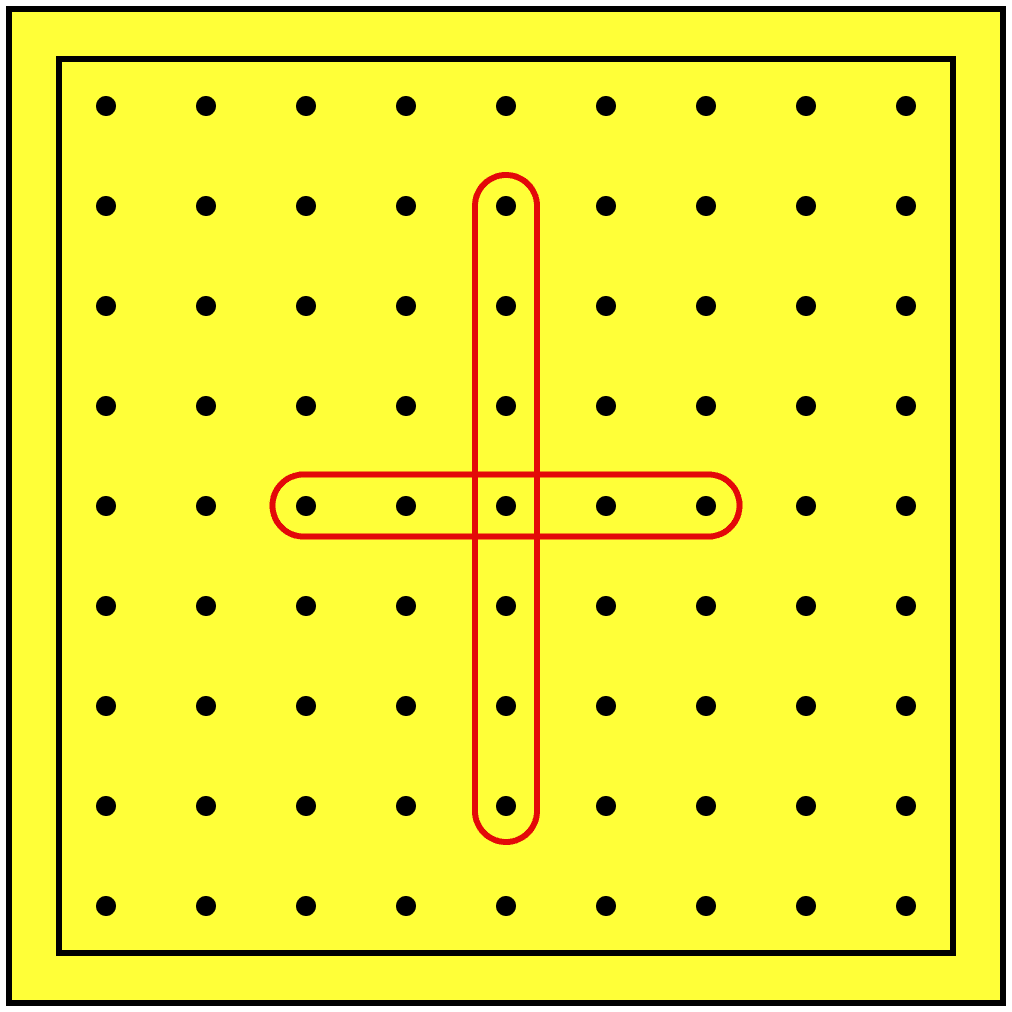
(ii) Extend one of the diagonals on both sides by 2 cm. What quadrilateral will you get now? Justify your answer.
Answer
(i) The two rubber bands are placed perpendicular to each other and are of equal length. Since they cross at their middle points, they also bisect each other.
So the two diagonals are:
(a) equal in length,
(b) bisect each other, and
(c) perpendicular to each other (90°).
A quadrilateral whose diagonals are equal, bisect each other and are perpendicular to each other is a square.
∴ The quadrilateral obtained is a square.
(ii) When one diagonal is extended by 2 cm on both sides, its length increases by 4 cm, so the two diagonals are no longer equal. But since the diagonal is extended equally on both sides of the point of intersection O, the point O is still the midpoint of both diagonals, and the diagonals remain perpendicular.
So now the two diagonals:
(a) are unequal in length,
(b) bisect each other, and
(c) are perpendicular to each other (90°).
A quadrilateral whose diagonals bisect each other at right angles, but are unequal, is a rhombus.
∴ The quadrilateral obtained now is a rhombus.
Take two cardboard cutouts of an equilateral triangle of sidelength 8 cm.
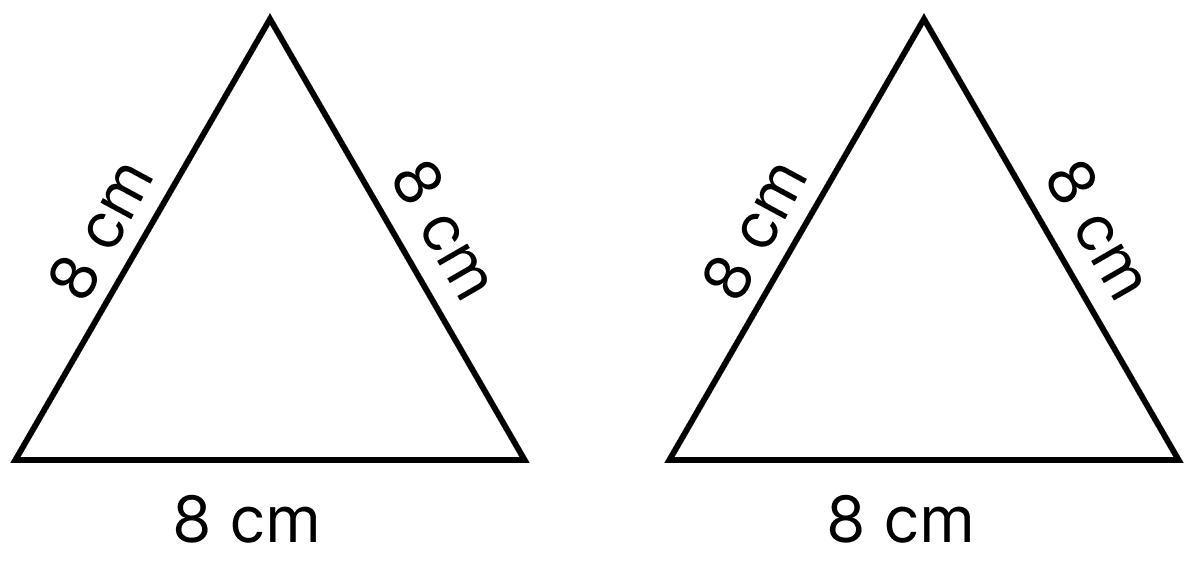
(i) Can you join them to get a quadrilateral?
(ii) What type of a quadrilateral is this? Justify your answer.
Answer
(i) Yes, the two equilateral triangles can be joined along a common side of 8 cm to get a quadrilateral.
Every side of the quadrilateral so formed is a side of one of the equilateral triangles, so all four sides are equal to 8 cm.
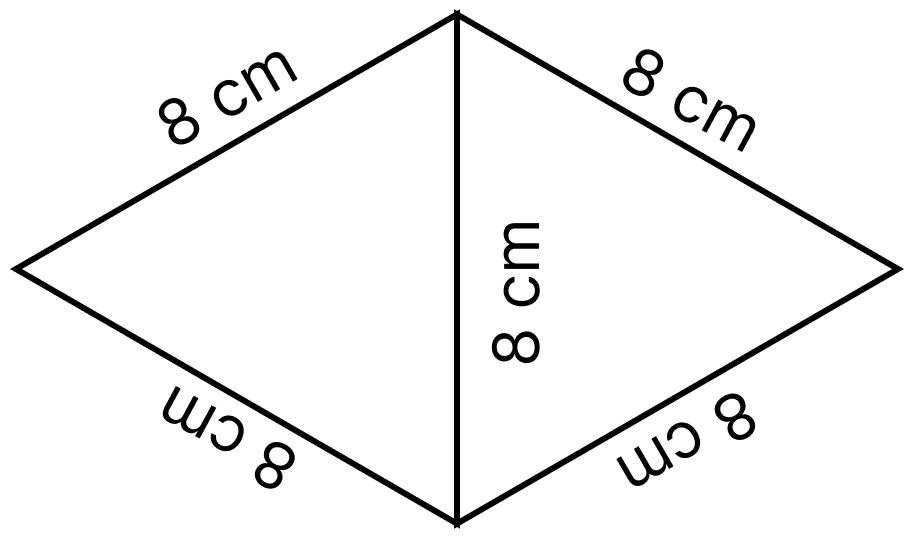
(ii) A quadrilateral in which all four sides are equal is a rhombus.
Justification:
Each angle of an equilateral triangle is 60°.
At the two vertices lying on the common side, two angles of 60° meet:
60° + 60° = 120°
At the other two vertices, there is a single angle of 60° each.
∴ The quadrilateral is a rhombus with all sides 8 cm and angles 60°, 120°, 60° and 120°.
Take two cardboard cutouts of an isosceles triangle with sidelengths 8 cm, 8 cm, and 6 cm.
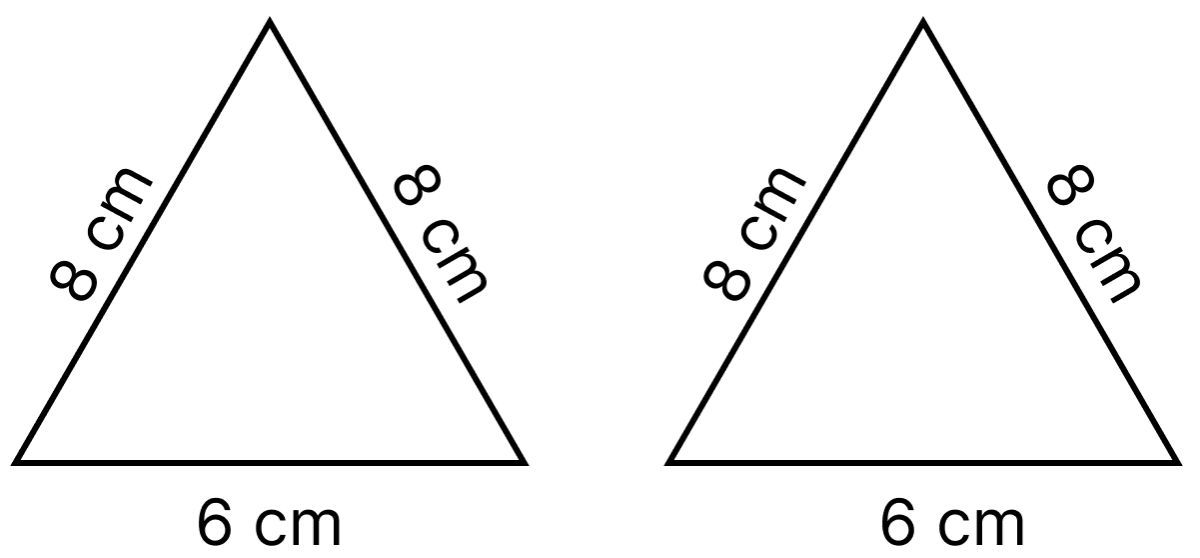
(i) What are the different ways they can be joined to get a quadrilateral?
(ii) What quadrilaterals are these? Justify your answers.
Answer
(i) The two congruent isosceles triangles (sides 8 cm, 8 cm and 6 cm) can be joined edge to edge in two different ways.
Way 1 — Joining along the 6 cm sides:
The 6 cm side of one triangle is placed exactly on the 6 cm side of the other. The shared 6 cm side becomes a diagonal, and the four equal sides (8 cm each) form the boundary of the quadrilateral.
Since all four sides are equal (8 cm), the quadrilateral obtained is a rhombus.
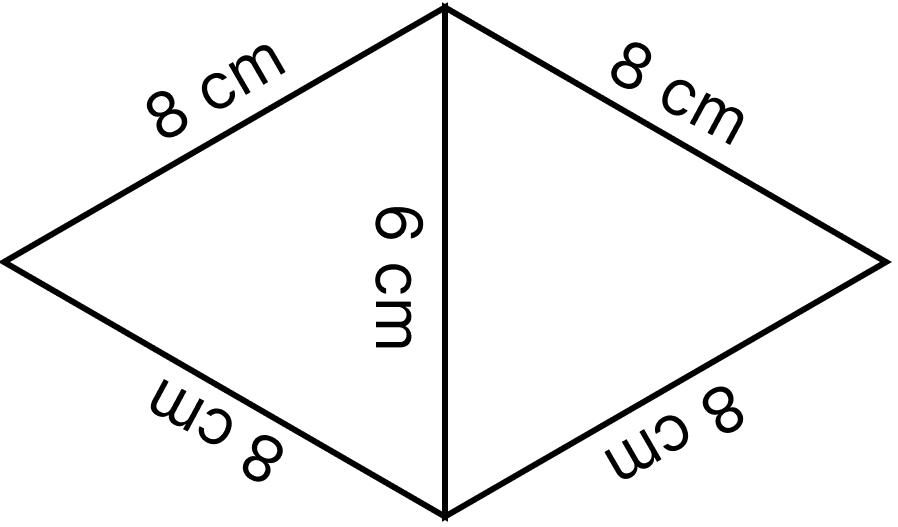
Way 2 — Joining along the 8 cm sides:
An 8 cm side of one triangle is placed on an 8 cm side of the other, with one triangle turned half-way round. The shared 8 cm side becomes a diagonal, and the remaining sides form the boundary.
(ii) The opposite sides of this quadrilateral are equal and parallel (one pair of 8 cm and one pair of 6 cm), so the quadrilateral obtained is a parallelogram.
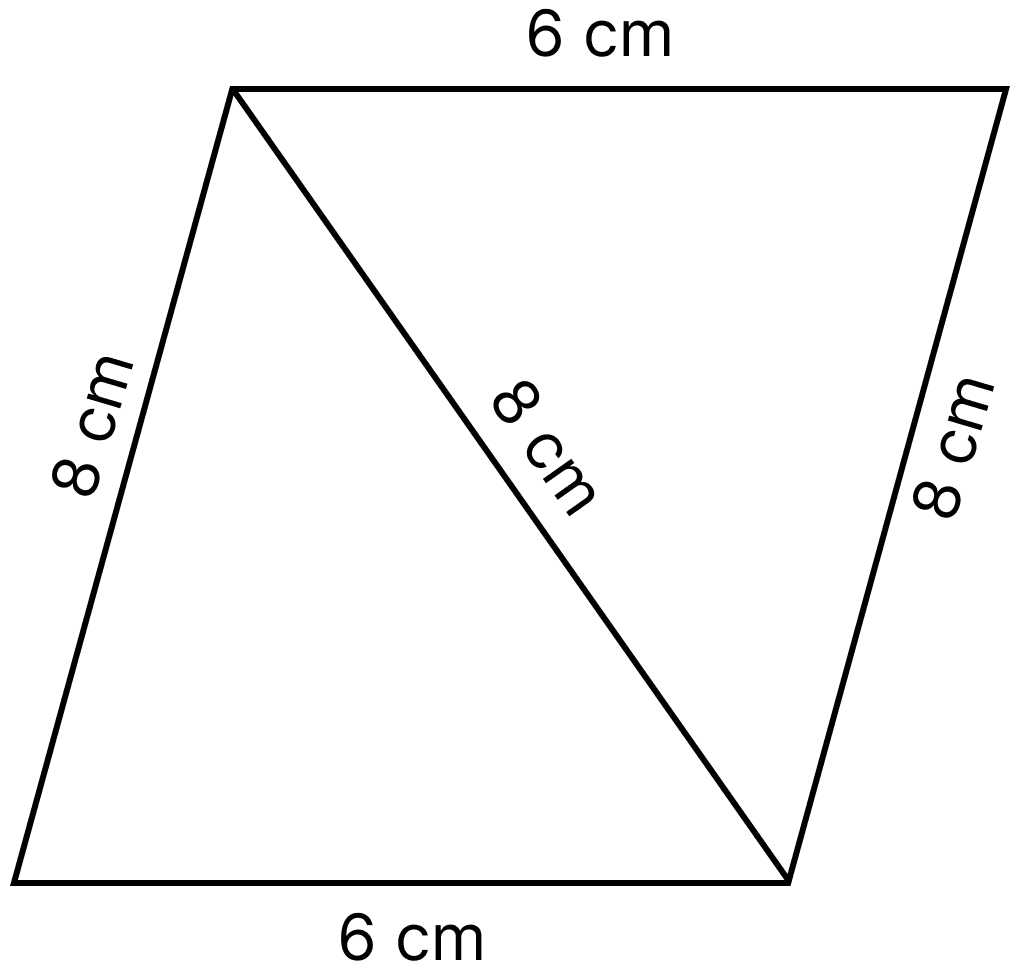
∴ The two quadrilaterals obtained are a rhombus and a parallelogram.
Take two cardboard cutouts of a scalene triangle with sides 6 cm, 9 cm, and 12 cm.
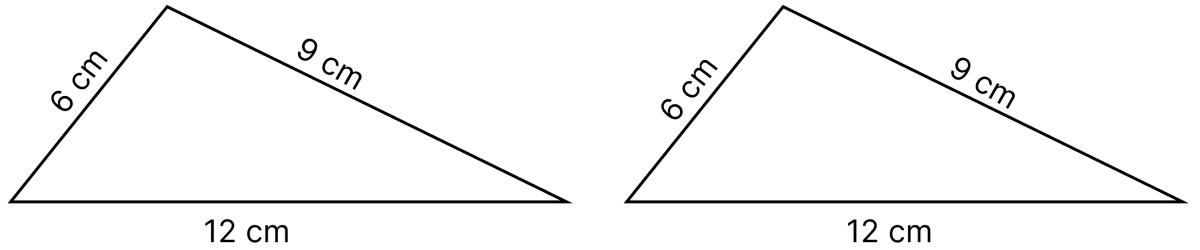
(i) What are the different ways they can be joined to get a quadrilateral?
(ii) Are you able to identify the different quadrilaterals that are obtained by joining the triangles? Justify your answer whenever you identify a quadrilateral.
Answer
The two congruent scalene triangles can be joined along any one of their three pairs of equal sides — the 6 cm, 9 cm, or 12 cm side. Along each such side they can be joined in two different ways: by turning one triangle half-way round (a half-turn), or by flipping one triangle over (a reflection). This gives six different quadrilaterals in all.
Joining by a half-turn — parallelograms:
When the triangle is turned half-way round, the shared side becomes a diagonal, and the opposite sides of the quadrilateral become equal and parallel. So a parallelogram is obtained.
- Joining along the 12 cm sides → a parallelogram with sides 6 cm and 9 cm.
- Joining along the 9 cm sides → a parallelogram with sides 6 cm and 12 cm.
- Joining along the 6 cm sides → a parallelogram with sides 9 cm and 12 cm.
Joining by a flip — kites:
When the triangle is flipped over, the shared side becomes the line of symmetry, so the two sides lying next to it become equal in pairs. So a kite is obtained.
- Joining along the 12 cm sides → a kite with sides 6 cm, 6 cm, 9 cm and 9 cm.
- Joining along the 9 cm sides → a kite with sides 6 cm, 6 cm, 12 cm and 12 cm.
- Joining along the 6 cm sides → a kite with sides 9 cm, 9 cm, 12 cm and 12 cm.
∴ The quadrilaterals obtained are three parallelograms and three kites.
A kite is a quadrilateral that can be labelled ABCD such that AB = BC, and CD = DA. In the kite, show that the diagonal BD
(i) bisects ∠ABC and ∠ADC,
(ii) bisects the diagonal AC, that is, AO = OC, and is perpendicular to it.
Hint: Is △AOB ≅ △COB?
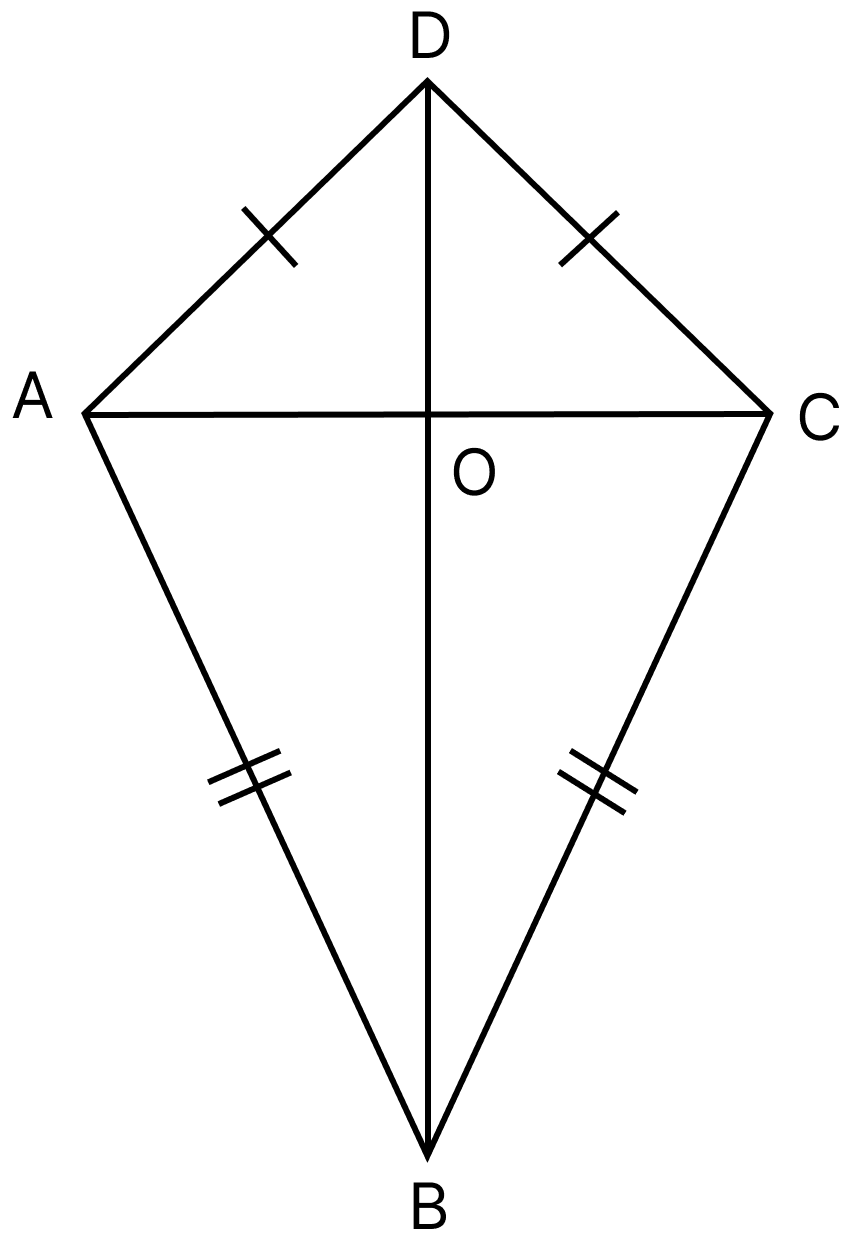
Answer
Given: ABCD is a kite in which AB = BC and CD = DA. The diagonals AC and BD intersect at O.
(i) BD bisects ∠ABC and ∠ADC.
In △ABD and △CBD:
AB = CB [Given]
DA = DC [Given]
BD = BD [Common side]
∴ △ABD ≅ △CBD [SSS congruence condition]
Therefore, by CPCT (corresponding parts of congruent triangles):
∠ABD = ∠CBD ⇒ BD bisects ∠ABC
∠ADB = ∠CDB ⇒ BD bisects ∠ADC
⇒ Hence proved
(ii) BD bisects AC (AO = OC) and is perpendicular to it.
In △AOB and △COB:
AB = CB [Given]
∠ABO = ∠CBO [Proved above, since ∠ABD = ∠CBD]
OB = OB [Common side]
∴ △AOB ≅ △COB [SAS congruence condition]
Therefore, by CPCT:
AO = OC ⇒ BD bisects the diagonal AC
Also, ∠AOB = ∠COB.
Since AOC is a straight line:
∠AOB + ∠COB = 180° [Linear pair]
⇒ ∠AOB + ∠AOB = 180° [∴ ∠AOB = ∠COB]
⇒ 2∠AOB = 180°
⇒ ∠AOB =
⇒ ∠AOB = 90°
∴ BD ⊥ AC
⇒ Hence proved
Construct a trapezium. Measure the base angles (marked in the figure). Can you find the remaining angles without measuring them?
Answer
A trapezium PQRS with PQ || SR can be constructed as follows.
Steps of construction:
Draw a line segment SR = 7 cm. This is the base.
At S, draw a ray making the base angle ∠S = 60° with SR.
At R, draw a ray making the base angle ∠R = 70° with RS, on the same side as the ray at S.
Draw a line parallel to SR cutting the rays from S and R at P and Q respectively.
Join PQ.
Then, PQRS is the required trapezium with PQ || SR.
On measuring the base angles, we get ∠S = 60° and ∠R = 70°.
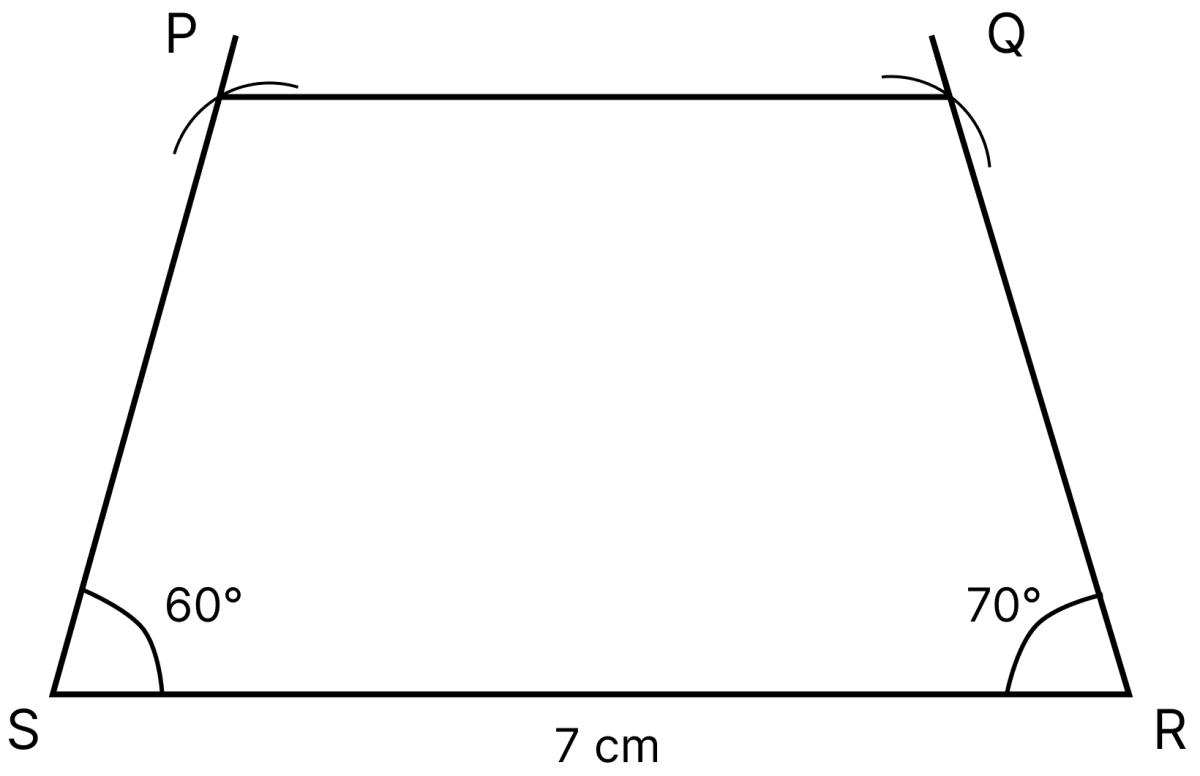
Yes, the remaining angles can be found without measuring them.
Since PQ || SR and SP is a transversal, the interior angles on the same side of the transversal add up to 180°.
∠S + ∠P = 180°
⇒ ∠P = 180° − ∠S
⇒ ∠P = 180° − 60°
⇒ ∠P = 120°
Similarly, since PQ || SR and RQ is a transversal:
∠R + ∠Q = 180°
⇒ ∠Q = 180° − ∠R
⇒ ∠Q = 180° − 70°
⇒ ∠Q = 110°
Verification:
∠P + ∠Q + ∠R + ∠S
= 120° + 110° + 70° + 60°
= 360°.
∴ The remaining angles are ∠P = 120° and ∠Q = 110°.
(The actual values of the base angles depend on the trapezium you construct; the method of finding the remaining angles stays the same.)
Construct an isosceles trapezium UVWX, with UV||XW. Measure ∠U. Can you find the remaining angles without measuring them?
Answer
An isosceles trapezium UVWX with UV ∥ XW and equal non-parallel sides UX = VW can be constructed as follows.
Steps of construction:
Draw a line segment UV = 7 cm.
Draw a line parallel to UV at a convenient distance less than 4 cm above it.
With U as centre and radius 4 cm, cut the upper parallel line at X.
With V as centre and radius 4 cm, cut the upper parallel line at W, choosing the point so that UX = VW.
Join UX, XW, and WV.
Then, UVWX is the required isosceles trapezium with UV ∥ XW and UX = VW.
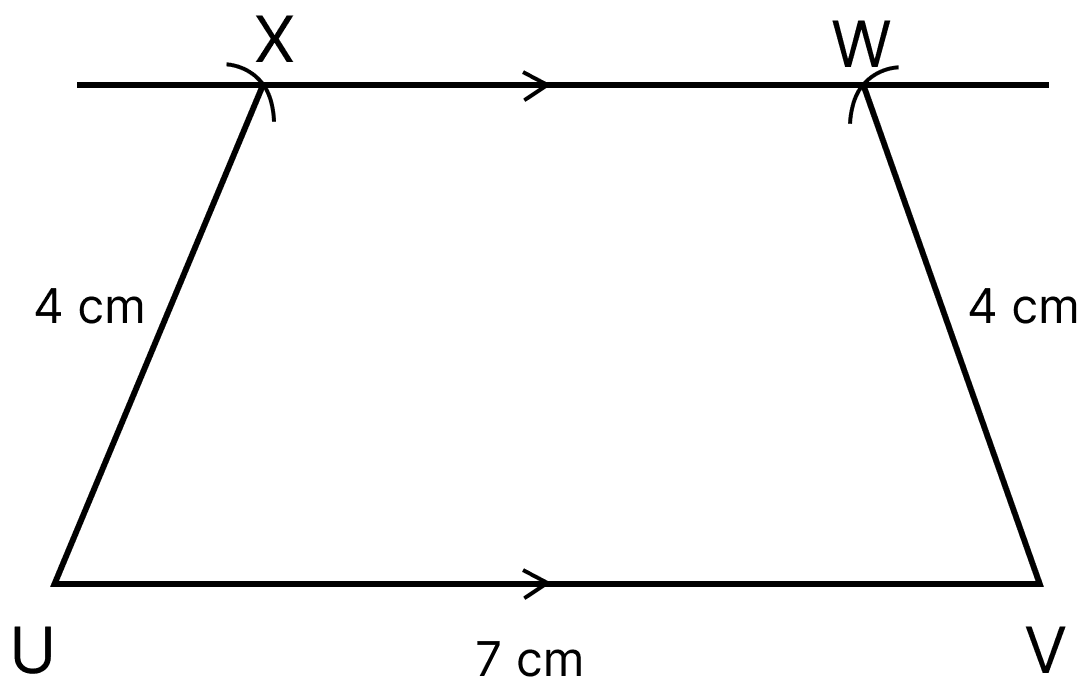
Suppose the measured value of ∠U is x°.
In an isosceles trapezium, the angles opposite the equal non-parallel sides are equal. Therefore:
∠V = ∠U = x°
Since UV ∥ XW and UX is a transversal, the co-interior angles are supplementary:
∠U + ∠X = 180°
⇒ ∠X = 180° − x°
Similarly, since UV ∥ XW and VW is a transversal:
∠V + ∠W = 180°
⇒ ∠W = 180° − x°
Thus:
∠U = ∠V = x°
∠X = ∠W = (180 − x)°
Verification:
x° + x° + (180 − x)° + (180 − x)° = 360°
Hence, the remaining angles are ∠V = x° and ∠X = ∠W = (180 − x)°.
Does it appear that the angles opposite to the equal sides — ∠U and ∠V — are also equal?
Can we find congruent triangles here?
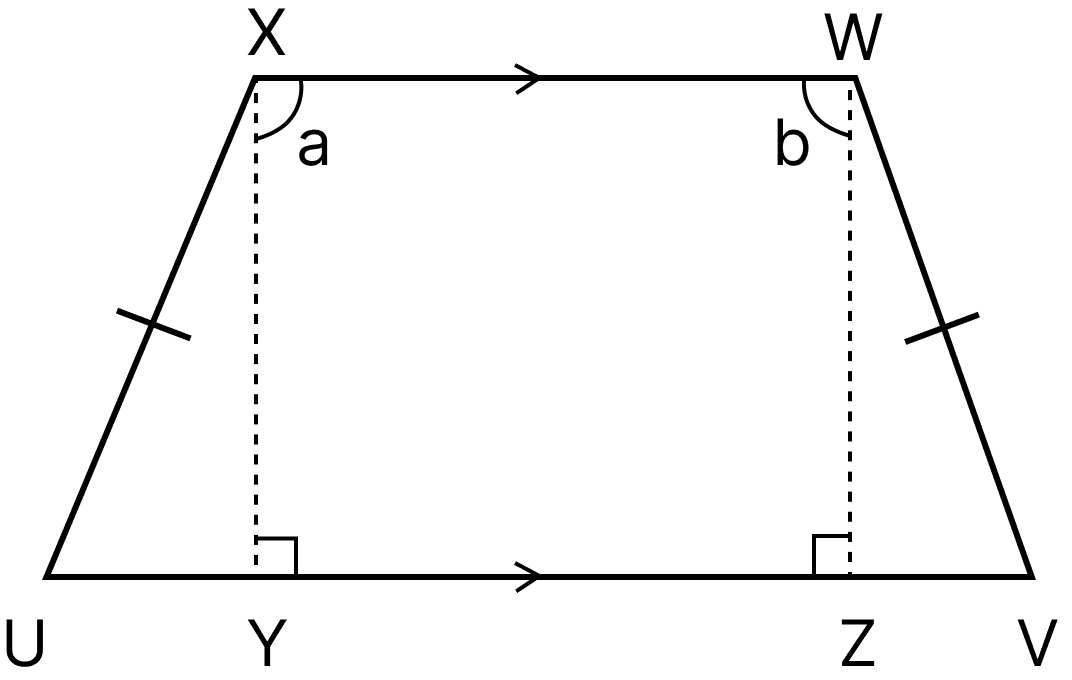
Answer
Yes, it does appear that ∠U and ∠V are equal.
In the isosceles trapezium UVWX, we have UV || XW, and the non-parallel sides are equal, that is, UX = VW.
To find congruent triangles, draw the line segments XY and WZ perpendicular to UV, with Y and Z lying on UV.
Since XW || UV, and both XY and WZ are perpendicular to UV, the figure XWZY has all its angles equal to 90°. So, XWZY is a rectangle, and therefore XY = WZ (opposite sides of a rectangle are equal).
This splits the trapezium into a rectangle XWZY in the middle and two right-angled triangles, △UXY and △VWZ, on either side. These two triangles can be shown to be congruent, and that will let us conclude that ∠U = ∠V.
Hence, the angles ∠U and ∠V do appear to be equal, and the congruent triangles needed to prove this are △UXY and △VWZ, obtained by dropping the perpendiculars XY and WZ from X and W to UV.
Now, it can be shown that △UXY ≅ △VWZ. How?
Answer
In the isosceles trapezium UVWX, the perpendiculars XY and WZ are drawn from X and W to UV. XWZY is a rectangle, so XY = WZ.
In △UXY and △VWZ:
UX = VW [The equal non-parallel sides of the isosceles trapezium]
XY = WZ [Opposite sides of the rectangle XWZY]
∠XYU = ∠WZV = 90° [Since XY and WZ are perpendicular to UV]
So, by the RHS congruence condition, △UXY ≅ △VWZ.
Therefore, ∠XUY = ∠WVZ, since they are corresponding parts of congruent triangles, that is, ∠U = ∠V.
Hence, △UXY ≅ △VWZ by the RHS congruence condition, which shows that ∠U = ∠V.
Find all the sides and the angles of the quadrilateral obtained by joining two equilateral triangles with sides 4 cm.
Answer
When two equilateral triangles of side 4 cm are joined along a common side, the common side becomes a diagonal of the quadrilateral, and the quadrilateral formed is a rhombus.
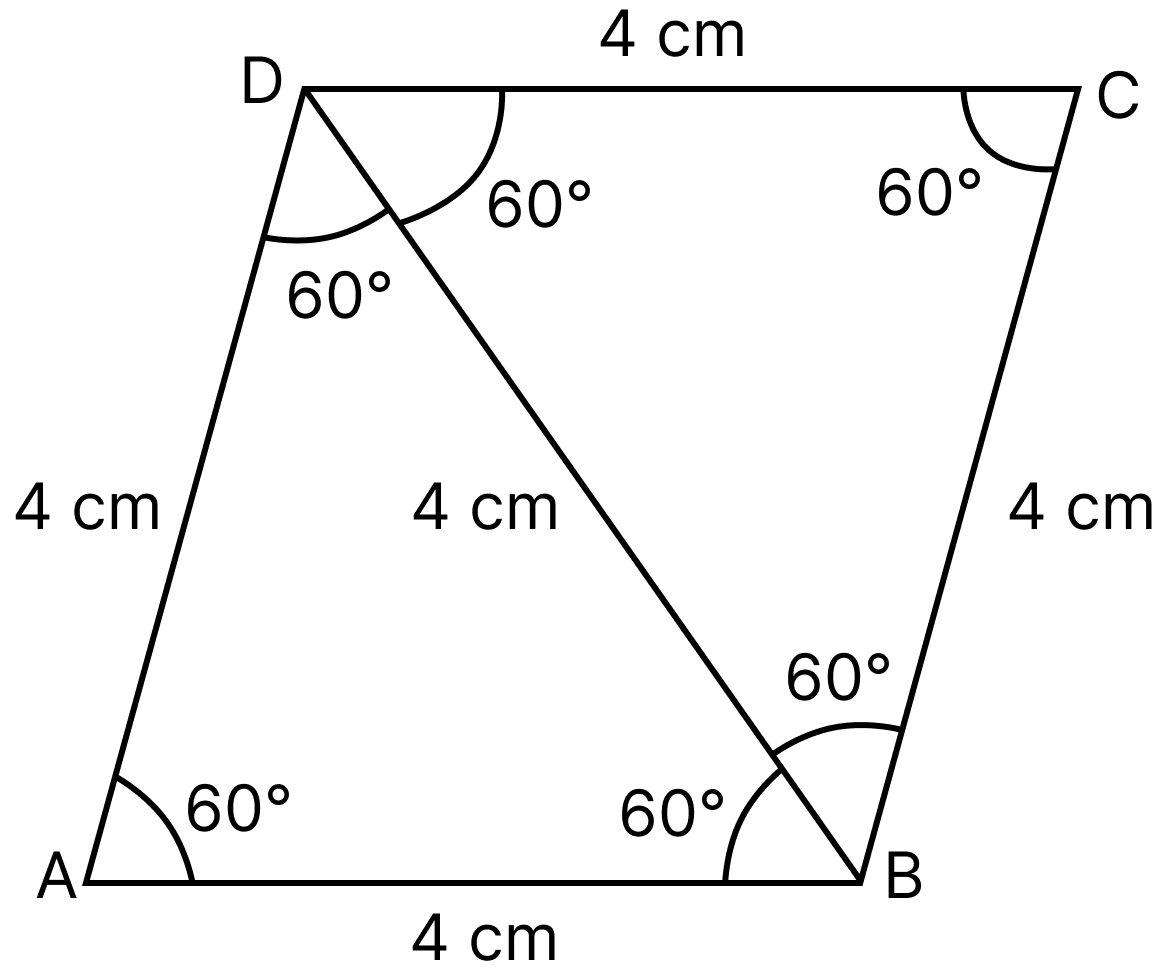
Let the two equilateral triangles △ABD and △CBD be joined along the common side BD. Then ABCD is the quadrilateral formed, where A and C are the apexes of the two triangles, and BD is the common side.
Sides:
Since both triangles are equilateral with side 4 cm, every side of each triangle is 4 cm. So,
AB = BC = CD = DA = 4 cm
All four sides of the quadrilateral are equal, each 4 cm. Hence, ABCD is a rhombus.
Angles:
Each angle of an equilateral triangle is 60°.
At A (apex of △ABD): ∠A = 60°
At C (apex of △CBD): ∠C = 60°
At B, the angle is made up of the two 60° angles of the triangles:
∠B = ∠ABD + ∠DBC
∠B = 60° + 60°
∠B = 120°
At D, similarly:
∠D = ∠ADB + ∠BDC
∠D = 60° + 60°
∠D = 120°
So, the quadrilateral is a rhombus in which all the sides are 4 cm and the angles are ∠A = 60°, ∠B = 120°, ∠C = 60°, and ∠D = 120°.
(The four angles add up to 60° + 120° + 60° + 120° = 360°.)
Construct a kite whose diagonals are of lengths 6 cm and 8 cm.
Answer
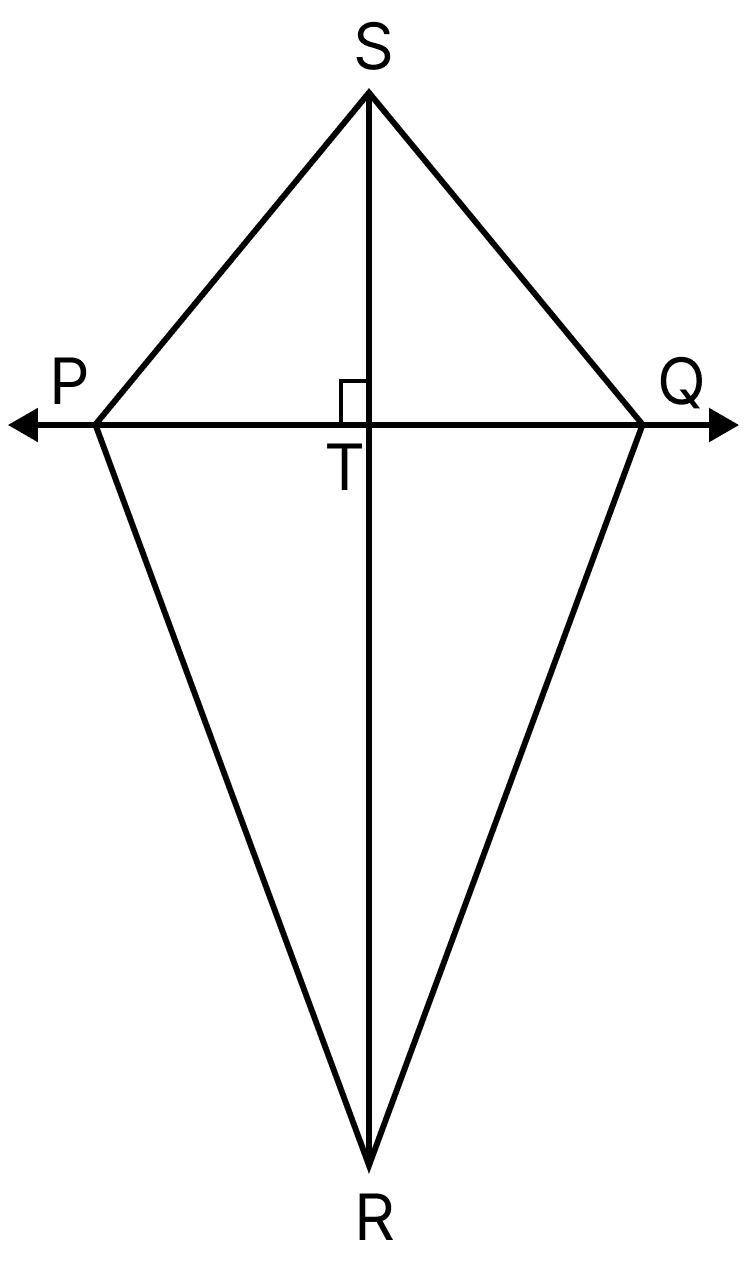
In a kite, the diagonals are perpendicular to each other, and one diagonal bisects the other. We use these properties to construct the kite.
Let the diagonals be SR = 8 cm and PQ = 6 cm, where SR bisects PQ at right angles at T.
Steps of construction:
Draw a line segment PQ = 6 cm
Construct the perpendicular bisector of PQ. Let it meet PQ at T, so that PT = TQ = 3 cm.
On this perpendicular line, mark two points S and R on opposite sides of T such that SR = 8 cm. Since the two parts of this diagonal need not be equal, take ST = 3 cm and TR = 5 cm
Join SP, PR, RQ, and QS.
Since PT = TQ and SR ⊥ PQ, we get SP = SQ and RP = RQ. Therefore, SPRQ is the required kite whose diagonals are 6 cm and 8 cm.
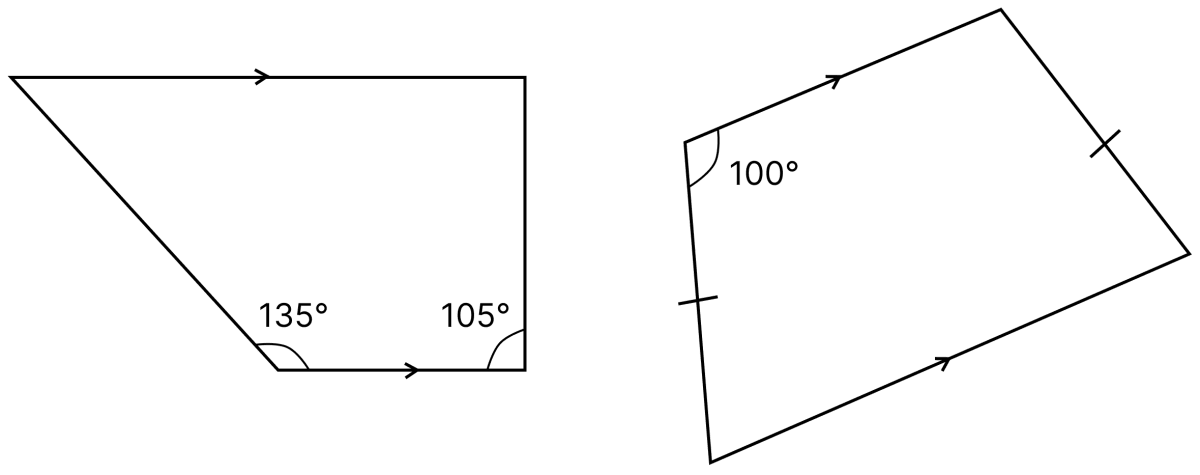
Find the remaining angles in the following trapeziums.
Answer
(i)
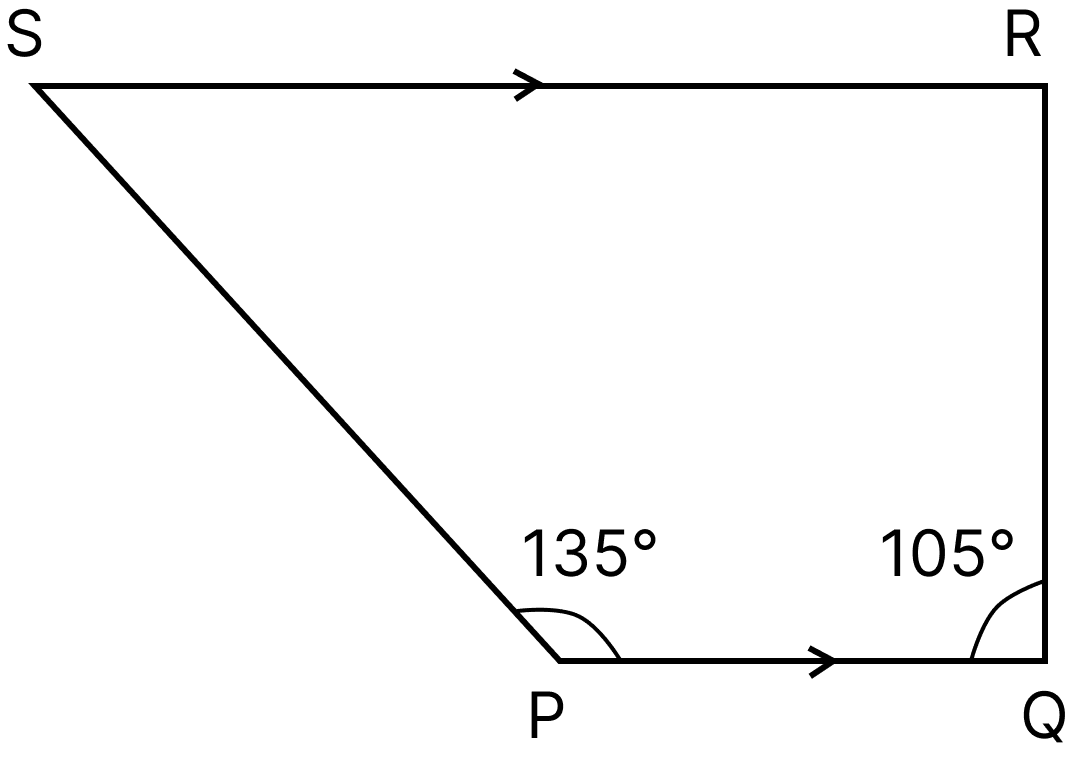
Let the trapezium be SPQR, with the parallel sides SR and PQ, so SR ∥ PQ. The given angles are ∠P = 135° and ∠Q = 105°
Since SR ∥ PQ and SP is a transversal, the co-interior angles add up to 180°:
∠S + ∠P = 180°
∠S + 135° = 180°
∠S = 180° - 135°
∠S = 45°
Since SR ∥ PQ and RQ is a transversal, the co-interior angles add up to 180°:
∠R + ∠Q = 180°
∠R + 105° = 180°
∠R = 180° - 105°
∠R = 75°
So, the remaining angles are ∠S = 45° and ∠R = 75°
(Check: 45° + 75° + 105° + 135° = 360°.)
(ii)
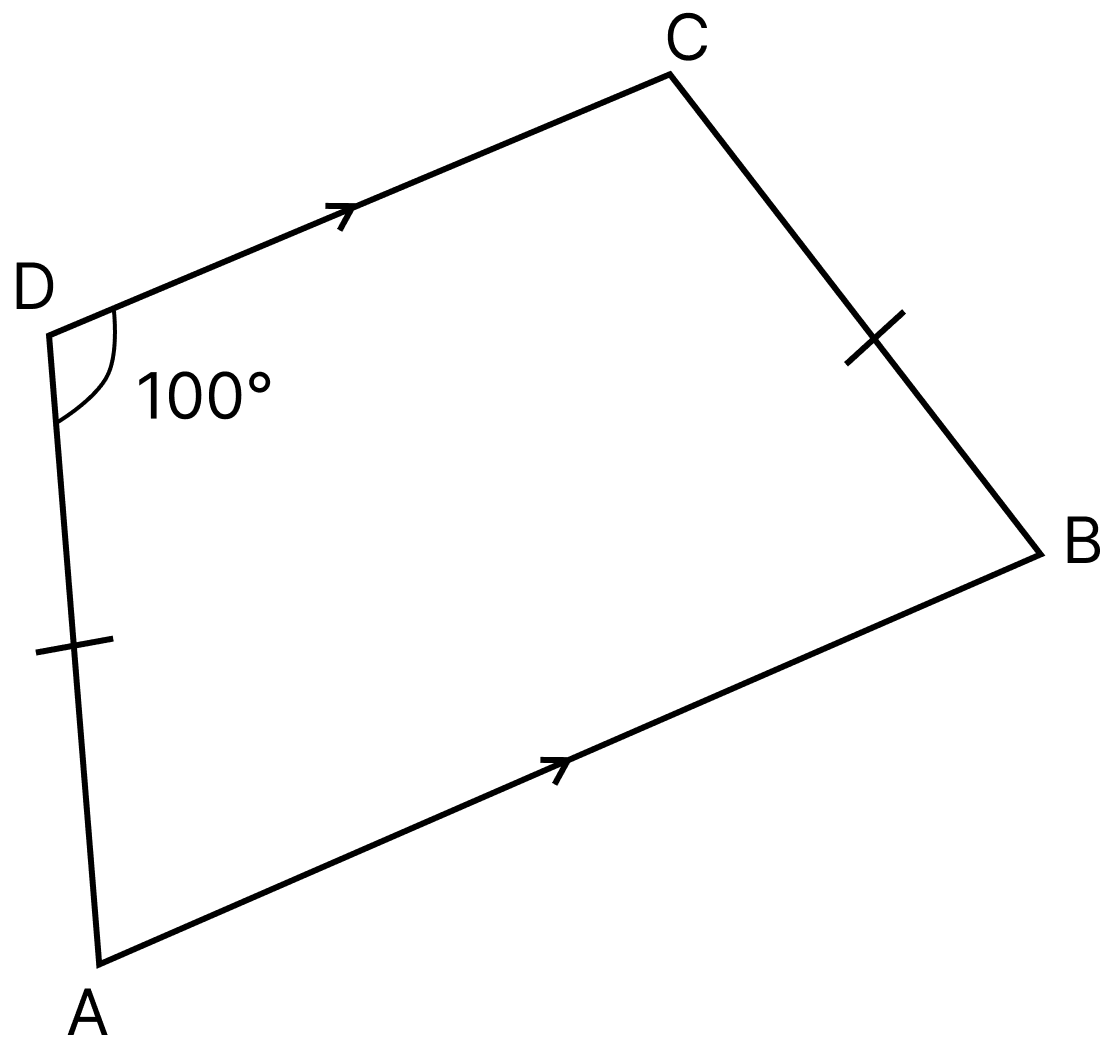
This is an isosceles trapezium ABCD, with the parallel sides AB and DC, so AB ∥ DC, and the equal non-parallel sides AD = BC. The given angle is ∠D = 100°
Since AB ∥ DC and AD is a transversal, the co-interior angles add up to 180°:
∠A + ∠D = 180°
∠A + 100° = 180°
∠A = 180° − 100°
∠A = 80°
In an isosceles trapezium, the angles at the two ends of each parallel side are equal:
∠A = ∠B and ∠D = ∠C
So,
∠C = ∠D = 100°
∠B = ∠A = 80°
So, the remaining angles are ∠A = 80°, ∠B = 80° and ∠C = 100°.
(Check: 100° + 100° + 80° + 80° = 360°.)
Draw a Venn diagram showing the set of parallelograms, kites, rhombuses, rectangles, and squares.
Then, answer the following questions:
(i) What is the quadrilateral that is both a kite and a parallelogram?
(ii) Can there be a quadrilateral that is both a kite and a rectangle?
(iii) Is every kite a rhombus? If not, what is the correct relationship between these two types of quadrilaterals?
Answer
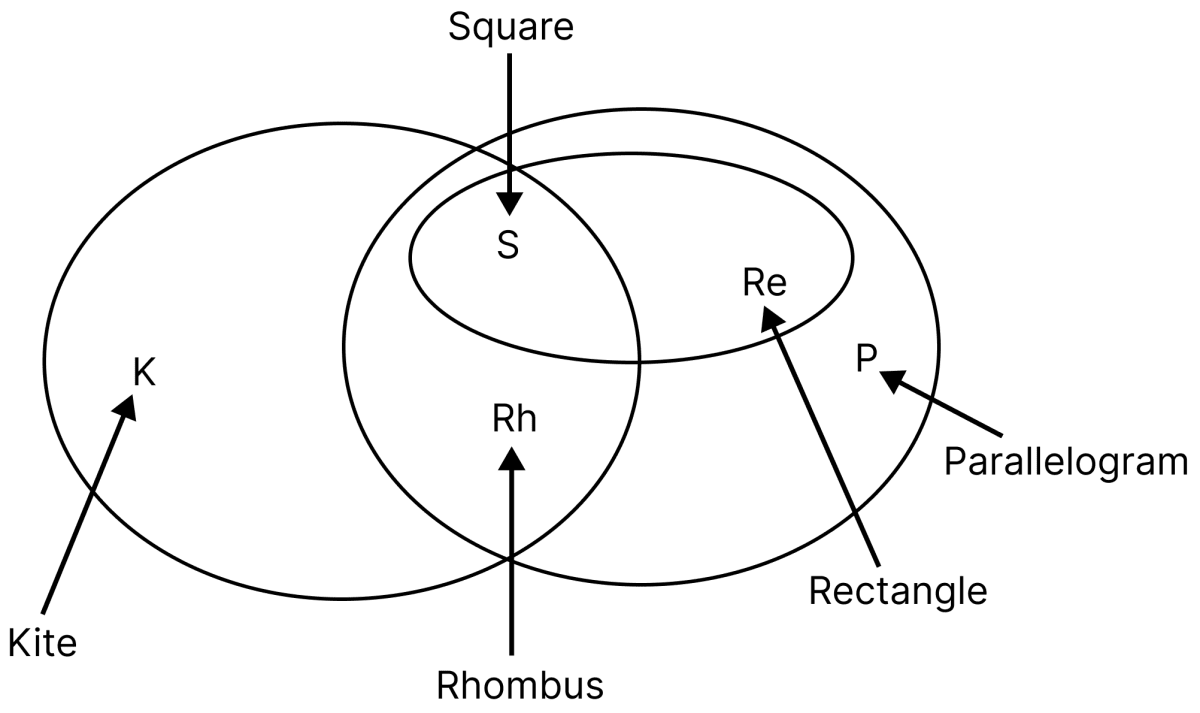
A Venn diagram for these quadrilaterals can be understood as follows:
- The set of parallelograms contains rectangles and rhombuses.
- The set of squares lies inside both rectangles and rhombuses because a square is both a rectangle and a rhombus.
- The set of kites overlaps with rhombuses, since every rhombus is also a kite.
(i) The quadrilateral that is both a kite and a parallelogram is a rhombus and square.
A kite has two pairs of equal adjacent sides, and a parallelogram has equal opposite sides. A quadrilateral that is both must have all four sides equal, which is a rhombus and square.
(ii) Yes. A quadrilateral that is both a kite and a rectangle is a square.
A square has all four sides equal, so it satisfies the kite condition (adjacent sides equal), and it has all angles 90°, so it is a rectangle. So, the square is both a kite and a rectangle.
(iii) No, every kite is not a rhombus.
In a kite ABCD, the two pairs of adjacent sides are equal (AB = BC and CD = DA), but the two pairs need not be equal to each other. In a rhombus, all four sides are equal. So, a kite becomes a rhombus only when all four of its sides are equal.
Hence, every rhombus is a kite, but every kite need not be a rhombus.
If PAIR and RODS are two rectangles, find ∠IOD.
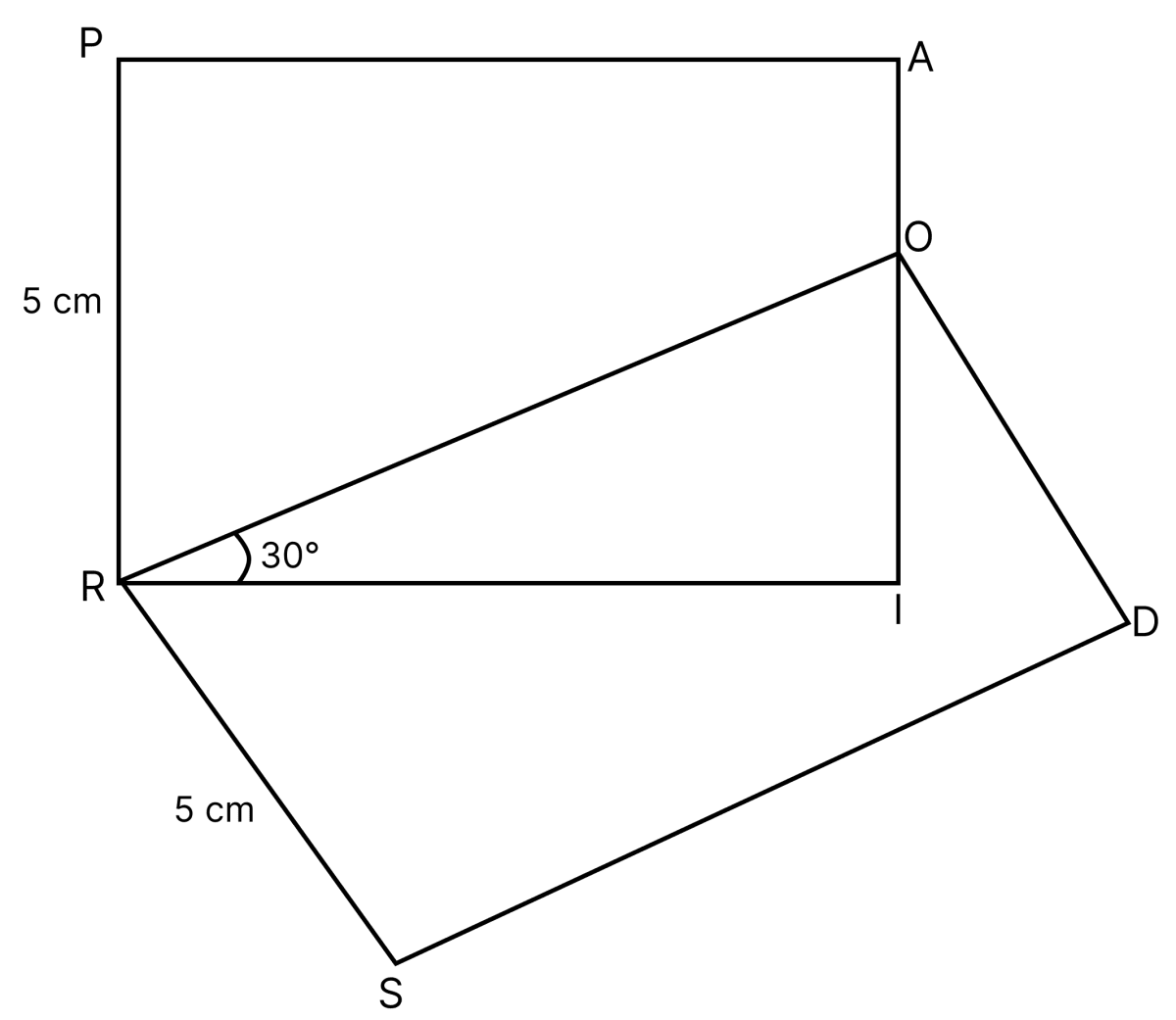
Answer
Join ID.
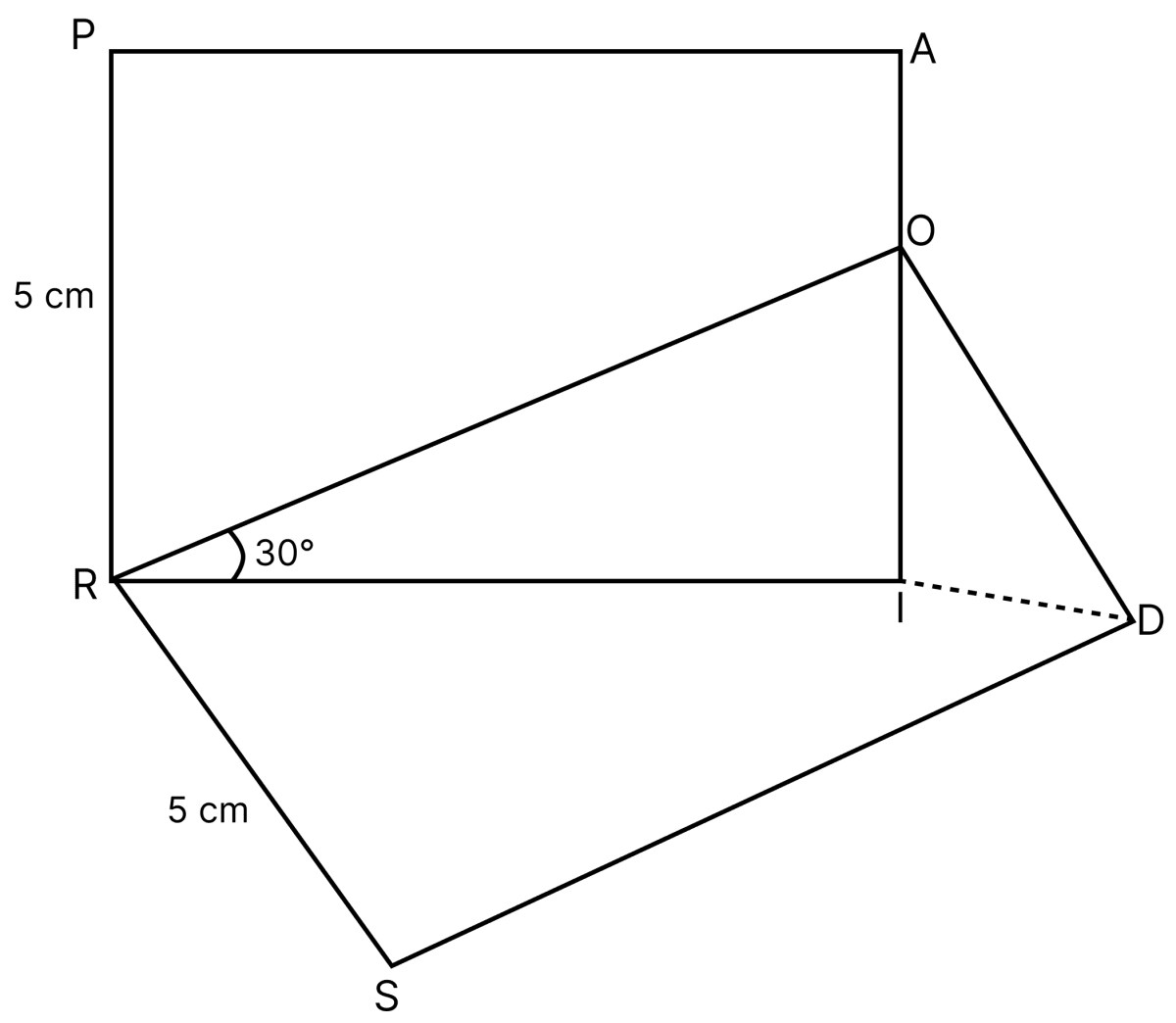
In rectangle PAIR, the angle at the vertex I is a right angle, so ∠AIR = 90°. The point O lies on the side AI, so OI lies along IA. This gives:
∠OIR = 90°
In △ORI:
∠IRO = 30° [given]
∠OIR = 90°
∠IRO + ∠OIR + ∠ROI = 180° [Angle sum property]
30° + 90° + ∠ROI = 180°
120° + ∠ROI = 180°
∠ROI = 180° - 120°
∠ROI = 60°
In rectangle RODS, the angle at the vertex O is a right angle, so:
∠ROD = 90°
The ray OI lies between OR and OD, so:
∠ROD = ∠ROI + ∠IOD
90° = 60° + ∠IOD
∠IOD = 90° - 60°
∠IOD = 30°
Hence, ∠IOD = 30°.
Construct a square with diagonal 6 cm without using a protractor.
Answer
In a square, the diagonals are equal in length, bisect each other, and meet at right angles.
So, both diagonals are 6 cm, and they cross at their midpoints at 90°. We use a compass to make the right angle, so no protractor is needed.
Step 1: Draw a line segment AB = 6 cm. (This is one diagonal).
Step 2: Construct the perpendicular bisector of AB using a compass (draw equal arcs from A and from B on both sides of AB, and join the two points where the arcs cross). Let the perpendicular bisector meet AB at O. Then AO = OB = 3 cm.
Step 3: The other diagonal CD is also 6 cm and lies along this perpendicular bisector, with O as its midpoint. So, mark C and D on the perpendicular bisector such that OC = OD = 3 cm.
Step 4: Join AC, BC, AD, and BD.
Since the diagonals AB and CD are equal, bisect each other, and meet at 90°, ACBD is the required square with diagonal 6 cm.
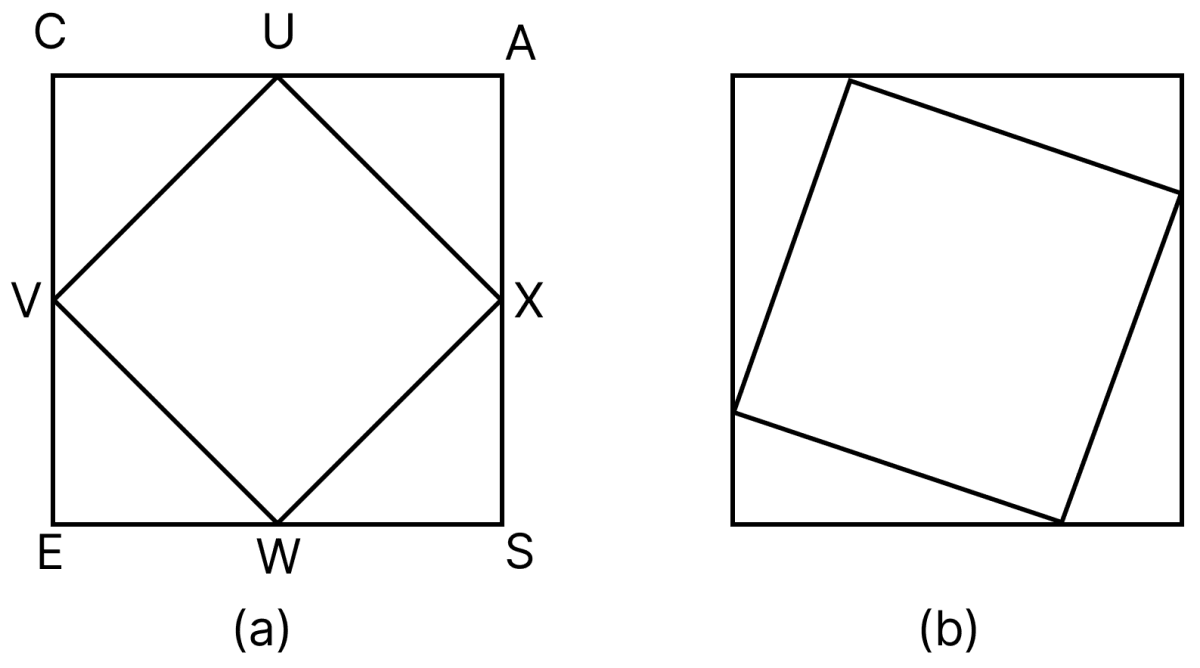
CASE is a square. The points U, V, W and X are the midpoints of the sides of the square.
What type of quadrilateral is UVWX?
Find this by using geometric reasoning, as well as by construction and measurement.
Find other ways of constructing a square within a square such that the vertices of the inner square lie on the sides of the outer square, as shown in Figure (b).
Answer
The quadrilateral UVWX is a square.
Geometric reasoning:
Let the square be CASE with each side of length 2a. Then U, V, W, and X are the midpoints of the sides, so each half-side has length a.
Joining the midpoints cuts off four corner triangles, at C, A, S, and E. Consider these triangles:
At C: the two legs are a and a, with ∠C = 90°.
At A: the two legs are a and a, with ∠A = 90°.
At S: the two legs are a and a, with ∠S = 90°.
At E: the two legs are a and a, with ∠E = 90°.
So, all four corner triangles are right-angled isosceles triangles with equal legs of length a. They are congruent, and each hypotenuse has the same length:
UV = VW = WX = XU = [hypotenuse of each triangle]
So, all four sides of UVWX are equal, which makes UVWX a rhombus.
Now consider the angles at U. Each corner triangle is right-angled and isosceles, so each of its base angles is 45°. At U, the two base angles ∠CUV and ∠AUX lie along the straight line CA, so:
∠VUX = 180° - ∠CUV - ∠AUX
∠VUX = 180° - 45° - 45°
∠VUX = 90°
So, UVWX has all four sides equal and one angle of 90°, which makes it a square.
Construction and measurement:
On drawing the square CASE, marking the midpoints U, V, W, and X, joining them, and then measuring, all four sides UV, VW, WX, and XU come out equal, and each angle of UVWX measures 90°. This confirms that UVWX is a square.
Hence, UVWX is a square.
Other ways of constructing a square within a square:
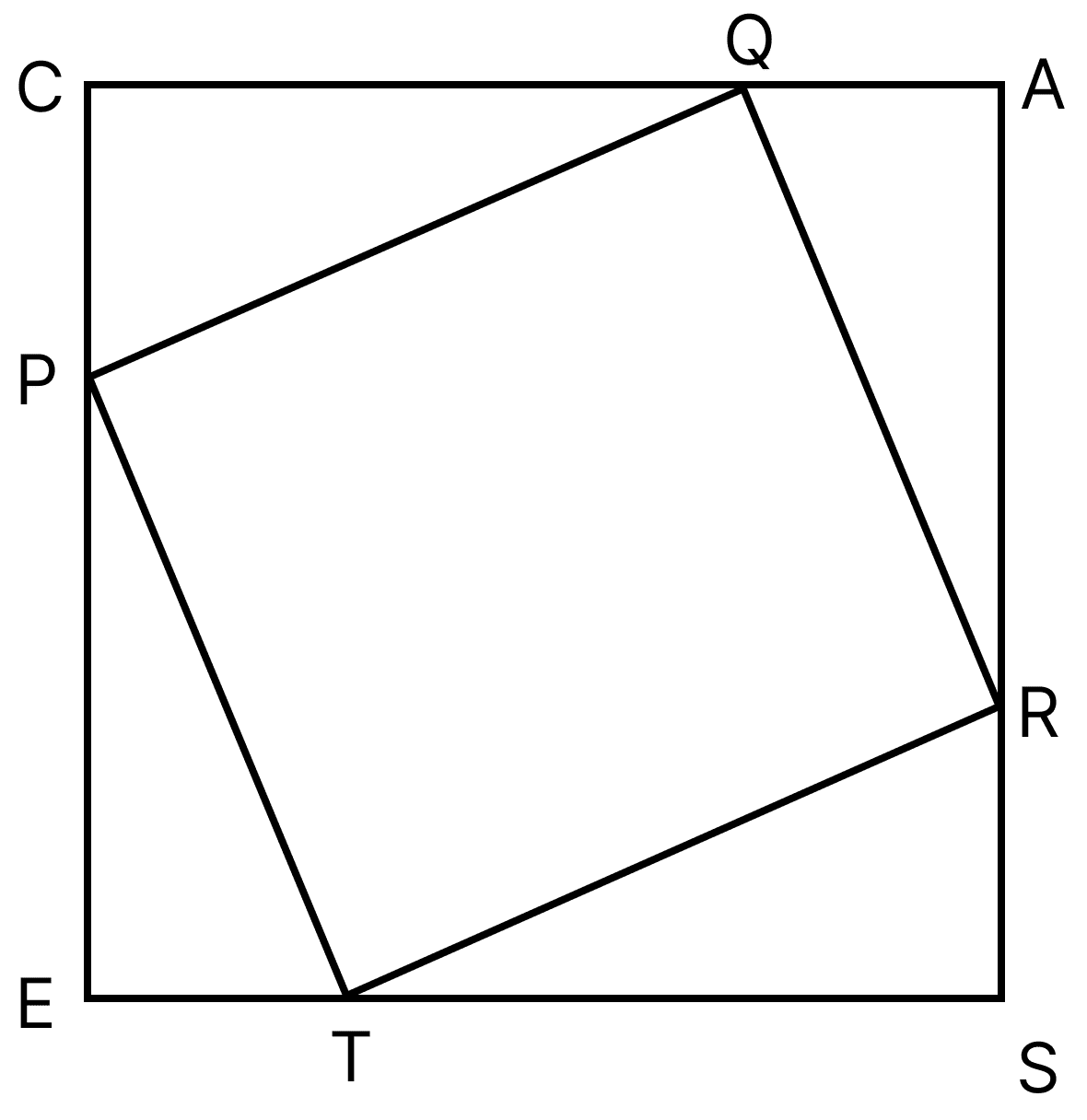
Instead of using the midpoints, mark a point on each side at the same distance from a corner, going around the square in the same direction. For example, in square CASE, mark points P, Q, R, and T on the four sides such that the distances measured from the corners (in the same direction) are equal. Joining P, Q, R, and T gives a square inscribed in CASE.
This works because the four corner triangles formed are congruent — each has legs of the same two lengths with the right angle between them (the SAS condition). So, the four sides of the inner quadrilateral are equal, and the angles at each vertex work out to 90°. The midpoint case is just the special case in which the marked distance is half the side. By choosing different distances, we get different squares inside the square, with their vertices on the sides of the outer square, as in Figure (b).
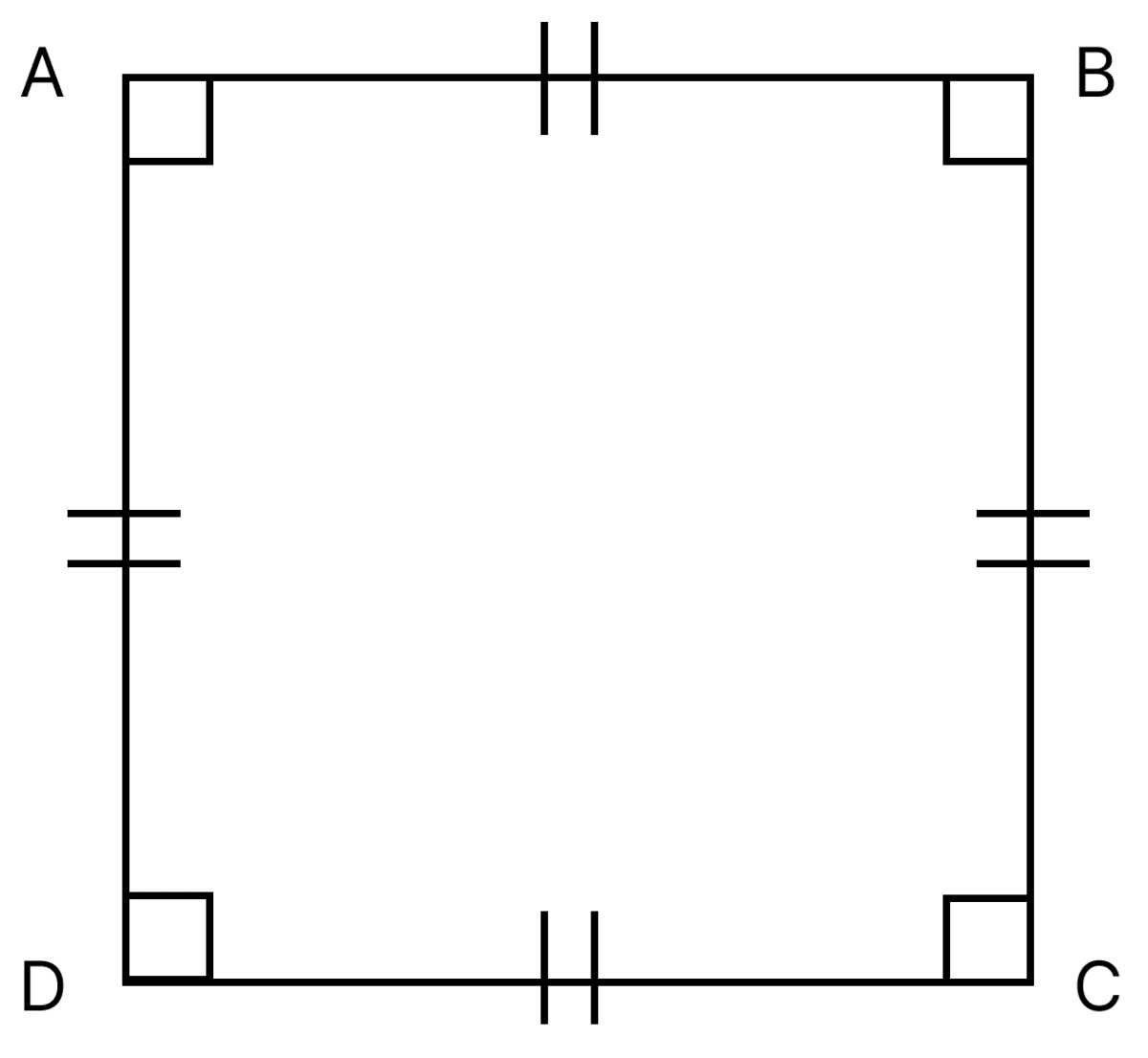
If a quadrilateral has four equal sides and one angle of 90°, will it be a square?
Find the answer using geometric reasoning as well as by construction and measurement.
Answer
Yes, it will be a square.
Geometric reasoning:
A quadrilateral with four equal sides is a rhombus. A rhombus is a parallelogram, so its opposite angles are equal, and its adjacent angles add up to 180°.
Let the rhombus be ABCD with ∠A = 90°.
Adjacent angles add up to 180°:
∠A + ∠B = 180°
90° + ∠B = 180°
∠B = 180° - 90°
∠B = 90°
Opposite angles are equal:
∠C = ∠A = 90°
∠D = ∠B = 90°
So, all four angles are 90°, and all four sides are equal. A quadrilateral in which all the sides are equal and all the angles are 90° is a square.
Construction and measurement:
If we construct a quadrilateral with four equal sides and make one of its angles 90°, then on measuring, the remaining three angles also come out as 90°, and the figure is a square.
Hence, a quadrilateral with four equal sides and one angle of 90° will be a square.
What type of a quadrilateral is one in which the opposite sides are equal?
Justify your answer.
Hint: Draw a diagonal and check for congruent triangles.
Answer
A quadrilateral in which the opposite sides are equal is a parallelogram.
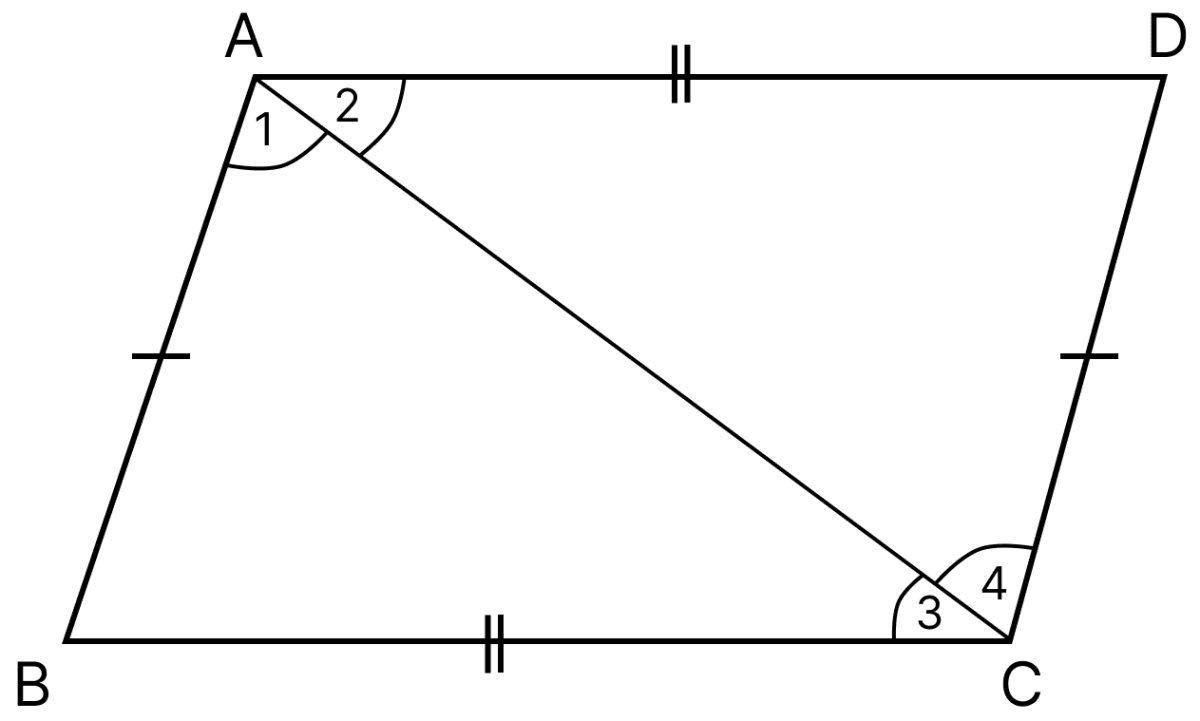
Let ABCD be a quadrilateral in which the opposite sides are equal, so AB = CD and BC = DA. Draw the diagonal AC.
In △ABC and △CDA:
AB = CD [given]
BC = DA [given]
AC = CA [common side]
So, by the SSS condition, △ABC ≅ △CDA.
Since these are corresponding parts of congruent triangles:
∠BAC = ∠DCA and ∠BCA = ∠DAC
Now, ∠BAC and ∠DCA are alternate angles formed by the lines AB and DC with the transversal AC. As they are equal, AB || DC.
Similarly, ∠BCA and ∠DAC are alternate angles formed by the lines BC and AD with the transversal AC. As they are equal, BC || AD.
Since both pairs of opposite sides are parallel, ABCD is a parallelogram.
Hence, a quadrilateral in which the opposite sides are equal is a parallelogram.
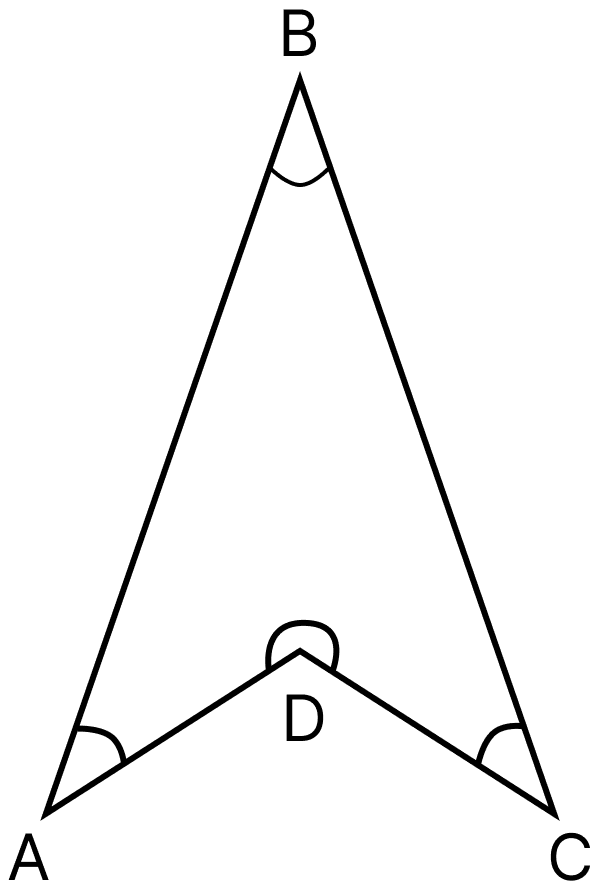
Will the sum of the angles in a quadrilateral such as the following one also be 360°?
Find the answer using geometric reasoning as well as by constructing this figure and measuring.
Answer
Yes, the sum of the angles in quadrilateral ADCB is also 360°.
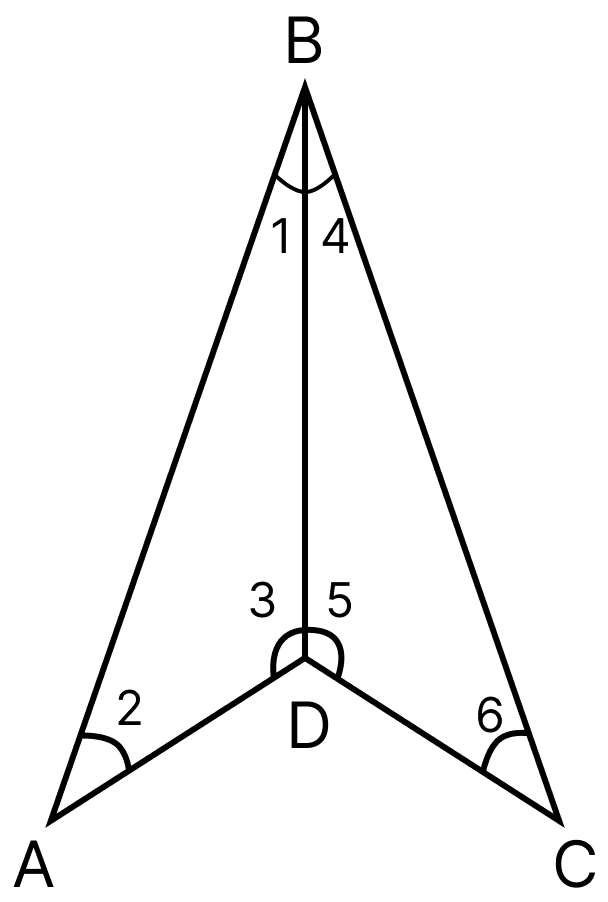
This is a non-convex (concave) quadrilateral ADCB, in which the angle at the vertex D (the interior angle ∠ADC) is a reflex angle.
Geometric reasoning:
Join B and D. The diagonal BD divides the quadrilateral into two triangles, △ABD and △CBD.
In △ABD:
∠BAD + ∠ABD + ∠ADB = 180° [Angle sum property]
In △CBD:
∠BCD + ∠CBD + ∠BDC = 180° [Angle sum property]
Adding the two:
(∠BAD + ∠BCD) + (∠ABD + ∠CBD) + (∠ADB + ∠BDC) = 360°
Now,
∠ABD + ∠CBD = ∠ABC (the whole angle at B)
∠ADB + ∠BDC = reflex ∠ADC (the whole interior angle at D)
∠BAD = ∠A and ∠BCD = ∠C
So,
∠A + ∠B + ∠C + reflex ∠D = 360°
So, the four interior angles of the quadrilateral (taking the reflex angle at D) add up to 360°.
Construction and measurement:
On constructing this figure and measuring its four interior angles (taking the reflex angle at the vertex D), their sum comes out to be 360°.
Hence, the sum of the angles in this quadrilateral is also 360°.
State whether the following statements are true or false.
Justify your answers.
(i) A quadrilateral whose diagonals are equal and bisect each other must be a square.
(ii) A quadrilateral having three right angles must be a rectangle.
(iii) A quadrilateral whose diagonals bisect each other must be a parallelogram.
(iv) A quadrilateral whose diagonals are perpendicular to each other must be a rhombus.
(v) A quadrilateral in which the opposite angles are equal must be a parallelogram.
(vi) A quadrilateral in which all the angles are equal is a rectangle.
(vii) Isosceles trapeziums are parallelograms.
Answer
(i) False
Reason — If the diagonals of a quadrilateral are equal and bisect each other, the quadrilateral is a rectangle. It need not be a square. It is a square only when the diagonals also intersect at right angles.
(ii) True
Reason — The sum of the interior angles of a quadrilateral is 360°. If three angles are 90°, then the fourth angle is:
= 360° − (90° + 90° + 90°)
= 360° − 270°
= 90°
Thus, all four angles are right angles, so the quadrilateral is a rectangle.
(iii) True
Reason — By geometric definition, in a quadrilateral if the diagonals bisect each other, then it is a parallelogram.
(iv) False
Reason — For a quadrilateral to be a rhombus, its diagonals must be perpendicular and they must bisect each other. If they cross at 90° but do not cut each other in half, the shape is not a rhombus.
Example: A standard kite has diagonals that cross at a perpendicular 90° angle, but its four sides are not equal in length.
(v) True
Reason — If opposite angles are equal, the consecutive adjacent angles are supplementary (they add up to 180°). When adjacent interior angles sum to 180°, it forces the structural lines to run perfectly parallel to each other, making the shape a parallelogram.
(vi) True
Reason — The sum of all the angles of a quadrilateral is 360°. If all the angles are equal, then each angle
=
= 90°
Since every angle is 90°, the quadrilateral is a rectangle (by definition, a quadrilateral in which all the angles are 90° is a rectangle).
(vii) False
Reason — By definition, a parallelogram must have two pairs of parallel opposite sides. An isosceles trapezium only has one single pair of parallel sides (the bases), while its other two opposite sides (the legs) are non-parallel but equal in length.