
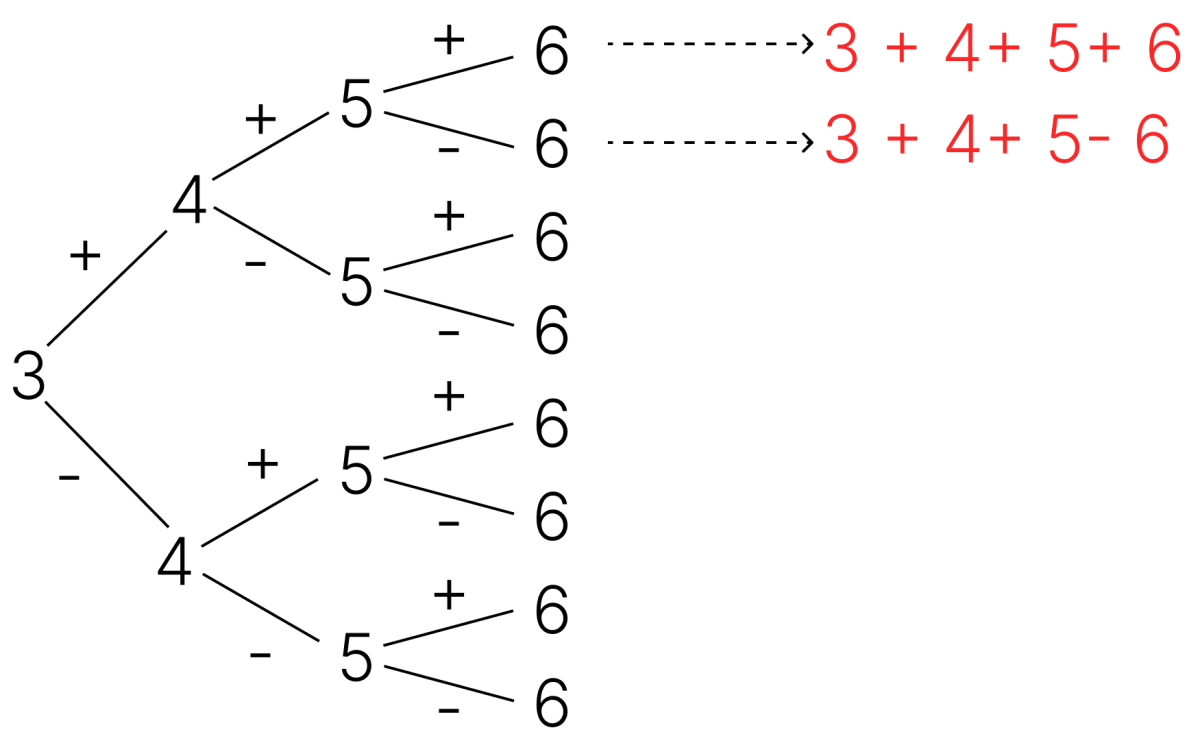
Evaluate each expression and write the result next to it. Do you notice anything interesting?
Answer
Evaluating each of the eight expressions:
3 + 4 + 5 + 6 = 18
3 + 4 + 5 – 6 = 6
3 + 4 – 5 + 6 = 8
3 + 4 – 5 – 6 = – 4
3 – 4 + 5 + 6 = 10
3 – 4 + 5 – 6 = – 2
3 – 4 – 5 + 6 = 0
3 – 4 – 5 – 6 = – 12
The interesting thing is that the result of every expression is an even number.
Hence, no matter how the '+' and '–' signs are placed, each expression evaluates to an even number.
Do these patterns occur no matter which 4 consecutive numbers are chosen? Is there a way to find out through reasoning?
Answer
Yes, the pattern occurs for any 4 consecutive numbers, and it can be proved through reasoning using algebra.
Let the 4 consecutive numbers be n, n + 1, n + 2 and n + 3.
The sum of all four numbers is:
n + (n + 1) + (n + 2) + (n + 3)
= 4n + 6
= 2(2n + 3)
Since 2 is a factor, the sum 2(2n + 3) is always an even number.
Now, when any '+' sign is changed to a '–' sign, say + (n + 2) is changed to – (n + 2), the value of the expression decreases by 2(n + 2), which is an even number.
So, changing any sign changes the value of the expression only by an even number, which means the parity does not change.
Since all 8 expressions are obtained from n + (n + 1) + (n + 2) + (n + 3) by changing some of the signs, all of them have the same parity as 2(2n + 3), that is, all of them are even.
Hence, the result is always an even number for any 4 consecutive numbers, and this can be proved through reasoning using algebra.
Replace any negative sign in the expression a + b – c – d with a positive sign and find the difference between the two numbers. What do you conclude from this observation?
Answer
Given expression:
a + b – c – d.
Replace the negative sign of c (that is, – c) with a positive sign to get a + b + c – d.
The difference between the two numbers is:
(a + b + c – d) – (a + b – c – d)
= a + b + c – d – a – b + c + d
= 2c
which is an even number.
So, switching a negative sign to a positive sign also changes the value of the expression by an even number, exactly as switching a positive sign to a negative sign did.
We can conclude that switching any sign changes the value by an even number. Therefore, the two expressions have the same parity, and all the expressions have the same parity.
Is the phenomenon of all the expressions having the same parity limited to taking 4 numbers? What do you think?
Answer
No, the phenomenon is not limited to taking only 4 numbers.
For any collection of numbers combined using '+' and '–' signs, switching any one sign changes the value of the expression by twice that number, which is always an even number. So the parity of the expression never changes.
This means all the expressions of the form a ± b ± c ± d ± … ± n have the same parity.
Hence, the phenomenon holds for any number of numbers and is not limited to taking 4 numbers.
Without computing them, find out which of the following arithmetic expressions are even.
(i) 43 + 37
(ii) 672 – 348
(iii) 4 × 347 × 3
(iv) 708 – 477
(v) 809 + 214
(vi) 119 × 303
(vii) 543 – 479
(viii) 5133
Answer
We use the parity rules:
odd ± odd = even
even ± even = even
odd ± even = odd
A product is even if at least one of its factors is even.
An odd number raised to any power remains odd.
(i) 43 + 37 = odd + odd = even
(ii) 672 – 348 = even – even = even
(iii) 4 × 347 × 3 = even × odd × odd = even (since 4 is even)
(iv) 708 – 477 = even – odd = odd
(v) 809 + 214 = odd + even = odd
(vi) 119 × 303 = odd × odd = odd
(vii) 543 – 479 = odd – odd = even
(viii) 5133 = 513 × 513 × 513 = odd × odd × odd = odd
Hence, the even expressions are 43 + 37, 672 – 348, 4 × 347 × 3 and 543 – 479.
Using our understanding of how parity behaves under different operations, identify which of the following algebraic expressions give an even number for any integer values for the letter-numbers and write a couple of examples and non-examples, as appropriate, for each expression.
- 2a + 2b
- 3g + 5h
- 4m + 2n
- 2u − 4v
- 13k − 5k
- 6m − 3n
- x2 + 2
- b2 + 1
- 4k × 3j
Answer
An expression gives an even number for all integer values of its letter-numbers when 2 is a factor of the expression.
(i) 2a + 2b
= 2(a + b) → 2 is a factor → always even
Example:
If a = 3, b = 5:
2a + 2b = 2(3) + 2(5)
= 6 + 10
= 16
If a = 4, b = – 7:
2a + 2b = 2(4) + 2(-7)
= 8 – 14
= – 6
Both are even.
(ii) 3g + 5h
= 2 is not a factor → not always even
Example:
If g = 1, h = 1:
3g + 5h = 3 + 5
= 8 (even).
Non-example:
If g = 1, h = 2:
3g + 5h = 3 + 10
= 13 (odd).
(iii) 4m + 2n
= 2(2m + n) → 2 is a factor → always even
Examples:
If m = 5 and n = 3:
4m + 2n = 4(5) + 2(3)
= 20 + 6
= 26
If m = 4 and n = –1,
4m + 2n = 4(4) + 2(–1)
= 16 – 2
= 14
Both are even.
(iv) 2u – 4v
= 2(u – 2v) → 2 is a factor → always even
Example:
If u = 5, v = 2:
2u – 4v = 2(5) – 4(2)
= 10 – 8
= 2
If u = 3, v = – 1:
2u – 4v = 2(3) – 4(–1)
= 6 + 4
= 10
Both are even.
(v) 13k – 5k
= 8k
= 2(4k) → 2 is a factor → always even
Example:
If k = 2:
13k – 5k = 13(2) – 5(2)
= 26 – 10
= 16
If k = 3:
13k – 5k = 13(3) – 5(3)
= 39 – 15
= 24
Both are even.
(vi) 6m – 3n
= 3(2m – n)
= 2 is not a factor → not always even
Example:
If m = 1, n = 2:
6m – 3n = 6(1) – 3(2)
= 6 – 6
= 0 (even).
Non-example:
If m = 1, n = 1:
6m – 3n = 6 – 3
= 3 (odd)
(vii) x2 + 2
= x2 has the same parity as x → not always even
Example:
If x = 2:
x2 + 2 = (2)2 + 2
= 4 + 2
= 6 (even).
Non-example:
If x = 3:
x2 + 2 = (3)2 + 2
= 9 + 2
= 11 (odd)
(viii) b2 + 1
= b2 has the same parity as b → not always even
Example:
If b = 1:
b2 + 1 = (1)2 + 1
= 1 + 1
= 2 (even).
Non-example:
If b = 2:
b2 + 1 = (2)2 + 1
= 4 + 1
= 5 (odd)
(ix) 4k × 3j
= 12kj
= 2(6kj) → 2 is a factor → always even
Example:
If k = 1, j = 1:
4k × 3j = 4(1) × 3(1)
= 4 × 3
= 12
If k = 2, j = 3:
4k × 3j = 4(2) × 3(3)
= 8 × 9
= 72
Both are even.
Hence, among these, 2a + 2b, 4m + 2n, 2u – 4v, 13k – 5k and 4k × 3j always give even numbers, while 3g + 5h, 6m – 3n, x2 + 2 and b2 + 1 do not always give even numbers.
Write a few algebraic expressions which always give an even number.
Answer
An algebraic expression always gives an even number when 2 is a common factor of the expression. A few such expressions are:
2a, 2a + 2b, 4m + 6n, 8p – 4q, 2(x + y), 10s + 6t and 2mn.
Hence, each of the above expressions has 2 as a factor and therefore always gives an even number.
Take a pair of even numbers. Add them.
(i) Is the sum divisible by 4?
(ii) Try this with different pairs of even numbers. When is the sum a multiple of 4, and when is it not?
(iii) Is there a general rule or a pattern?
Answer
(i) The sum of a pair of even numbers is not always divisible by 4.
Based on the remainder they leave when divided by 4, even numbers are of two types:
Even numbers that are multiples of 4 leave a remainder of 0 when divided by 4: 4, 8, 12, 16, 20, …
Even numbers that are not multiples of 4 leave a remainder of 2 when divided by 4: 2, 6, 10, 14, 18, …
(ii) Different pairs:
8 + 12 = 20 = 4 × 5 (a multiple of 4) — both are multiples of 4
6 + 10 = 16 = 4 × 4 (a multiple of 4) — both leave a remainder of 2
8 + 6 = 14 (not a multiple of 4) — one is a multiple of 4 and the other is not
4 + 18 = 22 (not a multiple of 4) — one is a multiple of 4 and the other is not
(iii) The pattern is that the sum is a multiple of 4 when both even numbers leave the same remainder when divided by 4 (either both are multiples of 4, or both leave a remainder of 2).
The sum is not a multiple of 4 when the two even numbers leave different remainders, that is, when one is a multiple of 4 and the other is not.
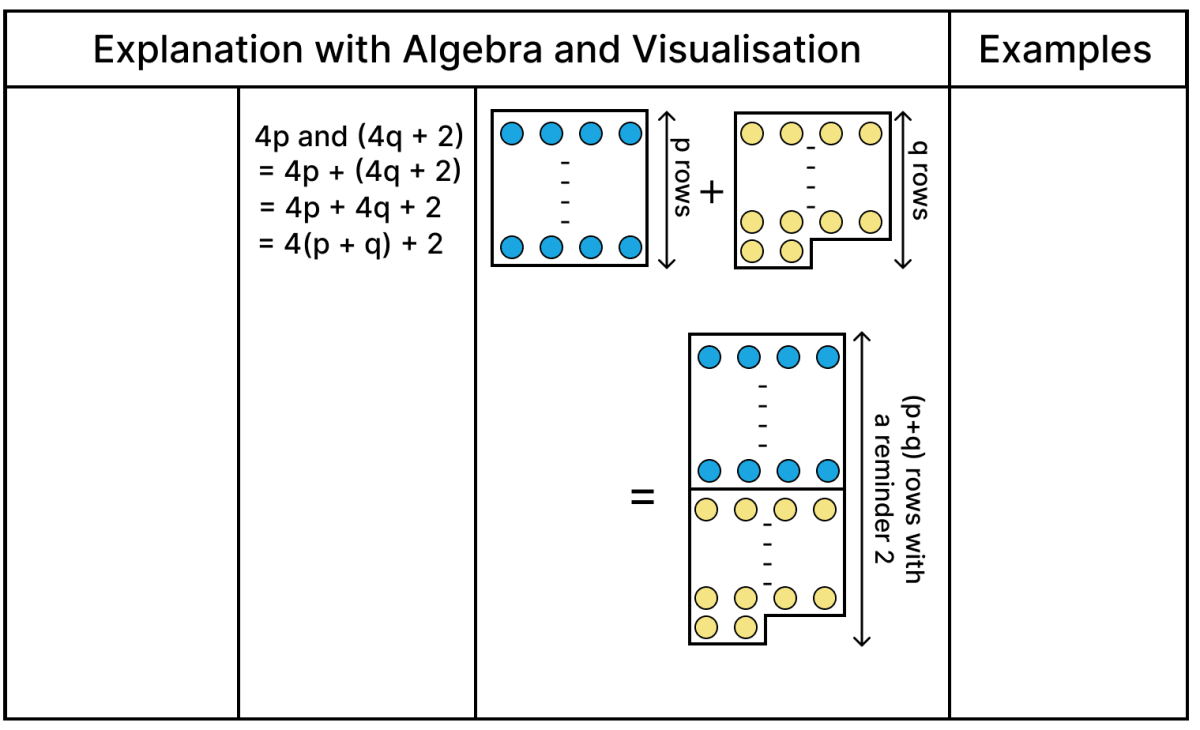
What happens when we add a multiple of 4 to an even number that is not a multiple of 4?
(i) Is it similar to the case of the parity of the sum of an even and an odd number?
(ii) Look at the following expressions and the visualisation. Write the corresponding explanation and examples.
Answer
Let the multiple of 4 be 4p and the even number that is not a multiple of 4 be (4q + 2).
4p + (4q + 2)
= 4p + 4q + 2
= 4(p + q) + 2
The sum is 4(p + q) + 2, which leaves a remainder of 2 when divided by 4. So the sum is not a multiple of 4.
(i) Yes, this is similar to the parity of the sum of an even number and an odd number.
(ii) Here a "multiple of 4" plays the role of an "even number" and a "number that is not a multiple of 4 (remainder 2)" plays the role of an "odd number". Just as even + odd = odd, adding a multiple of 4 to a non-multiple of 4 again gives a non-multiple of 4.
Examples:
12 + 2 = 14 = 4(3) + 2
8 + 6 = 14 = 4(3) + 2
20 + 10 = 30 = 4(7) + 2
In each case the sum leaves a remainder of 2 and is not a multiple of 4.
Hence, adding a multiple of 4 to an even number that is not a multiple of 4 always gives a number that is not a multiple of 4, exactly as adding an even number to an odd number always gives an odd number.
If 8 exactly divides two numbers separately, it must exactly divide their sum. This statement is always true. Determine if it is also true with subtraction.
Answer
If 8 exactly divides two numbers, then the two numbers are multiples of 8, so they can be written as 8a and 8b.
Their difference is:
8a – 8b = 8(a – b)
Since 8 is a factor of 8(a – b), the number 8 exactly divides the difference as well.
Example:
8 exactly divides 56 and 24 separately. Their difference is 56 – 24 = 32 = 8 × 4, which is also divisible by 8.
In general, if a divides M and a divides N, then a divides M – N as well, just as a divides M + N.
Hence, if 8 exactly divides two numbers separately, it must also exactly divide their difference; the statement is true for subtraction too.
Examine each of the following statements, and determine whether it is 'Always true', 'Sometimes true', or 'Never true'.
(i) If a number is divisible by both 9 and 4, it must be divisible by 36.
(ii) If a number is divisible by both 6 and 4, it must be divisible by 24.
Answer
If A is divisible by k and A is also divisible by m, then A is divisible by the LCM of k and m. This is because A's prime factorisation must contain the prime factorisation of the LCM of k and m.
(i) If a number is divisible by both 9 and 4, it must be divisible by 36.
Here,
9 = 3 × 3
4 = 2 × 2
They have no common prime factor, so LCM(9, 4) = 9 × 4 = 36.
A number divisible by both 9 and 4 must contain the prime factors of both, that is, 2 × 2 × 3 × 3 = 36.
So such a number must be divisible by 36.
Examples:
72 = 36 × 2 is divisible by 9 and 4 and also by 36
180 = 36 × 5 is divisible by 9 and 4 and also by 36.
So this statement is always true
(ii) If a number is divisible by both 6 and 4, it must be divisible by 24.
Here,
6 = 2 × 3
4 = 2 × 2
They share the common factor 2, so LCM(6, 4) = 12, not 24.
A number divisible by both 6 and 4 must be divisible by 12, but it need not be divisible by 24.
Example:
24 is divisible by 6 and 4 and also by 24.
Non-example:
12 is divisible by both 6 and 4, but it is not divisible by 24
similarly, 36 is divisible by both 6 and 4, but not by 24.
So this statement is sometimes true
(a) Find a number that has a remainder of 3 when divided by 5. Write more such numbers.
(b) Which algebraic expression(s) capture all numbers?
(i) 3k + 5
(ii) 3k – 5
(iii)
(iv) 5k + 3
(v) 5k – 2
(vi) 5k – 3
Answer
(a) A number that has a remainder of 3 when divided by 5 is 3 more than a multiple of 5.
The smallest such number is 3, because 3 = 5 × 0 + 3.
Writing more such numbers by adding 5 each time:
3 = 5 × 0 + 3
8 = 5 × 1 + 3
13 = 5 × 2 + 3
18 = 5 × 3 + 3
23 = 5 × 4 + 3
Hence, the numbers 3, 8, 13, 18, 23, … each leave a remainder of 3 when divided by 5, and they are all 3 more than a multiple of 5.
(b) A number that leaves a remainder of 3 when divided by 5 is 3 more than a multiple of 5.
Since multiples of 5 are of the form 5k, such numbers are of the form 5k + 3.
Checking each expression:
(i) 3k + 5
If k = 0:
3k + 5 = 5 → remainder 0
If k = 1:
3k + 5 = 8 → remainder 3
If k = 2:
3k + 5 = 11 → remainder 1
The remainder is not always 3, so it does not capture these numbers.
(ii) 3k – 5
If k = 2:
3k - 5 = 1 → remainder 1
If k = 3:
3k - 5 = 4 → remainder 4
The remainder is not always 3, so it does not capture these numbers.
(iii)
This does not even give a whole number for most values of k, so it does not capture these numbers.
(iv) 5k + 3
If k = 0:
5k + 3 = 3 → remainder 3
If k = 1:
5k + 3 = 8 → remainder 3
If k = 2:
5k + 3 = 13 → remainder 3
The remainder is always 3, so it captures all these numbers.
(v) 5k – 2
If k = 1:
5k – 2 = 3 → remainder 3
If k = 2:
5k – 2 = 8 → remainder 3
If k = 3:
5k – 2 = 13 → remainder 3
The remainder is always 3, so it captures all these numbers.
(vi) 5k – 3
If k = 1:
5k – 3 = 2 → remainder 2
If k = 2:
5k – 3 = 7 → remainder 2
If k = 3:
5k – 3 = 12 → remainder 2
The remainder is 2, not 3, so it does not capture these numbers.
Are there other expressions that generate numbers that are 3 more than a multiple of 5?
Answer
The numbers that are 3 more than a multiple of 5 are those of the form 5k + 3, where k is an integer:
…, – 7, – 2, 3, 8, 13, 18, 23, …
We have already seen two expressions that generate them: 5k + 3 and 5k – 2.
Yes, there are many other such expressions. Any expression of the form 5k + c works, where k is an integer and c leaves a remainder of 3 when divided by 5 (that is, c = …, – 7, – 2, 3, 8, 13, …). This is because every such expression can be rewritten in the form 5(…) + 3.
For example:
5k + 8 = 5k + 5 + 3 = 5(k + 1) + 3
5k – 7 = 5k – 10 + 3 = 5(k – 2) + 3
5k + 13 = 5k + 10 + 3 = 5(k + 2) + 3
Each of these expressions gives numbers that are 3 more than a multiple of 5.
Hence, there are infinitely many such expressions, such as 5k + 8, 5k − 7, and 5k + 13.
The sum of four consecutive numbers is 34. What are these numbers?
Answer
Let the four consecutive numbers be n, n + 1, n + 2 and n + 3.
Their sum is:
n + (n + 1) + (n + 2) + (n + 3) = 4n + 6
Since the sum is given to be 34:
4n + 6 = 34
4n = 28
n = 7
So the four numbers are 7, 8, 9 and 10.
Check: 7 + 8 + 9 + 10 = 34.
Hence, the four consecutive numbers are 7, 8, 9 and 10.
Suppose p is the greatest of five consecutive numbers. Describe the other four numbers in terms of p.
Answer
Since p is the greatest of the five consecutive numbers, the remaining numbers must be smaller than p and come just before it.
The number immediately before p is p − 1, the number before that is p − 2, then p − 3, and then p − 4.
Therefore, the five consecutive numbers in increasing order are:
p – 4, p – 3, p – 2, p – 1, p
Hence, the other four numbers in terms of p are p − 1, p − 2, p − 3 and p − 4.
For each statement below, determine whether it is always true, sometimes true, or never true. Explain your answer. Mention examples and non-examples as appropriate. Justify your claim using algebra.
(i) The sum of two even numbers is a multiple of 3.
(ii) If a number is not divisible by 18, then it is also not divisible by 9.
(iii) If two numbers are not divisible by 6, then their sum is not divisible by 6.
(iv) The sum of a multiple of 6 and a multiple of 9 is a multiple of 3.
(v) The sum of a multiple of 6 and a multiple of 3 is a multiple of 9.
Answer
(i) The sum of two even numbers is a multiple of 3.
Let the two even numbers be 2m and 2n.
Their sum is:
2m + 2n = 2(m + n)
This shows that the sum of two even numbers is always even, but it need not always have 3 as a factor.
Example:
6 + 12 = 18 = 3 × 6, which is a multiple of 3.
Non-example:
2 + 6 = 8, which is not a multiple of 3.
Hence, the statement is sometimes true.
(ii) If a number is not divisible by 18, then it is also not divisible by 9.
Every multiple of 18 is a multiple of 9, but every multiple of 9 need not be a multiple of 18.
A multiple of 9 can be written as 9k. It is divisible by 18 only when k is even.
Example:
7 is not divisible by 18 and is also not divisible by 9, so the statement is true.
Non-example:
9 is not divisible by 18 but is divisible by 9, so the statement is false.
Hence, the statement is sometimes true.
(iii) If two numbers are not divisible by 6, then their sum is not divisible by 6.
A number that is not divisible by 6 can leave a remainder of 1, 2, 3, 4 or 5 when divided by 6.
Sometimes, the sum of these remainders can make the total divisible by 6.
Example:
4 and 5 are not divisible by 6. Their sum is:
4 + 5 = 9, which is not divisible by 6.
Non-example:
2 and 4 are not divisible by 6, but
2 + 4 = 6, which is divisible by 6.
Hence, the statement is sometimes true.
(iv) The sum of a multiple of 6 and a multiple of 9 is a multiple of 3.
Let the multiple of 6 be 6a and the multiple of 9 be 9b.
Their sum is:
6a + 9b = 3(2a + 3b)
Since 3 is a factor of the sum, it is always a multiple of 3.
Example:
12 + 18 = 30 = 3 × 10
Hence, the statement is always true.
(v) The sum of a multiple of 6 and a multiple of 3 is a multiple of 9.
Let the multiple of 6 be 6a and the multiple of 3 be 3b.
Their sum is:
6a + 3b = 3(2a + b)
This shows that the sum is always a multiple of 3, but it need not always be a multiple of 9.
Example:
6 + 3 = 9, which is a multiple of 9.
Non-example:
6 + 6 = 12, which is not a multiple of 9.
Hence, the statement is sometimes true.
Find a few numbers that leave a remainder of 2 when divided by 3 and a remainder of 2 when divided by 4. Write an algebraic expression to describe all such numbers.
Answer
A number that leaves a remainder of 2 when divided by 3 is 2 more than a multiple of 3.
Similarly, a number that leaves a remainder of 2 when divided by 4 is 2 more than a multiple of 4.
Therefore, if we subtract 2 from such a number, the remaining number must be divisible by both 3 and 4.
The least common multiple of 3 and 4 is:
LCM (3, 4) = 12
So the required numbers must be 2 more than multiples of 12.
Therefore, all such numbers can be represented as:
12k + 2, where k is an integer.
For different values of k:
- k = 0 → 12(0) + 2 = 2
- k = 1 → 12(1) + 2 = 14
- k = 2 → 12(2) + 2 = 26
- k = 3 → 12(3) + 2 = 38
So a few such numbers are:
2, 14, 26, 38, 50, …
Check for 14:
14 ÷ 3 gives quotient 4 and remainder 2.
14 ÷ 4 gives quotient 3 and remainder 2.
Hence, all such numbers are described by the expression 12k + 2, and a few examples are 2, 14, 26, 38 and 50.
"I hold some pebbles, not too many, When I group them in 3's, one stays with me. Try pairing them up — it simply won't do, A stubborn odd pebble remains in my view. Group them by 5, yet one's still around, But grouping by seven, perfection is found. More than one hundred would be far too bold, Can you tell me the number of pebbles I hold?"

Answer
Let the number of pebbles be N.
From the given clues:
- Grouping in 3's leaves one pebble, so N leaves a remainder of 1 when divided by 3.
- Pairing them up leaves one pebble, so N leaves a remainder of 1 when divided by 2.
- Grouping in 5's leaves one pebble, so N leaves a remainder of 1 when divided by 5.
- Grouping by 7 leaves no pebble, so N is a multiple of 7.
- The number of pebbles is less than 100.
Since N leaves a remainder of 1 when divided by 2, 3 and 5, the number N − 1 must be divisible by 2, 3 and 5.
Now,
LCM of 2, 3 and 5 = 30
Therefore, N − 1 must be a multiple of 30.
So the possible values of N are:
N = 1, 31, 61, 91, 121, …
Since the number must be less than 100, we consider:
1, 31, 61, 91
Among these numbers,
91 = 7 × 13
So, 91 is divisible by 7.
Checking:
91 ÷ 3 = 30 remainder 1
91 ÷ 2 = 45 remainder 1
91 ÷ 5 = 18 remainder 1
91 ÷ 7 = 13 remainder 0
All the conditions are satisfied.
Hence, the number of pebbles is 91.
Tathagat has written several numbers that leave a remainder of 2 when divided by 6. He claims, "If you add any three such numbers, the sum will always be a multiple of 6." Is Tathagat's claim true?
Answer
A number that leaves a remainder of 2 when divided by 6 is 2 more than a multiple of 6.
So, such numbers can be written in the form:
6k + 2, where k is an integer.
Let any three such numbers be:
6a + 2, 6b + 2 and 6c + 2
Their sum is:
(6a + 2) + (6b + 2) + (6c + 2)
= 6a + 6b + 6c + 6
= 6(a + b + c + 1)
Since the sum has 6 as a factor, it is always a multiple of 6.
For example:
8 + 14 + 20 = 42 = 6 × 7
2 + 8 + 26 = 36 = 6 × 6
In both cases, the sums are multiples of 6.
Hence, Tathagat's claim is true — the sum of any three numbers that leave a remainder of 2 when divided by 6 is always a multiple of 6.
When divided by 7, the number 661 leaves a remainder of 3, and 4779 leaves a remainder of 5. Without calculating, can you say what remainders the following expressions will leave when divided by 7? Show the solution both algebraically and visually.
(i) 4779 + 661
(ii) 4779 – 661
Answer
Since 661 leaves a remainder of 3 when divided by 7, it can be written as:
661 = 7p + 3
Since 4779 leaves a remainder of 5 when divided by 7, it can be written as:
4779 = 7q + 5
where p and q are integers.
(i) 4779 + 661
Algebraically:
4779 + 661
= (7q + 5) + (7p + 3)
= 7q + 7p + 8
= 7(p + q) + 8
= 7(p + q) + 7 + 1
= 7(p + q + 1) + 1
The expression is 1 more than a multiple of 7.
So, 4779 + 661 leaves a remainder of 1 when divided by 7.
Visually:
4779 consists of some complete groups of 7 with 5 left over.
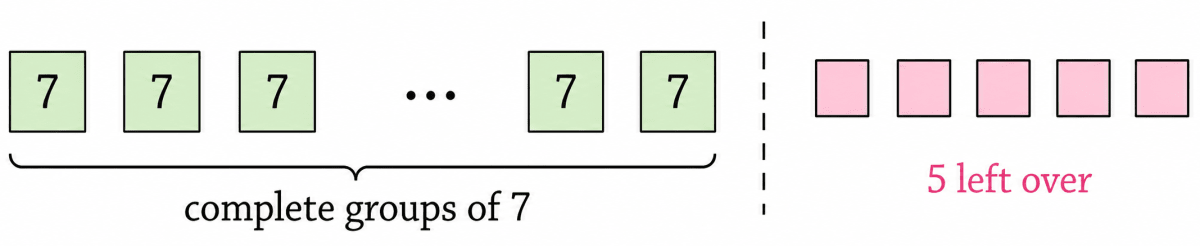
661 consists of some complete groups of 7 with 3 left over.

Adding the leftover parts:
5 + 3 = 8
Out of these 8 units, 7 units form one more complete group, leaving:
8 − 7 = 1
So the remainder is 1.

(ii) 4779 – 661
Algebraically:
4779 – 661
= (7q + 5) – (7p + 3)
= 7q – 7p + 5 – 3
= 7(q – p) + 2
The expression is 2 more than a multiple of 7.
So, 4779 − 661 leaves a remainder of 2 when divided by 7.
Visually:
4779 has complete groups of 7 with 5 units left over.
When 661 is subtracted, its complete groups of 7 are removed along with its 3 leftover units.
The remaining leftover units are:
5 − 3 = 2
So the remainder is 2.

Find a number that leaves a remainder of 2 when divided by 3, a remainder of 3 when divided by 4, and a remainder of 4 when divided by 5. What is the smallest such number? Can you give a simple explanation of why it is the smallest?
Answer
Let the required number be N.
Observe the given conditions:
- When divided by 3, the remainder is 2 (one less than 3).
- When divided by 4, the remainder is 3 (one less than 4).
- When divided by 5, the remainder is 4 (one less than 5).
So, in each case, the number is 1 less than a multiple of the divisor.
Therefore, if we add 1 to the number, N + 1 will be exactly divisible by 3, 4 and 5.
Hence, N + 1 must be a common multiple of 3, 4 and 5.
Now,
LCM of 3, 4 and 5 = 60
The smallest common multiple of 3, 4 and 5 is 60.
Therefore,
N + 1 = 60
So,
N = 60 − 1 = 59
Checking:
- 59 ÷ 3 = 19 remainder 2
- 59 ÷ 4 = 14 remainder 3
- 59 ÷ 5 = 11 remainder 4
All the conditions are satisfied.
The number 59 is the smallest because N + 1 must be a common multiple of 3, 4 and 5, and their smallest common multiple is 60. Any smaller value of N + 1 will not be divisible by all three numbers.
Hence, the smallest such number is 59, because 59 + 1 = 60 is the smallest common multiple of 3, 4 and 5.
Explain using algebra why the divisibility shortcuts for 5, 2, 4, and 8 work.
Answer
Any number can be written in general as …dcba, where the letter-numbers a, b, c, d represent the units, tens, hundreds and thousands digits, respectively.
Writing the number as a sum of place values, we get:
… + 1000d + 100c + 10b + a
Here, a is the units digit, 10b + a represents the last two digits, and 100c + 10b + a represents the last three digits.
Divisibility by 2:
Since 10, 100, 1000, … are all multiples of 2,
10b, 100c, 1000d, … are also multiples of 2.
So the number can be written as:
(a multiple of 2) + a
Therefore, divisibility by 2 depends only on the units digit a.
The number is divisible by 2 if a is divisible by 2.
The possible values of a are:
0, 2, 4, 6 or 8
Divisibility by 5:
Since 10, 100, 1000, … are all multiples of 5,
10b, 100c, 1000d, … are also multiples of 5.
So the number can be written as:
(a multiple of 5) + a
Therefore, divisibility by 5 depends only on the units digit a.
The number is divisible by 5 if a is divisible by 5.
The possible values of a are:
0 or 5
Divisibility by 4:
Since 100 = 4 × 25, 100 and all higher place values are multiples of 4.
So,
100c, 1000d, … are multiples of 4.
The number can be written as:
(a multiple of 4) + (10b + a)
The part 10b + a represents the number formed by the last two digits.
Therefore, the whole number is divisible by 4 if the number formed by its last two digits is divisible by 4.
Divisibility by 8:
Since 1000 = 8 × 125, 1000 and all higher place values are multiples of 8.
So,
1000d, 10000e, … are multiples of 8.
The number can be written as:
(a multiple of 8) + (100c + 10b + a)
The part 100c + 10b + a represents the number formed by the last three digits.
Therefore, the whole number is divisible by 8 if the number formed by its last three digits is divisible by 8.
Hence, divisibility by 2 and 5 depends on the units digit, divisibility by 4 depends on the last two digits, and divisibility by 8 depends on the last three digits because the remaining place values are already multiples of these numbers.
Can you say, without actually calculating, which of these numbers are divisible by 9: 999, 909, 900, 90, 990?
Answer
The given numbers are:
999, 909, 900, 90 and 990
Each number is made up only of the digits 9 and 0.
In the expanded form of these numbers, every term is either:
9 × a place value, or
0 × a place value
Since the place values 1, 10, 100, ... leave a remainder of 1 when divided by 9, each term containing digit 9 becomes a multiple of 9.
For example,
909 = 9 × 100 + 0 × 10 + 9 × 1
= 900 + 0 + 9
Here,
900 = 9 × 100 and 9 = 9 × 1
Both terms are multiples of 9.
So, 909 is divisible by 9.
Similarly, all the other given numbers can be written as sums of multiples of 9.
Hence, all the given numbers — 999, 909, 900, 90 and 990 — are divisible by 9.
Can we say that any number made up of only the digits '0' and '9', in any order, will always be divisible by 9?
Answer
Yes, any number made up of only the digits 0 and 9 is always divisible by 9.
Consider such a number. In its expanded form, each term will have a digit multiplied by its place value.
Since every digit is either 0 or 9, each term will be of the form:
9 × (a place value), or
0 × (a place value)
Both are multiples of 9.
Therefore, the number becomes a sum of multiples of 9, which is again a multiple of 9.
For example:
99009 = 9 × 10000 + 9 × 1000 + 0 × 100 + 0 × 10 + 9 × 1
= 90000 + 9000 + 0 + 0 + 9
Each term is a multiple of 9, so 99009 is divisible by 9.
Hence, any number made up of only the digits 0 and 9, in any order, is always divisible by 9.
Is 10 divisible by 9? If not, what is the remainder? Check the divisibility of other multiples of 10 (10, 20, 30, ...) by 9.
Answer
No, 10 is not divisible by 9.
We can write:
10 = 9 × 1 + 1
So, when 10 is divided by 9, it leaves a remainder of 1.
Now, checking other multiples of 10:
20 = 10 × 2 = (9 + 1) × 2 = 18 + 2
So, 20 leaves a remainder of 2.
30 = 10 × 3 = (9 + 1) × 3 = 27 + 3
So, 30 leaves a remainder of 3.
Similarly,
- 40 ÷ 9 → remainder 4
- 50 ÷ 9 → remainder 5
- 60 ÷ 9 → remainder 6
- 70 ÷ 9 → remainder 7
- 80 ÷ 9 → remainder 8
- 90 ÷ 9 → remainder 0
In general, for a multiple of 10:
10k = (9 + 1)k
= 9k + k
Since 9k is divisible by 9, the remainder depends on k, the number of tens.
Hence, 10 is not divisible by 9 and leaves a remainder of 1. For multiples of 10, the remainder on division by 9 follows the number of tens, reducing again after reaching 9.
Look at the remainder when the multiples of 100 (100, 200, 300, …) are divided by 9. What do you notice?
Answer
First, check the remainder of 100 when divided by 9.
We can write:
100 = 9 × 11 + 1
So, 100 leaves a remainder of 1 when divided by 9.
Now, checking other multiples of 100:
200 = 100 × 2 = (99 + 1) × 2
= 198 + 2
So, 200 leaves a remainder of 2.
300 = 100 × 3 = (99 + 1) × 3
= 297 + 3
So, 300 leaves a remainder of 3.
Similarly,
- 400 ÷ 9 → remainder 4
- 500 ÷ 9 → remainder 5
- 600 ÷ 9 → remainder 6
- 700 ÷ 9 → remainder 7
- 800 ÷ 9 → remainder 8
- 900 ÷ 9 → remainder 0
In general, for a multiple of 100:
100k = (99 + 1)k
= 99k + k
Since 99k is divisible by 9, the remainder depends on k, the number of hundreds.
Hence, the remainder left by a multiple of 100 on division by 9 is the same as its number of hundreds, reducing again after reaching 9.
Look at each of the following statements. Which are correct and why?
(i) If a number is divisible by 9, then the sum of its digits is divisible by 9.
(ii) If the sum of the digits of a number is divisible by 9, then the number is divisible by 9.
(iii) If a number is not divisible by 9, then the sum of its digits is not divisible by 9.
(iv) If the sum of the digits of a number is not divisible by 9, then the number is not divisible by 9.
Answer
We know that any number can be written as:
Number = (a multiple of 9) + (sum of its digits)
This means a number and the sum of its digits leave the same remainder when divided by 9.
Using this idea:
(i) If a number is divisible by 9, it leaves a remainder of 0 when divided by 9.
Since the number and its digit sum leave the same remainder, the sum of its digits must also leave a remainder of 0.
Therefore, the sum of its digits is divisible by 9.
So, statement (i) is correct.
(ii) If the sum of the digits is divisible by 9, the digit sum leaves a remainder of 0.
Since the number has the same remainder as its digit sum, the number also leaves a remainder of 0 when divided by 9.
Therefore, the number is divisible by 9.
So, statement (ii) is correct.
(iii) If a number is not divisible by 9, it leaves a remainder other than 0.
Since the digit sum has the same remainder as the number, the digit sum also cannot be divisible by 9.
So, statement (iii) is correct.
(iv) If the digit sum is not divisible by 9, it leaves a non-zero remainder.
Since the number and its digit sum have the same remainder when divided by 9, the number also cannot be divisible by 9.
So, statement (iv) is correct.
Find, without dividing, whether the following numbers are divisible by 9.
(i) 123
(ii) 405
(iii) 8888
(iv) 93547
(v) 358095
Answer
A number is divisible by 9 if and only if the sum of its digits is divisible by 9.
So, we check the sum of the digits of each number.
(i) 123
Sum of digits:
1 + 2 + 3 = 6
Since 6 is not divisible by 9, 123 is not divisible by 9.
(ii) Sum of digits:
4 + 0 + 5 = 9
Since 9 is divisible by 9, 405 is divisible by 9.
(iii) 8888: Sum of digits:
8 + 8 + 8 + 8 = 32
Since 32 is not divisible by 9, 8888 is not divisible by 9.
(iv) 93547:
Sum of digits:
9 + 3 + 5 + 4 + 7 = 28
Since 28 is not divisible by 9, 93547 is not divisible by 9.
(v) 358095
Sum of digits:
3 + 5 + 8 + 0 + 9 + 5 = 30
Since 30 is not divisible by 9, 358095 is not divisible by 9.
Find the smallest multiple of 9 with no odd digits.
Answer
A number with no odd digits means all its digits must be even.
The possible digits are:
0, 2, 4, 6 and 8
For a number to be a multiple of 9, the sum of its digits must be divisible by 9.
The smallest positive multiple of 9 is 9, but the sum of even digits is always even, so the digit sum cannot be 9.
The next possible multiple of 9 is 18
So, the digit sum must be at least 18.
Now, check the number of digits:
A two-digit number cannot work because the largest possible digit sum using two even digits is:
8 + 8 = 16
which is less than 18.
Therefore, the required number must have at least three digits.
To get the smallest three-digit number, choose the smallest possible hundreds digit.
The smallest non-zero even digit is 2.
The remaining digit sum needed is:
18 − 2 = 16
The only way to get 16 using two even digits (each at most 8) is:
8 + 8 = 16
So the number is:
288
Checking:
All digits of 288 are even
Digit sum = 2 + 8 + 8 = 18, which is divisible by 9
Therefore, 288 is divisible by 9
Hence, the smallest multiple of 9 with no odd digits is 288.
Find the multiple of 9 that is closest to the number 6000.
Answer
To find the closest multiple of 9 to 6000, divide 6000 by 9.
So, 6000 lies between the two multiples:
9 × 666 and 9 × 667
Now,
9 × 666 = 5994
and
9 × 667 = 6003
Compare their distances from 6000:
6000 − 5994 = 6
6003 − 6000 = 3
Since 3 < 6, 6003 is closer to 6000.
Checking:
Sum of digits of 6003:
6 + 0 + 0 + 3 = 9
Since the digit sum is divisible by 9, 6003 is a multiple of 9.
Hence, the multiple of 9 closest to 6000 is 6003.
How many multiples of 9 are there between the numbers 4300 and 4400?
Answer
First, find the smallest multiple of 9 greater than 4300.
9 × 478 = 4302
So, the first multiple of 9 after 4300 is:
4302
Now, find the largest multiple of 9 less than 4400.
9 × 488 = 4392
So, the last multiple of 9 before 4400 is:
4392
Therefore, the multiples of 9 between 4300 and 4400 are:
4302, 4311, 4320, …, 4392
These are:
9 × 478, 9 × 479, 9 × 480, …, 9 × 488
Number of multiples:
488 − 478 + 1 = 11
Hence, there are 11 multiples of 9 between 4300 and 4400.
The shortcut to find the divisibility by 3 is similar to the method for 9. A number is divisible by 3 if the sum of its digits is divisible by 3. Explore the remainders when powers of 10 are divided by 3. Explain why this method works.
Answer
First, observe the remainders obtained when powers of 10 are divided by 3.
10⁰ = 1 = 3 × 0 + 1 → remainder 1
10¹ = 10 = 3 × 3 + 1 → remainder 1
10² = 100 = 3 × 33 + 1 → remainder 1
10³ = 1000 = 3 × 333 + 1 → remainder 1
Thus, every power of 10 leaves a remainder of 1 when divided by 3.
Now, consider a four-digit number with digits a, b, c and d.
Using place value, the number can be written as:
1000a + 100b + 10c + d
Since each place value is 1 more than a multiple of 3, we can write:
1000a + 100b + 10c + d
= (3 × 333 + 1)a + (3 × 33 + 1)b + (3 × 3 + 1)c + d
Expanding and grouping:
= (3 × 333a + 3 × 33b + 3 × 3c) + (a + b + c + d)
= 3(333a + 33b + 3c) + (a + b + c + d)
The first part,
3(333a + 33b + 3c)
is a multiple of 3.
So, the divisibility of the number depends only on:
a + b + c + d
which is the sum of its digits.
Therefore, a number is divisible by 3 if and only if the sum of its digits is divisible by 3.
Hence, the method works because every power of 10 leaves a remainder of 1 when divided by 3, making the number and its digit sum leave the same remainder on division by 3.
Can you tell whether the number 462 is divisible by 11?
Answer
To check divisibility by 11, we look at how each place value behaves when divided by 11.
The place values give alternating remainders:
1 = 11 × 0 + 1 → 1 more than a multiple of 11
10 = 11 × 1 − 1 → 1 less than a multiple of 11
100 = 11 × 9 + 1 → 1 more than a multiple of 11
So, the digits contribute alternately with + and − signs.
Now consider the number 462.
Using place values:
462 = 4 × 100 + 6 × 10 + 2 × 1
= 400 + 60 + 2
Now,
400 = 396 + 4 = 11 × 36 + 4
So it contributes +4.
60 = 66 − 6 = 11 × 6 − 6
So it contributes −6.
2 = 11 × 0 + 2
So it contributes +2.
Combining these contributions:
4 − 6 + 2 = 0
Since 0 is a multiple of 11, the extra parts cancel out completely.
Therefore, 462 is divisible by 11.
Checking:
462 = 11 × 42
Hence, 462 is divisible by 11 because the alternating sum of its digits, 4 − 6 + 2, is a multiple of 11.
What could be a general method or shortcut to check divisibility by 11?
Answer
The place values of a number, taken from the units digit, are alternately 1 more and 1 less than a multiple of 11:
units (1) → 1 more, tens (10) → 1 less, hundreds (100) → 1 more, thousands (1000) → 1 less, and so on.
Because of this alternating pattern, the shortcut is to take the alternating sum of the digits. Starting from the units digit:
add the digits in the 1st, 3rd, 5th, … places (units, hundreds, ten-thousands, …),
add the digits in the 2nd, 4th, 6th, … places (tens, thousands, lakhs, …),
and find the difference between these two sums.
If this difference is 0 or a multiple of 11, the number is divisible by 11; otherwise it is not.
For example, for 462 the difference is (2 + 4) – 6 = 0, so 462 is divisible by 11.
Hence, a number is divisible by 11 if the difference between the sum of the digits in alternate places is 0 or a multiple of 11.
(a) The difference between these two sums 8 – 11 = –3, indicating that the number 3,28,105 is 3 short of or 8 more than a multiple of 11. If this difference is 11 or a multiple of 11, what does that say about the remainder obtained when the number is divisible by 11?
(b) Using this shortcut, find out whether the following numbers are divisible by 11. Further, find the remainder if a number is not divisible by 11.
(i) 158
(ii) 841
(iii) 481
(iv) 5529
(v) 90904
(vi) 857076
(c) Is this method similar to or different from the method we saw just before?
Answer
(a)
If the difference is 11 or any multiple of 11, it leaves a remainder of 0 when divided by 11.
Therefore, the original number also leaves a remainder of 0 when divided by 11.
Hence, the number is divisible by 11.
(b)
(i) 158
Alternating sum = 8 – 5 + 1 = 4
Therefore, the remainder is 4. It is not divisible by 11.
(ii) 841
Alternating sum = 1 – 4 + 8 = 5
Therefore, the remainder is 5. It is not divisible by 11.
(iii) 481
Alternating sum = 1 – 8 + 4 = –3
This means the number is 3 less than a multiple of 11, or equivalently 8 more than the preceding multiple of 11.
Therefore, the remainder is 8. It is not divisible by 11.
(iv) 5529
Alternating sum = 9 – 2 + 5 – 5 = 7
Therefore, the remainder is 7. It is not divisible by 11.
(v) 90904
Alternating sum = 4 – 0 + 9 – 0 + 9 = 22
Since 22 is a multiple of 11, 90904 is divisible by 11.
(vi) 857076
Alternating sum = 6 – 7 + 0 – 7 + 5 – 8 = –11
Since –11 is a multiple of 11, 857076 is divisible by 11.
Hence, the remainders are 4, 5, 8 and 7 for 158, 841, 481 and 5529, respectively, while 90904 and 857076 are divisible by 11.
(c)
It is similar in idea but different in detail.
It is similar because both shortcuts come from the same source — looking at the remainders that the powers of 10 leave when divided by the divisor.
It is different in the way the digits are combined.
For 9 (and for 3), every power of 10 leaves a remainder of 1, so all the digits are simply added with the same sign.
For 11, the powers of 10 leave remainders that alternate between 1 more and 1 less than a multiple of 11, so the digits are combined with alternating + and – signs (an alternating sum) instead of a plain sum.
Hence, the two methods rest on the same idea, but the divisibility-by-9 method uses the ordinary sum of the digits, while the divisibility-by-11 method uses the alternating sum of the digits.
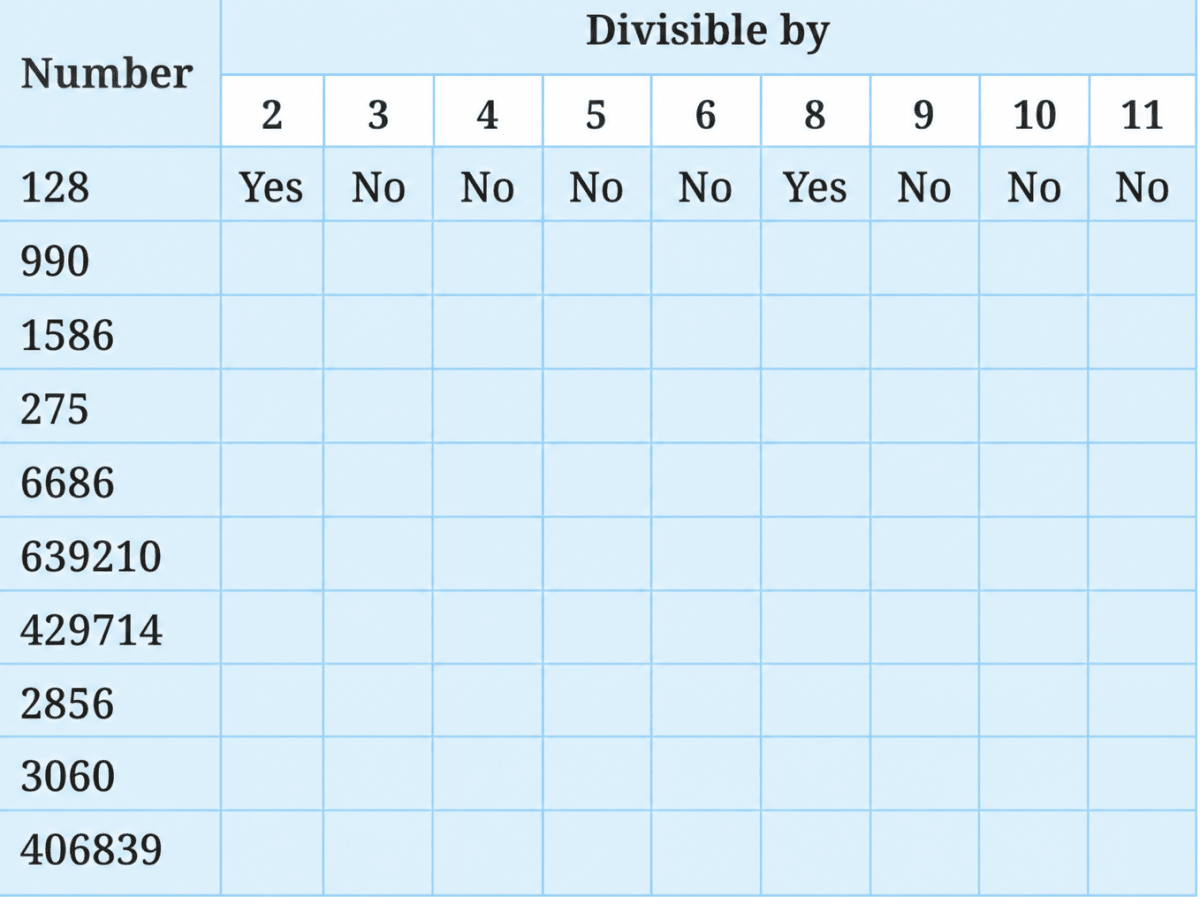
Fill in the following table. Find a quick way to do this?
Answer
The completed table is:
| Number | 2 | 3 | 4 | 5 | 6 | 8 | 9 | 10 | 11 |
|---|---|---|---|---|---|---|---|---|---|
| 128 | Yes | No | Yes | No | No | Yes | No | No | No |
| 990 | Yes | Yes | No | Yes | Yes | No | Yes | Yes | Yes |
| 1586 | Yes | No | No | No | No | No | No | No | No |
| 275 | No | No | No | Yes | No | No | No | No | Yes |
| 6686 | Yes | No | No | No | No | No | No | No | No |
| 639210 | Yes | Yes | No | Yes | Yes | No | No | Yes | Yes |
| 429714 | Yes | Yes | No | No | Yes | No | Yes | No | No |
| 2856 | Yes | Yes | Yes | No | Yes | Yes | No | No | No |
| 3060 | Yes | Yes | Yes | Yes | Yes | No | Yes | Yes | No |
| 406839 | No | Yes | No | No | No | No | No | No | No |
Quick way to do this is:
Divisible by 2 → last digit is even.
Divisible by 3 → sum of digits is divisible by 3.
Divisible by 4 → last two digits are divisible by 4.
Divisible by 5 → last digit is 0 or 5.
Divisible by 6 → divisible by both 2 and 3.
Divisible by 8 → last three digits are divisible by 8.
Divisible by 9 → sum of digits is divisible by 9.
Divisible by 10 → last digit is 0.
Divisible by 11 → difference between the sums of alternate digits is 0 or a multiple of 11.
How can we find out if a number is divisible by 6? Will checking its divisibility by its factors 2 and 3 work? Use the shortcuts for 2 and 3 on these numbers and divide each number by 6 to verify— 38, 225, 186, 64.
Answer
Since 6 = 2 × 3 and 2 and 3 are co-prime, a number is divisible by 6 if and only if it is divisible by both 2 and 3.
Therefore, we can use the divisibility tests:
A number is divisible by 2 if its units digit is even.
A number is divisible by 3 if the sum of its digits is divisible by 3.
Let us check each number.
38 → Units digit = 8, so 38 is divisible by 2.
Sum of digits = 3 + 8 = 11, which is not divisible by 3.
Therefore, 38 is not divisible by 6.
225 → Units digit = 5, so 225 is not divisible by 2.
Sum of digits = 2 + 2 + 5 = 9, which is divisible by 3.
Since it is not divisible by 2, it is not divisible by 6.
186 → Units digit = 6, so 186 is divisible by 2.
Sum of digits = 1 + 8 + 6 = 15, which is divisible by 3.
Since it is divisible by both 2 and 3, it is divisible by 6.
64 → Units digit = 4, so 64 is divisible by 2.
Sum of digits = 6 + 4 = 10, which is not divisible by 3.
Therefore, 64 is not divisible by 6.
In every case the result of the 2-and-3 test agrees with the result of dividing by 6.
Hence, a number is divisible by 6 if and only if it is divisible by both 2 and 3. Among the given numbers, only 186 is divisible by 6.
How about checking divisibility by 24? Will checking the divisibility by its factors, 4 and 6, work? Why or why not?
Answer
Checking divisibility by 4 and 6 does not always work for 24.
The reason is that 4 and 6 are not co-prime — they share the common factor 2 (4 = 2 × 2 and 6 = 2 × 3). A number divisible by both 4 and 6 is only guaranteed to be divisible by their LCM, and
LCM of 4 and 6 = 12, not 24.
So passing the 4-test and the 6-test only ensures divisibility by 12.
Non-example: 36 is divisible by 4 (36 ÷ 4 = 9) and by 6 (36 ÷ 6 = 6), but 36 ÷ 24 = 1 remainder 12, so 36 is not divisible by 24. This shows the test by 4 and 6 fails.
Hence, checking divisibility by 4 and 6 does not work for 24, because 4 and 6 are not co-prime and their LCM is only 12, not 24.
Explain using prime factorisation why checking divisibility by 3 and 8 works for checking divisibility by 24, but checking divisibility by 4 and 6 is not sufficient for checking divisibility by 24.
Answer
The prime factorisation of 24 is:
24 = 2 × 2 × 2 × 3 = 23 × 3
To be sure a number is divisible by 24, it must contain the factors 23 and 3.
Checking by 3 and 8. Here 8 = 23 and 3 = 3, and these two have no common factor. A number divisible by 8 must contain 23, and a number divisible by 3 must contain the factor 3. Together they supply 23 × 3 = 24 with nothing missing and nothing overlapping. So divisibility by 3 and 8 guarantees divisibility by 24.
Checking by 4 and 6. Here 4 = 22 and 6 = 2 × 3. A number divisible by both must contain 22 (from 4) and 2 × 3 (from 6). But the single factor of 2 inside 6 overlaps with the factors of 2 inside 4 — we cannot be sure the number really has three 2’s. Taking the LCM, 4 and 6 together only guarantee 22 × 3 = 12, not 23 × 3 = 24. A number such as 12 or 36 has only two factors of 2, so it can be divisible by 4 and 6 yet fail to be divisible by 24.
In general, checking divisibility by a collection of numbers is sufficient for checking divisibility by a target number when the LCM of those numbers equals the target number.
Here,
LCM(3, 8) = 24
but
LCM(4, 6) = 12.
Hence, checking divisibility by 3 and 8 guarantees divisibility by 24 because their LCM is 24, whereas checking divisibility by 4 and 6 guarantees only divisibility by 12.
Take a number. Add its digits repeatedly till you get a single-digit number. This single-digit number is called the digital root of the number. For example, the digital root of the number 489710 will be 2 (4 + 8 + 9 + 7 + 1 + 0 = 29, 2 + 9 = 11, 1 + 1 = 2).
What property do you think this digital root will have? Recall that we did this while finding the divisibility shortcut for 9.
Answer
The digital root of a number is the single digit obtained by repeatedly adding its digits.
Its key property is that the digital root equals the remainder when the number is divided by 9 — except that when this remainder is 0 (that is, when the number is a multiple of 9), the digital root is taken as 9 rather than 0.
This is because each power of 10 leaves a remainder of 1 when divided by 9, so a number and the sum of its digits leave the same remainder on division by 9. Adding the digits again and again does not change this remainder, so the final single digit carries the same remainder as the original number.
Hence, the digital root of a number is the same as its remainder on division by 9, with multiples of 9 having a digital root of 9.
Between the numbers 600 and 700, which numbers have the digital root:
(i) 5
(ii) 7
(iii) 3
Answer
A number has:
digital root 5 if it leaves a remainder of 5 when divided by 9,
digital root 7 if it leaves a remainder of 7 when divided by 9,
digital root 3 if it leaves a remainder of 3 when divided by 9.
Numbers with the same digital root occur at intervals of 9.
Since
600 = 9 × 66 + 6,
600 has digital root 6.
(i) Digital root 5: The first number greater than 600 with digital root 5 is 608.
Adding 9 repeatedly gives:
608, 617, 626, 635, 644, 653, 662, 671, 680, 689, 698
(ii) Digital root 7: The first number greater than 600 with digital root 7 is 601.
Adding 9 repeatedly gives:
601, 610, 619, 628, 637, 646, 655, 664, 673, 682, 691
(iii) Digital root 3: The first number greater than 600 with digital root 3 is 606.
Adding 9 repeatedly gives:
606, 615, 624, 633, 642, 651, 660, 669, 678, 687, 696
Hence, between 600 and 700, the numbers with digital root 5 are 608, 617, ..., 698; the numbers with digital root 7 are 601, 610, ..., 691; and the numbers with digital root 3 are 606, 615, ..., 696.
Write the digital roots of any 12 consecutive numbers. What do you observe?
Answer
Take the 12 consecutive numbers 101 to 112:
101 → 2, 102 → 3, 103 → 4, 104 → 5, 105 → 6, 106 → 7, 107 → 8, 108 → 9,
109 → 1 (1 + 0 + 9 = 10 → 1), 110 → 2, 111 → 3, 112 → 4
The digital roots are: 2, 3, 4, 5, 6, 7, 8, 9, 1, 2, 3, 4.
We observe that:
- The digital root increases by 1 when the number increases by 1.
- After reaching 9, the next digital root becomes 1.
- The pattern repeats every 9 numbers.
This happens because the digital root is determined by the remainder when the number is divided by 9 (with multiples of 9 having digital root 9). As the remainders modulo 9 repeat every 9 numbers, the digital roots also repeat every 9 numbers.
Since 12 = 9 + 3,
the first three digital roots (2, 3 and 4) appear again at the end of the list.
Hence, the digital roots of consecutive numbers follow the repeating pattern 1,2,3,…,9,1,2,3,…, repeating every 9 numbers.
Now, find the digital roots of some consecutive multiples of
(i) 3
(ii) 4
(iii) 6
Answer
Each time we move to the next multiple, the digital root increases by the digital root of the common difference (taken in the digital-root sense, i.e. modulo 9).
(i) Multiples of 3: 3, 6, 9, 12, 15, 18, 21, 24, 27, …
3 → 3, 6 → 6, 9 → 9, 12 → 3, 15 → 6, 18 → 9, 21 → 3, 24 → 6, 27 → 9, …
Their digital roots are:
3, 6, 9, 3, 6, 9, 3, 6, 9,…
(ii) Multiples of 4: 4, 8, 12, 16, 20, 24, 28, 32, 36, 40, …
4 → 4, 8 → 8, 12 → 3, 16 → 7, 20 → 2, 24 → 6, 28 → 1, 32 → 5, 36 → 9, 40 → 4, …
Their digital roots are:
4, 8, 3, 7, 2, 6, 1, 5, 9, 4,…
We observe that the digital roots repeat in the cycle 4, 8, 3, 7, 2, 6, 1, 5, 9.
This cycle contains all the digital roots from 1 to 9.
(iii) Multiples of 6: 6, 12, 18, 24, 30, 36, 42, …
6 → 6, 12 → 3, 18 → 9, 24 → 6, 30 → 3, 36 → 9, 42 → 6, …
Their digital roots are:
6, 3, 9, 6, 3, 9, 6,…
We observe that the digital roots repeat in the cycle 6, 3, 9.
Thus, every multiple of 6 also has a digital root that is a multiple of 3.
From these examples, we see that the digital roots of consecutive multiples follow repeating patterns.
Hence, the digital roots of multiples of 3 repeat as 3, 6, 9; those of multiples of 4 repeat as 4, 8, 3, 7, 2, 6, 1, 5, 9; and those of multiples of 6 repeat as 6, 3, 9.
What are the digital roots of numbers that are 1 more than a multiple of 6? What do you notice? Try to explain the patterns noticed.
Answer
Numbers that are 1 more than a multiple of 6 are 7, 13, 19, 25, 31, 37, 43, 49, … Their digital roots are:
7 → 7
13 → 4 (1 + 3 = 4)
19 → 1 (1 + 9 = 10 → 1)
25 → 7 (2 + 5 = 7)
31 → 4 (3 + 1 = 4)
37 → 1 (3 + 7 = 10 → 1)
43 → 7 (4 + 3 = 7)
49 → 4 (4 + 9 = 13 → 4)
We notice that the digital roots repeat in a cycle of three: 7, 4, 1, 7, 4, 1, …
This happens because each successive number is obtained by adding 6. Since digital roots behave like remainders modulo 9, adding 6 changes the digital root by 6 each time:
7 → 4 → 1 → 7 → ⋯
After three steps, we have added
3 × 6 = 18,
and 18 is a multiple of 9. Therefore, the digital root returns to its starting value, producing a cycle of length 3
Hence, the digital roots of numbers that are 1 more than a multiple of 6 repeat in the pattern 7, 4, 1, 7, 4, 1, …, because each step adds 6 and every three steps add 18, which is a multiple of 9.
I'm made of digits, each tiniest and odd,
No shared ground with root #1—how odd!
My digits count, their sum, my root—
All point to one bold number's pursuit—
The largest odd single-digit I proudly claim.
What's my number? What's my name?
Answer
Let us read the clues one by one:
“each tiniest and odd” → all the digits are the smallest odd digit, which is 1.
“No shared ground with root #1” → the digital root of the number is not 1.
“My digits count, their sum, my root — all point to one bold number” → the number of digits, the sum of the digits, and the digital root are all equal to the same number.
“The largest odd single-digit I proudly claim” → that common number is 9 (the largest odd single-digit number).
So the number has 9 digits, each equal to 1:
111111111
For this number: the number of digits = 9, the sum of digits = 1 + 1 + 1 + 1 + 1 + 1 + 1 + 1 + 1 = 9, and the digital root = 9. All three are 9, the largest odd single-digit number, and the digital root 9 is indeed different from 1. Every clue is satisfied.
Its name, in the Indian system (11,11,11,111), is “eleven crore eleven lakh eleven thousand one hundred eleven”.
Hence, the number is 111111111, named eleven crore eleven lakh eleven thousand one hundred eleven.
The digital root of an 8-digit number is 5. What will be the digital root of 10 more than that number?
Answer
The digital root of a number behaves like its remainder on division by 9.
Since 10 leaves a remainder of 1 when divided by 9 (the digital root of 10 is 1 + 0 = 1), adding 10 increases the digital root by 1.
So, if the digital root of the number is 5, then the digital root of 10 more than it is:
5 + 1 = 6
Hence, the digital root of the number 10 more is 6.
Write any number. Generate a sequence of numbers by repeatedly adding 11. What would be the digital roots of this sequence of numbers? Share your observations.
Answer
Since 11 leaves a remainder of 2 when divided by 9, adding 11 changes the digital root in the same way as adding 2, with the values cycling from 1 to 9.
Take, for example, the number 100 (digital root 1) and keep adding 11:
100, 111, 122, 133, 144, 155, 166, 177, 188, 199, …
Their digital roots are:
100 → 1, 111 → 3, 122 → 5, 133 → 7, 144 → 9, 155 → 2, 166 → 4, 177 → 6, 188 → 8, 199 → 1, …
So the digital roots form the repeating sequence:
1, 3, 5, 7, 9, 2, 4, 6, 8, 1, …
We observe that:
- The digital root increases by 2 at each step.
- After reaching 9, the pattern continues with 2, 4, 6, 8 and then returns to 1.
- The pattern repeats every 9 terms
This happens because
11 = 9 + 2,
so adding 11 is equivalent to adding 2 as far as digital roots are concerned. After nine additions, we have added 9 × 11 = 99,
which is a multiple of 9, so the digital root returns to its starting value.
Hence, when 11 is repeatedly added, the digital root advances by 2 cyclically and repeats after every 9 terms.
What will be the digital root of the number 9a + 36b + 13?
Answer
A number and its digital root leave the same remainder when divided by 9, except that a multiple of 9 has digital root 9.
Now,
9a + 36b + 13
= 9a + 9(4b) + 9 + 4
= 9(a + 4b + 1) + 4
Since 9(a + 4b + 1) is a multiple of 9, the expression leaves a remainder of 4 when divided by 9.
Hence, the digital root of 9a + 36b + 13 is 4.
Make conjectures by examining if there are any patterns or relations between
(i) the parity of a number and its digital root.
(ii) the digital root of a number and the remainder obtained when the number is divided by 3 or 9.
Answer
(i) Parity of a number and its digital root.
There is no fixed relationship between the two. An even number can have either an even or an odd digital root (for example, 20 → 2 is even, while 14 → 5 is odd), and an odd number can also have either an even or an odd digital root (for example, 21 → 3 is odd, while 13 → 4 is even).
So the parity of a number does not decide the parity of its digital root, and vice versa.
(ii) Digital root and the remainder on division by 3 or 9.
The digital root is closely tied to these remainders:
For division by 9, the digital root is the remainder, except that a remainder of 0 (a multiple of 9) is shown as digital root 9.
For division by 3, the remainder is the same as the remainder when the digital root is divided by 3. In particular, a number is divisible by 3 exactly when its digital root is 3, 6 or 9.
So the digital root tells us at once the remainder on division by 9, and through it the remainder on division by 3.
Hence, the parity of a number has no fixed link with the parity of its digital root, while the digital root equals the remainder on division by 9 (taking 9 for a remainder of 0) and also reveals the remainder on division by 3.
Solve the cryptarithm given below.
Answer
Look at the units column first.
1 + B must give 0 in the units place.
A single digit cannot make 1 + B equal to 0, so the only possibility is that 1 + B = 10, which gives a 0 in the units place and a carry of 1.
So,
1 + B = 10, which gives B = 9 (with a carry of 1 to the tens column).
Now look at the tens column.
A + 1 + 1 (carry) = B
A + 2 = 9
A = 7
Checking:
71 + 19 = 90
Hence, A = 7 and B = 9, so the cryptarithm is 71 + 19 = 90.
Solve the cryptarithm given below.
Answer
Look at the units column.
B + 7 must end in A. In the tens column, A + 3, together with any carry from the units column, must give 6.
If there is no carry, A = 3, but then B + 7 cannot end in 3 without producing a carry. Therefore, there must be a carry of 1 from the units column.
A + 3 + 1 = 6
A = 2
Now, the units column gives:
B + 7 = A + 10
B + 7 = 12
B = 5
Checking:
25 + 37 = 62
Hence, A = 2 and B = 5, so the cryptarithm is 25 + 37 = 62.
Solve the cryptarithm given below.
Answer
This means three times the 2-digit number ON gives the 2-digit number PO. So 3 × ON must be a 2-digit number, which means ON is at most 33.
In the units column, 3 × N must end in O (the units digit of the answer).
In the tens column, 3 × O together with any carry from the units must give P.
Trying the possible values of O (which can only be 1, 2 or 3, since 3 × ON stays a 2-digit number):
- O = 1: 3 × N ends in 1 gives N = 7, since 3 × 7 = 21 (units 1, carry 2).
Then tens: 3 × 1 + 2 = 5 = P.
So 17 × 3 = 51.
- O = 2: 3 × N ends in 2 gives N = 4, since 3 × 4 = 12 (units 2, carry 1).
Then tens: 3 × 2 + 1 = 7 = P.
So 24 × 3 = 72.
- O = 3: 3 × N ends in 3 gives N = 1, since 3 × 1 = 3 (units 3, carry 0).
Then tens: 3 × 3 + 0 = 9 = P.
So 31 × 3 = 93.
Each of these satisfies all the conditions of the cryptarithm.
Hence, the cryptarithm has three solutions: 17 + 17 + 17 = 51, 24 + 24 + 24 = 72 and 31 + 31 + 31 = 93.
Solve the cryptarithm given below.
Answer
This means that three times the 2-digit number QR gives the 3-digit number PRR.
Look at the units column.
3 × R must end in R.
∴ 3R − R = 2R must be a multiple of 10.
Hence, R = 0 or R = 5.
If R = 0, then
3 × Q0 = P00
30Q = 100P
3Q = 10P
This is impossible for a non-zero digit Q. Therefore, R ≠ 0.
Hence, R = 5.
In the units column:
3 × 5 = 15
So, write 5 in the units place and carry 1.
In the tens column:
3 × Q + 1 = 5 + 10P
Since Q is a digit,
3 × Q + 1 ≤ 28.
Therefore, P can only be 1 or 2.
If P = 1:
3Q + 1 = 15
3Q = 14,
which is impossible.
If P = 2:
3Q + 1 = 25
3Q = 24
Q = 8.
Checking:
85 × 3 = 255
Hence, Q = 8, R = 5 and P = 2, so the cryptarithm is 85 + 85 + 85 = 255.
PQ × 8 = RS. Guna found that 12 × 8 = 96 fits all the conditions. Can PQ be 13? Think.
Answer
Here PQ is a 2-digit number, and the product RS must also be a 2-digit number.
Checking PQ = 13:
13 × 8 = 104
But 104 is a 3-digit number, while RS must be a 2-digit number.
In fact, for every 2-digit number greater than 12, the product with 8 is a 3-digit number, because 13 × 8 = 104 is already more than 99. The largest 2-digit number whose product with 8 is still a 2-digit number is 12, since 12 × 8 = 96.
Hence, PQ cannot be 13, because 13 × 8 = 104 is a 3-digit number.
Try this now: GH × H = 9K. Observe the letters corresponding to the units digits in this cryptarithm. Pick the solution to this question from the options given below:
(a) 11 × 9 = 99
(b) 12 × 8 = 96
(c) 46 × 2 = 92
(d) 24 × 4 = 96
(e) 47 × 2 = 94
(f) 31 × 3 = 93
(g) 16 × 6 = 96
Answer
In the cryptarithm GH × H = 9K:
- GH is a 2-digit number whose units digit is H.
- The same letter H is also the number that GH is multiplied by.
- So the units digit of GH must be equal to the multiplier.
- The product 9K is a 2-digit number in the nineties, and its units digit K must be a different digit from G and H.
Now check each option against the condition that the units digit of the 2-digit number equals the multiplier:
- (a) 11 × 9:
Here G and H would both be 1, but G and H must be different digits. Also the units digit 1 is not the multiplier 9. Rejected. - (b) 12 × 8:
Units digit is 2, but the multiplier is 8. Rejected. - (c) 46 × 2:
Units digit is 6, but the multiplier is 2. Rejected. - (d) 24 × 4:
Units digit is 4, and the multiplier is 4. This matches. The product is 96, so 9K = 96 gives K = 6. The digits G = 2, H = 4 and K = 6 are all different. Accepted. - (e) 47 × 2:
Units digit is 7, but the multiplier is 2. Rejected. - (f) 31 × 3:
Units digit is 1, but the multiplier is 3. Rejected. - (g) 16 × 6:
Units digit is 6, and the multiplier is 6, which matches. But the product is 96, so K = 6, which is the same as H = 6. Since K and H must be different digits, this is rejected.
Therefore, only option (d) satisfies all the conditions.
Hence, the correct solution is 24 × 4 = 96.
BYE × 6 = RAY. What can you say about 'Y'? What digits are possible/not possible?
Answer
Here BYE is a 3-digit number, and the product RAY is also a 3-digit number.
Since the product is a 3-digit number, B cannot be 2 or more, because 200 × 6 = 1200 is already a 4-digit number. So B = 1.
With B = 1, the number is 1YE, and the product 1YE × 6 must stay a 3-digit number, that is, at most 999. So:
1YE × 6 ≤ 999, which means 1YE ≤ 166.
So Y can be at most 6. This means Y cannot be 7, 8 or 9.
Also, the product 6 × BYE is 6 times a whole number, so it is always even. The units digit of the product is Y, and an even number must end in an even digit. So Y must be even.
Putting both conditions together, Y must be even and not more than 6.
Hence, at this stage, the candidate values of Y are 0, 2, 4 and 6. The digits 7, 8 and 9 are too large, while 1, 3 and 5 are odd and therefore not possible.
Solve the following:
UT × 3 = PUT
Answer
Here a 2-digit number UT multiplied by 3 gives a 3-digit number PUT, in which the tens and units digits are the same as those of UT.
Writing this out using place value:
3 × (10U + T) = 100P + 10U + T
30U + 3T = 100P + 10U + T
20U + 2T = 100P
10U + T = 50P
But 10U + T is just the number UT itself, so UT = 50P.
Since UT is a 2-digit number, P can only be 1, which gives UT = 50.
Checking:
50 × 3 = 150
Hence, U = 5, T = 0 and P = 1, so the cryptarithm is 50 × 3 = 150.
Solve the following:
AB × 5 = BC
Answer
Here a 2-digit number AB multiplied by 5 gives a 2-digit number BC.
Since AB × 5 must stay a 2-digit number, AB can be at most 19, so A = 1.
Writing this out using place value (with A = 1):
(10 + B) × 5 = 10B + C
50 + 5B = 10B + C
50 = 5B + C
C = 50 − 5B = 5(10 − B)
For C to be a single digit, 5(10 − B) must be at most 9, which is only possible when B = 9, giving C = 5.
Checking:
19 × 5 = 95
Hence, A = 1, B = 9 and C = 5, so the cryptarithm is 19 × 5 = 95.
Solve the following:
L2N × 2 = 2NP
Answer
Here a 3-digit number L2N (with middle digit 2) multiplied by 2 gives a 3-digit number 2NP.
Since the product begins with 2, the number L2N must lie between 100 and 149, so L = 1, and the number is 12N.
Writing this out using place value:
2 × (120 + N) = 200 + 10N + P
240 + 2N = 200 + 10N + P
40 = 8N + P
Now find the digits N and P that fit, keeping in mind that the tens digit of the product must be N:
- N = 4: P = 40 − 32 = 8, giving 124 × 2 = 248.
- N = 5: P = 40 − 40 = 0, giving 125 × 2 = 250.
Both satisfy all the conditions of the cryptarithm.
Hence, the cryptarithm has two solutions: 124 × 2 = 248 and 125 × 2 = 250.
Solve the following:
XY × 4 = ZX
Answer
Here a 2-digit number XY multiplied by 4 gives a 2-digit number ZX, whose units digit is the same as the tens digit of XY.
Since XY × 4 must stay a 2-digit number, XY can be at most 24, so X is 1 or 2.
The units digit of the product must be X. Since the product 4 × XY is even, its units digit must be even, so X must be even. Therefore X = 2.
Writing this out using place value (with X = 2):
(20 + Y) × 4 = 10Z + 2
80 + 4Y = 10Z + 2
The units digit of 80 + 4Y must be 2, which happens when Y = 3 (since 4 × 3 = 12 ends in 2).
Checking:
23 × 4 = 92
Hence, X = 2, Y = 3 and Z = 9, so the cryptarithm is 23 × 4 = 92.
Solve the following:
PP × QQ = PRP
Answer
Here,
PP = 11P
and
QQ = 11Q.
Therefore,
PP × QQ = 121PQ.
The product PRP is a three-digit multiple of 121. The three-digit multiples of 121 are:
121, 242, 363, 484, 605, 726, 847 and 968.
Among these, the numbers whose hundreds digit and units digit are the same are:
121, 242, 363 and 484.
The number 121 would require P = Q = 1, but different letters must represent different digits. Therefore, 121 is not a valid solution.
Thus,
22 × 11 = 242
33 × 11 = 363
44 × 11 = 484
These correspond to:
(P, Q, R) = (2, 1, 4), (3, 1, 6) and (4, 1, 8).
Hence, the cryptarithm has three solutions: 22 × 11 = 242, 33 × 11 = 363 and 44 × 11 = 484.
Solve the following:
JK × 6 = KKK
Answer
Here a 2-digit number JK multiplied by 6 gives a 3-digit number KKK, all of whose digits are equal to K.
A number with all three digits equal to K can be written as 111 × K.
Writing this out using place value:
(10J + K) × 6 = 111K
60J + 6K = 111K
60J = 105K
4J = 7K
So 4J = 7K. For J and K to be digits, K must be a multiple of 4. The only value that works is K = 4, which gives J = 7.
Checking:
74 × 6 = 444
Hence, J = 7 and K = 4, so the cryptarithm is 74 × 6 = 444.
If 31z5 is a multiple of 9, where z is a digit, what is the value of z? Explain why there are two answers to this problem.
Answer
A number is divisible by 9 when the sum of its digits is divisible by 9.
The sum of the digits of 31z5 is:
3 + 1 + z + 5 = 9 + z
For 31z5 to be a multiple of 9, the sum 9 + z must be a multiple of 9.
Since z is a single digit (from 0 to 9), the value of 9 + z lies between 9 and 18. The multiples of 9 in this range are 9 and 18.
- If 9 + z = 9, then z = 0.
- If 9 + z = 18, then z = 9.
Checking:
- 3105: 3 + 1 + 0 + 5 = 9, and 3105 = 9 × 345.
- 3195: 3 + 1 + 9 + 5 = 18, and 3195 = 9 × 355.
There are two answers because the digit sum 9 + z can be made equal to either 9 or 18, and both of these are multiples of 9 that can be reached with a single digit z.
Hence, z = 0 or z = 9, and there are two answers because both 9 (when z = 0) and 18 (when z = 9) are multiples of 9.
"I take a number that leaves a remainder of 8 when divided by 12. I take another number which is 4 short of a multiple of 12. Their sum will always be a multiple of 8", claims Snehal. Examine his claim and justify your conclusion.
Answer
A number that leaves a remainder of 8 when divided by 12 can be written as:
12a + 8, where a is a whole number.
A number that is 4 short of a multiple of 12 can be written as:
12b − 4, where b is a whole number.
Their sum is:
(12a + 8) + (12b − 4)
= 12a + 12b + 4
= 12(a + b) + 4
= 4(3(a + b) + 1)
Since 4 is a factor of the sum, the sum is always a multiple of 4.
However, for it to be a multiple of 8, the part 3(a + b) + 1 would have to be even, which happens only when a + b is odd. So the sum is a multiple of 8 only sometimes, not always.
Example (sum is a multiple of 8):
8 + 8 = 16 = 8 × 2
Non-example:
20 + 8 = 28, which is not a multiple of 8 (it is 4 × 7).
Hence, Snehal's claim is false. The sum is always a multiple of 4, but it is a multiple of 8 only sometimes (when a + b is odd).
When is the sum of two multiples of 3, a multiple of 6 and when is it not? Explain the different possible cases, and generalise the pattern.
Answer
Every multiple of 3 is either even or odd. A multiple of 3 that is even is itself a multiple of 6, while a multiple of 3 that is odd is not.
Let the two multiples of 3 be 3m and 3n. Their sum is:
3m + 3n = 3(m + n)
This sum is a multiple of 6 only when it is also even, that is, when 3(m + n) is even. Since 3 is odd, this happens exactly when m + n is even, that is, when m and n have the same parity (both even or both odd).
The possible cases are:
- Both multiples of 3 are even (both multiples of 6): even + even = even, so the sum is a multiple of 6.
Example: 6 + 12 = 18 = 6 × 3. - Both multiples of 3 are odd: odd + odd = even, so the sum is a multiple of 6.
Example: 9 + 15 = 24 = 6 × 4. - One multiple of 3 is even and the other is odd: even + odd = odd, so the sum is not a multiple of 6.
Example: 6 + 9 = 15, which is not a multiple of 6.
Generalising, the sum 3m + 3n = 3(m + n) is a multiple of 6 exactly when m + n is even, that is, when the two multiples of 3 are either both even or both odd; if one is even and the other is odd, the sum is not a multiple of 6.
Hence, the sum of two multiples of 3 is a multiple of 6 when both are even or both are odd, and it is not a multiple of 6 when one is even and the other is odd.
Sreelatha says, "I have a number that is divisible by 9. If I reverse its digits, it will still be divisible by 9".
(i) Examine if her conjecture is true for any multiple of 9.
(ii) Are any other digit shuffles possible such that the number formed is still a multiple of 9?
Answer
(i) A number is divisible by 9 exactly when the sum of its digits is divisible by 9.
When the digits of a number are reversed, the digits stay the same — only their order changes. So the sum of the digits of the reversed number is the same as the sum of the digits of the original number.
Since the original number is divisible by 9, its digit sum is divisible by 9.
The reversed number has the same digit sum, so it too is divisible by 9.
Example:
153 is divisible by 9 (1 + 5 + 3 = 9, and 153 = 9 × 17). Reversing the digits gives 351, and 3 + 5 + 1 = 9, so 351 = 9 × 39 is also divisible by 9.
Hence, Sreelatha's conjecture is true for every multiple of 9, because reversing the digits does not change the digit sum.
(ii) Yes. Reversing is just one way of rearranging the digits. Any rearrangement (shuffle) of the digits keeps exactly the same digits, so the digit sum stays the same and remains divisible by 9. Therefore the new number formed by any shuffle of the digits is also divisible by 9.
Example:
From 153, other shuffles such as 315 (3 + 1 + 5 = 9, 315 = 9 × 35) and 531 (531 = 9 × 59) are also divisible by 9.
Hence, any rearrangement of the digits, not just the reversal, gives a number that is still a multiple of 9.
If 48a23b is a multiple of 18, list all possible pairs of values for a and b.
Answer
A number is a multiple of 18 exactly when it is a multiple of both 2 and 9 (since 18 = 2 × 9).
For divisibility by 2, the last digit b must be even, so:
b = 0, 2, 4, 6 or 8
For divisibility by 9, the sum of the digits must be a multiple of 9. The digit sum is:
4 + 8 + a + 2 + 3 + b = 17 + a + b
For 17 + a + b to be a multiple of 9, since a and b are digits, the sum 17 + a + b lies between 17 and 35, and the multiples of 9 in this range are 18 and 27. So:
- 17 + a + b = 18 gives a + b = 1
- 17 + a + b = 27 gives a + b = 10
Now combine these with the condition that b is even.
If a + b = 1 with b even:
- b = 0, a = 1 → (a, b) = (1, 0)
If a + b = 10 with b even:
- b = 2, a = 8 → (a, b) = (8, 2)
- b = 4, a = 6 → (a, b) = (6, 4)
- b = 6, a = 4 → (a, b) = (4, 6)
- b = 8, a = 2 → (a, b) = (2, 8)
Checking (digit sums shown):
- 481230: 4 + 8 + 1 + 2 + 3 + 0 = 18, last digit even, and 481230 = 18 × 26735.
- 488232: 4 + 8 + 8 + 2 + 3 + 2 = 27, last digit even, and 488232 = 18 × 27124.
- 486234: 4 + 8 + 6 + 2 + 3 + 4 = 27, last digit even, and 486234 = 18 × 27013.
- 484236: 4 + 8 + 4 + 2 + 3 + 6 = 27, last digit even, and 484236 = 18 × 26902.
- 482238: 4 + 8 + 2 + 2 + 3 + 8 = 27, last digit even, and 482238 = 18 × 26791.
Hence, the possible pairs (a, b) are (1, 0), (2, 8), (4, 6), (6, 4) and (8, 2).
If 3p7q8 is divisible by 44, list all possible pairs of values for p and q.
Answer
Since 44 = 4 × 11 and 4 and 11 have no common factor other than 1, a number is divisible by 44 only when it is divisible by both 4 and 11.
So the number 3p7q8 must satisfy two conditions.
Divisibility by 4
A number is divisible by 4 when the number formed by its last two digits is divisible by 4.
Here the last two digits form the number q8, that is, 10q + 8.
Now,
10q + 8 = 8 + 8q + 2q = (a multiple of 4) + 2q
So 3p7q8 is divisible by 4 only when 2q is a multiple of 4, that is, when q is even.
Therefore, q can be 0, 2, 4, 6 or 8.
Divisibility by 11
Place alternating '+' and '–' signs before the digits, starting from the units digit:
8 – q + 7 – p + 3 = 18 – (p + q)
For divisibility by 11, this value must be 0 or a multiple of 11.
Since p and q are digits, p + q lies between 0 and 18, so 18 – (p + q) lies between 0 and 18.
The only multiples of 11 in this range are 0 and 11.
- If 18 – (p + q) = 0, then p + q = 18, which needs p = q = 9. But q must be even, so this is rejected.
- If 18 – (p + q) = 11, then p + q = 7.
Combining both conditions
We need p + q = 7 with q even.
- q = 0 → p = 7 → (p, q) = (7, 0)
- q = 2 → p = 5 → (p, q) = (5, 2)
- q = 4 → p = 3 → (p, q) = (3, 4)
- q = 6 → p = 1 → (p, q) = (1, 6)
- q = 8 → p = –1, which is not a digit, so it is rejected.
Checking:
37708 ÷ 44 = 857, 35728 ÷ 44 = 812, 33748 ÷ 44 = 767, 31768 ÷ 44 = 722.
All four numbers are exactly divisible by 44.
Hence, the possible pairs (p, q) are (7, 0), (5, 2), (3, 4) and (1, 6).
Find three consecutive numbers such that the first number is a multiple of 2, the second number is a multiple of 3, and the third number is a multiple of 4. Are there more such numbers? How often do they occur?
Answer
Let the three consecutive numbers be n, n + 1 and n + 2.
The conditions are:
- n is a multiple of 2.
- n + 1 is a multiple of 3.
- n + 2 is a multiple of 4.
Since n + 2 is a multiple of 4, n is 2 less than a multiple of 4, so n leaves a remainder of 2 when divided by 4. (This also makes n even, so the first condition is automatically satisfied.)
Since n + 1 is a multiple of 3, n is 1 less than a multiple of 3, so n leaves a remainder of 2 when divided by 3.
So n leaves a remainder of 2 both when divided by 4 and when divided by 3.
Therefore, n – 2 is divisible by both 3 and 4, that is, by their LCM.
LCM (3, 4) = 12
So n – 2 is a multiple of 12, which means n is of the form 12k + 2.
The smallest such number is n = 2, giving the consecutive numbers:
2, 3, 4
Check:
2 is a multiple of 2, 3 is a multiple of 3, 4 is a multiple of 4.
All conditions are satisfied
For the next values of n (14, 26, 38, …), we get:
14, 15, 16 ; 26, 27, 28 ; 38, 39, 40 ; …
Yes, there are infinitely many such triples. Since the starting number is always of the form 12k + 2, such triples occur once in every block of 12 consecutive numbers.
Hence, one such triple is 2, 3, 4. There are infinitely many such triples (for example 14, 15, 16 and 26, 27, 28), and they occur once in every 12 consecutive numbers.
Write five multiples of 36 between 45,000 and 47,000. Share your approach with the class.
Answer
A number is a multiple of 36 only when it is divisible by both 4 and 9, because 36 = 4 × 9 and 4 and 9 have no common factor other than 1.
To find multiples of 36 near 45,000, first divide 45,000 by 36:
45000 ÷ 36 = 1250
So 45000 = 36 × 1250 is itself a multiple of 36.
The next multiples are found by repeatedly adding 36:
- 45000 + 36 = 45036
- 45036 + 36 = 45072
- 45072 + 36 = 45108
- 45108 + 36 = 45144
- 45144 + 36 = 45180
Thus, five multiples of 36 between 45,000 and 47,000 are:
45036, 45072, 45108, 45144, 45180.
Checking 45036 as an example:
Digit sum = 4 + 5 + 0 + 3 + 6 = 18, which is divisible by 9.
Last two digits =36, which is divisible by 4.
Therefore, 45036 is divisible by 36.
Hence, five multiples of 36 between 45,000 and 47,000 are 45036, 45072, 45108, 45144, 45180.
The middle number in the sequence of 5 consecutive even numbers is 5p. Express the other four numbers in sequence in terms of p.
Answer
In a sequence of consecutive even numbers, each number is 2 more than the one before it.
The middle number of the five numbers is 5p.
Since 5p is even and 5 is odd, p must be an even integer.
The two numbers before 5p are 5p – 2 and 5p – 4, and the two numbers after it are 5p + 2 and 5p + 4.
Therefore, the five consecutive even numbers in increasing order are:
5p – 4, 5p – 2, 5p, 5p + 2, 5p + 4
Hence, the other four numbers are 5p – 4, 5p – 2, 5p + 2 and 5p + 4, where p is an even integer.
Write a 6-digit number that is divisible by 15, such that when the digits are reversed, it is divisible by 6.
Answer
We need a 6-digit number that is divisible by 15, and whose reverse is divisible by 6.
Since 15 = 3 × 5, the number must be divisible by both 3 and 5:
- Divisible by 5 means its last digit is 0 or 5.
- Divisible by 3 means the sum of its digits is a multiple of 3.
Since 6 = 2 × 3, the reversed number must be divisible by both 2 and 3:
- Divisible by 2 means the last digit of the reversed number is even. The last digit of the reversed number is the first digit of the original number, so the first digit of the original number must be even.
- Divisible by 3 means its digit sum is a multiple of 3. Since reversing does not change the digits, the digit sum stays the same, so this is automatically satisfied.
So we need a 6-digit number whose:
- last digit is 5 (so it is divisible by 5, and reversing keeps a non-zero first digit),
- first digit is even,
- digit sum is a multiple of 3.
Consider the number 612345:
- Last digit is 5, so it is divisible by 5.
- Digit sum = 6 + 1 + 2 + 3 + 4 + 5 = 21, which is a multiple of 3.
So 612345 is divisible by 15 (612345 ÷ 15 = 40823).
Its reverse is 543216:
- Last digit is 6, which is even, so it is divisible by 2.
- Digit sum = 21, which is a multiple of 3.
So 543216 is divisible by 6 (543216 ÷ 6 = 90536).
Hence, one such number is 612345; its reverse 543216 is divisible by 6. (Many other such numbers are also possible.)
Deepak claims, "There are some multiples of 11 which, when doubled, are still multiples of 11. But other multiples of 11 don't remain multiples of 11 when doubled". Examine if his conjecture is true; explain your conclusion.
Answer
Any multiple of 11 can be written as 11k, where k is an integer.
When it is doubled,
2 × 11k = 22k = 11(2k)
Since 11 is a factor of 11(2k), the doubled number is always a multiple of 11.
This is true for every multiple of 11, not just for some of them. So it is never the case that a multiple of 11 stops being a multiple of 11 after doubling.
For example:
- 22 × 2 = 44 = 11 × 4
- 33 × 2 = 66 = 11 × 6
- 55 × 2 = 110 = 11 × 10
In each case the result is still a multiple of 11.
So the first part of Deepak's statement is correct, but the second part is wrong, which makes his conjecture false.
Hence, Deepak's conjecture is false. Every multiple of 11, when doubled, remains a multiple of 11, because 2 × 11k = 11(2k).
Determine whether the statements below are 'Always True', 'Sometimes True', or 'Never True'. Explain your reasoning.
(i) The product of a multiple of 6 and a multiple of 3 is a multiple of 9.
(ii) The sum of three consecutive even numbers will be divisible by 6.
(iii) If abcdef is a multiple of 6, then badcef will be a multiple of 6.
(iv) 8(7b – 3) – 4(11b + 1) is a multiple of 12.
Answer
(i) The product of a multiple of 6 and a multiple of 3 is a multiple of 9.
Let the multiple of 6 be 6a and the multiple of 3 be 3b.
Their product is:
6a × 3b = 18ab = 9(2ab)
Since 9 is a factor of the product, it is always a multiple of 9.
Example:
6 × 3 = 18 = 9 × 2
Hence, the statement is always true.
(ii) The sum of three consecutive even numbers will be divisible by 6.
Let the three consecutive even numbers be 2n, 2n + 2 and 2n + 4.
Their sum is:
2n + (2n + 2) + (2n + 4) = 6n + 6 = 6(n + 1)
Since 6 is a factor of the sum, it is always divisible by 6.
Example:
8 + 10 + 12 = 30 = 6 × 5
Hence, the statement is always true.
(iii) If abcdef is a multiple of 6, then badcef will be a multiple of 6.
The number badcef is formed from abcdef by swapping the first two digits (a and b) and the next two digits (c and d), while keeping e and f in their places.
A number is divisible by 6 only when it is divisible by both 2 and 3.
- Divisibility by 2 depends only on the units digit. In both abcdef and badcef the units digit is f, so if one is even, the other is also even.
- Divisibility by 3 depends only on the digit sum. Both numbers are made of the same digits a, b, c, d, e and f, so they have the same digit sum.
Therefore, if abcdef is divisible by both 2 and 3, then badcef is also divisible by both 2 and 3.
Example:
123456 is divisible by 6, and rearranging gives 214356, which is also divisible by 6.
Hence, the statement is always true.
(iv) 8(7b – 3) – 4(11b + 1) is a multiple of 12.
Simplifying the expression:
8(7b – 3) – 4(11b + 1)
= 56b – 24 – 44b – 4
= 12b – 28
Now,
12b – 28 = 12(b – 3) + 8
So the expression is always 8 more than a multiple of 12. It leaves a remainder of 8 when divided by 12, and so it can never be a multiple of 12.
Example:
For b = 5, the value is 12 × 5 – 28 = 32, and 32 is not a multiple of 12.
Hence, the statement is never true.
Choose any 3 numbers. When is their sum divisible by 3? Explore all possible cases and generalise.
Answer
Any number, when divided by 3, leaves a remainder of 0, 1 or 2.
Let the three numbers be 3a + r1, 3b + r2 and 3c + r3, where r1, r2 and r3 are the remainders.
Their sum is:
(3a + r1) + (3b + r2) + (3c + r3)
= 3(a + b + c) + (r1 + r2 + r3)
The part 3(a + b + c) is always a multiple of 3. So the sum is divisible by 3 only when the sum of the remainders r1 + r2 + r3 is divisible by 3.
Checking all possible cases for the remainders:
- All three remainders 0: 0 + 0 + 0 = 0 → divisible by 3
- All three remainders 1: 1 + 1 + 1 = 3 → divisible by 3
- All three remainders 2: 2 + 2 + 2 = 6 → divisible by 3
- One of each remainder (0, 1 and 2): 0 + 1 + 2 = 3 → divisible by 3
In every other combination, the sum of remainders is not a multiple of 3.
So the sum of three numbers is divisible by 3 only when either all three numbers leave the same remainder on division by 3, or the three numbers leave all three different remainders (one each of 0, 1 and 2).
Example:
- 4 + 7 + 10 = 21 (each leaves remainder 1) → divisible by 3
- 5 + 6 + 7 = 18 (remainders 2, 0, 1) → divisible by 3
Hence, the sum of three numbers is divisible by 3 exactly when the three numbers either all leave the same remainder, or leave all three different remainders, when divided by 3.
Is the product of two consecutive integers always a multiple of 2? Why? What about the product of three consecutive integers? Is it always a multiple of 6? Why or why not? What can you say about the product of 4 consecutive integers? What about the product of five consecutive integers?
Answer
Two consecutive integers
Among any two consecutive integers, one is even and the other is odd. So their product always has 2 as a factor.
Example: 4 × 5 = 20, 7 × 8 = 56.
So the product of two consecutive integers is always a multiple of 2.
Three consecutive integers
Among any three consecutive integers, at least one is even (giving a factor of 2), and exactly one is a multiple of 3 (giving a factor of 3). Since 2 and 3 have no common factor, the product has 2 × 3 = 6 as a factor.
Example: 4 × 5 × 6 = 120 = 6 × 20.
So the product of three consecutive integers is always a multiple of 6.
Four consecutive integers
Among any four consecutive integers, there are two even numbers, and one of these two is a multiple of 4. Together they give a factor of 4 × 2 = 8. Also, at least one of the four numbers is a multiple of 3. Since 8 and 3 have no common factor, the product has 8 × 3 = 24 as a factor.
Example: 1 × 2 × 3 × 4 = 24, 2 × 3 × 4 × 5 = 120 = 24 × 5.
So the product of four consecutive integers is always a multiple of 24.
Five consecutive integers
Among any five consecutive integers, there is a multiple of 5, and (as above) the numbers also provide factors of 8 and 3. Since 8, 3 and 5 have no common factors, the product has 8 × 3 × 5 = 120 as a factor.
Example: 1 × 2 × 3 × 4 × 5 = 120, 2 × 3 × 4 × 5 × 6 = 720 = 120 × 6.
So the product of five consecutive integers is always a multiple of 120.
Hence, the product of two consecutive integers is always a multiple of 2, of three consecutive integers a multiple of 6, of four consecutive integers a multiple of 24, and of five consecutive integers a multiple of 120. (In general, the product of n consecutive integers is always a multiple of n factorial.)
Solve the cryptarithm —
(i) EF × E = GGG
(ii) WOW × 5 = MEOW
Answer
(i) EF × E = GGG
Here GGG is a 3-digit number with all digits the same, so
GGG = 111 × G = 3 × 37 × G
So the product EF × E must be a multiple of 37.
Since 37 is prime and E is a single digit, E cannot be a multiple of 37. So the two-digit number EF must be a multiple of 37, that is, EF = 37 or EF = 74.
- If EF = 37, then E = 3, and 37 × 3 = 111 = GGG, with G = 1.
- If EF = 74, then E = 7, and 74 × 7 = 518, which is not of the form GGG.
So the only solution is EF = 37 and GGG = 111.
Here E = 3, F = 7 and G = 1, which are all different digits.
Hence, E = 3, F = 7 and G = 1, giving 37 × 3 = 111.
(ii) WOW × 5 = MEOW
The units digit of WOW is W, and the units digit of the product is also W.
Therefore, 5 × W must end in W.
This is possible only when W = 0 or W = 5. Since W is the leading digit of WOW, W cannot be 0.
Hence, W = 5.
Now consider the multiplication:
5O5 × 5
In the units column:
5 × 5 = 25
So, write 5 and carry 2.
In the tens column:
5O + 2 must end in O.
Therefore,
5O + 2 = O + 10k
4O + 2 = 10k
This gives:
O = 2 or O = 7.
If O = 2:
5 × 2 + 2 = 12
So, write 2 and carry 1.
In the hundreds column:
5 × 5 + 1 = 26
Thus, M = 2 and E = 6.
But M = O = 2, which is not allowed because different letters must represent different digits. Therefore, O ≠ 2.
If O = 7:
5 × 7 + 2 = 37
So, write 7 and carry 3.
In the hundreds column:
5 × 5 + 3 = 28
Thus,
M = 2 and E = 8.
Checking:
575 × 5 = 2875
The digits W = 5, O = 7, M = 2 and E = 8 are all different.
Hence, W = 5, O = 7, M = 2 and E = 8, giving 575 × 5 = 2875.
Which of the following Venn diagrams captures the relationship between the multiples of 4, 8, and 32?
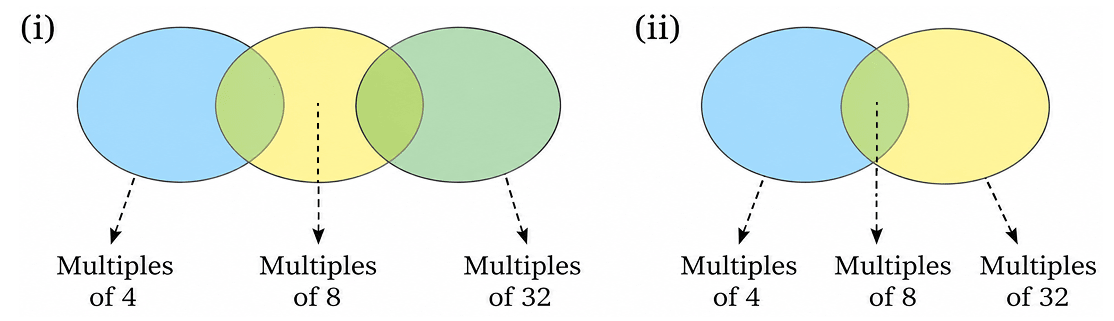
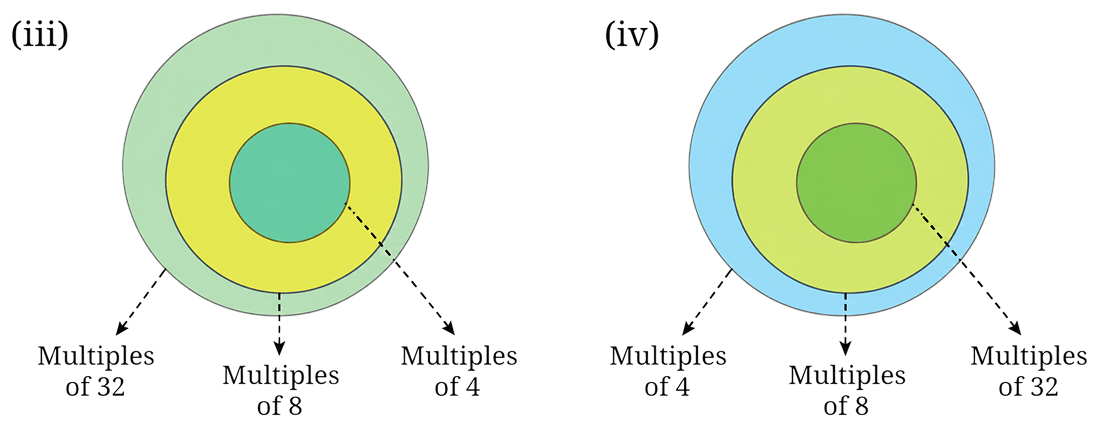
Answer
Every multiple of 32 is also a multiple of 8, because 32 = 8 × 4. So all multiples of 32 lie inside the set of multiples of 8.
Every multiple of 8 is also a multiple of 4, because 8 = 4 × 2. So all multiples of 8 lie inside the set of multiples of 4.
However, the reverse is not true: for example, 4 is a multiple of 4 but not of 8, and 8 is a multiple of 8 but not of 32.
So the three sets are nested one inside another:
multiples of 32 ⊂ multiples of 8 ⊂ multiples of 4
This is shown by three circles drawn one inside the other, with the multiples of 4 as the largest (outermost) circle, the multiples of 8 inside it, and the multiples of 32 as the smallest (innermost) circle. This matches Venn diagram (iv).
Hence, the correct Venn diagram is (iv), in which the multiples of 32 lie inside the multiples of 8, which in turn lie inside the multiples of 4.