
Consider the multiplication of two numbers, say, 23 × 27.
(i) By how much does the product increase if the first number (23) is increased by 1?
(ii) What if the second number (27) is increased by 1?
(iii) How about when both numbers are increased by 1?
Answer
(i) The original product is: 23 × 27
If the first number is increased by 1, the new product becomes:
(23 + 1) × 27
Using the distributive property,
⇒ (23 + 1) × 27 = 23 × 27 + 1 × 27 = 23 × 27 + 27.
So the product increases by 27, which is the second number.
Hence, when the first number (23) is increased by 1, the product increases by 27.
(ii) Increasing the second number (27) by 1:
The new product becomes: 23 × (27 + 1)
Using the distributive property,
⇒ 23 × (27 + 1) = 23 × 27 + 23 × 1 = 23 × 27 + 23.
So the product increases by 23, which is the first number.
Hence, when the second number (27) is increased by 1, the product increases by 23.
(iii) Increasing both numbers by 1:
The new product becomes: (23 + 1)(27 + 1)
Using the distributive property,
⇒ (23 + 1)(27 + 1) = 23 × 27 + (27 + 23 + 1) = 23 × 27 + 51.
So the product increases by 51.
Hence, when both numbers are increased by 1, the product increases by 51.
Do you see a pattern that could help generalise our observations to the product of any two numbers?
Answer
Let the two numbers be a and b, with product ab.
⇒ If a is increased by 1: (a + 1)b = ab + b, so the product increases by b.
⇒ If b is increased by 1: a(b + 1) = ab + a, so the product increases by a.
⇒ If both are increased by 1: (a + 1)(b + 1) = ab + (a + b + 1), so the product increases by a + b + 1.
Hence, increasing one number by 1 increases the product by the other number, and increasing both numbers by 1 increases the product by (a + b + 1).
What would we get if we had expanded (a + 1) (b + 1) by first taking (b + 1) as a single term? Try it?
Answer
Taking (b + 1) as a single term and applying the distributive property:
⇒ (a + 1)(b + 1) = a(b + 1) + 1(b + 1)
= ab + a + b + 1
= ab + (a + b + 1).
This is exactly the same result we obtained earlier by taking (a + 1) as a single term.
Hence, (a + 1)(b + 1) = ab + (a + b + 1), so the product increases by (a + b + 1) regardless of which term is taken first.
Will the product always increase? Find 3 examples where the product decreases.
What happens when a and b are negative integers?
Answer
When a is increased by 1 and b is decreased by 1, the product becomes (a + 1)(b – 1):
Expanding,
⇒ (a + 1)(b – 1) = ab + b – a – 1.
So the product changes by (b – a – 1).
This is negative when b – a – 1 < 0, that is, when b ≤ a. So the product does not always increase.
Three examples where the product decreases:
⇒ a = 5, b = 2: ab = 10, while (a + 1)(b – 1) = 6 × 1 = 6 < 10.
⇒ a = 7, b = 4: ab = 28, while (a + 1)(b – 1) = 8 × 3 = 24 < 28.
⇒ a = 9, b = 6: ab = 54, while (a + 1)(b – 1) = 10 × 5 = 50 < 54.
For negative integers, the identity (a + 1)(b – 1) = ab + b – a – 1 still holds:
⇒ a = –5, b = 8: (a + 1)(b – 1) = (–4)(7) = –28, and ab + b – a – 1 = –40 + 8 + 5 – 1 = –28.
⇒ a = –4, b = –5: (a + 1)(b – 1) = (–3)(–6) = 18, and ab + b – a – 1 = 20 – 5 + 4 – 1 = 18.
Hence, the product does not always increase, and the expressions for the change in product continue to hold even when a and b are negative integers.
Use Identity (a + m)(b + n) = ab + mb + an + mn to find how the product changes when
(i) one number is decreased by 2 and the other increased by 3;
(ii) both numbers are decreased, one by 3 and the other by 4.
Verify the answers by finding the products without converting the subtractions to additions.
Answer
Given identity is (a + m)(b + n) = ab + mb + an + mn.
(i) One number decreased by 2 and the other increased by 3, so m = –2 and n = 3:
⇒ (a – 2)(b + 3) = ab + (–2)b + a(3) + (–2)(3)
= ab + 3a – 2b – 6.
So the product changes by (3a – 2b – 6).
Verification (without converting subtractions to additions):
⇒ (a – 2)(b + 3) = a(b + 3) – 2(b + 3) = ab + 3a – 2b – 6.
Hence, (a – 2)(b + 3) = ab + 3a – 2b – 6.
(ii) Both numbers decreased, one by 3 and the other by 4, so m = –3 and n = –4:
⇒ (a – 3)(b – 4) = ab + (–3)b + a(–4) + (–3)(–4)
= ab – 4a – 3b + 12.
So the product changes by (–4a – 3b + 12).
Verification (without converting subtractions to additions):
⇒ (a – 3)(b – 4) = a(b – 4) – 3(b – 4) = ab – 4a – 3b + 12.
Hence, (a – 3)(b – 4) = ab – 4a – 3b + 12.
Expand
(i) (a – u) (b + v)
(ii) (a – u) (b – v)
Answer
(i) Using the distributive property:
⇒ (a – u)(b + v) = a(b + v) – u(b + v)
= ab + av – ub – uv
= ab – ub + av – uv.
Hence, (a – u)(b + v) = ab – ub + av – uv.
(ii) Using the distributive property:
⇒ (a – u)(b – v) = a(b – v) – u(b – v)
= ab – av – ub + uv
= ab – ub – av + uv.
Hence, (a – u)(b – v) = ab – ub – av + uv.
Observe the multiplication grid below. Each number inside the grid is formed by multiplying two numbers. If the middle number of a 3 × 3 frame is given by the expression pq, as shown in the figure, write the expressions for the other numbers in the grid.
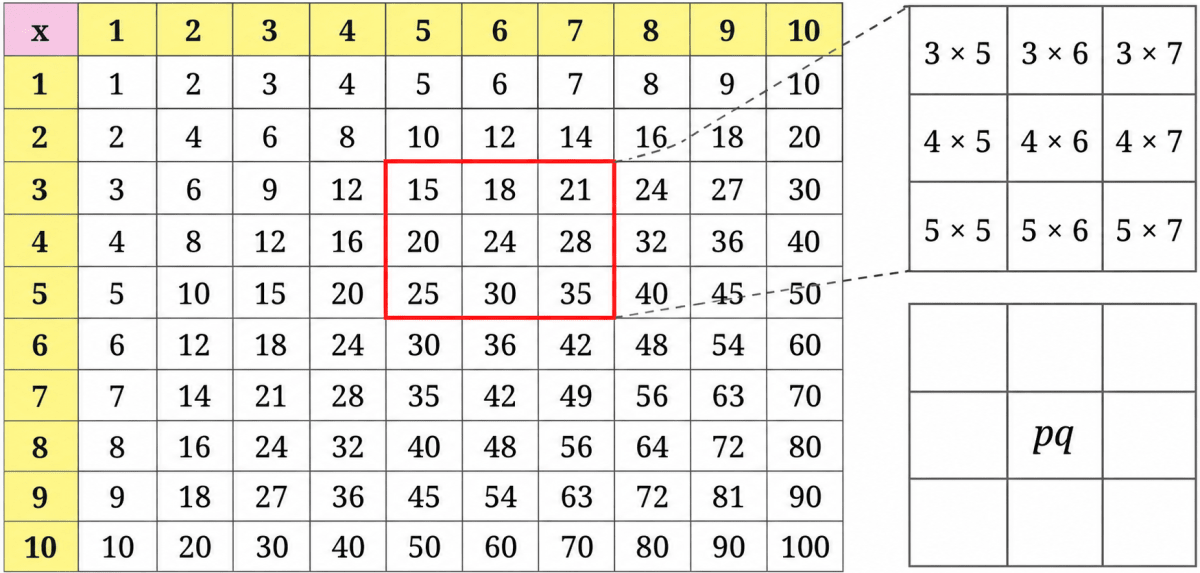
Answer
The middle entry pq sits in row p and column q. So the rows just above and below correspond to (p – 1) and (p + 1), and the columns to the left and right correspond to (q – 1) and (q + 1). Multiplying each row value by each column value gives the entries of the 3 × 3 frame:
| q – 1 | q | q + 1 | |
|---|---|---|---|
| p – 1 | (p – 1)(q – 1) | (p – 1)q | (p – 1)(q + 1) |
| p | p(q – 1) | pq | p(q + 1) |
| p + 1 | (p + 1)(q – 1) | (p + 1)q | (p + 1)(q + 1) |
Hence, the expressions for the nine numbers in the frame are as shown in the table above, with pq at the centre.
Expand the following product.
(i) (3 + u) (v – 3)
(ii)
(iii) (10a + b)(10c + d)
(iv) (3 – x)(x – 6)
(v) (–5a + b)(c + d)
(vi) (5 + z)(y + 9)
Answer
(i) (3 + u) (v – 3)
= 3(v – 3) + u(v – 3)
= 3v – 9 + uv – 3u
= 3v – 3u + uv – 9.
Hence, (3 + u)(v – 3) = 3v – 3u + uv – 9.
(ii)
=
= 10 + 4a.
Hence, .
(iii) (10a + b)(10c + d)
= 10a(10c + d) + b(10c + d)
= 100ac + 10ad + 10bc + bd.
Hence, (10a + b)(10c + d) = 100ac + 10ad + 10bc + bd.
(iv) (3 – x)(x – 6)
= 3(x – 6) – x(x – 6)
= 3x – 18 – x2 + 6x
= –x2 + 9x – 18.
Hence, (3 – x)(x – 6) = –x2 + 9x – 18.
(v) (–5a + b)(c + d)
= –5a(c + d) + b(c + d)
= –5ac – 5ad + bc + bd.
Hence, (–5a + b)(c + d) = –5ac – 5ad + bc + bd.
(vi) (5 + z)(y + 9)
= 5(y + 9) + z(y + 9)
= 5y + 45 + yz + 9z
= 5y + yz + 9z + 45.
Hence, (5 + z)(y + 9) = 5y + yz + 9z + 45.
Find 3 examples where the product of two numbers remains unchanged when one of them is increased by 2 and the other is decreased by 4.
Answer
Let the two numbers be a and b.
We need the product to be unchanged when a is increased by 2 and b is decreased by 4:
⇒ (a + 2)(b – 4) = ab
⇒ ab – 4a + 2b – 8 = ab
⇒ –4a + 2b – 8 = 0
⇒ b = 2a + 4.
So any pair with b = 2a + 4 works. Choosing a = 1, 2, 3 gives:
⇒ a = 1, b = 6: (1 + 2)(6 – 4) = 3 × 2 = 6 = 1 × 6.
⇒ a = 2, b = 8: (2 + 2)(8 – 4) = 4 × 4 = 16 = 2 × 8.
⇒ a = 3, b = 10: (3 + 2)(10 – 4) = 5 × 6 = 30 = 3 × 10.
Hence, three such examples are (a = 1, b = 6), (a = 2, b = 8) and (a = 3, b = 10), all satisfying b = 2a + 4.
Expand
(i) (a + ab – 3b2)(4 + b)
(ii) (4y + 7)(y + 11z – 3)
Answer
(i) (a + ab – 3b2)(4 + b)
= 4(a + ab – 3b2) + b(a + ab – 3b2)
= 4a + 4ab – 12b2 + ab + ab2 – 3b3
= 4a + 5ab + ab2 – 12b2 – 3b3.
Hence, (a + ab – 3b2)(4 + b) = 4a + 5ab + ab2 – 12b2 – 3b3.
(ii) (4y + 7)(y + 11z – 3)
= 4y(y + 11z – 3) + 7(y + 11z – 3)
= 4y2 + 44yz – 12y + 7y + 77z – 21
= 4y2 + 44yz + 77z – 5y – 21.
Hence, (4y + 7)(y + 11z – 3) = 4y2 + 44yz + 77z – 5y – 21.
Expand
(i) (a – b) (a + b)
(ii) (a – b) (a2 + ab + b2)
(iii) (a – b) (a3 + a2b + ab2 + b3)
Do you see a pattern? What would be the next identity in the pattern that you see? Can you check it by expanding?
Answer
(i) (a – b)(a + b)
= a(a + b) – b(a + b)
= a2 + ab – ab – b2
= a2 – b2.
Hence, (a – b)(a + b) = a2 – b2.
(ii) (a – b)(a2 + ab + b2)
= a(a2 + ab + b2) – b(a2 + ab + b2)
= a3 + a2b + ab2 – a2b – ab2 – b3
= a3 – b3.
Hence, (a – b)(a2 + ab + b2) = a3 – b3.
(iii) (a – b)(a3 + a2b + ab2 + b3)
= a(a3 + a2b + ab2 + b3) – b(a3 + a2b + ab2 + b3)
= a4 + a3b + a2b2 + ab3 – a3b – a2b2 – ab3 – b4
= a4 – b4.
Hence, (a – b)(a3 + a2b + ab2 + b3) = a4 – b4.
Pattern: The results are a2 – b2, a3 – b3, a4 – b4, so the next identity should give a5 – b5:
⇒ (a – b)(a4 + a3b + a2b2 + ab3 + b4) = a5 – b5.
Checking by expanding:
⇒ (a – b)(a4 + a3b + a2b2 + ab3 + b4)
= a5 + a4b + a3b2 + a2b3 + ab4 – a4b – a3b2 – a2b3 – ab4 – b5
= a5 – b5.
Hence, the pattern continues, and the next identity is (a – b)(a4 + a3b + a2b2 + ab3 + b4) = a5 – b5.
Use the following multiplications to find the product of a number with 11 in a single step.
(a) 3874 × 11
(b) 5678 × 11
Answer
Multiplying by 11 means multiplying by (10 + 1), so using the distributive property:
⇒ dcba × 11 = dcba × (10 + 1) = dcba × 10 + dcba.
When the shifted number is added, each digit of the answer is the sum of two adjacent digits of the original number (carrying over wherever a sum exceeds 9):
⇒ dcba × 11 = d (c + d) (b + c) (a + b) a.
(a) For 3874 (d = 3, c = 8, b = 7, a = 4):
⇒ units = 4;
tens = 7 + 4 = 11 (write 1, carry 1);
hundreds = 8 + 7 + 1 = 16 (write 6, carry 1);
thousands = 3 + 8 + 1 = 12 (write 2, carry 1);
ten-thousands = 3 + 1 = 4.
⇒ 3874 × 11 = 42614.
Hence, 3874 × 11 = 42614.
(b) For 5678 (d = 5, c = 6, b = 7, a = 8):
⇒ units = 8;
tens = 7 + 8 = 15 (write 5, carry 1);
hundreds = 6 + 7 + 1 = 14 (write 4, carry 1);
thousands = 5 + 6 + 1 = 12 (write 2, carry 1);
ten-thousands = 5 + 1 = 6.
⇒ 5678 × 11 = 62458.
Hence, 5678 × 11 = 62458.
Describe a general rule to multiply a number (of any number of digits) by 11 and write the product in one line.
Answer
General rule: Write the units digit of the number as the last digit of the product. Then, moving leftwards, write the sum of each pair of adjacent digits. Finally, write the leftmost digit together with any remaining carry. Carry over to the next sum whenever a digit-sum is 10 or more. This works because multiplying by 11 means multiplying by 10 and adding the original number, which makes adjacent digits overlap and add.
Hence, to multiply a number by 11 in one line, add adjacent digits from right to left and include any necessary carries.
Evaluate
(i) 94 × 11
(ii) 495 × 11
(iii) 3279 × 11
(iv) 4791256 × 11
(v) Can we come up with a similar rule for multiplying a number by 101?
Answer
(i) 94 × 11
⇒ units = 4;
tens = 9 + 4 = 13 (write 3, carry 1);
hundreds = 9 + 1 = 10 (write 0, carry 1);
thousands = 1.
⇒ 94 × 11 = 1034.
Hence, 94 × 11 = 1034.
(ii) 495 × 11
⇒ units = 5;
tens = 9 + 5 = 14 (write 4, carry 1);
hundreds = 4 + 9 + 1 = 14 (write 4, carry 1);
thousands = 4 + 1 = 5.
⇒ 495 × 11 = 5445.
Hence, 495 × 11 = 5445.
(iii) 3279 × 11
⇒ units = 9;
tens = 7 + 9 = 16 (write 6, carry 1);
hundreds = 2 + 7 + 1 = 10 (write 0, carry 1);
thousands = 3 + 2 + 1 = 6;
ten-thousands = 3.
⇒ 3279 × 11 = 36069.
Hence, 3279 × 11 = 36069.
(iv) 4791256 × 11.
Taking the adjacent-digit sums of 4791256 from the right and carrying over:
⇒ 6, (5 + 6) = 11, (2 + 5), (1 + 2), (9 + 1), (7 + 9), (4 + 7), 4, processed with carries
⇒ 4791256 × 11 = 52703816.
Hence, 4791256 × 11 = 52703816.
(v) Rule for 101:
Yes. Multiplying by 101 = (100 + 1) means adding the number to itself after shifting two places, so the digits overlap with a gap of one.
Taking a 4-digit number dcba:
⇒ dcba × 101 = dcba × (100 + 1) = dcba × 100 + dcba = d c (b + d) (a + c) b a.
Hence, a number can be multiplied by 101 by adding each digit to the digit two places to its right (with carrying).
Multiply 3874 × 101 in one line.
Answer
Using 101 = (100 + 1) with the distributive property and the digit pattern d c (b + d) (a + c) b a, where d = 3, c = 8, b = 7, a = 4:
⇒ 3874 × 101 = 3874 × 100 + 3874 = 387400 + 3874.
Adding with the two-place gap:
units b a = 7 4;
next (a + c) = 4 + 8 = 12 (write 2, carry 1);
next (b + d) = 7 + 3 + 1 = 11 (write 1, carry 1);
next c = 8 + 1 = 9; then d = 3.
⇒ 3874 × 101 = 391274.
Hence, 3874 × 101 = 391274.
(a) What could be a general rule to multiply a number by 101 and write the product in one line? Extend this rule for multiplication by 1001, 10001, …
(b) Use this to find
- 89 × 101
- 949 × 101
- 265831 × 1001
- 1111 × 1001
- 9734 × 99
- 23478 × 999
Answer
(a)
Since 101 = 100 + 1,
multiplying a number by 101 means adding the number to a copy of itself shifted two places to the left.
For example,
3874 × 101 = 387400 + 3874 = 391274.
Observe the addition:
387400 + 3874 = 391274
Each digit is added to the digit two places away (with carrying wherever necessary).
For multiplication by 1001,
1001 = 1000 + 1.
So we add the number to a copy shifted three places to the left.
For example,
3874 × 1001 = 3874000 + 3874 = 3877874.
For multiplication by 10001,
10001 = 10000 + 1.
So we add the number to a copy shifted four places to the left.
For example,
3874 × 10001 = 38740000 + 3874 = 38743874.
Hence, to multiply by 10…01 with k zeros, add the number to a copy of itself shifted (k + 1) places to the left; the overlapping digits are added with carrying.
(b)
(i) 89 × 101
= 89 × (100 + 1)
= 8900 + 89
= 8989.
Hence, 89 × 101 = 8989.
(ii) 949 × 101
= 949 × (100 + 1)
= 94900 + 949
= 95849.
Hence, 949 × 101 = 95849.
(iii) 265831 × 1001
= 265831 × (1000 + 1)
= 265831000 + 265831
= 266096831.
Hence, 265831 × 1001 = 266096831.
(iv) 1111 × 1001
= 1111 × (1000 + 1)
= 1111000 + 1111
= 1112111.
Hence, 1111 × 1001 = 1112111.
(v) 9734 × 99
Here 99 = (100 – 1), so subtraction is easier:
⇒ 9734 × 99
= 9734 × (100 – 1)
= 973400 – 9734
= 963666.
Hence, 9734 × 99 = 963666.
(vi) 23478 × 999
Here 999 = (1000 – 1):
⇒ 23478 × 999
= 23478 × (1000 – 1)
= 23478000 – 23478
= 23454522.
Hence, 23478 × 999 = 23454522.
What if we write 652 as (30 + 35)2 or (52 + 13)2? Draw the figures and check the area that you get.
Answer
A square of sidelength 65 can be split into four parts: two smaller squares and two equal rectangles. Whichever way we split 65 into a sum of two numbers, the total area stays 652 = 4225 sq. units.
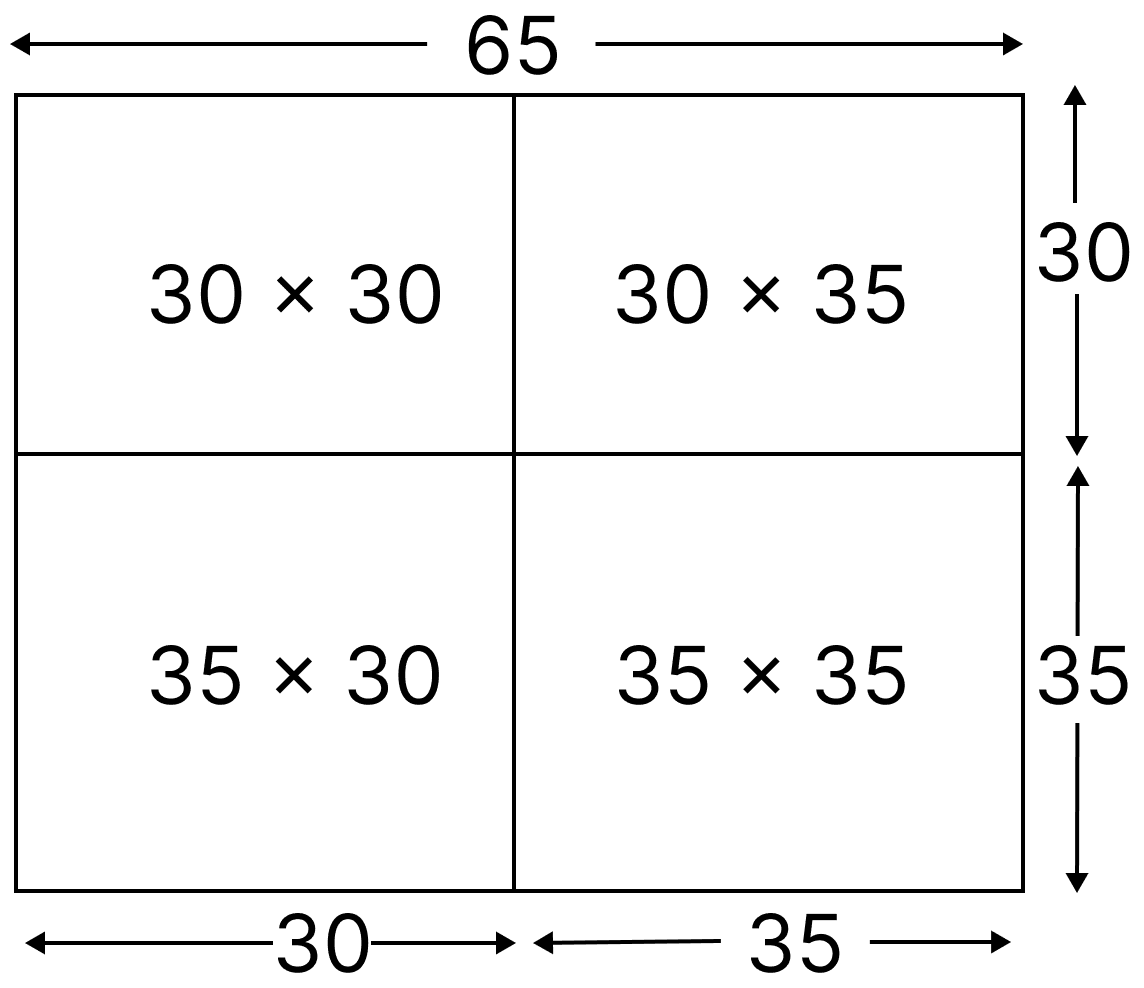
Splitting as (30 + 35): the four parts are a 30 × 30 square, a 35 × 35 square, and two 30 × 35 rectangles.
⇒ (30 + 35)2 = 302 + 352 + 2 × (30 × 35)
= 900 + 1225 + 2100
= 4225 sq. units.
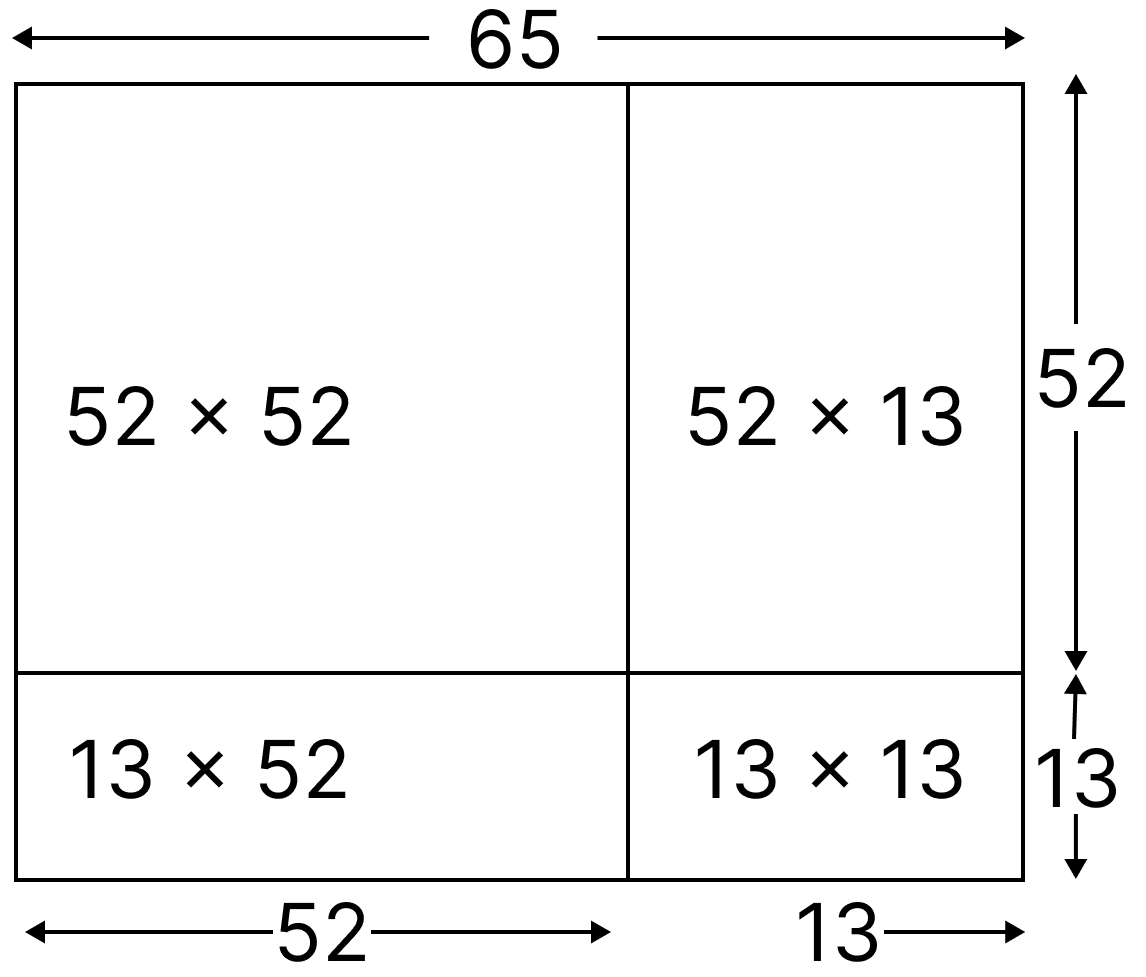
Splitting as (52 + 13): the four parts are a 52 × 52 square, a 13 × 13 square, and two 52 × 13 rectangles.
⇒ (52 + 13)2 = 522 + 132 + 2 × (52 × 13)
= 2704 + 169 + 1352
= 4225 sq. units.
Hence, both splittings give the same area, 652 = 4225 sq. units, confirming that the way we break up the side does not change the total area.
If a and b are any two integers, is (a + b)2 always greater than a2 + b2? If not, when is it greater?
Answer
Using Identity 1A, we get:
⇒ (a + b)2 = a2 + 2ab + b2.
Comparing with a2 + b2:
⇒ (a + b)2 – (a2 + b2) = 2ab.
So the difference is 2ab, which is not always positive:
⇒ if a and b have the same sign (both positive or both negative), 2ab > 0, so (a + b)2 > a2 + b2;
⇒ if a or b is 0, 2ab = 0, so (a + b)2 = a2 + b2;
⇒ if a and b have opposite signs, 2ab < 0, so (a + b)2 < a2 + b2.
Hence, (a + b)2 is not always greater than a2 + b2; it is greater only when a and b have the same sign (so that 2ab > 0).
Use Identity 1A to find the values of 1042, 372. (Hint: Decompose 104 and 37 into sums or differences of numbers whose squares are easy to compute.)
Answer
Identity 1A is (a + b)2 = a2 + 2ab + b2.
1042: writing 104 = 100 + 4:
⇒ 1042 = (100 + 4)2 = 1002 + 2 × (100 × 4) + 42
= 10000 + 800 + 16
= 10816.
Hence, 1042 = 10816.
372: writing 37 = 30 + 7:
⇒ 372 = (30 + 7)2 = 302 + 2 × (30 × 7) + 72
= 900 + 420 + 49
= 1369.
Hence, 372 = 1369.
Use Identity 1A to write the expressions for the following.
(i) (m + 3)2
(ii) (6 + p)2
Answer
Identity 1A is (a + b)2 = a2 + 2ab + b2.
(i) Taking a = m and b = 3:
⇒ (m + 3)2 = m2 + 2 × (m × 3) + 32
= m2 + 6m + 9.
Hence, (m + 3)2 = m2 + 6m + 9.
(ii) Taking a = 6 and b = p:
⇒ (6 + p)2 = 62 + 2 × (6 × p) + p2
= 36 + 12p + p2.
Hence, (6 + p)2 = 36 + 12p + p2.
Expand (6x + 5)2.
Answer
Using Identity 1A, (a + b)2 = a2 + 2ab + b2, with a = 6x and b = 5:
⇒ (6x + 5)2 = (6x)2 + 2 × (6x × 5) + 52
= 36x2 + 60x + 25.
This is the same result obtained by the distributive property:
⇒ (6x + 5)(6x + 5) = 6x(6x + 5) + 5(6x + 5)
= 36x2 + 30x + 30x + 25
= 36x2 + 60x + 25.
Hence, (6x + 5)2 = 36x2 + 60x + 25.
Expand (3j + 2k)2 using both the identity and by applying the distributive property.
Answer
Using the identity (a + b)2 = a2 + 2ab + b2, with a = 3j and b = 2k:
⇒ (3j + 2k)2 = (3j)2 + 2(3j)(2k) + (2k)2
= 9j2 + 12jk + 4k2.
Applying the distributive property:
⇒ (3j + 2k)2 = (3j + 2k)(3j + 2k)
= 3j(3j + 2k) + 2k(3j + 2k)
= 9j2 + 6jk + 6jk + 4k2
= 9j2 + 12jk + 4k2.
Hence, (3j + 2k)2 = 9j2 + 12jk + 4k2.
Find the general expansion of (a – b)2 using geometry.
Answer
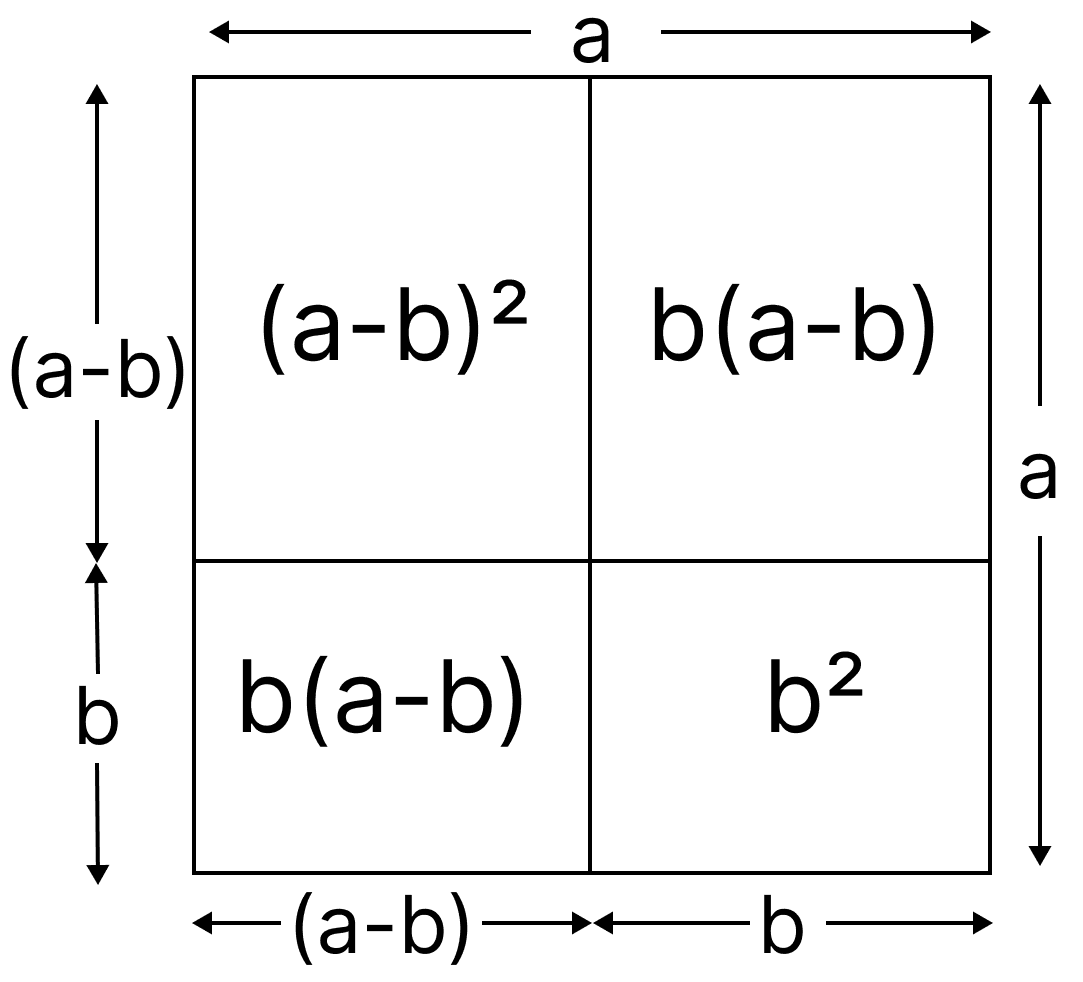
Consider a square of side a, whose area is a2. Mark a length b along each side, dividing each side into a part of length (a – b) and a part of length b. These divisions split the square into four regions:
- a square of side (a – b), with area (a – b)2,
- two rectangles of sides b and (a – b), each with area b(a – b),
- a square of side b, with area b2.
The areas of these four regions add up to the area of the whole square:
⇒ a2 = (a – b)2 + 2b(a – b) + b2.
Rearranging to make (a – b)2 the subject:
⇒ (a – b)2 = a2 - 2b(a – b) - b2
= a2 - 2ab + 2b2 - b2
= a2 - 2ab + b2.
Hence, (a – b)2 = a2 – 2ab + b2.
Use the identity (a – b)2 to find the values of (a) 992 and (b) 582.
Answer
(a) Writing 99 as (100 – 1) and using (a – b)2 = a2 – 2ab + b2:
⇒ (99)2 = (100 - 1)2 = (100)2 - 2(100)(1) + (1)2
= 10000 - 200 + 1
= 9801.
(b) Writing 58 as (60 – 2) and using (a – b)2 = a2 – 2ab + b2:
⇒ (58)2 = (60 - 2)2 = (60)2 - 2(60)(2) + (2)2
= 3600 - 240 + 4
= 3364.
Hence, (a) 992 = 9801 and (b) 582 = 3364.
Expand the following using both Identity 1B and by applying the distributive property.
(i) (b – 6)2
(ii) (–2a + 3)2
(iii) (7y – )2
Answer
(i) (b – 6)2
Using Identity 1B (a – b)2 = a2 – 2ab + b2, taking the first term as b and the second term as 6:
⇒ (b – 6)2 = (b)2 - 2(b)(6) + (6)2
= b2 - 12b + 36.
Applying the distributive property:
⇒ (b – 6)2 = (b – 6)(b – 6)
= b(b – 6) – 6(b – 6)
= b2 - 6b - 6b + 36
= b2 - 12b + 36.
Hence, (b – 6)2 = b2 – 12b + 36.
(ii) (–2a + 3)2
Rewriting (–2a + 3)2 as (3 – 2a)2 and using Identity 1B (a – b)2 = a2 – 2ab + b2, with the first term 3 and the second term 2a:
⇒ (–2a + 3)2 = (3 – 2a)2 = (3)2 - 2(3)(2a) + (2a)2
= 9 - 12a + 4a2
= 4a2 - 12a + 9.
Applying the distributive property:
⇒ (–2a + 3)2 = (–2a + 3)(–2a + 3)
= –2a(–2a + 3) + 3(–2a + 3)
= 4a2 - 6a - 6a + 9
= 4a2 - 12a + 9.
Hence, (–2a + 3)2 = 4a2 – 12a + 9.
(iii) (7y – )2
Using Identity 1B, (a – b)2 = a2 – 2ab + b2, with a = 7y and :
Applying the distributive property:
Hence, .
Look at the following pattern.
2 (22 + 12) = 32 + 12
2 (32 + 12) = 42 + 22
2 (62 + 52) = 112 + 12
2 (52 + 32) = 82 + 22
Take a pair of natural numbers. Calculate the sum of their squares. Can you write twice this sum as a sum of two squares? Try this with other pairs of numbers. Have you figured out a pattern?
Answer
Take any pair of natural numbers a and b, and find the sum of their squares, a2 + b2. Twice this sum is 2(a2 + b2).
Adding the identities (a + b)2 = a2 + 2ab + b2 and (a – b)2 = a2 – 2ab + b2:
⇒ (a + b)2 + (a – b)2 = (a2 + 2ab + b2) + (a2 - 2ab + b2)
= 2a2 + 2b2
= 2(a2 + b2).
So twice the sum of the squares of two numbers can always be written as a sum of two squares, namely (a + b)2 and (a – b)2. For example, with a = 6 and b = 5:
⇒ 2(62 + 52) = (6 + 5)2 + (6 – 5)2 = 112 + 12.
Hence, for any two natural numbers a and b, 2(a2 + b2) = (a + b)2 + (a – b)2.
Here is a related pattern. Try to describe the pattern using algebra to determine if the pattern always holds.
9 × 9 – 1 × 1 = 10 × 8
8 × 8 – 6 × 6 = 14 × 2
7 × 7 – 2 × 2 = 9 × 5
10 × 10 – 4 × 4 = 14 × 6
Answer
In each line the left side is a difference of two squares, and the right side is a product of two numbers. Writing the first number as a and the second as b, every line has the form:
⇒ a × a – b × b = a2 – b2.
Using Identity 1C, a2 – b2 = (a + b)(a – b). So:
⇒ a × a – b × b = (a + b) × (a – b).
The two factors on the right are exactly the sum (a + b) and the difference (a – b) of the numbers. For example:
⇒ 9 × 9 – 1 × 1 = (9 + 1) × (9 – 1) = 10 × 8.
⇒ 8 × 8 – 6 × 6 = (8 + 6) × (8 – 6) = 14 × 2.
Since this follows directly from the identity a2 – b2 = (a + b)(a – b), the pattern always holds.
Hence, a × a – b × b = (a + b) × (a – b) for all numbers a and b.
Use Identity 1C to calculate 98 × 102, and 45 × 55.
Answer
Using Identity 1C, (a + b)(a – b) = a2 – b2.
For 98 × 102, write 98 = (100 – 2) and 102 = (100 + 2):
⇒ 98 × 102 = (100 – 2)(100 + 2) = (100)2 - (2)2
= 10000 - 4
= 9996.
For 45 × 55, write 45 = (50 – 5) and 55 = (50 + 5):
⇒ 45 × 55 = (50 – 5)(50 + 5) = (50)2 - (5)2
= 2500 - 25
= 2475.
Hence, 98 × 102 = 9996 and 45 × 55 = 2475.
Show that (a + b) × (a – b) = a2 – b2 geometrically.
Answer
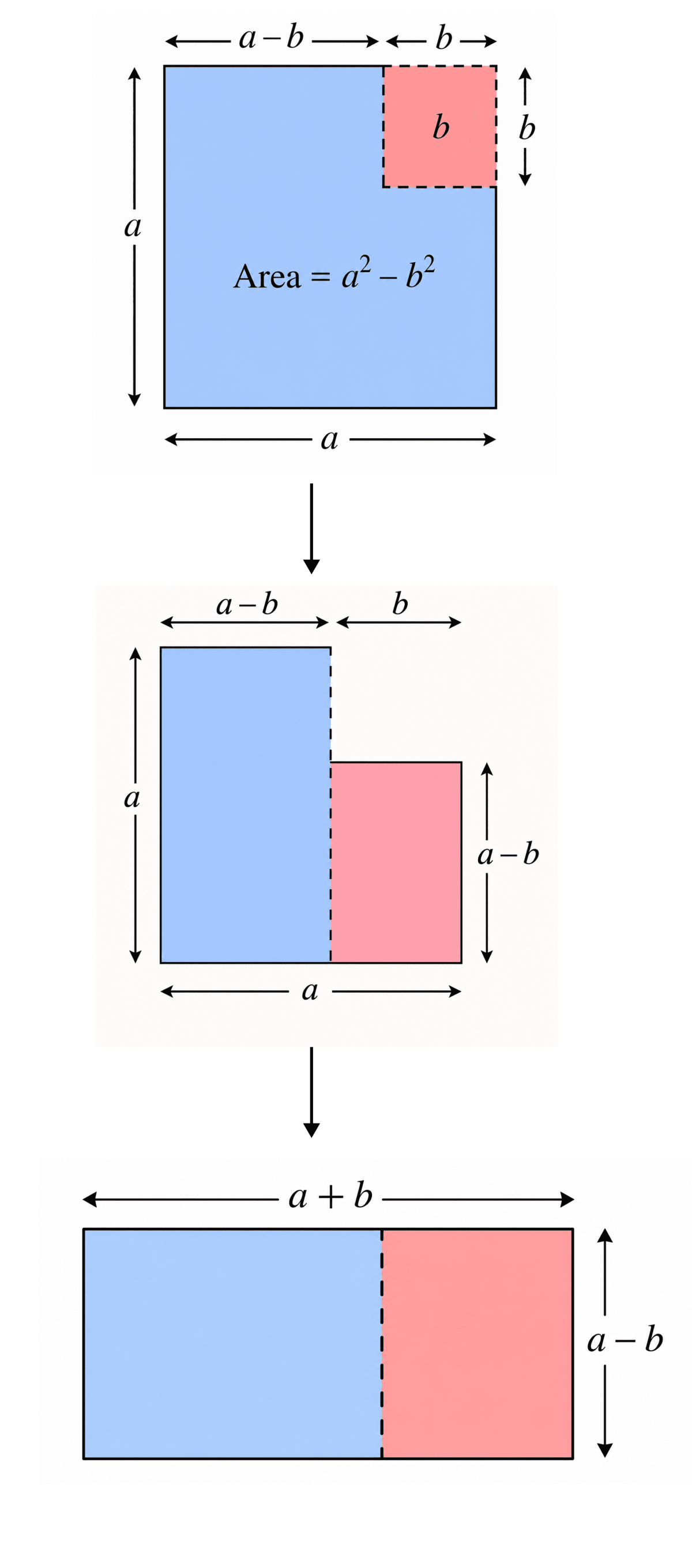
Start with a square of side a, whose area is a2. From one corner remove a small square of side b, whose area is b2. The remaining L-shaped region has area a2 – b2.
Now cut this L-shaped region into two rectangles and rearrange them into a single rectangle. The rearranged rectangle has length (a + b) and width (a – b), so its area is (a + b)(a – b).
Since cutting and rearranging the pieces does not change the total area:
⇒ (a + b)(a – b) = a2 – b2.
Hence, (a + b) × (a – b) = a2 – b2.
Why is the identity a2 = (a + b) (a – b) + b2 true?
Answer
From Identity 1C we know:
⇒ (a + b)(a – b) = a2 – b2.
Adding b2 to both sides:
⇒ (a + b)(a – b) + b2 = a2 - b2 + b2
= a2.
So this identity is simply the difference-of-squares identity rearranged.
Hence, a2 = (a + b)(a – b) + b2 is true.
Which is greater: (a – b)2 or (b – a)2? Justify your answer.
Answer
Notice that (b – a) is the negative of (a – b), that is, (b – a) = –(a – b). Squaring a number and squaring its negative give the same result, so:
⇒ (b – a)2 = (–(a – b))2 = (a – b)2.
We can also check this by expanding both using Identity 1B:
⇒ (a – b)2 = a2 – 2ab + b2.
⇒ (b – a)2 = b2 – 2ba + a2 = a2 – 2ab + b2.
Both expansions are identical.
Hence, neither is greater — (a – b)2 and (b – a)2 are always equal.
Express 100 as the difference of two squares.
Answer
Using Identity 1C, a2 – b2 = (a + b)(a – b). We need (a + b)(a – b) = 100.
Choosing the factor pair 100 = 50 × 2 (both factors even, so a and b come out as whole numbers):
⇒ a + b = 50 and a – b = 2
⇒ a = 26 and b = 24.
Checking:
⇒ 262 – 242 = 676 – 576 = 100.
Hence, 100 = 262 – 242.
Find 4062, 722, 1452, 10972, and 1242 using the identities you have learnt so far.
Answer
We decompose each number into a sum or difference whose squares are easy to compute, then apply Identity 1A, (a + b)2 = a2 + 2ab + b2, or Identity 1B, (a – b)2 = a2 – 2ab + b2.
4062 = (400 + 6)2:
⇒ 4062 = 4002 + 2 × 400 × 6 + 62
= 160000 + 4800 + 36
= 164836.
Hence, 4062 = 164836.
722 = (70 + 2)2:
⇒ 722 = 702 + 2 × 70 × 2 + 22
= 4900 + 280 + 4
= 5184.
Hence, 722 = 5184.
1452 = (150 – 5)2:
⇒ 1452 = 1502 – 2 × 150 × 5 + 52
= 22500 – 1500 + 25
= 21025.
Hence, 1452 = 21025.
10972 = (1100 – 3)2:
⇒ 10972 = 11002 – 2 × 1100 × 3 + 32
= 1210000 – 6600 + 9
= 1203409.
Hence, 10972 = 1203409.
1242 = (120 + 4)2:
⇒ 1242 = 1202 + 2 × 120 × 4 + 42
= 14400 + 960 + 16
= 15376.
Hence, 1242 = 15376.
Do Patterns 1 and 2 hold only for counting numbers? Do they hold for negative integers as well? What about fractions? Justify your answer.
Answer
Pattern 1 is 2(a2 + b2) = (a + b)2 + (a – b)2, and Pattern 2 is a2 – b2 = (a + b)(a – b).
Both patterns were established purely by expanding using the distributive property (Identities 1A, 1B and 1C). The distributive property holds for all numbers — not just counting numbers — so the algebra is unchanged whether a and b are negative integers or fractions. Therefore both patterns continue to hold in every case.
We verify with examples.
Pattern 1 with negative integers (a = –3, b = 2):
⇒ 2(a2 + b2) = 2(9 + 4) = 26.
⇒ (a + b)2 + (a – b)2 = (–1)2 + (–5)2 = 1 + 25 = 26.
Pattern 1 with fractions :
⇒ 2(a2 + b2) = .
⇒ (a + b)2 + (a – b)2 = .
Pattern 2 with negative integers (a = –5, b = –2):
⇒ a2 – b2 = 25 – 4 = 21.
⇒ (a + b)(a – b) = (–7)(–3) = 21.
Pattern 2 with fractions :
⇒ a2 – b2 = .
⇒ (a + b)(a – b) = (2)(1) = 2.
Hence, Patterns 1 and 2 do not hold only for counting numbers — they hold equally well for negative integers and for fractions, because they follow from the distributive property, which is valid for all numbers.
The expression k2 + 2k gives the number of circles at Step k. Use this formula to find the number of circles in Step 15.
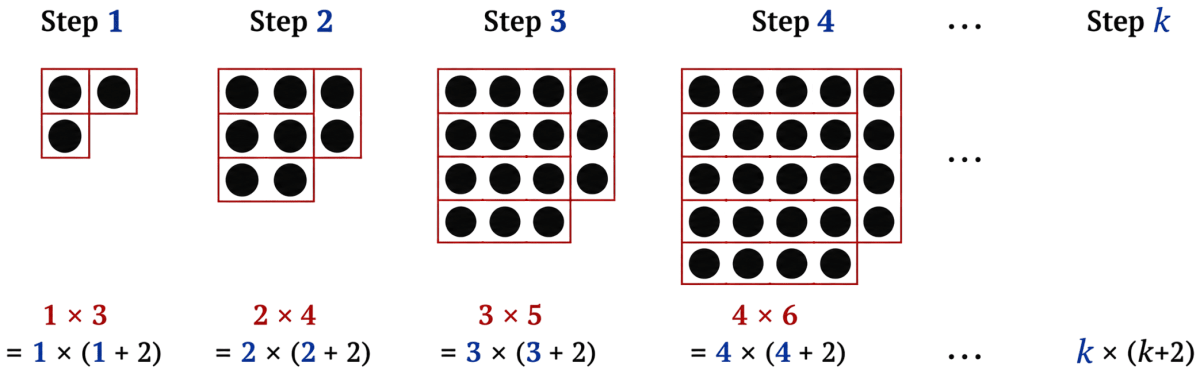
Answer
Substituting k = 15 into k2 + 2k:
⇒ 152 + 2 × 15 = 225 + 30 = 255.
Hence, Step 15 of the pattern has 255 circles.
Consider the pattern made of square tiles in the picture below.
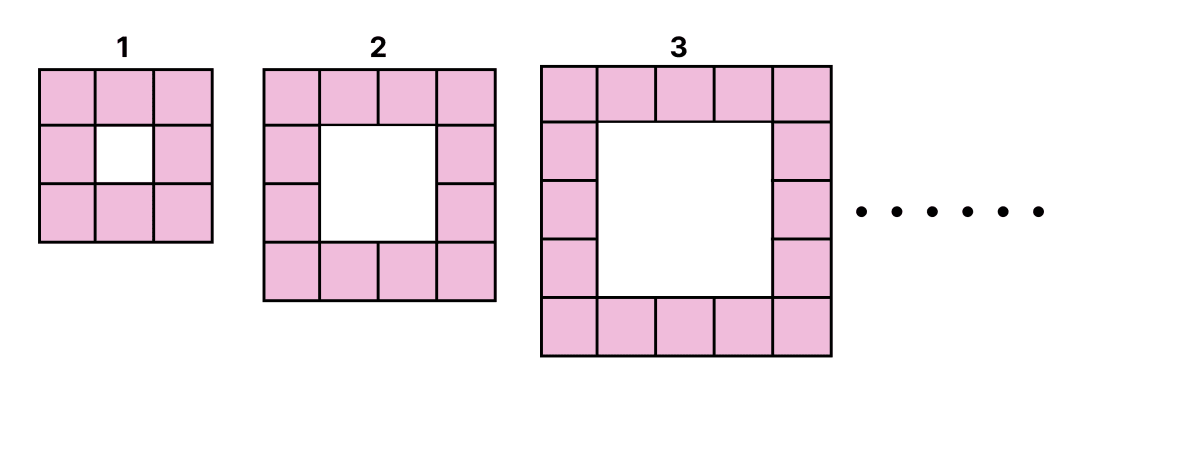
(i) How many square tiles are there in each figure?
(ii) How many are there in Step 4 of the sequence? What about Step 10?
(iii) Write an algebraic expression for the number of tiles in Step n. Can you find more than one method to arrive at the answer?
Answer
(i) Each figure is a square frame (border) of tiles, one tile thick, with an empty square in the middle.
- Step 1: a 3 × 3 outer square with a 1 × 1 hollow centre, leaving 9 – 1 = 8 tiles.
- Step 2: a 4 × 4 outer square with a 2 × 2 hollow centre, leaving 16 – 4 = 12 tiles.
- Step 3: a 5 × 5 outer square with a 3 × 3 hollow centre, leaving 25 – 9 = 16 tiles.
Hence, the figures have 8, 12 and 16 tiles respectively.
(ii) Number of tiles in Step 4 and Step 10:
For Step n, the outer square has side (n + 2) and the hollow centre is an n × n square.
⇒ Number of tiles = (n + 2)2 – n2
= (n2 + 4n + 4) – n2
= 4n + 4
= 4(n + 1).
For step 4:
4(4 + 1) = 4 × 5 = 20 tiles.
For step 10:
4(10 + 1) = 4 × 11 = 44 tiles.
Hence, there are 20 tiles in Step 4 and 44 tiles in Step 10.
(iii) Algebraic expression for Step n:
Method 1 (outer square minus hollow centre):
(n + 2)2 – n2
= (n2 + 4n + 4) – n2
= 4n + 4
= 4(n + 1).
Method 2 (four sides minus the doubly-counted corners):
Each side of the outer square has (n + 2) tiles, giving 4(n + 2) tiles, but each of the 4 corner tiles has then been counted twice, so we subtract 4:
Number of tiles:
= 4(n + 2) – 4
= 4n + 8 – 4
= 4n + 4
= 4(n + 1).
Both methods give the same expression.
Hence, the number of tiles in Step n is 4(n + 1) (equivalently 4n + 4).
Consider the figure below. All four rectangles have the same dimensions.
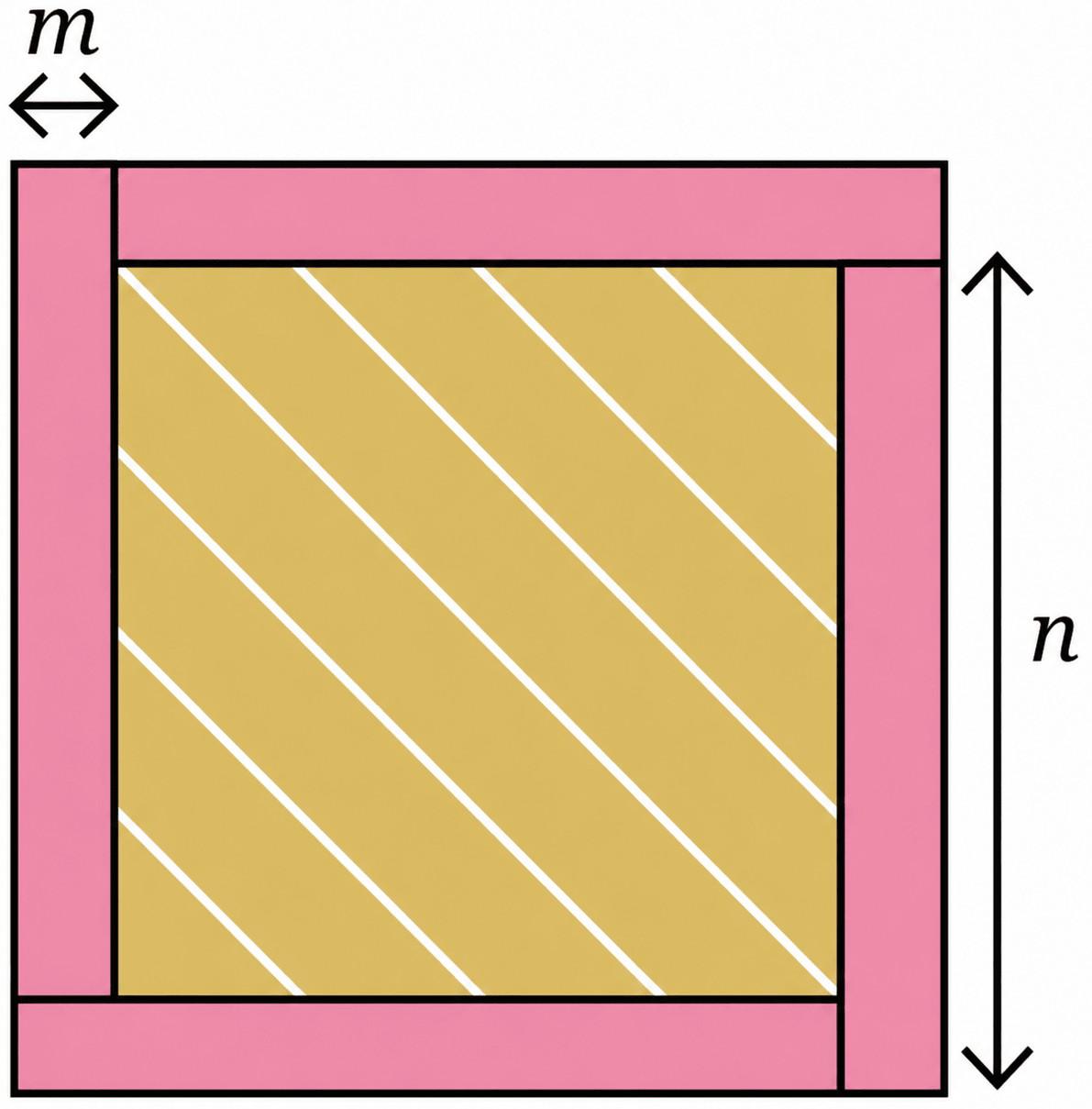
On finding the area of the figure, Tadang's method gives the area as (m + n)2 – 4mn. Yusuf's method gives it as (n – m)2.
By expanding both expressions, check that (m + n)2 – 4mn = (n – m)2.
Answer
Expanding Tadang's expression using Identity 1A:
⇒ (m + n)2 – 4mn = (m2 + 2mn + n2) – 4mn
= m2 – 2mn + n2.
Expanding Yusuf's expression using Identity 1B:
⇒ (n – m)2 = n2 – 2nm + m2
= m2 – 2mn + n2.
Both expansions simplify to m2 – 2mn + n2.
Hence, (m + n)2 – 4mn = (n – m)2, so the two methods give the same area for the shaded region.
Consider the figure below. All three rectangles have the same dimensions (Fig. 1).
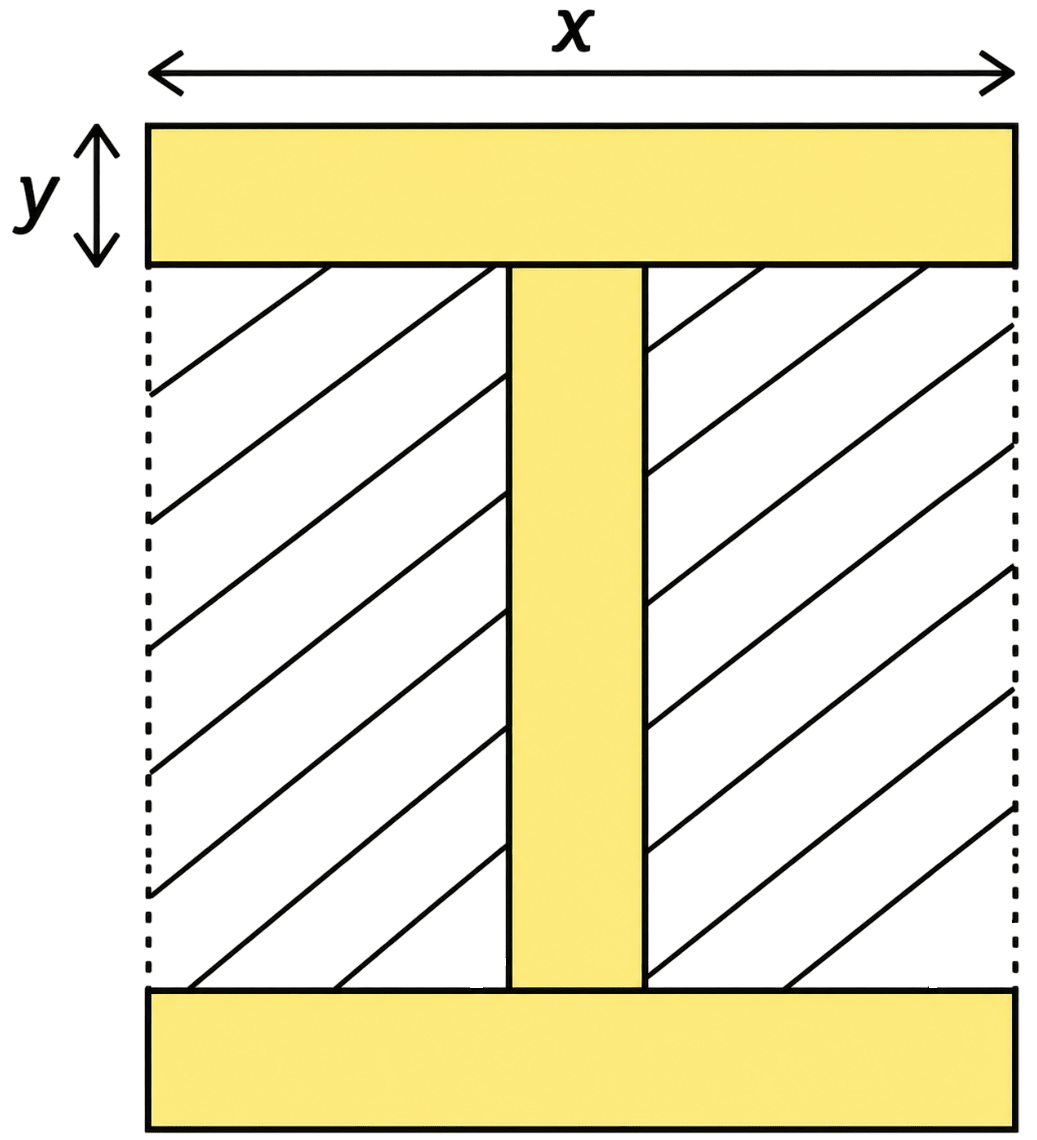
On finding the area of the figure, Anusha's method gives x2 – xy, Vaishnavi's method gives x(x + 2y) – 3xy, and Aditya's method gives x(x – y).
(i) By expanding the expressions, verify that all three expressions are equivalent.
(ii) If x = 8 and y = 3, find the area of the shaded region.
Answer
(i) We expand each expression.
⇒ Anusha:
x2 – xy (already in simplest form).
⇒ Vaishnavi:
x(x + 2y) – 3xy
= x2 + 2xy – 3xy
= x2 – xy.
⇒ Aditya:
x(x – y)
= x2 – xy.
Hence, all three expressions simplify to x2 – xy and are equivalent.
(ii) Substituting x = 8 and y = 3:
⇒ x2 – xy = 82 – 8 × 3
= 64 – 24
= 40.
Hence, for x = 8 and y = 3, the shaded area is 40 square units.
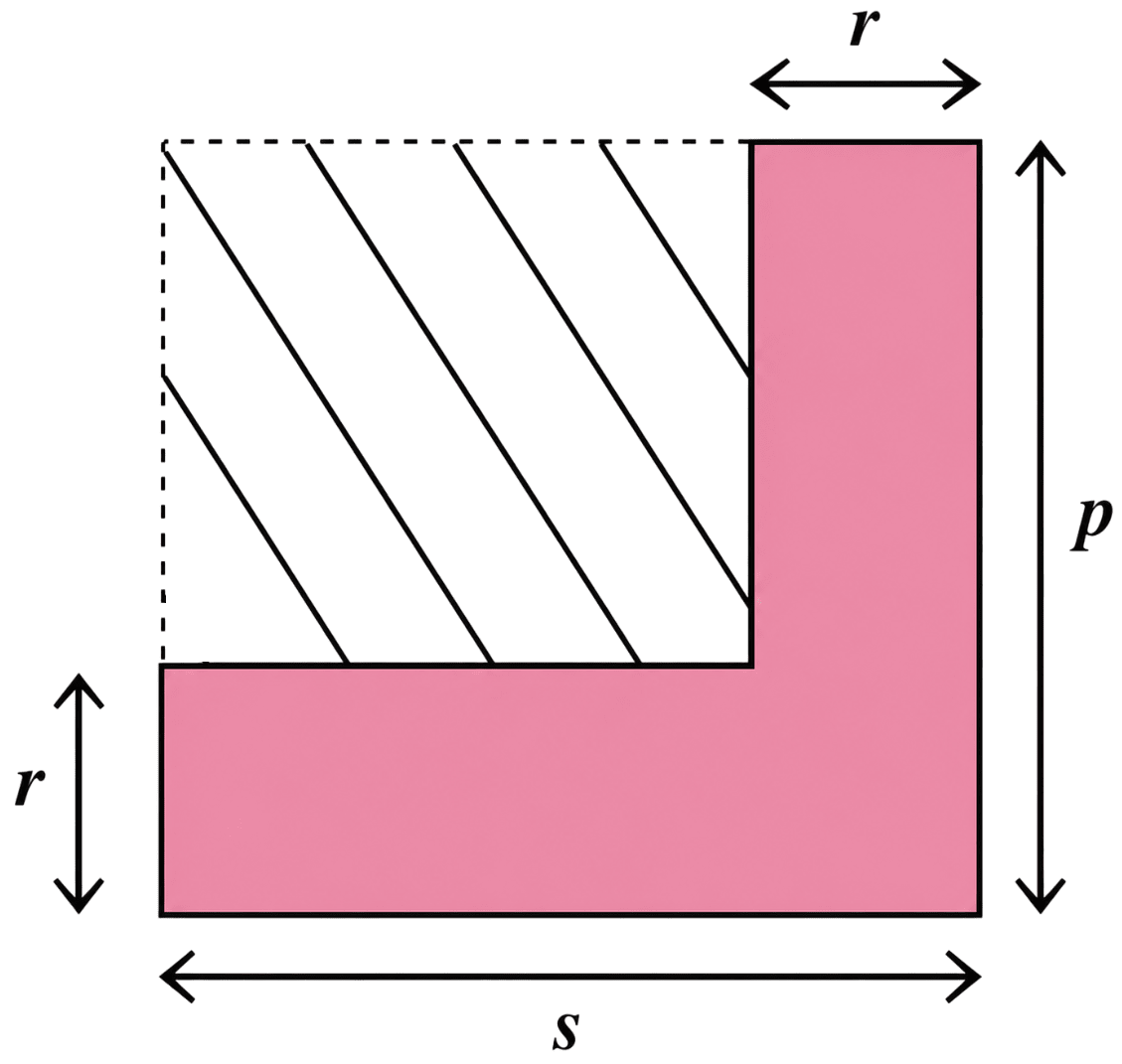
Write an expression for the area of the dashed region in the figure below. Use more than one method to arrive at the answer. Substitute p = 6, r = 3.5, and s = 9, and calculate the area.
Answer
The whole figure is a rectangle of width s and height p.
The pink (un-dashed) part is an L-shape made of a bottom strip of height r (running the full width s) and a vertical strip of width r on the right.
The dashed region is the rectangle left in the upper-left corner; its width is (s – r) and its height is (p – r).
Method 1 (the dashed region as a single rectangle):
⇒ Area = (s – r)(p – r).
Method 2 (whole rectangle minus the L-shaped region):
The whole rectangle has area sp.
The L-shape is the bottom strip (area sr) together with the vertical strip above it (area r(p – r)):
⇒ Area = sp – [sr + r(p – r)]
= sp – sr – rp + r2.
Expanding Method 1 confirms the two agree:
⇒ (s – r)(p – r) = sp – sr – rp + r2.
Substituting p = 6, r = 3.5 and s = 9:
⇒ Area = (s – r)(p – r) = (9 – 3.5)(6 – 3.5)
= 5.5 × 2.5
= 13.75.
Hence, the area of the dashed region is (s – r)(p – r), which equals 13.75 square units when p = 6, r = 3.5 and s = 9.
Compute these products using the suggested identity.
(i) 462 using Identity 1A for (a + b)2
(ii) 397 × 403 using Identity 1C for (a + b) (a – b)
(iii) 912 using Identity 1B for (a – b)2
(iv) 43 × 45 using Identity 1C for (a + b) (a – b)
Answer
(i) 462 using Identity 1A for (a + b)2
Writing 46 as (40 + 6)
Using Identity 1A (a + b)2 = a2 + 2ab + b2:
⇒ (46)2 = (40 + 6)2 = (40)2 + 2(40)(6) + (6)2
= 1600 + 480 + 36
= 2116.
Hence, 462 = 2116
(ii) 397 × 403 using Identity 1C for (a + b) (a – b)
Writing 397 as (400 – 3) and 403 as (400 + 3)
Using Identity 1C (a + b)(a – b) = a2 – b2:
⇒ 397 × 403 = (400 – 3)(400 + 3) = (400)2 - (3)2
= 160000 - 9
= 159991.
Hence, 397 × 403 = 159991
(iii) 912 using Identity 1B for (a – b)2
Writing 91 as (100 – 9)
Using Identity 1B (a – b)2 = a2 – 2ab + b2:
⇒ (91)2 = (100 – 9)2 = (100)2 - 2(100)(9) + (9)2
= 10000 - 1800 + 81
= 8281.
Hence, 912 = 8281.
(iv) 43 × 45 using Identity 1C for (a + b) (a – b)
Writing 43 as (44 – 1) and 45 as (44 + 1)
Using Identity 1C (a + b)(a – b) = a2 – b2:
⇒ 43 × 45 = (44 – 1)(44 + 1) = (44)2 - (1)2
= 1936 - 1
= 1935.
Hence, 43 × 45 = 1935.
Use either a suitable identity or the distributive property to find the following products.
(i) (p – 1) (p + 11)
(ii) (3a – 9b) (3a + 9b)
(iii) –(2y + 5) (3y + 4)
(iv) (6x + 5y)2
(v) (2x – )2
(vi) (7p) × (3r) × (p + 2)
Answer
(i) (p – 1) (p + 11)
Applying the distributive property:
⇒ (p – 1)(p + 11) = p(p + 11) – 1(p + 11)
= p2 + 11p - p - 11
= p2 + 10p - 11.
Hence, (p – 1)(p + 11) = p2 + 10p – 11.
(ii) (3a – 9b) (3a + 9b)
Using Identity 1C (a + b)(a – b) = a2 – b2, with a = 3a and b = 9b:
⇒ (3a – 9b)(3a + 9b) = (3a)2 - (9b)2
= 9a2 - 81b2.
Hence, (3a – 9b)(3a + 9b) = 9a2 – 81b2
(iii) –(2y + 5) (3y + 4)
First expanding (2y + 5)(3y + 4) using the distributive property:
⇒ (2y + 5)(3y + 4) = 2y(3y + 4) + 5(3y + 4)
= 6y2 + 8y + 15y + 20
= 6y2 + 23y + 20.
Applying the leading negative sign:
⇒ –(2y + 5)(3y + 4) = –(6y2 + 23y + 20)
= –6y2 - 23y - 20.
Hence, –(2y + 5)(3y + 4) = –6y2 – 23y – 20.
(iv) (6x + 5y)2
Using Identity 1A (a + b)2 = a2 + 2ab + b2, with a = 6x and b = 5y:
⇒ (6x + 5y)2 = (6x)2 + 2(6x)(5y) + (5y)2
= 36x2 + 60xy + 25y2.
Hence, (6x + 5y)2 = 36x2 + 60xy + 25y2
(v) (2x – )2
Using Identity 1B (a – b)2 = a2 – 2ab + b2, with a = 2x and :
Hence, .
(vi) (7p) × (3r) × (p + 2)
Multiplying the first two terms and then applying the distributive property:
⇒ (7p) × (3r) × (p + 2) = 21pr(p + 2)
= 21pr(p) + 21pr(2)
= 21p2r + 42pr.
Hence, (7p) × (3r) × (p + 2) = 21p2r + 42pr.
For each statement identify the appropriate algebraic expression(s).
(i) Two more than a square number.
2 + s, (s + 2)2, s2 + 2, s2 + 4, 2s2, 22s
(ii) The sum of the squares of two consecutive numbers
m2 + n2, (m + n)2, m2 + 1, m2 + (m + 1)2, m2 + (m – 1)2, (m + (m + 1))2, (2m)2 + (2m + 1)2
Answer
(i) A square number is s2, and "two more than" it means adding 2 to it. So the correct expression is s2 + 2.
Hence, the expression is s2 + 2.
(ii) Consecutive numbers can be represented as m and (m + 1), or as (m – 1) and m. Also, 2m and (2m + 1) are consecutive numbers for every integer m.
Therefore, the appropriate expressions are:
⇒ m2 + (m + 1)2,
⇒ m2 + (m – 1)2, and
⇒ (2m)2 + (2m + 1)2.
Hence, the appropriate expressions are m2 + (m + 1)2, m2 + (m – 1)2, and (2m)2 + (2m + 1)2.
Consider any 2 by 2 square of numbers in a calendar, as shown in the figure.
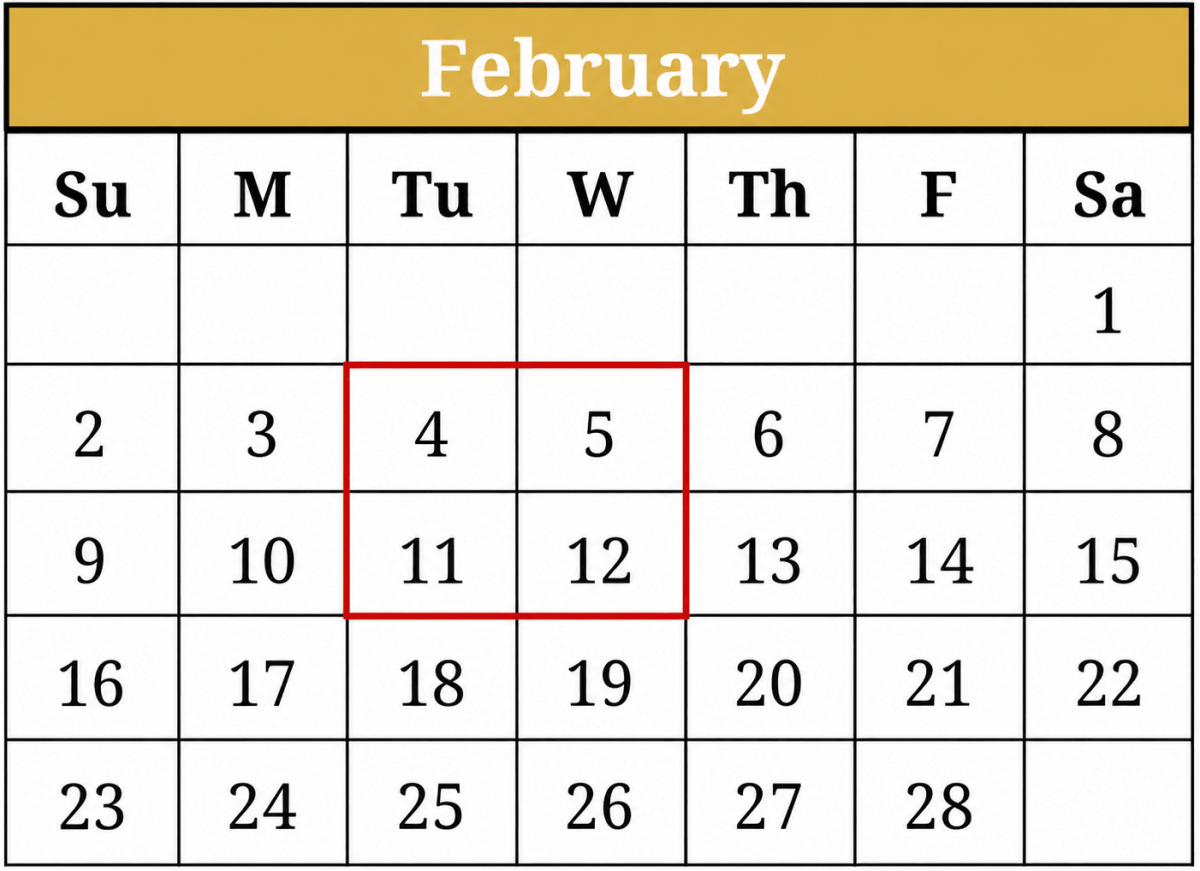
Find products of numbers lying along each diagonal — 4 × 12 = 48, 5 × 11 = 55. Do this for the other 2 by 2 squares. What do you observe about the diagonal products? Explain why this happens.
Hint: Label the numbers in each 2 by 2 square as
| a | a + 1 |
|---|---|
| a + 7 | a + 8 |
Answer
Consider the 2 by 2 square:
| 4 | 5 |
|---|---|
| 11 | 12 |
The diagonal products are:
4 × 12 = 48 and 5 × 11 = 55
Subtracting we get,
55 – 48 = 7
Consider the other 2 by 2 square:
| 3 | 4 |
|---|---|
| 10 | 11 |
The diagonal products are:
3 × 11 = 33 and 4 × 10 = 40
Subtracting we get,
40 - 33 = 7
Thus, we observe that the difference between the two diagonal products is always 7.
To explain why this happens, let the numbers in any 2×2 calendar square be:
| a | a + 1 |
|---|---|
| a + 7 | a + 8 |
The two diagonal products are:
⇒ a × (a + 8) = a2 + 8a.
⇒ (a + 1) × (a + 7) = a2 + 7a + a + 7 = a2 + 8a + 7.
Subtracting one diagonal product from the other:
⇒ (a + 1)(a + 7) – a(a + 8) = (a2 + 8a + 7) - (a2 + 8a)
= 7.
So in every such 2 by 2 square the two diagonal products differ by exactly 7.
This happens because each row of a calendar has 7 days, so moving one place down adds 7 to a number.
Hence, the two diagonal products of any 2 by 2 calendar square always differ by 7.
Verify which of the following statements are true.
(i) (k + 1) (k + 2) – (k + 3) is always 2.
(ii) (2q + 1) (2q – 3) is a multiple of 4.
(iii) Squares of even numbers are multiples of 4, and squares of odd numbers are 1 more than multiples of 8.
(iv) (6n + 2)2 – (4n + 3)2 is 5 less than a square number.
Answer
(i) False
Reason —
Expanding the expression:
⇒ (k + 1)(k + 2) – (k + 3) = (k2 + 3k + 2) - (k + 3)
= k2 + 2k - 1.
This depends on the value of k and is not always 2, so the statement is false.
(ii) False
Reason —
Expanding the expression:
⇒ (2q + 1)(2q – 3) = 4q2 - 6q + 2q - 3
= 4q2 - 4q - 3
= 4(q2 - q) - 3.
This is 3 less than a multiple of 4 (in fact it is odd), so it is not a multiple of 4. The statement is false.
(iii) True
Reason —
An even number can be written as 2n. Its square is:
⇒ (2n)2 = 4n2,
which is a multiple of 4. An odd number can be written as (2n + 1). Its square is:
⇒ (2n + 1)2 = 4n2 + 4n + 1 = 4n(n + 1) + 1.
Since n and (n + 1) are consecutive, one of them is even, so n(n + 1) is even and 4n(n + 1) is a multiple of 8. Hence the square of an odd number is 1 more than a multiple of 8. The statement is true.
(iv) False
Reason —
Using Identity 1C, expand the difference of squares:
⇒ (6n + 2)2 – (4n + 3)2 = [(6n + 2) + (4n + 3)][(6n + 2) – (4n + 3)]
= (10n + 5)(2n – 1)
= 5(2n + 1)(2n – 1)
= 20n2 - 5.
If this were 5 less than a square number, then adding 5 would give a perfect square. But 20n2 – 5 + 5 = 20n2, and 20n2 is not a perfect square in general (20 is not a perfect square). So the statement is false.
A number leaves a remainder of 3 when divided by 7, and another number leaves a remainder of 5 when divided by 7. What is the remainder when their sum, difference, and product are divided by 7?
Answer
Let the two numbers be n1 = 7a + 3 and n2 = 7b + 5, where a and b are whole numbers.
Sum:
⇒ n1 + n2 = (7a + 3) + (7b + 5) = 7a + 7b + 8
= 7(a + b + 1) + 1.
So the sum leaves a remainder of 1.
Difference (second number – first number):
⇒ n2 – n1 = (7b + 5) – (7a + 3) = 7(b – a) + 2.
So the difference leaves a remainder of 2.
Product:
⇒ n1 × n2 = (7a + 3)(7b + 5) = 49ab + 35a + 21b + 15
= 7(7ab + 5a + 3b + 2) + 1.
So the product leaves a remainder of 1.
Hence, the sum leaves remainder 1, the difference leaves remainder 2, and the product leaves remainder 1 when divided by 7.
Choose three consecutive numbers, square the middle one, and subtract the product of the other two. Repeat the same with other sets of numbers. What pattern do you notice? How do we write this as an algebraic equation? Expand both sides of the equation to check that it is a true identity.
Answer
Take three consecutive numbers as (n – 1), n and (n + 1), where n is the middle number.
Squaring the middle number and subtracting the product of the other two gives:
⇒ n2 – (n – 1)(n + 1).
Using Identity 1C, (n – 1)(n + 1) = n2 – 1, so:
⇒ n2 – (n – 1)(n + 1) = n2 - (n2 - 1)
= 1.
The result is always 1, whatever the three consecutive numbers are. This can be written as the equation:
⇒ n2 – (n – 1)(n + 1) = 1, or equivalently (n – 1)(n + 1) = n2 – 1.
Expanding the left side of the second form by the distributive property gives (n – 1)(n + 1) = n2 + n – n – 1 = n2 – 1, which matches the right side, so it is a true identity.
Hence, the square of the middle of three consecutive numbers minus the product of the other two is always 1, that is, n2 – (n – 1)(n + 1) = 1.
What is the algebraic expression describing the following steps — add any two numbers. Multiply this by half of the sum of the two numbers? Prove that this result will be half of the square of the sum of the two numbers.
Answer
Let the two numbers be a and b.
Adding them gives the sum (a + b).
Half of this sum is .
Multiplying the sum by half of the sum gives:
This is exactly half of (a + b)2, which is the square of the sum of the two numbers.
Hence, the expression is (a + b) × (a + b) = (a + b)2, which is half of the square of the sum.
Which is larger? Find out without fully computing the product.
(i) 14 × 26 or 16 × 24
(ii) 25 × 75 or 26 × 74
Answer
(i) Let a = 14 × 26 and b = 16 × 24.
⇒ a = (16 – 2)(24 + 2)
= 16 × 24 + 16 × 2 – 2 × 24 – 2 × 2
= b + 32 – 48 – 4
= b – 20.
Therefore, b > a.
Hence, 16 × 24 > 14 × 26.
(ii) Let a = 25 × 75 and b = 26 × 74.
⇒ a = (26 – 1)(74 + 1)
= 26 × 74 + 26 × 1 – 1 × 74 – 1 × 1
= b + 26 – 74 – 1
= b – 49.
Therefore, b > a.
Hence, 26 × 74 > 25 × 75.
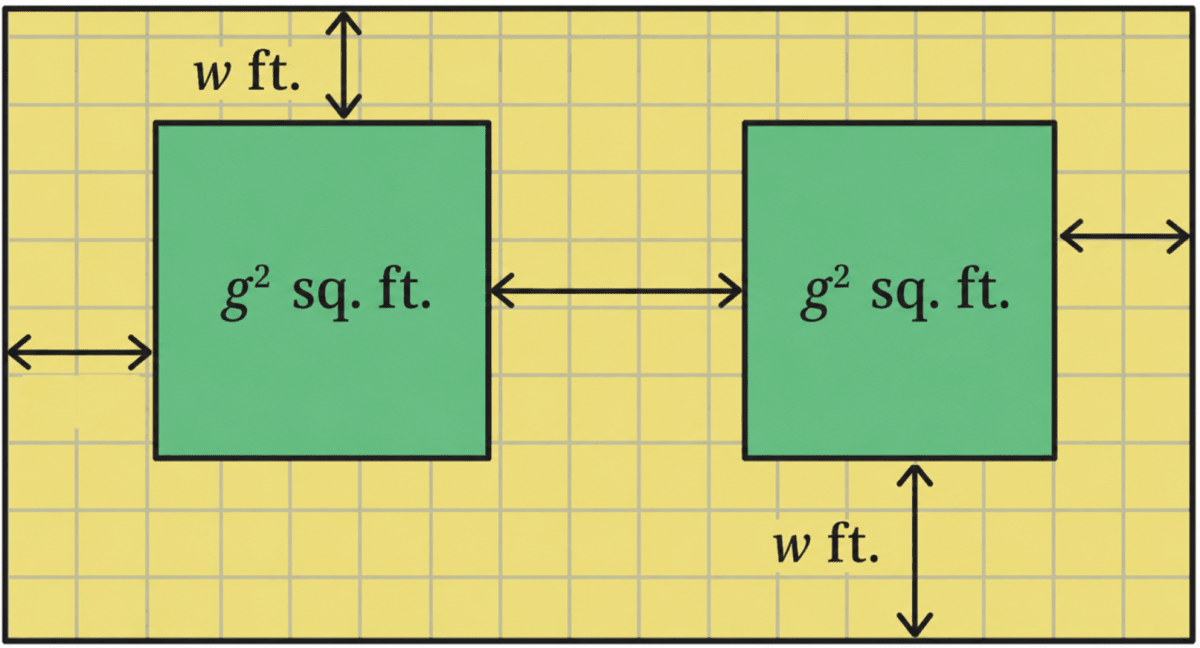
A tiny park is coming up in Dhauli. The plan is shown in the figure. The two square plots, each of area g2 sq. ft., will have a green cover. All the remaining area is a walking path w ft. wide that needs to be tiled. Write an expression for the area that needs to be tiled.
Answer
From the plan, the overall park is a rectangle. Reading across its length, there is a path of width w, then a square of side g, then a path of width 2w between the two squares, then the second square of side g, then a path of width w. So the length of the park is:
⇒ Length = w + g + 2w + g + w = (2g + 4w) ft.
Reading across its breadth, there is a path of width w, the square of side g, and a path of width w, so the breadth of the park is:
⇒ Breadth = w + g + w = (g + 2w) ft.
The total area of the park is:
⇒ Area of park = (2g + 4w)(g + 2w)
= 2g2 + 4gw + 4gw + 8w2
= 2g2 + 8gw + 8w2.
The two square plots together have area 2g2 sq. ft. and do not need tiling. So the area to be tiled is:
⇒ Area to be tiled = (2g2 + 8gw + 8w2) – 2g2
= 8gw + 8w2
= 8w(g + w).
Hence, the area that needs to be tiled is 8w(g + w) sq. ft.
For each pattern shown below,
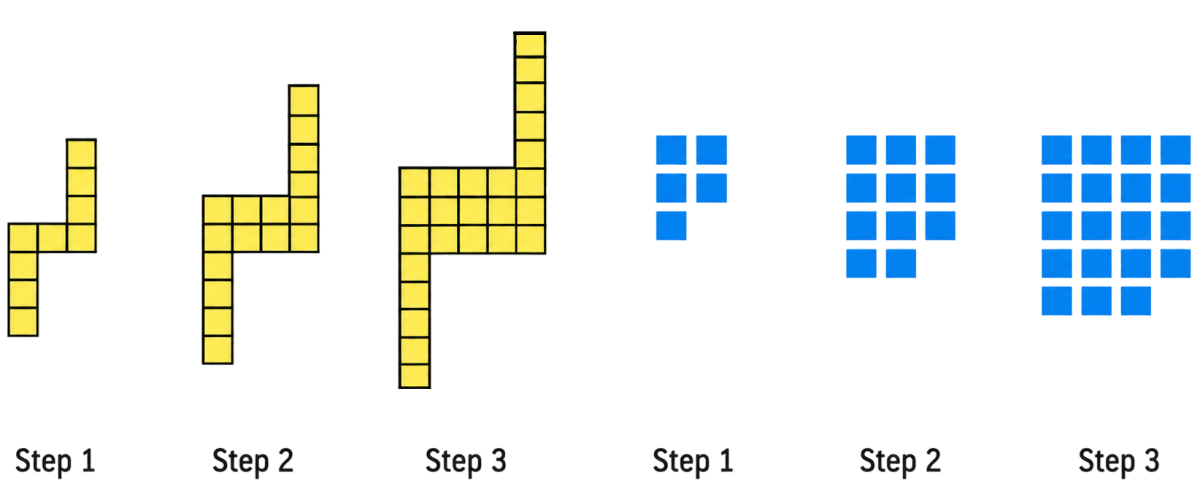
(i) Draw the next figure in the sequence.
(ii) How many basic units are there in Step 10?
(iii) Write an expression to describe the number of basic units in Step y.
Answer
Pattern (a):
(i) The number of basic units in each step is a perfect square:
Step 1 has (2 + 1)2 = 9, Step 2 has (2 + 2)2 = 16, and Step 3 has (2 + 3)2 = 25.
The next figure, Step 4, has (2 + 4)2 = 36 basic units.
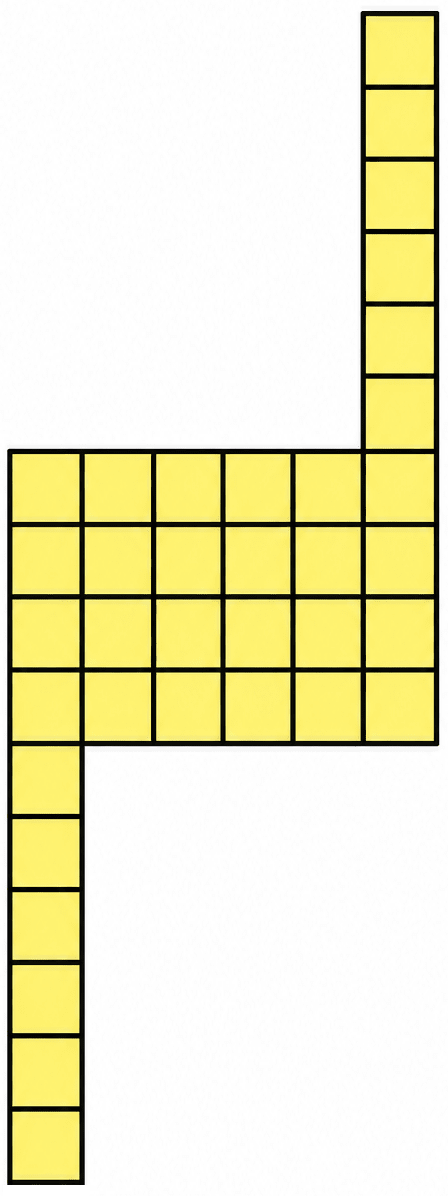
(ii) In Step 10, the number of basic units is:
⇒ (2 + 10)2 = (12)2 = 144.
(iii) In Step y, the number of basic units is (y + 2)2.
Pattern (b):
(i) Here each step has a perfect square plus the step number:
Step 1 has 22 + 1 = 5, Step 2 has 32 + 2 = 11, and Step 3 has 42 + 3 = 19.
The next figure, Step 4, has 52 + 4 = 29 basic units.
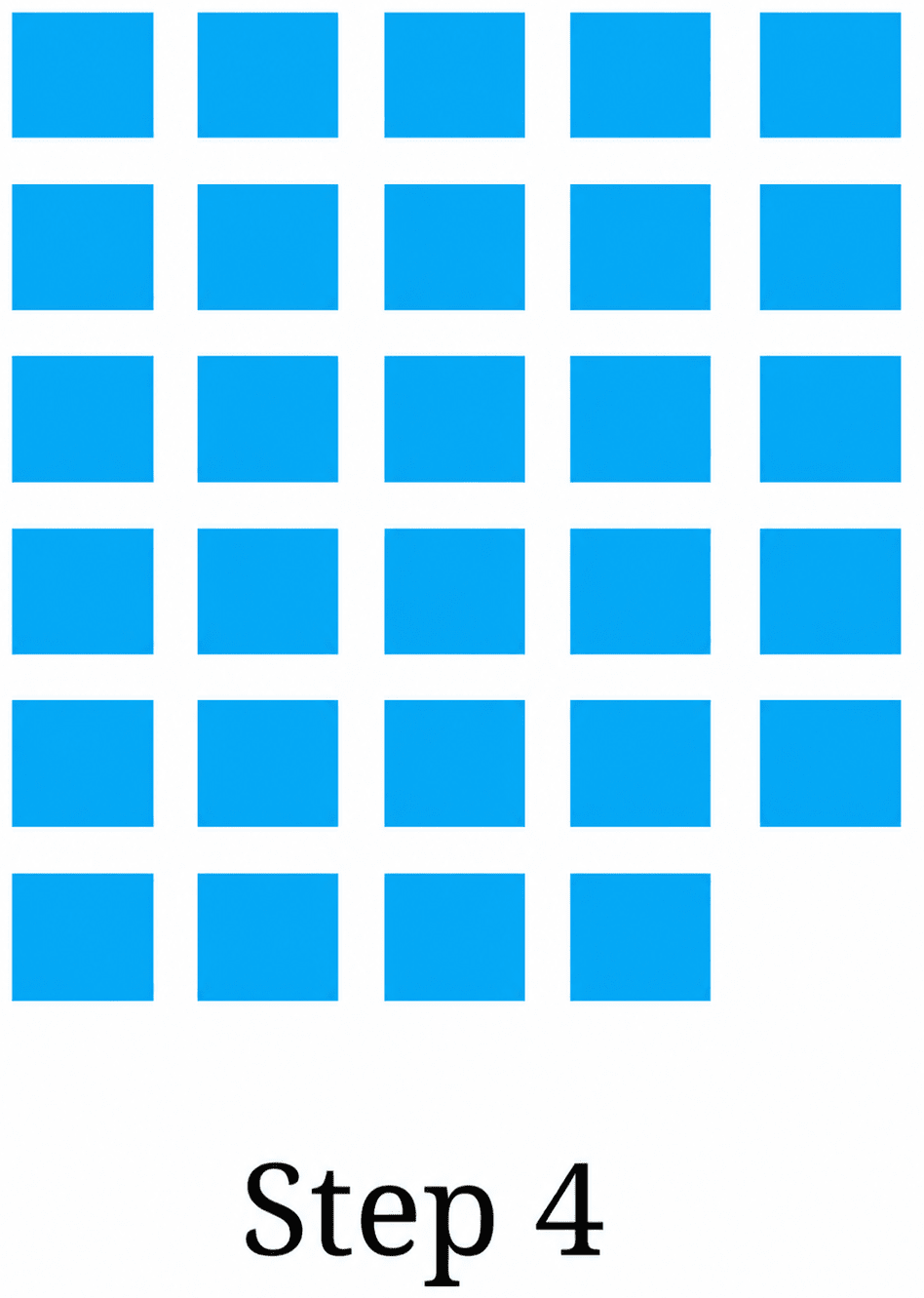
(ii) In Step 10, the number of basic units is:
⇒ (11)2 + 10 = 121 + 10 = 131.
(iii) In Step y, the number of basic units is (y + 1)2 + y.
Arrange 10 coins in a triangle as shown in the figure below on the left. The task is to turn the triangle upside down by moving one coin at a time. How many moves are needed? What is the minimum number of moves? A triangle of 3 coins can be inverted (turned upside down) with a single move, and a triangle of 6 coins can be inverted by moving 2 coins.
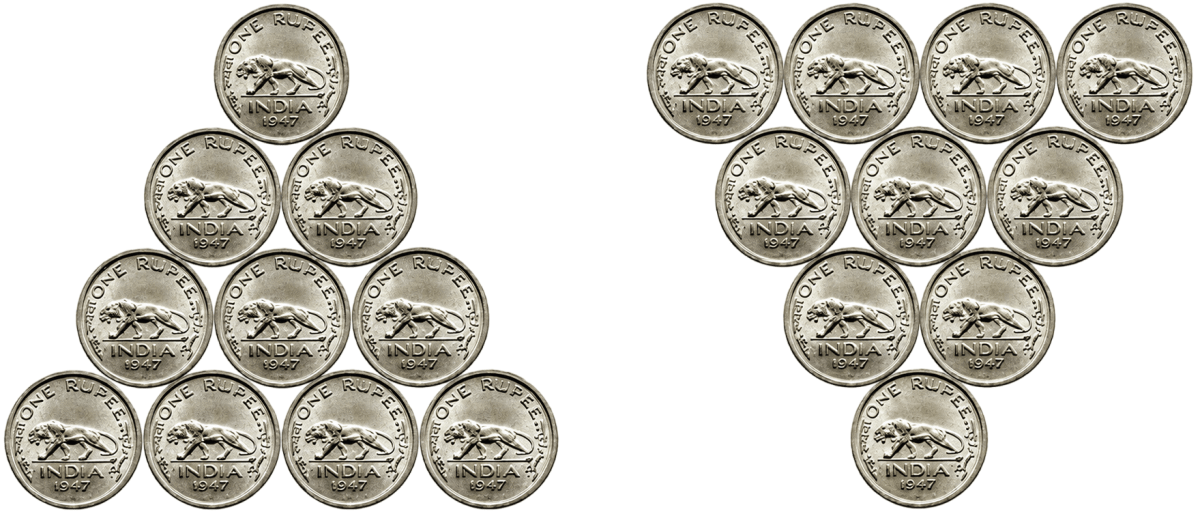
The 10-coin triangle can be flipped with just 3 moves; did you figure out how? Find out the minimum possible moves needed to flip the next bigger triangle having 15 coins. Try the same for bigger triangular numbers. Is there a simple way to calculate the minimum number of coin moves needed for any such triangular arrangement?
Answer
A triangle of coins with the same number of coins on each side is a triangular arrangement, and the total number of coins is a triangular number. The smallest cases are already given: 3 coins need 1 move, 6 coins need 2 moves, and 10 coins need 3 moves.
To invert the triangle while moving as few coins as possible, we keep the largest possible block of coins fixed and shift only the coins around it. Doing this for the 15-coin triangle, the minimum number of coins that must be moved turns out to be 5.
Looking at the pattern of the minimum number of moves against the total number of coins:
- 3 coins ⇒ 1 move,
- 6 coins ⇒ 2 moves,
- 10 coins ⇒ 3 moves,
- 15 coins ⇒ 5 moves,
- 21 coins ⇒ 7 moves.
In each case the minimum number of moves is about one-third of the total number of coins. If the triangle has T coins in all, the minimum number of moves is the whole-number part of , that is, . Equivalently, for a triangle with n coins along each side, the total number of coins is , and the minimum number of moves is .
Hence, the 15-coin triangle can be inverted in a minimum of 5 moves, and a triangular arrangement of T coins can be inverted by moving about a third of them, namely coins.