
Why does this new dotted square have double the area of the original square?
Answer
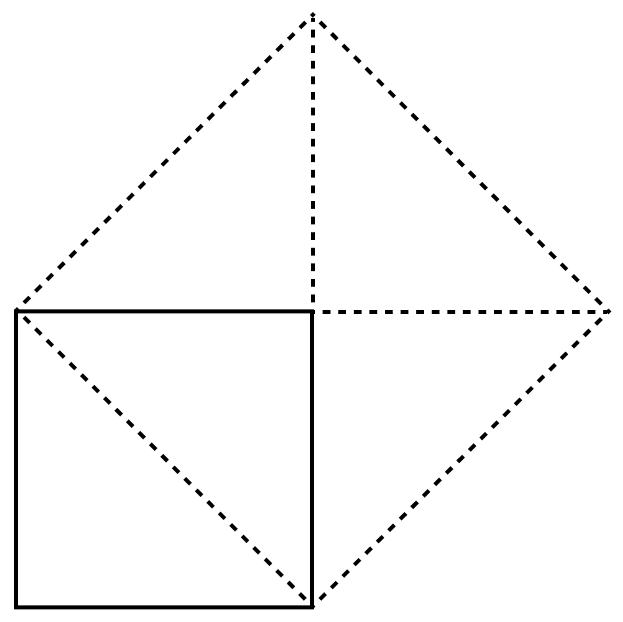
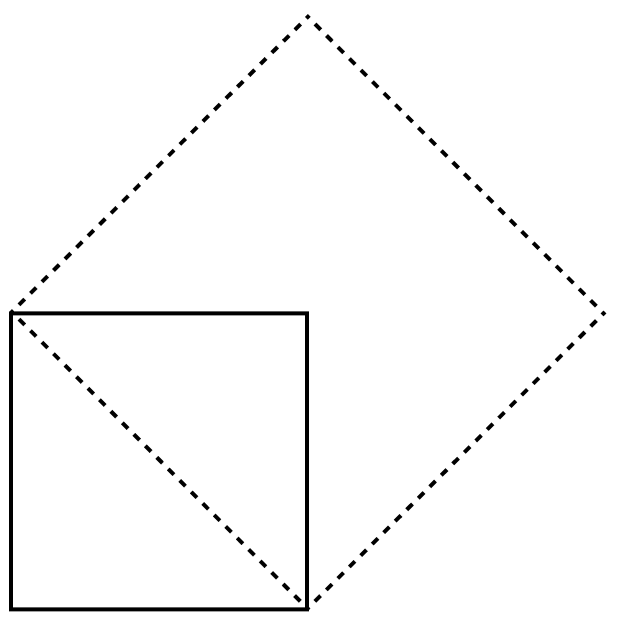
The new (dotted) square is constructed on the diagonal of the original square.
Draw the horizontal and vertical lines (the diagonals of the new dotted square) inside the figure.
The original square is made up of 2 small triangles.
The new dotted square is made up of 4 small triangles.
All these small triangles are congruent, so they have equal area.
Therefore, the new dotted square contains twice as many such triangles as the original square.
So, Area of new square = 2 × Area of original square.
Hence, the new dotted square has double the area of the original square.
Why should the extension of the vertical and horizontal sides of the original square pass through the vertices of the dotted square?
[Hint: From the diagonal property of a square, the line that bisects an angle passes through the opposite vertex. Argue why the vertical and horizontal sides of the original square bisect the two angles of the dotted square.]
Answer
The dotted square is constructed on the diagonal of the original square.
At each endpoint of this diagonal, the diagonal of the original square makes an angle of 45° with the horizontal and vertical sides of the original square.
Also, the adjacent side of the dotted square is perpendicular to this diagonal. Therefore, the relevant horizontal or vertical side of the original square divides the 90° angle of the dotted square into two equal angles of 45° each.
Thus, the horizontal and vertical sides of the original square bisect the corresponding angles of the dotted square.
In a square, the angle bisector at a vertex is a diagonal, and it passes through the opposite vertex.
Therefore, the extensions of these horizontal and vertical sides pass through the opposite vertices of the dotted square.
Hence, the extensions of the vertical and horizontal sides of the original square pass through the vertices of the dotted square.
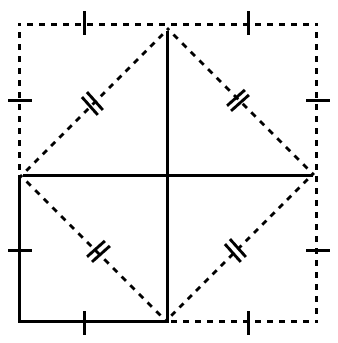
All these small triangles are congruent to each other. Can you explain why?
Answer
Each of the small triangles is an isosceles right-angled triangle.
Their two shorter sides have the same lengths, and each has a right angle between them.
Therefore, all the triangles have the same shape and the same size.
Hence, all the small triangles are congruent to each other and have equal area.
Hence, all the small triangles are congruent to each other.
Why is the smaller inside square half the area of the larger square?

Answer
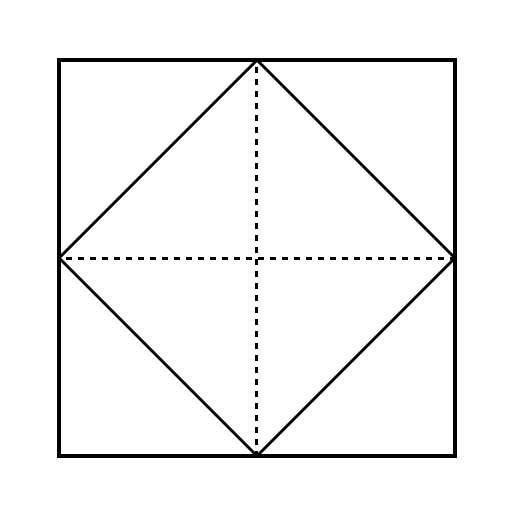
Draw the east–west and north–south lines (the lines joining the midpoints of opposite sides of the larger square).
These lines, together with the sides of the tilted inner square, divide the larger square into 8 small congruent triangles.
The smaller (tilted) inside square is made up of 4 of these small triangles, while the larger square is made up of all 8 of them.
Therefore,
Area of inner square = × Area of larger square
= × Area of larger square.
Hence, the smaller inside square is half the area of the larger square.
Will the square having half the sidelength have half the area? Why not? How many such squares will fill the original square?
Answer
No, the square having half the side length will not have half the area.
Let the side length of the original square be s.
Then, Area of original square = s × s = s2.
A square having half the side length has side .
Its area = × = .
So the new square has area of the original square, not .
This happens because the area of a square depends on the square of its side length, so halving the side makes the area one-fourth.
Number of such squares needed to fill the original square = = 4.
Hence, a square with half the side length has one-fourth (not half) the area, and 4 such squares are needed to fill the original square.
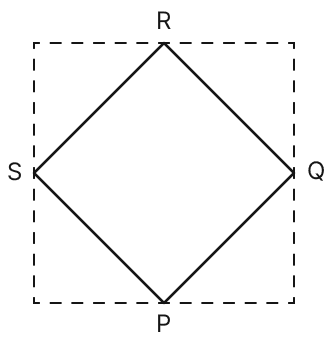
Why is PQRS a square? Why is its area half that of the original paper? Explain by connecting QS and PR, finding the different angles formed, and then using triangle congruence.
Answer
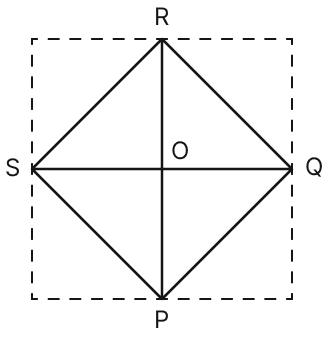
Here P, Q, R and S are the midpoints of the sides of the original square paper.
Join QS and PR. Let them intersect at O.
QS and PR are the lines joining the midpoints of opposite sides. Let them meet at the centre O.
- QS is parallel to two sides of the original square and PR is parallel to the other two sides, so QS ∥ PR's perpendicular — that is, QS ⊥ PR, and they meet at a right angle.
- QS = PR = side length of the original square.
- O is the midpoint of both, so OP = OQ = OR = OS = × (side of original square).
PQRS is a square:
Consider the four triangles △POQ, △QOR, △ROS and △SOP.
In each triangle, the two sides from O are equal (each equal to × side) and the included angle at O is 90°.
So, by the SAS criterion,
△POQ ≅ △QOR ≅ △ROS ≅ △SOP
⇒ PQ = QR = RS = SP [Corresponding sides of congruent triangles]
Also, each of these triangles is an isosceles right triangle, so its two base angles are 45° each.
At vertex P, ∠SPQ = ∠OPS + ∠OPQ = 45° + 45° = 90°.
Similarly, ∠PQR = ∠QRS = ∠RSP = 90°.
Since all four sides are equal and all four angles are right angles, PQRS is a square.
Area of PQRS is half the original paper:
The lines PR and QS divide the original square into 4 equal small squares.
In each small square, a side of PQRS is its diagonal, which divides that small square into two congruent triangles — one lying inside PQRS and one lying outside.
So exactly half of each small square lies inside PQRS.
⇒ Area of PQRS = × Area of the original square.
Hence, PQRS is a square whose area is half the area of the original paper.
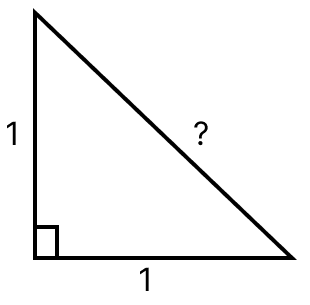
Find the hypotenuse of this isosceles right triangle.
Answer
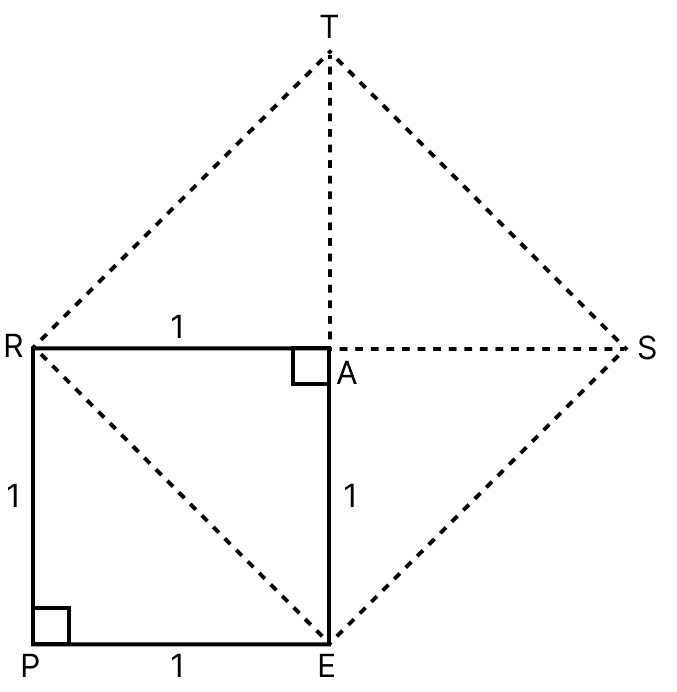
Given: An isosceles right triangle with each of the two equal (perpendicular) sides of length 1 unit.
A unit square (PEAR) of side 1 unit is made up of two such isosceles right triangles.
We also know that the square constructed on the diagonal (hypotenuse) of a square has twice the area of the original square.
So the square REST drawn on the hypotenuse has area:
Area of REST = 2 × Area of PEAR
= 2 × 1 sq. unit
= 2 sq. units.
Let c be the length of the hypotenuse ER.
We know that Area of a square = side × side.
So, Area of REST = c × c = c2.
⇒ c2 = 2
⇒ c =
Hence, the hypotenuse of the isosceles right triangle is units.
Earlier, we saw a method to create a square with double the area of a given square paper. There is another method to do this in which two identical square papers are cut in the following way.
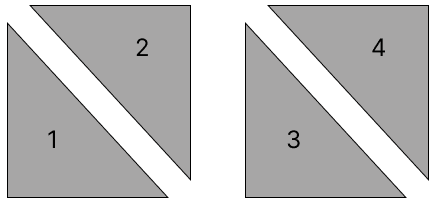
Can you arrange these pieces to create a square with double the area of either square?
Answer
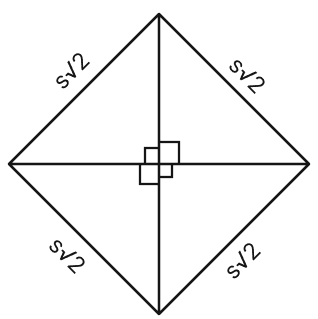
Each of the two identical square papers is cut along a diagonal, giving four congruent isosceles right-angled triangles in all.
Let the side length of each original square be s units.
Area of each original square = s × s = s2.
Area of each triangular piece = .
Let d be the diagonal of an original square. By the Baudhāyana-Pythagoras theorem,
d2 = s2 + s2
⇒ d2 = 2s2.
⇒ d =
⇒ d = .
Arrange the four triangles so that their hypotenuses form the four sides of a new tilted square and their right-angled vertices meet at the centre.
Side of the new square = .
Area of the new square =
= 2s2.
This is twice the area of either original square.
The same conclusion follows by counting the pieces: the new square contains all four triangular pieces, whereas either original square contains only two.
Hence, the four triangular pieces form a square whose area is double the area of either original square.
The length of the two equal sides of an isosceles right triangle is given. Find the length of the hypotenuse. Find bounds on the length of the hypotenuse such that they have at least one digit after the decimal point.
(i) 3
(ii) 4
(iii) 6
(iv) 8
(v) 9
Answer
We have the formula for an isosceles right triangle with equal sides a and hypotenuse c:
c2 = 2a2
(i) a = 3
c2 = 2 × 32
= 2 × 9
= 18
⇒ c = units
We have 42 = 16 and 52 = 25.
Since 16 < 18 < 25 ⇒ 4 < < 5
For bounds with a digit after the decimal point:
4.22 = 17.64 and 4.32 = 18.49
Since 17.64 < 18 < 18.49 ⇒ 4.2 < < 4.3
Hypotenuse = units, and 4.2 < < 4.3
(ii) a = 4
c2 = 2 × 42
= 2 × 16
= 32
⇒ c = units
We have 52 = 25 and 62 = 36.
Since 25 < 32 < 36
⇒ 5 < < 6
For bounds with a digit after the decimal point:
5.62 = 31.36 and 5.72 = 32.49
Since 31.36 < 32 < 32.49
⇒ 5.6 < < 5.7
Hypotenuse = units, and 5.6 < < 5.7
(iii) a = 6
c2 = 2 × 62
= 2 × 36
= 72
⇒ c = units
We have 82 = 64 and 92 = 81.
Since 64 < 72 < 81
⇒ 8 < < 9
For bounds with a digit after the decimal point:
8.42 = 70.56 and 8.52 = 72.25
Since 70.56 < 72 < 72.25
⇒ 8.4 < < 8.5
Hypotenuse = units, and 8.4 < < 8.5
(iv) a = 8
c2 = 2 × 82
= 2 × 64
= 128
⇒ c = units
We have 112 = 121 and 122 = 144.
Since 121 < 128 < 144 ⇒ 11 < < 12
For bounds with a digit after the decimal point:
11.32 = 127.69 and 11.42 = 129.96
Since 127.69 < 128 < 129.96
⇒ 11.3 < < 11.4
Hypotenuse = units, and 11.3 < < 11.4
(v) a = 9
c2 = 2 × 92
= 2 × 81
= 162
⇒ c = units
We have 122 = 144 and 132 = 169.
Since 144 < 162 < 169 ⇒ 12 < < 13
For bounds with a digit after the decimal point:
12.72 = 161.29 and 12.82 = 163.84
Since 161.29 < 162 < 163.84
⇒ 12.7 < < 12.8
Hypotenuse = units, and 12.7 < < 12.8
The hypotenuse of an isosceles right triangle is 10. What are its other two sidelengths?
[Hint: Find the area of the square composed of two such right triangles.]
Answer
![The hypotenuse of an isosceles right triangle is 10. What are its other two sidelengths? [Hint: Find the area of the square composed of two such right triangles.]. The Baudhayana - Pythagoras Theorem, NCERT Class 8 Ganita Prakash Mathematics CBSE Solutions.](https://cdn1.knowledgeboat.com/img/ncert-8/q3-figure-out-1-ans-1-ganita-prakash-2-cbse-class-8-c2-202608061600-450x463.png)
Two such equal right triangles together form a square whose side is an equal side a.
The square drawn on the hypotenuse has twice the area of this smaller square.
Let a be the length of each equal side and c = 10 the hypotenuse.
Area of the square on the hypotenuse = c2 = 102 = 100 sq. units
Area of the smaller square = × 100 = 50 sq. units
This smaller square has side a, so
a2 = 50
⇒ a = = =
Each of the other two sides has length units.
Find the hypotenuse of an isosceles right triangle whose equal sides have length 12.
Answer
Given:
Equal sides a = 12
We have the formula,
c2 = 2a2
= 2 × 122 [Substituting the value]
= 2 × 144
= 288
⇒ c = = = units
We have 162 = 256 and 172 = 289.
Since 256 < 288 < 289
⇒ 16 < < 17
The hypotenuse = units, which lies between 16 and 17 units.
Why does Baudhāyana's method work?
Answer
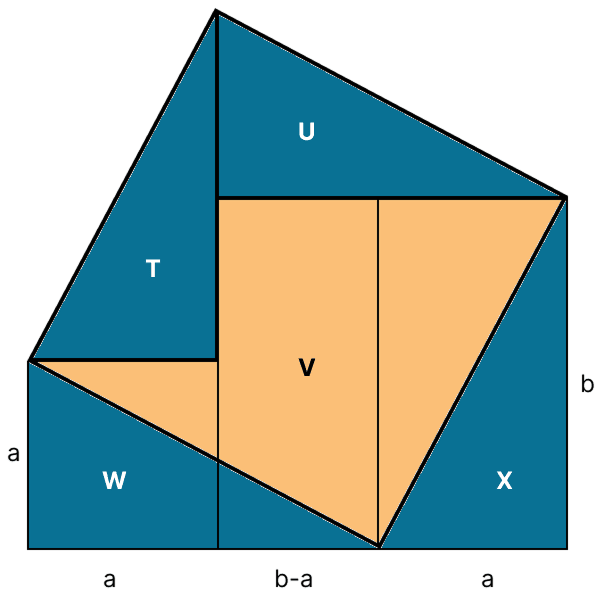
To combine two squares of sides a and b, Baudhāyana first forms a right-angled triangle whose perpendicular sides are a and b.
Three more triangles congruent to this triangle are drawn around it. These four congruent triangles form a 4-sided figure in the middle.
Since all four triangles are congruent, the four sides of the middle figure are equal. Also, each angle of the middle figure is a right angle. Therefore, the middle figure is a square.
The side of this square is the hypotenuse c of the right triangle.
The area of the square on the hypotenuse is equal to the combined area of the two original squares. Hence,
c2 = a2 + b2
Baudhāyana's method works because the square on the hypotenuse has the same area as the two original squares taken together. Therefore, c2 = a2 + b2.
Can you see why the method works in the case where the two squares are the same size? Does it agree with the method we used earlier to combine two same sized squares into a bigger square?
Answer
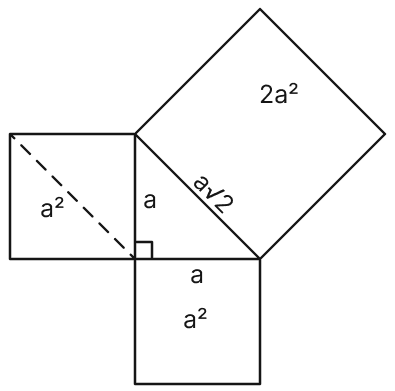
When the two squares have the same size, a = b. The right-angled triangle used in the construction then becomes an isosceles right-angled triangle, with both perpendicular sides equal to a.
By Baudhāyana's method, the area of the square on the hypotenuse:
c2 = a2 + a2 = 2a2
So the new square has area 2a2, that is, double the area of either original square.
This agrees with the earlier method of doubling a square. There we constructed a square on the diagonal of a given square and found that it had double the area. The diagonal of a square of side a is exactly the hypotenuse of the isosceles right-angled triangle with equal sides a and a, and the square on this diagonal has area 2a2.
Yes. For two equal squares the method gives a square of area 2a2, the same result as building a square on the diagonal of one square — so the two methods agree.
The 4-sided figure obtained (T + U + V) is in fact a square with an area equal to the sum of the areas of the two smaller squares! Why?
Answer
The four triangles T, U, W, and X are congruent right-angled triangles.
Each side of the central figure (T + U + V) is the hypotenuse of one of these triangles. Since the triangles are congruent, their hypotenuses are equal. Therefore all four sides of the central figure are equal.
Let the acute angles of each triangle be θ and (90° − θ). At every corner of the central figure these two angles meet, so
θ + (90° − θ) = 90°.
Thus each interior angle of the central figure is a right angle.
Hence the central figure is a square.
Also, the whole large figure consists of the central square together with the four congruent triangles. Rearranging the same four triangles around the two smaller squares of sides a and b shows that the area of the central square equals the combined area of the two squares.
Therefore,
Area of central square = a2 + b2
Hence, the 4-sided figure is a square whose area is equal to the sum of the areas of the two smaller squares.
Explain why all the angles of this new 4-sided figure are right angles and so it is a square.
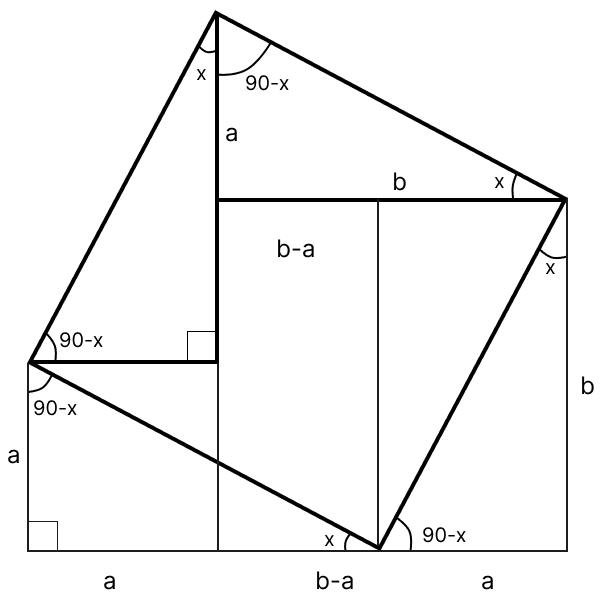
Answer
Each of the four triangles T, U, W, and X is a congruent right-angled triangle.
Let the two acute angles of each triangle be x and (90° − x).
At any vertex of the new 4-sided figure, the angles x, (90° − x) and the angle of the figure together form a straight angle. Hence,
x + (angle of the figure) + (90° − x) = 180°
⇒ angle of the figure = 180° − x − (90° − x)
⇒ angle of the figure = 180° − x − 90° + x
⇒ angle of the figure = 90°
Thus every angle of the new 4-sided figure is a right angle.
Since all four sides of the figure are equal (each being the hypotenuse of a congruent triangle) and all four angles are 90°, the new 4-sided figure is a square.
Since all four sides are equal and all four angles are right angles, the new 4-sided figure is a square.
If a right-angled triangle has shorter sides of lengths 5 cm and 12 cm, then what is the length of its hypotenuse? First draw the right-angled triangle with these sidelengths and measure the hypotenuse, then check your answer using Baudhāyana's Theorem.
Answer
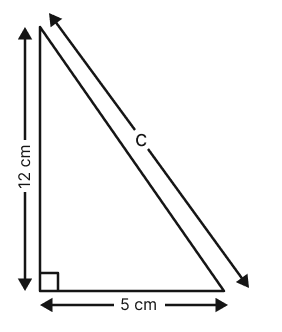
Given:
The two shorter sides of the right-angled triangle are 5 cm and 12 cm.
On drawing the right-angled triangle and measuring, the hypotenuse reads about 13 cm.
Checking using Baudhāyana's Theorem:
Let a = 5 cm, b = 12 cm and let c be the length of the hypotenuse.
By Baudhāyana's Theorem,
a2 + b2 = c2
⇒ 52 + 122 = c2 [Substituting the values]
⇒ 25 + 144 = c2
⇒ 169 = c2
⇒ c = cm
⇒ c = 13 cm
The length of the hypotenuse = 13 cm.
If a right-angled triangle has a short side of length 8 cm and hypotenuse of length 17 cm, what is the length of the third side? Again, try drawing the triangle and measuring, and then check your answer using Baudhāyana's Theorem.
Answer
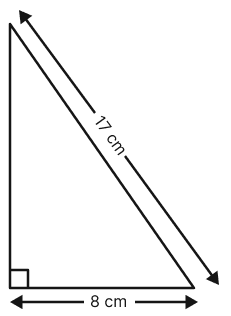
Given:
One shorter side = 8 cm, hypotenuse = 17 cm.
On drawing the right-angled triangle and measuring, the third side reads about 15 cm.
Checking using Baudhāyana's Theorem:
Shorter side : a = 8 cm
hypotenuse : c = 17 cm
let b be the length of the third side.
By Baudhāyana's Theorem,
a2 + b2 = c2
⇒ 82 + b2 = 172 [Substituting the values]
⇒ 64 + b2 = 289
⇒ b2 = 289 − 64
⇒ b2 = 225
⇒ b = cm
⇒ b = 15 cm
The length of the third side = 15 cm.
Using the constructions you have now seen, how would you construct a square whose area is triple the area of a given square? Five times the area of a given square? (Baudhāyana's Śulba-Sūtra, Verse 1.10)
Answer
Let the given square have area A and sidelength s.
Square with triple the area (3A):
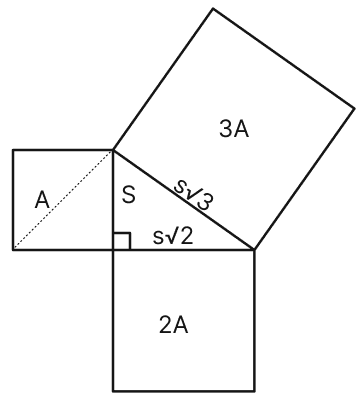
We use the doubling construction together with Baudhāyana's method of combining two different squares.
Step 1: Construct the square on the diagonal of the given square. By the doubling result, this new square has area 2A (its sidelength is the diagonal of the given square).
Step 2: Make a right-angled triangle whose two perpendicular sides are a side of the given square (the square of area A) and a side of the doubled square (the square of area 2A).
Step 3: Construct the square on the hypotenuse of this right-angled triangle. By Baudhāyana's Theorem on combining two different squares,
Area of square on hypotenuse = A + 2A = 3A
The square on the hypotenuse has area 3A, i.e., triple the area of the given square.
Square with five times the area (5A):
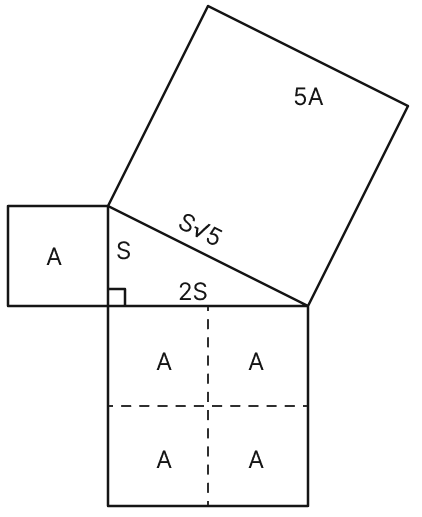
Step 1: Double the given square twice. The square on the diagonal of the given square has area 2A; the square on the diagonal of that square has area 4A.
Step 2: Make a right-angled triangle whose two perpendicular sides are a side of the given square (the square of area A) and a side of the quadrupled square (the square of area 4A).
Step 3: Construct the square on the hypotenuse of this right-angled triangle. By Baudhāyana's Theorem on combining two different squares,
Area of square on hypotenuse = A + 4A = 5A
The square on the hypotenuse has area 5A, i.e., five times the area of the given square.
Let a, b and c denote the length of the sides of a right triangle, with c being the length of the hypotenuse. Find the missing sidelength in each of the following cases:
(i) a = 5, b = 7
(ii) a = 8, b = 12
(iii) a = 9, c = 15
(iv) a = 7, b = 12
(v) a = 1.5, b = 3.5
Answer
In each case we use Baudhāyana's Theorem, a2 + b2 = c2, where c is the hypotenuse.
(i) a = 5, b = 7
Here a and b are the two shorter sides, so c (the hypotenuse) is missing.
a2 + b2 = c2
⇒ 52 + 72 = c2 [Substituting the values]
⇒ 25 + 49 = c2
⇒ 74 = c2
⇒ c =
We have 82 = 64 and 92 = 81, so lies between 8 and 9.
The missing sidelength c = (between 8 and 9).
(ii) a = 8, b = 12
Here a and b are the two shorter sides, so c (the hypotenuse) is missing.
a2 + b2 = c2
⇒ 82 + 122 = c2 [Substituting the values]
⇒ 64 + 144 = c2
⇒ 208 = c2
⇒ c =
⇒ c =
⇒ c =
We have 142 = 196 and 152 = 225, so lies between 14 and 15.
The missing sidelength c = (between 14 and 15).
(iii) a = 9, c = 15
Here c = 15 is the hypotenuse and a = 9 is a shorter side, so b is missing.
a2 + b2 = c2
⇒ 92 + b2 = 152 [Substituting the values]
⇒ 81 + b2 = 225
⇒ b2 = 225 − 81
⇒ b2 = 144
⇒ b =
⇒ b = 12
The missing sidelength b = 12.
(iv) a = 7, b = 12
Here a and b are the two shorter sides, so c (the hypotenuse) is missing.
a2 + b2 = c2
⇒ 72 + 122 = c2 [Substituting the values]
⇒ 49 + 144 = c2
⇒ 193 = c2
⇒ c =
We have 132 = 169 and 142 = 196, so lies between 13 and 14.
The missing sidelength c = (between 13 and 14).
(v) a = 1.5, b = 3.5
Here a and b are the two shorter sides, so c (the hypotenuse) is missing.
a2 + b2 = c2
⇒ (1.5)2 + (3.5)2 = c2 [Substituting the values]
⇒ 2.25 + 12.25 = c2
⇒ 14.5 = c2
⇒ c =
We have 32 = 9 and 42 = 16, so lies between 3 and 4.
The missing sidelength c = (between 3 and 4).
List down all the Baudhāyana triples with numbers less than or equal to 20.
Answer
A Baudhāyana triple (a, b, c) satisfies a2 + b2 = c2.
Checking all triples in which every number is less than or equal to 20:
32 + 42 = 9 + 16 = 25 = 52
62 + 82 = 36 + 64 = 100 = 102
52 + 122 = 25 + 144 = 169 = 132
92 + 122 = 81 + 144 = 225 = 152
82 + 152 = 64 + 225 = 289 = 172
122 + 162 = 144 + 256 = 400 = 202
The Baudhāyana triples with numbers less than or equal to 20 are:
(3, 4, 5), (6, 8, 10), (5, 12, 13), (9, 12, 15), (8, 15, 17) and (12, 16, 20).
Is (30, 40, 50) a Baudhāyana triple? Is (300, 400, 500) a Baudhāyana triple?
Answer
A triple (a, b, c) is a Baudhāyana triple if a2 + b2 = c2.
For (30, 40, 50):
302 + 402 = 900 + 1600 = 2500
502 = 2500
⇒ 302 + 402 = 502
So (30, 40, 50) is a Baudhāyana triple.
For (300, 400, 500):
3002 + 4002 = 90000 + 160000 = 250000
5002 = 250000
⇒ 3002 + 4002 = 5002
So (300, 400, 500) is a Baudhāyana triple.
Yes, both (30, 40, 50) and (300, 400, 500) are Baudhāyana triples.
Is (5, 12, 13) a primitive Baudhāyana triple? What are the other primitive Baudhāyana triples with numbers less than or equal to 20?
Answer
First, check whether (5, 12, 13) is a Baudhāyana triple:
52 + 122 = 25 + 144 = 169 = 132
So (5, 12, 13) is a Baudhāyana triple.
The numbers 5, 12 and 13 have no common factor greater than 1, so the triple is primitive.
Yes, (5, 12, 13) is a primitive Baudhāyana triple.
Now, from the list of Baudhāyana triples with numbers less than or equal to 20 — (3, 4, 5), (6, 8, 10), (5, 12, 13), (9, 12, 15), (8, 15, 17), (12, 16, 20) — we check which have no common factor greater than 1:
(3, 4, 5) — no common factor greater than 1 ⇒ primitive
(6, 8, 10) — common factor 2 ⇒ not primitive
(9, 12, 15) — common factor 3 ⇒ not primitive
(12, 16, 20) — common factor 4 ⇒ not primitive
(8, 15, 17) — no common factor greater than 1 ⇒ primitive
The other primitive Baudhāyana triples with numbers less than or equal to 20 are (3, 4, 5) and (8, 15, 17).
Generate 5 scaled versions of each of these primitive triples. Are these scaled versions primitive?
Answer
A scaled version of (a, b, c) is (ka, kb, kc), where k is a positive integer. The three primitive triples are (3, 4, 5), (5, 12, 13) and (8, 15, 17). Taking k = 2, 3, 4, 5 and 6:
For (3, 4, 5):
(6, 8, 10), (9, 12, 15), (12, 16, 20), (15, 20, 25), (18, 24, 30)
For (5, 12, 13):
(10, 24, 26), (15, 36, 39), (20, 48, 52), (25, 60, 65), (30, 72, 78)
For (8, 15, 17):
(16, 30, 34), (24, 45, 51), (32, 60, 68), (40, 75, 85), (48, 90, 102)
In every scaled version (ka, kb, kc), the scaling factor k is greater than 1, so it is a common factor of all three numbers. Hence none of these scaled versions is primitive.
No, these scaled versions are not primitive. In each scaled version (ka,kb,kc), the common factor k(>1) divides all three numbers. Therefore, each scaled version has a common factor greater than 1 and is not primitive.
If (a, b, c) is non-primitive, and the integers have f — greater than 1 — as a common factor, then is a Baudhāyana triple? Check this statement for (9, 12, 15). Justify this statement.
Answer
Checking for (9, 12, 15):
The numbers 9, 12 and 15 have f = 3 as a common factor. Dividing each by 3:
, ,
So .
Check: 32 + 42 = 9 + 16 = 25 = 52
So (3, 4, 5) is a Baudhāyana triple.
Justification (in general):
Let (a, b, c) be a Baudhāyana triple, so
a2 + b2 = c2
Since f (greater than 1) is a common factor of a, b and c, the numbers , and are all positive integers. Let
, ,
Then a = fp, b = fq and c = fr. Substituting into a2 + b2 = c2:
⇒ (fp)2 + (fq)2 = (fr)2
⇒ f2 p2 + f2 q2 = f2 r2
⇒ f2 (p2 + q2) = f2 r2
⇒ p2 + q2 = r2
So p, q, r satisfy the Baudhāyana relation, which means is a Baudhāyana triple.
Yes, is a Baudhāyana triple. For (9, 12, 15) with f = 3, it gives (3, 4, 5).
Find 5 more Baudhāyana triples using this idea.
Answer
The idea is this: the nth odd number is 2n − 1, and we have the relation
(n − 1)2 + (2n − 1) = n2
Whenever the odd number 2n − 1 is itself an odd square, say 2n − 1 = m2, the relation becomes
(n − 1)2 + m2 = n2
So (m, n − 1, n) is a Baudhāyana triple.
The text already used the odd squares 9 (giving (3, 4, 5)) and 25 (giving (5, 12, 13)). Taking the next five odd squares 49, 81, 121, 169, and 225:
49 = 2 × 25 − 1, the 25th odd number ⇒ 242 + 49 = 252 ⇒ (7, 24, 25)
81 = 2 × 41 − 1, the 41st odd number ⇒ 402 + 81 = 412 ⇒ (9, 40, 41)
121 = 2 × 61 − 1, the 61st odd number ⇒ 602 + 121 = 612 ⇒ (11, 60, 61)
169 = 2 × 85 − 1, the 85th odd number ⇒ 842 + 169 = 852 ⇒ (13, 84, 85)
225 = 2 × 113 − 1, the 113th odd number ⇒ 1122 + 225 = 1132 ⇒ (15, 112, 113)
Five more Baudhāyana triples are (7, 24, 25), (9, 40, 41), (11, 60, 61), (13, 84, 85), and (15, 112, 113).
Does this method yield non-primitive Baudhāyana triples?
[Hint: Observe that among the triples generated, one of the smaller sidelengths is one less than the hypotenuse.]
Answer
In this method, every Baudhāyana triple has the form (m, n − 1, n).
One of the smaller sidelengths is n − 1 and the hypotenuse is n.
Since n − 1 and n are consecutive integers, they have no common factor greater than 1.
Therefore, the three numbers m, n − 1, and n cannot have a common factor greater than 1.
Hence, every triple obtained by this method is primitive. Therefore, this method does not yield non-primitive Baudhāyana triples.
Are there primitive triples that cannot be obtained through this method? If yes, give examples.
Answer
Yes. Every triple obtained by this method has the form (m, n − 1, n),
so one of the shorter sides is exactly 1 less than the hypotenuse.
Consider the triple (8, 15, 17):
82 + 152 = 64 + 225 = 289 = 172 [so it is a Baudhāyana triple]
Also, 8, 15, and 17 have no common factor greater than 1, so it is primitive.
Here 17 − 15 = 2 and 17 − 8 = 9,
neither shorter side is 1 less than the hypotenuse.
Two more such primitive triples are (20, 21, 29) and (12, 35, 37).
Therefore, (8, 15, 17) is a primitive Baudhāyana triple that cannot be obtained by this method. Other examples include (20, 21, 29), and (12, 35, 37).
Find the diagonal of a square with sidelength 5 cm.
Answer
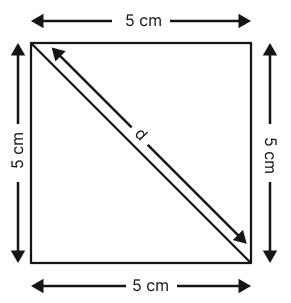
A diagonal of a square divides it into two congruent right triangles.
Each side of the square is 5 cm. Let the diagonal be d.
By the Baudhāyana-Pythagoras theorem,
d2 = 52 + 52
d2 = 25 + 25
d2 = 50
⇒ d = =
The diagonal of the square = cm.
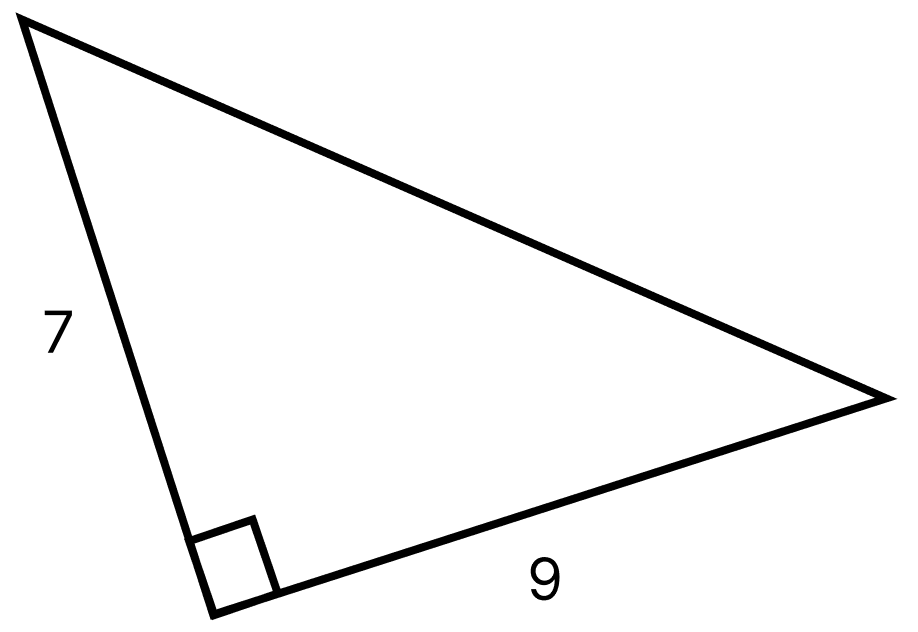
Find the missing sidelength in the following right triangle.
Answer
We use the Baudhāyana-Pythagoras theorem, a2 + b2 = c2, where c is the hypotenuse.
The two legs are 7 units and 9 units. Let the hypotenuse be c.
c2 = 72 + 92
c2 = 49 + 81
c2 = 130
⇒ c =
The missing sidelength (hypotenuse) = units.
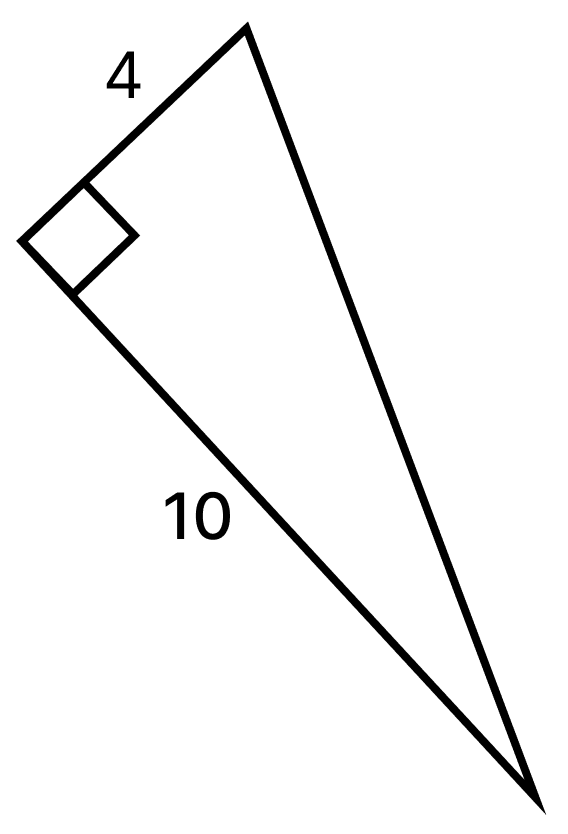
Find the missing sidelength in the following right triangle.
Answer
We use the Baudhāyana-Pythagoras theorem, a2 + b2 = c2, where c is the hypotenuse.
The two legs are 4 units and 10 units. Let the hypotenuse be c.
c2 = 42 + 102
c2 = 16 + 100
c2 = 116
⇒ c = =
The missing sidelength (hypotenuse) = units.
Find the missing sidelength in the following right triangle.
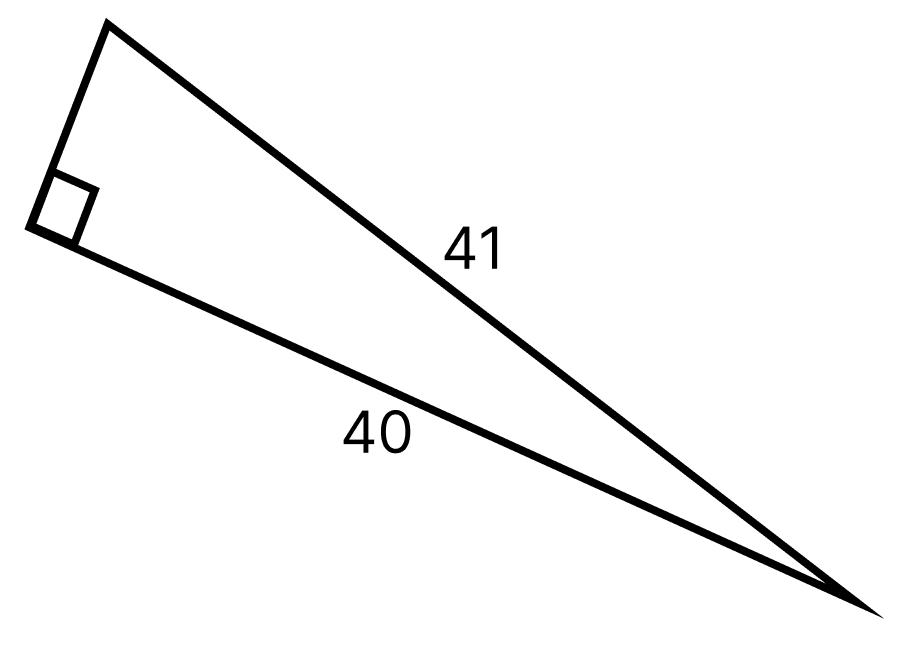
Answer
We use the Baudhāyana-Pythagoras theorem, a2 + b2 = c2, where c is the hypotenuse.
One leg is 40 units and the hypotenuse is 41 units. Let the missing leg be b.
402 + b2 = 412
1600 + b2 = 1681
b2 = 1681 - 1600
b2 = 81
⇒ b = = 9
The missing sidelength = 9 units.
Find the missing sidelength in the following right triangle.
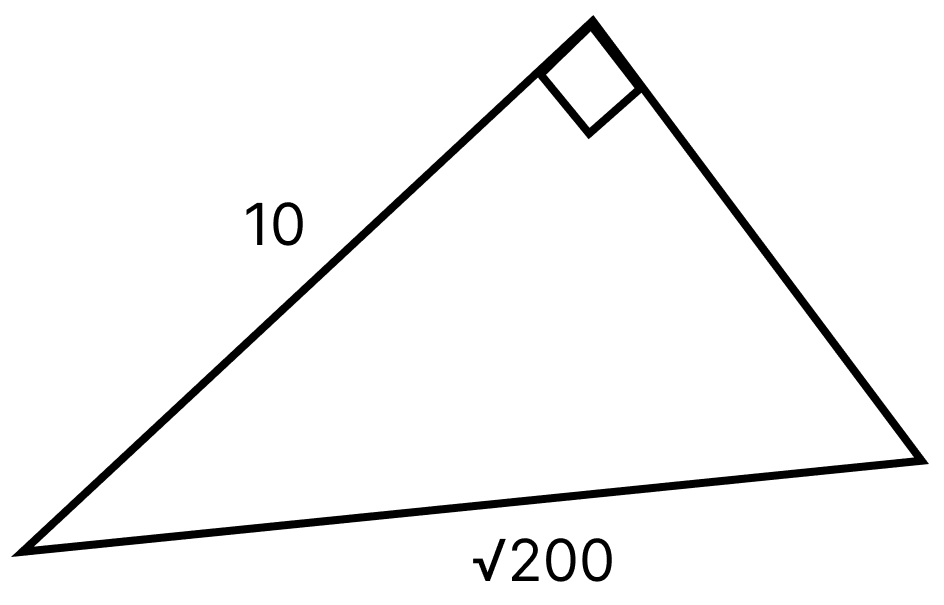
Answer
We use the Baudhāyana-Pythagoras theorem, a2 + b2 = c2, where c is the hypotenuse.
One leg is 10 units and the hypotenuse is units. Let the missing leg be b.
102 + b2 =
100 + b2 = 200
b2 = 200 - 100
b2 = 100
⇒ b = = 10
The missing sidelength = 10 units.
Find the missing sidelength in the following right triangle.
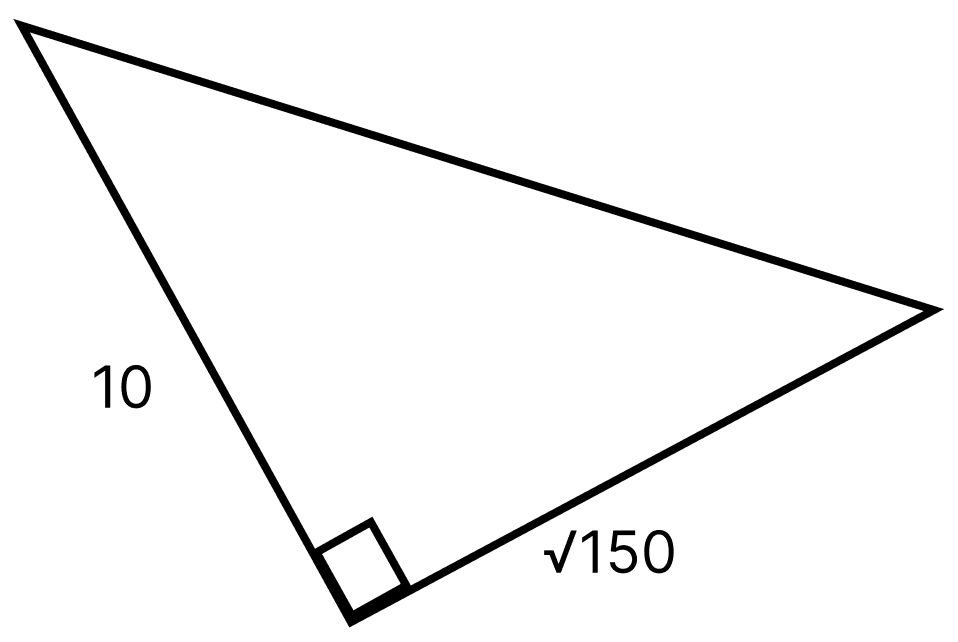
Answer
We use the Baudhāyana-Pythagoras theorem, a2 + b2 = c2, where c is the hypotenuse.
The two legs are 10 units and units. Let the hypotenuse be c.
c2 = 102 +
c2 = 100 + 150
c2 = 250
⇒ c = =
The missing sidelength (hypotenuse) = units.
Find the missing sidelength in the following right triangle.
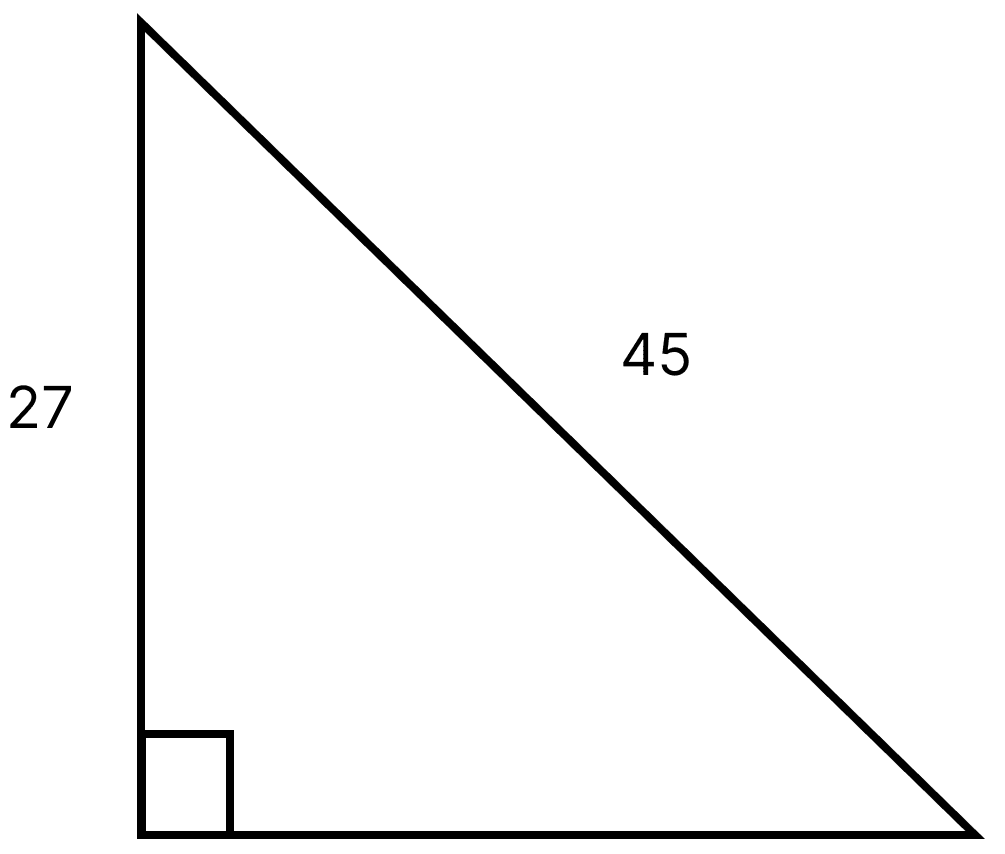
Answer
We use the Baudhāyana-Pythagoras theorem, a2 + b2 = c2, where c is the hypotenuse.
One leg is 27 units and the hypotenuse is 45 units. Let the missing leg be b.
272 + b2 = 452
729 + b2 = 2025
b2 = 2025 - 729
b2 = 1296
⇒ b = = 36
The missing sidelength = 36 units.
Find the sidelength of a rhombus whose diagonals are of length 24 units and 70 units.
Answer
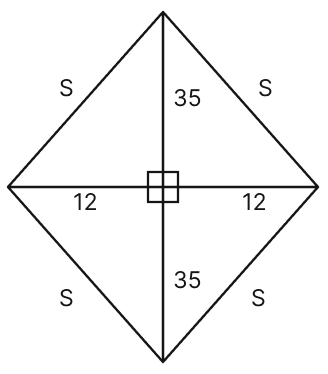
The diagonals of a rhombus bisect each other at right angles. So they cut the rhombus into four congruent right triangles, in each of which the legs are the half-diagonals and the hypotenuse is a side of the rhombus.
Half of the diagonals:
= 12 units and = 35 units
Let the sidelength of the rhombus be s. By the Baudhāyana-Pythagoras theorem,
s2 = 122 + 352
s2 = 144 + 1225
s2 = 1369
⇒ s = = 37
The sidelength of the rhombus = 37 units.
Is the hypotenuse the longest side of a right triangle? Justify your answer.
Answer
Yes, the hypotenuse is the longest side of a right triangle.
Let a and b be the two legs and c the hypotenuse.
By the Baudhāyana-Pythagoras theorem,
c2 = a2 + b2
Since a2 and b2 are both positive,
c2 = a2 + b2 > a2 ⇒ c > a
c2 = a2 + b2 > b2 ⇒ c > b
So the hypotenuse c is greater than each of the other two sides.
Hence, the hypotenuse is always the longest side of a right triangle.
True or False — Every Baudhāyana triple is either a primitive triple or a scaled version of a primitive triple.
Answer
This statement is True.
Case 1: If a Baudhāyana triple has no common factor greater than 1, then it is a primitive Baudhāyana triple.
Case 2: If it has a common factor greater than 1, we can divide all three numbers by their common factor. The resulting triple is again a Baudhāyana triple. Repeating this process, we eventually obtain a primitive Baudhāyana triple.
Therefore, every Baudhāyana triple is either a primitive triple or a scaled version of a primitive triple.
Hence, the statement is True.
Give 5 examples of rectangles whose sidelengths and diagonals are all integers.
Answer
For a rectangle with sides a and b, the diagonal d together with the two sides forms a right-angled triangle. By the Baudhāyana–Pythagoras Theorem,
a2 + b2 = d2
So the sides and the diagonal are all integers exactly when (a, b, d) is a Baudhāyana triple. Choosing five such triples:
Example 1: sides 3 and 4
d2 = 32 + 42
d2 = 9 + 16
d2 = 25
d = 5
Example 2: sides 6 and 8
d2 = 62 + 82
d2 = 36 + 64
d2 = 100
d = 10
Example 3: sides 5 and 12
d2 = 52 + 122
d2 = 25 + 144
d2 = 169
d = 13
Example 4: sides 8 and 15
d2 = 82 + 152
d2 = 64 + 225
d2 = 289
d = 17
Example 5: sides 7 and 24
d2 = 72 + 242
d2 = 49 + 576
d2 = 625
d = 25
Hence, the five rectangles are: (3, 4) with diagonal 5; (6, 8) with diagonal 10; (5, 12) with diagonal 13; (8, 15) with diagonal 17; and (7, 24) with diagonal 25.
Construct a square whose area is equal to the difference of the areas of squares of sidelengths 5 units and 7 units.
Answer
The area of the square of side 7 units is:
72 = 49 sq. units.
The area of the square of side 5 units is:
52 = 25 sq. units.
Therefore, the required area = (area of square of side 7) − (area of square of side 5)
= 49 − 25
= 24 sq. units
So we need a square whose area is 24 sq. units, i.e. whose sidelength is units.
The key idea is the Baudhāyana–Pythagoras Theorem written as a2 = c2 − b2. If a side of length 5 and a hypotenuse of length 7 are two sides of a right triangle, then the third side has length , and the square on it has area 24.
Construction:
(1) Draw a line segment PQ of length 5 units (a side of the smaller square).
(2) At Q, construct a perpendicular QR to PQ.
(3) With P as centre and radius 7 units (a side of the larger square), draw an arc cutting the perpendicular at the point R.
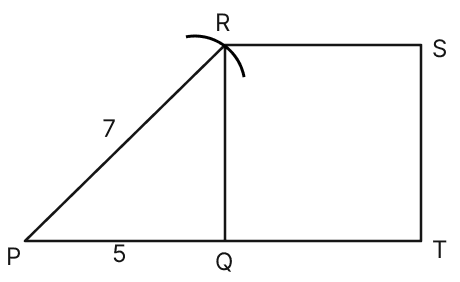
(4) Then △PQR is right-angled at Q, with hypotenuse PR = 7 and side PQ = 5, so
QR = = = = units.
(5) Construct a square QRST on side QR.
The area of square QRST is
QR2 = = 24 sq. units.
Hence, the square drawn on QR has area 24 sq. units, which is the difference of the areas of the squares of sidelengths 7 units and 5 units.
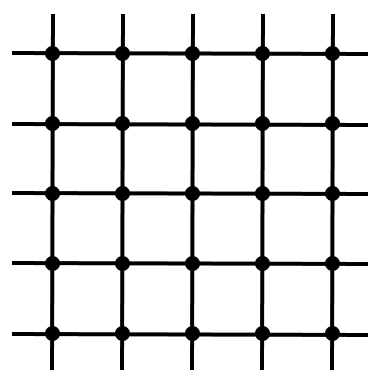
(i) Using the dots of a grid as the vertices, can you create a square that has an area of (a) 2 sq. units, (b) 3 sq. units, (c) 4 sq. units, and (d) 5 sq. units?
(ii) Suppose the grid extends indefinitely. What are the possible integer-valued areas of squares you can create in this manner?
Answer
(i)
Using the dots of the grid as vertices:
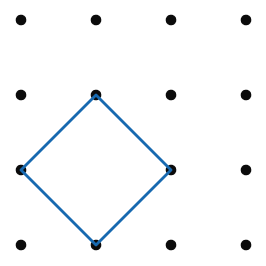
(a) Area = 2 sq. units
Draw a square whose vertices are four neighbouring dots joined diagonally. Its side is , so its area is
= 2 sq. units.
(b) Area = 3 sq. units
3 cannot be written as m2 + n2 for any whole numbers m and n, so such square cannot be formed using the given grid dots as vertices.
(c) Area = 4 sq. units
Draw a 2 × 2 square on the grid.
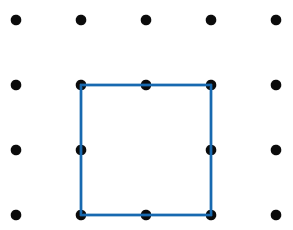
Area = 2 × 2 = 4 sq. units.
(d) Area = 5 sq. units
Draw a tilted square whose side joins two dots that are 1 unit apart horizontally and 2 units apart vertically.
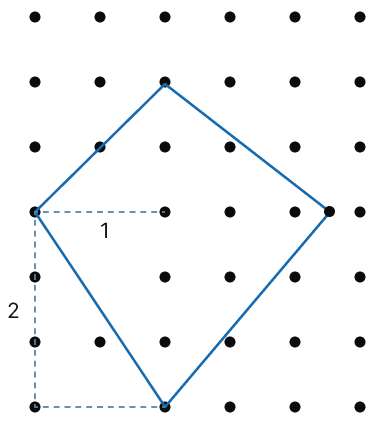
By the Baudhāyana-Pythagoras theorem,
side2 = 12 + 22 = 5.
Hence the area of the square is 5 sq. units.
Hence, squares of areas 2 sq. units, 4 sq. units, and 5 sq. units can be drawn on the grid, but a square of area 3 sq. units cannot be drawn.
(ii)
From part (i), the area of any square drawn on the grid must be of the form
Area = m2 + n2,
where m and n are whole numbers.
So the possible integer areas are exactly those numbers that can be written as a sum of two perfect squares (including 0). The first few such areas are
1, 2, 4, 5, 8, 9, 10, 13, 16, 17, 18, 20, 25, …
Integers that are not a sum of two squares — such as 3, 6, 7, 11, 12, 14, 15, 19, … — cannot be the area of any such square.
Hence, the possible integer-valued areas are precisely the numbers expressible as m2 + n2 (a sum of two perfect squares), for example 1, 2, 4, 5, 8, 9, 10, 13, …
Find the area of an equilateral triangle with sidelength 6 units.
[Hint: Show that an altitude bisects the opposite side. Use this to find the height.]
Answer
![Find the area of an equilateral triangle with sidelength 6 units. [Hint: Show that an altitude bisects the opposite side. Use this to find the height.]. The Baudhayana - Pythagoras Theorem, NCERT Class 8 Ganita Prakash Mathematics CBSE Solutions.](https://cdn1.knowledgeboat.com/img/ncert-8/q9-figure-out-4-ans-1-ganita-prakash-2-cbse-class-8-c2-202608061600-377x357.png)
Given:
An equilateral triangle ABC with each side equal to 6 units.
Draw altitude AD to BC. Then,
∠ADB = ∠ADC = 90°.
In △ABD and △ACD,
AB = AC [Sides of an equilateral triangle]
AD = AD [Common side]
∠ADB = ∠ADC = 90°.
Therefore,
△ABD ≅ △ACD [RHS congruence criterion]
⇒ BD = DC [Corresponding parts of congruent triangles]
Since BC = 6 units,
BD = DC =
=
= 3 units.
In right-angled △ABD, AB = 6 units and BD = 3 units. By the Baudhāyana-Pythagoras theorem,
AB2 = AD2 + BD2
62 = AD2 + 32
36 = AD2 + 9
⇒ AD2 = 27
⇒ AD =
= units.
Area of △ABC = × base × height
= × 6 ×
= sq. units.
Hence, the area of the equilateral triangle is sq. units.
There are 3 closed boxes — one containing only red balls, the second containing only blue balls and the third containing only green balls. The boxes are labelled RED, BLUE and GREEN such that 'no' box has the correct label. We need to find which label goes with which box. How can this be done if we are allowed to open only one box?
Answer
Open the box labelled RED.
Since each box is wrongly labelled, the box labelled RED does not contain red balls — it must contain either blue balls or green balls. Whichever single ball we draw from it tells us the true colour of that whole box.
Case 1: A blue ball comes out.
⇒ The box labelled RED actually contains BLUE balls.
Now the box labelled BLUE cannot contain blue (it is wrongly labelled) and cannot contain blue anyway (blue is already placed), so it must contain GREEN balls.
⇒ The remaining box labelled GREEN must contain RED balls.
Case 2: A green ball comes out.
⇒ The box labelled RED actually contains GREEN balls.
Now the box labelled BLUE cannot contain blue (it is wrongly labelled) and cannot contain green (green is already placed), so it must contain RED balls.
⇒ The remaining box labelled GREEN must contain BLUE balls.
The reasoning is easiest to see by noting that with three boxes all mislabelled, there are only two possible arrangements:
| Box labelled RED | Box labelled BLUE | Box labelled GREEN |
|---|---|---|
| BLUE | GREEN | RED |
| GREEN | RED | BLUE |
The two arrangements differ in what the box labelled RED holds (blue in the first, green in the second). So opening that single box and seeing its colour tells us exactly which arrangement we are in, and the other two boxes are then fixed.
Hence, by opening only the box labelled RED, the colour of the ball drawn determines the correct labels for all three boxes.