
Viswanath made idlis by mixing 6 cups of rice with 3 cups of urad dal, while Puneet made idlis by mixing 4 cups of rice with 2 cups of urad dal. If cooked in the same way, would their idlis taste the same?
Answer
Viswanath's mixture (rice : urad dal) = 6 : 3
Puneet's mixture (rice : urad dal) = 4 : 2
To check whether the two ratios are proportional, use the cross-multiplication method:
For the ratios 6 : 3 and 4 : 2,
6 × 2 = 12
3 × 4 = 12
The two products are equal (12), so the two ratios are proportional.
Hence, if all the other ingredients are also proportional, their idlis would taste the same.
Convert 60,00,000 cm to kilometres.
Answer
We know that:
1 m = 100 cm
1 km = 1000 m = 1000 × 100 = 1,00,000 cm
To convert centimetres to kilometres, divide by 1,00,000:
Hence, 60,00,000 cm is equal to 60 km.
Puneet has only 2 red chillies in his kitchen. But he wants to make spice mix powder that tastes the same as Viswanath's spice mix powder. How much of the other ingredients should Puneet use to make his spice mix powder?
Answer
For Viswanath's spice mix powder, the ratio of
coriander seeds : red chillies : toor dal : fenugreek seeds = 8 : 4 : 2 : 1
For Puneet's powder to taste the same, all the ingredients must be in this same ratio.
Puneet has only 2 red chillies, while Viswanath used 4 red chillies.
Find the factor of change in the number of red chillies:
So every ingredient must be reduced to half. Multiply each term of the ratio by :
Coriander seeds = spoons
Red chillies = spoons
Toor dal = spoon
Fenugreek seeds = spoon
So the ratio becomes 4 : 2 : 1 : 0.5.
Hence, Puneet should use 4 spoons of coriander seeds, 2 red chillies, 1 spoon of toor dal, and half a spoon of fenugreek seeds.
A cricket coach schedules practice sessions that include different activities in a specific ratio — time for warm-up/cool-down : time for batting : time for bowling : time for fielding :: 3 : 4 : 3 : 5. If each session is 150 minutes long, how much time is spent on each activity?
Answer
Given:
Time for warm-up/cool-down : batting : bowling : fielding = 3 : 4 : 3 : 5
Total length of each session = 150 minutes
Add the terms of the ratio to find the number of equal parts:
3 + 4 + 3 + 5 = 15 parts
To divide 150 minutes in this ratio, the time for each activity is found by multiplying 150 by the corresponding fraction of the total:
Warm-up/cool-down = minutes
Batting = minutes
Bowling = minutes
Fielding = minutes
Check: 30 + 40 + 30 + 50 = 150 minutes [matches the session length]
Hence, 30 minutes are spent on warm-up/cool-down, 40 minutes on batting, 30 minutes on bowling, and 50 minutes on fielding.
A school library has books in different languages in the following ratio — no. of Odiya books : no. of Hindi books : no. of English books :: 3 : 2 : 1. If the library has 288 Odiya books, how many Hindi and English books does it have?
Answer
Given ratio of books, Odiya : Hindi : English = 3 : 2 : 1
Number of Odiya books = 288
In the ratio, Odiya books correspond to 3 parts.
If 3 parts = 288 books, then
1 part = books
Now find the other quantities:
Hindi books = 2 parts = 2 × 96 = 192
English books = 1 part = 1 × 96 = 96
Hence, the library has 192 Hindi books and 96 English books.
I have 100 coins in the ratio — no. of ₹10 coins : no. of ₹5 coins : no. of ₹2 coins : no. of ₹1 coins :: 4 : 3 : 2 : 1. How much money do I have in coins?
Answer
Given ratio of coins, ₹10 : ₹5 : ₹2 : ₹1 = 4 : 3 : 2 : 1
Total number of coins = 100
Add the terms of the ratio to find the number of equal parts:
4 + 3 + 2 + 1 = 10 parts
To divide 100 coins in this ratio:
1 part = coins
Number of each type of coin:
₹10 coins = 4 × 10 = 40
₹5 coins = 3 × 10 = 30
₹2 coins = 2 × 10 = 20
₹1 coins = 1 × 10 = 10
Now find the value of each type of coin:
Value of ₹10 coins = 40 × 10 = ₹400
Value of ₹5 coins = 30 × 5 = ₹150
Value of ₹2 coins = 20 × 2 = ₹40
Value of ₹1 coins = 10 × 1 = ₹10
Total money = 400 + 150 + 40 + 10 = ₹600
Hence, I have ₹600 in coins.
Construct a triangle with sidelengths in the ratio 3 : 4 : 5. Will all the triangles drawn with this ratio of sidelengths be congruent to each other? Why or why not?
Answer
A triangle can be drawn only if the sum of any two sides is greater than the third side.
For the ratio 3 : 4 : 5, take the sides as 3 cm, 4 cm and 5 cm:
3 + 4 = 7 > 5 [the largest side]
So a triangle with these sidelengths can be constructed.
Construction steps:
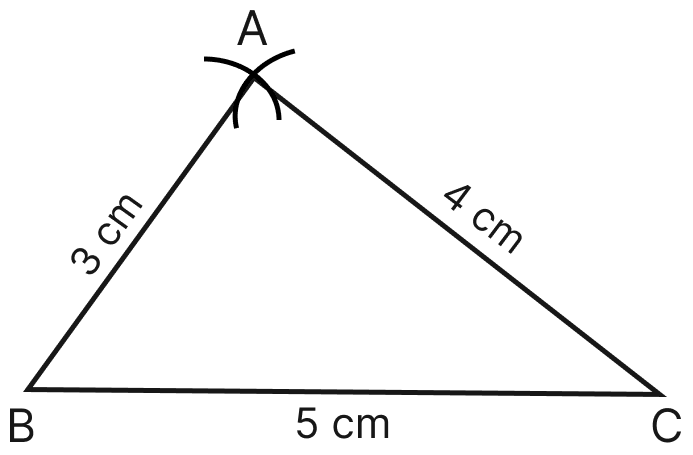
⇒ Draw a base BC = 5 cm.
⇒ With B as centre and radius 3 cm, draw an arc.
⇒ With C as centre and radius 4 cm, draw another arc cutting the first arc at A.
⇒ Join AB and AC to complete triangle ABC.
Will all such triangles be congruent?
We can take the sides in the ratio 3 : 4 : 5 as different actual lengths, for example:
3 cm, 4 cm, 5 cm or 6 cm, 8 cm, 10 cm or 9 cm, 12 cm, 15 cm
All these triangles have the same shape (their sides are in the same ratio), so they are similar. But their actual sizes are different, so they are not equal in size.
Hence, a triangle with sides in the ratio 3 : 4 : 5 can be constructed, but all such triangles need not be congruent — they will be similar (same shape) and congruent only when their corresponding sidelengths are also equal.
Can you construct a triangle with sidelengths in the ratio 1 : 3 : 5? Why or why not?
Answer
A triangle can be constructed only if the sum of the lengths of any two sides is greater than the third side.
Take the sides in the ratio 1 : 3 : 5 as 1 unit, 3 units and 5 units.
Check the sum of the two smaller sides against the largest side:
1 + 3 = 4
Compare with the largest side: 4 < 5
The sum of the two smaller sides (4 units) is less than the third side (5 units), so the two shorter sides cannot meet to form a triangle.
Hence, a triangle with sidelengths in the ratio 1 : 3 : 5 cannot be constructed, because it does not satisfy the triangle inequality.
A group of 360 people were asked to vote for their favourite season from the three seasons — rainy, winter and summer. 90 liked the summer season, 120 liked the rainy season, and the rest liked the winter. Draw a pie chart to show this information.
Answer
Total number of people = 360
Number who liked summer = 90
Number who liked rainy = 120
Number who liked winter = 360 – 90 – 120 = 150
The total angle in a circle is 360°. The angle of each slice is proportional to the number of people, so:
Summer =
Rainy =
Winter =
Check: 90° + 120° + 150° = 360° [the full circle]
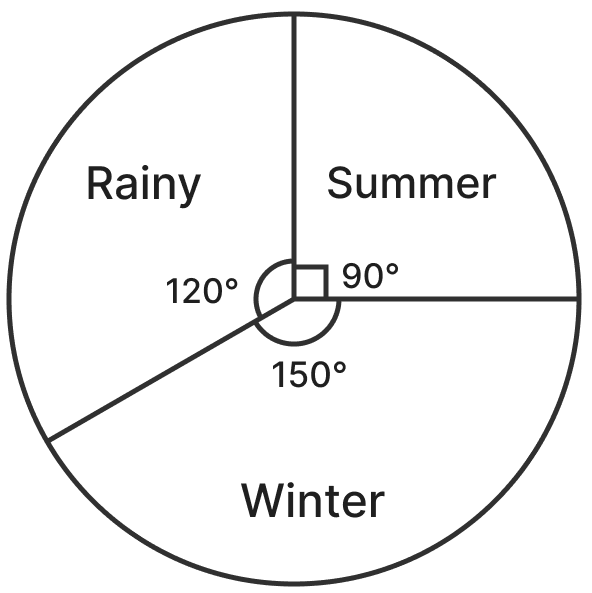
Hence, the pie chart has slices of 90° for summer, 120° for rainy, and 150° for winter.
Draw a pie chart based on the following information about viewers' favourite type of TV channel: Entertainment — 50%, Sports — 25%, News — 15%, Information — 10%.
Answer
The total angle in a circle is 360°.
The angle of each slice is proportional to its percentage, so:
Entertainment =
Sports =
News =
Information =
Check: 180° + 90° + 54° + 36° = 360° [the full circle]

Hence, the pie chart has slices of 180° for Entertainment, 90° for Sports, 54° for News, and 36° for Information.
Puneeth's father went from Lucknow to Kanpur in 3 hours by riding his motorcycle at a speed of 30 km/h.
(i) If he takes a car instead and drives at 60 km/h, how long will it take him to reach Kanpur?
(ii) Can we represent this problem with the following statement of proportionality — 30 : 60 :: 3 : x ? Will the travel time increase or decrease as the speed of the motorcycle increases?
Answer
(i)
The distance between Lucknow and Kanpur stays the same in both cases.
Distance = Speed × Time
= 30 × 3
= 90 km
The distance covered is fixed, so speed and time are inversely proportional, i.e., (Speed) × (Time) = constant.
Let the time taken by car be x hours. Then:
30 × 3 = 60 × x
⇒ x = hours
Hence, the car will take 1.5 hours (1 hour 30 minutes) to reach Kanpur.
(ii)
The statement 30 : 60 :: 3 : x treats speed and time as a direct proportion.
Solving it would give:
This means the travel time would increase from 3 hours to 6 hours when the speed doubles, which is not correct. When you travel faster over the same distance, you take less time, not more.
So speed and travel time (for a fixed distance) are inversely proportional, not directly proportional. As the speed increases, the travel time decreases.
Hence, the problem cannot be represented by 30 : 60 :: 3 : x, because speed and time are inversely proportional; as the speed increases, the travel time decreases.
Which of these are in inverse proportion?
| x | 40 | 80 | 25 | 16 |
|---|---|---|---|---|
| y | 20 | 10 | 32 | 50 |
Answer
Two quantities x and y are in inverse proportion if their product x × y is the same (a constant) for every pair of values.
Find the product x × y for each column:
40 × 20 = 800
80 × 10 = 800
25 × 32 = 800
16 × 50 = 800
All the products are equal to 800
Hence, x and y are in inverse proportion.
Which of these are in inverse proportion?
| x | 40 | 80 | 25 | 16 |
|---|---|---|---|---|
| y | 20 | 10 | 12.5 | 8 |
Answer
Two quantities x and y are in inverse proportion if their product x × y is the same (a constant) for every pair of values.
Find the product x × y for each column:
40 × 20 = 800
80 × 10 = 800
25 × 12.5 = 312.5
16 × 8 = 128
The products are not all equal
Hence, x and y are not in inverse proportion.
Which of these are in inverse proportion?
| x | 30 | 90 | 150 | 10 |
|---|---|---|---|---|
| y | 15 | 5 | 3 | 45 |
Answer
Two quantities x and y are in inverse proportion if their product x × y is the same (a constant) for every pair of values.
Find the product x × y for each column:
30 × 15 = 450
90 × 5 = 450
150 × 3 = 450
10 × 45 = 450
All the products are equal to 450
Hence, x and y are in inverse proportion.
Fill in the empty cells if x and y are in inverse proportion.
| x | 16 | 12 | 36 | |
|---|---|---|---|---|
| y | 9 | 48 |
Answer
Since x and y are in inverse proportion, the product x × y is a constant.
Find the constant using the first column (where both values are known):
k = x × y = 16 × 9 = 144
So x × y = 144 for every column.
Use this to find each missing value:
For x = 12:
For y = 48:
For x = 36:
The completed table is:
| x | 16 | 12 | 3 | 36 |
|---|---|---|---|---|
| y | 9 | 12 | 48 | 4 |
Hence, the missing values are y = 12, x = 3, and y = 4.
Which of the following pairs of quantities are in inverse proportion?
(i) The number of taps filling a water tank and the time taken to fill it.
(ii) The number of painters hired and the days needed to paint a wall of fixed size.
(iii) The distance a car can travel and the amount of petrol in the tank.
(iv) The speed of a cyclist and the time taken to cover a fixed route.
(v) The length of cloth bought and the price paid at a fixed rate per metre.
(vi) The number of pages in a book and the time required to read it at a fixed reading speed.
Answer
Two quantities are in inverse proportion when one increases by a factor and the other decreases by the same factor, so that their product stays constant.
(i) More taps pour in more water at once, so the tank fills in less time. As the number of taps increases, the time taken decreases by the same factor. ⇒ Inverse proportion.
(ii) More painters share the same wall, so the work is finished in fewer days. As the number of painters increases, the number of days decreases by the same factor. ⇒ Inverse proportion.
(iii) More petrol in the tank lets the car travel a greater distance. As the petrol increases, the distance increases by the same factor. ⇒ Direct proportion.
(iv) For a fixed route, a faster cyclist covers it in less time. As the speed increases, the time decreases by the same factor. ⇒ Inverse proportion.
(v) At a fixed rate per metre, more cloth costs more money. As the length increases, the price increases by the same factor. ⇒ Direct proportion.
(vi) At a fixed reading speed, more pages take more time to read. As the number of pages increases, the time increases by the same factor. ⇒ Direct proportion.
Hence, the pairs in inverse proportion are (i), (ii) and (iv).
If 24 pencils cost ₹120, how much will 20 such pencils cost?
Answer
Given:
24 pencils cost ₹120.
20 pencils cost ₹?
More pencils cost more money, so the number of pencils and the cost are in direct proportion.
So, 24 : 120 :: 20 : x
Find the factor of change in the first term by dividing the terms:
The number of pencils changes by a factor of .
On multiplying the cost by the same factor, we get:
Hence, 20 pencils will cost ₹100.
A tank on a building has enough water to supply 20 families living there for 6 days. If 10 more families move in there, how long will the water last? What assumptions do you need to make to work out this problem?
Answer
Given:
Water is enough for 20 families for 6 days.
After 10 more families move in, the number of families = 20 + 10 = 30.
More families share the same water, so the water will last for fewer days. The number of families and the number of days are in inverse proportion, so their product stays constant.
Let the number of days the water now lasts be x.
20 × 6 = 30 × x
⇒ x =
Hence, the water will last for 4 days.
Assumptions:
- Every family uses the same amount of water each day, so that the daily usage per family stays constant.
- The total quantity of water stored in the tank is the same as before (the tank is not refilled).
Fill in the average number of hours each living being sleeps in a day by looking at the charts. Select the appropriate hours from this list: 15, 2.5, 20, 8, 3.5, 13, 10.5, 18.

Answer
Each ring chart shows the part of a 24-hour day for which the living being sleeps (the shaded portion).
From the charts, the approximate sleeping hours are as follows:
| Living being | Sleep (hours) |
|---|---|
| Giraffe | 2.5 |
| Elephant | 3.5 |
| Human (child) | 8 |
| Dog | 10.5 |
| Cat | 13 |
| Squirrel | 15 |
| Python | 18 |
| Bat | 20 |
Hence, the average number of hours each living being sleeps in a day is as shown above.
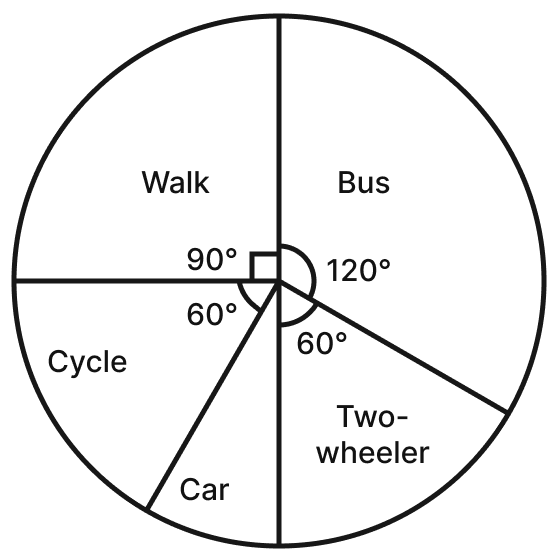
The pie chart on the right shows the result of a survey carried out to find the modes of transport used by children to go to school. Study the pie chart and answer the following questions.
(i) What is the most common mode of transport?
(ii) What fraction of children travel by car?
(iii) If 18 children travel by car, how many children took part in the survey? How many children use taxis to travel to school?
(iv) By which two modes of transport are equal numbers of children travelling?
Answer
From the pie chart, the angles of the slices for walk, bus, cycle and two-wheeler are given. The angle for the car slice is not marked, so we first find it.
The total angle of a circle is 360°, so:
Angle of car slice = 360° - (walk + bus + cycle + two-wheeler)
⇒ Angle of car slice = 360° - (90° + 120° + 60° + 60°)
= 360° - 330°
= 30°
So the angle of each slice is:
| Mode | Walk | Bus | Two-wheeler | Car | Cycle |
|---|---|---|---|---|---|
| Angle | 90° | 120° | 60° | 30° | 60° |
(The angles add up to 90° + 120° + 60° + 60° + 30° = 360°, as expected for a complete circle.)
(i) The most common mode corresponds to the largest slice. The largest angle is 120°, which belongs to the bus.
Hence, the most common mode of transport is the bus.
(ii) The slice for the car has an angle of 30°. The whole circle is 360°.
Fraction of children travelling by car
of the children travel by car.
(iii) The car slice represents of all the children, and this equals 18 children.
So,
⇒ Total number of children = 18 × 12 = 216
So, 216 children took part in the survey.
There is no slice for "taxi" in the pie chart, so no child uses a taxi to travel to school.
So, the number of children who use taxis = 0.
216 children took part in the survey and 0 children use taxis.
(iv) The cycle slice and the two-wheeler slice both have an angle of 60°, so they represent equal numbers of children.
Number of children for each
So, an equal number of children (36 each) travel by cycle and by two-wheeler.
Hence, the cycle and the two-wheeler carry equal numbers of children.
Three workers can paint a fence in 4 days. If one more worker joins the team, how many days will it take them to finish the work? What are the assumptions you need to make?
Answer
Given:
3 workers paint the fence in 4 days.
After one more worker joins, the number of workers = 3 + 1 = 4.
More workers finish the same fence in fewer days, so the number of workers and the number of days are in inverse proportion, and their product stays constant.
Let the number of days taken by 4 workers be x.
3 × 4 = 4 × x
⇒ x =
Hence, the 4 workers will finish painting the fence in 3 days.
Assumptions:
- All the workers paint at the same rate and work equally hard.
- The size of the fence (the amount of work) stays the same.
- The workers do not get in each other's way, so adding a worker truly increases the painting speed.
It takes 6 hours to fill 2 tanks of the same size with a pump. How long will it take to fill 5 such tanks with the same pump?
Answer
Given:
The pump fills 2 tanks in 6 hours.
It has to fill 5 tanks with the same pump.
More tanks take more time to fill, so the number of tanks and the time taken are in direct proportion.
So, 2 : 6 :: 5 : x
Find the factor of change in the first term by dividing the terms:
The number of tanks changes by a factor of .
On multiplying the time by the same factor, we get:
Hence, it will take 15 hours to fill 5 such tanks with the same pump.
A given set of chairs are arranged in 25 rows, with 12 chairs in each row. If the chairs are rearranged with 20 chairs in each row, how many rows does this new arrangement have?
Answer
Given:
First arrangement: 25 rows with 12 chairs in each row.
New arrangement: 20 chairs in each row, number of rows = ?.
The total number of chairs stays the same.
So, the number of chairs in each row and the number of rows are in inverse proportion, and their product (the total number of chairs) stays constant.
Total number of chairs = 25 × 12 = 300
Let the number of rows in the new arrangement be x.
25 × 12 = x × 20
⇒ x =
Hence, the new arrangement has 15 rows.
A school has 8 periods a day, each of 45 minutes duration. How long is each period, if the school has 9 periods a day, assuming that the number of school hours per day stays the same?
Answer
Given:
First case: 8 periods a day, each of 45 minutes.
Second case: 9 periods a day, length of each period = ?
The total class time in a day stays the same.
So, the number of periods and the length of each period are in inverse proportion, and their product (the total time) stays constant.
Total class time = 8 × 45 = 360 minutes
Let the length of each period now be x minutes.
8 × 45 = 9 × x
⇒ x =
Hence, each period will be 40 minutes long.
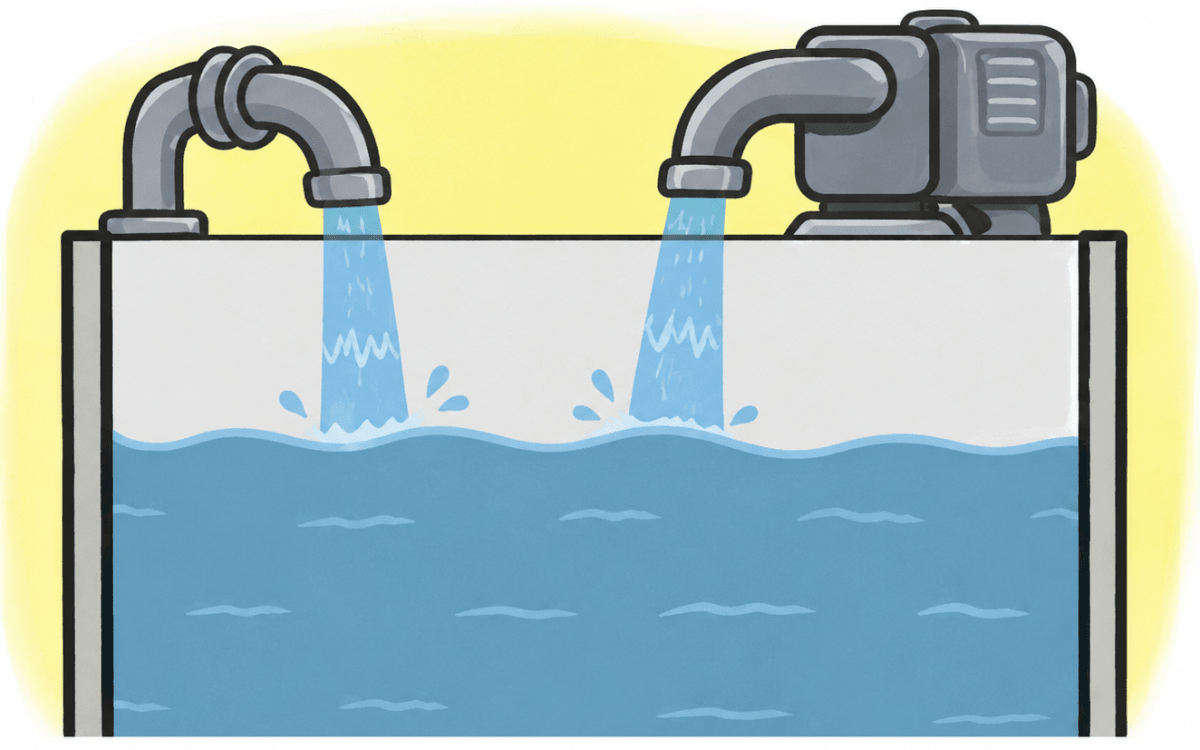
A small pump can fill a tank in 3 hours, while a large pump can fill the same tank in 2 hours. If both pumps are used together, how long will the tank take to fill?
Answer
Consider filling the tank as 1 unit of work.
Let us find the work each pump does in 1 hour.
- The small pump fills the tank in 3 hours, so in 1 hour it does of the tank.
- The large pump fills the tank in 2 hours, so in 1 hour it does of the tank.
So, the work done by both pumps together in 1 hour is:
of the tank.
Therefore, to fill of the tank, both pumps together take 1 hour. How much time will they take to fill 1 full tank?
The quantity of work and the time taken are in direct proportion.
So, this can be represented as:
hours = 1 hour + × 60 minutes = 1 hour 12 minutes.
Hence, both pumps used together will fill the tank in hours, that is, 1 hour 12 minutes.
A factory requires 42 machines to produce a given number of toys in 63 days. How many machines are required to produce the same number of toys in 54 days?
Answer
Given:
42 machines produce the toys in 63 days.
To produce the same toys in 54 days, machines required = ?
To finish the same work in fewer days, more machines are needed.
So, the number of machines and the number of days are in inverse proportion, and their product stays constant.
Let the number of machines required be x.
42 × 63 = x × 54
Hence, 49 machines are required to produce the same number of toys in 54 days.
A car takes 2 hours to reach a destination, travelling at a speed of 60 km/h. How long will the car take if it travels at a speed of 80 km/h?
Answer
Given:
At 60 km/h, the car takes 2 hours.
At 80 km/h, time taken by car = ?
For the same fixed distance, a higher speed means less time.
So, the speed and the time taken are in inverse proportion, and their product (the distance) stays constant.
Let the time taken at 80 km/h be x hours.
60 × 2 = 80 × x
hours
hours = 1 hour 30 minutes.
Hence, the car will take hours, that is, 1 hour 30 minutes, at a speed of 80 km/h.