
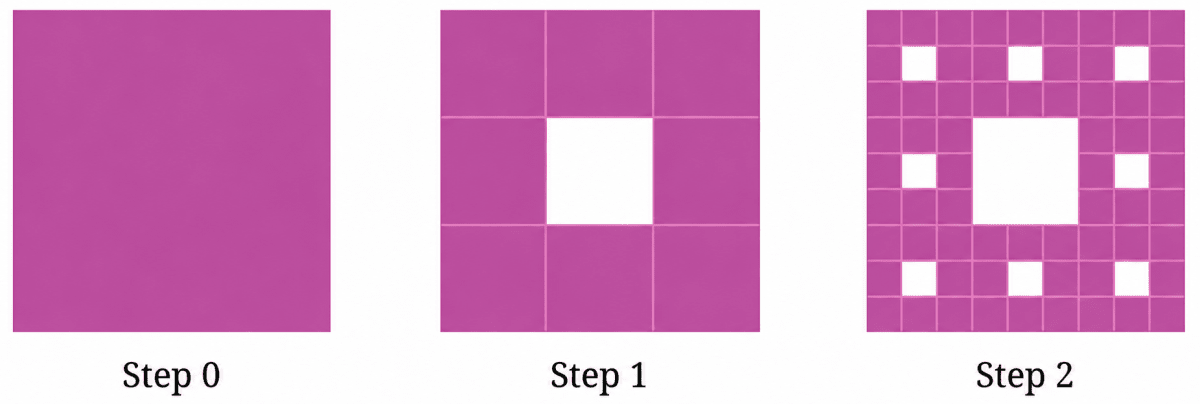
Draw the initial few steps (at least till Step 2) of the shape sequence that leads to the Sierpinski Carpet.
Answer
The Sierpinski Carpet is built by repeating one simple rule on every square that remains in the figure.
Rule: Take a square, divide it into 9 equal smaller squares (a 3 × 3 grid), and remove the central square. Then repeat the same rule on each of the remaining 8 squares.
Step 0: Start with a single square.
Step 1: Divide the square into 9 equal squares and remove the central square.
Step 2: Divide each of the 8 remaining squares into 9 equal squares and remove the central square of each.
Show that by joining the midpoints of an equilateral triangle, we divide it into 4 identical equilateral triangles. [Hint: Note that the corner triangles are isosceles.]
Answer
Let D, E and F be the midpoints of the sides of equilateral triangle ABC.
![Show that by joining the midpoints of an equilateral triangle, we divide it into 4 identical equilateral triangles. [Hint: Note that the corner triangles are isosceles.]. Exploring Some Geometric Themes, NCERT Class 8 Ganita Prakash Mathematics CBSE Solutions.](https://cdn1.knowledgeboat.com/img/ncert-8/q2-text-1-ans-1-ganita-prakash-2-cbse-class-8-c4-202608111921-1165x1080.png)
Since ABC is an equilateral triangle,
AB = BC = CA
and each angle is 60°.
Consider triangle ADF.
Since D and F are the midpoints of AB and AC,
AD = , AF =
Since AB = AC,
AD = AF.
So, ADF is an isosceles triangle with vertex angle 60°.
Therefore,
∠ADF = ∠AFD =
Hence, all three angles of ADF are 60°, so ADF is an equilateral triangle.
Similarly, triangles BDE and CEF are also equilateral.
Each side of these corner triangles is half the side of ABC. Therefore,
DF = DE = EF.
So triangle DEF is also equilateral.
Thus, the four triangles ADF, BDE, CEF, and DEF are all equilateral and have the same side length (where s is the side of ABC).
Hence, joining the midpoints of an equilateral triangle divides it into 4 identical equilateral triangles.
Draw the initial few steps (at least till Step 2) of the shape sequence that leads to the Sierpinski Triangle.
Answer
The Sierpinski Triangle (Gasket) is built by repeating one rule on every triangle that remains in the figure.
Rule: Take an equilateral triangle, join the midpoints of its three sides to divide it into 4 identical equilateral triangles, and remove the central triangle. Then repeat the same rule on each of the remaining 3 triangles.
Step 0: Start with a single equilateral triangle.
Step 1: Join the midpoints and remove the central triangle.
Step 2: Repeat the rule on each of the 3 remaining triangles.
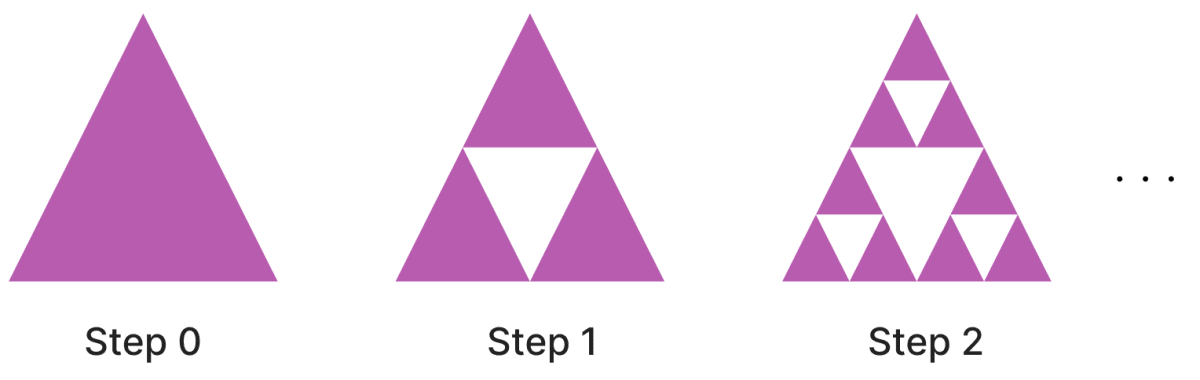
Find the number of holes, and the triangles that remain at each step of the shape sequence that leads to the Sierpinski Triangle.
Answer
Let Rn represent the number of remaining triangles at the nth step, and Hn represent the number of holes at the nth step.
Triangles that remain:
Every triangle that remains at the nth step gives rise to 3 triangles that remain at the (n + 1)th step.
Rn + 1 = 3 Rn
So we have:
R0 = 1
R1 = 3 × 1 = 3
R2 = 3 × 3 = 32
R3 = 3 × 32 = 33
In general, Rn = 3n.
Holes:
Every triangle that remains at the nth step gives rise to one hole in the (n + 1)th step. All the holes present at the nth step remain in the (n + 1)th step as well.
Hn + 1 = Hn + Rn
So we have:
R0 = 1, H0 = 0
R1 = 3, H1 = 1
R2 = 32, H2 = 1 + 3
R3 = 33, H3 = 1 + 3 + 32
Adding these up, the number of holes at the nth step is:
Hn = 1 + 3 + 32 + … + 3n − 1
The values for the first few steps are:
Step 0: R0 = 1 triangle, H0 = 0 holes
Step 1: R1 = 3 triangles, H1 = 1 hole
Step 2: R2 = 9 triangles, H2 = 4 holes
Step 3: R3 = 27 triangles, H3 = 13 holes
Hence, at the nth step, the number of triangles that remain is Rn = 3n and the number of holes is Hn = 1 + 3 + 32 + … + 3n − 1.
Find the area of the region remaining at the nth step in each of the shape sequences that lead to the Sierpinski fractals. Take the area of the starting square/triangle to be 1 sq. unit.
Answer
(i) Sierpinski Carpet
At each step, every remaining square is divided into 9 equal smaller squares and 1 is removed, so 8 out of 9 parts remain.
Each small square has of the area of the square from which it is formed.
Number of remaining squares at the nth step = 8n
Area of each remaining square at the nth step = sq. unit
Area remaining = Number of squares × Area of each square
= 8n ×
= sq. unit
Area remaining at the nth step of the Sierpinski Carpet = sq. unit.
(ii) Sierpinski Triangle
At each step, every remaining triangle is divided into 4 equal smaller triangles and 1 is removed, so 3 out of 4 parts remain. Each small triangle has of the area of the triangle from which it is formed.
Number of remaining triangles at the nth step = 3n
Area of each remaining triangle at the nth step = sq. unit
Area remaining = Number of triangles × Area of each triangle
= 3n ×
= sq. unit
Area remaining at the nth step of the Sierpinski Triangle = sq. unit.
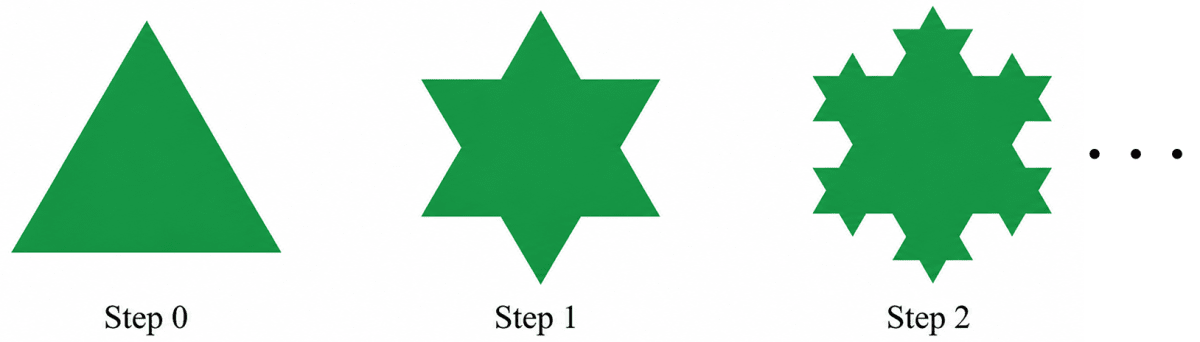
Draw the initial few steps (at least till Step 2) of the shape sequence that leads to the Koch Snowflake.
Answer
The Koch Snowflake is built by repeating one rule on every side of the shape.
Rule: Divide each side into 3 equal parts. Construct an equilateral triangle on the middle part and remove the middle segment. Thus, each side is replaced by a bump-shaped figure.
Step 0: Start with an equilateral triangle (3 sides).
Step 1: Replace each of the 3 sides by a bump.
Step 2: Replace each of the 12 sides by a bump.
Find the number of sides in the nth step of the shape sequence that leads to the Koch Snowflake.

Answer
Let Sn represent the number of sides at the nth step.
At each step, every side is divided into 3 equal parts and the middle part is replaced by the two slanting sides of a bump. So every single side becomes 4 sides.
Sn + 1 = 4Sn
So we have:
S0 = 3 [An equilateral triangle has 3 sides]
S1 = 4 × 3 = 12
S2 = 4 × 12 = 48
S3 = 4 × 48 = 192
In general,
Sn = 3 × 4n
Hence, the number of sides at the nth step = 3 × 4n.
Find the perimeter of the shape at the nth step of the sequence. Take the starting equilateral triangle to have a sidelength of 1 unit.
Answer
Given:
Side length of the starting equilateral triangle = 1 unit
At each step, every side is divided into 3 equal parts and is replaced by 4 such parts.
So the length of each side becomes of the previous side length, while the number of sides becomes 4 times.
Length of each side at the nth step:
Each step makes every side as long.
Length of each side at the nth step = unit
Number of sides at the nth step:
From the previous question, Sn = 3 × 4n
Perimeter:
Perimeter = Number of sides × Length of each side
= 3 × 4n ×
= units
Checking the first few steps:
P0 = = 3 units
P1 = = 4 units
P2 = = units
P3 = = units
Hence, the perimeter of the shape at the nth step = units.
If the congruent polygons of a prism have 10 sides, how many faces, edges and vertices does the prism have? What if the polygons have n sides?
Answer
A prism has two congruent polygonal bases and one parallelogram side face corresponding to each side of the base polygon.
When the congruent polygons have 10 sides:
Faces:
There are 2 polygonal bases and 10 side faces.
Number of faces = 2 + 10 = 12
Vertices:
Each base polygon has 10 vertices, and there are 2 such bases.
Number of vertices = 2 × 10 = 20
Edges:
There are 10 edges on each base and 10 edges joining the corresponding vertices.
Number of edges = 10 + 10 + 10 = 30
When the polygons have n sides:
The prism has the 2 bases and n parallelogram side faces, n vertices on each of the 2 bases, and n edges on each base together with n joining edges.
Number of faces = n + 2
Number of vertices = 2n
Number of edges = n + n + n = 3n
Hence, a prism with a 10-sided base has 12 faces, 30 edges and 20 vertices, and a prism with an n-sided base has (n + 2) faces, 3n edges and 2n vertices.
If the base of a pyramid has 10 sides, how many faces, edges and vertices does the pyramid have? What if the base is an n-sided polygon?
Answer
A pyramid has a polygonal base and one point (the apex) outside it. The apex is joined to every vertex of the base by an edge, so each side face is a triangle.
When the base has 10 sides:
Faces:
There is 1 base, and 1 triangular face for each of the 10 sides of the base.
Number of faces = 1 + 10 = 11
Vertices:
There are the 10 vertices of the base, together with the 1 apex.
Number of vertices = 10 + 1 = 11
Edges:
There are the 10 edges of the base, together with 10 edges joining the apex to the base vertices.
Number of edges = 10 + 10 = 20
When the base has n sides:
The pyramid has the 1 base and n triangular side faces, n base vertices together with 1 apex, and n base edges together with n edges meeting at the apex.
Number of faces = n + 1
Number of vertices = n + 1
Number of edges = n + n = 2n
Hence, a pyramid with a 10-sided base has 11 faces, 20 edges and 11 vertices, and a pyramid with an n-sided base has (n + 1) faces, 2n edges and (n + 1) vertices.
What is a net of a cube?
Answer
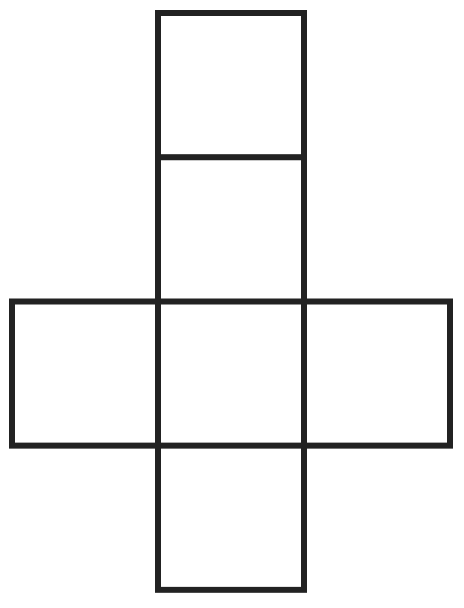
A net of a cube is a flat shape obtained by unfolding a cube onto a plane.
Since a cube has 6 square faces, its net consists of 6 equal squares joined edge-to-edge in such a way that they can be folded along the edges to form the cube.
The cross-shaped figure shown below is one such net of a cube.
Which of the following are the nets of a cube? First, try to answer by visualisation. Then, you may use cutouts and try.
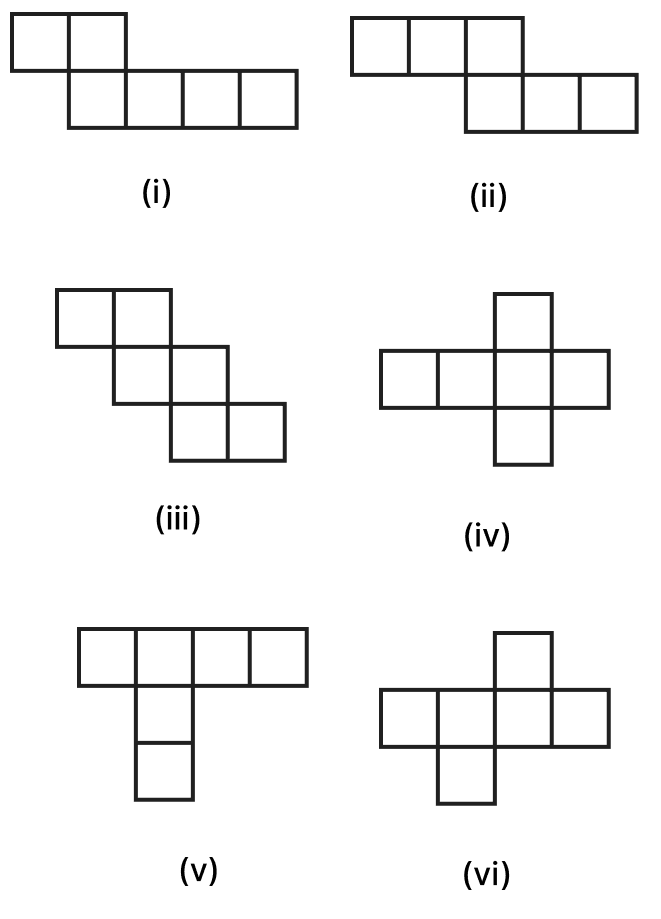
Answer
For a figure of 6 squares to be a net of a cube, it must fold so that the 6 squares cover the 6 faces of the cube exactly once, with no two squares landing on the same face.
Checking each figure by folding:
(i) On folding, two of its squares come to lie on the same face of the cube, leaving one face uncovered.
It is not a net.
(ii) Its 6 squares fold to cover the 6 faces exactly once.
It is a net.
(iii) This staircase arrangement folds to cover all 6 faces exactly once.
It is a net.
(iv) The row of 4 squares wraps around 4 faces, and the squares above and below close off the remaining 2 faces.
It is a net.
(v) The two squares hanging one below the other fold onto the same face, so the cube cannot be completed.
It is not a net.
(vi) The row of 4 squares wraps around 4 faces, and the squares above and below (placed on different squares of the row) close off the remaining 2 faces.
It is a net.
A cube has 11 possible net structures in total. In this count, two nets are considered the same if one can be obtained from the other by a rotation or a flip (for example, the nets shown below are all considered the same). Find all the 11 nets of a cube.
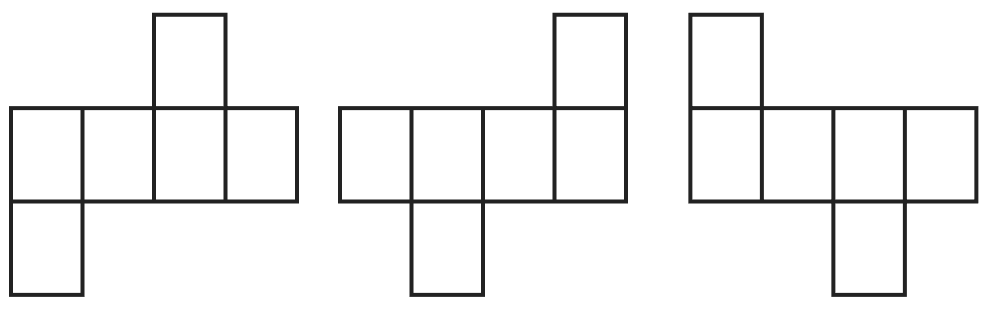
Answer
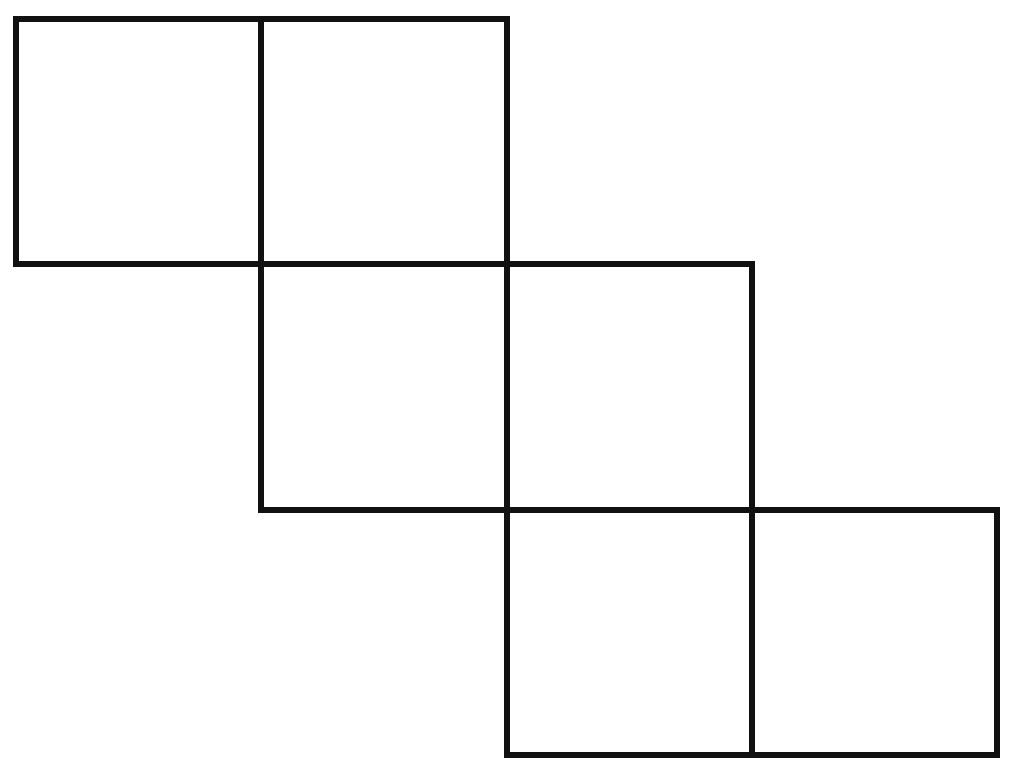
The 11 different nets of a cube can be grouped into four families, based on how the 6 squares are arranged. (Two nets that differ only by a rotation or a flip are counted as the same net.)
(a) The 1–4–1 family (6 nets):
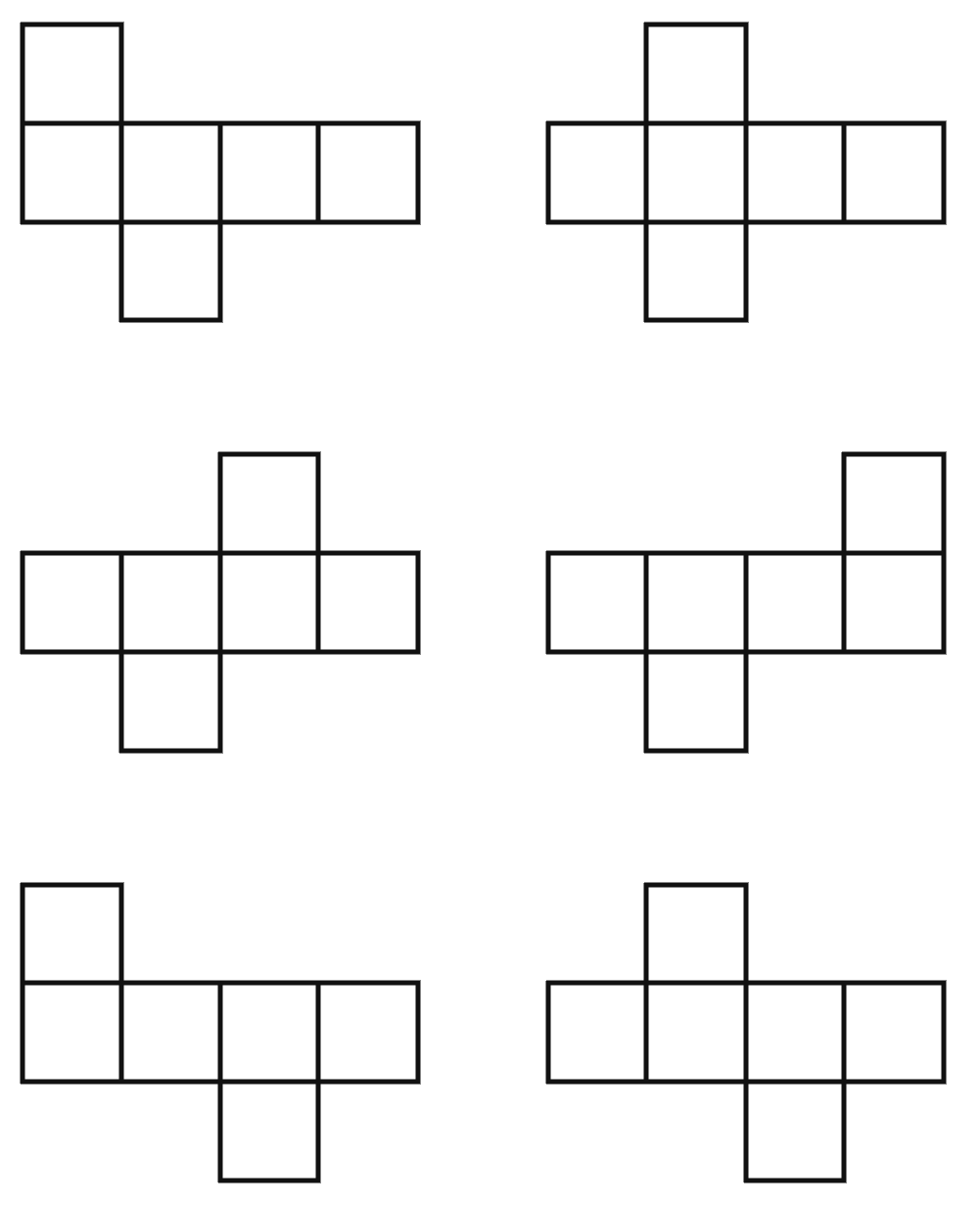
(b) The 2–3–1 family (3 nets):
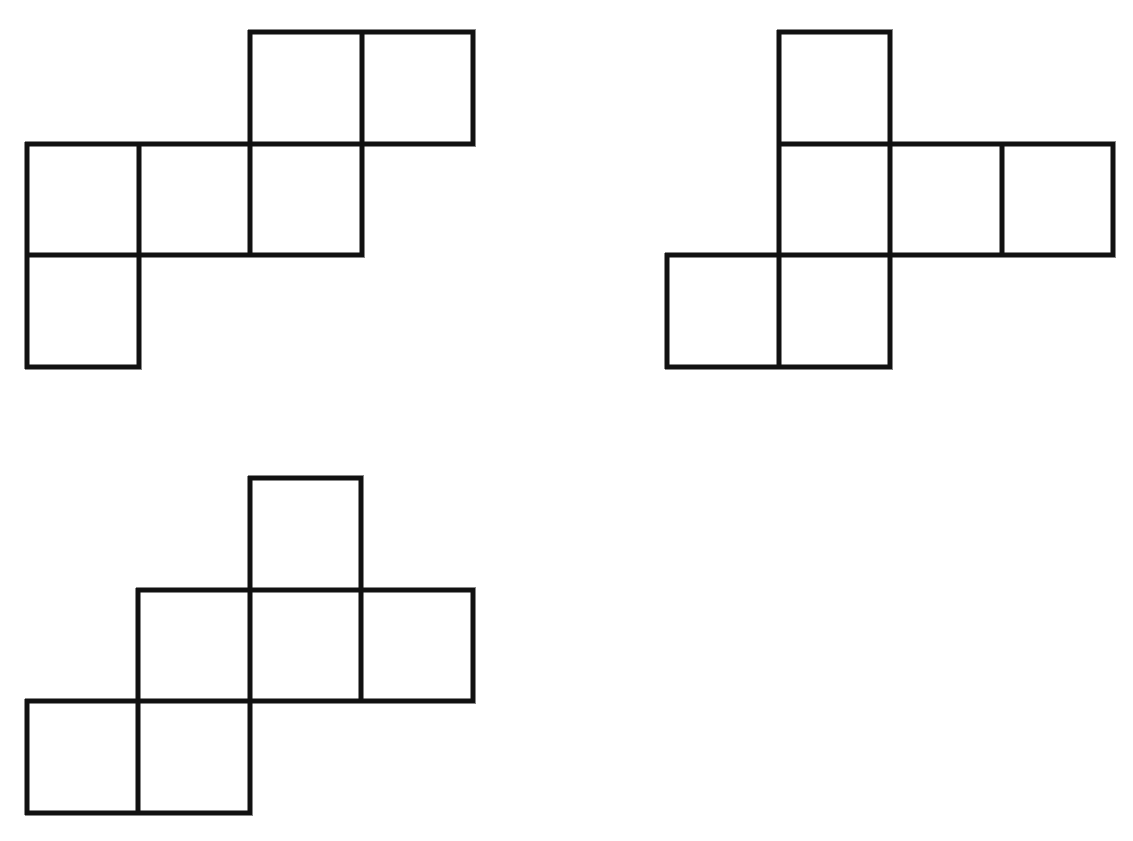
(c) The 2–2–2 family (1 net):
(d) The 3–3 family (1 net):
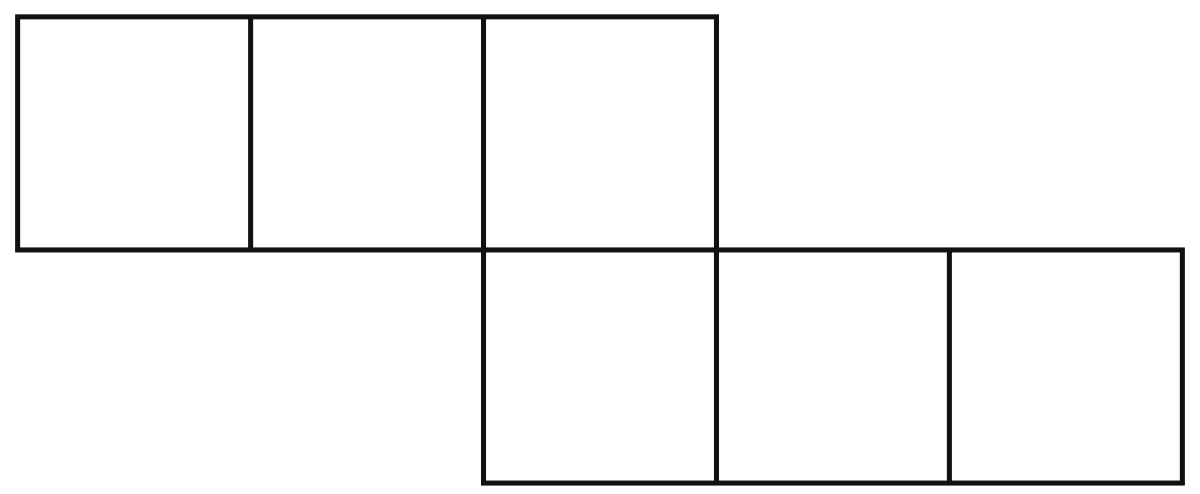
Counting them all:
6 + 3 + 1 + 1 = 11
Hence, the 11 nets of a cube are made up of 6 nets of the 1–4–1 type, 3 of the 2–3–1 type, 1 of the 2–2–2 type and 1 of the 3–3 type.
Draw a net of a cuboid having sidelengths:
(i) 5 cm, 3 cm and 1 cm
(ii) 6 cm, 3 cm and 2 cm
Answer
A cuboid has 6 rectangular faces that occur in 3 equal pairs. If the cuboid has length l, breadth b and height h, then its faces are:
2 rectangles of size l × b (the top and the bottom),
2 rectangles of size l × h (the front and the back),
2 rectangles of size b × h (the two side faces).
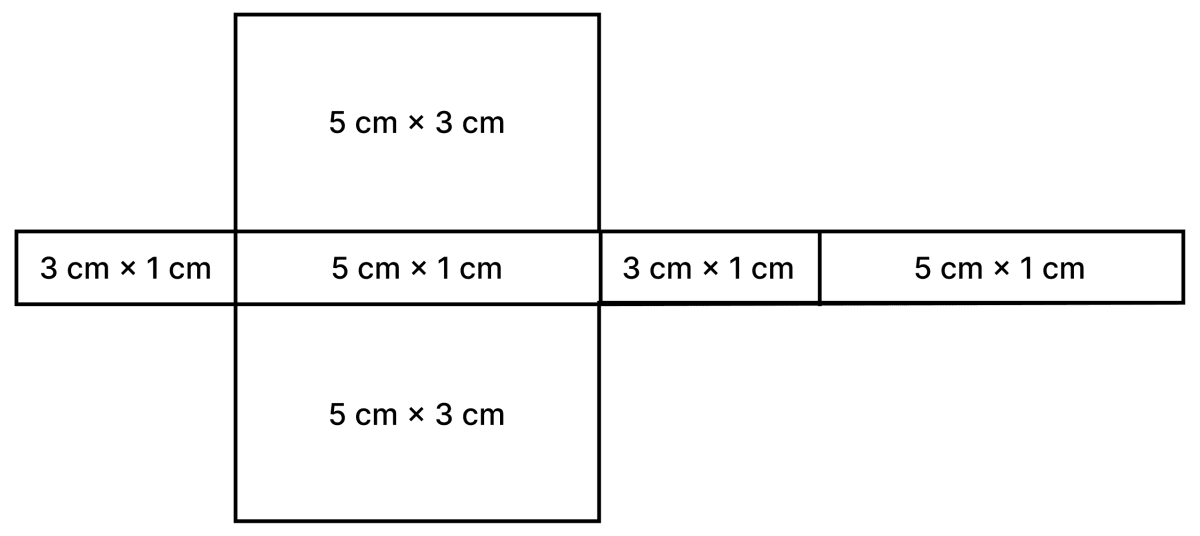
A net can be drawn by taking the 4 faces around the cuboid in a row (front, side, back, side) and attaching the top and bottom to one of these rectangles, so that the figure folds into a cuboid without gaps or overlaps.
(i) Cuboid of sidelengths 5 cm, 3 cm and 1 cm
Take l = 5 cm, b = 3 cm and h = 1 cm. The faces are:
2 rectangles of 5 cm × 3 cm
2 rectangles of 5 cm × 1 cm
2 rectangles of 3 cm × 1 cm
(ii) Cuboid of sidelengths 6 cm, 3 cm and 2 cm
Take l = 6 cm, b = 3 cm and h = 2 cm. The faces are:
2 rectangles of 6 cm × 3 cm
2 rectangles of 6 cm × 2 cm
2 rectangles of 3 cm × 2 cm
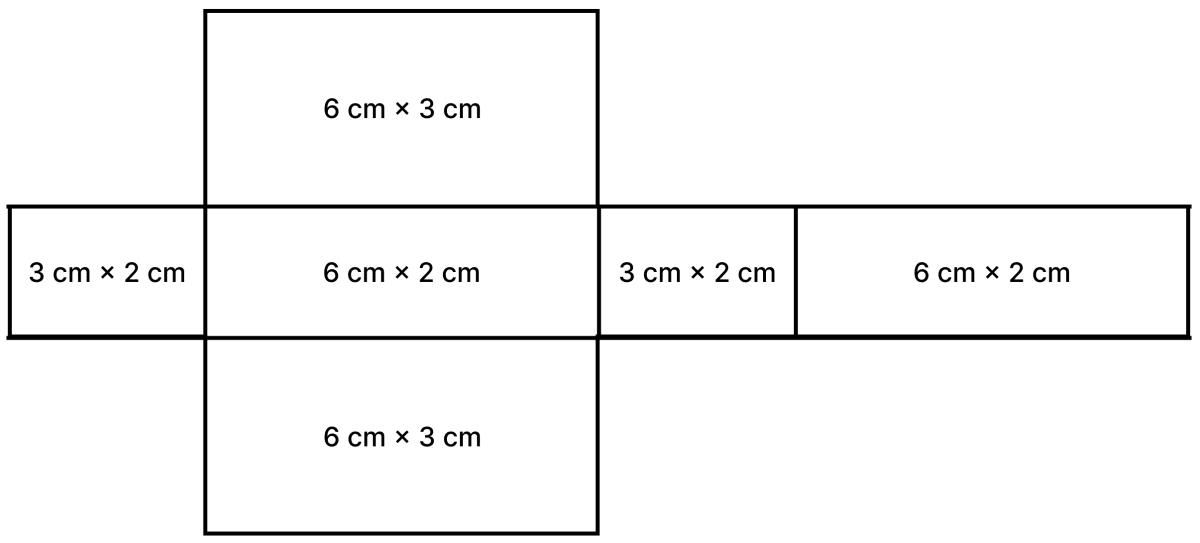
Hence, a net of each cuboid is formed by arranging its 6 rectangular faces (in the three pairs listed above) edge-to-edge so that they fold into the cuboid.
What is a net of a regular tetrahedron? Which of the following are nets of a regular tetrahedron?

Answer
A regular tetrahedron has 4 faces, each of which is an equilateral triangle. So a net of a regular tetrahedron is a flat figure made up of 4 equilateral triangles, joined edge-to-edge, that folds along its edges to form the tetrahedron.
Checking the given figures by folding:
The first figure — a large equilateral triangle divided into 4 small equilateral triangles by joining the midpoints — is a net. On folding the three corner triangles up over the central triangle, they meet to form a regular tetrahedron.
The third figure — a straight strip (row) of 4 equilateral triangles, pointing up–down–up–down — is a net. On folding, the four triangles wrap up to form a regular tetrahedron.
The second and fourth figures are not nets. In each of these, the triangles are bent around so that, on folding, two faces overlap and the tetrahedron cannot be completed.
A regular tetrahedron has only 2 possible nets, and these are exactly the first and third figures.
Hence, a net of a regular tetrahedron is an arrangement of 4 equilateral triangles that folds into the tetrahedron; among the given figures, the first and the third are its nets.
Draw a net with appropriate measurements that can be folded into a regular tetrahedron.
Answer
A regular tetrahedron has 4 faces, each an equilateral triangle of the same size. So its net is made of 4 equal equilateral triangles.
Take the edge of the tetrahedron to be 6 cm. Then each of the 4 triangular faces is an equilateral triangle of side 6 cm.
Steps to draw the net (triangle form):
Step 1: Take the edge length of the regular tetrahedron to be 6 cm.
Step 2: Draw an equilateral triangle of side 6 cm. Then draw three more equilateral triangles of side 6 cm, one on each side of the first triangle.
The resulting figure consists of 4 congruent equilateral triangles and forms a net of a regular tetrahedron.
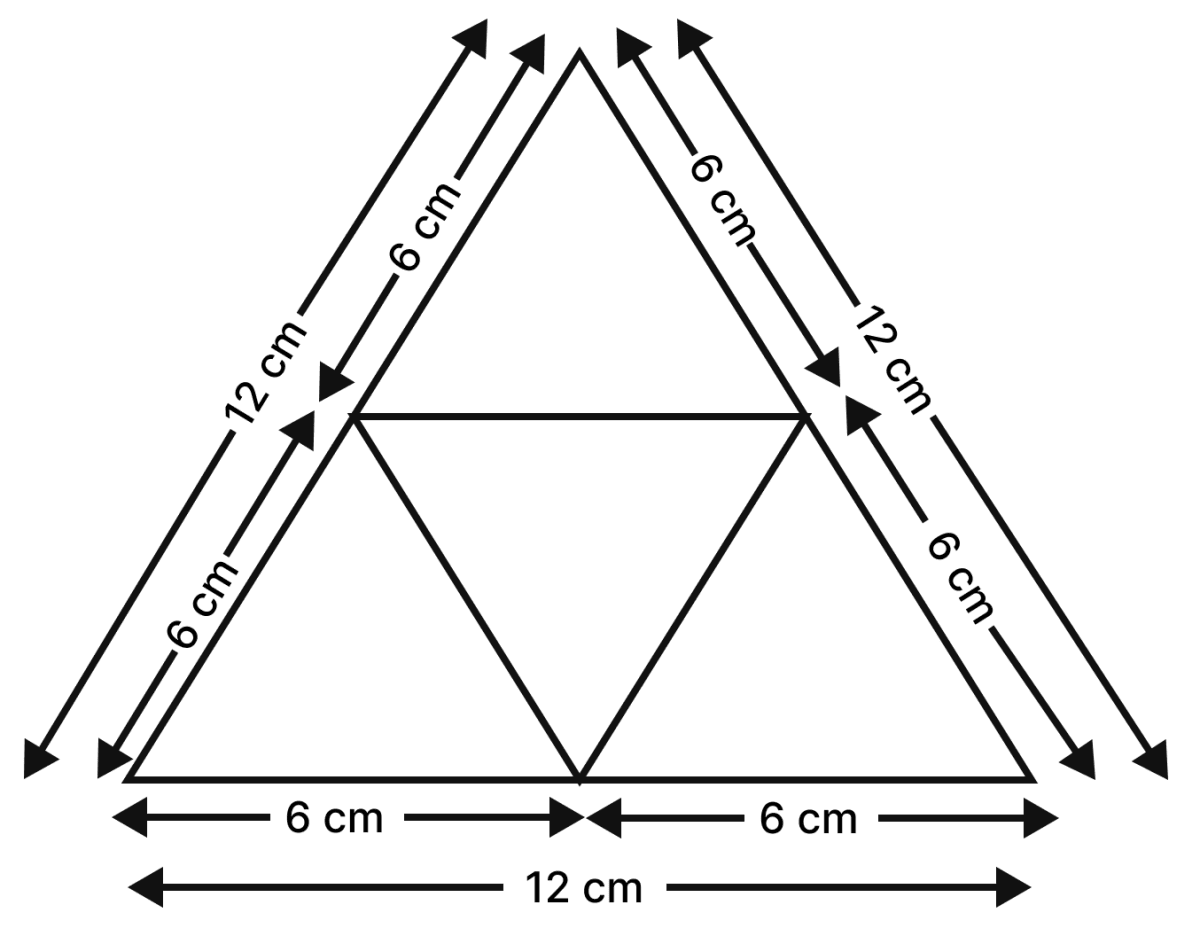
When folded along the common edges, the three outer triangles meet above the central triangle to form a regular tetrahedron.
Hence, the above figure is a net of a regular tetrahedron of edge 6 cm.
Draw a net with appropriate measurements that can be folded into a square pyramid.
Answer
A square pyramid has 1 square base and 4 triangular side faces. So its net is made of 1 square together with 4 congruent isosceles triangles, one on each side of the square.
Take the base edge of the pyramid to be 4 cm and the slant height (the height of each triangular face) to be 5 cm.
Steps to draw the net:
Step 1: Draw a square of side 4 cm. This is the base.
Step 2: On each of the 4 sides of the square, draw an isosceles triangle pointing outwards, with base 4 cm (the side of the square) and height 5 cm (the slant height).
When the 4 triangles are folded up about the sides of the square, their apexes meet at a single point above the centre of the square, forming a square pyramid.
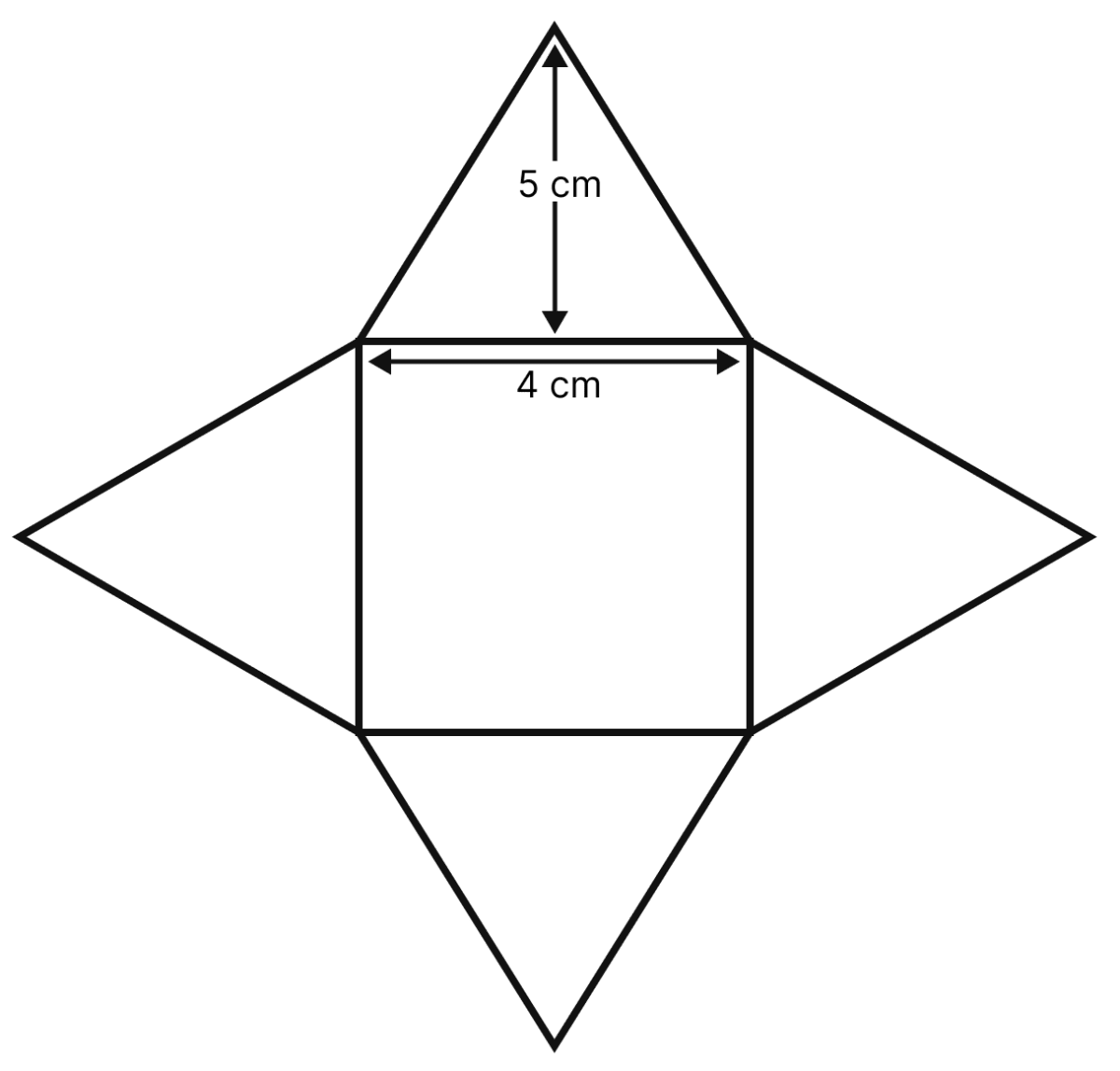
Hence, the above figure is a net of a square pyramid.
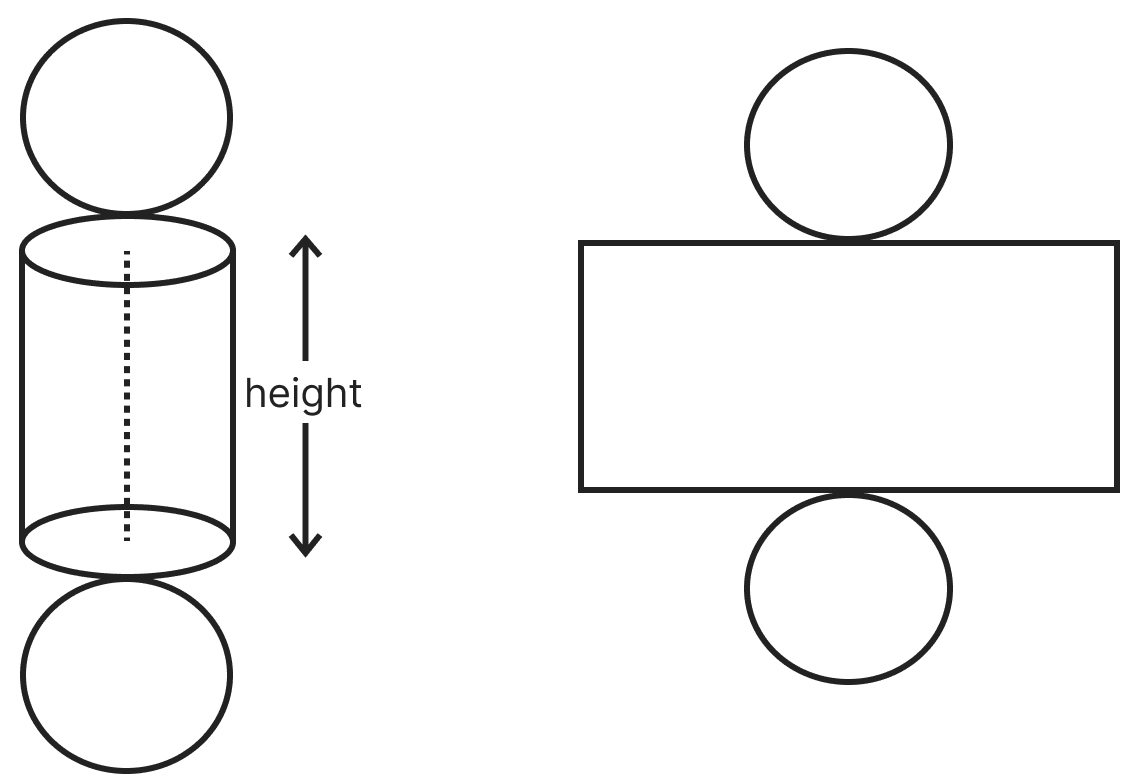
When the circular faces of a cylinder are unfolded and a cut is made along its height, a rectangle is obtained. What are the sidelengths of the rectangle obtained?
Answer
The curved surface of a cylinder is rolled around its two circular faces. When this curved surface is cut along the height of the cylinder and unrolled flat, it opens out into a rectangle.
Let the radius of the circular face be r and the height of the cylinder be h.
One pair of sides of the rectangle:
The cut is made along the height of the cylinder, so this side of the rectangle is equal to the height of the cylinder.
Length of this side = h
The other pair of sides of the rectangle:
The top and bottom edges of the curved surface were wrapped exactly once around the circular faces. So, when unrolled, the length of each of these edges equals the circumference of the circular face.
Length of this side = 2πr [Circumference of a circle of radius r]
Hence, the rectangle obtained has sidelengths equal to the height of the cylinder, h, and the circumference of its circular face, 2πr (that is, πd, where d is the diameter of the base).
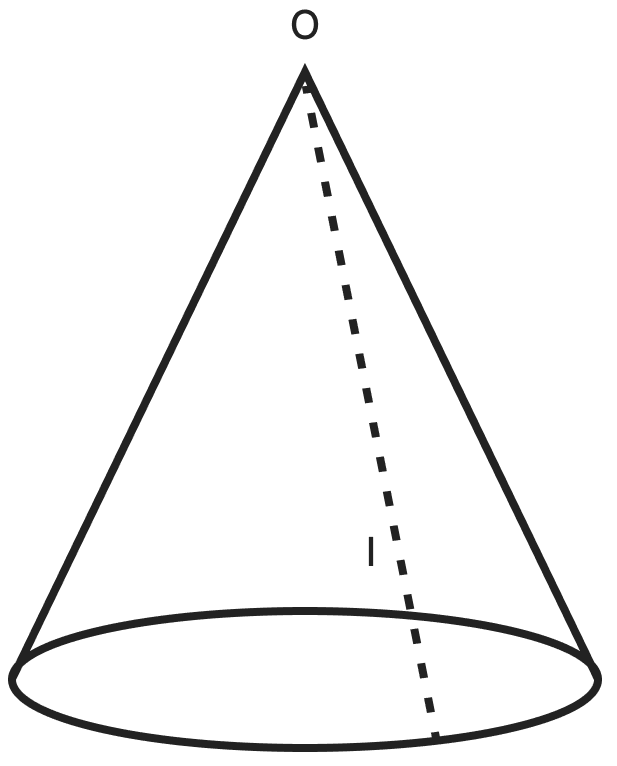
If the cone is slit open along the line l and then unrolled, what will we get?
Answer
When the cone is slit open along the slant line l and unrolled flat, the curved (lateral) surface opens out into a sector of a circle.

This is because every point on the boundary of the base circle is at the same distance from the apex O. This distance is the slant height l.
Therefore, after unrolling, the boundary of the net forms an arc of a circle with:
- Centre O
- Radius l
The length of this arc is equal to the circumference of the base circle, 2πr
Thus, the net of the cone consists of:
- A sector of a circle of radius l, and
- The circular base of radius r.
Hence, slitting a cone along a slant edge and unrolling it gives a sector of a circle with centre O and radius equal to the slant height l.
Draw a net with appropriate measurements that can be folded into a triangular prism. Verify that it works by making an actual cutout.
Answer
A triangular prism has 2 triangular faces (its two congruent ends) and 3 rectangular faces (its sides). Its net is made up of these 5 pieces.
Take the triangular ends to be equilateral triangles of side 4 cm and the length of the prism to be 6 cm.
Step 1: Draw three rectangles of dimensions 6 cm × 4 cm joined edge-to-edge in a row.
Step 2: Attach an equilateral triangle of side 4 cm to the top edge of the middle rectangle.
Step 3: Attach another equilateral triangle of side 4 cm to the bottom edge of the same rectangle.
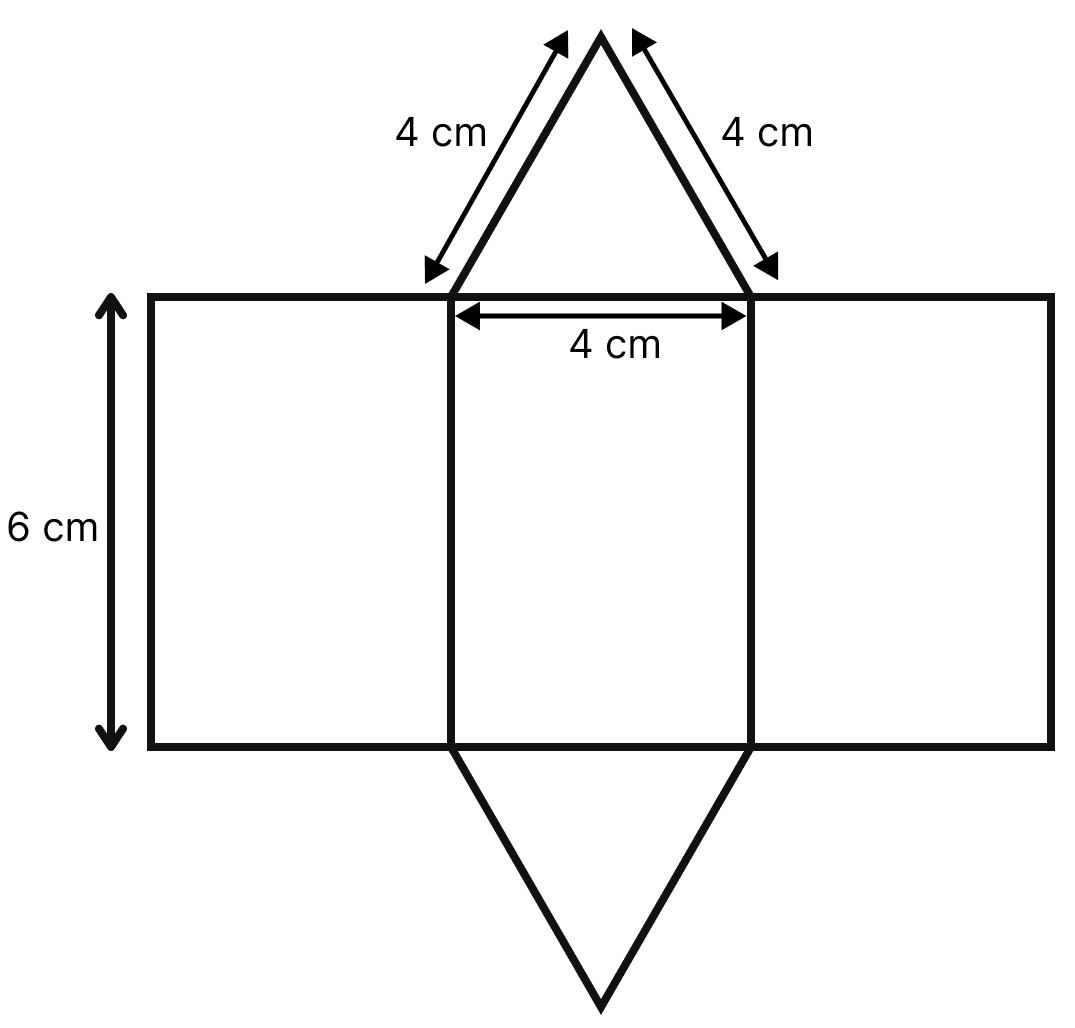
When folded along the common edges, the three rectangles form the side faces and the two triangles form the two ends of the prism.
Hence, this net folds into a triangular prism.
A hungry ant lives on the surface of a cuboid, with a laddu at the centre of the top face and the ant at the centre of the side face. What is the shortest path for the ant to reach the laddu?
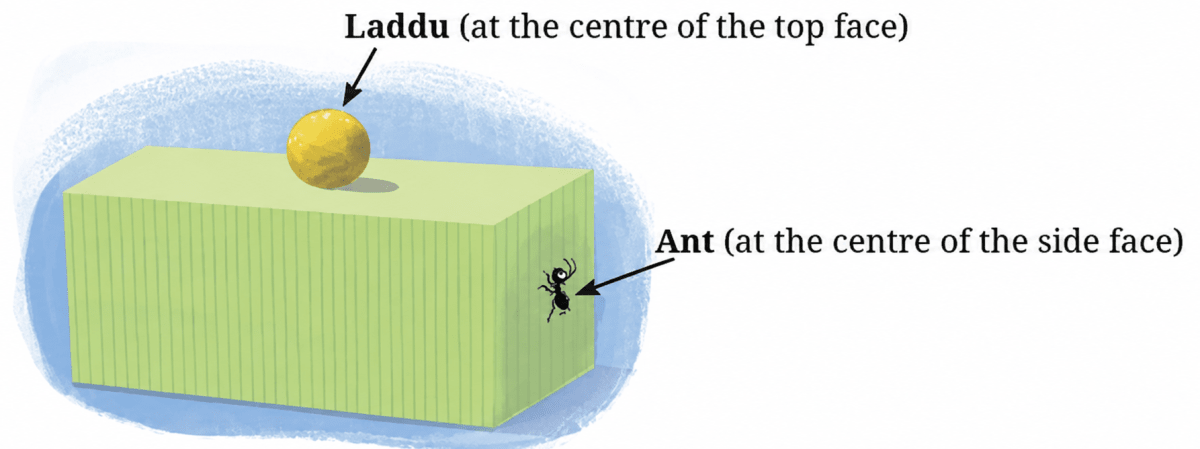
Answer
To find the shortest path, unfold the top face and the side face into a net.
The ant and the laddu then lie on the same plane.
On the net, join the ant and the laddu by a straight line segment.
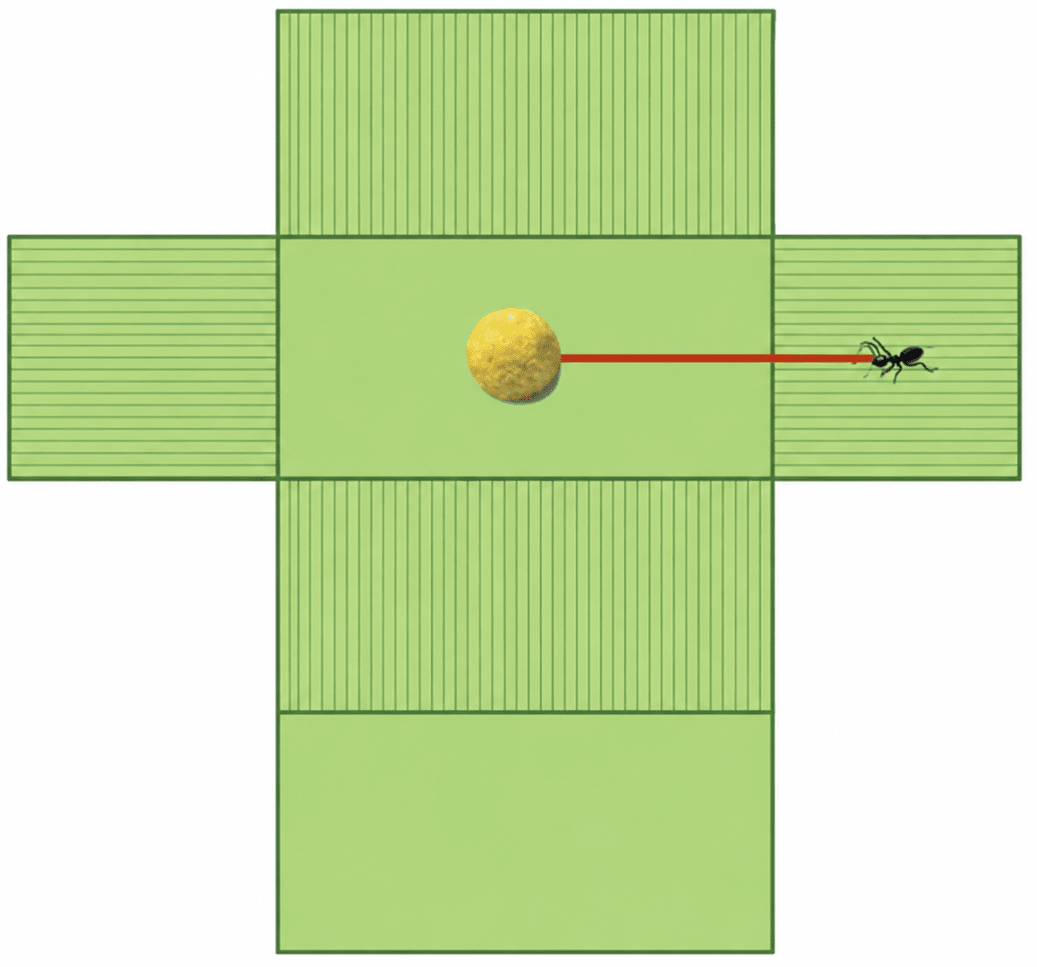
Since the straight line is the shortest distance between two points on a plane, this line gives the shortest path on the net.
When the net is folded back into the cuboid, this straight line becomes the shortest path on the surface of the cuboid.
Hence, the shortest path is the path that becomes a straight line joining the ant and the laddu on the unfolded net.
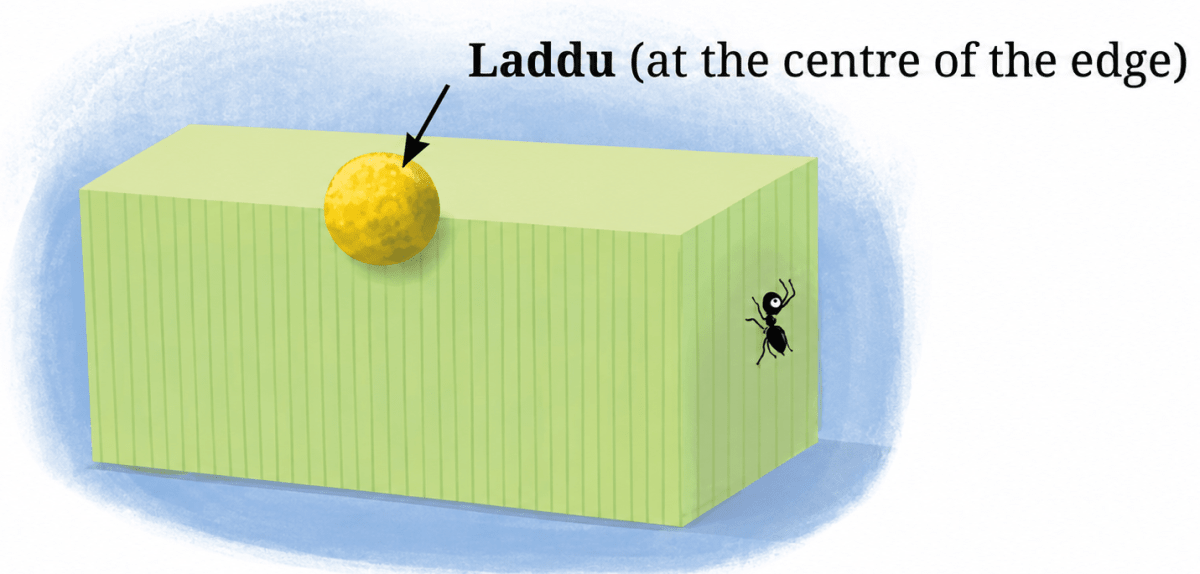
What about in the following case, where the laddu is at the centre of an edge?
Answer
To find the shortest path, unfold the relevant faces of the cuboid into a net.
The laddu is at the centre of an edge of the cuboid. In the net, mark this point on the corresponding edge.
Now join the ant and the laddu by a straight line segment on the net.
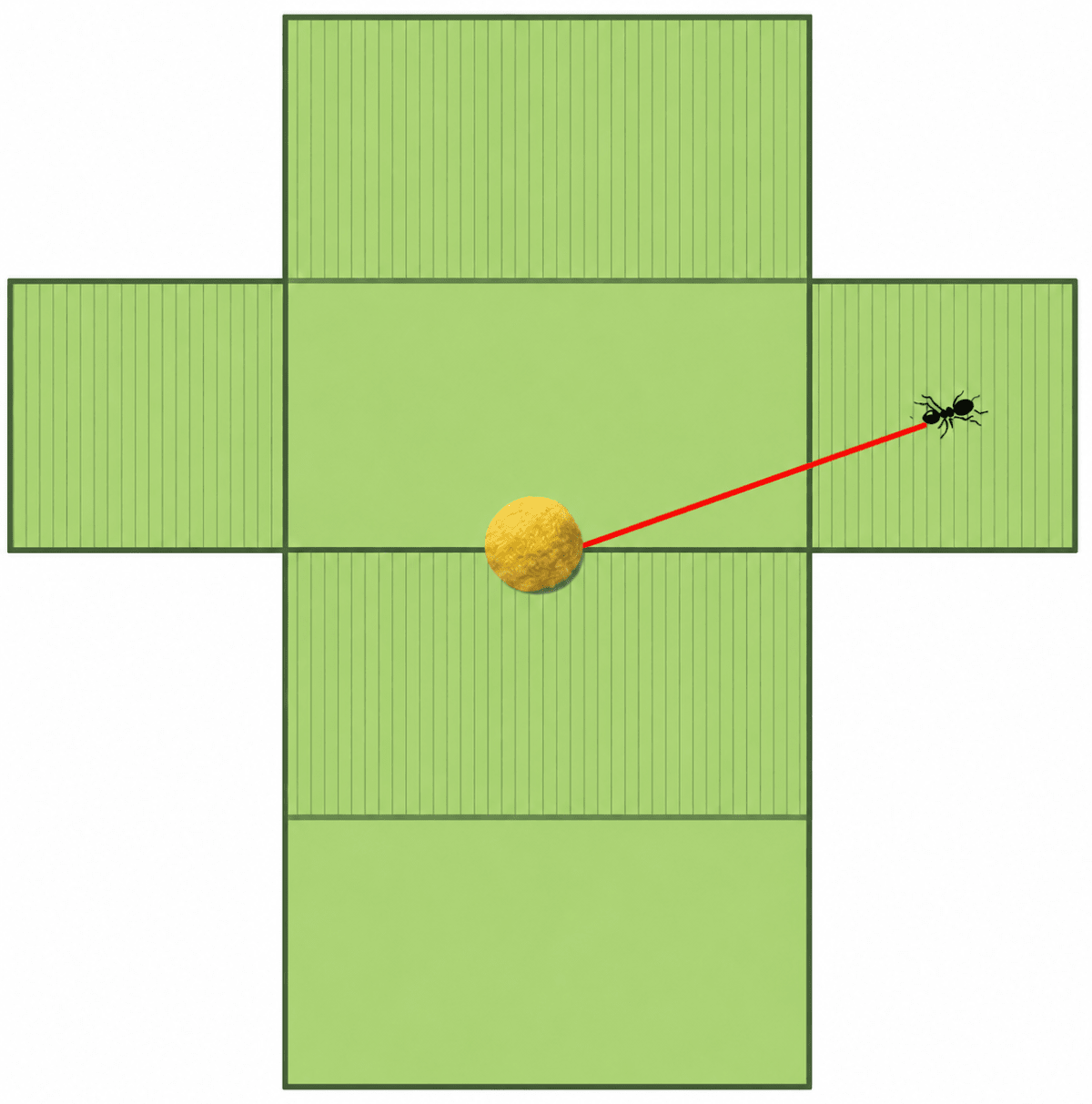
Since a straight line is the shortest distance between two points on a plane, this segment gives the shortest path on the net.
When the net is folded back into the cuboid, the segment becomes the shortest path on the surface.
Hence, the shortest path is obtained by unfolding the cuboid into a net and joining the ant and the laddu by a straight line.
If we think that a certain path is the shortest, how can we be sure that it truly is, among all the infinite possibilities?
Answer
A path on the surface of a cuboid can be unfolded onto a net without changing its length.
Therefore, every path on the cuboid corresponds to a path of the same length on the net.
Now, on a plane, the shortest distance between two points is a straight line.
So, if a path on the cuboid becomes a straight line joining the two points on the net, then it must be the shortest possible path. Any other path would become a bent line on the net and would be longer than the straight line.
Hence, a path is certainly the shortest if it unfolds into a straight line segment between the two points on the net.
Are either of these the shortest path?
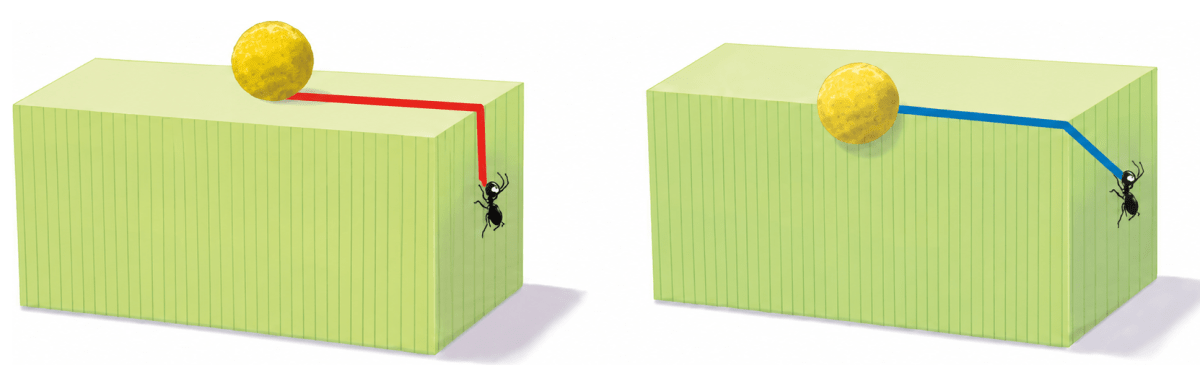
Answer
To determine whether a path is the shortest, we unfold the cuboid into a suitable net.
- The first (red) path becomes a straight line segment joining the ant and the laddu on the net. Since a straight line is the shortest distance between two points on a plane, this path is a shortest path.
- The second (blue) path becomes a bent line on the net. Since it is not a straight line joining the two points, it is longer than the shortest path.
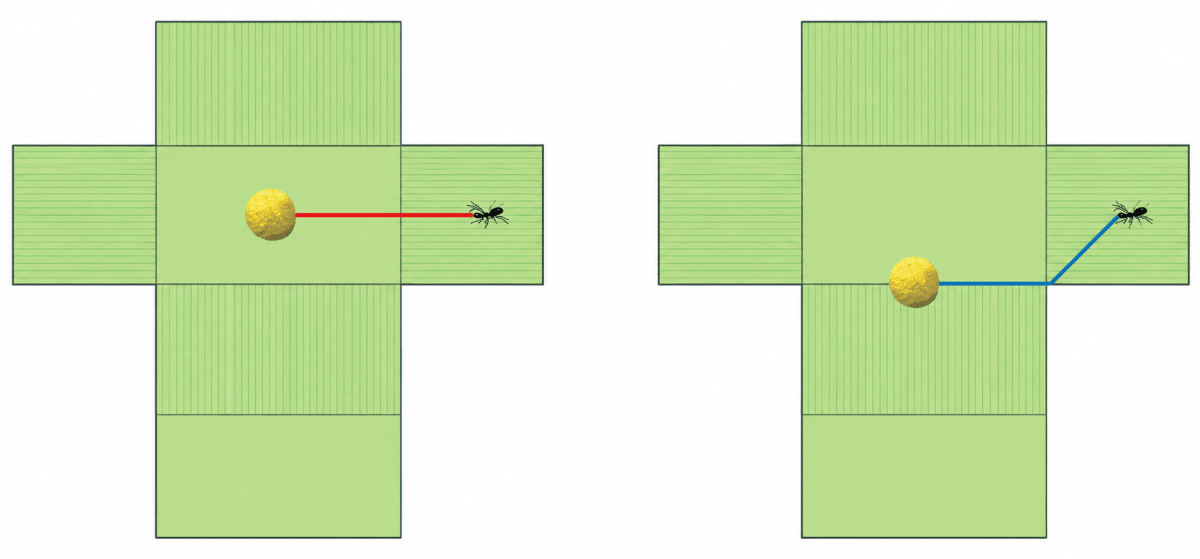
Hence, the first (red) path is the shortest path, while the second (blue) path is not.
Find the shortest path between the ant and the laddu in the following case.
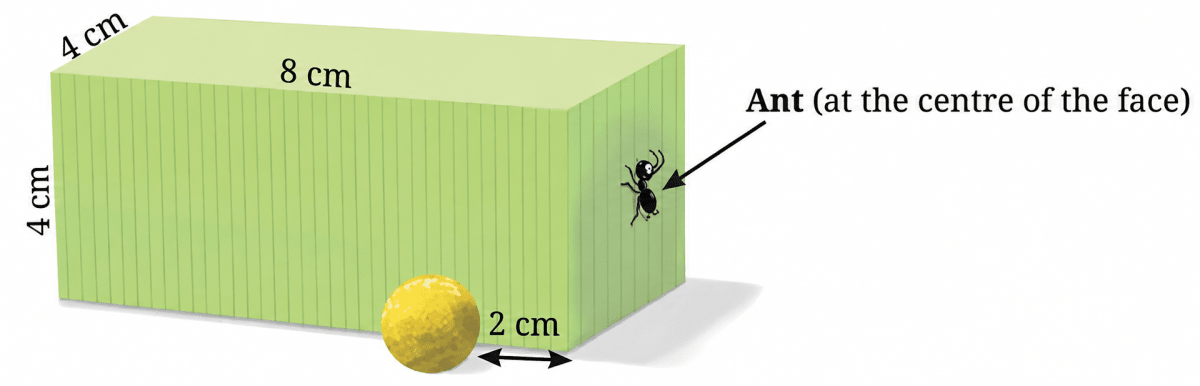
Answer
Given:
A cuboid of dimensions 8 cm × 4 cm × 4 cm.
Unfold the right face and the front face of the cuboid into a net.
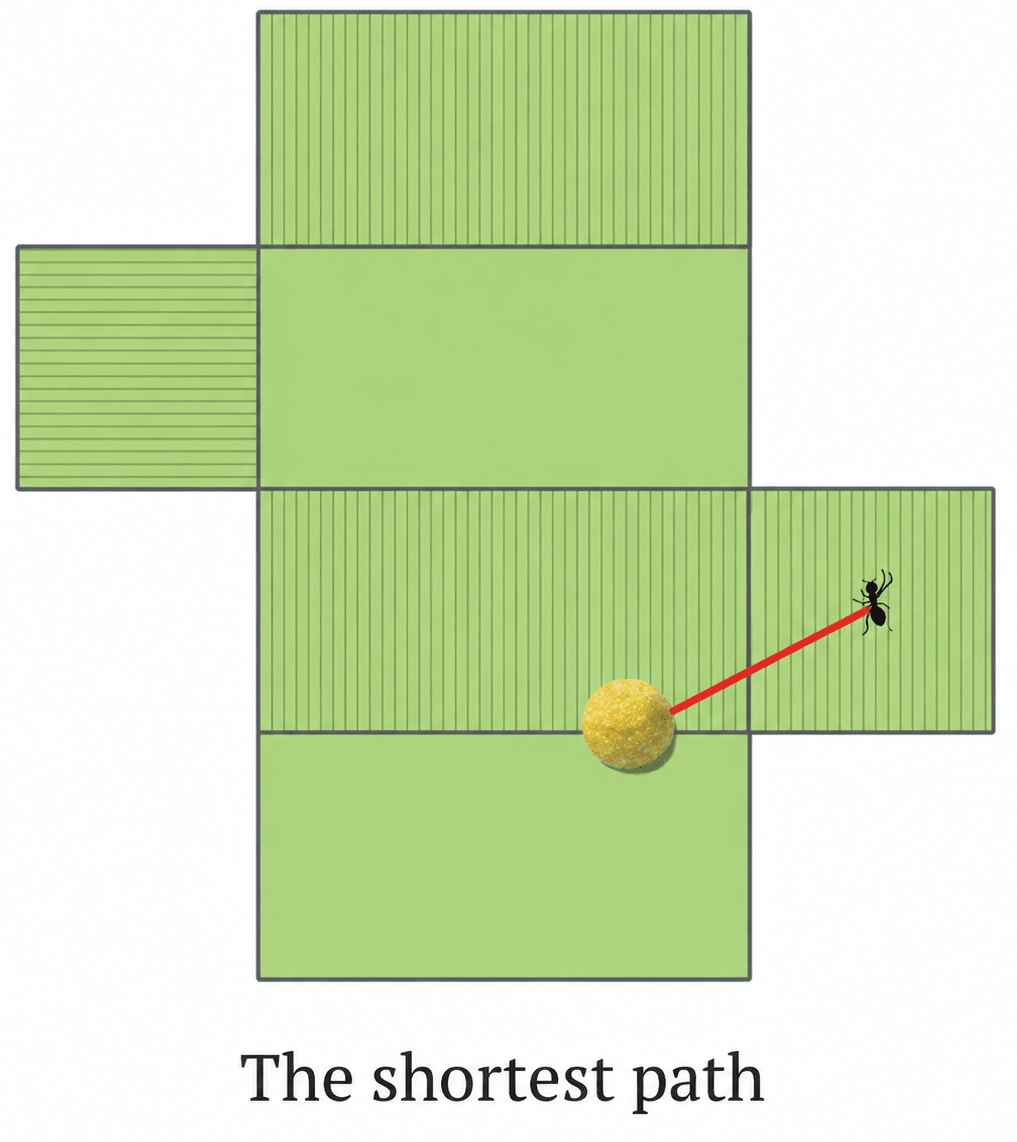
In the net:
- The ant is 2 cm from the common edge.
- The laddu is 2 cm from the same edge.
So the horizontal distance between them is 2 + 2 = 4 cm
The ant is at the centre of the face, so it is 2 cm above the bottom edge.
Thus the shortest path is the hypotenuse of a right triangle with sides 4 cm and 2 cm.
By the Baudhāyana (Pythagoras) theorem, the length d of the straight line — the shortest path — is:
d2 = 42 + 22
⇒ d2 = 16 + 4 = 20
⇒ d2 = 20
⇒ d = = cm ≈ 4.47 cm
Hence, the shortest path between the ant and the laddu is cm ≈ 4.47 cm.
What is the length of the shortest path between the ant and the laddu in the following case?
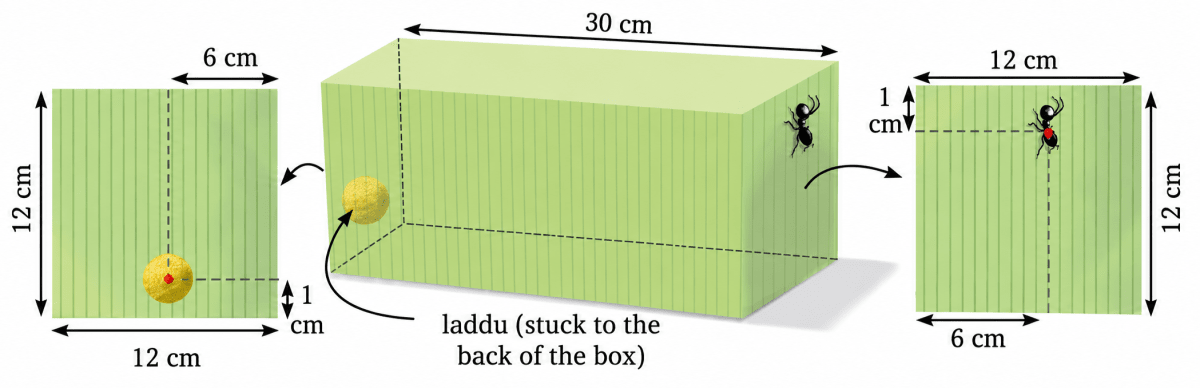
Answer
Given:
A cuboid (box) of dimensions 30 cm × 12 cm × 12 cm.
The ant is on the front face, 1 cm below the top edge (near one end).
The laddu is stuck to the back face, 1 cm above the bottom edge (near the other end).
Unfold the cuboid into a suitable net and join the ant and the laddu by a straight line.
In the unfolding that gives the shortest route, the ant and the laddu are the endpoints of the hypotenuse of a right triangle with sides 32 cm and 24 cm.
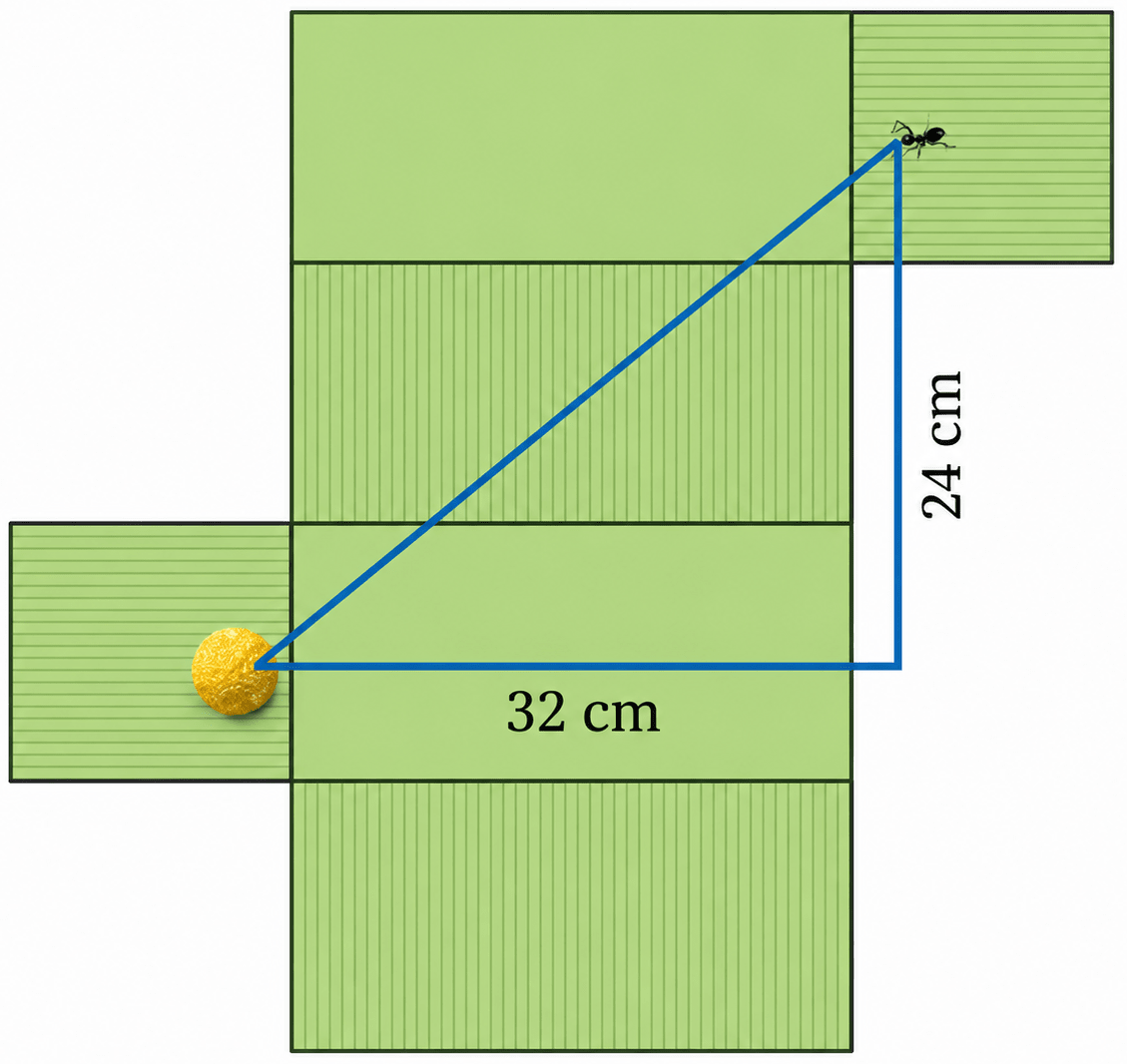
Using the Baudhāyana (Pythagoras) theorem,
d2 = 322 + 242
⇒ d2 = 1024 + 576
⇒ d2 = 1600
⇒ d =
⇒ d = 40 cm
(One must check all the possible unfoldings; the smallest straight-line length among them is the shortest path.)
Hence, the length of the shortest path between the ant and the laddu is 40 cm.
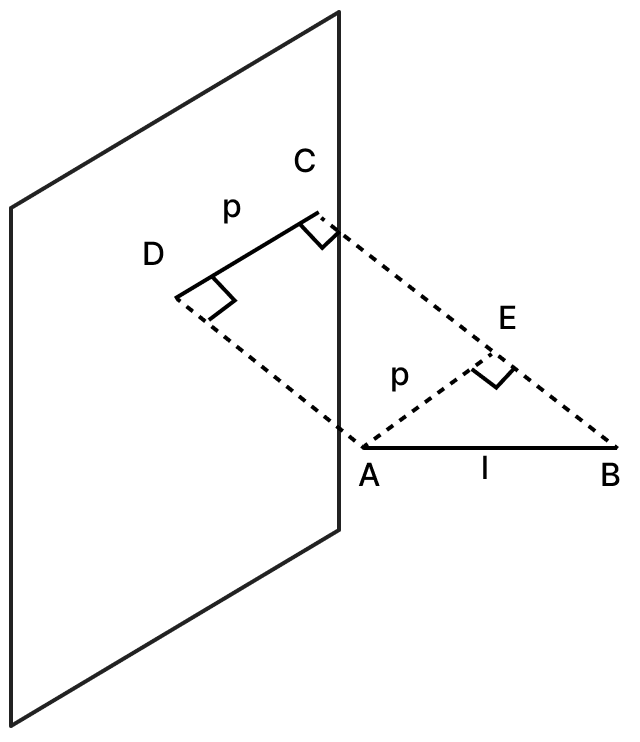
Let l be the actual length of a line and p be the length of its projection. Can you compare the lengths p and l?
Answer
Let AB = l be the actual length of the line and DC = p be the length of its projection on the plane.
From the figure, AECD is a rectangle.
Therefore, AE = DC = p.
Also, △AEB is right-angled at E, and AB is its hypotenuse.
Since the hypotenuse of a right triangle is the longest side,
AB ≥ AE.
That is, l ≥ p.
Hence, p ≤ l
Thus, the length of the projection of a line is never greater than the actual length of the line.
When is the length of the projected line equal to its actual length?
Answer
From Question 1, the actual length is AB = l and the projected length is DC = p.
Also, AE = DC = p.
In right triangle AEB, AB is the hypotenuse.
The projected length equals the actual length only when AE = AB.
This happens only when BE = 0,
that is, when E coincides with B.
In this case, the two endpoints of the line are at the same distance from the plane, so the line is parallel to the plane of projection.
Therefore, the projected length equals the actual length only when the line is parallel to the plane of projection.
What do you think are the different possible projections of a square that we get based on its orientation?
Answer
The projection of a square depends on its orientation with respect to the plane of projection.
Some possible projections are:
The plane of the square parallel to the plane of projection ⇒ a congruent square.
The square tilted about one of its sides ⇒ a rectangle.
The square tilted in a general way ⇒ a parallelogram (a rhombus in special cases).
The plane of the square perpendicular to the plane of projection (seen edge-on) ⇒ a line segment.
Hence, depending on its orientation, a square may project as a square, a rectangle, a parallelogram, or a line segment.
What do you think is the projection of a parallelogram under different orientations? Can this ever be a quadrilateral that is not a parallelogram? (As a starting point, you could think about the projection of a pair of parallel lines.)
Answer
A pair of parallel lines always projects to a pair of parallel lines, because projection keeps parallel lines parallel.
A parallelogram has two pairs of parallel sides. Under projection, each pair of opposite sides projects to a pair of parallel segments.
So in the projection, both pairs of opposite sides are parallel, which makes the projection a parallelogram as well.
The only special (degenerate) case is when the parallelogram is held perpendicular to the plane (seen edge-on), in which case its projection is a line segment.
∴ The projection can never be a quadrilateral that is not a parallelogram.
Hence, the projection of a parallelogram is always a parallelogram (or a line segment when seen edge-on), and never a non-parallelogram quadrilateral.
What can you say about the projection of an n-sided regular polygon?
[Hint: Projection of a polygon is composed of the projections of its sides.]
Answer
The projection of a polygon is made up of the projections of its sides. Each side projects to a line segment, and parallel sides stay parallel.
When the plane of the polygon is parallel to the plane of projection ⇒ the projection is the same regular n-sided polygon.
When the polygon is tilted ⇒ every side still projects to a segment, so the projection is an n-sided polygon, but the side lengths and angles change, so it is generally not regular.
In special orientations ⇒ some sides may project onto the same straight line (become collinear), so the projection may have fewer than n sides.
When the polygon is held perpendicular to the plane (edge-on) ⇒ the projection collapses to a line segment.
Hence, the projection of an n-sided regular polygon is, in general, an n-sided polygon (usually not regular); it may have fewer sides in special orientations, and reduces to a line segment when seen edge-on.
How would the projections of a cube and a cone look?
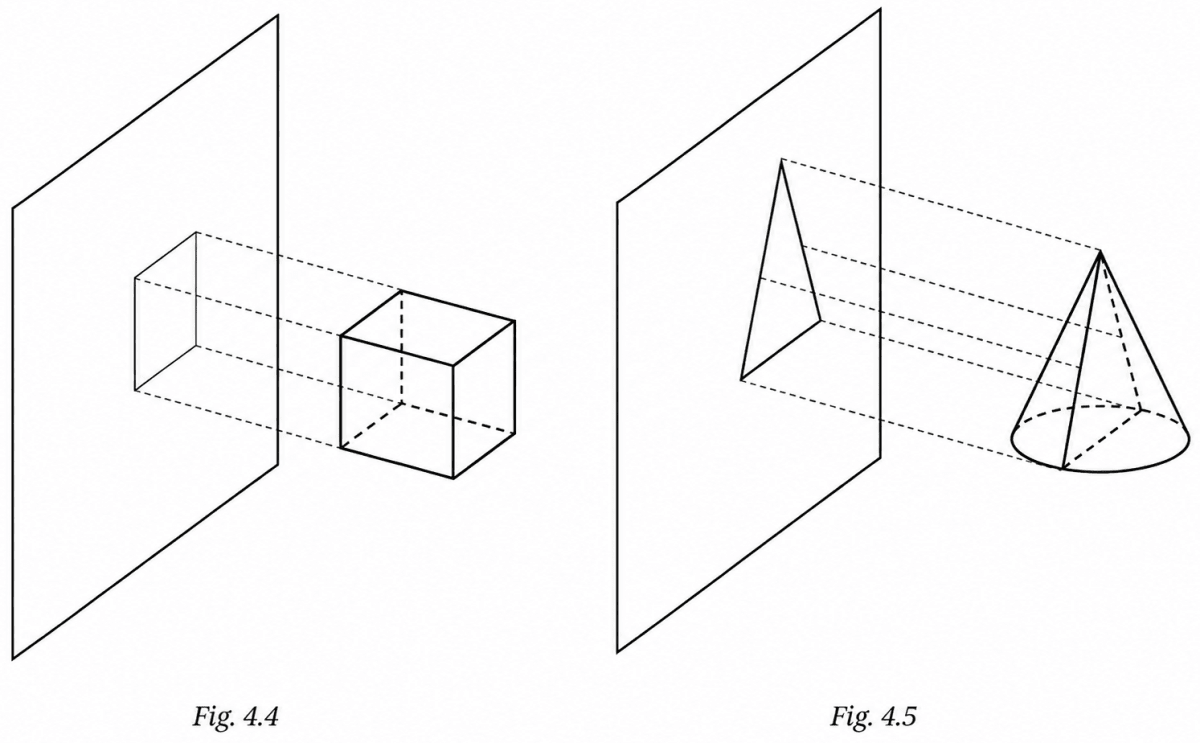
Answer
Cube:
Depending on its orientation, a cube may project as:
A face parallel to the plane ⇒ projection is a square.
Tilted about one edge ⇒ projection is a rectangle.
Balanced on a corner (isometric position) ⇒ projection is a regular hexagon.
Cone:
Depending on its orientation, a cone may project as:
Viewed along its axis, from the top ⇒ projection is a circle.
Viewed from the side, with its axis parallel to the plane ⇒ projection is an isosceles triangle.
Hence, the projection of a cube can take different polygonal shapes such as a square, rectangle, or hexagon, while the projection of a cone can be a circle or a triangle.
Find another object that makes the same projection as that of a given cone.
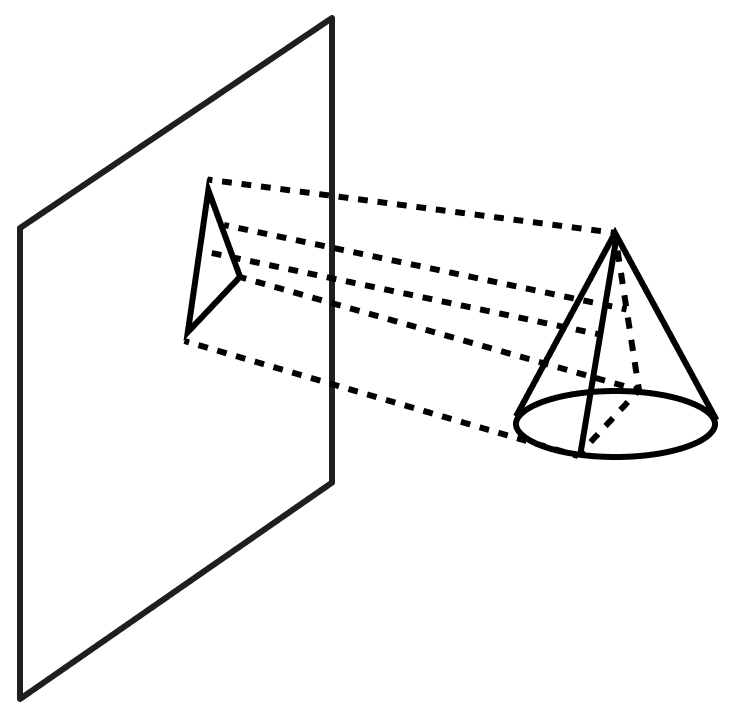
Answer
A cone seen from the side projects to a triangle, and seen from the top (along its axis) projects to a circle.
The same triangular projection is also made by a pyramid (for example, a triangular or a square pyramid), by a triangular prism, or by a flat triangle.
The same circular projection (top view) is made by a cylinder or a sphere.
Hence, a pyramid (or a triangular prism) makes the same triangular projection as a cone, just as a cylinder makes the same circular projection.
Observe the front view, top view and side view of the different lines in Fig. 4.6. Is there any relation between their lengths?
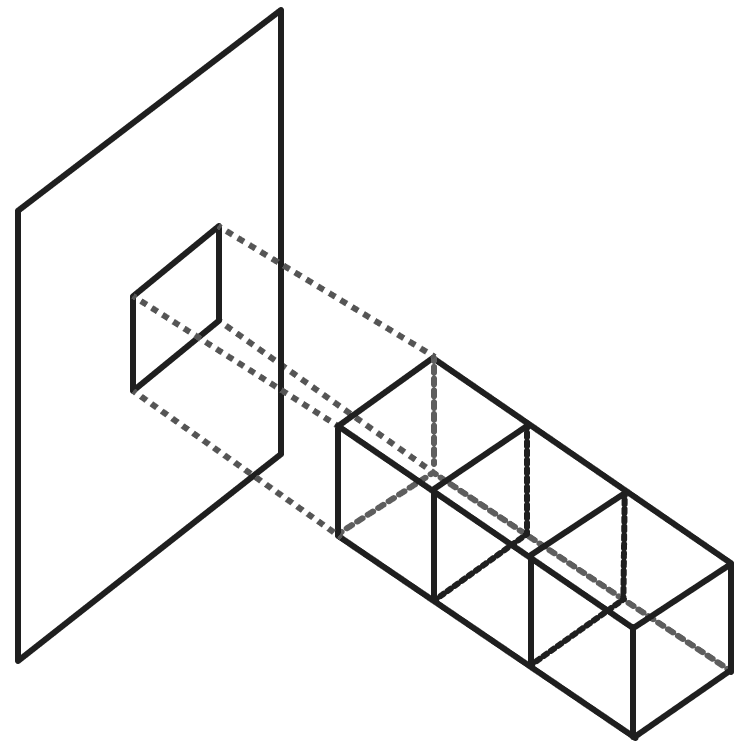
Answer
Projections of the different lines in Fig. 4.6 —
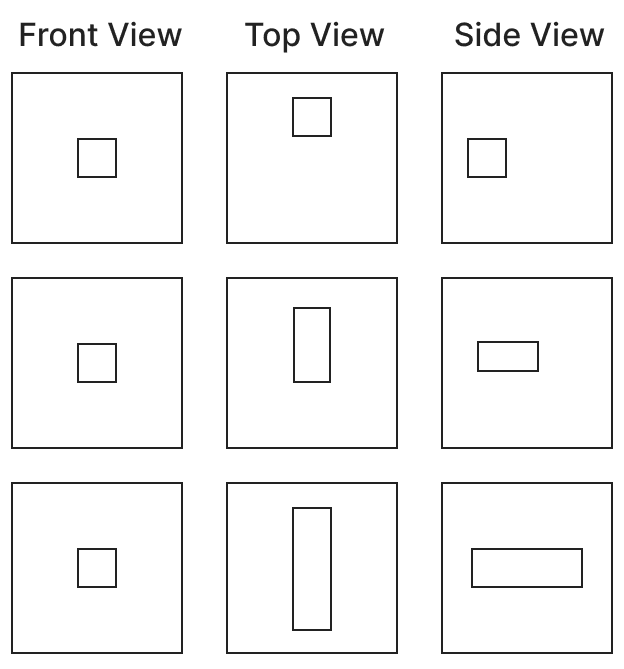
Yes. On comparing the three views of each line, we see that the three lengths are usually different from one another, and each of them is related to the actual length of the line as follows:
A line shows its true length in a view only when it is parallel to that plane.
In the other views the line appears shorter (foreshortened), and if the line is perpendicular to a plane, its view on that plane shrinks to a point.
So for every line, the length seen in any single view is at most the actual length of the line, and the actual length equals the longest of the three views.
∴ Length of the line in any view ≤ Actual length of the line
Hence, the length seen in any view is never greater than the actual length of the line; it equals the actual length only when the line is parallel to the corresponding plane.
Find the front view, top view and side view of each of the following solids, fixing its orientation with respect to the vertical, horizontal and side planes: cube, cuboid, parallelepiped, cylinder, cone, prism, and pyramid. If needed, see the next problem for clues.
Answer
Taking each solid in a natural orientation with respect to the vertical (front), horizontal (top) and side planes, the three views are as follows.
| Solid | Front view | Top view | Side view |
|---|---|---|---|
| Cube (resting on a face) | square | square | square |
| Cuboid (resting on a face) | rectangle | rectangle | rectangle |
| Parallelepiped (oblique prism) | parallelogram | parallelogram | parallelogram |
| Cylinder (axis vertical) | rectangle | circle | rectangle |
| Cone (apex up, axis vertical) | triangle | circle (with centre point) | triangle |
| Prism (triangular, resting on a rectangular face) | triangle | rectangle | rectangle |
| Pyramid (square base, apex up) | triangle | square with its two diagonals | triangle |
Hence, the front, top and side views depend on the orientation of the solid; one possible set of views is given above.
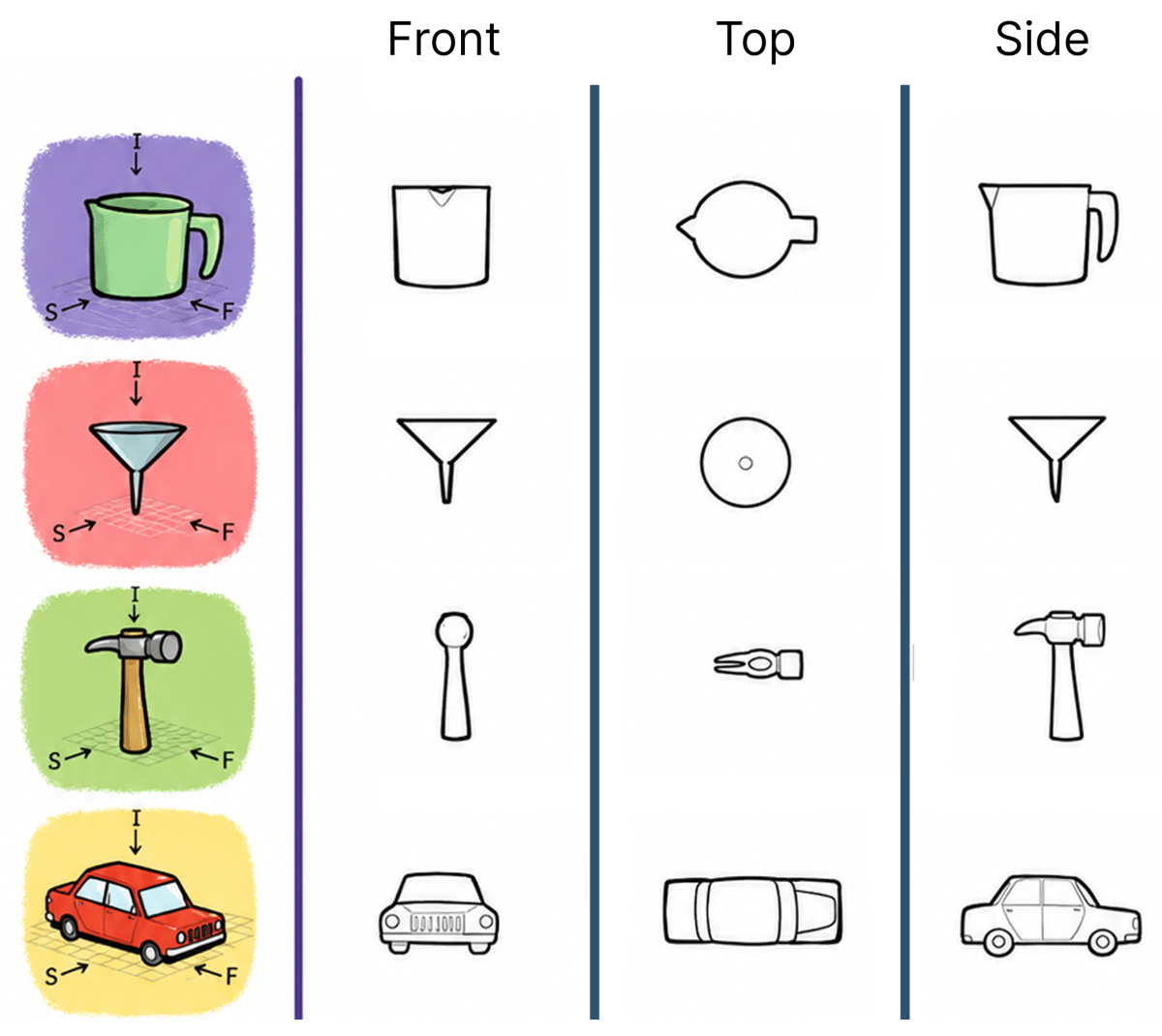
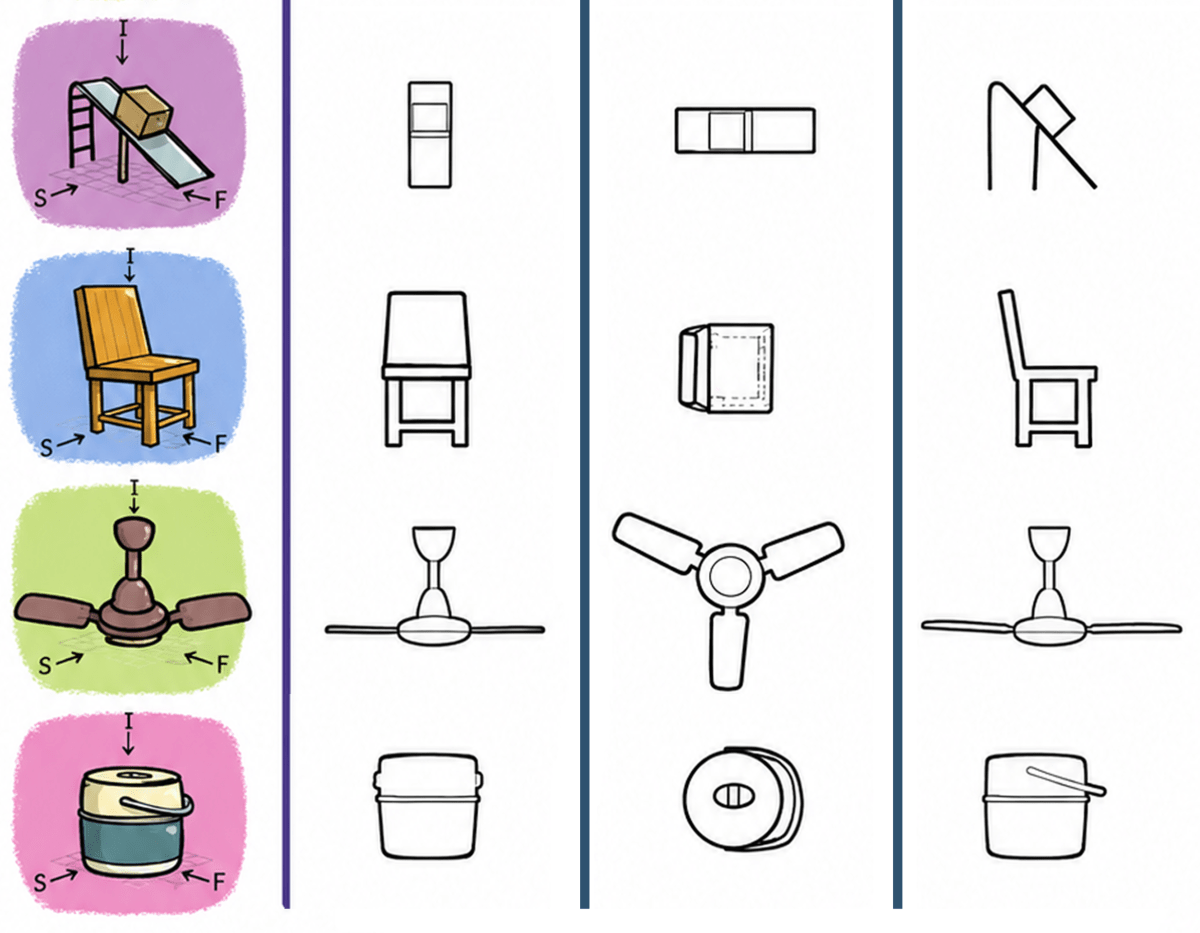
Match each of the following objects with its projections.
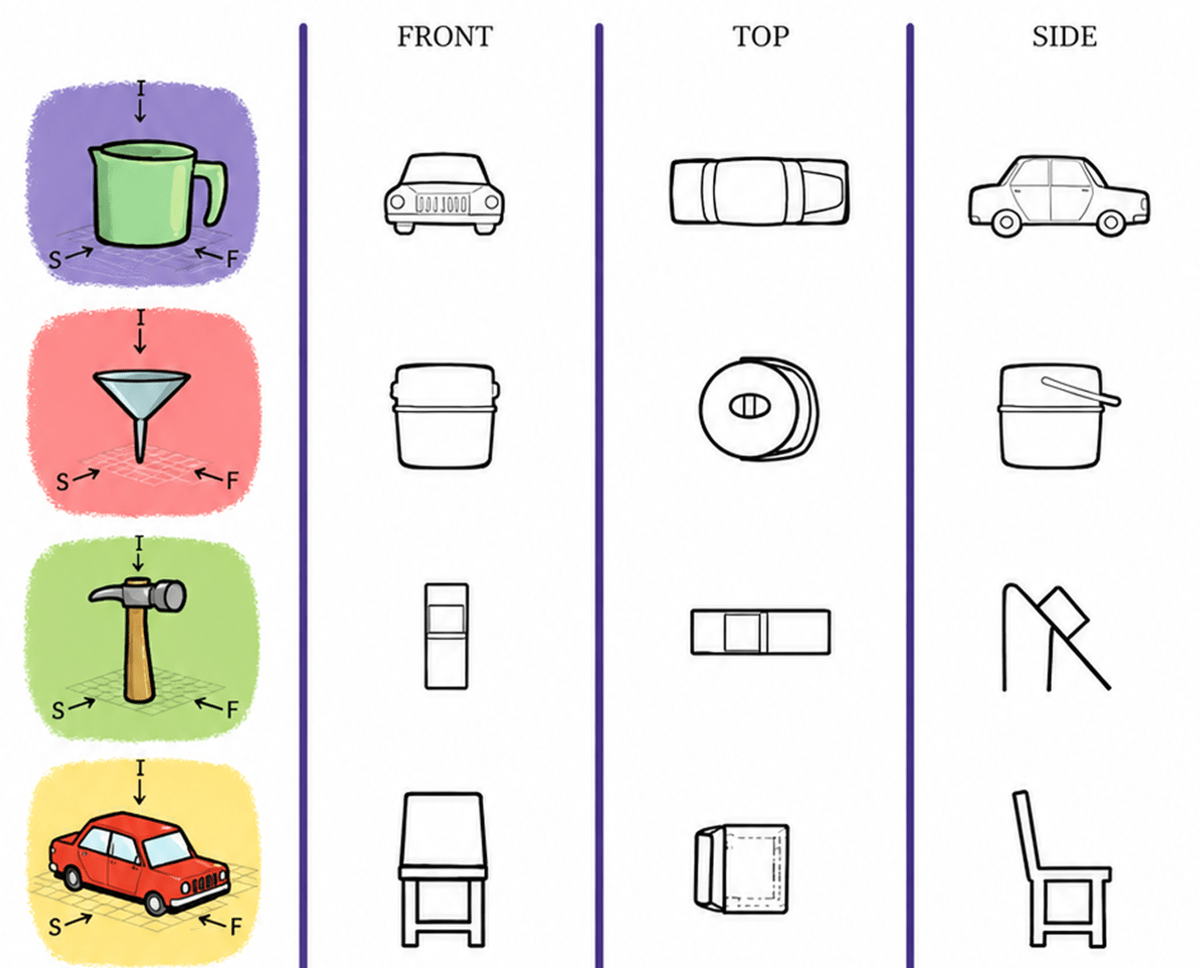
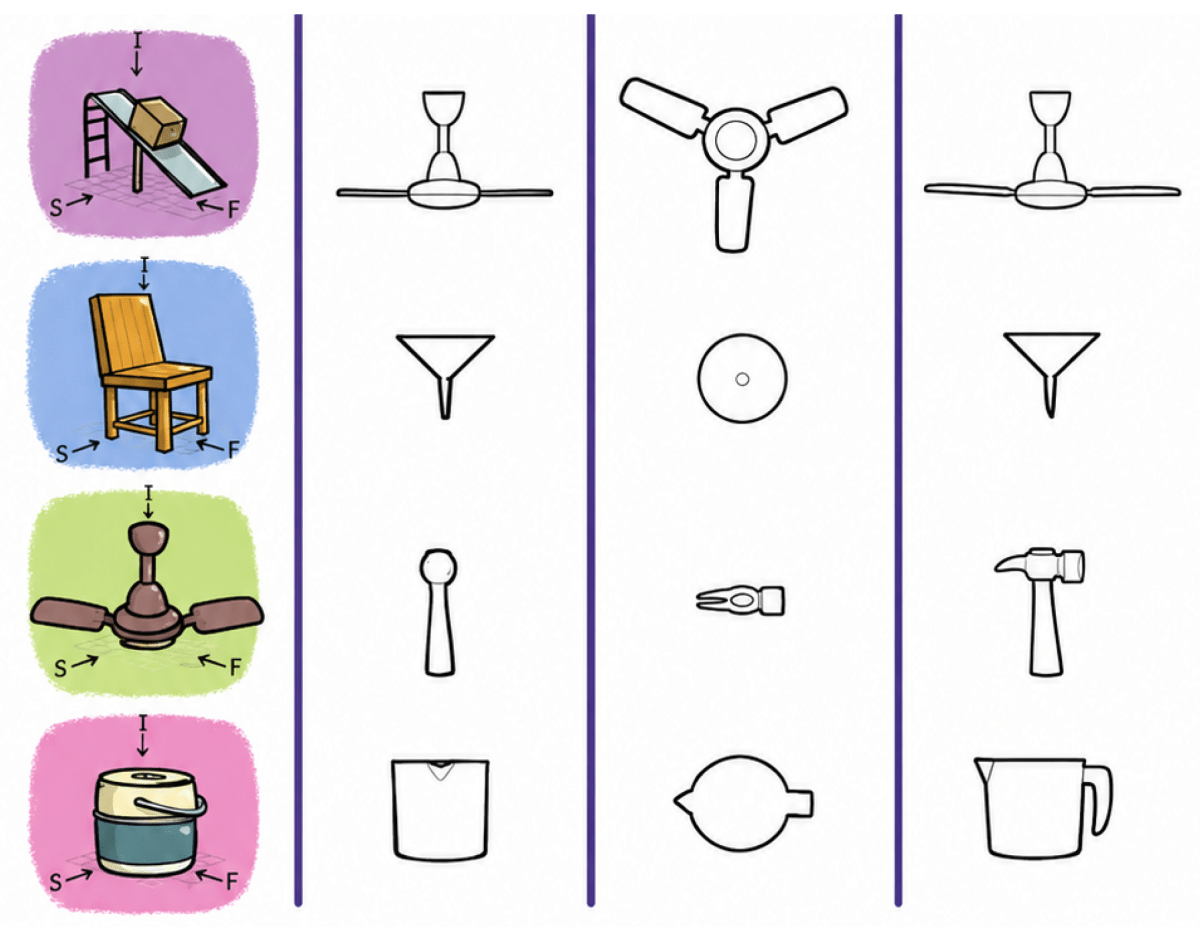
Answer
The objects match their projections as shown below:
Observe what happens to the size of the shadow as you vary the distance between your torch and your object. Why does this happen?
Answer
When the torch is brought closer to the object, the shadow becomes larger. When the torch is moved farther away, the shadow becomes smaller.
This happens because the light from a torch spreads out in different directions. When the torch is close to the object, the blocked light spreads out more before reaching the wall, producing a larger shadow. When the torch is farther away, the rays reaching the object are more nearly parallel, so the shadow becomes smaller.
If the torch is very far away, the shadow approaches the size of the object's projection.
Hence, the size of the shadow changes because the light from the torch spreads out, and the amount of spreading depends on the distance between the torch and the object.
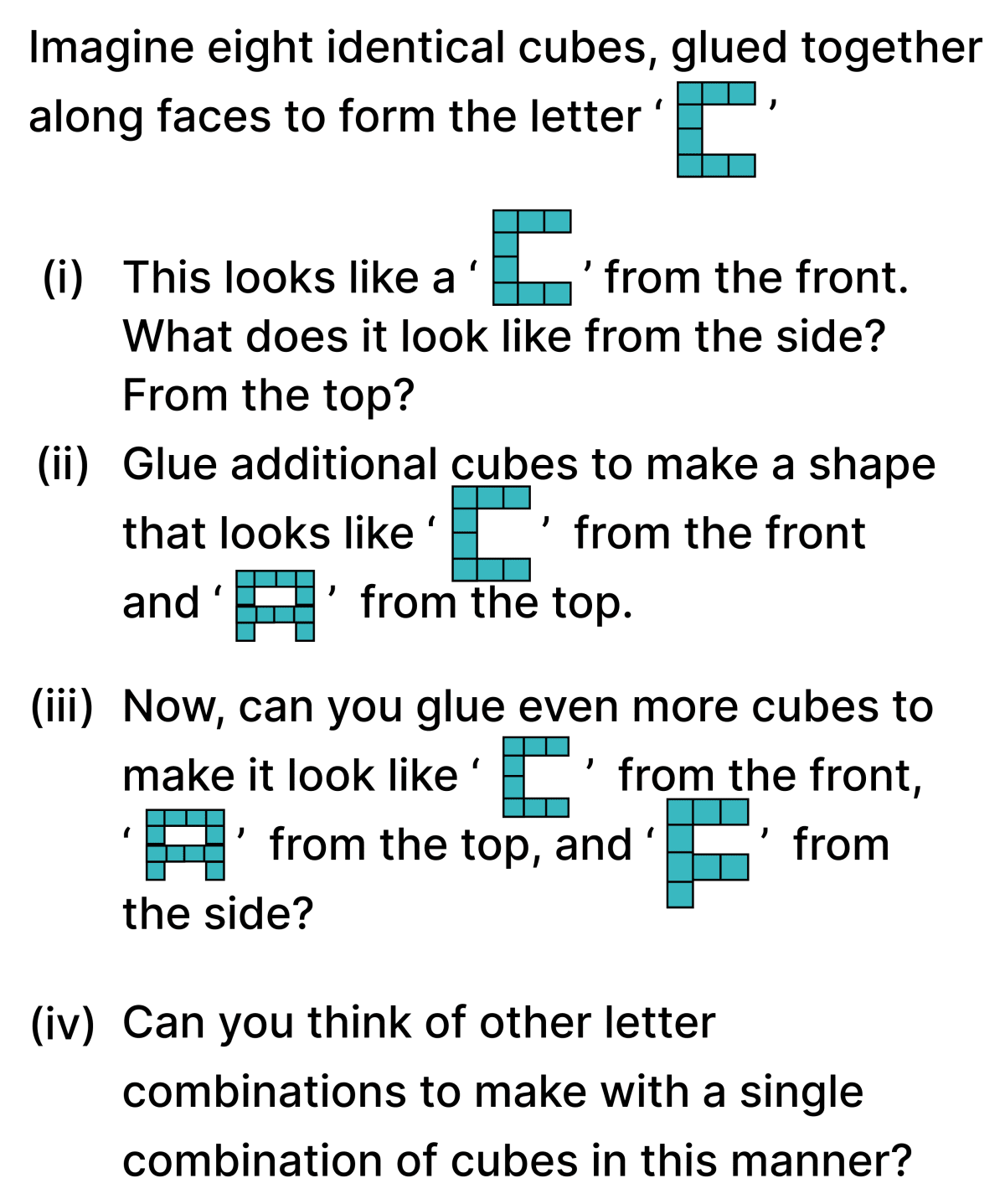
Draw the top view, front view and the side view of each of the following combinations of identical cubes.
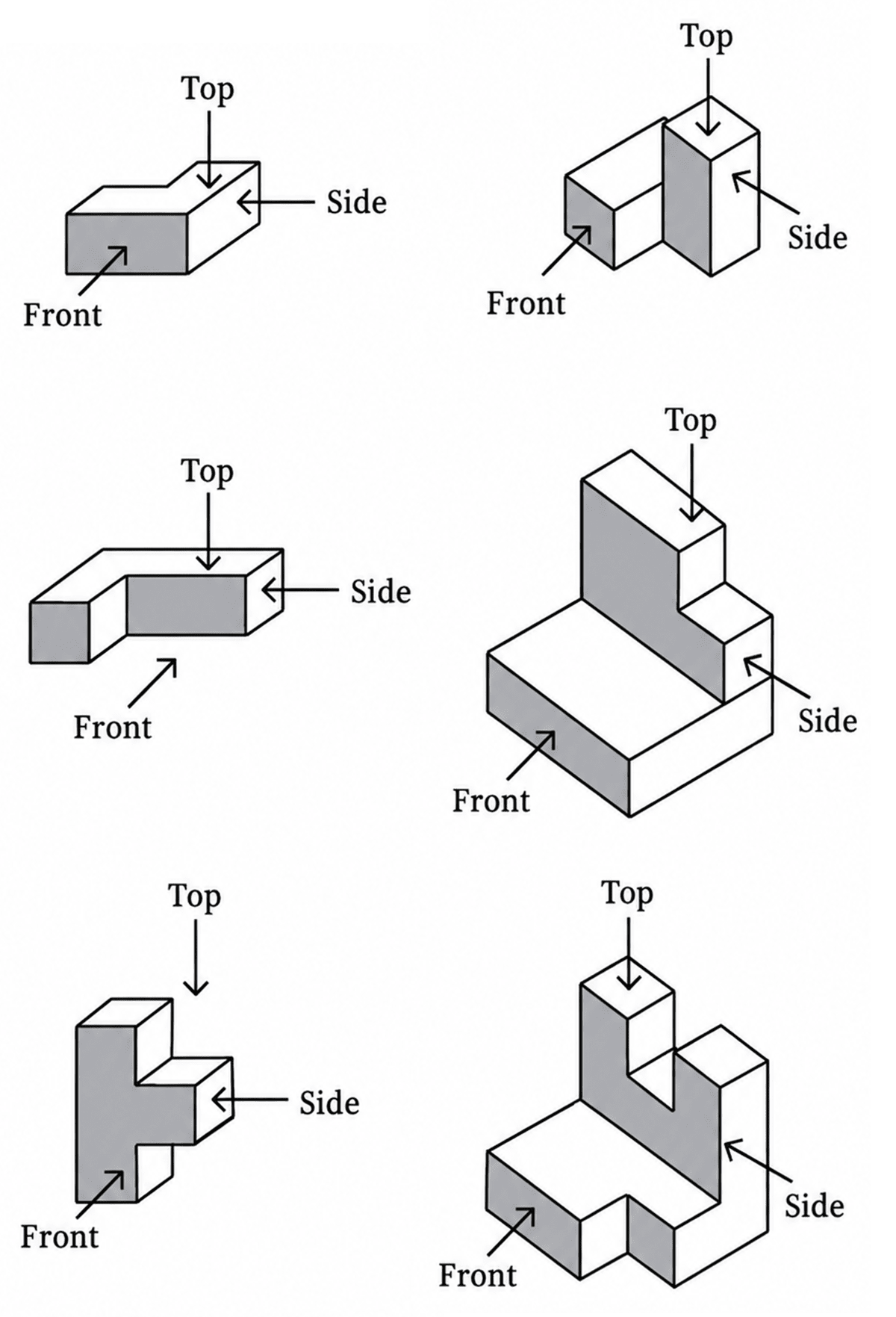
Answer
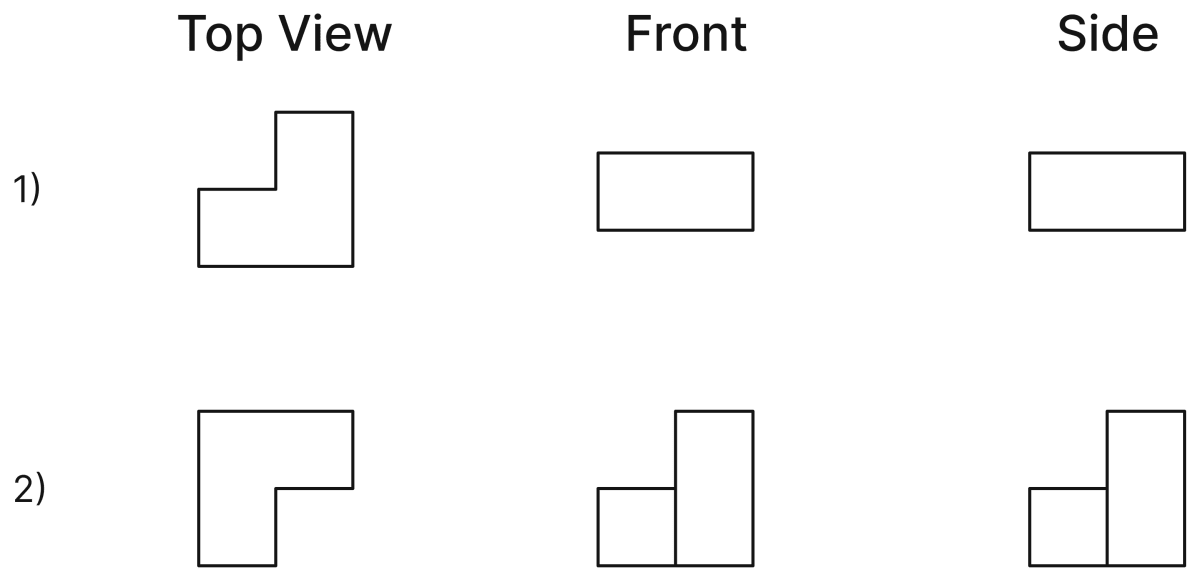
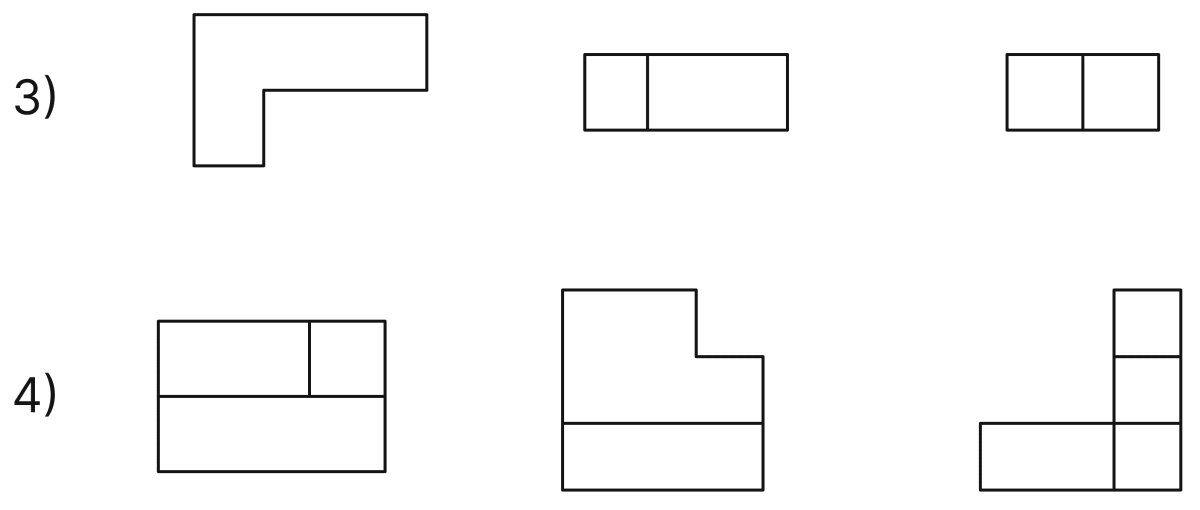
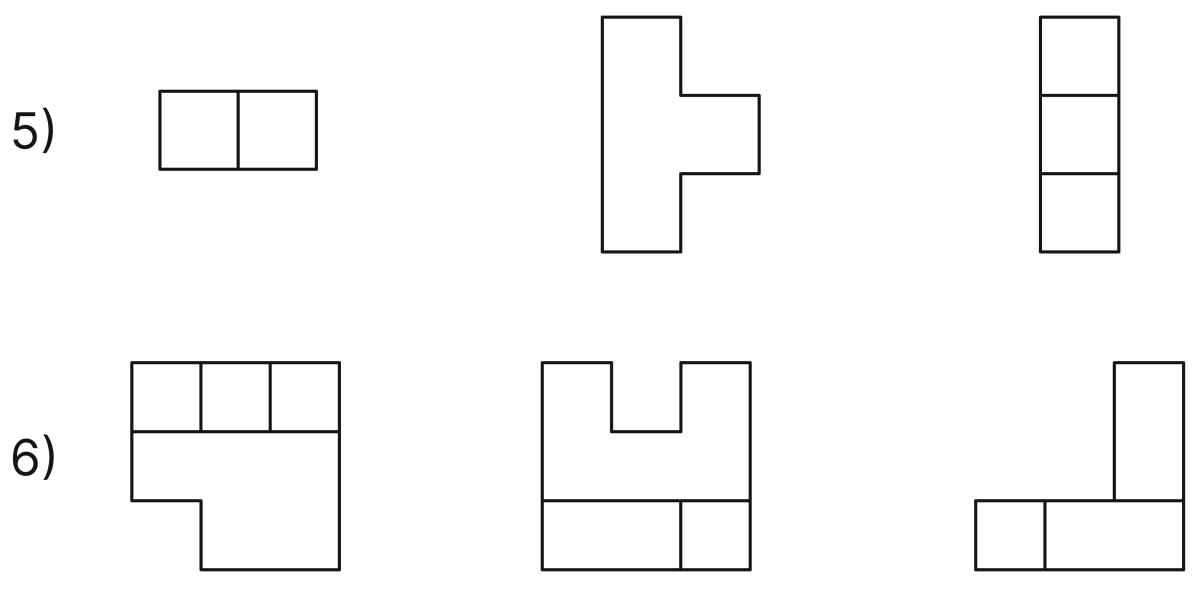
Answer
Which solid corresponds to the given top view, front view, and side view?
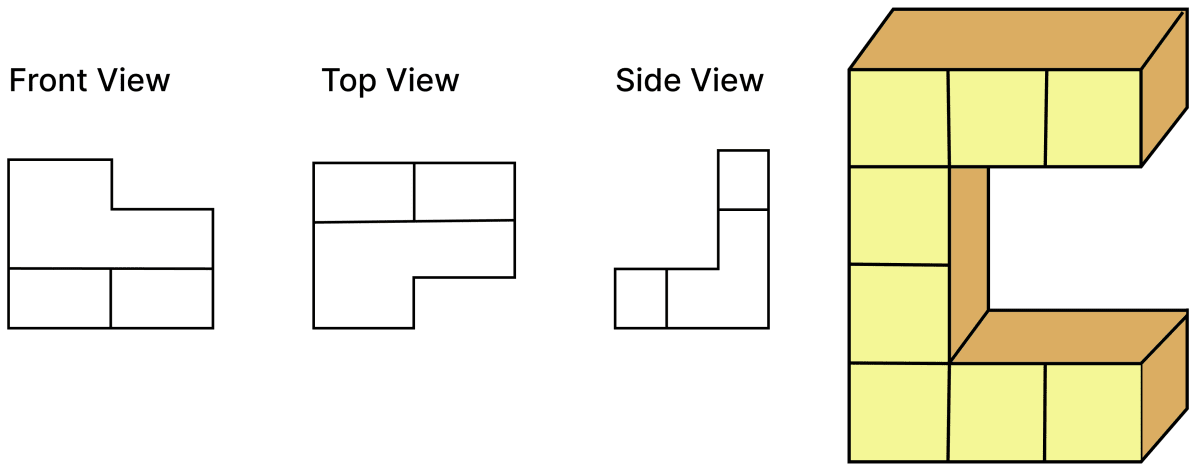
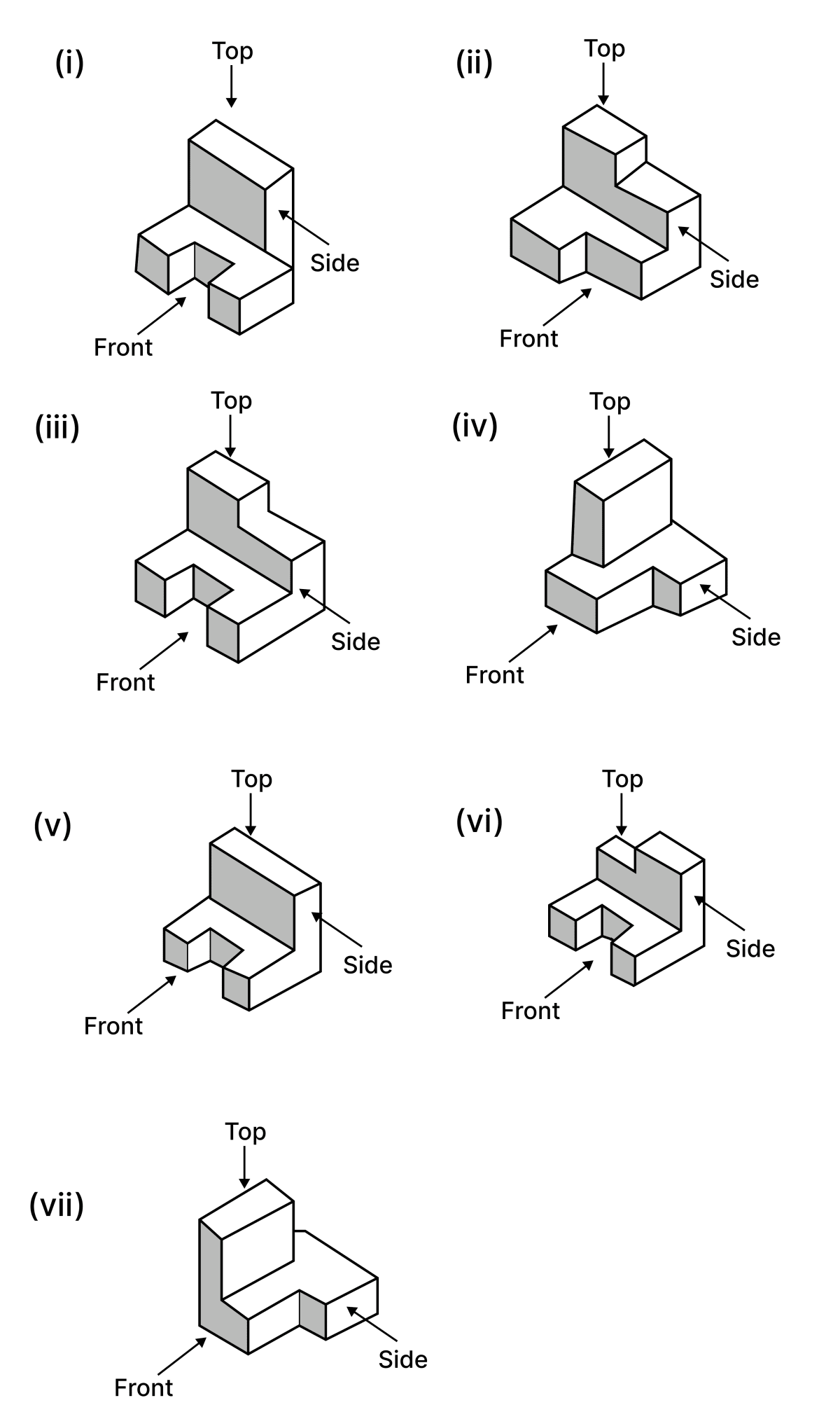
Answer
Among the given options, only option (ii) satisfies all three views simultaneously.
∴ The solid that matches all three views is the one with a tall (2-high) block at the back-left and a single-layer L-base, i.e. option (ii).
Hence, the given front, top and side views correspond to the 7-cube solid having a 2-high wall at the back-left and an L-shaped single base — option (ii).
Hence, option (ii) is the correct option.
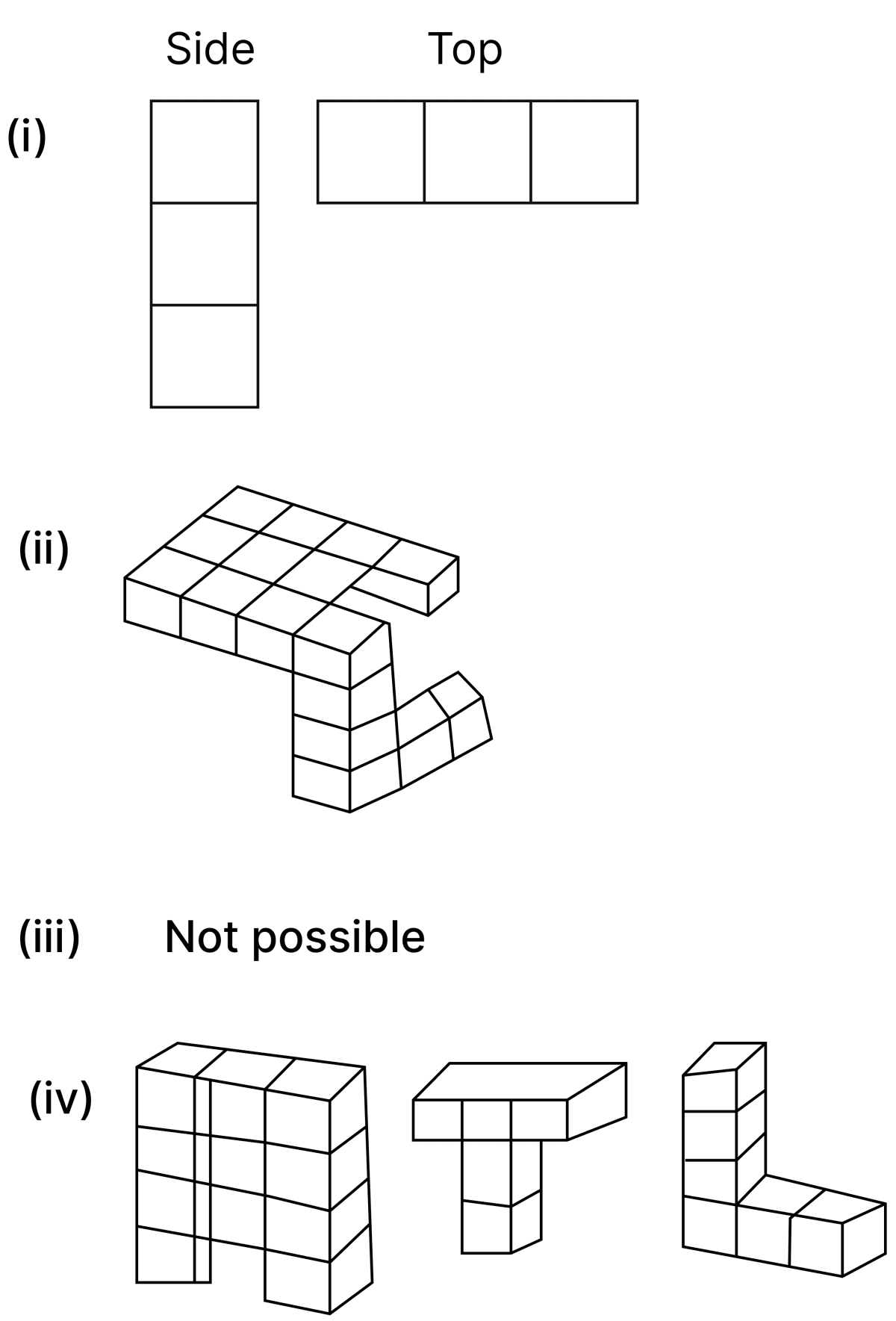
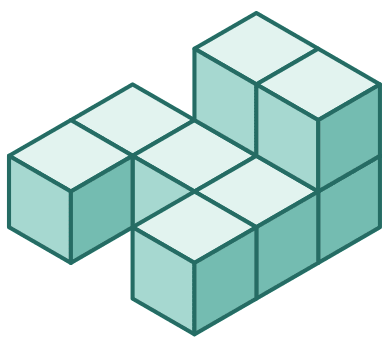
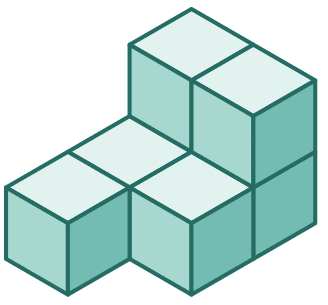
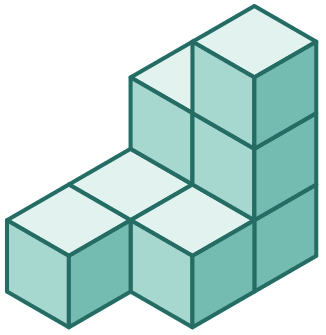
Using identical cubes, make a solid that gives the following projections.
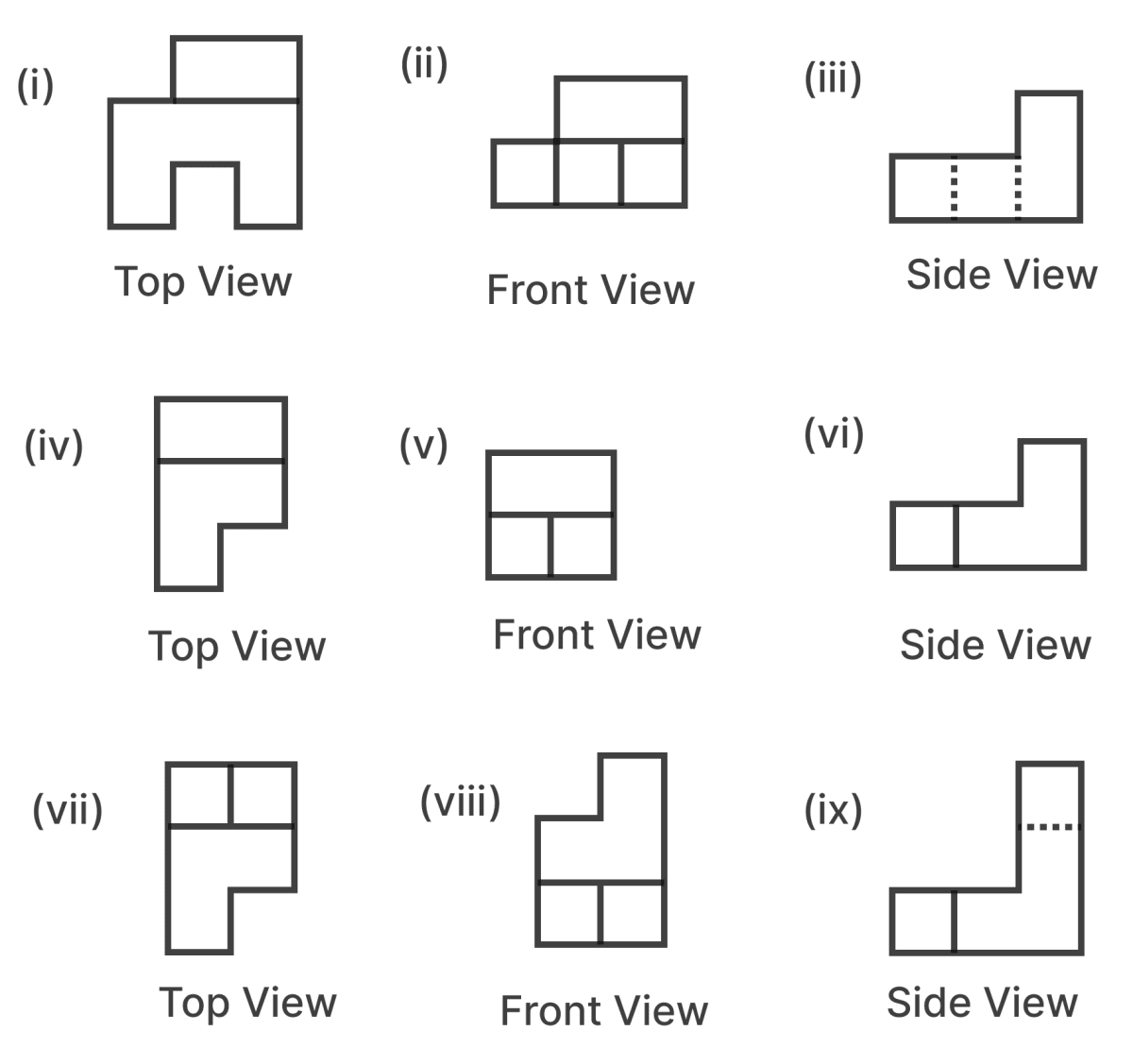
Answer
Find the number of cubes in this stack of identical cubes.
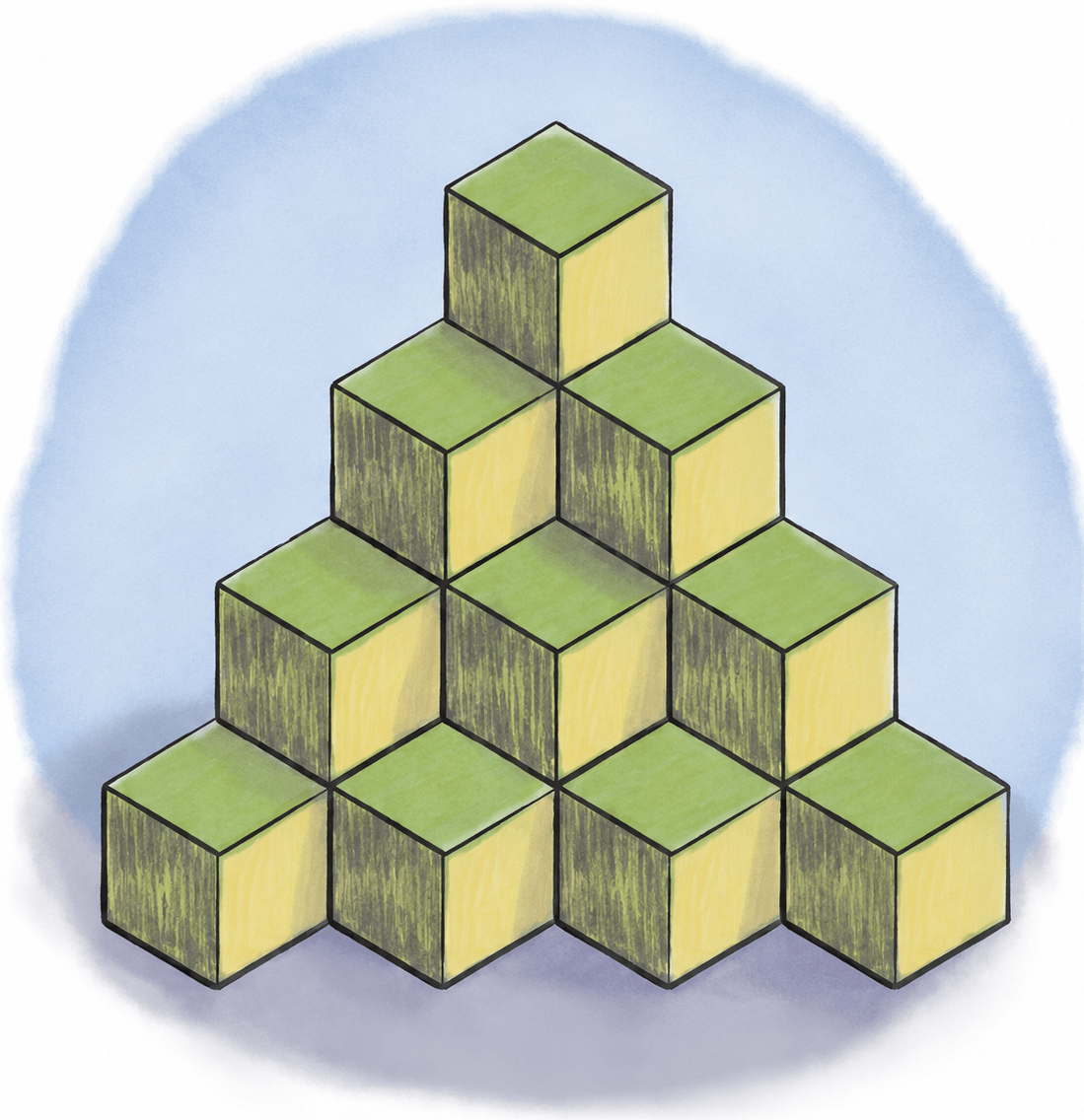
Answer
The cubes are arranged as a triangular pyramid (tetrahedral stack) with 4 layers.
To count the cubes, count the number of cubes in each horizontal layer.
Top layer: 1 cube
Second layer: 1 + 2 = 3 cubes
Third layer: 1 + 2 + 3 = 6 cubes
Bottom layer: 1 + 2 + 3 + 4 = 10 cubes
Total number of cubes:
1 + 3 + 6 + 10 = 20
Hence, the stack contains 20 cubes.
What are the different shapes the projection of a cube can make under different orientations?
Answer
The shape of the projection of a cube depends on its orientation.
Some possible projections are:
A square: when one face of the cube is parallel to the plane, the projection is a square (the same as that face).
A rectangle: when the cube is tilted so that one set of edges stays parallel to the plane but a face is no longer parallel to it, the projection becomes a rectangle.
A hexagon: when the cube is tilted further (for example, looking along a face-diagonal direction), the outline of the projection becomes a six-sided figure.
A regular hexagon: in the special orientation where the cube is balanced on one corner with its main diagonal perpendicular to the plane, the projections of all the edges are equal and the outline is a regular hexagon. This is the isometric projection of the cube.
Hence, depending on its orientation, the projection of a cube can be a square, a rectangle, a hexagon, or — in the isometric orientation — a regular hexagon.
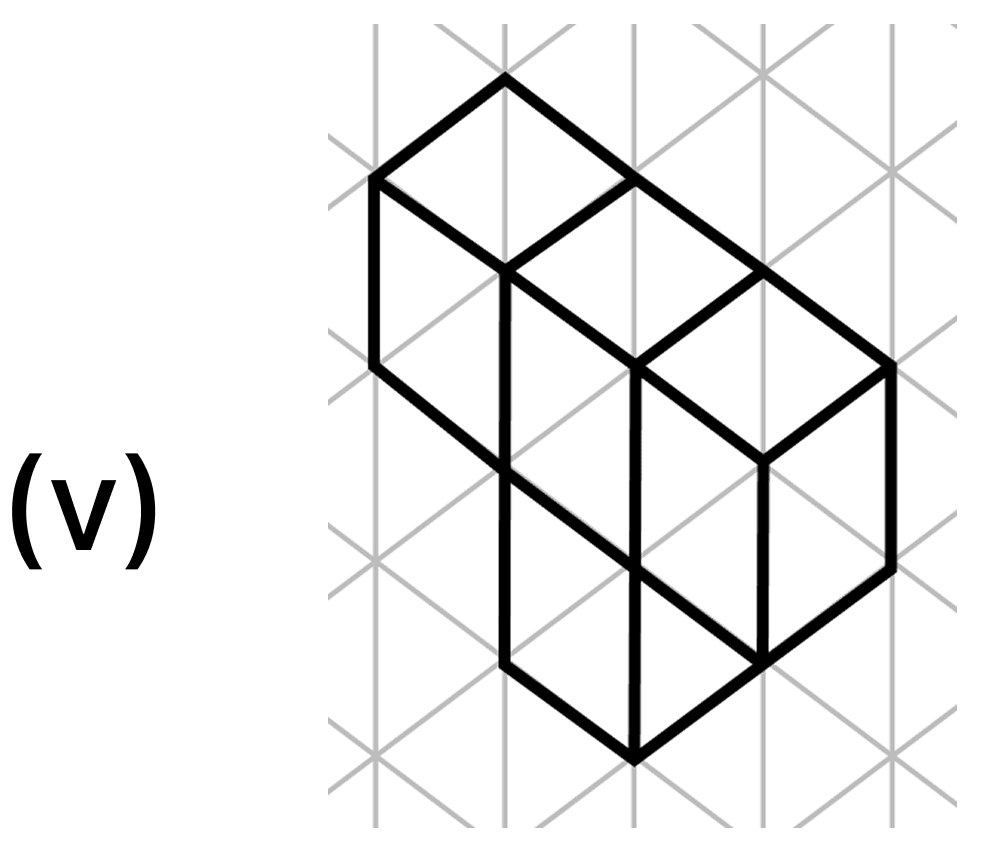
Imagine the five basic Tetris shapes are made of cubes, not squares. Draw each of these on your isometric paper.
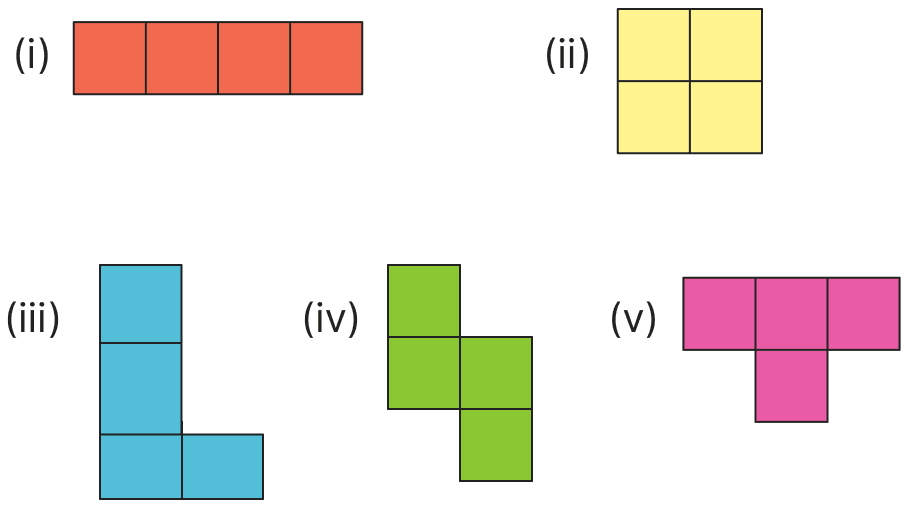
Answer
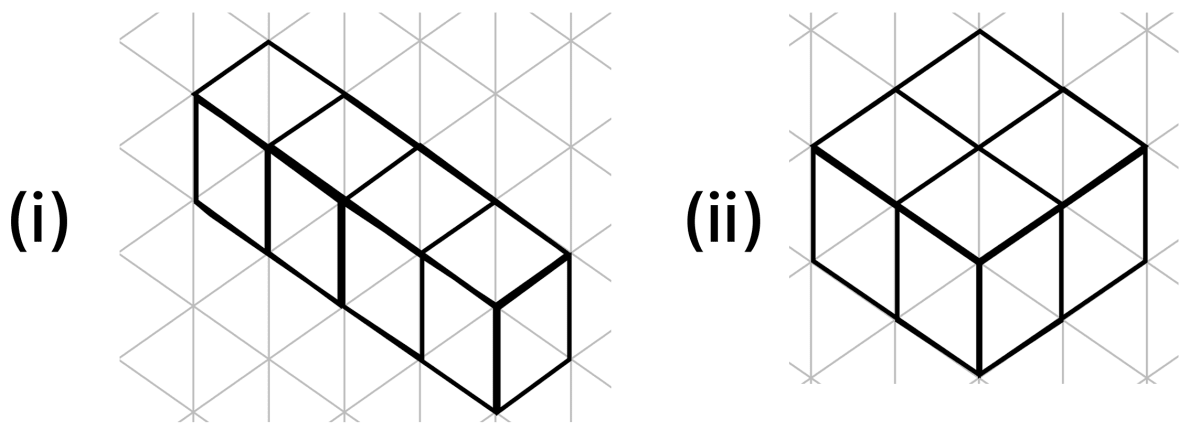
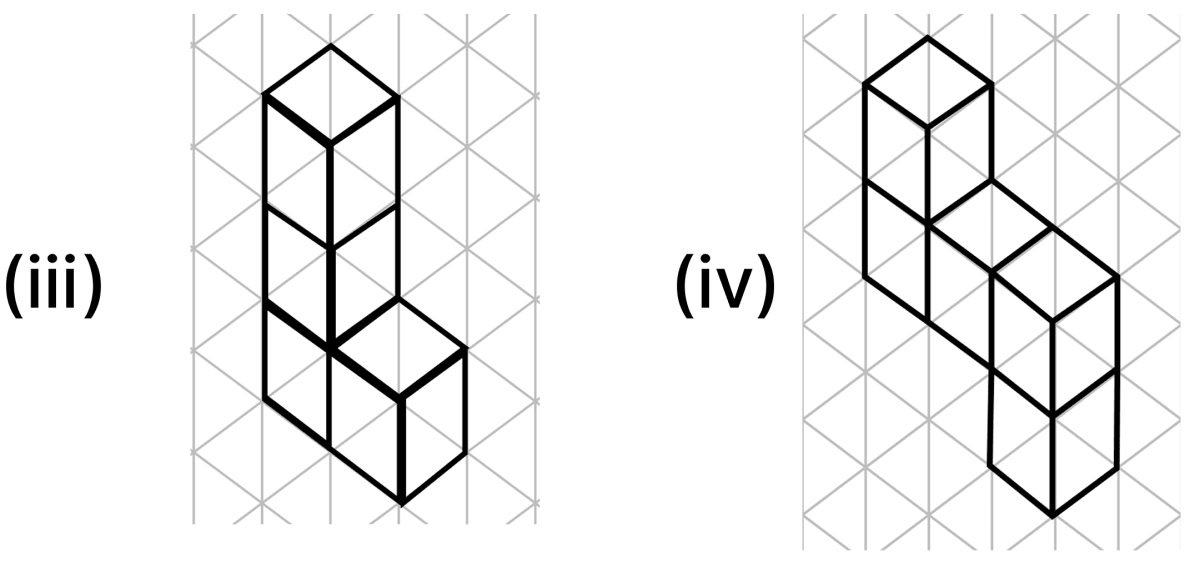
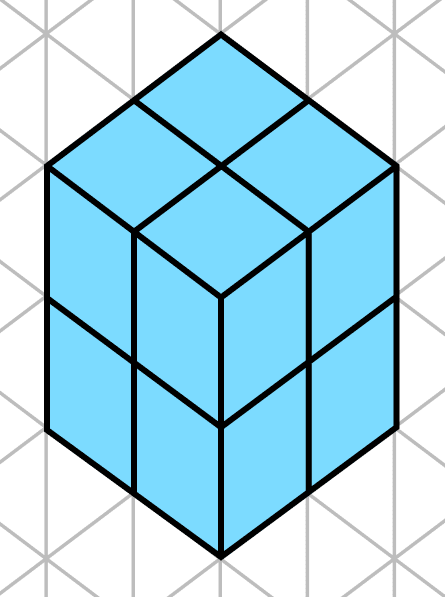
How would you draw a 2 × 2 × 2 cube on the isometric grid?
Answer
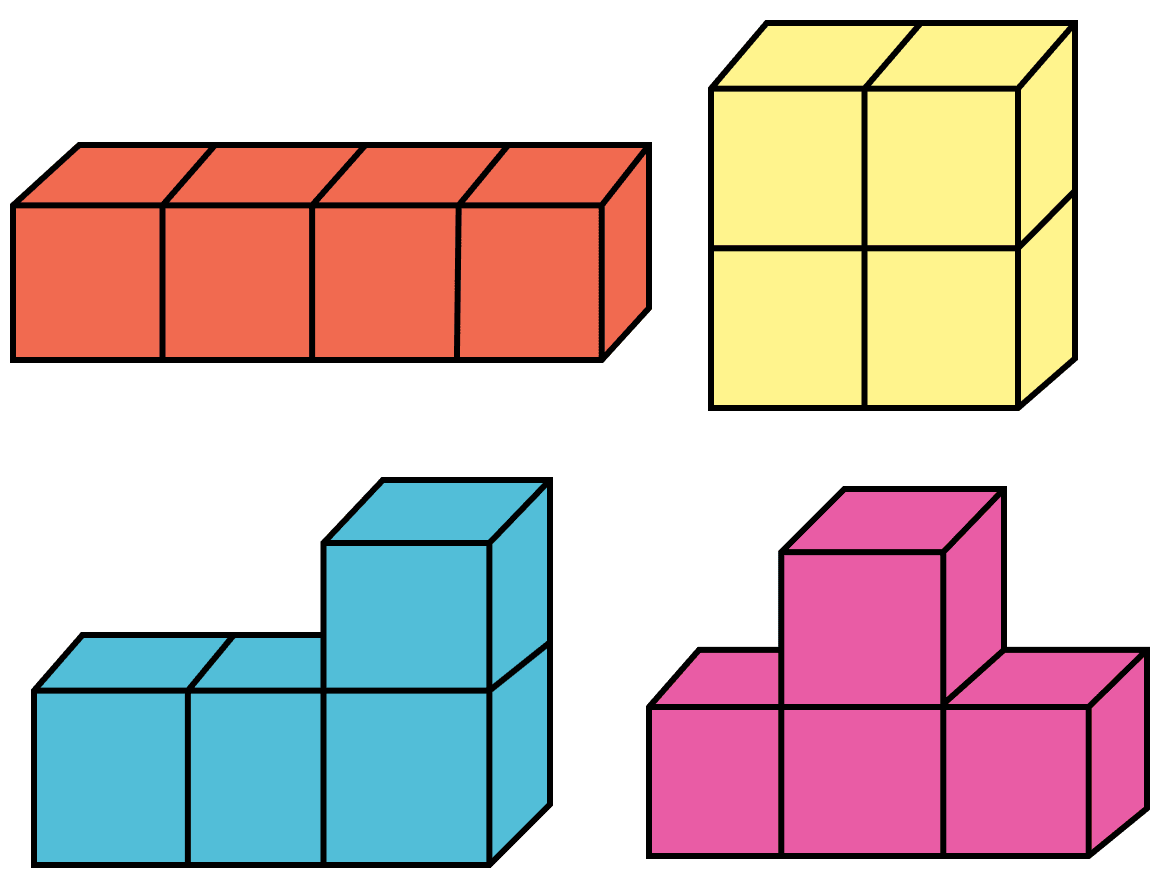
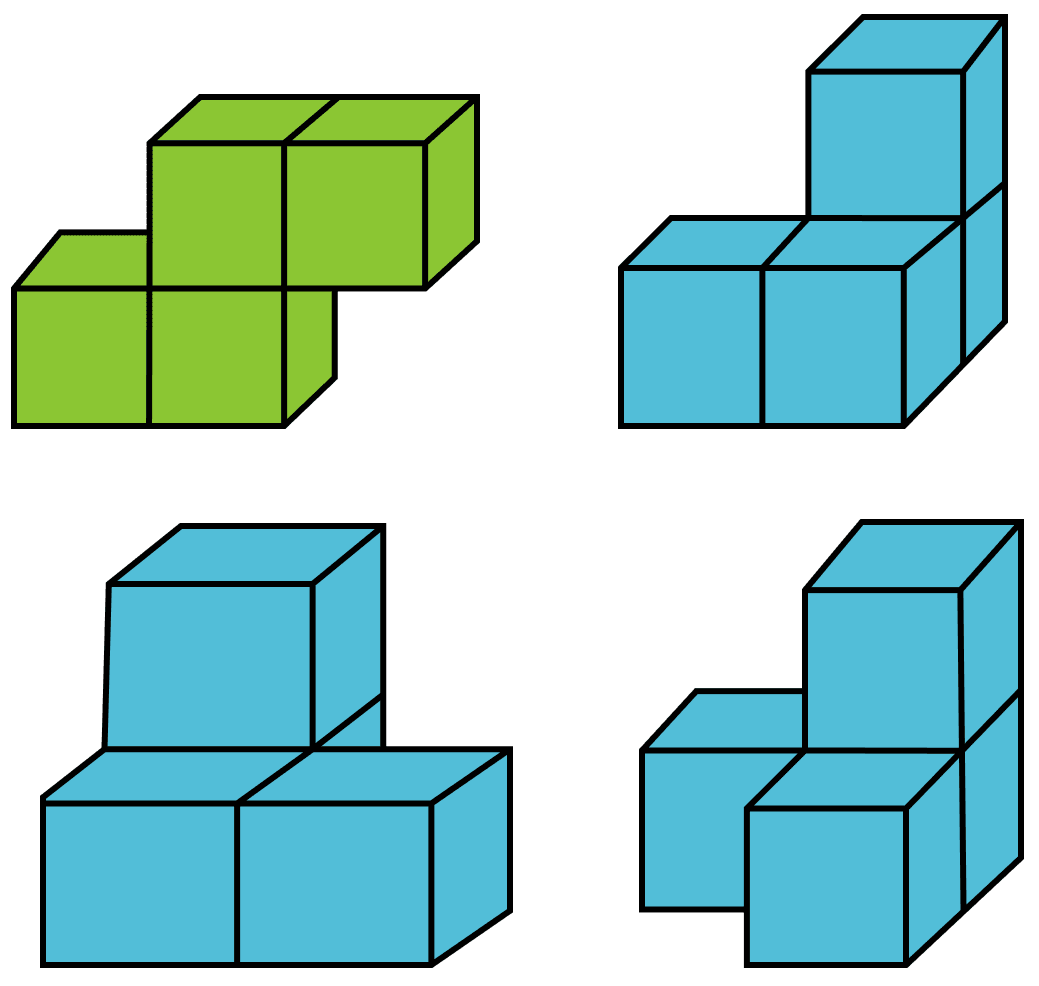
In addition to the 5 ways shown in Fig. 4.8, are there any additional ways of gluing four cubes together along faces? Can you visualise and draw these as well?
Answer
Draw the following figures on the isometric grid.
![Draw the following figures on the isometric grid. [Hint: It may be useful to determine whether the edge to be currently drawn — say, along the height — goes from down to up or up to down. Accordingly, draw the line segment on the grid either in the direction of the height axis or opposite to it.]. Exploring Some Geometric Themes, NCERT Class 8 Ganita Prakash Mathematics CBSE Solutions.](https://cdn1.knowledgeboat.com/img/ncert-8/q2-figure-out-6-1-ganita-prakash-2-cbse-class-8-c4-202608111858-777x273.png)
[Hint: It may be useful to determine whether the edge to be currently drawn — say, along the height — goes from down to up or up to down. Accordingly, draw the line segment on the grid either in the direction of the height axis or opposite to it.]
Answer
Figures on the isometric grid are shown below:
![Draw the following figures on the isometric grid. [Hint: It may be useful to determine whether the edge to be currently drawn — say, along the height — goes from down to up or up to down. Accordingly, draw the line segment on the grid either in the direction of the height axis or opposite to it.]. Area, NCERT Class 8 Ganita Prakash Mathematics CBSE Solutions.](https://cdn1.knowledgeboat.com/img/ncert-8/q2-figure-out-6-ans-1-ganita-prakash-2-cbse-class-8-c4-202608201159-523x739.png)
![Draw the following figures on the isometric grid. [Hint: It may be useful to determine whether the edge to be currently drawn — say, along the height — goes from down to up or up to down. Accordingly, draw the line segment on the grid either in the direction of the height axis or opposite to it.]. Area, NCERT Class 8 Ganita Prakash Mathematics CBSE Solutions.](https://cdn1.knowledgeboat.com/img/ncert-8/q2-figure-out-6-ans-2-ganita-prakash-2-cbse-class-8-c4-202608201159-539x691.png)
![Draw the following figures on the isometric grid. [Hint: It may be useful to determine whether the edge to be currently drawn — say, along the height — goes from down to up or up to down. Accordingly, draw the line segment on the grid either in the direction of the height axis or opposite to it.]. Exploring Some Geometric Themes, NCERT Class 8 Ganita Prakash Mathematics CBSE Solutions.](https://cdn1.knowledgeboat.com/img/ncert-8/q2-figure-out-6-ans-3-ganita-prakash-2-cbse-class-8-c4-202608111858-701x886.png)
Is there anything strange about the path of this ball? Recreate it on the isometric grid.
![Is there anything strange about the path of this ball? Recreate it on the isometric grid. [Hint: Consider a portion of this figure that is physically realisable and identify the 3 primary directions.]. Exploring Some Geometric Themes, NCERT Class 8 Ganita Prakash Mathematics CBSE Solutions.](https://cdn1.knowledgeboat.com/img/ncert-8/q3-figure-out-6-1-ganita-prakash-2-cbse-class-8-c4-202608111858-1004x876.png)
[Hint: Consider a portion of this figure that is physically realisable and identify the 3 primary directions.]
Answer
Yes, the path is strange — it is impossible.
The arrows show the ball rolling continuously downhill. However, if we follow the arrows around the loop, the ball eventually returns to its starting point.
A ball cannot keep moving downhill and yet come back to the same position. Therefore, the staircase shown cannot be a real object.
Each small part of the figure can be drawn and built using cubes, but when all the parts are joined together, they create an impossible staircase.
![Is there anything strange about the path of this ball? Recreate it on the isometric grid. [Hint: Consider a portion of this figure that is physically realisable and identify the 3 primary directions.]. Exploring Some Geometric Themes, NCERT Class 8 Ganita Prakash Mathematics CBSE Solutions.](https://cdn1.knowledgeboat.com/img/ncert-8/q3-figure-out-6-ans-1-ganita-prakash-2-cbse-class-8-c4-202608111921-869x915.png)
Hence, the ball's path is an optical illusion and cannot occur on a real staircase.
Observe this triangle.
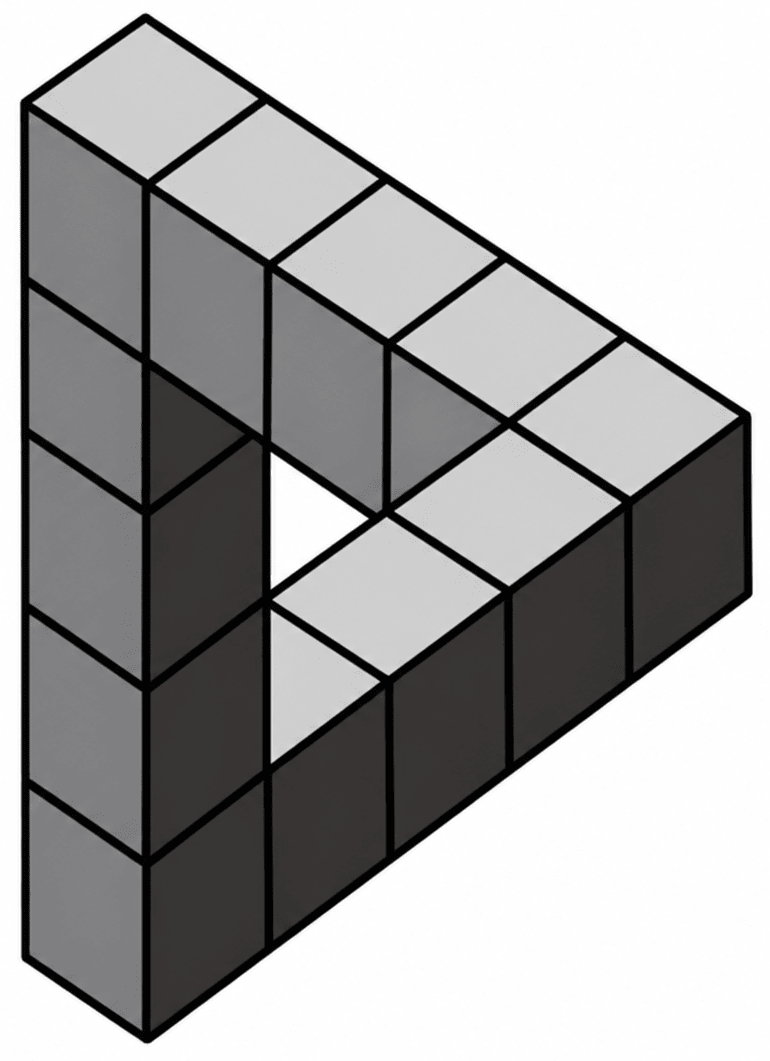
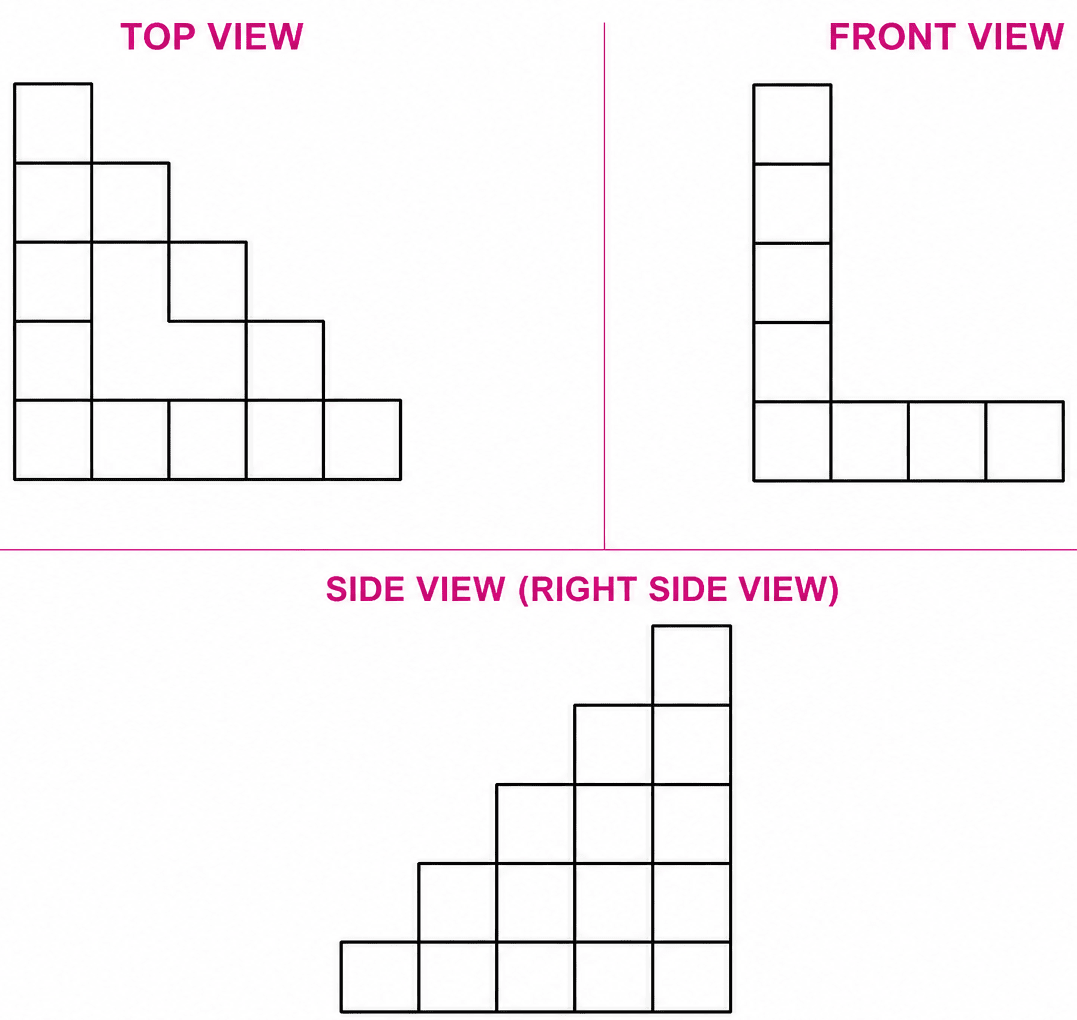
(i) Would it be possible to build a model out of actual cubes? What are the front, top, and side profiles of this impossible triangle?
(ii) Recreate this on an isometric grid.
(iii) Why does the illusion work?
Answer
(i) No. It is not possible to build a solid object made of cubes that forms a closed triangle exactly as shown. The figure is an impossible triangle (Penrose triangle).
However, it is possible to build a model consisting of three separate bars of cubes placed at different depths. When viewed from one special direction, the gaps are hidden and the model appears to be a closed triangle.
The front, top and side profiles depend on the particular realizable model chosen. In each view, some of the bars appear connected while others are separated.
(ii)
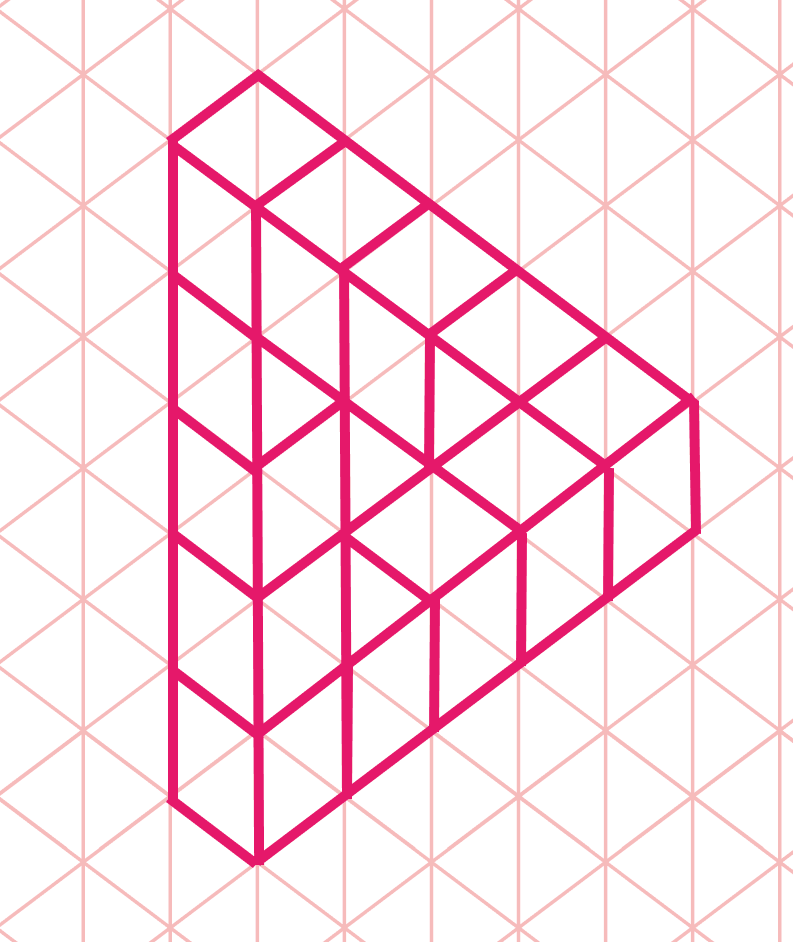
(iii) The illusion works because an isometric (parallel) projection does not show depth.
Parts of the figure that are actually at different distances from the viewer appear to lie in the same plane. The ends of the bars seem to meet, even though they are not connected in space.
Our brain interprets these apparent connections as a single closed triangular object, producing the illusion.
Hence, the impossible triangle appears to be a real solid even though no such solid can exist.