
Cortisol hormone is secreted by :
- Medulla of adrenal
- Cortex of adrenal
- Pancreas
- Thyroid
Answer
Cortex of adrenal
Reason — The adrenal cortex secretes cortisol, which helps regulate metabolism and the body's response to stress. The adrenal medulla secretes hormones like adrenaline and noradrenaline, not cortisol. The pancreas secretes hormones like insulin and glucagon, which regulate blood sugar levels. The thyroid gland secretes thyroxine, which controls metabolism.
Which one of the following hormones stimulates the breakdown of glycogen in the liver into glucose?
- Insulin
- Adrenaline
- Glucagon
- Thyroxine
Answer
Glucagon
Reason — Glucagon stimulates the breakdown of glycogen in the liver to glucose.
Insulin lowers blood glucose levels by converting glucose into glycogen (glycogenesis), not the other way round. Adrenaline can stimulate glycogen breakdown during emergencies, but it is not the primary hormone responsible for regulating this process in the liver. Thyroxine regulates overall metabolism, not specifically glycogen breakdown.
Which one of the following hormones converts excess of glucose into glycogen
- Glucagon
- Thyroxine
- Insulin
- Adrenaline
Answer
Insulin
Reason — Insulin converts extra glucose to glycogen which is ultimately stored in the liver and muscles.
Glucagon does the opposite, it converts glycogen into glucose, increasing blood sugar levels. Thyroxine regulates metabolism, not specifically glucose storage. Adrenaline promotes breakdown of glycogen into glucose during stress.
Which one of the following glands is also called the master gland :
- Pituitary gland
- Adrenal gland
- Thyroid gland
- Ovary
Answer
Pituitary gland
Reason — Pituitary gland regulates the activity of other endocrine glands. So, it is also called the "master gland".
The adrenal gland produces hormones like adrenaline and cortisol, but it does not control other glands. The thyroid gland regulates metabolism by secreting thyroxine, but it is itself controlled by the pituitary gland. The ovary produces reproductive hormones like estrogen and progesterone, but it is not a controlling gland.
The emergency hormone to face the danger or to fight is secreted by:
- Islets of Langerhans
- Adrenal cortex
- Pituitary
- Adrenal medulla
Answer
Adrenal medulla
Reason — Adrenaline hormone is also called the "fight or flight hormone". It is secreted by Adrenal medulla.
Islets of Langerhans secrete insulin and glucagon (blood sugar control). Adrenal cortex secretes cortisone and other hormones (long-term stress, metabolism). Pituitary controls other glands but does not produce the emergency hormone.
Which one of the following endocrine glands produces its hormone in large quantities as a result of emotional stimulation?
- Thyroid
- Islets of Langerhans
- Adrenal medulla
- Adrenal cortex
Answer
Adrenal medulla
Reason — Adrenal medulla secretes adrenaline (also called epinephrine or emergency hormone). This hormone is secreted when a person is under severe stress (physical or emotional).
Islets of Langerhans are part of the pancreas and secrete insulin and glucagon, which regulate blood sugar. The adrenal cortex secretes hormones like cortisone and aldosterone, related to metabolism and salt balance. The thyroid gland secretes thyroxine, which controls metabolic rate.
In humans, increased thyroxine production results in:
- Increased metabolism
- Decreased metabolism
- Dwarfism
- Cretinism
Answer
Increased metabolism
Reason — Oversecretion of thyroxine causes an increased metabolic rate.
Decreased metabolism happens when thyroxine levels are low, not high. Dwarfism is related to growth hormone deficiency, not excess thyroxine. Cretinism occurs due to deficiency of thyroxine in childhood, not excess.
Akash is suffering from a disease caused due to insufficient secretion of thyroxine. It shows general sluggishness with swelling on the face and hands. This disease is caused due to the deficiency of :
- Iron
- Iodine
- Calcium
- Phosphorus
Answer
Iodine
Reason — Myxoedema is a condition seen in an adult when an insufficient amount of thyroxine is produced. It shows general sluggishness with swelling on the face and hands. Insufficient secretion of thyroxine is commonly related to the deficiency of iodine.
Iron is important for haemoglobin, not thyroxine production. Calcium is important for bones and teeth. Phosphorus helps in energy transfer and bones.
Pituitary gland is considered as the 'master gland' of the body. Which of the following reasons supports this statement?
P. It is a pea-sized gland.
Q. It is the largest and strongest gland.
R. It regulates the activities of all other endocrine glands.
- Only P and R
- Only Q
- Only R
- Only P and Q
Answer
Only R
Reason — Pituitary gland is a pea-sized gland, located below the brain. However, it is called the 'master gland' due to the fact that it secretes several hormones, some of which regulate the activity of other endocrine glands.
Aman is in the state of mental or emotional strain which can be termed as 'stress'. In simple terms, people call it 'tension'. Which of the following ways can help Aman manage his stress?
P. Yoga and exercise.
Q. Uncontrolled eating and watching television.
R. Deep breathing and meditation
- Only P and Q
- Only Q and R
- Only Q
- Only P and R
Answer
Only P and R
Reason — Yoga, exercise, deep breathing and meditation are among the few methods that help manage stress or tension.
Assertion (A): The exocrine glands send their secretions (enzymes) to the target organs through ducts.
Reason (R): Such glands are called exocrine glands because their secretions act on the surface of organs.
- Both A and R are true and R is the correct explanation of A.
- Both A and R are true but R is not the correct explanation of A.
- A is true but R is false.
- A is false but R is true.
Answer
Both A and R are true and R is the correct explanation of A.
Explanation — A is true as exocrine glands send their secretions (enzymes) to the target organs through ducts.
R is true as these secretions usually act on the surface of organs, such as the skin or digestive tract.
Therefore, Both A and R are true and R is the correct explanation of A is the correct option.
Assertion (A): Thyroxine is the hormone which regulates basal metabolism of the body and speeds up the rate of most activities of the body.
Reason (R): Its undersecretion is harmful which can cause different types of ailments but its oversecretion is very important as it increases the metabolic rate of the body.
- Both A and R are true and R is the correct explanation of A.
- Both A and R are true but R is not the correct explanation of A.
- A is true but R is false.
- A is false but R is true.
Answer
A is true and R is false.
Explanation — A is true as thyroxine is an iodine-containing hormone and is very important for our body.
R is false as its oversecretion is harmful too as it can cause an increase in metabolic rate and heartbeat, weight loss, restlessness, and other issues.
Therefore, A is true and R is false is the correct option.
Assertion (A): The hormone epinephrine is secreted by the adrenal medulla when a person is under stress (physical or emotional), fearful or angry.
Reason (R): This hormone prepares the body to meet any emergency situation, i.e. to face the danger or flee from a situation.
- Both A and R are true and R is the correct explanation of A.
- Both A and R are true but R is not the correct explanation of A.
- A is true but R is false.
- A is false but R is true.
Answer
Both A and R are true and R is the correct explanation of A.
Explanation — A is true as adrenal Medulla secretes adrenaline or epinephrine hormone, when a person is under severe stress (physical or emotional), fearful or angry.
R is true as this hormone provides extra energy and strength to the body in any adverse (or emergency) situation.
Therefore, Both A and R are true and R is the correct explanation of A is the correct option.
Assertion (A): Oversecretion of insulin causes diabetes mellitus.
Reason (R): Insulin converts extra glucose to glycogen which is ultimately stored in the liver and muscles.
- Both A and R are true and R is the correct explanation of A.
- Both A and R are true but R is not the correct explanation of A.
- A is true but R is false.
- A is false but R is true.
Answer
A is false but R is true.
Explanation — A is false as insufficient secretion of insulin leads to an increase in the concentration of sugar (glucose) in the blood causing diabetes mellitus.
R is true as insulin promotes the conversion of extra glucose to glycogen which is ultimately stored in the liver and muscles.
Therefore, A is false but R is true is the correct option.
Match the items in Column A with those in Column B.
| Column A | Column B |
|---|---|
| Cretinism | Pituitary Gland |
| Diabetes Mellitus | Abnormal development of infant |
| Increased metabolic rate | Oversecretion of thyroxine |
| Simple goitre | Insufficient iodine in food |
| Growth hormone | Insufficient insulin in blood |
Answer
| Column A | Column B |
|---|---|
| Cretinism | Abnormal development of infant |
| Diabetes Mellitus | Insufficient insulin in blood |
| Increased metabolic rate | Oversecretion of thyroxine |
| Simple goitre | Insufficient iodine in food |
| Growth hormone | Pituitary gland |
Define Endocrine glands.
Answer
Endocrine glands are ductless glands that secrete hormones directly into the bloodstream.
Define Cretinism.
Answer
Cretinism is an ailment in infants caused by insufficient secretion of thyroxine. It results in abnormal physical and mental development.
Define Glucagon.
Answer
Glucagon is a hormone produced by the pancreas. It raises the blood sugar level by stimulating the breakdown of glycogen in the liver into glucose.
Define Adolescence.
Answer
The period of life when the body undergoes changes leading to reproductive maturity is called adolescence. It is the transitional phase of growth and development between childhood and adulthood.
Define Puberty.
Answer
Puberty is the period during which the reproductive systems of boys and girls mature and become capable of reproduction.
Define Hormone
Answer
A hormone is a chemical substance secreted by an endocrine gland, poured directly into the bloodstream, and acting on a target organ or cell.
Write the exact locations of the following :
(a) Thyroid gland
(b) Adrenal gland
(c) Pancreas
(d) Pituitary gland
(e) Adam's apple
Answer
(a) Thyroid gland — The thyroid gland is located on either side of the wind pipe, just below the larynx.
(b) Adrenal gland — The adrenal glands are located on top of each kidney like caps.
(c) Pancreas — The pancreas is located behind the stomach.
(d) Pituitary gland — The pituitary gland is located at the base of the brain, below the hypothalamus.
(e) Adam's apple — The Adam's apple is located in the protruding part of the throat.
In table given below, fill in the blanks by naming endocrine glands, the hormones they secrete, and the function they perform, in a normal person.
| S.No. | Name of the gland | Hormone produced | Function |
|---|---|---|---|
| 1. | Thyroid | ............... | ............... |
| 2. | ............... | Insulin | ............... |
| 3. | ............... | ............... | Prepares the body for action |
| 4. | ............... | Growth Hormone | ............... |
Answer
| S.No | Name of the gland | Hormone produced | Function |
|---|---|---|---|
| 1. | Thyroid | Thyroxine | Control of metabolic rate |
| 2. | Pancreas | Insulin | Regulation of sugar in blood. |
| 3. | Adrenal Medulla | Adrenaline | Prepares the body for action |
| 4. | Pituitary | Growth Hormone | Speeds up growth |
Name the source and the function of each of the following hormones:
| Hormone | Source | Function | |
|---|---|---|---|
| (a) | Glucagon | ............... | ............... |
| (b) | Thyroxine | ............... | ............... |
| (c) | Adrenaline | ............... | ............... |
| (d) | Insulin | ............... | ............... |
| (e) | Cortisone | ............... | ............... |
Answer
| Hormone | Source | Function | |
|---|---|---|---|
| (a) | Glucagon | Pancreas | Breakdown of glycogen to glucose. Raises sugar in the blood. |
| (b) | Thyroxine | Thyroid gland | Controls the metabolic rate. |
| (c) | Adrenaline | Adrenal Medulla | Prepares the body to face emergency situations. |
| (d) | Insulin | Pancreas | Regulates the amount of sugar in the blood |
| (e) | Cortisone | Adrenal cortex | Influences carbohydrate, fat and protein metabolism. Regulates the salt and water balance in the body. |
Distinguish between the following pair on the basis of the words indicated in the brackets.
Exocrine and Endocrine glands (secretion)
Answer
Difference between Exocrine and Endocrine glands on the basis of secretion:
| Characteristic | Exocrine glands | Endocrine glands |
|---|---|---|
| Secretion | Exocrine glands secrete their products like sweat, enzyme, mucus, sebum, saliva, milk, etc. into ducts. | Endocrine glands secrete their products, known as hormones, directly into the bloodstream. |
Distinguish between the following pair on the basis of the words indicated in the brackets.
Cretinism and Myxoedema (symptoms)
Answer
Difference between Cretinism and Myxoedema on the basis of symptoms:
| Characteristic | Cretinism | Myxoedema |
|---|---|---|
| Symptoms | Cretinism occurs in infants resulting in physical and mental retardation. | Myxoedema occurs in adults and is characterised by symptoms such as sluggishness with swelling on face and hands. |
Distinguish between the following pair on the basis of the words indicated in the brackets.
Insulin and Glucagon (function)
Answer
Difference between Insulin and Glucagon on the basis of function:
| Characteristic | Insulin | Glucagon |
|---|---|---|
| Function | Insulin lowers blood glucose levels by facilitating the uptake of glucose into cells and its conversion to glycogen in the liver and muscles. | Glucagon raises blood glucose levels by promoting the conversion of glycogen back to glucose in the liver and muscles. |
Distinguish between the following pair on the basis of the words indicated in the brackets.
Thyroxine and adrenaline (source)
Answer
Difference between Thyroxine and Adrenaline on the basis of source:
| Characteristic | Thyroxine | Adrenaline |
|---|---|---|
| Source | Thyroxine is produced by the thyroid gland. | Adrenaline is produced by the adrenal medulla. |
Distinguish between the following pair on the basis of the words indicated in the brackets.
Human male and female hormone (one example of each)
Answer
Difference between Human male and female hormone on the basis of one example of each:
| Characteristic | Human male hormone | Human female hormone |
|---|---|---|
| One example | A common male hormone is testosterone. | An example of a female hormone is oestrogen. |
Give reason/explain — Pituitary gland is considered as the "master gland".
Answer
Pituitary gland secretes some hormones that regulate the activity of other endocrine glands. So, the pituitary gland is also called the "master gland".
Give reason/explain — Epinephrine is also called as the 'emergency hormone'.
Answer
Epinephrine (also called adrenaline) is released by the adrenal medulla in response to stress. This hormone prepares the body to meet any emergency situation i.e., to face the danger or flee from a situation. Hence it is called the 'fight or flight' hormone or the 'emergency hormone'.
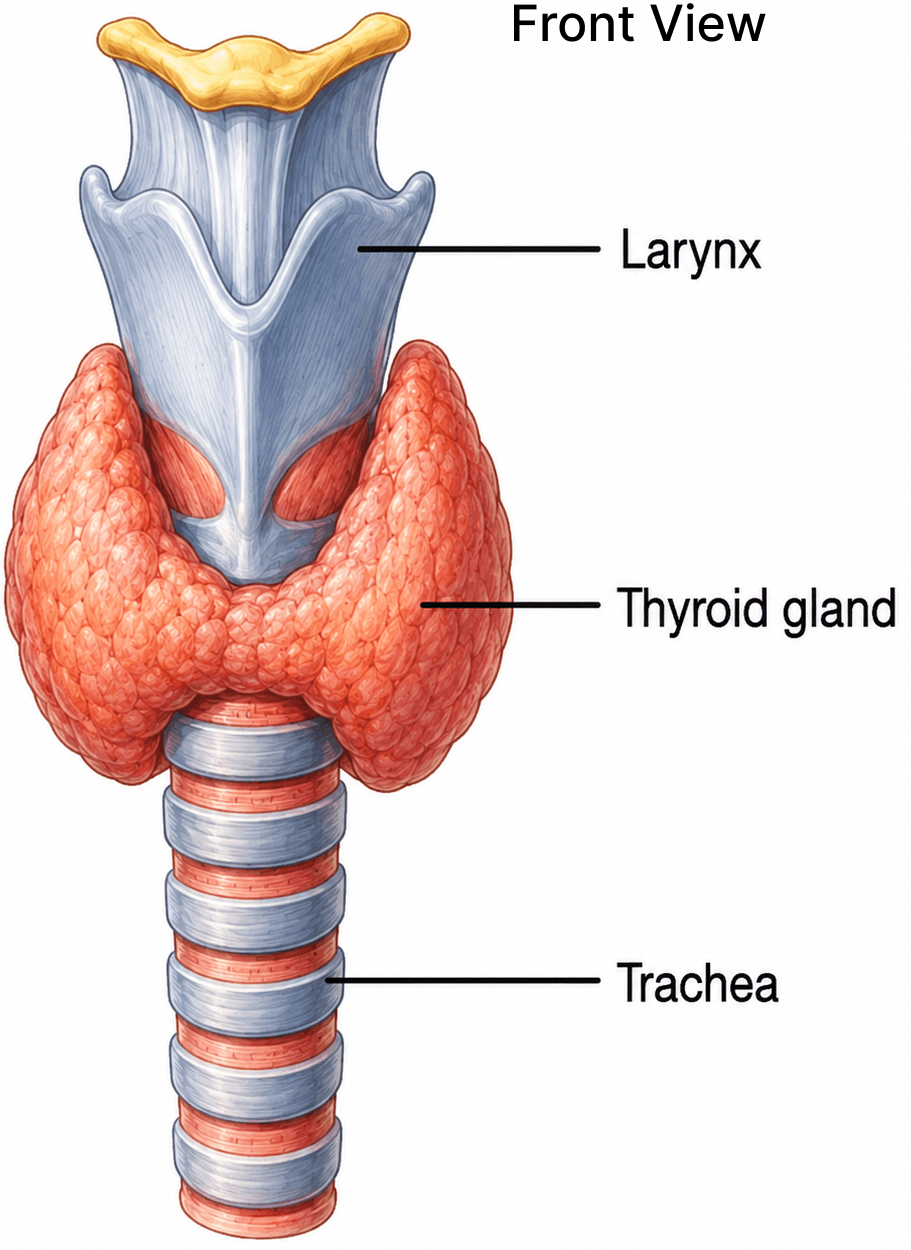
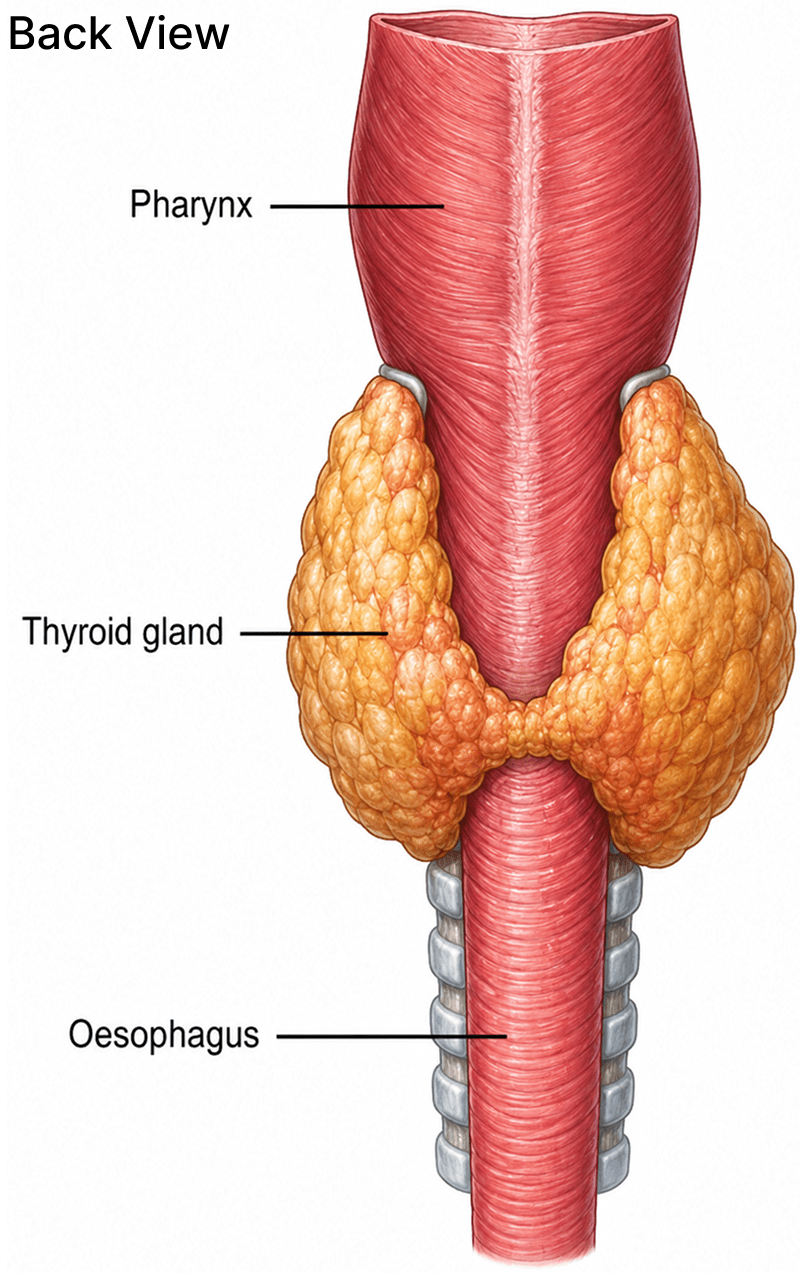
Draw neat and labelled diagrams of the thyroid gland showing its :
(a) Front view
(b) Back view
Answer
(a) Below labelled diagram shows the front view of the thyroid gland:
(b) Below labelled diagram shows the back view of the thyroid gland:
Briefly write about the importance of physical hygiene during adolescence.
Answer
Physical hygiene plays a very important role in maintaining one's own health during adolescence. Following are some important practices for maintaining physical hygiene:
- Proper and safe food:
- To support rapid growth and development during adolescence, an adolescent should take a balanced diet including proteins, carbohydrates, fats, minerals, and vitamins. Milk, fruits and fresh vegetables should be part of the regular diet.
- Avoid stale food and excessive fast food.
- Perishable food items should be properly stored in refrigerator.
- Proper lifestyle:
- Avoid long hours of continuous table work.
- Avoid watching television and playing computer games for long hours.
- Avoid smoking and consumption of alcohol and drugs.
- Cleanliness:
- Washing hands with soap before and after meals, brushing teeth, taking regular bath, regular toilet habits should be followed.
- Clothes, especially undergarments should be changed daily. Wearing very tight clothes should be avoided.
- Eyes should be washed daily with clean and cold water. Rubbing of eyes with hands should be avoided to prevent entry of germs.
- Lack of cleanliness may lead to bacterial infection. Girls should take special care of cleanliness during the time of their menstrual cycle.
- Physical Exercise:
- All young boys and girls should walk, exercise and play outdoor games regularly.
- Physical activity is important to combat the stress and strain of adolescence.
Briefly discuss any four activities which can be practised to overcome stress.
Answer
Four activities which can be practised to overcome stress are:
- Yoga — Yoga is a mind-body practice that combines physical poses, controlled breathing and meditation or relaxation. It helps to reduce stress with:
- Increased flexibility.
- Increased muscle strength and tone.
- Improved respiration, energy and vitality.
- Weight reduction.
- Improved athletic performance.
- Exercise — Just 30 to 45 minutes of exercise at least three times a week can make one feel much healthier. Regular exercise can be done by running/jogging, swimming, cricket, football, hockey, etc.
- Proper sleep schedule — Sound and timely sleep helps one to reduce the level of stress.
- Reading — It is a great way to calm the mind and to gain knowledge.
Sanjeev, a class 8 student, has noticed that his father has become unusually quiet and irritable. He often returns from work complaining of headache. His eating habits and sleep patterns have also worsened. His family simply says he has "tension" but the doctor said that constant work stress may be overstimulating his adrenal glands. Based on this information, answer the questions that follow:
(a) Name the 'fight or flight' hormone released by the adrenal glands during stress.
(b) Which of the following is not a typical effect of the 'fight or flight'hormone on the body?
(i) Increased heartbeat
(ii) Increased rate of respiration
(iii) Release of more glucose into the blood
(iv) Decreased blood supply to the muscles.
(c) Prolonged stress can also increase the level of cortisol in the blood. From which part of the adrenal gland is cortisol released?
(d) Mention any two ways by which stress can be easily managed at home.
Answer
(a) The 'fight or flight' hormone released by the adrenal glands during stress is adrenaline or epinephrine. It is secreted by the adrenal medulla.
(b) Decreased blood supply to the muscles is not a typical effect of the 'fight or flight hormone' on the body because adrenaline actually increases blood flow to muscles to prepare for action.
Increased heartbeat helps pump more blood quickly. Increased rate of respiration supplies more oxygen. Release of more glucose into the blood provides instant energy.
(c) Cortisol is released from the adrenal cortex.
(d) Stress can be managed at home by:
- Practising yoga or meditation.
- Doing regular exercise, deep breathing, or following a proper sleep schedule.