
The term "ecosystem" is derived from the Greek word "Oikos" meaning :
- Body weight
- Food
- House
- Size
Answer
House
Reason — The term ecosystem comes from the Greek word “Oikos”, which means “house” or “home”. It refers to the natural home or environment where living organisms interact with each other and their surroundings.
Body weight is not related to the origin of the word. Food is not the meaning of “Oikos”. Size is unrelated.
Rat in any food chain would occupy the position of :
- Tertiary consumer
- Secondary consumer
- Primary consumer
- Producer
Answer
Primary consumer
Reason — A rat usually feeds on plants, grains, and seeds, so it acts as a herbivore in most food chains. Rat is the primary consumer in the food chain. Rat is eaten by snake which is a secondary consumer of the food chain or ecosystem.
Producers are plants (make their own food). Primary consumers are herbivores. Secondary/Tertiary consumers are carnivores.
Evergreen broad-leaved trees are characteristic of :
- Tropical rain forests
- Temperate deciduous forests
- Coniferous forests
- All of the above types of forests
Answer
Tropical rain forests
Reason — Evergreen broad-leaved trees are typical of tropical rain forests. These forests grow in regions where year-round rainfall is high and steady and frost is rare. Evergreen trees have broad leaves to permit transpiration of surplus moisture.
Temperate deciduous forests are trees that shed leaves in a particular season. Coniferous forests are trees which have needle-like leaves, not broad leaves.
The number of steps in a food chain can never be more than :
- Four
- Five
- Six
- Seven
Answer
Five
Reason — At each level, a large amount of energy is lost as heat (only about 10% energy is transferred to the next level). After a few steps, there is not enough energy left to support another level. Therefore, food chains generally do not exceed five steps.
Sameer while studying the topic of 'Interdependence between organisms' found that some organisms live together and benefit each other. Which of the following is a suitable example of such a relationship ?
- Algae
- Bacteria
- Fungi
- Lichen
Answer
Lichen
Reason — A lichen is a perfect example of a symbiotic relationship (two organisms living together and benefiting each other). Algae makes food by photosynthesis. Fungi provides shelter, protection, and absorbs water.
Algae, Bacteria, Fungi are individual organisms, not necessarily living in a mutually beneficial partnership in this context.
Predators are the animals who chase other animals, kill them and feed on their flesh. Which of the following statements supports this given explanation ?
P. They are carnivores.
Q. They belong to trophic level-2 of the food chain.
R. They are also considered as decomposers.
- Only P
- Only Q and R
- Only P and Q
- Only P and R
Answer
Only P
Reason — Predators are carnivores. Predators eat other animals, so they are carnivores.
Trophic level-2 is for primary consumers (herbivores). Decomposers (like bacteria and fungi) break down dead matter. Predators hunt and kill, so they are not decomposers.
Latika has prepared a food web which is a network of interconnected food chains. Which of the following are involved in a food web ?
(i) Producers
(ii) Sunlight
(iii) Herbivores
(iv) Secondary consumers
- Only 2 and 3
- Only 1, 2 and 3
- Only 1, 3 and 4
- Only 1 and 3
Answer
Only 1, 3 and 4
Reason — A food web is a network of interconnected food chains and includes different living components of an ecosystem. Producers form the first trophic level. Herbivores are primary consumers that feed on producers. Secondary consumers feed on herbivores. Sunlight is the primary source of energy for producers, but it is not itself a living component of a food web.
Assertion (A): All plant eating animals are considered as primary producers.
Reason (R): Producers are the first step of the food chain which can supply food to the next trophic level.
- Both A and R are true and R is the correct explanation of A.
- Both A and R are true but R is not the correct explanation of A.
- A is true but R is false.
- A is false but R is true.
Answer
A is false but R is true.
Reason — A is false as all plant-eating animals are called herbivores, not primary producers. Primary producers are plants and algae, which make their own food.
R is true as producers are indeed the first trophic level in a food chain and provide food for all other organisms.
Therefore, A is false but R is true is the correct option.
Assertion (A): An ecosystem consists of two categories of components - Biotic and Abiotic which are interdependent on each other.
Reason (R): Biotic components are dependent on abiotic components but never on other biotic components.
- Both A and R are true and R is the correct explanation of A.
- Both A and R are true but R is not the correct explanation of A.
- A is true but R is false.
- A is false but R is true.
Answer
A is true but R is false.
Reason — A is true as an ecosystem indeed has two components: biotic and abiotic. Both are interdependent, meaning they depend on and affect each other for survival and functioning.
R is false as biotic components depend not only on abiotic factors, but also on other biotic components.
Therefore, A is true but R is false is the correct option.
Assertion (A): Symbiosis, parasitism and predation are the categories of interdependence between organisms, which are the ways of transferring energy.
Reason (R): The transfer of energy from one trophic level to the other always occurs through the food chain.
- Both A and R are true and R is the correct explanation of A.
- Both A and R are true but R is not the correct explanation of A.
- A is true but R is false.
- A is false but R is true.
Answer
A is false but R is true.
Reason — A is false as symbiosis, parasitism, and predation are types of interactions (interdependence) between organisms. However, they are not all ways of energy transfer between trophic levels. Energy transfer mainly happens through feeding relationships in food chains, not all forms of symbiosis (e.g., mutualism in lichens is not simply a trophic energy transfer step in a chain).
R is true as energy transfer from one trophic level to another occurs through food chains and interconnected food chains forming a food web.
Therefore, A is false but R is true is the correct option.
Assertion (A): Flora and fauna of forests differ throughout the world.
Reason (R): Different regions of the world have different climatic conditions, so only those plants and animals that are adapted to those conditions can survive there.
- Both A and R are true and R is the correct explanation of A.
- Both A and R are true but R is not the correct explanation of A.
- A is true but R is false.
- A is false but R is true.
Answer
Both A and R are true and R is the correct explanation of A.
Reason — A is true as the flora (plants) and fauna (animals) of forests vary in different parts of the world because environmental conditions are not the same everywhere. The climatic conditions significantly affect the type of plants and animals that can survive in a forest. R is true as different regions have different climates (temperature, rainfall, humidity, etc.), and only organisms that are adapted to those conditions can survive there.
Therefore, Both A and R are true and R is the correct explanation of A is the correct option.
Assertion (A): Scavengers are considered as cleaners of the earth as they feed on dead animal and plant remains.
Reason (R): Scavengers consume the remains left by detritivores and decomposers.
- Both A and R are true and R is the correct explanation of A.
- Both A and R are true but R is not the correct explanation of A.
- A is true but R is false.
- A is false but R is true.
Answer
A is true but R is false.
Reason — A is true as scavengers are called “cleaners of the environment” because they feed on dead animals (and sometimes plant remains). Examples include vultures and hyenas.
R is false as scavengers do not consume remains left by detritivores and decomposers. Scavengers eat dead organisms directly. Detritivores (like earthworms) and decomposers (like bacteria, fungi) act on dead matter after scavengers or alongside them.
Therefore, A is true but R is false is the correct option.
Fill in the blanks :
- Lichens are the good example of ............... association.
- Two intermediate hosts of liver fluke are ............... and ............... .
- Evergreen trees are common flora of ............... forests.
- ............... will always be trophic level-1 in a food chain.
- ............... sanctuary is found in West Bengal which is famous for rhinoceros.
Answer
- Lichens are the good example of symbiotic association.
- Two intermediate hosts of liver fluke are snail and fish .
- Evergreen trees are common flora of tropical rain forests.
- Producers will always be trophic level-1 in a food chain.
- Jaldapara Wildlife sanctuary is found in West Bengal which is famous for rhinoceros.
Mention if the following statements are true (T) or false (F):
- Snakes are primary consumers.
- Some humans are strictly primary consumers while others are secondary or tertiary consumers as well.
- No ecosystem can survive without light.
Answer
False
Corrected statement - Snakes are carnivores, usually secondary or tertiary consumers, not primary consumers.True
True
| Column A | Column B |
|---|---|
| (a) Grass | (i) Carnivore |
| (b) Deer | (ii) Decomposers |
| (c) Cobra | (iii) Primary consumer |
| (d) Vulture | (iv) Autotroph |
| (e) Microbes | (v) Scavenger |
Answer
| Column A | Column B |
|---|---|
| (a) Grass | (iv) Autotroph |
| (b) Deer | (iii) Primary consumer |
| (c) Cobra | (i) Carnivore |
| (d) Vulture | (v) Scavenger |
| (e) Microbes | (ii) Decomposers |
Rewrite the following in their correct sequence in a food chain :
(a) Snake → Grasshopper → Grass → Frog
(b) Grass → Tiger → Deer
(c) Snake → Peacock → Rat → Wheat
(d) Lizard → Grass → Crow → Grasshopper
(e) Goat → Man → Maize
Answer
(a) Grass → Grasshopper → Frog → Snake
(b) Grass → Deer → Tiger
(c) Wheat → Rat → Snake → Peacock
(d) Grass → Grasshopper → Lizard → Crow
(e) Maize → Goat → Man
Choose the odd one out and write the category of the remaining terms :
(a) Bacteria, Fungi, Vulture, Protists
(b) Air, Water, Plants, Temperature
(c) Rice, Grass, Grasshopper, Maize
(d) Deer, Rabbits, Tigers, Rats
(e) Plasmodium, Tiger, Liver fluke, Tapeworm
Answer
(a) Vulture
Reason — Vulture is a scavenger, not a microorganism. Bacteria, fungi and protists are mostly microscopic organisms. Therefore, the category of the remaining terms is microorganisms.
(b) Plants
Reason — Plants are living organisms. Air, water and temperature are non-living physical factors needed for life. Therefore, the category of the remaining terms is abiotic components.
(c) Grasshopper
Reason — Grasshopper is an insect and a consumer that eats plants. Rice, grass and maize are green plants. Therefore, the category of the remaining terms is producers.
(d) Tiger
Reason — Tiger is a carnivore that eats other animals. Deer, rabbits and rats mostly eat plants, so they are herbivores. Therefore, the category of the remaining terms is herbivores/primary consumers.
(e) Tiger
Reason — Tiger is a predator, not a parasite. Plasmodium, liver fluke and tapeworm are parasites. Therefore, the category of the remaining terms is parasites.
Given below is a box containing some words/phrases. Out of these, ten can be used to make five suitable pairs. Choose and make 5 such pairs.
Oikos, Food, Grasshopper, Troph, Tertiary consumer, Producers, House, Green plants, Evergreen trees, Gir forests, Ecosystem, Man, Lion.
Answer
Five pairs :
- Oikos – House
“Oikos” is a Greek word meaning house or home.
- Food – Troph
“Troph” relates to feeding or nourishment.
- Grasshopper – Primary consumer
Grasshopper is a consumer (feeds on plants).
- Producers – Green plants
Green plants are called producers because they make food.
- Tertiary consumer – Lion
Lion is a top carnivore, so it is a tertiary consumer.
Name 3 categories of organisms that feed on dead materials.
Answer
3 categories of organisms that feed on dead materials are :
- Decomposers
- Detritivores
- Scavengers
Name 5 abiotic components of the ecosystem.
Answer
5 abiotic components of the ecosystem are :
- Air
- Water
- Soil
- Sunlight
- Temperature
Name 4 kinds of the ecosystem.
Answer
4 kinds of the ecosystem are :
- Forest ecosystem
- Desert ecosystem
- Aquatic ecosystem
- Grassland ecosystem
Name 3 categories of interdependence between the organisms.
Answer
3 categories of interdependence between the organisms are :
- Predation
- Parasitism
- Symbiosis
Name 3 categories of consumers.
Answer
3 categories of consumers are :
- Herbivores
- Carnivores
- Omnivores
Give two examples of producers.
Answer
Two examples of producers are :
- Green plants
- Algae
Give two examples of herbivores.
Answer
Two examples of herbivores are :
- Cow
- Deer
Give two examples of carnivores.
Answer
Two examples of carnivores are :
- Lion
- Tiger
Give two examples of predators.
Answer
Two examples of predators are :
- Lion
- Hawk
Give two examples of parasites.
Answer
Two examples of parasites are :
- Tapeworm
- Plasmodium
Give two examples of scavengers.
Answer
Two examples of scavengers are :
- Vulture
- Hyena
Define ecosystem.
Answer
An ecosystem is a self-contained area composed of all the different organisms living in it, interacting with each other, as well as interacting with the physical conditions i.e., sunlight, air, water, soil, climatic factors, etc. prevailing in the area.
Define autotrophs.
Answer
Autotrophs are organisms that produce their own food through photosynthesis using simple substances like Carbon dioxide and Water in the presence of Sunlight. They come at the beginning of the food chain.
Define heterotrophs.
Answer
Heterotrophs are organisms that cannot make their own food and depend on plants and other organisms for food.
Define food chain.
Answer
Food chain is the linear sequence of organisms in which each organism eats the lower member and is itself eaten by the next higher member.
Define food web.
Answer
A food web is a network of interconnected food chains showing feeding relationships in an ecosystem.
Define consumers.
Answer
The organisms that cannot make their own food but consume either plants or animals are called consumers.
Define symbiosis.
Answer
Symbiosis is a relationship or interaction in which both interacting species are benefited.
Differentiate between flora and fauna.
Answer
| Flora | Fauna |
|---|---|
| Flora means the plants naturally occurring in a particular area. | Fauna means the animals naturally living in a particular area. |
| Flora is the naturally grown greenery of a region. | Fauna includes all types of organisms from tiny bacteria to giant animals. |
| Most members of flora can make their own food by photosynthesis. | Fauna cannot make their own food; they depend directly or indirectly on plants for food. |
| Some examples of flora: mosses, herbs, shrubs and trees etc. | Some examples of fauna: birds, animals, fish, insects, etc. |
Differentiate between primary consumer and secondary consumer.
Answer
| Primary consumer | Secondary consumer |
|---|---|
| They feed directly on producers | They feed on primary consumers |
| They are herbivores | They are carnivores or omnivores |
Differentiate between parasitism and predation.
Answer
| Parasitism | Predation |
|---|---|
| One organism lives on/in another and harms it | One organism kills and eats another |
| Parasite benefits, host is harmed | Predator benefits, prey is killed |
Differentiate between biotic and abiotic components.
Answer
| Biotic component | Abiotic component |
|---|---|
| They are living components of an ecosystem. | They are non-living components of an ecosystem. |
| They depend upon abiotic components in various ways. | They provide physical conditions and resources needed by biotic components. |
| They include plants, animals and microbes. | They include air, water, soil and sunlight. |
Differentiate between scavengers and detritivores.
Answer
| Scavengers | Detritivores |
|---|---|
| They feed on dead animals and sometimes plant remains. | They feed on dead and decaying organic matter. |
| They feed directly on dead organisms. | They break down and digest organic matter inside their body. |
| They are usually larger animals. | They are usually smaller organisms. |
Differentiate among primary, secondary and tertiary consumers. Give one example of each in a food chain.
Answer
| Properties | Primary consumer | Secondary consumer | Tertiary consumer |
|---|---|---|---|
| What they eat | Producers | Primary consumers | Secondary consumers |
| Trophic level | 2nd trophic level | 3rd trophic level | 4th trophic level |
| Role in food chain | Herbivores that feed directly on plants | Carnivores/omnivores that eat herbivores | Top carnivores that eat secondary consumers |
| Examples | Grasshopper eating grass | Frog eating Grasshopper | Snake eating Frog. |
List any three members each of the flora and fauna of tropical rain forests.
Answer
Three members of flora are :
- Evergreen trees
- Bamboo
- Ferns
Three members of fauna are :
- Monkey
- Leopard
- Flying squirrel
Food web is important to maintain an ecosystem.
Answer
Food web illustrates the complex relationships between different species and how they are interdependent on each other for survival. Food webs show the flow of energy and matter, highlighting the importance of each organism in the ecosystem. They help maintain the natural balance of habitats, which is essential for the sustainability of animal and plant life. The complex food web imparts that in case of sudden change in population of a species, the food chain will not collapse at once and the stability of ecosystem will be maintained.
The existence of plant life is integral to the continuity and development of most ecosystems.
Answer
The existence of plant life is integral to the continuity and development of most ecosystems because plants are the primary producers in an ecosystem. Plants convert solar energy into chemical energy, which is passed to all organisms through food chains. Plants release oxygen during photosynthesis, which is essential for respiration of all living organisms. Plants provide habitat and shelter.
Draw the pyramid of numbers with a suitable example.
Answer
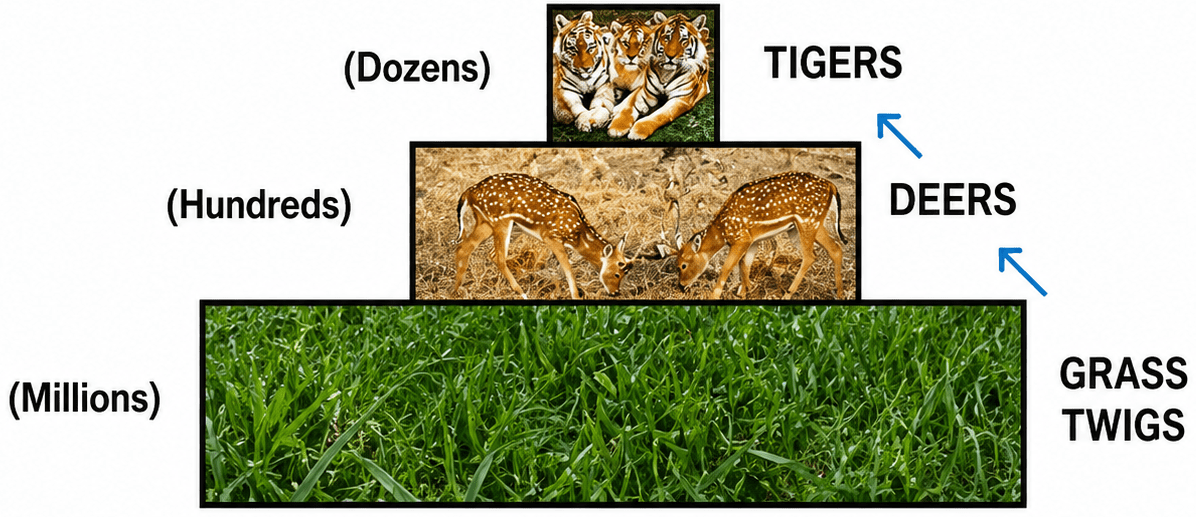
Draw the pyramid of biomass with a suitable example.
Answer
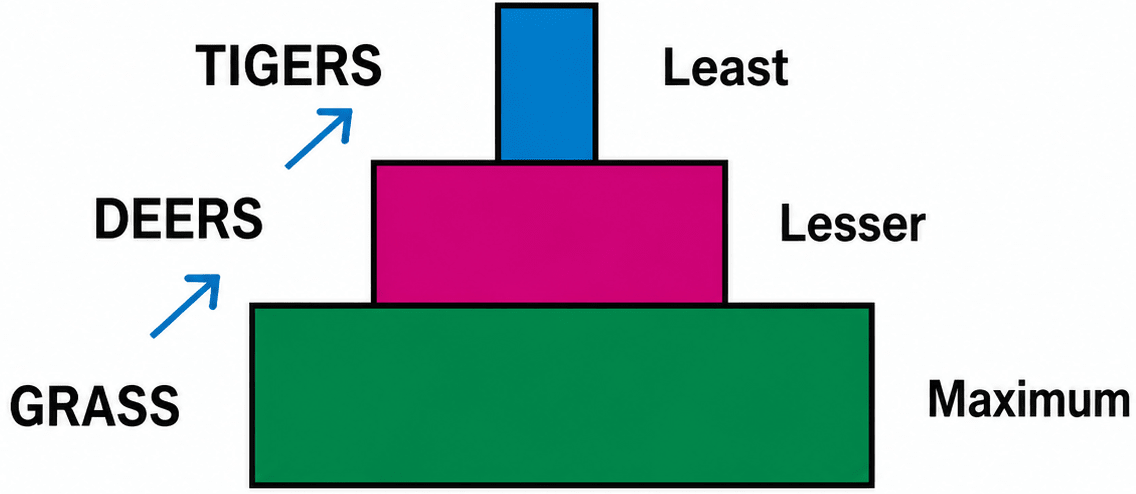
A river ecosystem is one where living organisms interact with each other and with the physical environment of flowing water. The Yamuna River in Delhi supports a variety of plants, fish, insects, birds and microorganisms. People also depend on it for water, recreation and cultural reasons. But over the years,pollution and encroachment have become major threats to this ecosystem.
To bring the river back to life, the Delhi government has launched a 'Yamuna Rejuvenation Plan'. Under this plan, the government has allocated large funds to build many small sewage treatment plants so that the waste water from homes is treated before reaching the river. The plan also includes reducing pollution by intercepting major drains and the government is even buying special dredging machines to clean up waste and silt in the river.
On the tourism side, there is a proposal to run eco-friendly cruises on the Yamuna. The boats would be solar- or battery-powered. Some people welcome this as a way to bring attention and care to the river. Others worry that tourism should only start after the river is fully cleaned.
(a) Name two abiotic and two biotic components of the Yamuna river ecosystem.
(b) Name two producers and two consumers in this river ecosystem.
(c) Write a simple food chain that is possible in this river ecosystem.
(d) As a student, what small actions can you take to prevent pollution and protect the Yamuna River?
Answer
(a) Two abiotic components of the Yamuna river ecosystem are :
- Water
- Dissolved oxygen
Two biotic components of the Yamuna river ecosystem are :
- Fish
- Microorganisms
(b) Two producers in this river ecosystem are :
- Algae
- Aquatic plants
Two consumers in this river ecosystem are :
- Fish
- Birds
(c) A simple food chain in this ecosystem is :
Aquatic plants → Insects → Fish → Birds
(d) Small actions to prevent pollution and protect the Yamuna River are :
- Do not throw garbage, plastics, or chemicals into drains or rivers.
- Reduce use of plastic and promote recycling.
- Use water carefully and avoid wastage.
- Participate in cleanliness drives near water bodies.
- Create awareness among others about keeping rivers clean.