
Read the two statements given below about the impact of Industrial Revolution. Select the option that shows the correct relationship between (A) and (R).
Assertion (A): European countries acquired colonies in Asia and Africa.
Reason (R): Industrial Revolution led to mass production of goods which could not be consumed locally.
- (R) contradicts (A)
- (R) is the reason for (A)
- (A) is true but (R) is false
- (A) and (R) are independent
Answer
(R) is the reason for (A)
Explanation — During the Industrial Revolution, European industries produced goods on a large scale. They needed new markets to sell their surplus goods. They also needed raw materials (like cotton, rubber, coal, etc.) to feed their factories. Thus, European powers expanded into Asia and Africa to:
- Obtain raw materials.
- Sell their manufactured goods.
- Exploit cheap labor and gain strategic advantages.
Identify the achievements of George Washington.
P: The Continental Army was led by him.
Q: He established the Young Socialist Party at Boston.
R: He became the first President of the United States of America.
S: He wrote 'A History of the English-speaking Peoples'.
- P and Q
- R and S
- P and R
- Q and S
Answer
P and R
Pooja is preparing a speech on the American Civil War. Which of the following person's contribution she must mention in her speech?
- James Madison
- Martin Van Buren
- Andrew Jackson
- Abraham Lincoln
Answer
Abraham Lincoln
Which of the following aspects is being depicted by the given picture?
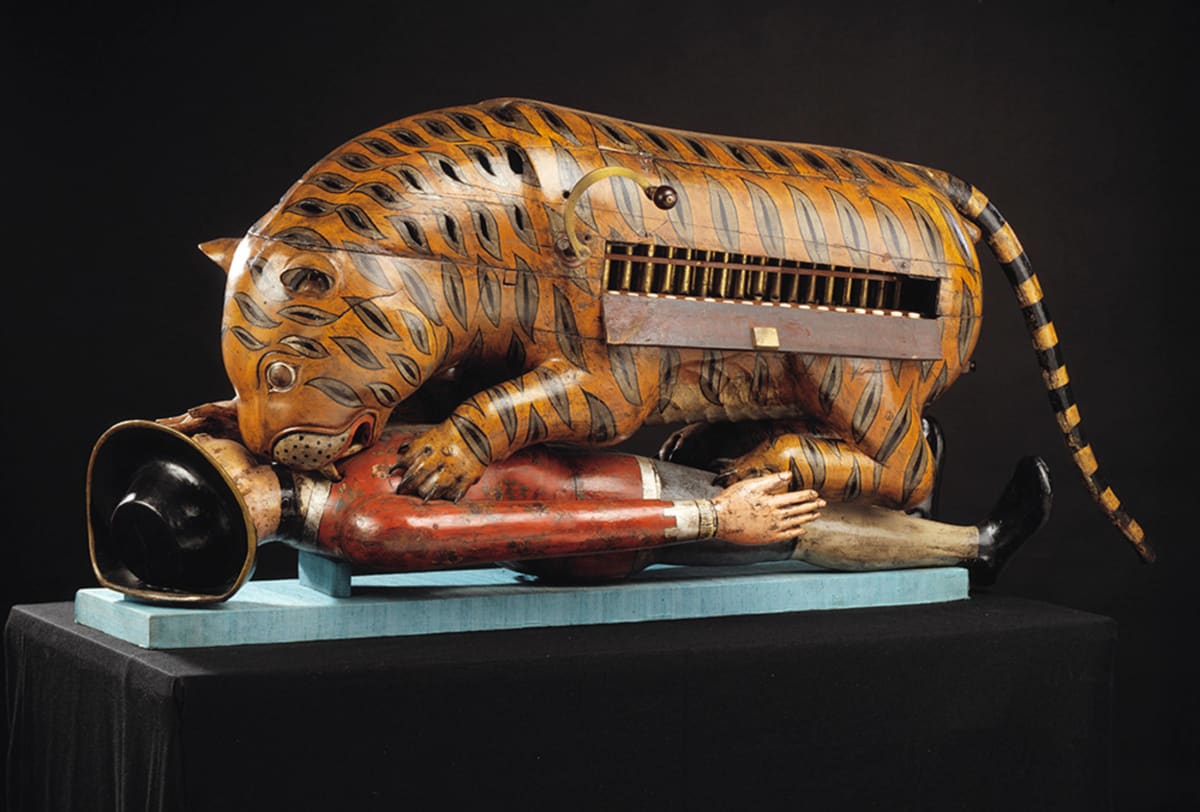
- Tipu's hatred towards his enemy, the British
- Tiger and white person
- A toy featuring colonialism
- A toy featuring strength of tiger
Answer
Tipu's hatred towards his enemy, the British
The Third Anglo-Maratha War was fought during the Governor-Generalship of ............... .
- Wellesley
- Robert Clive
- Marques of Hastings
- Warren Hastings
Answer
Marques of Hastings
What is the minimum age to become a member of the Lok Sabha?
- 18
- 21
- 25
- 30
Answer
25
Who is the Supreme Commander of the Armed Forces?
- President
- Vice President
- Prime Minister
- Defence Minister
Answer
President
Cartwright was associated with ............... .
- powerloom
- cotton gin
- sewing machine
- water frame
Answer
powerloom
After the discovery of America in CE 1492 by ..............., many European countries began to establish their colonies there.
- Columbus
- Henry Navigator
- Vasco-da-Gama
- Ferdinand Megellan
Answer
Columbus
To become a member of the Lok Sabha, one should attain the minimum age ............... .
- 18 years
- 25 years
- 30 years
- 35 years
Answer
25 years
............... means the people's court.
- High Court
- Lok Adalat
- Subordinate Court
- Supreme Court
Answer
Lok Adalat
Read the following statements carefully about the period of Renaissance and identify the incorrect one from the following:
- There was development in arts, literature, religion and the beginning of modern science.
- Movement against certain practices if Catholic Church and the authority of the pope.
- People began to question everything and did not accept everything.
- Acquired knowledge was based on scientific thinking.
Answer
Movement against certain practices if Catholic Church and the authority of the pope.
Two statements are given in the question below as Assertion (A) and Reasoning (R). Read the statements and choose the appropriate option.
Assertion (A): WHO was formed in 1947.
Reason (R): To promote health in the world.
- Both (A) and (R) are true and (R) is the correct explanation of (A).
- Both (A) and (R) are true, but (R) is not the correct explanation of (A).
- (A) is true but (R) is false.
- (A) is false but (R) is true.
Answer
(A) is false but (R) is true.
Explanation — WHO was formed in 1948 to promote health in the world.
Arrange the following in chronological order:
I. American Revolution to overthrow foreign rule and establish a sovereign democratic state - the USA.
II. Discovery of America by Columbus.
III. George Washington, the first President of the USA.
IV. Treaty of Paris between the American colonies and Great Britain, ended the American Revolution and formally recognized the United States as an independent nation.
Options:
- II, IV, I, III
- II, I, III, IV
- II, I, IV, III
- II, III, I, IV
Answer
II, I, IV, III
Identify the executive on the basis of given information
I. Appoints the Prime Minster and Union Minister
II. Nominates 12 members to the Rajya Sabha
III. No money bill can be introduced without his prior approval.
IV. Supreme commander of the Armed forces.
Options:
- Prime Minister
- Vice President
- President
- Chief Minister
Answer
President
Fill in the blanks.
In 1787, new constitution of the United States of America was framed at ............... .
Bartholomew Diaz reached the southernmost tip of Africa, which came to be known as ............... .
In AD 1680, the British purchased three villages ..............., ............... and Calicut.
Answer
Philadelphia
Cape of Good Hope
Sutanuti, Govindapur
Write True or False against the following statements.
The Vice President is elected by the members of Rajya Sabha only.
Murshid Quli Khan established new system of land revenue collection known as ljara System.
Napoleon overthrew the Directorate and formed a Consulate in France consisting of three Consuls.
Lord Wellesley abolished the titles and pensions of childless Indian rulers after their death and thereby annexed their territories.
The separated southern states of America established a new nation, the Confederate States of America.
Answer
False
Correct Statement — The Vice President is elected by the members of both Houses of the Parliament.True
True
False
Correct Statement — Lord Dalhousie (through Doctrine of Lapse) abolished the titles and pensions of childless Indian rulers after their death and thereby annexed their territories.True
Mention two functions of the Vice President.
Answer
Two functions of the Vice President are:
- He is the ex-officio chairman of the Rajya Sabha.
- He presides over the sessions of the House and regulates debates and proceedings.
- In the absence of the President, the Vice President carries-out his functions.
Write achievements of the Raja Sawai Jai Singh.
Answer
Raja Sawai Jai Singh was the prominent ruler of Amber. The city of Jaipur (Pink City) was built by him in a very planned manner in 1727. He was a statesman, scientist and social reformer. He built observatories at Delhi, Jaipur, Mathura, Ujjain and Varanasi.
Discuss the rise of Napoleon Bonaparte in the French Revolution.
Answer
Napoleon Bonaparte rose through the ranks of the military during the French Revolution. In 1799, he overthrew the Directory and formed a Consulate in France consisting of three Consuls, becoming the First Consul and later Consul for life. He achieved military victories against Austria, Russia, and Britain, and established small republics in Italy, Germany, and Belgium. These successes strengthened his political and military power, eventually leading him to become the Emperor of France in 1804, with the Pope attending his coronation. He reached the height of his glory between 1808–1810.
What was the system of Subsidiary Alliance?
Answer
The Subsidiary Alliance was a system introduced by Lord Wellesley in which a native Indian ruler was required to keep a permanent British force in his territory and pay a subsidy for its maintenance. The ruler could not employ any European or negotiate with other rulers without consulting the Governor-General. In return, the British promised to defend the ruler and follow a policy of non-interference in internal affairs, though this was seldom followed.
Describe working of the Lok Sabha.
Answer
The working of the Lok Sabha is given below:
- The Parliament holds at least two sessions a year, though generally three sessions are held.
- The interval between two sessions cannot exceed six months.
- Each day of the session begins with Question Hour, when ministers are asked questions.
- A minimum of 10% of total members must be present to conduct business, called the Quorum.
- The Lok Sabha can introduce new laws or amend existing laws.
- Proposed laws are introduced as Bills, which must be passed by both Lok Sabha and Rajya Sabha.
How slavery was the reason behind the Civil War?
Answer
Slavery was a major reason behind the Civil War because the Northern and Southern states had opposing views on it. The North shunned slavery, considering it a blot on the nation, while the South relied on slaves for their cotton, tobacco, and sugarcane plantations. The Anti-Slavery Movement of 1840 threatened the Southern economy, and public opinion in the North, intensified by Harriet Beecher Stowe's novel Uncle Tom’s Cabin (1852), strongly opposed slavery. These economic and moral differences created such tension that a Civil War became inevitable.
What were the causes of the British success in India?
Answer
The causes of the British success in India can be listed as follows:
- Military Superiority – The British had well-trained armies, modern weapons, and disciplined forces.
- Political Weakness of Indian States – Many Indian kingdoms were divided, weak, and fought among themselves, which made them easy to defeat.
- Alliances and Diplomacy – The British made alliances with some Indian rulers and used policies like the Subsidiary Alliance to control others.
- Economic Strength – The East India Company had strong financial resources to fund wars and administration.
- Efficient Administration – The British had an organized system of governance which helped them maintain control over territories.
- Exploitation of Local Conflicts – They used divisions and rivalries among Indian rulers to their advantage.
Imagine that you are an employee of the British Government and planning to leave India at the time of its independence. You are writing a letter to your father in which you discuss what is likely to happen to India without the British. What would be your personal views about the future of India?
Answer
My personal views about the future of India would be:
- India will now have freedom to govern itself and make its own laws.
- The country will face challenges like uniting different communities and maintaining law and order.
- Rebuilding the economy will be an important task for the new government.
- If Indians work together and stay united, India can become strong and prosperous.
- Independence gives India the chance to shape its own destiny and gain respect in the world.
Discuss various factors which led to the rise of imperialism.
Answer
The factors which led to the rise of imperialism are given below:
- Surplus Production – European industries produced more goods than could be sold locally, prompting colonies as new markets.
- Need for Raw Materials – Colonies supplied raw materials for European industries.
- Modern Transportation & Communication – Steamships, railways, telegraphs, and posts made it easier to conquer and control colonies.
- Population Pressure – Rapid population growth in Europe created a need for new territories to settle surplus population.
- Industrial Capitalism – Merchants, traders, and bankers sought new markets and investment opportunities.
- Christian Missionaries – Spread of Christianity supported imperial expansion.
- Geographical Explorations – Discoveries of new lands in Asia, Africa, and America facilitated imperialism.
Mention causes and consequences of the American Civil War.
Answer
The main causes of the American Civil War were:
- Slavery: The Southern states relied on slavery for their plantations, while the North opposed it, and the Anti-Slavery Movement increased tensions.
- States’ Rights: Southern states resisted federal interference, claiming the right to reject laws they disliked, which created a conflict with the Union.
- Election of 1860: Abraham Lincoln, a Republican opposed to slavery, was elected President, alarming the South.
- Secession: After Abraham Lincoln was elected President in 1860, Southern states like South Carolina, Mississippi, Alabama, Georgia, Louisiana, and Texas seceded and formed the Confederate States of America, triggering the Civil War in 1861.
The main consequences of the American Civil War were:
- Most fighting occurred on Southern soil, causing heavy damage; it took decades for the South to recover during a period of reconstruction.
- Slavery was abolished, secession ended, and the Federal Government became Supreme Authority in the United States. The war also sped up the country’s economic reconstruction on an unprecedented scale.
Imagine that you are living in the decade of 1850s. All of a sudden you hear about implementation of Wood's Despatch in Indian education system. Write about your reactions.
Answer
If I were living in the 1850s and heard about the implementation of Wood’s Despatch in India, I would feel both excited and hopeful. It promised modern education for Indians, the establishment of schools, colleges, and universities, and the training of teachers. I would be pleased to know that education would now be more organized and widespread, giving Indians a chance to learn English, science, and literature. At the same time, I might feel curious about how this new system would impact traditional learning and whether it would really benefit people across the country. Overall, it would seem like a new dawn for education in India.