
Read the two statements given below about decline of the Mughal Empire. Select the option that shows the correct relationship between (A) and (R).
Assertion (A): After Aurangzeb died in 1707, the Mughal empire started declining.
Reason (R): The successors of Aurangzeb were weak and were merely puppets in the hand of the nobles and Governors.
- (R) contradicts (A)
- (R) is the reason for (A)
- (A) is true but (R) is false
- (A) and (R) are independent of each other
Answer
(R) is the reason for (A)
Explanation — After Aurangzeb died in 1707, the Mughal empire started declining. This is because his successors were weak and were merely puppets in the hand of the nobles and Governors.
Identify the main reasons for the rise of Tipu Sultan as a brave General.
P: Built a modern navy
Q: Introduced modern weapons in army
R: Introduced fighter plane in airforce
S: Used liquid fire in war
- P and Q
- R and S
- P and R
- Q and S
Answer
P and Q
Jasleen is preparing a project on "Rise of the Maratha Power" in India. Which of the following rulers, she is MOST LIKELY to highlight?
- Haider Ali
- Raja Sawai Jai Singh
- Guru Gobind Singh
- Shivaji
Answer
Shivaji
Which of the following aspects is being depicted by the given picture?
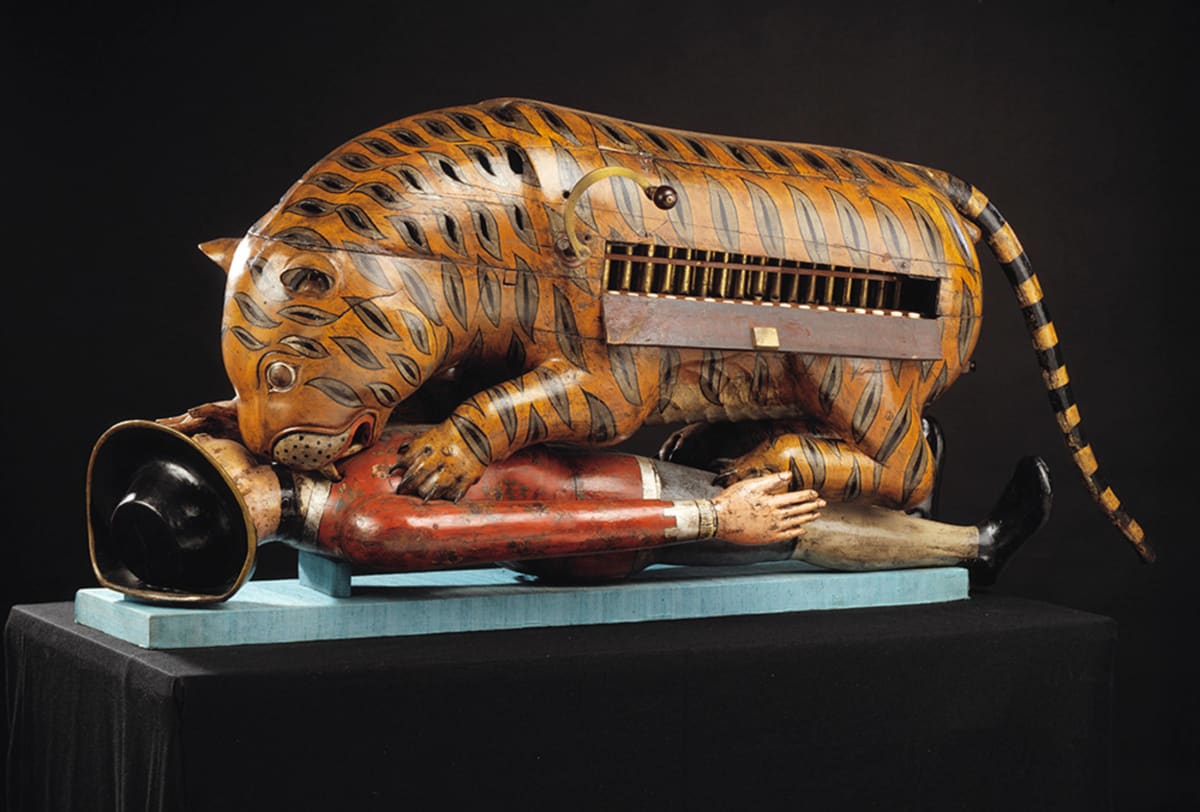
- Tipu's hatred towards his enemy, the British
- Tiger and white person
- A toy featuring colonialism
- A toy featuring strength of tiger
Answer
Tipu's hatred towards his enemy, the British
Identify the ODD ONE out of the following.
- Baji Rao I
- Balaji Vishwanth
- Balaji Baji Rao
- Mukesh Rao
Answer
Mukesh Rao
Consider the statements given below and choose the correct answer:
Statement I: Haider Ali who became the ruler of Mysore in 1761 started his career as an ordinary soldier in the Mysore army.
Statement II: Haider Ali was succeeded by his son Bahadur Shah Zafar.
- Statement (I) is correct and statement (II) is incorrect.
- Statement (I) is incorrect and statement (II) is correct.
- Both statements (I) and (II) are incorrect.
- Both statements (I) and (II) are correct.
Answer
Statement (I) is correct and statement (II) is incorrect.
Which among the following statements is incorrect?
- The defeat in the Third Battle of Panipat put an end to the Maratha dream of establishing an All India empire.
- The Maratha power reached its peak during the reign of Balaji Baji Rao.
- Tipu Sultan was deeply influenced by the ideas of the French Revolution.
- The city of Jaipur is also known as the White City.
Answer
The city of Jaipur is also known as the White City.
Arrange the following in chronological order:
(i) Third Battle of Panipat
(ii) Invasion of Nadir Shah
(iii) Banda Singh Bahadur was killed
(iv) Tipu Sultan became ruler of Mysore
- (ii), (iv), (i), (iii)
- (iv), (iii), (ii), (i)
- (i), (ii), (iii), (iv)
- (iii), (ii), (i), (iv)
Answer
(iii), (ii), (i), (iv)
Who among the following organised the Sikhs into a military brotherhood called the Khalsa?
- Guru Nanak
- Guru Gobind Singh
- Maharaja Ranjit Singh
- Guru Angad
Answer
Guru Gobind Singh
Identify the ruler on the basis of given clues.
- He shifted his capital from Satara to Poona.
- The Maratha power reached its peak during his reign.
- Shivaji
- Balaji Vishwanath
- Baji Rao I
- Balaji Baji Rao
Answer
Balaji Baji Rao
Fill in the blanks.
............... became the independent ruler of Bengal and shifted his capital to Murshidabad.
............... founded the Hyderabad state.
Haider Ali was the ruler of ............... .
............... was the leader of the Sikhs after the death of Guru Govind Singh.
............... was the first Peshwa.
The ............... was the Chief Minister of Marathas.
Answer
Murshid Quli Khan
Nizam-ul-Mulk Asaf Jah
Mysore
Banda Singh Bahadur
Balaji Vishwanath
Peshwa
Match Column A with Column B.
| Column A | Column B |
|---|---|
| 1. Charles Metcalfe | (a) Tiger of Mysore. |
| 2. Shivaji | (b) Treaty of Amritsar. |
| 3. Tipu Sultan | (c) founder of the Maratha power. |
| 4. Ranjit Singh | (d) united the Sikhs on the west of river Sutlej. |
Answer
| Column A | Column B |
|---|---|
| 1. Charles Metcalfe | (b) Treaty of Amritsar. |
| 2. Shivaji | (c) founder of the Maratha power. |
| 3. Tipu Sultan | (a) Tiger of Mysore. |
| 4. Ranjit Singh | (d) united the Sikhs on the west of river Sutlej. |
State whether the following statements are True or False.
The office of the Peshwas was always hereditary.
In the Third Battle of Panipat, the Marathas fought with the Rajputs and the Jats.
The later Mughal kings were able rulers.
Safdar Jung was the first Nizam of Hyderabad.
Jai Singh built an observatory (Jantar Mantar) at Jaipur.
Answer
False
Correct Statement — The office of the Peshwas was not always hereditary.False
Correct Statement — In the Third Battle of Panipat, the Marathas fought with the Afghan General Ahmed Shah Abdali.False
Correct Statement — The later Mughal kings were weak rulers.False
Correct Statement — Nizam-ul-Mulk Asaf Jah was the first Nizam of Hyderabad.True
Write in brief the causes that led to the downfall of the Mughal empire.
Answer
The decline of the Mughal empire was caused by several key factors:
- Weak Successors: After Aurangzeb’s death in 1707, his successors lacked administrative skill and were controlled by powerful nobles, leading to the fragmentation of the empire.
- Rivalry Among Nobles: Constant power struggles between different noble groups created political instability and hindered effective governance.
- Weak Administration: The jagirdari and mansabdari systems became ineffective due to the indiscriminate distribution of land, draining the treasury. The central authority weakened, reducing military efficiency.
- Invasions of Nadir Shah and Ahmad Shah Abdali: Foreign invasions, especially by Nadir Shah in 1739 and Ahmad Shah Abdali, devastated the empire, with Nadir Shah looting the Kohinoor Diamond and the Peacock Throne.
- Wars of Succession: Wars for succession drained resources and caused political instability.
- Aurangzeb’s Policies: His religious intolerance and costly military campaigns, especially against the Marathas and Sikhs, weakened both the economy and administration.
When and between whom was the Third Battle of Panipat fought? What were its results?
Answer
The Third Battle of Panipat was fought between the Marathas and the Afghan General Ahmed Shah Abdali in 1761. The Marathas suffered a crushing defeat, which ended their dream of establishing an all-India empire. Their defeat also provided the English East India Company an opportunity to consolidate power in India.
Name the first independent Nawab of Bengal. What were his achievements?
Answer
The first independent Nawab of Bengal was Murshid Quli Khan. The Nawab brought peace and encouraged trade and commerce in Bengal.
Who was Haider Ali? Discuss his achievements.
Answer
Haider Ali became the ruler of Mysore in 1761. He started his career as an ordinary soldier in the Mysore army. He won many battles against the Marathas and the Nizam of Hyderabad, and successfully defeated the British in the first two Anglo-Mysore Wars.
Which ruler was known as the Tiger of Mysore? Write a short paragraph about him.
Answer
Tipu Sultan is known as the 'Tiger of Mysore'. Tipu ruled Mysore for 17 years. He was an efficient ruler and brave General. He was wise and was deeply influenced by the ideas of the French Revolution. He introduced modern weapons in his army and tried to build a modern navy. He died in 1799, while defending his capital Seringapatam in the final Anglo-Mysore War.
Give Reason:
The consequence of the Third Battle of Panipat was advantageous for the British.
Answer
In the Third Battle of Panipat (1761), Ahmad Shah Abdali, an Afghan invader, gave a crushing defeat to the forces of Peshwa Balaji Baji Rao. It put an end to the Maratha power and allowed the East India Company to gain power and become supreme in India.
Give Reason:
Independent states were formed in the eighteenth century.
Answer
After the death of Aurangzeb in 1707, the Mughal Empire weakened significantly. His successors were ineffective rulers, often manipulated by powerful nobles and governors, which led to a decline in central authority. This allowed regional powers to assert their independence.
Identify the ruler.
How did he unite the Sikhs in Punjab?

Answer
The given picture depicts Maharaja Ranjit Singh.
Maharaja Ranjit Singh united the twelve misls or groups led by Sikh Chiefs. He brought the whole area west of river Sutlej under his control and established the Sikh kingdom in Punjab. He signed the Treaty of Amritsar (1809) with Charles Metcalfe, which confirmed his conquest and sovereignty over the territory west of the Sutlej.
Assertion (A): Asaf Jah declared himself the ruler of Deccan.
Reason (R): He took advantage of the disturbance in the Deccan.
- Both Assertion (A) and Reason (R) are true and Reason (R) is the correct explanation of Assertion (A).
- Both Assertion (A) and Reason (R) are true but Reason (R) is not the correct explanation of Assertion (A).
- Assertion (A) is true but Reason (R) is false.
- Assertion (A) is false but Reason (R) is true.
Answer
Both Assertion (A) and Reason (R) are true and Reason (R) is the correct explanation of Assertion (A).
Explanation — After the death of Aurangzeb in 1707, the Mughal Empire was weakening, and there was political instability in the Deccan region. The Sayyid brothers, who held power in the Mughal Empire, were overthrown, and this disturbance allowed Asaf Jah to seize the opportunity and establish his own independent rule.
Assertion (A): Rajputs of Amber and Jodhpur were looked upon with much respect.
Reason (R): Raja Swai Jai Singh established the city of Jaipur.
- Both Assertion (A) and Reason (R) are true and Reason (R) is the correct explanation of Assertion (A).
- Both Assertion (A) and Reason (R) are true but Reason (R) is not the correct explanation of Assertion (A).
- Assertion (A) is true but Reason (R) is false.
- Assertion (A) is false but Reason (R) is true.
Answer
Assertion (A) is false but Reason (R) is true.
Explanation — As a political power, the Rajputs were insignificant during the 18th century. This is because a majority of Rajput states were most of the time involved in feuds and civil wars among themselves.