
List the outcomes you can see in these experiments.
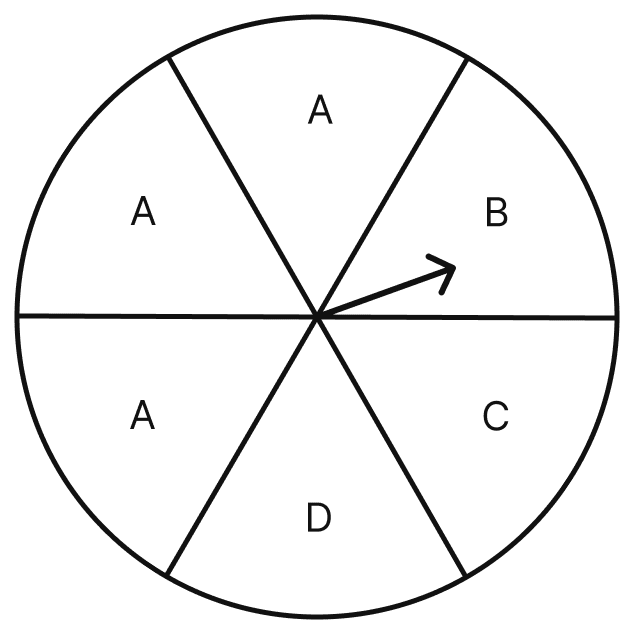
(i) Spinning a wheel
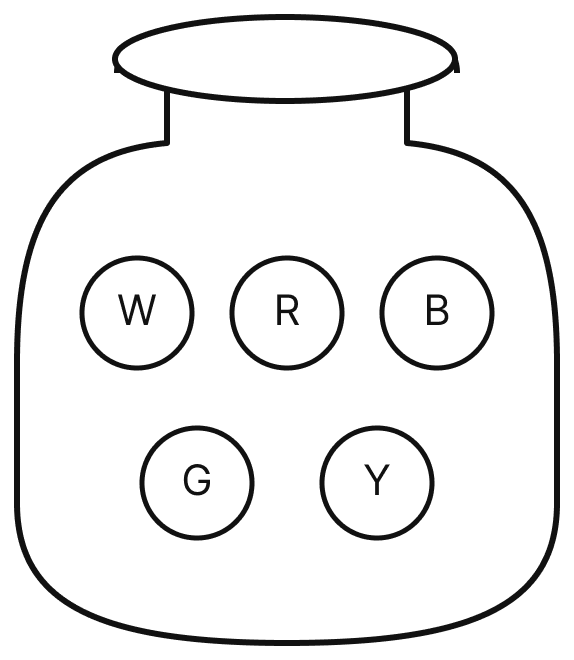
(ii) Drawing a ball from the bag containing 5 identical balls of different colours
Answer
(i) When we spin the wheel shown in the figure, the pointer can stop in any one of the sectors marked as A, A, A, B, C and D.
Hence, the possible outcomes are A, A, A, B, C, D.
(ii) The bag contains 5 identical balls marked W (white), R (red), B (blue), G (green) and Y (yellow). The ball drawn can be any one of these.
Hence, the possible outcomes are W, R, B, G, Y.
A die is rolled once. Find the probability of getting
(i) an even number
(ii) a multiple of 3
(iii) not a multiple of 3
Answer
When a die is rolled once, the possible outcomes are 1, 2, 3, 4, 5 or 6.
∴ Total number of outcomes = 6
(i) The event is getting an even number and the outcomes 2, 4, 6 are even numbers.
So, the number of favourable outcomes = 3
⇒ P(getting an even number) =
=
=
Hence, the probability of getting an even number is .
(ii) The event is getting a multiple of 3 and the outcomes 3, 6 are multiples of 3.
So, the number of favourable outcomes = 2
⇒ P(getting a multiple of 3) =
=
=
Hence, the probability of getting a multiple of 3 is .
(iii) The event is not getting a multiple of 3 and the outcomes 1, 2, 4, 5 are not multiples of 3.
So, the number of favourable outcomes = 4
⇒ P(not getting a multiple of 3) =
=
=
Hence, the probability of not getting a multiple of 3 is .
Two coins are tossed together. Find the probability of getting
(i) two tails
(ii) atleast one tail
(iii) no tail
Answer
When two coins are tossed together, the possible outcomes are HH, HT, TH and TT.
∴ Total number of outcomes = 4
(i) The event is getting two tails and the outcome TT is favourable to the event.
So, the number of favourable outcomes = 1
⇒ P(getting two tails) =
=
Hence, the probability of getting two tails is .
(ii) The event is getting atleast one tail, means getting one tail or two tails, and the outcomes HT, TH, TT are favourable to the event.
So, the number of favourable outcomes = 3
⇒ P(getting atleast one tail) =
=
Hence, the probability of getting atleast one tail is .
(iii) The event is getting no tail and the outcome HH is favourable to the event.
So, the number of favourable outcomes = 1
⇒ P(getting no tail) =
=
Hence, the probability of getting no tail is .
Three coins are tossed together. Find the probability of getting
(i) atleast two heads
(ii) atleast one tail
(iii) atmost one tail
Answer
When three coins are tossed together, the possible outcomes are HHH, HHT, HTH, HTT, TTT, TTH, THT and THH.
∴ Total number of outcomes = 8
(i) The event is getting atleast two heads, means getting two heads or three heads, and the outcomes HHH, HHT, HTH, THH are favourable to the event.
So, the number of favourable outcomes = 4
⇒ P(getting atleast two heads) =
=
=
Hence, the probability of getting atleast two heads is .
(ii) The event is getting atleast one tail, means getting one tail or two tails or three tails, and the outcomes HHT, HTH, HTT, TTT, TTH, THT, THH are favourable to the event.
So, the number of favourable outcomes = 7
⇒ P(getting atleast one tail) =
=
Hence, the probability of getting atleast one tail is .
(iii) The event is getting atmost one tail, means getting no tail or one tail, and the outcomes HHH, HHT, HTH, THH are favourable to the event.
So, the number of favourable outcomes = 4
⇒ P(getting atmost one tail) =
=
=
Hence, the probability of getting atmost one tail is .
A box contains 600 screws, one tenth are rusted. One screw is taken out at random from the box. Find the probability that it is
(i) a rusted screw
(ii) not a rusted screw
Answer
Total number of screws in the box = 600
∴ Total number of outcomes = 600
Number of rusted screws = × 600 = 60
∴ Number of screws which are not rusted = 600 - 60 = 540
(i) The event is getting a rusted screw.
The number of rusted screws in the box is 60.
So, the number of favourable outcomes = 60
⇒ P(getting a rusted screw) =
=
=
Hence, the probability of getting a rusted screw is .
(ii) The event is getting a screw which is not rusted.
The number of screws which are not rusted in the box is 540.
So, the number of favourable outcomes = 540
⇒ P(getting a screw which is not rusted) =
=
=
Hence, the probability of getting a screw which is not rusted is .
A letter is chosen from the word 'TRIANGLE'. What is the probability that it is a vowel?
Answer
In the word 'TRIANGLE' there are 8 letters T, R, I, A, N, G, L and E.
∴ Total number of outcomes = 8
Out of these 8 letters, there are three vowels I, A and E.
So, the number of favourable outcomes = 3
⇒ P(getting a vowel) =
=
Hence, the probability that the letter chosen is a vowel is .
A bag contains 5 red, 6 black and 4 white balls. A ball is drawn at random from the bag, find the probability the ball drawn is
(i) white
(ii) not black
(iii) red or black
(iv) neither red nor black
Answer
Total number of balls in the bag = 5 + 6 + 4 = 15
∴ Total number of outcomes = 15
(i) The event is getting a white ball.
The number of white balls in the bag is 4.
So, the number of favourable outcomes = 4
⇒ P(getting a white ball) =
=
Hence, the probability of getting a white ball is .
(ii) The event is getting a ball which is not black.
The number of balls which are not black in the bag = 5 + 4 = 9
So, the number of favourable outcomes = 9
⇒ P(getting a ball which is not black) =
=
=
Hence, the probability of getting a ball which is not black is .
(iii) The event is getting a red or a black ball.
The number of red or black balls in the bag = 5 + 6 = 11
So, the number of favourable outcomes = 11
⇒ P(getting a red or a black ball) =
=
Hence, the probability of getting a red or a black ball is .
(iv) The event is getting a ball which is neither red nor black, that is getting a white ball.
The number of white balls in the bag is 4.
So, the number of favourable outcomes = 4
⇒ P(getting a ball which is neither red nor black) =
=
Hence, the probability of getting a ball which is neither red nor black is .
A box contains 17 cards numbered 1, 2, 3, ....., 17 and are mixed thoroughly. A card is drawn at random from the box. Find the probability that the number on the card is
(i) odd
(ii) even
(iii) prime
(iv) divisible by 3
(v) divisible by 2 and 3 both
Answer
The box contains 17 cards numbered 1, 2, 3, ....., 17 and one card is drawn.
∴ Total number of outcomes = 17
(i) The event is getting an odd number and the outcomes 1, 3, 5, 7, 9, 11, 13, 15, 17 are odd numbers.
So, the number of favourable outcomes = 9
⇒ P(getting an odd number) =
=
Hence, the probability that the number on the card is odd is .
(ii) The event is getting an even number and the outcomes 2, 4, 6, 8, 10, 12, 14, 16 are even numbers.
So, the number of favourable outcomes = 8
⇒ P(getting an even number) =
=
Hence, the probability that the number on the card is even is .
(iii) The event is getting a prime number and the outcomes 2, 3, 5, 7, 11, 13, 17 are prime numbers.
So, the number of favourable outcomes = 7
⇒ P(getting a prime number) =
=
Hence, the probability that the number on the card is prime is .
(iv) The event is getting a number divisible by 3 and the outcomes 3, 6, 9, 12, 15 are divisible by 3.
So, the number of favourable outcomes = 5
⇒ P(getting a number divisible by 3) =
=
Hence, the probability that the number on the card is divisible by 3 is .
(v) A number divisible by both 2 and 3 is divisible by 6.
The event is getting a number divisible by 2 and 3 both and the outcomes 6, 12 are divisible by 6.
So, the number of favourable outcomes = 2
⇒ P(getting a number divisible by 2 and 3 both) =
=
Hence, the probability that the number on the card is divisible by 2 and 3 both is .
A card is drawn from a well-shuffled pack of 52 cards. Find the probability that the card drawn is:
(i) an ace
(ii) a red card
(iii) neither a king nor a queen
(iv) a red face card
(v) a card of spade or an ace
(vi) non face card of red colour
Answer
There are 52 playing cards and one card is drawn.
∴ Total number of outcomes = 52
(i) The event is getting an ace. There are 4 aces in a pack of 52 cards.
So, the number of favourable outcomes = 4
⇒ P(getting an ace) =
=
=
Hence, the probability of getting an ace is .
(ii) The event is getting a red card. There are 26 red cards, that is 13 cards of heart and 13 cards of diamond.
So, the number of favourable outcomes = 26
⇒ P(getting a red card) =
=
=
Hence, the probability of getting a red card is .
(iii) The event is getting neither a king nor a queen. There are 4 kings and 4 queens in a pack of 52 cards.
∴ Number of cards which are neither a king nor a queen = 52 - (4 + 4) = 52 - 8 = 44
So, the number of favourable outcomes = 44
⇒ P(getting neither a king nor a queen) =
=
=
Hence, the probability of getting neither a king nor a queen is .
(iv) The event is getting a red face card. The face cards are kings, queens and jacks, so the red face cards are 2 kings, 2 queens and 2 jacks.
∴ Number of red face cards = 2 + 2 + 2 = 6
So, the number of favourable outcomes = 6
⇒ P(getting a red face card) =
=
=
Hence, the probability of getting a red face card is .
(v) The event is getting a card of spade or an ace. There are 13 cards of spade, which include the ace of spade, and 3 more aces of the other suits.
∴ Number of cards which are of spade or an ace = 13 + 3 = 16
So, the number of favourable outcomes = 16
⇒ P(getting a card of spade or an ace) =
=
=
Hence, the probability of getting a card of spade or an ace is .
(vi) The event is getting a non face card of red colour. There are 26 red cards, out of which 6 are face cards.
∴ Number of non face cards of red colour = 26 - 6 = 20
So, the number of favourable outcomes = 20
⇒ P(getting a non face card of red colour) =
=
=
Hence, the probability of getting a non face card of red colour is .
In a lottery, there are 5 prized tickets and 995 blank tickets. A person buys a lottery ticket. Find the probability of his winning a prize.
Answer
Total number of tickets = 5 + 995 = 1000
∴ Total number of outcomes = 1000
The event is winning a prize.
The number of prized tickets is 5.
So, the number of favourable outcomes = 5
⇒ P(winning a prize) =
=
=
Hence, the probability of his winning a prize is .