
is equal to
3
4
5
6
Answer
Using the identity,
a2 - b2 = (a + b)(a - b)
Solving,
Hence, option 4 is the correct option.
If the sum of three consecutive even integers is 36, then the largest integer is
10
12
14
16
Answer
It is given that the sum of three consecutive even integers is 36.
Let the three consecutive even integers be x, x + 2 and x + 4.
⇒ x + (x + 2) + (x + 4) = 36
⇒ 3x + 6 = 36
⇒ 3x = 36 - 6
⇒ 3x = 30
⇒ x =
⇒ x = 10
⇒ x + 2 = 10 + 2 = 12
⇒ x + 4 = 10 + 4 = 14
Thus, the three consecutive even integers are 10, 12 and 14.
So, the largest integer is 14.
Hence, option 3 is the correct option.
Find the area of rectangle whose length and breadth are respectively (4x2 - 3x + 7) and (3 - 2x + 3x2)
Answer
Given,
Length = (4x2 - 3x + 7)
Breadth = (3 - 2x + 3x2) or (3x2 - 2x + 3)
By formula,
Area of a rectangle = length x breadth
Area = (4x2 - 3x + 7)(3x2 - 2x + 3)
= 4x2(3x2 - 2x + 3) - 3x(3x2 - 2x + 3) + 7(3x2 - 2x + 3)
= 12x4 - 8x3 + 12x2 - 9x3 + 6x2 - 9x + 21x2 - 14x + 21
= 12x4 - 8x3 - 9x3 + 12x2 + 6x2 + 21x2 - 9x - 14x + 21
= 12x4 - 17x3 + 39x2 - 23x + 21
Hence, the area of the rectangle is 12x4 - 17x3 + 39x2 - 23x + 21.
Factorize: a2 - c2 - 2ab + b2
Answer
⇒ a2 - c2 - 2ab + b2
Rearranging the terms,
⇒ a2 - 2ab + b2 - c2
Using the identity a2 - 2ab + b2 = (a - b)2,
⇒ (a - b)2 - c2
Using the identity p2 - q2 = (p + q)(p - q),
⇒ (a - b + c)(a - b - c)
Hence, a2 - c2 - 2ab + b2 = (a - b + c)(a - b - c).
The ages of A and B are in the ratio 3 : 4. Five years later the sum of their ages will be 31 years. What are their present ages?
Answer
It is given that the ages of A and B are in the ratio 3 : 4 and five years later the sum of their ages will be 31 years.
Let the common factor be a. So, the present age of A is 3a years and the present age of B is 4a years.
Five years later,
Age of A = (3a + 5) years and Age of B = (4a + 5) years
⇒ (3a + 5) + (4a + 5) = 31
⇒ 7a + 10 = 31
⇒ 7a = 31 - 10
⇒ 7a = 21
⇒ a =
⇒ a = 3
Thus,
Present age of A = 3a = 3 x 3 = 9 years
Present age of B = 4a = 4 x 3 = 12 years
Hence, the present ages of A and B are 9 years and 12 years respectively.
The sum of the digits of a two digit number is 13. If the number obtained by reversing the digits is 45 more than the original number. Find the original number.
Answer
Let the digit at the tens place be a and the digit at the units place be b.
So, the original number is 10a + b and the number obtained by reversing the digits is 10b + a.
As the sum of the digits is 13,
a + b = 13 ...............(1)
Given,
Number obtained by reversing the digits is 45 more than the original number.
⇒ 10b + a = (10a + b) + 45
⇒ 10b + a - 10a - b = 45
⇒ 9b - 9a = 45
⇒ 9(b - a) = 45
⇒ b - a =
⇒ b - a = 5 ...............(2)
Adding equations (1) and (2), we get:
⇒ a + b + (b - a) = 13 + 5
⇒ 2b = 18
⇒ b =
⇒ b = 9
Substituting b = 9 in equation (1), we get:
⇒ a + 9 = 13
⇒ a = 13 - 9
⇒ a = 4
Thus, the original number = 10a + b = 10 x 4 + 9 = 49
Hence, the original number is 49.
The ratio between an exterior angle and interior angle of a regular polygon is 1 : 5, find
(i) the measure of each exterior angle.
(ii) the measure of each interior angle.
(iii) the number of sides of the polygon.
Answer
It is given that the ratio between an exterior angle and interior angle of a regular polygon is 1 : 5.
Let the common factor be a. So, the exterior angle is a and the interior angle is 5a.
As the sum of an interior angle and its adjacent exterior angle is 180°,
⇒ a + 5a = 180°
⇒ 6a = 180°
⇒ a =
⇒ a = 30°
(i) Each exterior angle = a = 30°
Hence, the measure of each exterior angle is 30°.
(ii) Each interior angle = 5a = 5 x 30° = 150°
Hence, the measure of each interior angle is 150°.
(iii) According to the properties of a polygon,
If each exterior angle of a regular polygon is a°, then the number of sides in the regular polygon is .
Number of sides = = 12
Hence, the number of sides of the polygon is 12.
Solve the inequality: 3 - , x ∈ W. Also represent its solution set on the number line.
Answer
Given,
Inequation : 3 -
L.C.M. of 2 and 3 = 6
Multiplying both sides of the inequality by 6, we get :
⇒ 6 x 3 - 6 x > 6 x 2 - 6 x
⇒ 18 - 3x > 12 - 2x
⇒ 18 - 12 > 3x - 2x
⇒ 6 > x
⇒ x < 6
As x ∈ W, the values of x are 0, 1, 2, 3, 4 and 5.
So, the solution set is {0, 1, 2, 3, 4, 5}.
The solution set is represented on the number line as shown below:

Hence, the solution set is {0, 1, 2, 3, 4, 5}.
Factorise: .
Answer
Given,
Let
Squaring both the sides,
Substituting these values in the given expression,
Hence, .
In the given figure, ABCD is a parallelogram. Find x, y, z and w.
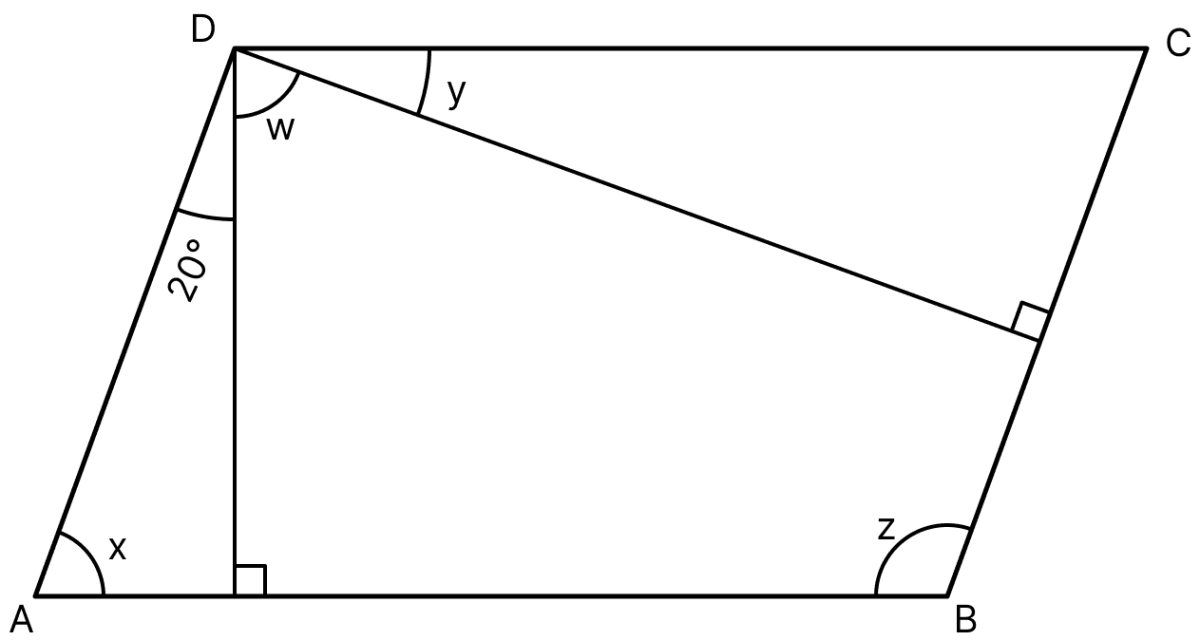
Answer
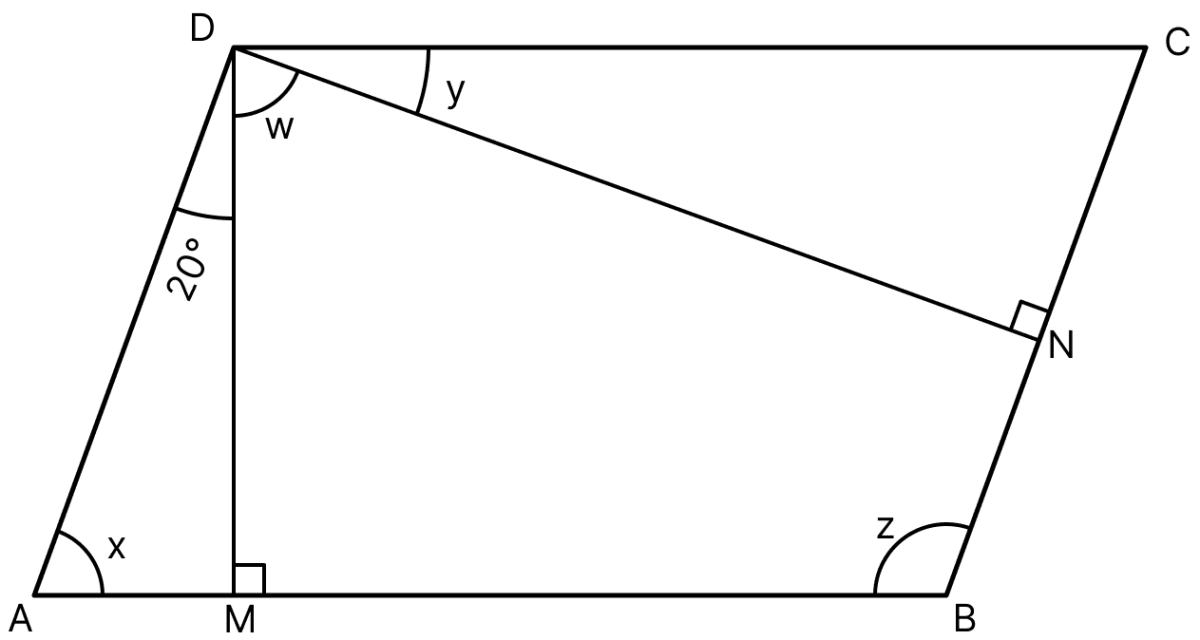
It is given that ABCD is a parallelogram in which the perpendicular from D meets AB at M and BC at N, and ∠ADM = 20°, ∠MDN = w, ∠NDC = y, ∠DAB = x and ∠ABC = z.
In ΔADM, ∠AMD = 90° as DM ⊥ AB.
As the sum of all the angles of a triangle is 180°,
⇒ x + ∠ADM + ∠AMD = 180°
⇒ x + 20° + 90° = 180°
⇒ x + 110° = 180°
⇒ x = 180° - 110°
⇒ x = 70°
As the adjacent angles of a parallelogram are supplementary,
⇒ z + x = 180°
⇒ z + 70° = 180°
⇒ z = 180° - 70°
⇒ z = 110°
As the opposite angles of a parallelogram are of equal measure,
∠BCD = ∠DAB = x = 70°
From figure,
∠DCN = ∠BCD = 70°
In ΔDNC, ∠DNC = 90° as DN ⊥ BC.
As the sum of all the angles of a triangle is 180°,
⇒ y + ∠DCN + ∠DNC = 180°
⇒ y + 70° + 90° = 180°
⇒ y + 160° = 180°
⇒ y = 180° - 160°
⇒ y = 20°
As DC ∥ AB and DM ⊥ AB, we have DM ⊥ DC.
So, ∠MDC = 90°
From the figure,
⇒ w + y = ∠MDC
⇒ w + 20° = 90°
⇒ w = 90° - 20°
⇒ w = 70°
Hence, x = 70°, y = 20°, w = 70° and z = 110°.