
Write the number of faces, vertices and edges of a hexagonal pyramid.
Answer
In a hexagonal pyramid, the number of sides of the polygonal base is 6.
Number of faces in a pyramid is 1 more than the number of sides of the polygonal base.
Number of faces = 6 + 1 = 7
Number of vertices in a pyramid is 1 more than the number of sides of the polygonal base.
Number of vertices = 6 + 1 = 7
Number of edges in a pyramid is twice the number of sides of the polygonal base.
Number of edges = 6 × 2 = 12
Hence, in a hexagonal pyramid, F = 7, V = 7 and E = 12.
Write the number of faces, vertices and edges of an octagonal pyramid.
Answer
In an octagonal pyramid, the number of sides of the polygonal base is 8.
Number of faces in a pyramid is 1 more than the number of sides of the polygonal base.
Number of faces = 8 + 1 = 9
Number of vertices in a pyramid is 1 more than the number of sides of the polygonal base.
Number of vertices = 8 + 1 = 9
Number of edges in a pyramid is twice the number of sides of the polygonal base.
Number of edges = 8 × 2 = 16
Hence, in an octagonal pyramid, F = 9, V = 9 and E = 16.
Write the number of faces, vertices and edges of a decagonal pyramid.
Answer
In a decagonal pyramid, the number of sides of the polygonal base is 10.
Number of faces in a pyramid is 1 more than the number of sides of the polygonal base.
Number of faces = 10 + 1 = 11
Number of vertices in a pyramid is 1 more than the number of sides of the polygonal base.
Number of vertices = 10 + 1 = 11
Number of edges in a pyramid is twice the number of sides of the polygonal base.
Number of edges = 10 × 2 = 20
Hence, in a decagonal pyramid, F = 11, V = 11 and E = 20.
Write the number of faces, vertices and edges of a nonagonal pyramid.
Answer
In a nonagonal pyramid, the number of sides of the polygonal base is 9.
Number of faces in a pyramid is 1 more than the number of sides of the polygonal base.
Number of faces = 9 + 1 = 10
Number of vertices in a pyramid is 1 more than the number of sides of the polygonal base.
Number of vertices = 9 + 1 = 10
Number of edges in a pyramid is twice the number of sides of the polygonal base.
Number of edges = 9 × 2 = 18
Hence, in a nonagonal pyramid, F = 10, V = 10 and E = 18.
Write the number of faces, vertices and edges of a heptagonal prism.
Answer
In a heptagonal prism, the number of sides of the polygonal base is 7.
Number of faces in a prism is 2 more than the number of sides of the polygonal base.
Number of faces = 7 + 2 = 9
Number of vertices in a prism is twice the number of sides of the polygonal base.
Number of vertices = 7 × 2 = 14
Number of edges in a prism is thrice the number of sides of the polygonal base.
Number of edges = 7 × 3 = 21
Hence, in a heptagonal prism, F = 9, V = 14 and E = 21.
Write the number of faces, vertices and edges of a decagonal prism.
Answer
In a decagonal prism, the number of sides of the polygonal base is 10.
Number of faces in a prism is 2 more than the number of sides of the polygonal base.
Number of faces = 10 + 2 = 12
Number of vertices in a prism is twice the number of sides of the polygonal base.
Number of vertices = 10 × 2 = 20
Number of edges in a prism is thrice the number of sides of the polygonal base.
Number of edges = 10 × 3 = 30
Hence, in a decagonal prism, F = 12, V = 20 and E = 30.
Give two examples of 3 dimensional shapes around you which are the combinations of 2 or more 3-dimensional shapes.
Answer
Two such examples are given below:
A tomb — In a tomb, a cylinder is surmounted by a hemisphere.
An ice cream cone — In an ice cream cone, a cone is surmounted by a hemisphere.
Hence, a tomb and an ice cream cone are two shapes around us which are the combinations of 2 or more 3-dimensional shapes.
Give two examples of solids which are not polyhedrons.
Answer
A polyhedron is a solid made up of polygonal regions.
A sphere has a curved surface and a cylinder has a curved surface together with two circular ends. So, neither of them is made up of polygonal regions.
Hence, a sphere and a cylinder are two solids which are not polyhedrons.
Why a pentagonal pyramid having all its edges congruent cannot be a regular polyhedron?
Answer
A polyhedron is said to be a regular polyhedron if all of its faces are regular polygons and the same number of faces meet at each vertex.
In a pentagonal pyramid having all its edges congruent, the base is a regular pentagon and each of its 5 lateral faces is an equilateral triangle. So, all of its faces are regular polygons.
At the apex of this pyramid, 5 faces meet.
At each vertex of its base, 3 faces meet — two lateral faces and the base.
So, the same number of faces do not meet at each of its vertices.
Hence, a pentagonal pyramid having all its edges congruent cannot be a regular polyhedron, as all its vertices are not formed by the same number of faces.
In a polyhedron, if F = 8 and V = 12 then find the number of edges.
Answer
Given:
F = 8, V = 12
According to Euler's formula,
F + V = E + 2
⇒ 8 + 12 = E + 2
⇒ 20 = E + 2
⇒ E = 20 - 2
⇒ E = 18
Hence, the number of edges = 18.
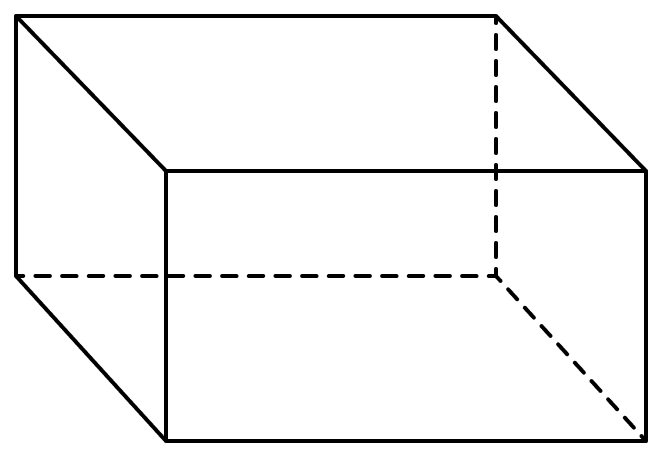
Verify Euler's formula for the following figure:
Answer
The given solid is a cuboid.
From the figure,
F = 6, V = 8, E = 12
According to Euler's formula,
F + V = E + 2
L.H.S. = F + V = 6 + 8 = 14
R.H.S. = E + 2 = 12 + 2 = 14
Since, L.H.S. = R.H.S.
Hence, Euler's formula is verified.
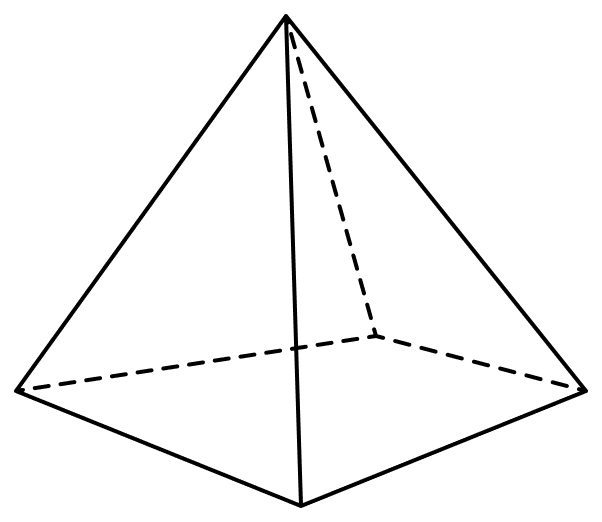
Verify Euler's formula for the following figure:
Answer
The given solid is a rectangular pyramid.
From the figure,
F = 5, V = 5, E = 8
According to Euler's formula,
F + V = E + 2
L.H.S. = F + V = 5 + 5 = 10
R.H.S. = E + 2 = 8 + 2 = 10
Since, L.H.S. = R.H.S.
Hence, Euler's formula is verified.
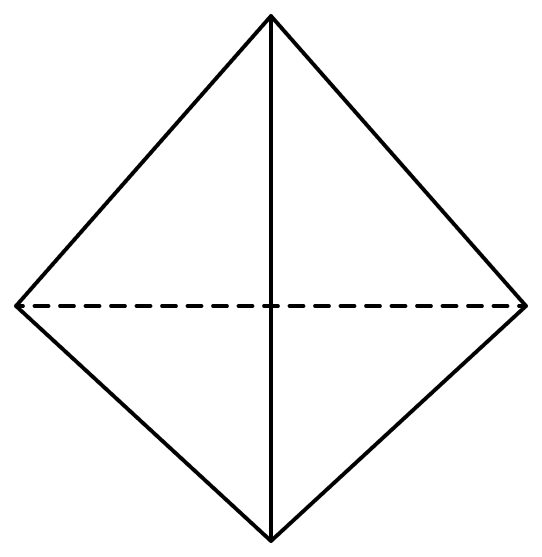
Verify Euler's formula for the following figure:
Answer
The given solid is a triangular pyramid.
From the figure,
F = 4, V = 4, E = 6
According to Euler's formula,
F + V = E + 2
L.H.S. = F + V = 4 + 4 = 8
R.H.S. = E + 2 = 6 + 2 = 8
Since, L.H.S. = R.H.S.
Hence, Euler's formula is verified.
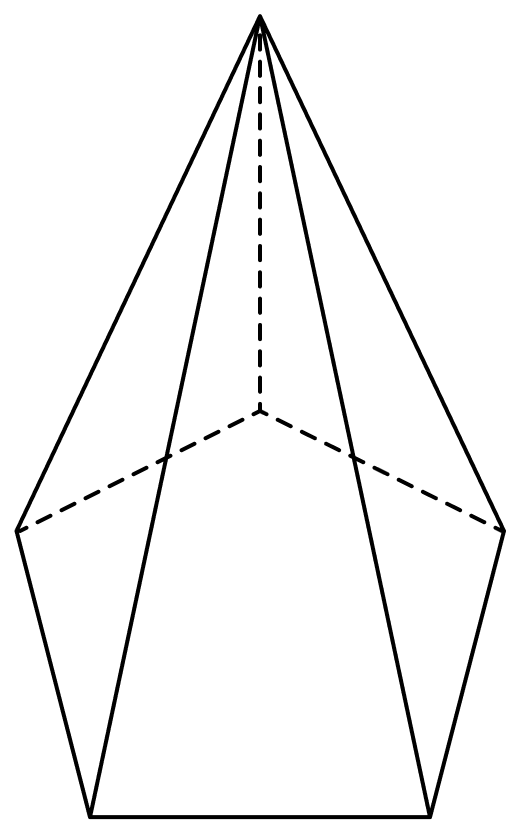
Verify Euler's formula for the following figure:
Answer
The given solid is a pentagonal pyramid.
From the figure,
F = 6, V = 6, E = 10
According to Euler's formula,
F + V = E + 2
L.H.S. = F + V = 6 + 6 = 12
R.H.S. = E + 2 = 10 + 2 = 12
Since, L.H.S. = R.H.S.
Hence, Euler's formula is verified.
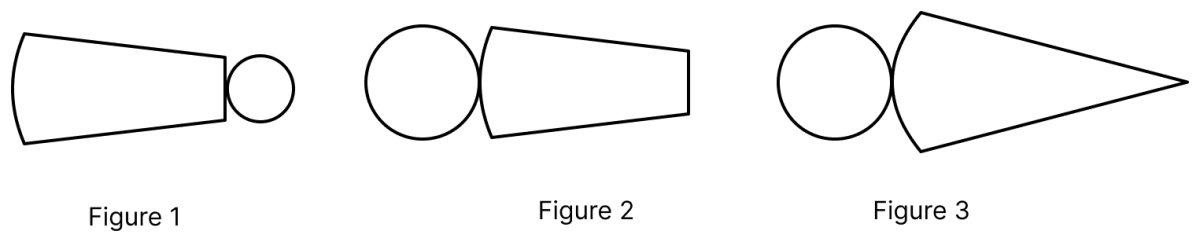
Which of the following nets can be folded to form a cone?
Answer
The net of a cone consists of a circle, which forms its base, and a sector of a circle, which forms its curved surface.
In Figure 1 and Figure 2, the part which is to form the curved surface is cut off at its narrow end, so on folding it does not meet at a point. So, neither of these nets can be folded to form a cone.
In Figure 3, the part which is to form the curved surface tapers to a point and the circle attached to it forms the base. So, on folding, this net gives a cone.
Hence, the net given in Figure 3 can be folded to form a cone.
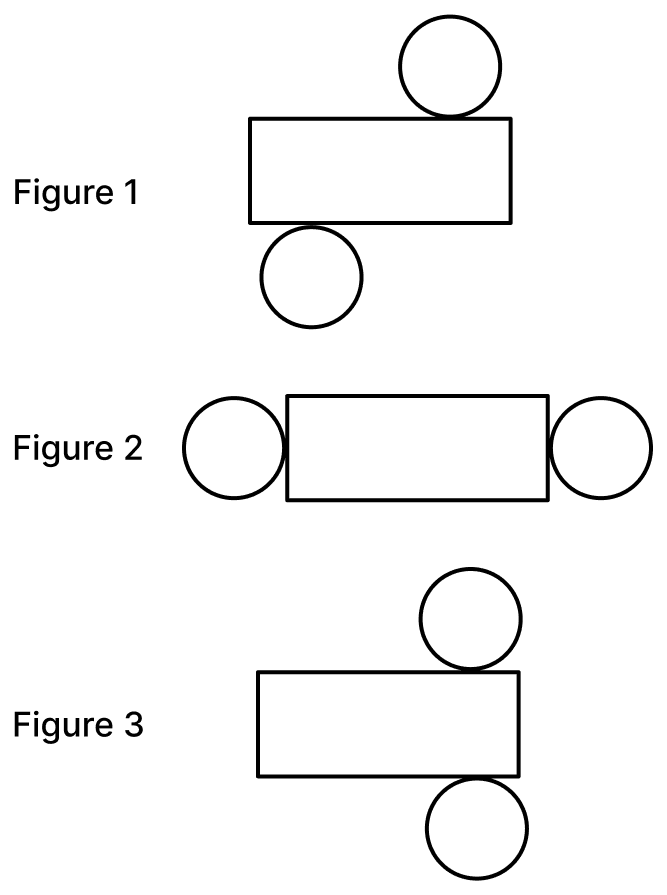
Which of the following nets can be folded to form a cylinder?
Answer
The net of a cylinder consists of a rectangle, which forms its curved surface, and two circles, which form its two ends.
On folding the net, the length of the rectangle becomes the circumference of each of the two circles. So, the two circles must be attached along the length of the rectangle.
In Figure 1 and Figure 3, the two circles are attached along the length of the rectangle. So, each of these nets can be folded to form a cylinder.
In Figure 2, the two circles are attached along the breadth of the rectangle. So, this net cannot be folded to form a cylinder.
Hence, the nets given in Figure 1 and Figure 3 can be folded to form a cylinder.