
The length and breadth of a rectangular field are in the ratio 9 : 5. If the area of the field is 14580 square metres, find the cost of surrounding the field with a fence at the rate of ₹325 per metre.
Answer
Given,
The length and the breadth of a rectangular field are in the ratio 9 : 5.
Area of the field = 14580 m2
Let the length of the field be 9a metres and the breadth of the field be 5a metres.
By formula,
Area of a rectangle = length × breadth
⇒ 9a × 5a = 14580
⇒ 45a2 = 14580
⇒ a2 =
⇒ a2 = 324
⇒ a =
⇒ a = 18
So, length of the field = 9a = 9 × 18 m = 162 m
And, breadth of the field = 5a = 5 × 18 m = 90 m
Length of the fence required = Perimeter of the field
= 2(length + breadth)
= 2(162 + 90) m
= 2 × 252 m
= 504 m
Cost of fencing = Length of the fence × Rate of fencing
= 504 m × ₹325/m
= ₹1,63,800
Hence, the cost of surrounding the field with a fence is ₹1,63,800.
A rectangle is 16 m by 9 m. Find a side of the square whose area equals the area of the rectangle. By how much does the perimeter of the rectangle exceed the perimeter of the square?
Answer
Given,
Length of the rectangle = 16 m
Breadth of the rectangle = 9 m
By formula,
Area of a rectangle = length × breadth
= 16 × 9 m2
= 144 m2
Let the side of the square be a metres.
It is given that the area of the square is equal to the area of the rectangle.
⇒ a2 = 144
⇒ a =
⇒ a = 12 m
Perimeter of the rectangle = 2(length + breadth)
= 2(16 + 9) m
= 2 × 25 m
= 50 m
Perimeter of the square = 4 × side
= 4 × 12 m
= 48 m
Difference of the perimeters = 50 - 48 m = 2 m
Hence, a side of the square is 12 m and the perimeter of the rectangle exceeds the perimeter of the square by 2 m.
Two adjacent sides of a parallelogram are 24 cm and 18 cm. If the distance between longer sides is 12 cm, find the distance between shorter sides.
Answer
Given,
Two adjacent sides of the parallelogram are 24 cm and 18 cm.
Distance between the longer sides = 12 cm
By formula,
Area of a parallelogram = base × corresponding height
Taking 24 cm as the base,
Area of the parallelogram = 24 × 12 cm2
= 288 cm2
Let the distance between the shorter sides be h cm.
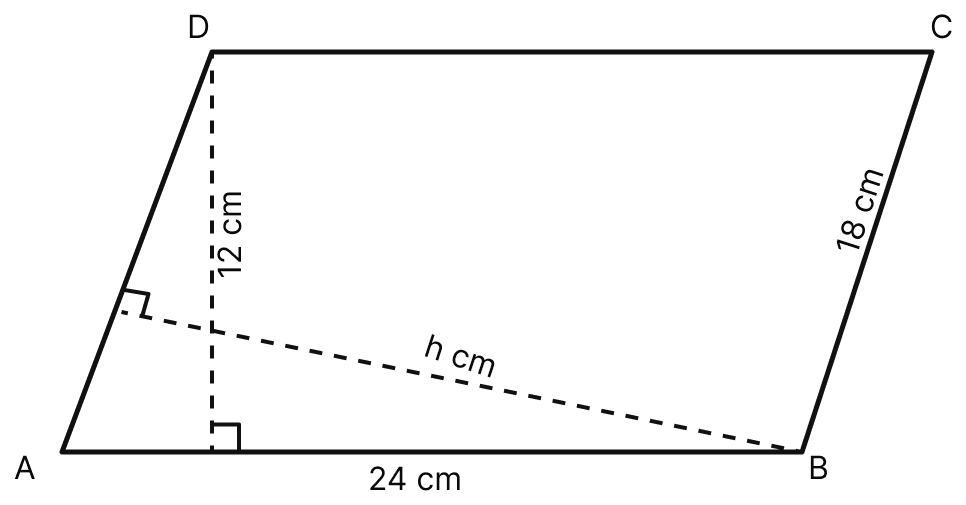
Taking 18 cm as the base,
Area of the parallelogram = 18 × h cm2
⇒ 18 × h = 288
⇒ h =
⇒ h = 16 cm
Hence, the distance between the shorter sides is 16 cm.
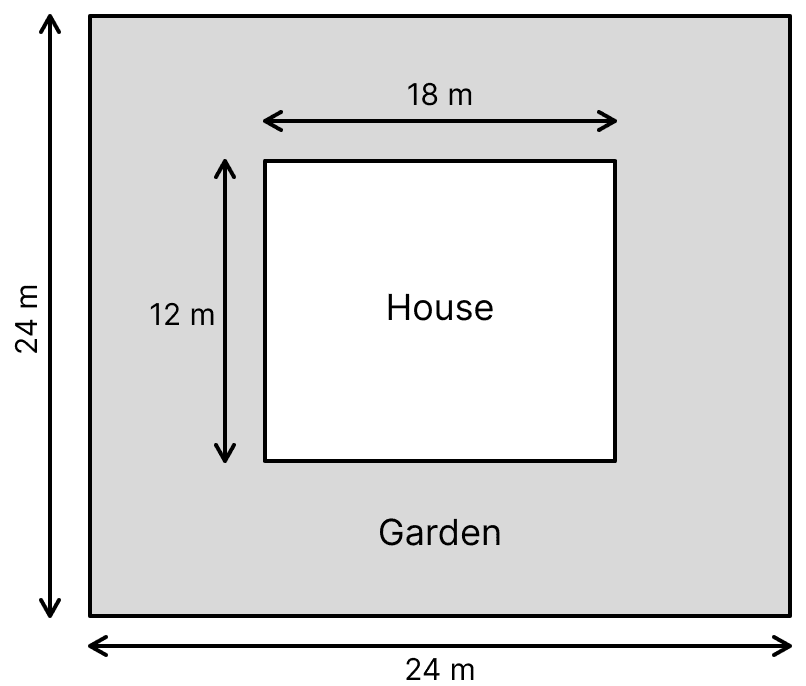
Rajesh has a square plot with the measurement as shown in the adjoining figure. He wants to construct a house in the middle of the plot. A garden is developed around the house. Find the total cost of developing a garden around the house at the rate of ₹200 per m2.
Answer
Given,
Side of the square plot = 24 m
Length of the house = 18 m
Breadth of the house = 12 m
By formula,
Area of a square = side2
Area of the square plot = (24)2 m2
= 576 m2
By formula,
Area of a rectangle = length × breadth
Area covered by the house = 18 × 12 m2
= 216 m2
Area of the garden = Area of the plot - Area covered by the house
= 576 - 216 m2
= 360 m2
Cost of developing the garden = Area of the garden × Rate
= 360 m2 × ₹200/m2
= ₹72,000
Hence, the total cost of developing the garden around the house is ₹72,000.
A flooring tile has a shape of parallelogram whose base is 18 cm and the corresponding height is 6 cm. How many such tiles are required to cover a floor of area 540 m2? (If required you can split the tiles in whatever way you want to fill up the corners).
Answer
Given,
Base of the parallelogram shaped tile = 18 cm
Corresponding height of the tile = 6 cm
By formula,
Area of a parallelogram = base × height
Area of one tile = 18 × 6 cm2
= 108 cm2
Area of the floor = 540 m2
Converting the area of the floor into square centimetres,
Area of the floor = 540 × 10000 cm2
= 5400000 cm2
Hence, 50000 tiles are required to cover the floor.
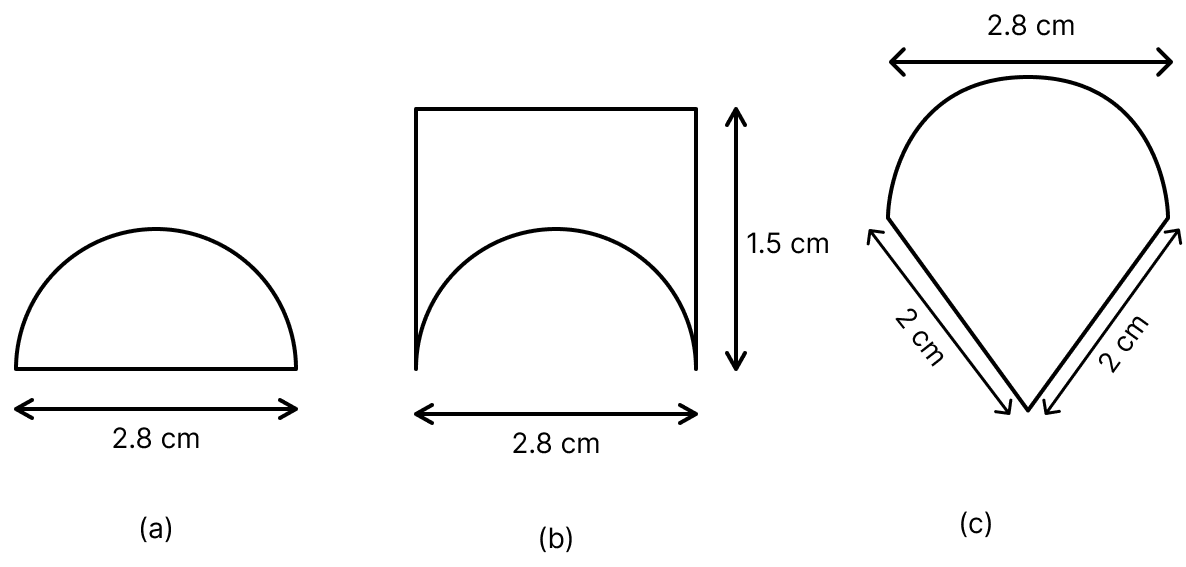
An ant is moving around a few food pieces of different shapes scattered on the floor. For which food piece would the ant have to take a longer round?
Answer
The ant has to move along the boundary of each food piece. So, we find the perimeter of each of the three shapes.
(a) The boundary of this food piece consists of a semicircular arc of diameter 2.8 cm and a straight side of length 2.8 cm.
Radius of the semicircle = cm = 1.4 cm
Length of the semicircular arc = πr
= x 1.4 cm
= 4.4 cm
Perimeter of the food piece = 4.4 + 2.8 cm
= 7.2 cm
(b) The boundary of this food piece consists of a semicircular arc of diameter 2.8 cm, two straight sides of length 1.5 cm each and a straight side of length 2.8 cm.
Length of the semicircular arc = 4.4 cm
Perimeter of the food piece = 4.4 + 1.5 + 1.5 + 2.8 cm
= 10.2 cm
(c) The boundary of this food piece consists of a semicircular arc of diameter 2.8 cm and two straight sides of length 2 cm each.
Length of the semicircular arc = 4.4 cm
Perimeter of the food piece = 4.4 + 2 + 2 cm
= 8.4 cm
On comparing the three perimeters, 10.2 cm is the greatest.
Hence, the ant has to take a longer round for the food piece (b).
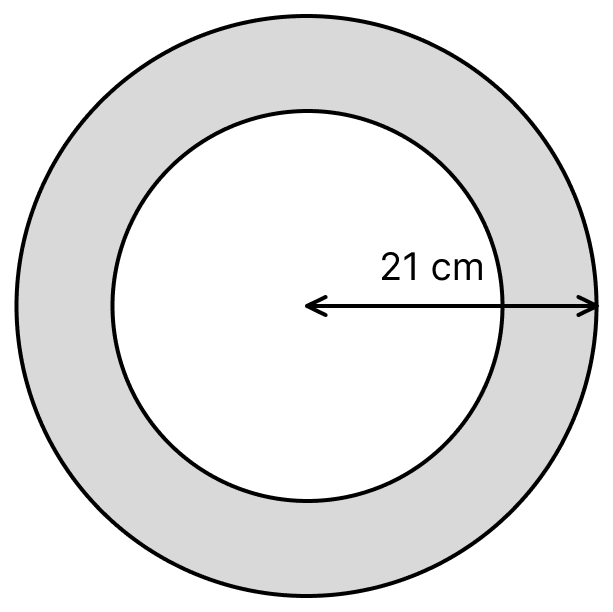
In the adjoining figure, the area enclosed between the concentric circles is 770 cm2. If the radius of the outer circle is 21 cm, calculate the radius of the inner circle.
Answer
Given,
Area enclosed between the concentric circles = 770 cm2
Radius of the outer circle (R) = 21 cm
Let the radius of the inner circle be r cm.
Area enclosed between the circles = Area of the outer circle - Area of the inner circle
⇒ πR2 - πr2 = 770
⇒ π(R2 - r2) = 770
⇒ × (212 - r2) = 770
⇒ 212 - r2 =
⇒ 441 - r2 = 245
⇒ r2 = 441 - 245
⇒ r2 = 196
⇒ r =
⇒ r = 14
Hence, the radius of the inner circle is 14 cm.
A copper wire when bent in the form of a square encloses an area of 121 cm2. If the same wire is bent into the form of a circle, find the area of the circle.
Answer
Given,
Area enclosed by the wire when bent in the form of a square = 121 cm2
Let the side of the square be a cm.
By formula,
Area of a square = side2
⇒ a2 = 121
⇒ a =
⇒ a = 11 cm
Length of the wire = Perimeter of the square
= 4 × side
= 4 × 11 cm
= 44 cm
When the same wire is bent into the form of a circle, the length of the wire becomes the circumference of the circle.
Let the radius of the circle be r cm.
By formula,
Area of a circle = πr2
Hence, the area of the circle is 154 cm2.
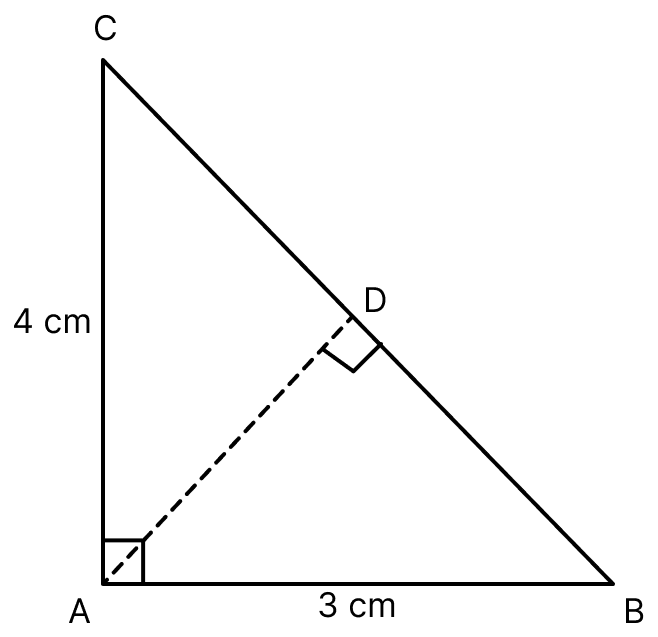
From the adjoining figure, find
(i) the area of ΔABC
(ii) length of BC
(iii) the length of altitude from A to BC
Answer
(i) From the figure, ΔABC is a right-angled triangle, right angled at A.
Base of the triangle, AB = 3 cm
Height of the triangle, AC = 4 cm
By formula,
Area of a triangle = × base × height
= x 3 x 4 cm2
= x 12 cm2
= 6 cm2
Hence, the area of ΔABC is 6 cm2.
(ii) In right-angled triangle ABC, BC is the hypotenuse.
By Pythagoras theorem,
Base2 + Height2 = Hypotenuse2
⇒ AB2 + AC2 = BC2
⇒ (3)2 + (4)2 = BC2
⇒ 9 + 16 = BC2
⇒ BC2 = 25
⇒ BC =
⇒ BC = 5 cm
Hence, the length of BC is 5 cm.
(iii) Let the length of the altitude AD from A to BC be h cm.
Taking BC as the base,
Area of ΔABC = × BC × AD
[∵ Both the products give the area of the same triangle.]
⇒ x 5 x h = 6
⇒ 5 × h = 2 × 6
⇒ 5 × h = 12
⇒ h =
⇒ h = 2.4 cm
Hence, the length of the altitude from A to BC is 2.4 cm.
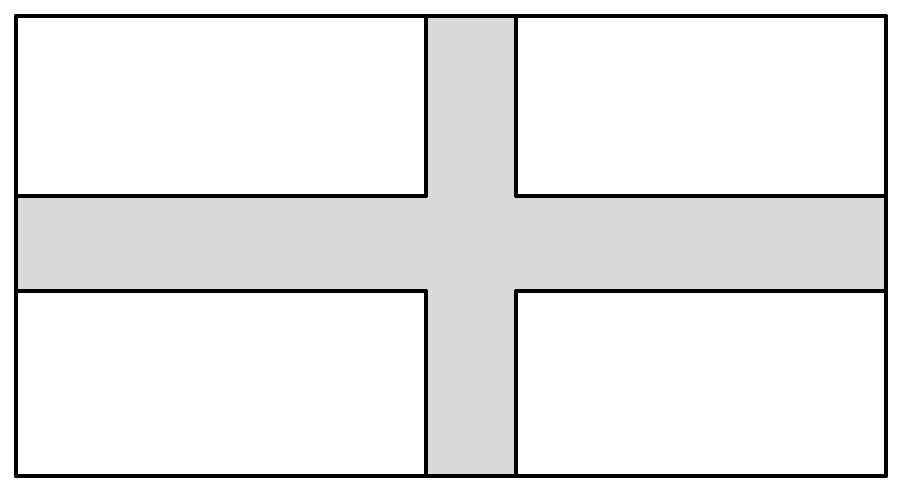
A rectangular garden 80 m by 40 m is divided into four equal parts by two cross-paths 2.5 m wide. Find
(i) the area of the cross-paths.
(ii) the area of the unshaded portion
Answer
Given,
Length of the rectangular garden = 80 m
Breadth of the rectangular garden = 40 m
Width of each cross-path = 2.5 m
(i) The two cross-paths are rectangles which cross each other, and the square where they cross is common to both of them.
Area of the path along the length = 80 × 2.5 m2
= 200 m2
Area of the path along the breadth = 40 × 2.5 m2
= 100 m2
Area of the common square portion = 2.5 × 2.5 m2
= 6.25 m2
Area of the cross-paths = 200 + 100 - 6.25 m2
= 293.75 m2
Hence, the area of the cross-paths is 293.75 m2.
(ii) Area of the garden = length × breadth
= 80 × 40 m2
= 3200 m2
Area of the unshaded portion = Area of the garden - Area of the cross-paths
= 3200 - 293.75 m2
= 2906.25 m2
Hence, the area of the unshaded portion is 2906.25 m2.
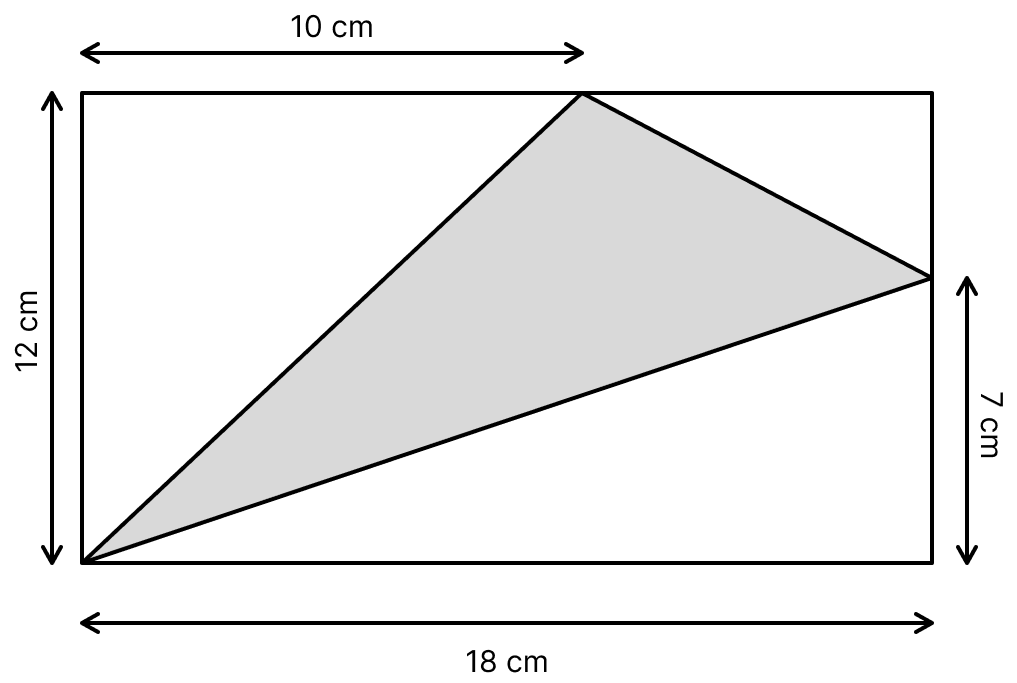
In the adjoining figure ABCD is a rectangle. Find the area of the shaded region.
Answer
Given,
Length of rectangle ABCD = 18 cm
Breadth of rectangle ABCD = 12 cm
By formula,
Area of a rectangle = length × breadth
Area of rectangle ABCD = 18 × 12 cm2
= 216 cm2
The three unshaded triangles are right-angled triangles.
By formula,
Area of a triangle = × base × height
Area of the upper left triangle = × 10 × 12 cm2
= 60 cm2
Area of the upper right triangle = × (18 - 10) × (12 - 7) cm2
= × 8 × 5 cm2
= 20 cm2
Area of the lower triangle = × 18 × 7 cm2
= 63 cm2
Area of the shaded region = Area of rectangle ABCD - Sum of the areas of the three triangles
= 216 - (60 + 20 + 63) cm2
= 216 - 143 cm2
= 73 cm2
Hence, the area of the shaded region is 73 cm2.
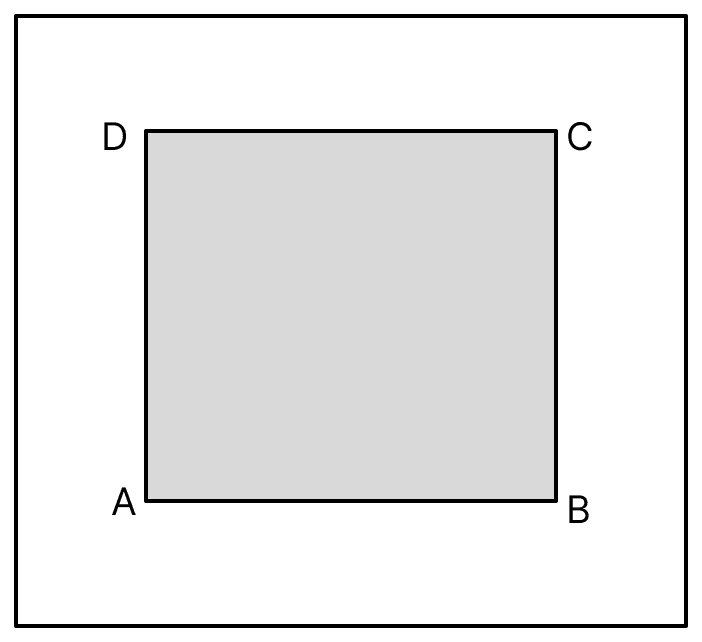
In the adjoining figure, ABCD is a square grassy lawn of area 729 m2. A path of uniform width runs all around it. If the area of the path is 295 m2, find
(i) the width of the path
(ii) the length of the boundary of the square field enclosing the lawn and the path
Answer
Given,
Area of the square grassy lawn ABCD = 729 m2
Area of the path = 295 m2
(i) Let the side of the square lawn be a metres.
By formula,
Area of a square = side2
⇒ a2 = 729
⇒ a =
⇒ a = 27 m
Area of the square field enclosing the lawn and the path = Area of the lawn + Area of the path
= 729 + 295 m2
= 1024 m2
Let the side of this bigger square field be b metres.
⇒ b2 = 1024
⇒ b =
⇒ b = 32 m
The path of uniform width runs all around the lawn, so it lies on both sides of the lawn.
Width of the path = m
= m
= 2.5 m
Hence, the width of the path is 2.5 m.
(ii) Length of the boundary of the square field = Perimeter of the bigger square
= 4 × side
= 4 × 32 m
= 128 m
Hence, the length of the boundary of the square field enclosing the lawn and the path is 128 m.