
In a pentagonal pyramid number of faces, vertices and edges are
F = 6, V = 6, E = 10
F = 7, V = 7, E = 12
F = 6, V = 8, E = 12
none of these
Answer
A pentagonal pyramid is a pyramid whose base is a pentagon.
Its faces are the pentagonal base and the 5 triangular lateral faces.
Number of faces, F = 1 + 5 = 6
Its vertices are the 5 vertices of the pentagonal base and the apex.
Number of vertices, V = 5 + 1 = 6
Its edges are the 5 edges of the pentagonal base and the 5 slant edges.
Number of edges, E = 5 + 5 = 10
Hence, option 1 is the correct option.
Point (-10, 0) lies
on the negative direction of x-axis
in the third quadrant
on the negative direction of y-axis
in the fourth quadrant
Answer
For the point (-10, 0), the abscissa is -10 and the ordinate is 0.
Since the ordinate is 0, the point lies on the x-axis.
Since the abscissa is negative, the point lies to the left of the origin.
Hence, option 1 is the correct option.
If the area of a semicircular region is 308 cm2, find its diameter.
Answer
Given,
Area of the semicircular region = 308 cm2
Let the radius of the semicircular region be cm.
By formula,
Area of a semicircle =
So, radius of the semicircular region = 14 cm
Diameter of the semicircular region = 2 × radius
= 2 × 14 cm
= 28 cm
Hence, the diameter of the semicircular region is 28 cm.
The area of a trapezium is 96 cm2. If the lengths of its two parallel sides are 14 cm and 10 cm, then find the perpendicular distance between parallel sides.
Answer
Given,
Area of the trapezium = 96 cm2
Lengths of the two parallel sides = 14 cm and 10 cm
Let the perpendicular distance between the parallel sides be cm.
By formula,
Area of a trapezium = × sum of parallel sides × distance between the parallel sides
⇒
⇒
⇒ 12 × = 96
⇒
⇒ = 8 cm
Hence, the perpendicular distance between the parallel sides is 8 cm.
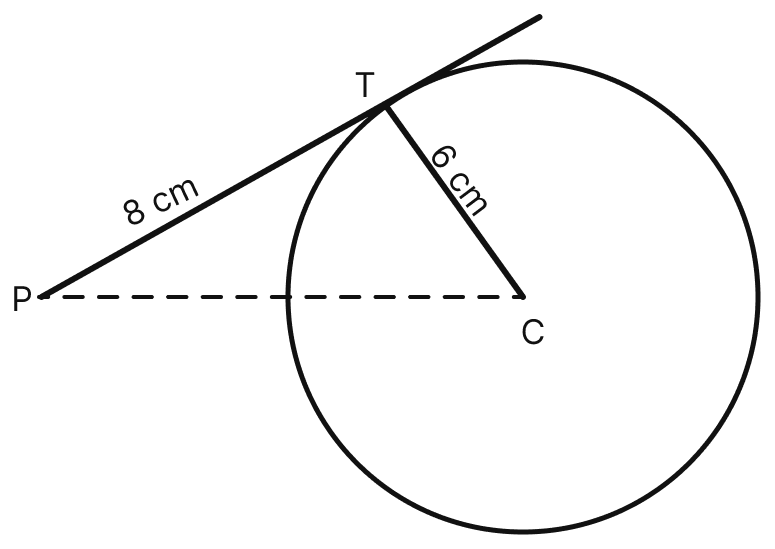
In the adjoining figure, C is the centre of the circle. The tangent to the circle of radius 6 cm from a point P outside the circle is of length 8 cm. Find the distance of the point P from the farthest point of the circumference.
Answer
Given,
Radius of the circle = 6 cm
Length of the tangent from P to the circle = 8 cm
Let the tangent touch the circle at the point T.
As we know, the tangent at any point of a circle is perpendicular to the radius through the point of contact.
So, ∠CTP = 90°.
In right-angled triangle CTP, CP is the hypotenuse.
By Pythagoras theorem,
⇒ CT2 + TP2 = CP2
⇒ (6)2 + (8)2 = CP2
⇒ 36 + 64 = CP2
⇒ CP2 = 100
⇒ CP =
⇒ CP = 10 cm
The farthest point of the circumference from P lies on the line CP produced beyond the centre C, at a distance equal to the radius from C.
Distance of P from the farthest point of the circumference = CP + radius
= 10 + 6 cm
= 16 cm
Hence, the distance of the point P from the farthest point of the circumference is 16 cm.
Construct a quadrilateral PQRS in which PQ = 5.5 cm, RS = 6.5 cm, PS = 4.4 cm, PR = 6.5 cm and QS = 7.1 cm
Answer
Steps of construction:
Draw PQ = 5.5 cm.
Taking P as centre, draw an arc of radius 4.4 cm and taking Q as centre, draw one more arc of radius 7.1 cm. Let these two arcs intersect at point S.
Join PS and QS.
Taking P as centre, draw an arc of radius 6.5 cm on the same side of PS as Q and taking S as centre, draw one more arc of radius 6.5 cm. Let these two arcs intersect at point R.
Join PR, QR and SR.
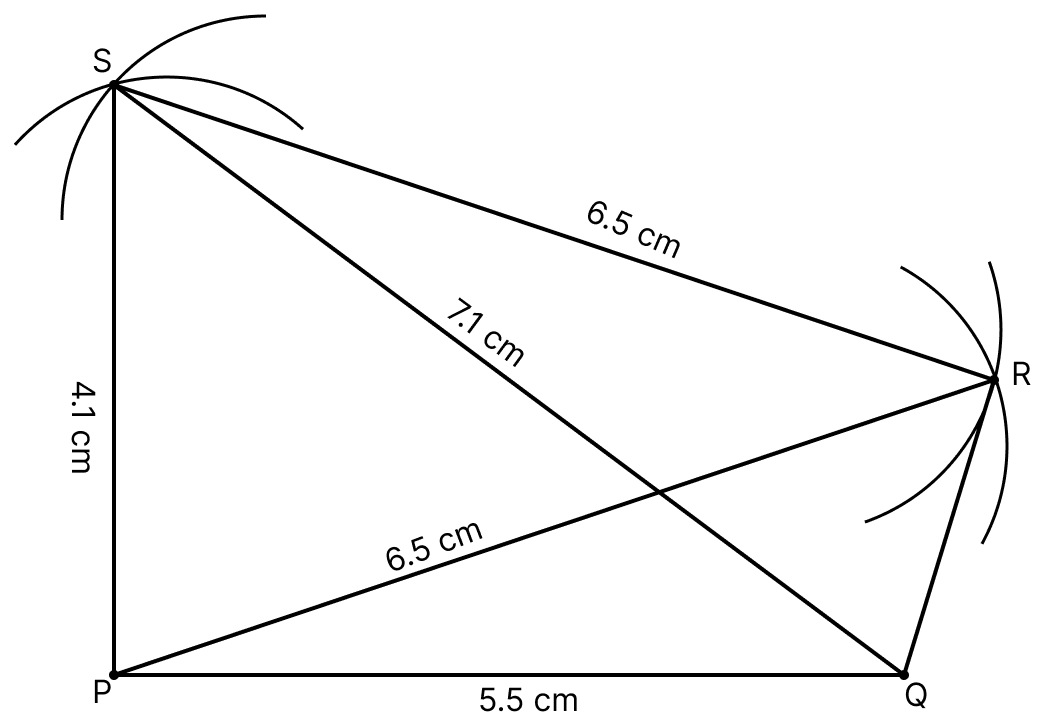
Hence, PQRS is the required quadrilateral.
The length, breadth and height of cuboidal water tank is 7 m, 6 m and 2 m respectively. If 4200 litre of water is pumped out from the tank. Find the fall in water level in the tank.
Answer
Given,
Length of the cuboidal water tank = 7 m
Breadth of the cuboidal water tank = 6 m
Height of the cuboidal water tank = 2 m
Volume of water pumped out = 4200 litres
Converting the volume of water into cubic metres,
Volume of water pumped out = m3
[∵ 1 m3 = 1000 litres]
= 4.2 m3
By formula,
Volume of a cuboid = length × breadth × height
Let the fall in the water level be h metres.
⇒ 7 × 6 × h = 4.2
⇒ 42 × h = 4.2
⇒ h =
⇒ h = 0.1 m
Converting the fall in the water level into centimetres,
Fall in the water level = 0.1 × 100 cm = 10 cm
Hence, the fall in the water level in the tank is 10 cm.
Construct a rhombus PQRS such that PQ = 5.4 cm and ∠P = 60°. Also draw its lines of symmetry.
Answer
We know that,
All the sides of a rhombus are equal.
So, PQ = QR = RS = SP = 5.4 cm
Steps of construction:
Draw PQ = 5.4 cm.
At P, construct ∠XPQ = 60°. From PX cut off PS = 5.4 cm.
Taking Q as centre, draw an arc of radius 5.4 cm (= QR) and taking S as centre, draw one more arc of radius 5.4 cm (= SR). Let these two arcs intersect at point R.
Join QR and SR.
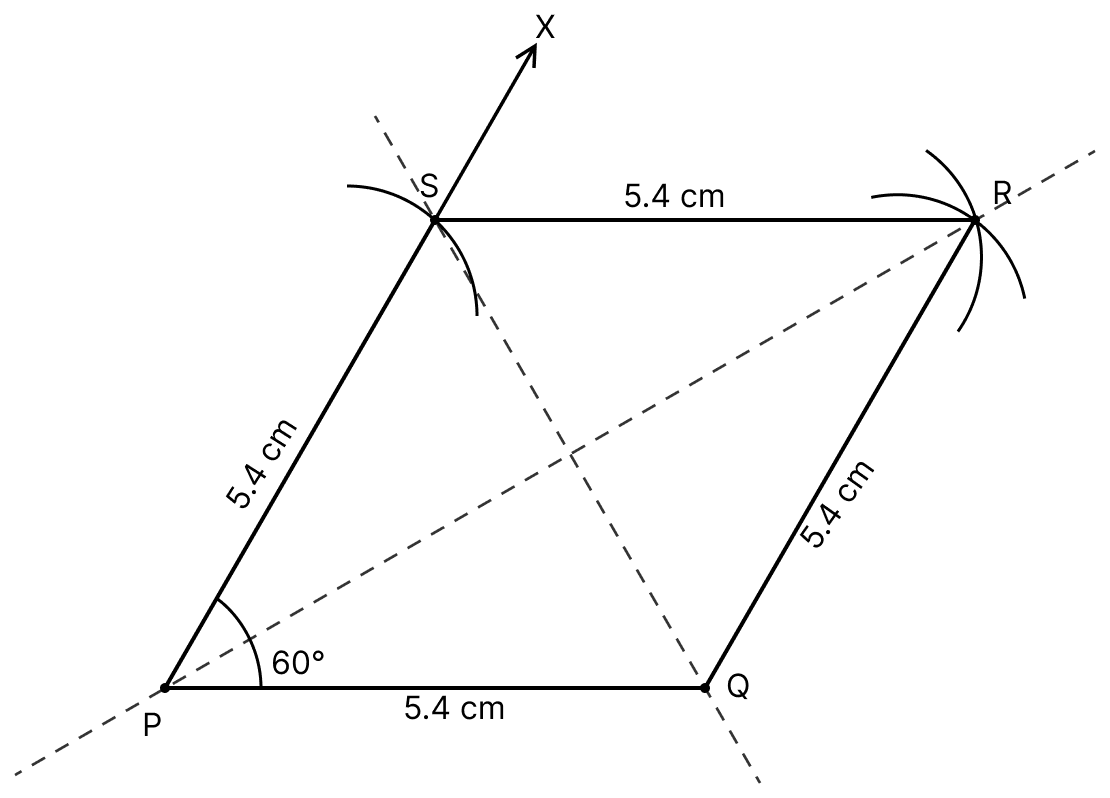
A rhombus has two lines of symmetry — its diagonals PR and QS. They are shown by the dotted line in the figure above.
Hence, PQRS is the required rhombus and it has 2 lines of symmetry.
A road roller has a diameter 84 cm and its width is 1.2 m. If it takes 500 complete revolutions to level a playground, find the area of the playground. Also find the cost of levelling the playground at the rate of ₹2.50 paise per m2
Answer
Given,
Diameter of the road roller = 84 cm
Width of the road roller = 1.2 m
Number of complete revolutions = 500
Rate of levelling = ₹2.50 per m2
Radius of the roller = cm = 42 cm = 0.42 m
In one complete revolution, the roller levels an area equal to its curved surface area.
As we know, curved surface area of a cylinder = 2πrh
= 2 x 22 x 0.06 x 1.2
= 3.168
So, area levelled in one revolution = 3.168 m2
Area of the playground = Area levelled in one revolution × Number of revolutions
= 3.168 × 500 m2
= 1584 m2
Cost of levelling the playground = Area of the playground × Rate
= ₹1584 × 2.50
= ₹3,960
Hence, the area of the playground is 1584 m2 and the cost of levelling it is ₹3,960.
Construct a rectangle ABCD, such that AB = 6.4 cm and BD = 7.6 cm
Answer
We know that,
Each angle of a rectangle is a right angle and its opposite sides are equal.
So, ∠DAB = 90° and DC = AB = 6.4 cm.
Steps of construction:
Draw a line segment AB = 6.4 cm.
At A, construct ∠XAB = 90°.
Taking B as centre, draw an arc of radius 7.6 cm (= BD). Let it cut AX at point D.
At B, construct ∠YBA = 90°.
Taking D as centre, draw an arc of radius 6.4 cm (= DC). Let it cut BY at point C.
Join DC.
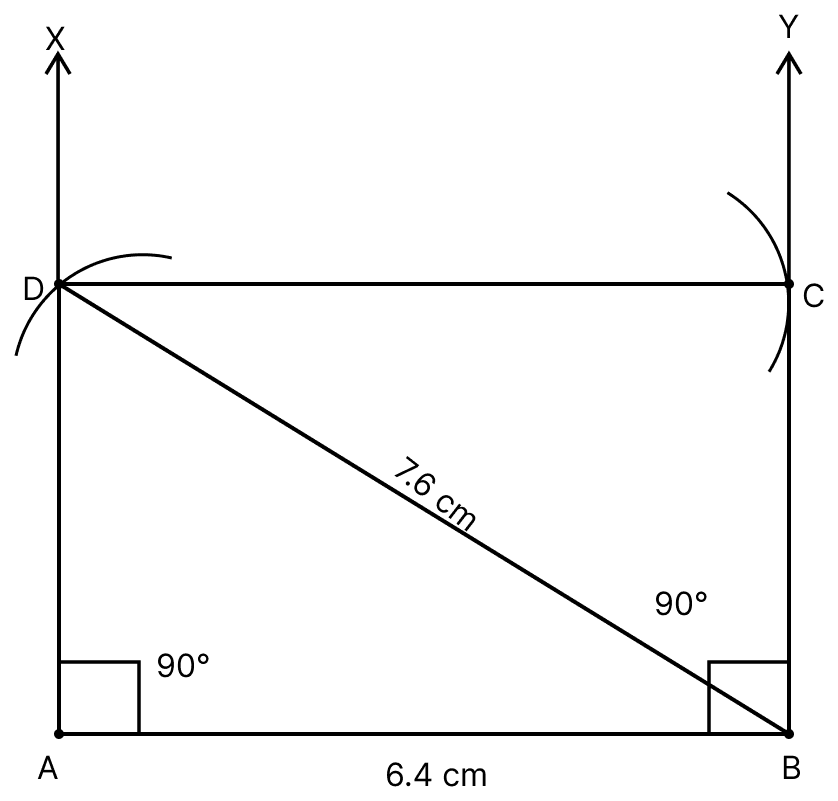
Hence, ABCD is the required rectangle.