
Statement I: A chord of a circle passing through its centre is called a diameter.
Statement II: Diameter = 2 × radius.
Statement I is true but Statement II is false.
Statement I is false but Statement II is true.
Both Statement I and Statement II are true.
Both Statement I and Statement II are false.
Answer
A chord of a circle which passes through the centre of the circle is called a diameter of the circle.
So, statement I is true.
A diameter of a circle is made up of two radii lying on the same straight line, so its length is twice the radius of the circle.
⇒ Diameter = 2 × radius
So, statement II is true.
∴ Both statement I and statement II are true.
Hence, option 3 is the correct option.
Statement I: In the adjoining figure, AB is the diameter. If the radius of the circle is 5 cm and PB = 6 cm, then AP = 7 cm.
Statement II: The arc = the arc .
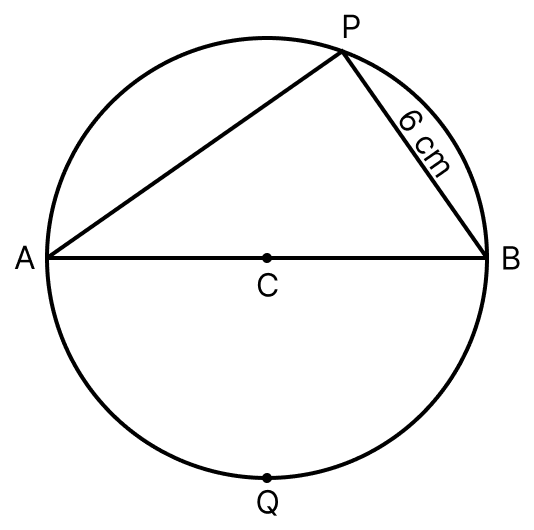
Statement I is true but Statement II is false.
Statement I is false but Statement II is true.
Both Statement I and Statement II are true.
Both Statement I and Statement II are false.
Answer
Given, the radius of the circle = 5 cm and PB = 6 cm.
As we know that the diameter is twice the radius.
⇒ AB = 2 × 5
⇒ AB = 10 cm
We know that,
Angle in a semicircle is a right angle.
⇒ ∠APB = 90°
In ∆APB, using Pythagoras theorem,
⇒ AP2 + PB2 = AB2
⇒ AP2 + 62 = 102
⇒ AP2 + 36 = 100
⇒ AP2 = 100 - 36
⇒ AP2 = 64
⇒ AP =
⇒ AP = 8 cm
So, statement I is false.
Since AB is the diameter of the circle, it divides the circle into two equal arcs and each of these arcs is a semicircle.
⇒ arc APB = arc AQB
So, statement II is true.
∴ Statement I is false but statement II is true.
Hence, option 2 is the correct option.