
A square field of side 65 m and rectangular field of length 75 m have the same perimeter. Which field has a larger area and by how much?
Answer
Given,
Side of the square field = 65 m
Length of the rectangular field = 75 m
Both the fields have the same perimeter.
By formula,
Perimeter of a square = 4 × side
Perimeter of the square field = 4 × 65 m
= 260 m
Let the breadth of the rectangular field be b metres.
By formula,
Perimeter of a rectangle = 2(length + breadth)
⇒ 2(75 + b) = 260
⇒ 75 + b =
⇒ 75 + b = 130
⇒ b = 130 - 75
⇒ b = 55 m
By formula,
Area of a square = side2
Area of the square field = (65)2 m2
= 4225 m2
By formula,
Area of a rectangle = length × breadth
Area of the rectangular field = 75 × 55 m2
= 4125 m2
Since 4225 m2 is greater than 4125 m2, the square field has a larger area.
Difference of the areas = 4225 - 4125 m2
= 100 m2
Hence, the square field has a larger area, by 100 m2.
A table top is shaped as a trapezium. Find its area if the parallel sides are 1.5 m and 2.5 m and perpendicular distance between them is 0.8 m.
Answer
Given,
Parallel sides of the trapezium shaped table top = 1.5 m and 2.5 m
Perpendicular distance between the parallel sides = 0.8 m
By formula,
Area of a trapezium = × sum of parallel sides × distance between the parallel sides
= × (1.5 + 2.5) × 0.8 m2
= × 4 × 0.8 m2
= 2 × 0.8 m2
= 1.6 m2
Hence, the area of the table top is 1.6 m2.
The length and breadth of a rectangular hall of a school are 26 m and 22 m respectively. If one student requires 1.1 sq. m area, then find the maximum number of students to be seated in this hall.
Answer
Given,
Length of the rectangular hall = 26 m
Breadth of the rectangular hall = 22 m
Area required by one student = 1.1 sq. m
By formula,
Area of a rectangle = length × breadth
Area of the hall = 26 × 22 m2
= 572 m2
Hence, the maximum number of students that can be seated in the hall is 520.
It costs ₹9360 to fence a square field at ₹78 per metre. Find the cost of levelling the field at ₹25 per square metre.
Answer
Given,
Total cost of fencing the square field = ₹9360
Rate of fencing = ₹78 per metre
Perimeter of the field =
= m
= 120 m
Let the side of the square field be a metres.
By formula,
Perimeter of a square = 4 × side
⇒ 4 × a = 120
⇒ a =
⇒ a = 30 m
By formula,
Area of a square = side2
= (30)2 m2
= 900 m2
Cost of levelling the field = Area of the field × Rate of levelling
= 900 m2 × ₹25/m2
= ₹22,500
Hence, the cost of levelling the field is ₹22,500.
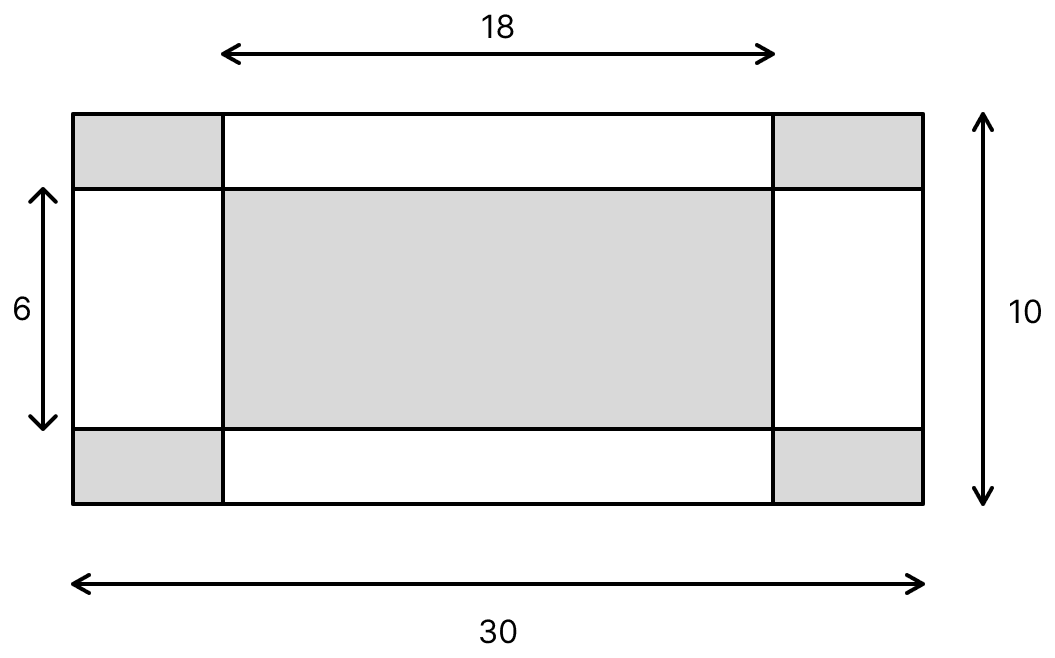
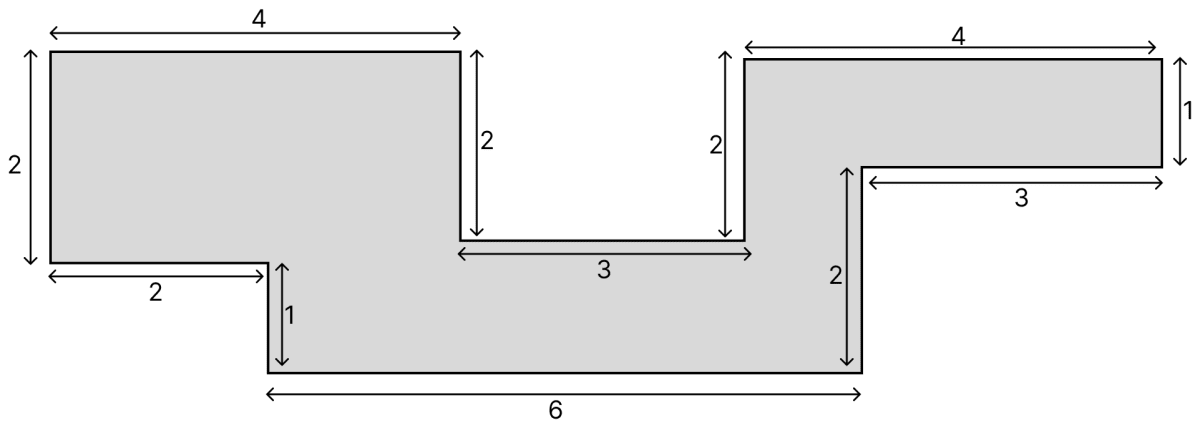
Find the area of the shaded portion in the following figures all measurements are given in cm.
(i)
(ii)
Answer
(i) From the figure, the shaded portion consists of the central rectangle and the four small rectangles at the corners.
The outer rectangle is 30 cm long and 10 cm wide, and the central shaded rectangle is 18 cm long and 6 cm wide.
Length of each corner rectangle = cm
= cm
= 6 cm
Breadth of each corner rectangle = cm
= cm
= 2 cm
By formula,
Area of a rectangle = length × breadth
Area of the central rectangle = 18 × 6 cm2
= 108 cm2
Area of one corner rectangle = 6 × 2 cm2
= 12 cm2
Area of the four corner rectangles = 4 × 12 cm2
= 48 cm2
Area of the shaded portion = 108 + 48 cm2
= 156 cm2
Hence, the area of the shaded portion is 156 cm2.
(ii) The given shaded figure can be divided into three portions, as shown below.
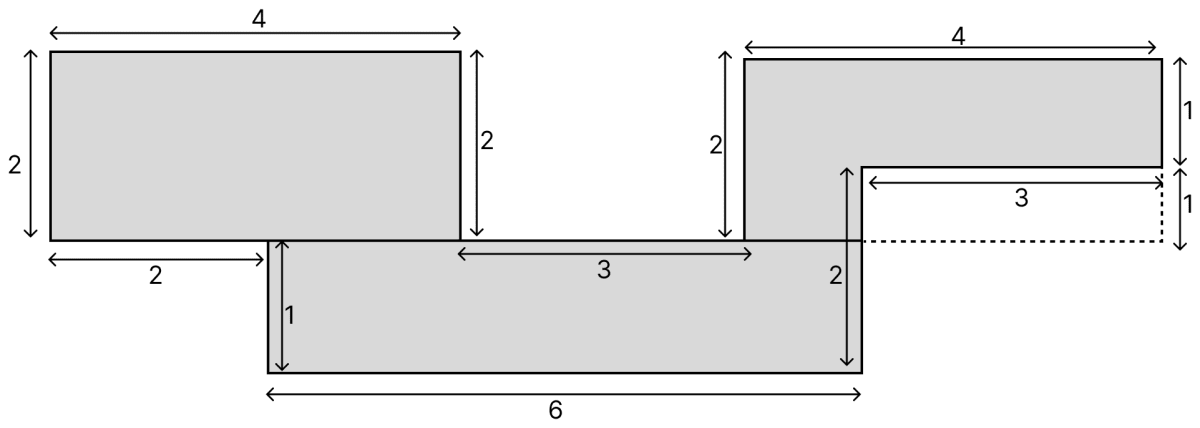
The first portion is a rectangle 4 cm long and 2 cm wide.
The second portion is a rectangle 6 cm long and 1 cm wide.
The third portion is a rectangle 4 cm long and 2 cm wide from which a rectangle 3 cm long and 1 cm wide has been removed.
By formula,
Area of a rectangle = length × breadth
Area of the first portion = 4 × 2 cm2
= 8 cm2
Area of the second portion = 6 × 1 cm2
= 6 cm2
Area of the third portion = (4 × 2) - (3 × 1) cm2
= 8 - 3 cm2
= 5 cm2
Area of the shaded portion = 8 + 6 + 5 cm2
= 19 cm2
Hence, the area of the shaded portion is 19 cm2.
Area of a trapezium is 160 sq. cm. Lengths of parallel sides are in the ratio 1 : 3. If smaller of the parallel sides is 10 cm in length, then find the perpendicular distance between them.
Answer
Given,
Area of the trapezium = 160 sq. cm
The lengths of the parallel sides are in the ratio 1 : 3.
Length of the smaller parallel side = 10 cm
Since the parallel sides are in the ratio 1 : 3,
Length of the larger parallel side = 3 × 10 cm
= 30 cm
Let the perpendicular distance between the parallel sides be h cm.
By formula,
Area of a trapezium = × sum of parallel sides × distance between the parallel sides
⇒ x (10 + 30) x h = 160
⇒ x 40 x h = 160
⇒ 20 × h = 160
⇒ h =
⇒ h = 8 cm
Hence, the perpendicular distance between the parallel sides is 8 cm.
The area of a trapezium is 729 cm2 and the distance between two parallel sides is 18 cm. If one of its parallel sides is 3 cm shorter than the other parallel side, find the lengths of its parallel sides.
Answer
Given,
Area of the trapezium = 729 cm2
Distance between the two parallel sides = 18 cm
One parallel side is 3 cm shorter than the other parallel side.
Let the longer parallel side be a cm.
Then, the shorter parallel side = (a - 3) cm
By formula,
Area of a trapezium = × sum of parallel sides × distance between the parallel sides
⇒ x (a + a - 3) x 18 = 729
⇒ (2a - 3) × 9 = 729
⇒ 2a - 3 =
⇒ 2a - 3 = 81
⇒ 2a = 81 + 3
⇒ 2a = 84
⇒ a =
⇒ a = 42 cm
So, the longer parallel side = 42 cm
And, the shorter parallel side = 42 - 3 cm = 39 cm
Hence, the lengths of the parallel sides of the trapezium are 39 cm and 42 cm.
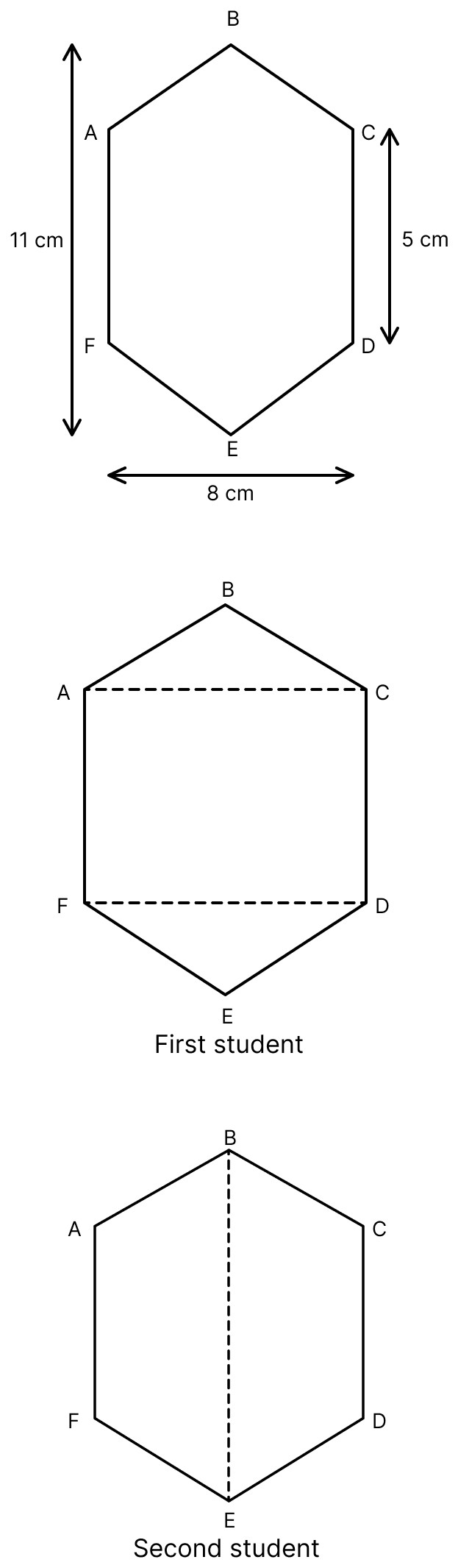
There is a hexagon ABCDEF of side 5 cm. Two students divided it in different ways. Find the area of this hexagon using both ways.
Answer
Given,
Side of the hexagon ABCDEF = 5 cm
From the figure, AC = FD = 8 cm and the distance between AC and FD is 5 cm.
The height of the hexagon, that is the distance between B and E is 11 cm.
First student's way:
The first student divides the hexagon into two triangles, ABC and FED, and a rectangle ACDF.
Total height = 11 cm
AF = 5 cm
From figure,
Height of each triangle = cm
= cm
= 3 cm
Height of triangle ABC = 3 cm
By formula,
Area of a triangle = × base × height
Area of triangle ABC = x 8 x 3 cm2
= 12 cm2
Area of triangle FED = 12 cm2
By formula,
Area of a rectangle = length × breadth
Area of rectangle ACDF = 8 × 5 cm2
= 40 cm2
Area of the hexagon = 12 + 12 + 40 cm2
= 64 cm2
Second student's way:
The second student divides the hexagon into two congruent trapeziums, ABEF and BCDE, by joining B and E.
In trapezium ABEF, the parallel sides are AF and BE.
Length of AF = 5 cm and length of BE = 11 cm
Distance between AF and BE = cm
= 4 cm
By formula,
Area of a trapezium = × sum of parallel sides × distance between the parallel sides
Area of trapezium ABEF = x (5 + 11) x 4 cm2
= x 16 x 4 cm2
= 32 cm2
Area of trapezium BCDE = 32 cm2
Area of the hexagon = 32 + 32 cm2
= 64 cm2
Hence, by both the ways the area of the hexagon is 64 cm2.
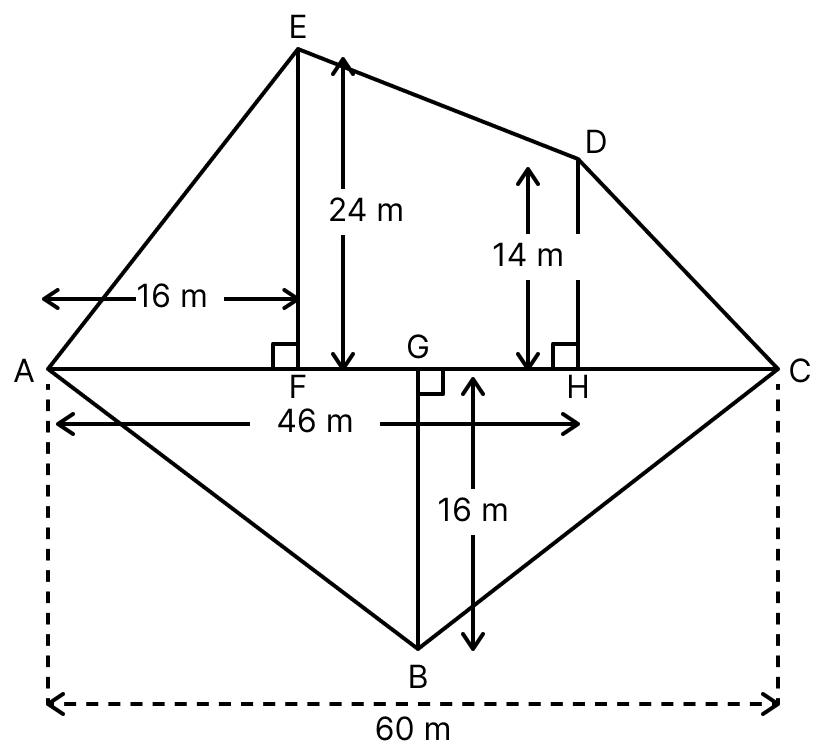
Find the area of the polygon given in the adjoining figure:
Answer
From the given figure,
AC = 60 m, AF = 16 m, AH = 46 m, EF = 24 m, DH = 14 m and BG = 16 m
The diagonal AC divides the polygon into two parts. EF, DH and BG are perpendiculars drawn on AC.
FH = AH - AF = 46 - 16 = 30 m
HC = AC - AH = 60 - 46 = 14 m
Area of the portion above AC:
By formula,
Area of a triangle = × base × height
Area of triangle AEF = x 16 x 24 m2
= 192 m2
By formula,
Area of a trapezium = × sum of parallel sides × distance between the parallel sides
Area of trapezium FEDH = x (24 + 14) x 30 m2
= x 38 x 30 m2
= 570 m2
Area of triangle DHC = x 14 x 14 m2
= 98 m2
Area of the portion below AC:
Area of triangle ABC = x 60 x 16 m2
= 480 m2
Area of the polygon = 192 + 570 + 98 + 480 m2
= 1340 m2
Hence, the area of the polygon is 1340 m2.
The diagonals of a rhombus are 16 m and 12 m, find:
(i) its area
(ii) length of a side
(iii) perimeter.
Answer
Given,
Diagonals of the rhombus = 16 m and 12 m
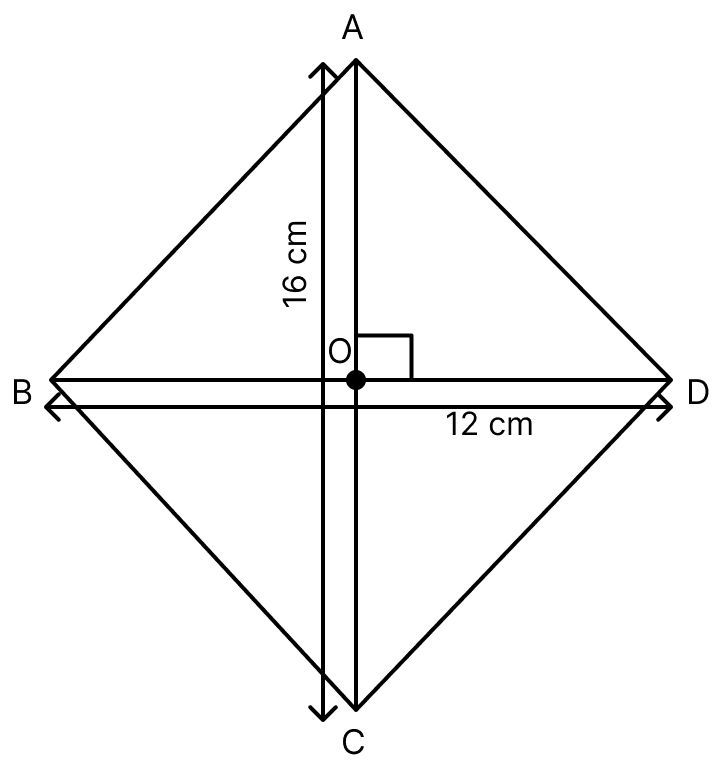
Let ABCD be the rhombus in which AC = 16 m and BD = 12 m. Let its diagonals meet at O.
(i) By formula,
Area of a rhombus = × product of its diagonals
= x 16 x 12 m2
= 8 × 12 m2
= 96 m2
Hence, the area of the rhombus is 96 m2.
(ii) As we know, the diagonals of a rhombus bisect each other at right angles.
OA = x 16 m = 8 m
OB = x 12 m = 6 m
In right-angled triangle AOB, AB is the hypotenuse.
By Pythagoras theorem,
OA2 + OB2 = AB2
⇒ (8)2 + (6)2 = AB2
⇒ 64 + 36 = AB2
⇒ AB2 = 100
⇒ AB =
⇒ AB = 10 m
Hence, the length of a side of the rhombus is 10 m.
(iii) By formula,
Perimeter of a rhombus = 4 × side
= 4 × 10 m
= 40 m
Hence, the perimeter of the rhombus is 40 m.
The area of a parallelogram is 98 cm2. If one altitude is half the corresponding base, determine the base and the altitude of the parallelogram.
Answer
Given,
Area of the parallelogram = 98 cm2
One altitude is half of the corresponding base.
Let the base of the parallelogram be b cm.
Then, the corresponding altitude = cm
By formula,
Area of a parallelogram = base × corresponding altitude
⇒ b x = 98
⇒ b2 = 2 × 98
⇒ b2 = 196
⇒ b =
⇒ b = 14 cm
So, the altitude of the parallelogram = cm = 7 cm
Hence, the base of the parallelogram is 14 cm and its altitude is 7 cm.
Preeti is painting the walls and ceiling of a hall whose dimensions are 18 m × 15 m × 5 m. From each can of paint 120 m2 of area is painted. How many cans of paint she need to paint the hall?
Answer
Given,
Dimensions of the hall = 18 m × 15 m × 5 m
Area painted by one can of paint = 120 m2
Here, length = 18 m, breadth = 15 m and height = 5 m.
By formula,
Area of four walls = 2(length + breadth) × height
= 2(18 + 15) × 5 m2
= 2 × 33 × 5 m2
= 330 m2
Area of the ceiling = length × breadth
= 18 × 15 m2
= 270 m2
Total area to be painted = 330 + 270 m2
= 600 m2
Number of cans of paint =
=
= 5
Hence, she needs 5 cans of paint to paint the hall.
A rectangular paper of size 22 cm × 14 cm is rolled to form a cylinder of height 14 cm, find the volume of the cylinder.
Answer
Given,
Size of the rectangular paper = 22 cm × 14 cm
Height of the cylinder formed = 14 cm
Since the height of the cylinder is 14 cm, the side of length 22 cm becomes the circumference of the base of the cylinder.
Let the radius of the base of the cylinder be r cm.
⇒ 2πr = 22
By formula,
Volume of a cylinder = πr2h
Hence, the volume of the cylinder is 539 cm3.
A closed rectangular wooden box has inner dimensions 90 cm by 80 cm by 70 cm. Compute its capacity and the area of the tin foil needed to line its inner surface.
Answer
Given,
Inner dimensions of the closed rectangular wooden box = 90 cm by 80 cm by 70 cm
Here, length = 90 cm, breadth = 80 cm and height = 70 cm.
By formula,
Volume of a cuboid = length × breadth × height
Capacity of the box = 90 × 80 × 70 cm3
= 504000 cm3
Since the box is closed, the tin foil is needed for all its six inner faces.
By formula,
Total surface area of a cuboid = 2(lb + bh + hl)
Area of the tin foil = 2(90 × 80 + 80 × 70 + 70 × 90) cm2
= 2(7200 + 5600 + 6300) cm2
= 2 × 19100 cm2
= 38200 cm2
Hence, the capacity of the box is 504000 cm3 and the area of the tin foil needed to line its inner surface is 38200 cm2.
The lateral surface area of a cuboid is 224 cm2. Its height is 7 cm and the base is a square. Find
(i) a side of the square base
(ii) the volume of the cuboid.
Answer
Given,
Lateral surface area of the cuboid = 224 cm2
Height of the cuboid = 7 cm
The base of the cuboid is a square.
(i) Let the length of the side of the square base be a cm.
Since the base is a square, length = breadth = a cm.
By formula,
Lateral surface area of a cuboid = 2(length + breadth) × height
⇒ 2(a + a) × 7 = 224
⇒ 2 × 2a × 7 = 224
⇒ 28a = 224
⇒ a =
⇒ a = 8 cm
Hence, the length of a side of the square base is 8 cm.
(ii) By formula,
Volume of a cuboid = length × breadth × height
= 8 × 8 × 7 cm3
= 448 cm3
Hence, the volume of the cuboid is 448 cm3.
The inner dimensions of a closed wooden box are 2 m by 1.2 m by 0.75 m. The thickness of the wood is 2.5 cm. Find the cost of wood required to make the box if 1 m3 of wood costs ₹27000.
Answer
Given,
Inner dimensions of the closed wooden box = 2 m by 1.2 m by 0.75 m
Thickness of the wood = 2.5 cm = 0.025 m
Since the box is closed, the wood is present on both the opposite faces in each direction. So, each inner dimension increases by 2 × 0.025 = 0.05 m.
Outer length = 2 + 0.05 m = 2.05 m
Outer breadth = 1.2 + 0.05 m = 1.25 m
Outer height = 0.75 + 0.05 m = 0.8 m
By formula,
Volume of a cuboid = length × breadth × height
Outer volume of the box = 2.05 × 1.25 × 0.8 m3
= 2.05 m3
Inner volume of the box = 2 × 1.2 × 0.75 m3
= 1.8 m3
Volume of the wood = Outer volume - Inner volume
= 2.05 - 1.8 m3
= 0.25 m3
Cost of the wood = Volume of the wood × Rate
= 0.25 m3 × ₹27000/m3
= ₹6,750
Hence, the cost of the wood required to make the box is ₹6,750.
A car has a petrol tank 40 cm long, 28 cm wide and 25 cm deep. If the full consumption of the car averages 13.5 km per litre, how far can the car travel with a full tank of petrol?
Answer
Given,
Length of the petrol tank = 40 cm
Width of the petrol tank = 28 cm
Depth of the petrol tank = 25 cm
Average consumption of the car = 13.5 km per litre
By formula,
Volume of a cuboid = length × breadth × height
Volume of the petrol tank = 40 × 28 × 25 cm3
= 28000 cm3
Converting the volume into litres,
Capacity of the tank = litres
[∵ 1 litre = 1000 cm3]
= 28 litres
Distance travelled = Capacity of the tank × Average consumption
= 28 × 13.5 km
= 378 km
Hence, the car can travel 378 km with a full tank of petrol.
The diameter of a garden roller is 1.4 m and it is 2 m long. How much area it will cover in 5 revolutions?
Answer
Given,
Diameter of the garden roller = 1.4 m
Length of the garden roller = 2 m
Radius of the roller = m = 0.7 m
In one complete revolution, the roller covers an area equal to its curved surface area.
By formula,
Curved surface area of a cylinder = 2πrh
So, area covered in one revolution = 8.8 m2
Area covered in 5 revolutions = 5 × 8.8 m2
= 44 m2
Hence, the roller will cover an area of 44 m2 in 5 revolutions.
The capacity of an open cylindrical tank is 2079 m3 and the diameter of its base is 21 m. Find the cost of plastering its inner surface at ₹40 per square metre.
Answer
Given,
Capacity of the open cylindrical tank = 2079 m3
Diameter of the base of the tank = 21 m
Radius of the base = m = 10.5 m
Let the height of the tank be h m.
By formula,
Volume of a cylinder = πr2h
So, height of the tank = 6 m
Since the tank is open at the top, its inner surface consists of the curved surface and the base.
By formula,
Curved surface area of a cylinder = 2πrh
So, curved surface area = 396 m2
By formula,
Area of a circle = πr2
So, area of the base = 346.5 m2
Inner surface area to be plastered = 396 + 346.5 m2
= 742.5 m2
Cost of plastering = Inner surface area × Rate
= 742.5 m2 × ₹40/m2
= ₹29,700
Hence, the cost of plastering the inner surface of the tank is ₹29,700.
A solid right circular cylinder of height 1.21 m and diameter 28 cm is melted and recast into 7 equal solid cubes. Find the edge of each cube.
Answer
Given,
Height of the solid right circular cylinder = 1.21 m = 121 cm
Diameter of the cylinder = 28 cm
Number of equal solid cubes formed = 7
Radius of the cylinder = cm = 14 cm
By formula,
Volume of a cylinder = πr2h
Since the cylinder is melted and recast into 7 equal cubes, the total volume remains the same.
Volume of one cube = cm3
= 10648 cm3
Let the edge of each cube be a cm.
Volume of a cube = (edge)3
⇒ a3 = 10648
⇒ a =
⇒ a = 22 cm
Hence, the edge of each cube is 22 cm.
(i) How many cubic metres of soil must be dug out to make a well 20 m deep and 2 m in diameter?
(ii) If the inner curved surface of the well in part (i) above is to be plastered at the rate of ₹200 per m2, find the cost of plastering to the nearest hundred rupees.
Answer
Given,
Depth of the well = 20 m
Diameter of the well = 2 m
Radius of the well = m = 1 m
(i) The soil to be dug out occupies a cylindrical space of radius 1 m and height 20 m.
By formula,
Volume of a cylinder = πr2h
Hence, cubic metres of soil must be dug out.
(ii) The inner curved surface of the well is the curved surface of the cylinder.
By formula,
Curved surface area of a cylinder = 2πrh
So, inner curved surface area = m2
Cost of plastering = Inner curved surface area × Rate
= m2 × ₹200/m2
= ₹
= ₹25142.86 (approximately)
Rounding off to the nearest hundred rupees, the cost of plastering is ₹25,100.
Hence, the cost of plastering the inner curved surface of the well is ₹25,100.
The length of a room is 50% more than its breadth. The cost of carpeting the room at the rate of ₹385 per m2 is ₹9240 and the cost of papering the walls at ₹33 per m2 is ₹2145. If the room has one door of dimensions 1 m × 2 m and two windows each of dimensions 1m × 1.5 m, find the dimensions of the room.
Answer
Given,
The length of the room is 50% more than its breadth.
Cost of carpeting the room at ₹385 per m2 = ₹9240
Cost of papering the walls at ₹33 per m2 = ₹2145
The room has one door of dimensions 1 m × 2 m and two windows each of dimensions 1 m × 1.5 m.
Area of the floor =
= m2
= 24 m2
Let the breadth of the room be b metres.
Since the length is 50% more than the breadth,
Length of the room =
=
= metres
By formula,
Area of a rectangle = length × breadth
⇒
⇒ 3b2 = 48
⇒ b2 =
⇒ b2 = 16
⇒ b =
⇒ b = 4 m
So, breadth of the room = 4 m
And, length of the room = m = 6 m
Area of the walls papered =
= m2
= 65 m2
Area of the door = 1 × 2 m2
= 2 m2
Area of the two windows = 2 × (1 × 1.5) m2
= 3 m2
Let the height of the room be h metres.
By formula,
Area of four walls = 2(length + breadth) × height
Area of four walls - Area of the door - Area of the windows = Area of the walls papered
⇒ 2(6 + 4) × h - 2 - 3 = 65
⇒ 20h - 5 = 65
⇒ 20h = 65 + 5
⇒ 20h = 70
⇒ h =
⇒ h = 3.5 m
Hence, the dimensions of the room are 6 m × 4 m × 3.5 m.
The barrel of a fountain pen, cylindrical in shape, is 7 cm long and 5 mm in diameter. A full barrel of ink in the pen will be used up when writing 310 words on an average. How many words would use up a bottle of ink containing one-fifth of a litre? Answer correct to the nearest 100 words.
Answer
Given,
Length of the barrel of the fountain pen = 7 cm
Diameter of the barrel = 5 mm = 0.5 cm
A full barrel of ink is used up in writing 310 words.
Volume of the bottle of ink = one-fifth of a litre
Radius of the barrel = cm = 0.25 cm
By formula,
Volume of a cylinder = πr2h
So, volume of ink in a full barrel = 1.375 cm3
Volume of ink in the bottle = cm3
[∵ 1 litre = 1000 cm3]
= 200 cm3
Number of barrels that can be filled from the bottle =
=
=
Number of words =
=
= 45090.9 (approximately)
Rounding off to the nearest 100 words, the number of words is 45100.
Hence, about 45100 words would use up a bottle of ink containing one-fifth of a litre.
A cylindrical jar is 20 cm high with internal diameter 7 cm. An iron cube of edge 5 cm is immersed in the jar completely in the water which was originally 12 cm high. Find the rise in the level of water.
Answer
Given,
Height of the cylindrical jar = 20 cm
Internal diameter of the jar = 7 cm
Edge of the iron cube = 5 cm
Original height of the water = 12 cm
Radius of the jar = cm = 3.5 cm
By formula,
Volume of a cube = (edge)3
Volume of the iron cube = (5)3 cm3
= 125 cm3
When the cube is completely immersed, the volume of the water that rises is equal to the volume of the cube.
Let the rise in the level of water be h cm.
By formula,
Volume of a cylinder = πr2h
Hence, the rise in the level of water is cm.
Squares each of side 6 cm are cut off from the four corners of a sheet of tin measuring 42 cm by 30 cm. The remaining portion of the tin sheet is made into an open box by folding up the flaps. Find the capacity of the box.
Answer
Given,
Size of the tin sheet = 42 cm by 30 cm
Side of each square cut off from the corners = 6 cm
When squares of side 6 cm are cut off from the four corners and the flaps are folded up, the side of each square becomes the height of the open box, and each dimension of the sheet decreases by 6 cm at both the ends.
Length of the box = 42 - 6 - 6 cm
= 30 cm
Breadth of the box = 30 - 6 - 6 cm
= 18 cm
Height of the box = 6 cm
By formula,
Volume of a cuboid = length × breadth × height
Capacity of the box = 30 × 18 × 6 cm3
= 3240 cm3
Hence, the capacity of the box is 3240 cm3.