
Verify Euler's relation for a cuboid.
Answer
In a cuboid, we have
Number of faces = 6
Number of edges = 12
Number of vertices = 8
∴ F = 6, E = 12 and V = 8
∴ (F - E + V) = (6 - 12 + 8) = 2
Hence, Euler's relation is verified.
Verify Euler's relation for a triangular prism.
Answer
In a triangular prism, we have
Number of faces = 2 triangular + 3 rectangular = 5
Number of edges = 9
Number of vertices = 6
∴ F = 5, E = 9 and V = 6
∴ (F - E + V) = (5 - 9 + 6) = 2
Hence, Euler's relation is verified.
Verify Euler's relation for a square pyramid.
Answer
In a square pyramid, we have
Number of faces = 1 square + 4 triangular = 5
Number of edges = 8
Number of vertices = 5
∴ F = 5, E = 8 and V = 5
∴ (F - E + V) = (5 - 8 + 5) = 2
Hence, Euler's relation is verified.
Verify Euler's relation for a tetrahedron.
Answer
In a tetrahedron, we have
Number of faces = 4
Number of edges = 6
Number of vertices = 4
∴ F = 4, E = 6 and V = 4
∴ (F - E + V) = (4 - 6 + 4) = 2
Hence, Euler's relation is verified.
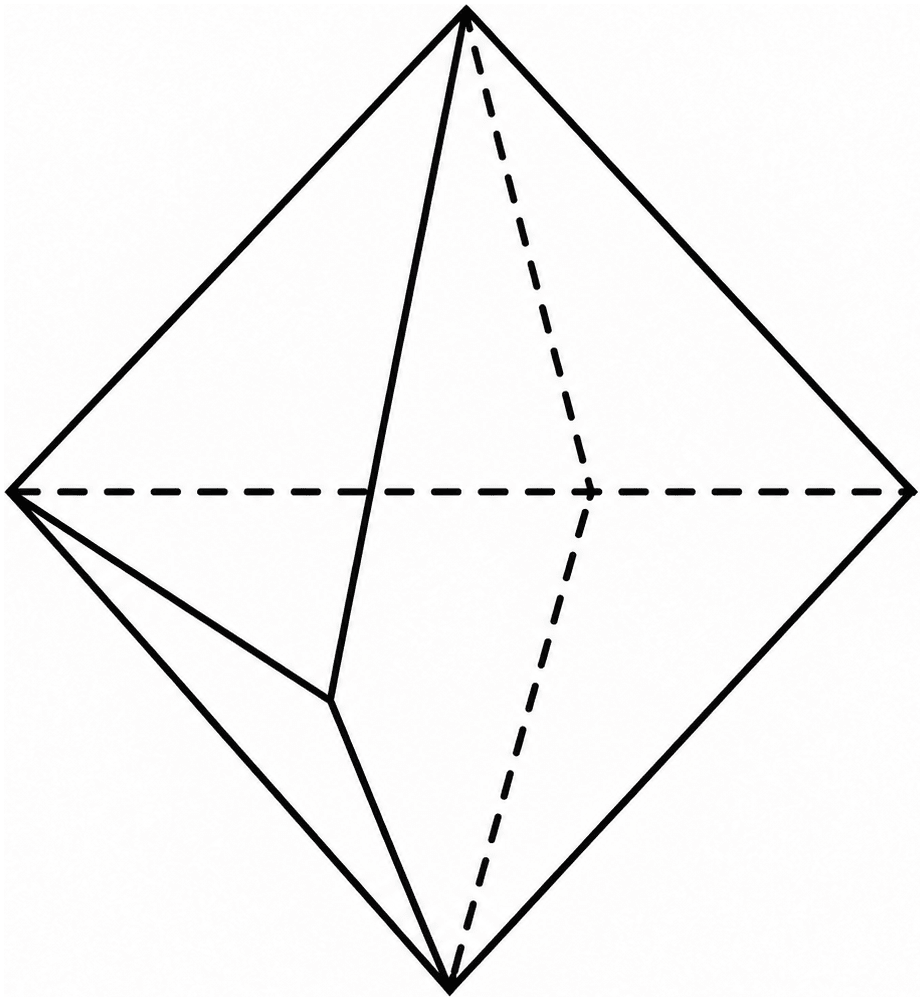
Verify Euler's relation for the following solid:
Answer
The given solid is an octahedron.
From the figure,
Number of faces = 8
Number of edges = 12
Number of vertices = 6
∴ F = 8, E = 12 and V = 6
∴ (F - E + V) = (8 - 12 + 6) = 2
Hence, Euler's relation is verified.
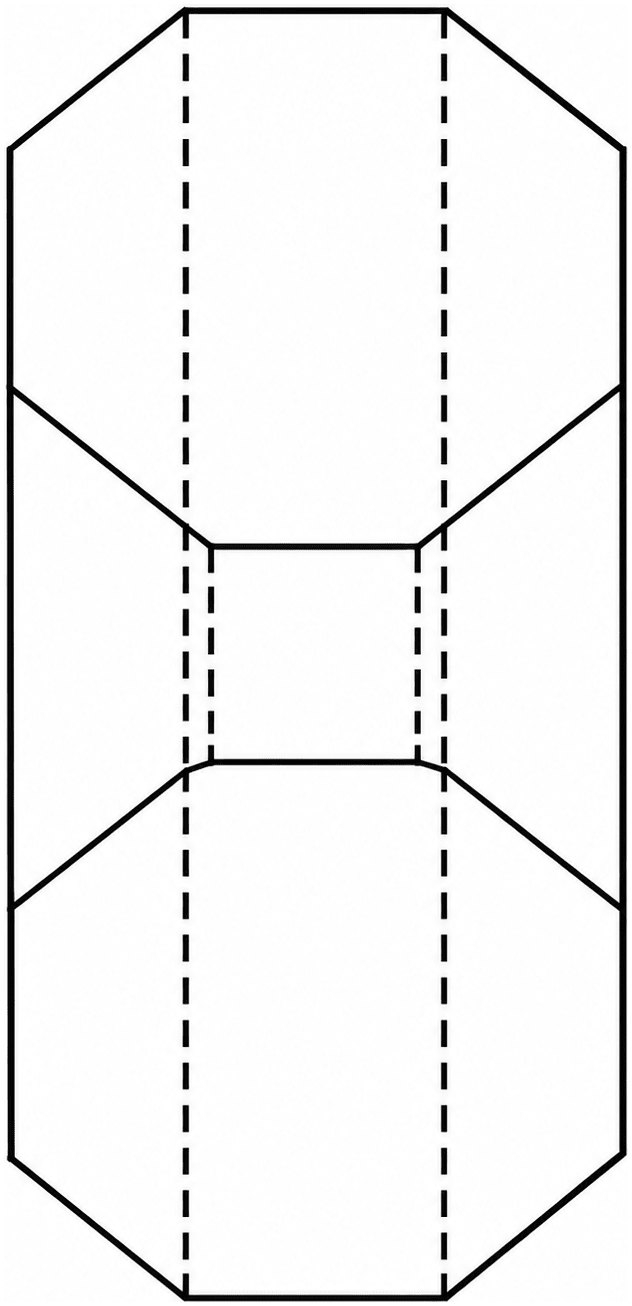
Verify Euler's relation for the following solid:
Answer
The given solid is a hexagonal prism.
From the figure,
Number of faces = 2 hexagonal + 6 rectangular = 8
Number of edges = 18
Number of vertices = 12
∴ F = 8, E = 18 and V = 12
∴ (F - E + V) = (8 - 18 + 12) = 2
Hence, Euler's relation is verified.
If a polyhedron has 8 faces and 10 vertices, find the number of edges.
Answer
Given:
F = 8, V = 10
According to Euler's relation,
F - E + V = 2
⇒ 8 - E + 10 = 2
⇒ 18 - E = 2
⇒ E = 18 - 2
⇒ E = 16
Hence, the number of edges = 16.
If a polyhedron has 8 faces and 16 edges, find the number of vertices.
Answer
Given:
F = 8, E = 16
According to Euler's relation,
F - E + V = 2
⇒ 8 - 16 + V = 2
⇒ V - 8 = 2
⇒ V = 2 + 8
⇒ V = 10
Hence, the number of vertices = 10.
Write the number of faces, vertices and edges in an octagonal pyramid and verify Euler's relation for the same.
Answer
In an octagonal pyramid, the number of sides of the polygonal base is 8.
Number of faces in a pyramid is 1 more than the number of sides of the polygonal base.
Number of faces = 8 + 1 = 9
Number of vertices in a pyramid is 1 more than the number of sides of the polygonal base.
Number of vertices = 8 + 1 = 9
Number of edges in a pyramid is twice the number of sides of the polygonal base.
Number of edges = 8 × 2 = 16
∴ F = 9, E = 16 and V = 9
∴ (F - E + V) = (9 - 16 + 9) = 2
Hence, in an octagonal pyramid, F = 9, V = 9, E = 16 and Euler's relation is verified.
Write the number of faces, vertices and edges in a decagonal prism and verify Euler's relation for the same.
Answer
In a decagonal prism, the number of sides of the polygonal base is 10.
Number of faces in a prism is 2 more than the number of sides of the polygonal base.
Number of faces = 10 + 2 = 12
Number of vertices in a prism is twice the number of sides of the polygonal base.
Number of vertices = 10 × 2 = 20
Number of edges in a prism is thrice the number of sides of the polygonal base.
Number of edges = 10 × 3 = 30
∴ F = 12, E = 30 and V = 20
∴ (F - E + V) = (12 - 30 + 20) = 2
Hence, in a decagonal prism, F = 12, V = 20, E = 30 and Euler's relation is verified.