
Which solid figure would the following net make when folded along dotted lines?
Answer
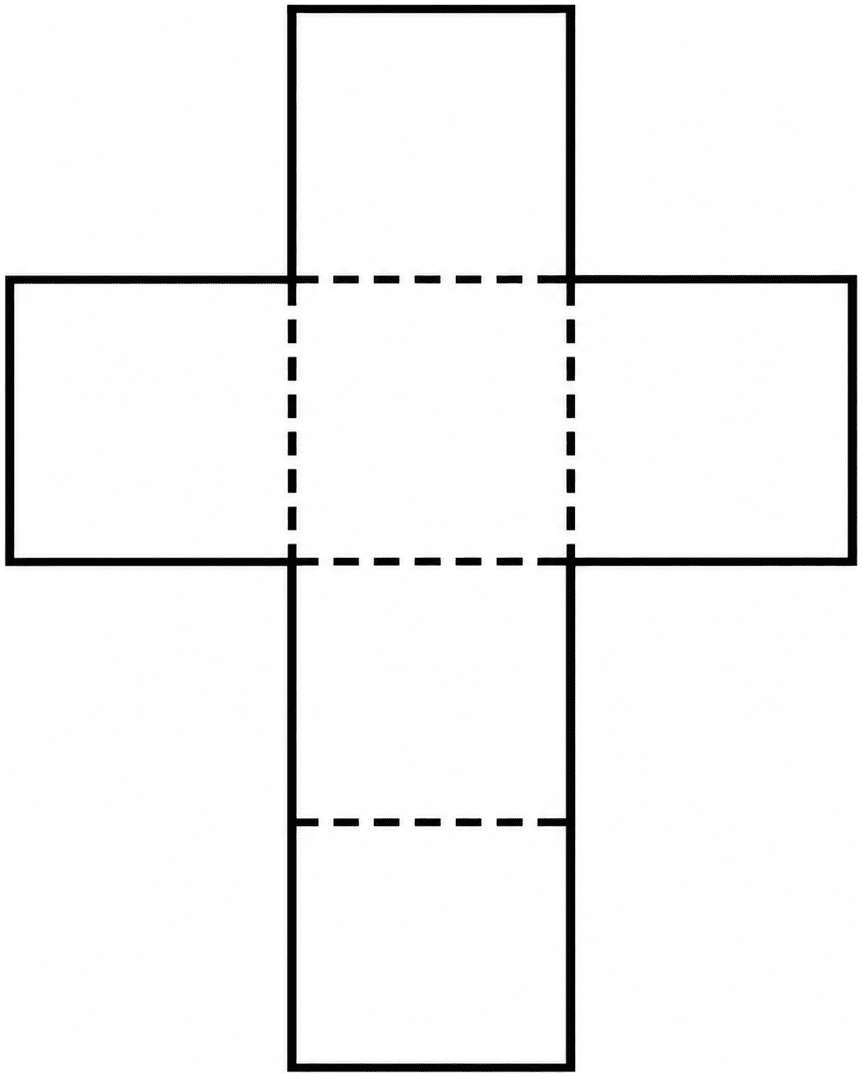
The given net consists of 6 rectangles. Four of these rectangles are placed one below the other forming a vertical strip, and the remaining two rectangles are attached to the two sides of the second rectangle of this strip.
On folding the net along the dotted lines, the four rectangles of the vertical strip form the four side faces of the solid, and the two rectangles attached to the sides form its remaining two opposite faces.
So, the solid formed is bounded by 6 rectangular faces.
Hence, the given net makes a cuboid.
Which solid figure would the following net make when folded along dotted lines?
Answer
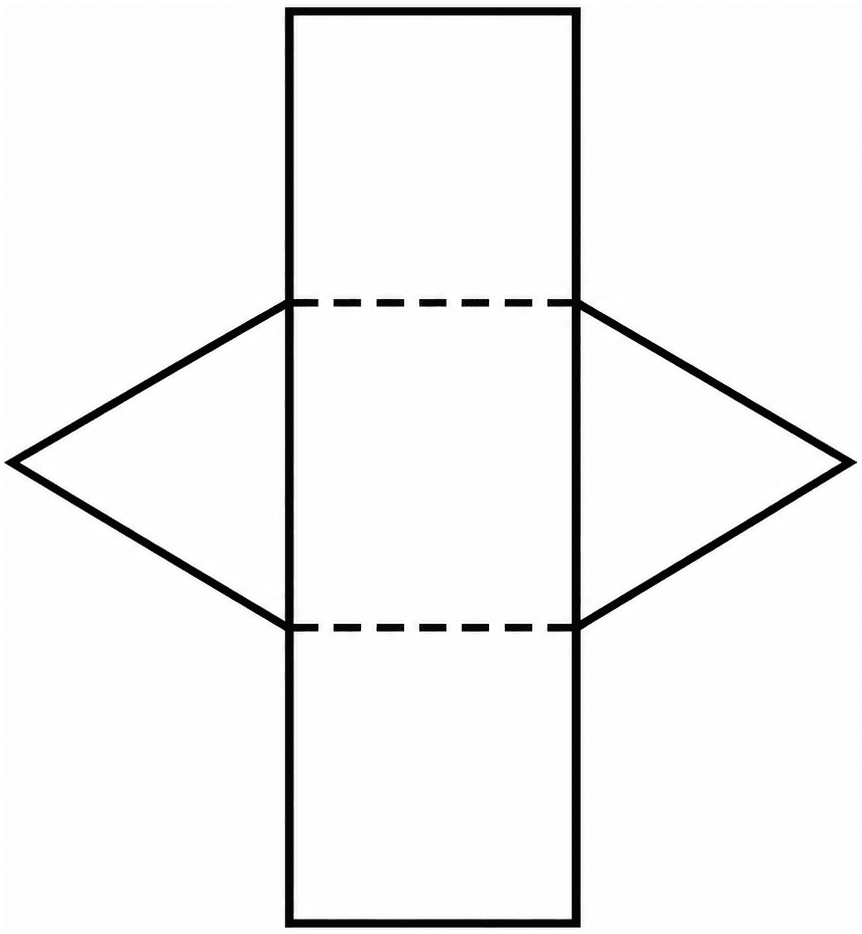
The given net consists of 3 rectangles placed one below the other forming a vertical strip, and 2 triangles attached to the two sides of the middle rectangle of this strip.
On folding the net along the dotted lines, the 3 rectangles form the 3 lateral faces of the solid, and the 2 triangles form its 2 congruent triangular faces at the two ends.
So, the solid formed has 2 congruent triangular faces and 3 rectangular lateral faces.
Hence, the given net makes a triangular prism.
Which of these nets cannot be folded to form a cube?
Answer
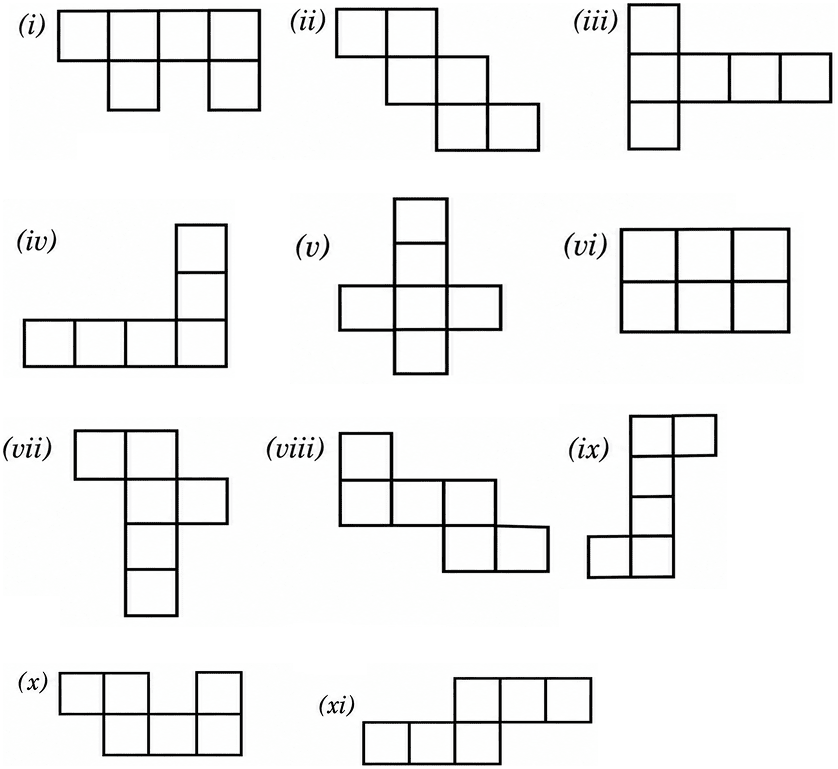
A net can be folded to form a cube only if its 6 squares form the 6 faces of the cube, no two of them falling one upon the other.
In net (i), the 4 squares of the upper row form the 4 side faces of the cube. Of these, the second square and the fourth square become opposite faces. So, the 2 squares hanging below them fall one upon the other on the bottom face, leaving one face of the cube open. So, net (i) cannot be folded to form a cube.
In net (iv), the 4 squares of the lower row form the 4 side faces of the cube and the square just above the last of them forms the top face. The topmost square then folds over the top face and falls upon one of the side faces already formed, leaving one face of the cube open. So, net (iv) cannot be folded to form a cube.
In net (vi), the 6 squares form a rectangle of 2 rows and 3 columns. On folding, the squares fall one upon the other and only 4 faces of the cube are formed, leaving 2 faces of the cube open. So, net (vi) cannot be folded to form a cube.
In net (x), the 3 squares of the lower row form 3 faces of the cube, of which the first square and the third square become opposite faces. So, the 2 squares standing above them fall one upon the other, leaving one face of the cube open. So, net (x) cannot be folded to form a cube.
Each of the remaining nets, that is (ii), (iii), (v), (vii), (viii), (ix) and (xi), folds to form a cube.
Hence, the nets given in (i), (iv), (vi) and (x) cannot be folded to form a cube.
Which of the following four nets cannot be folded to form a square pyramid?
Answer
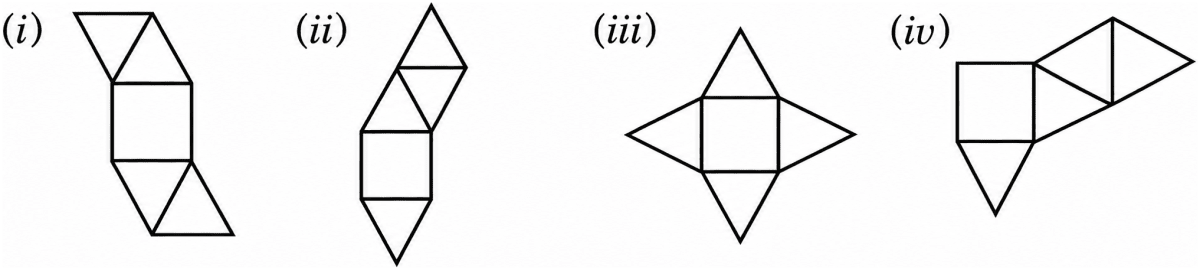
A net can be folded to form a square pyramid only if, on folding, a triangle rises from each of the four sides of the square, so that the four triangles meet at a common vertex.
In net (i), one triangle is attached to the upper side of the square and another to its lower side. Each of the remaining two triangles is attached to a slant side of these triangles, so on folding they come to rest on the left side and the right side of the square. So, net (i) can be folded to form a square pyramid.
In net (ii), one triangle is attached to the upper side of the square and another to its lower side. Of the remaining two triangles, one comes to rest on the right side of the square and the other falls upon the triangle standing on the lower side of the square. So, two triangles fall one upon the other and no triangle rises from the left side of the square. So, net (ii) cannot be folded to form a square pyramid.
In net (iii), one triangle is attached to each of the four sides of the square. So, net (iii) can be folded to form a square pyramid.
In net (iv), one triangle is attached to the lower side of the square and another to its right side. Each of the remaining two triangles is attached to a slant side of the triangle on the right, so on folding they come to rest on the upper side and the left side of the square. So, net (iv) can be folded to form a square pyramid.
Hence, the net given in (ii) cannot be folded to form a square pyramid.
Shown below is a cuboid.
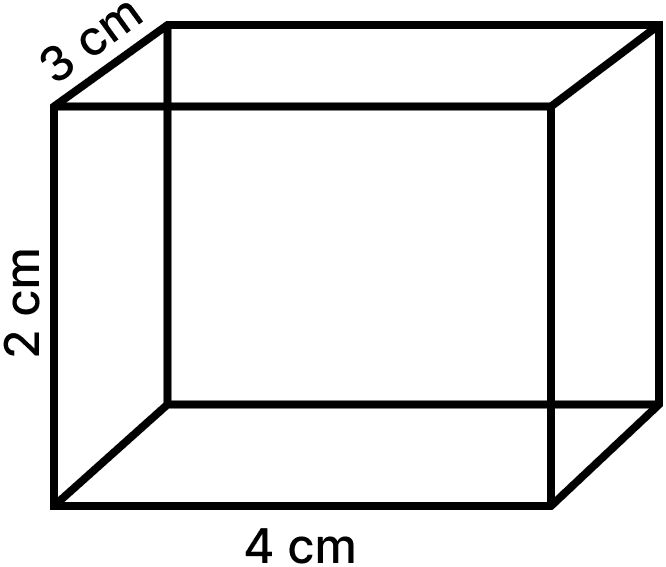
Draw a net for the cuboid on the square grid given below. Each square is 1 cm × 1 cm.
Answer
A cuboid is bounded by 6 rectangular faces, which form 3 pairs of equal and opposite faces.
For a cuboid of length 4 cm, breadth 3 cm and height 2 cm, we have:
The top face and the bottom face, each of dimensions 4 cm × 3 cm
The front face and the back face, each of dimensions 4 cm × 2 cm
The left face and the right face, each of dimensions 3 cm × 2 cm
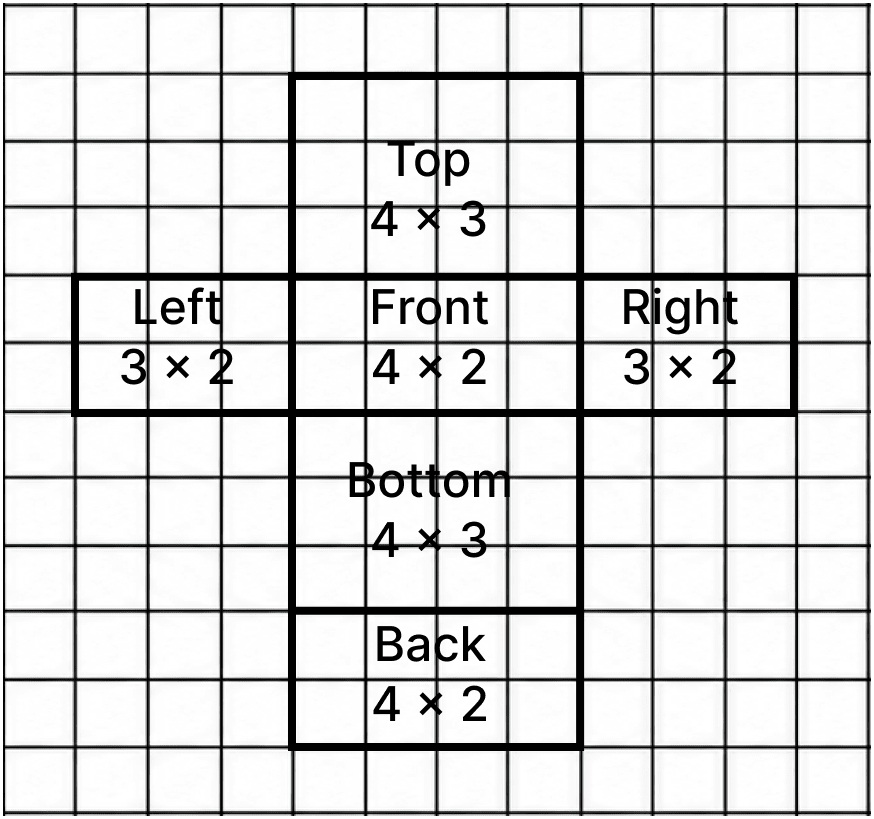
On the given square grid, draw the top face, the front face, the bottom face and the back face one below the other forming a vertical strip, each of these rectangles being 4 cm wide. Then draw the left face and the right face on the two sides of the front face.
The required net of the cuboid is shown below:
Assertion (A): A polyhedron can have 10 faces, 20 edges and 15 vertices.
Reason (R): For a polyhedron, we have F + V - E = 2.
Both Assertion (A) and Reason (R) are true and Reason (R) is the correct explanation of Assertion (A).
Both Assertion (A) and Reason (R) are true and Reason (R) is not the correct explanation of Assertion (A).
Assertion (A) is true but Reason (R) is false.
Assertion (A) is false but Reason (R) is true.
Answer
Given:
F = 10, E = 20, V = 15
For a polyhedron,
F + V - E = 2
L.H.S. = F + V - E = 10 + 15 - 20 = 5
R.H.S. = 2
Since, L.H.S. ≠ R.H.S.
So, a polyhedron cannot have 10 faces, 20 edges and 15 vertices.
So, Assertion (A) is false.
Euler's relation states that in a polyhedron F - E + V = 2, which can also be written as F + V - E = 2.
So, Reason (R) is true.
Hence, option 4 is the correct option.
Assertion (A): A regular octahedron has 8 congruent faces which are equilateral triangles.
Reason (R): The net of a 3D shape is a figure in a plane which can be folded to form that 3D shape.
Both Assertion (A) and Reason (R) are true and Reason (R) is the correct explanation of Assertion (A).
Both Assertion (A) and Reason (R) are true and Reason (R) is not the correct explanation of Assertion (A).
Assertion (A) is true but Reason (R) is false.
Assertion (A) is false but Reason (R) is true.
Answer
A regular octahedron is a polyhedron bounded by 8 congruent faces, each of which is an equilateral triangle.
So, Assertion (A) is true.
The net of a 3D shape is the figure in a plane which can be folded to form that 3D shape.
So, Reason (R) is true.
Reason (R) tells us what the net of a 3D shape is, which does not explain the number of faces of a regular octahedron or their shape.
So, Reason (R) is not the correct explanation of Assertion (A).
Hence, option 2 is the correct option.
The minimum number of faces needed to form a polyhedron is:
1
2
3
4
Answer
A polyhedron is a solid made up of polygonal regions. The polygon having the least number of sides is a triangle.
Three triangles having a common vertex do not enclose any space, as the solid so formed remains open at its base. So, one more triangular face is needed to close it, and the solid so formed is a tetrahedron.
So, the minimum number of faces needed to form a polyhedron = 4
Hence, option 4 is the correct option.
How many minimum faces do you need to form a prism?
5
4
3
2
Answer
A prism has 2 congruent polygons as its base and its top, and 1 rectangular lateral face along each side of the base.
The polygon having the least number of sides is a triangle, which has 3 sides. So, the prism having the least number of faces is a triangular prism.
Number of faces = 2 + 3 = 5
Hence, option 1 is the correct option.
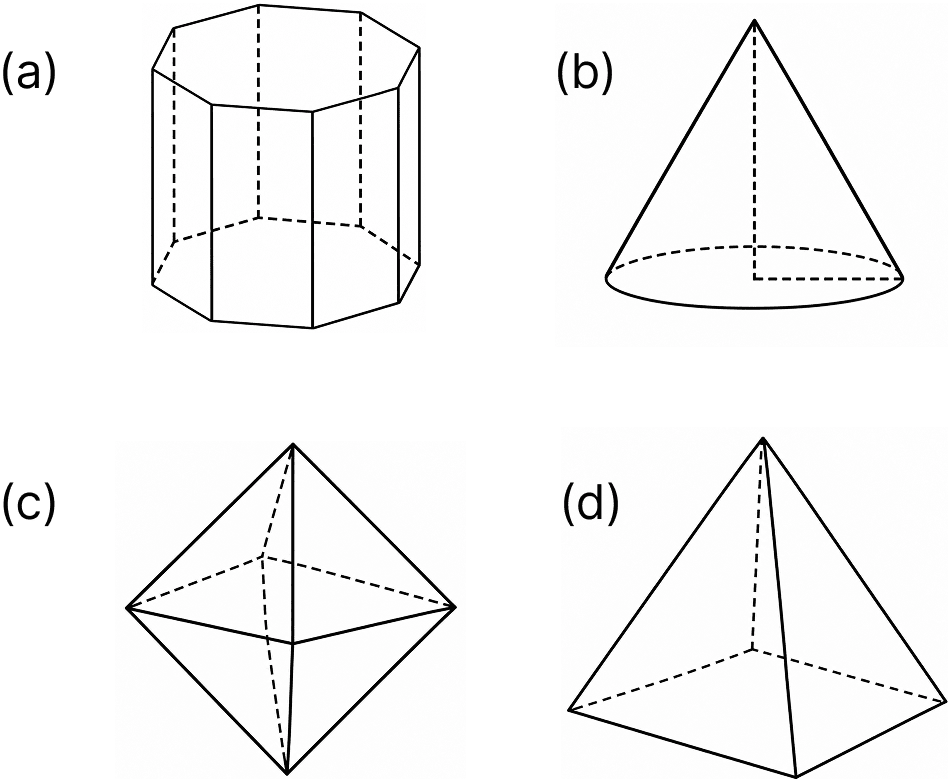
Without counting, any faces, edges or vertices, tell which of the following objects will not satisfy Euler's formula:
Answer
Euler's formula holds for a polyhedron, that is, for a solid which is made up of polygonal regions.
The solids given in options 1, 3 and 4 are an octagonal prism, an octahedron and a square pyramid respectively. Each of them is made up of polygonal regions, so each of them is a polyhedron.
The solid given in option 2 is a cone. It has a circular base and a curved surface, so it is not made up of polygonal regions and hence it is not a polyhedron.
So, the cone will not satisfy Euler's formula.
Hence, option 2 is the correct option.
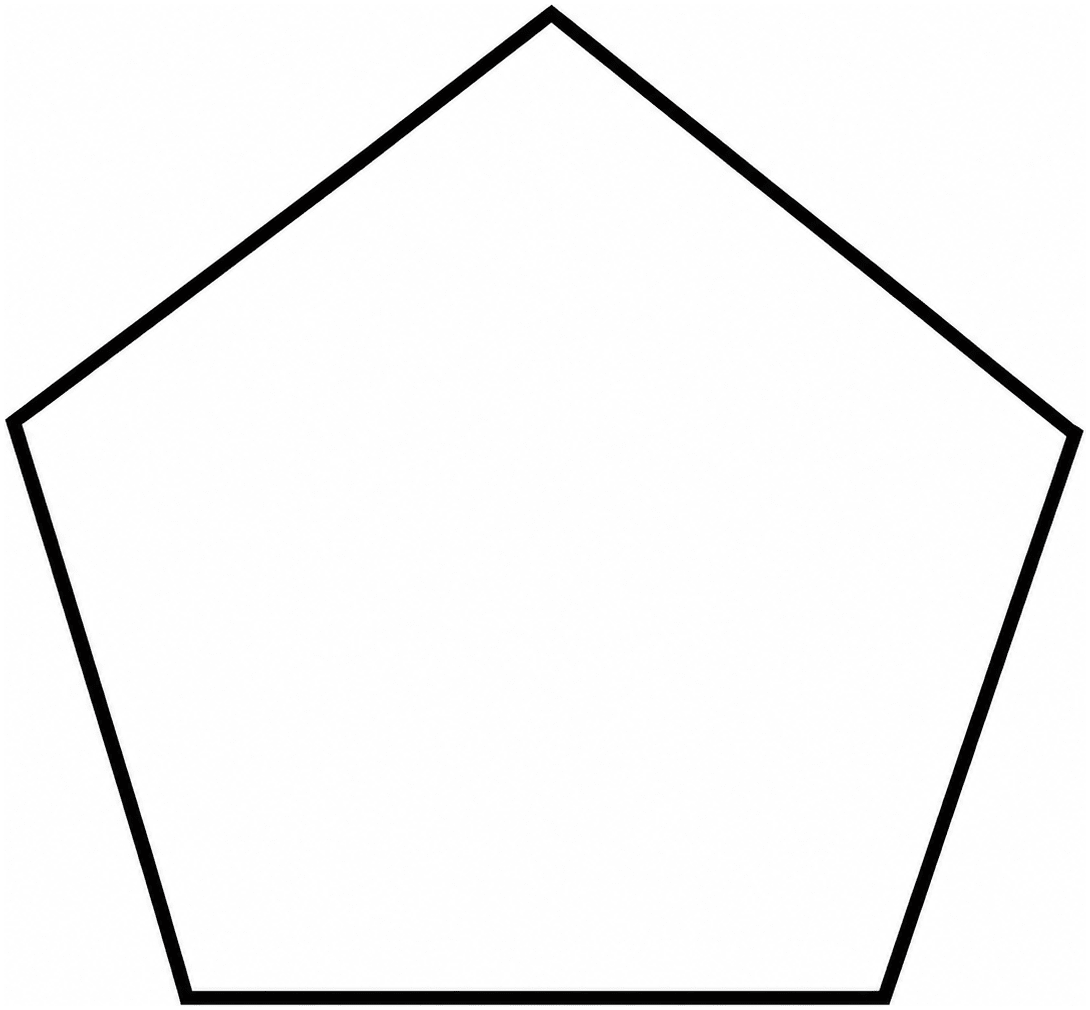
The given polygon is the base of a pyramid. The number of faces this pyramid will have:
5
6
8
10
Answer
The given polygon is a pentagon, which has 5 sides.
So, the pyramid having it as its base is a pentagonal pyramid.
Number of faces in a pyramid is 1 more than the number of sides of the polygonal base.
Number of faces = 5 + 1 = 6
Hence, option 2 is the correct option.
The sum of the interior angles of a polygon which is the base of a prism is 540°. The prism will have:
10 vertices
8 vertices
7 vertices
6 vertices
Answer
Let the number of sides of the polygon forming the base of the prism be .
Sum of the interior angles of a polygon of sides
According to the question,
So, the base of the prism is a pentagon and the prism is a pentagonal prism.
Number of vertices in a prism is twice the number of sides of the polygonal base.
Number of vertices = 5 × 2 = 10
Hence, option 1 is the correct option.
Archana, a class 8 student, claims that we cannot have a polyhedron with 8 faces, 12 vertices and 18 edges. Her statement is:
correct
incorrect
cannot say anything
none of these
Answer
Given:
F = 8, E = 18, V = 12
According to Euler's relation,
F - E + V = 2
L.H.S. = F - E + V = 8 - 18 + 12 = 2
R.H.S. = 2
Since, L.H.S. = R.H.S.
So, Euler's relation is satisfied and hence we can have a polyhedron with 8 faces, 12 vertices and 18 edges.
So, the claim made by Archana is incorrect.
Hence, option 2 is the correct option.
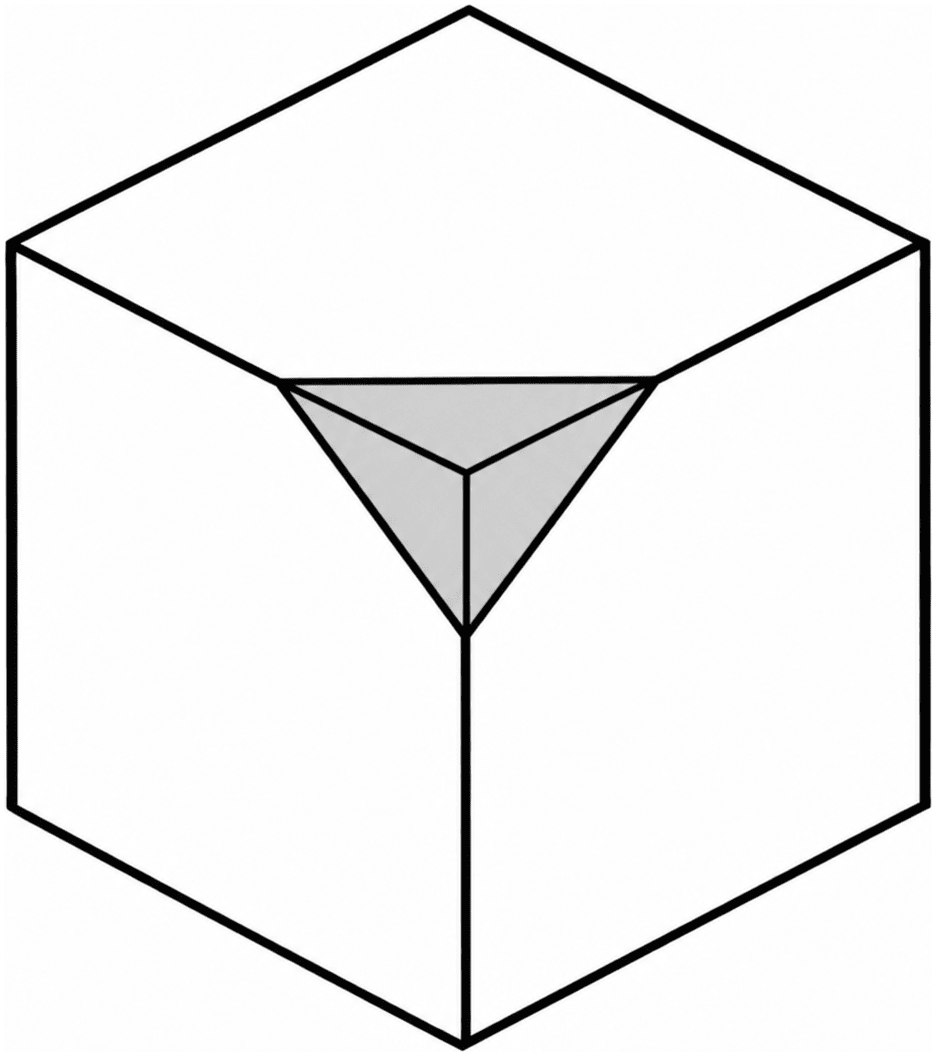
When you cut a corner of a cube as shown, what will be the shape of the cutout piece?
Triangular prism
Triangular pyramid
Octahedron
none of these
Answer
At a corner of a cube, 3 faces of the cube meet. The cut is made along a plane which meets the 3 edges of the cube passing through that corner.
So, the cutout piece is bounded by 3 triangular faces, which are parts of the 3 faces of the cube meeting at that corner, and 1 more triangular face, which is formed by the cut.
So, the cutout piece has 4 triangular faces, 6 edges and 4 vertices.
So, the cutout piece is a triangular pyramid.
Hence, option 2 is the correct option.
Identical cubes are stacked in the corner of a room as shown.
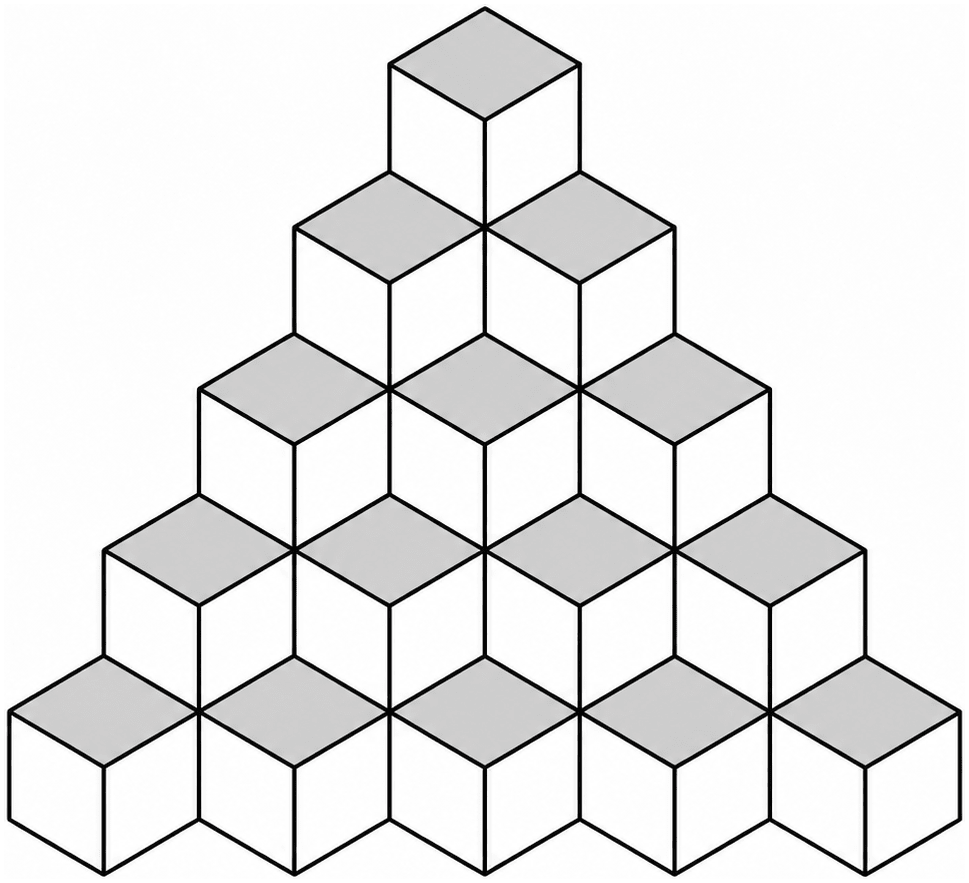
How many cubes are not visible?
10
11
15
20
Answer
From the figure, the cubes are stacked in 5 layers, one above the other.
In the bottom layer, the cubes are placed in 5 rows having 5, 4, 3, 2 and 1 cubes.
Number of cubes in the bottom layer = 5 + 4 + 3 + 2 + 1 = 15
Number of cubes in the second layer = 4 + 3 + 2 + 1 = 10
Number of cubes in the third layer = 3 + 2 + 1 = 6
Number of cubes in the fourth layer = 2 + 1 = 3
Number of cubes in the top layer = 1
Total number of cubes = 15 + 10 + 6 + 3 + 1 = 35
In each layer, only the cubes lying along the front edge of that layer can be seen, as every other cube is covered by the cubes lying in front of it and by the cube lying above it.
Number of cubes which are visible = 5 + 4 + 3 + 2 + 1 = 15
Number of cubes which are not visible = 35 - 15 = 20
Hence, option 4 is the correct option.
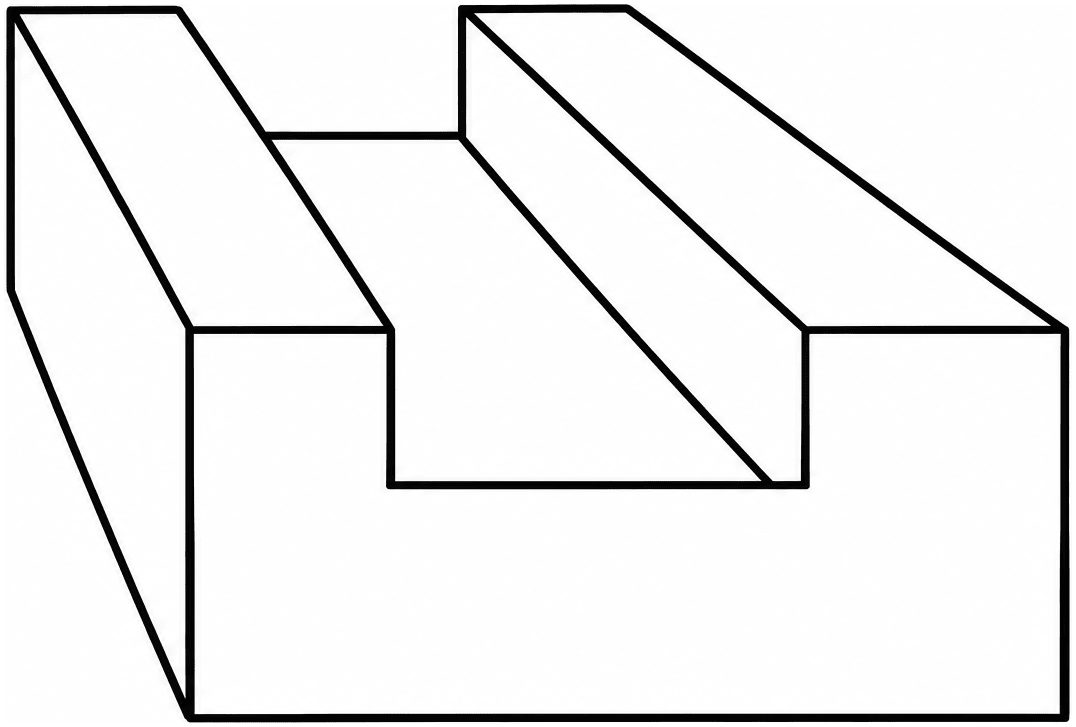
The number of faces in the given shape is:
6
8
9
10
Answer
The given shape is obtained by cutting a rectangular groove along the length of a cuboid.
So, its cross-section is a rectangle from which a rectangle has been cut out at the top, and this cross-section has 8 sides.
The given shape has 1 face along each side of this cross-section.
Number of such faces = 8
Besides these, the given shape has 2 more faces, one at each of its two ends.
Number of faces = 8 + 2 = 10
Hence, option 4 is the correct option.