
Construct a quadrilateral PQRS in which PQ = 4 cm, ∠P = 90°, QR = 4.3 cm, RS = 3.6 cm and SP = 3.2 cm.
Answer
Steps of construction :
Draw a line segment PQ = 4 cm.
At P, construct ∠QPX = 90°.
From PX, cut off PS = 3.2 cm.
With Q as centre and radius 4.3 cm, draw an arc.
With S as centre and radius 3.6 cm, draw another arc cutting the previous arc at R.
Join QR and RS.
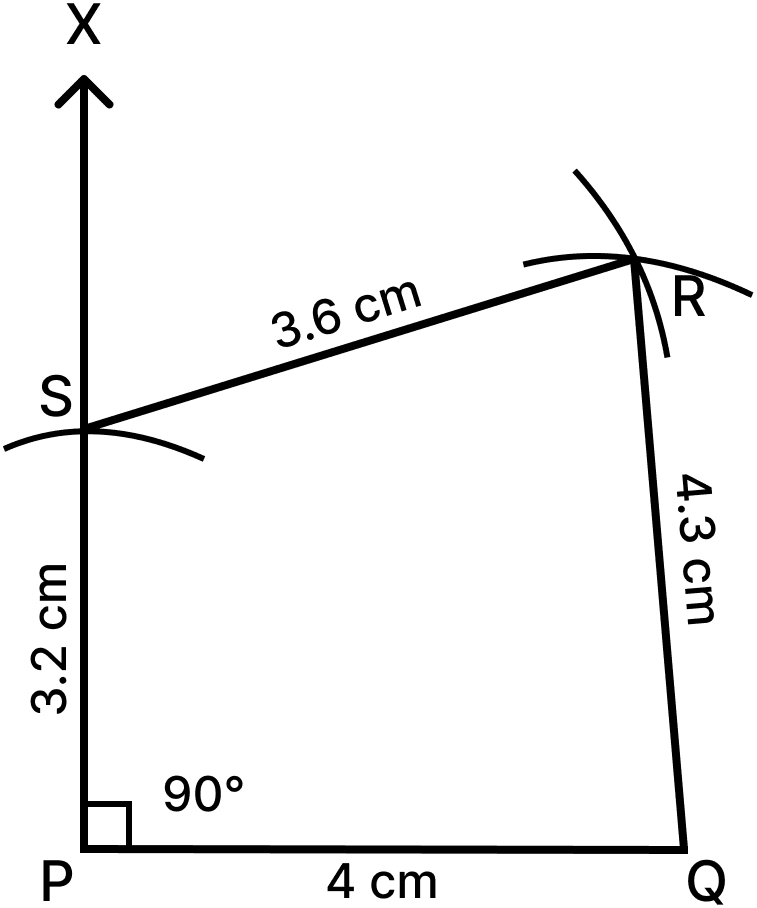
Hence, PQRS is the required quadrilateral.
Construct a quadrilateral ABCD in which AB = 4.5 cm, BC = 5.2 cm, CD = 5 cm, DA = 4.7 cm and ∠ABC = 75°.
Answer
Steps of construction :
Draw a line segment AB = 4.5 cm.
At B, construct ∠ABX = 75°.
From BX, cut off BC = 5.2 cm.
With A as centre and radius 4.7 cm, draw an arc.
With C as centre and radius 5 cm, draw another arc cutting the previous arc at D.
Join AD and CD.
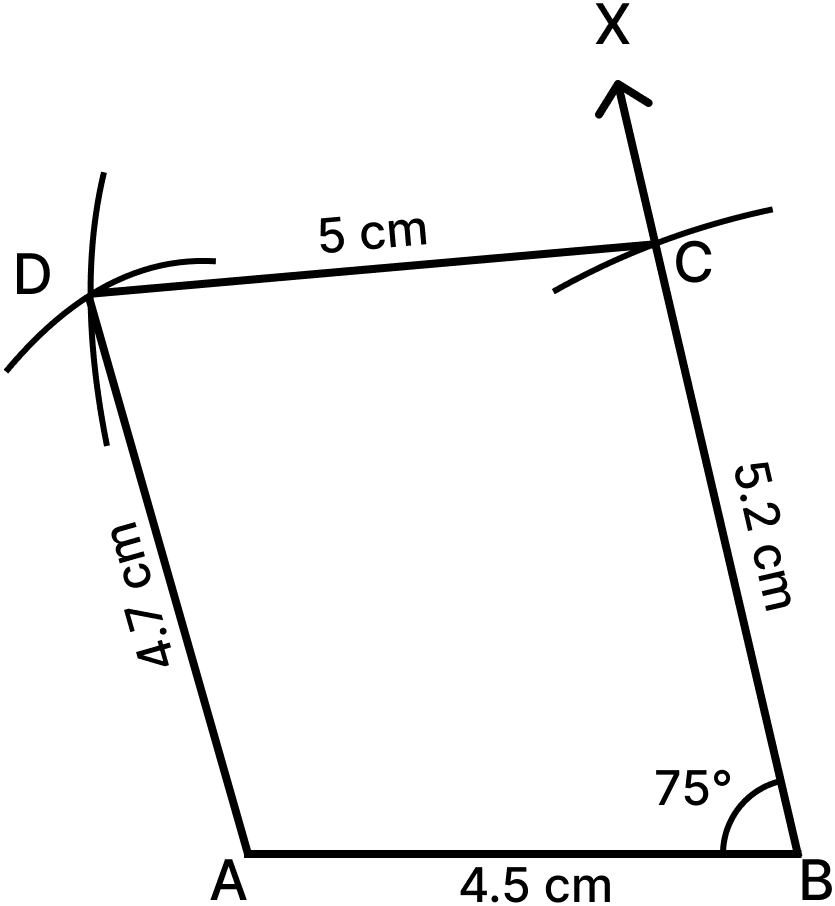
Hence, ABCD is the required quadrilateral.
Construct a quadrilateral ABCD in which AB = CD = 5.1 cm, BC = 4.7 cm, DA = 4.2 cm and ∠BCD = 60°.
Answer
Steps of construction :
Draw a line segment BC = 4.7 cm.
At C, construct ∠BCX = 60°.
From CX, cut off CD = 5.1 cm.
With B as centre and radius 5.1 cm, draw an arc.
With D as centre and radius 4.2 cm, draw another arc cutting the previous arc at A.
Join AB and AD.
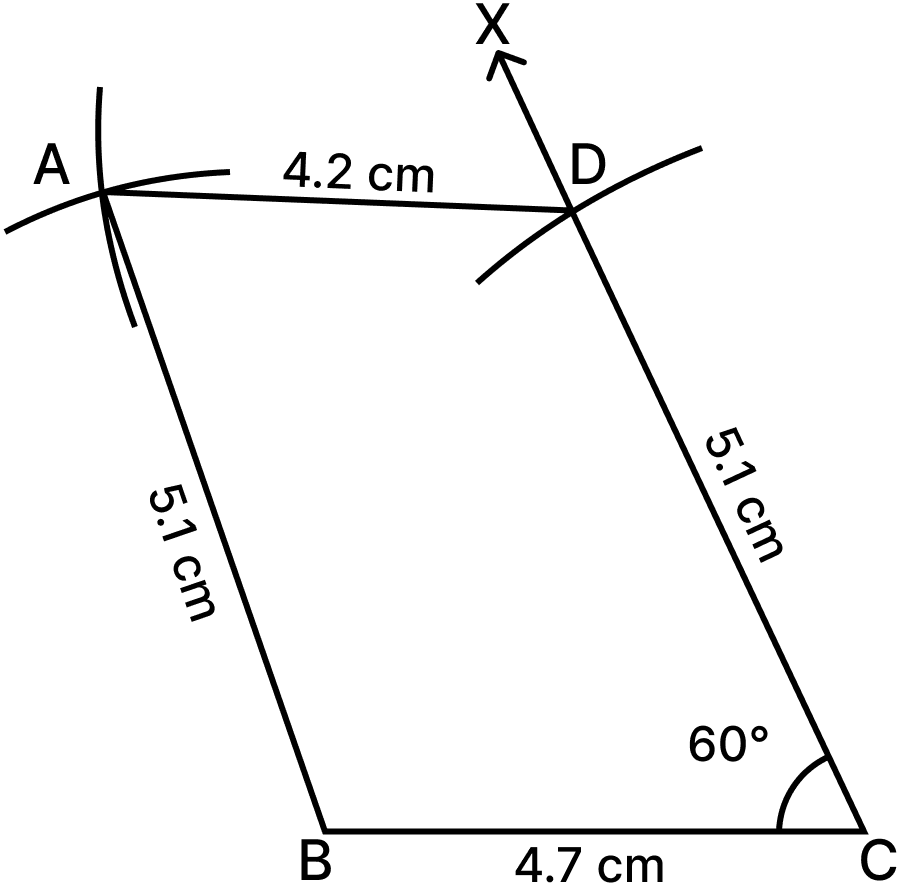
Hence, ABCD is the required quadrilateral.
Construct a quadrilateral EFGH in which EF = 6 cm, FG = 5.3 cm, EH = 5 cm, ∠E = 60° and ∠F = 75°.
Answer
Steps of construction :
Draw a line segment EF = 6 cm.
At E, construct ∠FEX = 60°.
From EX, cut off EH = 5 cm.
At F, construct ∠EFY = 75° on the same side of EF as that of H.
From FY, cut off FG = 5.3 cm.
Join GH.
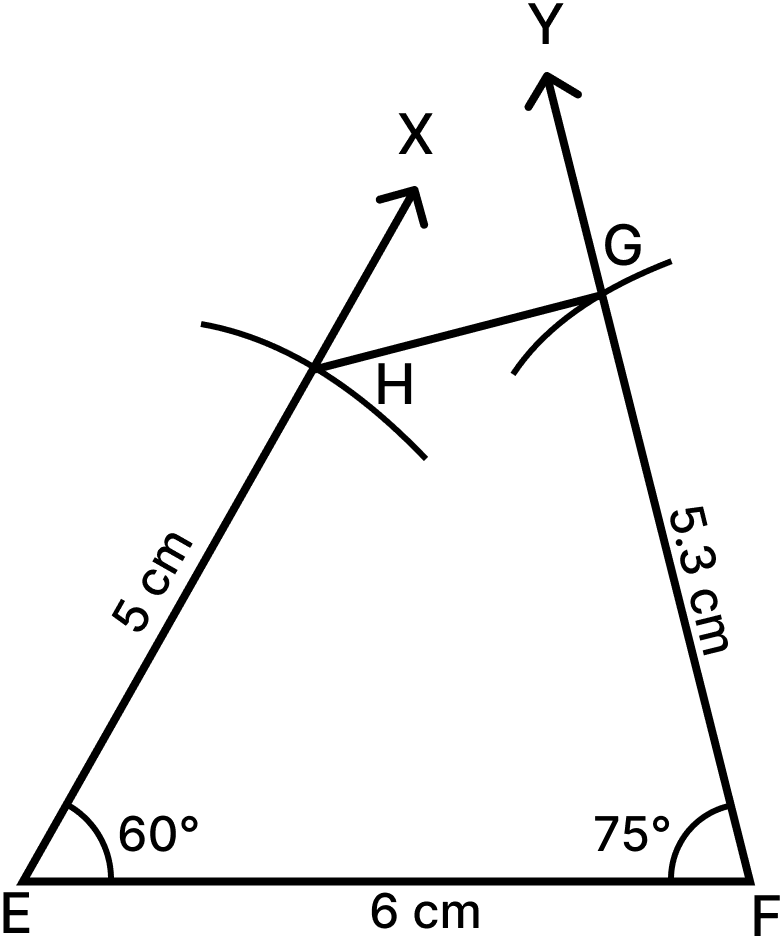
Hence, EFGH is the required quadrilateral.
Construct a quadrilateral PQRS in which PQ = 4.5 cm, QR = 5.6 cm, RS = 4.1 cm, ∠Q = 60° and ∠R = 120°.
Answer
Steps of construction :
Draw a line segment QR = 5.6 cm.
At Q, construct ∠RQX = 60°.
From QX, cut off QP = 4.5 cm.
At R, construct ∠QRY = 120° on the same side of QR as that of P.
From RY, cut off RS = 4.1 cm.
Join PS.
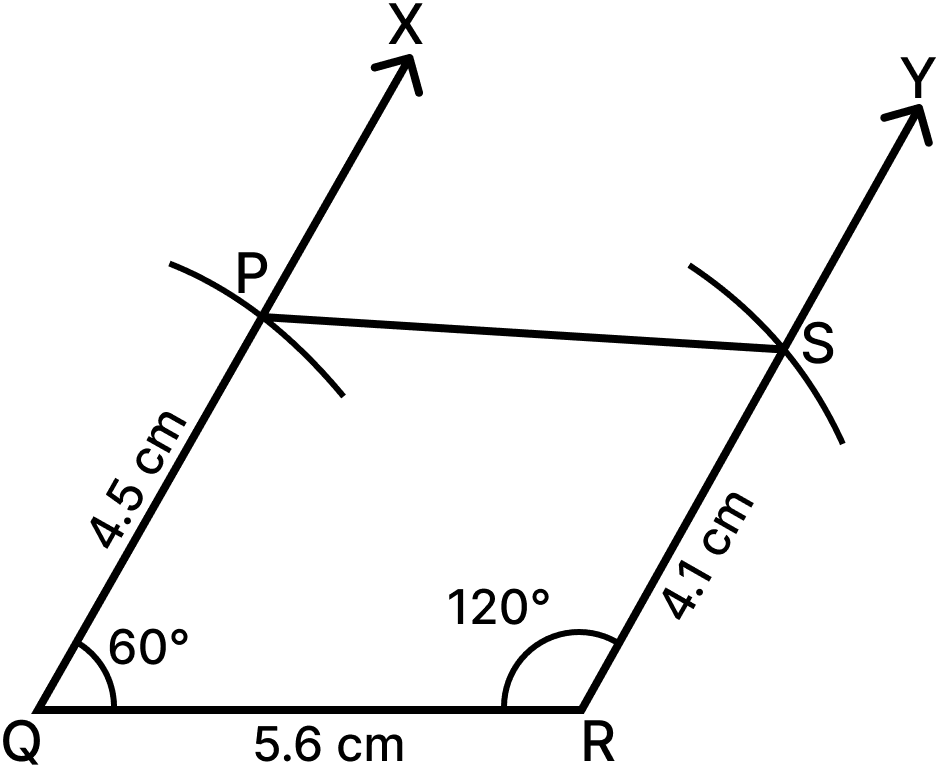
Hence, PQRS is the required quadrilateral.
Construct a quadrilateral ABCD in which AB = AD = 5.3 cm, BC = CD = 5 cm and diagonal BD = 6.4 cm.
Answer
The diagonal BD divides the quadrilateral ABCD into two triangles, ΔABD and ΔBCD, and all the three sides of each of them are known.
Steps of construction :
Draw a line segment AB = 5.3 cm.
With A as centre and radius 5.3 cm, draw an arc.
With B as centre and radius 6.4 cm, draw another arc cutting the previous arc at D.
Join AD and BD.
With B as centre and radius 5 cm, draw an arc on the side of BD opposite to that of A.
With D as centre and radius 5 cm, draw another arc cutting the previous arc at C.
Join BC and CD.
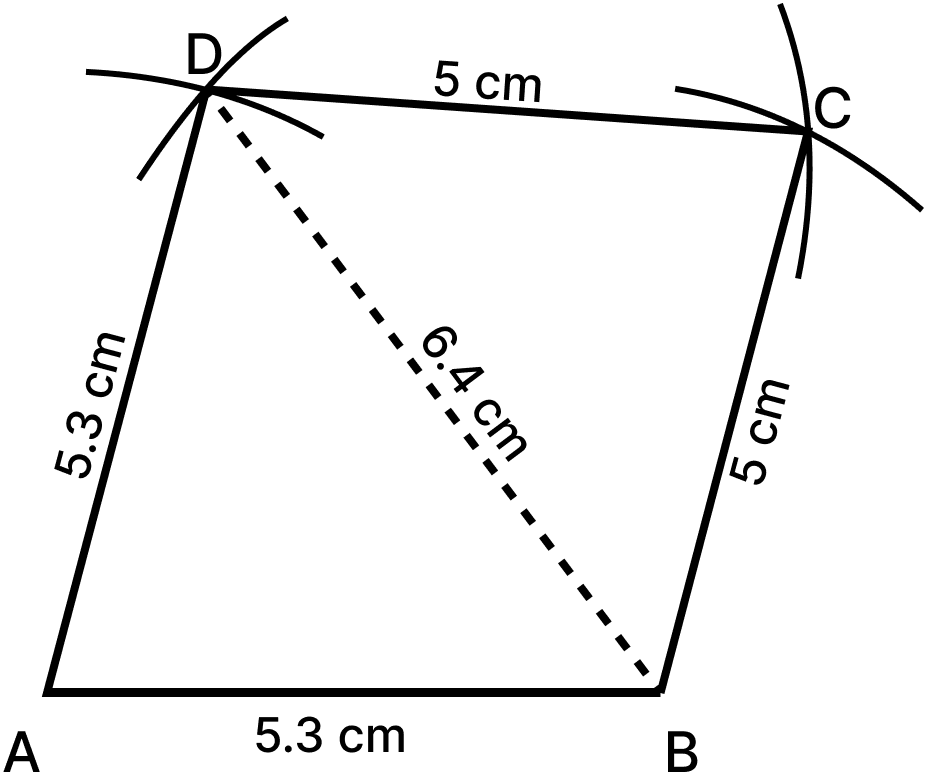
Hence, ABCD is the required quadrilateral.
Construct a quadrilateral PQRS in which PQ = 3 cm, QR = 2.4 cm, PS = 3.7 cm, PR = 4 cm and QS = 5.5 cm.
Answer
Steps of construction :
Draw a line segment PQ = 3 cm.
With P as centre and radius 4 cm, draw an arc.
With Q as centre and radius 2.4 cm, draw another arc cutting the previous arc at R.
Join PR and QR.
With P as centre and radius 3.7 cm, draw an arc on the side of PR opposite to that of Q.
With Q as centre and radius 5.5 cm, draw another arc cutting the previous arc at S.
Join PS, RS and QS.
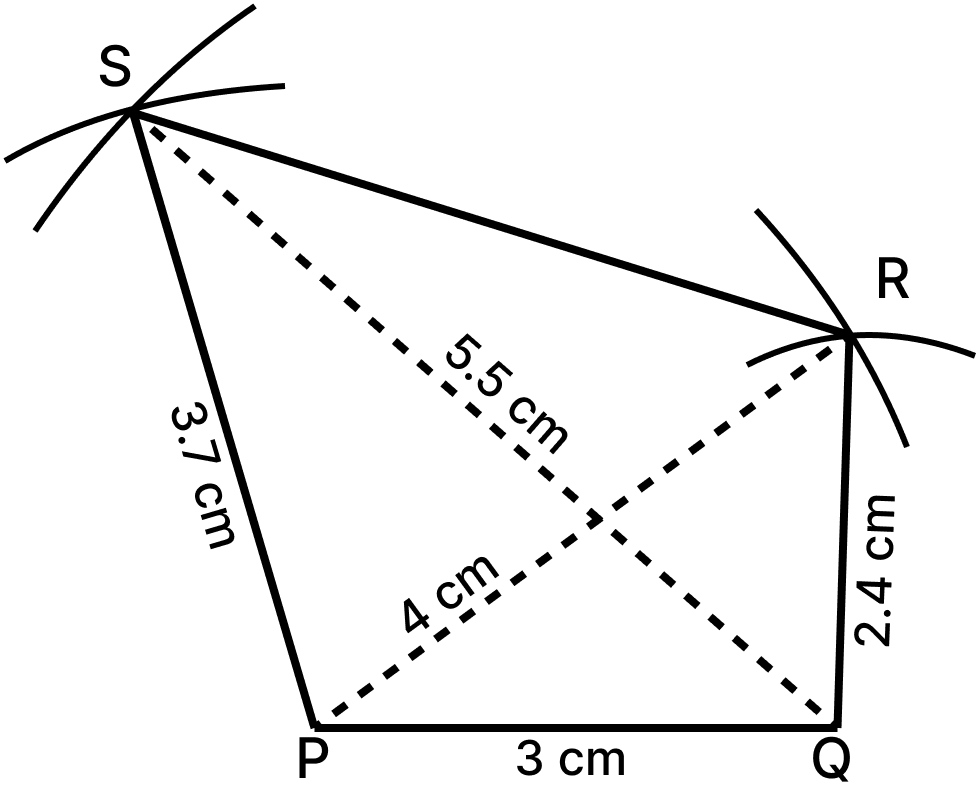
Hence, PQRS is the required quadrilateral.
Construct a quadrilateral ABCD in which AB = 5.2 cm, BC = 3.6 cm, ∠A = 60°, ∠B = 90° and ∠C = 120°.
Answer
Steps of construction :
Draw a line segment AB = 5.2 cm.
At B, construct ∠ABX = 90°.
From BX, cut off BC = 3.6 cm.
At A, construct ∠BAY = 60° on the same side of AB as that of C.
At C, construct ∠BCZ = 120° such that CZ meets AY at D.
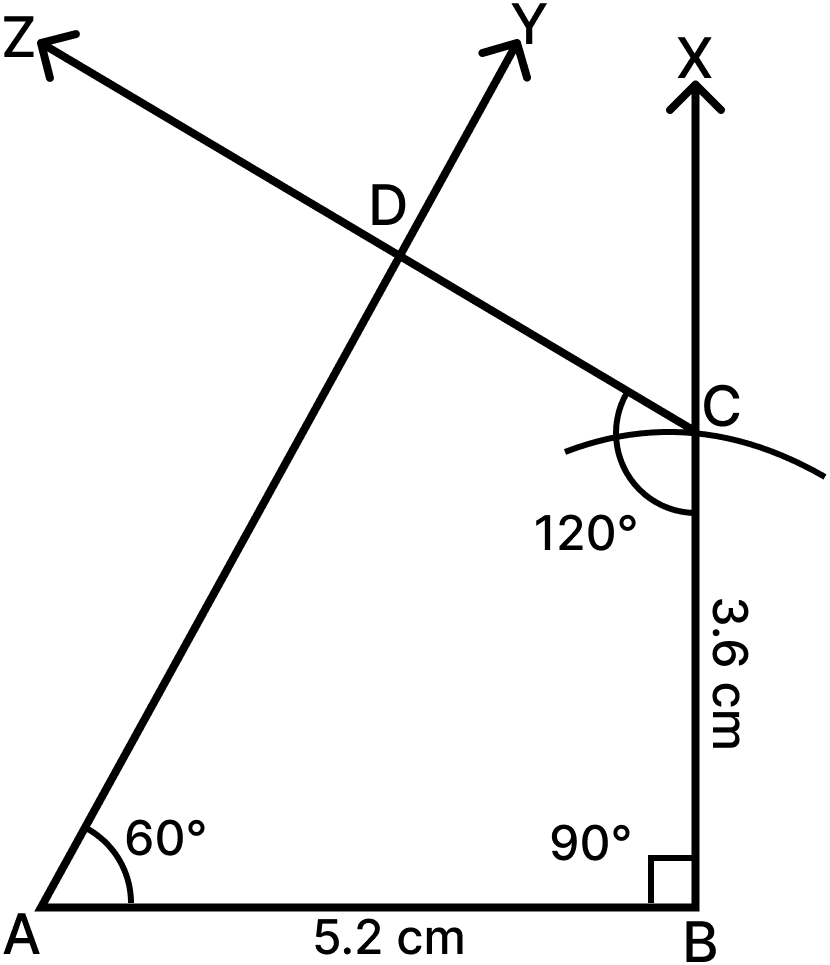
Hence, ABCD is the required quadrilateral.