
Construct a parallelogram ABCD in which BC = 6 cm, CD = 4 cm and ∠C = 60°.
Answer
Property used: The opposite sides of a parallelogram are equal.
Thus, in parallelogram ABCD,
AB = CD = 4 cm and AD = BC = 6 cm
Steps of construction :
Draw a line segment BC = 6 cm.
At C, construct ∠BCX = 60°.
From CX, cut off CD = 4 cm.
With B as centre and radius 4 cm, draw an arc.
With D as centre and radius 6 cm, draw another arc cutting the previous arc at A.
Join AB and AD.
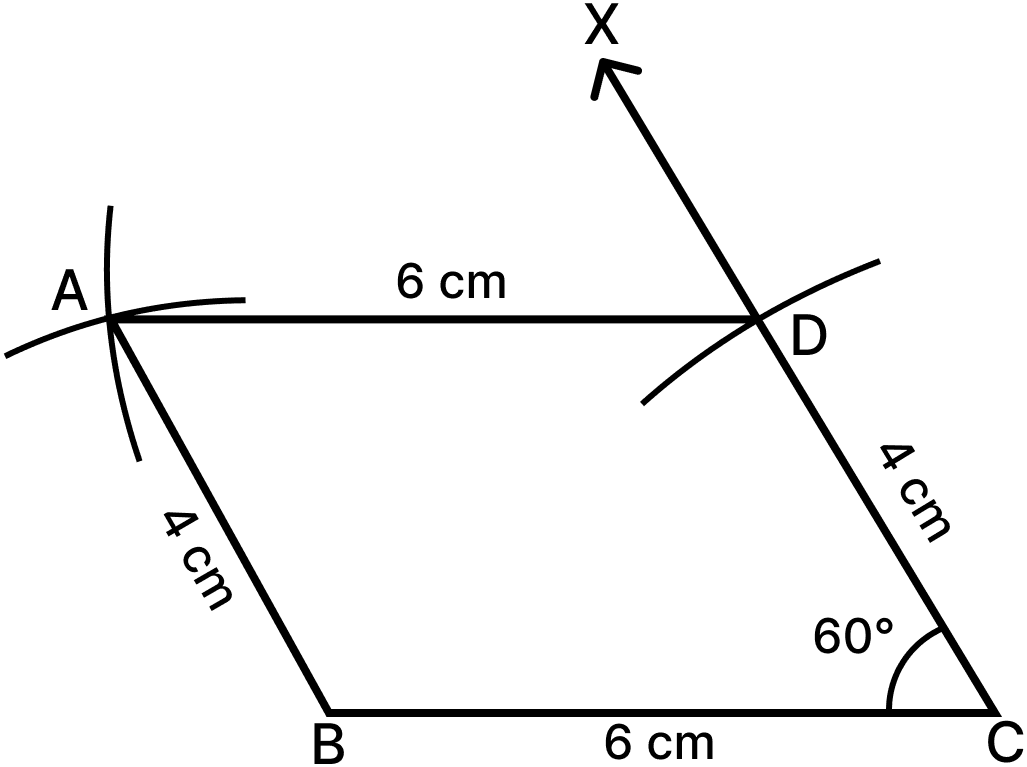
Hence, ABCD is the required parallelogram.
Construct a parallelogram PQRS in which QR = 4.7 cm, ∠Q = 120° and PQ = 2.8 cm.
Answer
Property used: The opposite sides of a parallelogram are equal.
Thus, in parallelogram PQRS,
PS = QR = 4.7 cm and RS = PQ = 2.8 cm
Steps of construction :
Draw a line segment PQ = 2.8 cm.
At Q, construct ∠PQX = 120°.
From QX, cut off QR = 4.7 cm.
With P as centre and radius 4.7 cm, draw an arc.
With R as centre and radius 2.8 cm, draw another arc cutting the previous arc at S.
Join PS and RS.
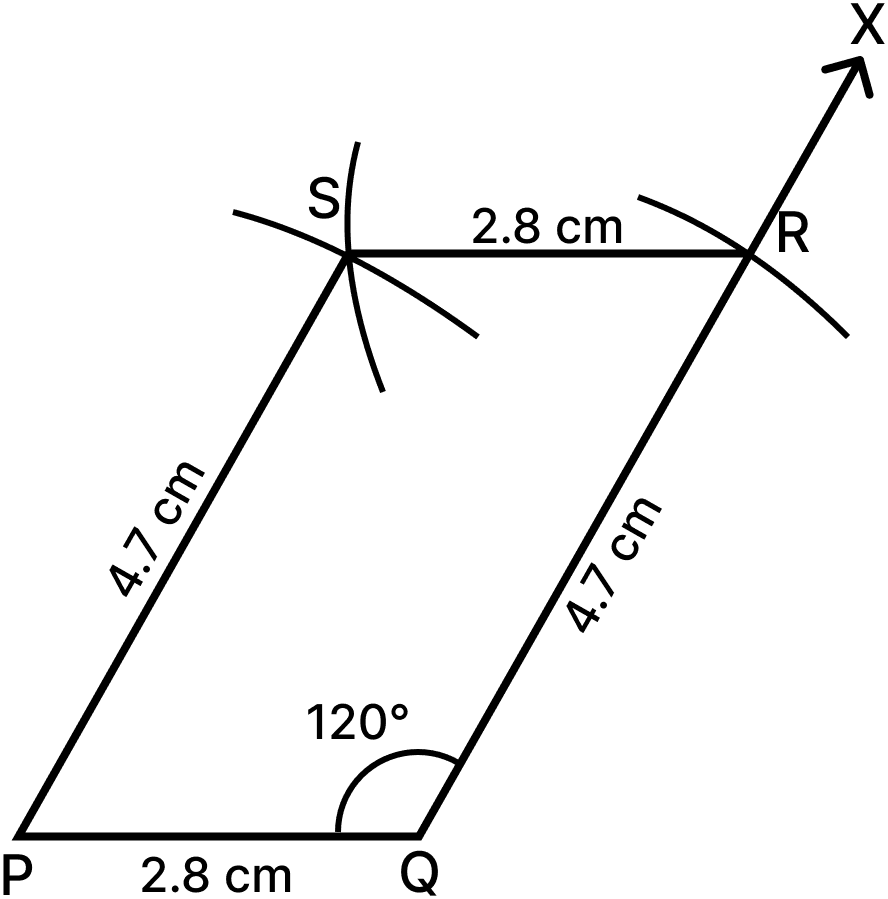
Hence, PQRS is the required parallelogram.
Construct a parallelogram ABCD in which BC = 5 cm, CD = 3 cm and diagonal BD = 6 cm.
Answer
Property used: The opposite sides of a parallelogram are equal.
Thus, in parallelogram ABCD,
AB = CD = 3 cm and AD = BC = 5 cm
Steps of construction :
Draw a line segment BC = 5 cm.
With B as centre and radius 6 cm, draw an arc.
With C as centre and radius 3 cm, draw another arc cutting the previous arc at D.
Join BD and CD.
With B as centre and radius 3 cm, draw an arc on the side of BD opposite to that of C.
With D as centre and radius 5 cm, draw another arc cutting the previous arc at A.
Join AB and AD.
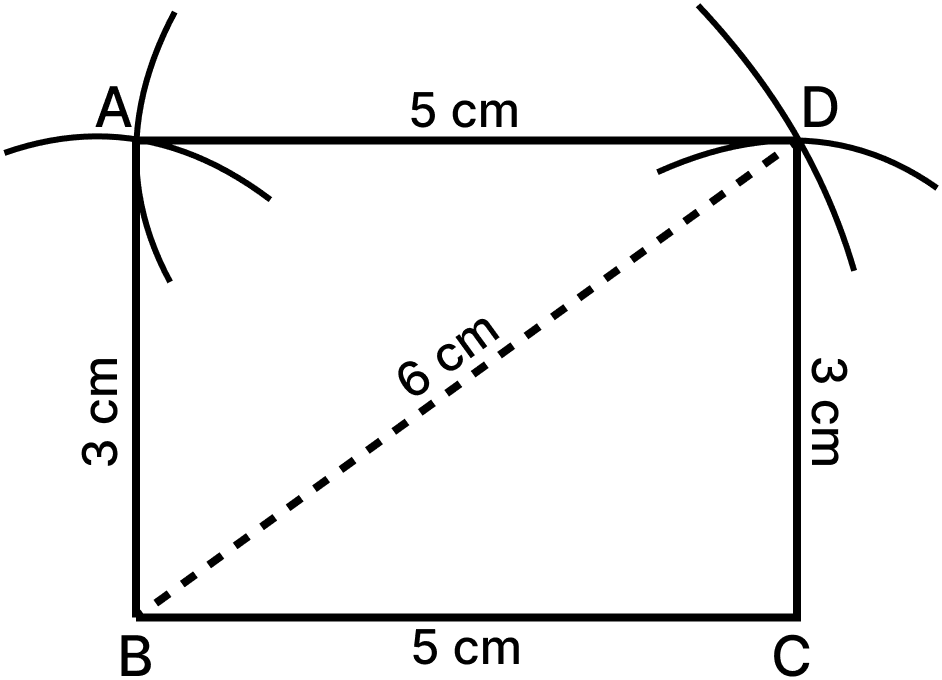
Hence, ABCD is the required parallelogram.
Construct a parallelogram ABCD in which AB = 4.8 cm, BC = 3.5 cm and diagonal AC = 5.4 cm.
Answer
Property used: The opposite sides of a parallelogram are equal.
Thus, in parallelogram ABCD,
AD = BC = 3.5 cm and CD = AB = 4.8 cm
Steps of construction :
Draw a line segment AB = 4.8 cm.
With A as centre and radius 5.4 cm, draw an arc.
With B as centre and radius 3.5 cm, draw another arc cutting the previous arc at C.
Join AC and BC.
With A as centre and radius 3.5 cm, draw an arc on the side of AC opposite to that of B.
With C as centre and radius 4.8 cm, draw another arc cutting the previous arc at D.
Join AD and CD.
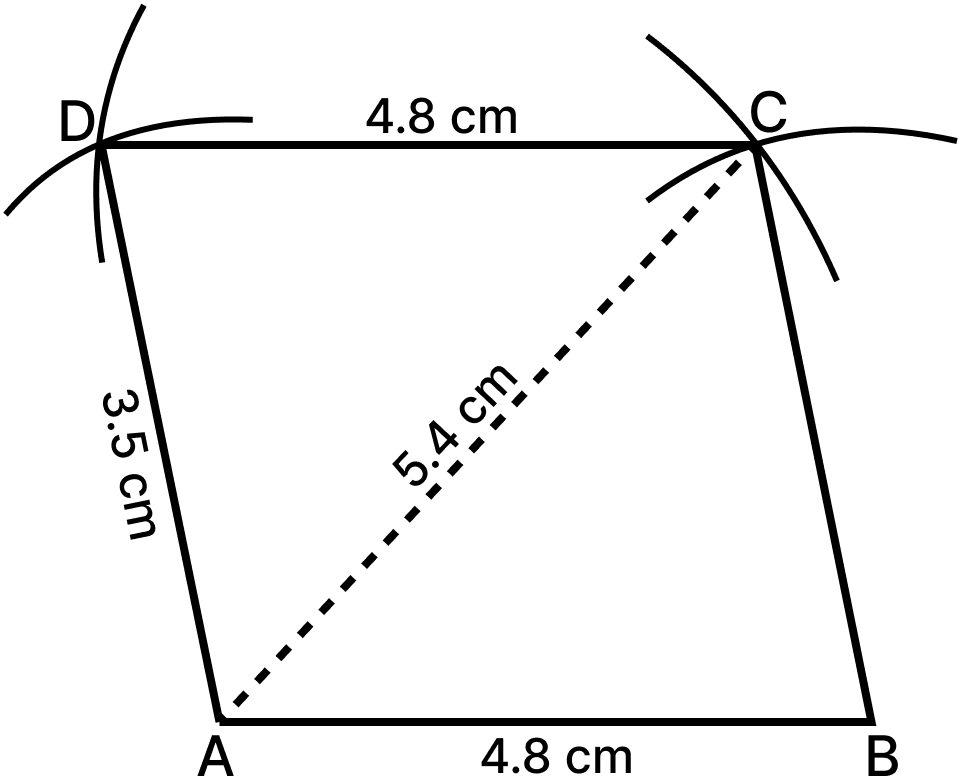
Hence, ABCD is the required parallelogram.
Construct a parallelogram ABCD in which diagonal AC = 5.6 cm, diagonal BD = 6.2 cm and angle between them is 60°.
Answer
Property used: The diagonals of a parallelogram bisect each other.
Thus, in parallelogram ABCD, if the diagonals AC and BD intersect at O, then
Steps of construction :
Draw a line segment AC = 5.6 cm.
Find the mid-point O of AC, so that OA = OC = 2.8 cm.
At O, construct ∠AOX = 60° and produce XO to Y.
From OX, cut off OD = 3.1 cm and from OY, cut off OB = 3.1 cm.
Join AB, BC, CD and AD.
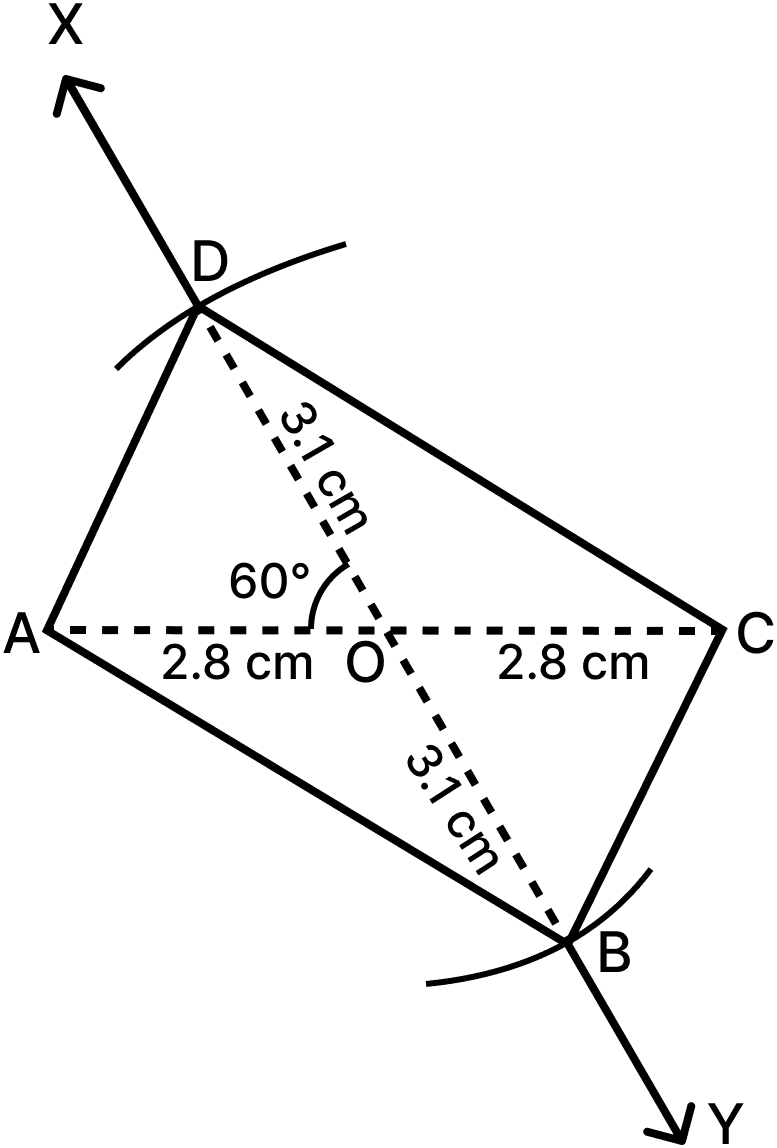
Hence, ABCD is the required parallelogram.
Construct a rectangle whose adjacent sides are 4.7 cm and 3.2 cm.
Answer
Property used: In a rectangle, the opposite sides are equal and each angle is a right angle.
Let ABCD be the rectangle with AB = 4.7 cm and BC = 3.2 cm.
Thus, in rectangle ABCD,
AD = BC = 3.2 cm, CD = AB = 4.7 cm and ∠A = ∠B = ∠C = ∠D = 90°
Steps of construction :
Draw a line segment AB = 4.7 cm.
At B, construct ∠ABX = 90°.
From BX, cut off BC = 3.2 cm.
With A as centre and radius 3.2 cm, draw an arc.
With C as centre and radius 4.7 cm, draw another arc cutting the previous arc at D.
Join AD and CD.
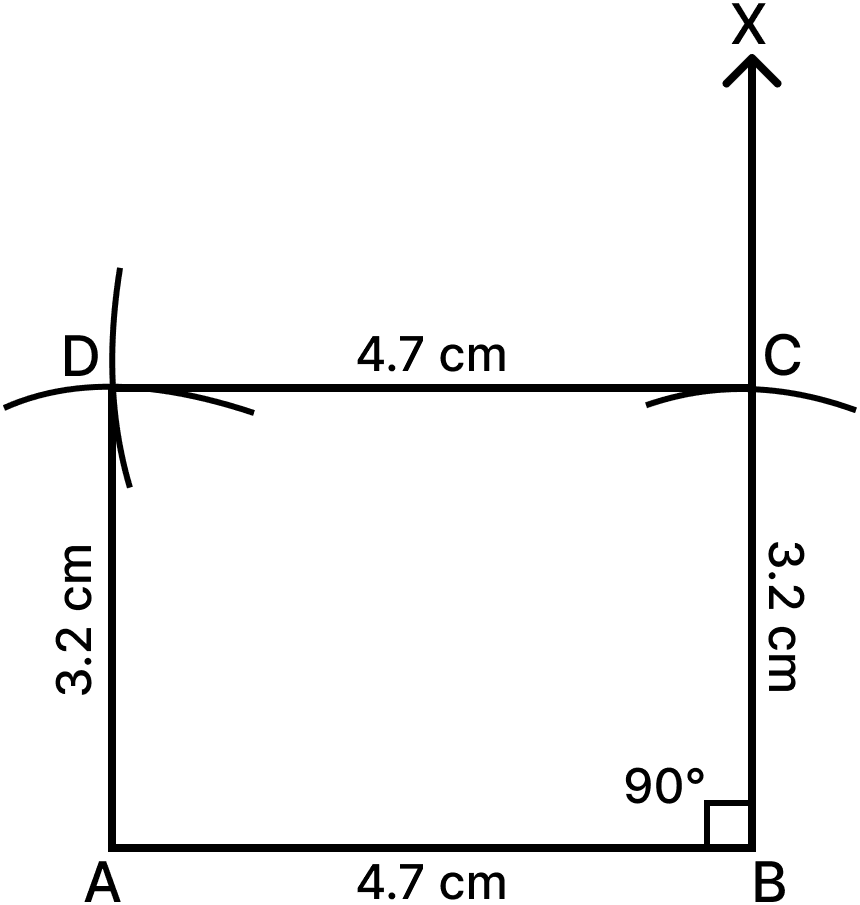
Hence, ABCD is the required rectangle.
Construct a rectangle ABCD in which AB = 4.5 cm and diagonal AC = 6 cm.
Answer
Property used: In a rectangle, the opposite sides are equal and each angle is a right angle.
Thus, in rectangle ABCD,
CD = AB = 4.5 cm, AD = BC and ∠A = ∠B = ∠C = ∠D = 90°
Steps of construction :
Draw a line segment AB = 4.5 cm.
At B, construct ∠ABX = 90°.
With A as centre and radius 6 cm, draw an arc cutting BX at C.
Join AC.
With C as centre and radius 4.5 cm, draw an arc.
With A as centre and radius equal to BC, draw another arc cutting the previous arc at D.
Join AD and CD.
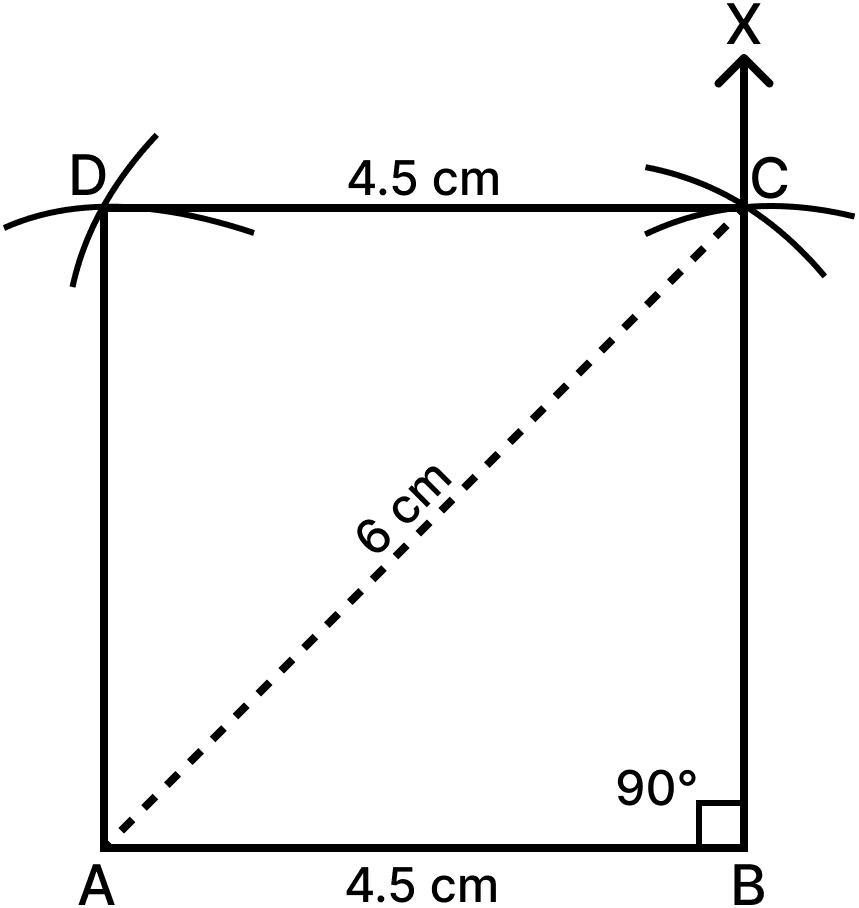
Hence, ABCD is the required rectangle.
Construct a rectangle ABCD in which diagonal AC = 6.3 cm and the angle between the two diagonals is 45°.
Answer
Property used: The diagonals of a rectangle are equal and they bisect each other.
Thus, in rectangle ABCD, if the diagonals AC and BD intersect at O, then
Steps of construction :
Draw a line segment AC = 6.3 cm.
Find the mid-point O of AC, so that OA = OC = 3.15 cm.
At O, construct ∠AOX = 45° and produce XO to Y.
From OX, cut off OD = 3.15 cm and from OY, cut off OB = 3.15 cm.
Join AB, BC, CD and AD.
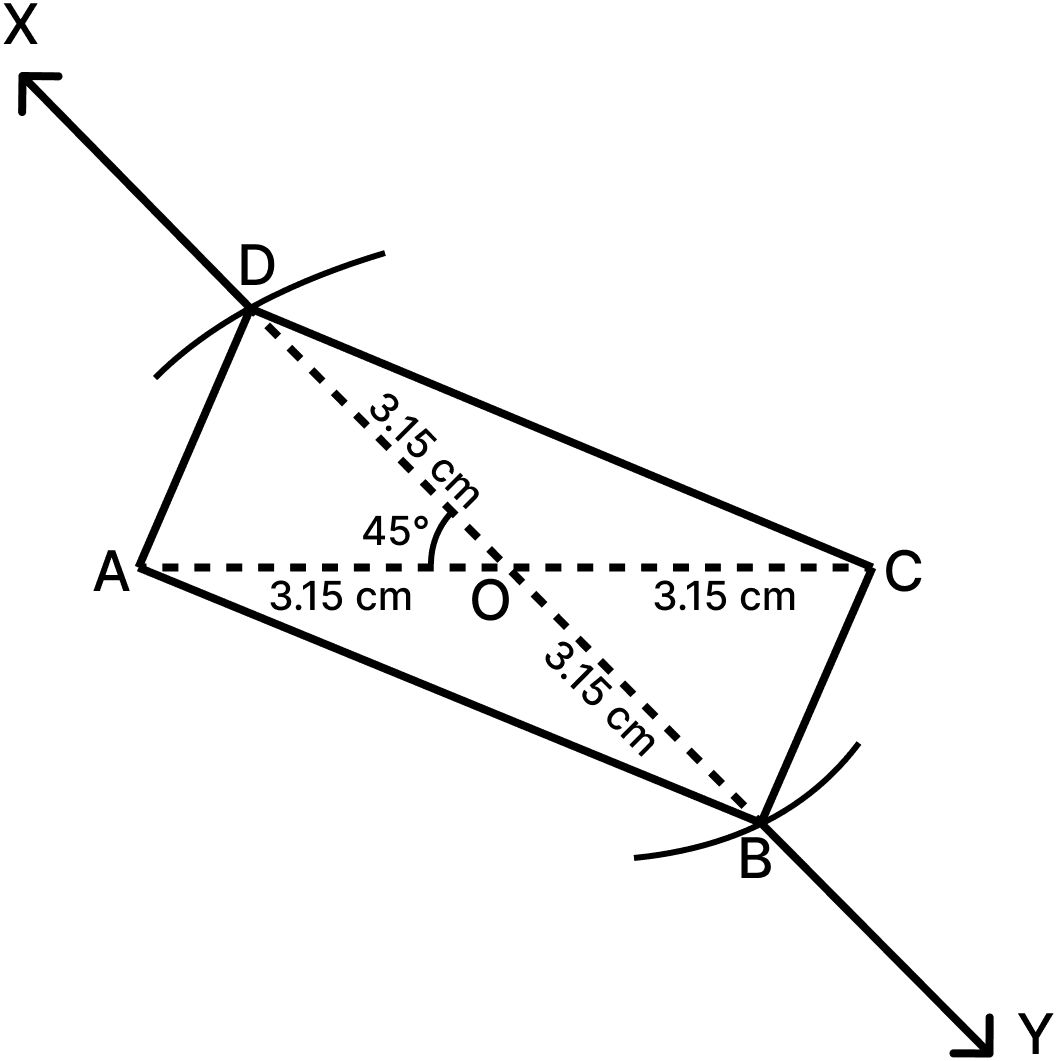
Hence, ABCD is the required rectangle.
Construct a square of side 4.8 cm.
Answer
Property used: In a square, all the four sides are equal and each angle is a right angle.
Let ABCD be the square of side 4.8 cm.
Thus, in square ABCD,
AB = BC = CD = DA = 4.8 cm and ∠A = ∠B = ∠C = ∠D = 90°
Steps of construction :
Draw a line segment AB = 4.8 cm.
At B, construct ∠ABX = 90°.
From BX, cut off BC = 4.8 cm.
With C as centre and radius 4.8 cm, draw an arc.
With A as centre and radius 4.8 cm, draw another arc cutting the previous arc at D.
Join AD and CD.
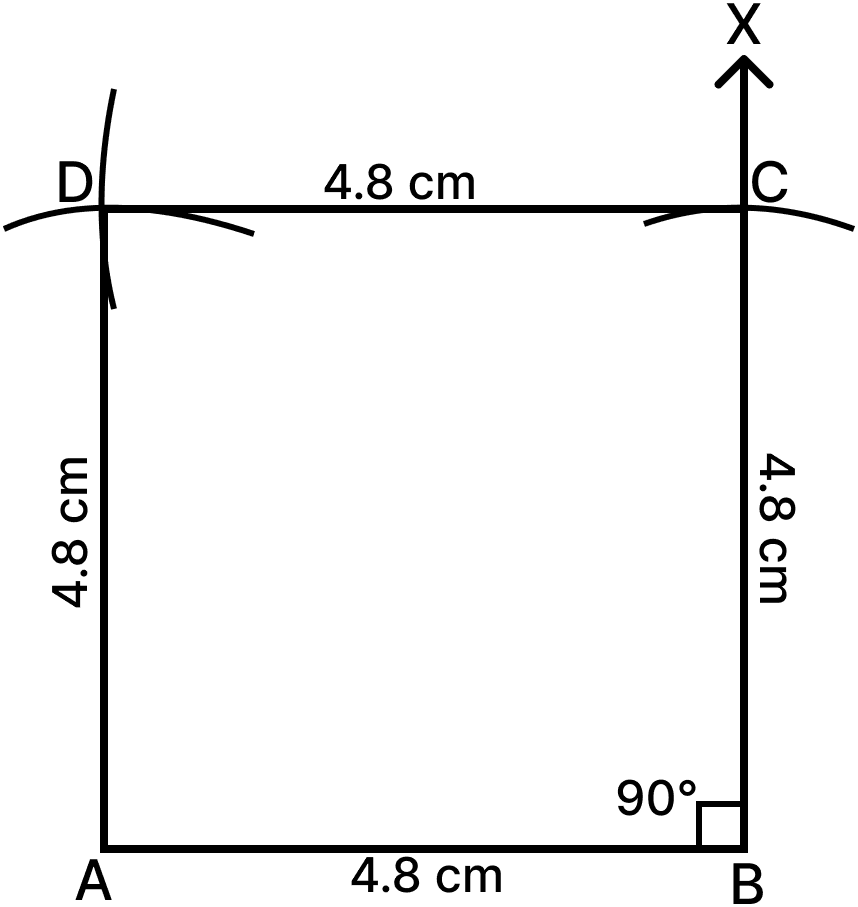
Hence, ABCD is the required square.
Construct a square one of whose diagonals is 5.6 cm.
Answer
Property used: The diagonals of a square are equal and they bisect each other at right angles.
Let ABCD be the square with diagonal AC = 5.6 cm.
Thus, in square ABCD, if the diagonals AC and BD intersect at O, then
and, ∠AOD = 90°, i.e. AC ⊥ BD
Steps of construction :
Draw a line segment AC = 5.6 cm.
Draw the perpendicular bisector XY of AC, meeting AC at its mid-point O.
From OX, cut off OD = 2.8 cm.
Join AD and CD.
From OY, cut off OB = 2.8 cm.
Join AB and BC.
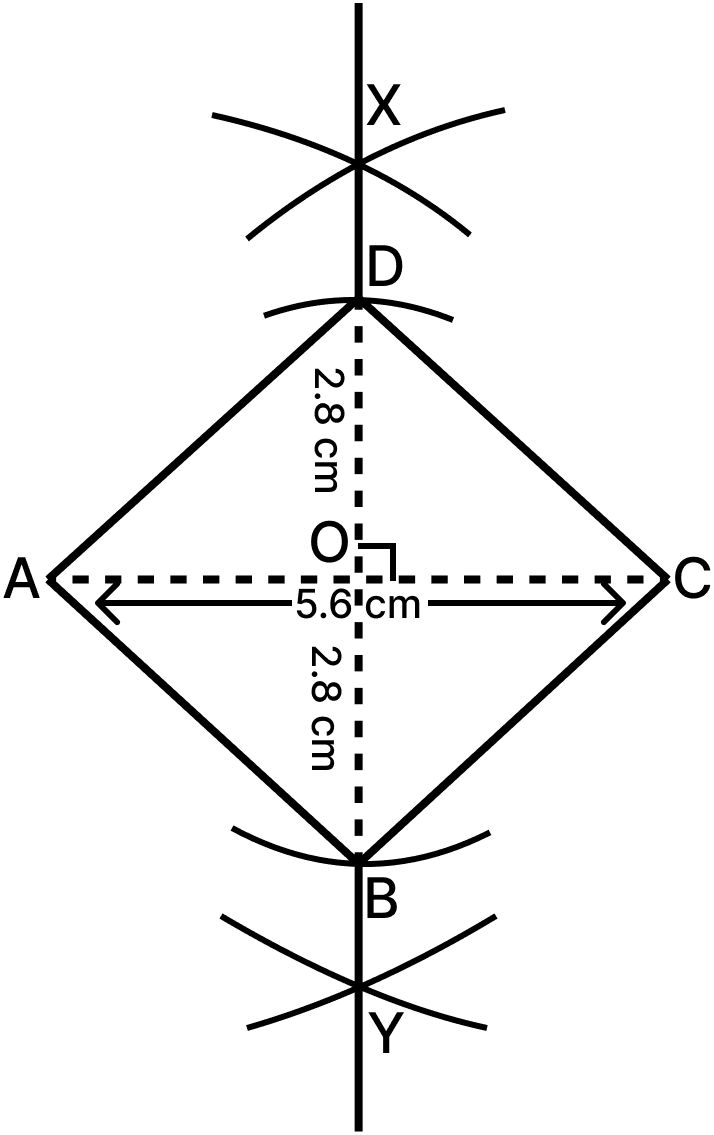
Hence, ABCD is the required square.
Construct a rhombus ABCD in which AB = 4.3 cm and ∠A = 45°.
Answer
Property used: All the sides of a rhombus are equal.
Thus, in rhombus ABCD,
AD = BC = CD = AB = 4.3 cm
Steps of construction :
Draw a line segment AB = 4.3 cm.
At A, construct ∠BAX = 45°.
From AX, cut off AD = 4.3 cm.
With B as centre and radius 4.3 cm, draw an arc.
With D as centre and radius 4.3 cm, draw another arc cutting the previous arc at C.
Join BC and CD.
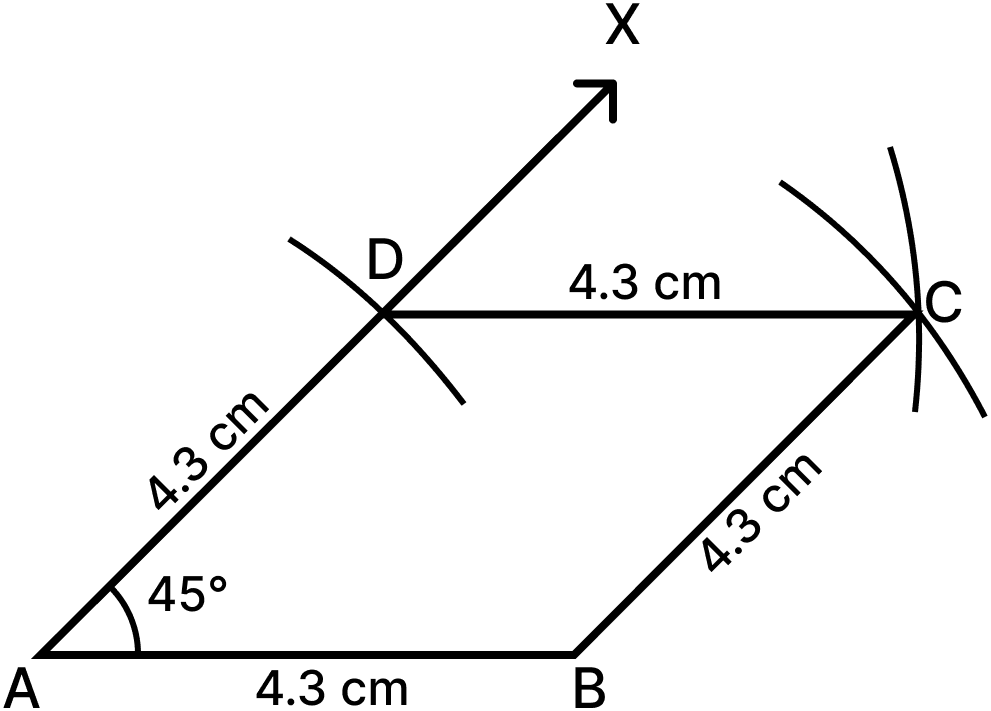
Hence, ABCD is the required rhombus.
Construct a rhombus ABCD in which AB = 5 cm and diagonal AC = 6.8 cm.
Answer
Property used: All the sides of a rhombus are equal.
Thus, in rhombus ABCD,
AD = BC = CD = AB = 5 cm
Steps of construction :
Draw a line segment AB = 5 cm.
With A as centre and radius 6.8 cm, draw an arc.
With B as centre and radius 5 cm, draw another arc cutting the previous arc at C.
Join AC and BC.
With A as centre and radius 5 cm, draw an arc on the side of AC opposite to that of B.
With C as centre and radius 5 cm, draw another arc cutting the previous arc at D.
Join AD and CD.
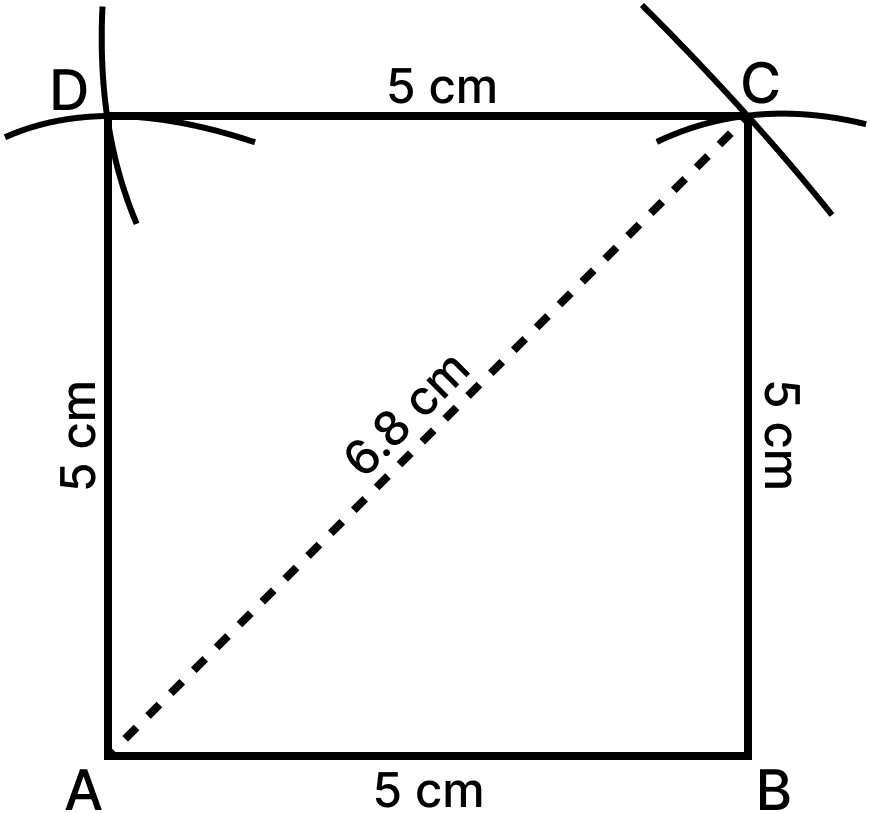
Hence, ABCD is the required rhombus.
Construct a rhombus ABCD in which diagonal AC = 5.8 cm and diagonal BD = 6.4 cm.
Answer
Property used: The diagonals of a rhombus bisect each other at right angles.
Thus, in rhombus ABCD, if the diagonals AC and BD intersect at O, then
and, ∠AOD = 90°, i.e. AC ⊥ BD
Steps of construction :
Draw a line segment AC = 5.8 cm.
Draw the perpendicular bisector XOY of AC, meeting AC at its mid-point O.
From OX, cut off OD = 3.2 cm and from OY, cut off OB = 3.2 cm.
Join AB, BC, CD and AD.
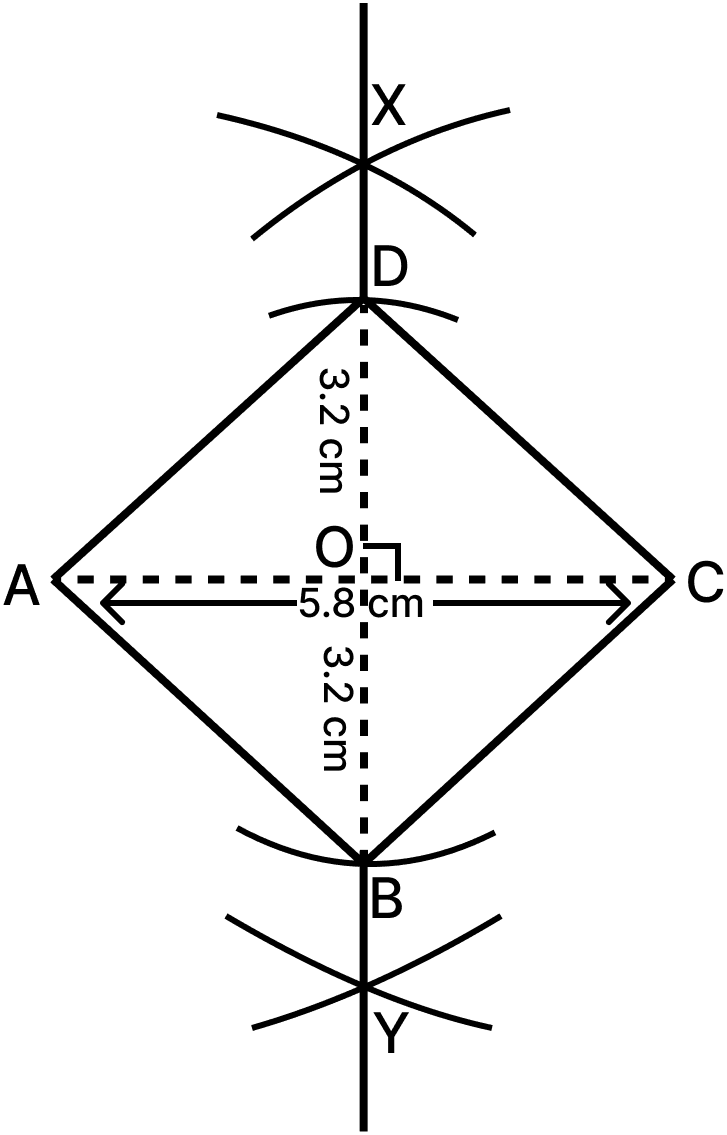
Hence, ABCD is the required rhombus.