
Find the perimeter and area of a semi-circle whose radius is 35 cm.
Answer
Given:
Radius of the semi-circle (r) = 35 cm
By formula,
Perimeter of a semi-circle = r(π + 2)
By formula,
Area of a semi-circle = πr2
= cm2
= 11 x 5 x 35 cm2
= 1925 cm2
Hence, the perimeter and area of the semi-circle are 180 cm and 1925 cm2 respectively.
Find the perimeter and area of a semi-circle whose radius is 4.2 cm.
Answer
Given:
Radius of the semi-circle (r) = 4.2 cm
By formula,
Perimeter of a semi-circle = r(π + 2)
By formula,
Area of a semi-circle = πr2
= cm2
= 11 x 0.6 x 4.2 cm2
= 27.72 cm2
Hence, the perimeter and area of the semi-circle are 21.6 cm and 27.72 cm2 respectively.
Find the perimeter and area of a semi-circle whose radius is 15.4 cm.
Answer
Given:
Radius of the semi-circle (r) = 15.4 cm
By formula,
Perimeter of a semi-circle = r(π + 2)
By formula,
Area of a semi-circle = πr2
= cm2
= 11 x 2.2 x 15.4 cm2
= 372.68 cm2
Hence, the perimeter and area of the semi-circle are 79.2 cm and 372.68 cm2 respectively.
Find the perimeter and area of a semi-circle whose diameter is 18.2 cm.
Answer
Given:
Diameter of the semi-circle = 18.2 cm
∴ Radius of the semi-circle (r) = cm = 9.1 cm
By formula,
Perimeter of a semi-circle = r(π + 2)
By formula,
Area of a semi-circle = πr2
= cm2
= 11 x 1.3 x 9.1 cm2
= 130.13 cm2
Hence, the perimeter and area of the semi-circle are 46.8 cm and 130.13 cm2 respectively.
Find the perimeter and area of a semi-circle whose diameter is 5.6 cm.
Answer
Given:
Diameter of the semi-circle = 5.6 cm
∴ Radius of the semi-circle (r) = cm = 2.8 cm
By formula,
Perimeter of a semi-circle = r(π + 2)
By formula,
Area of a semi-circle = πr2
= cm2
= 11 x 0.4 x 2.8 cm2
= 12.32 cm2
Hence, the perimeter and area of the semi-circle are 14.4 cm and 12.32 cm2 respectively.
Taking π = 3.14, find the perimeter and area of a semi-circle whose radius is 8 cm.
Answer
Given:
Radius of the semi-circle (r) = 8 cm and π = 3.14
By formula,
Perimeter of a semi-circle = r (π + 2)
= 8 x (3.14 + 2) cm
= 8 x 5.14 cm
= 41.12 cm
By formula,
Area of a semi-circle = πr2
= x 3.14 x 8 x 8 cm2
= 1.57 x 64 cm2
= 100.48 cm2
Hence, the perimeter and area of the semi-circle are 41.12 cm and 100.48 cm2 respectively.
Taking π = 3.14, find the perimeter and area of a semi-circle whose radius is 15 cm.
Answer
Given:
Radius of the semi-circle (r) = 15 cm and π = 3.14
By formula,
Perimeter of a semi-circle = r (π + 2)
= 15 x (3.14 + 2) cm
= 15 x 5.14 cm
= 77.1 cm
By formula,
Area of a semi-circle = πr2
= x 3.14 x 15 x 15 cm2
= 1.57 x 225 cm2
= 353.25 cm2
Hence, the perimeter and area of the semi-circle are 77.1 cm and 353.25 cm2 respectively.
Taking π = 3.14, find the perimeter and area of a semi-circle whose radius is 20 cm.
Answer
Given:
Radius of the semi-circle (r) = 20 cm and π = 3.14
By formula,
Perimeter of a semi-circle = r (π + 2)
= 20 x (3.14 + 2) cm
= 20 x 5.14 cm
= 102.8 cm
By formula,
Area of a semi-circle = πr2
= x 3.14 x 20 x 20 cm2
= 1.57 x 400 cm2
= 628 cm2
Hence, the perimeter and area of the semi-circle are 102.8 cm and 628 cm2 respectively.
Find the area of a semi-circle whose perimeter is 54 cm.
Answer
Given:
Perimeter of the semi-circle = 54 cm
Let the radius of the semi-circle be r cm.
By formula,
Perimeter of a semi-circle = r(π + 2)
Now,
Area of the semi-circle = πr2
= cm2
= 11 x 1.5 x 10.5 cm2
= 173.25 cm2
Hence, the area of the semi-circle is 173.25 cm2.
Find the area of a semi-circle whose perimeter is 144 cm.
Answer
Given:
Perimeter of the semi-circle = 144 cm
Let the radius of the semi-circle be r cm.
By formula,
Perimeter of a semi-circle = r(π + 2)
Now,
Area of the semi-circle = πr2
= cm2
= 11 x 4 x 28 cm2
= 1232 cm2
Hence, the area of the semi-circle is 1232 cm2.
Find the radius and perimeter of a semi-circle whose area is 77 cm2.
Answer
Given:
Area of the semi-circle = 77 cm2
Let the radius of the semi-circle be r cm.
By formula,
Area of a semi-circle = πr2
Now,
Perimeter of the semi-circle = r(π + 2)
= 7 x cm
= 7 x cm
= 36 cm
Hence, the radius of the semi-circle is 7 cm and its perimeter is 36 cm.
Find the radius and perimeter of a semi-circle whose area is 12.32 m2.
Answer
Given:
Area of the semi-circle = 12.32 m2
Let the radius of the semi-circle be r m.
By formula,
Area of a semi-circle = πr2
Now,
Perimeter of the semi-circle = r(π + 2)
Hence, the radius of the semi-circle is 2.8 m and its perimeter is 14.4 m.
A wire is in the form of a semi-circle of radius 28 cm. It is straightened and bent into the form of a square. What is the length of the side of the square?
Answer
Given:
Radius of the semi-circle (r) = 28 cm
Since the wire is in the form of a semi-circular arc,
Length of the wire = Length of the semi-circular arc
= πr
= x 28 cm
= 88 cm
When this wire is bent into the form of a square, the perimeter of the square = 88 cm.
By formula,
Perimeter of a square = 4 x side
⇒ 4 x side = 88
⇒ side =
⇒ side = 22 cm
Hence, the length of the side of the square is 22 cm.
A wire is in the form of a square of side 49.5 cm. It is straightened and bent into a semi-circle. What is the radius of the semi-circle so formed?
Answer
Given:
Side of the square = 49.5 cm
Length of the wire = Perimeter of the square
= 4 x side
= 4 x 49.5 cm
= 198 cm
When this wire is bent into a semi-circle, it forms the semi-circular arc, so the length of the semi-circular arc = 198 cm.
Let the radius of the semi-circle be r cm.
By formula,
Length of a semi-circular arc = πr
⇒ x r = 198
⇒ r = 198 x
⇒ r = 63 cm
Hence, the radius of the semi-circle so formed is 63 cm.
A wire when bent in the form of a square encloses an area of 756.25 cm2. If the same wire is bent to form a semi-circle, what will be the radius of the semi-circle so formed?
Answer
Given:
Area of the square = 756.25 cm2
By formula,
Side of a square =
= cm
= 27.5 cm
∴ Length of the wire = Perimeter of the square
= 4 x side
= 4 x 27.5 cm
= 110 cm
When this wire is bent to form a semi-circle, it forms the semi-circular arc, so the length of the semi-circular arc = 110 cm.
Let the radius of the semi-circle be r cm.
By formula,
Length of a semi-circular arc = πr
⇒ x r = 110
⇒ r = 110 x
⇒ r = 35 cm
Hence, the radius of the semi-circle so formed is 35 cm.
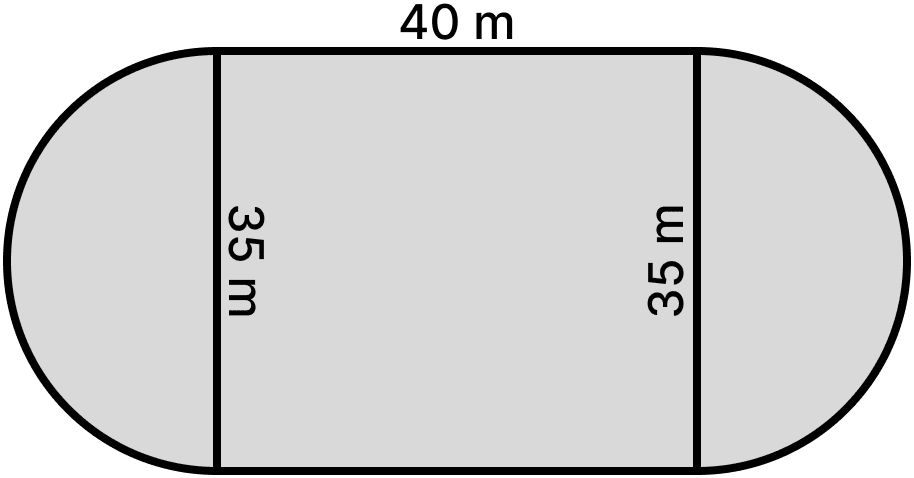
The shape of a park is a rectangle bounded by semi-circles at the ends, each of radius 17.5 m, as shown in the adjoining figure. Find the area and the perimeter of the park.
Answer
Given:
Radius of each semi-circle (r) = 17.5 m
Length of the rectangle = 40 m
Since the semi-circles are described on the breadth of the rectangle,
Breadth of the rectangle = 2 x 17.5 m = 35 m
Area of the rectangle = length x breadth
= 40 x 35 m2
= 1400 m2
Area of the two semi-circles = πr2
= m2
= 22 x 2.5 x 17.5 m2
= 962.5 m2
∴ Area of the park = (1400 + 962.5) m2
= 2362.5 m2
Perimeter of the park = 2 x length + (circumference of the two semi-circles)
= 2 x length + 2πr
= (2 x 40) m + m
= 80 m + 110 m
= 190 m
Hence, the area of the park is 2362.5 m2 and its perimeter is 190 m.
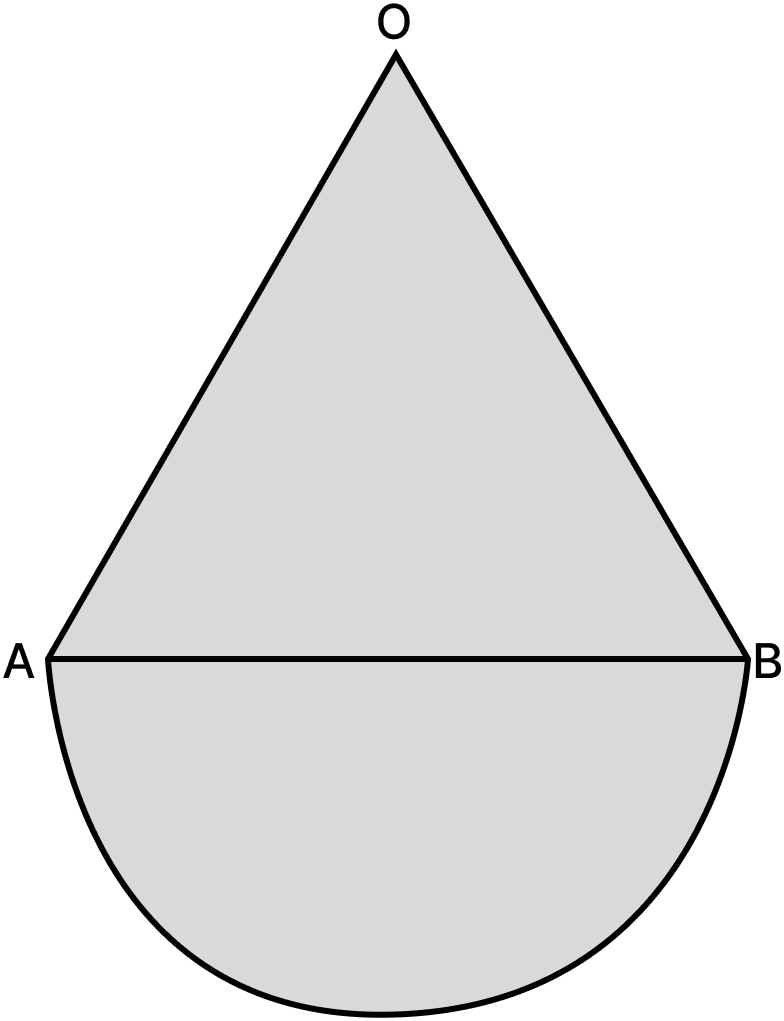
Find the perimeter and the area of the shaded region in the adjoining figure, it being given that OAB is an equilateral triangle of side 28 cm and one end is a semi-circle on AB as diameter. (Take = 1.73)
Answer
Given:
OAB is an equilateral triangle of side 28 cm.
A semi-circle is described on AB as diameter.
∴ Radius of the semi-circle (r) = cm = 14 cm
Area of the equilateral triangle OAB =
Area of the semi-circle = πr2
= cm2
= 11 x 2 x 14 cm2
= 308 cm2
∴ Area of the shaded region = (339.08 + 308) cm2
= 647.08 cm2
Perimeter of the shaded region = OA + OB + (length of the semi-circular arc)
= (28 + 28) cm + πr
= 56 cm + cm
= 56 cm + 44 cm
= 100 cm
Hence, the perimeter of the shaded region is 100 cm and its area is 647.08 cm2.
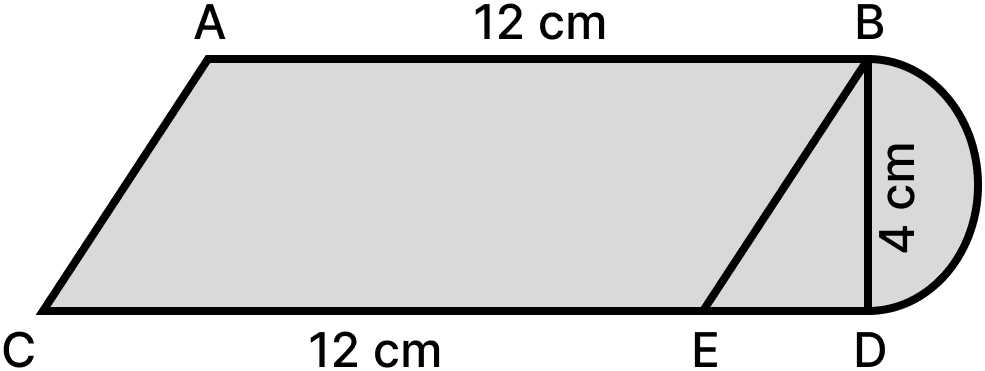
Find the perimeter and area of the adjoining figure, it being given that AB ∥ CD, AB = 12 cm, CD = 15 cm, BD = 4 cm and one end of the figure is a semi-circle with BD as diameter. (Take π = 3.14.)
Answer
Given:
AB ∥ CD, AB = 12 cm, CD = 15 cm, BD = 4 cm and π = 3.14
A semi-circle is described on BD as diameter.
Draw BE ∥ AC.
Then, CE = AB = 12 cm
∴ ED = (CD - CE)
= (15 - 12) cm
= 3 cm
Using Pythagoras theorem in right triangle BDE,
BE2 = ED2 + BD2
⇒ BE2 = (3)2 + (4)2
⇒ BE2 = 9 + 16
⇒ BE2 = 25
⇒ BE =
⇒ BE = 5 cm
Since ACEB is a parallelogram, AC = BE = 5 cm.
Radius of the semi-circle (r) = = cm = 2 cm
Area of trapezium ABDC = x (AB + CD) x BD
= x (12 + 15) x 4 cm2
= x 27 x 4 cm2
= 54 cm2
Area of the semi-circle = πr2
= x 3.14 x 2 x 2 cm2
= 6.28 cm2
∴ Area of the figure = (54 + 6.28) cm2
= 60.28 cm2
Perimeter of the figure = AB + AC + CD + (length of the semi-circular arc)
= (12 + 5 + 15) cm + πr
= 32 cm + (3.14 x 2) cm
= 32 cm + 6.28 cm
= 38.28 cm
Hence, the perimeter of the figure is 38.28 cm and its area is 60.28 cm2.
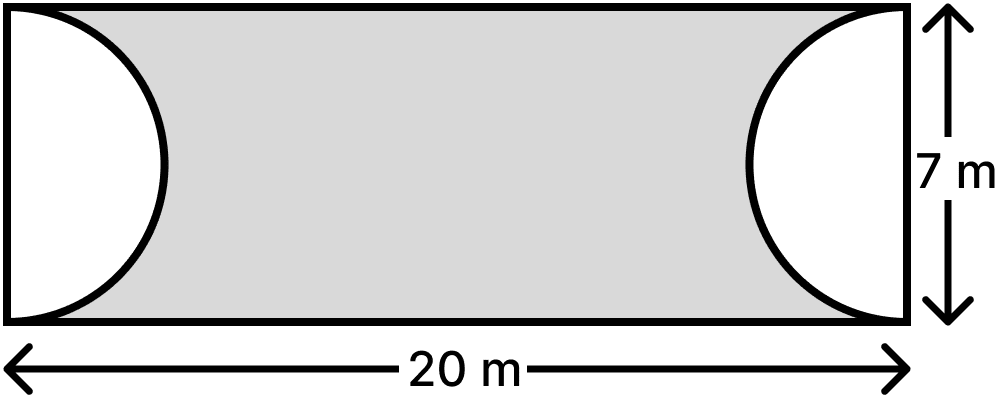
Find the area of the shaded region in the following figure:
Answer
Given:
Length of the rectangle = 20 m
Breadth of the rectangle = 7 m
Two semi-circles are cut off from the rectangle, each having the breadth of the rectangle as its diameter.
∴ Radius of each semi-circle (r) = m = 3.5 m
Area of the rectangle = length x breadth
= 20 x 7 m2
= 140 m2
Area of the two semi-circles = πr2
= m2
= 22 x 0.5 x 3.5 m2
= 38.5 m2
∴ Area of the shaded region = (140 - 38.5) m2
= 101.5 m2
Hence, the area of the shaded region is 101.5 m2.
Find the area of the shaded region in each of the following figures:
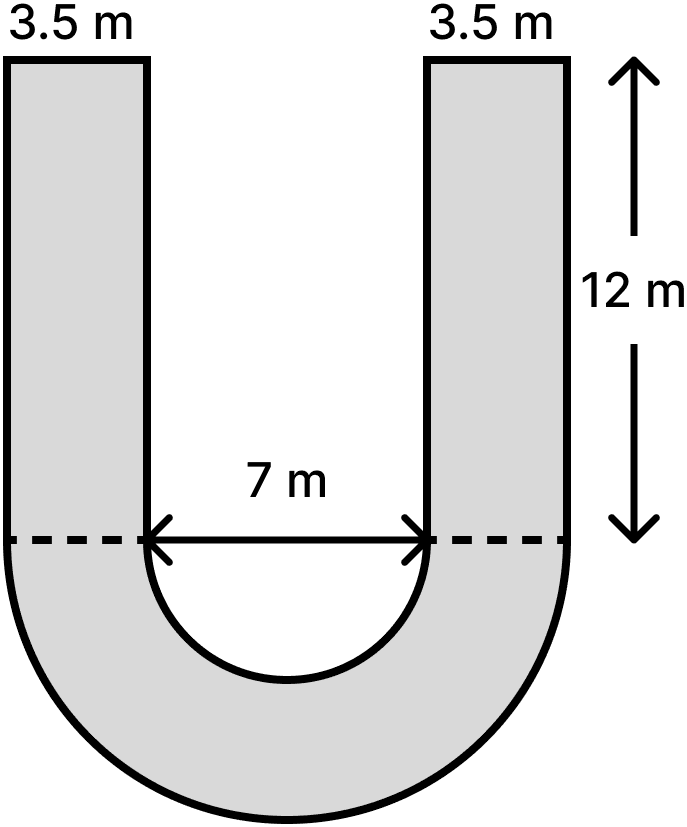
Answer
The shaded region consists of two rectangles, each 3.5 m by 12 m, and a semi-circular ring.
Area of the two rectangles = 2 x (length x breadth)
= 2 x (3.5 x 12) m2
= 2 x 42 m2
= 84 m2
For the semi-circular ring,
Inner radius (r) = m = 3.5 m
Outer radius (R) = m = m = 7 m
Area of the semi-circular ring = π (R2 - r2)
∴ Area of the shaded region = (84 + 57.75) m2
= 141.75 m2
Hence, the area of the shaded region is 141.75 m2.
Find the area of the shaded region in each of the following figures:
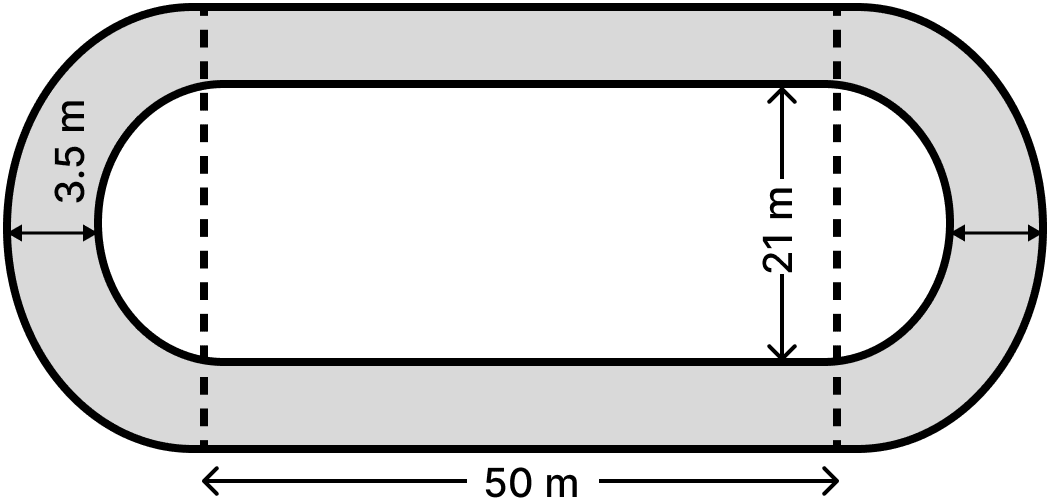
Answer
The inner white region is a rectangle 50 m by 21 m with a semi-circle at each end, and the shaded region is a border of uniform width 3.5 m around it.
For the inner region,
Radius of each inner semi-circle (r) = m = 10.5 m
Area of the inner region = (length x breadth) + πr2
= (50 x 21) m2 + m2
= 1050 m2 + 346.5 m2
= 1396.5 m2
For the outer region,
Radius of each outer semi-circle (R) = (10.5 + 3.5) m = 14 m
Breadth of the outer rectangle = (21 + 3.5 + 3.5) m = 28 m
Area of the outer region = (length x breadth) + πR2
= (50 x 28) m2 + m2
= 1400 m2 + 616 m2
= 2016 m2
∴ Area of the shaded region = (2016 - 1396.5) m2
= 619.5 m2
Hence, the area of the shaded region is 619.5 m2.
Find the area of the shaded region in each of the following figures:
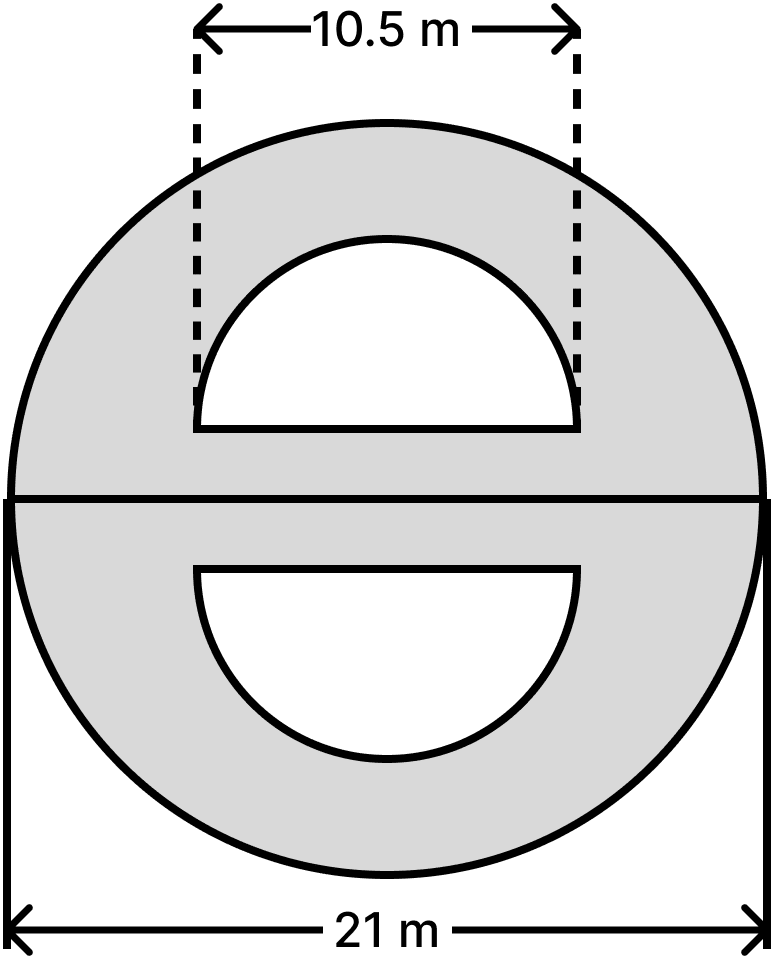
Answer
Diameter of the bigger circle = 21 m
∴ Radius of the bigger circle (R) = m = 10.5 m
Area of the bigger circle = πR2
= m2
= 22 x 1.5 x 10.5 m2
= 346.5 m2
Diameter of each of the two unshaded semi-circles = 10.5 m
∴ Radius of each unshaded semi-circle (r) = m = 5.25 m
Area of the two unshaded semi-circles = πr2
= m2
= 22 x 0.75 x 5.25 m2
= 86.625 m2
∴ Area of the shaded region = (346.5 - 86.625) m2
= 259.875 m2
Hence, the area of the shaded region is 259.875 m2.
Find the area of the shaded region in each of the following figures:
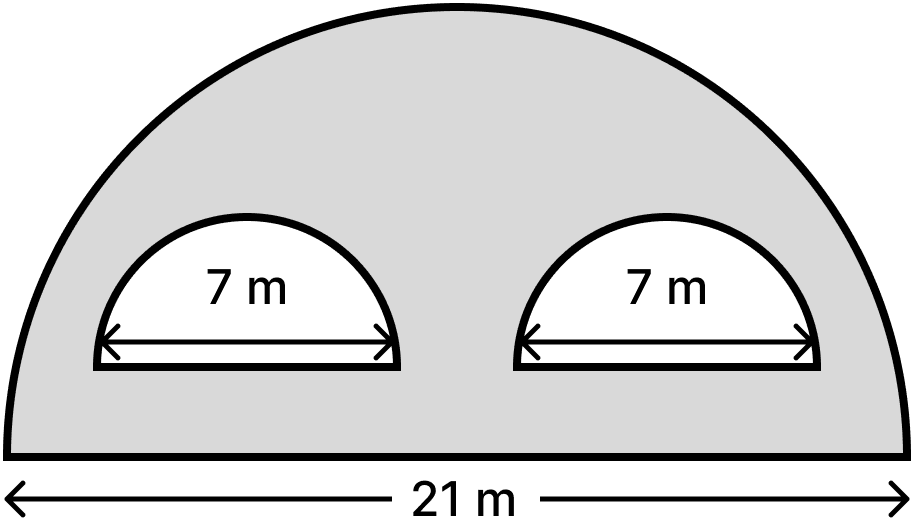
Answer
Diameter of the bigger semi-circle = 21 m
∴ Radius of the bigger semi-circle (R) = m = 10.5 m
Area of the bigger semi-circle = πR2
= m2
= 11 x 1.5 x 10.5 m2
= 173.25 m2
Diameter of each of the two smaller semi-circles = 7 m
∴ Radius of each smaller semi-circle (r) = m = 3.5 m
Area of the two smaller semi-circles = πr2
= m2
= 22 x 0.5 x 3.5 m2
= 38.5 m2
∴ Area of the shaded region = (173.25 - 38.5) m2
= 134.75 m2
Hence, the area of the shaded region is 134.75 m2.
Find the area of the shaded region in each of the following figures:
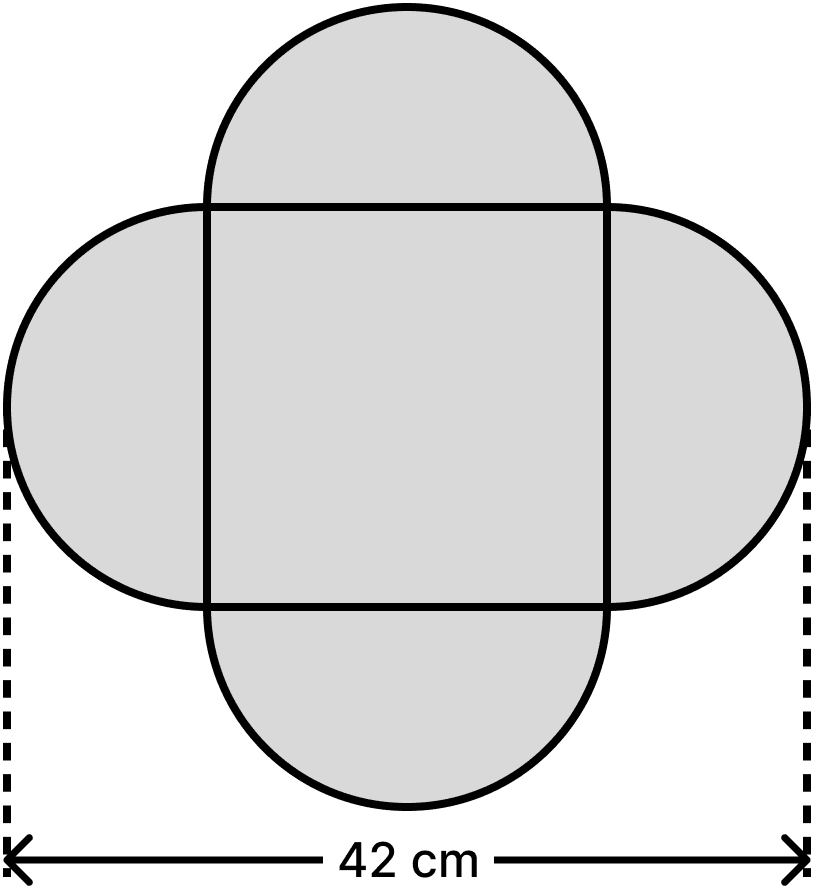
Answer
Let the side of the square be a cm.
A semi-circle is described on each side of the square, so the radius of each semi-circle = cm.
From the figure,
= 42
⇒ 2a = 42
⇒ a = 21
So, side of the square = 21 cm
∴ Radius of each semi-circle (r) = cm = 10.5 cm
Area of the square = side2
= (21)2 cm2
= 441 cm2
Area of the four semi-circles = πr2
= cm2
= 2 x 22 x 1.5 x 10.5 cm2
= 693 cm2
∴ Area of the shaded region = (441 + 693) cm2
= 1134 cm2
Hence, the area of the shaded region is 1134 cm2.
Find the area of the shaded region in each of the following figures:
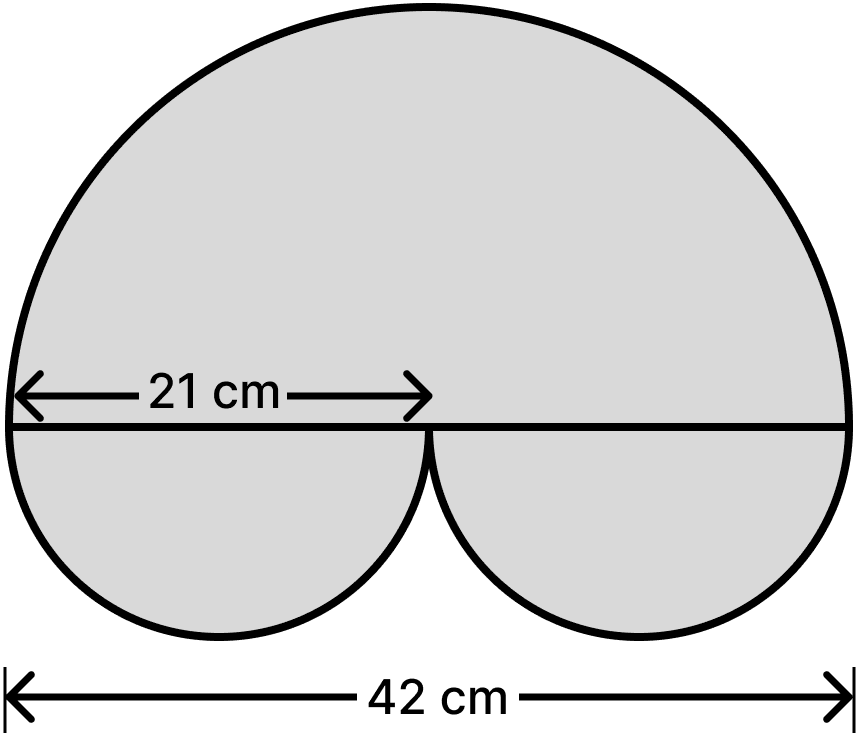
Answer
The figure consists of a bigger semi-circle of diameter 42 cm and two smaller semi-circles, each of diameter 21 cm.
Radius of the bigger semi-circle (R) = cm = 21 cm
Area of the bigger semi-circle = πR2
= cm2
= 11 x 3 x 21 cm2
= 693 cm2
Radius of each smaller semi-circle (r) = cm = 10.5 cm
Area of the two smaller semi-circles = πr2
= cm2
= 22 x 1.5 x 10.5 cm2
= 346.5 cm2
∴ Area of the shaded region = (693 + 346.5) cm2
= 1039.5 cm2
Hence, the area of the shaded region is 1039.5 cm2.